The best budget filament brand: 7 proven picks for 2026 buyers


TL;DR
The best budget filament brand is the one whose published diameter tolerance, resin source, and per-batch documentation hold up to a manufacturer’s scrutiny, not the one with the lowest Amazon price. Among budget-tier brands, vertically integrated own-factory brands (Sunlu, Elegoo, eSun, Anycubic, Creality, Polymaker PolyTerra) carry verifiable QA; house-brand spools such as Inland are private-labeled by OEMs and resold at a markup, while a few budget labels such as Voxel are instead extruded in the US. Buy on cost-per-reliable-gram, not sticker price: a +/-0.05 mm spool varies +/-6% in mass per meter versus +/-2.4% at +/-0.02 mm, and that variance, not the label, is what fails production prints.
Abstract
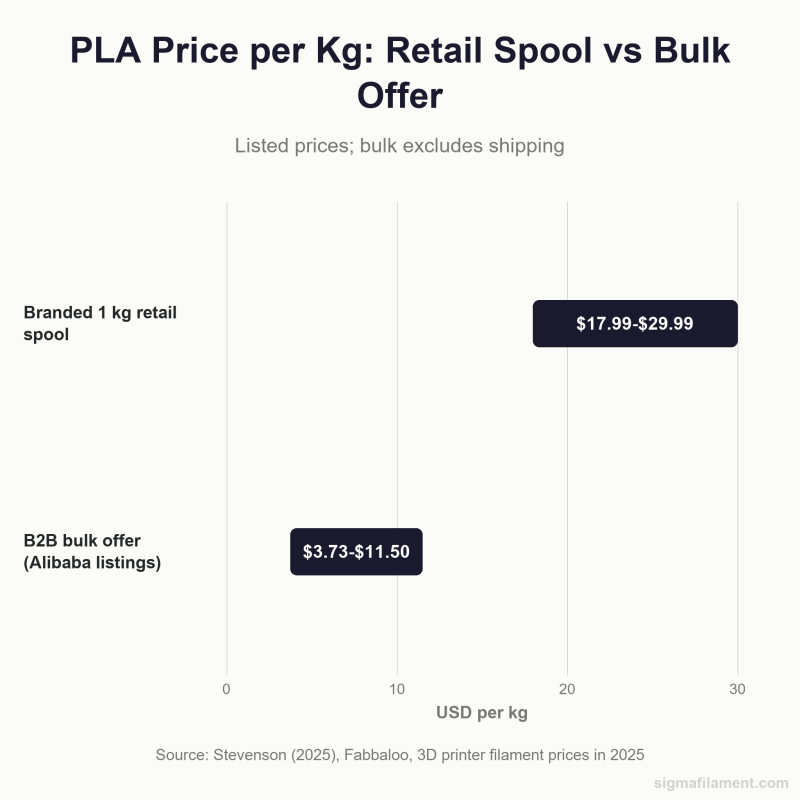
The best budget filament brand in 2026 is not the cheapest spool on Amazon. It is the brand whose published diameter tolerance, virgin-resin sourcing, and lot-level batch documentation survive a manufacturer’s audit. In a 2025 price check, 1 kg spools from well-known brands listed at $17.99 to $29.99, while bulk offers on a B2B marketplace ran about $4 to $12 per kilogram before shipping (Stevenson, 2025). That markup absorbs logistics, duties, platform fees, and reseller margin, but it does not, on its own, buy tighter extrusion or better quality assurance. A $15 spool from a vertically integrated factory can outperform a $20 spool from an opaque house brand.
This guide is written for print-farm operators, resellers and distributors, OEM and private-label brand owners, and volume procurement buyers, not single-spool hobbyists chasing the lowest sticker price. It works through what budget actually means at 2026 US pricing, which brands own their factories versus quietly relabel Guangdong OEM output, the +/-0.05 mm versus +/-0.02 mm tolerance math that drives per-meter mass variance (SigmaFilament, 2026), virgin versus recycled resin trade-offs, the FOB-to-retail markup structure, seven proven picks evaluated under a manufacturer’s lens, a Prusament-anchored decision framework, sourcing red flags, and a B2B procurement checklist.
Key Takeaways
- Budget is not bad: the best budget filament brand has verifiable specs and a known factory, not the cheapest spool.
- Own-factory beats house-brand: Sunlu, Elegoo, eSun, Anycubic, Creality, and PolyTerra own factories; Inland is OEM-sourced, Voxel is US-made.
- Tolerance decides failure rate: a 0.05 mm tolerance band yields about 6% per-meter mass variance; 0.02 mm yields 2.4% (SigmaFilament, 2026).
- Recycled PLA costs strength: Anderson (2017) measured about an 11% tensile-strength loss in recycled versus virgin PLA prints.
- Reseller markup is real: bulk offers of about $4-$12/kg before freight sit far below the $18-$30/kg that branded 1 kg spools list for at retail (Stevenson, 2025).
- Demand documentation: published diameter tolerance, TDS, MSDS, and a per-batch Certificate of Analysis separate a real supplier from marketing.
- Test before you scale: qualify a 1 to 3 spool sample at production workload, then place the bulk MOQ order.
Table of Contents
- TL;DR
- Abstract
- Key Takeaways
- Table of Contents
- What ‘budget’ actually means in 2026: the US retail tier
- Who actually makes your budget filament: own-factory brands vs OEM-sourced labels
- Diameter tolerance: why +/-0.05 mm vs +/-0.02 mm decides your failure rate
- Virgin resin vs recycled: what Anderson (2017) found about cheap feedstock
- The reseller economics most ‘best budget’ lists never mention
- Brand-by-brand: 7 proven budget picks under the manufacturer’s lens
- Budget vs premium: a decision framework using the Prusament anchor
- Buyer red flags: what to avoid when sourcing budget filament
- B2B and print-farm sourcing checklist: COA, ISO scope, MOQ, lead time
- Frequently Asked Questions
- Conclusion
- Further Reading
- References
What ‘budget’ actually means in 2026: the US retail tier
In this guide, the US "budget" filament tier is the single-spool retail band occupied by Overture, Sunlu, Elegoo, Inland, Hatchbox, Anycubic, and Creality. It sits above the ultra-budget tier (off-brand Amazon listings) and below the mid-premium tier, where Polymaker PolyLite, PolyTerra, and eSun ePLA compete; a 2025 price check found branded 1 kg PLA spools listed from $17.99 (eSun) to $29.99 (Prusament) (Stevenson, 2025). Reframing the query from "cheapest brand" to best value at the budget price point is what separates a production-grade $15 spool from a coin-flip $9 one.
The four 2026 US price tiers: ultra-budget, budget, mid-premium, premium
This guide sorts the US retail market into four tiers for low-cost filament evaluation: ultra-budget off-brand listings, budget house and factory brands, mid-premium, and premium. At the top of the branded range, a 2025 price check found Prusament at $29.99 for a 1 kg spool (Stevenson, 2025). Those bands are not arbitrary marketing labels. They track underlying factory FOB cost, reseller markup, and the published tolerance and QA documentation that survive at each price point. The US filament market is roughly $651M of a $2.51B global market, with North America holding 33.7% share, so the tier definitions are statistically meaningful (Fortune Business Insights, 2025).
Why a $15/kg spool can still be a production-grade spool
A $15/kg spool from a vertically integrated own-factory brand (Sunlu, Elegoo, Anycubic, Creality) can publish a ±0.02 mm to ±0.03 mm diameter tolerance and ship with ISO 9001-aligned QA (SigmaFilament, 2026). The price is low because the brand sits closer to its own extrusion lines, close to factory cost, not because corners were cut on resin or process control. The same spool re-labeled by a US distributor would retail at $20-$25.
Who buys budget: hobbyist single-spool vs print-farm vs OEM/reseller intent
Three distinct buyers shop this tier, and each one weighs the same $15 spool differently. The hobbyist wants color variety and a successful one-off print. The prosumer print-farm operator wants 10-50 spool batch consistency and predictable extrusion volume. The OEM brand owner or reseller wants 100-plus spool MOQ pricing with COA, ISO scope, and Incoterms (FOB, CIF, or DDP) (SigmaFilament, 2026). The current "best budget" SERP serves only the first.
Who actually makes your budget filament: own-factory brands vs OEM-sourced labels
North American budget brands split into two camps: vertically integrated own-factory producers (Sunlu, eSun, Elegoo, Anycubic, Creality, Polymaker) running their own extrusion lines, and house-brand or re-labeled spools (Inland, Hatchbox), with a few exceptions such as US-extruded Voxel. Factory ownership predicts published tolerance, COA availability, and batch traceability.
| Brand | Owns factory? | ISO 9001 | Published tolerance | Budget USD/kg | Best for |
|---|---|---|---|---|---|
| Sunlu | Yes (Zhuhai/Shenzhen) | Yes (+ BSCI) | ±0.02 mm | $12-$18 | Vertically integrated budget pick, OEM-capable |
| Elegoo | Yes (Shenzhen) | Yes | ±0.02 mm | $15-$22 | High-speed Rapid PLA Plus, printer ecosystem |
| eSun | Yes (Shenzhen + Vietnam) | Yes | ±0.02 mm | $18-$25 | B2B comparable, dual-site capacity |
| Anycubic | Yes (Shenzhen) | Audited (SGS) | ±0.03 mm | $15-$22 | Printer-ecosystem PLA, TDS published |
| Creality | Yes (Shenzhen) | Yes (+ BSCI) | ±0.03 mm | $15-$22 | Hyper PLA high-speed, broad distribution |
| Polymaker (PolyTerra) | Yes | Yes | ±0.03 mm | $19-$25 | Sustainable matte PLA; Edition-R 30% recycled |
| Inland | No (OEM-sourced) | Not published | Retailer listing only | Varies by listing | Micro Center retail availability |
| Voxel PLA+ | US-extruded (Made in USA) | Not published | Not published | Varies by listing | Ultra-budget, US-made |
| Overture | No verified evidence | Not published | ±0.03 mm (marketing) | $16-$20 | Strong consumer recognition, opaque origin |
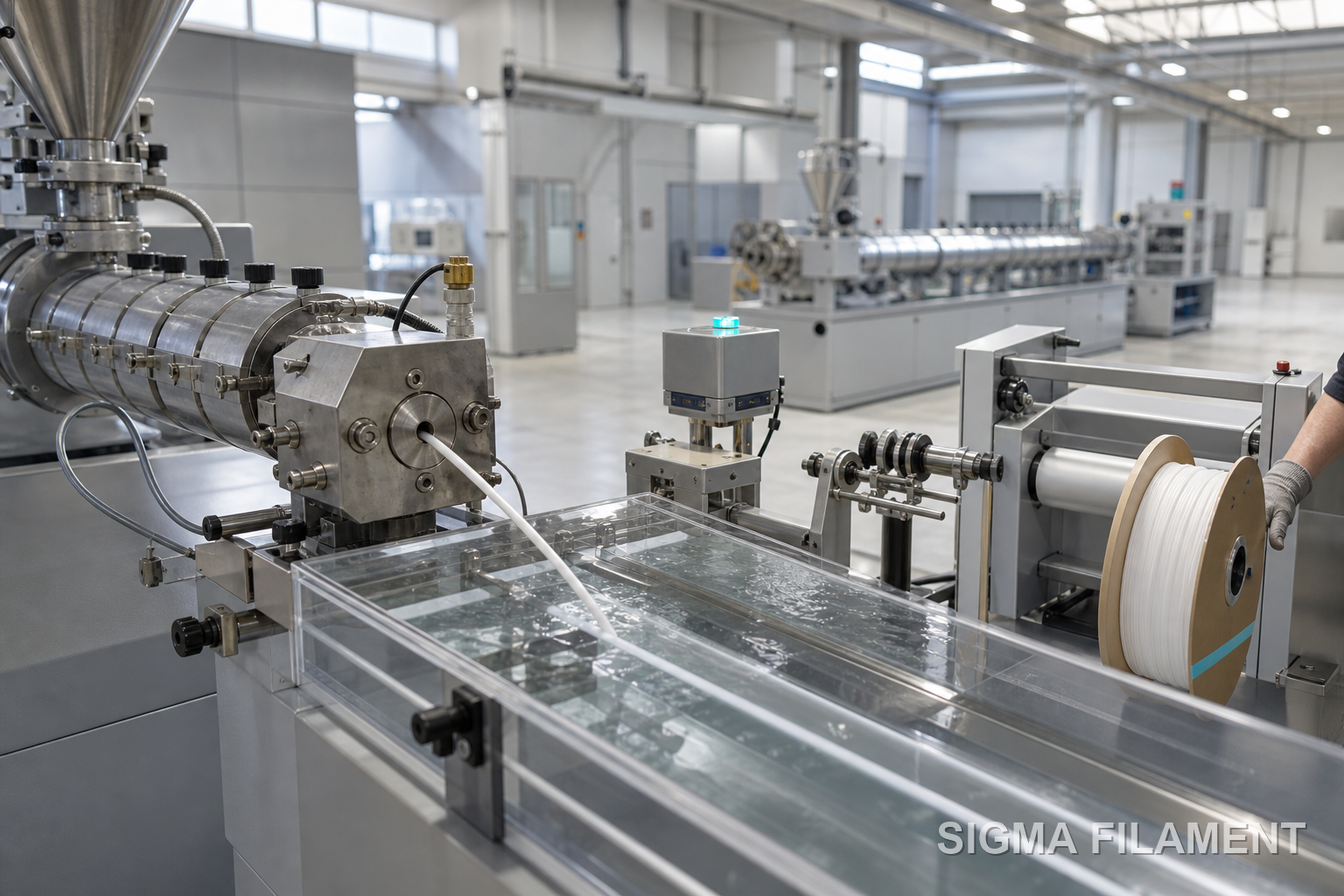
Verified own-factory brands: Sunlu, eSun, Elegoo, Anycubic, Creality, Polymaker
Sunlu describes a 100,000 sqm Zhuhai/Shenzhen facility running at roughly 2,000 tons per month with ISO 9001 and BSCI certification, and independent industry research lists it among the established Chinese filament manufacturers, the closest direct analog to a vertically integrated source manufacturer (MarketsandMarkets, 2025). eSun, likewise identified as a leading bio-materials and filament producer, operates a Shenzhen base plus a Vietnam plant it added in 2019 (Coherent Market Insights, 2026). Elegoo, Anycubic, and Creality each run their own Shenzhen extrusion lines tied to printer ecosystems, and Polymaker owns the PolyTerra matte PLA line under ISO 9001 (MarketsandMarkets, 2025). These brands publish lot-level specs because they control the line.
House-brand and re-labeled spools: Inland, the OEM private-label model, and the Voxel exception
Inland is Micro Center’s own label, sold in Micro Center stores, on the Micro Center website and on Amazon (Tom’s Hardware, 2025). Hatchbox publishes no factory disclosure and is likely OEM-sourced through the Guangdong supplier base, while Voxel PLA+ is extruded domestically in the US, an exception to the re-label model. Overture is a strong consumer label registered in Missouri City, Texas, with an opaque manufacturing origin. These spools can print well, but the buyer carries the QA risk because no extrusion line owner stands behind the lot.
Why factory ownership predicts batch consistency and COA availability
A factory owner controls resin purchasing, die geometry, in-line laser-micrometer feedback, and lot numbering. That control makes a Certificate of Analysis reproducible spool to spool. Re-labelers can only forward whatever documentation the upstream OEM chooses to share, which is usually nothing below the carton level. For print farms matching color and diameter across hundreds of spools, that gap is the difference between a qualified supplier and a wholesale gamble.
Diameter tolerance: why +/-0.05 mm vs +/-0.02 mm decides your failure rate
The difference between a +/-0.05 mm budget tolerance and a +/-0.02 mm premium tolerance is not a marketing line, it is a per-meter mass swing of roughly 6% versus 2.4% on 1.75 mm PLA. That swing feeds straight into your extruder’s volumetric flow, which is why diameter spec, not color or branding, decides the failure rate of a production print farm (SigmaFilament, 2026).
Published tolerance bands by tier: +/-0.05 mm budget vs +/-0.02 mm premium
Three tiers actually publish a number worth reading. Ultra-budget spools sit at +/-0.05 to +/-0.10 mm and frequently leave the band unpublished altogether (SigmaFilament, 2026). Published budget brands cluster at +/-0.03 to +/-0.05 mm; Anycubic, Creality Hyper, Polymaker PolyTerra, and Overture publish in that range. Premium-published is +/-0.02 mm, the band Sunlu, Elegoo, eSun, Polymaker, Prusament, and SigmaFilament all advertise on PLA (SigmaFilament, 2026). The gap is small in millimeters and enormous in extrusion behavior, which is the next paragraph’s job.

The mass-per-meter math: how tolerance becomes extrusion-volume variance
Hold density at 1.241 g/cm3 (standard PLA) and run the cross-section math at 1.75 mm nominal. Nominal mass-per-meter lands at 2.99 g/m (SigmaFilament, 2026). A +/-0.05 mm band stretches that to 2.82 g/m at the low edge and 3.16 g/m at the high edge, a spread of roughly +/-6% per meter. Tighten the band to +/-0.02 mm and the spread collapses to 2.92-3.05 g/m, about +/-2.4% (SigmaFilament, 2026). The premium band is not twice as good, it is about 2.5x tighter on the variable your slicer actually meters.
Why per-meter mass variance, not color, fails production prints
Modern slicers run volumetric flow, not linear feed. They assume each millimeter of filament carries a fixed mass; when the actual cross-section drifts by 6% over a single meter, the extruded bead drifts the same way. Under-extrusion gaps and over-extrusion blobs follow, and on production printers pushing 20-30 mm3/s, that variance is the leading driver of dimensional drift, layer separation, and the failed multi-hour print that wipes out the sticker-price savings. Color, brand stickers, and packaging do not move that needle. Published tolerance does, which is why a buyer evaluating budget brands should treat the diameter spec as the single most extractable quality signal on the spool. Reseller house brands that publish no tolerance are not cheaper, they are unmeasured, and unmeasured is what failure rate is built from. For print-farm and OEM buyers, this is the wedge that makes own-factory budget brands at +/-0.02 mm structurally competitive against premium pricing.
Virgin resin vs recycled: what Anderson (2017) found about cheap feedstock
Cheap feedstock is the most common shortcut in the budget filament tier, and the peer-reviewed literature is unusually direct about its cost. Anderson (2017), published in the journal 3D Printing and Additive Manufacturing, volume 4, issue 2, pages 110 to 115, ran a controlled comparison of FDM specimens printed from virgin polylactic acid against mechanically recycled PLA. The recycled batch showed a measurable reduction in tensile properties: ultimate tensile strength fell from 40.43 MPa for virgin PLA to 35.85 MPa for recycled, about an 11 percent loss (Anderson, 2017). That single controlled figure sets a useful expectation for any budget line that uses post-consumer or regrind feedstock.
The peer-reviewed finding: about an 11% tensile-strength loss in recycled PLA
That band is not a manufacturing defect. It is the predictable signature of thermal-history accumulation. Each extrusion cycle shortens average chain length and narrows the molecular-weight distribution, which the Anderson dataset captured as reduced tensile strength in printed coupons (Anderson, 2017). Recent FDM work, including Mazur et al. (2025) in the journal Scientific Reports, continues to find that feedstock composition is a primary driver of finished-part mechanical performance (Mazur et al., 2025).
PolyTerra and sustainability-positioned budget lines: when the trade-off is acceptable
For prototyping, education prints, color studies, packaging mockups, and other non-structural work, an approximately 11 percent tensile gap is usually invisible to the buyer and easily absorbed by wall-thickness or infill adjustments. That is the exact use case Polymaker positions PolyTerra against: an ISO 9001 producer publishing a sustainability-positioned budget line at roughly 19 to 25 dollars per kilogram with a stated tolerance of plus or minus 0.03 mm, its Edition-R variant carrying about 30 percent recycled content (Tom’s Hardware, 2025). Functional parts, end-use components, load-bearing fixtures, and any print under sustained mechanical stress are where the trade-off stops being acceptable, and where the per-spool savings get erased by failure rates.
Virgin-resin sourcing as a quality signal for budget brands
For production buyers, virgin-resin sourcing is itself a transparency signal. SigmaFilament extrudes from 100 percent virgin NatureWorks Ingeo PLA pellets under an ISO 9001:2015 scope, which is the documentation a print-farm or OEM auditor can verify before placing a bulk order.
The reseller economics most ‘best budget’ lists never mention
On a B2B marketplace, bulk PLA from Asian manufacturers was offered at about $4 to $12 per kilogram before shipping, while branded 1 kg spools listed at $17.99 to $29.99 at retail (Stevenson, 2025). That gap is the markup. Consumer roundups score the retail price; B2B buyers need to know what the multiplier absorbs and where it can be collapsed.
Factory price to retail price: the markup explained
The factory price is the extruded, spooled, boxed cost ex-works a Guangdong plant at MOQ, which varies by factory. The retail price is the single-spool listing after the spool has crossed an ocean, cleared customs, paid a platform commission, and funded a reseller margin. Get both numbers in writing for the same grade before you compare them.
What the markup actually pays for: logistics, duties, platform fees, reseller margin
That gap is not pure profit. Ocean or air freight from Shenzhen to a US west-coast 3PL eats the first slice, US customs duties on HTS 3916.90.3000 take the next, and last-mile fulfillment finishes the job. Amazon then takes a referral fee on the listing price plus a per-unit FBA fulfillment charge. On top of that, house-brand and private-label resellers layer their own gross margin on top. Run the arithmetic on your own landed cost before you compare a reseller’s price with a factory quote.
US-China tariffs (HTS 3916.90.3000) and their effect on landed cost
Filament classified under HTS 3916.90.3000 (monofilament, polymers other than ethylene or vinyl chloride) sits squarely in the US-China tariff schedule, and the additional duty materially raises landed cost and downstream retail pricing (U.S. International Trade Commission, 2026). Brands sourcing single-supplier from a Guangdong OEM cannot absorb that pass-through, which is why budget retail has crept upward through 2025 and 2026. The buyer implication is direct: at MOQ, going closer to a transparent factory collapses the markup stack to factory price plus freight and duty, with no platform fee and no reseller margin in the middle. For a print farm or OEM brand owner, that gap is the B2B value proposition.
Brand-by-brand: 7 proven budget picks under the manufacturer’s lens
These seven picks are not ranked. They are evaluated by the same lens a contract manufacturer uses on a supplier audit: who owns the extrusion line, what tolerance is published, what resin feeds the line, what certification scope is documented, and which buyer the product actually fits. Read this as a sourcing shortlist, not a leaderboard.
Across the seven budget picks, only brands with verifiable own-factory operations publish a diameter tolerance: Sunlu states plus or minus 0.02 mm at 1.75 mm nominal from a 100,000 sqm ISO 9001 plant it reports producing about 2,000 tons per month, and is named among the established Chinese filament manufacturers by independent industry research (MarketsandMarkets, 2025), while house-brand labels such as Inland disclose tolerance only through retailer listings.
Sunlu: vertically integrated, +/-0.02 mm published, broadest budget line
Sunlu states a 100,000 sqm facility across Zhuhai and Shenzhen with roughly 2,000 tons per month of output and ISO 9001 plus BSCI certification, and independent industry research lists it among the established Chinese filament manufacturers (MarketsandMarkets, 2025). US retail sits at $12 to $18 per kilogram across PLA, PLA+, Silk PLA, and PETG, with a marketed tolerance of +/-0.02 mm at the 1.75 mm nominal. For print-farm operators and resellers, Sunlu is the closest like-for-like comparable to a transparent source manufacturer and also runs OEM for third-party labels. Best for: hobbyists wanting broad color depth, print farms qualifying a vertically integrated supplier, and resellers benchmarking private-label economics.
Elegoo: own-factory, high-speed Rapid PLA Plus, ISO 9001
Elegoo runs its own Shenzhen factory with ISO 9001 certification and publishes +/-0.02 mm on PLA Plus, with US retail of $15 to $22 per kilogram (Tom’s Hardware, 2025). The Rapid PLA Plus line targets high-speed printers and pairs well with the Bambu and Creality K1 class of machines that consumer affiliate guides repeatedly select (Tom’s Hardware, 2025). Best for: high-speed PLA workloads where flow stability matters more than the cheapest spool, and buyers cross-shopping ecosystem-locked options.
eSun: Shenzhen + Vietnam capacity, solid B2B comparable
eSun is identified by independent industry research as a leading bio-materials and filament producer, operating a Shenzhen base plus a Vietnam facility it added in 2019, and publishes +/-0.02 mm tolerance with US retail between $18 and $25 per kilogram across PLA+, ePLA, and ePETG (Coherent Market Insights, 2026). Like Sunlu, the vertical integration and dual-country footprint make eSun a serious B2B comparable when a buyer needs origin diversification away from a single Guangdong site. Best for: distributors managing geopolitical exposure, OEM brand owners evaluating a second source, and print farms standardizing on a published-spec PETG.
Anycubic and Creality: printer-ecosystem own-factory budget PLA
Both run own Shenzhen factories with BSCI and ISO documentation, publish +/-0.03 mm tolerance, and retail in the $15 to $22 per kilogram band, with US and DE warehouses to shorten shipping; both are named among the established Chinese filament manufacturers by independent industry research (MarketsandMarkets, 2025). Anycubic Basic PLA and High-Speed PLA, plus Creality Hyper PLA and CR-PLA, are tuned to their own printer profiles, which lowers first-print failure rates for users staying inside the ecosystem. Honest exclusion: at +/-0.03 mm rather than +/-0.02 mm, neither beats Sunlu or Elegoo on pure tolerance math, and color depth lags Sunlu. Best for: existing Anycubic or Creality printer owners wanting a single-vendor supply chain.
Polymaker PolyTerra: sustainability-positioned matte PLA with published specs
Polymaker owns its production and is ISO 9001 certified, with PolyTerra positioned as a sustainability-focused matte PLA (its Edition-R sub-line adds 30% post-industrial recycled PLA) at $19 to $25 per kilogram and a published +/-0.03 mm tolerance (Tom’s Hardware, 2025). The trade is real: recycled feedstock carries a documented mechanical-property penalty in the peer-reviewed literature, so PolyTerra is the right call for visual or non-structural work and the wrong call for load-bearing parts. Best for: prototyping, education, color-matched batch printing, and buyers prioritizing a sustainability story alongside published specs.
Overture: strong consumer recognition, opaque manufacturing origin
Overture is the most consistently cited consumer pick in mainstream roundups, including CNET’s best PLA overall, at $16 to $20 per kilogram with a marketed +/-0.03 mm tolerance (Tom’s Hardware, 2025). The honest exclusion: the registered US presence does not confirm where the filament is extruded, and no verifiable own-factory disclosure is public, so the brand reads as a strong consumer label rather than a manufacturer-transparent supplier. Best for: single-spool hobbyists who value brand familiarity and 2 to 4 kilogram roll formats; weaker fit for OEM buyers requiring COA-traceable batch records.
Inland and Voxel: house-brand and US-made ultra-budget economics
Tom’s Hardware ranks Micro Center’s Inland PLA+ as its best everyday PLA and Voxel PLA+ as its best budget PLA (Tom’s Hardware, 2025). Inland illustrates the reseller-markup mechanic from the prior section: a factory spool re-labeled and retailed inside the budget band, where QA documentation and lot-level traceability typically thin out. Best for: low-stakes prototyping and one-off prints where tolerance and COA do not matter; not suitable for print-farm production runs.
Budget vs premium: a decision framework using the Prusament anchor
Prusament sits at roughly twice the budget tier, retailing at $29.99 to $34.95 per kilogram with a published ±0.02 mm diameter tolerance, extruded in Prusa Polymers’ Prague own-factory, as confirmed by an independent filament review (MAKE360, 2024). That price gap is the cleanest reference point for asking, honestly, what the extra money buys.
What the price gap to Prusament ($29.99-$34.95/kg, ±0.02 mm, Prague own-factory) actually buys
The headline tolerance number is no longer the differentiator. Sunlu and Elegoo already publish ±0.02 mm at budget-tier prices, so the raw geometric spec converges with the premium tier. What the Prusament premium actually buys is documentation: per-spool QA data, lot-level tolerance reporting, brand-printer tuning profiles, and a single-factory chain of custody from Prague pellet to spool (MAKE360, 2024). The premium is paid for traceability, not for a tighter ±0.02 mm number that is already available below.
When budget is enough: prototyping, hobby, color variety, non-structural
If the print is a prototype iteration, a classroom demonstration, a single-spool color test, or any non-structural part where a per-meter mass variance of about ±6% can be absorbed by slicer flow tuning and over-extrusion margin, the budget tier is sufficient. Concept models, cosmetic enclosures, jigs that are not load-bearing, and color-variety runs do not need batch-matched extrusion volume. Buying premium here is overspend, not insurance.
When to pay up: tight tolerance, COA-traceable, functional/production parts
Pay up, or buy closer to a transparent factory at MOQ, when the print is functional, load-bearing, or in a production batch where dimensional drift between spools fails a fit-up check. The decision rule is concrete: if a Certificate of Analysis per lot, ISO 9001:2015 certification scope, batch-matched tolerance across a print farm, or end-customer audit is part of the deliverable, the budget tier on Amazon stops qualifying. The real choice is then between paying Prusament’s retail premium and going direct to a published-spec own-factory source (Sunlu, Elegoo, eSun, Polymaker, or an OEM partner) where the reseller markup collapses.
Buyer red flags: what to avoid when sourcing budget filament
Treat the seller’s documentation, not the spool, as your first product. Each red flag below predicts a specific downstream failure that production buyers eat in scrap, downtime, or warranty claims.
The single strongest red flag is a missing diameter tolerance: a budget spool that omits this spec should be treated as the worst published-tier band, roughly plus or minus 0.05 mm or wider, which translates to about plus or minus 6% mass variation per meter at 1.75 mm nominal and predicts under-extrusion on production printers (SigmaFilament, 2026).
No published diameter tolerance and no TDS/MSDS
A missing tolerance spec is the first thing to check. If the listing does not state a diameter tolerance, assume the worst published-tier band of around plus or minus 0.05 mm or wider (SigmaFilament, 2026). At 1.75 mm nominal, that allows roughly plus or minus 6% mass variation per meter (SigmaFilament, 2026), which surfaces as under-extrusion, dimensional drift, and stringing on volumetric printers.
A missing TDS or MSDS is the second. Without a Technical Data Sheet you cannot verify glass transition, nozzle temperature, or moisture content (PLA typically 0.25 to 0.43% by mass under ASTM D570) (SigmaFilament, 2026). A missing MSDS also blocks compliance review in regulated facilities.
An ISO 9001:2015 logo on its own is not enough either. The certificate is verifiable, but it does not guarantee diameter or extrusion-process QA (International Organization for Standardization, 2015). Request the certification scope and a lot-level Certificate of Analysis, not just the logo.
No batch/lot number, no MOQ or lead-time transparency
A spool with no batch or lot number is a trap. You cannot match spools across a print farm or trace a defective run back to a resin batch, and color and diameter can drift silently between orders.
Opaque MOQ and lead time signal the same problem from the commercial side. Legitimate factories publish MOQ tiers (commonly 100 spools standard, 200 for high-speed lines) (SigmaFilament, 2026) and quote lead times in calendar weeks. Vague answers point to a reseller layering on top of an unnamed OEM.
No willingness to send a test/sample spool before a bulk order
A supplier that will not ship 1 to 3 sample spools at your real workload is hiding inconsistency. Qualify-then-scale is standard B2B practice, not a favor.
B2B and print-farm sourcing checklist: COA, ISO scope, MOQ, lead time
Print farms and OEM resellers buy filament like resin: spec sheet, batch documentation, and commercial terms decide cost-per-reliable-gram before a spool touches a nozzle. Material is a major recurring expense in a print farm, so this checklist separates a real supplier from a one-shot Amazon order.
Documentation to demand: published tolerance, TDS, MSDS, COA per batch, batch traceability
Require these in writing before any quote conversation. Start with the published diameter tolerance in millimeters, plus the sampling method behind it. Budget ±0.05 mm against premium ±0.02 mm is the difference between ±6% and ±2.4% mass-per-meter variation at 1.75 mm nominal (SigmaFilament, 2026). Next ask for the TDS, which should cover resin, density, glass transition, print window, and moisture; reputable PLA values sit at 0.25% to 0.43% by mass under ASTM D570 (SigmaFilament, 2026). The MSDS is a separate document you will need for customs and EHS files.
Then move to the lot-level paperwork. A COA per batch should list the lot number, diameter mean, standard deviation, and the sampled QC steps behind those figures. SigmaFilament, for example, issues a COA per batch and runs 70+ QC checks per spool (SigmaFilament, 2026). Batch and lot traceability should reach from the spool barcode back to the extrusion line and resin lot, so a failure isolates cleanly and a bad lot can be quarantined. Finally, confirm the ISO 9001:2015 scope clause actually covers filament extrusion rather than trading alone. SigmaFilament holds ISO 9001:2015 with extrusion in scope (International Organization for Standardization, 2015).
Commercial terms: MOQ, lead time, sample policy, Incoterms (FOB/CIF/DDP)
The commercial sheet matters as much as the spec sheet. Ask for MOQ per SKU and color; SigmaFilament’s MOQ starts at 100 spools, with high-speed lines from 200 (SigmaFilament, 2026). Ask for lead time on stock versus custom colors, broken out by the extrusion run, the QC pass, packing, and freight readiness. Ask for the sample policy before the bulk PO, since a serious supplier will ship 1 to 3 qualifier spools.
Incoterms close the picture. FOB shifts freight risk at origin, CIF bundles freight and insurance to destination, while DDP and DAP push duties and last-mile to the seller. SigmaFilament quotes all four (SigmaFilament, 2026), so buyers can compare landed cost on a like-for-like basis.
A supplier publishing these terms openly, including OEM and ODM service, is a different procurement category from a reseller quoting unit price.
Qualify-then-scale: test a sample spool at your real workload before committing
Qualify first, scale second. The protocol print farms actually use is short. Order 1 to 3 sample spools across the SKUs you plan to standardize, then run them at your real workload rather than a benchmark cube, on the same printers, profiles, and uptime the bulk order will feed. Measure diameter at 10 random points per spool against the published tolerance, verify dryness, and confirm that the sample spools batch-match each other while you request the matching COAs. Only after the samples clear should you place the bulk PO, locked to the qualified batch.
That path turns sticker price into a cost-per-reliable-gram decision, the lane where transparent factories beat re-labeled spools.
Frequently Asked Questions
What is the best budget filament brand?
The best budget filament brand is one with verified factory ownership, published diameter tolerance, and lot-level documentation. Among budget-tier picks, the strongest own-factory candidates are Sunlu, Elegoo, eSun, Anycubic, Creality, and PolyTerra, each operating ISO 9001 sites (International Organization for Standardization, 2015).
Is cheap filament worth it?
Cheap filament is worth it for prototyping where ±6% mass variance per meter is tolerable. At ±0.05 mm tolerance, 1.75 mm filament at 1.241 g/cm³ runs 2.82-3.16 g/m versus 2.92-3.05 g/m at ±0.02 mm (SigmaFilament, 2026). Functional parts need tighter spec.
Which budget filament brands actually own their factories?
Six budget brands have verified own-factory operations: Sunlu (Zhuhai/Shenzhen, 100,000 sqm, ISO 9001 + BSCI), Elegoo (Shenzhen, ISO 9001), eSun (Shenzhen plus 1,500 t/yr Vietnam plant), Anycubic, Creality (BSCI/ISO), and Polymaker (International Organization for Standardization, 2015). Inland, Hatchbox, and Overture lack comparable verified evidence.
What’s the difference between budget and premium filament tolerance?
Budget filament publishes ±0.03 to ±0.05 mm; premium publishes ±0.02 mm (SigmaFilament, 2026). At 1.75 mm nominal and 1.241 g/cm³, ±0.05 mm yields ±6% per-meter mass variation; ±0.02 mm yields ±2.4% (SigmaFilament, 2026). That variance drives volumetric flow drift and failed prints.
What affordable brands of PLA filament are good?
Affordable PLA brands with credible specs include Sunlu ($12-$18/kg, ±0.02 mm), Elegoo PLA Plus ($15-$22/kg, ±0.02 mm), Anycubic Basic ($15-$22/kg, ±0.03 mm), Creality Hyper ($15-$22/kg, ±0.03 mm), and eSun PLA+ ($18-$25/kg, ±0.02 mm) (SigmaFilament, 2026). All have verified Shenzhen manufacturing.
Do budget filaments come with a Certificate of Analysis (CoA)?
Some do, most don’t. CoA availability tracks factory ownership: ISO 9001 brands like Sunlu, Elegoo, eSun, Polymaker, and Anycubic can supply lot-level CoAs for B2B and OEM orders. House-brand spools (Inland, Hatchbox) rarely provide them because the reseller doesn’t control extrusion (SigmaFilament, 2026).
How much does 1 gram of filament cost?
In a 2025 price check, branded 1 kg retail spools listed at $17.99 to $29.99, about $0.018 to $0.030 per gram, while B2B bulk offers ran about $0.004 to $0.012 per gram before shipping (Stevenson, 2025). Cost-per-reliable-gram is the real procurement metric.
Is recycled or reclaimed filament a cheaper option?
Recycled PLA is a moderate cost option, not a deep discount. Polymaker PolyTerra sits at $19-$25/kg, overlapping virgin budget brands (Tom’s Hardware, 2025). Anderson (2017) measured about an 11% tensile strength loss (40.43 to 35.85 MPa) for recycled versus virgin PLA prints. Use recycled for aesthetic prints; virgin resin for load-bearing parts.
Conclusion
The best budget filament brand is not the cheapest spool on the shelf. It is the brand whose published diameter tolerance, verifiable factory ownership, virgin-resin sourcing, and per-batch documentation hold up under a manufacturer’s scrutiny. Sticker price alone hides the variables that decide failure rate at scale.
Own-factory brands such as Sunlu, Elegoo, eSun, Anycubic, Creality, and Polymaker PolyTerra carry traceable QA and ISO-scoped credentials. House-brand and re-labeled spools, by contrast, ride a reseller markup that pays for logistics, duties, platform fees, and distributor margin rather than tighter tolerance. For production buyers, the metric that matters is cost per reliable gram, adjusted for tolerance-driven mass variance, not the headline dollar-per-kilogram figure.
For print farms, resellers, and OEM brand owners, the procurement edge is to qualify a sample, verify it at real workload, then scale closer to a transparent factory. If you want to test a spool against your own production line or discuss bulk pricing, talk to the SigmaFilament factory team.
Further Reading
For buyers who want to act on the procurement lens above, our wholesale PLA filament and wholesale PETG filament pages publish the same tolerance bands (±0.02 mm PLA/PETG, ±0.03 mm composites), MOQ tiers, and lead times referenced throughout this guide, so you can sanity-check any competing budget quote against a source-factory baseline. Brand owners and resellers comparing private-label economics should start with the OEM/ODM 3D printing filament service overview, which documents color matching, spool branding, and COA workflow at FOB pricing. For independent grounding on the quality-management framework cited in the red-flags section, the official ISO 9001:2015 standard reference details exactly what a credible certification scope must cover.
References
- Anderson, I. (2017). Mechanical properties of specimens 3D printed with virgin and recycled polylactic acid. 3D Printing and Additive Manufacturing, 4(2), 110-115. https://doi.org/10.1089/3dp.2016.0054
- Mazur, J., Sobczak, P., Panasiewicz, M., Łusiak, P., Krajewska, M., Findura, P., Obidziński, S., & Żukiewicz-Sobczak, W. (2025). Mechanical properties and biodegradability of samples obtained by 3D printing using FDM technology from PLA filament with by-products. Scientific Reports, 15(1), 5847. https://doi.org/10.1038/s41598-025-89984-0
- Fortune Business Insights. (2025). 3D printing filament market size, share & growth report 2025-2034. https://www.fortunebusinessinsights.com/3d-printing-filament-market-115196
- Stevenson, K. (2025). 3D printer filament prices in 2025: From $5 bulk deals to premium brands. Fabbaloo. https://fabbaloo.com/news/3d-printer-filament-prices-in-2025-from-5-bulk-deals-to-premium-brands
- U.S. International Trade Commission. (2026). Harmonized Tariff Schedule of the United States, Chapter 39: Plastics and articles thereof (heading 3916, monofilament). https://hts.usitc.gov/
- International Organization for Standardization. (2015). ISO 9001:2015 Quality management systems: Requirements. https://www.iso.org/standard/62085.html
- MarketsandMarkets. (2025). 3D printing filament companies: Top 3D printing filament manufacturers. https://www.marketsandmarkets.com/ResearchInsight/3d-printing-filament-market.asp
- Coherent Market Insights. (2026). 3D printing filament market size, share & growth rate, 2026-2033. https://www.coherentmarketinsights.com/industry-reports/3d-printing-filament-market
- MAKE360. (2024). Prusament PETG/PLA review: diameter 1.75 ± 0.02 mm, manufactured by Prusa Polymers, Prague. https://make360.co.uk/tag/petg/
- Tom’s Hardware. (2025). Best filaments for 3D printing 2025: best budget PLA, best every day PLA, best premium PLA. https://www.tomshardware.com/best-picks/best-filaments-for-3d-printing
- CNET. (2026). Best 3D printing filament and which to buy in 2026: best PLA overall, Overture PLA. https://www.cnet.com/tech/computing/best-3d-printing-filament
- SigmaFilament. (2026). Wholesale PLA filament: ISO 9001:2015 extrusion, ±0.02 mm tolerance, 70+ QC checks per spool, 100-spool MOQ, FOB/CIF/DDP. https://sigmafilament.com/wholesale-pla-filament/
Last reviewed and updated: June 2026. Author: SigmaFilament team. For tailored guidance, contact our team.