Filament Multicolor: 3 Proven Routes to Color in 2026

TL;DR
Three routes to multicolor: single-spool filament (coextruded, silk, gradient) for zero-setup decorative color; hardware systems (AMS, MMU3, IDEX, tool-changers) for 4-16 designed colors; manual M600 swaps for 2-3 colors at zero hardware cost. Single-hot-end AMS still purges 30-100 g (about $0.60-$2.00) per print; tool-changers approach zero. For B2B, multicolor SKUs are a coextrusion-line sourcing decision.
Abstract
Filament multicolor 3D printing is not one technique but three distinct routes, and the route you pick is driven by color count, waste tolerance and production volume, not by which brand sits on the bench. The first route is single-spool multicolor filament, where coextruded, silk and gradient products bake the color into the strand at the factory and run on any single extruder with zero added hardware. The second is hardware multi-material systems, where an AMS-class box, a Prusa MMU3, an IDEX pair or a tool-changer swaps feedstock mid-print to place 4 to 16 designed colors, though single-hot-end systems pay a purge-waste cost of roughly 30 to 100 grams per print. The third is manual M600 swaps, which reach 2 to 3 colors at zero hardware cost and zero swap waste, paid only in operator labor. Tool-changers now approach zero purge and are displacing single-hot-end AMS for production work.
The guide is written for OEM brand owners, print-farm operators and distributors who must deliver multicolor prints at volume and control the cost of doing so. It maps the three routes onto a single taxonomy, lays out a hardware capability grid across AMS, MMU3, IDEX and tool-changers, quantifies the purge economics that vendor pages omit, and supplies a decision matrix that matches each use case to a method. It closes with the sourcing reality of multicolor SKUs, where color is a coextrusion-line and color-matching decision, and the ISO/ASTM 52900, REACH, RoHS and Pantone standards that govern retail channels.
Key Takeaways
- Three routes, not one method: multicolor resolves into single-spool filament, hardware multi-material systems, and manual swaps.
- Single-hot-end AMS still purges: AMS, MMU3 and ACE Pro discard 30 to 100 grams per multicolor print, about $0.60 to $2.00 (Molitch-Hou, 2025).
- Tool-changers approach zero purge: Prusa XL and the H2C Vortek park heads, eliminate the tower, and save $5 to $10 per large part (Molitch-Hou, 2025).
- IDEX is strictly two-channel: two independent hot ends give clean boundaries but cannot reach 4-plus designed colors (Mensley, 2026).
- Tri-color is not gradient: coextruded tri-color shows three fixed cross-section sectors, while gradient shifts color continuously along the strand.
- Multicolor SKUs are a sourcing decision: coextrusion-line capacity and color matching to deltaE under 1.5 govern OEM supply.
Table of Contents
- TL;DR
- Abstract
- Key Takeaways
- Table of Contents
- The Three Routes to Multicolor 3D Printing
- Single-Spool Multicolor Filaments: Coextrusion, Silk and Gradient
- Hardware Multi-Material Systems: AMS, MMU3, IDEX and Tool-Changers
- Manual Swaps and M600: The Zero-Hardware Path
- Purge Tower Economics: Real Waste Numbers by System
- Decision Framework: Which Multicolor Method Fits Your Use Case
- Common Misconceptions About Multicolor 3D Printing
- Sourcing OEM and Custom Multicolor Filament: A Manufacturer’s Lens
- Standards and Compliance: ISO/ASTM 52900, REACH, RoHS and Pantone
- Frequently Asked Questions
- Conclusion
- References
The Three Routes to Multicolor 3D Printing
Filament multicolor 3D printing is not one technique. It is three distinct routes, and the route a buyer picks is decided by color count, purge-waste tolerance, and production scale, not by which printer brand sits on the bench. Multicolor sits inside the broader category of multi-material extrusion as a color-only special case.
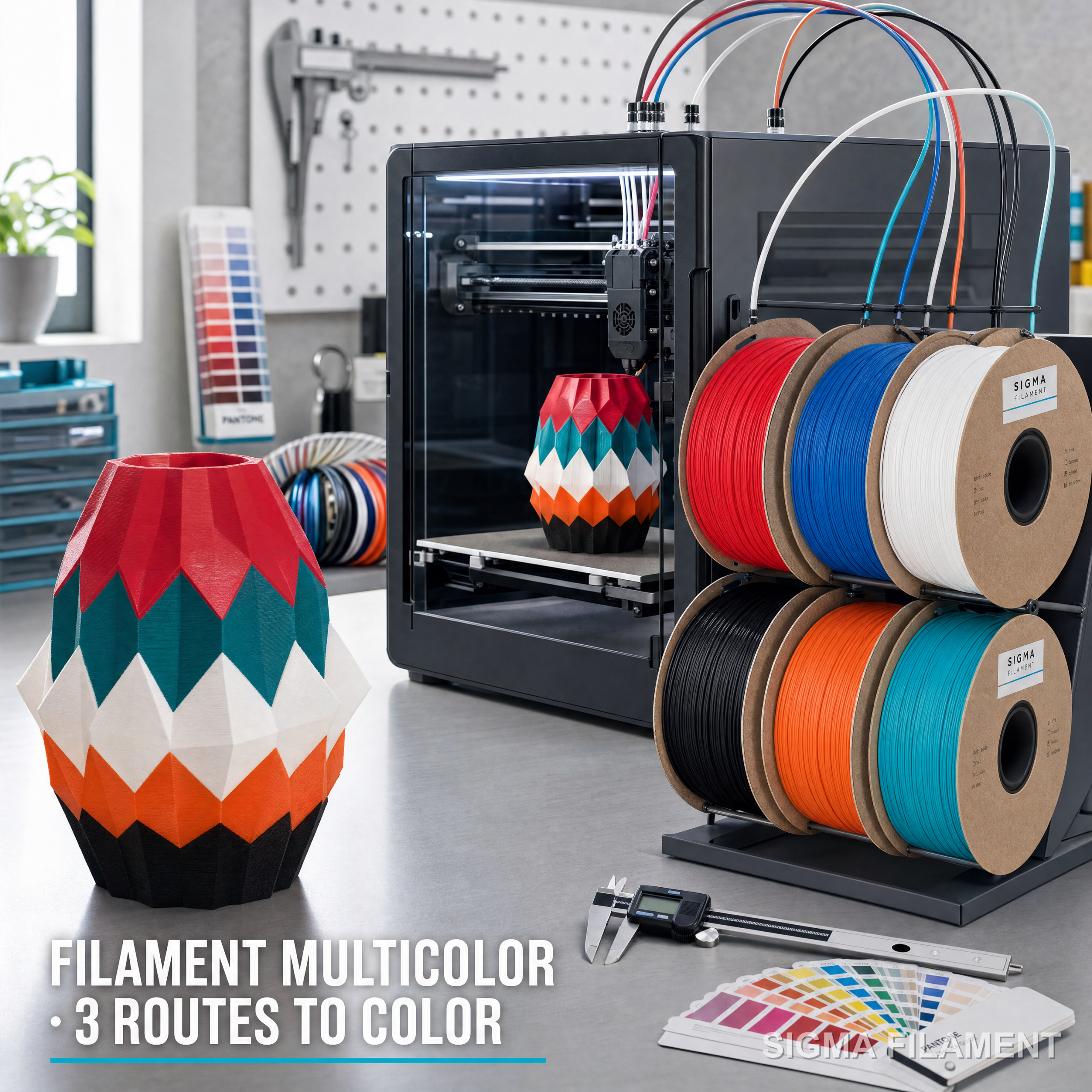
The three routes are single-spool multicolor filament, where color is baked into the strand at the factory; hardware multi-material systems, where the printer swaps spools mid-print; and manual filament swaps, where the operator changes spools at a layer pause. Each sits at a different point on the cost, color-count and waste curve. The overview table maps all three at a glance, and the next four sections drill into each.
| Route | How color is achieved | Hardware needed | Best for |
|---|---|---|---|
| Single-spool multicolor filament | Coextrusion, silk blends, gradient pigment along the strand | Any standard FDM printer, one extruder | Decorative gradient art, zero-setup color |
| Hardware multi-material (AMS, MMU3, IDEX, tool-changer) | Multiple spools fed to one or more hot ends; printer swaps between them | AMS or MMU box (4-16 colors), IDEX (2 channels), or tool-changer (4-6 parked heads) | 4-color designed prints, production runs |
| Manual swap (M600) | Operator pauses the print and physically changes filament at a layer boundary | Single-extruder printer plus slicer "change filament at layer" instruction | 2-3 colors, low volume, zero hardware budget |
ISO/ASTM 52900:2021 defines material extrusion (MEX) as a process in which feedstock is selectively dispensed through a nozzle, and frames multi-material extrusion as any MEX build using two or more distinct feedstocks (ISO/ASTM, 2021). Multicolor is the color-only subset of that definition.
Route 1: single-spool multicolor filament
Single-spool products carry the color information inside the strand. Coextruded dual-color and tri-color filaments are produced by feeding two or three polymer melts into a shared die so the strand exits with side-by-side sectors visible in cross-section (Sasse et al., 2022). Silk multicolor blends and gradient (rainbow) PLAs use pigment loading that shifts along strand length. Printer-side setup is zero. The trade is creative control: the pattern is decided at the factory, not in the slicer.
Route 2: hardware multi-material systems
Hardware systems let the design, not the spool, decide where color lands. Single-hot-end systems like the Bambu Lab AMS family, Prusa MMU3, Anycubic ACE Pro, and Creality CFS feed 4 to 16 spools through one nozzle and purge a prime tower between swaps. IDEX printers run two independent hot ends and are strictly 2-channel. Tool-changers (Prusa XL, the H2C Vortek class) park 4 to 6 heads and eliminate cross-swap purge, the architecture now displacing single-hot-end AMS in production workflows.
Route 3: manual filament swaps
Manual swaps are the zero-hardware path. The slicer inserts an M600 Marlin filament-change command, or a "change filament at layer" pause, and the operator unloads and reloads at the chosen layer. Hardware cost is zero, color-swap waste is effectively zero, and the practical ceiling is 2 to 3 colors before operator fatigue caps throughput.
Multicolor vs multi-material: the key distinction
Multicolor means two or more colors of the same polymer family, usually PLA. Multi-material means two or more different polymers in one print, for example a rigid PLA body with a TPU gasket, or a build paired with PVA water-soluble support. Every multi-material print is multicolor by side effect; not every multicolor print is multi-material. This pillar treats color as the primary axis and notes the multi-material crossover where it matters for sourcing or hardware choice.
Single-Spool Multicolor Filaments: Coextrusion, Silk and Gradient
The simplest route to multicolor is also the oldest. One spool, one extruder, no add-on hardware. Any FDM printer that accepts 1.75 mm or 2.85 mm filament can run a single-spool multicolor product the day it ships. The trade-off sits on the other side of the bargain: the color pattern is baked into the strand at the factory, so the operator gets the optical effect but not per-region color control. For B2B buyers, this branch covers three distinct product families, each made on a coextrusion line rather than a standard mono-extruder.
Coextruded dual-color and tri-color (cross-section sectors)
Coextruded multicolor filament is produced by feeding two or three polymer melts into a shared die that keeps the streams side-by-side, with downstream cooling at roughly a 7 mm zone and 1.5 to 2 m/s airflow to lock the strand round and the boundaries clean (Sasse et al., 2022). A dual-color strand shows two semicircular sectors in cross-section; a tri-color strand shows three. Because the sector geometry is fixed along the entire spool, the on-print color pattern is deterministic and banded, not a continuous gradient. Buyers see crisp, repeatable two-tone or three-tone lines on every printed wall, with boundaries that follow the print’s outer perimeter.
Silk multicolor and the strength trade-off
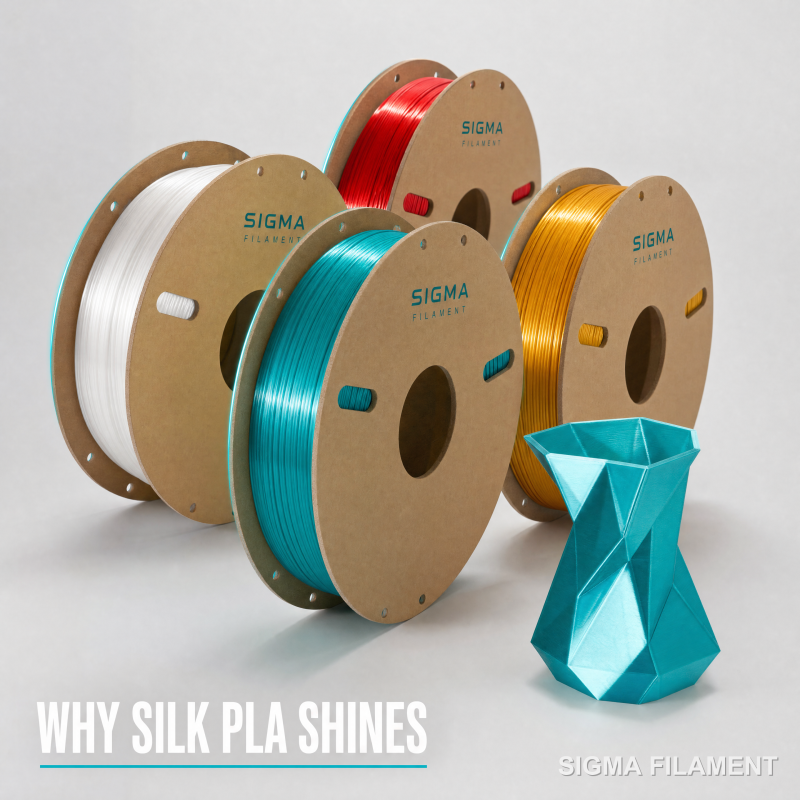
Silk multicolor PLA blends high-gloss additives and dense pigment systems into the polymer matrix, then routes that compound through the same coextrusion geometry as standard multicolor. The visual payoff is a mirror-like sheen across each color sector. The mechanical cost is real: silk multicolor PLA exhibits roughly a 5-15% tensile-strength reduction versus standard PLA, driven by pigment loading and the inter-stream bonding interface inside the strand (Yang et al., 2025). Decorative parts absorb that hit easily. Load-bearing brackets and functional jigs or fixtures should not be specified in silk multicolor as a default.
Coextruded multicolor filament feeds two or three polymer melts through one shared die with side-by-side channels, cooled in a 7 mm zone at 1.5 to 2 m/s airflow; the strand shows two or three color sectors in cross-section and prints a deterministic banded pattern on any single-extruder FDM printer, with no AMS hardware required (Sasse et al., 2022).
Gradient, rainbow and color-changing (thermochromic/photochromic)
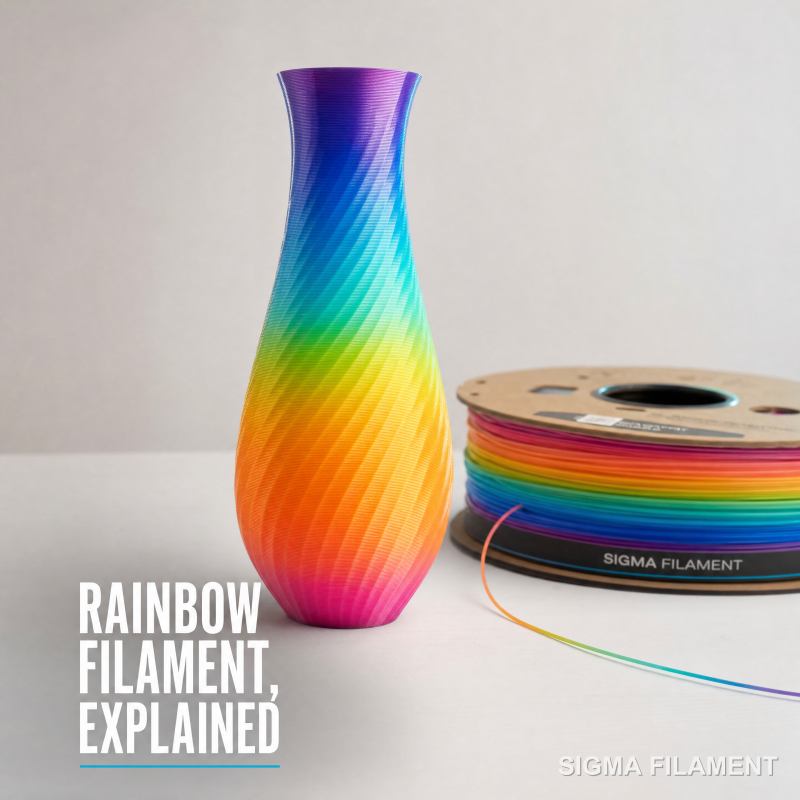
Gradient and rainbow filaments shift color continuously along the strand length rather than across the cross-section, at a transition length that varies by product, so check the maker’s stated length per color before sizing a print to it. The on-print effect is a smooth color sweep keyed to print height and surface area, not to layer geometry. The same single-spool branch also covers thermochromic PLA, whose pigment shifts color with temperature, and photochromic PLA, which reacts to UV exposure. The transition-length math for gradient filament (meters per kilogram, bands per spool, print-size matching) has its own dedicated companion guide on this site and is not re-derived here.
Tri-color vs rainbow gradient: different optical outcomes
The two are often conflated and they should not be. Tri-color is cross-sectional and deterministic: three sectors, fixed boundaries, banded prints. Rainbow gradient is longitudinal and continuous: one pigment family slowly displaces the next along the strand, so the printed color is a function of how much filament has been consumed. A buyer specifying a multicolor SKU picks one or the other based on whether the end use wants crisp banded color or a smooth sweep across a finished part.
Hardware Multi-Material Systems: AMS, MMU3, IDEX and Tool-Changers
Route 2 covers every printer-side mechanism for multicolor work on the build plate. Four hardware architectures dominate the 2025-2026 multicolor market, and they split cleanly on two axes: how many feedstock channels the machine carries, and whether color swaps require a purge tower. Single-hot-end multiplexers feed many spools through one nozzle and must purge on every change. IDEX and tool-changers carry independent heads and skip the purge entirely.
Single-hot-end AMS-class systems (AMS, ACE Pro, CFS): 4-16 colors
Bambu Lab’s AMS and AMS 2 Pro hold four spools per box and daisy-chain across four boxes for a 16-color multicolor ceiling on a single hot end (Holland, 2025). Anycubic’s ACE Pro carries four spools with active drying but does not chain, capping the build at four colors. Creality’s CFS also runs four spools per box and chains across multiple boxes when paired with K-series printers. Every machine in this class swaps color by cutting, retracting and loading a new strand into the same nozzle, so the slicer prints a purge tower that bleeds the previous color out of the hot end before the next layer face is laid. Purge mass scales with color-change count and tower height, not with object size.
Prusa MMU3: 5 channels on a single hot end
The Prusa MMU3 retrofits onto MK3S+, MK4 and MK4S printers and feeds five filament paths into one nozzle (Mensley, 2026). The mechanical principle matches the AMS-class boxes: cut, unload, load, prime, wipe. Five channels is the hard ceiling because the selector head is mechanical rather than chainable. MMU3 ships without active drying, so hygroscopic feedstocks need an external dryer in parallel.
IDEX: two independent hot ends, 2-channel limit
Independent dual extruder machines (Snapmaker Artisan, BIQU Hurakan IDEX, Sovol SV04, Raise3D E2) carry two hot ends on separate gantries (Mensley, 2026). Each head parks during the other’s pass, so cross-color contamination is minimal and the slicer does not generate a purge tower. The architecture is strictly two-channel: useful for two-color work, rigid-plus-flex pairs or build-plus-soluble-support, but not for four-color designs. Mirror and duplication modes double throughput on symmetric parts, which is the workflow advantage that other multicolor multiplexers cannot match.
Tool-changers (Prusa XL, Vortek): parked heads, near-zero purge
Tool-changers park complete print heads in a dock and swap them between multicolor layer regions. Prusa XL carries up to five tool heads; the Bambu Lab H2C Vortek mounts six nozzles in a carousel (Molitch-Hou, 2025). Because each head keeps its own filament path, no material crosses the nozzle, and the purge tower disappears. The trade is hardware cost and per-swap mechanical time of roughly three to five seconds, with hot ends held at temperature so no reheat penalty applies. For production print farms, the swap-time hit is paid once per layer region while the purge waste is paid per color change across every multicolor job, which is why fleet operators are rotating onto tool-changers.
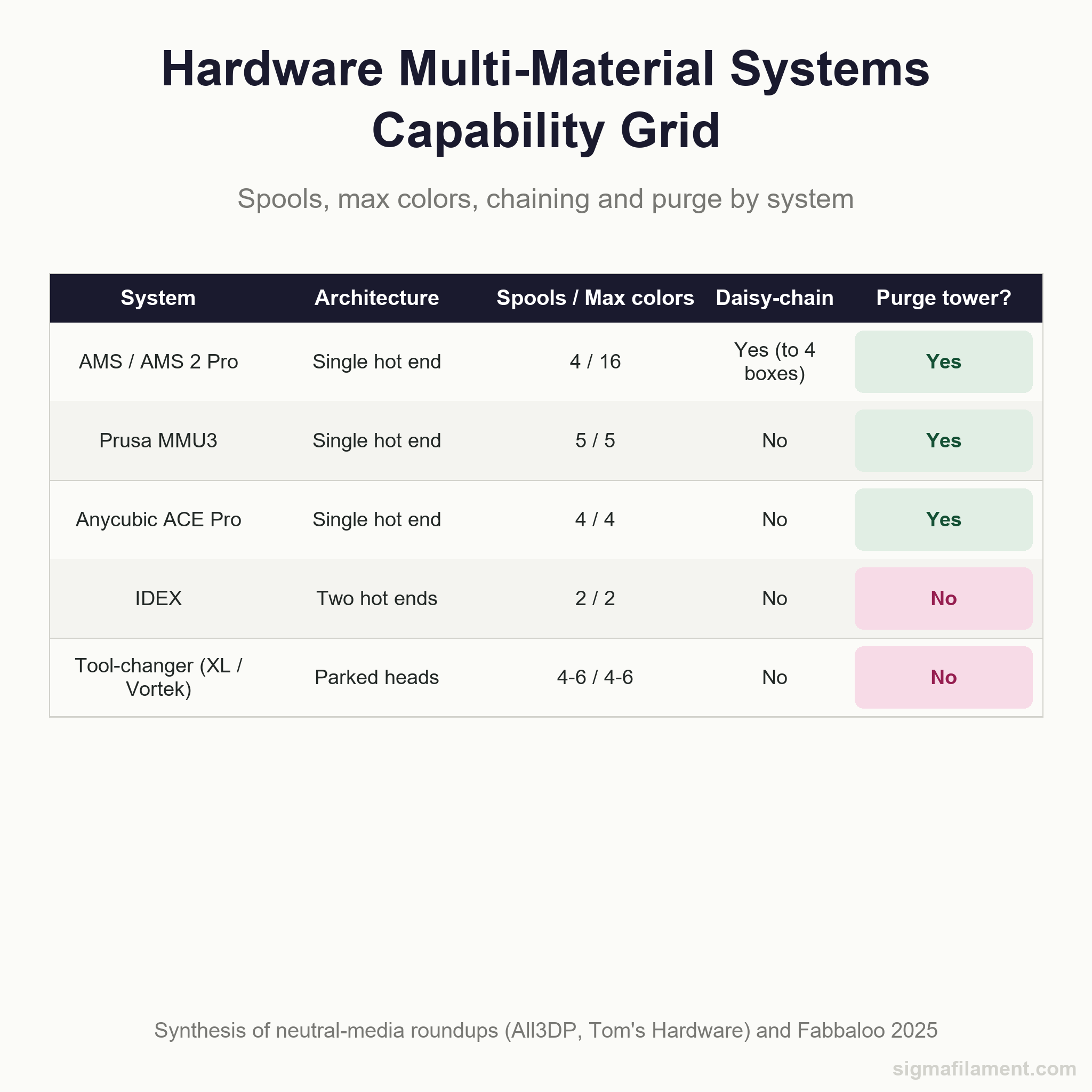
| System | Architecture | Spools / Max colors | Daisy-chain | Purge tower |
|---|---|---|---|---|
| AMS / AMS 2 Pro | Single hot end | 4 / 16 | Yes (to 4 boxes) | Yes |
| Prusa MMU3 | Single hot end | 5 / 5 | No | Yes |
| Anycubic ACE Pro | Single hot end | 4 / 4 | No | Yes |
| IDEX | Two hot ends | 2 / 2 | No | No |
| Tool-changer (XL / Vortek) | Parked heads | 4-6 / 4-6 | No | No |
The Bambu Lab AMS, introduced with the X1 Carbon in 2022, set the four-spool-per-box pattern that ACE Pro and CFS now follow, and the daisy-chain extension to four boxes gives single-hot-end multicolor machines a 16-color theoretical ceiling that no tool-changer currently matches (Holland, 2025). The waste cost of that ceiling is quantified in the next section.
Manual Swaps and M600: The Zero-Hardware Path
The third route to filament multicolor requires no AMS, no MMU, no IDEX carriage and no tool-changer. It uses the single-extruder printer already on the shop floor, a slicer that can insert a filament-change command at a chosen layer, and an operator willing to stand next to the machine. Hardware cost is zero. Purge waste is zero. The trade-off is operator labor, and a hard ceiling on color complexity at the layer boundary.
Pause-and-swap via slicer ‘change filament at layer’
Every mainstream slicer (PrusaSlicer, OrcaSlicer, Bambu Studio, Cura) exposes a "change filament at layer" or "insert pause" action on the print preview. The slicer injects a pause command at the start of the chosen layer; the printer then parks the head and retracts before it waits for input. The operator unloads the current spool, loads the next color, purges by hand until clean polymer flows from the nozzle, and resumes the job. Color changes are restricted to whole-layer boundaries, so the technique produces banded multicolor, not designs that shift color within a single layer or across a curved surface inside one layer (Marlin Firmware Project, 2024).
The M600 G-code command (Marlin)
On Marlin-firmware printers, the slicer pause resolves to the M600 filament-change command. M600 parks the toolhead, retracts a configurable length of filament, beeps for operator attention, and waits for a resume signal. Klipper exposes the same behavior through PAUSE / RESUME macros, and recent Bambu firmware exposes equivalent layer-change pauses in the UI. M600 gives single-extruder owners a multicolor path without retrofit hardware (Marlin Firmware Project, 2024).
When manual wins: 2-3 colors, low volume, zero waste
Manual swap is the rational choice when three conditions hold at once: color count is 2 or 3, run length is low (signs, name plates, layer-banded art, prototype runs), and an operator is already supervising the machine. Above three colors, operator fatigue and swap-error risk dominate; above low volume, labor cost compounds faster than purge cost on a single-hot-end AMS. The route corrects a common misconception that multicolor 3D printing demands hardware investment. For a 3-color name plate in single-digit quantities, M600 on an existing printer remains the lowest total cost path to multicolor output, and the only one with truly zero purge-tower waste at the print level.
Purge Tower Economics: Real Waste Numbers by System
Multicolor 3D printing has one cost line that vendor pages quietly omit: the prime tower. Every single-hot-end multi-material system, AMS-class boxes included, must extrude the previous color out of a shared melt zone before laying down the next. That extrusion lands on a purge tower next to the part, gets binned at the end of the print, and shows up nowhere in the slicer’s filament-cost preview. For a print farm running multicolor work all day, this is the single largest variable in cost-per-finished-gram.
Why single-hot-end systems purge (the prime/wipe tower)
A single hot end carries one melt at a time. Swap from red to white and the residual red has to be cleared, or the first centimeters of white print streaky pink. Slicers handle this by parking the toolhead over a purge or "wipe" tower and extruding 30-100 grams of mixed filament before resuming the part (Molitch-Hou, 2025). Tower height scales with color-change frequency and color contrast: a tall four-color model with frequent swaps purges more than a two-color logo with one transition.
Per-print waste and dollar cost at 2025-2026 PLA pricing
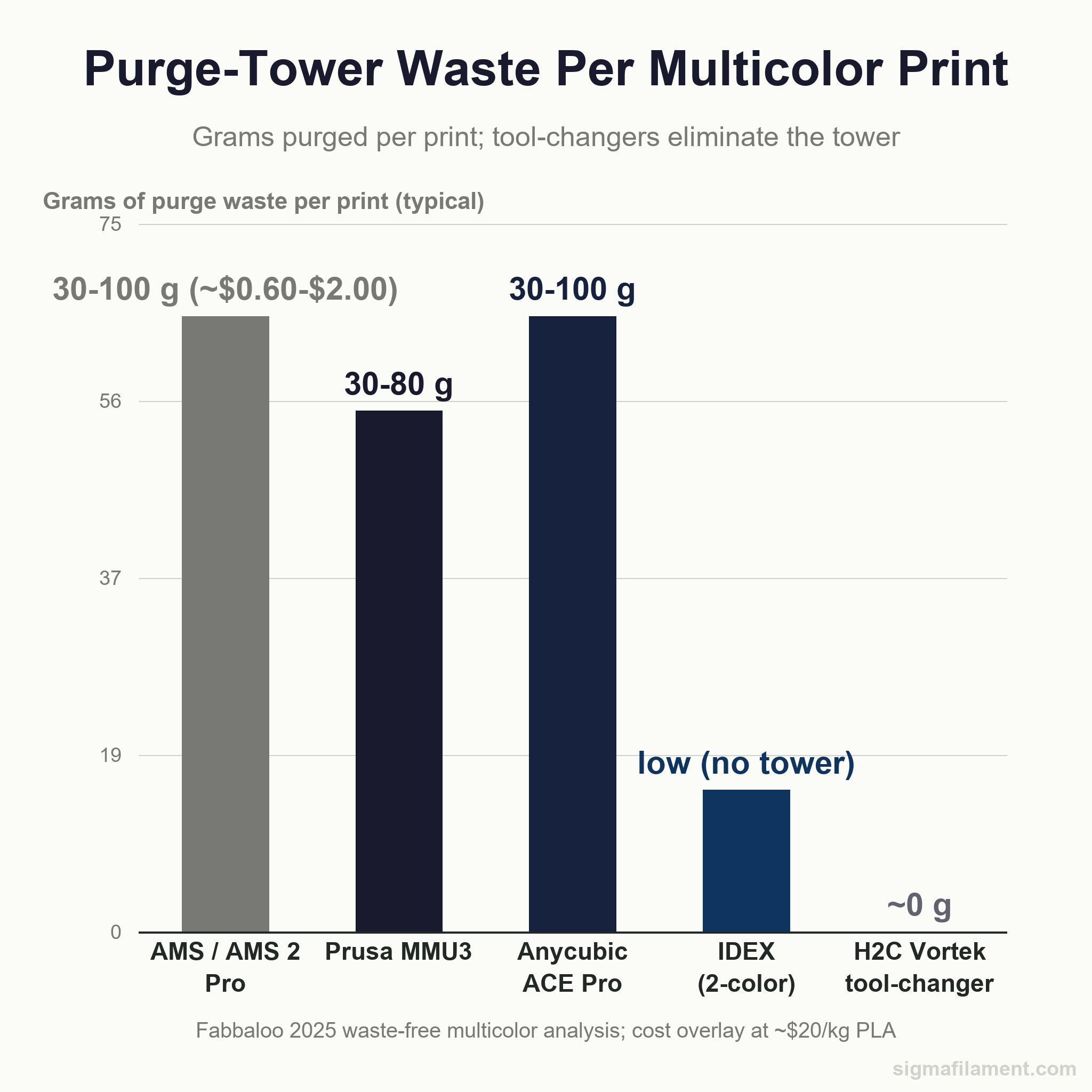
Bambu Lab AMS and AMS 2 Pro typically discard 30-100 g per multicolor job, roughly $0.60-$2.00 per print at $20/kg PLA pricing (Molitch-Hou, 2025). Prusa MMU3 sits in a similar 30-80 g band on the same single-hot-end architecture, and Anycubic ACE Pro tracks AMS at 30-100 g. IDEX printers, by contrast, swap between two independent hot ends with no shared melt, so cross-color purge effectively disappears below 15 g of nominal priming.
The bigger number is cost-per-finished-gram. On a four-color 100 g model with ~50 g of purge, you have paid for 150 g of filament to ship 100 g of part: a 1.5x multiplier on raw material before labor, machine time and electricity (Molitch-Hou, 2025). At a 30 prints/day farm cadence, that 50 g of waste compounds to 1.5 kg per day, or roughly $30 daily at $20/kg PLA, ~$900 a month, ~$10,800 a year per machine, a cost line that compounds fastest in bulk-spool print operations.
Tool-changers and the near-zero-waste benchmark
Tool-changers reverse the math. The Bambu Lab H2C Vortek six-nozzle changer parks dedicated heads at temperature and swaps the entire toolhead rather than the melt, eliminating the cross-swap purge tower and saving an estimated $5-$10 of filament per large multicolor part versus a single-nozzle AMS (Molitch-Hou, 2025). Prusa XL takes the same architectural approach with five tools. The trade is upfront hardware cost, typically a $1.5-5k printer class, and a ~3-5 second mechanical swap penalty per color change.
A 2025 industry analysis of waste-free multicolor printing found single-hot-end AMS-class systems discarding 30-100 g per multicolor job, about $0.60-$2.00 in PLA at typical 2025-2026 pricing, while the Bambu Lab H2C Vortek six-nozzle changer saves an estimated $5-$10 of filament per large multicolor part by eliminating the tower entirely (Molitch-Hou, 2025).
The decision is therefore not "which AMS is best." It is whether the production volume justifies tool-changer capital. For occasional 4-color work, AMS-class convenience wins. For waste-sensitive print farms running multicolor SKUs at scale, tool-changers and IDEX dominate on cost-per-finished-gram.
Decision Framework: Which Multicolor Method Fits Your Use Case
Method selection across the three routes is not a taste question. It resolves cleanly against four inputs: color count, purge-waste tolerance, production volume, and hardware budget. Read the matrix below, identify the row that matches the job, and the deciding factor column explains why the alternatives lose on that specific axis.
Map use case to method (the decision matrix)
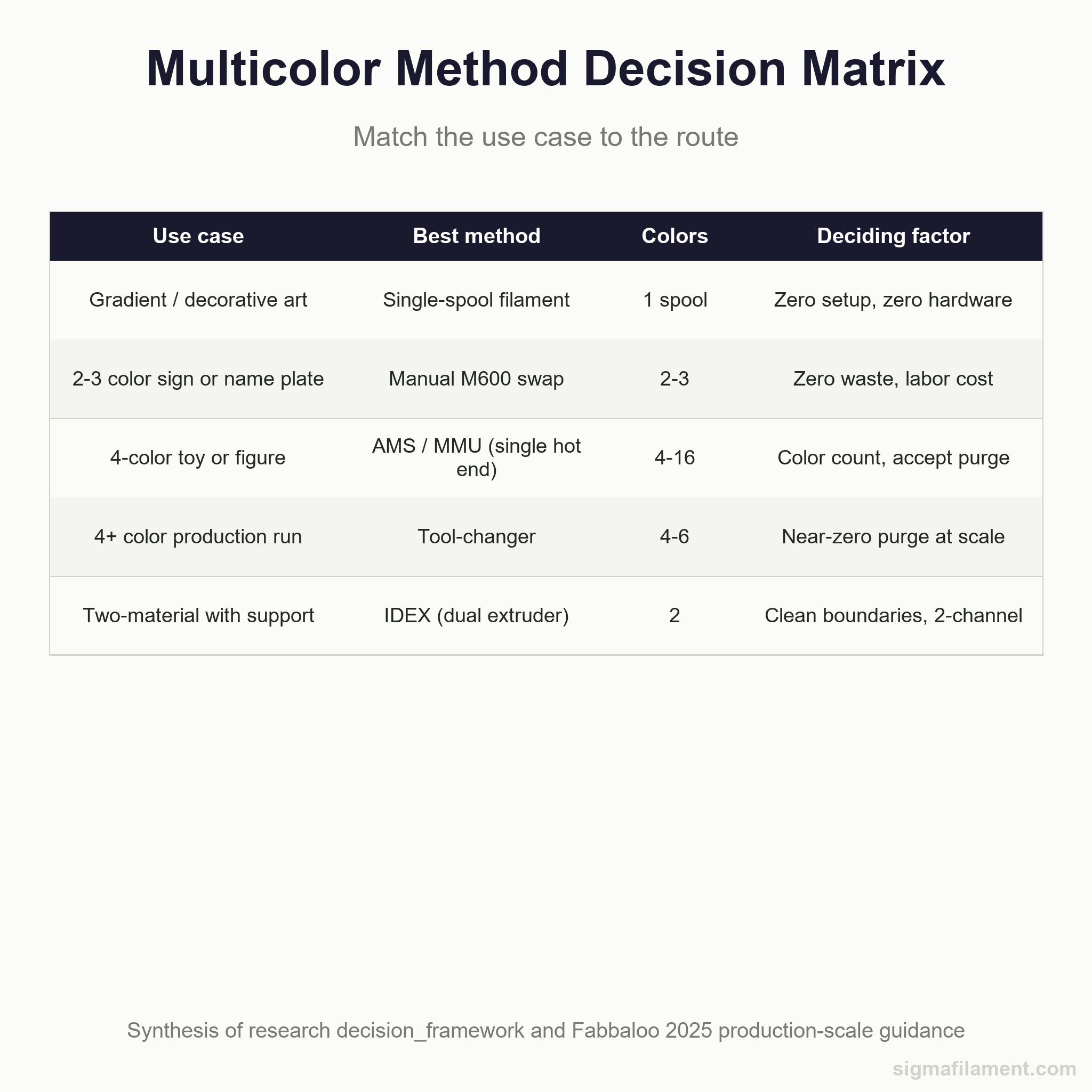
| Use case | Best method | Colors needed | Deciding factor |
|---|---|---|---|
| Occasional hobby multicolor, gradient or decorative art | Single-spool coextruded or gradient filament | 1 spool, 2-3 visible colors | Zero setup, zero hardware, color pattern fixed by the strand |
| 2-3 color sign, name plate or low-volume functional part | Manual M600 swap on existing single-extruder printer | 2-3 | Zero waste, zero hardware cost; pays in operator labor |
| 4-color toy, figure, light-commercial multicolor | AMS / MMU3 / ACE Pro single-hot-end system | 4-16 | Color count up to 16, accept 30-100 g purge per print |
| High-volume waste-sensitive production run | Tool-changer (H2C Vortek, Prusa XL) | 4-6 | Near-zero purge at scale; tower cost compounds in a print farm |
| 2-color functional part with clean material boundary or support interface | IDEX dual extruder | 2 | Strictly 2-channel, but no cross-contamination and duplication mode available |
| Low-budget, no hardware additions allowed | Single-spool filament or manual M600 swap | 1-3 | No capital spend; route depends on whether the color pattern is fixed or designed |
Color count, waste tolerance and production scale
Color count sets the first cut. One to three colors stays inside single-spool filament or M600 territory; four or more pushes the job onto AMS-class hardware or a tool-changer. Waste tolerance sets the second. A single-hot-end AMS, MMU3 or ACE Pro still purges 30-100 g per filament multicolor print, roughly $0.60 to $2.00 at 2025-2026 PLA pricing near $20/kg; tool-changers eliminate the tower and save $5 to $10 per large part (Molitch-Hou, 2025). Volume sets the third. A 50-piece batch at 50 g of purge per print discards 2.5 kg of polymer before the run finishes, which moves the decision toward a tool-changer or, for two-channel work, IDEX (Molitch-Hou, 2025). Budget sets the floor. Where capital spend is blocked, manual M600 on existing hardware delivers 2-3 color output at zero hardware cost.
Print-farm and production-scale considerations
A print farm running 200 four-color jobs per week on single-hot-end AMS-class hardware burns roughly 10 kg of purge filament each week at typical 50 g per-print waste; the same fleet on tool-changers approaches zero, which is why 2025-2026 industry data shows tool-changer and dual-nozzle architectures displacing AMS for production-grade multicolor (Molitch-Hou, 2025).
Fleet-scale economics invert the consumer ranking. Purge cost compounds linearly with both print count and color-change count, while tool-changer waste stays near zero regardless of throughput. For two-material work where one channel carries the support interface, IDEX remains the cleanest answer at the two-channel limit. For pure single-color long runs, no multicolor hardware belongs in the workflow at all; a fleet of single-extruder printers wins on cost per part.
Common Misconceptions About Multicolor 3D Printing
Four claims appear in almost every multicolor 3D printing buyer thread, and all four are wrong in ways that matter for purchasing and production planning. Each is corrected below against the actual mechanics of filament multicolor workflows.
"AMS prints multicolor with no waste"
Single-hot-end automatic material systems still purge. Every color change forces the active polymer out of the nozzle before the next color enters, and that purge stacks into a prime tower beside the part.
Single-hot-end multicolor systems (Bambu Lab AMS and AMS 2 Pro, Anycubic ACE Pro, Creality CFS, Prusa MMU3) typically generate 30 to 100 g of purge-tower waste per print, roughly $0.60 to $2.00 at $20/kg PLA pricing in 2025-2026 industry analysis. Only tool-changer architectures such as the Bambu Lab H2C Vortek and Prusa XL approach near-zero color-swap waste (Molitch-Hou, 2025).
"Tri-color filament equals rainbow gradient"
Tri-color filament and rainbow gradient are different products with different optical outcomes. Tri-color is a coextruded strand with three distinct polymer sectors visible in cross-section; the boundaries appear as fixed stripes on the printed surface and follow the toolpath, not the design. Rainbow gradient is a single-extrusion strand whose pigment shifts continuously along the length, so color bands track print height rather than geometry. Neither gives per-region user color control: the pattern is decided at the spool, not in the slicer.
"IDEX is a multicolor system"
Independent dual extruders are a two-channel architecture. The second hot end widens material options to rigid-plus-flexible or build-plus-soluble-support and supports mirror and duplication modes for throughput, but it cannot address 4 or more colors in a single design (Mensley, 2026). A 4-color toy, figure or branded part still requires an AMS-class system or a tool-changer; IDEX is a different solution to a different problem.
"You need an expensive printer for multicolor"
Multicolor is reachable on any single-extruder Marlin printer through the M600 G-code or a slicer "change filament at layer" instruction, with no hardware upgrade required. Operator labor replaces hardware cost: 2 to 3 colors per print is the practical ceiling before user fatigue compounds, and color-swap waste is effectively zero. Name plates, layer-banded artwork, two-tone signage and short-run promotional parts are common production fits, and the same single-spool printer remains free for standard single-color volume runs the rest of the week.
Sourcing OEM and Custom Multicolor Filament: A Manufacturer’s Lens
Most articles on filament multicolor stop at the printer side. The supply side is where the SKU actually exists, and it looks very different from a single-color PLA run.
Why multicolor needs specialized coextrusion lines
A coextruded dual-color or tri-color filament is not a colored spool. It is two or three polymer melts pushed simultaneously through a shared die, with cross-section sectors held in fixed angular position along several kilometers of strand. That requires twin extruders, a co-die, matched melt rheology between color streams, and tight transition-length control when the formulation calls for a gradient or rainbow shift (Sasse et al., 2022). Most standard PLA or PETG lines have one extruder and one die. They cannot make this product. Sigma Filament runs 20+ extrusion lines, including dedicated coextrusion lines for dual-color, tri-color, silk multicolor, gradient and rainbow product families, all fed by 100% virgin NatureWorks PLA resin under ISO 9001:2015 controls.
The polymer extrusion 3D printing market reached $2.2 billion in 2025, with single-hot-end AMS-class boxes pulling demand toward 4-spool and 10-color retail bundles; coextruded multicolor SKUs and AMS-compatible spool sets are the fastest-growing slice of that volume, and the production constraint is the coextrusion line, not the brand on the box (Hanaphy, 2025).
MOQ, color matching and the custom workflow
A serious multicolor sourcing conversation has five inputs: target Pantone or RAL reference, deltaE tolerance, transition length for gradient SKUs, MOQ tier, and Incoterm. Stock colors clear at 100 spools; OEM custom colors start at 500 spools per color with deltaE under 1.5 against the Pantone or RAL reference under D65 illumination. Bulk pricing steps at 500 spools (up to 15%) and 1,000 spools (up to 20%). FOB, CIF, DDP and DAP are all on the table. Custom dual-color, tri-color and gradient formulations move under NDA in the ODM track.
Sampling is non-negotiable for any buyer planning a multicolor SKU launch. A 1 to 3 spool sample run validates color registration, deltaE on first article, transition length on gradient strands, diameter tolerance at +/-0.02 mm, and the 70+ in-line QC checks every production spool sees before packaging.
AMS-compatible spool sets and private-label bundles
The 2025-2026 retail multicolor pattern is the 4-spool box and the 10-color bundle, sized and labeled to drop directly into AMS, ACE Pro, MMU3 and CFS feeders. Private-label work on this format means matched diameter tolerance across the bundle, consistent winding, NFC or RFID tag compatibility where the printer ecosystem expects it, and packaging that survives 50+ country export. Sigma has shipped this work for 200+ brands with a stated defect rate under 0.01%.
Brand owners scoping a multicolor SKU line, and print-farm operators specifying AMS-ready spool bundles at volume, can scope MOQ tiers, deltaE targets, gradient transition specs and Incoterms with Sigma’s engineering team via the OEM and custom filament and contact channels.
Standards and Compliance: ISO/ASTM 52900, REACH, RoHS and Pantone
Multicolor filament SKUs sit at the intersection of three regulatory frames that single-color spools largely escape. More pigments mean more REACH and RoHS exposure. More color claims mean tighter Pantone or RAL tolerance. And the underlying process needs the right ISO/ASTM 52900 vocabulary on every spec sheet and tender document, or a buyer cannot tell whether the supplier is talking about the same thing.
ISO/ASTM 52900 and material extrusion (MEX) terminology
ISO/ASTM 52900:2021 is the additive manufacturing terminology standard. It names the seven process categories, defines material extrusion (MEX) as the family of processes that selectively dispense material through a nozzle or orifice, and distinguishes multi-material extrusion as a MEX build employing two or more feedstock materials (ISO/ASTM, 2021). For a multicolor filament SKU the standard matters in two places: spec sheets should call the process MEX (not the colloquial FDM, which is a trademark), and a tri-color or coextruded product is still single-material from a 52900 perspective if only the colorant differs, multi-material if the polymer differs.
REACH, RoHS and FDA pigment compliance for retail channels
For any spool sold into the EU, pigments and additives fall under REACH (Regulation EC 1907/2006), with substance-of-very-high-concern (SVHC) disclosure above 0.1% w/w, and RoHS (Directive 2011/65/EU), which restricts lead, cadmium, mercury, hexavalent chromium and named phthalates (European Parliament and Council, 2011). Multicolor SKUs load more pigment than neutral PLA, so the test matrix is broader: every color in a 10-spool bundle needs its own SDS and SVHC screen. For toy-category or food-contact retail channels, US FDA 21 CFR 175/177 pigment compliance is the parallel requirement.
Pantone/RAL deltaE color tolerance under D65
Color claims travel with a tolerance number. Pantone and RAL are reference systems; deltaE is the measurement. Brand-accurate multicolor work needs both, plus a defined illuminant and a defined observer, so the same chip looks the same to the buyer, the auditor and the customer on the unboxing video.
The CIE Lab deltaE metric quantifies the perceptual distance between a sample and a Pantone or RAL reference under D65 daylight illumination; a well-controlled coextrusion line holds deltaE under 1.5 batch-to-batch, the threshold below which two colors look identical to an unaided observer.
For a brand owner the practical compliance checklist on every multicolor PO has four lines: 52900 process declaration on the spec sheet, SVHC and RoHS test reports per color, FDA pigment status if the SKU is retail-bound to children or food-contact channels, and a deltaE-against-reference acceptance limit with the illuminant named. Skip any one of these and the SKU becomes hard to defend in an audit.
Frequently Asked Questions
Buyer questions about filament multicolor cluster around three numbers: colors supported, grams purged per print, and MOQ for a custom run. Single-hot-end AMS-class systems waste 30 to 100 g per multi-color print, about USD 0.60 to USD 2.00 in PLA, while tool-changers approach zero (Molitch-Hou, 2025).
Can any 3D printer print filament multicolor?
Yes, with caveats. A single-extruder printer running Marlin produces 2 to 3 color prints via the M600 G-code pause or slicer layer-change swap, at zero hardware cost. Beyond 3 colors, an AMS feeder, MMU3, IDEX, or tool-changer is needed to keep operator labor reasonable (Holland, 2025).
Do you need an AMS for multicolor?
No. An AMS is one of four hardware paths. Prusa MMU3 gives 5 channels on a single hot end, IDEX gives clean 2-color boundaries, and tool-changers such as Prusa XL or H2C Vortek give near-zero purge across 4 to 6 colors (Mensley, 2026).
What is the cheapest route to filament multicolor?
Manual M600 swaps on an existing single-extruder printer. Hardware cost is zero, color-swap waste is zero, and any PLA spool is a usable channel. The trade-off is operator labor and a 2 to 3 color ceiling. For gradient work, single-spool tri-color or rainbow PLA is next cheapest.
How much filament does multicolor printing waste?
On single-hot-end systems, the purge tower consumes 30 to 100 g per print, about USD 0.60 to USD 2.00 at USD 20 per kg PLA pricing (Molitch-Hou, 2025). A 4-color 100 g part with a 50 g tower pushes cost per finished gram to roughly 1.5 times base.
What is the difference between multicolor and multi-material printing?
Multicolor uses the same polymer family in different pigments. Multi-material uses different polymers entirely, such as rigid PLA paired with water-soluble PVA support. ISO/ASTM 52900 treats multi-material extrusion as a distinct process classification under material extrusion (MEX) (ISO/ASTM, 2021).
Can you get filament multicolor from a single spool?
Yes. Coextruded dual-color and tri-color filaments show 2 or 3 polymer sectors in the strand cross-section. Gradient PLAs shift color continuously along the strand, at a transition length that varies by product. Silk multicolor adds gloss at a 5-15% tensile-strength cost (Yang et al., 2025).
Is multicolor printing slower?
Usually yes on single-hot-end systems. Each color change adds 20 to 60 seconds for retract, swap and purge, plus tower deposition. A 4-color print runs 25 to 60 percent longer than the single-color version. Tool-changers and IDEX cut swap time to 3 to 5 seconds.
What MOQ is needed for OEM multicolor filament?
Industry benchmarks sit at 100 to 500 spools per color for standard stock SKUs, and 500-plus spools for custom OEM formulations. Pantone or RAL matching at deltaE under 1.5 under D65 illumination is the retail tolerance. Coextrusion capability is the gating factory requirement.
Conclusion
Filament multicolor work resolves into three routes, and the right one is chosen by color count, purge-waste tolerance and production scale, not by brand loyalty. Single-spool coextruded, silk and gradient filaments deliver decorative color with zero hardware and zero swap waste, which makes them the default for aesthetic prints and any farm that cannot absorb purge cost. Hardware multi-material systems earn their place when a part needs true per-region color across 4 to 16 designed channels; single-hot-end AMS, MMU3 and ACE Pro do this at a real 30 to 100 g purge per print, while tool-changers such as Prusa XL and the H2C Vortek collapse that overhead toward zero. Manual M600 swaps remain the honest answer for 2 to 3 colors at low volume, where operator labor is cheaper than a new printer.
For brands and distributors, multicolor is a coextrusion-line and color-matching decision before it is a printer decision. To scope a custom or OEM multicolor SKU, AMS-compatible spool set or private-label gradient run, contact the SigmaFilament engineering team.
References
- International Organization for Standardization. (2021). ISO/ASTM 52900:2021: Additive manufacturing, general principles, fundamentals and vocabulary. ISO. https://www.iso.org/standard/74514.html
- Molitch-Hou, M. (2025). Tool changing vs. hot-end swapping: The battle for waste-free multicolor 3D printing. Fabbaloo. https://www.fabbaloo.com/news/tool-changing-vs-hot-end-swapping-the-battle-for-waste-free-multicolor-3d-printing
- Holland, D. (2025). Best multicolor 3D printers of 2025: Print the rainbow. Tom’s Hardware. https://www.tomshardware.com/3d-printing/best-multicolor-3d-printers
- Mensley, M. (2026). Best multi/dual extruder & multicolor 3D printers of 2026. All3DP. https://all3dp.com/1/best-dual-extruder-3d-printer
- Sasse, J., Pelzer, L., Schön, M., Ghaddar, T., & Hopmann, C. (2022). Investigation of recycled and coextruded PLA filament for additive manufacturing. Polymers, 14(12), 2407. https://doi.org/10.3390/polym14122407
- Yang, L., Petterson, H., Olofsson, J., & Palmaer, P. (2025). A bi-material FDM system with reinforced mixing and cooling for uniform material mixing and broad functionality. Progress in Additive Manufacturing, 10(8), 5589–5600. https://doi.org/10.1007/s40964-024-00926-0
- Marlin Firmware Project. (2024). M600: Filament change. Marlin Firmware G-code documentation. https://marlinfw.org/docs/gcode/M600.html
- Hanaphy, P. (2025). AMR report says polymer extrusion 3D printing market reached $2.2 billion in 2025. 3DPrint.com. https://3dprint.com/323067/ams-report-says-polymer-extrusion-3d-printing-market-reached-2-2-billion-in-2025/
- European Parliament and Council. (2011). Directive 2011/65/EU on the restriction of the use of certain hazardous substances in electrical and electronic equipment (RoHS). EUR-Lex. https://eur-lex.europa.eu/legal-content/EN/TXT/?uri=CELEX:32011L0065
Last reviewed and updated: June 2026. Author: SigmaFilament team. For tailored guidance, contact our team.