3D Printing Deals in 2026: A Smart Buyer’s Cost Guide

TL;DR
Searches for 3D printing deals return printer sales and retail filament discounts, and timing a buy to Prime Day, Black Friday, Cyber Monday, or Singles Day is worth doing. But for anyone running a print operation, the larger and repeating savings live in procurement and operations: bulk and wholesale PLA runs $5-11/kg versus $13-30 retail, and recurring cost is driven by materials and labor, with failed prints close behind, far more than the printer’s sticker price. This guide covers both the deal cycle and the cost structure that beats any coupon.
Abstract
Searches for 3d printing deals in 2026 surface discounts on individual printers and 1 kg retail spools, and that intent is real. This guide honors it with a price-band map, a seasonal sale calendar, and a six-point framework for judging whether an advertised percentage actually beats the MSRP price history (Murray, 2026). But for anyone running a print operation, the larger and repeating savings live outside the sale page: in landed-cost-per-kg of materials, where bulk offers list PLA well below the retail spool price, plus machine uptime, labor productivity, and failure-rate control (Fabbaloo, 2025; Baumers et al., n.d.).
This guide is written for hobbyist upgraders, 10-printer studios, 50-printer farms, and OEM brand owners and distributors weighing wholesale tiers. Chapters move from SERP reality and the 2026 price-band map, through the seasonal deal calendar (Prime Day, Black Friday, Cyber Monday, Singles Day) and a deal-quality framework, into printer deals by price band and filament pricing across retail, bulk, and OEM-wholesale channels. The back half covers the cost structure of an FDM operation, bulk procurement economics with MOQ tiers and Incoterms, and total-cost-of-ownership at 10- and 50-printer scale. Figures are sourced and time-sensitive; verify current pricing before committing to a purchase order.
Key Takeaways
- The SERP serves consumer discounts. Printer sales and 1 kg spool deals dominate; the larger savings sit in procurement and operations.
- Time hardware to four windows. Prime Day in July, Black Friday and Cyber Monday in November, and Singles Day on 11.11 deliver 20-47% off.
- Judge by MSRP price history, not the badge. A 40% sticker on an inflated MSRP can cost more than a steady seller at street price.
- Bulk and wholesale PLA runs $5-11/kg vs $13-30 retail. That spread is a 50-70% materials saving available without waiting for any promotion.
- Materials, labor, and failed prints drive recurring spend. Roughly 10% of jobs fail; the printer sticker is a one-time line, not the cost center.
- For print farms and OEM buyers, landed-cost-per-kg and MOQ tiers win. Freight mode and order size beat any seasonal coupon, every month.
Table of Contents
- TL;DR
- Abstract
- Key Takeaways
- Table of Contents
- What "3D Printing Deals" Actually Means in 2026: The SERP Reality
- The 2026 3D Printing Deal Calendar: Seasonal Sale Events
- How to Evaluate a 3D Printing Deal: A 6-Point Quality Framework
- Printer Deals in 2026 by Price Band: Entry FDM to Prosumer and Resin
- Filament Deals: Retail vs Bulk vs OEM-Wholesale (With $/kg Benchmarks)
- Where the Real Savings Live: The Cost Structure of a 3D Print Operation
- Bulk Procurement Economics: MOQ, Incoterms, and Landed Cost per Kg
- Print-Farm Total Cost of Ownership: 10- and 50-Printer Scenarios
- Frequently Asked Questions
- Conclusion
- References
What "3D Printing Deals" Actually Means in 2026: The SERP Reality
The query "3d printing deals" returns a SERP dominated by consumer and hobbyist intent: printer sale pages, retail filament discounts at $13 to $30 per kilogram, and roundups timed to Prime Day, Black Friday, Cyber Monday, and Singles Day. Procurement, bulk pricing, and operating cost almost never appear (Murray, 2026).
What the search results actually serve
Look at the top ten organic results and the pattern is consistent. Retailer "on sale" collection pages, affiliate roundups from Tom’s Hardware and CNET, manufacturer landing pages from Bambu Lab and Creality, and community deal threads on Reddit. Every result assumes one reader buying one printer or restocking one to five kilograms of filament. None of the top ten addresses landed cost per kilogram, MOQ tiers, true cost per gram, or print-farm OPEX. People Also Ask leans the same way, with questions like "Is 3D printing expensive?" and "Should I wait for Black Friday to buy a 3D printer?"
That matters because pretending the SERP is already B2B would be dishonest. It isn’t. Anyone landing on this guide via a "deals" query expects price tags, sale windows, and brand discounts, and that is a legitimate intent we cover in full. The differentiation is what comes after the sale page, not instead of it.
The 2026 price-band map (printers and filament)
Across 2026 catalog and sale data, six price bands frame almost every buying decision in this category. Entry-level FDM printers sit at $150 to $500, with examples like the Creality Ender-3 V3 SE near $186 on Amazon. Mid-tier high-speed FDM runs $500 to $1,500, covering the Bambu Lab A1 Combo and Creality K2 family. Prosumer multi-material FDM lands at $1,500 to $3,000, anchored by the Bambu Lab H2C and H2D at around $2,400. Consumer resin MSLA machines from Anycubic and Elegoo form their own band; price them from current listings.
For filament, retail single-spool pricing is the visible layer of the deal market: PLA at $13 to $30 per kilogram, PETG near $25, TPU close to $70, carbon-fiber PLA around $46, and PA-CF roughly $120 per kilogram.
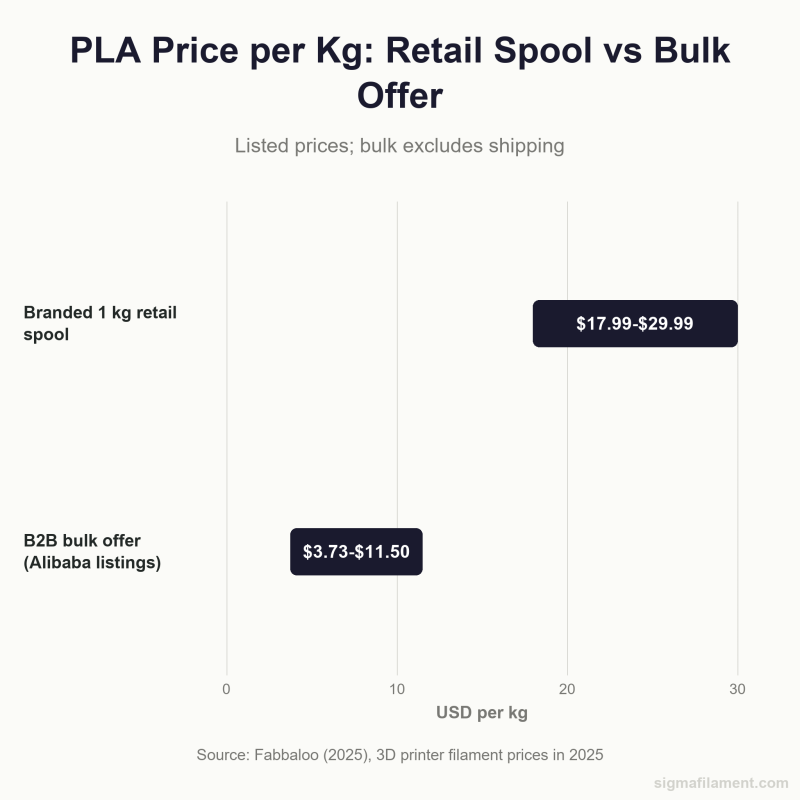
One comparison frames the rest of this guide: a branded 1 kg retail spool of PLA lists at roughly $18 to $30, while bulk PLA offers from suppliers such as Kingroon, SUNLU and eSun land between $5.04 and $10.05 per kilogram, a gap that B2B sourcing of bulk PLA opens up and that no top-10 result in the current ranking set explains (Fabbaloo, 2025).
The deal pages compete on percentage off MSRP, but the real arbitrage is at the channel level, not the coupon. The rest of this guide covers both: the seasonal cycle to time printer and spool buys, and the procurement layer where most of the recurring savings actually live.
The 2026 3D Printing Deal Calendar: Seasonal Sale Events
Five sale windows compress most annual 3D printing deals into roughly 90 days of trading: Amazon Prime Day in July, Singles Day on November 11, Black Friday in late November, Cyber Monday in early December, and brand anniversary or Father’s Day promotions through the shoulder months. Across the 2025 Black Friday and Cyber Monday window, Bambu Lab’s official store advertised discounts of up to 47% on its larger machines, and Prime Day saw the P1P drop near $400 from a $700 anchor (Nicholls, 2025; TechRadar, 2025).
Major sale windows and expected discount depth
The table below maps the windows our research surfaced, the discount depth manufacturers and retailers have published in 2025, and which product classes typically participate. Filament discounts tend to lag printer discounts by 5 to 10 percentage points because margins on consumables are thinner, but multi-spool bundles and accessory pack-ins close most of that gap.
| Sale event | Typical window | Expected discount depth | What goes on sale |
|---|---|---|---|
| Amazon Prime Day | Mid-July (48 hours) | 20-43% on printers, 15-30% on filament | Entry and mid-tier FDM printers, resin printers, 1 kg retail filament spools, Amazon-stocked accessories |
| Singles Day (11.11) | November 11 (1-7 days) | 20-40% on Chinese-brand storefronts | Direct-to-consumer printers (Anycubic, Creality, Kingroon, Elegoo), brand-store filament, scanner and laser bundles |
| Black Friday | Late November (3-7 days) | 20-47% on printers, 20-50% on filament | Full catalog: FDM, resin, multi-material flagships, retail and bulk filament, hotends, build plates |
| Cyber Monday | First Monday of December (24-48 hours) | 15-35%, often Black Friday carry-over | Online-only refresh of Black Friday inventory, brand-store exclusives, end-of-week stragglers |
| Brand anniversary sales | Various (Snapmaker, Bambu Lab, Elegoo, xTool, etc.) | Varies by brand; often 10-20% off flagship hardware | Tier-specific bundles, flagship printers, scanners, laser engravers, accessory kits |
| Father’s Day / mid-year promos | Early-to-mid June | Up to 40% on selected SKUs | Entry FDM printers, starter filament packs, gift-positioned bundles |
| End-of-year clearance | Late December into January | 10-30% on outgoing SKUs | Discontinued or refreshed-generation printers, overstocked filament colors, open-box units |
How you act on this calendar depends on burn rate. Hobbyists and single-printer households can run a just-in-time plan: wait for Black Friday or Prime Day, buy the printer and a 4-6 spool starter stack, then top up at retail between windows. Print farms and classrooms, along with OEM buyers running 50 kg or more of filament per month, should stockpile against the calendar instead, often by switching to larger 3 kg, 5 kg and 10 kg spool formats that compress changeover labor at the same time. Lock in 60-120 days of consumption during Black Friday and Singles Day, when retail per-kilogram pricing is closest to bulk-channel pricing, and reserve procurement orders for the gap months. The deal calendar is real money on hardware, but for materials it only shortens the gap to the wholesale price your operation can already access year-round.
How to Evaluate a 3D Printing Deal: A 6-Point Quality Framework
Not every advertised discount is a real saving. Deal-aggregator pages list promos but rarely test whether the headline percentage holds up against MSRP history, total landed cost, or the recurring economics of running a print operation. Use the six checks below to decide whether a 3D printing deal is worth your purchase order (Murray, 2026).
- Check MSRP price history, not the advertised percentage. A "40% off" badge means nothing if the reference price was inflated in the weeks before the sale. Pull the model’s price history on a tracker (CamelCamelCamel for Amazon listings, Keepa, or the manufacturer’s own past sale pages) and compare the sale price to the 90-day median, not the sticker (Murray, 2026).
- Compute total cost, not just the sticker. A $186 entry-level FDM printer is rarely $186 out the door. Add freight, sales tax, import duty for cross-border buys (5.8% US, 6.5% EU/UK on filament under HS 3916.90.00), a starter spool, a spare nozzle set, and a build-surface replacement. The honest sticker is the line that lands on your card.
- Compare $/kg, not $/spool, for filament. A four-spool bundle at $59.99 looks attractive until you weigh it: four 750 g spools is 3 kg, or $20/kg, while a single 1 kg spool at $17.42 is the cheaper material. Always normalize to dollars per kilogram before judging a filament promo.
- Factor failure and defect cost into the effective price. Community-reported FDM failure rates average around 10% (range 1-50%). On a $25/kg material burn, every percentage point of failure adds $0.25/kg of waste, plus the machine-hours lost. A "cheap" spool that prints poorly costs more than a tested one at full price.
- Check warranty and support, then read the firmware fine print for ecosystem lock-in. A closed firmware (proprietary slicer, locked filament profiles, paid cloud features) raises the long-run cost of ownership, even when day-one pricing is competitive. Confirm warranty length, parts availability, and whether the printer accepts third-party filament without degraded mode.
- Ask whether bulk procurement beats the one-off promo. For any buyer running more than two or three printers, a 20% Black Friday spool discount rarely beats wholesale: bulk PLA tiers run $5-$11/kg against $13-$30 retail, a 50-70% materials saving available every month, not once a year.
MSRP history vs advertised percentage
The "% off" label is the loudest signal on a deal page and the least reliable one. Anchor against the 90-day median price, the prior seasonal-event low, and the manufacturer’s own historical sale page. If the current price beats two of those three, the deal is real; if it only beats the freshly-raised MSRP, it isn’t.
Total cost, not sticker price
The deal that quietly wins is rarely the one with the biggest percentage. It’s the one where shipping, duty, consumables, failure cost, and material per kilogram all stay low across a 12-month order cadence. Score every 3D printing deal on landed total cost, not the badge above the buy button.
Printer Deals in 2026 by Price Band: Entry FDM to Prosumer and Resin
Across the 2026 retail cycle, observed printer sale prices land in four clean bands: entry FDM at $150-500 (Ender-3 V3 SE sourced at $186.15), mid FDM at $500-1,500 (Bambu A1 Combo sourced at $379, P1P at roughly $400 on Prime Day), prosumer multi-material at $1,500-3,000 (Bambu H2C at $2,399.99), and consumer resin at $200-800 (Photon Mono 4 at $189.99).
All prices below are observed at named retailers during specific 2026 sale windows and are time-sensitive. Treat them as anchors for evaluating future offers, not as a current quote.
| Price band | Typical MSRP | Sale-price range | Representative models | Best-fit buyer |
|---|---|---|---|---|
| Entry FDM ($150-500) | $200-500 | $186-220 | Creality Ender-3 V3 SE ($186.15 Amazon), Ender-3 V3 SE bundles (~$209.89), Anycubic Kobra entry (<$220) | First-time hobbyist, classroom, low-budget upgrader |
| Mid FDM ($500-1,500) | $700-1,500 | $379-1,299 | Bambu Lab A1 Combo ($379, CNET tested-best), Bambu Lab P1P (~$400 Prime Day, from $700), Creality K2 Plus / K2 Pro combos (<$1,299) | Serious hobbyist, small studio, multi-color prototyping |
| Prosumer multi-material ($1,500-3,000) | $2,200-3,000 | $2,399 | Bambu Lab H2C ($2,399.99 Best Buy), Bambu Lab H2D (~$2,399 range) | Production-leaning prosumer, multi-material engineering parts, side-business operator |
| Consumer resin ($200-800) | $250-800 | $189-380 | Anycubic Photon Mono 4 ($189.99), Elegoo Mars / Mars Pro ($269-380) | Miniatures, dental, jewelry, high-detail small parts |
(Murray, 2026; CNET, 2026)
Entry and mid FDM ($150-1500)
The entry band exists because Creality and Anycubic (with Elegoo close behind) run the Ender-3 V3 SE and Kobra Neo under $220 most months, and Prime Day pushes them below $190. That makes the entry band the right place to start for anyone learning the workflow or running a single school printer.
The mid band is where Bambu Lab dominates 2026 printer deals. The A1 Combo at $379 and the P1P at around $400 on Prime Day cover most prosumer needs (multi-color AMS, fast print speeds, reliable hardware) without crossing into prosumer pricing. A buyer producing a few parts a week, not a print farm, lands here.
Prosumer multi-material and resin
The prosumer FDM band is narrow and currently anchored by Bambu Lab. The H2C at $2,399.99 is the deal to watch when production-grade multi-material matters; H2D pricing tracks alongside. Below that, mid-band combos do most jobs at a third the price.
Resin sits in its own economy. The Photon Mono 4 at $189.99 and Elegoo Mars Pro at $269-380 cover detail-driven work that FDM cannot match (miniatures, dental, jewelry casting). Resin is not a substitute for FDM; the two address different use cases and rarely live in the same buy decision (Murray, 2026).
Filament Deals: Retail vs Bulk vs OEM-Wholesale (With $/kg Benchmarks)
Filament is the recurring cost in 3D printing, and the channel you buy through reshapes the math more than any seasonal promo does. A single 1 kg retail spool of branded PLA lists at roughly $18 to $30, while bulk offers from some of the same brands on a B2B marketplace land between about $5 and $11 per kilogram. That gap is not a sale; it is the price of buying like a print operation (Fabbaloo, 2025).
Retail and multipack deals
Single-spool retail is where most 3D printing deals on consumer SERPs live. Hatchbox PLA sits near $13.99 per kilogram on Amazon, Elegoo PLA near $17.42, and a 2025 price check found 1 kg spools of four well-known PLA brands listed between $17.99 and $29.99 (Fabbaloo, 2025). PETG retail anchors around $22 to $30 per kilogram, TPU runs $50 to $80, and PLA-CF composite holds at $40 to $60.
Multipack and seasonal sales compress those numbers but rarely break the channel floor, and reseller SKU planning is built around that floor rather than the retail-shelf headline. A 4 to 8 spool multipack on Amazon or a brand-direct Black Friday promo typically cuts 15 to 30 percent off single-spool retail, putting PLA in the $13 to $17 per kilogram range and PETG nearer $18 to $22. That is a real saving for a hobbyist printing under 20 kilograms a year. For a 10-printer studio burning 300 to 600 kilograms a month, the same percent off retail still loses to bulk pricing by a wide margin.
Bulk and OEM-wholesale per-kg pricing
The pricing structure shifts as the order size crosses MOQ thresholds. Bulk-weight cartons (often 5 to 20 kg of one color) move PLA into the $8 to $11 per kilogram band. Wholesale tiers at 100 to 499 kilograms (or roughly 100 to 500 spools) pull it down further, and OEM-wholesale at 500 plus spools per SKU lands at the bottom of the curve. Fabbaloo’s 2025 supplier benchmark documents Kingroon PLA at $5.04 per kilogram, SUNLU at $6.79, and eSun at $10.05 across that tier, with comparable curves for bulk PETG, TPU, and carbon-fiber wholesale tiers.
The headline number for any buyer evaluating procurement against promotions is this: bulk PLA from suppliers such as Kingroon, SUNLU and eSun lists at $5.04 to $10.05 per kilogram, against $17.99 to $29.99 for a branded 1 kg retail spool (Fabbaloo, 2025). On this guide’s own retail band of $13 to $30, that works out to a materials saving of roughly 50 to 70 percent, and it repeats on every reorder, not once a year.
| Material | Retail single spool | Multipack / sale | Bulk-weight | Wholesale 100-499 kg | OEM 500+ spools |
|---|---|---|---|---|---|
| PLA | $13-$30/kg | $13-$17/kg | $8-$11/kg | $6-$9/kg | $5-$7/kg |
| PETG | $22-$30/kg | $18-$22/kg | $12-$15/kg | $9-$12/kg | $7-$10/kg |
| TPU | $50-$80/kg | $40-$55/kg | $25-$35/kg | $18-$25/kg | $14-$20/kg |
| CF-PLA | $40-$60/kg | $32-$45/kg | $22-$30/kg | $16-$22/kg | $13-$18/kg |
The crossover point where bulk beats any retail promo is lower than most buyers assume. A printer running 15 kilograms of PLA per month covers a 100-spool MOQ in roughly seven months, and the per-kilogram saving against multipack pricing pays back the working capital well inside that window. This whole-operation guide sets the frame; the filament-only deep dive on bulk procurement carries the MOQ math, freight-mode tradeoffs, and a six-program wholesale comparison.
Where the Real Savings Live: The Cost Structure of a 3D Print Operation
In an FDM operation running at mid volume, recurring cost breaks down roughly as 38% labor, 28% materials, 14% machine depreciation, 10% failed prints and waste, 6% maintenance, and 4% electricity. That mix shifts hard at low volume, where one peer-reviewed lab study put labor near 88% of per-part cost (Pasculescu et al., 2022).
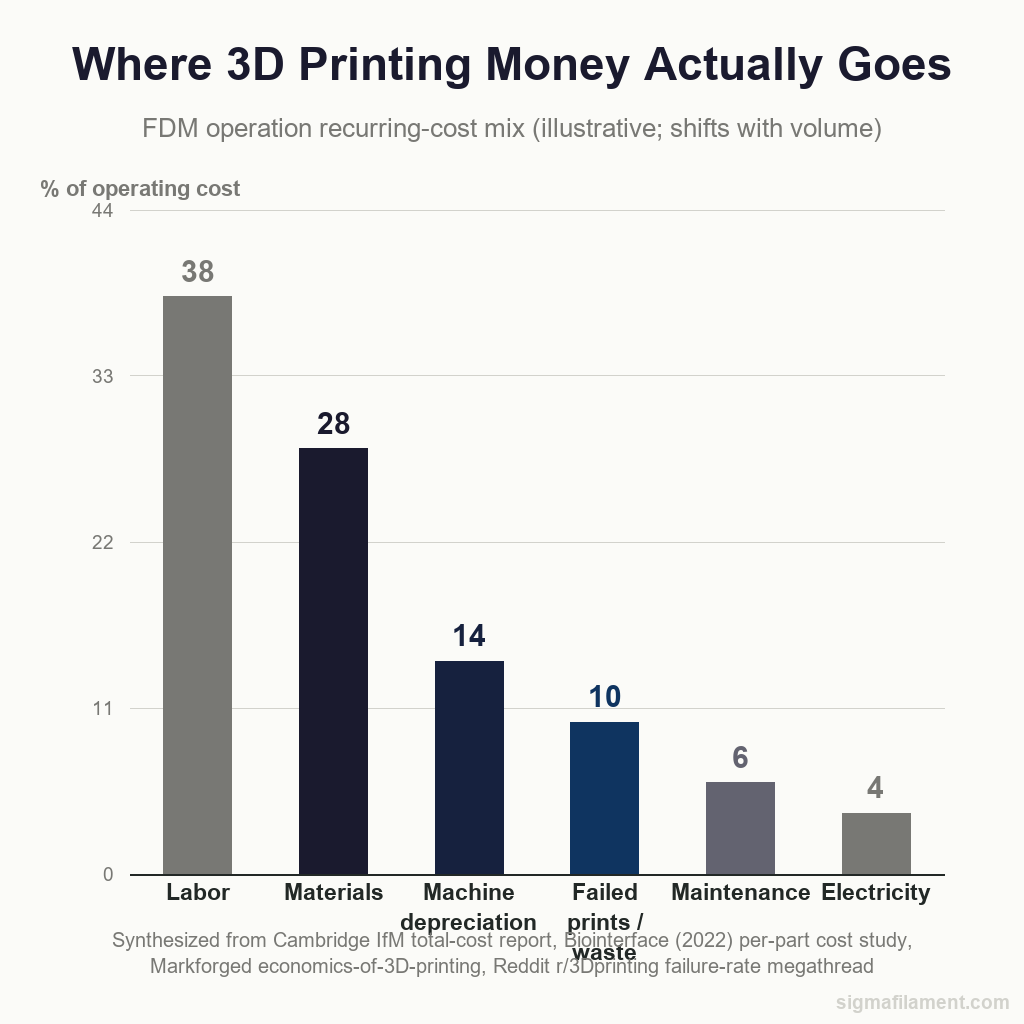
Where the money actually goes
Use the percentages above as an illustrative mid-volume mix, not a universal constant. The dollar anchors behind them come from sources no 3D printing deals roundup cites.
Labor sits at the top because someone has to slice files, load spools, level beds, harvest parts, and troubleshoot. The Biointerface study modeled €340 to €360 of labor per part against €2.35 of raw material and €0.71 of energy, so labor climbed to roughly 88% of total per-part cost at very low volume (Pasculescu et al., 2022). At print-farm volume that share compresses toward the 38% band shown in the chart, but it almost never falls below materials.
Materials run about 28% of the recurring mix at mid volume. Cambridge IfM puts industrial AM polymer at about £45.05/kg (Baumers et al., n.d.), while bulk PLA offers from suppliers such as Kingroon, SUNLU and eSun list at $5.04 to $10.05/kg against $17.99 to $29.99 for a branded 1 kg retail spool (Fabbaloo, 2025). The procurement choice between those two channels moves a large share of the 28% slice on its own, every month.
Machine depreciation is the next 14%. Cambridge IfM models an industrial machine cost rate of about £5.22/h across 5,000 annual print hours, one component of a total indirect cost rate of about £10.06/h (Baumers et al., n.d.).
Failed prints and waste account for around 10%. Community failure-rate data on r/3Dprinting clusters near 10%, with a 1 to 50% range that depends on the machine and material as much as on operator skill. That 10% is machine time plus filament plus electricity, written off. Maintenance (nozzles, belts, build plates) is roughly 6%. Electricity, at about 80 W per FDM printer during a print, lands near 4% in most desktop FDM scenarios.
That gives you the six-line breakdown shown in the chart (Baumers et al., n.d.; Pasculescu et al., 2022; r/3Dprinting community, 2022).
Why deal pages never publish this
Deal roundups optimize for affiliate clicks on hardware and 1 kg spools. The recurring cost stack above is structurally invisible to that page format: labor and depreciation, plus waste and maintenance, are not SKUs anyone can link to.
Reframe the question. A 30% Black Friday discount on a $700 printer saves $210 once. Compressing the materials line by 50% on a 200 kg annual filament burn, at $20/kg retail versus $9/kg bulk, saves about $2,200 every year that the operation runs. Trimming the failure rate from 10% to 5% on that same burn recovers another $900. Neither shows up on a sale page, and neither expires when the promotion does.
This is what cost-structure optimization looks like in practice: the printer purchase is a one-time line, while materials, labor productivity, and failure rate are six monthly lines that compound. The seasonal sale calendar still matters for hardware, as the earlier sections laid out. The bigger lever lives in the rest of the chart.
Methodology and limitations
The six-line percentage mix is calibrated to a mid-volume desktop FDM operation (roughly 5 to 20 printers, 200 to 600 kg of annual material throughput, mixed PLA and PETG, 4,000 print-hours per machine per year). It is a composite estimate built from the Cambridge IfM industrial-AM cost model, the Biointerface low-volume per-part study, and the community-reported failure-rate distribution on r/3Dprinting (Baumers et al., n.d.; Pasculescu et al., 2022; r/3Dprinting community, 2022). Three limitations apply. First, very low-volume operations (under 100 kg per year) push labor share above 80% and compress materials and depreciation accordingly. Second, resin and industrial-AM cost stacks have different shape: resin trades higher consumable cost (post-cure alcohol, FEP film, build-plate replacements) against lower labor, and industrial systems carry a higher fixed cost-rate. Third, regional electricity prices and labor rates can shift the labor and electricity lines by a factor of two without changing the relative ranking of materials and depreciation. Treat the chart as a planning anchor, not a universal constant.
Bulk Procurement Economics: MOQ, Incoterms, and Landed Cost per Kg
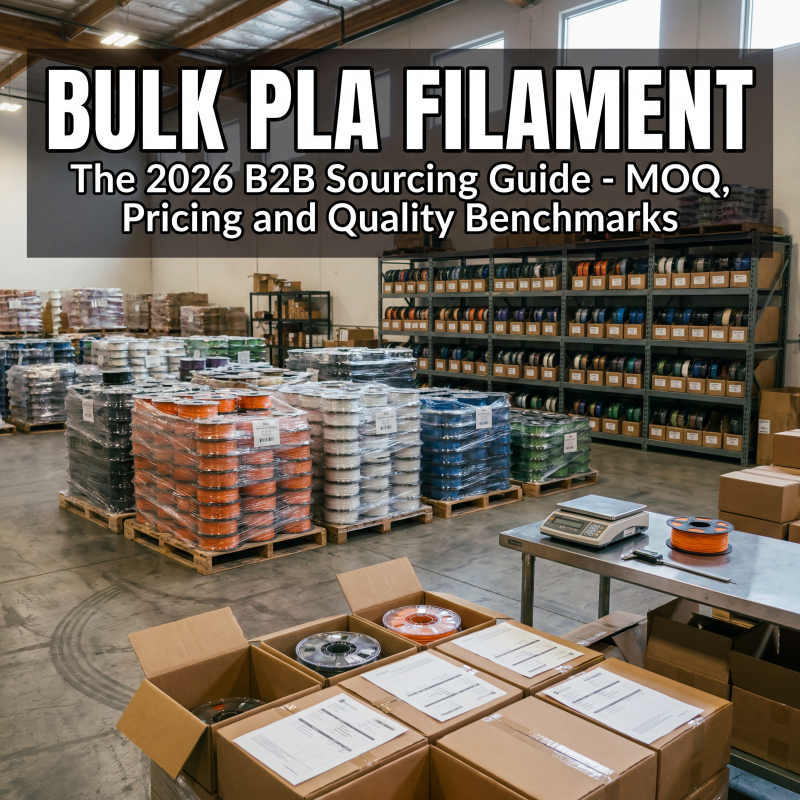
For any buyer past the single-spool stage, the 3D printing deals that repeat every month do not live on the sale page. They live in procurement math. A 1,000 kg PLA order from a source manufacturer lands in the $7 to $9 per kg range delivered, against a branded retail spool. That gap is structural, not seasonal, and it survives every Black Friday cycle.
MOQ tiers and bulk discount structure
Source manufacturers price in tiers, and the entry point is lower than most buyers expect. A typical structure at a Shenzhen filament factory looks like this: 100 spools as the standard stock MOQ (around $10 per kg landed-cost-equivalent at FOB), 500-plus spools earning up to 15% off list, and 1,000-plus spools earning up to 20% off, with OEM custom colors and private-label runs starting at 500 spools. A 100-spool order is roughly 100 kg, which is one quarter of a typical reseller’s monthly burn. Wholesale per-kg pricing from Chinese suppliers benchmarks at $5 to $11 per kg (Kingroon $5.04, SUNLU $6.79, eSun $10.05), against a retail PLA band of $13 to $30 per kg (Fabbaloo, 2025). SigmaFilament offers this 100-spool entry MOQ with the 15% and 20% tier breaks at 500 and 1,000 spools, sourcing from 100% virgin NatureWorks PLA pellets out of a 10,000 sqm Shenzhen facility.
Incoterms decide who pays what. Under FOB (Free on Board), the buyer takes title at the origin port and pays ocean or air freight, import duty, customs broker, and last-mile delivery. Under CIF (Cost, Insurance, Freight), the seller covers freight and marine insurance to the destination port, but the buyer still clears customs and pays duty. DDP (Delivered Duty Paid) is the all-in option: the seller covers freight and duty plus delivery to the buyer’s door, simplest for first-time importers but priced for the convenience. DAP (Delivered at Place) is DDP minus the duty, which the buyer settles on arrival (Dutiable.io, 2026).
A landed-cost-per-kg worked example (Incoterms)
Walk a 1,000 kg PLA order from Shenzhen to a US warehouse on FOB ocean LCL. The FOB unit price runs 1,000 kg × $6/kg = $6,000. Ocean LCL freight adds ~$1.20/kg × 1,000 kg = $1,200, and US import duty (HS 3916.90.00, 5.8%) is $6,000 × 0.058 = $348. Then come the smaller lines:
- Customs broker, single entry: $200
- Merchandise Processing Fee (0.3464%, $31.67 minimum): $31.67
- Last-mile and handling: ~$100
Total delivered cost: $7,879.67, or $7.88 per kg landed. The same 1,000 kg moved by air ($7.73/kg freight per Sino-Shipping) lands closer to $14 per kg, so freight mode is the dominant variable (Dutiable.io, 2026). Either path beats a branded retail spool by a wide margin, every month, with no coupon required.
Print-Farm Total Cost of Ownership: 10- and 50-Printer Scenarios
Sticker-price 3D printing deals rarely move the needle for a print farm: in the total-cost model below, hardware is one line in seven, and the recurring lines are bigger.
The TCO formula
A workable print-farm TCO model has seven recurring lines, each annualized. Hardware amortization spreads machine acquisition over a 3 to 5 year useful life, and materials are simply kilograms consumed per year times landed cost per kg. Labor covers operator time across queuing, removal, post-processing, and QC. Electricity is the active watt-draw of about 80 W per FDM machine times print hours times grid rate, while maintenance and consumables bundle nozzles and belts, build plates and hotends, plus routine calibration. The failure-rate line applies the share of print jobs scrapped (community-reported 10%, range 1 to 50%) to both material and machine hours. Facility comes last: floor space, ventilation, racking, climate control.
A per-part cost formula is useful when quoting work; the per-year framing above is better for planning capacity. Cambridge IfM’s industrial study puts the total indirect cost rate at about £10.06 per hour, of which the machine cost rate is about £5.22 per hour (Baumers et al., n.d.).
10-printer vs 50-printer economics
Scale changes which lines dominate. A 10-printer studio amortizing $7,000 of consumer hardware per machine, running 4,000 print hours each year, burning 6,000 kg of PLA at retail $20/kg, lands roughly: $23,000 in amortized hardware (a three-year write-down of the $70,000 fleet), $120,000 materials, plus labor and the rest. Materials already outweigh the amortized hardware line by about 5x.
Drop to wholesale or OEM landed cost ($7/kg) on the same 6,000 kg burn, and the materials line falls from $120,000 to $42,000, a $78,000 annual swing that no Black Friday printer discount can match. A 50-printer farm at 30 tonnes a year sees the same lever multiply to roughly $390,000 a year, the order of magnitude behind any print-farm profitability calculation (GrandpaCAD, n.d.; Fabbaloo, 2025).
That is the through-line of this whole guide on 3D printing deals: the printer price is a once-every-four-years decision; landed cost per kg is a decision you re-bank every month. For any operator past five machines, procurement structure outweighs promotional pricing on every horizon longer than a quarter.
Frequently Asked Questions
How much does it cost to start a 3D printing business?
A 2-3 printer side-hustle typically runs $1,800-$2,800 all-in, covering printers, an initial filament stock, spare nozzles and belts, an enclosure, and shipping supplies (GrandpaCAD, n.d.). Scaling to a 10-printer studio pushes hardware alone past $6,000 before factoring in labor, electricity, and failure-rate buffers. Procurement, not the printer purchase, dominates year-two economics.
Is 3D printing expensive?
It depends on volume. Per-part energy is small (roughly $0.05 for a 45 g PETG print at $0.12/kWh), but in low-volume work labor can consume around 88% of per-part cost (Pasculescu et al., 2022). The printer’s sticker price is the smallest recurring line; materials and labor, with failed prints alongside, set the real budget.
When is the best time to buy a 3D printer?
Time hardware purchases to four windows: Amazon Prime Day (mid-July, 20-43% off), Black Friday and Cyber Monday (late November, 20-47% off), Singles Day (November 11, strong on Chinese-brand stores), and manufacturer anniversary events. Bambu Lab, Creality and Anycubic all participate consistently, as do Elegoo and Polymaker. Outside those windows, MSRP rarely moves more than 10%.
Where can I find the best 3D printing deals?
Brand storefronts (Bambu Lab, Creality, Anycubic, Elegoo) post the deepest first-party discounts during seasonal events. Editorial roundups like Tom’s Hardware and CNET aggregate cross-brand pricing and verify sale claims against MSRP history. For procurement-grade pricing, request quotes directly from manufacturers and compare landed cost, not the advertised percentage off.
How much does 3D printer filament cost in bulk?
Bulk and wholesale PLA from China-supplier benchmarks runs $5-$11 per kilogram at MOQs of 100-500 spools, with Kingroon near $5.04/kg, SUNLU around $6.79/kg, and eSun about $10.05/kg. PETG bulk tiers sit roughly $1-$3 above PLA. OEM/ODM programs at 500+ spool volumes can clear $5-$7/kg before freight and duty.
Is it cheaper to buy filament in bulk?
Yes, materially. Bulk PLA offers list at about $5-$10/kg against $18-$30 for a branded 1 kg retail spool (Fabbaloo, 2025), a materials saving that no seasonal coupon matches. Landed cost is the qualifier: a 1,000 kg China-to-US air-freight example lands around $14/kg total once you add freight, the 5.8% duty, broker fees and the MPF. Ocean LCL drops that further at sufficient volume.
How do I reduce my 3D printing costs?
Pull four levers. Move filament procurement from retail to bulk or OEM-wholesale for the largest recurring saving. Lift machine uptime with reliable profiles and operator workflow to compress labor share. Tighten failure rates (community average sits near 10%) through calibration and slicer discipline. Right-size hardware to actual throughput rather than buying capacity you do not yet need.
What is the cheapest 3D printer filament per kg?
Kingroon-tier bulk PLA, at roughly $5.04 per kilogram under MOQ procurement, is the lowest verified per-kg benchmark in current supplier data. SUNLU bulk PLA at $6.79/kg and eSun at $10.05/kg sit in the same wholesale tier. Retail single spools never reach those numbers; the savings are gated by minimum order quantity, not by waiting for a sale.
Conclusion
3D printing deals are worth timing. Prime Day, Black Friday, Cyber Monday, and Singles Day move printer and retail spool prices the most, and any advertised discount should be checked against a real MSRP history rather than the percentage on the banner. That cycle is real money on a one-off purchase.
The durable savings sit somewhere else. For anyone running more than a handful of machines, recurring cost is dominated by materials and labor, plus machine uptime and the failure rate, not the printer’s sticker. Bulk and wholesale filament at roughly $5 to $11 per kilogram against $13 to $30 retail compresses the largest line on the operating sheet by 50 to 70 percent, every month, with no coupon required. MOQ tiers and Incoterms, paired with a clean landed-cost-per-kg calculation, usually beat the best seasonal promo by a wide margin once volume is steady.
Buyers who want to take that lever can look at a source manufacturer’s wholesale PLA program and OEM/ODM options, or get in touch for a landed-cost quote against current usage. Time the hardware buy on the calendar, then move the filament line off the retail shelf.
Figures in this guide combine 2026 retail sale prices observed at named US retailers (Amazon, Best Buy) and printer makers’ own storefronts, with wholesale per-kilogram benchmarks from China-supplier programs listed in Fabbaloo’s 2025 price check (Kingroon, SUNLU, eSun). Cost-structure modeling draws on the Cambridge IfM industrial-AM study and the Biointerface lab-scale per-part study; freight and duty arithmetic uses Sino-Shipping rate cards and HS code 3916.90.00 (Dutiable.io). Retail prices are seasonal and tier-dependent and should be verified before any purchase order. Where the article gives a percentage saving (such as 50 to 70%), it is this guide’s arithmetic on the bands above, not a guarantee for any single SKU.
References
- Baumers, M., Tuck, C., Wildman, R., Ashcroft, I., Rosamond, E., & Hague, R. (n.d.). The economics of 3D printing: A total cost perspective. University of Cambridge Institute for Manufacturing. https://www.ifm.eng.cam.ac.uk/uploads/Research/TEG/3DP-RDM_Total_cost_report.pdf
- Pasculescu, A. C., et al. (2022). Cost profile of 3D printing using biomaterials on a lab scale. Biointerface Research in Applied Chemistry, 13(1), Article 93. https://biointerfaceresearch.com/wp-content/uploads/2022/02/BRIAC131.093.pdf
- Fabbaloo. (2025). 3D printer filament prices in 2025: From $5 bulk deals to premium brands. https://fabbaloo.com/news/3d-printer-filament-prices-in-2025-from-5-bulk-deals-to-premium-brands
- Murray, D. (2026). Best 3D printer deals 2026: deals on Bambu Lab, Prusa, Creality, Elegoo, and more. Tom’s Hardware. https://www.tomshardware.com/news/best-3d-printer-deals
- Nicholls, B. (2025, November 26). Live: Last chance for Cyber Monday 3D printing deals with up to 50% off. Creative Bloq. https://www.creativebloq.com/live/news/black-friday-3d-printing-deals
- TechRadar. (2025). Amazon Prime Day printer deals and 3D printer deals 2025. https://www.techradar.com/pro/prime-day-printer-deals
- Dutiable.io. (2026). 3D printer filament (PLA / ABS / PETG) HS code 3916.90.00: duty 5.8% (US), 6.5% (EU/UK). https://dutiable.io/hs-code/arts-crafts/3d-printer-filament
- r/3Dprinting community. (2022). What’s your average failure rate? Reddit. https://www.reddit.com/r/3Dprinting/comments/ud34k9/whats_your_average_failure_rate/
- GrandpaCAD. (n.d.). 3D printing business calculator: Profit, print farm ROI and pricing. https://grandpacad.com/en/tools/3d-printing-business-calculator
- CNET. (2026). Best 3D printer deals: Many of our favorite models are on sale. https://www.cnet.com/deals/best-3d-printer-deals/
Last reviewed and updated: June 2026. Author: SigmaFilament team. For tailored guidance, contact our team.