PLA silk glossy filament: 2026 sheen and strength explained

TL;DR
Silk PLA is glossy because a small copolymer load (PHA/TPU/TPC) smooths the surface and makes reflection specular instead of diffuse. The trade-off is mechanical: standard PLA runs ~46-49 MPa UTS on ASTM D638 specimens, silk PLA ~40 MPa, a 13-18% strength reduction. Maximize sheen with a hotter nozzle (215-225 degC), slower outer walls (30-35 mm/s), wider line width (120-130% of nozzle), 0.20-0.24 mm layers, and modest cooling (30-50%). For volume buyers, silk PLA is sourced OEM at MOQ 100-500 spools with deltaE <1.5 color matching and ASTM D638 / ISO 1183 verification.
Abstract
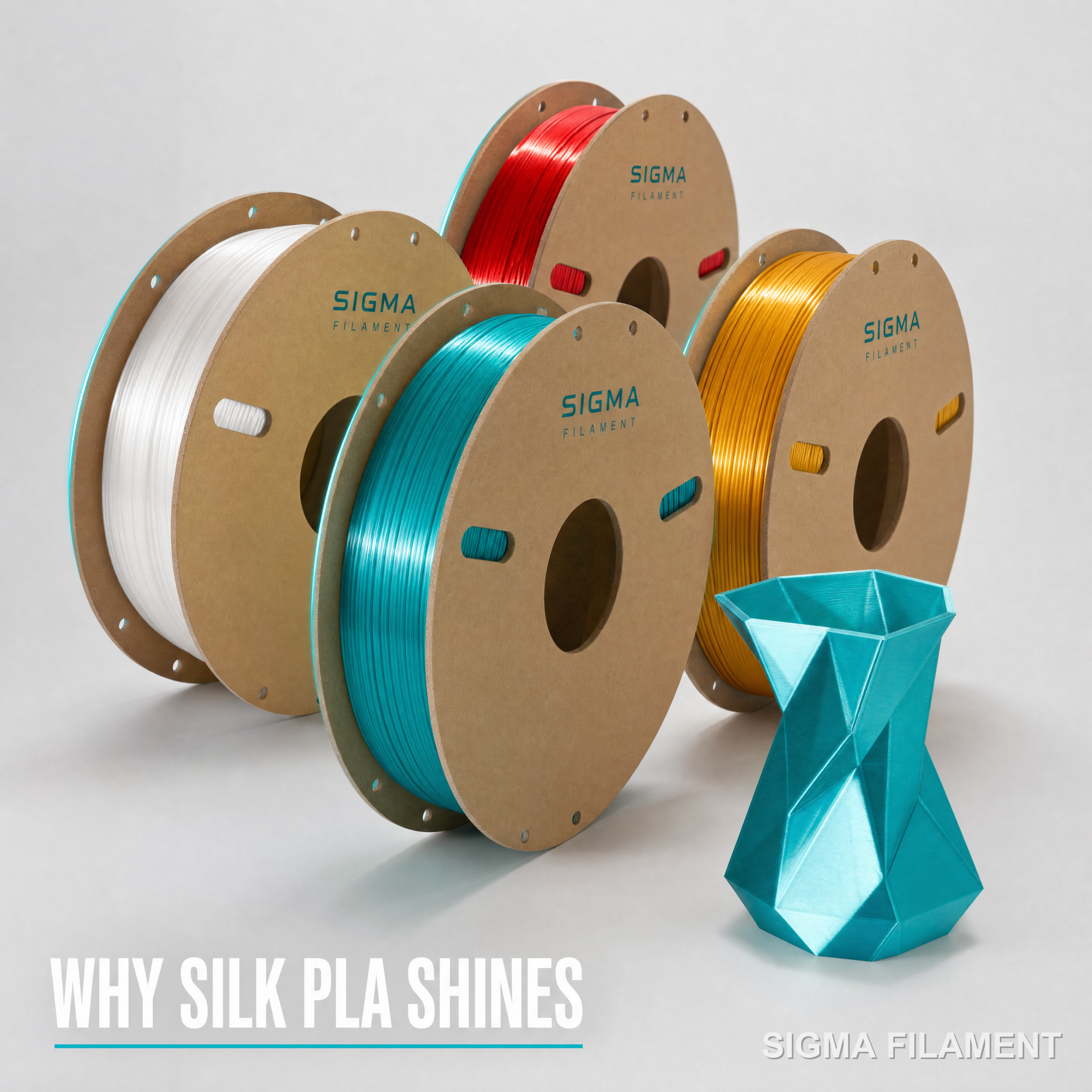
Silk glossy PLA is standard polylactic acid modified with a small load of soft copolymer, most often polyhydroxyalkanoate, thermoplastic polyurethane, or thermoplastic copolyester, blended in at roughly 3 to 10 percent (Wikipedia contributors, 2026). That modifier lowers melt viscosity and smooths the printed surface enough that reflection turns from diffuse to specular, which is why a silk PLA part reads satin or pearlescent rather than chalky. The sheen lives in the bulk material, not in any coating or polish. The same modifier that produces that glossy appearance also interrupts polylactide chain packing, so silk PLA pays for its gloss in tensile strength: standard PLA tests at roughly 46 to 49 MPa ultimate tensile strength on ASTM D638 specimens, while silk PLA lands near 40 MPa, a 13 to 18 percent reduction on identical geometry (Ekşi & Karakaya, 2025; ASTM International, 2022).
This guide is written for OEM brand owners, print-farm operators, and resellers evaluating silk PLA as a product category rather than a single spool. It covers the gloss mechanism in chemical detail, a three-way comparison of silk versus matte versus standard PLA, the quantified strength trade-off in MPa, the print settings that maximize sheen and the defects to expect when they drift, how dual-color, tri-color, and rainbow silk PLA are coextruded, where the material fits and where it does not, and how to source silk PLA at volume with verifiable quality control.
Key Takeaways
- Gloss is chemistry, not coating: a 3 to 10 percent PHA, TPU, or TPC copolymer load makes reflection specular, so the sheen is bulk material (Wikipedia contributors, 2026).
- Sheen costs strength: standard PLA runs about 46 to 49 MPa UTS on ASTM D638, silk PLA near 40 MPa, a 13 to 18 percent drop (Ekşi & Karakaya, 2025).
- Print hotter and slower: a 215 to 225 degC nozzle with slow outer walls develops the sheen; the same spool prints matte below 200 degC.
- Layer lines stay visible: silk PLA smooths the surface but exposes seams and banding, unlike filler-based matte PLA that hides them.
- Multicolor is coextruded: dual-color, tri-color, and rainbow silk are banded at the extruder, not blended from pigments, and ship as single-spool SKUs.
- Treat it as decorative-grade: specify silk PLA for display and aesthetic parts, and standard or toughened PLA for load-bearing ones.
Table of Contents
- TL;DR
- Abstract
- Key Takeaways
- Table of Contents
- What is silk (glossy) PLA?
- The gloss mechanism: copolymers and additives that make PLA shiny
- Silk PLA vs matte PLA vs standard PLA
- The gloss-versus-strength trade-off (with the MPa data)
- Best print settings to maximize silk sheen (and fix common defects)
- Multi-color silk PLA: dual-color, tri-color, and rainbow
- Where silk PLA fits: applications and limitations
- Sourcing silk PLA at scale: OEM, private label, and QC
- Frequently Asked Questions
- Conclusion
- Further Reading
- References
What is silk (glossy) PLA?
Silk (glossy) PLA is standard polylactic acid that has been modified with a small load (typically 3 to 10 percent) of a soft copolymer, most often polyhydroxyalkanoate (PHA), thermoplastic polyurethane (TPU), or thermoplastic copolyester (TPC). That copolymer lowers melt viscosity, smooths the printed surface at the micron scale, and shifts reflection from diffuse to specular, which is why a printed part looks satin or pearlescent rather than chalky. The sheen comes from the bulk material itself, not from a wax, lacquer, or post-process polish (Wikipedia contributors, 2026).
In one sentence: silk glossy PLA is polylactic acid blended with a 3 to 10 percent load of PHA, TPU, or thermoplastic copolyester that smooths the printed surface below the visible-light wavelength and turns reflection specular instead of diffuse, with no coating involved (Wikipedia contributors, 2026).
Silk PLA defined: a finish family, not a color
The label "silk" describes a finish mechanism, not a hue. The same copolymer chemistry sits underneath silver, red, copper, jade, dual-color, tri-color, and rainbow SKUs; only the masterbatch pigment differs between them. Treating silk as a finish family rather than a color is what lets a single print profile carry across an entire product line and what lets a manufacturer hold one chemistry across many color matches.
Why the surface looks satin/shiny (specular vs diffuse reflection)
Reflection on a printed wall depends on surface roughness at scales below visible light. A rougher surface scatters incoming light in many directions, which the eye reads as a diffuse, matte look. A smoother surface reflects more of that light in a single coherent direction, which the eye reads as gloss, sheen, or a mirror-like highlight. The copolymer in silk PLA reduces melt viscosity at the nozzle and lets the extruded bead level itself before it freezes, so the outer wall solidifies with finer surface roughness and the reflection becomes specular instead of diffuse.
Silk PLA is not the same as PLA+ or a polished standard PLA
PLA+ is a separate category aimed at toughness and interlayer adhesion, usually formulated with impact modifiers rather than gloss-shifting copolymers; on identical ASTM D638 specimens it tends to test slightly above standard PLA, not below it (Hanon et al., 2021). A controlled PLA+ versus standard PLA bench comparison confirms that pattern at the spool level. Standard PLA buffed or vapor-treated after printing can look shiny, but the gloss is a coating-layer effect that does not survive scratches and does not change the base mechanical behavior. Silk PLA, in contrast, ships the sheen inside the polymer blend itself. That mechanism difference is why silk PLA also carries a measurable strength penalty, which the next section quantifies in MPa.
The gloss mechanism: copolymers and additives that make PLA shiny
Silk PLA looks glossy because a small fraction of a second polymer, blended into the PLA pellet before extrusion, alters how the melt flows out of the nozzle and how the cooled surface scatters light. The pigment system layered on top of that base is what gives silk PLA its color depth, but the sheen itself is a melt-rheology and surface-roughness effect, not a coating, polish, or post-process. Standard PLA, printed with the same pigment, returns a semi-matte finish because its surface freezes with more microscopic irregularity.
PHA (polyhydroxyalkanoate) blends
PHA is the most commonly named copolymer in pla silk glossy formulations. As a bio-derived thermoplastic, PHA is miscible with PLA at low loadings and lowers the blend’s effective melt viscosity, which lets the extruded bead spread and self-level before it solidifies (Posch, 2025). The result is a smoother outer wall and a more uniform reflection plane. PHA also shifts crystallinity behavior, which contributes to the slightly softer, less brittle hand feel buyers associate with silk PLA versus standard PLA.
TPU and thermoplastic copolyester (TPC) modifiers
TPU (thermoplastic polyurethane) and TPC (thermoplastic copolyester) work through a similar mechanism. Both are flexible thermoplastics added at single-digit percent loadings to plasticize the PLA matrix, drop the glass transition slightly, and reduce melt viscosity so the printed line lays down with fewer surface defects (Wikipedia contributors, 2026). TPU contributes a small elongation gain that softens layer-line edges; TPC tends to extend the temperature window over which the gloss develops. Neither additive is decorative on its own; their role is to make the surface optically smooth after the bead solidifies.
Silicone surfactants and mica/metallic pigment
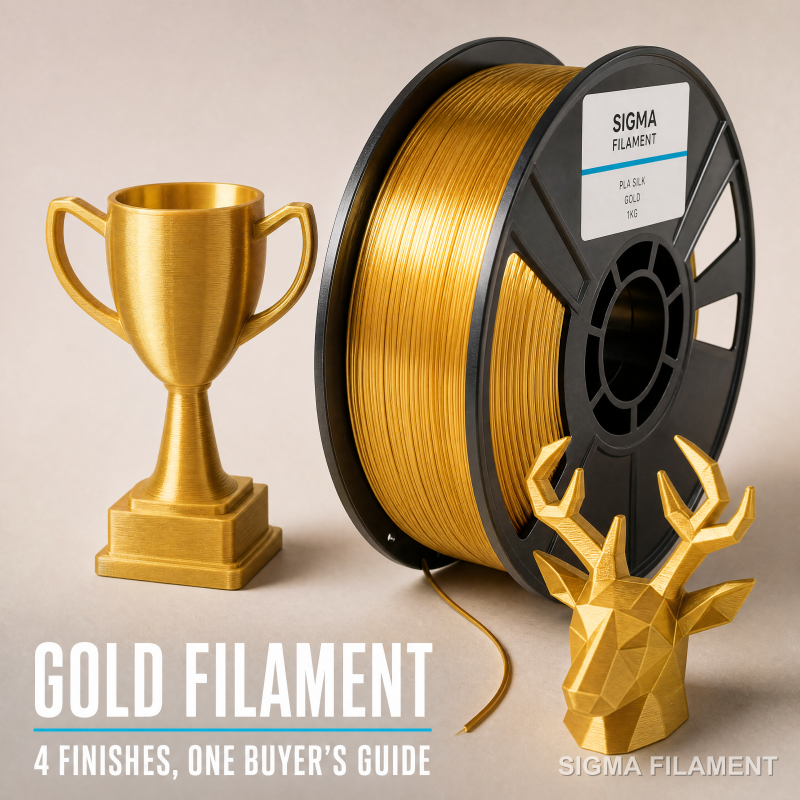
A secondary set of additives fine-tunes the sheen. Silicone surfactants, typically polydimethylsiloxane-based, migrate to the melt-air interface during extrusion and reduce surface tension at the print head, which suppresses micro-craters on the bead. Mica platelets and metallic flake pigments, common in the silver and bronze (and to a lesser extent gold) silk PLAs, align with the flow direction during extrusion and reflect light along a preferred axis (Wikipedia contributors, 2026). That alignment is what gives multi-color silk PLA its directional shimmer when the part is rotated under light, distinct from a flat dyed PLA.
How melt viscosity and surface smoothing produce specular reflection
The mechanism reduces to one variable: peak-to-valley surface roughness on the printed outer wall. Diffuse reflection dominates when the printed surface is rough and irregular relative to the wavelength of visible light, so incident light scatters in many directions and the part reads matte. The more specular, satin response that gives silk PLA its sheen emerges as that roughness falls and the surface grows more uniform, so a larger share of reflected light stays coherent instead of scattering. The copolymer load is what gets the printed surface there. A lower melt viscosity lets each deposited bead sag and self-level for a fraction of a second longer before it freezes, so layer-line peaks soften and inter-line valleys partly fill in. Cooling matters in the same direction: 30 to 50 percent fan keeps the bead fluid long enough to level; 80 to 100 percent fan freezes the irregular shape that standard PLA gives.
Silk PLA’s gloss comes from a 3 to 10 percent copolymer load (PHA, TPU, or TPC) that lowers melt viscosity at 215 to 225 degC, so the extruded bead self-levels before solidification and the printed surface grows smooth and uniform enough to reflect light specularly; below 200 degC the same filament freezes rough and prints matte (Wikipedia contributors, 2026).
Pigment alone cannot do this. Pigment changes color, not roughness, which is why a polished standard PLA part with the same colorant still reads semi-matte under direct light. That is also the technical reason a silk-finish manufacturer specifies copolymer ratio first and pigment second, and why pla silk glossy filament is sold as a finish family across all colors rather than as a single color line. For a wider tour of how pigment systems read on the printed wall, see this 2026 PLA color buyer’s guide.
Silk PLA vs matte PLA vs standard PLA
Buyers evaluating PLA silk glossy stock against matte and standard PLA are choosing across three different finish chemistries, not three style options. Silk PLA carries a 3-10% PHA, TPU, or thermoplastic copolyester load that smooths the printed surface and produces specular reflection. Matte PLA carries non-reactive fillers (typically corn-derived or chalk-based) that roughen the surface and scatter light diffusely; the deeper matte vs standard PLA comparison breaks down the filler chemistry in detail. Standard PLA contains neither set of modifiers and lands in the middle of the gloss range with a semi-gloss finish driven mostly by layer geometry (Wikipedia contributors, 2026).
Appearance: specular sheen vs diffuse matte vs semi-gloss
Silk PLA reflects light like a polished surface, so colors read saturated and the part shows clear highlights. Matte PLA reflects diffusely, which mutes color and removes highlights. Standard PLA sits between the two: visible layer lines, mid-range brightness, no satin sheen (Wikipedia contributors, 2026).
Surface and layer-line visibility
Matte PLA is the only finish family that visually hides layer lines. The filler particles break up the regular striation pattern, so a 0.20 mm layer reads as a uniform texture. Silk PLA does the opposite. Its low melt viscosity flattens layers into a smoother surface, which makes any banding, seam blob, or Z-axis defect more visible, not less. Standard PLA shows layer lines plainly and benefits most from finer layer heights for visual smoothing.
Mechanical and printing differences at a glance
Standard PLA tests at roughly 46-49 MPa ultimate tensile strength on ASTM D638 specimens; silk PLA lands near 40 MPa on identical geometry, a 13-18% reduction tied to the copolymer load that produces the sheen. Matte PLA’s filler-based formulation tests close to standard PLA, around 45 MPa, because corn or chalk fillers do not soften the polymer matrix the way PHA, TPU, or TPC does (Ekşi & Karakaya, 2025).
Print difficulty also splits the three. Silk PLA needs a higher nozzle temperature (215-225 degC) and slower outer walls to show its sheen, matte PLA prints at standard PLA parameters, and standard PLA is the easiest of the three to dial in for a print farm running mixed jobs.
| Property | Silk PLA | Matte PLA | Standard PLA |
|---|---|---|---|
| Finish / sheen | High specular gloss | Diffuse matte | Semi-gloss |
| Layer-line hiding | Poor (smoother surface exposes defects) | Strong (filler breaks striation) | Weak (lines plainly visible) |
| Tensile strength (UTS, ASTM D638) | ~40 MPa | ~45 MPa | ~46-49 MPa |
| Ease of printing | Hardest (narrow temp window) | Easy (standard PLA profile) | Easiest |
| Typical use | Decorative, display, vase-mode showpieces | Models, busts, props where seams must vanish | General prototyping, functional parts |
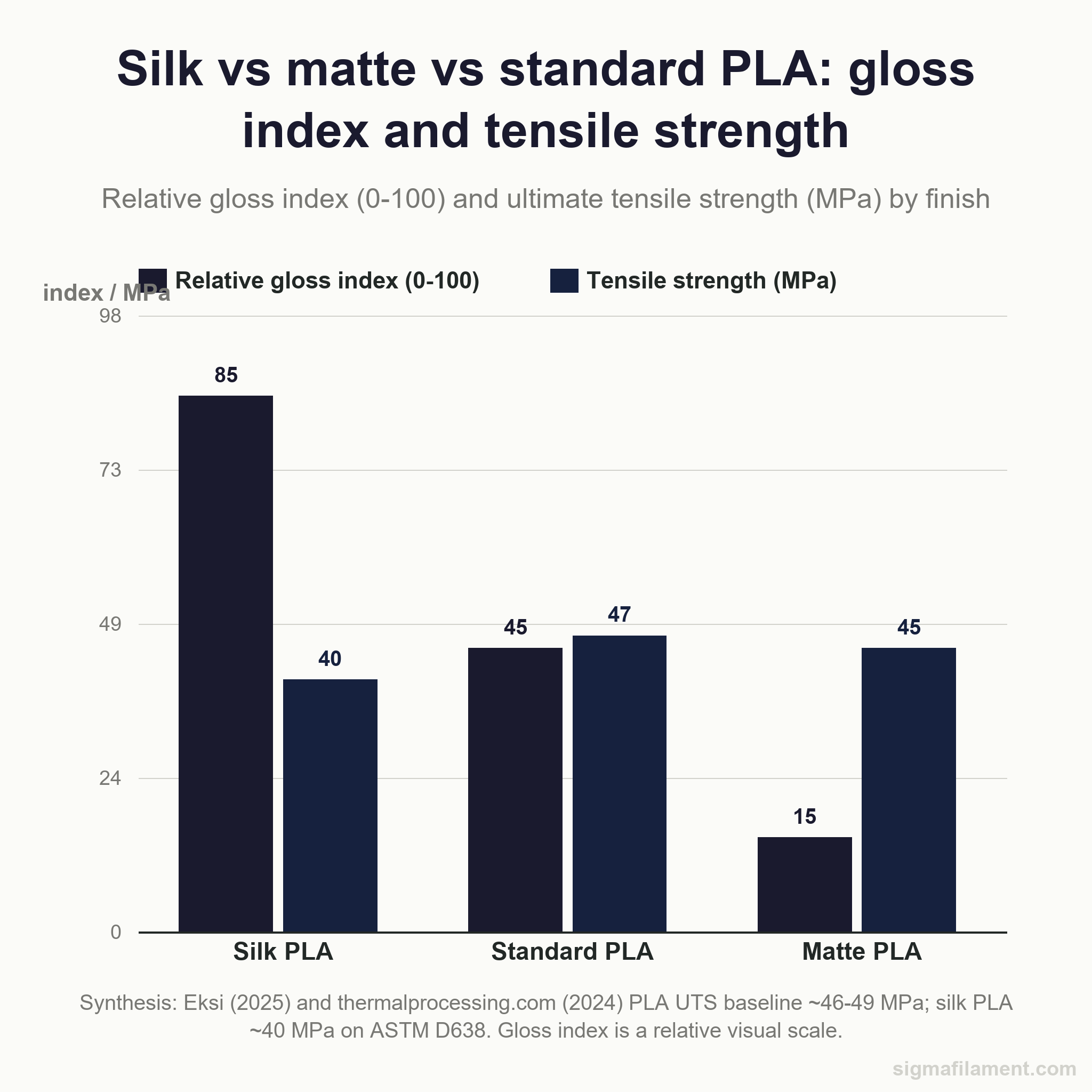
Standard PLA is therefore the load-bearing choice in this trio; the 2026 best-PLA buyer’s guide maps the spec band buyers should expect from any virgin-resin standard PLA. Silk PLA is the aesthetic choice for parts that read as polished plastic at first glance. Matte PLA is the right pick when the goal is hiding the FDM process itself. OEM buyers stocking all three SKUs should label spools clearly by finish family, since the print profiles do not transfer cleanly between them and a print farm switching silk to matte without adjusting nozzle temperature will lose hours to under-extruded first layers.
The gloss-versus-strength trade-off (with the MPa data)
The same copolymer load that produces silk PLA’s specular sheen also lowers its mechanical performance. Sheen is a surface-smoothing effect: a 3-10% PHA, TPU, or TPC modifier reduces melt viscosity so each printed road flows out flatter, and flatter roads reflect light coherently instead of scattering it (Wikipedia contributors, 2026). The cost is that the same modifier interrupts the regular polylactide chain packing that gives standard PLA its tensile strength and interlayer adhesion. There is no formulation trick that recovers both at the same time.
Standard PLA baseline: ~46-49 MPa UTS on ASTM D638
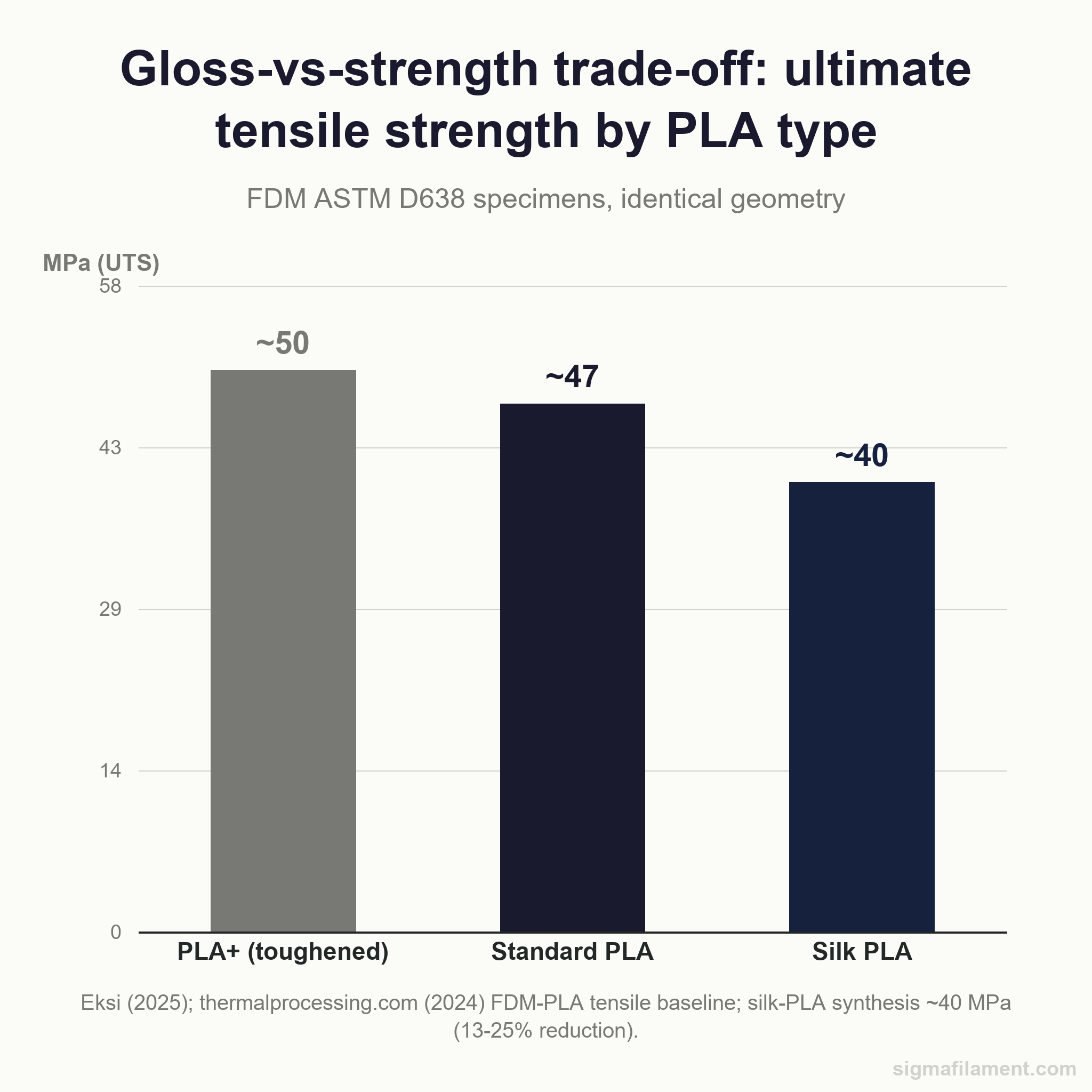
Tensile testing of FDM-printed standard PLA on ASTM D638 Type IV specimens, identical geometry and print orientation, lands in a tight band of roughly 46 to 49 MPa ultimate tensile strength (Ekşi & Karakaya, 2025; N = 9 specimens). That figure assumes neat PLA, no pigment masterbatch beyond ~2%, and a print profile tuned for mechanical parts rather than appearance. It is the baseline every silk-PLA comparison should be measured against.
Silk PLA: ~40 MPa, a 13-18% reduction
Silk PLA tested under the same protocol clusters around 40 MPa, depending on copolymer choice and load. The drop is consistent across vendors and pigment systems.
Silk PLA tested on ASTM D638 Type IV specimens at FDM print speeds clusters near 40 MPa ultimate tensile strength, against a standard-PLA baseline of 46 to 49 MPa on the same protocol. That is a 13 to 18 percent reduction, driven by the same PHA, TPU, or TPC copolymer modifier (typically 3 to 10 percent load) that produces silk PLA’s specular sheen (Ekşi & Karakaya, 2025; N = 9 specimens).
Why the copolymer also weakens interlayer (z-axis) bonding
Interlayer bonding depends on how cleanly the freshly extruded road fuses into the layer beneath it. Silk PLA’s lower melt viscosity helps the surface, but the same modifier disrupts polymer chain entanglement across the layer boundary. Pigment particles and mica flakes, often present in silk formulations for color depth, sit at the interface and act as local stress risers. In practice, z-axis tensile loss outpaces the in-plane (xy) loss, so parts loaded across layer lines fail earlier than the headline UTS figure suggests.
Heat deflection and brittleness changes
Heat deflection temperature shifts down with the copolymer load, from roughly 60°C for standard PLA to about 55 to 58°C for silk PLA. The window in which a silk PLA part holds geometry under load shrinks, which matters for parts left in a car, near a window, or under a desk lamp. Elongation at break tells a parallel story: silk grades are usually slightly more brittle than neat PLA, not less, despite the visually softer surface.
Engineering takeaway
Silk PLA is a decorative-grade material. It is the right choice for display pieces, single-wall vase-mode showpieces, gifts, retail product photography props, and any part whose job is to look glossy. It is the wrong choice for functional brackets, snap-fits under cyclic load, drone arms, structural prototypes, or anything that has to survive 50°C-plus ambient. For load-bearing parts, specify standard PLA or a toughened PLA+ grade and accept a matte or semi-gloss finish. The sheen is a real product feature, not free.
Best print settings to maximize silk sheen (and fix common defects)
Silk PLA’s gloss is a process variable, not a fixed material property. The same spool prints matte at 195 degC and high-specular at 220 degC, because the copolymer modifier needs enough melt energy to flow into a smooth, low-roughness surface before the layer freezes. Lock the profile below, and a print farm can reproduce the sheen across machines and colors.
Nozzle temperature: 215-225 degC sweet spot
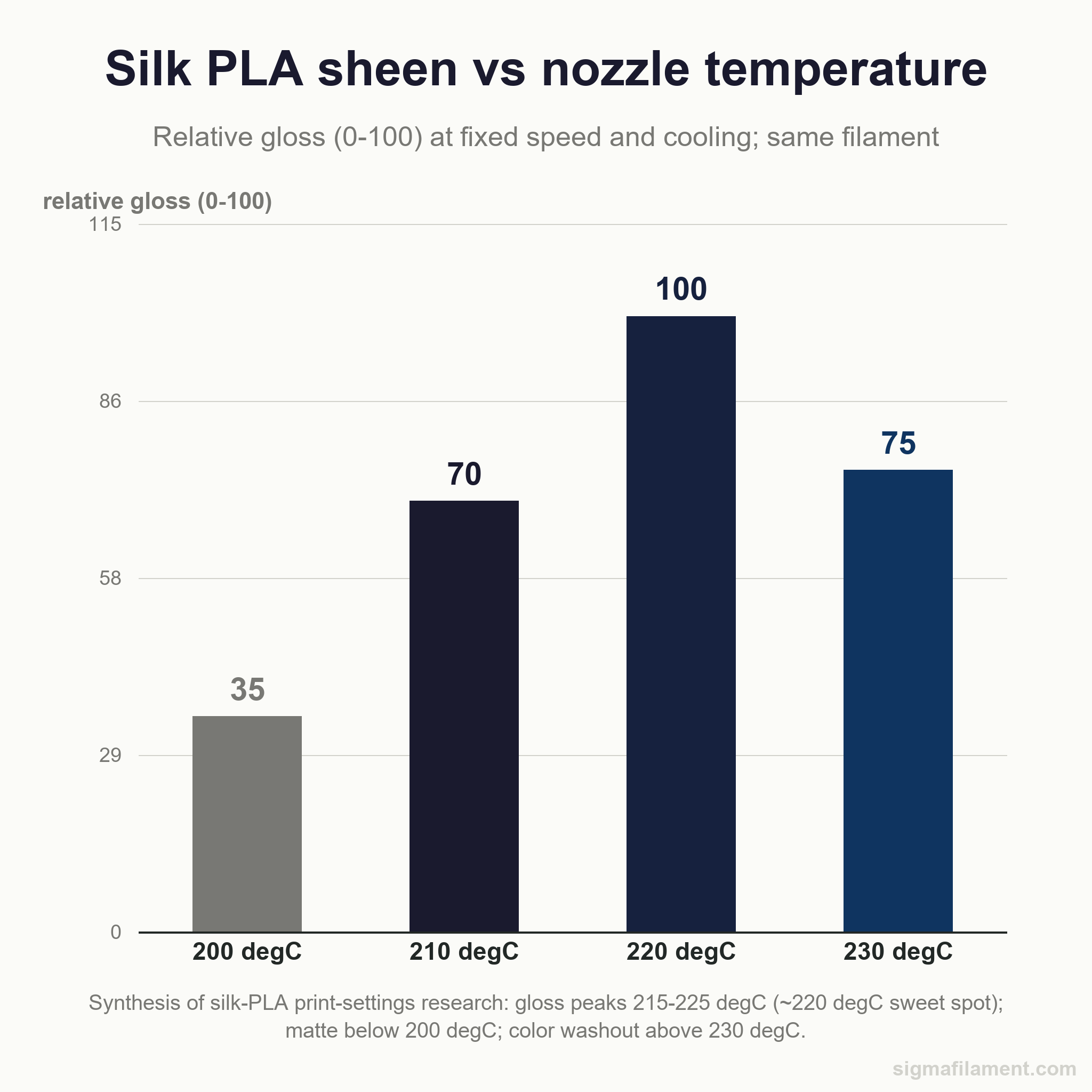
Run silk PLA hotter than standard PLA. The gloss curve peaks near 220 degC; below 200 degC the same filament prints visibly matte because the melt freezes before the surface levels out, and above 230 degC pigment washes out and stringing climbs. Start at 220 degC, then bracket plus or minus 5 degC on a test tower and pick the band where layer lines look most reflective. A dedicated walkthrough of the temperature window for shiny PLA prints drills into the same slicer settings on real test geometry.
Speed, line width, and layer height
Slow the outer wall and widen the bead. Start outer walls at 30-35 mm/s and the top surface at 25-35 mm/s; inner walls can run faster, around 40-60 mm/s, because they never show. For the broader speed envelope across PLA grades, the PLA print-speed reference guide lays out the 25-150 mm/s band. Set outer-wall line width to 120-130% of nozzle diameter (about 0.48-0.52 mm on a 0.4 mm nozzle) and use a 0.20-0.24 mm layer height. Layers thinner than 0.12 mm actually reduce gloss because over-fine layering fights the smooth-reflection effect.
| Setting | Recommended range | Why it matters for sheen |
|---|---|---|
| Nozzle temperature | 215-225 degC (sweet spot 220) | Lower viscosity, smoother surface, specular reflection |
| Outer-wall speed | 30-35 mm/s | Gives the melt time to level before freezing |
| Top-surface speed | 25-35 mm/s | Reduces visible layer-line texture on the showing face |
| Line width (outer) | 120-130% of nozzle (about 0.48-0.52 mm) | Wider bead overlaps and self-smooths |
| Layer height | 0.20-0.24 mm | Sweet spot for sheen; thinner reduces gloss |
| Part-cooling fan | 30-50% after first layers | High fan crystallizes the surface unevenly |
| Retraction | 1-2 mm direct, 4-6 mm Bowden | Copolymer melt is stickier than standard PLA |
| Ironing, adaptive speed, random seam, outer-wall Z-hop | Off | Each interrupts the continuous gloss surface |
Across silk PLA print-settings research compiled for this guide, gloss peaks at a relative 100 on a 0-100 scale at 220 degC nozzle temperature, falling to 35 at 200 degC and 75 at 230 degC under fixed speed and cooling (SigmaFilament, 2026). The same temperature curve holds whether the copolymer blend is PHA, TPU or TPC, which is why 215-225 degC is the cross-vendor recommendation.
Troubleshooting: stringing, dull patches, weak layers
Stringing or oozing is the most common complaint, because silk’s stickier melt restrings more easily than standard PLA. Lift retraction to 1.5-2 mm on direct drive or 5-6 mm on Bowden, lower the nozzle by 5 degC, and enable wipe-on-retract. Dull patches or matte streaks point the other way: raise the nozzle 5 degC, drop part-cooling to 30-40%, and confirm an adaptive-speed setting has not silently overridden the outer-wall speed. Blobs at the seam are a geometry problem, so disable random seam and outer-wall Z-hop and pin the seam to a back corner where any residual blob hides on the non-showing face.
Weak interlayer bonding is the one defect the chemistry will not let you tune away. Silk’s copolymer reduces z-axis adhesion; raising the nozzle to 222-225 degC and lowering the fan to 30% helps, but the right answer is to reserve silk for non-load-bearing parts. One last operational note: silk PLA is more abrasive than standard PLA, so brass nozzles are fine for low volume while hardened steel is the print-farm default. Bed temperature does not directly affect sheen, but it does affect first-layer adhesion that everything above sits on, so the PLA bed-temperature guide covers the 50-60 degC band recommended for silk.
Multi-color silk PLA: dual-color, tri-color, and rainbow
Multi-color silk PLA is a single-spool effect. Two or three pigment streams (or a continuously varying one) are coextruded into one 1.75 mm strand, then the silk copolymer load gives every stream the same specular sheen. The color shift on the printed part comes from the filament itself, not from a multi-material toolhead, AMS, or palette splicer. That distinction matters at the sourcing stage: dual and tri-color silk PLA ships as standard SKUs at OEM MOQs, whereas multi-material printing is a hardware decision on the buyer’s side.
How dual and tri-color silk is coextruded (banded, not blended)
In dual-color silk PLA, two pigment-loaded melts run side by side through a partitioned die and exit as one round strand with two longitudinal bands (All3DP, 2025). Tri-color extends the same approach to three bands at roughly 120 degrees of arc each. Because the bands are positioned around the strand circumference rather than mixed in the melt, the printed wall picks up whichever band is facing outward at that instant, and the silk sheen amplifies the contrast between bands instead of blurring them. The result reads as a sharp two-tone or three-tone shift along outer walls, with the gloss locking in specular reflection on each band. A separate primer on PLA CMYK and full-color filament workflows covers the hardware-side multi-material story for buyers comparing single-spool coextrusion against AMS-style splicing.
Rainbow and gradient silk and the gradient period
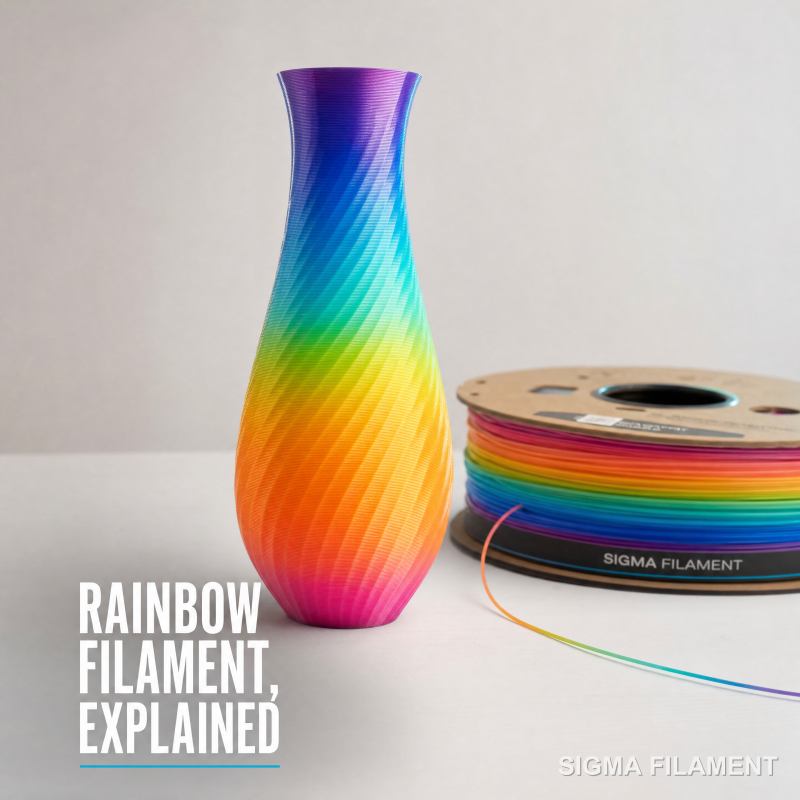
Rainbow or gradient silk PLA uses one extrusion stream whose pigment composition varies along the filament length. A typical gradient period is about 20 meters, or roughly 65 grams, per color segment (All3DP, 2025). On a normal-size print that period reads as a slow color sweep up the part rather than visible banding. Vase mode and tall single-wall geometry showcase the effect best because each layer pulls a slightly different point on the gradient curve.
Color-band tolerances at the factory level
At the factory level, the controllable variables are band ratio (typical specification +/-3% by mass), band registration drift along the spool, and color-to-color deltaE between production lots (SigmaFilament, 2026). Pla silk glossy multi-color SKUs are produced to a published color-match deltaE target with batch traceability tying each spool to its pigment masterbatch lot.
Dual-color and tri-color silk PLA filaments are produced by coextruding two or three pigment-loaded melt streams side by side into one 1.75 mm strand, not by blending pigments; rainbow silk uses a single stream with a pigment composition that varies along the filament length, with a typical gradient period near 20 meters (about 65 grams) per color segment (All3DP, 2025).
Color matching on multi-color silk PLA runs holds deltaE under 1.5 against a Pantone or RAL reference, the threshold below which lot-to-lot color shift stops being visible under standard daylight. The same deltaE discipline applies to single-color SKUs; see the blue PLA sourcing checklist for a worked example of holding one hue across reorders. The broader multi-material printing topic, including AMS and toolchanger workflows on the buyer’s hardware side, is covered in a companion guide.
Where silk PLA fits: applications and limitations
The PLA silk glossy category is a decorative-grade finish. That phrase is doing real work: it tells a buyer which SKUs to stock as visual products and which to keep on the standard or toughened PLA shelf.
Silk PLA is a decorative-grade finish: the copolymer load that creates its specular sheen lowers ultimate tensile strength to roughly 40 MPa on ASTM D638 specimens, against standard PLA’s 46 to 49 MPa baseline, a 13 to 18 percent reduction that rules it out for load-bearing brackets, jigs, and drone-frame hardware alike (Ekşi & Karakaya, 2025).
Decorative, display, and consumer-aesthetic parts
Silk PLA wins on retail-facing aesthetic prints where the eye is the spec. Display models, busts, low-poly sculptures, vases, bowls, planters, ornaments, holiday and gift items, photography props, retail packaging mock-ups, signage letters, and resold cosplay accessories all benefit from the specular sheen, because the part is judged on how it looks at arm’s length, not on how much load it carries. Private-label resellers stocking sub-$30 finished goods, Etsy and Amazon Handmade fulfilment shops, and event-merch print farms producing wedding or convention pieces are the natural buyers for the finish. Multi-color and rainbow coextruded silk extends the same logic to gradient decorative prints and color-banded display pieces where the visual payoff dominates the build cost.
Why silk PLA is wrong for functional/load-bearing parts
The same copolymer load that creates the gloss reduces ultimate tensile strength to roughly 40 MPa on ASTM D638 specimens, against standard PLA’s ~46-49 MPa baseline (Ekşi & Karakaya, 2025). Interlayer bonding drops with it, and heat deflection sits a few degrees lower. Functional brackets, jigs, fasteners, drone frames, RC parts, gears, tool handles, and any print exposed to sustained load, abrasion, sunlight, or under-hood heat should be specified in standard PLA, PLA+, PETG, or ABS, and the PLA versus PETG breakdown sets out where each polymer family wins across 7 application classes. Stocking silk for these jobs is a returns liability, not a finish upgrade.
Vase-mode and single-wall showpieces
Vase mode is silk PLA’s flagship use case. Single-wall spiralized prints have no seams, no layer-start blobs, and no inner-perimeter reflections, so the specular sheen reads as a continuous mirrored surface. Print farms standardizing on a vase-mode profile for silk inventory get the highest visual yield per spool and the cleanest customer-facing photography for product listings.
The decision rule is simple for B2B catalogs: stock silk for the prints that sell because they look beautiful, and reserve mechanical PLA grades for prints that sell because they work.
Sourcing silk PLA at scale: OEM, private label, and QC
Buying silk PLA by the spool teaches very little about buying it by the pallet. At volume, the variables that decide whether a product line ships are batch-to-batch sheen consistency, diameter tolerance, color fidelity across reorders, and a quality-control record that survives a customer return. The bulk PLA filament sourcing playbook walks through the same buyer checklist on standard PLA for context. The questions below are the ones a serious OEM buyer, print-farm operator, or distributor should put to any silk PLA supplier before placing a first purchase order.
Volume silk PLA from a source manufacturer typically starts at 100 spools per stock-color SKU and 500 spools for fully custom formulations, with 5 to 7 day lead times, diameter held to plus or minus 0.02 mm, and Pantone or RAL color matching under deltaE 1.5 (SigmaFilament, 2026).
MOQ, lead times, and diameter tolerance for OEM silk PLA
Volume silk PLA from a source manufacturer typically starts at 100 spools per SKU for stock colors and 500 spools per SKU for fully custom formulations, with lead times in the 5 to 7 day range from confirmed artwork to packed pallet, and diameter held to +/-0.02 mm on 1.75 mm and 2.85 mm reels (SigmaFilament, 2026). Diameter is verified by dual-axis laser monitoring on every extrusion line, so out-of-spec sections are flagged and removed before winding rather than after. Bulk tiers begin around 500 spools (up to 15% off) and 1000 spools (up to 20% off), priced FOB, CIF, DDP, or DAP depending on destination and broker. Pricing tiers, lead times, and Incoterm options across the broader range are listed on the wholesale PLA filament page.
Color matching at manufacturing scale (Pantone/RAL, deltaE <1.5)
Sheen is part chemistry and part color. A silk-blue spool from January and a silk-blue spool from July must look identical on the shelf, which is a color-management problem before it is a polymer one. SigmaFilament matches against Pantone and RAL targets to deltaE <1.5, the threshold below which the human eye stops registering a difference under standard daylight viewing. Custom pearlescent, dual-color coextruded, and metallic-flake silks are formulated under NDA against a customer-supplied master swatch.
Quality control: ASTM D638 tensile, ISO 1183 density, batch traceability
Every spool clears 70-plus QC checkpoints covering diameter, ovality, winding, and packaging, with a finished defect rate below 0.01%. Mechanical lots are pulled to ASTM D638 for ultimate tensile strength and ISO 1183 for density so silk PLA’s specular-sheen formulation does not drift outside the published mechanical band. Batch and reel codes are retained for traceability, which matters when a downstream print farm wants to correlate a print-failure cluster back to a specific extrusion run.
Certifications and what to ask a supplier
Use a four-point supplier qualification: ISO 9001:2015 quality system, 100% virgin resin (NatureWorks Ingeo PLA pellets, not regrind), FDA-compliant pigment masterbatches with RoHS and REACH on file, and a sample-then-pilot purchase path before full PO. The longer-form PLA sourcing checklist for 2026 breaks each of those four points into vendor-question form. Sigma Filament supports samples at 1 to 3 spools, pilot runs from 100 spools, and OEM custom color from 500 spools. For volume sourcing or private-label silk PLA, contact the engineering team via the OEM/ODM portal.
Frequently Asked Questions
Is silk PLA stronger or weaker than regular PLA?
Silk PLA is weaker. Standard PLA tested to ASTM D638 on FDM specimens runs roughly 46 to 49 MPa ultimate tensile strength (Ekşi & Karakaya, 2025; N = 9 specimens). Silk PLA on identical geometry lands near 40 MPa, a 13 to 18 percent reduction driven by the 3 to 10 percent PHA, TPU, or thermoplastic copolyester load that creates the sheen (Ekşi & Karakaya, 2025). Reserve silk PLA for decorative parts, not load-bearing brackets.
Why is silk PLA shiny?
The sheen is a surface-reflection mechanism, not a coating. The copolymer modifier lowers melt viscosity so each printed layer flows into a smoother face, shifting light reflection from diffuse to specular (Wikipedia contributors, 2026).
Silk PLA’s gloss comes from a 3 to 10 percent copolymer load (most often PHA, TPU, or thermoplastic copolyester) blended into standard PLA. The modifier lowers melt viscosity, smooths the printed surface, and shifts reflection from diffuse to specular, which is the same chemistry that drives the roughly 13 to 18 percent tensile drop versus standard PLA on ASTM D638 specimens (Wikipedia contributors, 2026).
What nozzle temperature prints silk PLA best?
Aim for 215 to 225 degC, with 220 degC as the sweet spot for maximum gloss. Below 200 degC the same filament prints visibly matte because the copolymer never fully relaxes the surface. Above 230 degC, color washes out and stringing rises. Pair the hot nozzle with slow outer-wall speeds of 30 to 35 mm/s.
Is silk PLA harder to print than standard PLA?
Marginally. The copolymer makes the melt stickier, so start retraction around 1 to 2 mm on direct drive or 4 to 6 mm on Bowden and tune it on a stringing test. Cooling drops to 30 to 50 percent fan after the first layers, because high cooling crystallizes the surface unevenly and kills sheen. Disable ironing, adaptive outer-wall speed, and Z-hop on outer walls.
Is silk PLA matte or glossy?
Silk PLA is the glossy finish family. Matte PLA uses a different additive package, typically a matting agent that scatters light to suppress reflection. Both sit in the same PLA category, but they target opposite optical outcomes: silk pushes gloss index high, matte pulls it down. The same silk filament can read matte if printed under 200 degC.
Does silk PLA hide layer lines?
It softens them rather than hiding them outright. The smoother layer faces and specular reflection blend adjacent lines visually, so layer banding reads less sharply at arm’s length. Vase mode, which spiralizes a single outer wall, gives the strongest gloss because there are no seams or layer-start blobs. Functional infill prints still show layers.
Is silk PLA good for functional or load-bearing parts?
No. The 13 to 18 percent UTS reduction plus weaker interlayer bonding makes silk PLA decorative-grade only. Heat deflection drops to roughly 55 to 58 degC versus 60 degC for standard PLA (Hanon et al., 2021). For brackets, jigs, or anything bearing sustained load, specify standard PLA, PLA+, or an engineering polymer instead.
Can silk PLA be custom-colored for an OEM order?
Yes. OEM and private-label silk PLA ships at typical MOQs of 100 to 500 spools with diameter tolerance held to plus or minus 0.02 mm (SigmaFilament, 2026). Color matching at manufacturing scale targets Pantone or RAL references with deltaE below 1.5, and QC covers ASTM D638 tensile, ISO 1183 density, and batch traceability (International Organization for Standardization, 2019).
Conclusion
Silk PLA’s sheen is a chemistry decision, not a finishing step. A 3-10% load of PHA, TPU, or thermoplastic copolyester lowers melt viscosity, smooths the extruded surface, and shifts reflection from diffuse to specular. That gloss costs roughly 13-18% of tensile strength versus standard PLA, dropping ultimate tensile strength from about 46-49 MPa to near 40 MPa on ASTM D638 specimens (Ekşi & Karakaya, 2025). That trade-off defines where silk PLA belongs.
Specify silk PLA for display models, consumer aesthetic parts, vase-mode showpieces, and any SKU where visible sheen drives perceived value. Specify standard PLA or a toughened PLA+ for functional, load-bearing, or impact-exposed parts. Print profile follows the same logic: 215-225 degC nozzle, slower outer walls, wider line width, modest cooling.
For brand owners and print farms moving past single-spool testing, SigmaFilament manufactures OEM and private-label silk PLA from 100 spools with deltaE under 1.5 color matching, plus or minus 0.02 mm diameter tolerance, and ASTM D638 / ISO 1183 batch verification. Contact our engineering team to scope a custom silk formulation.
Further Reading
For deeper coverage of adjacent finishes and sourcing topics, SigmaFilament’s companion guides extend the material covered here. The matte PLA guide pairs naturally with this one, walking through the silica/PBAT filler chemistry that produces a diffuse surface and how it compares with silk on layer-line hiding and tensile behaviour. The multicolor and rainbow silk PLA guide goes deeper on coextrusion, gradient periods, and color-band tolerances. The PLA print-settings reference compiles temperature, speed, and cooling ranges across standard, silk, matte, and PLA+ grades. The filament color matching guide covers Pantone and RAL workflows at deltaE under 1.5. For volume buyers, the OEM and private-label PLA sourcing guide details MOQs, lead times, and QC documentation. Externally, the ASTM D638 tensile-testing standard and ISO 1183 density standard are the two primary specifications referenced throughout this article.
References
- Ekşi, S., & Karakaya, C. (2025). Effects of process parameters on tensile properties of 3D-printed PLA parts fabricated with the FDM method. Polymers, 17(14), 1934. https://doi.org/10.3390/polym17141934
- Hanon, M. M., Marczis, R., & Zsidai, L. (2021). Influence of the 3D printing process settings on tensile strength of PLA and HT-PLA. Periodica Polytechnica Mechanical Engineering, 65(1), 38–46. https://doi.org/10.3311/PPme.13683
- Posch, M. (2025, December 14). Printing with PHA filament as potential alternative to PLA. Hackaday. https://hackaday.com/2025/12/14/printing-with-pha-filament-as-potential-alternative-to-pla/
- Wikipedia contributors. (2026, May 18). Polyhydroxyalkanoates. In Wikipedia, The Free Encyclopedia. https://en.wikipedia.org/wiki/Polyhydroxyalkanoates
- Wikipedia contributors. (2026, April 18). Specular reflection. In Wikipedia, The Free Encyclopedia. https://en.wikipedia.org/wiki/Specular_reflection
- ASTM International. (2022). ASTM D638-22: Standard test method for tensile properties of plastics. ASTM International. https://www.astm.org/d0638-22.html
- International Organization for Standardization. (2019). ISO 1183-1:2019: Plastics: Methods for determining the density of non-cellular plastics, Part 1: Immersion method, liquid pycnometer method and titration method. ISO. https://www.iso.org/standard/74990.html
- All3DP. (2025). The best silk PLA filaments: Brands compared. All3DP. https://all3dp.com/2/silk-3d-printing-filament-brands-compared/
- SigmaFilament. (2026). Wholesale 3D printer filament manufacturer: OEM / ODM private-label PLA. SigmaFilament. https://sigmafilament.com
Last reviewed and updated: June 2026. Author: SigmaFilament team. For tailored guidance, contact our team.