

High-Speed Filament
for Printers That Don't Wait
Standard filament was designed for 60 mm/s printers. Your Bambu, K1, or Voron runs at 300–600 mm/s. Our High-Speed PLA, PETG, and ABS are formulated with higher melt flow and faster cooling — so your machines can print at full capability without under-extrusion, poor adhesion, or quality loss.
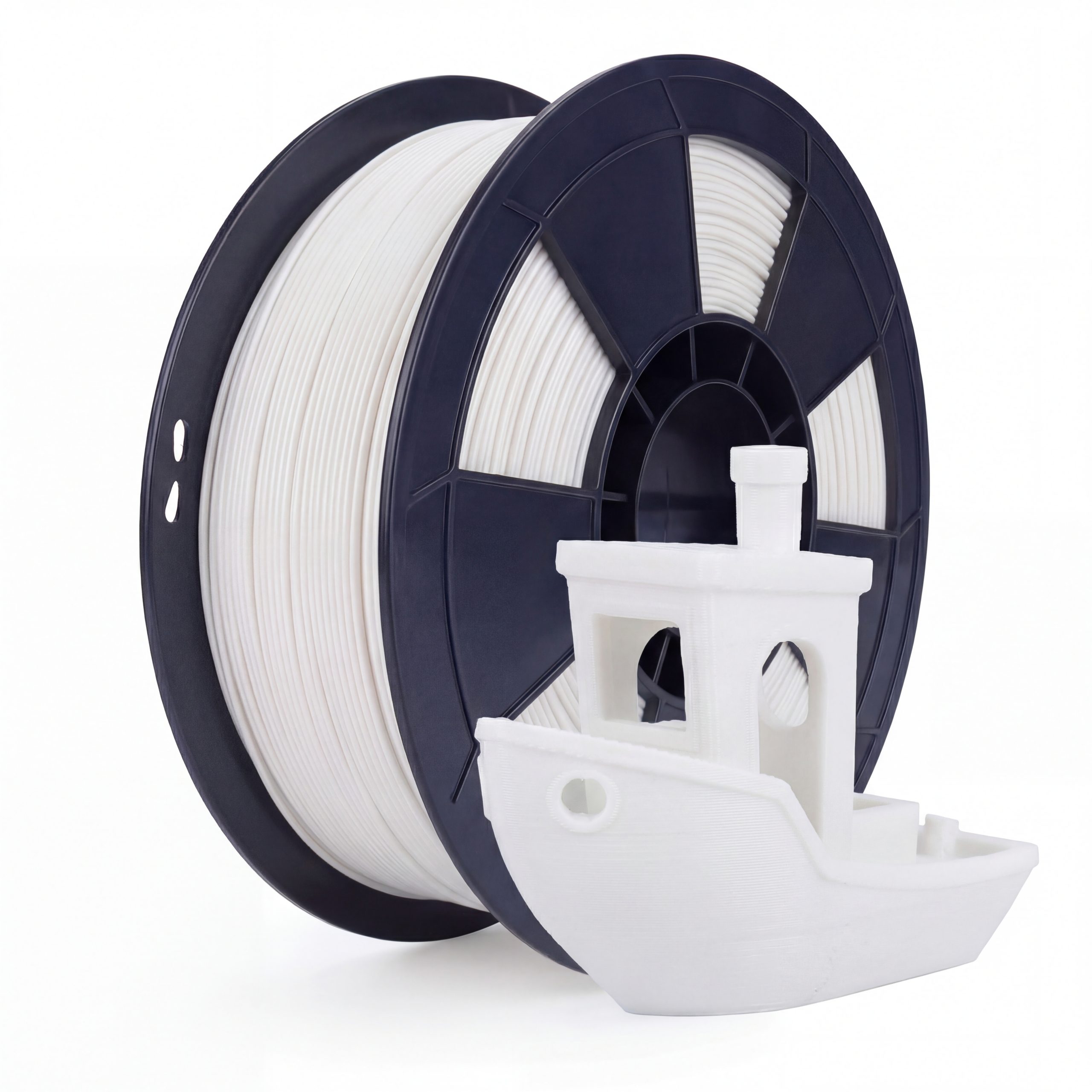
What Makes High-Speed Filament Different from Standard
High-speed filament isn't standard filament pushed faster — it's re-engineered at the polymer level. The formulation changes are what make the speed difference possible.
3–5× Faster Print Time — Without Sacrificing Quality
Standard filament at 300+ mm/s causes under-extrusion — the material simply can't melt fast enough. High-speed formulations have a higher melt flow index (MFI), meaning the polymer reaches printable viscosity faster in the hotend. The result: full flow at speeds that would starve a standard filament. A Benchy that takes 40 minutes at 60 mm/s can print in under 12 minutes at 500 mm/s with the right material.
Strong Layer Adhesion at High Velocity
Speed kills layer adhesion in standard filament — faster layers = less time for polymer chains to entangle. High-speed filament uses modified crystallization kinetics and flow additives to ensure each new layer bonds fully to the one below, even at 300–600 mm/s. The result is parts with comparable interlayer strength to slow-printed standard filament, validated by our in-house mechanical testing.
Rapid Cooling for Dimensional Accuracy
At high speeds, layers stack faster than they can cool — causing warping, drooping, and dimensional drift. High-speed filament is formulated to solidify faster upon extrusion, working in sync with your printer's active cooling system. This means overhangs stay sharp, thin walls stay straight, and dimensional accuracy is maintained even on parts with aggressive geometry.
Direct ROI — Time Is Your Most Expensive Input
For a print farm running 50 printers, switching from 60 mm/s to 300 mm/s doesn't just save time — it multiplies output capacity without adding machines. A farm that produces 200 parts/day at standard speed can produce 600–1,000 parts/day with high-speed filament and compatible printers. The filament cost premium is typically 15–25% — the throughput gain is 300–500%.
High-Speed Filament Is Not for Everyone — Here's Who Benefits Most
High-speed filament only delivers value on printers with the hardware to support it. Here are the four buyer profiles where it makes the most economic sense.
High-Volume Production
Running 20–500+ CoreXY printers. Every minute of print time is a cost. High-speed filament turns machine time into more parts per shift.
- 3–5× throughput per machine
- Fewer machines needed for same output
- 3kg/5kg spools reduce changeover
- Consistent quality at sustained speed
Iteration Speed = Competitive Edge
Design → print → test → redesign. When each cycle takes hours instead of a full day, your product development timeline compresses dramatically.
- Same-day design iteration cycles
- Functional prototypes in under 1 hour
- HS-PETG / HS-ABS for stress testing
- Maintain dimensional accuracy at speed
On-Demand & Contract Printing
Client deadlines are fixed. Faster print speed means shorter lead times, more orders per week, and ability to accept rush jobs competitors can't handle.
- Shorter lead time = more competitive bids
- Handle rush orders profitably
- Multiple material options (PLA/PETG/ABS)
- Same quality as standard at 3–5× speed
Fastest-Growing Filament Category
High-speed printers are now mainstream. Bambu Lab sold millions of units. Your customers need high-speed filament — if you don't stock it, they'll buy elsewhere.
- High-margin, high-demand category
- HS-PLA, HS-PETG, HS-ABS full range
- OEM / white-label available
- Factory-direct pricing, global shipping
High-Speed Filament vs. Standard Filament — What Actually Changes
This isn't about "premium" vs "basic" — it's about polymer engineering designed for a completely different speed regime.
| Property | Standard Filament | High-Speed Filament |
|---|---|---|
| Recommended Speed | 30–80 mm/s | 200–600 mm/s |
| Melt Flow Index | Standard (baseline) | 2–3× higher MFI |
| Cooling Behavior | Normal solidification | Rapid solidification |
| Layer Adhesion at Speed | Degrades above 150 mm/s | Maintained up to 600 mm/s |
| Under-Extrusion Risk | High above 200 mm/s | Minimal up to 600 mm/s |
| Dimensional Accuracy | Good at designed speed | Maintained at 3–5× speed |
| Stringing | Low at slow speeds | Controlled at high speeds |
| Print Quality | Excellent (at spec speed) | Excellent (at 3–5× speed) |
| Printer Compatibility | All FDM printers | CoreXY / high-flow systems |
| Best For | General / slow printers | Print farms / fast printers |
⚡ Real-World Example: Time Savings
A typical 50g part (e.g., a phone case mold or equipment bracket):
On a farm of 50 printers running 16-hour shifts, that's the difference between ~320 parts/day and ~1,370 parts/day.
⚠️ Important: High-speed filament requires a high-flow hotend (capable of ≥24 mm³/s volumetric flow). Standard i3/bed-slinger printers at 60 mm/s won't benefit — you need a CoreXY or similar motion system. If your fleet is already fast, this filament is the bottleneck remover.
High-Speed Series — Three Materials, One Speed Standard
Choose your material based on the application. Choose high-speed because your printer can handle it and your business needs the throughput.
- Print speed: 200–600 mm/s
- Nozzle temp: 190–230 °C
- Tolerance: ±0.02mm
- Higher MFI for sustained fast extrusion
- Rapid cooling for sharp overhangs
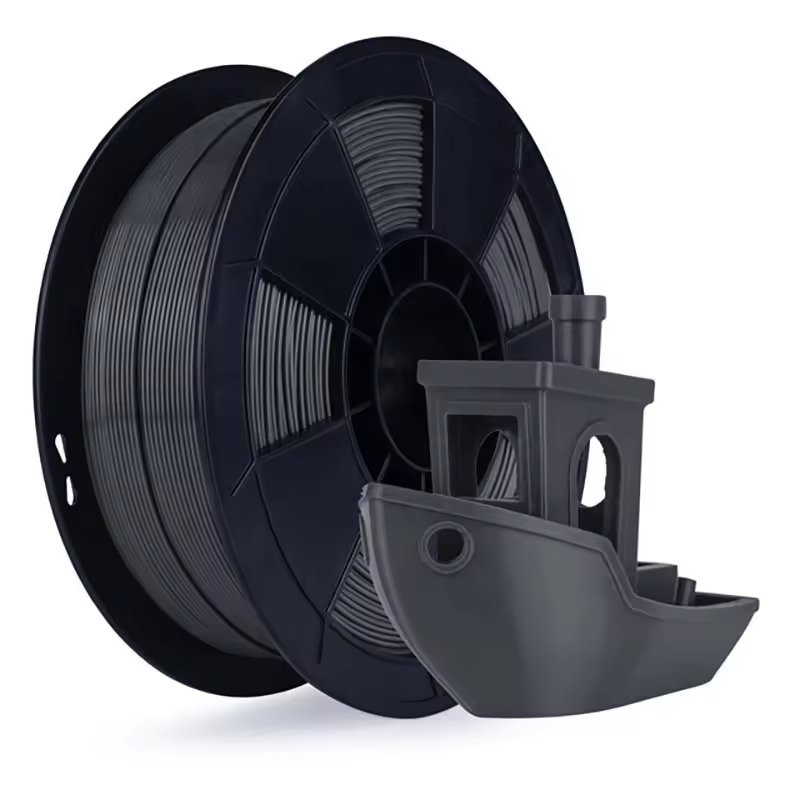
- Print speed: 200–500 mm/s
- Nozzle temp: 230–260 °C
- Tolerance: ±0.03mm
- Chemical & impact resistance maintained
- Reduced stringing vs standard PETG at speed

- Print speed: 200–500 mm/s
- Nozzle temp: 240–270 °C
- Tolerance: ±0.02mm
- Heat resistance ~100 °C HDT
- Requires enclosed printer with heated bed
Which Printers Can Actually Use High-Speed Filament?
High-speed filament requires high-flow hotends and fast motion systems. Here's how to know if your hardware qualifies.
🔧 Key Hardware Requirements
Where High-Speed Filament Delivers the Most Value
High-speed filament shines in time-sensitive, volume-driven, or iteration-heavy workflows — where speed directly translates to revenue or competitive advantage.
Print Farm Production
Consumer products, D2C goods, batch fulfillment. 3–5× output per machine per shift.
Rapid Prototyping
Design iteration cycles compressed from days to hours. Functional prototypes in under 60 minutes.
Medical & Dental Models
Surgical planning models, dental aligners, prosthetic fittings. Time-critical, patient-specific production.
On-Demand Manufacturing
Same-day or next-day delivery promises. Rush orders that competitors quote at 5–7 days.
Consumer Electronics
Custom cases, mounts, and enclosures. HS-ABS for heat resistance near electronics.
Automotive Prototyping
Fit-check parts, interior mockups, tooling aids. HS-PETG/HS-ABS for thermal environments.
Makerspaces & Labs
More prints per class session. Students iterate faster, learn more per semester.
Architecture Models
Large-scale building models for client presentations. Overnight print runs become 4-hour jobs.
MOQ, Lead Time & Shipping for High-Speed Orders
High-speed filament has slightly higher MOQs than standard due to specialized formulation. Volume discounts scale the same way.

Bundling note: You can mix HS-PLA, HS-PETG, and HS-ABS in a single order as long as the combined total meets 200 spools. Volume discounts of up to 20% for 1,000+ spools. Payment: T/T (100% prepayment).
From Quote to Delivery — 4 Steps
Same streamlined B2B process as our standard line. Tell us which HS materials and colors you need — we handle the rest.
Tell Us Your Setup
Which printers you run, target speeds, materials needed (HS-PLA / HS-PETG / HS-ABS), colors, and spool sizes. This helps us recommend the right formulation and print profiles.
Test at Speed
We ship 1–3 sample spools. We recommend testing at your target production speed — not just "normal" speed. Validate layer adhesion, dimensional accuracy, and surface quality at 300+ mm/s.
Confirm PI & Production
Approve the Proforma Invoice and arrange 100% prepayment. We lock specialized HS resin and additives, schedule production run, and apply 70+ quality checkpoints including high-speed print validation.
QC, Package & Ship
Final inspection including speed-printing test samples from each batch. Vacuum-sealed with desiccant. Full documentation, QC reports, and logistics coordination worldwide.
High-Speed Filament — Frequently Asked Questions
Common questions from print farms, rapid prototyping shops, and resellers evaluating wholesale HS-PLA, HS-PETG, and HS-ABS sourcing — from manufacturer identity and printer compatibility to MOQ and delivery.