

An Expert’s Guide: How to Choose a Reliable Filament Manufacturer: 12 QC Checks Buyers Should Ask For

Abstract
The selection of a 3D printing filament manufacturer represents a foundational decision for businesses relying on additive manufacturing for production, prototyping, or wholesale distribution. Inconsistent filament quality introduces significant operational risks, including production downtime, increased failure rates, reputational damage, and unpredictable material costs. This guide examines the intricate process of how to choose a reliable filament manufacturer by proposing a comprehensive framework of twelve specific quality control (QC) checks. It moves beyond surface-level evaluations of price and material type to a more rigorous, evidence-based vetting process. The analysis covers the entire production chain, from the verification of raw material purity and the auditing of ISO 9001 certified quality management systems to the technical specifics of laser-monitored dimensional accuracy, colorimetric consistency, and moisture control protocols. The objective is to equip buyers, particularly those engaging in OEM/ODM partnerships, with the analytical tools necessary to forge a resilient and scalable supply chain, thereby ensuring consistent print outcomes and protecting brand integrity.
Key Takeaways
- Verify ISO 9001:2015 certification to confirm a structured quality management system is in place.
- Demand dimensional accuracy reports showing tolerances of ±0.02mm, monitored by laser micrometers.
- Evaluate the manufacturer’s raw material sourcing, preferring virgin pellets over inconsistent recycled materials.
- Assess their OEM/ODM capabilities, including custom color matching and R&D for new formulas.
- A key step in how to choose a reliable filament manufacturer is to request and test production samples.
- Confirm robust moisture control, including material drying and vacuum-sealed packaging with desiccants.
- Inquire about batch traceability systems that allow for quick identification and resolution of issues.
Table of Contents
- A Foundational Inquiry: The Nature of Reliability in Manufacturing
- 1. Raw Material Purity and Sourcing Verification
- 2. ISO 9001:2015 Certification and the Quality Management System (QMS)
- 3. Dimensional Accuracy and Laser Monitoring
- 4. Color Consistency and Spectrophotometric Analysis
- 5. Material Drying and Moisture Control Protocols
- 6. Spooling Quality and Winding Consistency
- 7. In-House R&D for OEM/ODM Customization
- 8. Contaminant and “Fish Eye” Detection Systems
- 9. Regulatory and Environmental Compliance
- 10. Comprehensive Batch Traceability and Labeling
- 11. Packaging, Sealing, and Shipping Integrity
- 12. Test Printing and Sample Evaluation Programs
- Frequently Asked Questions (FAQ)
- Forging a Partnership Through Diligence
- References
A Foundational Inquiry: The Nature of Reliability in Manufacturing
Before we can construct a framework for selecting a partner, we must first arrive at a shared understanding of what “reliability” truly signifies in the context of industrial production. It is a concept that extends far beyond the simple fulfillment of an order. Reliability is not an event; it is a sustained condition. It is the demonstrable capacity of a manufacturer to produce a consistent product, batch after batch, month after month, conforming to a precise set of specifications. For a business scaling its 3D printing operations, a reliable filament manufacturer is not merely a supplier; they become an extension of your own production floor. Their failures become your failures; their consistency becomes your competitive advantage.
Imagine you are a product designer who has just secured a contract to produce 10,000 custom enclosures for an electronics device. You have perfected your design, optimized your print settings, and your fleet of 3D printers is ready. You source filament from a new, low-cost supplier. The first 100 spools work flawlessly. The next shipment arrives, and suddenly, your print failure rate skyrockets. Nozzles clog, prints suffer from delamination, and the color of the enclosures no longer matches the approved sample. Your production line grinds to a halt. The cost is not just the wasted filament; it is the lost time, the missed deadlines, the potential damage to a client relationship. This scenario, all too common, illustrates that the initial price of a spool of filament is a poor indicator of its true cost.
The true cost encompasses the hidden expenses of inconsistency. Therefore, learning how to choose a reliable filament manufacturer is an exercise in risk mitigation. It requires a shift in perspective—from that of a simple buyer to that of a quality assurance auditor. You must cultivate a healthy skepticism, replacing assumptions with evidence. The following twelve checks are not a mere checklist; they are a series of deep inquiries, a structured dialogue designed to reveal the genuine capabilities and commitments of a potential production partner. They are your tools for peering behind the marketing brochures and into the heart of the manufacturing process.
1. Raw Material Purity and Sourcing Verification
The final quality of any extruded plastic can never exceed the quality of the raw resin from which it was made. This is the first principle of polymer processing. All the sophisticated machinery in the world cannot compensate for contaminated or inconsistent raw materials. A serious inquiry into a manufacturer’s reliability begins here, at the very start of the supply chain.
The Foundation of Consistency: Virgin vs. Recycled Pellets
The primary input for filament is plastic resin in the form of small pellets. These pellets can be “virgin” or “recycled.” Virgin pellets are produced directly from petrochemical feedstocks, offering the highest level of purity and consistency. Their properties are well-defined and predictable. Recycled pellets, while appealing from an environmental standpoint, introduce a significant variable. They may be sourced from post-industrial or post-consumer waste, and their composition can vary wildly. They might contain traces of other plastics, paper, adhesives, or unknown additives from their previous life.
While some manufacturers use recycled content successfully for non-critical applications, for a business where consistency is paramount, the use of 100% virgin resin is a non-negotiable starting point for high-quality filament. When vetting a potential partner, you should ask directly:
- “What percentage of your PLA/PETG/ABS filament is made from virgin resin?”
- “Who are your primary resin suppliers?” (Reputable suppliers include NatureWorks for Ingeo PLA, Eastman for Tritan copolyesters, or Covestro for polycarbonates).
- “Can you provide documentation certifying the origin and grade of the resin used for our production run?”
A transparent manufacturer will have no hesitation in providing this information. A hesitant or vague response should be considered a significant red flag.
Asking for Material Safety Data Sheets (MSDS/SDS)
Every legitimate chemical product, including plastic resin, is accompanied by a Material Safety Data Sheet (or simply Safety Data Sheet). This document provides a wealth of information about the material’s properties, composition, and handling requirements. While its primary purpose is safety, it serves as a valuable QC document for a buyer.
Request the SDS for the specific grade of raw material they use for the filament you intend to purchase. This allows you to verify that the base polymer is what they claim it is. For example, the SDS for a high-quality PLA resin will clearly identify it as “Polylactic Acid” and list its CAS number (a unique identifier for chemical substances). This cross-references their claims and provides an official document trail.
The Impact of Impurities on Print Performance
Why is this focus on purity so intense? Impurities in the raw resin manifest as tangible printing problems. A particle of a different polymer with a higher melting point can fail to melt in the hotend, causing a partial or complete nozzle clog. Off-gassing from unknown additives can lead to bubbles and voids in the extruded plastic, creating weak points in the final print. Inconsistent melt flow characteristics, common in mixed recycled materials, result in uneven extrusion, visible as banding or texture variations on the surface of your part. By ensuring material purity at the source, you are preemptively solving a whole class of potential printing failures.
2. ISO 9001:2015 Certification and the Quality Management System (QMS)
If raw material purity is the foundation, a robust Quality Management System (QMS) is the architectural blueprint that governs the entire manufacturing process. The most globally recognized standard for a QMS is ISO 9001:2015. Seeing this certification on a manufacturer’s website is a good start, but a discerning buyer must understand what it truly represents.
What Does ISO 9001 Actually Guarantee?
ISO 9001 does not, in itself, guarantee a high-quality product. A company could, in theory, be ISO 9001 certified to produce consistently mediocre filament. What the certification does guarantee is that the company has a documented, structured, and audited system for managing quality. It ensures that processes are defined, followed, tracked, and improved.
Key principles of ISO 9001 include:
- Process Approach: The organization manages its activities as a series of interrelated processes.
- Customer Focus: The primary goal of the QMS is to meet customer requirements.
- Evidence-based Decision Making: Decisions are based on the analysis of data and information.
- Continual Improvement: The organization is committed to continually improving its processes.
A manufacturer with ISO 9001 certification has invested significant time and resources to build this system. It signals a serious commitment to operational discipline, which makes it a useful first screen for a potential partner.
Beyond the Certificate: Auditing the QMS
Do not stop at simply seeing the certificate. Ask probing questions about their QMS in practice:
- “Could you walk me through your process for handling a non-conforming product batch?” (Their answer will reveal their traceability and corrective action procedures).
- “How do you manage document control for process specifications and work instructions?”
- “What are some of the Key Performance Indicators (KPIs) you track within your QMS?” (Look for metrics like customer complaint rate, on-time delivery, and internal defect rates).
Their ability to answer these questions fluently demonstrates that the QMS is a living part of their culture, not just a certificate on the wall.
How a Robust QMS Prevents Defects
Think of a QMS as the factory’s central nervous system. When a sensor (like a laser micrometer) detects a deviation in filament diameter, the QMS dictates the immediate response: flag the section, alert the operator, document the event, and trigger an investigation into the root cause. Without a formal system, that same deviation might go unnoticed or be ignored, resulting in a defective spool being shipped to a customer. The QMS transforms quality control from a reactive inspection at the end of the line into a proactive, preventative system embedded at every stage of production.
3. Dimensional Accuracy and Laser Monitoring
Of all the technical specifications of a 3D printer filament, its diameter and the consistency of that diameter are arguably the most impactful on print quality. The 3D printer’s slicer software calculates the precise volume of material to be extruded for every single movement. This calculation is based on the assumption that the filament diameter is constant. When it varies, the entire volumetric calculation becomes incorrect.
Understanding Tolerance: Why ±0.02mm Matters
Filament comes in a range of diameters, most commonly 1.75mm or 2.85mm (Wikipedia contributors, 2026). The tolerance specification, such as ±0.05mm or ±0.02mm, indicates the maximum allowable deviation from this nominal diameter. Let’s consider the mathematical implication.
The volume of a cylinder (our filament) is V = π * (d/2)² * L. A small change in diameter (d) has a squared effect on the volume.
- A filament with a ±0.05mm tolerance can range from 1.70mm to 1.80mm. The cross-sectional area can vary by nearly 12%. This means your printer could be over-extruding or under-extruding by up to 12% at any given moment, leading to gaps, blobs, and poor layer adhesion.
- A filament with a ±0.02mm tolerance can range from 1.73mm to 1.77mm. The cross-sectional area variation is reduced to just 4.6%. This is a level of variation that most modern extruders can handle with minimal visible impact on the print.
For any professional application, a tolerance of ±0.03mm should be the absolute maximum acceptable, with ±0.02mm being the gold standard for a reliable filament manufacturer.
| Tolerance Specification | Diameter Range (for 1.75mm) | Max. Cross-Sectional Area Variation | Expected Print Quality Impact |
|---|---|---|---|
| ±0.05mm (Poor) | 1.70mm – 1.80mm | ~11.6% | Visible inconsistencies, over/under-extrusion, potential jams. |
| ±0.03mm (Acceptable) | 1.72mm – 1.78mm | ~6.9% | Generally good, but minor inconsistencies may appear on detailed prints. |
| ±0.02mm (Excellent) | 1.73mm – 1.77mm | ~4.6% | Highly consistent extrusion, smooth surfaces, reliable performance. |
The Role of Dual-Axis Laser Micrometers
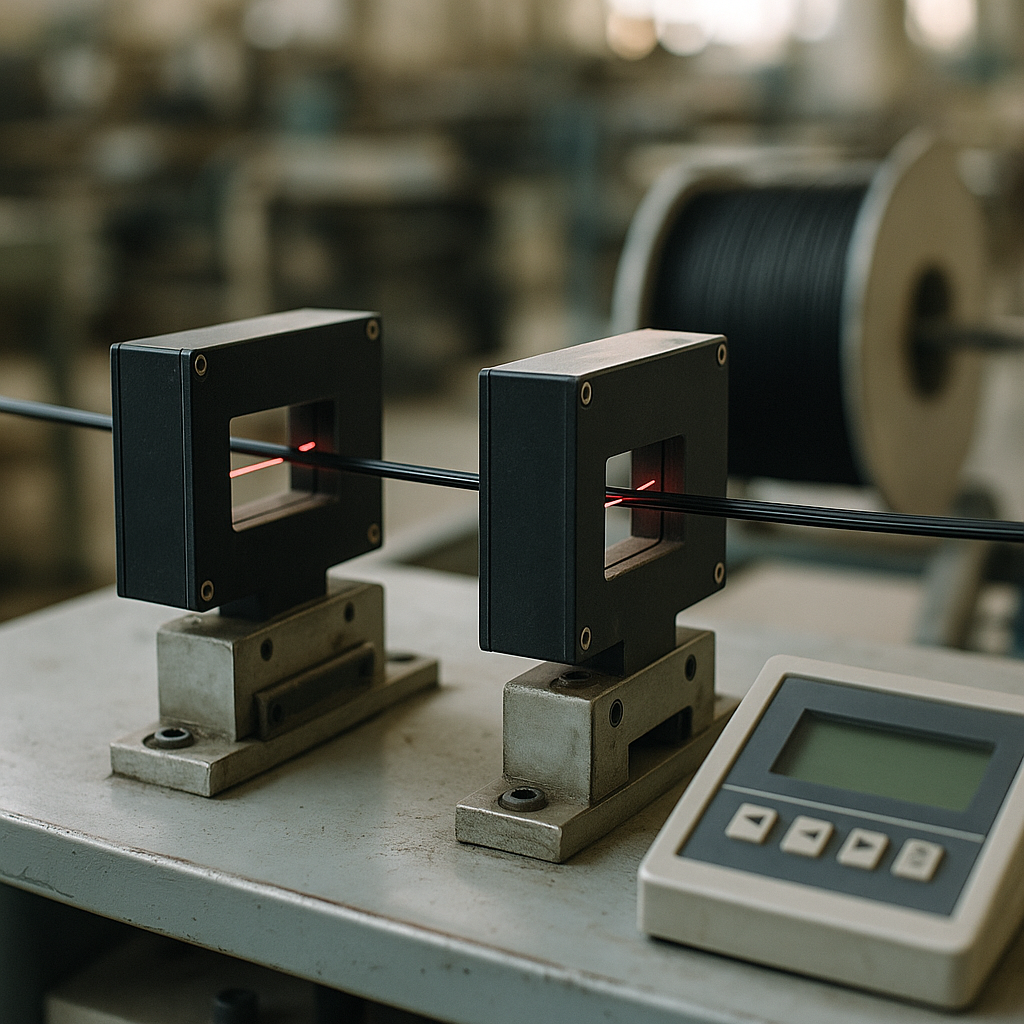
How does a manufacturer achieve and verify such tight tolerances? The answer is in-line, dual-axis laser micrometers. During extrusion, the still-warm filament passes through a device that projects lasers across it from two perpendicular axes (X and Y). The shadows cast by the filament are measured by sensors thousands of times per second. This provides a continuous, real-time measurement of the filament’s diameter and ovality (how round it is).
This data is fed back into the extruder’s control system. If the diameter starts to drift, the system can automatically adjust the puller speed or extruder screw speed to bring it back into spec. This closed-loop control is the only way to guarantee consistent diameter over the entire length of a multi-kilogram spool.
When vetting a manufacturer, ask to see their extrusion line. Look for these laser measurement units. Ask them, “Do you use single-axis or dual-axis laser micrometers for diameter control?” Dual-axis is superior as it detects ovality, which a single-axis system can miss.
Requesting Batch-Specific Dimensional Accuracy Reports
A top-tier manufacturer will not only use this technology but will also log the data. For OEM/ODM customers, it is entirely reasonable to request a dimensional accuracy report for your specific production batches. This report should show a graph of the diameter measurement over the length of a representative spool. It should display the mean diameter, the standard deviation, and the maximum/minimum measurements. This data is the ultimate proof of their process control. It replaces a vague marketing claim of “high precision” with verifiable statistical evidence.
4. Color Consistency and Spectrophotometric Analysis
For businesses producing consumer products, brand identity is often tied to a specific color. Imagine a company whose signature color is a specific shade of “safety orange.” If they order 1,000 spools of orange filament to produce a line of products, it is imperative that the first spool and the last spool are visually indistinguishable. Achieving this level of color consistency is a complex science.
The Science of Color Matching in Polymers
The color of a filament is achieved by mixing a small amount of concentrated colorant, known as a masterbatch, into the natural, uncolored base resin. Achieving a consistent final color depends on several factors:
- The Masterbatch: The quality, pigment concentration, and carrier resin of the masterbatch must be consistent.
- The Base Resin: The natural color and translucency of the base resin can vary slightly from batch to batch, affecting the final appearance.
- The Mixing Ratio: The “let-down ratio” (the proportion of masterbatch to base resin) must be controlled with extreme precision.
- Processing Conditions: The temperature and shear rate inside the extruder can slightly alter the final color.
Relying on the human eye to judge color is notoriously subjective and unreliable. What looks like a perfect match under the fluorescent lights of a factory floor might look completely different in daylight or under LED store lighting—a phenomenon known as metamerism.
Spectrophotometers: The Tool for Objective Color Measurement
The solution to subjective color evaluation is a device called a spectrophotometer. This instrument shines a controlled light source onto a sample and measures the exact amount of light reflected at each wavelength across the visible spectrum. This generates a unique “fingerprint” for that color. The data is then translated into a set of coordinates within a color space, such as CIELAB.
In the CIELAB color space, any color can be defined by three values:
- L*: Lightness (0=black, 100=white)
- a*: Position on the red-green axis
- b*: Position on the yellow-blue axis
A reliable filament manufacturer will use a spectrophotometer to measure the color of the approved master sample and assign it a target CIELAB value. Then, during production, they will take samples from the line and measure them. The difference between the sample and the standard is calculated as a Delta E (ΔE) value. A ΔE of less than 1.0 is generally considered imperceptible to the human eye.
For your OEM/ODM projects, you can provide a physical sample or a Pantone/RAL color code. Ask the manufacturer: “What is your process for color matching, and what is the target Delta E value you guarantee for production?” This question separates the professionals from the amateurs.
Verifying Batch-to-Batch Color Uniformity for Branding
When placing a large order that may be produced over several weeks or months, it is vital to ensure consistency across all batches. A manufacturer with strong process control will be able to provide CIELAB data for each production batch, proving that the color has not drifted. This is especially important for custom filament solutions where brand identity is at stake. This level of data-driven quality assurance protects your brand and ensures that all your products, whether made in January or June, share the exact same aesthetic.
5. Material Drying and Moisture Control Protocols
Many of the most common 3D printing polymers, including PLA, PETG, ABS, Nylon, and Polycarbonate, are hygroscopic. This means they actively absorb moisture from the surrounding atmosphere, much like a sponge. If this moisture is not removed before the filament is extruded, it causes significant problems during printing.
Why Moisture is the Enemy of Many Filaments
When a wet filament enters the printer’s hotend, which is heated to 200°C or more, the trapped water instantly flashes into steam. This tiny explosion has several destructive effects:
- Hydrolysis: At high temperatures, the water molecules can chemically break down the long polymer chains that give the plastic its strength. This results in an extremely brittle print that may crumble in your hands.
- Voids and Bubbles: The steam creates bubbles in the molten plastic, which are then deposited into your print. This results in a rough, pocked surface finish and compromises the part’s structural integrity.
- Inconsistent Extrusion: The popping and sputtering of steam in the nozzle lead to inconsistent material flow, causing audible crackling sounds during printing and visible defects on the print surface.
- Nozzle Clogs: The steam can cause material to build up and carbonize inside the nozzle, leading to a stubborn clog.
Properly drying the raw resin before extrusion is not an optional step; it is a fundamental requirement for producing high-quality filament.
Inspecting the Drying Infrastructure: Hoppers and Dehumidifiers
A serious manufacturer will have a dedicated, industrial-scale drying system. This typically consists of large drying hoppers that sit directly on top of the extruders. These are not simple ovens. A proper system works by circulating hot, dehumidified air through the resin pellets for a specific duration (e.g., 4 hours at 80°C for PETG).
When evaluating a manufacturer, ask to see their drying setup. Look for large, insulated hoppers connected by ducting to a central dehumidifying unit. Ask them about their specific drying protocols for different materials:
- “What is your standard drying time and temperature for Nylon PA12?”
- “What is the dew point of the air used in your drying system?” (A low dew point, e.g., -40°C, indicates very dry air, which is more effective at pulling moisture from the resin).
- “How do you validate that the resin is adequately dried before it enters the extruder?” (Some may use moisture analyzers that provide a quantitative measurement).
The “Snap Test” and Other Practical Moisture Checks
While you may not be able to bring a moisture analyzer to a factory tour, you can perform a simple qualitative check on a sample of filament. For materials like PLA or PETG, a properly dried filament should be relatively tough and flexible. If you sharply bend a piece back on itself, it should bend significantly before snapping. A wet filament, having undergone hydrolysis, will be very brittle and will snap with very little bending force, often with a loud “crack.” This simple “snap test” can be a surprisingly effective indicator of poor moisture control.
6. Spooling Quality and Winding Consistency
A perfectly manufactured filament can be rendered completely useless if it is wound improperly onto its spool. A tangle or snag on the spool will cause the printer’s extruder to be unable to pull the filament, leading to a print failure. For users running long prints or operating print farms, a single tangle can mean hours of lost work and wasted material.
The Nightmare of a Tangled Spool
A filament tangle occurs when a loop of filament gets trapped underneath another loop on the spool. This is almost always caused by a loss of tension during the winding process. If the filament becomes slack at any point, it can easily form a misplaced loop. Once the winding continues, this loop becomes a knot waiting to happen. It is important to note that a spool cannot “tangle itself” after it has been wound. The fault lies entirely in the manufacturing and spooling process.
Automated Winding Systems vs. Manual Spooling
The key to a perfectly wound, tangle-free spool is maintaining constant, smooth tension from the moment the filament is extruded until the very last meter is wound onto the spool. High-volume, reliable manufacturers achieve this using automated winding systems. These machines feature:
- Dancers/Accumulators: These are systems of pulleys on moving arms that act as a buffer, maintaining tension even if the extruder speed and winder speed fluctuate slightly.
- Traverse Guides: A mechanism that moves back and forth, carefully laying the filament in neat, even rows across the width of the spool.
- Tension Control: Sophisticated sensors and motors that precisely control the pulling force on the filament.
During a factory visit, observe the spooling process. Is it a fully automated line, or is it a semi-manual process where an operator guides the filament by hand? Automated systems are far superior in their consistency and ability to prevent the slack conditions that lead to tangles.
Evaluating Spool Design for Compatibility and Strength
The spool itself is also a component of the quality system. A well-designed spool should be:
- Sturdy: It should not flex or warp, which can cause the filament to unspool unevenly. Cardboard spools, while eco-friendly, must be robust enough to withstand shipping and handling.
- Standardized: The hub diameter and overall width should be compatible with a wide range of common printer spool holders and automated material handling systems (like the Bambu Lab AMS).
- Informative: Many high-quality spools include graduated marks or windows that help the user estimate how much filament is remaining.
Ask the manufacturer for the technical specifications of their spools. Better yet, request samples to physically test on your own equipment.
7. In-House R&D for OEM/ODM Customization
For many businesses, the goal is not just to buy a standard product off the shelf but to develop a unique material or branded product line. This is the realm of Original Equipment Manufacturing (OEM) and Original Design Manufacturing (ODM). Understanding a manufacturer’s capabilities in this area is a critical part of how to choose a reliable filament manufacturer for a long-term partnership.
Differentiating OEM from True ODM
It is important to understand the distinction between these two service models.
- OEM (Original Equipment Manufacturing): This is essentially private labeling. The manufacturer produces their standard filament (e.g., their stock PLA+), but they put it on a spool with your branding, in a box with your logo, and with your user manual. The product itself is not unique to you. This is a great option for brands wanting to enter the market quickly with a proven product.
- ODM (Original Design Manufacturing): This is a much deeper partnership. In an ODM relationship, the manufacturer’s research and development (R&D) team works with you to design and produce a completely new filament. This could involve matching a unique color, developing a formula with specific mechanical properties (e.g., higher impact strength), or creating novel composite materials.
| Service Model | Description | Key Feature | Ideal For |
|---|---|---|---|
| OEM | Manufacturer produces their standard product under your brand name. | Private Labeling | Brands wanting a quick market entry with a proven product. |
| ODM | Manufacturer’s R&D team collaborates with you to develop a new, exclusive product. | Custom Formulation | Businesses needing a unique material with specific performance or aesthetic properties. |
Assessing a Manufacturer’s Ability to Develop Custom Materials
A true ODM partner is more than just a factory; they are a technology company. To assess their R&D strength, you should inquire about:
- Their R&D Team: “How many chemists or materials scientists do you have on staff? What are their qualifications?”
- Their Lab Equipment: “Do you have in-house equipment for testing mechanical properties like tensile strength, impact strength, and heat deflection temperature?” Look for universal testing machines (UTMs) and dynamic mechanical analyzers (DMAs).
- Their Experience: “Can you provide case studies (non-confidential, of course) of custom materials you have developed for other clients?” For instance, have they developed specialized engineering-grade materials like carbon fiber-reinforced nylon or ESD-safe PETG?
Their ability to have a deep technical conversation about polymer science is a strong indicator of their ODM capabilities.
The Importance of Non-Disclosure Agreements (NDAs)
When you are developing a proprietary new filament formula, protecting your intellectual property is paramount. A professional ODM manufacturer will not only be willing to sign a Non-Disclosure Agreement (NDA) but will likely insist on it. This legal document binds them to confidentiality, ensuring that the unique formula they develop for you will not be sold to or shared with any other client, including your competitors. Discussing and executing an NDA is a standard and necessary step in any serious ODM engagement.
8. Contaminant and “Fish Eye” Detection Systems
Even with pure raw materials, contamination can be introduced during the manufacturing process. A speck of dust, a carbonized particle from the extruder barrel, or a gel of improperly melted polymer can all result in a defect in the filament. When this contaminated section is printed, it often creates a “fish eye”—a small, circular blemish or void on the surface of the print. For aesthetic parts, a single fish eye can be cause for rejection.
What Causes “Fish Eyes” and Black Specks?
- Black Specks: These are typically particles of degraded or carbonized polymer. They can form if the extruder is run too hot, if material sits in the barrel for too long, or if there are “dead spots” in the flow path where plastic can stagnate and burn.
- Gels or “Fish Eyes”: These are often caused by a small amount of polymer that has a higher molecular weight or is cross-linked, causing it to not melt and flow at the same rate as the surrounding material. This can be due to inconsistencies in the raw resin or issues within the extruder.
Preventing these requires meticulous machine maintenance, including regular purging and cleaning of the extruder screw and barrel.
Melt Flow Index (MFI) Testing for Consistency
One of the key QC tests for both raw resin and finished filament is the Melt Flow Index (MFI) or Melt Flow Rate (MFR). This test measures how easily a polymer flows at a specific temperature and pressure. A sample of the plastic is heated in a small, specialized barrel and then forced through a die by a known weight. The amount of material (in grams) that flows out in 10 minutes is the MFI.
A consistent MFI from the start of a production run to the end indicates that the polymer has not degraded and that its basic flow properties are uniform. A reliable manufacturer will have an MFI tester in their QC lab and will have defined MFI specifications for each material they produce. You can ask, “What is the target MFI for your PLA+ filament, and what is your acceptable range?”
Optical and X-ray Inspection Systems
While MFI testing is good for batch-level QC, some advanced manufacturers employ in-line inspection systems to detect individual contaminants in real-time. These systems use high-speed cameras or even X-rays to continuously scan the filament as it is being produced. If a black speck or a significant gel is detected, the system can automatically flag that section of the spool, often by marking it with ink, so it can be discarded later. While this technology is not yet universal, its presence indicates a manufacturer at the cutting edge of quality control.
9. Regulatory and Environmental Compliance
In a global marketplace, finished products must often meet a complex web of regulations related to health, safety, and the environment. A filament, as a component of that final product, must also comply. A manufacturer that is ignorant of or non-compliant with these standards can create significant legal and financial risks for your business.
Navigating the Alphabet Soup of Regulations
For businesses selling in the US, UK, and Europe, several key regulations are paramount:
- RoHS (Restriction of Hazardous Substances): Originating in the EU, this directive restricts the use of specific hazardous materials found in electrical and electronic products. Key restricted substances include lead, mercury, cadmium, and certain flame retardants. A RoHS-compliant filament is certified to be free of these substances above a certain threshold.
- REACH (Registration, Evaluation, Authorisation and Restriction of Chemicals): Another EU regulation, REACH is broader than RoHS and aims to protect human health and the environment from the risks posed by chemicals. A manufacturer should be able to provide a statement confirming their products’ compliance with REACH.
- FDA-Compliant Materials: This is a term often used in the US market. It means that the constituent components of the material are approved by the U.S. Food and Drug Administration for use in applications involving contact with food. It is important to note that the filament itself is not “FDA approved,” but rather it is made from resins and colorants that are compliant for food contact use under specific conditions.
Requesting Certificates of Compliance
Do not take a manufacturer’s word for their compliance. For each of these standards, they should be able to provide a formal Certificate of Compliance or a declaration statement. Often, these certificates are based on testing performed by a third-party laboratory. For example, a RoHS compliance certificate will typically be accompanied by a lab report showing the measured levels of the restricted substances. Reviewing this documentation is a necessary due diligence step.
| Regulation | Scope | Relevance to Filament | Verification Document |
|---|---|---|---|
| RoHS | Restricts specific hazardous substances in electronics. | Ensures filament is free from lead, mercury, cadmium, etc. | Certificate of Compliance, Third-Party Lab Report. |
| REACH | Governs the use of chemicals to protect human/environmental health. | Confirms no harmful chemicals are used in the filament’s formulation. | REACH Declaration Statement. |
| FDA-Compliant | Materials are suitable for food-contact applications under specific conditions. | For producing kitchen tools, cookie cutters, or food packaging prototypes. | Letter of Guaranty from the resin/colorant supplier. |
Implications for Consumer-Facing Products
If you are manufacturing any product that will be sold to consumers, especially a product for children, a kitchen utensil, or an electronic device housing, this regulatory compliance is not optional. Selling a non-compliant product can lead to forced recalls, hefty fines, and legal liability. Partnering with a manufacturer who understands and meticulously documents their compliance helps protect your business from these downstream risks.
10. Comprehensive Batch Traceability and Labeling
In any large-scale manufacturing operation, despite the best efforts, an occasional quality issue may still occur. When it does, the ability to quickly identify, isolate, and analyze the problem is what separates a great manufacturer from a poor one. The key to this capability is a robust batch traceability system.
The Power of a Unique Batch Number
Every single spool of filament produced by a reputable manufacturer should be labeled with a unique batch number (or lot number). This number is not random; it is a key that unlocks a wealth of information in the manufacturer’s database. A good batch number allows them to trace:
- The exact date and time of production.
- The specific extrusion line and operator team that made it.
- The batch number of the raw resin used.
- The batch number of the color masterbatch used.
- The logged dimensional accuracy data for that run.
- The QC test results (like MFI) for that batch.
How Traceability Aids in Troubleshooting
Imagine you receive a report from a customer about a single spool of brittle PLA. You give the batch number from the spool’s label to your filament manufacturer. Within minutes, they should be able to use that number to review all the production data associated with that spool.
They might discover that this batch was made using a new lot of raw resin, which they can then test for moisture. Or they might see in the process logs that the extruder temperature briefly dropped below the setpoint during that run. This ability to pinpoint the root cause allows them to take targeted corrective action, such as quarantining the rest of the affected batch and adjusting their process to prevent a recurrence. Without batch traceability, the complaint “this spool is brittle” is an unsolvable mystery.
What to Look for on a Filament Label
A professional filament label is an information-rich document. When you receive samples, inspect the label. It should contain, at a minimum:
- Material Type (e.g., PLA+)
- Color
- Diameter (e.g., 1.75mm)
- Net Weight (e.g., 1kg)
- The unique Batch/Lot Number
- Recommended printing temperature range
The presence of a clear, unique batch number is a direct reflection of the manufacturer’s confidence in their process control and their commitment to post-sale quality support.
11. Packaging, Sealing, and Shipping Integrity
The highest quality filament can be ruined during transit if it is not packaged correctly. As we discussed, moisture is a primary enemy of many filaments. The packaging’s main job, after the filament has been properly dried at the factory, is to keep it dry until the user opens it.
The Role of Vacuum Sealing and Desiccants
The standard for high-quality filament packaging is a thick, low-permeability plastic bag that is vacuum-sealed around the spool. The process of vacuum sealing removes most of the air, which also removes most of the ambient moisture.
In addition to the vacuum seal, a small packet of desiccant should be included inside the bag. Desiccants are materials like silica gel that have a very high affinity for moisture. This little packet acts as a scavenger, absorbing any residual moisture inside the bag or any that might slowly permeate the bag material over time. When you receive a sample, the bag should be tight against the spool, and the desiccant packet should feel dry and granular. If the bag is loose or the desiccant feels clumpy or soft, it is a sign of a poor seal.
Evaluating Box Quality for Global Shipping
The vacuum-sealed spool is then placed in a cardboard box. For a wholesale buyer importing thousands of spools, the quality of this outer box is surprisingly important. The boxes will be stacked on pallets, loaded into containers, and subjected to the rigors of international freight. A flimsy box can be crushed, potentially damaging the spool inside or breaking the vacuum seal.
The box should be made of sturdy corrugated cardboard. It should fit the spool snugly to prevent it from rattling around. For OEM customers, this box is also a prime piece of marketing real estate. A good manufacturer can offer high-quality, full-color printing on the box to showcase your brand.
Understanding Shipping Terms (EXW, FOB, CIF, DDP)
For international buyers, understanding Incoterms (International Commercial Terms) is vital. These standardized terms define the responsibilities of the seller and buyer for the shipment. A manufacturer’s flexibility with these terms can greatly simplify your logistics.
- EXW (Ex Works): You are responsible for everything. You have to arrange for a truck to pick up the goods at their factory door.
- FOB (Free On Board): The manufacturer is responsible for getting the goods to the port in their country and loaded onto the ship. You take over responsibility from there. This is a very common term.
- CIF (Cost, Insurance, and Freight): The manufacturer handles everything to get the goods to the destination port in your country. You handle customs clearance and final delivery.
- DDP (Delivered Duty Paid): The manufacturer handles everything—shipping, insurance, customs clearance, and duties—and delivers the goods directly to your warehouse. This is the most hands-off option for the buyer, but also typically the most expensive.
A sophisticated manufacturer will have experience with all these terms and can provide quotes for each, allowing you to choose the option that best fits your logistics capabilities and budget.
12. Test Printing and Sample Evaluation Programs
After all the documentation has been reviewed and all the questions have been answered, there is one final, inescapable test: the print. No amount of data can replace a physical trial of the material in your own printers and your own environment. A confident manufacturer will not only encourage this but will have a structured program to facilitate it. Well-known brands with positive reviews are often a good starting point.
The Ultimate Proof: Requesting Production Samples
Before committing to a large order, always request samples. Do not settle for small, 50-gram coils. Ask for at least one full 1kg spool of each material and color you are considering. This is important because some issues, like inconsistent winding, may only appear after several hundred grams have been printed. Specify that you want a standard production sample, not a specially prepared “golden sample.” You want to test what a typical customer receives. Many users recommend starting with good quality PLA and PETG to establish a baseline.
Establishing a Standardized Test Print Protocol
To evaluate the samples objectively, you need a consistent testing methodology. Do not just print random decorative models. Design a set of standardized test prints that stress the filament in different ways:
- Temperature Tower: Determines the optimal printing temperature.
- Overhang Test: Evaluates the filament’s cooling properties.
- Bridging Test: Tests its ability to print across open gaps.
- Retraction Test: Helps dial in settings to prevent stringing.
- Dimensional Accuracy Test: A cube or other object with precise dimensions to check for over- or under-extrusion.
- A Tall, Simple Object: A cylinder or tower printed in “vase mode” is excellent for revealing inconsistencies in diameter or color.
Print these same models with each sample filament on the same printer with the same base slicer profile. This allows for a true, apples-to-apples comparison. Document the results with photos and notes.
Evaluating a Manufacturer’s Own QC Printing Farm
A top-tier filament manufacturer will consume their own product. They will have a dedicated “print farm”—a room filled with dozens of 3D printers—running 24/7. This farm serves two purposes. First, it is used for their own R&D and material testing. Second, and more importantly for a buyer, it is a part of their ongoing QC process.
They will randomly pull spools from the production line and run them on their farm to ensure they perform well in a real-world environment. Ask to see their print farm. Observe the quality of the prints they are producing. A manufacturer that extensively uses its own filament demonstrates a deep understanding of its product’s performance and a profound confidence in its quality. It is the ultimate expression of “eating your own dog food,” and it is one of the most powerful indicators of a truly reliable partner.
Frequently Asked Questions (FAQ)
What is the difference between OEM and ODM filament manufacturing?
OEM (Original Equipment Manufacturing) is a service where a manufacturer produces their existing, standard filament product but packages it with your company’s branding, including custom spools, boxes, and labels. ODM (Original Design Manufacturing), on the other hand, is a collaborative partnership where the manufacturer’s R&D team works with you to design and create a completely new and exclusive filament formula based on your specific performance, material, or color requirements.
How much does diameter tolerance really matter for my prints?
Diameter tolerance is extremely important. Your 3D printer’s software calculates extrusion volume based on a fixed diameter. A filament with a poor tolerance (e.g., ±0.05mm) can cause the actual volume of extruded plastic to vary by over 10%, leading to visible print defects like gaps, blobs, and inconsistent surface finish. A tight tolerance (e.g., ±0.02mm) ensures consistent, reliable extrusion, which is foundational for high-quality prints.
Is filament from China reliable?
The reliability of filament is not determined by its country of origin, but by the manufacturer’s commitment to quality control. There are excellent and poor manufacturers in every country. A Chinese manufacturer with ISO 9001 certification, advanced laser monitoring, robust moisture control, and a transparent approach to quality data can be an exceptionally reliable production partner, often offering advantages in scale and cost. The key is to perform the rigorous vetting described in this guide rather than making assumptions based on geography.
Why do some PLA filaments print better than others, even with the same settings?
This variation typically stems from factors beyond basic print settings. Differences in the purity of the raw PLA resin, the specific type and quality of additives or colorants used, the consistency of the filament’s diameter, and its moisture content can all have a significant impact. A high-quality PLA from a reputable manufacturer will have tighter controls on all these variables, leading to more predictable and reliable performance.
What does ISO 9001 certification mean for a filament manufacturer?
ISO 9001:2015 certification signifies that the manufacturer has implemented and maintains a documented Quality Management System (QMS). It does not certify the quality of the filament itself, but it confirms that the company has formal, audited processes for things like process control, handling defects, customer feedback, and continual improvement. It is a strong indicator of operational discipline and a serious commitment to producing a consistent product.
How can I verify a manufacturer’s claims about material purity?
You can take several steps. First, ask if they use 100% virgin resin and inquire about their suppliers. Reputable manufacturers are often proud of their sources. Second, request the Material Safety Data Sheet (SDS) for the raw resin, which provides official documentation on its composition. Finally, when you receive samples, perform a close visual inspection of the filament for any specks or contaminants and evaluate its print performance for signs of impurity, such as nozzle clogs or brittle prints.
Forging a Partnership Through Diligence
The process of how to choose a reliable filament manufacturer is not a simple transaction; it is the beginning of a critical business partnership. The twelve inquiries outlined here are not intended to be an interrogation but a dialogue. A manufacturer who welcomes these questions, who readily provides data, who is proud to show you their processes, is a manufacturer who is confident in their capabilities. They see you not as a one-time customer but as a long-term partner.
This diligence is an upfront investment of time, but it pays dividends in the form of reduced risk, predictable quality, and a scalable supply chain. It allows you to focus on your own core business—designing innovative products and serving your customers—with the assurance that the very material your business is built upon is consistent, reliable, and of the highest quality. By moving beyond the price-per-kilogram and embracing a holistic, evidence-based approach to vetting, you can build a manufacturing relationship that fosters growth and safeguards your brand’s hard-won reputation.
References
- International Organization for Standardization. (n.d.). ISO 9001:2015 – Quality management systems — Requirements. ISO. Retrieved January 27, 2026, from
- U.S. Food & Drug Administration. (2023). Code of Federal Regulations Title 21. Retrieved January 27, 2026, from
- Valer, F. S., Farias, F. W. C., Silva, F. P., & Cândido, G. M. (2021). Processing and characterization of PLA/PBAT filaments for 3D printing. Journal of Materials Research and Technology, 15, 233-242.
- Vidakis, N., Petousis, M., Michailidis, N., Grammatikos, S., David, C. N., Mountakis, N., & Kechagias, J. D. (2023). A comprehensive investigation of the mechanical behavior and printability of a wide range of commercial 3D printing filaments. Journal of the Mechanical Behavior of Biomedical Materials, 138, 105615.
- Wikipedia contributors. (2026, November 3). 3D printing filament. In Wikipedia. https://en.wikipedia.org/w/index.php?title=3D_printing_filament&oldid=1383497031
Last reviewed and updated: January 2026. Author: SigmaFilament Engineering Team. For custom filament solutions and wholesale inquiries, contact our team.

