Flexible PLA Filament: The Definitive Material Guide 2026

TL;DR
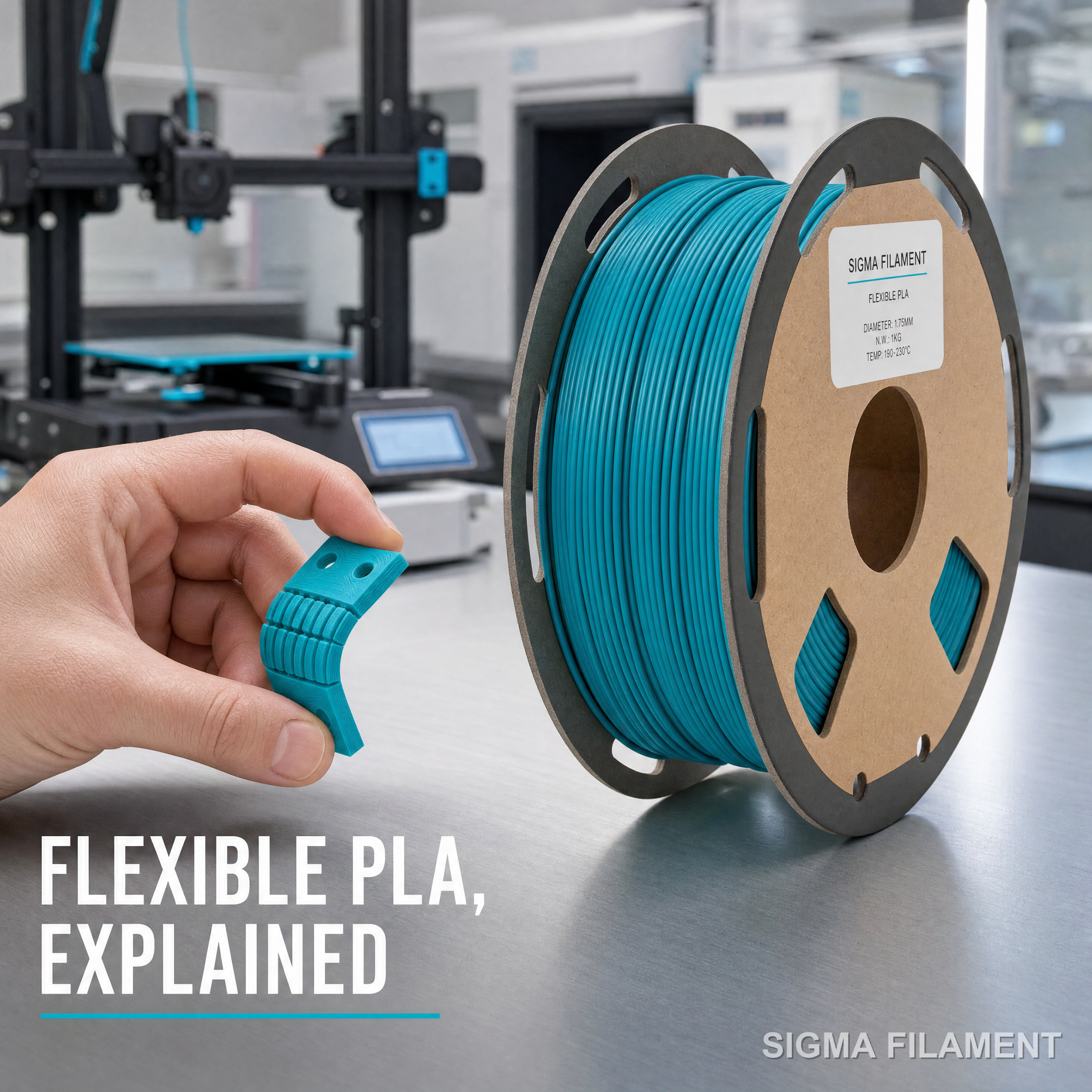
Choose flexible PLA when a part needs to bend, hinge, or damp without the feeding headaches and cost of a true elastomer. It runs on the same Bowden or direct-drive hardware as standard PLA, reaches 200-350% elongation, and lands at Shore A 80-95: soft enough for living hinges, grips, and light-duty gaskets, but far easier to run than soft TPU. Reach for TPU instead when the job demands high-cycle fatigue life, abrasion resistance, or true rubber rebound. For OEM brand owners and print farms, the real lever is custom Shore-hardness formulation and tight diameter tolerance from a source manufacturer, not an off-the-shelf spool.
Abstract
Flexible PLA is polylactic acid modified by plasticizers or copolymerization so it bends where rigid PLA snaps, landing on the Shore-hardness spectrum at roughly Shore A 80-95, between rigid PLA at Shore D 80+ and TPU at Shore A 85-95 (Joseph et al., 2023; ASTM International, 2021). It is the easy-printing semi-flexible middle ground, not a soft-TPU substitute and not a brittle-PLA footnote. The material reaches 200-350% elongation at break against rigid PLA’s 6-8% (Joseph et al., 2023; Jakab & Lendvai, 2025), holds tensile strength of 30-45 MPa, and prints at 190-220C nozzle with 40-60C bed, feeding cleanly on Bowden setups that buckle soft TPU. It trades some abrasion resistance, service temperature, and rubber rebound for far simpler feeding, faster prototyping, and biodegradability.
This guide is written for OEM brand owners and print-farm operators, for resellers, and for the engineering buyers who evaluate flexible PLA as a material category and then source it at volume. It is not written for hobbyists buying a single spool. It covers what flexible PLA is and where it sits on the Shore-hardness spectrum, the chemistry that makes PLA flexible (plasticizers versus copolymers versus elastomer blends), a numbers-backed comparison against TPU and TPE, the print settings and troubleshooting that make it Bowden-friendly, the mechanical specs and QC standards a buyer should demand, real-world applications, and how to source or custom-formulate it at OEM volume from a source manufacturer.
Key Takeaways
- Flexible PLA is its own material class on the Shore-hardness spectrum, between rigid PLA at Shore D 80+ and TPU at Shore A 85-95 (ASTM International, 2021; Joseph et al., 2023).
- Plasticizers or copolymers make PLA flexible: PEG, ATBC, and citrate esters, or PLA-PCL, PLA-PBS, PLA-PBAT, and PLA/TPU blends.
- It reaches 200-350% elongation at break against rigid PLA’s 6-8%, but stays below TPU’s 300-650% (Jakab & Lendvai, 2025).
- Typical specs: Shore A 80-95, tensile 30-45 MPa, modulus 2.0-2.5 GPa, nozzle 190-220C, bed 40-60C (Jakab & Lendvai, 2025; Cuervo et al., 2025).
- Versus TPU it feeds easier and prints faster (Bowden-compatible), but loses abrasion resistance, service temperature, and rubber rebound.
- OEM buyers should specify a target Shore hardness and demand ISO 9001, RoHS, REACH, and FDA-compliant resin from a source manufacturer.
Table of Contents
- TL;DR
- Abstract
- Key Takeaways
- Table of Contents
- What flexible PLA is and where it sits on the Shore-hardness spectrum
- How PLA is made flexible: plasticizers, copolymers, and elastomer blends
- Flexible PLA vs TPU vs rigid PLA: the property comparison
- Mechanical properties, QC, and the specs that matter
- Print settings and troubleshooting for flexible PLA
- Applications and use cases for flexible PLA
- Sourcing flexible PLA at volume: OEM, custom formulation, and MOQ
- Frequently Asked Questions
- Conclusion
- Further Reading
- References
What flexible PLA is and where it sits on the Shore-hardness spectrum
Flexible PLA is polylactic acid that has been chemically modified to lower its stiffness and raise its elongation at break, while keeping the print-friendliness that makes standard PLA the dominant FDM material. It sits on the Shore-hardness spectrum at roughly Shore A 80-95 (about Shore D 27-48), between rigid PLA at Shore D 80+ and thermoplastic polyurethane at Shore A 85-95 (ASTM International, 2021). That position is the entire reason the category exists: it is the band where a part can flex, hinge, or damp without demanding a true elastomer.
Defining flexible PLA: soft PLA, semi-flex PLA, plasticized PLA
The material goes by several names in the trade, all describing the same chemistry. Soft PLA, semi-flex PLA, and plasticized PLA are interchangeable labels for polylactic acid whose backbone or matrix has been modified with plasticizers (PEG, ATBC, citrate esters) or with softer co-monomers and blend partners (PLA-PCL, PLA-PBS, PLA-PBAT, PLA/TPU). The chemistry is the subject of section four; for the definition, the point is that flexible PLA reaches 200-350% elongation at break against rigid PLA’s 6-8% (Jakab & Lendvai, 2025), a roughly 35-to-50-fold jump in stretch capacity, while typical tensile strength stays at 30-45 MPa and Young’s modulus at 2.0-2.5 GPa.
Flexible PLA is not a niche tweak of standard PLA, and it is not a soft-TPU substitute. It is a distinct material class with its own print envelope (190-220 C nozzle, 40-60 C bed) and its own application envelope.
The Shore-hardness spectrum: rigid PLA, flexible PLA, TPU, TPE
Hardness on 3D-printable polymers is measured per ASTM D2240 and ISO 868, using two scales: Shore A for soft elastomers and Shore D for rigid plastics, with a narrow overlap band where flexible PLA actually lives (ASTM International, 2021; International Organization for Standardization, 2003). Rigid PLA reads off the top of the Shore D scale at 80+. Thermoplastic elastomer (TPE) sits at the soft end of Shore A, typically 60-85. TPU runs 85-95 Shore A. Flexible PLA falls at Shore A 80-95, which translates to roughly Shore D 27-48, overlapping the upper Shore A range with TPU but with a stiffer feel under the same indenter load. The four bands plotted side by side are the clearest single visual for material selection.
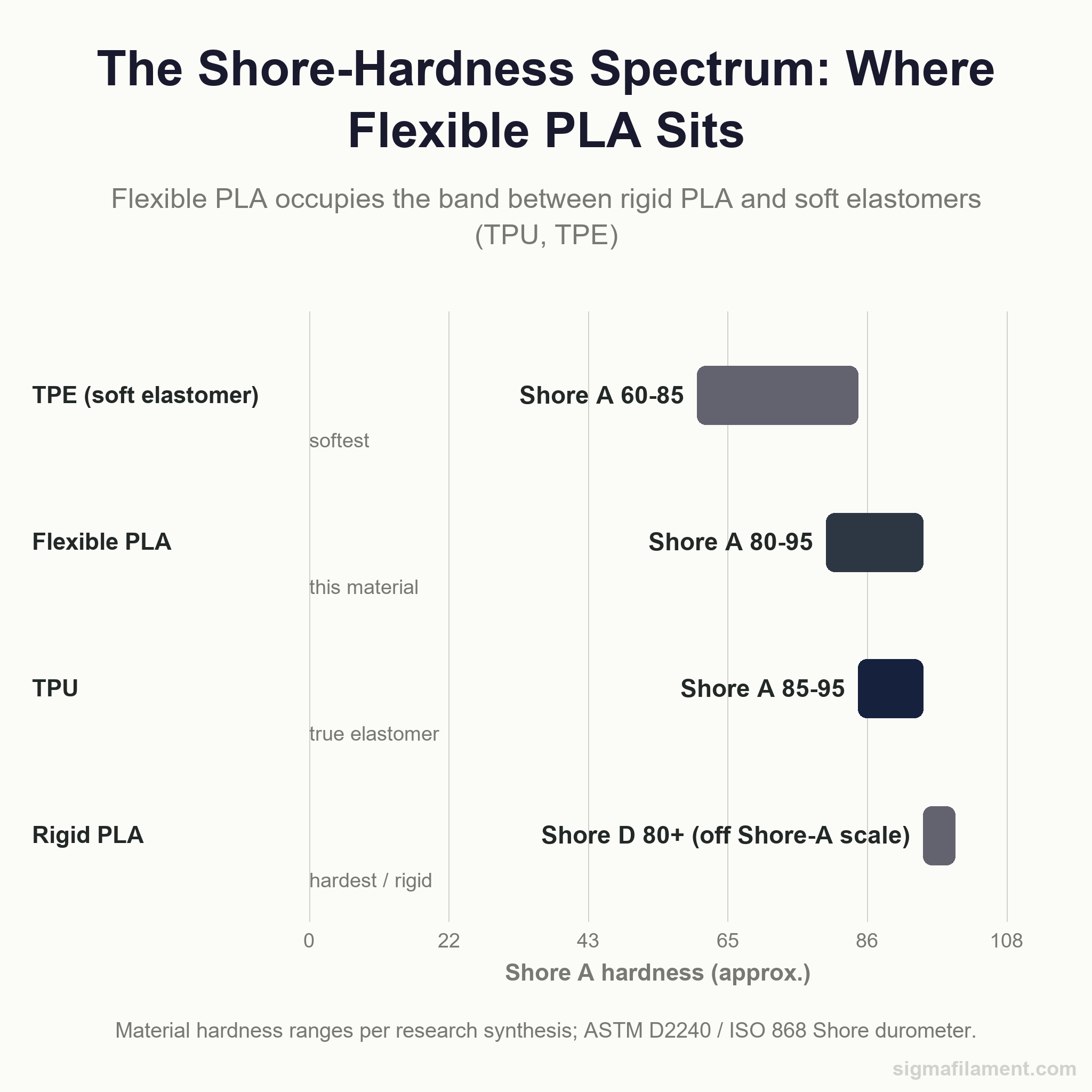
A standards-grounded measurement matters here because vendor "Shore hardness" claims are often quoted without specifying the scale, the conditioning, or the indenter dwell time defined in ASTM D2240 (15-second reading on a 6 mm thick, conditioned specimen). Buyers comparing a flexible PLA Shore A 90 against a TPU Shore A 95 are comparing two materials that test on the same scale but behave very differently under load, because Shore hardness does not capture rebound, abrasion, or elongation.
Why the spectrum framing matters for material selection
Most informational guides treat PLA as a single rigid material and route every flexible-printing question to TPU. That framing collapses a whole band of useful behavior. Spectrum framing makes the selection rule explicit. Pick rigid PLA when stiffness and dimensional stability dominate, the workhorse decision covered in the broader PLA versus PETG versus ABS comparison. Pick TPU when rubber rebound and abrasion dominate, or when the part needs high elongation. Pick flexible PLA when the part needs moderate flex (Shore A 80-95) with Bowden-compatible feeding, when prototyping has to move faster, or when biodegradability and a lower cost than a true elastomer carry weight. For OEM brand owners and print-farm operators, the spectrum is also the lever for custom Shore-hardness formulation: a source manufacturer can tune the plasticizer load or copolymer ratio to land a target hardness for the application, which is the topic of section nine.
How PLA is made flexible: plasticizers, copolymers, and elastomer blends
Polylactic acid in its native form is a glassy, semi-crystalline polyester with a glass-transition temperature near 60 C and an elongation at break of roughly 6 to 8 percent (Joseph et al., 2023). Flexible PLA is engineered backwards from that baseline along three distinct chemical routes. Each route lowers stiffness and raises elongation, but each comes with its own trade-offs around clarity, mechanical retention, regulatory profile, and dimensional stability over time.
Plasticization: PEG, ATBC, and citrate esters
The first and oldest route is external plasticization. Low-molecular-weight additives such as polyethylene glycol (PEG), acetyl tributyl citrate (ATBC), and other citrate esters are dispersed into the PLA matrix during compounding (Cuervo et al., 2025). These molecules wedge between polymer chains, increase free volume, and drop the glass-transition temperature so chains can slide past each other under load (Cuervo et al., 2025). A 2025 PEG-plasticized PLA filament study reported a tensile-elongation increase from baseline single-digit values to a multi-hundred-percent range with PEG loadings in the 10 to 20 percent range, while keeping the print window standard (Cuervo et al., 2025). The recipe is cheap and converts on existing extrusion lines, which is why most commodity "soft PLA" grades use it.
Copolymers and blends: PLA-PCL, PLA-PBS, PLA-PBAT
The second route is chemical: copolymerization or reactive blending with softer biopolyesters such as polycaprolactone (PCL), polybutylene succinate (PBS), and polybutylene adipate terephthalate (PBAT) (Jakab & Lendvai, 2025; Rajabifar & Rostami, 2023). Here the softening unit is bonded into the chain backbone, so it cannot migrate out. PLA/PBAT blends in particular have become a standard sustainable-flex platform, delivering large elongation gains while keeping the article largely bio-based and industrially compostable (Jakab & Lendvai, 2025; Yang et al., 2025). The penalty is on the tensile and modulus side, since the rubbery phase reduces load-bearing stiffness.
PLA/TPU and shape-memory blends
The third route uses a true elastomer as the toughening phase. PLA/TPU blends graft TPU domains into the PLA matrix to combine PLA’s print discipline with TPU’s elongation and rubber rebound (Hamidi et al., 2025; Abdullah et al., 2024). With certain compatibilizers and blend ratios these systems also show shape-memory behavior, recovering an as-printed geometry after deformation when reheated above PLA’s glass-transition temperature (Hamidi et al., 2025). SigmaFilament treats these PLA/TPU blends as a distinct fourth grade, sitting between plasticized soft PLA and a pure TPU 95A line. Their feeding behavior on Bowden setups stays PLA-like, while fatigue life climbs toward TPU territory.
The trade-off: plasticizer migration and what it costs
Plasticization is the cheapest path and the most chemically fragile. Small plasticizer molecules can diffuse to the surface over weeks to months, especially under heat or contact with fats and solvents, which is one reason filament storage discipline matters more for soft grades than for rigid PLA. The part turns stiffer and hazier, and sometimes tacky to the touch (Joseph et al., 2023; Cuervo et al., 2025). Migration also raises regulatory questions for food-contact and skin-contact applications, where ATBC is generally favored over phthalate-class plasticizers. Copolymer and elastomer-blend grades avoid migration but cost more per kilogram and need tighter extrusion control to keep diameter tolerance inside spec. For OEM buyers, the practical rule is to match the chemistry to the duty cycle: plasticized flexible PLA for short-life prototypes and indoor parts, PLA/PBAT for compostable single-use pieces, PLA/TPU for parts that must keep their hand and rebound past the first year.
A 2025 peer-reviewed study on PEG-plasticized PLA filaments documented that adding roughly 10 to 20 percent PEG into PLA raises tensile elongation at break from the native 6 to 8 percent range into the hundreds of percent, while the standard 190 to 220 C print window is preserved (Cuervo et al., 2025).
Flexible PLA vs TPU vs rigid PLA: the property comparison
Treating the choice as a binary between PLA and TPU is what most material guides get wrong. Flexible PLA is a third option with its own property envelope, and the right way to evaluate it is across the same nine specs an engineer would use for any thermoplastic. The table below sets the three materials side by side using documented property ranges for each class (Joseph et al., 2023; ASTM International, 2022).
Shore hardness, elongation, and tensile side by side
| Property | Flexible PLA | Rigid PLA | TPU |
|---|---|---|---|
| Shore hardness | Shore A 80-95 (~Shore D 27-48) | Shore D 80+ | Shore A 85-95 |
| Elongation at break | 200-350% | 6-8% | 300-650% |
| Tensile strength | 30-45 MPa | 50-60 MPa | 25-40 MPa |
| Young’s modulus | 2.0-2.5 GPa | 3.0-3.5 GPa | 0.01-0.1 GPa |
| Nozzle temperature | 190-220 C | 195-220 C | 220-240 C |
| Bed temperature | 40-60 C | 50-60 C | 40-60 C |
| Abrasion resistance | Moderate | Low | High |
| Service temperature ceiling | ~50-55 C | ~55-60 C | ~80-90 C |
| Biodegradability | Industrial compost | Industrial compost | No |
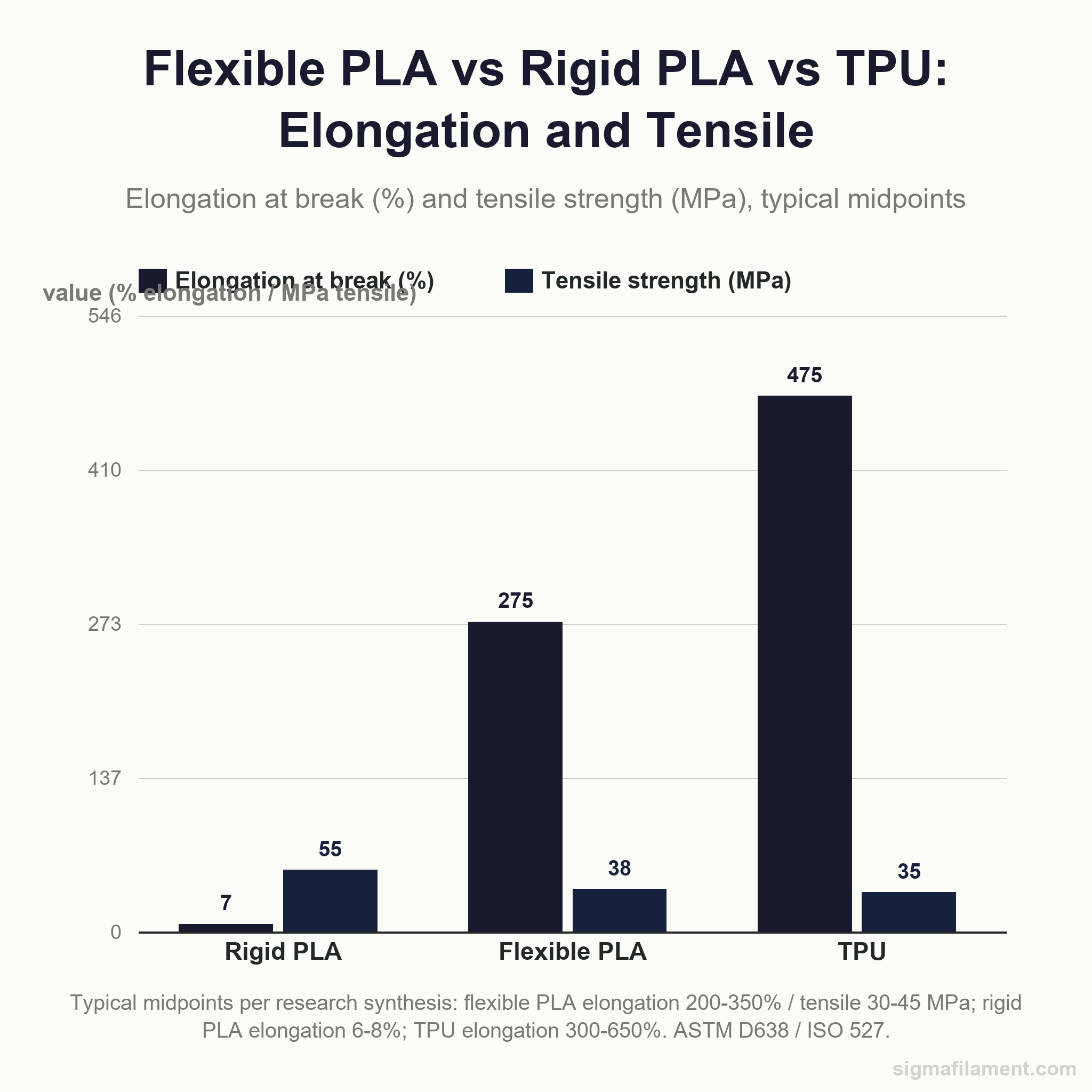
The elongation column is the headline. Flexible PLA reaches 200-350% elongation against rigid PLA’s 6-8%, a roughly 40-fold gain. That gain lets the material hinge and bend, and absorb impact where rigid PLA shatters (Jakab & Lendvai, 2025). TPU sits higher at 300-650%, with a much lower modulus that gives true rubber feel and full elastic recovery (Jakab & Lendvai, 2025).
Where flexible PLA wins: feeding, speed, biodegradability, cost
Four structural advantages keep flexible PLA in the conversation against TPU. First, the higher effective stiffness in the cold zone of the extruder cuts the buckling and skiving that plague soft TPU on Bowden setups, so flexible PLA runs on stock Bowden printers without a swap to direct drive (Abdullah et al., 2024). Second, the achievable print speed sits in the 30-60 mm/s direct drive band and 20-40 mm/s Bowden band, against 20-30 mm/s for typical TPU 95A, which compresses cycle time for prototyping and short production runs (Jakab & Lendvai, 2025; Abdullah et al., 2024). Third, the PLA base remains compostable under industrial conditions, a property TPU cannot claim. Fourth, the resin cost per kilogram tracks PLA, not TPU, and trims roughly 25-40% off filament unit cost at OEM volumes.
Across the three property classes, flexible PLA documented as plasticized or PCL/PBAT-copolymerized PLA shows Shore A 80-95 hardness, 200-350% elongation at break, 30-45 MPa tensile strength, and 2.0-2.5 GPa modulus, with a 190-220 C print window. That envelope puts it between rigid PLA (Shore D 80+, 6-8% elongation) and TPU (Shore A 85-95, 300-650% elongation) (Jakab & Lendvai, 2025; Cuervo et al., 2025).
Where TPU wins: abrasion, service temperature, rubber rebound
The losses are real and a buyer should size them. TPU 95A and below carry materially higher abrasion resistance and survive cyclic flex fatigue that work-hardens or fractures flexible PLA after a few thousand cycles (Abdullah et al., 2024). TPU’s service temperature ceiling sits in the 80-90 C range against roughly 50-55 C for flexible PLA, which rules flexible PLA out for under-hood, near-motor, or sustained outdoor applications (Abdullah et al., 2024). The low Young’s modulus also gives TPU the rubber rebound that flexible PLA approximates but does not match, important for gaskets under repeated compression set and for elastomeric grips; the full TPU materialeigenschaften reference covers these specs in depth.
Is flexible PLA the same as TPU? (no, and why)
Flexible PLA is not TPU. The two materials sit in different chemical families: TPU is a thermoplastic polyurethane elastomer with hard and soft urethane segments, while flexible PLA is polylactic acid modified by plasticization or biopolymer copolymerization. They overlap in Shore A hardness but diverge sharply on elongation, modulus, abrasion, service temperature, and biodegradability (Joseph et al., 2023; Hamidi et al., 2025). The right framing is selection by load case. Pick flexible PLA when a part needs moderate flex, easy Bowden-friendly printing, fast prototyping, biodegradability, or lower cost. Step up to TPU when the application demands abrasion resistance, sustained service temperature, or full rubber rebound. For OEM buyers running mixed lines, both materials usually belong in the spec book.
Mechanical properties, QC, and the specs that matter
A flexible PLA spec sheet that omits the test standard behind every number is a marketing document, not an engineering one. A B2B buyer qualifying flexible PLA for an OEM run should be able to read four properties off the technical data sheet, see the ASTM or ISO method that produced each value, and see a diameter tolerance backed by inline metrology. Anything thinner than that is unauditable.
Shore A hardness, elongation at break, tensile, and modulus
The property envelope for flexible PLA, drawn from peer-reviewed mechanical studies and the published material-class ranges, sits in a narrow band. Shore A hardness lands at 80 to 95, placing the material between rigid PLA on the Shore D scale and true thermoplastic elastomers below Shore A 80 (ASTM International, 2021; Joseph et al., 2023). Elongation at break runs 200 to 350 percent, against rigid PLA’s 6 to 8 percent and TPU’s 300 to 650 percent (Jakab & Lendvai, 2025; Joseph et al., 2023). Tensile strength holds at 30 to 45 MPa and Young’s modulus at 2.0 to 2.5 GPa (Joseph et al., 2023; Cuervo et al., 2025). These are class ranges, not a guarantee on a specific lot. A buyer specifies a target Shore value for the application and qualifies the actual lot against it.
How these are tested (ASTM D2240, D638; ISO 527, 868)
Shore A hardness is measured per ASTM D2240 or its ISO equivalent ISO 868, using a Type A durometer with a defined indenter geometry and load and a fixed dwell time, read on a conditioned specimen of stated thickness (ASTM International, 2021; International Organization for Standardization, 2003). Tensile strength, elongation at break, and Young’s modulus come from ASTM D638 or ISO 527, pulling a dumbbell-shape specimen at a controlled crosshead speed to failure (ASTM International, 2022). A credible flexible PLA technical data sheet names the standard and the specimen geometry, and states the conditioning next to every value. A number without a method is not comparable across vendors, since durometer dwell time alone shifts Shore A readings by several points.
Independent peer-reviewed PLA-modification studies and the published material-class synthesis converge on the same test envelope: Shore A 80 to 95 hardness per ASTM D2240, 200 to 350 percent elongation at break per ASTM D638, 30 to 45 MPa tensile strength, and 2.0 to 2.5 GPa Young’s modulus, with print processing at 190 to 220 C nozzle and 40 to 60 C bed (ASTM International, 2021; ASTM International, 2022; Joseph et al., 2023).
Diameter tolerance and batch consistency for flexible grades
Diameter tolerance matters more for flexible grades than for rigid PLA because a softer filament is more sensitive to feed-path friction and melt-flow variance. A 0.05 mm out-of-round excursion that a rigid PLA print would absorb shows up on flexible PLA as under-extrusion, surface gloss banding, or a buckled length in the cold zone of a Bowden tube. A spec sheet should list nominal diameter, tolerance, and ovality, and a buyer should expect a tolerance no looser than plus or minus 0.02 mm on 1.75 mm PLA-class material, the band Sigma Filament holds across its PLA lines using inline dual-axis laser diameter monitoring and automated gravimetric dosing (ASTM International, 2022). Batch traceability, 70-plus QC checks per spool, ISO 9001:2015 quality system, and a stated resin source close the loop. A certificate of analysis per lot, the standards-referenced property table above, and a real tolerance number are the three artifacts a print farm or product team should require before committing volume.
Print settings and troubleshooting for flexible PLA
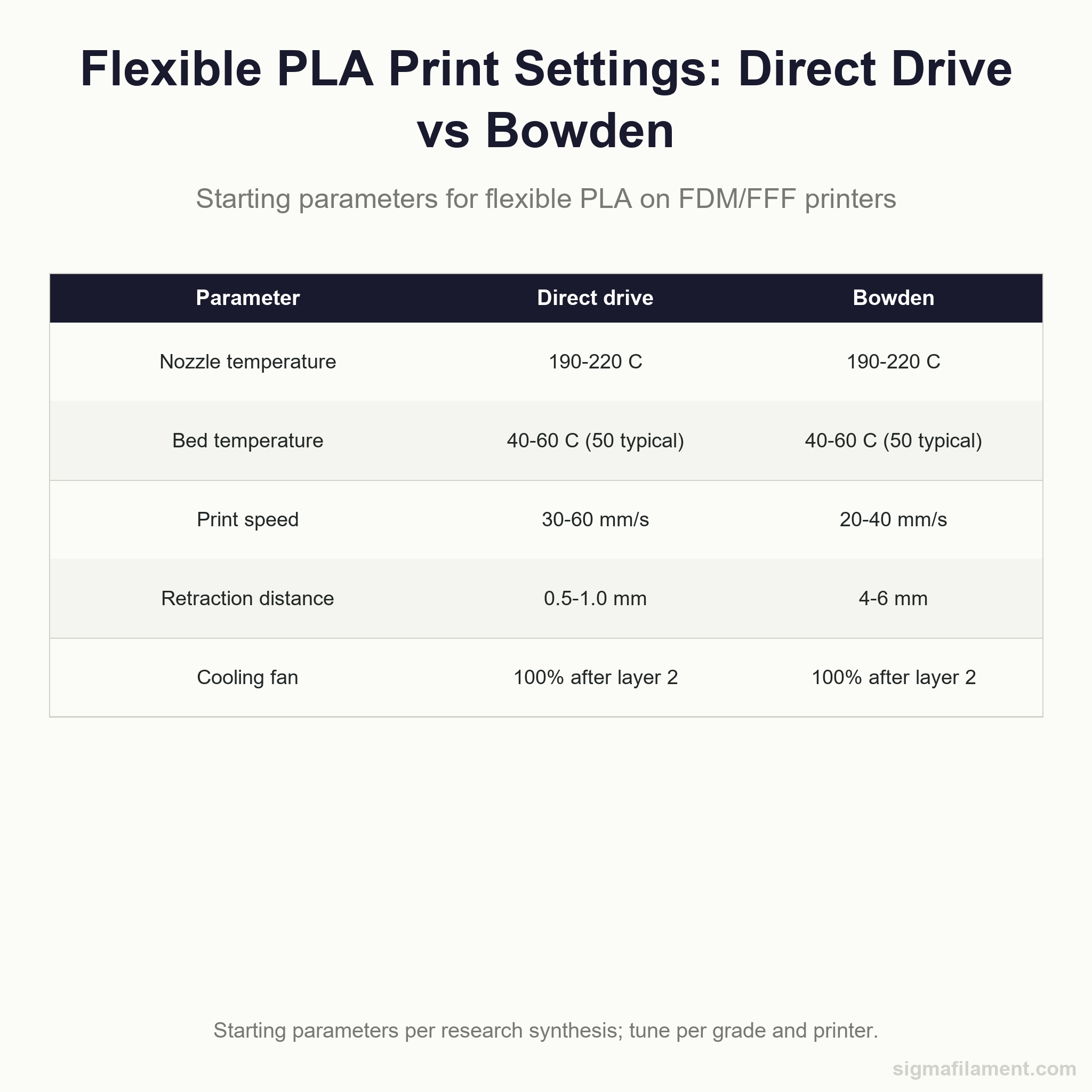
Flexible PLA prints close to a standard PLA profile, with two adjustments that matter: slower line speed on a Bowden setup, and longer retraction to compensate for filament compression in the tube. The settings below are starting points for the documented Shore A 80-95 grade range (Cuervo et al., 2025; Abdullah et al., 2024). Tune by grade and printer, then lock the profile once first-layer adhesion and stringing are clean.
A typical nozzle window is 190-220 C, with some harder grades printing up to 230 C (Cuervo et al., 2025). Bed temperature sits between 40 and 60 C, with 50 C as a reliable midpoint on glass or PEI (Cuervo et al., 2025). Run the part cooling fan at 100 percent after the first two layers; the fan stabilises the soft melt against droop on overhangs and small features.
| Parameter | Direct drive | Bowden |
|---|---|---|
| Nozzle temperature | 190-220 C | 190-220 C |
| Bed temperature | 40-60 C (50 typical) | 40-60 C (50 typical) |
| Print speed | 30-60 mm/s | 20-40 mm/s |
| Retraction distance | 0.5-1.0 mm | 4-6 mm |
| Cooling fan | 100% after layer 2 | 100% after layer 2 |
Direct drive vs Bowden: why feeding is easier than TPU
Direct drive is the recommended setup for the softer Shore A 80-90 grades, because the extruder gears grip the filament a few millimetres from the hot end and never let it buckle. Bowden remains workable on flexible PLA, which is the practical separator from soft TPU: the higher effective stiffness of plasticized PLA in the cold zone resists the compression that makes Shore A 85 TPU jam in a long PTFE tube (Abdullah et al., 2024). Drop Bowden speed to 20-40 mm/s, increase retraction to 4-6 mm, and constrain any unsupported filament path between the spool and the extruder.
Troubleshooting stringing, under-extrusion, and buckling
Three failure modes account for most flexible-PLA reprints. Stringing usually means the nozzle is too hot or retraction is too short for the extruder type. Drop the nozzle in 5 C steps from 220 toward 200, and on Bowden raise retraction toward 6 mm before adding more travel speed. A short coast distance of 0.2-0.4 mm at the end of each move also helps clean tails on small features.
Under-extrusion shows as gaps in top layers or a hollow feel on flexed parts. The fix is slower flow and a small temperature bump, in that order, because pushing soft filament harder through a partially clogged nozzle compounds the jam. Cut print speed by 20 percent first, then raise the nozzle by 5 C, then check that the extruder gear is clean of swarf.
Buckling between the drive gear and the hot end is the third issue and the one that ends most Bowden jobs. Constrain the filament path with a tighter PTFE inner-diameter tube, shorten the tube where possible, and reduce retraction speed to 25-35 mm/s so the filament does not whip back and bow inside the tube. A broader catalogue of flexible filament print failures and the matching fixes is worth a side read before committing a Bowden line to flexible PLA. First-layer adhesion is rarely a chemistry problem on PLA-base flexibles: level the bed to 0.20 mm, clean the build surface with isopropyl alcohol, and set the first layer at 60-80 percent of normal speed with the fan off. Damp filament also produces stringing and weak interlayer bonds, so drying PLA before printing is worth a 4-hour pre-print step on any spool that has been open longer than a week.
Across the documented flexible PLA Shore A 80-95 range, starting parameters published in 2026 vendor and peer-reviewed data are 190-220 C nozzle, 40-60 C bed, 30-60 mm/s on direct drive versus 20-40 mm/s on Bowden, and 0.5-1.0 mm retraction direct versus 4-6 mm Bowden, with 100 percent part cooling after the first two layers (Cuervo et al., 2025; Abdullah et al., 2024). The settings tune within the grade, not across it.
These ranges are starting points for a Shore A 80-95 flexible PLA, not a locked recipe. Buyers ordering custom Shore-hardness grades should request the manufacturer’s recommended profile and validate it against a first-layer adhesion test and a retraction tower before committing to a production run.
Applications and use cases for flexible PLA
Flexible PLA earns its place in a buyer’s catalog when a part needs to bend, damp, or seal, but the duty cycle does not demand the abrasion life and rubber rebound of TPU. For OEM brands and print farms, the question is not "PLA or TPU" in the abstract; it is which grade to stock or private-label for the application mix on the line. The map below sorts the right-fit jobs from the cases where stepping up to TPU 85A or 95A is the honest specification call (Rajabifar & Rostami, 2023; Jakab & Lendvai, 2025).
Living hinges, snap-fits, and gaskets
Living hinges, integrated snap-fits, and light-duty gaskets sit in the sweet spot. Shore A 80-95 hardness and 200-350% elongation at break let a hinge cycle without fracturing and let a snap latch flex past detents that rigid PLA at 6-8% elongation would snap on the first close. Static or low-pressure seals (enclosure gaskets, dust lips, blanking plugs) print cleanly at 190-220C without the buckling that plagues soft TPU on Bowden setups, which keeps unit cost workable for short and mid-volume runs. For production tooling rather than wear parts, see the parallel notes on filament for jigs and fixtures, where the spec calculus shifts toward stiffer grades.
Vibration damping, bumpers, and wearable straps
Tensile strength of 30-45 MPa and a modulus around 2.0-2.5 GPa give the material enough body for vibration-damping mounts, phone-case bumpers, drone landing pads, and tool grips. Wearable straps, watch bands, cosplay armor joints, and education-grade tactile parts print on existing PLA-tuned lines without retooling the hot end. The trade is service temperature and cyclic fatigue resistance: anything seeing sustained loads above roughly 55C, repeated impact, or heavy chemical exposure should be quoted in TPU instead (Abdullah et al., 2024; Rajabifar & Rostami, 2023).
Footwear-midsole prototyping and low-cost orthoses
For form-and-fit prototyping of footwear midsoles, insoles, prosthetic sockets, and orthotic shells, this grade is the iteration material, not the end-use material. Print farms can validate geometry and shore-feel against a wearer in days, then transfer the approved file to TPU or a cast elastomer for production; the TPU filament options tuned for footwear cover the production-grade step. The same logic applies to medical-form mock-ups and educational anatomical models where biodegradability and lower cost matter more than long-term wear.
Is flexible PLA biodegradable? (and what that enables)
Flexible PLA is built on a polylactic acid base and stays industrially compostable under EN 13432 and ASTM D6400 conditions even after plasticizer or copolymer modification, though plasticizer migration over months of storage can shift end-of-life behavior on long-shelved spools and finished parts (Yang et al., 2025).
That biodegradability opens single-use flexible jigs, compostable packaging inserts, trade-show giveaways, and disposable medical-form prototypes as legitimate end-uses, surfaces TPU cannot serve. For OEM buyers, the practical play is to stock flexible-PLA grades for prototyping, hinge, gasket, and sustainability-led work, then reserve TPU for high-cycle fatigue and abrasion, plus any job that demands full elastomer rebound.
Sourcing flexible PLA at volume: OEM, custom formulation, and MOQ
Sourcing flexible PLA at OEM volume is a different problem from buying a single spool. The flex point is tunable, the diameter tolerance window is tighter than rigid PLA, and the cost curve only opens up once batch-to-batch consistency is locked at the extrusion line. Off-the-shelf flexible PLA exists, but a real B2B program almost always reaches the question every consumer guide skips: can you formulate this material to hit a specific Shore hardness, in a specific color, under NDA, at a defined MOQ?
Custom Shore-hardness formulation and private-label runs
A source manufacturer with in-house compounding can shift flexible PLA’s flex point by adjusting plasticizer load (PEG, ATBC, citrate esters) or copolymer ratio (PLA-PCL, PLA-PBS, PLA-PBAT, PLA/TPU) to land on a target Shore A within the documented Shore A 80-95 band (International Organization for Standardization, 2003; Cuervo et al., 2025). Private-label runs work the same way: under NDA, an OEM and ODM filament program can match Pantone or RAL color to a deltaE under 1.5 and run a custom Shore-hardness recipe through standard 1.75 mm or 2.85 mm diameter on branded spool sizes from 200 g samples to 1 kg, 3 kg, and 5 kg production spools. The broader playbook for custom 3D printing material sourcing walks through the same NDA-to-production path for adjacent resins. The decisive specification is not the headline Shore number a buyer asks for, but the diameter tolerance the line can hold for a softer grade; flexible PLA at +/-0.02 mm on a vertically integrated line behaves predictably in production print farms, while loose tolerance on a soft grade quietly cascades into under-extrusion and jam rates.
MOQ economics and bulk pricing
MOQs exist because each formulation run consumes line setup, a resin lot, and QC time. A workable B2B ladder is: 1-3 spool samples for material qualification, standard stock runs from 100 spools, custom-color or custom-formula runs from 500 spools, with bulk discounts opening at 500-plus spools and stepping again at 1,000-plus. Buyers comparing this ladder against rigid grades can cross-reference the bulk PLA filament sourcing guide and the live wholesale PLA program for benchmark MOQs and unit-cost tiers. Buyers should treat the sample tier as a Shore-and-elongation qualification, not a price comparison.
A flexible PLA program that scales cleanly typically follows a three-step path: a 1-3 spool sample at the target Shore band for application qualification, a 100-spool standard production run to confirm batch behavior on the buyer’s printers, then a 500-spool custom-formula or custom-color run at the locked specification, with bulk-tier discount stepping in at 500-plus and again at 1,000-plus spools per order (International Organization for Standardization, 2003).
Certifications to demand: ISO 9001, RoHS, REACH, FDA-compliant resin
A buyer specifying flexible PLA at volume should require, in writing, a quality management system audit under ISO 9001:2015, RoHS and REACH compliance on the finished filament, and FDA-compliant resin where the part may contact food, skin, or a regulated environment (International Organization for Standardization, 2003). The resin base matters: 100 percent virgin NatureWorks Ingeo PLA pellets give a known starting point for the plasticization or copolymer blend, whereas reground or off-spec resin introduces lot-to-lot variability that no downstream QC can fully recover. A certificate of analysis with diameter, ovality, Shore hardness, and tensile data per spool lot is the minimum traceability standard; the longer-form 12 QC checks buyers should ask for at audit time enumerate the questions worth putting in writing.
Why a source manufacturer beats a trading company
A vertically integrated source manufacturer (pellet to packaged spool, dual-axis laser diameter monitoring, automated gravimetric dosing, batch traceability) controls every variable that determines whether a soft-grade run repeats next quarter. A trading company resells whatever line happened to extrude that week, with no formulation authority and no control over plasticizer migration over time (International Organization for Standardization, 2003). The longer audit on how to vet a filament maker covers the seven concrete checks a buyer can run before signing the first PO.
If a flexible PLA grade is in scope for a product launch or a print farm, request a factory sample at the target Shore band, qualify the Shore and elongation against the application, then scale through 100-spool and 500-spool tiers under a custom-formulation NDA.
Frequently Asked Questions
Is flexible PLA the same as TPU?
No. Flexible PLA is plasticized or copolymerized polylactic acid; TPU is thermoplastic polyurethane, a true elastomer. They overlap on the Shore-A 85-95 band, but TPU reaches 300-650% elongation versus flexible PLA’s 200-350%, and TPU carries higher abrasion resistance, wider service temperature, and real rubber rebound. Flexible PLA feeds easier on Bowden setups, prints faster, and remains biodegradable under industrial composting (Joseph et al., 2023; Jakab & Lendvai, 2025).
What Shore hardness is flexible PLA?
Flexible PLA typically falls in the Shore A 80-95 range, which corresponds to roughly Shore D 27-30 on the harder durometer scale. Rigid PLA sits at Shore D 80+, and TPU usually lands at Shore A 85-95. A 2025 PEG-plasticized PLA filament study shows that adjusting plasticizer load shifts hardness predictably within this band, which is the lever a source manufacturer pulls to hit a target Shore value for OEM specifications, measured per ASTM D2240 or ISO 868 (Cuervo et al., 2025; ASTM International, 2021).
What print temperature does flexible PLA need?
Most flexible PLA grades print at a nozzle temperature of 190-220 C, with some formulations running up to 230 C. Bed temperature is 40-60 C, with 50 C as a common starting point. Run cooling fan at 100% after the first two layers. Start at the middle of each range, then tune by 5 C steps if stringing or under-extrusion appears (Cuervo et al., 2025).
Can flexible PLA be printed on a Bowden extruder?
Yes. Flexible PLA is Bowden-compatible because its effective stiffness in the cold zone is higher than soft TPU’s, so the filament resists buckling inside the PTFE tube. Use retraction of 4-6 mm at 25-35 mm/s and print speed of 20-40 mm/s on Bowden setups, versus 0.5-1.0 mm retraction and 30-60 mm/s on direct drive. Soft TPU below Shore A 85 still benefits from a direct-drive head (Abdullah et al., 2024).
Is flexible PLA biodegradable?
Yes, under industrial composting conditions. The base polymer is polylactic acid derived from plant feedstocks such as NatureWorks Ingeo resin, which carries industrial-compostable certification. Plasticizers and copolymer partners like PCL, PBS, or PBAT also break down in those environments, though home-compost performance is slower and less reliable. This biodegradability is the property that makes flexible PLA attractive for single-use flexible parts and sustainable prototyping (Yang et al., 2025).
Is flexible PLA stronger than TPU?
On tensile strength, often yes; on elongation, no. Flexible PLA reaches 30-45 MPa tensile with a Young’s modulus of 2.0-2.5 GPa, while TPU typically lands around 30-35 MPa with much lower modulus. TPU outperforms on elongation at break (300-650% versus 200-350%), abrasion resistance, and fatigue under repeated cyclic loading, which is why high-cycle elastomeric parts still belong in TPU (Jakab & Lendvai, 2025).
What is the elongation at break of flexible PLA?
Flexible PLA reaches an elongation at break of 200-350%, with 300% as a typical midpoint when tested per ASTM D638 or ISO 527. Rigid PLA breaks at 6-8% strain, and TPU stretches to 300-650% before failure. The 200-350% range is what enables living hinges, gaskets, and damping mounts to bend repeatedly without snapping (Jakab & Lendvai, 2025; ASTM International, 2022).
Can I buy flexible PLA in bulk for OEM private label?
Yes. Source manufacturers run sampling at 1-3 spools, standard production runs from roughly 100 spools, and custom Shore-hardness or color-matched runs from around 500 spools. Demand ISO 9001 quality management, RoHS, REACH, and FDA-compliant resin documentation, along with a certified virgin-PLA pellet base. A vertically integrated factory beats a trading company on batch traceability and custom formulation (International Organization for Standardization, 2003).
Why is flexible PLA softer than rigid PLA?
Flexible PLA is engineered by adding plasticizers (PEG, ATBC, citrate esters) or copolymer partners (PLA-PCL, PLA-PBS, PLA-PBAT) to lower the glass-transition temperature and increase chain mobility. These additives wedge between polymer chains and raise free volume so the chains slide past each other under load. A 2025 PEG-plasticized PLA filament study shows that 10-20 percent PEG loading raises tensile elongation from the native 6-8 percent range into the hundreds of percent while preserving the standard 190-220 C print window (Cuervo et al., 2025).
Conclusion
Flexible PLA is a material category in its own right, sitting on the Shore-hardness spectrum between rigid PLA and TPU. Specify it when a part needs to bend, hinge, damp vibration, or absorb a light impact, and when easy Bowden-friendly feeding, fast prototyping, biodegradable resin, and lower per-spool cost matter more than full elastomer performance. Step up to TPU when the application demands high-cycle fatigue resistance, abrasion resistance, broader service temperature, or true rubber rebound. The two materials are not substitutes; they are adjacent tools.
For OEM brand owners, print farms, and resellers, the operational lever is custom Shore-hardness formulation. Tell a source manufacturer the target Shore A value, the elongation envelope, and the certifications you require (ISO 9001, RoHS, REACH, FDA-compliant resin), then request a factory sample before committing to volume. Qualify the spool against the application, confirm batch-to-batch tolerance on a small run, and scale from there. SigmaFilament runs custom formulations on NatureWorks Ingeo virgin pellets across the full filament catalog; contact our team to discuss a target spec.
Further Reading
Readers evaluating flexible PLA against neighboring materials will find the SigmaFilament TPU filament guides (covering Shore 95A and Shore 85A grades) the natural next stop for high-rebound, high-abrasion applications where the limits of flexible PLA become binding. The PLA versus PETG comparison material is the right reference when the question is rigid prototyping rather than flex, and the broader PLA material category guide situates flexible PLA within the wider polylactic acid family. Print farms running flexible grades at volume should consult the filament storage and drying guidance, since softer PLA formulations absorb moisture faster than rigid PLA. For OEM buyers, the private-label and custom-formulation sourcing overview explains the MOQ tiers and certification scope referenced in the sourcing section above. On the standards side, ASTM and ISO durometer and tensile specifications (notably the D2240, D638, 868, and 527 families) are the authoritative external references for the test methods cited throughout this guide.
References
- Joseph, T. M., Kallingal, A., Suresh, A. M., Mahapatra, D. K., Hasanin, M. S., Haponiuk, J., & Thomas, S. (2023). 3D printing of polylactic acid: Recent advances and opportunities. The International Journal of Advanced Manufacturing Technology, 125(3-4), 1015-1035. https://doi.org/10.1007/s00170-022-10795-y
- Cuervo, L. V., Rojas, O. E., Sanchez, L. E., Herrera, L. K., & Serrato, J. C. (2025). Enhanced PLA/PEG filaments for sustainable high-performance 3D printing using PLA synthesized from commercial lactic acid. Journal of Materials Science. https://doi.org/10.1007/s10853-025-11532-y
- Jakab, S. K., & Lendvai, L. (2025). Toward sustainable 3D printing: Tensile mechanical comparison of PLA/PBAT biopolymer blend and TPU in MEX additive manufacturing. Engineering Proceedings, 113(1), 22. https://doi.org/10.3390/engproc2025113022
- Hamidi, M. N., Abdullah, J., Mahmud, A. S., & Namazi, H. (2025). Effects of blend ratios and printing parameters on shape memory performance of polylactic acid (PLA)/thermoplastic polyurethane (TPU) shape memory polymer. SSRN. https://doi.org/10.2139/ssrn.5499597
- Abdullah, J., Hamidi, M. N., Mahmud, A. S., Hassan, M. H., & Zainoddin, A. Y. (2024). Influence of thermoplastic polyurethane (TPU) and printing parameters on the thermal and mechanical performance of polylactic acid (PLA)/thermoplastic polyurethane (TPU) polymer. SSRN. https://doi.org/10.2139/ssrn.4982897
- Rajabifar, N., & Rostami, A. (2023). Investigation of the effect of hybrid nanofiller on the mechanical performance and surface properties of bio-based polylactic acid/polyolefin elastomer (PLA/POE) blend. Polymers, 15(12), 2708. https://doi.org/10.3390/polym15122708
- Yang, Z., Zhang, Q., & Cai, D. (2025). Biodegradable polymer blend based on polylactic acid and polyhydroxybutyrate in FDM 3D printing technology. In Interdisciplinary Biotechnological Advances (pp. 233-250). Springer. https://doi.org/10.1007/978-981-95-0094-9_8
- ASTM International. (2021). ASTM D2240-15(2021): Standard test method for rubber property: Durometer hardness. ASTM International. https://www.astm.org/d2240-15r21.html
- ASTM International. (2022). ASTM D638-22: Standard test method for tensile properties of plastics. ASTM International. https://www.astm.org/d0638-22.html
- International Organization for Standardization. (2003). ISO 868:2003: Plastics and ebonite: Determination of indentation hardness by means of a durometer (Shore hardness). ISO. https://www.iso.org/standard/34804.html
Last reviewed and updated: June 2026. Author: SigmaFilament team. For tailored guidance, contact our team.