

Carbon Fiber & Glass Fiber Filament:
Standard Plastic Strength, Composite Performance
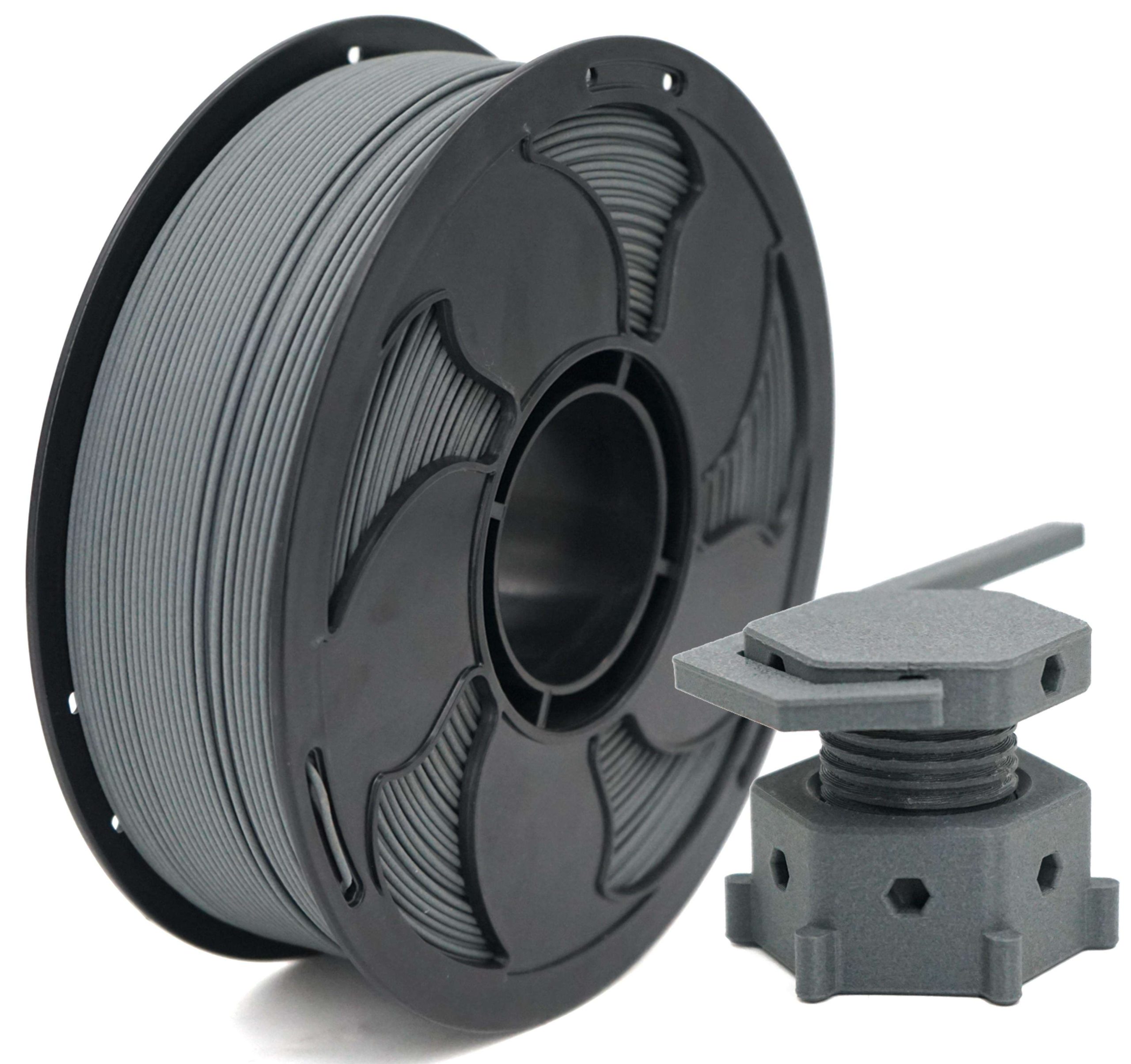
Short chopped carbon and glass fibers embedded in PLA, PETG, ABS, ASA, and Nylon PA12 create composite filaments that are 2–5× stiffer and significantly more dimensionally stable than their unfilled counterparts. SigmaFilament ships 15 in-stock SKUs across 7 composite families — PLA-CF, PETG-CF, ABS-CF, PA12-CF, PLA-GF, PETG-GF, and ABS-GF/ASA-GF — factory-direct from our ISO 9001 facility.
Six Advantages That Make Reinforced Filament Worth the Premium
Carbon fiber and glass fiber don't just look professional — they fundamentally change the mechanical behavior of the base polymer. Here's what buyers need to understand.
High Stiffness & Rigidity
Short chopped carbon or glass fibers act as a rigid skeleton within the polymer matrix. The result: 2–5× higher tensile modulus depending on base material and fiber type. Parts resist bending, flexing, and deformation under load — critical for structural components, brackets, and fixtures where dimensional rigidity matters.
Lightweight Strength
Carbon fiber's exceptional strength-to-weight ratio means reinforced parts achieve near-engineering-grade stiffness without the weight penalty of metal or solid infill. This is why CF composites dominate in aerospace, drones, and racing applications — every gram matters, and CF filament delivers strength without mass.
Dimensional Stability — Less Warping
Carbon and glass fibers reduce shrinkage and warping by 20–30% compared to unfilled base polymers. The fibers resist thermal contraction during cooling, keeping parts dimensionally accurate. This is particularly valuable for large prints, tight-tolerance assemblies, and batch production where consistency between parts is non-negotiable.
Improved Heat & Chemical Resistance
Fiber reinforcement raises the effective heat deflection temperature and improves chemical/solvent resistance. PA12-CF achieves HDT above 100 °C — suitable for under-hood automotive parts and industrial environments. ABS-CF and ASA-GF offer superior outdoor & weather durability; even PLA-CF shows measurably improved thermal stability over standard PLA.
Professional Matte Surface Finish
CF-reinforced filament produces a distinctive matte, textured surface that hides layer lines far better than standard filaments. The result looks and feels engineered — not 3D printed. This aesthetic is valued for client-facing prototypes, display models, and end-use parts where appearance matters alongside function. GF variants offer a cleaner semi-matte look.
Easier Printing Than You'd Expect
Fibers actually improve printability in many cases — reducing stringing, oozing, and blob formation. PLA-CF and PETG-CF print on any printer that handles their base material (with a hardened nozzle). The main requirement is nozzle material, not printer capability. ABS-CF, PA12-CF, and ASA-GF need enclosed machines because of their base polymer, not the fiber.
What Carbon Fiber Actually Changes — A Direct Comparison
How CF-reinforced filaments compare to their unfilled counterparts across all four polymer families. Glass fiber variants (PLA-GF, PETG-GF, ABS-GF/ASA-GF) behave similarly but with better impact toughness, lower cost, and slightly lower stiffness than their CF equivalents.
| Property | Standard PLA | PLA-CF | Standard PETG | PETG-CF | Standard ABS | ABS-CF | Nylon (PA) | PA12-CF |
|---|---|---|---|---|---|---|---|---|
| Tensile Modulus | ~2,300 MPa | ~4,500 MPa | ~2,000 MPa | ~4,700 MPa | ~2,100 MPa | ~3,800 MPa | ~1,700 MPa | ~6,500 MPa |
| Stiffness Gain | Baseline | ~2× stiffer | Baseline | ~2.3× stiffer | Baseline | ~1.8× stiffer | Baseline | ~3.8× stiffer |
| Heat Deflection | ~55°C | ~60°C | ~70°C | ~80°C | ~95°C | ~100°C | ~80°C | >100°C |
| Warping | Low | Very low | Low–moderate | Very low | High | Moderate | High | Moderate |
| Impact Strength | Brittle | More brittle | Good | Moderate | Excellent | Good | Excellent | Good |
| Surface Finish | Glossy/smooth | Matte CF texture | Glossy | Matte CF texture | Glossy | Matte CF texture | Smooth | Matte CF texture |
| Chemical Resist. | Poor | Poor | Good | Good+ | Moderate (acetone-soluble) | Moderate | Excellent | Excellent |
| Moisture Sensitivity | Low | Low | Moderate | Moderate | Low | Low | Very high | High |
| Hardened Nozzle? | No | ⚠️ Required | No | ⚠️ Required | No | ⚠️ Required | No | ⚠️ Required |
| Enclosure? | No | No | Optional | Optional | Required | Required | Required | Required |
| Nozzle Temp | 190–220°C | 200–230°C | 230–250°C | 240–265°C | 230–260°C | 240–260°C | 240–270°C | 260–290°C |
| Relative Price | $ | $$ | $ | $$ | $ | $$ | $$ | $$$ |
💡 Reading this table: Carbon fiber increases stiffness dramatically, but reduces impact toughness (the material becomes more brittle). This is a deliberate trade-off: CF composites are ideal for rigid structural parts, but not for parts that need to absorb energy on impact — for that, use unfilled PETG / ABS / Nylon, or a glass-fiber variant (GF retains more impact toughness than CF).
⚠️ Nozzle warning: All carbon fiber and glass fiber filaments are abrasive. A standard brass nozzle will wear through in hours, causing diameter enlargement and quality degradation. A hardened steel, ruby, or tungsten carbide nozzle is mandatory for every SKU on this page. This is not optional.
7 Composite Families · 15 In-Stock SKUs · CF & GF Reinforced
Choose by application requirements. Entry-level composites (PLA-CF, PETG-CF, PLA-GF, PETG-GF) print on most FDM machines with a hardened nozzle. High-performance composites (ABS-CF, PA12-CF, ABS-GF/ASA-GF) require enclosed printers but deliver engineering-grade performance.
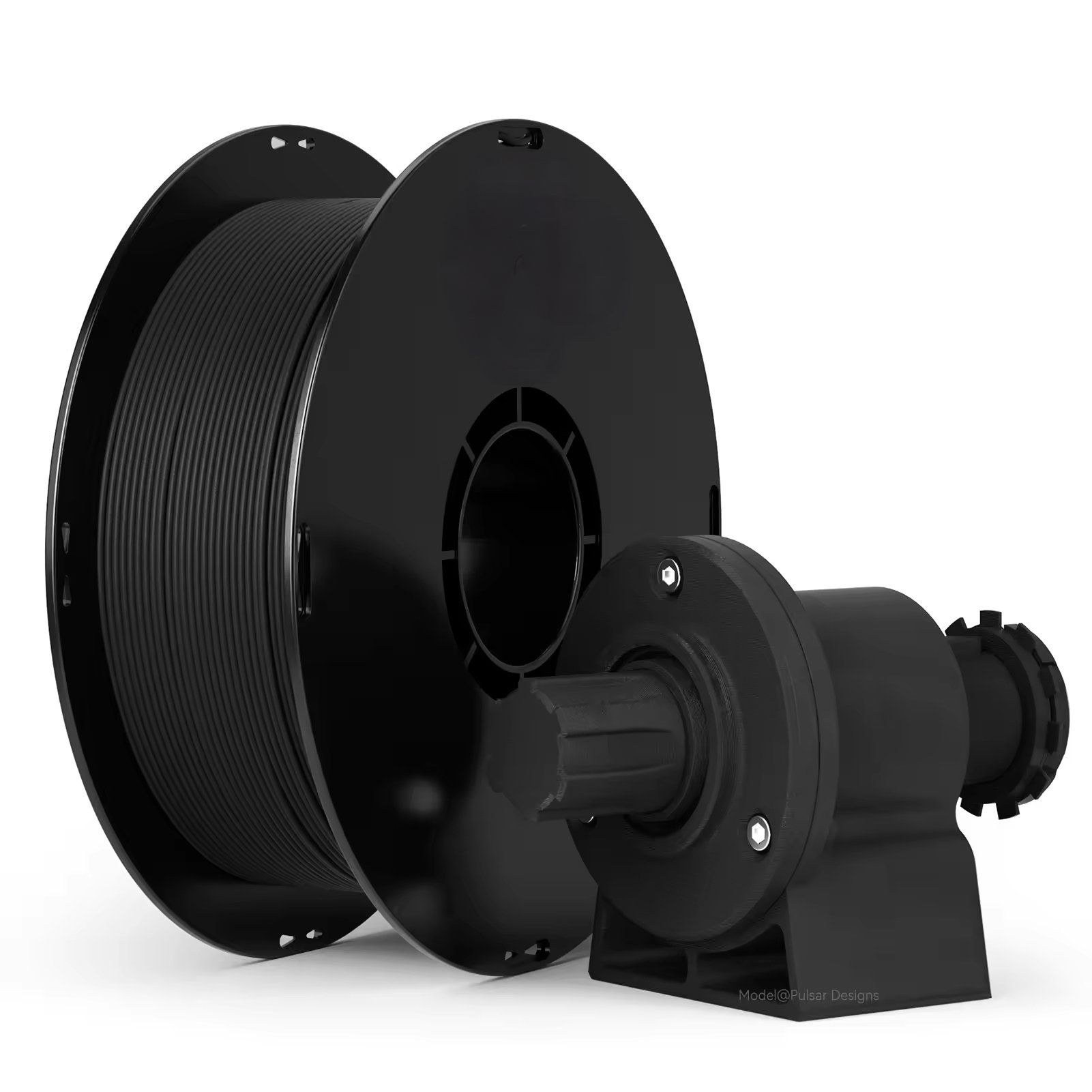
- Nozzle: 190–230°C · Bed: 50–65°C
- Flexural modulus +50–80% vs standard PLA
- No enclosure needed · Matte CF surface
- Hardened nozzle required (abrasive)

- Nozzle: 240–265°C · Bed: 75–95°C
- ~2.3× stiffer than standard PETG
- Better heat / chemical / UV resistance than PLA-CF
- Hardened nozzle required (abrasive)
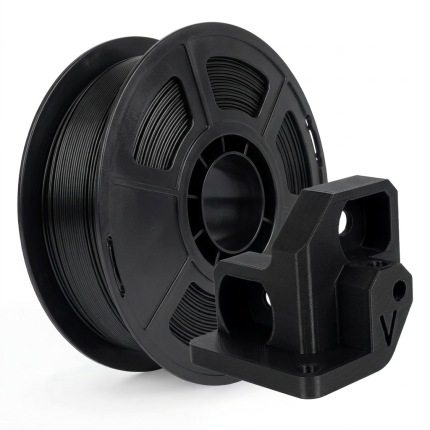
- Nozzle: 240–260°C · Bed: 90–110°C
- ~1.8× stiffer than standard ABS · HDT ~100 °C
- Enclosed printer required (ABS base polymer)
- Hardened nozzle required (abrasive)
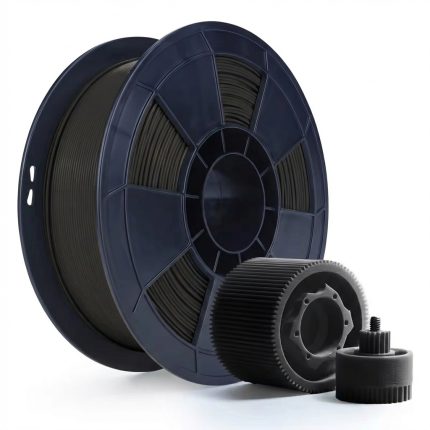
- Nozzle: 260–290°C · Bed: 80–110°C
- ~3.8× stiffer than standard Nylon
- HDT >100 °C · Excellent chemical resistance
- Enclosed printer + dry box + hardened nozzle
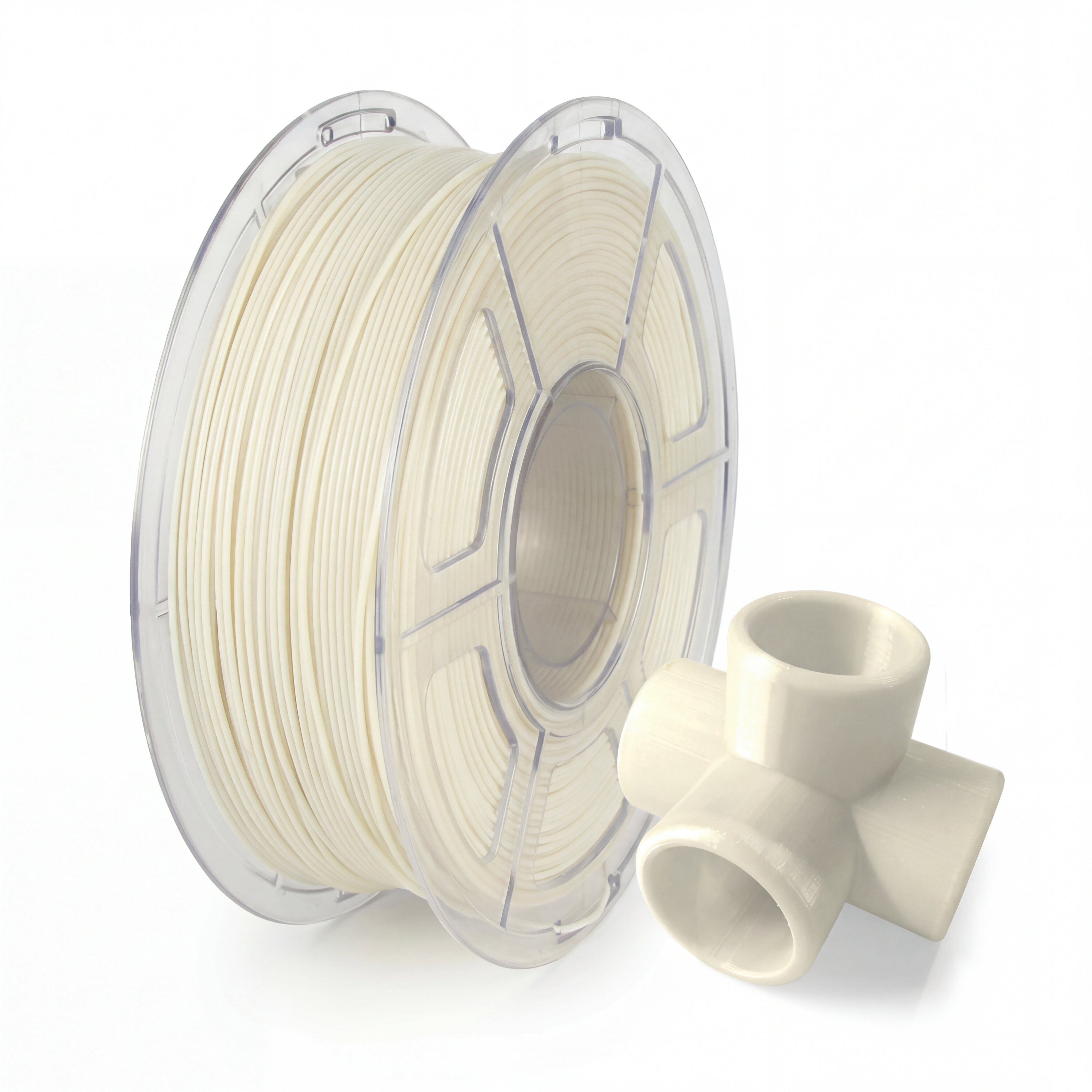
- Nozzle: 195–225°C · Bed: 50–65°C
- Moderate stiffness + better impact vs PLA-CF
- Lower cost than CF variants · less nozzle wear
- Hardened nozzle still recommended
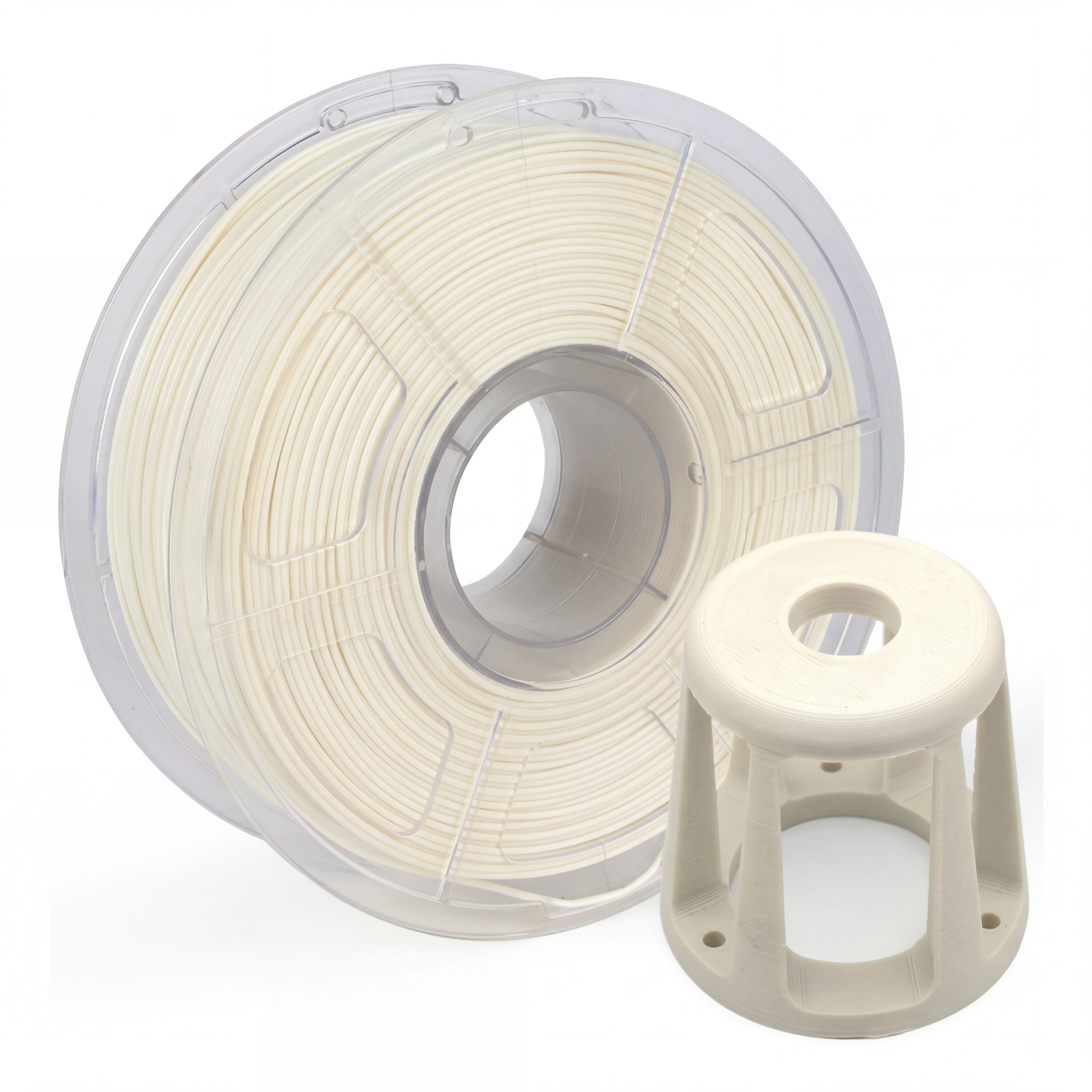
- Nozzle: 235–255°C · Bed: 75–85°C
- Stiffer than standard PETG with better impact than PETG-CF
- Good moisture, chemical & UV resistance
- Hardened nozzle recommended (abrasive)
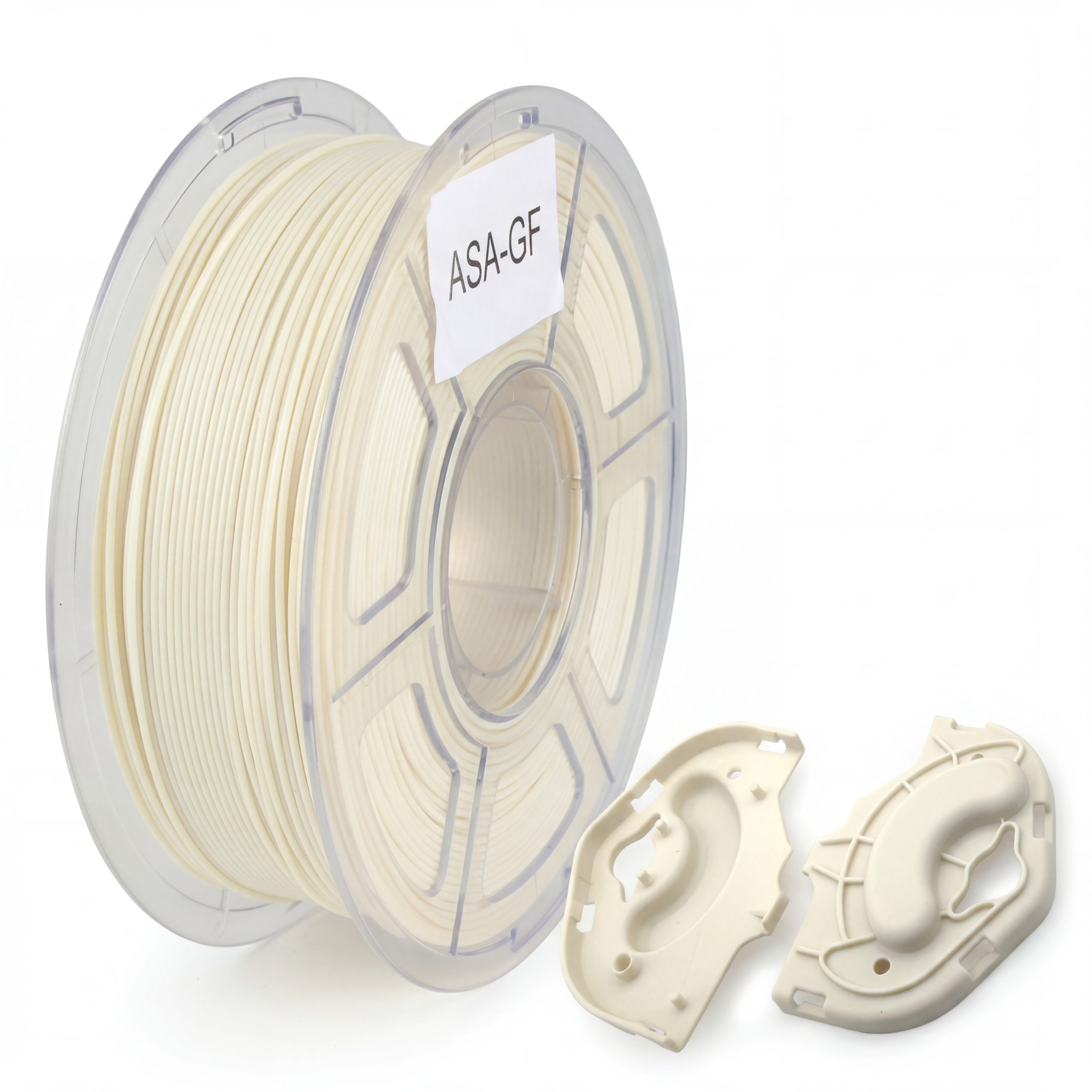
- Nozzle: 240–260°C · Bed: 90–110°C
- Dramatically increased strength & heat resistance vs standard ABS / ASA
- ASA-GF adds UV / weather resistance for outdoor parts
- Enclosed printer + hardened nozzle required
Before You Buy: What CF & GF Filament Demands from Your Hardware
Every SKU on this page is abrasive — carbon and glass fibers both wear brass nozzles within hours. This section covers everything you need to print successfully across all 7 families.
Why Brass Nozzles Fail with CF & GF
Both carbon and glass fibers are extremely hard (harder than brass). As filament is pushed through a brass nozzle, the fibers abrade the inner bore, gradually widening it from 0.4mm to 0.5mm, 0.6mm, and beyond. This causes under-extrusion, inconsistent line width, poor surface quality, and failed prints. The damage happens invisibly — by the time you notice quality degradation, the nozzle is already ruined. A hardened steel nozzle costs $5–15 and lasts thousands of hours with fiber-reinforced materials. This is a mandatory upgrade, not optional — for all 15 SKUs in our composite catalog.
Buyer Tip: For Your Customers
If you're a reseller or distributor, always inform end users about the hardened nozzle requirement — it prevents returns, bad reviews, and support tickets. Consider bundling hardened nozzles with CF/GF filament sales. SigmaFilament can include nozzle requirement labels on OEM packaging upon request.
Where CF & GF Filament Delivers the Most Value
Each application card shows which family tier is the better match — entry-level (PLA-CF, PETG-CF, PLA-GF, PETG-GF), industrial (ABS-CF, ABS-GF/ASA-GF), or high-performance (PA12-CF).
Engineering Prototypes
Functional prototypes that approximate injection-molded stiffness. Test fit, form, and load before committing to tooling.
All 7 FamiliesJigs, Fixtures & Tooling
Production line aids, assembly jigs, positioning fixtures. CF/GF stiffness ensures repeatability under mechanical contact.
PETG-CF / ABS-CF / PA12-CFDrone Frames & UAV Parts
Lightweight + rigid = ideal for drone arms, motor mounts, and camera gimbals. PETG-CF for outdoor UV stability.
PETG-CF / PA12-CFAutomotive Components
Under-hood brackets, interior trim, dashboards. PA12-CF handles high engine bay heat; ABS-CF for interior structural parts.
PA12-CF / ABS-CFSmall-Batch End-Use Parts
Low-volume production of rigid structural parts. Replace CNC-machined metal with printed CF/GF composite for 60–80% cost reduction.
All 7 FamiliesOutdoor & UV-Exposed Parts
Signage brackets, enclosures, solar-exposed hardware. ASA-GF provides the best UV / weather durability in the lineup.
ASA-GF / PETG-CFPrint Farm Production
Batch manufacturing of functional CF/GF parts. Consistent ±0.05mm composite tolerance ensures reliable fleet-wide output.
All 7 FamiliesRacing & High-Performance
Motorsport brackets, mounting solutions, aero components. Weight reduction is the priority — PA12-CF delivers the best performance.
PA12-CFThree Buyer Profiles for Carbon Fiber & Glass Fiber Composites
Engineering & Manufacturing
Product development teams and contract manufacturers printing functional parts, jigs, fixtures, and pre-production prototypes that require stiffness and precision.
- PETG-CF / ABS-CF / PA12-CF for structural applications
- ASA-GF for outdoor / weather-exposed parts
- PLA-CF for rapid concept models
- TDS and per-batch QC documentation
Print Farms & Service Bureaus
Operations with 10–500+ printers offering CF/GF printing as a premium service tier. Composite filament commands higher per-part pricing from clients.
- Premium material = premium service margin
- ±0.05mm composite tolerance · fleet consistency
- Volume discounts on 200+ spool orders
- Mixed CF + GF + standard orders accepted
Resellers & OEM Brands
Filament brands building an engineering materials lineup. CF & GF is the fastest-growing premium segment — customers who buy composites are among the highest-value buyers in your catalog.
- Full OEM: branded spools, packaging, TDS
- Custom fiber content % and formulations
- 7 composite families in a single SKU range
- NDA-protected partnerships
MOQ, Lead Time & Shipping for CF & GF Filament
Mixing note: You can combine any of the 7 composite families — PLA-CF, PETG-CF, ABS-CF, PA12-CF, PLA-GF, PETG-GF, ABS-GF/ASA-GF — in a single order as long as the combined total meets the 100-spool threshold. You can also mix composites with standard filaments (PLA, PETG, ABS, ASA) in the same shipment. Volume discounts available at 500+ and 1,000+ spools.
From Quote to Delivery — 4 Steps
Specify Material & Application
Tell us which families you need from the 7 composites (CF and/or GF), your target applications (structural? aesthetic? outdoor?), quantities, and whether you need OEM packaging. Mention your printer fleet — we'll confirm nozzle and enclosure compatibility.
Sample & Validate
We ship 1–3 sample spools. Test with your hardened nozzle at your production settings. Validate stiffness, surface finish, dimensional accuracy, and interlayer adhesion. For PA12-CF and ABS-CF, verify your enclosed printer and dry storage workflow handle the material.
Confirm PI & Production
Approve Proforma Invoice. We schedule production with lot-specific QC including fiber dispersion checks, tensile testing, and diameter verification. Composite filaments require additional fiber distribution quality checks vs standard filaments.
QC, Package & Ship
Final batch QC with documentation. All CF/GF filament is vacuum-sealed with desiccant (especially critical for PA12-CF). Customs documentation and global logistics coordination for door-to-door delivery via EXW, FOB, CIF, or DDP.

Wholesale CF & GF Filament — FAQ
Common questions from engineering teams, print farms, and resellers evaluating wholesale composite sourcing — from manufacturer identity and material selection across 7 families to nozzle requirements, MOQ, and international delivery.