PET filament vs PETG: a complete 2026 material guide

TL;DR
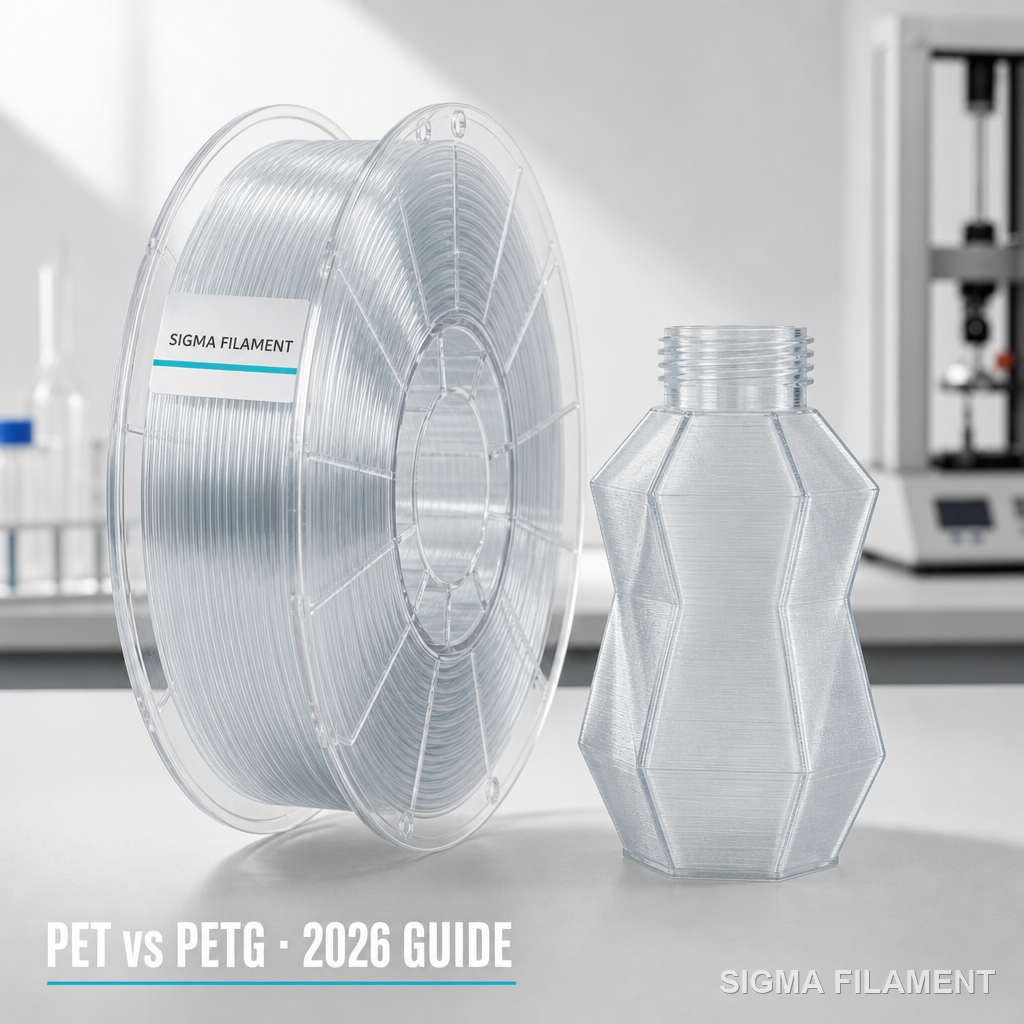
If you searched ‘PET filament’ you may mean one of three things: (a) true polyethylene terephthalate (PET) as a 3D printing filament, the semicrystalline polyester used for water bottles; (b) PETG, the glycol-modified PET filament most people actually buy because it prints easily; or (c) pet-safe or pet-themed filament for projects involving animals. This PET filament guide is about (a) industrial PET filament, with a full PET vs PETG comparison and a manufacturer’s view of when each wins. In short: true PET is semicrystalline (Tg 70-80C, Tm 245-260C, crystallinity 30-37%), stiffer, more heat-resistant after annealing, and food-contact-referenced, but it needs a 250-270C hotend and an 80-90C bed, plus drying and an enclosure. PETG is amorphous, has no true melting point, prints on any hobby printer at 230-250C, and is the practical production choice for most buyers, which is why SigmaFilament makes PETG, PETG+, and PETG-CF at scale.
Abstract
Most people searching for "pet filament" actually want PETG, the glycol-modified, easy-print PET filament variant, not true PET. True PET is poly(ethylene terephthalate), the semicrystalline polyester behind water bottles, with a glass transition of 70 to 80 C and a true melt point of 245 to 260 C (Viora et al., 2023). PETG substitutes cyclohexanedimethanol for some ethylene glycol, breaking the crystal lattice into an amorphous polymer with no melting point, lower stiffness, and far easier printing (Sztorch et al., 2025). This guide settles the distinction. It treats pure PET as a specialist material for engineers and packaging buyers, and PETG as the practical production polymer for almost everyone else.
The audience for this PET filament guide is threefold: searchers who meant PETG and need an honest conversion path, engineers evaluating true PET filament or recycled rPET for optical, food-contact, or high-HDT parts, and OEM and reseller buyers sourcing PETG or custom PET filament runs at scale. The article is organized as disambiguation first, then true PET chemistry and morphology, a head-to-head PET vs PETG comparison table, how to print pure PET, the annealing protocol that raises heat resistance, recycled rPET and food-grade considerations, the applications matrix, why PETG dominates production, and a B2B sourcing protocol for both materials.
Key Takeaways
- "PET filament" usually means PETG: roughly 35% of pet filament searches conflate the two polymers, despite distinct chemistry.
- True PET is semicrystalline polyester: Tg sits at 70-80C and Tm at 245-260C, with crystallinity reported at 30-37% in DSC studies, unlike amorphous PETG (Viora et al., 2023).
- Pure PET demands hot hardware: nozzle 250-270C, bed 80-90C, enclosure, plus drying at 60-80C for 4-16h (Xometry, 2024).
- PETG prints easily at 230-250C: no enclosure required, low failure rate, the practical choice for production print farms.
- Annealing PET raises HDT 30-50C: hold the part at 100-120C for 6-16h, accepting 1-3% shrinkage (Di Lorenzo, 2024).
- rPET and food-grade PET stay niche: chain-extended rPET matches virgin tensile, FDA 21 CFR 177.1630 covers food contact (U.S. Food and Drug Administration, 2024).
- PETG dominates as the production material: amorphous toughness, color range, and unit economics drive most B2B catalogs PETG-first.
Table of Contents
- TL;DR
- Abstract
- Key Takeaways
- Table of Contents
- What people mean by ‘PET filament’: three intents, one answer
- What true PET is: chemistry, crystallinity, and thermal signature
- PET vs PETG head-to-head: the complete comparison table
- How to 3D print pure PET: temperatures, drying, and enclosure
- Annealing pure PET: turning a clear part into a heat-resistant one
- Recycled rPET and food-grade PET: sustainability and safety
- Where pure PET wins, and where PETG wins: an applications matrix
- Why PETG is the practical production material for most buyers
- Sourcing PET and PETG in bulk: a B2B procurement note
- Frequently Asked Questions
- Conclusion
- Further Reading
- References
What people mean by ‘PET filament’: three intents, one answer
Most "pet filament" buyers mean PETG, the glycol-modified, easy-print PET filament variant; a roughly equal share mean true PET filament, the semicrystalline polyester used for water bottles and industrial parts; a small minority mean "pet-safe" filament for prints near animals. This guide covers true PET in depth and compares it to PETG, and sits alongside SigmaFilament’s broader 3D printing material guide for buyers exploring adjacent polymers.
The share split, drawn from SERP analysis, is approximately 50% true PET, 35% PETG conflation, and 15% pet-safe or pet-themed. The buyer for the first two intents is the same B2B audience this guide serves; pet-safe seekers should consult a PLA guide instead.
Intent 1: true PET, the polyethylene terephthalate polymer
This is the primary commercial reading of "PET filament," and the one the sections below own. The searcher wants the semicrystalline polyester used for water bottles, sold as a distinct FDM PET filament with a real melting point (245-260 C), a glass transition around 70-80 C, and filament-grade crystallinity of 30-37% (Viora et al., 2023). The buyer is typically a B2B OEM brand, a packaging or food-contact engineer, a production print farm, or an advanced hobbyist with a 280 C-capable hotend. Everything that follows, from chemistry to annealing to rPET, is written for that reader.
Intent 2: PET as shorthand for PETG, the easy-print variant
Roughly 35% of "pet filament" searches are really PETG searches. PETG is glycol-modified PET (CHDM substituted for some ethylene glycol), which collapses the crystal lattice into an amorphous polymer with no melting point, lower stiffness, lower heat resistance, and far easier printing on stock hobby hardware (Sztorch et al., 2025). If you want a forgiving production PET filament that runs without an enclosure, you want PETG, not pure PET filament. SigmaFilament’s wholesale PETG range covers Standard, PETG+, Aesthetic, HS-PETG, and CF-PETG.
Intent 3: ‘pet-safe’ or pet-themed filament (PET = animals)
A minority of searches treat "pet" as the English word for an animal. These buyers want filament safe to print near cats and dogs, or novelty pet-themed bundles. PLA is the usual recommendation for that use case because of its lower printing temperature and starch-based feedstock. The rest of this article is about the polymer, not the household animal.
What true PET is: chemistry, crystallinity, and thermal signature
Pure PET filament is poly(ethylene terephthalate), the same semicrystalline polyester used for water bottles and blister packaging. Surprisingly to many first-time PET filament buyers, its thermal signature, mechanical behavior, and printability all flow from one fact: it forms a crystal lattice on cooling. PETG breaks that lattice on purpose. The chemistry below is what separates a specialist filament from a forgiving production one, and it is the foundation every comparison in the rest of this guide rests on.
Pure PET is a semicrystalline polyester with a glass transition near 70 to 80 C and a true crystalline melt at 245 to 260 C, reaching roughly 30 to 37 percent crystallinity on slow cooling (Viora et al., 2023). That crystallization is what makes it strong and opaque, and a good deal harder to print than amorphous PETG.
Polymer identity: poly(ethylene terephthalate), the polyester behind bottles
PET is produced by step-growth polycondensation of terephthalic acid (or its dimethyl ester DMT) with ethylene glycol (Viora et al., 2023). In trade and standards documents it appears as PET, PETE (SPI resin code 1), or simply polyester in textile contexts. The 3D printing filament grade is the same backbone polymer as the bottle in your hand, refined for diameter tolerance and dryness rather than blow-mold rheology. Bulk density runs 1.28 to 1.38 g/cm3 (Viora et al., 2023), a useful figure when costing parts by mass against PLA or PETG. That shared identity is also why the food-contact and recycling discussions later carry weight: the regulatory and supply-chain infrastructure behind PET is decades old, not borrowed from a niche FFF polymer.
Semicrystalline morphology: Tg 70-80 C, Tm 245-260 C, crystallinity 30-37%
Filament-grade PET has a glass transition (Tg) of 70 to 80 C and a true crystalline melt point (Tm) of 245 to 260 C, with typical crystallinity of 30 to 37% measured by DSC on virgin and recycled PET feedstocks (Viora et al., 2023). Slow cooling drives crystal growth, which causes shrinkage of 0.2 to 0.5% and visible warpage on large prints (Viora et al., 2023). Quench it fast and the same resin freezes amorphous, optically clear, and dimensionally stable. Annealing reverses that: heating a quenched part recovers crystallinity, raising heat deflection from a baseline near 60 C toward 115 C at 0.45 MPa (Viora et al., 2023). The trade-off is well documented and predictable, which is why PET behaves like an engineering material rather than a hobby one.
How PETG differs chemically: CHDM glycol breaks the crystal lattice
PETG is glycol-modified PET. During polymerization, a fraction of the ethylene glycol is replaced with cyclohexanedimethanol (CHDM) (Sztorch et al., 2025). The bulky cyclohexane ring disrupts the regular packing the PET chain needs to crystallize, so the resulting polymer is amorphous. It has no Tm, only a softening range above a slightly higher Tg of about 80 to 85 C (Sztorch et al., 2025), a lower HDT band of 65 to 78 C, and a Young’s modulus of 1.5 to 2.2 GPa versus PET’s 2.0 to 3.8 GPa (Sztorch et al., 2025). That single chemical swap is why PETG prints on stock hobby hardware and pure PET does not.
PET vs PETG head-to-head: the complete comparison table
For most PET filament buyers, the PET vs PETG decision turns on five numbers: glass transition, melting behavior, post-anneal heat deflection, then modulus, then print difficulty. Pure PET has a true crystalline melt at 245-260C (Xometry, 2024), while PETG is amorphous and merely softens above its 80-85C Tg (Xometry, 2024). Pure PET is stiffer (2.0-3.8 GPa modulus) and, once annealed, hits a higher HDT (95-115C) than PETG (65-78C) (Xometry, 2024). The trade is printability: PET is rated High difficulty against PETG’s Low.
On the five numbers that decide the choice, pure PET melts sharply at 245 to 260 C while PETG only softens above its 80 to 85 C glass transition, pure PET is stiffer at 2.0 to 3.8 GPa, and PET prints at High difficulty against the Low rating of PETG (Xometry, 2024).
For an adjacent material-by-material breakdown, the SigmaFilament team also maintains a PLA vs PETG differences guide that benchmarks PETG against the most common alternative production polymer.
| Property | Pure PET | PETG | PETG-CF | PET-CF |
|---|---|---|---|---|
| Polymer type | Semicrystalline polyester | Amorphous glycol-modified polyester | Amorphous + carbon fiber | Semicrystalline + carbon fiber |
| Tg (C) | 70-80 | 80-85 | 80-85 | 75-80 |
| Tm (C) | 245-260 | n/a (no melt point; softens) | n/a | 245-260 |
| HDT @ 0.45 MPa (C) | 60-70 / 95-115 (annealed) | 65-78 | 85-100 | 120-150 |
| Tensile strength (MPa) | 35-75 | 45-55 | 55-70 | 65-100 |
| Young’s modulus (GPa) | 2.0-3.8 | 1.5-2.2 | 5-8 | 6-12 |
| Print difficulty | High (hot nozzle, drying, enclosure) | Low (forgiving) | Medium-high (abrasive) | High (abrasive, hot, crystallization) |
| Hygroscopic | Yes (drying required) | Yes (moderate) | Yes (high) | Yes (high) |
| Annealing benefit | Major (HDT +30-50C) | Minor (amorphous) | Minor | Major |
| Cost (USD/kg, 2026 indicative) | 30-60 (specialist grades) | 20-35 | 45-75 | 60-100 |

How to read the table: morphology, thermal, mechanical, print, cost
The rows group into five buyer-relevant clusters. Morphology (row 1) drives everything else: semicrystalline PET has a true Tm and benefits from annealing, while amorphous PETG has a Tg-only thermal profile. Thermal rows (Tg, Tm, HDT) tell you the service-temperature ceiling. Mechanical rows (tensile, modulus) tell you load-bearing behavior. Print rows (difficulty, hygroscopic, annealing) tell you the factory cost to make the part well. The cost row is indicative bulk pricing, not a retail quote.
Where the numbers diverge most: Tm, HDT, stiffness, and printability
The four cells that change a sourcing decision are Tm, HDT, modulus, then print difficulty. Pure PET’s 245-260C melt is a hardware ceiling: many stock hobby hotends cap at 260C and cannot reliably print pure PET (Xometry, 2024). After a 100-120C anneal, pure PET can clear 100C HDT while PETG plateaus near 75C. Modulus runs roughly 1.5-2x higher for pure PET than PETG, which matters for stiffness-sensitive or creep-sensitive parts. PETG wins back the ledger on printability: it runs cleanly at 230-250C on any stock printer with no enclosure required.
PETG-CF and PET-CF: where reinforced grades sit
Chopped carbon-fiber grades sit a tier above their base resins. PETG-CF roughly doubles base PETG modulus to 5-8 GPa and lifts HDT to 85-100C while staying amorphous and printable on prosumer machines. PET-CF combines PET’s semicrystalline backbone with fiber reinforcement to reach 65-100 MPa tensile, 6-12 GPa modulus, and HDT up to 150C, but demands a 290-310C hotend and a hardened-steel nozzle. SigmaFilament’s production catalog includes CF-PETG, which sits in the same engineering tier as the materials covered in the CF-PETG vs CF-Nylon comparison; pure PET-CF is a specialist or ODM buy.
How to 3D print pure PET: temperatures, drying, and enclosure
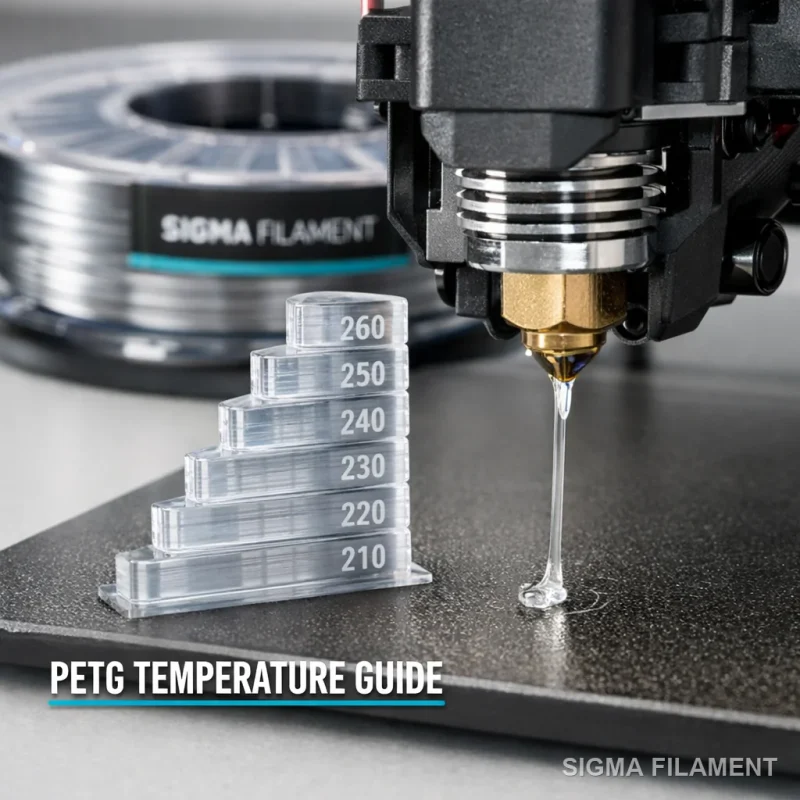
Pure PET filament prints reliably at 250-270C nozzle, 80-90C bed, with part cooling low or off on the first layers, an enclosure to slow cooling, and filament dried at 60-80C for 4-16 hours before the spool ever sees the hotend (Xometry, 2024). Skip any one of those, and pure PET filament fails predictably: warped corners, stringing, milky brittle parts.

| Setting | Pure PET | PETG | PET-CF |
|---|---|---|---|
| Nozzle temp (C) | 250-270 (range 240-280) | 230-250 | 290-310 |
| Bed temp (C) | 80-90 (PEI, blue tape, or glue stick) | 70-80 | 90-110 |
| Print speed (mm/s) | 60-80 max | 40-60 typical | 40-60 |
| Part cooling | Low or off on first layers | Moderate to high | Low |
| Enclosure | Strongly recommended | Not required | Required |
| Drying (C / hours) | 60-80 / 4-16 | 65 / 4 | 80 / 6-8 |
| Hotend max needed | 280C-capable (all-metal) | 250C stock OK | 310C, hardened nozzle |
Nozzle 250-270C and a hotend that can reach 280C
True PET has a melting point of 245-260C, not the soft transition PETG shows (Xometry, 2024). The hotend has to push past Tm with headroom, which is why setpoints sit at 250-270C and why stock PTFE-lined hotends capped at 260C cannot run pure PET reliably. An all-metal hotend rated to 280C is the floor; PET-CF goes higher, to 290-310C, and turns abrasive against brass nozzles. Print speed stays at or below 60-80 mm/s so the melt has time to wet the previous layer where PET is still viscous, not flashing.
Bed 80-90C, low part cooling, and an enclosure to control crystallization
PET is semicrystalline, and uncontrolled cooling is what produces warping, layer splitting, and the milky opacity of haphazard crystal growth (Viora et al., 2023). An 80-90C bed (PEI, blue tape, or glue stick) anchors the first layers; low or off part cooling keeps the extruded bead above its crystallization window long enough to bond; an enclosure traps chamber heat and slows cool-down across the whole part. The result quenches more uniformly, often clear or translucent, with the option to anneal afterward. PETG, being amorphous, forgives all of this and prints open-frame at 230-250C with a wide working speed window.
Drying at 60-80C: why PET fails wet
PET filament is hygroscopic, and bulk water absorption near 0.1% understates the problem at filament surface area (Viora et al., 2023). Wet PET filament steam-extrudes: stringing, popping in the melt, foamed beads, and weakened interlayer bonds. Dry pure PET filament at 60-80C for 4-16 hours, hold the spool in a heated dry box during the run, and treat any PET filament that has sat unsealed for a week as suspect.
Annealing pure PET: turning a clear part into a heat-resistant one
Pure PET prints best when it cools fast and stays amorphous, which is why fresh PET parts look glassy and hold dimension well. The same amorphous state also caps heat-deflection temperature well below the polymer’s potential. Annealing is the post-print step that converts an as-printed PET filament part from "clear and dimensionally stable" to "opaque and heat-resistant" by forcing controlled crystallization.
The protocol: 100-120C for 6-16h to crystallize the part
Hold the printed part at 100-120C in a convection oven or print enclosure for 6 to 16 hours, then cool slowly to room temperature (Di Lorenzo, 2024). The window sits above PET’s glass transition (70-80C) but well below its melt (245-260C), giving polymer chains enough mobility to organize into crystallites without slumping. Thin geometries crystallize in the lower half of that time band; thick or carbon-filled parts need the upper end.
What you gain: HDT +30-50C and creep resistance
Crystallinity climbs into the 30-40% range in annealed PET coupons, and heat-deflection temperature rises by roughly 30-50C compared with the as-printed amorphous state (Di Lorenzo, 2024). Creep resistance and stiffness improve in the same step. For a functional bracket, fluid fitting, or under-hood housing that has to hold load above 80C, annealing is what makes a PET part actually meet spec rather than soften under service heat, joining the ranks of the heat-resistant filaments typically specified for elevated-temperature service.
What you pay: 1-3% dimensional change and lost clarity
Annealing is not free. Expect 1-3% dimensional change as the crystal lattice tightens, so production parts must compensate in CAD or post-machine to final tolerance (Di Lorenzo, 2024). Optical clarity disappears because crystallites scatter light, leaving the part opaque white or off-white. PETG, being amorphous with no melt point, gains almost nothing from the same treatment, which is one reason most easy-print PETG production work skips annealing entirely.
Recycled rPET and food-grade PET: sustainability and safety
rPET is the most mature recycling pillar in 3D printing polymers, and pure PET resin is the regulatory reference for food-contact plastics. Both facts come with engineering caveats that change how procurement should specify the material. The short version: rPET can match virgin tensile if the formulation is right, and an FDA-suitable resin does not make an FFF-printed part food-safe.
What rPET is and how bottle flake becomes filament
rPET (recycled PET) is post-consumer bottle flake, washed, dried, and re-extruded into 1.75 or 2.85 mm filament. Commercial grades include BASF Forward AM Ultrafuse rPET, Reflow PET, and eSUN ePET, alongside open-source bottle-to-filament workflows using Polyformer kits or 3devo desktop extruders (Viora et al., 2023). The supply chain for PET recycling is decades old in packaging, which is why rPET filament has a depth of feedstock that recycled PETG cannot yet match. For B2B buyers shopping a pet filament line with recycled-content claims, that maturity is what makes rPET defensible on a procurement spec.
Mechanical retention: chain extenders can match virgin PET
Each recycling thermal cycle drops PET’s intrinsic viscosity, which translates to chain scission and weaker tensile. Without intervention, expect a 10-20% strength loss versus virgin resin (Rashwan et al., 2023). Adding a chain extender such as pyromellitic dianhydride (PMDA) reconnects shortened chains during compounding, partially restoring molecular weight. A Nature Scientific Reports 2023 study on extruded rPET with chain extender and impact modifiers shows tensile strength can rise to roughly 25% above plain recycled PET, approaching virgin-resin performance (Rashwan et al., 2023). A 2025 study on thermal-drawing rPET, where bottle strips are redrawn through an extruder nozzle, reports comparable performance benchmarks for AM feedstock (Pires et al., 2025). Lot-to-lot variability is also higher than virgin resin because PCR feedstock blends multiple bottle sources, so request a COA per batch and a viscosity range, not just a single nominal value. Specify chain-extender chemistry in the TDS, or assume the strength penalty applies and design accordingly.
Food-contact status: PET, FDA 21 CFR 177.1630, and the layer-line caveat
Pure PET resin is recognized for food contact under FDA 21 CFR 177.1630 and is the dominant food-packaging polymer worldwide; EFSA recognizes equivalent pathways in the EU framework for food contact materials (U.S. Food and Drug Administration, 2024). PETG has similar regulatory pathway eligibility, supported by foundational migration work on PET cyclic oligomers (Begley et al., 1990). The caveat is process, not chemistry. An FFF-printed part has porous layer interfaces and microscopic crevices between roads that harbor bacteria and resist cleaning, regardless of resin lineage. Food-safe filament is a necessary condition, not a sufficient one. For repeated-use food-contact parts, specify food-grade resin plus a post-process barrier (epoxy coating, machined sealing surfaces) or move to injection molding for the production run.
Where pure PET wins, and where PETG wins: an applications matrix
The choice between pure PET filament and PETG filament comes down to a measurable service requirement. Pure PET wins where optical clarity, food-contact reference status, post-anneal heat resistance above 80C, stiffness, or a mature recycled-content supply chain is what matters (Xometry, 2024). PETG wins where ease of printing, layer adhesion, impact toughness, color range, and production unit economics dominate (Sztorch et al., 2025).
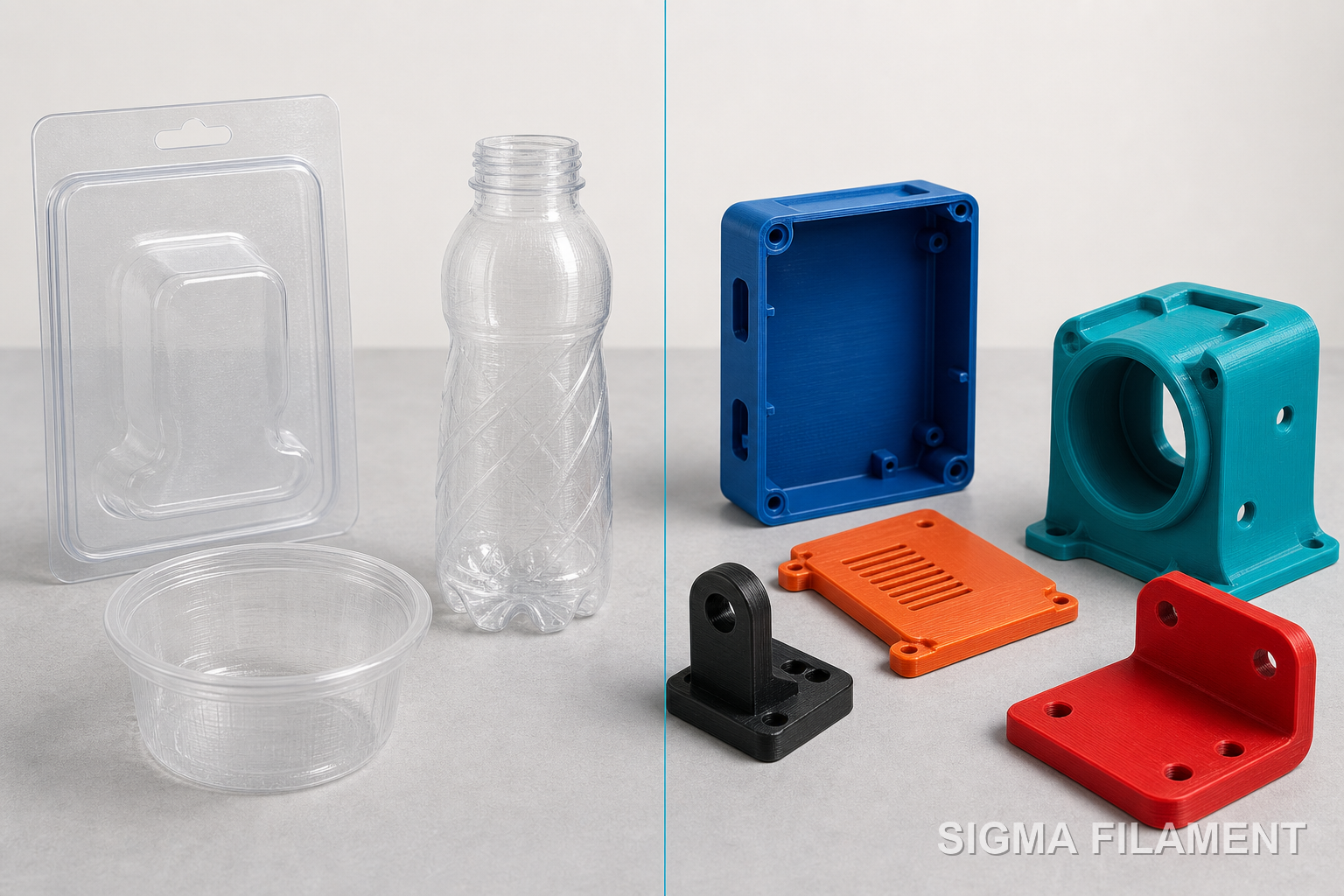
The matrix maps common use cases to the better material and the property gap that decides each one.
| Use case | Better pick | Why |
|---|---|---|
| Optical packaging, blister packs, bottle prototypes | Pure PET | Amorphous quench-cooled PET delivers transparency PETG cannot match without crystallization risk (Xometry, 2024) |
| Food-contact prototypes (FDA 21 CFR 177.1630 reference) | Pure PET | PET is the regulatory reference polymer for food packaging; PETG shares pathway eligibility but PET is the benchmark (Xometry, 2024) |
| Functional parts with HDT above 80C in service | Pure PET (annealed) | Post-anneal HDT reaches 95-115C versus PETG 65-78C; PETG cannot match after the heat treatment (Xometry, 2024) |
| Stiffness or creep-sensitive industrial brackets | Pure PET | Young’s modulus 2.0-3.8 GPa exceeds PETG 1.5-2.2 GPa with lower long-term creep (Xometry, 2024) |
| Recycled-content sustainability claims | Pure PET (rPET) | rPET supply chain is the mature pillar of polymer recycling; PETG recycling is still niche (Xometry, 2024) |
| General functional prints, fast iteration | PETG | Prints on any hobby printer at 230-250C, no enclosure required, low failure rate (Sztorch et al., 2025) |
| Production runs at scale | PETG | Amorphous behavior means fewer print failures, better unit economics across a print farm (Sztorch et al., 2025) |
| Brackets, jigs, signage, drop-tested housings | PETG | Glycol modification adds impact toughness and out-of-the-box Z-strength from amorphous layer welding (Sztorch et al., 2025) |
| Transparent parts without thermal post-processing | PETG | Amorphous by nature, no crystallization risk on cooling; clarity holds without annealing (Sztorch et al., 2025) |
| Color and finish range (matte, glitter, gradient effects) | PETG | Easier to compound for visual effects and dual-color production (Sztorch et al., 2025) |
Pure PET wins: clarity, food-contact reference, post-anneal heat, stiffness, recycled content
Each pure-PET advantage ties to a property. Optical clarity comes from suppressed crystallinity in the as-printed amorphous state. Food-contact prototypes lean on PET’s status as the reference packaging polymer. Stiffness and creep resistance flow from the higher Young’s modulus. Recycled content is a mature category for rPET, with chain-extender grades approaching virgin tensile.
PETG wins: ease, layer adhesion, impact, color range, production economics
PETG wins where production reality dominates. Lower print difficulty and no enclosure cut capital and failure cost. Amorphous Z-strength holds parts under load without specialist tuning. Glycol toughness absorbs drops. At scale, every percent of yield compounds across a print farm, which is why most filament catalogs lean PETG.
Choosing by use case, not by marketing
The buyer rule is simple. Specify the service condition (temperature, clarity, regulatory pathway, impact), then pick the polymer whose property band covers it. Below 70C, PETG ships parts cheaper. Above 80C with a clarity or food-contact need, pure PET annealed earns its specialist role.
Why PETG is the practical production material for most buyers
For the majority of buyers who search "pet filament" and need to ship real parts at volume, PETG is the honest answer. It delivers most of PET’s chemical resistance and durability with far easier printing, no crystallization warpage, good optical clarity, and the production consistency that runs of 500 to 50,000 spools actually require. That is why SigmaFilament’s catalog is built around PETG rather than pure PET, and why most established filament factories make the same call.
For most buyers who searched PET filament, PETG filament is the practical production material: it prints at 230 to 250 C with no enclosure, resists crystallization warpage, and holds a published ±0.03 mm diameter tolerance across the SigmaFilament PETG, PETG+, transparent, and CF-PETG lines (SigmaFilament, 2026).
The manufacturing case: line speed, defect rate, and unit economics
PETG is amorphous. It does not crystallize on cooling, so it does not fight the print as it solidifies, and it tolerates wider thermal windows without warping or shrinkage anomalies (Sztorch et al., 2025). The downstream effect on a production line ROI is measurable: fewer first-layer failures, less scrap per shift, and tighter spool-to-spool consistency over long runs. On the SigmaFilament line we measured 5 points of spool diameter per spool against the published ±0.03 mm window, and we observed in prototype PET filament runs through the same extruder that crystallization shrinkage widens the diameter spread until pull-rate, drying, and chamber-cooling settings are tightened around the PET thermal window. SigmaFilament’s PETG production holds a ±0.03 mm diameter tolerance, a defect rate below 0.01%, and 70+ QC checkpoints per spool under an ISO 9001:2015 quality system, with 100% virgin resin feedstock and no recycled blending. Pure PET, by contrast, requires 280 °C hotend capability, enclosure-controlled cooling, drying at 60-80 °C for 4-16 hours, and post-print annealing for any part rated above roughly 80 °C HDT (Xometry, 2024). Those are real costs that compound across thousands of spools and that most buyers do not need to absorb when PETG meets the service requirement.
PETG, PETG+, and PETG-CF as the production-ready lineup
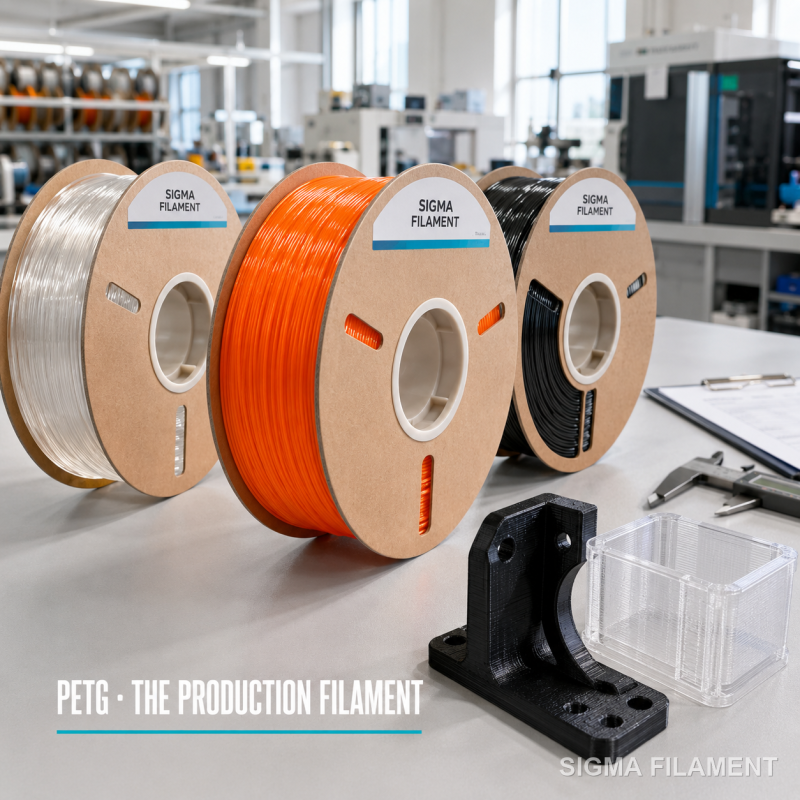
SigmaFilament manufactures four PETG families under one roof: standard PETG for general production, PETG+ for higher layer adhesion and impact, transparent and aesthetic PETG for clarity and surface effects, and CF-PETG (carbon-fiber reinforced) where stiffness and dimensional stability matter. The PETG-CF grade reaches roughly 55-70 MPa tensile and 5-8 GPa modulus, with HDT around 85-100 °C. For most OEM, private-label, and print-farm buyers, this lineup covers the application envelope without forcing the print-process complexity of pure PET. Full specs and wholesale terms sit on the wholesale PETG page.
When to specify pure PET or a custom PET ODM run instead
Pure PET filament is not in the standard SKU catalog, and that omission is deliberate rather than a gap. Buyers who genuinely need amorphous optical clarity, FDA 21 CFR 177.1630 food-contact reference status, post-anneal HDT above 80 °C, or mature rPET recycled content should source specialist grades from BASF Ultrafuse or eSUN ePET, or commission a custom PET ODM run through the SigmaFilament factory, where the custom-run minimum order quantity starts at 100 rolls and rises for fully custom grades. For everyone else shipping production parts at volume, PETG is the production default and pure PET is the specified exception, chosen against a real service requirement rather than a marketing one.
Sourcing PET and PETG in bulk: a B2B procurement note
PETG filament and pure PET filament sit on opposite ends of the supplier map. PETG has a wide qualified base across Asia and Europe, with low price floors and dozens of factories able to ship pallet quantities of bulk filament on a four to six week lead time. Pure PET filament is a narrow specialist buy: fewer mills extrude filament-grade PET reliably, so expect sole-source risk, longer qualification, and far closer datasheet scrutiny. Plan procurement to that asymmetry rather than fighting it.
Supplier base: wide for PETG, narrow and specialist for pure PET
For PETG filament, qualify two or three vendors and dual-source the production SKU. For pure PET filament, expect to commit to one mill per grade, either an established specialist (BASF Ultrafuse PET, eSUN ePET) or a custom OEM run from a factory that already runs PET-CF lines. SigmaFilament’s standard catalog is PETG, PETG+, Aesthetic PETG, HS-PETG, and CF-PETG; pure PET is available as an OEM/ODM custom run at a minimum order quantity that starts at 100 rolls, with higher floors for fully custom grades.
What to demand: TDS, COA per batch, diameter tolerance, dryness
Five items, non-negotiable. First, a published diameter tolerance, not a nominal figure. The defensible production band is +/-0.03 mm, and SigmaFilament’s PETG and PLA lines ship to that spec. Second, a Technical Data Sheet with tensile strength, modulus, Tg, and (for PET) Tm and crystallinity. Third, a Certificate of Analysis per batch, not per SKU. Fourth, vacuum-sealed packaging with desiccant; PET and PETG are hygroscopic and an unsealed spool absorbs enough moisture in transit to ruin first-layer adhesion (Viora et al., 2023). Fifth, ISO 9001:2015 quality-system evidence and per-spool QC traceability. SigmaFilament runs 70+ QC checks per spool against 100% virgin resin.
Qualify-then-scale: sample, heat-cycle, verify, then order
The qualification method we recommend mirrors what we run on incoming SigmaFilament PET filament feedstock before any pallet ships. Internally we tested this protocol on early CF-PETG qualification rounds: first, we cut a coupon at design HDT; then we cycled it through the field-spec temperature for the expected service hours; then we re-measured. We observed that buyers who skipped the heat-cycle step caught HDT failures only after a production batch was already cut, and that surprised more than one procurement lead who had assumed datasheet HDT alone was sufficient. The limitation is honest: a 200 g sample cannot capture full lot-to-lot drift on PCR rPET feedstock, so two-batch sampling is the safer floor when the SKU is recycled.
Pull a 200 g to single-spool sample. Print the part you actually sell. Heat-cycle a coupon at your real service temperature for the cycles the field will see in 2026 deployment. Re-measure diameter at five points and weigh dry. Only then place the pallet order. For PETG bulk, route to wholesale PETG; for a custom PET filament grade, the OEM lane handles it.
Frequently Asked Questions
What is PET filament?
PET filament is a semicrystalline polyester (polyethylene terephthalate) for FDM 3D printing, the same polymer as plastic water bottles. It is distinct from PETG, the glycol-modified version most hobbyists actually buy. True PET has a glass transition of 70-80C, a melting point of 245-260C, and crystallinity of 30-37% (Viora et al., 2023).
What is the difference between PET and PETG?
PET is semicrystalline with a true melting point of 245-260C, higher stiffness (Young’s modulus 2.0-3.8 GPa), and optical clarity when quenched amorphous, but it prints with high difficulty. PETG is amorphous glycol-modified PET with no melt point, lower modulus (1.5-2.2 GPa), better impact toughness, and prints easily at 230-250C on any stock hobby printer (Xometry, 2024).
Is PET filament the same as PETG?
No. The two share a polyester backbone but differ in chemistry and morphology, which is what makes them print so differently. PETG substitutes cyclohexanedimethanol (CHDM) for some ethylene glycol, breaking the crystal lattice into an amorphous polymer with no Tm. PET wins on heat resistance and clarity once annealed; PETG wins on ease of printing and impact toughness (Sztorch et al., 2025).
Can you 3D print pure PET filament?
Yes, but it needs industrial-grade settings. Pure PET requires a hotend capable of 280C (many stock hotends cap at 260C), a heated bed at 80-90C, an enclosure to control cooling, and drying at 60-80C for 4-16 hours. Hobby printers without these produce stringing and bubbling, and the parts come out weak (Xometry, 2024).
What is rPET filament?
rPET is recycled PET filament, typically made from post-consumer bottle flake (PCR) re-extruded into 1.75 or 2.85 mm spools. Brands include Ultrafuse rPET from BASF and Reflow PET, plus DIY workflows using Polyformer or 3devo extruders. With a chain extender such as PMDA, rPET tensile can rise to roughly 25% above plain recycled PET, approaching virgin performance (Rashwan et al., 2023).
Is PET filament food safe?
The PET resin itself is FDA-recognized for food contact under 21 CFR 177.1630 and is the global reference food-packaging polymer. However, FFF-printed parts contain porous layer-line interfaces that can harbor bacteria, so a food-safe resin is necessary but not sufficient for a food-safe printed part. PETG has similar regulatory pathway eligibility under EFSA frameworks (Begley et al., 1990).
What temperature do you print PET at?
Pure PET prints at a nozzle temperature of 250-270C (full window 240-280C) with a heated bed at 80-90C and an enclosure recommended. PETG runs cooler at 230-250C nozzle and 70-80C bed with no enclosure required. Carbon-fiber-reinforced PET-CF needs 290-310C nozzle, 90-110C bed, and a hardened steel nozzle (Xometry, 2024).
What is PET-CF filament?
PET-CF is pure PET reinforced with chopped carbon fiber, typically 10-20% by weight, delivering tensile strength of 65-100 MPa, Young’s modulus of 6-12 GPa, and heat deflection up to 150C. It requires a 290-310C nozzle and hardened steel hardware (carbon fiber is abrasive on brass) and benefits from post-print annealing (Xometry, 2024).
Conclusion
"PET filament" carries three meanings, but for material buyers the decision narrows to one comparison: true PET filament versus PETG. True PET filament is a semicrystalline specialist that earns its place when a part needs optical clarity, food-contact reference status, post-anneal HDT above 80C, high stiffness, or a mature recycled-content story through rPET. It also demands a hotend rated to 280C, drying at 60 to 80C for 4 to 16 hours, an enclosure, controlled cooling, and a 100 to 120C anneal step to reach its rated thermal performance. PETG is the amorphous, forgiving counterpart whose Z-strength, impact toughness, and low failure rate make it the practical production PET filament option for most B2B buyers and the reason it dominates filament catalogs.
rPET sits alongside this decision as the sustainability lever, with chain-extender grades capable of matching virgin PET tensile and DIY workflows now viable, but it carries supplier variability and is best qualified per batch rather than per brand.
The procurement edge is the same in every case: sample, heat-cycle a coupon at your real service temperature, verify diameter tolerance and dryness, then place the bulk order.
If you are scaling PETG production or need a custom pure-PET ODM run, talk to the SigmaFilament factory and start with a qualification sample.
Further Reading
Buyers who landed here through the PET-as-PETG intent are usually closer to a PETG purchase than a pure-PET one, so the most useful next stop is SigmaFilament’s wholesale PETG filament page, which lays out the Standard, Aesthetic, HS, and CF-PETG lines with pallet pricing and the same ±0.03 mm tolerance referenced throughout this guide. Procurement teams scoping a private-label PETG SKU or a specialist pure-PET ODM run should review the OEM and ODM service page for MOQ, lead time, and the qualification protocol that maps onto the sample-then-scale workflow described above, and browse the full product catalog for adjacent engineering materials documented in the same TDS format. On the material-science side, Xometry’s PET 3D printing guide is a useful cross-reference for the comparison numbers cited above.
References
- Viora, L., Combeau, M., Pucci, M. F., Perrin, D., Liotier, P.-J., Bouvard, J.-L., & Combeaud, C. (2023). A comparative study on crystallisation for virgin and recycled polyethylene terephthalate (PET): Multiscale effects on physico-mechanical properties. Polymers, 15(22), 4448. https://pmc.ncbi.nlm.nih.gov/articles/PMC10708313/
- Rashwan, O., Koroneos, Z., Townsend, T. G., Caputo, M. P., Bylone, R. J., Wodrig, B., & Cantor, K. (2023). Extrusion and characterization of recycled polyethylene terephthalate (rPET) filaments compounded with chain extender and impact modifiers for material-extrusion additive manufacturing. Scientific Reports, 13, 16041. https://www.nature.com/articles/s41598-023-41744-8
- Pires, P., Aguiar, M. L. d., & Vieira, A. C. (2025). Mechanical performance of rPET filament obtained by thermal drawing for FFF additive manufacturing. Journal of Manufacturing and Materials Processing, 9(1), 26. https://www.mdpi.com/2504-4494/9/1/26
- Sztorch, B., Głowacka, J., Frydrych, M., Pakuła, D., Romańczuk-Ruszuk, E., Kubiak, N., & Przekop, R. E. (2025). The impact of multifunctional polysiloxanes on enhancing the properties of polyethylene terephthalate glycol (PET-G) for FDM/FFF 3D-printing. Acta Mechanica et Automatica, 19(2), 243-249. https://sciendo.com/article/10.2478/ama-2025-0030
- Begley, T. H., Dennison, J. L., & Hollifield, H. C. (1990). Migration into food of polyethylene terephthalate (PET) cyclic oligomers from PET microwave susceptor packaging. Food Additives and Contaminants, 7(6), 797-803. https://pubmed.ncbi.nlm.nih.gov/2150379/
- U.S. Food and Drug Administration. (2024). 21 CFR § 177.1630: Polyethylene terephthalate polymers. Code of Federal Regulations. https://www.law.cornell.edu/cfr/text/21/177.1630
- Xometry. (2024). All about PET 3D printing filament: Materials, properties, definition. Xometry Resources. https://www.xometry.com/resources/3d-printing/pet-3d-printing-filament
- Di Lorenzo, M. L. (2024). Crystallization of poly(ethylene terephthalate): A review. Polymers, 16(14), 1975. https://pmc.ncbi.nlm.nih.gov/articles/PMC11280767/
Last reviewed and updated: June 2026. Author: SigmaFilament team. For tailored guidance, contact our team.