Calculate Your Real ROI: 5 Reasons The Hidden Costs of Cheap Filament Aren’t Worth It


Abstract
The initial appeal of low-cost 3D printing filament often masks a series of significant, indirect expenses that can substantially increase the total cost of operation for both hobbyists and professionals. This analysis examines the multifaceted hidden costs of cheap filament, moving beyond the purchase price to evaluate the economic and practical consequences of using substandard materials. Key contributors to these hidden costs include dimensional inconsistencies, such as poor diameter and ovality tolerance, which lead to frequent nozzle clogs, under-extrusion, and accelerated hardware wear. Material impurities, including undeclared fillers, recycled content of unknown origin, and excessive moisture, further degrade print quality, compromise the mechanical integrity of finished parts, and can pose health risks through unregulated off-gassing. The cumulative financial impact is explored through the tangible costs of wasted material and energy from failed prints and the intangible, yet substantial, costs of lost time, project delays, and the frustration that stifles creativity and productivity. Ultimately, a thorough cost-benefit analysis reveals that investing in high-quality, reliable filament with documented specifications and process controls is a more economically sound strategy.
Key Takeaways
- Prioritize filament with a tight diameter tolerance (e.g., ±0.02mm) to prevent clogs and ensure consistent extrusion.
- Recognize that the hidden costs of cheap filament include wasted material, time, and potential printer damage.
- Factor in the value of your time and electricity costs when calculating the true price of a failed print.
- Select filaments from manufacturers who provide transparency regarding material purity and quality control.
- Protect your 3D printer’s nozzle, extruder, and hotend from the accelerated wear caused by impure materials.
- Evaluate filament based on total cost of ownership rather than the initial price per spool.
Table of Contents
- The Siren Song of the Bargain Bin: Deconstructing Our Attraction to Cheap Filament
- Reason 1: The Tyranny of Inconsistency—Diameter, Ovality, and the Extrusion Cascade Failure
- Reason 2: A Chemical Lottery—The Unseen World of Impurities and Contaminants
- Reason 3: The Economy of Failure—Calculating the True Price of a Wasted Print
- Reason 4: A House of Cards—The Compromise of Mechanical and Aesthetic Integrity
- Reason 5: The Slow Erosion of Your Investment—Accelerated Hardware Degradation
- From Consumer to Connoisseur: A Practical Guide to Selecting Superior Filament
- FAQ: Answering Your Pressing Questions About Filament Costs
- A Final Reflection on Value
- References
The Siren Song of the Bargain Bin: Deconstructing Our Attraction to Cheap Filament
It is a familiar scenario for anyone involved in the world of 3D printing. You are browsing online, and a spool of PLA filament catches your eye, priced at a figure that seems too good to be true—perhaps half of what you would typically pay for a reputable brand. The temptation is immediate and potent. The thought of stocking up, of reducing the material cost for your next dozen projects, is powerfully alluring. This moment, however, is a critical juncture where a simple transactional decision conceals a complex web of future consequences. To understand why we so often reach for that bargain spool, we must look inward at our own cognitive processes and outward at the market that presents these choices.
The Cognitive Biases at Play: Anchoring and the Lure of Immediate Savings
Our brains are wired to seek efficiency, and in the context of purchasing, this often translates to finding the lowest price. A cognitive bias known as “anchoring” plays a significant role here. When we see a spool advertised for $15, that number becomes the anchor point against which all other filaments are judged. A $30 spool from a premium manufacturer now feels exorbitant, even if its intrinsic value, reliability, and consistency are orders of magnitude higher. We anchor our perception of value to the most visible metric: the upfront cost.
This is compounded by our natural preference for immediate gratification. The savings from buying cheap filament are concrete and instantaneous; you spend less money right now. The potential costs—a failed 18-hour print, a clogged nozzle, a weakened functional part—are abstract, probabilistic, and in the future. It requires a disciplined and analytical mindset to override the powerful allure of a present-day discount in favor of mitigating a future, uncertain risk. We are, in essence, taking a loan against future time and frustration, and the interest rate on that loan can be devastatingly high.
Total Cost of Ownership (TCO) in Additive Manufacturing: A Paradigm Shift
In professional industries, from IT infrastructure to fleet management, decisions are rarely based on initial purchase price alone. Instead, they rely on the concept of Total Cost of Ownership (TCO). TCO is a comprehensive assessment that includes the initial purchase plus all direct and indirect costs incurred throughout the product’s lifespan. For 3D printing, this framework is exceptionally clarifying.
Imagine you are choosing between two spools to print 10 identical, 100g models.
| Feature | Budget Filament ($18/kg) | Premium Filament ($35/kg) |
|---|---|---|
| Initial Cost (1kg Spool) | $18.00 | $35.00 |
| Cost per 100g Model | $1.80 | $3.50 |
| Assumed Failure Rate | 20% (2 out of 10 prints fail) | <1% (0 out of 10 prints fail) |
| Wasted Filament Cost | 2 models * $1.80/model = $3.60 | $0.00 |
| Time to Reprint Failures | 2 models * 5 hours/model = 10 hours | 0 hours |
| Total Filament Used | 1200g (1.2 spools) | 1000g (1 spool) |
| Total Material Cost | 1.2 kg * $18/kg = $21.60 | 1 kg * $35/kg = $35.00 |
| Real Cost per Successful Model | $21.60 / 10 = $2.16 | $35.00 / 10 = $3.50 |
At first glance, the budget filament still seems cheaper per successful model. But this table is incomplete. It omits the cost of electricity for failed prints, the accelerated wear on the printer, and, most importantly, the value of those 10 hours you spent re-printing. If your time is valued at even a modest $20/hour, that adds $200 in opportunity cost to the budget filament’s column, making it astronomically more expensive. The hidden costs of cheap filament are not just about wasted plastic; they are about wasted life. This shift from thinking about “price per spool” to “cost per successful print” is fundamental.
The Digital Marketplace Illusion: How Online Platforms Obscure True Quality
The rise of global e-commerce platforms has been a double-edged sword for the 3D printing community. On one hand, it has provided unprecedented access to a wide variety of materials. On the other, it has created an environment where it is nearly impossible to distinguish a genuine manufacturer from a fleeting reseller. A listing with professional-looking graphics and a low price can easily be a re-spooled, untested, or off-spec batch from a larger, anonymous factory. The seller may not have any technical knowledge of the product they are shipping.
These platforms often prioritize sellers who can offer the lowest price, creating a race to the bottom where quality is the first casualty. Reviews can be manipulated, and specifications can be exaggerated or outright fabricated. Without a clear line of sight to the actual producer—one who has a vested interest in maintaining a reputation for quality—the consumer is left to navigate a minefield of uncertainty. The brand on the box may simply be a sticker, representing nothing more than a temporary marketing effort.
Reason 1: The Tyranny of Inconsistency—Diameter, Ovality, and the Extrusion Cascade Failure
At the very heart of the Fused Deposition Modeling (FDM) process is a simple, yet delicate, principle: a precise volume of molten material must be pushed through a nozzle of a fixed size at a controlled rate. Your slicer software performs complex calculations based on the assumption that the filament entering the system has a consistent diameter. When this fundamental assumption is violated—the core sin of most cheap filaments—a cascade of failures begins, ranging from subtle imperfections to catastrophic jams.
Precision Engineering vs. “Good Enough”: What a ±0.02mm Tolerance Truly Signifies
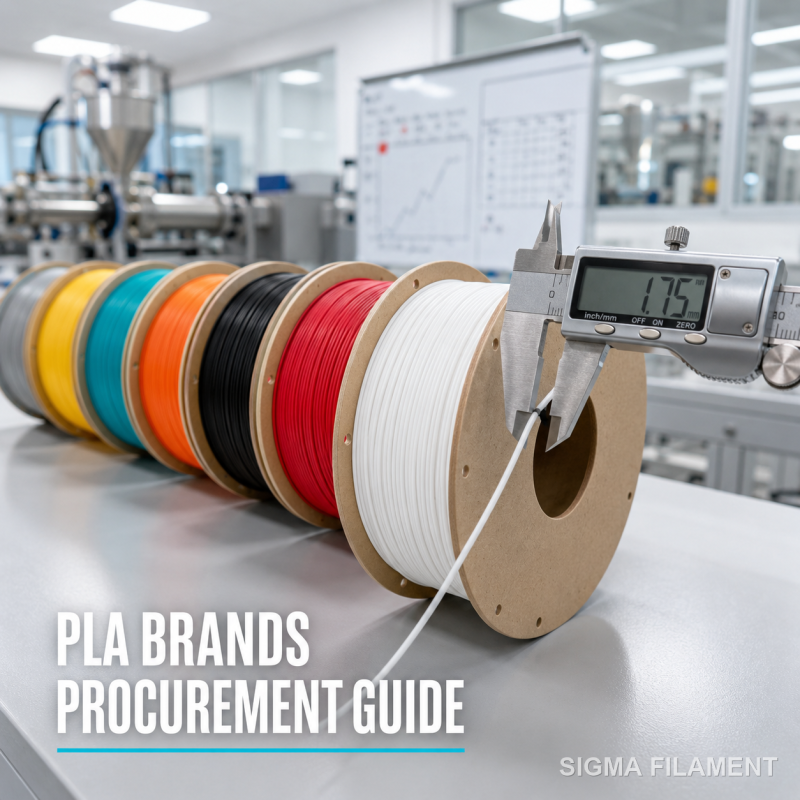
When a reputable filament manufacturer specifies a diameter of 1.75mm with a tolerance of ±0.02mm, it is making a profound statement about its process control. It means that at no point along the entire kilometer of plastic on that spool will the diameter be less than 1.73mm or more than 1.77mm. To achieve this requires a significant investment in technology, specifically dual-axis laser micrometers that continuously monitor the filament as it is being extruded and pulled. This real-time data is fed back into the system, which makes micro-adjustments to the puller speed to maintain that consistency.
In contrast, a cheap filament might advertise a tolerance of ±0.05mm, or more commonly, provide no specification at all. In practice, this can mean the diameter varies from 1.65mm to 1.85mm or even worse. An even more insidious problem is “ovality,” where the filament is not perfectly round. A laser micrometer measuring only on one axis might read 1.75mm, while the diameter on the other axis is 1.85mm.
Think of your printer’s hotend as a precision fluid pump. It is engineered to handle a specific input volume. A ±0.02mm tolerance results in a cross-sectional area variance of about 2.3%. A ±0.05mm tolerance results in a variance of 5.8%. A wild swing to 1.85mm represents a nearly 12% increase in volume compared to the expected 1.75mm. Your printer has no way of knowing this change has occurred. It continues to push the filament at the same rate, leading to severe over-extrusion.
The Physics of Clogging: How Diameter Swells Create Catastrophic Pressure Buildup
A nozzle clog is the most dramatic and frustrating failure mode caused by inconsistent diameter. It is not a random event but a predictable outcome of physics.
Let’s trace the journey of a section of oversized filament, say 1.85mm, entering a standard hotend designed for 1.75mm filament.
- Entry into the Heat Break: The filament passes from the cold end into the heat break, a narrow tube designed to have a close tolerance with the filament to prevent buckling. The oversized section may already begin to scrape against the walls, introducing extra friction.
- Entering the Melt Zone: As the filament is pushed into the heated block, it begins to soften and melt. The extruder gear, unaware of the increased resistance, continues to push with the same force.
- Pressure Spike: The wider section of filament requires more force to be pushed into the melt zone and through the nozzle. Because the volume of plastic is greater than the system was designed to handle at that moment, pressure inside the nozzle skyrockets.
- Heat Creep: This backpressure can have a dangerous side effect. It slows the downward flow of new, cool filament into the hotend. As a result, the heat from the heater block begins to “creep” upward, past the heat break and into the cold end.
- The Catastrophic Jam: The filament, which should be solid in the cold end, begins to soften and expand prematurely. It swells to fill the entire diameter of the heat break, creating a large, sticky plug. At this point, the extruder motor can no longer generate enough force to overcome the friction. The gear grinds against the filament, stripping it, and all extrusion stops. The print is ruined, and you are now faced with the painstaking task of disassembling your hotend to clear the jam.
Under-Extrusion: The Invisible Defect That Compromises Everything
While clogs are dramatic, the more frequent and subtle problem is under-extrusion caused by sections of filament that are too thin. When a 1.65mm section passes through the extruder, the volume of plastic being pushed into the nozzle is about 11% less than the slicer expects. The printer, however, continues to move the print head at the programmed speed.
The result is a fine, web-like structure where there should be a solid line. This manifests in several ways:
- Gaps between walls: The perimeters of your print do not touch, leaving visible gaps.
- Poor infill: The infill structure looks weak and stringy, failing to connect to the inner walls of the print.
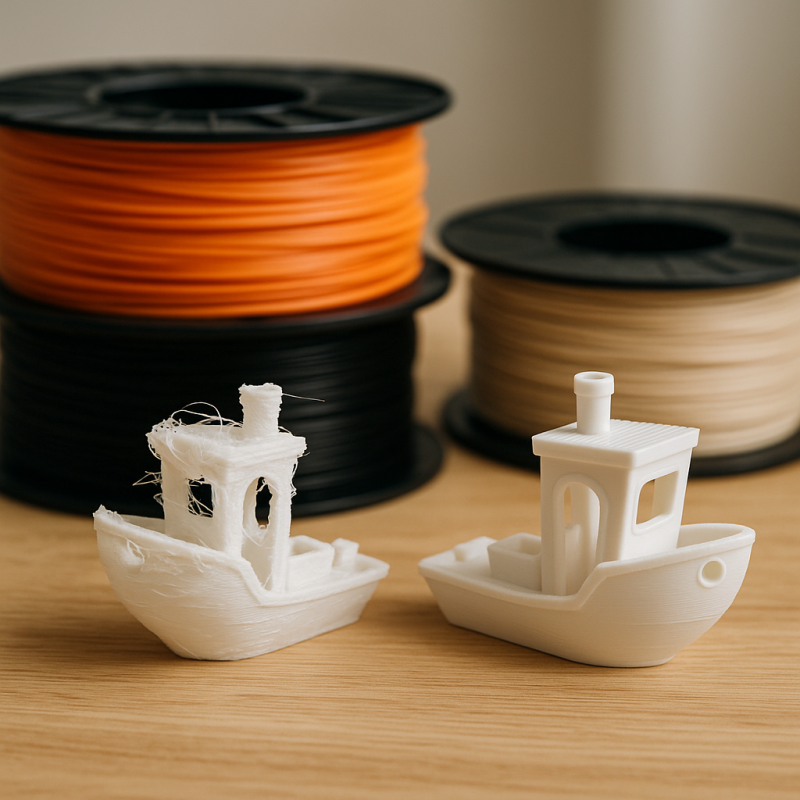
- Terrible layer adhesion: Because not enough material is being extruded, the new layer is not hot enough or voluminous enough to properly fuse with the layer below it. The final part can be pulled apart with your bare hands, separating cleanly at the layer lines.
- Brittleness: The entire object becomes a collection of loosely connected lines instead of a solid, homogenous part. It will have drastically reduced tensile and shear strength.
A single spool of cheap filament can have dozens of these thin spots, meaning your print’s structural integrity will be a lottery, varying from one layer to the next.
Reason 2: A Chemical Lottery—The Unseen World of Impurities and Contaminants
If inconsistent diameter is a mechanical failure of process control, the issue of material impurity is a chemical one. The vibrant color and smooth texture of a filament spool can conceal a cocktail of additives, contaminants, and moisture that will sabotage your prints and potentially harm your equipment and your health. When you buy from a reputable source, you are paying for purity. When you buy cheap filament, you are often paying to be a test subject for an unknown material blend.
Deconstructing the “Proprietary Blend”: Fillers, Regrind, and Inconsistent Colorants
To reduce costs, some manufacturers mix the virgin polymer resin (the pure, raw plastic beads) with cheaper materials, or “fillers.” These can include substances like calcium carbonate (chalk), talc, or other minerals. While some specialized filaments intentionally use additives for specific properties (like wood or carbon fiber), the undisclosed use of fillers in standard PLA or PETG is purely a cost-cutting measure that degrades performance. These fillers do not melt at the same temperature as the base polymer. They can act as contaminants that:
- Cause Nozzle Clogs: A particle of filler larger than the nozzle orifice will inevitably cause a clog.
- Weaken the Part: These particles disrupt the polymer chains, creating internal stress points and voids that drastically reduce the part’s strength, much like a rock in a pane of glass.
- Create Inconsistent Finishes: The surface of the print may appear splotchy or have small zits where a pocket of filler material was extruded.
Another common cost-cutting technique is the use of “regrind,” which is recycled plastic from old prints, rejected spools, or industrial scrap. While recycling is commendable, using unsorted, uncleaned, and unverified regrind is a recipe for disaster. It can introduce different types of plastic into the mix (e.g., a piece of ABS in a PLA batch), causing unpredictable melting behavior and clogs. It can also contain dirt, dust, and oils that will burn in the nozzle, creating fumes and blockages [tiger-labs.sg].
The Hydrophilic Menace: How Poorly Processed Filament Absorbs Ruinous Moisture
Most common 3D printing filaments, especially PETG, Nylon, and to a lesser extent, PLA, are hygroscopic, meaning they readily absorb moisture from the surrounding air. Professional filament manufacturers go to great lengths to mitigate this. They dry the raw resin pellets for several hours at a specific temperature before extrusion, and then immediately vacuum-seal the finished spool with a desiccant packet.
Cheap filament production often skips or shortens these critical drying steps. The filament may be extruded while still containing moisture, or it may sit in a humid warehouse for weeks before being packaged (often in a simple shrink-wrap without a proper vacuum seal). When you print with “wet” filament, the water trapped inside the plastic is rapidly heated in the nozzle and flashes into steam. This causes a host of problems:
- Audible Popping/Cracking: You can literally hear a sizzling or popping sound at the nozzle as the steam bubbles escape.
- Extreme Stringing and Oozing: The steam pressure forces molten plastic out of the nozzle, creating excessive stringing between travel moves.
- Poor Surface Finish: The escaping steam leaves bubbles and voids on the surface of the print, resulting in a rough, pockmarked texture.
- Dramatically Reduced Part Strength: The steam creates voids within the extruded lines, but more importantly, it interferes with layer adhesion. The process, known as hydrolysis, can break down the polymer chains themselves, making the final part incredibly brittle.
While a filament dryer can rescue a wet spool, it is an extra step that costs time and electricity. Furthermore, you should not have to finish the manufacturing process for the company you bought from.
Off-Gassing and Volatile Organic Compounds (VOCs): The Hidden Health and Environmental Costs
When you melt plastic, it releases fumes. For well-characterized materials like pure PLA, these emissions are generally considered minimal and relatively benign. However, when you are extruding a filament full of unknown fillers, recycled materials of dubious origin, and inconsistent colorants, you have no idea what you are venting into your workspace.
These unknown additives can release a range of Volatile Organic Compounds (VOCs) and ultrafine particles (UFPs) when heated. Some of these can be irritants or even toxic. This is a significant concern, especially for users operating printers in poorly ventilated spaces like homes, offices, or classrooms.
Reputable manufacturers who serve industrial and OEM clients are held to a higher standard. They can often provide a Material Safety Data Sheet (MSDS) that details the material’s composition and any potential hazards. Furthermore, compliance with standards like RoHS (Restriction of Hazardous Substances) ensures that the filament is free from lead, mercury, cadmium, and other dangerous materials. With cheap filament, you receive no such assurances. The potential health cost is one of the most alarming hidden costs of cheap filament.
Reason 3: The Economy of Failure—Calculating the True Price of a Wasted Print
Every 3D printing enthusiast knows the sinking feeling: you walk over to your printer expecting to find a completed masterpiece, only to be greeted by a tangled mess of plastic spaghetti, a part that has detached from the bed, or a print head frozen in mid-air over a half-finished object. Each of these failures carries a cost, and with cheap, unreliable filament, these failures become a regular part of the printing experience. The true cost of that bargain spool is not its sticker price, but the accumulated price of every failed print.
A Quantitative Framework: The Tangible Costs of Material and Energy
Let’s move beyond abstract frustration and put some hard numbers to a typical failure scenario. We can use a more detailed version of our earlier table to perform this analysis.
Scenario: A 500g, 18-hour print for a functional prototype. Assumptions: Electricity cost is $0.15/kWh. The printer consumes an average of 150 Watts.
| Cost Factor | Using Cheap Filament ($18/kg) | Using Quality Filament ($35/kg) |
|---|---|---|
| Filament Cost per Attempt (500g) | $9.00 | $17.50 |
| Electricity Cost per Attempt (18h) | 18h * 0.15kW * $0.15/kWh = $0.41 | 18h * 0.15kW * $0.15/kWh = $0.41 |
| Total Cost per Attempt | $9.41 | $17.91 |
| Assumed Failure Rate | 30% (realistic for unreliable filament) | <5% (typical for reliable filament) |
| Expected Number of Attempts | 1 / (1 – 0.30) = ~1.43 attempts | 1 / (1 – 0.05) = ~1.05 attempts |
| Total Expected Project Cost | 1.43 * $9.41 = $13.46 | 1.05 * $17.91 = $18.81 |
Looking only at the tangible costs, the cheap filament still appears to be the more economical choice, though the gap has narrowed significantly. However, this calculation is dangerously incomplete because it omits the most valuable resource of all.
The Unquantifiable Losses: Time, Frustration, and Creative Momentum
The most significant of the hidden costs of cheap filament is the loss of your time. In our scenario, a 30% failure rate means that for every two successful prints, you will have one failure. Let’s say that failure happens, on average, halfway through the print. That is 9 hours of your printer being occupied, 9 hours of you waiting, all for nothing. Then you have to add the time to clean the print bed, diagnose the failure, and restart the print.
This is not just a logistical problem; it is a psychological one. The creative process relies on momentum. When you design a part, you are excited to see it, to hold it, to test it. A failed print breaks that momentum. It replaces excitement with frustration and troubleshooting. It turns a creative outlet into a chore. This “frustration tax” can be high enough to make you abandon a project or even the hobby altogether. How much is your enthusiasm worth?
The Opportunity Cost Doctrine: Every Hour Spent Troubleshooting Is an Hour Not Spent Innovating
The concept of opportunity cost is central to economics and is perfectly applicable here. The time you spend dealing with the consequences of cheap filament is time you are not spending on more valuable activities.
- You could be designing your next great idea.
- You could be learning a new skill in CAD or electronics.
- If you run a print farm, you could be printing a paying customer’s job.
- You could be spending time with your family or on other hobbies.
The 18 hours lost to a failed print are not just 18 hours of waiting; they represent a lost opportunity to create, learn, or earn [maxfilament.com]. If you are a professional using 3D printing for prototyping, a single day’s delay due to a print failure can push back a product launch, cause you to miss a deadline for a client, and damage your professional reputation. In this context, the extra $15-$20 for a spool of reliable filament is not a cost; it is the cheapest insurance policy you can buy.
Reason 4: A House of Cards—The Compromise of Mechanical and Aesthetic Integrity
For many applications, a 3D print is not merely a decorative object; it is a functional part, a mechanical prototype, a jig, a fixture, or an end-use product. In these cases, the mechanical properties of the material are not just a secondary characteristic—they are the primary reason for the part’s existence. Using cheap filament for such applications is akin to building a house with a faulty foundation. It may look fine on the surface, but it is structurally compromised and destined to fail under stress.
The Science of Interlayer Adhesion: Covalent Bonds vs. Simple Fusion
The strength of an FDM-printed part is largely determined by the quality of the bond between its individual layers. When a line of molten filament is extruded onto the previous layer, a process of thermal fusion occurs. The heat from the new layer remelts the surface of the layer below it, and the long-chain polymer molecules from both layers intermingle. As it cools, these molecules form entanglements and, in some cases, covalent bonds, creating a strong weld.
This process is highly sensitive to three factors that cheap filaments disrupt:
- Temperature: Impurities and inconsistent colorants in cheap filament can cause the material’s ideal printing temperature to vary along its length. A section that requires 220°C to flow properly but is printed at 210°C will not be hot enough to fully melt the layer below it, resulting in a “cold weld” with poor adhesion.
- Purity: As discussed, non-melting fillers and contaminants act as physical barriers between the layers. They prevent the polymer chains from intermingling, creating a microscopic plane of weakness. Imagine trying to glue two pieces of wood together with sand mixed into the glue; the bond will be incredibly weak.
- Volume: Under-extrusion caused by thin sections of filament means there is simply not enough material to create a robust bond. The extruded line is flatter and cools faster, reducing the time and energy available for thermal fusion.
From Ductile to Brittle: Analyzing the Loss of Tensile Strength and Impact Resistance
The cumulative effect of poor layer adhesion is a dramatic reduction in the part’s mechanical performance. A part printed with high-quality PLA should be quite strong and slightly ductile, meaning it will bend slightly before it breaks. A part printed with cheap, impure, or wet PLA will often be extremely brittle, snapping cleanly along a layer line with very little force.
For a functional part like a bracket, a gear, or a mounting clamp, weak layer adhesion is the difference between a part that works and a part that shatters upon its first use. The hidden costs of cheap filament become painfully obvious when a part fails in the field, potentially damaging more expensive equipment or causing a safety hazard.
The Unfulfilled Promise: When Functional Prototypes and End-Use Parts Fail
Consider the role of a prototype. Its purpose is to validate a design—to test its form, fit, and function. If you print a prototype with a cheap filament that has poor dimensional accuracy and weak mechanical properties, you are not testing your design. You are testing the unpredictable filament. If the prototype breaks during testing, you are left with a critical question: was it a bad design, or was it a bad print? This ambiguity completely undermines the purpose of prototyping and can lead you to needlessly redesign a part that was perfectly fine, wasting days or weeks of engineering effort.
The situation is even more dire for end-use parts. If you are selling printed products or using them in your own business operations, a part failure can lead to customer returns, reputational damage, and liability issues. The small amount saved on filament is dwarfed by the potential cost of a single product recall or a dissatisfied client. For any application where performance matters, using certified, consistent, and high-quality material from a reliable OEM filament supplier is not a luxury; it is a fundamental requirement of professional practice.
Reason 5: The Slow Erosion of Your Investment—Accelerated Hardware Degradation
Perhaps the most insidious of the hidden costs of cheap filament is the physical toll it takes on your 3D printer. Unlike a print failure, which is an immediate and obvious event, the damage to your hardware is often a slow, creeping process. The bargain filament acts like a poison, gradually degrading critical components until they fail prematurely, leading to expensive repairs and downtime. Your 3D printer is an investment, and feeding it a diet of low-quality material is the fastest way to erode its value and lifespan.
Nozzle Apocalypse: How Abrasive Contaminants Destroy Brass and Steel
Standard 3D printer nozzles are typically made of brass, a relatively soft metal chosen for its excellent thermal conductivity. A brass nozzle is designed to extrude clean, molten polymer. It is not designed to handle abrasive materials. The undisclosed fillers (like chalk, talc, or minerals) found in many cheap filaments are significantly harder than brass.
As the filament is forced through the nozzle, these abrasive particles act like sandpaper, literally grinding away the inner walls and, most critically, the tip of the nozzle orifice. A standard 0.4mm nozzle can be worn to 0.5mm or 0.6mm in as little as one spool of abrasive, low-quality filament.
This wear has several detrimental effects:
- Loss of Detail: A larger nozzle diameter makes it impossible to print fine details.
- Inconsistent Extrusion: Your slicer is still calculating flow for a 0.4mm nozzle, but the actual orifice is much larger, leading to messy, over-extruded prints.
- Poor Bridging and Overhangs: The wider, less-defined extrusion line sags more easily, resulting in drooping bridges and ugly overhangs.
While you can switch to a hardened steel nozzle to combat this, that is a workaround, not a solution. Hardened steel has lower thermal conductivity than brass, which can require you to increase print temperatures and may introduce its own set of extrusion issues. The core problem is the abrasive material, not the nozzle it is destroying.
The Strained Heart of the Printer: Overworking the Extruder Motor and Driver
Your printer’s extruder is a precision-engineered system, comprising a motor, a driver, and a gear mechanism designed to grip and push filament with a consistent force. As we have established, cheap filament presents two major challenges to this system: inconsistent diameter and higher friction from impurities.
When a thick section of filament enters the extruder, or when impurities create drag within the Bowden tube or hotend, the extruder motor has to work significantly harder to maintain the flow rate. This increased load draws more current, which puts a strain on both the stepper motor itself and the electronic driver on the mainboard. Over time, this can lead to:
- Premature Motor Failure: The motor may overheat, lose steps (leading to under-extrusion), or burn out completely.
- Blown Stepper Drivers: The electronic components that control the motor can overheat and fail, often requiring a full mainboard replacement—one of the most expensive repairs on a 3D printer.
- Stripped Filament: The extruder gear grinds against the filament in a desperate attempt to push it, filling the gear’s teeth with plastic shavings and losing its grip.
The Perils of the PTFE Tube: Heat Creep, Degradation, and Toxic Fumes
Many printers use a PTFE (Teflon) tube to guide the filament all the way down to the nozzle in the hotend. PTFE is a fantastic low-friction material, but it has a strict temperature limit. It begins to soften and degrade around 240°C and can release toxic fumes at temperatures above 260°C.
The backpressure and heat creep caused by clogs from cheap filament are particularly dangerous for these hotends. As heat travels up the heat break, it can cause the end of the PTFE tube to char, deform, and off-gas. This creates a constriction that further increases the risk of clogs, and the degraded tube will need to be replaced. More alarmingly, the fumes released by burning PTFE are a serious health hazard. By creating the conditions for heat creep, cheap filament can turn a standard component of your printer into a source of toxic emissions.
From Consumer to Connoisseur: A Practical Guide to Selecting Superior Filament
Navigating the filament market can be daunting, but by shifting your mindset from a price-first approach to a quality-first approach, you can arm yourself with the knowledge to make informed decisions. Becoming a connoisseur of filament does not mean always buying the most expensive option; it means understanding the indicators of quality and choosing a material that will deliver reliability, consistency, and value.
Decoding the Label: A Checklist for Evaluating a Spool Before You Buy
The information provided by the manufacturer is your first line of defense. A reputable producer will be transparent about their product’s specifications because they are proud of their process control. Here is what to look for:
- Diameter Tolerance: This is arguably the most critical specification. Look for a stated tolerance of ±0.03mm or, even better, ±0.02mm. If a manufacturer does not list this specification, assume the worst.
- Material Purity: Look for phrases like “100% virgin resin.” Be wary of vague terms like “premium blend” or “high-quality PLA,” which can hide the use of regrind or fillers.
- Recommended Print Settings: The manufacturer should provide a recommended range for nozzle and bed temperatures. A very wide range (e.g., 180-230°C for PLA) can be a red flag, suggesting material inconsistency. A tighter range suggests a more consistent formulation.
- Spooling Quality: Look at photos or videos of the spool. Is the filament wound neatly and tightly, or is it loose and crisscrossed? Messy winding is a sign of a poor manufacturing process and is a leading cause of tangles and print-ruining snags.
- Packaging: The filament should be in a vacuum-sealed bag, preferably a resealable one, with a fresh desiccant packet inside. Simple shrink-wrap is not sufficient to protect against moisture.
The Power of Traceability: Why Batch Numbers and QC Reports Are Non-Negotiable for Professionals
For businesses, print farms, and serious users, consistency between spools is just as important as consistency within a single spool. You need to know that the spool you buy in June will perform identically to the one you bought in January. This is where traceability comes in.
Top-tier manufacturers place a unique batch or lot number on every spool. This number links the spool back to a specific production run, date, and set of raw materials. In the unlikely event of a problem, this allows the manufacturer to quickly identify and rectify the issue. For the user, it is a powerful symbol of accountability. It shows that the manufacturer is tracking their process and standing behind their product. Some industrial suppliers even make the quality control (QC) reports for each batch, including the laser micrometer data, available to their customers.
Vetting the Source: Identifying a True Manufacturer vs. a White-Label Reseller
The key to getting consistent quality is to buy as close to the source of production as possible. A true manufacturer has control over their raw materials, their extrusion process, their quality control, and their packaging. A reseller simply buys bulk spools from the lowest bidder, puts their own label on them, and sells them on.
How can you tell the difference?
- Look for Factory Information: Does the company’s website show pictures or videos of their production facility? Do they talk about their specific equipment and processes (like ISO 9001:2015 certification)?
- Check for OEM/ODM Services: A company that offers Original Equipment Manufacturer (OEM) or Original Design Manufacturer (ODM) services is, by definition, a manufacturer. They have the capability to create custom formulas, match specific colors, and brand products for other companies. This is a strong indicator of a genuine production operation.
- Breadth of Portfolio: A manufacturer will typically offer a wide range of materials, from standard PLAs to advanced engineering-grade composites. A reseller often focuses on a few high-volume, low-cost materials.
Building a relationship with a trusted manufacturer provides peace of mind. You know who made your product, how it was made, and that they have a vested interest in your success.
FAQ: Answering Your Pressing Questions About Filament Costs
Is more expensive filament always better?
Not necessarily. While there is a strong correlation between price and quality, brand reputation and transparency are more important than price alone. A very expensive spool from an unknown brand with no published specifications is a riskier purchase than a moderately priced spool from a well-regarded manufacturer with a detailed datasheet and positive community reviews. Focus on the indicators of quality—tight tolerances, material purity, and process control—rather than just the price tag.
Can I fix the problems with cheap filament using my slicer settings?
You can mitigate some issues, but you cannot fix the root cause. You can increase your extrusion multiplier to compensate for thin filament, but you cannot adjust it in real-time for the thick and thin sections on the same spool. You can print a temperature tower to find the best average temperature, but it will not account for inconsistencies in the polymer blend. You can dry wet filament, but you cannot remove the physical impurities or abrasive fillers. Slicer adjustments are for tuning a good filament to your specific printer, not for salvaging a fundamentally flawed material.
How much money do I really save with cheap filament?
As our analysis has shown, you often save no money at all and may even end up spending more. When you factor in the cost of wasted plastic, wasted electricity, and especially the value of your lost time spent on failed prints and troubleshooting, the total cost of ownership for cheap filament quickly surpasses the initial price of a premium spool. The “savings” are an illusion that vanishes the moment you have your first significant print failure.
What is the single most important specification to look for on a spool of filament?
If you had to choose only one, it would be the diameter tolerance. A consistent diameter is the bedrock of reliable FDM printing. A filament with a tight, verifiable tolerance of ±0.02mm is indicative of a manufacturer with a high degree of process control. While material purity is also vital, a printer can sometimes handle minor impurities, but it cannot cope with the wild swings in volume caused by an inconsistent diameter.
Does drying cheap filament make it good?
Drying a cheap filament that has absorbed moisture will certainly improve its performance and is a recommended practice for any hygroscopic material. It will reduce stringing, improve surface finish, and increase layer adhesion. However, drying does absolutely nothing to fix the other common problems of cheap filament. It will not correct an inconsistent diameter, it will not remove abrasive fillers, and it will not purify a contaminated polymer blend. Drying is a necessary step, but it cannot turn a bad filament into a good one.
A Final Reflection on Value
In the pursuit of our creative, professional, and educational goals with 3D printing, the choices we make about our materials are as fundamental as the designs we conceive. The allure of a low upfront cost is a powerful force, one that speaks to our desire for efficiency and economy. Yet, a deeper examination reveals a more complex truth: true value is not found in the initial price tag but in the reliability, consistency, and peace of mind that allow our ideas to take physical form without struggle.
The hidden costs of cheap filament are not line items on a receipt. They are measured in hours of frustration, in the erosion of creative momentum, and in the slow degradation of the very tools we rely on. They manifest as the disappointment of a failed print and the ambiguity of a broken prototype. Choosing to invest in quality filament is an act of valuing your own time, respecting your craft, and protecting your equipment. It is a decision to trade the fleeting satisfaction of a bargain for the enduring reward of a successful print, every time. It is an understanding that the right material is not an expense, but an essential component of innovation.
References
- Petsiuk, A., & Pearce, J. M. (2021). Open source filament diameter sensor for recycling, winding, and additive manufacturing machines. Journal of Manufacturing Science and Engineering, 143(10), 105001. https://doi.org/10.1115/1.4050762
- MAXFILAMENT. (n.d.). Can cheap filament save you money on 3d printing? Retrieved January 25, 2026, from
- Shirmeh, S., & Paran, S. M. R. (2020). An overview of 3D printing in chemical industry: Application, materials, and challenges. Journal of Chemical Health Risks, 10(4), 263-277.
- Tiger-Labs. (n.d.). Why cheap 3D printer filament might be costing you more than you think. Retrieved January 25, 2026, from https://www.tiger-labs.sg/post/why-cheap-3d-printer-filament-might-be-costing-you-more-than-you-think
- Valer, M., Císcar, M., Cantavella, V., & García-Sanoguera, D. (2021). Influence of FDM process parameters on the mechanical properties of PBT. Polymers, 13(8), 1256. https://doi.org/10.3390/polym13081256
- Wickramasinghe, S., Do, T., & Tran, P. (2020). FDM-based 3D printing of polymer and associated composite: A review on mechanical properties, defects and treatments. Polymers, 12(7), 1529. https://doi.org/10.3390/polym12071529
- Zontek, T., Shukor, M. F. A., & El-Arem, S. (2023). Quality control in additive manufacturing: A review of challenges and solutions. Manufacturing Review, 10, 15. https://doi.org/10.1051/mfreview/2023013
Last reviewed and updated: January 2026. Author: SigmaFilament Engineering Team. For custom filament solutions and wholesale inquiries, contact our team.