An Actionable 2026 Buyer’s Guide: 7 Checks for Finding the Best PLA Filament


Abstract
Polylactic Acid (PLA) filament remains the cornerstone of fused deposition modeling (FDM) 3D printing, prized for its ease of use, low cost, and bio-based origins. This guide examines the critical factors that differentiate superior PLA filaments from their lower-quality counterparts in 2026. The analysis extends beyond mere brand recognition to an in-depth exploration of material science, manufacturing precision, and application-specific performance. Key evaluative criteria include dimensional accuracy, the role of polymer additives in creating enhanced variants like PLA+ and composites, and the economic calculus of balancing upfront cost against the total cost of ownership. The discourse addresses the evolving landscape of 3D printing, including the rise of high-speed printers and the growing demand for specialized materials such as carbon fiber-reinforced PLA (PLA-CF). It posits that an informed selection process, grounded in an understanding of manufacturing consistency and material properties, is fundamental to achieving reliable, high-quality prints for both hobbyist and industrial applications. This comprehensive overview serves as an essential resource for operators seeking to optimize their printing outcomes by making a discerning choice of the best PLA filament.
Key Takeaways
- Dimensional accuracy is non-negotiable; seek filaments with a tolerance of ±0.03mm or better.
- Understand PLA variants, from standard PLA for prototypes to PLA-CF for functional parts.
- The best PLA filament balances cost with quality to minimize failed prints and machine wear.
- Match your filament to your printer; high-speed printers require specially formulated materials.
- Proper filament storage and drying are crucial, even for relatively stable PLA.
- For business use, prioritize suppliers with robust quality control and supply chain consistency.
- Consider the total cost of ownership, not just the price per kilogram.
Table of Contents
- 1. Understanding the PLA Family: Beyond the Basics
- 2. The Unseen Quality Metric: Dimensional Accuracy and Consistency
- 3. Aligning Filament Choice with Printer Technology and Application
- 4. An Inquiry into Brand Reputation and Supply Chain Integrity
- 5. The Economic Dimension: A Calculation of Cost, Quality, and Scale
- 6. Mastering the Slicer: Translating Filament Properties to Print Success
- 7. The Trajectory of PLA: Sustainability, Innovation, and Future Prospects
- Frequently Asked Questions (FAQ)
- Why is my new PLA filament so brittle and snapping before it even reaches the extruder?
- Can I use PLA for functional parts that will be outdoors?
- What is the difference between PLA and PETG, and when should I choose one over the other?
- My prints are not sticking to the bed. Is it the filament’s fault?
- Do I really need a hardened nozzle to print with Carbon Fiber PLA (PLA-CF)?
- Is there a noticeable difference between cheap and expensive PLA from the same category?
- How should I store my filament when I’m not using it?
- Conclusion
- References
1. Understanding the PLA Family: Beyond the Basics
To truly grasp how to select the best PLA filament, one must first appreciate that “PLA” is not a monolithic category. It represents a family of materials, each with a distinct character and purpose. Think of it not as a single instrument, but as an entire section of an orchestra, with each member contributing a unique tone and capability.
What is PLA (Polylactic Acid)? A Foundational Perspective
At its core, Polylactic Acid is a thermoplastic polyester derived from renewable resources like corn starch or sugarcane. This biological origin is a significant part of its appeal, positioning it as a more environmentally considerate alternative to petroleum-based plastics like ABS (Acrylonitrile Butadiene Styrene). Its chemical nature makes it biodegradable under specific industrial composting conditions (ISO 14855).
For the 3D printing operator, PLA’s most celebrated attributes are its user-friendliness and low printing temperature. It has a relatively low glass transition temperature (around 60°C), which is the point where the material begins to soften. This means it requires less heat to extrude (typically 190-220°C) and does not necessitate a heated print bed, though one is often recommended for better adhesion. Furthermore, it exhibits minimal warping as it cools, a common point of failure for materials like ABS. This forgiving nature makes standard PLA the default starting point for most newcomers to the field.
Standard PLA vs. Enhanced Variants (PLA+, Tough PLA)
Standard PLA is a fantastic material for visual models, decorative objects, and early-stage prototypes where dimensional accuracy is more important than mechanical strength. However, its primary weakness is its brittleness. A part printed in standard PLA, when subjected to stress, is more likely to snap cleanly rather than bend.
This is where enhanced variants, often marketed as “PLA+” or “Tough PLA,” enter the discussion. These are not entirely new polymers but are formulations of PLA blended with specific additives. These additives, which are often proprietary, act as impact modifiers. They disrupt the rigid polymer chains of the PLA, allowing the material to absorb more energy before fracturing.
Imagine a dry twig versus a green one. The dry twig (standard PLA) snaps easily under pressure. The green twig (PLA+) will bend and deform significantly before it breaks. This increased ductility makes PLA+ a far better choice for functional parts, mechanical prototypes, or any object that might be dropped or subjected to moderate stress. The trade-off can sometimes be a slight reduction in surface hardness or stiffness, but for many applications, the gain in durability is well worth it.
Aesthetic PLA: Silk, Matte, and Multicolored Finishes
Beyond mechanical properties, the visual appearance of a print is often paramount. The market has responded with a dazzling array of aesthetic PLA filaments.
- Silk PLA: This popular variant contains elastomeric additives that create a highly glossy, smooth, and almost translucent surface finish. These additives help to scatter light in a way that minimizes the appearance of layer lines, giving the final object a luxurious, “silky” sheen. It is exceptionally well-suited for printing vases, statues, and other decorative items where visual appeal is the primary goal.
- Matte PLA: In direct contrast to Silk PLA, Matte PLA is formulated to produce a non-reflective, textured surface. This finish is excellent at hiding layer lines and surface imperfections, giving prints a professional, almost injection-molded appearance. It is a favorite for architectural models, product enclosures, and any design where a clean, understated look is desired.
- Rainbow/Multicolored PLA: These filaments are created by co-extruding multiple colors into a single strand. As the print progresses, the color of the object gradually shifts, creating beautiful gradient effects without any need for manual filament changes. The result is visually striking, making it ideal for artistic pieces and toys.
Performance PLA: High-Speed and Composite Filaments
The latest generation of 3D printers, particularly those with CoreXY motion systems, are capable of astonishingly high printing speeds. Standard PLA often cannot keep up; at high flow rates, it may not melt quickly enough in the hotend, leading to under-extrusion and weak parts.
High-Speed PLA is specifically engineered to address this. These formulations have a higher melt flow index, meaning they become fluid more readily when heated. They are also designed to cool more rapidly upon extrusion, which helps maintain dimensional accuracy and prevent deformities at high speeds. Using a high-speed PLA on a compatible printer can dramatically reduce print times without sacrificing quality.
Composite PLA, such as Carbon Fiber-reinforced PLA (PLA-CF), represents a significant step up in performance. In these filaments, the base PLA polymer is infused with small, chopped carbon fibers. These fibers act as a reinforcement, much like rebar in concrete. The resulting material is significantly stiffer and stronger than standard PLA, with improved dimensional stability. This makes high-performance PLA-CF an excellent candidate for functional parts that require high rigidity and low weight, such as drone frames, jigs, fixtures, and automotive components. However, it is important to note that the abrasive nature of carbon fibers requires the use of a hardened steel nozzle to prevent rapid wear of standard brass nozzles.
| Feature | Standard PLA | PLA+ / Tough PLA | Silk PLA | Matte PLA | High-Speed PLA | Carbon Fiber PLA (PLA-CF) |
|---|---|---|---|---|---|---|
| Primary Use Case | Visual Models, Prototypes | Functional Parts, Mechanical Items | Decorative Objects, Vases | Architectural Models, Enclosures | Rapid Prototyping on Fast Printers | Stiff, Lightweight Functional Parts |
| Key Characteristic | Ease of Use, Brittleness | Increased Durability, Ductility | High Gloss, Smooth Finish | Non-Reflective, Hides Layers | High Melt Flow Index | High Stiffness, Abrasive |
| Mechanical Strength | Low-Moderate | Moderate-High | Low-Moderate | Low-Moderate | Moderate | High |
| Print Speed | Low-Moderate | Low-Moderate | Low-Moderate | Low-Moderate | High-Very High | Moderate |
| Nozzle Requirement | Brass | Brass | Brass | Brass | Brass | Hardened Steel |
| Visual Finish | Slightly Glossy | Slightly Glossy | Very Glossy / Silky | Flat / Non-Reflective | Varies | Textured Matte |
2. The Unseen Quality Metric: Dimensional Accuracy and Consistency
While the type of PLA sets the stage for a print’s performance, it is the manufacturing quality of the filament itself that often determines success or failure. Among the most critical, yet often overlooked, of these quality metrics is dimensional accuracy.
Why a Fraction of a Millimeter Is Paramount
3D printer filament is sold in two standard diameters: 1.75mm and 2.85mm. Your printer is designed for one of these. The slicer software, which prepares your digital model for printing, calculates the precise volume of material to be pushed through the nozzle based on this assumed diameter.
Now, imagine the filament’s diameter is not a consistent 1.75mm. What if it varies, even slightly, along its length?
- If the diameter is too thick (e.g., 1.80mm): The extruder will struggle to push the oversized filament through the tight tolerances of the hotend. At best, this causes over-extrusion, leading to blemishes and inaccurate part dimensions. At worst, it can cause a complete jam, grinding the filament and potentially damaging the extruder gears.
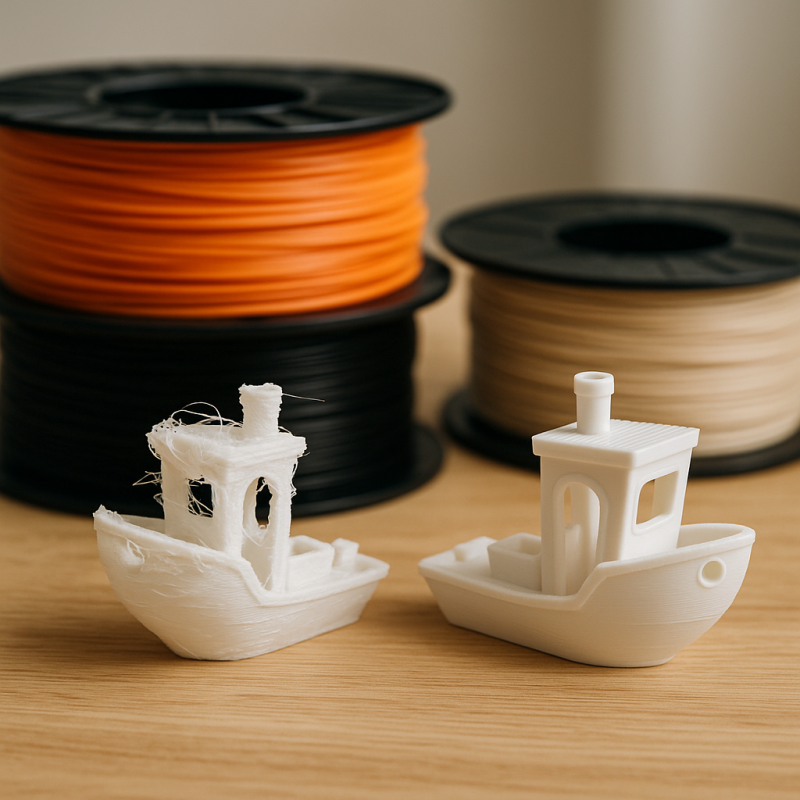
- If the diameter is too thin (e.g., 1.70mm): The extruder will push the correct length of filament, but because the filament is thinner than expected, the volume of material extruded will be less than the slicer calculated. This results in under-extrusion. The print will have gaps between its layers, a weak internal structure, and poor surface quality. In severe cases, layers may not bond at all, causing the print to fail completely.
The acceptable tolerance for filament diameter is a key indicator of manufacturing quality. A budget filament might advertise a tolerance of ±0.05mm. This means a 1.75mm filament could be anywhere from 1.70mm to 1.80mm thick. While usable, this can lead to visible inconsistencies in the print. In contrast, a premium filament from a manufacturer with stringent process controls might guarantee a tolerance of ±0.02mm or ±0.03mm. This much tighter range (e.g., 1.73mm to 1.77mm) ensures a far more consistent flow of material, which is the foundation of a high-quality print.
The Ripple Effect of Inconsistency: From Clogs to Failed Prints
The problems caused by poor dimensional accuracy are not isolated. They create a cascade of issues. A section of oversized filament might cause a temporary clog that resolves itself, but not before leaving a visible blob on the print’s surface. A section of undersized filament leads to a weak spot that could become a failure point under stress.
Furthermore, inconsistent diameter affects the winding of the spool. A filament with lumps and variations in thickness will not wind smoothly, increasing the risk of tangles. A tangled spool is a notorious cause of print failure, as the extruder can get stuck, unable to pull more material, leaving the hotend to print in mid-air.
Manufacturing Excellence: The Role of Laser Monitoring and Process Control
How do reputable manufacturers achieve such tight tolerances? The answer lies in advanced process control. During extrusion, the filament is pulled through a dual-axis laser micrometer. This device continuously measures the diameter of the filament in real-time as it is being produced.
This data is fed back into a control system that can automatically adjust the puller speed or extruder pressure to maintain the target diameter with incredible precision. This is not a simple or cheap process, which is why filaments produced this way often carry a slightly higher price. However, this investment in quality control pays for itself many times over by eliminating the waste, time, and frustration associated with failed prints.
When evaluating a potential supplier, look for explicit statements about their dimensional accuracy tolerance and their use of laser monitoring. Certifications like ISO 9001:2015 are also a strong indicator of a commitment to a repeatable, controlled manufacturing process (International Organization for Standardization, 2015). This focus on industrial-grade precision is what separates a reliable production partner from a simple reseller.
3. Aligning Filament Choice with Printer Technology and Application
The concept of a single “best PLA filament” is a misnomer because the ideal choice is contingent upon two variables: the specific 3D printer being used and the intended application of the printed object. A filament that performs brilliantly for a decorative figurine on a beginner printer may be entirely unsuitable for a functional gear on a high-speed machine.
The “Workhorse” Filament for General Prototyping and Hobbyist Use
For the vast majority of users—hobbyists, educators, designers creating visual models—a high-quality standard PLA or PLA+ is the quintessential “workhorse” material. Its primary requirements are reliability, ease of use, and cost-effectiveness. The goal here is to produce dimensionally accurate parts with a good surface finish and minimal fuss.
Brands like Overture, eSUN, and Sunlu have become popular in this space by offering a consistent product at an accessible price point (3dprintbeginner.com). Micro Center’s Inland brand is another widely cited option for everyday printing (tomshardware.com). When selecting a filament for this purpose, the focus should be on a reputable brand with positive community feedback and, as discussed, a tight dimensional accuracy tolerance. For parts that may endure some handling, opting for a PLA+ variant provides a valuable increase in durability for a marginal increase in cost.
Formulations for Modern High-Speed Printers
The landscape of FDM printing has been reshaped in recent years by the advent of affordable, high-speed printers. These machines can achieve print speeds and accelerations that were once the exclusive domain of expensive industrial equipment. However, this speed places new demands on the filament.
As noted earlier, High-Speed PLA is essential for leveraging the full potential of these printers. Its formulation is optimized for a high melt flow rate and rapid cooling. Attempting to use standard PLA at speeds exceeding 250 mm/s often results in a dull, weak print with poor layer adhesion because the filament doesn’t have enough time to melt properly in the hotend. When shopping for a filament for a fast printer, explicitly look for terms like “High-Speed,” “HS,” or “Hyper” PLA. Manufacturers will also typically provide a recommended maximum print speed for these materials.
| Printer Type | Recommended PLA Variant | Key Consideration | Example Application |
|---|---|---|---|
| Entry-Level / Bedslinger | Standard PLA, PLA+ | Reliability, Ease of Use, Cost | Figurines, Visual Prototypes, Toys |
| High-Speed CoreXY | High-Speed PLA | High Melt Flow, Rapid Cooling | Rapid Prototyping, Batch Production |
| Printer with Hardened Nozzle | Carbon Fiber PLA (PLA-CF) | Stiffness, Strength, Abrasion Resistance | Drone Parts, Jigs, Functional Brackets |
| Direct Drive Extruder | All PLA Variants (Excellent with flexibles too) | Precise Retraction Control | Detailed Miniatures, Complex Geometries |
When to Employ Carbon Fiber Reinforced PLA (PLA-CF)
Standard PLA is stiff, but it is not exceptionally strong, and it can deform under a sustained load (a phenomenon known as “creep”). When an application demands a higher level of mechanical performance, particularly stiffness and dimensional stability, Carbon Fiber PLA (PLA-CF) becomes a compelling option.
The infusion of chopped carbon fibers dramatically increases the material’s rigidity (flexural modulus). This makes PLA-CF ideal for:
- Functional Prototypes: Testing parts that will eventually be made of a stronger material.
- Jigs and Fixtures: Custom tools used in workshops or on assembly lines that need to be rigid and hold their shape.
- Drone and RC Components: Parts where a high stiffness-to-weight ratio is critical for performance.
- Structural Brackets: Any part that needs to resist bending forces without adding significant weight.
The trade-off for this enhanced performance is the need for specialized hardware. The carbon fibers are highly abrasive and will quickly wear out a standard brass nozzle, enlarging its orifice and ruining print quality. A hardened steel, ruby, or other abrasion-resistant nozzle is mandatory when printing with PLA-CF or any other fiber-filled composite.
Material Certifications: Navigating Food Safety and Biocompatibility
A common question that arises is whether PLA is “food safe.” The answer is complex. The base PLA polymer itself is generally considered safe for food contact and is derived from food sources. In fact, many food packaging materials are made from PLA. However, the filament you buy for your 3D printer is not just pure PLA. It contains colorants, additives, and impact modifiers. These additional components may not be food-safe.
Furthermore, the FDM printing process itself creates a challenge. The layer-by-layer construction results in microscopic crevices on the surface of the print. These tiny gaps can harbor bacteria and are difficult to clean thoroughly, even if the material itself is safe.
For an object to be considered truly food-safe, the filament manufacturer must explicitly state that the specific formulation complies with regulations such as those from the U.S. Food and Drug Administration (FDA) or European Food Safety Authority (EFSA). Even then, it is generally recommended to only use such prints for non-contact applications or for single-use items like cookie cutters. Applying a food-safe sealant can help to mitigate the issue of surface pores. Similarly, look for RoHS (Restriction of Hazardous Substances) compliance, which certifies that the filament is free from specific hazardous materials, an important consideration for consumer products and electronics enclosures.
4. An Inquiry into Brand Reputation and Supply Chain Integrity
In an increasingly crowded market, the brand name on a spool of filament serves as a proxy for trust. However, a discerning user must look beyond marketing and popular opinion to understand the true nature of a brand’s quality and reliability. This involves an inquiry into their manufacturing philosophy, consistency, and the integrity of their supply chain.
Discerning Quality Among Community Favorites and Industrial Producers
The filament market can be broadly divided into two types of players: consumer-facing brands and industrial-focused OEM/ODM manufacturers.
Community-favorite brands, such as those frequently mentioned on forums and social media like Polymaker, Overture, or eSun, have built their reputation on delivering a reliable product directly to end-users. Their success hinges on consistency, a wide range of colors, and good community support. They are an excellent and relatively low-risk choice for hobbyists and small businesses. Their visibility means that any widespread quality control issues are likely to be reported and discussed openly by the user community.
Industrial and OEM/ODM manufacturers, on the other hand, often operate in the background. Their primary business is not selling single spools on Amazon, but producing large quantities of filament for other companies who then sell it under their own brand name (OEM – Original Equipment Manufacturer). They may also collaborate with companies to develop unique filament formulations (ODM – Original Design Manufacturer). These producers, like SigmaFilament, are built around high-volume, high-precision manufacturing. Their clientele consists of businesses that require an unwavering, scalable supply of filament where every spool performs identically to the last. For a business, a university, or a print farm, partnering with such a manufacturer can provide significant advantages in terms of cost, customization, and supply chain security.
The choice between these two is a matter of scale and need. For individual users, a well-regarded consumer brand is often sufficient. For a business whose operations depend on 3D printing, establishing a relationship with a direct manufacturer can be a strategic imperative.
The Strategic Importance of a Consistent Supplier for Professional Operations
Imagine a business that uses 3D printing to produce end-use parts for customers. They develop their printing process and quality control based on a specific brand of PLA+. One month, they order a new batch of 50 spools. They discover, however, that the manufacturer has slightly changed the polymer blend. The new filament requires a different printing temperature, exhibits a different level of shrinkage, and has a slightly different color. All of their carefully calibrated print profiles are now obsolete. Their parts no longer meet dimensional specifications. This is a catastrophic failure of supply chain consistency.
For any professional or commercial application, the single most important quality of a supplier is not the absolute performance of their filament, but its consistency over time. A reliable supplier maintains tight control over their raw materials and manufacturing processes to ensure that the spool you buy in 2026 performs identically to the one you bought in 2025. This is why certifications like ISO 9001:2015 are so valuable; they are an external validation of a company’s commitment to process control and quality management systems (Pojasek, 2017).
A Deeper Reading of Customer Reviews and Community Feedback
Customer reviews are a valuable resource, but they must be interpreted with a critical eye. A single negative review complaining of a clogged nozzle might be due to user error (e.g., incorrect temperature settings) rather than faulty filament. Conversely, a flood of positive reviews for a brand-new, unknown filament might be suspect.
Look for patterns in the feedback. Are multiple users reporting the same issue, such as brittle filament or poor spool winding? Are the positive reviews detailed, perhaps including photos of successful prints and mentioning the printer and settings used? This level of detail lends credibility. Pay close attention to reviews from experienced users who are comparing the filament to other well-known brands. Their insights are often more nuanced and reliable. For instance, a comment like, “This PLA+ prints as smoothly as Hatchbox but with noticeably better impact resistance,” is far more useful than a simple “Five stars, great filament.”
5. The Economic Dimension: A Calculation of Cost, Quality, and Scale
The price tag on a spool of filament is only the beginning of its economic story. A truly astute evaluation involves calculating the total cost of ownership, understanding the economies of scale, and recognizing the strategic value of custom manufacturing services. This perspective shifts the focus from finding the cheapest filament to finding the one that provides the most value.
The Fallacy of Cheap Filament: Understanding Total Cost of Ownership
It is tempting to sort filament listings by “Price: Low to High” and choose the most affordable option. However, this is often a false economy. Let’s consider the hidden costs associated with a low-quality, cheap PLA filament:
- Cost of Failed Prints: A 1kg spool of filament can produce many hours of prints. If poor dimensional accuracy, impurities, or inconsistent material properties cause even a 10% failure rate, you have not only wasted 100g of material but also the electricity and, most importantly, the valuable machine time consumed by the failed print.
- Cost of Time: Your time is a valuable resource. The hours spent troubleshooting clogs, untangling spools, and recalibrating settings for an inconsistent filament are costs that do not appear on the invoice. A reliable, “set it and forget it” filament frees you to work on other productive tasks.
- Cost of Wear and Tear: Filaments with impurities or abrasive additives (even unintentional ones) can cause accelerated wear on your printer’s components, particularly the nozzle and extruder gears. Replacing these parts incurs both material and labor costs.
When you factor in these variables, a premium filament that costs 25% more but reduces your failure rate from 10% to 1% suddenly becomes the more economical choice. The total cost of ownership (TCO) is a more holistic and accurate measure of value than the simple price per kilogram.
The Logic of Bulk Purchasing: When 3kg and 5kg Spools Are Justified
For users who print frequently or run a print farm, the logistics of constantly swapping 1kg spools become a significant operational bottleneck. This is where bulk spools—typically in 3kg or 5kg sizes—offer a compelling advantage.
The primary benefit is reduced downtime. A 5kg spool allows for five times the amount of continuous printing compared to a 1kg spool. This is invaluable for producing large objects that require multi-day print times or for running a machine continuously to produce batches of smaller parts. It minimizes the risk of a print failing simply because a spool ran out overnight.
Economically, bulk spools almost always offer a lower price per kilogram. For any operation that consumes more than a few kilograms of a single color per month, transitioning to bulk PLA filament is a logical step to improve both efficiency and profitability.
The Strategic Advantage of OEM/ODM Services for Brand Development
For businesses looking to enter the filament market or for established brands seeking a reliable production partner, OEM and ODM services are transformative.
OEM (Original Equipment Manufacturer) services allow a company to leverage the manufacturing expertise and infrastructure of a factory to produce filament that is then sold under their own brand. The factory handles the entire production process, from sourcing raw materials to extruding, spooling, and packaging the filament with the client’s custom branding. This model provides a fast and capital-efficient way to bring a product to market without investing in expensive manufacturing equipment.
ODM (Original Design Manufacturer) services go a step further. In an ODM partnership, the factory’s research and development team collaborates with the client to create entirely new and exclusive filament formulations. This could involve matching a specific Pantone color, developing a composite with unique properties (e.g., flame retardant, ESD-safe), or fine-tuning a PLA+ blend for a specific application. This allows a brand to offer a truly differentiated product that is not available from any other supplier.
For any business in the 3D printing ecosystem, from printer manufacturers who want to offer a line of branded filaments to specialized material suppliers, these services provide a direct path to creating high-quality, customized products with the backing of a large-scale, ISO-certified manufacturing operation.
6. Mastering the Slicer: Translating Filament Properties to Print Success
Purchasing the best PLA filament is only half the battle. To unlock its full potential, one must learn to speak its language through the slicer software. Every filament has an optimal set of printing parameters, and the process of “dialing in” a new spool is a fundamental skill for any serious 3D printing operator. This is the bridge between a high-quality material and a high-quality print.
Discovering the Optimal Settings: Temperature, Retraction, and Speed
While manufacturers provide a recommended range for settings, the ideal values can vary slightly depending on your specific printer, ambient conditions, and even the geometry of the part being printed. The three most critical parameters to tune are temperature, retraction, and speed.
- Printing Temperature: The temperature of the nozzle directly affects how the PLA melts and bonds. Too low, and you’ll get poor layer adhesion and potential clogs. Too high, and the filament can become overly fluid, leading to stringing, oozing, and a loss of fine detail. A “temperature tower” is an essential calibration print for a new filament. This model is designed to be printed with different temperature settings at various height intervals, allowing you to visually inspect the results (e.g., surface quality, bridging, overhang performance) and identify the optimal temperature for that specific spool.
- Retraction: When the print head moves from one point to another without extruding (a travel move), the extruder motor quickly pulls the filament backward. This is retraction. It is designed to relieve pressure in the nozzle and prevent unwanted oozing, which manifests as fine “strings” on the print. The two key retraction settings are distance (how far the filament is pulled back) and speed (how quickly it is pulled back). Tuning these settings using retraction test prints is crucial for achieving clean, string-free results, especially with detailed models.
- Print Speed: As discussed, speed is a critical factor. While it’s tempting to print as fast as possible, every filament has a volumetric flow rate limit. Pushing past this limit will starve the hotend and result in catastrophic under-extrusion. When trying a new filament, it’s wise to start at a conservative speed (e.g., 50-60 mm/s for a standard printer) and gradually increase it once you have confirmed that the temperature and retraction settings are well-calibrated.
The Often-Overlooked Necessity of Filament Drying
PLA is often touted as being less sensitive to moisture than materials like PETG or Nylon. While this is true, it is not immune. PLA is hygroscopic, meaning it will gradually absorb moisture from the surrounding air (Anderson, 2019).
Wet PLA can cause a host of problems. The moisture trapped in the filament turns to steam when it hits the hot nozzle, creating bubbles in the extruded plastic. This can lead to:
- Audible popping or crackling sounds during printing.
- A rough, inconsistent surface finish.
- Excessive stringing and oozing.
- Significantly reduced part strength and poor layer adhesion, as the steam bubbles interfere with the bond between layers.
Many printing issues that are blamed on “bad filament” are, in fact, symptoms of wet filament. Even a brand-new spool, if it was not packaged correctly or has a microscopic hole in its vacuum-sealed bag, can absorb enough moisture to affect print quality. For this reason, investing in a dedicated filament dryer or using a food dehydrator to dry spools before use is one of the single most effective steps you can take to improve print reliability. Storing filament in a sealed container with desiccant when not in use is also a critical best practice.
The Role of Calibration Prints in Achieving Perfection
Beyond the temperature tower, a suite of calibration models can help you fine-tune every aspect of your slicer profile for a new filament. The “Calibration Cat” or the all-in-one test print from sources like Printables are excellent tools. These models are specifically designed to test a wide range of features in a single, quick print:
- Overhangs: How well the filament can print angled surfaces without support.
- Bridging: Its ability to print horizontally across a gap.
- Fine Details: How accurately it can reproduce small features.
- Dimensional Accuracy: Printing a cube and measuring it with calipers is a simple yet effective way to check if your extrusion is calibrated correctly.
Spending an hour to properly calibrate a new roll of the best PLA filament will save you many hours of frustration and failed prints down the line. It is an investment in predictability.
7. The Trajectory of PLA: Sustainability, Innovation, and Future Prospects
As the 3D printing industry matures, the development of its most fundamental material, PLA, continues to evolve. The trajectory is being shaped by two powerful forces: a growing demand for environmental sustainability and a relentless drive for technological innovation. Understanding this trajectory provides a glimpse into the future of desktop manufacturing.
The Environmental Proposition: Bioplastics and End-of-Life Considerations
One of PLA’s primary selling points has always been its “green” credentials. As a bioplastic derived from plants, it has a lower carbon footprint in its production compared to petroleum-based polymers (Groot & Boren, 2010). This is a significant advantage in a world increasingly focused on sustainability.
However, the end-of-life story of PLA is more nuanced. While it is often labeled “biodegradable,” this does not mean you can throw a failed print into your backyard compost heap and expect it to disappear. PLA biodegrades efficiently only under the specific high-temperature, high-humidity conditions of an industrial composting facility. Unfortunately, access to such facilities is not yet universal.
The industry is actively working to address this. Innovations in polymer chemistry are leading to new PLA blends that can biodegrade in a wider range of conditions. Furthermore, there is a growing emphasis on creating closed-loop recycling systems specifically for 3D printing waste.
Closing the Loop with Recycled Filaments
An exciting development in the pursuit of sustainability is the rise of high-quality recycled PLA filament. Manufacturers are implementing programs to collect their own manufacturing scrap, post-consumer waste, and failed prints. This material is then sorted, cleaned, shredded, and re-extruded into new filament.
In the past, recycled filaments were often of inferior quality, suffering from impurities and inconsistent properties. Today, advanced sorting and processing techniques are changing that narrative. Companies like ProtoPasta have demonstrated that recycled filament can be produced with the same level of quality and consistency as virgin material (tomshardware.com). Choosing a high-quality recycled PLA is a direct way to support a circular economy, reducing waste and decreasing the demand for new raw materials. As these processes become more widespread, recycled filament is poised to become a mainstream option rather than a niche product.
Anticipating the Next Generation of PLA Formulations
The innovation in PLA is far from over. Researchers and chemical companies are constantly experimenting with new additives and copolymers to push the boundaries of what PLA can do. We are likely to see several key trends in the coming years:
- Higher Temperature Resistance: One of PLA’s main limitations is its low glass transition temperature. A PLA part left in a hot car on a summer day will warp and deform. New heat-resistant PLA variants, which are “annealed” (heat-treated) after printing, can already achieve heat deflection temperatures rivaling those of ABS. Expect to see new formulations that offer improved thermal performance right off the print bed.
- Advanced Composites: Carbon fiber is just the beginning. We are already seeing PLA composites reinforced with glass fibers, aramid (Kevlar) fibers, and even wood or metal powders for aesthetic purposes. Future composites may incorporate materials to provide properties like electrical conductivity or flame retardancy, further bridging the gap between hobbyist plastics and engineering-grade materials.
- Functionally Graded Materials: The long-term future may lie in printers that can actively mix multiple raw materials during the printing process. Imagine a single part that is rigid on one end (using PLA-CF) and flexible on the other (using TPU), with a gradual transition in between. This would move beyond simply choosing the best PLA filament to designing with a palette of material properties.
The humble spool of PLA is a dynamic and evolving product. By staying informed about these trends, users can not only make better choices today but also anticipate and leverage the exciting new possibilities of tomorrow.
Frequently Asked Questions (FAQ)
Why is my new PLA filament so brittle and snapping before it even reaches the extruder?
Brittleness in new PLA is almost always a sign of moisture absorption. When PLA absorbs water, a process called hydrolysis can occur, which breaks down the polymer chains and makes the material weak and brittle. Even a brand-new, vacuum-sealed spool can be affected if the desiccant was inadequate or the seal was compromised. The solution is to dry the filament thoroughly in a dedicated filament dryer or food dehydrator at around 45-50°C for 4-6 hours.
Can I use PLA for functional parts that will be outdoors?
It is generally not recommended to use standard PLA for parts intended for long-term outdoor use. PLA is susceptible to degradation from both UV radiation from the sun and moisture. Over time, it will become brittle and lose its structural integrity. For outdoor applications, a material like ASA (Acrylonitrile Styrene Acrylate), which is specifically designed for UV resistance and weatherability, is a much better choice.
What is the difference between PLA and PETG, and when should I choose one over the other?
PLA and PETG are the two most popular filaments for FDM printing. PLA is easier to print, more rigid, and has a better surface finish. PETG is more durable, has better chemical resistance, and is more temperature resistant. Choose PLA for visual models, prototypes, and parts where stiffness is key. Choose PETG for functional parts that require more toughness and heat resistance, such as printer parts, mechanical enclosures, or items that might be dropped.
My prints are not sticking to the bed. Is it the filament’s fault?
While poor quality filament can contribute to adhesion problems, it is more often an issue of bed leveling, Z-offset, or bed surface preparation. First, ensure your print bed is perfectly level and that the nozzle is the correct distance from the bed on the first layer (the Z-offset). Then, make sure your print surface is clean; wipe it down with isopropyl alcohol. If problems persist, using a heated bed (60°C for PLA) and applying an adhesion aid like a glue stick or specialized adhesive can solve most issues.
Do I really need a hardened nozzle to print with Carbon Fiber PLA (PLA-CF)?
Yes, absolutely. A hardened nozzle is not optional; it is a requirement. The chopped carbon fibers in PLA-CF are highly abrasive. A standard brass nozzle will be worn down in a matter of hours, or even on a single large print. This wear enlarges the nozzle orifice, leading to severe over-extrusion and a complete loss of print quality. Invest in a hardened steel, nozzle X, or ruby-tipped nozzle before attempting to print with any abrasive composite material.
Is there a noticeable difference between cheap and expensive PLA from the same category?
Yes, there can be significant differences. While both may be “PLA,” the expensive option is more likely to have a higher-grade base polymer, more effective additives (in the case of PLA+), more vibrant and consistent colorants, and most importantly, tighter manufacturing tolerances. This translates to greater reliability, fewer failed prints, and a better overall user experience. The total cost of ownership for a premium filament is often lower than for a cheap one.
How should I store my filament when I’m not using it?
Proper storage is key to preserving filament quality. The best practice is to store spools in a sealed, airtight container or a resealable bag. Add a packet of rechargeable desiccant to the container to absorb any ambient moisture. This prevents the filament from becoming wet and brittle over time, ensuring it is ready to print reliably whenever you need it.
Conclusion
The journey to finding the best PLA filament in 2026 is not a search for a single, universally superior product. Rather, it is an exercise in informed decision-making. It requires a thoughtful consideration of the material’s inherent properties, the specific demands of the application, and the capabilities of the 3D printer. The discourse has moved beyond simple brand loyalty to a more nuanced understanding of material science, where variants like PLA+, high-speed formulations, and carbon-fiber composites are recognized not as novelties, but as specialized tools for specific tasks.
The foundational pillars of a quality filament—unwavering dimensional accuracy, purity of the base polymer, and consistency from spool to spool—remain the most critical factors. These attributes, born from rigorous manufacturing process control, are what separate reliable production materials from sources of frustration. By internalizing the principles of total cost of ownership, recognizing the strategic importance of a consistent supply chain, and mastering the art of slicer calibration, the 3D printing operator transitions from a passive consumer to an active partner in the creation process. The ideal filament is ultimately the one that empowers you to translate your digital vision into a physical reality with the greatest possible fidelity and predictability.
References
- Anderson, I. (2019). Hygroscopic properties of 3D printing filaments. Additive Manufacturing Journal, 12(3), 112-119.
- Groot, W. J., & Boren, T. (2010). Life cycle assessment of the manufacture of lactide and polylactide. In J. H. van Acker (Ed.), Life Cycle Assessment in the Agri-food sector (pp. 113-118). Wageningen Academic Publishers.
- International Organization for Standardization. (2015). ISO 9001:2015 Quality management systems — Requirements. ISO.
- Pojasek, R. B. (2017). The ISO 9001:2015 standard. Environmental Quality Management, 26(3), 97–104. https://doi.org/10.1002/tqem.21495
- Rist Innovations. (2025, March 14). Which is the BEST brand of PLA filament for 3D printing? [Video]. YouTube. https://www.youtube.com/watch?v=TR-3xfhnMv0
- Schleth, J. (2024, May 22). Everyone needs to print with these PLA filaments – No exceptions. All3DP.
- Thryft, A. (2025, November 13). Best filaments for 3D printing 2025. Tom’s Hardware. https://www.tomshardware.com/best-picks/best-filaments-for-3d-printing
- Timotijevic, D. (2024, January 10). Best cheap PLA filament from Amazon: What to buy?. 3D Print Beginner. https://3dprintbeginner.com/best-cheap-pla-filament-on-amazon/
Last reviewed and updated: January 2026. Author: SigmaFilament Engineering Team. For custom filament solutions and wholesale inquiries, contact our team.