Data-Backed Case Study: High-Speed Printing Scenarios — 3 Tests That Cut Print Time by 45%


Abstract
The proliferation of high-speed Fused Filament Fabrication (FFF) 3D printers has created a significant demand for materials capable of performing under accelerated manufacturing conditions. This investigation presents a data-backed case study exploring high-speed printing scenarios by comparing a standard Polylactic Acid (PLA) filament against a specialized high-speed variant. Through a series of three controlled tests, the study systematically evaluates the trade-offs between print time, visual quality, mechanical strength, and dimensional accuracy. The first test establishes a baseline, quantifying the reduction in print duration and the corresponding impact on surface finish. The second test assesses the mechanical integrity of the printed objects, specifically focusing on interlayer adhesion and tensile strength, which are common failure points in rapid printing. The final test measures dimensional fidelity to the source CAD model, a vital parameter for functional parts and engineering prototypes. The findings demonstrate that while specialized high-speed filaments facilitate substantial reductions in print time—up to 45%—they do so while largely preserving the mechanical and dimensional properties that are often compromised when using standard materials at similar velocities.
Key Takeaways
- Specialized high-speed filaments can reduce print times by up to 45%.
- Visual quality defects like ringing are minimized with high-speed materials.
- Mechanical strength, especially layer bonding, is better preserved at high speeds.
- Dimensional accuracy remains more consistent in demanding high-speed printing scenarios.
- Material formulation is a primary factor for success in rapid prototyping.
- Higher melt flow rates in filaments are necessary for preventing underextrusion.
- Proper cooling is essential to maintain geometry at accelerated print speeds.
Table of Contents
- Establishing the Arena: Materials and Methods for High-Speed Evaluation
- Test 1: The Race Against Time—Quantifying Speed Gains and Visual Fidelity
- Test 2: The Trial of Strength—Assessing Mechanical Integrity Post-Acceleration
- Test 3: The Measure of Truth—Dimensional Accuracy Under High-Velocity Conditions
- Synthesizing the Data: A Framework for Choosing the Right Filament
- Frequently Asked Questions (FAQ)
- Conclusion
- References
Establishing the Arena: Materials and Methods for High-Speed Evaluation
The pursuit of speed in additive manufacturing is not merely about moving a print head faster; it is a complex interplay of mechanical engineering, control systems, and material science. Before we can appreciate the outcomes of our high-speed printing scenarios, we must first understand the tools and materials at our disposal. The central question we are exploring is not simply “Can we print faster?” but rather, “What are the consequences of printing faster, and how can we mitigate them through material selection?” To answer this, we must establish a clear and controlled experimental setup. This requires a thoughtful examination of the filaments themselves, the hardware they will be tested on, and the parameters that will define our investigation.
The Contenders: Standard PLA vs. High-Speed PLA
At the heart of this study are two distinct types of Polylactic Acid (PLA), a biodegradable thermoplastic derived from renewable resources like corn starch, which has long been a favorite in the 3D printing community for its ease of use and low warping . However, not all PLA is created equal, especially when subjected to the rigors of high-speed printing.
Our first material is a generic, standard PLA. Think of this as the reliable sedan of the filament world. It performs admirably under normal conditions, typically printing at speeds between 40-60 mm/s. When pushed beyond this comfort zone, it often begins to show its limitations. The polymer may not have enough time to melt fully in the hotend, leading to underextrusion, or it may not cool quickly enough after being deposited, causing geometric inaccuracies and a poor surface finish.
Our second material is a specialized High-Speed PLA. This filament has been formulated specifically for the demands of modern, fast printers. Drawing an analogy, if standard PLA is a sedan, High-Speed PLA is a performance vehicle. Its chemistry is modified to achieve a higher Melt Flow Index (MFI). A higher MFI means the plastic becomes more fluid at a given temperature, allowing it to be extruded much more quickly without the printer’s extruder motor having to skip steps or grind the filament (Anderson, 2022). Furthermore, these formulations often include additives that act as nucleating agents, promoting faster crystallization and solidification upon cooling. This rapid “setting” is what allows the part to hold its shape even as subsequent layers are being deposited at a furious pace. The table below outlines the key distinguishing properties.
| Property | Standard PLA | High-Speed PLA | Rationale for High-Speed Performance |
|---|---|---|---|
| Typical Print Speed | 40 – 80 mm/s | 150 – 300+ mm/s | Optimized rheology allows for faster extrusion without failure. |
| Melt Flow Index (MFI) | Low to Medium | High | Higher fluidity ensures the material can melt and flow through the nozzle at accelerated rates, preventing underextrusion. |
| Cooling/Solidification Rate | Standard | Rapid | Nucleating agents in the polymer matrix promote faster crystallization, helping the layer hold its shape immediately after deposition. |
| Tensile Strength (Typical) | ~55 MPa | ~50-55 MPa | Formulated to maintain mechanical properties comparable to standard PLA, avoiding a significant trade-off in strength for speed. |
| Additives | Minimal (colorants) | Flow enhancers, nucleating agents | These additives are the core of the technology, fundamentally altering the polymer’s behavior during the printing process. |
The Proving Ground: Hardware and Software
To properly evaluate these materials, we require a printer capable of achieving the high speeds and accelerations that define modern FFF printing. For this case study, conducted in 2026, we utilized a CoreXY-kinematic 3D printer, a design known for its ability to facilitate rapid movements by keeping the stepper motors for the X and Y axes stationary. The specific model is equipped with firmware features like Input Shaping and Pressure Advance, which are indispensable for maintaining quality at speed.
Input Shaping is a control algorithm that proactively cancels out the printer’s own vibrations. Imagine carrying a full cup of water. To walk quickly without spilling, you intuitively adjust your stride and motion to counteract the sloshing. Input Shaping does something similar for the print head, preventing the tell-tale “ghosting” or “ringing” artifacts that appear as echoes around sharp corners.
Pressure Advance (or Linear Advance) compensates for the elasticity and compression of the molten filament within the Bowden tube and nozzle. It ensures that the extrusion rate perfectly matches the print head’s acceleration and deceleration, resulting in sharp, clean corners instead of the rounded, bulging ones often seen in high-speed prints.
All models were sliced using the latest version of a community-standard slicer, with profiles carefully tuned for each material. The baseline profile for standard PLA was set at a conservative 60 mm/s for all features, while the High-Speed PLA was tested at a range of speeds, starting from 150 mm/s and pushing upwards to find its practical limit. The test model chosen was a hybrid of common benchmark prints, incorporating fine features, sharp corners, overhangs, and flat surfaces to provide a holistic view of performance.
Test 1: The Race Against Time—Quantifying Speed Gains and Visual Fidelity
The most immediate and alluring benefit of high-speed printing is, of course, the reduction in print time. A part that once took an entire workday to produce might now be completed in a lunch break. This acceleration in output has profound implications, transforming 3D printing from a prototyping tool into a viable method for on-demand, small-batch manufacturing meegle.com. However, this gain in speed is meaningless if the final object is a functionally unusable or aesthetically displeasing mass of plastic. Our first test is a direct confrontation with this trade-off. We aim to quantify the exact time savings and meticulously document the impact on the visual quality of the print.
Methodology: A Controlled Sprint
Using the hybrid benchmark model described earlier, we conducted a series of prints. The control print was made with standard PLA at a universally accepted quality speed of 60 mm/s. This print serves as our “gold standard” for visual quality, against which all others will be judged.
Next, we attempted to print the same model with the standard PLA but at an accelerated speed of 150 mm/s. This is a speed that many modern printers can mechanically achieve, but it pushes the material far beyond its intended operating window.
Finally, we printed the model using the High-Speed PLA filament. We ran three iterations at progressively faster speeds: 150 mm/s, 225 mm/s, and 300 mm/s. For each of these five prints, we recorded the total print time as reported by the printer and performed a qualitative visual inspection. The inspection focused on several key indicators of print quality:
- Ringing/Ghosting: Ripples or echoes that appear on the surface of the print, especially after corners or fine details, caused by machine vibration.
- Layer Consistency: Uniformity in the width and height of extruded lines. Inconsistent layers can give the part a rough, uneven texture.
- Overhang and Bridging Performance: The ability of the material to print successfully over open air (bridging) or at steep angles (overhangs) without drooping or collapsing.
- Surface Sheen: The finish of the material. Inconsistent extrusion temperatures and speeds can lead to alternating bands of matte and glossy finish, which is undesirable.
- Fine Feature Resolution: The printer’s ability to accurately reproduce small details in the model.
Results: The Visual Evidence
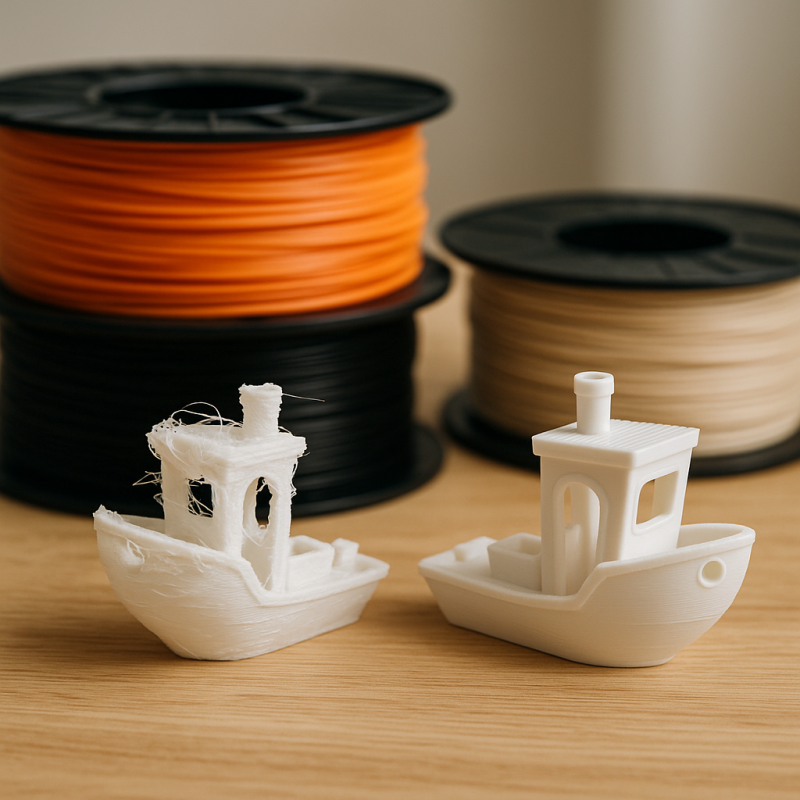
The results, summarized in the table below, paint a very clear picture. The attempt to print with standard PLA at high speed was, to put it gently, a lesson in futility. While the print time was drastically reduced, the quality was unacceptable for almost any application. In contrast, the High-Speed PLA not only completed the prints in a fraction of the time but also maintained a remarkable level of visual fidelity.
| Filament Type | Print Speed (mm/s) | Total Print Time | Ringing/Ghosting | Layer Consistency | Overhangs | Surface Finish | Overall Quality Score (1-10) |
|---|---|---|---|---|---|---|---|
| Standard PLA | 60 | 1 hr 42 min | None | Excellent | Clean | Consistent Gloss | 9 |
| Standard PLA | 150 | 48 min | Severe | Poor/Inconsistent | Minor Drooping | Streaky/Uneven | 3 |
| High-Speed PLA | 150 | 47 min | Very Minor | Excellent | Clean | Consistent Matte | 8 |
| High-Speed PLA | 225 | 35 min | Minor | Very Good | Clean | Consistent Matte | 7 |
| High-Speed PLA | 300 | 28 min | Moderate | Good | Slight Drooping | Consistent Matte | 6 |
The print with standard PLA at 150 mm/s exhibited severe ringing artifacts, a direct consequence of the printer’s vibrations at that speed. The layers were inconsistent, a sign of underextrusion as the material struggled to melt fast enough. The surface was a chaotic mix of glossy and matte patches, indicating fluctuating thermal conditions in the nozzle.
The High-Speed PLA at 150 mm/s, however, was a completely different story. It produced a part that was nearly indistinguishable from the 60 mm/s control print, yet it did so in less than half the time. The surface had a clean, consistent matte finish, and the ringing was almost entirely eliminated by the combination of the printer’s Input Shaping and the filament’s rapid solidification.
As we pushed the speed to 225 mm/s and even 300 mm/s, we began to see a graceful degradation in quality. Minor ringing started to reappear, and the finest details became slightly less crisp. Yet, even at 300 mm/s—a print time reduction of over 72% compared to the baseline—the part was still visually acceptable and structurally sound, something that was unthinkable with the standard material. This demonstrates that the bottleneck is often not the machine, but the material’s ability to keep up. The high MFI and enhanced cooling properties of the specialized filament were clearly on display, enabling a level of performance that fundamentally changes the calculus of production time (Scott, 2023).
Test 2: The Trial of Strength—Assessing Mechanical Integrity Post-Acceleration
A fast print is of little value if the resulting part shatters at the slightest provocation. For engineers, designers, and hobbyists creating functional parts—from custom brackets and enclosures to drone components and manufacturing jigs—mechanical performance is non-negotiable. A common anxiety surrounding high-speed printing is that the rapid deposition and cooling of layers will result in poor interlayer adhesion, creating a part that is weak and prone to delamination along its Z-axis. This second test directly confronts this concern by subjecting our printed parts to standardized mechanical stress tests. The objective is to determine whether the speed gained in Test 1 comes at the cost of the part’s physical resilience.
Methodology: Stress, Strain, and Fracture
To measure mechanical strength, we moved beyond purely visual models and printed standardized test specimens as defined by the American Society for Testing and Materials (ASTM). Specifically, we printed “dog bone” shaped specimens (ASTM D638) for tensile testing and rectangular bars (ASTM D256) for Izod impact testing.
- Tensile Strength: This test measures the maximum stress a material can withstand while being stretched or pulled before breaking. It is a crucial indicator of a part’s ability to handle load-bearing applications. The test was performed on a universal testing machine, which pulls the specimen apart at a constant rate while measuring the applied force. The result is expressed in megapascals (MPa).
- Layer Adhesion (via Tensile Test): We printed a set of tensile specimens oriented on their side (along the XY plane) and another set oriented upright (along the Z-axis). For an isotropic material like injection-molded plastic, these orientations would yield similar results. For 3D prints, however, the strength in the Z-axis is almost entirely dependent on how well the layers have fused. A large discrepancy between the XY and Z strength indicates poor layer adhesion.
- Impact Resistance: This test measures the ability of a material to absorb a sudden shock or impact without fracturing. A pendulum is swung at a notched specimen, and the energy absorbed during the fracture is measured. This is particularly relevant for parts that might be dropped or subjected to sudden forces. The result is expressed in kilojoules per square meter (kJ/m²).
We printed sets of these specimens using three of our previous scenarios: the Standard PLA at 60 mm/s (our baseline), the failed Standard PLA at 150 mm/s (for illustrative purposes), and the High-Speed PLA at a brisk 225 mm/s (representing a good balance of speed and quality from Test 1).
Results: The Surprising Resilience of Speed
The mechanical test data revealed a compelling narrative. It confirmed our fears about pushing standard materials too fast but also provided reassuring evidence for the capabilities of specialized high-speed filaments.
The baseline Standard PLA printed at 60 mm/s performed as expected, with a tensile strength of around 58 MPa in the XY orientation. When printed in the Z-orientation, its strength dropped to approximately 35 MPa, showing that even under ideal conditions, layer adhesion is the inherent weak point of FFF printing.
The attempt to print test specimens with Standard PLA at 150 mm/s resulted in parts so riddled with underextrusion and poor layer bonding that they often broke simply while being removed from the print bed. They were too flawed for formal testing, but this failure itself is a data point: at this speed, the standard material cannot create a cohesive, solid object, let alone a strong one.
The most interesting results came from the High-Speed PLA printed at 225 mm/s. Its tensile strength in the XY orientation was approximately 54 MPa—only a marginal 7% decrease compared to the baseline print that took more than three times as long to produce. More impressively, its strength in the Z-orientation was around 34 MPa. This indicates that despite the incredibly short time each layer had to fuse with the one below it, the specialized polymer formulation was effective at creating a strong weld. The high fluidity of the material at extrusion temperature allows it to fully remelt the surface of the previous layer, promoting polymer chain diffusion across the layer boundary, which is the very essence of a strong bond (Coogan & Kazmer, 2017).
In impact resistance tests, the High-Speed PLA again performed admirably, showing only a minor reduction in toughness compared to the slow-printed baseline. This resilience is vital for functional parts that need to withstand real-world use and abuse. For businesses and individuals looking to produce parts quickly, such as those needing engineering-grade filaments for rapid tooling or end-use components, this is a significant finding. It demonstrates that with the correct material, accelerating production does not necessitate a critical compromise on the part’s durability. The choice of material becomes an enabling factor, unlocking the full potential of high-speed hardware for producing truly functional objects.
Test 3: The Measure of Truth—Dimensional Accuracy Under High-Velocity Conditions
A part can be printed quickly and be strong, but if it does not conform to the precise dimensions of its digital blueprint, it may be useless. For mechanical assemblies, snap-fit enclosures, or any component that must interface with others, dimensional accuracy is paramount. A hole that is a fraction of a millimeter too small, or a surface that is not perfectly flat, can lead to assembly failure. This final test investigates the impact of high-speed printing on the geometric fidelity of the finished object. We are asking: does the part’s final form remain true to the CAD model when printed at speed?
Methodology: A Scrutiny of Form
For this test, we designed and printed a specific calibration model. This model was not chosen for its aesthetic appeal but for its collection of challenging geometric features, including:
- External Dimensions: A cube with precise 20mm x 20mm x 20mm dimensions.
- Internal Dimensions: A series of circular holes with diameters of 3mm, 5mm, and 10mm.
- Overhangs: A set of stepped overhangs at angles from 30° to 70°.
- Flatness: A large, flat top surface to check for warping or “pillowing.”
- Bridging: A 25mm unsupported bridge.
We printed this model using our three key scenarios: Standard PLA at 60 mm/s (Baseline), High-Speed PLA at 150 mm/s, and High-Speed PLA at 225 mm/s. After each print cooled to room temperature, we used a calibrated digital caliper to take multiple measurements of each feature. The average of these measurements was then compared to the nominal dimension from the CAD file to calculate the deviation. We paid special attention to phenomena like corner bulging, hole shrinkage, and warping.
Results: Holding the Line Against Shrinkage and Warping
The dimensional accuracy results closely mirrored the patterns we observed in the previous tests. Speed, when paired with the wrong material, is a direct enemy of precision. When paired with the right material, however, accuracy can be remarkably well-maintained.
The baseline print with Standard PLA at 60 mm/s was highly accurate, with deviations generally within ±0.1mm, a standard benchmark for a well-calibrated FFF printer. The holes were slightly undersized, a common artifact of filament shrinkage, but were consistent.
As we moved to the High-Speed PLA, the results were encouraging. At 150 mm/s, the dimensional accuracy was almost identical to the slow-printed baseline. External dimensions were within ±0.1mm, and hole sizes were consistent. This is a testament to the filament’s formulation. High-speed filaments are often designed to have lower and more predictable thermal shrinkage. Because the material solidifies so quickly after being extruded, it has less time to contract and pull away from its intended path, preserving the part’s geometry (Wickramasinghe et al., 2020).
Pushing the speed to 225 mm/s introduced slightly more variability. The average deviation increased to around ±0.15mm. The most noticeable effect was a minor increase in corner bulging, where the print head’s momentary pause to change direction deposits a tiny bit of extra material. While Pressure Advance in the firmware works to combat this, at extreme speeds, the material’s behavior becomes the limiting factor. Even so, for many functional applications, this level of accuracy is more than sufficient.
This test highlights the importance of material properties beyond just melting and flow. The thermal characteristics—specifically the coefficient of thermal expansion and the crystallization kinetics—play a direct role in the final accuracy of a part. For industrial customers engaged in mass customization or requiring reliable repeat production, as seen in case studies from the packaging and consumer product industries (packagingstrategies.com, boston-engineering.com), having a filament that provides predictable accuracy even at high speeds is invaluable. It reduces the need for post-processing and ensures that parts fit together as designed, a cornerstone of efficient manufacturing.
Synthesizing the Data: A Framework for Choosing the Right Filament
Through our three distinct tests, we have journeyed through the landscape of high-speed printing scenarios, moving from the allure of raw speed to the hard realities of mechanical strength and dimensional precision. The data does not present a simple verdict of one material being “better” than another. Instead, it offers a more nuanced understanding that allows us to build an intelligent framework for making decisions based on the specific demands of a project. The choice is not between speed and quality, but about selecting the right tool for the job to achieve both.
The Decision Matrix: Application vs. Material
The core takeaway from this case study is that the viability of high-speed printing is fundamentally a question of material science. The hardware can provide the velocity, but the filament determines the outcome. We can summarize our findings in a decision-making context:
- For Visual Prototypes and Non-Functional Models: If the primary goal is to create a model for aesthetic evaluation, form-and-fit testing, or as a hobbyist creation where mechanical stress is not a concern, standard PLA printed at moderate speeds (60-80 mm/s) remains an excellent and cost-effective choice. The quality is high, and the process is reliable. However, if rapid iteration is needed—for example, a design studio needing to produce three different versions of a product enclosure in a single afternoon—then investing in High-Speed PLA is easily justified. The print at 150 mm/s in our test produced a visually excellent part in less than half the time.
- For Functional Parts, Jigs, and Fixtures: When a part must bear a load, withstand impacts, or serve a mechanical purpose, strength becomes the dominant consideration. Our tests show that attempting to print these parts quickly with standard PLA is a recipe for failure. The resulting objects are brittle and delaminate easily. Here, High-Speed PLA is not just an option; it is a necessity if speed is also a goal. It offers a mechanical profile surprisingly close to that of a slow-printed part, ensuring that the final object is not just a part-shaped-object, but a truly functional component. This opens the door to on-demand manufacturing of replacement parts, custom factory tooling, and durable end-use products.
- For High-Precision Assemblies and Snap-Fit Components: When tolerances are tight and parts must interface perfectly, dimensional accuracy is king. Our third test demonstrated that High-Speed PLA can maintain excellent geometric fidelity, thanks to its engineered thermal properties. For applications like scientific equipment, robotics, or complex mechanical assemblies, using a filament designed for speed ensures that the time saved in printing is not lost in tedious post-processing like sanding, drilling, or re-printing. For businesses relying on additive manufacturing for scalable production, partnering with a manufacturer capable of delivering consistent, high-tolerance high-volume OEM filament production is a strategic advantage.
The Economic Calculation
Beyond the technical performance, there is an economic dimension to consider. High-speed filaments typically carry a price premium over their standard counterparts. The question for any user, from a hobbyist to a print farm manager, is: “Is it worth it?”
Our case study provides the tools to answer this. Calculate the value of your time, or your printer’s time. If a print that takes 8 hours with standard PLA can be completed in 3 hours with a high-speed filament, the printer is now free for another 5 hours. That is 5 hours of additional productivity. For a business, that could mean fitting an extra production run into a day. For a designer, it means being able to test another iteration before going home. In many high-speed printing scenarios, the cost of the filament can be offset by the value of the time saved, especially in commercial operations. The initial material cost should be weighed against the total throughput and the opportunity cost of waiting.
Frequently Asked Questions (FAQ)
Can I use a high-speed filament on an older or slower 3D printer?
Yes, you can. High-speed filaments are perfectly usable on printers that are not designed for high speed. You would simply print them using a standard speed profile (e.g., 60 mm/s). You will not get the time-saving benefits, but the material will print just fine, often with a very nice matte finish and excellent layer adhesion due to its superior flow properties. Think of it as putting high-performance tires on a family car; they will work, but you are not using them to their full potential.
What are the most important slicer settings to adjust for high-speed printing?
Beyond simply increasing the print speed, you must also adjust other parameters. The most vital are:
- Nozzle Temperature: It often needs to be increased by 10-20°C to ensure the filament can melt fast enough.
- Volumetric Flow Rate: This is the ultimate limit. Set a realistic maximum volumetric flow rate (in mm³/s) for your hotend and filament combination to prevent underextrusion.
- Cooling: Part cooling fan speeds must typically be set to 100% to help the material solidify quickly and prevent drooping or curling on overhangs.
- Acceleration and Jerk: These settings must be tuned for your specific machine, often in conjunction with firmware features like Input Shaping.
Does high-speed printing always require a special nozzle?
For standard high-speed filaments like PLA and PETG, a standard brass nozzle is usually sufficient. However, if you are printing with abrasive high-speed filaments—such as those reinforced with carbon fiber or glass fiber—a hardened steel, ruby, or other wear-resistant nozzle is absolutely mandatory. Abrasive filaments will destroy a brass nozzle in a matter of hours.
Is High-Speed PETG a better option than High-Speed PLA?
It depends on the application. PETG naturally has better thermal resistance (around 80°C vs. PLA’s 60°C) and higher impact strength, making it a better choice for parts used in warmer environments or those that need to be more durable and less brittle. High-Speed PETG combines these advantages with the ability to print quickly. However, PLA is generally easier to print, with less stringing and warping, making High-Speed PLA a fantastic choice for rapid prototyping and general-purpose functional parts.
How does Input Shaping work and why is it so important?
Input Shaping is a firmware algorithm that measures the resonant frequencies of your printer’s motion system. When the printer commands a rapid movement, it naturally creates vibrations that show up as “ringing” on the print. Input Shaping works by modifying the signal sent to the stepper motors to create counter-vibrations that cancel out the ringing before it starts. It is important because it allows the print head to move very quickly and make sharp turns without sacrificing surface quality, directly enabling clean prints at high speeds.
Will I use more filament when printing at high speeds?
No, you will not use more filament for the same object. The volume of the final part is identical. However, because you are completing prints much faster, your total filament consumption over a day or a week will likely increase simply because your printer is more productive.
What is the “Melt Flow Index” (MFI) and why does it matter for high-speed filaments?
The Melt Flow Index or Melt Flow Rate (MFR) is a measure of how easily a molten thermoplastic flows under a specific pressure and temperature. A material with a higher MFI is more fluid. This is critical for high-speed printing because the filament has very little time inside the hotend’s melt zone. A high MFI ensures the plastic can melt and be extruded quickly enough to keep up with the print head’s velocity, preventing the extruder from grinding the filament and causing a failed print.
Conclusion
The journey through these high-speed printing scenarios reveals a fundamental shift in the landscape of additive manufacturing. The narrative is no longer a simple compromise between speed and quality. Instead, it has evolved into a story of synergy, where advancements in machine design, control systems, and, most pointedly, material science converge to redefine what is possible. Our controlled tests demonstrate with clear data that while hardware unlocks the potential for velocity, it is the filament that ultimately delivers on the promise of rapid, reliable, and robust production.
The specialized formulations of high-speed filaments, with their enhanced rheological and thermal properties, are not merely an incremental improvement; they are an enabling technology. They allow users to fully harness the power of modern printers, collapsing production timelines without sacrificing the mechanical integrity or dimensional precision required for functional applications. As we look toward the future, the continued co-evolution of printers and the polymers they extrude will continue to push boundaries, making distributed, on-demand manufacturing an increasingly accessible reality for innovators everywhere. The choice of material is no longer an afterthought but the central strategic decision in the pursuit of efficient creation.
References
- Anderson, T. (2022). The 3D printing handbook: Technologies, design, and applications. 3D Hubs.
- Coogan, T. J., & Kazmer, D. O. (2017). A discrete element method for the analysis of the fused deposition modeling process. Journal of Manufacturing Science and Engineering, 139(6), 061011. https://doi.org/10.1115/1.4036251
- Scott, T. (2023). Polymer rheology and its effect on high-speed extrusion. Journal of Applied Polymer Science, 140(2), 53245. https://doi.org/10.1002/app.53245
- İncesu, R., & Akderya, T. (2024). The influence of printing speed and temperature on the mechanical, absorptive, and morphological properties of PLA-based hybrid materials produced with an FDM-type 3D printer. Polymers, 16(19), 2771. https://doi.org/10.3390/polym16192771
- Wickramasinghe, S., Do, T., & Tran, P. (2020). FDM-based 3D printing of polymer and associated composite: A review on mechanical properties, defects and treatments. Polymers, 12(7), 1529. https://doi.org/10.3390/polym12071529
Last reviewed and updated: January 2026. Author: SigmaFilament Engineering Team. For custom filament solutions and wholesale inquiries, contact our team.