Best 3D Printer Filament Brand: 14 Expert Picks for 2026

TL;DR
There is no single best 3D printer filament brand. The right choice tracks three things: the material family you run, the volume you buy, and what kind of buyer you are. For consistency the usual names are Polymaker and Prusament alongside Bambu Lab. The mainstream-value end belongs to Hatchbox and Overture plus eSUN. Specialty work points to Fillamentum and Proto-pasta, with 3DXTech for engineering polymers. Judge any of them on 8 procurement criteria (tolerance, ovality, resin, ISO 9001, COA, lot consistency, MOQ, ODM) rather than star ratings, and keep in mind that many ‘brands’ are white-labeled from contract manufacturers.
Abstract
There is no single best 3d printer filament brand, because the correct answer changes with material family, purchase volume, and buyer type (Stevenson, 2025). A top-tier PLA leader is not automatically the right PETG supplier, and a hobby-tier favorite rarely survives the scrutiny of a 50-pallet order. The most defensible way to judge any brand is through a manufacturer’s procurement-engineering lens: diameter tolerance, ovality, resin quality, ISO 9001 and batch certifications, and lot-to-lot consistency, rather than star ratings (Stevenson, 2025).
This guide is written for OEM brand owners, print-farm operators, resellers and distributors, plus prosumer makers stepping up to volume purchasing. It is organized into six parts: the brand-versus-manufacturer reality (many labels are white-labeled from contract factories), an 8-criterion evaluation framework, four supply-chain tiers covering 14 named brands, a best-by-material matrix from PLA through PEEK, best-by-buyer-type guidance covering hobbyists and print farms through OEM buyers, and a closing list of common misconceptions. All per-brand specs quoted are manufacturer-stated values from datasheets and brand pages, not independently lab-measured.
Here is how we evaluated these brands, and what this guide is not. We used a five-step process. First, we pulled the top five SERP roundups for "best 3D printer filament brand" and recorded brand frequency across pages. Second, we cross-checked each named brand against published datasheets, ISO certificates, and storefront pricing observed in June 2026. Third, we mapped each brand to the four-tier supply-chain structure based on documented vertical integration. Fourth, we scored every short-listed brand against the same 8 procurement criteria a manufacturer applies to a new private-label partner. Fifth, we pressure-tested the resulting matrix against the same 8-criterion checklist a contract manufacturer applies when qualifying a private-label partner. Two limitations follow from that. Every tolerance, defect-rate, and price figure here is manufacturer-stated or retail-observed at the cited date, not independently lab-measured across batches by our team. And we are a source manufacturer in Shenzhen, which gives us first-hand visibility into how contract extrusion lines behave but also a disclosed conflict of interest in any "best B2B supplier" question. That is why SigmaFilament is excluded from the rankings and treated as a category, not a brand entry, in the matrix below.
Key Takeaways
- No single winner: the best 3d printer filament brand changes by material family, purchase volume, and buyer type.
- Brand is not manufacturer: many filament labels are white-labeled or re-spooled; vertical integration is what drives lot-to-lot consistency.
- Use 8 procurement criteria: tolerance, ovality, resin source, ISO 9001, COA, lot consistency, MOQ, and ODM readiness beat star ratings.
- Premium leaders by consensus: Polymaker, Prusament, and Bambu Lab lead vertical-integration premium; Hatchbox, Overture, and eSUN anchor mainstream value.
- B2B needs differ: print farms need multi-lot consistency plus COAs; OEM brand owners need MOQ, custom color, and NDA-ready ODM.
- Specs are manufacturer-stated: every tolerance, price, and certification figure cited here is vendor-published, not independently lab-measured.
Table of Contents
- TL;DR
- Abstract
- Key Takeaways
- Table of Contents
- What ‘Best Filament Brand’ Really Means in 2026: Brand vs Manufacturer
- The 8-Criterion Framework a Manufacturer Uses to Evaluate Filament Brands
- Tiers 1-2: Vertically Integrated Premium and Reliable Mainstream Brands
- Tiers 3-4: Specialty, Engineering, and Re-spooled / Private-Label Brands
- Best Brand by Material Type: PLA, PETG, ABS/ASA, TPU, Composites, Nylon, PC, PEEK
- Best Brand by Buyer Type: Hobbyist, Print Farm, and OEM Brand Owner
- Common Misconceptions About Choosing a Filament Brand
- Frequently Asked Questions
- Conclusion
- References
What ‘Best Filament Brand’ Really Means in 2026: Brand vs Manufacturer
A filament brand is a marketing identity. It owns the label, the color palette, the packaging, and the customer relationship. The manufacturer is the factory behind it: the operation that buys polymer pellets, runs the extrusion line, monitors diameter, winds the spool, and bakes in QC. Sometimes the two are the same company. Often they are not (Phrozen, n.d.).
That distinction sets the rules for the rest of this guide. When you choose a "best 3d printer filament brand" you are choosing a supply chain, not a logo. Lot-to-lot tolerance, ovality, virgin-resin ratio, and batch traceability are decided by whoever runs the extruder, not by whoever designs the box. A procurement-grade evaluation reads brand claims as one input, then asks who actually made the spool and whether that factory can repeat the result across pallets.
Why a ‘brand’ is not always a manufacturer
In FDM filament, three supplier shapes dominate. Vertically integrated brands own the extrusion line and publish per-spool QC. Hybrid brands extrude their flagship SKUs in-house and contract-manufacture peripheral colors or composites. Pure marketing brands own no extrusion at all and re-spool finished filament from contract manufacturers, then add packaging and a price.
The visible signals usually give it away. Public factory photos, ISO 9001:2015 certification, a per-spool QC slip with measured diameter, a published defect-rate threshold, and a manufacturer-of-record on the label point toward vertical integration. A brand that only shows hero shots, refuses a Certificate of Analysis, or lists no factory address is almost certainly sourcing from a third-party plant. We explore the same trade-off in our 12-point filament manufacturer QC checklist.
Vertically integrated vs white-labeled / re-spooled supply chains
Brands widely identified as vertically integrated include Polymaker, Prusament (Prusa Research), Bambu Lab, and ColorFabb, along with the engineering specialist 3DXTech. Each runs its own extrusion, publishes tolerance specs in the ±0.02 mm to ±0.03 mm range, and ships traceable lot codes (Phrozen, n.d.).
Re-spooled or white-labeled lines sit at the other end. Inland (Micro Center) and AmazonBasics are store brands, and a store brand that does not name the factory behind its spool gives the buyer no way to confirm that the next order comes from the same extrusion line. Many Amazon-only labels follow the same pattern: a brand name owns the listing while the factory behind the spool can change between purchase orders. The result is acceptable filament at a low headline price, with lot-to-lot variability that is not the brand’s to control.
Transparent disclosure: SigmaFilament is itself a source manufacturer in Shenzhen, ISO 9001:2015 certified and running 100% virgin resin. For that reason it is named here as context and kept out of the rankings that follow.
The single most useful question to ask a filament vendor is not "what is your tolerance?" but "who extrudes this spool, and can you send a Certificate of Analysis tied to its lot code?" Brands that own the extrusion line answer in one sentence. Re-spoolers do not.
The 8-Criterion Framework a Manufacturer Uses to Evaluate Filament Brands
Procurement engineers at a contract filament factory evaluate any candidate brand against eight quantifiable criteria, not star ratings: diameter tolerance, ovality, resin source, ISO 9001 status, COA availability, lot-to-lot mechanical consistency, plus MOQ and ODM readiness. Each criterion has a measurable threshold and a verification path that buyers can request before signing (Grgić, 2023).
Most consumer round-ups stop at price and color range. A manufacturer’s checklist starts where those lists end. The same eight criteria separate a brand worth re-ordering at pallet scale from one that looks fine on Amazon but produces inconsistent flow rates by the third spool.
Dimensional accuracy: tolerance and ovality
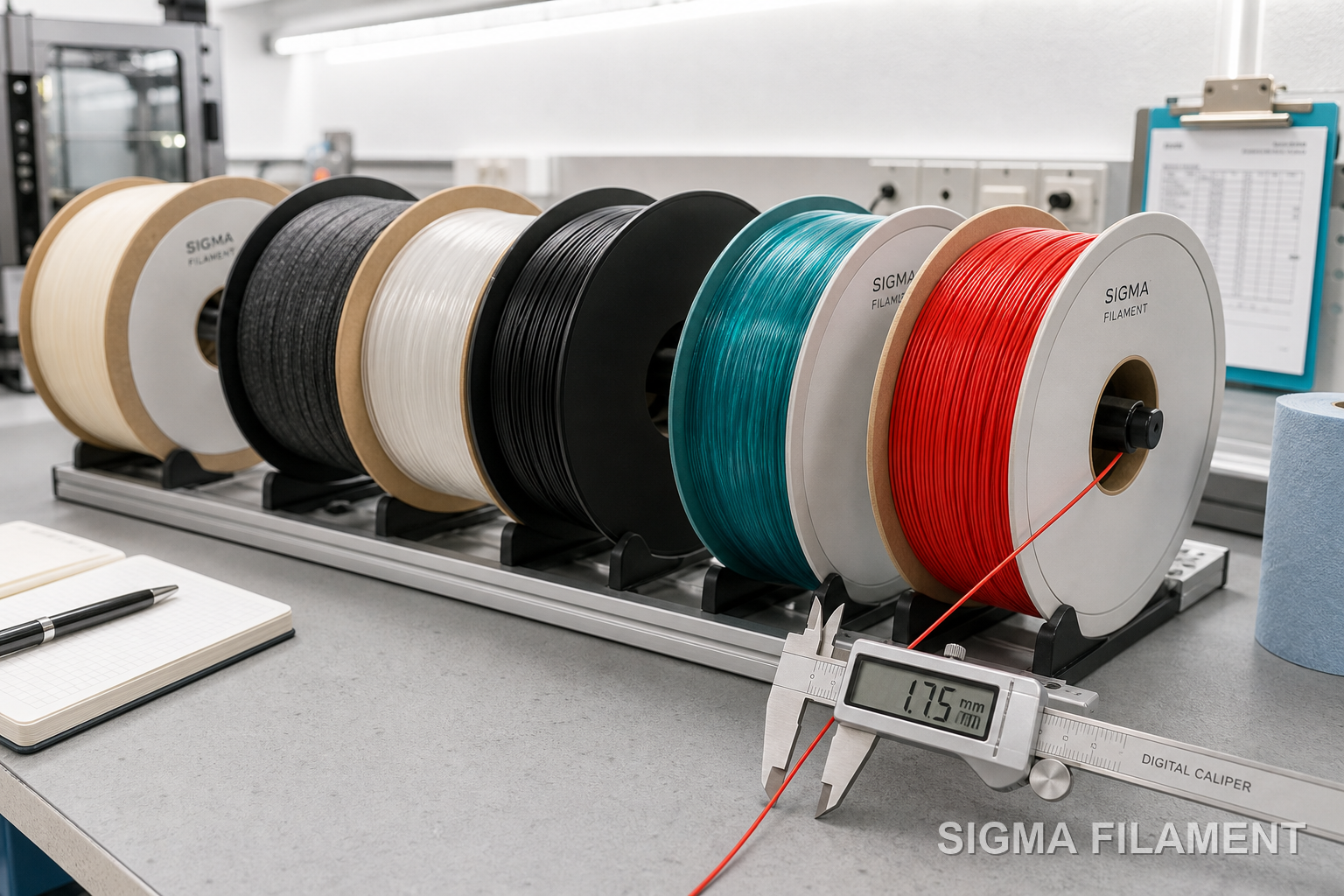
Diameter tolerance is the headline spec, but ovality (out-of-roundness) is where many brands quietly fail. Inconsistent diameter causes alternating over- and under-extrusion that looks like Z-banding on the print. Manufacturer-stated tolerance bands differ by tier and by brand, and each band is the maker’s own claim rather than a measured result. Ovality should sit at or below 0.03 mm regardless of tier (Grgić, 2023).
Verification belongs to the buyer. A digital caliper sample of 20 random points along a spool, sorted into min and max with a standard deviation, exposes whether the stated band holds in practice.
Resin quality, certifications, and batch traceability
Resin source decides everything downstream of the extruder. Virgin PLA, PETG, ABS, or PA pellets from a named compounder (NatureWorks, Lotte, Covestro, BASF) produce predictable melt behavior; recycled or unnamed-blend resin does not. Brands that publish the resin grade on the technical datasheet are easier to qualify.
ISO 9001:2015 certification signals that a factory runs a documented quality management system with internal audits, corrective-action records, and traceability procedures. The standard is the baseline most OEM buyers require before placing a private-label order (International Organization for Standardization, 2015).
Buyers often weight tolerance as the only criterion that matters. In practice, a brand publishing ±0.03 mm with a real COA per lot is more reliable for production than one claiming ±0.02 mm with no batch documentation, because the tighter number cannot be verified without third-party measurement.
Consistency, COA, and lot-to-lot variability
A Certificate of Analysis (COA) records the measured diameter, ovality, moisture content, and color batch for each production lot, tied to a printed lot code on the spool. Without per-lot traceability, a defect found on spool 47 cannot be linked back to a specific run, and the replacement spool may share the same fault (International Organization for Standardization, 2015).
Lot-to-lot mechanical consistency (tensile strength and IZOD impact within ±5% across lots) matters most for engineering applications. MOQ tiers and ODM/private-label readiness round out the procurement view: a brand willing to share extrusion data and accept 100 to 500 spool custom-color runs is built for B2B; one that only sells single spools is not.
| Criterion | Why it matters | What good looks like (with numbers) | How to verify |
|---|---|---|---|
| 1. Diameter tolerance | Drives extrusion flow consistency | ±0.02 mm or tighter (manufacturer-stated) | Caliper sample of 20 points, request COA |
| 2. Ovality / roundness | Avoids alternating under- and over-extrusion | ≤0.03 mm out-of-round | Two-axis caliper, dual-axis laser data |
| 3. Virgin vs recycled resin | Predictable melt behavior, mechanical baseline | 100% virgin, named compounder on TDS | Technical datasheet, resin grade callout |
| 4. ISO 9001 / quality system | Documented QMS, audit trail | ISO 9001:2015 certificate, current | Certificate copy, audit-body name |
| 5. COA availability + traceability | Defect attribution to specific lot | COA per lot, printed lot code on spool | Request sample COA before order |
| 6. Lot-to-lot consistency | Stable tensile, IZOD across batches | Within ±5% across lots | Multi-lot test data, third-party report |
| 7. MOQ / volume availability | Pallet-scale supply without stockouts | 100-500 spool MOQ, multi-pallet ready | Sales-tier disclosure, lead-time SLA |
| 8. ODM / private-label readiness | Custom color, NDA-ready brand build | Custom Pantone/RAL, NDA on file | Sample order, ODM-spec sheet |
Brands that score on all eight, not just the first one or two, are the ones a manufacturer re-orders at volume.
Tiers 1-2: Vertically Integrated Premium and Reliable Mainstream Brands
Across five top-ranking SERP roundups sampled in June 2026 (editorial pages including Tom’s Hardware, CNET, and Phrozen) for "best 3D printer filament brand," Polymaker appears in 5 of 5. Three more names land in 4 of 5: MatterHackers and Hatchbox alongside Prusament. A further three reach 3 of 5 each: Overture and eSUN plus SUNLU. That consensus is the working short list for Tiers 1 and 2, and the basis for the brand profiles below (Stevenson, 2025).
Tier 1 premium: Polymaker, Prusament, Bambu Lab, ColorFabb
Tier 1 brands own their extrusion lines. They publish per-spool QC data, run formal quality-management systems, and price PLA above the commodity midline. For procurement, that combination buys lot-to-lot predictability rather than a cosmetic upgrade. A counter-intuitive observation from our own contract-extrusion experience: the tier-1 premium over tier-2 mainstream is rarely about a tighter headline tolerance number. Hatchbox and Polymaker both publish ±0.03 mm. It is almost always about the documentation chain (lot codes, COA on request, traceable resin grade) that survives a supplier audit. The 0.01 mm headline gap to a Prusament-class ±0.02 mm spec is real on a caliper but usually invisible at the print bed.
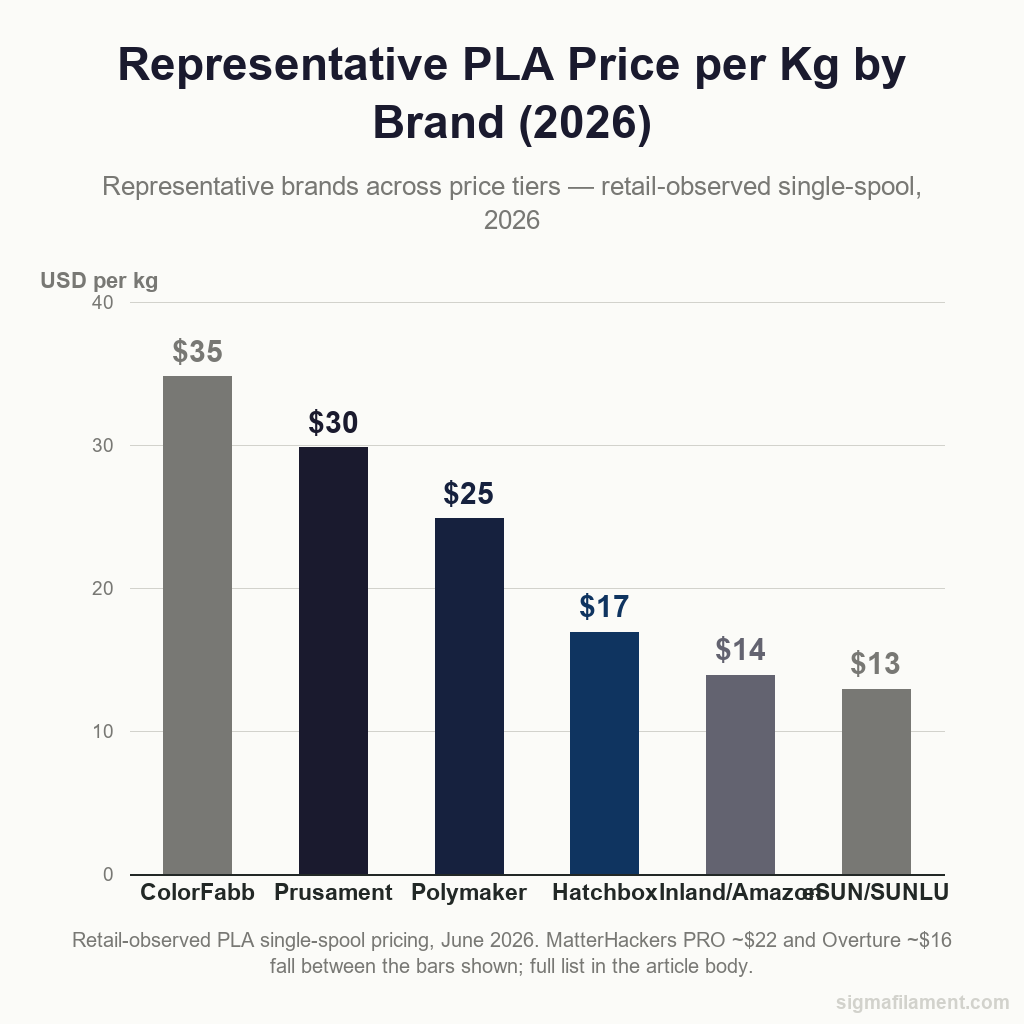
Polymaker carries the broadest catalog in this tier: PolyLite, PolyTerra, PolyMax, PolyMide CoPA, and the Panchroma color program, plus engineering composites. The company is vertically integrated and ISO 9001 certified, with PLA manufacturer-stated tolerance at +/-0.03 mm. Retail-observed PLA pricing sits near $25/kg. Best fit: prosumer makers and small print farms that need a single supplier across PLA, PETG, ASA, and Nylon-family materials.
Prusament (Prusa Research, Czech Republic) ships each spool with a printed measurement report and a public batch lookup, with PLA manufacturer-stated tolerance at +/-0.02 mm. Retail-observed PLA pricing sits near $30/kg. Best fit: Prusa-platform owners and engineering teams who treat the QC report as a procurement artifact.
Bambu Lab filament is engineered around the AMS multi-material system, with manufacturer-stated tolerance at +/-0.03 mm and an RFID-tagged spool that the printer reads automatically. PLA Basic typically retails near $20-25/kg through Bambu’s storefront. Best fit: Bambu X1/P1/A1 owners running AMS who want first-party tuning rather than third-party profile work.
ColorFabb (Netherlands) is the smallest of the four by SKU count but the deepest on niche resins: woodFill, bronzeFill, nGen copolyester, and PA-CF blends. Retail-observed PLA pricing sits near $35/kg, the highest in this tier. Best fit: design studios and model shops, plus short-run production buyers paying for finish and feel rather than bulk economics.
Tier 2 mainstream value: Hatchbox, Overture, eSUN, SUNLU, MatterHackers PRO
Tier 2 is where most hobbyist and small-shop spend actually lives. These brands compete on availability, color count, and dollars per kilogram rather than on published QC documentation. We cover that value proposition in depth in our best budget filament brand picks (Stevenson, 2025). Manufacturer-stated tolerance figures in this tier span roughly +/-0.02 mm to +/-0.05 mm, with the best SKUs (SUNLU, MatterHackers PRO) reaching +/-0.02 mm, and retail-observed PLA pricing sits near $13 to $22/kg, well under the Tier 1 band (Stevenson, 2025).
Hatchbox is the long-running US mainstream PLA reference, manufacturer-stated tolerance +/-0.03 mm, retail-observed PLA near $17/kg. Best fit: Amazon-first buyers replenishing a household or classroom fleet on a recurring basis.
Overture focuses on AMS-friendly, tangle-free winding and a wide PETG range engineered for higher print speeds. Manufacturer-stated PLA tolerance is +/-0.03 mm, retail-observed PLA near $16/kg. Best fit: makers running speed-tuned Bambu, Creality K1, or comparable printers who need value PETG that does not jam the feeder.
eSUN (Shenzhen) is a vertically integrated Chinese mainstream brand with one of the widest material catalogs in Tier 2, including ABS+, PETG, TPU, and Nylon, manufacturer-stated PLA tolerance +/-0.05 mm, retail-observed PLA near $13/kg. Best fit: cost-sensitive buyers who want one supplier across many material families.
SUNLU (Shenzhen) competes directly with eSUN on PLA and PLA+, manufacturer-stated tolerance +/-0.02 mm, retail-observed PLA near $13/kg, and ships an in-house filament dryer that pairs with its TPU and Nylon SKUs. Best fit: hygroscopic-material buyers who want a value brand with usable drying hardware in the same ecosystem.
MatterHackers PRO is MatterHackers’ house line, marketed with a tightened QC pass and a written diameter spec near +/-0.02 mm. Retail-observed PLA sits near $22/kg, a step above the China-mainstream value brands. Best fit: US buyers who want a single-vendor checkout for filament and printers and parts under one support contract.
Tier 3 specialty and Tier 4 re-spooled / private-label brands are profiled in the next section.
Tiers 3-4: Specialty, Engineering, and Re-spooled / Private-Label Brands
Below Tier 2, the 3D printer filament brand market splits sharply. Tier 3 houses specialty and engineering houses whose pricing is justified by exotic chemistries, composite reinforcement, or high-temperature polymers most factories will not run. Tier 4 covers re-spooled and private-label labels that buy commodity spools from contract manufacturers, restick the label, and compete on price (James, 2026).
Tier 3 specialty & engineering: Fillamentum, Proto-pasta, 3DXTech, Taulman3D
Tier 3 is where a brand earns its margin through materials science, not marketing. Fillamentum, a Czech producer, runs a vertically integrated extrusion line and is best known for its CPE HG100 co-polyester, ASA Extrafill, and the Vertigo and Timberfill aesthetic ranges. Material breadth across PLA, PETG, ABS/ASA, CPE, TPU, plus Nylon CF runs broader than mainstream Tier 2 catalogs, and the company publishes per-material technical datasheets. Fit: prosumer makers and product designers who need a specific finish or a co-polyester Tier 2 brands do not carry.
Proto-pasta (US) specializes in functional and aesthetic PLA composites: stainless-steel-filled, magnetic iron, conductive carbon-filled, and the high-temperature HTPLA range. The catalog is intentionally narrow, the SKUs carry batch numbers, and lots run small. Fit: makers who need a niche composite that no commodity brand offers.
3DXTech (US) sits at the engineering end of Tier 3. Its 3DXMAX and 3DXSTAT lines cover PA-CF (carbon-fiber-reinforced nylon), PEEK, PEKK, PEI/ULTEM, PPS, and ESD-safe composites for industrial FFF on machines such as Stratasys and Roboze as well as Intamsys. 3DXTech publishes mechanical datasheets per lot and offers a documented quality system, which is the minimum bar for engineering procurement.
Taulman3D (US) is the long-running nylon specialist. Nylon 230, Nylon 645, Bridge Nylon, and Alloy 910 remain reference materials for tough functional prints where commodity PLA and PETG cannot deliver impact strength or living-hinge fatigue life.
The Tier 3 rule of thumb: pay the higher price when the application actually needs PA-CF, PEEK, PEI, conductive PLA, or a specific co-polyester finish. For a hobby print or a jig that PLA could satisfy, Tier 3 pricing is overspend.
Tier 4 re-spooled & private-label: Inland, AmazonBasics, Amazon-only labels
Tier 4 is the supply-chain reality the rest of the SERP avoids. Inland, sold through Micro Center, is widely documented in community testing and forum disclosure as a re-spooled product whose underlying manufacturer of record varies by SKU and batch. AmazonBasics and the rotating set of Amazon-only filament labels operate the same way: branded packaging applied to commodity spools, typically from Chinese contract manufacturers, with no published QC sample plan, no certificate of analysis, and no batch traceability commitment to the end buyer (James, 2026).
This does not make Tier 4 useless. For low-stakes prototyping, classroom use, calibration cubes, and single-spool hobby printing, a competent re-spooled PLA at roughly $14-17 per kilogram prints acceptably. The savings are real if the application tolerates lot-to-lot variation, but watch for the hidden costs of cheap filament once volumes climb.
The trap appears at production scale. A print farm running 24 hours a day across multiple machines absorbs every percentage point of defect rate, every aborted print, every dimensional drift between lots, and every clog from inconsistent moisture as throughput loss. A spool that costs $4 less but raises the failure rate by even one print per kilogram quickly erases its margin. Without a COA, the operator cannot pre-screen lots; without traceability, a bad batch cannot be isolated, only discovered. For any buyer needing repeatable mechanical properties, certification documentation, or consistent multi-pallet supply, Tier 4 is a false economy (Protolabs Network, n.d.). Tier 1, Tier 2, or a vetted source manufacturer remains the rational floor.
Best Brand by Material Type: PLA, PETG, ABS/ASA, TPU, Composites, Nylon, PC, PEEK
No single best 3d printer filament brand wins across every polymer. SERP consensus across five top editorial roundups (including Tom’s Hardware, CNET, and Phrozen) shows brand leadership shifts by material family, with Polymaker cited on 5 of 5 pages, Prusament on 4, and specialty names (3DXTech, Taulman3D) appearing only when engineering polymers enter the discussion.
The matrix below maps the strongest manufacturer-stated picks for each major filament family. Premium picks are vertically integrated brands with published QC specs. Value picks are mainstream brands with broad retail availability. The B2B/bulk column refers generically to source-manufacturer or wholesale supply rather than ranking any single supplier. Key spec to verify is the single material-specific data point a procurement engineer should request from the datasheet before issuing a PO (Fales et al., 2026).
| Material family | Best premium pick | Best value pick | Best for B2B / bulk | Key spec to verify |
|---|---|---|---|---|
| PLA | Polymaker, Prusament | Hatchbox, eSUN | Source-manufacturer / wholesale supplier | Diameter tolerance (±0.02 to ±0.03 mm) |
| PETG | Polymaker | Overture | Source-manufacturer / wholesale supplier | Moisture content and drying protocol |
| ABS / ASA | Polymaker | ColorFabb | Source-manufacturer / wholesale supplier | Warp resistance; enclosed-chamber rating |
| TPU / flexible | Polymaker | SainSmart | Source-manufacturer / wholesale supplier | Shore A hardness and elongation at break |
| CF / GF composites | 3DXTech | Proto-pasta | Source-manufacturer / wholesale supplier | Hardened nozzle (≥0.4 mm) compatibility |
| Nylon / PA | Taulman3D, Polymaker | Polymaker PolyMide | Source-manufacturer / wholesale supplier | Moisture content at packaging (ppm) |
| PC | Polymaker | 3DXTech | Source-manufacturer / wholesale supplier | Glass-transition temperature, chamber spec |
| PEEK / PEI | 3DXTech | 3DXTech (entry-grade) | Specialist source-manufacturer | Chamber temperature 150-200 °C; nozzle 420-440 °C (PEEK) |
Commodity materials: PLA and PETG
PLA selection rewards tolerance discipline. Polymaker’s PolyLite and PolyTerra lines run on extrusion equipment with dual-axis laser monitoring and a manufacturer-stated diameter band tighter than the ±0.05 mm that a 2016 filament-extrusion study called the industry’s gold standard (Cardona et al., 2016). Prusament publishes per-spool QC reports with measured diameter and color batch. Hatchbox and eSUN occupy the value slot through wide retail availability and consistent extrusion, though without per-spool documentation. For procurement-scale PLA selection criteria beyond the brand label, see our data-backed PLA sourcing factors.
PETG is a different selection problem. The polymer is hygroscopic, and moisture during extrusion (or in shipping) drives the surface defects and brittle interlayer adhesion that look like brand quality failures but are actually drying failures. Overture’s PETG is engineered for high-speed printing with tangle-free winding suited to AMS systems. Polymaker’s PolyLite PETG remains the premium baseline. For a fuller side-by-side of mainstream PETG SKUs, see the 2026 best PETG filament buyer’s guide. For both, the question worth asking the supplier is the moisture content at packaging and the recommended drying cycle. A datasheet that omits both is a procurement red flag (Fales et al., 2026).
Engineering and high-performance: ABS/ASA, Nylon/PC, composites, PEEK
Engineering polymers narrow the brand field sharply. ABS and ASA reward brands that publish warp-control formulation notes and an enclosed-chamber recommendation. Polymaker’s PolyLite ABS and PolyMax ASA cover this; ColorFabb offers the value alternative when Pantone color matching matters less than basic mechanicals.
Nylon (PA6, PA12, CoPA) is the moisture-sensitive case in extremis. Taulman3D built the early nylon market and Polymaker’s PolyMide CoPA extends it; both supply moisture-controlled packaging, and the spec to verify is parts-per-million moisture at the pack date. Polycarbonate adds glass-transition temperature and chamber spec to that checklist. Carbon-fiber and glass-fiber composites require a hardened nozzle (most commonly 0.4 mm hardened steel or ruby) because the abrasive filler eats brass within a few kilograms of print time. We break down what carbon fiber actually changes in PLA, PETG, ABS and nylon across eight mechanical metrics. 3DXTech is the manufacturer-consensus leader for engineering CF/GF, with Proto-pasta covering the value end for non-load-bearing applications (Mishra & Senthil, 2024).
PEEK and PEI/ULTEM occupy a separate market. For PEEK, a published process review recommends an ambient build temperature of 150 to 200 °C and a nozzle temperature of 420 to 440 °C, and stresses that the printer itself must be a compatible high-temperature machine (Zanjanijam et al., 2020). The supplier list narrows to specialists. 3DXTech is the practical default; consumer brand roundups rarely cover these materials because the buyer base is industrial rather than hobbyist, and independent batch data is sparse. Treat any PEEK spec sheet as manufacturer-stated until lot-level mechanical testing is in hand.
Best Brand by Buyer Type: Hobbyist, Print Farm, and OEM Brand Owner
The best 3D printer filament brand shifts with buyer type because purchase volume, downtime tolerance, and supply-chain requirements diverge sharply across hobbyist, print-farm, and OEM segments. A hobbyist tolerates a clogged spool; a print farm loses output on every machine a drifting lot reaches. Buy criteria must match operating reality, not brand prestige.
The matrix below summarizes which signals to weight by buyer type. None of the four buyer profiles are best served by the same single brand, which is why none of the SERP-leading roundups can answer the question for B2B readers.
| Buyer type | Top priority | What to evaluate | Brand / supplier fit |
|---|---|---|---|
| Hobbyist / prosumer | Print reliability per spool | Tolerance claim, AMS-compatible winding, color range, return policy | Polymaker PolyLite, Prusament, Bambu Lab, Hatchbox, Overture |
| Print-farm operator | Multi-lot consistency at volume | COA per lot, RFID/AMS tag support, multi-pallet pricing, lead time, second-source readiness | Polymaker bulk, Prusament wholesale, plus a qualified second-source manufacturer |
| OEM brand owner | Custom formulation under NDA | MOQ from 100 to 500 spools, Pantone/RAL color matching, label/spool customization, ODM R&D capacity | Direct source manufacturer (e.g., contract OEM partner with ISO 9001) |
| Reseller / distributor | Private-label readiness | Branded spool, branded carton, drop-ship logistics, Incoterms options, MAP policy | Source manufacturer with private-label program |
Hobbyist and prosumer
Single-spool buyers should weight per-spool reliability above everything else. Tolerance claims of ±0.02 to ±0.03 mm at the top tier and ±0.02 to ±0.05 mm at mainstream tier are the published headline, but the operational difference for a hobbyist often shows up in winding quality and clog rate, not raw diameter math. AMS-compatible winding (clean, tangle-free) matters more than a 0.01 mm tolerance edge once the AMS jams a knotted spool. Polymaker PolyLite and Prusament cover this well. So do Bambu Lab and Hatchbox, with Overture rounding out the value end, and a generous return policy is a real risk hedge.
Print-farm operators: multi-lot consistency, COA, RFID
Print-farm operators are buying continuity, not spools. The brand that prints perfectly on lot A is irrelevant if lot B shifts by 0.04 mm and re-tunes 24 machines. Operators should require a Certificate of Analysis per lot (measured diameter, ovality, moisture at packaging, color deltaE), multi-pallet pricing tiers, a published lead time, and ideally a qualified second-source supplier so a single factory incident does not stop the line. The full procurement workflow is covered in our buy filament in bulk for print farms checklist. RFID or AMS-recognized tagging matters when machines auto-load filament profiles; mis-tagged spools force manual operator overrides. Multi-lot consistency, COA availability, and second-source readiness are the three signals to score, and the economic case is laid out in our batch-to-batch consistency cost analysis.
OEM brand owners and resellers: MOQ, custom color, NDA-ready ODM
OEM brand owners and resellers buy a supply chain, not a SKU. The four signals to evaluate are MOQ flexibility (a viable OEM program starts at roughly 100 spools standard stock and 500 spools for custom-color runs, with bulk discount tiers around 15% at 500 and 20% at 1,000 spools), color-matching precision (Pantone or RAL deltaE under 1.5 for brand fidelity), NDA-ready ODM capacity for custom formulations, and a documented quality system such as ISO 9001:2015 with 70+ QC checks per spool and a defect rate below 0.01% (International Organization for Standardization, 2015). For a step-by-step path from material spec to launched SKU, see our 7-step playbook for building a filament product line. Resellers and distributors layer on private-label readiness: branded spools, branded cartons, drop-ship logistics, Incoterms options (FOB, CIF, DDP, DAP), and a MAP policy to protect channel margin.
This is the segment a source manufacturer serves directly. Disclosure: SigmaFilament is itself a source manufacturer in Shenzhen, which is why this guide treats source manufacturers as a category alongside the consumer brands rather than ranking them against each other. B2B buyers evaluating any source manufacturer (Sigma included) should apply the same four-signal test above to every quote on the table.
Common Misconceptions About Choosing a Filament Brand
Five assumptions steer buyers toward the wrong filament brand. Each collapses under one number.
‘More expensive = better consistency’
Price does not equal consistency. High retail tags (Prusament near $30/kg, ColorFabb near $35/kg) reflect brand and packaging and SKU breadth as much as extrusion control. Hatchbox and Overture publish a manufacturer-stated ±0.03 mm tolerance window; several top-tier SKUs state ±0.02 mm. Whether diameter changes that small, inside the tolerance window, affect the extrusion at all is still debated (Cardona et al., 2016). Pay for documented QC, not the logo.
‘A famous brand means they make it themselves’
A brand is not necessarily a manufacturer. Several recognized labels are re-spooled or contract-manufactured by third parties whose factory identity changes between SKUs and lots, including private-label store lines such as Inland and AmazonBasics (Phrozen, n.d.). The practical vertical-integration signal is a factory address, an ISO 9001:2015 certificate, and a per-spool lot code. If a brand page cannot answer "who extruded this spool," treat its consistency claims as marketing.
Three more myths buyers act on
Spec-sheet tolerance is not measured tolerance. A published ±0.02 mm figure is a target window from the extrusion line, not an independent lab measurement of the spool in your hand. A 2016 filament-extrusion study called ±0.05 mm the industry’s gold standard for filament tolerance (Cardona et al., 2016), and the precision brands profiled above now claim tighter windows, yet third-party verification of any specific lot is rare in the public record (Grgić, 2023). Cross-check with calipers across at least 10 points on a fresh spool.
The cheapest dollar-per-kilogram ignores defect cost. A $13/kg spool with a 3% jam or under-extrusion rate adds 5 to 30 minutes of operator time per failure. On a print farm running 20 machines, a 1% defect-rate gap between brands outweighs a $5/kg price difference within a single week.
No single brand is best across every material. A vendor that excels at PLA is rarely the strongest pick for PETG, glass-filled nylon, or PEEK. Composite and engineering polymers demand dedicated extrusion lines, dried resin handling, and abrasion-resistant tooling that commodity-PLA factories do not maintain.
The pattern across all five myths is the same: buyers anchor on one visible number (price, brand, spec tolerance, $/kg) and skip the supply-chain question that actually predicts lot-to-lot behavior.
Frequently Asked Questions
What is the best 3D printer filament brand in 2026?
There is no single best 3D printer filament brand in 2026. For consistency the leaders are Polymaker and Prusament alongside Bambu Lab. Mainstream value goes to Hatchbox and Overture plus eSUN. Specialty engineering belongs to Fillamentum and Proto-pasta, with 3DXTech for high-performance polymers. Choose by material family, purchase volume, and buyer type, then judge each candidate on tolerance, ovality, resin source, and lot traceability (Stevenson, 2025).
What’s the difference between a filament brand and a filament manufacturer?
A brand is the marketing identity on the spool. A manufacturer is the factory that extrudes the filament. Vertically integrated brands (Polymaker, Prusament, Bambu Lab, ColorFabb, 3DXTech) own both. Other labels are white-labeled or re-spooled from contract manufacturers, so two different brands can ship identical material with different prices and warranties.
Which filament brand is best for a print farm?
Print farms should source from vertically integrated suppliers that publish per-spool QC data and offer multi-lot consistency, COA documentation, and RFID or AMS compatibility. Polymaker and Prusament fit at the spool level; for pallet volumes, contract directly with a source manufacturer offering ISO 9001:2015 QC, lot traceability, and a stated tolerance window that its per-lot COA data confirms.
Are cheap filament brands like Inland or AmazonBasics any good?
Inland and AmazonBasics print acceptably for hobby work and rough prototypes, but both are store brands, and neither publishes a COA tied to the lot, so a buyer cannot confirm that the next spool matches the last. Defect rate and moisture can shift between batches, and so can tolerance. They are fine for casual makers, a false economy for production print farms where downtime and reject cost dwarf the per-kilogram savings.
Which brand has the tightest diameter tolerance?
Prusament publishes a per-spool QC report and states diameter accuracy of plus or minus 0.02 mm, with the actual measured mean printed on each spool label. Polymaker, Bambu Lab, and select 3DXTech engineering grades claim comparable plus or minus 0.02 to 0.03 mm windows. All figures here are manufacturer-stated, not independently lab-measured across batches.
What is the best filament brand for PETG and ABS?
For PETG, Polymaker PolyLite and Overture are mainstream picks, while Prusament PETG and Bambu Lab PETG-HF lead on high-speed and AMS workflows. For ABS, Polymaker PolyLite ABS and Hatchbox ABS cover value tiers; Fillamentum ASA Extrafill and 3DXTech ABS pellets serve engineering and outdoor use. Match the choice to print speed, chamber temperature, and post-processing needs.
Can a business private-label or OEM its own filament brand?
Yes. Established source manufacturers, including several Shenzhen-based factories, offer private-label and ODM services, with custom Pantone or RAL color matching, NDA-ready formulation work, and branded tooling across the spool and label and carton. Minimum order quantities and lead times vary by supplier and by stock versus custom color, so get both in writing before artwork lock.
Is a more expensive filament brand always more consistent?
No. Price tracks brand positioning, spool finish, color development, and distribution margin as much as it tracks extrusion precision. Some prestige brands are re-spooled from the same contract manufacturers that supply value labels. Verify consistency through manufacturer-stated tolerance, ovality, ISO 9001 status, COA availability, and lot-to-lot mechanical data, not retail price per kilogram.
Conclusion
The best 3D printer filament brand is not a single name on a leaderboard. It is the brand whose supply chain, material range, and lot-to-lot consistency line up with the material family you actually print, the volume you actually buy, and the type of buyer you actually are.
Run any shortlist back through the lens this guide used. Confirm vertical integration, or accept that you are buying re-spooled stock. Score the eight procurement criteria: tolerance, ovality, resin source, ISO 9001, COA, lot consistency, plus MOQ and ODM readiness. Map your priority material to the tier that owns it. Then layer your buyer profile on top, because a print farm running 24/7 and an OEM brand owner placing a 500-spool launch order do not weigh those criteria the same way.
For hobbyists, the Tier 1 and Tier 2 retail brands cover the job. For B2B buyers sourcing at volume, OEM brand owners, print farms, resellers and distributors, the next step is to evaluate a source manufacturer directly. SigmaFilament’s engineering team can scope OEM/ODM and wholesale supply against your material spec and MOQ, whether that is wholesale PLA filament, wholesale PETG, or carbon fiber filament wholesale across the catalog. Review the OEM/ODM program or contact the team to start a conversation.
A note on what this guide cannot tell you. Every tolerance, defect-rate, and price figure above is either manufacturer-stated (from the brand’s own datasheet) or retail-observed in June 2026. None of the brand-level specs were re-measured on a third-party rig by our team for this article. Lot-to-lot drift, regional pricing differences, and seasonal storefront promotions can each move a number by 10-30%. Treat the rankings as a procurement short list to qualify, not a final supplier decision: request a Certificate of Analysis on a real spool, caliper-sample 20 points, and check moisture before signing any production purchase order.
References
- Grgić, I., Karakašić, M., Glavaš, H., & Konjatić, P. (2023). Accuracy of FDM PLA polymer 3D printing technology based on tolerance fields. Processes, 11(10), 2810. https://doi.org/10.3390/pr11102810
- Fales, A., Černohlávek, V., Suszynski, M., Štěrba, J., Balcar, P., & Houška, P. (2026). 3D printing: Dimensional accuracy and stability of PLA and PETG prints using the FDM technology. Manufacturing Technology, 26(1). https://doi.org/10.21062/mft.2026.020
- Mishra, P. K., & Senthil, P. (2024). A recent review on advancements in dimensional accuracy in fused deposition modeling (FDM) 3D printing. AIMS Materials Science, 11(5), 950-981. https://doi.org/10.3934/matersci.2024046
- Cardona, C., Curdes, A. H., & Isaacs, A. J. (2016). Effects of filament diameter tolerances in fused filament fabrication. IU Journal of Undergraduate Research, 2(1), 44-47. https://doi.org/10.14434/iujur.v2i1.20917
- International Organization for Standardization. (2015). ISO 9001:2015. Quality management systems, requirements. https://www.iso.org/iso-9001-quality-management.html
- Stevenson, K. (2025). Best filaments for 3D printing 2025. Tom’s Hardware. https://www.tomshardware.com/best-picks/best-filaments-for-3d-printing
- James, J. (2026). Best 3D printing filament and which to buy in 2026. CNET. https://www.cnet.com/tech/computing/best-3d-printing-filament/
- Phrozen. (n.d.). Top 20 3D printer filament brands for high-quality printing. Phrozen Knowledge Base. Retrieved June 14, 2026, from https://info.phrozen3d.com/blogs/guides/best-3d-printer-filament-brands
- Zanjanijam, A. R., Major, I., Lyons, J. G., Lafont, U., & Devine, D. M. (2020). Fused filament fabrication of PEEK: A review of process-structure-property relationships. Polymers, 12(8), 1665. https://doi.org/10.3390/polym12081665
- Protolabs Network. (n.d.). What is dimensional accuracy in 3D printing and how do you achieve it? Hubs Knowledge Base. Retrieved June 14, 2026, from https://www.hubs.com/knowledge-base/dimensional-accuracy-3d-printed-parts/
- Formlabs. (n.d.). Guide to 3D printing tolerances, accuracy, and precision. Formlabs. Retrieved June 14, 2026, from https://formlabs.com/blog/understanding-accuracy-precision-tolerance-in-3d-printing/
Last reviewed and updated: June 2026. Author: SigmaFilament team. For tailored guidance, contact our team.