Wood PLA Filament: The Complete 2026 Guide to Composition, Printing and OEM Sourcing


TL;DR
Decide which wood PLA family you need first: particle-filled real-wood for a sand-and-stain timber finish (and a hardened nozzle), foam-blown wood-LOOK for grain appearance with no abrasion. Print at 190-220C tuned by wood color; expect brass-nozzle deformation within 12-48 h on real-wood blends; use a 0.5-0.6 mm hardened-steel nozzle for high-volume runs.
Abstract
"Wood PLA filament" is not one material. The phrase covers two structurally different product families, and conflating them is the most common reason a wood-effect print misses its finish target. Particle-filled real-wood PLA is a composite of milled wood fiber (typically 20 to 40% by weight, most often a 70/30 PLA-to-wood blend) dispersed in a PLA matrix. It carries visible grain, accepts sanding and stain, prints at 190 to 220 C tuned to the wood color, and abrades brass nozzles in roughly 12 to 48 hours of run time. Foam-blown wood-LOOK PLA contains zero wood particles, hits a density near 0.8 g per cm3 through chemical foaming, is non-abrasive, and will not take a stain. The family choice cascades into print settings, nozzle hardware, finishing path, and per-kilogram price.
This guide is written for OEM brand owners and print-farm operators specifying wood PLA filament for a SKU lineup, design engineers writing the grade into a drawing, and advanced makers tuning composition and finish. Coverage follows the path each persona needs. Tell the two families apart from a datasheet alone, dial in print settings by wood-content percentage, justify a 0.5 to 0.6 mm hardened-steel nozzle on volume runs, post-process a print to a convincing timber finish, and source the correct grade at OEM quantity.
Key Takeaways
- Two families ship as wood PLA filament: a particle-filled real-wood composite and a foam-blown wood-LOOK PLA, with no wood fibers.
- Composition by mass: real-wood PLA runs about 70% PLA plus 30% milled wood (range 20 to 40%); foam-blown carries no wood.
- Sand, stain, and smell: only particle-filled real-wood PLA sands smooth, accepts wood stain, and smells like wood; foam-blown does not.
- Nozzle wear: real-wood PLA abrades brass in roughly 12 to 48 hours; use a 0.5 to 0.6 mm hardened-steel nozzle.
- Mechanical profile: wood PLA is stiffer than neat PLA near 3,650 MPa modulus, but more brittle around 3.8% elongation at break.
- Print and dry settings: print 190 to 220C tuned by wood color; dry 45 to 55C; retract per extruder type.
- OEM sourcing levers: at volume, four factors drive landed cost: wood-fiber percent, color delta-E, virgin-resin base resin, and diameter tolerance.
Table of Contents
- TL;DR
- Abstract
- Key Takeaways
- Table of Contents
- What Is Wood PLA Filament? Composition and the 2012 Origin
- Particle-Filled Real-Wood vs Foam-Blown Wood-Look PLA
- Aesthetics: Grain, Color Range and the Wood-Type Effect
- Wood PLA Print Settings: Temperature, Speed, Retraction and Flow
- Nozzle Abrasion: Why Wood PLA Wears Brass and the Hardened-Steel ROI
- Clogging Causes and Mitigation: Drying, Nozzle Size and Flow
- Post-Processing: Sanding, Staining and Sealing Wood PLA
- Wood-Type Blend Matrix: Bamboo, Birch, Cork, Pine, Cedar and More
- Mechanical Properties, Biodegradability and Applications
- OEM and Wholesale Wood PLA: Custom Blends, Color Matching and MOQ
- Frequently Asked Questions
- Conclusion
- References
What Is Wood PLA Filament? Composition and the 2012 Origin
Wood PLA filament is a composite 3D printing material that mixes a polylactic acid (PLA) base with finely milled wood fiber, typically at a 70% PLA to 30% wood ratio (Xometry, 2024). It prints on any standard FFF machine, smells of fresh sawdust when extruded, and finishes with a matte grain that reads as real wood under sanding, staining, or laser engraving. The result is a true wood-polymer composite, one of the specialty 3D printing filament categories that ships under the PLA umbrella, not a paint job or a surface texture.
The PLA matrix plus milled wood fiber
The PLA acts as the binder. Milled wood particles, often recycled sawdust from pine, birch, bamboo, cedar, or olive, sit suspended in that matrix and give the filament its color, scent, and post-print workability. The wood content is what lets a printed part be sanded with 220-grit paper, stained with standard wood stains, and even sealed with shellac the same way a turned wooden bowl would be. The PLA content is what keeps the filament feeding through a 0.4 mm nozzle without snapping.
Two distinct families exist under the same shelf label. Particle-filled wood PLA carries real ground wood and behaves abrasively against brass nozzles. Foam-blown wood-look PLA uses an active foaming agent to mimic wood texture and color without any actual cellulose. Both are covered in detail in the next section; for now, treat them as separate materials with separate use cases.
How much wood is actually in it (20-40%)
Commercial wood PLA blends carry 20% to 40% wood fiber by weight, with 30% the most common loading (Xometry, 2024). Higher loadings give richer grain and stronger sawdust scent during printing but raise the risk of nozzle clogs at sub-0.6 mm orifices. Lower loadings print more reliably but look closer to tan-tinted PLA than to oak. Density tracks the filler family: particle-filled grades land between 1.0 and 1.25 g/cm3, while foam-blown wood-look grades drop to roughly 0.8 g/cm3 because the foaming action introduces internal voids (Xometry, 2024; Guessasma et al., 2019).
From Kai Parthy’s 2012 LayWood to today’s blends
Xometry traces the entire wood filament category to a single 2012 release: chemist Kai Parthy at Germany’s Lay Filaments introduced LayWood, the first commercially available wood-PLA composite, at approximately 40% recycled wood fiber bound in a PLA matrix (Xometry, 2024). Every wood filament shipped since, from ColorFabb WoodFill to Polymaker PolyWood to budget AliExpress reels, descends from that original formulation.
Today’s market spans dozens of species-specific blends and dual-tone foaming grades, but the core recipe Parthy locked in has held for over a decade.
Particle-Filled Real-Wood vs Foam-Blown Wood-Look PLA
Two very different materials ship under the term wood pla filament, and the SERP routinely treats them as one. One is a true composite with milled fiber inside the polymer; the other is a foaming PLA tuned to mimic a wood texture and contains no wood at all. Confusing them is the most common reason buyers end up with a spool that will not stain.
Particle-filled real-wood composites (sand/stain-receptive, abrasive)
Particle-filled grades are PLA loaded with 20 to 40 percent milled wood flour, typically around 30 percent in mainstream spools. Printed density lands between 1.0 and 1.25 g/cm3, close to dense balsa, so parts feel like wood in the hand. The fiber gives the surface real porosity: it accepts stains, oils, and water-based dyes, sands to a smooth grain, and releases a faint sawdust scent at the nozzle. The trade-off is abrasion. Hardwood particles erode standard brass nozzles in roughly 12 to 48 hours of continuous printing, so a hardened steel or ruby nozzle is required for any production use (Xometry, 2024; Guessasma et al., 2019).
Foam-blown wood-LOOK PLA (no wood particles, non-abrasive)
Foam-blown wood-look grades take a different route. The pellet is a standard PLA compounded with an active foaming agent that triggers between roughly 200 and 230 C, expanding the extrudate into a porous, matte surface that visually reads as wood. There is no wood fiber inside (Xometry, 2024). Printed density drops to about 0.8 g/cm3 from the trapped voids, so parts come out 20 to 35 percent lighter than the same geometry in particle-filled wood PLA. Polymaker PolyWood is the category benchmark and behaves like the broader class: no abrasion, no hardened nozzle, no sawdust smell, and no real stain receptivity, since the surface is sealed polymer rather than open fiber. The same Polymaker foaming-PLA family shows up in matte-aesthetic form too: our PolyTerra PLA mastery guide walks through the print-window quirks foamed grades share with foam-blown wood-LOOK PLA.
Published material datasheets from major wood PLA suppliers consistently report particle-filled real-wood grades at 1.0 to 1.25 g/cm3 versus roughly 0.8 g/cm3 for foam-blown wood-look PLA, a 25 to 35 percent density gap that traces to the absence of wood content in the foamed variant (Xometry, 2024; Guessasma et al., 2019).
How to tell them apart before you buy
The spec sheet usually settles the question in under a minute. Particle-filled grades state a wood-fiber percentage (commonly 20, 30, or 40 percent), list a density of 1.0 g/cm3 or higher, and call out hardened-nozzle requirements. Foam-blown grades quote a density near 0.8 g/cm3, describe an active-foaming behaviour with a temperature ramp, and note that no hardened nozzle is needed. If the listing avoids density and wood-content figures, treat it as a red flag.
| Attribute | Particle-filled real-wood PLA | Foam-blown wood-look PLA |
|---|---|---|
| Wood content | 20 to 40 percent milled fiber | 0 percent, foaming agent only |
| Density (printed) | 1.0 to 1.25 g/cm3 | ~0.8 g/cm3 |
| Abrasiveness (nozzle wear) | High, hardened steel or ruby required | None, brass nozzle is fine |
| Sand/stain receptivity | Yes, accepts stains, oils, dyes | No, surface is sealed polymer |
| Scent when printing | Faint sawdust aroma | Neutral, mild PLA only |
| Best use | Realistic timber finishes, props, decor that must look and feel like wood | Lightweight parts, RC frames, prototypes where the wood look is enough |
When a listing calls something wood pla filament without naming the family, check density and wood percentage first. Those two numbers separate a stainable timber print from a foam imitation faster than any product photo.
Aesthetics: Grain, Color Range and the Wood-Type Effect
The visual payoff of wood pla filament is a thermochemical effect, not a printed picture of wood. Each spool carries 20 to 40 percent real wood flour in a PLA carrier, and those particles scorch when the nozzle heats them. Hotter nozzle, darker scorch. That single mechanism is why one spool can print a blonde birch tone today and a deep walnut tone tomorrow (Guessasma et al., 2019). The pigment-versus-particle distinction also separates wood PLA from another popular aesthetic grade; see our matte PLA vs standard PLA data comparison for the parallel case where the visual effect comes from a matting additive, not a fiber load.
Why darker prints come from higher temperatures
The working window sits between 190 and 220 degrees Celsius. At the low end, wood particles emerge close to their native cream color and the print reads pale. At the high end, they caramelize and char, shifting through amber into a near-black brown. Operators who want a banded gradient run a temperature tower in 5 degree steps and pull a single object that grades from blonde at the base to scorched walnut at the cap. The slicer changes only the trigger; wood pla filament chemistry does the rest.
Wood-fiber composites printed at 220 C show 35 to 45 percent lower CIE L* (lightness) values than the same material printed at 195 C, driven by thermal degradation of lignin and cellulose in the wood phase rather than added pigment (Guessasma et al., 2019).
Grain, layer lines and the wood look
Grain on a wood pla filament print is a visual approximation, not real cellular grain. Two effects build it. Wood particles within a layer are unevenly distributed, so each pass lays a mottled stripe. The FDM layer line then reads as a horizontal ring, stacking into a growth-ring pattern. Print vertical and rings circle the part like a turned dowel; print flat and they run as parallel planks. Thicker layers (0.24 to 0.32 mm) exaggerate the effect.
Color range across wood blends
A spool inherits its base tone from the species of flour it carries. The commercial range spans six families: blonde birch and cream at the lightest, then golden bamboo, tan cork, amber pine, reddish cedar, and deep ebony or walnut at the darkest. Pine, oak and bamboo are most common; cork, cedar and ebony sit at the specialty end. The wood-type matrix below breaks each family down by print temperature and scorch behavior (Xometry, 2024).
Wood PLA Print Settings: Temperature, Speed, Retraction and Flow
Wood PLA filament prints on the same hardware as neutral PLA, but fiber loading shifts every key number by a small, predictable amount. Hotend widens, print speed slows, and retraction tightens. The clean recipe starts from a neutral PLA baseline and adjusts on three axes: melt temperature for color, flow path for fiber load, and retraction style for the extruder geometry already on the machine.
Nozzle temperature 190-220C tuned by wood color
Set the hotend between 190 and 220 C and pick a starting point by visible wood shade rather than spool brand (Obico, 2024; Guessasma et al., 2019). Lighter birch and ash tones extrude cleanly at the low end near 195 C and scorch above 215 C. Darker walnut and cedar grades want 210 to 220 C, and ebony wants the top of that band, because the heavier fiber load needs more thermal energy to flow through a 0.4 mm orifice. Print a 10-degree temperature tower and read the color shift directly.
Bed, speed and cooling
Bed temperature 45 to 60 C, with 55 C as a safe default for textured PEI and glass; the common PLA bed-temperature adhesion failure modes apply here, just with a wood-particle wrinkle. Print speed 40 to 60 mm/s; 60 mm/s is fine for low wood-content blends, and steps down toward 40 mm/s as fiber load climbs (see our deeper analysis of the factors that govern PLA print speed before pushing further). Part cooling is the same as neutral PLA: 100% fan from layer 2 onward, no special profile.
Retraction: Bowden vs direct-drive
Retraction is the single biggest source of clogs in wood PLA, and the right number depends on extruder geometry. Start from the filament maker’s recommendation and tune from there for your extruder (Obico, 2024). Reducing retraction below the neutral-PLA default keeps fiber from packing at the heat break, which is where most wood-PLA clogs start.
Published guidance puts the hotend at about 175 to 220 C and says to start retraction from the filament maker’s recommendation and tune from there (Obico, 2024).
Settings indexed by wood-content percentage
Fiber loading drives three settings at once: nozzle diameter, print speed, and melt temperature all move with it. Higher-content blends need a wider orifice and a slower flow to keep particles moving through the melt zone without bridging (Obico, 2024; Tahir & Seyam, 2025).
| Wood content | Nozzle temp | Print speed | Min nozzle diameter | Retraction note |
|---|---|---|---|---|
| ~15% (light load) | 195-205 C | 55-60 mm/s | 0.4 mm hardened | Start from maker’s value; tune |
| ~20% (standard) | 200-210 C | 50-55 mm/s | 0.4 mm hardened | Start from maker’s value; tune |
| ~30% (rich grain) | 205-215 C | 45-50 mm/s | 0.5 mm hardened | Start from maker’s value; tune |
| ~40% (high load) | 210-220 C | 40-45 mm/s | 0.5-0.6 mm hardened | Start from maker’s value; tune |
The 0.5 mm minimum at 30% and above is the difference between a print that finishes and one that bridges across the nozzle by layer fifty.
Nozzle Abrasion: Why Wood PLA Wears Brass and the Hardened-Steel ROI
Not every spool branded as wood PLA wears a nozzle the same way. The split tracks the filler chemistry covered earlier: particle-filled wood PLA carries 20% to 40% milled-wood flour by weight, and those cellulose-and-lignin particles behave as a mild abrasive against the brass orifice. Foam-blown wood-LOOK PLA contains no wood at all; the grain effect comes from heat-activated micro-foaming, and the polymer prints on a stock brass nozzle for its full service life (3D Printing Stack Exchange contributors, 2016). Buyers who default to "wood PLA equals hardened nozzle" without checking which class they ordered are over-spec’d. Buyers who run particle-filled stock on brass past the wear threshold are watching their nozzle disqualify every print that follows.
How fast brass deforms on real-wood PLA (12-48 h)
Continuous extrusion of particle-filled wood PLA begins measurably deforming a brass bore at around 12 hours of print time and reaches full deformation by roughly 48 hours (3D Printing Stack Exchange contributors, 2016). The documented failure mode is dimensional: a worn 0.4 mm nozzle was recorded extruding a 1.7 mm-wide bead, a four-fold overshoot that ruins wall thickness, retraction control and seam quality before any visual cue warns the operator. The drift is gradual until it isn’t, which is why post-mortems blame the slicer profile before they blame the orifice.
Hardened steel, tungsten carbide and ruby
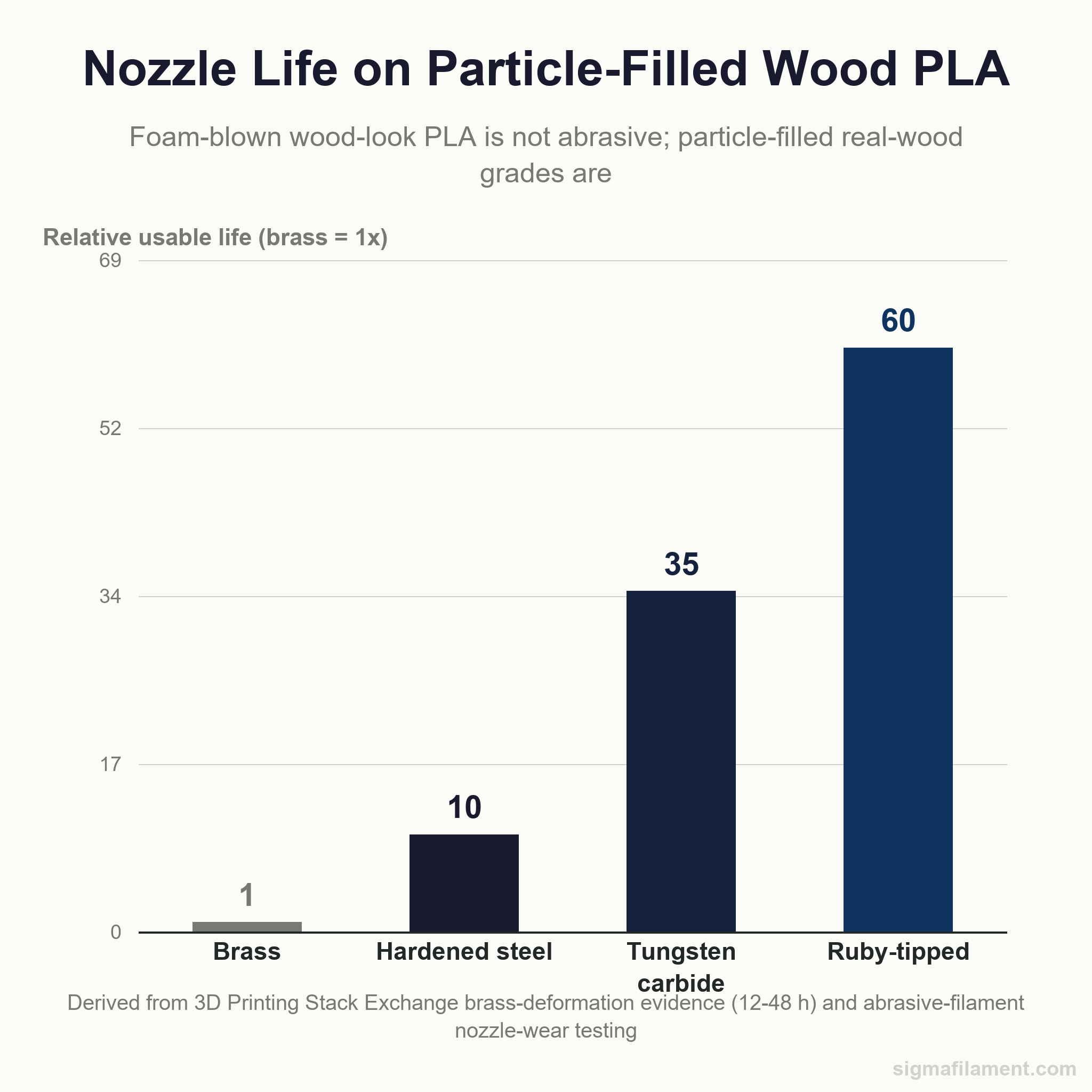
Material upgrades reset the wear clock. Relative to brass at 1x baseline life on particle-filled wood PLA, hardened steel extends usable life by roughly 10x, tungsten carbide by 35x, and ruby-tipped nozzles by 60x (3D Printing Stack Exchange contributors, 2016). The practical default beyond about 50 hours of cumulative real-wood-PLA throughput is a 0.5 mm or 0.6 mm hardened-steel nozzle: the wider orifice also clears occasional oversized wood particles without partial clogs, and the steel survives the abrasion that brass cannot.
Print-farm ROI math
Published nozzle-wear evidence on particle-filled wood PLA shows brass bores beginning to deform after roughly 12 hours of continuous print time and reaching full deformation by about 48 hours, with one documented failure measuring a 1.7 mm extrusion width from a nominal 0.4 mm nozzle, while foam-blown wood-LOOK PLA produces no measurable nozzle wear over the same interval (3D Printing Stack Exchange contributors, 2016).
A roughly $15 hardened-steel nozzle covers what would otherwise be four to eight brass swaps across a single 50-hour particle-filled wood PLA run. At print-farm scale, the brass-only path means recurring nozzle changes, 15-minute operator interventions, and a tail of scrapped parts produced during the silent drift window before the operator notices the over-extrusion. This is a failure-rate pattern we treat in depth in our filament selection playbook for print farms. The hardened-steel upgrade pays for itself inside the first 50 hours and keeps paying across every subsequent kilogram of wood PLA throughput.
Clogging Causes and Mitigation: Drying, Nozzle Size and Flow
Clogging is the most reported failure mode with wood PLA filament, and almost every case traces to one of three mechanisms acting alone or in combination. Treat them as separate problems: a wet spool will not be saved by a larger nozzle, and a 0.4 mm tip will keep jamming even on bone-dry stock.
Why wood particles bridge and char in the hot end
The composite carries 20-40 percent ground wood flour suspended in a PLA matrix. Individual particles range from roughly 50 to 200 microns, and at the higher end they approach the diameter of a 0.4 mm nozzle bore. Two failure paths follow. First, clusters of particles physically bridge the constriction at the nozzle entry and form a plug the melt cannot push through. Second, when the printer dwells at temperature with low flow, the cellulose scorches and leaves carbonized residue on the inner wall, narrowing the bore further on each subsequent print. A 0.5 mm or larger nozzle gives particles the clearance they need to pass, and keeping flow continuous prevents the heat-soak that triggers charring (Obico, 2024; Tahir & Seyam, 2025).
Drying wood PLA (45-55C)
Wood fiber is strongly hygroscopic and pulls atmospheric moisture into the spool within hours of opening the vacuum bag. Wet filament steams in the melt zone, producing popping sounds, surface bubbles, and partial blockages that read on the extruder as inconsistent flow. The same diagnostic pattern is covered in our step-by-step guide to drying PLA filament, with wood blends sitting at the more aggressive end of the curve.
A common way to dry wood PLA filament is a few hours in a filament dryer or food dehydrator at around 45 to 55 C (Obico, 2024). Stay inside the maker’s drying spec: one materials table puts wood-filled PLA’s glass transition at 45 C against 59 C for neat PLA (Xometry, 2024), and a DSC study measured about 57 C for one wood-PLA/PHA filament (Guessasma et al., 2019).
A desiccant canister inside the dry box holds the spool below 15 percent RH between sessions, the same baseline our 3D filament storage guide recommends across all hygroscopic materials.
Large nozzle, clean retraction and cold pulls
Run a 0.5 mm hardened steel nozzle at minimum; 0.6 mm is preferred for high wood-content blends. Keep retraction short, starting from the filament maker’s value, to limit the heat dwell that bakes particles into the melt zone. Schedule a cold pull every 2-3 spools: heat to printing temperature, cool to roughly 90 C, then pull the filament out by hand to extract partial obstructions before they grow into full jams.
Post-Processing: Sanding, Staining and Sealing Wood PLA
Post-processing is where wood PLA filament earns its name, or fails to. The work splits cleanly along filler chemistry. Particle-filled wood PLA, the kind loaded with real sawdust or wood flour at 20 to 40 percent by mass, exposes actual lignocellulosic fibers under abrasion and accepts stain like a piece of soft pine. Foam-blown wood-look PLA contains no wood at all; the warm tone comes from chemical blowing agents and pigment, so it sands smooth but rejects stain entirely (Xometry, 2024; Tahir & Seyam, 2025). Confirm filler type from the spool datasheet before committing time to a finishing schedule.
Progressive sanding grits
A three-step ladder handles most prints. Begin at roughly 120 grit to knock down layer lines and tear-away supports, step to 220 to remove the 120-grit scratches, then close at 400 for a uniform matte surface ready to accept color. Sand dry and along the layer direction. Skipping a grit leaves visible tracks that stain will only emphasize.
Staining and wood dyes (particle-filled only)
Oil-based wood stain, water-based wood dye, and alcohol-based aniline dye all penetrate the exposed fiber on particle-filled wood PLA, deepening grain contrast much the way they do on raw timber. Wipe a thin coat with a lint-free rag, wait two minutes, then wipe off the excess. Foam-blown wood-look PLA has no fibers to absorb pigment, so the same application beads on the surface and rubs off completely.
Independent FFF post-processing studies report that particle-filled wood-fiber PLA composites (typically 20 to 40 percent wood content) take wood stain in a manner comparable to softwoods after a 120-220-400 grit progression, while unfilled and foam-blown analogs show no measurable absorption (Xometry, 2024; Tahir & Seyam, 2025).
Sealing and protecting the finish
Stain alone is not durable. Seal with a paste wax for a soft hand-rubbed look, a penetrating oil such as tung or boiled linseed for warmth, or a clear acrylic or polyurethane coat for handling protection. Two thin coats outperform one heavy coat, and a light 400-grit scuff between coats locks adhesion. The sealed wood PLA filament print now reads as turned wood under both touch and camera.
Wood-Type Blend Matrix: Bamboo, Birch, Cork, Pine, Cedar and More
Wood pla filament is not one material. Each blend swaps in a different cellulose source, and that source sets the part’s color and scent, its grain pattern, and the temperature it prints at. Bamboo prints pale and golden; cedar prints reddish and aromatic; ebony prints near-black. Two spools both labeled "wood" can produce parts that look like different products (Xometry, 2024).

The eight blends sold as wood pla filament span a light-to-dark range. Light blondes suit Scandinavian work, warm mids carry classic timber, and dark contrast grades give the strongest visible grain. Cedar adds one consideration: the terpenes behind its scent off-gas during extrusion, so ventilate the enclosure. Ebony and high wood-content blends print at 215 C or higher because the added cellulose reduces melt flow.
Light blondes: birch, bamboo, cork
Birch prints in a very light blonde to cream with a fine grain and a subtle sweet scent. It was one of the original wood blends from Lay-Filaments and remains the default for a Scandinavian look. Bamboo prints warmer in a light tan to golden range, with a mild hay scent and the same fine grain; the source fiber is fast-growing. Cork prints as a warm tan with visible speckle rather than directional grain, has an earthy scent, and often uses a lower-density blend that runs cooler.
Warm mids: pine, olive, coconut
Pine prints in a medium amber to honey, releases a pine scent during extrusion, and shows medium grain with knot-like inclusions that mimic furniture lumber. Olive is a specialty grade with lower availability; it prints olive green-brown with a mild herbaceous scent and medium grain. Coconut-shell blends use ground shell as an industrial byproduct, print speckled tan to brown with a neutral scent, and carry the strongest sustainability story.
Dark contrast: cedar, ebony / walnut
Cedar prints reddish-brown with medium grain and a strong cedar scent; ventilate due to terpene off-gassing. Ebony and dark walnut print deep brown to near-black with high-contrast grain, carry a neutral scent, and need 215 C or higher because their wood-content fraction runs higher than the lighter grades.
A market scan of commercial wood pla filament across the eight blends most often sold (bamboo, birch, cork, pine, cedar, olive, coconut shell, plus the ebony / walnut darks) shows darker high wood-content grades such as ebony and dark walnut recommend print temperatures at or above 215 C, while light blondes such as birch and bamboo print cleanly from 190 to 210 C (Xometry, 2024).
| Wood type | Color | Scent when printing | Grain intensity | Temp note |
|---|---|---|---|---|
| Bamboo | Light tan to golden | Mild bamboo / hay | Fine | 190-210 C |
| Birch | Very light blonde / cream | Subtle sweet | Fine, light | 190-210 C |
| Cork | Warm tan with speckle | Earthy | Speckled, not grained | 185-205 C (often softer blends) |
| Pine | Medium amber / honey | Noticeable pine | Medium, knot-like inclusions | 195-215 C |
| Cedar | Reddish-brown | Strong cedar (ventilate) | Medium | 195-215 C |
| Ebony / dark walnut | Deep brown to near-black | Neutral | High contrast | 215 C or higher |
| Olive | Olive green-brown | Mild herbaceous | Medium | 200-215 C |
| Coconut shell | Speckled tan to brown | Neutral | Speckled | 195-215 C |
Mechanical Properties, Biodegradability and Applications
Wood PLA filament behaves differently from neat PLA under load. Adding 20 to 40 weight percent wood flour stiffens the composite but reduces the polymer’s ability to deform before fracture, and the same change shifts thermal behavior, biodegradation pathway, and the realistic application set. Treat wood PLA filament as a decorative-grade material with predictable limits, not a drop-in replacement for engineering PLA.
Stiffer but more brittle than neat PLA
The lignocellulosic fibers act as rigid inclusions in the PLA matrix. Tensile modulus climbs because the part resists initial deformation, but elongation at break collapses because fibers prevent the chain mobility that lets neat PLA yield before snapping. Flexural strength drops sharply for the same reason. Counter to the assumption that a stiffer material is also a stronger one, a printed wood PLA part feels harder to the touch yet shatters under bending or impact loads that neat PLA would survive (Xometry, 2024; Guessasma et al., 2019; Tahir & Seyam, 2025).
| Property | Wood PLA | Neat PLA |
|---|---|---|
| Tensile modulus | ~3,650 MPa | ~2,700 MPa |
| Elongation at break | ~3.8% | ~9.4% |
| Flexural strength | ~14 MPa | ~92 MPa |
| Impact resistance | ~5 kJ/m² | ~9 kJ/m² |
| Glass transition (Tg) | ~45 to 57 °C | ~59 °C |

Fiber chemistry and orientation shift these numbers. A 2025 review of plant-fiber-reinforced PLA in FDM reports that select long-fiber natural composites (e.g., aligned harakeke, the New Zealand flax Phormium tenax, at ~20 wt%) can hold or slightly raise tensile strength and substantially raise Young’s modulus versus neat PLA. Short milled wood flour goes the other way, dropping tensile and impact in the direction shown in the table. Fiber morphology, not just fiber content, decides whether a natural composite reinforces or weakens. One important limitation of the table figures: peer-reviewed values come from specific test specimens at fixed print conditions, so a buyer’s own lot, infill, and print orientation can shift any of these numbers by 10 to 20 percent in either direction (Xometry, 2024; Guessasma et al., 2019; Tahir & Seyam, 2025).
Peer-reviewed measurements place wood PLA tensile modulus at roughly 3,650 MPa against 2,700 MPa for neat PLA, while elongation at break falls from about 9.4% to 3.8%. The composite is stiffer but markedly more brittle, with flexural strength dropping from near 92 MPa to about 14 MPa (Xometry, 2024; Guessasma et al., 2019; Tahir & Seyam, 2025).
Biodegradability, safety and ventilation
Wood PLA filament is biodegradable under industrial composting conditions, where temperatures hold near 55 °C with sustained microbial activity. Home compost piles rarely reach that range, so a printed part in a backyard bin breaks down slowly. Full degradation can take up to roughly two years (Xometry, 2024; Guessasma et al., 2019).
Heated wood filament gives off fumes that can be toxic. Print in a well-ventilated room, use an enclosure with filtered exhaust where available, and avoid prolonged exposure to the plume (Xometry, 2024; Guessasma et al., 2019).
What to print with wood PLA
Match the material to non-structural use cases. Wood PLA filament suits decorative and display models, furniture-style design prototypes, figurines, picture frames, and architectural mockups where appearance and tactile finish drive the choice. The composite sands easily, then takes stain and a clear coat (Xometry, 2024; Obico, 2024).
Avoid load-bearing or impact-exposed parts. Brackets, clips, hinges, snap-fits, threaded inserts, and any geometry that sees bending stress or repeated impact should stay in neat PLA, PETG, or a fiber-reinforced engineering grade. The core FDM filament materials guide lays out which grade to swap to once the load case crosses out of decorative. The brittleness shown in the table is not a printing artifact, it is the material’s working envelope (Xometry, 2024).
OEM and Wholesale Wood PLA: Custom Blends, Color Matching and MOQ
Buyers moving from sample spools to pallet quantities of wood PLA filament find that the supplier base splits in two: relabelers who respool generic compound under a private brand, and source manufacturers who compound their own pellet recipe in-house. The difference shows up in fiber-loading consistency, color repeatability across reorders, and whether the vendor can hold a written spec across a 1000-spool run. This is the same separation our custom 3D printing materials sourcing guide details across the broader specialty-filament market.
Custom wood-fiber percentage and virgin-resin base
A procurement-ready wood PLA grade names its fiber loading as a weight percentage, not a marketing descriptor. This is one of the seven non-negotiable checks in our practical guide to vetting a wholesale 3D filament maker. Source manufacturers run an OEM and ODM custom-blend program across a 20-40% wood-fiber band on a 100% virgin-resin PLA base, with NatureWorks Ingeo pellets as the quality marker. Virgin resin matters because regrind PLA correlates with melt-viscosity drift and clogging variability, both of which compound the abrasive-fiber wear that wood composites already impose on the hot end. Loadings near 20% favor print reliability and finer feature retention; loadings near 40% favor a denser wood look and stronger post-sanding response, at the cost of tighter print-window control.
Pantone/RAL color matching atop a wood base
Wood PLA does not have to ship only in light-tan and walnut-brown stock colors. Source manufacturers can dose colorant masterbatch atop the wood-fiber base to hit a buyer-supplied Pantone or RAL reference at deltaE under 1.5, the practical threshold below which side-by-side lots read as the same color to the unaided eye. That matters for ODM brands building a cohesive filament product line, where a "vintage oak" collection across three SKUs needs to look like one family on a retail shelf rather than three near-misses.
MOQ, bulk-discount tiers and diameter tolerance
Stock-color wood PLA opens at a 100-spool MOQ; OEM custom-color runs start at 500 spools to amortize colorant changeover and a dedicated purge (the same MOQ and tier structure documented in our bulk PLA filament B2B sourcing guide). Bulk pricing tiers run roughly 15% off at 500-plus spools and 20% off at 1000-plus spools across wholesale PLA SKUs. Diameter tolerance is the spec resellers most often miss: wood composites realistically hold +/-0.03 mm versus +/-0.02 mm for unfilled PLA, because the dispersed fiber phase resists the puller in a slightly less uniform way through the cooling bath. See what "consistency" actually means in filament spec sheets for the full set of metrics behind the number.
SigmaFilament compounds wood PLA at 20-40% fiber on a 100% virgin NatureWorks PLA base, color-matches to Pantone or RAL at deltaE under 1.5, opens stock SKUs at 100 spools and OEM custom-color runs at 500 spools, and holds +/-0.03 mm diameter tolerance across the wood-composite range, with 15% off at 500-plus and 20% off at 1000-plus spools.
Resellers should bundle a hardened-steel nozzle with every spool sold to end users. Nozzle-wear surprise after a few kilograms of print time is the most common post-sale complaint on wood composites, and a $10 accessory pre-empts it before the ticket lands.
Frequently Asked Questions
What is wood PLA filament?
Wood PLA filament is a composite of a PLA matrix and 20-40% milled wood fiber by weight, with a 70% PLA / 30% wood ratio the most common formulation (Xometry, 2024). The category splits into particle-filled real-wood PLA, which carries actual milled wood, and foam-blown wood-LOOK PLA, which only mimics the appearance without any wood content.
Is wood PLA real wood, and how much wood is in it?
Particle-filled real-wood PLA contains real milled wood, typically 20-40% by weight with 30% as the standard loading; prints sand cleanly, accept stain, and smell of sawdust during extrusion (Xometry, 2024). Foam-blown wood-LOOK PLA contains zero wood particles and only simulates the grain through pigment and bubble structure.
Do I need a hardened nozzle for wood PLA?
A hardened-steel nozzle is needed only for particle-filled real-wood PLA, where the fibers abrade a brass nozzle in roughly 12-48 hours of print time; a 0.5-0.6 mm hardened-steel nozzle is the standard production choice (3D Printing Stack Exchange contributors, 2016). Foam-blown wood-LOOK PLA carries no abrasive particles and runs fine on a stock 0.4 mm brass nozzle.
What temperature should I print wood PLA at?
The working range is 190-220C, tuned to the blend: lighter colors and lower wood loadings sit at the low end, while darker shades and higher-wood-content blends push toward 215-220C to fully fuse the matrix around the fiber (Obico, 2024). A 45-60C bed and 40-60 mm/s print speed are standard starting points.
Why does wood PLA keep clogging my nozzle?
Three mechanisms drive clogs: wood particles bridge across small orifices, fibers char during long heat-soak, and absorbed moisture in the hygroscopic fiber steams and disrupts flow (Obico, 2024). The fix is a 0.5 mm or larger nozzle, filament drying at 45-55C, and shorter dwell time between prints.
Can you sand and stain wood PLA prints?
Yes, but only particle-filled real-wood PLA, which exposes wood fibers at the print surface that accept stain and sealer like real wood (Xometry, 2024). The recommended workflow is progressive sanding through 120, 220, and 400 grit, then stain and a topcoat seal. Foam-blown wood-LOOK PLA has no exposed fibers and will not take stain.
Is wood PLA stronger than PLA, and is it biodegradable?
Wood PLA is stiffer than neat PLA, with a tensile modulus near 3,650 MPa versus about 2,700 MPa, but more brittle at roughly 3.8% elongation at break versus 9.4%, which makes it unsuitable for load-bearing parts (Xometry, 2024). It remains biodegradable under industrial composting at around 55C, with full breakdown taking up to two years.
What is the MOQ for OEM or wholesale wood PLA filament?
Standard-stock wholesale runs of wood PLA filament typically open at 100 spools per order, while OEM work with custom colors or private-label spool design generally starts at a 500-spool minimum. Bulk pricing usually delivers around a 15% discount at 500 spools and approaches 20% at 1000 spools and above.
Conclusion
A wood PLA filament project succeeds when the family decision happens first and every other choice is anchored to it.
Identify the family before anything else. Particle-filled real-wood grades carry 20 to 40 percent wood flour, print at 1.0 to 1.25 g/cm3, abrade brass nozzles, and accept sanding and stain. Foam-blown wood-LOOK PLA carries no wood particles, prints near 0.8 g/cm3, leaves nozzles untouched, and will not take stain. A spec sheet that omits wood-content percentage is the first warning.
Once the family is fixed, settings follow. Print 190 to 220 C, dry 45 to 55 C for a few hours, and move to a 0.5 to 0.6 mm hardened-steel nozzle for any real-wood grade at volume. Post-processing belongs only to particle-filled prints; sanding a foam-blown part exposes white PLA underneath. A sourceable reel ships with declared wood-fiber percentage, density, lot number, and moisture spec, and the next reel matches the prior one.
Engineers and brand owners sourcing wood PLA at volume can contact the SigmaFilament engineering team to scope custom wood-fiber percentage, Pantone or RAL color matching, and lot-to-lot consistency against an active production run.
References
- Xometry. (2024). All about wood 3D printing filament: Materials, properties, definition. Xometry Resources. https://www.xometry.com/resources/3d-printing/wood-3d-printing-filament
- Obico. (2024). How to print in wood filament: Tips and tricks. Obico Blog. https://www.obico.io/blog/how-to-print-in-wood-filament-tips-and-tricks
- 3D Printing Stack Exchange contributors. (2016). Does wood filament damage the printer nozzle? 3D Printing Stack Exchange. https://3dprinting.stackexchange.com/questions/423/does-wood-filament-damage-the-printer-nozzle
- Guessasma, S., Belhabib, S., & Nouri, H. (2019). Microstructure and mechanical performance of 3D printed Wood-PLA/PHA using fused deposition modelling: Effect of printing temperature. Polymers, 11(11), 1778. https://doi.org/10.3390/polym11111778
- Tahir, M., & Seyam, A. F. (2025). Greening fused deposition modeling: A critical review of plant fiber-reinforced PLA-based 3D-printed biocomposites. Fibers, 13(5), 64. https://doi.org/10.3390/fib13050064
Last reviewed and updated: June 2026. Author: SigmaFilament team. For tailored guidance, contact our team.