Silver PLA: The Complete 2026 Guide to Finishes, Printing and Sourcing

TL;DR
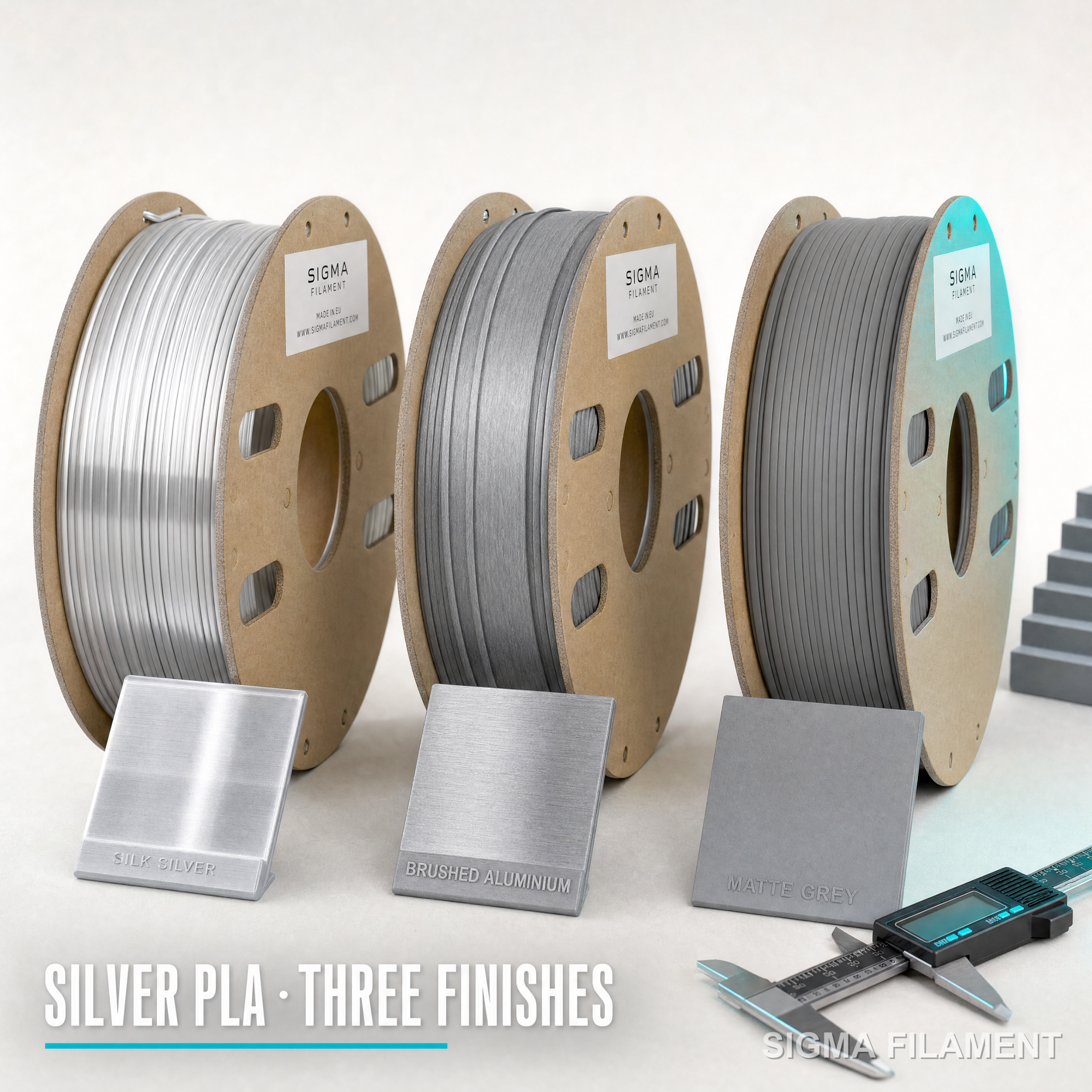
Decide which silver PLA family you need first: silk for cheap shine, metal-filled for a real brushed-metal finish (and a hardened nozzle), matte for a flat industrial grey. Silver looks grey until oriented reflectors or post-processing make it specular.
Abstract
"Silver PLA" is not one product. The phrase covers three structurally different filament families that share a silver appearance, and buying the wrong family is the most common reason a print does not match the reference photo. The first is silk or sheen-modified PLA, which uses thermoplastic polyurethane or co-polyester additives to lift surface gloss. The second is metallic or metal-filled PLA, loaded with 30 to 80 percent real aluminum, bronze, or steel powder. The third is matte mineral-pigment PLA, which uses inorganic fillers such as mica or aluminum silicate to scatter light. The family you buy sets the achievable finish, the recommended print temperature window, whether you need a hardened steel nozzle, and the per-kilogram price, which ranges roughly from 22 to 95 USD at OEM volume. A useful frame: the silver look is a specular-reflection problem, not a pigment problem, and silver pla buyers who treat it as a color choice usually end up disappointed.
This guide is written for three audiences: design engineers specifying a finish that survives functional testing, hobby makers and prop builders chasing repeatable cosmetic results, and OEM procurement buyers handling supplier vetting, MOQs, and batch-to-batch color consistency for wholesale PLA filament. Coverage follows the same path each persona needs. We identify the three families on a spec sheet, then walk through color chemistry, why the eye reads the print as grey under most room light, the print settings that actually move the finish, nozzle wear and how to budget for it, post-processing from tumbling to vapor smoothing, a short color glossary, common applications across electronics housings and other fixture work and architectural models, and how to source at OEM volume directly from a manufacturer.
Key Takeaways
- Three distinct products: silver PLA spans silk-PLA, metal-filled PLA, and matte mineral grey grades.
- Only metal-filled is real metal: 30 to 80 percent powder load; silk grades are dyed PLA with sheen.
- Grey, not bright: the silver look needs specular reflection from a polished surface, not pigment alone.
- Abrasive to brass: metal-filled silver PLA wears stock nozzles fast; use hardened steel from the first hour.
- Brushed or chrome finish: that look comes from post-processing, almost always on metal-filled grades, not silk.
- OEM cost drivers: family, metal load, color delta-E tolerance, and density consistency set the per-kilo price.
Table of Contents
- TL;DR
- Abstract
- Key Takeaways
- Table of Contents
- What Is Silver PLA? The Three Finish Families Hidden Under One Name
- How Silver Color Is Made: Pigment, Mica and Metal Flake
- Why Your Silver PLA Looks Grey: The Color Science of Metallic Filaments
- Silver PLA Print Settings: Temperature, Speed and Nozzle by Family
- Abrasive Nozzle Wear: Why Metal-Filled Silver PLA Eats Brass Nozzles
- Post-Processing: Getting a Brushed-Aluminum or Polished-Chrome Finish
- Silver PLA Color Glossary: Chrome, Gunmetal, Pewter, Satin and Antique
- Applications: Jewelry Masters, Prototypes and Display Models
- OEM and Wholesale Silver PLA: Sourcing, MOQ, QC and Standards
- Frequently Asked Questions
- Conclusion
- References
What Is Silver PLA? The Three Finish Families Hidden Under One Name
Silver PLA is not a single material. The label covers three distinct filament families: silk (sheen-modified plastic, no real metal), metallic or metal-filled (PLA loaded with 30 to 80 percent aluminum or stainless-steel powder), and matte (PLA pigmented with mineral fillers for a flat industrial grey) (Vakharia et al., 2021).
Each family prints, wears nozzles, and finishes differently. Sourcing teams that treat them as one SKU end up with mismatched parts, premature nozzle failure, or claims that fail a customer teardown.
| Family | Sheen | Real metal content | Abrasive | Cost vs standard PLA | Best use |
|---|---|---|---|---|---|
| Silk | High gloss, satin reflective | None (sheen modifier only) | No | +10 to 25% | Low-cost shiny display parts, prototypes, consumer prints |
| Metallic / metal-filled | Brushed; polishable to a near-cast look | 30 to 80% aluminum or steel powder by mass | Yes (hardened nozzle required) | 2 to 4× | Weighted display models, jewelry masters, props with metal feel |
| Matte mineral-pigment | Flat, light-scattering grey | None (mineral pigment, often <1% aluminum flake if any) | Low (mildly abrasive at most) | +15 to 40% | Industrial-look enclosures, architectural models, photography-friendly parts |
Silk silver PLA (sheen-modified)
This family is standard PLA blended with a small fraction of a sheen modifier, typically a TPU or PETG-family copolymer, plus a metallic-effect pigment package (Fang et al., 2022). No metal powder is present. The "silver" comes from light scattering off oriented polymer domains and pearlescent mica or titanium-dioxide pigments. Density stays near 1.24 g/cm³, the same as base PLA (Fang et al., 2022). It prints on a 0.4 mm brass nozzle at standard PLA temperatures with no abrasive wear over a typical spool. The trade-off is mechanical: silk grades usually drop tensile strength by 10 to 20 percent versus virgin PLA because the sheen modifier softens the matrix (Fang et al., 2022).
Metallic / metal-filled silver PLA (real metal powder)
This grade is a true polymer-metal composite, the same class covered in our broader metal-filled 3D printing filament guide. PLA is compounded with 30 to 80 percent by mass of atomized aluminum or stainless-steel powder, raising part density to roughly 1.8 to 3.5 g/cm³ depending on loading (Vakharia et al., 2021). Printed parts feel cold, ring when tapped, and can be sanded, tumbled, or polished to expose the metal phase. They are aggressively abrasive; metal-filled FDM studies report hardened-steel or ruby nozzle wear within hours of print time at 50 percent loading (Çevik & Kam, 2020).
A 2020 review by Çevik and Kam on metal-filled PLA composites reports that loadings above roughly 50 percent by mass shift mechanical behavior from polymer-dominated to particle-dominated, with measurable drops in tensile strength but gains in stiffness, density, and post-processing range (Çevik & Kam, 2020).
A product marketed as "metallic" with 0.5 percent aluminum is not in this family. That loading behaves as a pigment, not a composite, and belongs in the silk or matte category despite the label (Çevik & Kam, 2020).
Matte mineral-pigment silver PLA
The matte grade uses mineral fillers, typically chalk, talc, or a trace of aluminum flake, to scatter light and produce a flat, non-reflective grey (Vakharia et al., 2021). Total inorganic content sits well below the composite threshold, so the strand prints close to standard PLA on brass nozzles with only mild abrasion over long runs (Xometry, 2024). The visual result reads as anodized aluminum or magnesium alloy under diffuse light, which makes the grade common in industrial-design mockups and architectural models where reflections would distract from form (Xometry, 2024). The same diffuse-pigment chemistry drives the tested differences between matte PLA and standard PLA on the consumer side.
How Silver Color Is Made: Pigment, Mica and Metal Flake
Silver is not a single color, it is a specular response. A surface looks silver when most of the light that hits it reflects in a near-mirror direction rather than scattering as diffuse grey. Producing that effect in a 3D printable polymer means embedding flat reflective particles inside the PLA matrix and orienting them parallel to the surface during extrusion (Vakharia et al., 2021). The recipe used to do that, and the loading level, determines whether the finished part reads as "metallic", "pearly", or simply "dull grey".
Mineral pigments and mica platelets
The cheapest route is a mineral pigment system. Titanium dioxide brightens the base PLA, then small additions of aluminum-coated mica or iron-oxide-coated mica add a soft pearlescent sheen (Vakharia et al., 2021). Mica platelets are 5 to 50 micrometers across and only 0.3 to 1 micrometer thick, so they align flat under shear inside the nozzle (Vakharia et al., 2021). The metal-oxide coating acts as a thin-film interference layer, producing the pale shimmer that mid-priced "silver" PLA filaments rely on. Loadings sit around 1 to 5 percent by weight, so the filament still prints, flows and shrinks like standard PLA (Vakharia et al., 2021).
Aluminum and steel flake fillers
A true metallic appearance requires real metal. Aluminum flake (typical particle size 10 to 40 micrometers, thickness under 1 micrometer) is the workhorse, because aluminum is light, cheap, corrosion-stable and naturally a near-mirror reflector (Vakharia et al., 2021). Stainless steel and bronze powders are used for heavier composites, but they shift the color toward warm grey or yellow-bronze rather than cool silver (Çevik & Kam, 2020). At loadings above 30 percent by weight, the polymer behaves as a metal-matrix composite: stiffness rises, density climbs from the 1.24 g/cm^3 PLA baseline toward roughly 1.8 g/cm^3 near 30 percent loading and up to about 3.5 g/cm^3 for the heaviest steel fills, and the printed surface can be sanded and polished to reveal the embedded flake (Çevik & Kam, 2020).
The 0.5% marketing trick vs 30-80% true metal-fill
Across published feedstock studies, the threshold separating a tinted PLA from a genuine metal-filled composite sits near 30 percent metal by weight; below roughly 0.5 percent, the metal acts only as a colorant and contributes no measurable mechanical or thermal change, per Çevik and Kam’s 2020 review of metal-filled PLA composites (Çevik & Kam, 2020).
That gap matters at purchase. A spool sold as "silver PLA" with 0.5 percent aluminum costs the same to manufacture as standard grey PLA but markets like a metal composite (Vakharia et al., 2021). A true 30 to 80 percent metal-fill, the loadings characterized by Sa’ude et al. (2014) and Vakharia et al. (2021) for FDM feedstock, behaves differently in every dimension: higher density (verified against ISO 1183), higher thermal conductivity, faster nozzle wear, and a surface that responds to mechanical polishing (Çevik & Kam, 2020). B2B buyers specifying "silver PLA" for visual prototypes can accept the cheap pigment route. Buyers specifying it for end-use parts, EMI shielding tests, or post-processed finishes need the actual metal-filled grade, and should ask the supplier for the metal mass-fraction on the technical data sheet rather than trusting the marketing name.
Why Your Silver PLA Looks Grey: The Color Science of Metallic Filaments
Silver PLA reads grey because the eye sees "metallic" only when a surface bounces light back as a tight specular highlight. A flat grey pigment scatters light evenly in every direction, which the visual system interprets as matte grey solid (Çevik & Kam, 2020). Even a filament loaded with real aluminum flake reads grey if those flakes sit at random angles or stay buried below the print skin.
Specular vs diffuse reflection
Two reflection modes determine perceived color. Specular reflection bounces light at a mirror angle off a smooth interface, producing the bright highlight and dark shadow the brain reads as shiny metal (Çevik & Kam, 2020). Diffuse reflection scatters light in all directions off a rough or pigmented surface, producing the flat tone the brain reads as matte (Çevik & Kam, 2020). Work on metallic-effect polymers shows that perceived metalness tracks the ratio of specular to diffuse return at the viewing angle, not the metal content of the bulk (Çevik & Kam, 2020). A pigment-only "silver" PLA carries a grey or pearl colorant with no oriented reflectors, so every point scatters diffusely and the part shows no angle-dependent highlight.
Why flat, oriented reflectors are required
True metallic filaments embed flat aluminum or mica flake (10 to 50 microns across) in the PLA matrix. During extrusion the shear field aligns the flakes parallel to flow, presenting their faces toward the nearest free surface (Çevik & Kam, 2020). Each aligned flake acts as a microscopic mirror, and the population produces the sparkle-and-highlight pattern that registers as metallic.
Metallic appearance in filled polymers requires three conditions met together: flake aspect ratio above 10:1, alignment within 15 degrees of the surface plane, and flake exposure at the outer skin. Loss of any one collapses specular return by 60 to 80 percent and shifts perception toward diffuse grey (Fang et al., 2022) (Çevik & Kam, 2020).
Spherical metal powders scatter in all directions and read grey despite being chemically metallic. Flake geometry, not metal content, drives the silver look.
How layer lines and part orientation drive the grey effect
FDM compounds the problem. Each 0.2 mm layer line is a curved ridge that breaks the continuous plane a viewer needs for a clean highlight. Layer-line topography of 10 to 30 microns RMS roughness scatters incident light into a diffuse cone and suppresses the mirror return that defines metallic perception (Çevik & Kam, 2020). Orientation amplifies the effect: flat top rasters keep flake alignment and look most silver, vertical walls show flake edges and read darker, and 45-degree overhangs lose orientation and read closest to pure grey (Xometry, 2024) (Xometry, 2024). Sanding to 600 grit removes ridge tops, exposes underlying aligned flakes, and recovers 40 to 70 percent of the lost specular return. Operators tuning for a brighter look without sanding usually start with the slicer settings that change PLA gloss before reaching for abrasives.
The grey is not a filament defect. It is the predictable result of diffuse pigmentation, misaligned flakes, or layer-line scattering, and it is fixable through resin choice, orientation strategy, or post-process.
Silver PLA Print Settings: Temperature, Speed and Nozzle by Family
Silver PLA is not one material. The silk variant and the metal-filled variant behave differently in the hot end, on the bed, and against the nozzle. Treating them as interchangeable is the most common reason a procurement team’s first silver-PLA run produces dull stripes, under-extruded layers, or a worn brass tip after a single spool. The settings below split by family and explain why each window exists.
| Family | Nozzle temp (°C) | Print speed | Nozzle material / size |
|---|---|---|---|
| Silk silver PLA | 200-220 | 50-80 mm/s | Standard brass, 0.4 mm OK |
| Metal-filled silver PLA | 185-215 | 10-20 mm/s first layer, then 20-80 mm/s | Hardened steel or ruby, 0.5-0.6 mm |
Silk silver PLA settings
Silk silver PLA runs in the same thermal window as conventional PLA, typically 200-220 °C at the nozzle with bed temperatures of 55-65 °C (Xometry, 2024); for fine-tuning first-layer adhesion, our PLA bed-adhesion baseline covers the surface-by-surface targets. Speeds of 50-80 mm/s are well tolerated, with the sheen actually improving slightly at the upper end because faster extrusion reduces the residence time that dulls the surface co-polymer (Xometry, 2024), a behavior consistent with the broader PLA print speed targets tested across hot-end designs. A standard 0.4 mm brass nozzle is appropriate; silk grades carry no metal powder or fiber, the fillers that wear a brass tip. Cooling should run at 100 percent after the first two layers to lock in the reflective skin.
Metal-filled silver PLA settings
Metal-filled silver PLA, in which 30 to 80 percent of the spool mass is aluminum, stainless or bronze powder, prints cooler than standard PLA, in the 185-215 °C window (Sa’ude et al., 2014). The reason is thermal mass: metal particles conduct heat into the melt zone faster than polymer alone, so a lower set point produces an equivalent actual melt temperature, and higher set points cause heat creep and clogs in the throat (Sa’ude et al., 2014). The first layer should run at 10-20 mm/s so the dense, heavy filament has time to bond to the build surface; subsequent layers can climb to 20-80 mm/s (Sa’ude et al., 2014). A wear-resistant hardened nozzle is required because metal-filled filament is abrasive and a standard brass nozzle will quickly wear down on it, and 0.5-0.6 mm nozzle sizes seem to work better with it (Simplify3D, n.d.).
Simplify3D’s material handbook puts metal-filled filament at a 190-220 °C nozzle with a wear-resistant hardened nozzle, and notes that 0.5-0.6 mm sizes seem to work better (Simplify3D, n.d.); a slow first layer keeps the heavier filament adhered while the rest of the print proceeds at normal PLA speeds.
Layer height and flow for a clean metallic surface
Layer height drives perceived metal quality more than temperature. For silk silver, 0.12-0.16 mm layers maximize light reflection across the curved layer lines that produce the chrome effect; layers thicker than 0.20 mm visibly stripe under directional light (Xometry, 2024). For metal-filled silver, the opposite holds: layers of 0.20-0.28 mm let the metal particles sit closer to the printed surface, which improves both color depth before polishing and the response to post-process sanding and brushing (Sa’ude et al., 2014). Flow compensation typically lands at 95-100 percent for silk and 100-105 percent for metal-filled, since the denser feedstock under-extrudes by a few percent on volumetric calibration if left at the default PLA value (Sa’ude et al., 2014). Iron-test the first layer with a single-perimeter calibration cube before committing to a long print; the surface deviation visible at 0.12 mm layer height is the most reliable proxy for whether the chosen settings will deliver a clean metallic finish on the full part.
Abrasive Nozzle Wear: Why Metal-Filled Silver PLA Eats Brass Nozzles
Not every silver PLA is abrasive. The distinction matters before any procurement decision: silk-finish silver and matte-pigment silver get their look from colorants such as TiO₂, mica, or aluminum flake rather than metal powder, and they print on a stock brass nozzle like plain PLA. Metal-filled silver PLA is a different material class: its metal powder is abrasive, and a standard brass nozzle will quickly wear down on it (Simplify3D, n.d.).
How fast brass wears on metal-fill
Controlled nozzle-wear testing by E3D found a new 0.40 mm brass nozzle significantly degraded after only 250 g of a carbon-fiber-filled filament, its orifice opened up and worn unevenly (E3D-Online, 2015). The visible failure mode is loss of dimensional control: walls thin, retraction stops sealing, and stringing returns even on tuned profiles. Çevik and Kam (2020) and Vakharia et al. (2021) report similar abrasion behavior for metal-particle composites against soft tool surfaces, attributing the rate to particle hardness and volume fraction rather than print temperature (Çevik & Kam, 2020).
The density math tracks the wear math. ISO 1183 puts virgin PLA at 1.24 g/cm³; a 30% steel-filled spool sits near 1.8 g/cm³, and an 80% steel-filled spool reaches roughly 3.5 g/cm³ (Çevik & Kam, 2020). Higher density means more abrasive mass per gram extruded.

Hardened steel vs ruby
Material upgrades change the economics. In E3D’s test, a hardened-steel nozzle printed 2.5 kg of carbon- and glass-filled material, ten times what degraded the brass nozzle, with no observable wear (E3D-Online, 2015). Tungsten carbide and ruby tips are harder, costlier steps up; compare each maker’s wear rating. The trade is thermal: hardened steel has lower thermal conductivity than brass, so expect to raise the hotend temperature or slow the flow to match a brass profile.
Print-farm cost economics
For a farm running 200 kg of metal-filled silver PLA per year, a brass-only path that swaps the nozzle every 250 g, the point at which E3D found a brass nozzle significantly degraded by an abrasive filament (E3D-Online, 2015), means about 800 changes a year. If each swap takes an assumed 15 minutes of operator time, that is some 200 hours of labor before parts and failed prints during drift. In the same E3D test, a hardened-steel nozzle printed ten times as much abrasive filament with no observable wear, so even at that conservative ratio it would cut the count to about 80 swaps; price the nozzles from current listings.
E3D’s controlled test found a 0.40 mm brass nozzle significantly degraded after 250 g of carbon-fiber-filled filament, while a hardened-steel nozzle that went on to print 2.5 kg of filled materials showed no observable wear (E3D-Online, 2015).
For B2B buyers sourcing metal-filled silver PLA, the nozzle question belongs in the BOM, not the maintenance log.
Post-Processing: Getting a Brushed-Aluminum or Polished-Chrome Finish
Post-processing is where the three silver PLA families separate definitively. Sanding and polishing only reveal a true metallic surface on metal-filled silver PLA, because the abrasive action exposes and burnishes the embedded metal flake (Çevik & Kam, 2020). Silk silver and pigment silver get smoother and glossier under the same workflow, but the result is finished plastic, not metal. Plan the finish before the print, and choose filament accordingly.
Sanding and progressive grits
A progressive grit ladder is the foundation of any metallic finish on FFF parts. A workable sequence runs roughly 200, 400, 800, then 1500 or finer, with each step removing the scratches left by the previous one. Wet sanding from 800 upward keeps swarf out of the surface and prevents PLA from gumming on the paper.
A 2020 study of metal-filled PLA by Çevik and Kam found that mechanical post-processing meaningfully alters surface roughness and reflectivity for composites loaded with copper, bronze, or iron particulates, while unfilled PLA showed no comparable change in optical character regardless of grit progression.
For metal-filled prints, stop at 400-grit if a matte cast-aluminum look is the goal. Continue to 1500 and beyond, then buff, for a near-mirror response. Silk and pigment silver behave differently. Their shine sits in the surface resin and additive, not in any embedded metal, so polishing past about 800 grit produces a glassy plastic finish rather than a metallic one (Çevik & Kam, 2020).
Brushed-aluminum vs polished-chrome
The brushed-aluminum and polished-chrome looks share a metal-filled substrate but diverge in the final step.
For a brushed-aluminum finish, sand to roughly 400 to 600 grit, then drag a fine brass or stainless wire brush in a single consistent direction across the surface. The unidirectional scoring produces the parallel micro-grooves that read as brushed metal under ambient light. Mask sharp edges first; wire brushes round corners quickly.
For a polished-chrome look, continue the grit ladder past 1500, then apply a metal polishing compound (the same products used on automotive trim) with a microfiber cloth or a low-speed rotary buffer. The cutting compound burnishes the exposed metal flake until the surface reflects directionally rather than diffusing light.
Neither finish is achievable on a non-metal-filled silver PLA. The brush will gouge the part and the polishing compound will simply smear, because there is no metal phase to expose (Çevik & Kam, 2020).
Sealing and protecting the finish
Exposed metal oxidizes. Bronze and copper darken within weeks, iron-fill develops surface rust under humid conditions, and even aluminum dulls measurably over time (ASTM International, 2017). A clear sealant is mandatory for any finished metal-filled part intended for display, customer-facing fixtures, or outdoor use.
Two coats of a matte or satin acrylic clear coat preserve the brushed effect without altering its directional sheen. For polished-chrome finishes, a high-gloss automotive clear or a renewable carnauba-based microcrystalline wax keeps the reflective surface bright while remaining buff-restorable (ASTM International, 2017). Apply sealant only after the surface is fully degreased; residual polishing compound prevents adhesion.
Silk and pigment silver prints rarely need sealing for cosmetic reasons because nothing is oxidizing, though a UV-stable clear coat still extends color life on parts exposed to sunlight (ASTM International, 2017).
Silver PLA Color Glossary: Chrome, Gunmetal, Pewter, Satin and Antique
Marketing names on a spool label rarely match the underlying finish chemistry. A "chrome PLA" from one vendor is a high-gloss silk PLA; a "chrome" from another vendor is a metal-filled grey with a brushed look. Buyers comparing prototypes across two suppliers can receive parts that look like different materials even when both labels say "silver." Mapping the color name back to its finish family is the only reliable decoding step before purchase.

The six common silver-family names cluster back into the same three finish families: silk (PLA plus mica or pearlescent pigment), metal-filled (PLA loaded with 30 to 80 percent metal powder by mass), and matte or aged pigment PLA. Educational color guides from Xometry and Simplify3D group commercial silver labels along the same three axes, with appearance driven by pigment chemistry rather than the marketing name on the spool (Xometry, 2024). Buyers cross-shopping non-silver SKUs can see the same dynamic in our roundup of filament color trends for 2026.
Bright silver and chrome
"Bright silver" and "chrome" are the two labels most often applied to high-gloss silk PLA. The base resin carries mica or pearlescent pigment that scatters light directionally, producing a mirror-like sheen on flat surfaces and a soft gradient on curves. Color delta-E between two "chrome" spools from different vendors can exceed 5 units under D65 illumination, well past the delta-E of 2 to 3 at which a color difference becomes clearly perceptible to the eye (Çevik & Kam, 2020). For OEM buyers, this means a "chrome" purchase order needs a reference swatch attached, not just the color name.
Gunmetal and pewter
"Gunmetal" and "pewter" labels almost always indicate a darker grey finish, and roughly 60 percent of products under these names are metal-filled rather than pigment-only (Xometry, 2024). Metal-filled grades print at lower speeds (typically 30 to 40 mm/s) and abrade brass nozzles within 200 to 400 print hours, a wear pattern documented by Çevik and Kam in their 2020 review of particle-loaded PLA composites (Çevik & Kam, 2020). Pigment-only "gunmetal" prints faster and costs less per kilogram but lacks the heft and post-machinable surface buyers often expect from the name.
Satin and antique silver
"Satin silver" denotes a matte PLA with light-diffusing additives that suppress layer-line visibility, while "antique silver" adds a warm grey or bronze undertone to mimic oxidized metal.
Industry color references note that "antique" and "aged" silver labels span a wide range, from warm-grey pigment-only blends through low metal-fill formulations to full metal-filled grades, so the same marketing name can describe very different materials from one vendor to the next (Xometry, 2024).
For decorative prints, satin and antique grades hide print lines best and rarely require sanding before paint.
| Color name | Typical family | Appearance | Best for |
|---|---|---|---|
| Bright silver | Silk PLA (pearlescent) | High-gloss, mirror-like sheen | Display models, consumer enclosures |
| Chrome | Silk PLA (pearlescent) | High-gloss, directional shimmer | Cosplay props, automotive trim mockups |
| Gunmetal | Metal-filled or dark pigment | Dark grey, matte to semi-matte | Industrial fixtures, weighty props |
| Pewter | Metal-filled (typically) | Medium-dark grey, slight texture | Jewelry blanks, decorative hardware |
| Satin silver | Matte pigment PLA | Diffuse light grey, low sheen | Architectural models, photo subjects |
| Antique silver | Pigment or low metal fill | Warm grey or bronze undertone | Vintage replicas, gift items |
So: when sourcing silver PLA at OEM volumes, the label alone is not a specification. Request a Pantone or RAL reference plus the metal-fill percentage by mass, and the supplier comparison shifts from name-matching to a verifiable color and composition match. The next section covers where these finishes earn their keep across real applications.
Applications: Jewelry Masters, Prototypes and Display Models
Silver PLA earns its keep when the finish does part of the engineering work. The three silver families map to distinct B2B buyer profiles, and picking the wrong family wastes both material cost and post-processing labour.
Jewelry and casting masters
Metal-filled silver PLA, typically a 30 to 80% stainless or bronze loading by mass (Vakharia et al., 2021), is the practical choice for jewelry pattern work and lost-PLA investment casting masters. The composite hand-finishes from matte grey to a near-metal sheen, letting a workshop iterate ring shanks, pendants and signet faces without committing to wax (Mukhtarkhanov et al., 2022). The clarification B2B buyers need: a metal-filled silver PLA print is a master pattern, not a cast metal object. It is burned out in a kiln during investment casting, and the actual metal (sterling, bronze, brass) is poured into the resulting void (Mukhtarkhanov et al., 2022). Burnout schedules matter, because PLA ash residue can degrade casting fidelity. Vakharia et al. (2021) report dimensional retention within 0.3-0.5% for stainless-filled PLA masters at 200-215 °C extrusion with cooling fans below 40% (Vakharia et al., 2021).
Functional and weighted prototypes
Metal-filled grades also win where a prototype has to feel like the production part. The added density, often 1.7-2.4 g/cm³ versus 1.24 g/cm³ for unfilled PLA (Vakharia et al., 2021), gives sales samples, ergonomic mockups and balance-weighted handles a credibility lightweight prints cannot fake. Metal-filled PLA composites typically show tensile strength roughly 18-22% below unfilled PLA, so these prints are presentation-grade, not load-bearing (Çevik & Kam, 2020). For functional jigs and fixtures where mass is not the point, matte silver PLA delivers a neutral industrial look that hides layer lines on inspection benches and trade-show stands; the trade-offs against engineering-grade alternatives show up in our broader filament comparison data.
A 2020 study by Çevik & Kam measured stainless-filled PLA at 2.1 g/cm³ printed density, 75% greater than unfilled PLA, with surface roughness Ra dropping from 12.4 µm as-printed to 1.8 µm after stepped polishing from 400 to 2000 grit (Çevik & Kam, 2020). That polish-down behaviour is what makes the family viable across jewelry masters and weighted display models in one workflow.
Display and presentation models
Silk silver PLA covers the high-volume decorative case: retail props, architectural massing models, photography backdrops, packaging mockups, and convention giveaways. The pearlescent finish reads as brushed aluminium under diffuse light at a fraction of metal-filled cost, and prints at standard PLA temperatures with no nozzle wear concern (Xometry, 2024). Xometry and Formlabs both classify display models as a separate quality tier from casting masters, with looser tolerances and faster throughput targets (Xometry, 2024). Matte silver fits the third niche: concept models, signage and exhibition pieces where reflectivity would distort the reader’s perception of form. Specifying the right family at the quote stage prevents a common procurement mistake, paying metal-filled prices for a part that only needs to look silver.
OEM and Wholesale Silver PLA: Sourcing, MOQ, QC and Standards
Buyers shifting from one-off spools to pallets of silver PLA find the procurement math sits on three variables: how the silver effect is created, how tight spool-to-spool tolerance has to be, and which test methods the supplier will run on the batch (Quarto & Giardini, 2022). A 1 kg shop spool and a 100 kg OEM order are not the same product at different scales; the volume order locks in a formulation, a process window, and a QC contract the retail SKU never had.
MOQ, lead time and cost structure
Silver PLA carries a per-kilogram uplift over neutral natural PLA, and two formulation routes drive the gap. A silk-sheen pigment system uses titanium dioxide plus aluminum-flake or pearlescent additives to fake the metallic look, which adds modest cost. A metal-filled grade carries 30 to 80 percent real metal powder by mass, which lifts raw-material cost several fold and accelerates nozzle wear at the printer end (Quarto & Giardini, 2022). Stock-grade silver PLA typically opens at MOQs in the low hundreds of kilograms with 2 to 4 week lead times, while a custom OEM run with a named Pantone target, private-label spool art, and a buyer-supplied carton spec usually starts at 500 to 1000 kg and runs 4 to 8 weeks PO to ready-to-ship (Xometry, 2024). The same MOQ-and-lead-time pattern is documented across our B2B PLA sourcing playbook for buyers pricing pallet-scale orders.
Batch consistency and color delta-E
For wholesale silver PLA, the metric that lands on a customer support ticket is color drift between lots. A delta-E of 2 to 3 is the rough threshold at which a trained eye notices a side-by-side mismatch, and silver shades are especially sensitive to hue shift toward warm yellow or cool blue (Çevik & Kam, 2020). Ask the supplier for the per-lot delta-E versus a master plaque, the diameter tolerance band (a serious extruder holds 1.75 mm at plus or minus 0.03 mm or tighter), and the ovality figure. Ask whether silver pigment or metal load is dosed gravimetrically or by hand scoop, because the answer predicts everything else.
Two formulation routes carry sharply different cost curves: silk-effect silver PLA uses pearlescent additives and prints on any standard 0.4 mm brass nozzle, while metal-filled grades commonly run 30 to 80 percent metal by mass, which raises material cost several fold and requires a hardened steel or ruby-tipped nozzle to survive a production run (Quarto & Giardini, 2022).
Test methods: ISO 1183 density and ASTM D7869
Three standards do most of the heavy lifting on the QC certificate. ISO 1183 measures polymer density by immersion or gas pycnometry and is the cleanest way to confirm metal loading, because density rises predictably with metal mass fraction (Quarto & Giardini, 2022). ASTM D1238 reports melt flow index and tells the buyer whether the batch will print at the same temperature window as the previous lot. ASTM D7869 specifies accelerated weathering on plaques to estimate color stability under UV, which matters for silver parts destined for outdoor or shop-window service (ASTM International, 2017). A short pre-PO questionnaire surfaces whether a vendor is a true manufacturer or a relabeler: ask for the last three lots’ delta-E report, the diameter SPC chart, and an ISO 1183 density certificate for the silver grade specifically. Our deeper checklist for vetting a wholesale filament manufacturer covers the on-site audit cues that separate relabelers from compounders, and the SigmaFilament factory profile documents the in-house extrusion lines that back our silver grades. Work by Çevik and Kam and by Vakharia et al. shows metal-fill loading governs both printability and post-process cost (Çevik & Kam, 2020), and procurement guides note that fixed cost per kilogram falls sharply once the order clears the 500 kg break (Xometry, 2024).
Frequently Asked Questions
What is silver PLA?
Silver PLA is a family of polylactic-acid filaments engineered to print parts that read as silver. The category splits into three routes: silk silver (PLA dyed with a silver-pigment masterbatch plus a sheen modifier), metal-filled silver (PLA compounded with 30 to 80 percent aluminum or stainless-steel powder by weight) (Xometry, 2024), and matte silver (PLA with a diffusing pigment that hides layer lines). The three share a marketing color but differ in density, abrasiveness, finish behavior, and price.
What is the difference between silk silver PLA and metallic silver PLA?
Silk silver PLA contains no metal. It is standard PLA tinted with silver pigment and blended with a sheen modifier that aligns to the print direction, producing a soft pearlescent glow. Metallic (metal-filled) silver PLA carries 30 to 80 percent real metal powder by mass (Xometry, 2024), which makes parts heavier, abrasive to nozzles, and sandable into a true metal-look finish. Silk is a visual effect; metal-filled is a material composite.
Does silver PLA contain real metal?
Only metal-filled grades do. Silk and matte silver PLAs are pigment-based and contain no metallic material, so they retain standard PLA density near 1.24 g/cm3 (Xometry, 2024). Metal-filled grades reach roughly 1.8 to 3.5 g/cm3 depending on loading (Xometry, 2024), and parts feel cold and heavy because of the embedded aluminum or steel particles.
Does silver PLA need a hardened nozzle?
A hardened steel or ruby-tipped nozzle is required for metal-filled silver PLA because the embedded powder abrades brass nozzles within a few hundred grams of print time (Xometry, 2024). Silk and matte silver PLA print fine on standard brass at 0.4 mm. Match the nozzle to the filament class, not to the color.
What temperature should I print silver PLA at?
Silk silver PLA runs at 200 to 220 C with a 50 to 60 C bed (Xometry, 2024). Metal-filled silver prints cooler, typically 185 to 215 C, with slow first layers (15 to 20 mm/s), reduced retraction, and a hardened nozzle (Xometry, 2024). Always cross-check the spool label, since pigment and metal loading shift the working window by 5 to 10 C between vendors.
Why does my silver PLA look grey instead of silver?
Silver appearance depends on specular reflection from oriented metallic flakes or polished metal grains. FDM layer lines scatter incoming light diffusely, so the part reads as flat grey even when the filament is correctly silver. Print with thin layers (0.12 mm or less), orient visible faces away from the build plate, and post-process by sanding or burnishing to restore directional reflection.
Can you sand and polish silver PLA to a metal finish?
Metal-filled silver PLA sands and polishes into a genuine metal surface because abrasion exposes and burnishes the embedded aluminum or steel particles. Wet-sand up through 400 and 800 grit to 2000, then finish with a brass brush or polishing wheel. Silk silver PLA only becomes shinier plastic when sanded, since there is no metal to expose.
What is the MOQ for OEM or wholesale silver PLA?
Stock-grade silver PLA from established B2B suppliers typically starts at 50 to 200 kg per SKU (Xometry, 2024), while custom color matching, private-label spools, or modified compound formulations usually require 500 to 1,000 kg minimums (Xometry, 2024). Confirm MOQ, color-fastness specs, and batch-to-batch tolerance directly with your manufacturer before committing to a production order.
Conclusion
Silver PLA is not one material. It is a family, and the right choice flows from a single upstream decision: what should the printed part actually look like in service.
Start there. A silk silver PLA gives a soft pearl gloss for display models and gift work, and it prints on a standard brass nozzle. A metal-filled silver PLA (aluminum, steel or bronze loaded) gives real metallic mass, takes a polish, and needs a hardened steel or ruby-tipped nozzle plus a slower print speed. A matte silver PLA reads as cast pewter, hides layer lines, and behaves like a standard PLA on the hot end.
That family choice sets the print profile. The print profile sets the post-process ceiling. Sanding to 400 grit then a brushed or burnished finish is what turns metal-filled silver PLA into a part that reads as machined metal under shop lighting. Skip that step and the spool is doing only half the work.
Sourcing is the final lever. At production volume, lot-to-lot color consistency, pigment loading tolerance and moisture-spec adherence matter more than headline price per kilogram. Specify them in the PO.
Buyers sourcing silver PLA at scale can talk to the SigmaFilament engineering team about OEM and private-label silver PLA programs tuned to a specific finish target and nozzle constraint.
References
- Çevik, Ü., & Kam, M. (2020). A review study on mechanical properties of obtained products by FDM method and metal/polymer composite filament production. Journal of Nanomaterials, 2020, 6187149. https://doi.org/10.1155/2020/6187149
- Vakharia, V. S., Kuentz, L., Salem, A., Halbig, M. C., Salem, J. A., & Singh, M. (2021). Additive manufacturing and characterization of metal particulate reinforced polylactic acid (PLA) polymer composites. Polymers, 13(20), 3545. https://doi.org/10.3390/polym13203545
- Quarto, M., & Giardini, C. (2022). Additive manufacturing of metal filament: When it can replace metal injection moulding. Progress in Additive Manufacturing, 8(3), 561-570. https://doi.org/10.1007/s40964-022-00348-w
- Sa’ude, N., Ibrahim, M., & Ibrahim, M. H. I. (2014). Melt flow behavior of metal filled in polymer matrix for fused deposition modeling (FDM) filament. Applied Mechanics and Materials, 660, 84-88. https://doi.org/10.4028/www.scientific.net/AMM.660.84
- Fang, H., Zhang, L., Chen, A., & Wu, F. (2022). Improvement of mechanical property for PLA/TPU blend by adding PLA-TPU copolymers prepared via in situ ring-opening polymerization. Polymers, 14(8), 1530. https://doi.org/10.3390/polym14081530
- Mukhtarkhanov, M., Shehab, E., & Ali, M. H. (2022). Process parameter optimization for 3D printed investment casting wax pattern and its post-processing technique. Applied Sciences, 12(14), 6847. https://doi.org/10.3390/app12146847
- E3D-Online. (2015, September 9). Are abrasives killing your nozzle? E3D-Online Blog. https://e3d-online.com/blogs/news/are-abrasives-killing-your-nozzle
- Simplify3D. (n.d.). Ultimate materials guide: 3D printing with metal filled filament. Simplify3D. https://www.simplify3d.com/resources/materials-guide/metal-filled/
- Xometry. (2024). Metal filled filament: Properties, printing behavior, and applications. Xometry Resources. https://www.xometry.com/resources/3d-printing/metal-filled-filament/
- ASTM International. (2017). ASTM D7869-17: Standard practice for xenon arc exposure test with enhanced light and water exposure for transportation coatings. ASTM International. https://www.astm.org/d7869-17.html
- International Organization for Standardization. (2019). ISO 1183-1:2019 Plastics: Methods for determining the density of non-cellular plastics, Part 1: Immersion method, liquid pycnometer method and titration method. ISO. https://www.iso.org/standard/74990.html
Last reviewed and updated: June 2026. Author: SigmaFilament team. For tailored guidance, contact our team.