Filament Color Finder: The Complete 2026 Color-Match Guide


TL;DR
There is no single ‘filament color finder’ button. Finding the right 3D printer filament color is three different problems: browsing a stock palette with a digital finder or color chart, measuring a match to a brand color such as a Pantone or RAL reference, or commissioning a custom production batch when stock cannot reach the target. Stock finders and community color databases (which now catalogue thousands of measured swatches and match on perceptual color distance rather than naive RGB) solve the first problem. Brand color charts that cross-reference RAL Classic numbers against Pantone PMS codes and HEX values solve the second for visual approximations. For exact, repeatable brand color across a product line, a source manufacturer matches to a stated deltaE tolerance using the CIEDE2000 formula, with a sample-approval loop and defined MOQ and lead time. This guide walks all three paths, explains how color is engineered into a spool with masterbatch and pigment, covers the measurable effect of color on print strength, and gives a decision framework for choosing the right path.
Abstract
There is no single "filament color finder" button, and that is why the search is frustrating. Finding the right 3D printer filament color is really three different jobs: discovering a stock color from a palette, matching a brand or Pantone target within a measured tolerance, and commissioning a custom production batch. Most pages answer only one of these, so buyers bounce between a swatch gallery, a color-science explainer, and a vendor sales page without ever connecting them.
This guide consolidates all three workflows. It explains how filament color is engineered from masterbatch and pigment, how color match is measured with deltaE and the CIEDE2000 standard, the workflow to match a Pantone or RAL color in plastic and why that is an approximation rather than a certified equivalent, whether color actually changes print strength, the tools that catalogue thousands of stock swatches, and how a factory matches a custom color to deltaE under 1.5 at production volume. The goal is a single reference that takes an OEM brand owner, reseller, or print-farm buyer from "I need this color" to a defensible sourcing decision.
Key Takeaways
- A filament color finder means three things: a stock-palette browse, a measured brand-color match, or a custom production batch. The right path depends on exactness, volume, and batch consistency.
- Color comes from masterbatch, not dye, dosed at roughly 1 to 4 percent by weight, with carbon black and titanium dioxide the workhorse pigments for black and white.
- CIEDE2000 is the industry color-difference standard. A deltaE below 1.0 is generally imperceptible to the human eye, and deltaE under 1.5 is an excellent plastic match.
- Color measurably affects printing. A peer-reviewed study found the pigment system can shift tensile strength by up to about 32 percent within one brand.
- Pantone and RAL targets in plastic are approximations, not certified equivalents, because pigment in polymer behaves differently from ink on paper.
- Community color finders catalogue thousands of measured swatches and match on perceptual deltaE rather than naive RGB distance.
- Custom-color OEM matching to deltaE under 1.5 is achievable at production volume with a physical sample-approval loop and a defined minimum order quantity.
Table of Contents
- TL;DR
- Abstract
- Key Takeaways
- Table of Contents
- What a "Filament Color Finder" Actually Is, and the 3 Ways to Find a Color
- How Filament Color Is Engineered: Pigment, Masterbatch, and What’s Inside Your Spool
- Color Families and Finishes: Standard, Silk, Matte, Transparent, Dual-Color, Gradient, Glitter, Metallic
- Color Measurement and Tolerancing: deltaE, CIEDE2000, and What "a Good Match" Means
- Matching a Pantone, RAL, or Brand Color to Filament: The Workflow That Works
- Does Filament Color Affect Print Quality and Strength? The Data, Not the Rumor
- Tools and Resources for Finding a Stock Filament Color
- When Stock Won’t Do: B2B Custom-Color Filament (MOQ, Lead Time, and How a Factory Matches Your Color)
- Buyer Decision Framework: Choosing the Right Color and the Right Path
- Frequently Asked Questions
- Conclusion
- References
What a "Filament Color Finder" Actually Is, and the 3 Ways to Find a Color
A filament color finder is any method for locating a 3D printer filament in a specific color, and the work splits into three distinct paths: (1) browse a stock palette through a digital finder or community color database, (2) measure a visual match to a brand reference such as a Pantone, RAL, or HEX target, or (3) commission a custom production batch when stock cannot reach the target.
Each path solves a different problem and sets its own expectations for cost, turnaround time, and how close the final color lands. Tool sites cover path one, science articles cover the measurement vocabulary behind path two, and sales pages talk around path three without stating MOQs or tolerances. Treating "filament color finder" as one tool collapses three workflows that should stay separate. No upstream source treats stock-browse, brand-target match, and custom-batch as a single ordered decision tree keyed on exactness, volume, and batch-to-batch repeatability; the three-path frame consolidates a search journey that the rest of the web fragments across hobbyist forums, color-science PDFs, and B2B sales pages.
Path 1: stock-palette finders and community color databases
Community-built finders rank candidates by perceptual color distance rather than naive RGB difference. FilamentColors.xyz catalogues 3,349 measured swatches across 242 manufacturers as of mid-2026 and serves a Color Match tool that scores candidates in deltaE rather than raw HEX (FilamentColors.xyz, 2026). This path is fast and free, and fits hobby prints, prototypes, or any single-spool decision. For a curated annual view of what is trending in the stock palette, our companion piece on the hottest filament colors of the year walks through the popular shade families and where they print best.
Path 2: brand-color matching to a RAL, Pantone, or HEX target
The second path treats the filament color finder problem as a translation: you carry a target reference (a Pantone PMS code with coated or uncoated state, a RAL Classic or RAL Design number, or a measured CIELAB reading) and ask which available filament sits closest. Buyers chasing photo-accurate full-color prints often combine this approach with a CMYK filament workflow, where four base hues blend at the nozzle rather than relying on a single pre-pigmented spool. Pantone codes were defined for ink on paper, so reproducing PMS in molten polymer is universally treated as an approximation rather than a certified equivalent (Formlabs, 2023). Brand color charts and slicer libraries get you to a visual match; a spectrophotometer reading against the target confirms how close.
Path 3: custom-color manufacturing for an exact, repeatable match
When stock cannot reach the target, when the color must hold across many spools and many batches, or when a brand owner needs a specific shade locked under NDA, the third path is custom-color manufacturing. A factory receives the reference, develops a masterbatch recipe, extrudes a trial, measures against the target in CIEDE2000, and iterates through sample-approval rounds until the agreed deltaE is reached. This is the only path that gives an exact, repeatable color across production volumes.
How Filament Color Is Engineered: Pigment, Masterbatch, and What’s Inside Your Spool
Every spool a filament color finder surfaces was colored the same way: virgin resin pellets blended with a pigment concentrate during compounding, then extruded into a colored strand. Finished filament is never dyed after the fact. Color is locked into the polymer when the melt cools, so batch-to-batch consistency depends on what happened at the extruder, not the spooler.
Pigment versus dye, and why filament uses pigment
Pigments are insoluble particles that disperse through the molten polymer; dyes dissolve into a substrate. Filament uses pigment because dye would migrate, bleed across layers, fade under UV, and discolor at print temperatures of 200-260 C, which span most of the common FDM material families. Pigments fall into two families: organic (azo and phthalocyanine chemistries for bright reds, oranges, blues, greens) and inorganic (metal oxides for heat stability and opacity). The pigment system chosen for a color shapes both the visible result and how the polymer behaves once printed, which is why color and mechanical behavior are coupled, not independent.
Masterbatch dosing and dispersion
Color reaches the extruder as masterbatch: a pre-dispersed pigment concentrate in a compatible polymer pellet. The let-down ratio (masterbatch share in the final blend) sits between 1 and 4 percent by weight for standard filament colors, with deeper shades pushing toward 4-5 percent (Alsadi et al., 2024). Two variables decide whether spool 1 and spool 1,000 match: dosing accuracy, controlled by gravimetric feeders that weigh pellets and masterbatch in real time, and dispersion quality, set by screw geometry and melt residence time. Poor dispersion leaves pigment agglomerates that show as streaks or color shift along the strand. The downstream impact on production work is significant, see our breakdown of why batch-to-batch consistency matters for the data on print-farm scrap rates when dosing drifts.
The masterbatch route is the standard method for coloring thermoplastics across the polymer-compounding industry: a pigment concentrate is let down into natural resin at a ratio the compounder sets for each color. Gravimetric dosing replaced volumetric feeders because masterbatch density differs from base resin density, and a volumetric scoop drifts color batch to batch as pellet shape changes.
Carbon black, titanium dioxide, and functional additives
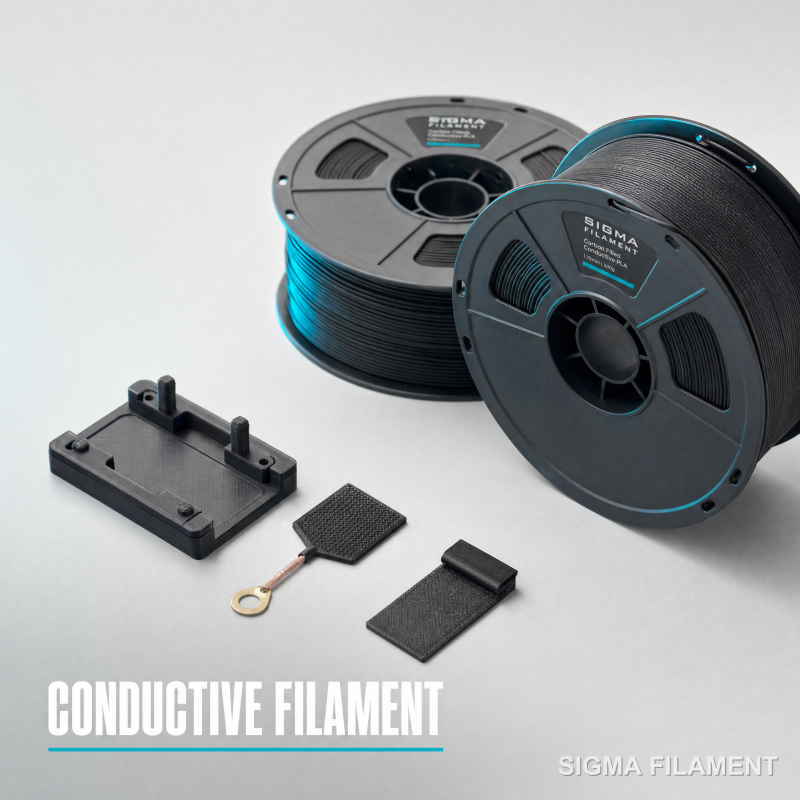
Two inorganic pigments do most of the heavy lifting. Carbon black, usually loaded at 0.5-3 percent by weight, gives the deepest opacity per gram of any pigment and absorbs UV across the solar spectrum, which is why black filament resists outdoor weathering longer than any tinted variant. Titanium dioxide (TiO2), loaded at 2-5 percent for opaque whites, delivers diffuse reflectivity that brightens prints but also reveals every surface imperfection. Matte additives, silk copolymers, glitter flakes, and metallic powders ride into the melt as dispersed solids that change appearance and, downstream, change how layers bond.
Color Families and Finishes: Standard, Silk, Matte, Transparent, Dual-Color, Gradient, Glitter, Metallic
Finish is the second axis of a filament color finder. Two spools sharing one hex code can look like different products once they are printed, because the pigment carrier, additive package, and base polymer change how light leaves the surface. A buyer choosing color for a product line has to pick the finish family at the same time as the hue, since finish affects perceived color and printability, then drives downstream wear on the nozzle.

| Finish | How it’s made / additive | Visual effect | Best use |
|---|---|---|---|
| Standard / opaque | Pigment masterbatch in standard PLA or PETG at roughly 1–4% by weight | Even neutral gloss, true-to-swatch color | General prototyping, functional parts, brand color matching |
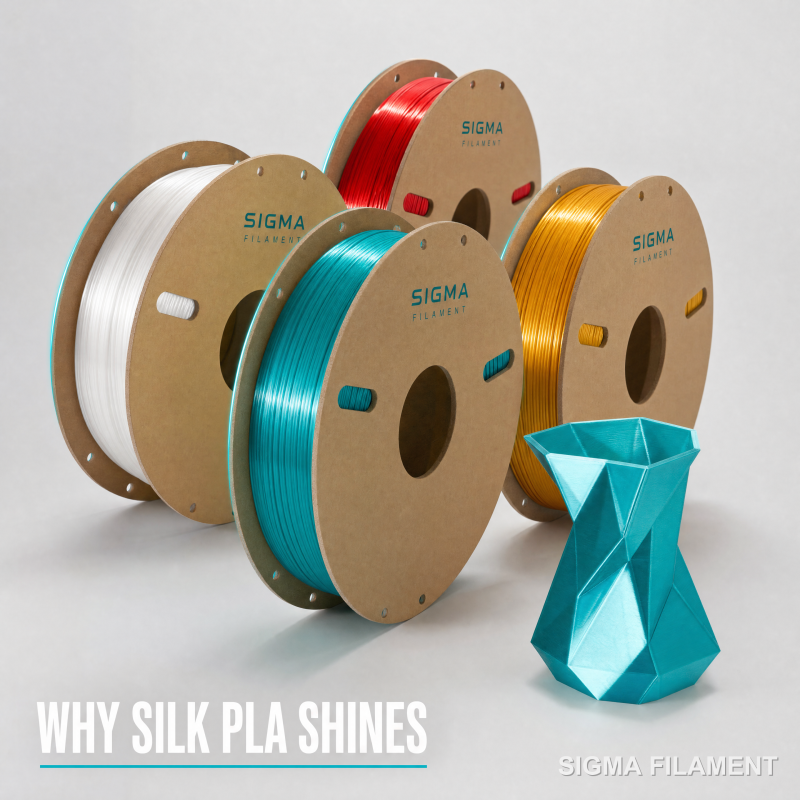
| Silk | PLA copolymer or silk additive that raises surface sheen | Soft satin shine, color reads more saturated | Decorative parts, vases, gift items, display models |
| Matte | Diffusing micro-filler (often a mineral particle) blended into the masterbatch | Flat, low-glare surface that hides layer lines | Cosplay props, architectural models, photo subjects |
| Transparent / clear | Uncolored or dye-toned PETG with no opacifying pigment | Light passes through, internal infill becomes visible | Lampshades, lenses, fluid reservoirs, light guides |
| Dual-color | Two pigment streams co-extruded into one strand | Color shifts as the viewing angle changes | Statement prints, signage, novelty enclosures |
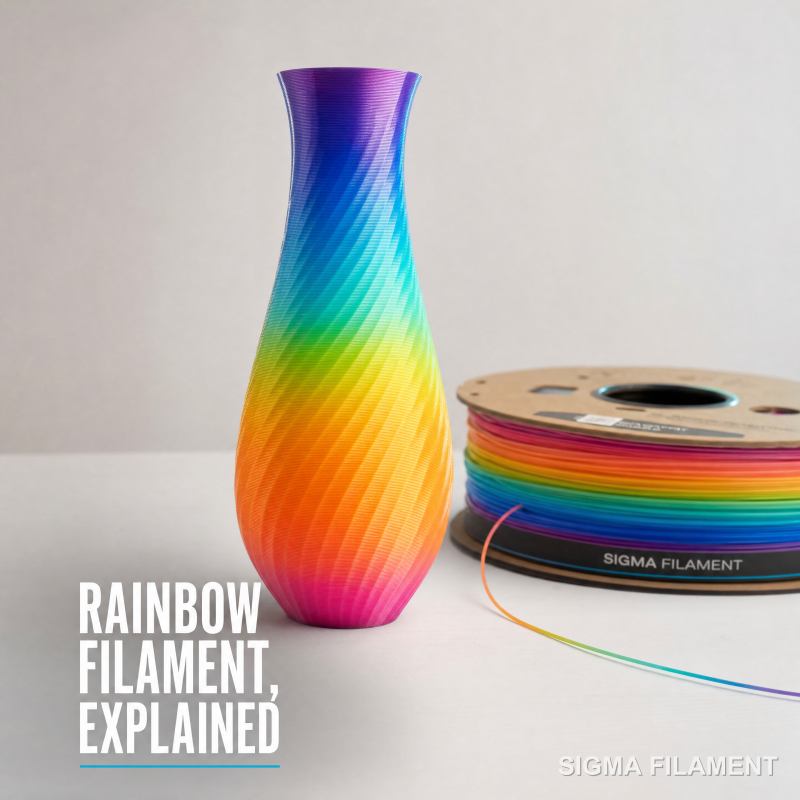
| Gradient | Programmed pigment dosing along the spool length | Slow color sweep from one hue to the next across a print | Vases, single-piece art prints, demo models |
| Glitter | Pigment plus reflective flake (mica, polyester, or aluminum) | Sparkle highlights against a base color | Ornaments, jewelry, children’s toys |
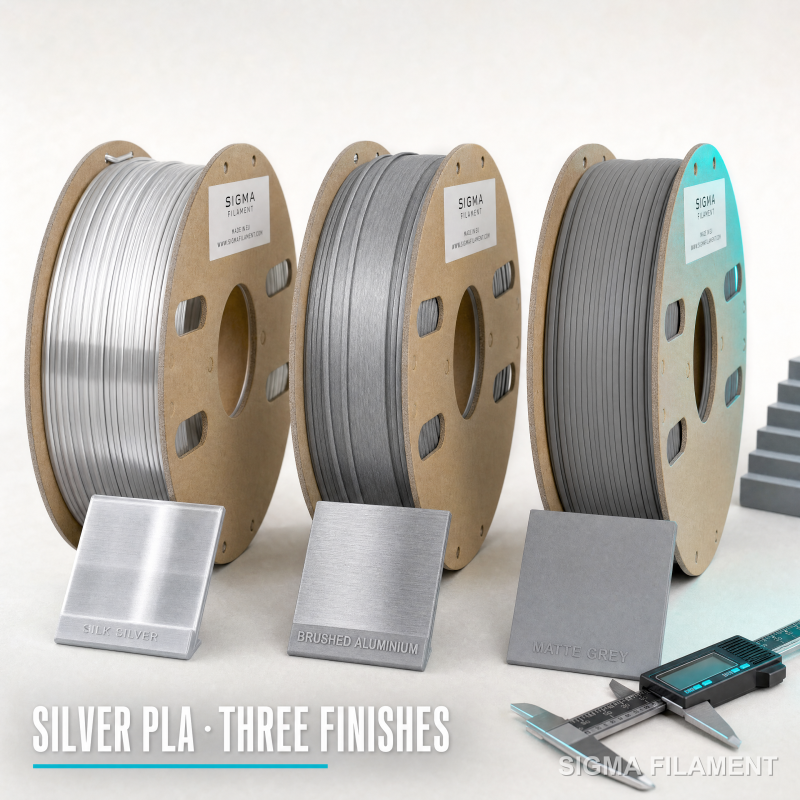
| Metallic | Metal powder or pearlescent mica suspended in the polymer | Brushed-metal look without metal weight | Trophy pieces, props, design mockups |
How a finish behaves at the nozzle matters as much as how it looks. Matte additives diffuse light by adding mineral particles, which also hide layer artifacts but can change extrusion behavior at high speed; the matte PLA versus standard PLA data comparison shows exactly how that filler load shifts measured strength. Silk grades amplify sheen but soften slightly and can blur fine detail. Transparent PETG reads as clear only when print speed is low and layer height is fine, so internal geometry does not scatter the light path; the slicer settings that unlock that result are documented in the clear PLA and transparent PETG guide. Glitter and metallic grades carry abrasive particles that wear brass nozzles quickly, so a hardened steel or ruby tip is the standard pairing on a production print farm.
The finish family also constrains the color match. A Pantone target hit in a standard opaque PLA will not read identically in a matte or silk version of the same hue, because diffusion and gloss shift the measured value at the spectrophotometer. Industry color-matching services typically quote a separate development run for each finish family, since the masterbatch recipe and additive ratio change between them. Multi-color systems such as the Bambu Lab AMS and the Prusa MMU3 combine stock colors at print time, which makes finish consistency across loaded spools a practical concern for any multi-material job. Print-farm buyers choosing AMS-friendly spools can use our shortlist of proven filaments for the Bambu P1S as a reference set when running mixed-color jobs.
Finish is also a mechanical decision, not only an aesthetic one. Peer-reviewed FDM PLA testing has reported that the pigment and additive package within a single brand can shift tensile strength by up to about 32% at identical print parameters (Gao et al., 2022). The recipe behind a finish changes how the part performs.
Color Measurement and Tolerancing: deltaE, CIEDE2000, and What "a Good Match" Means
Color matching stops being subjective the moment a number is attached to it. That number is deltaE (written ΔE or ΔE*00), a single value that quantifies how different two colors look to a human observer. A filament color finder that promises a "match" without a deltaE figure is making a visual claim, not a measurable one.
CIELAB and the CIEDE2000 formula
The measurement starts in CIELAB, a color space designed so that distances roughly correspond to perceived color differences. Every color is plotted as three coordinates: L* for lightness, a* for the red-to-green axis, and b* for the yellow-to-blue axis. A spectrophotometer such as an X-Rite handheld unit reads a physical sample under a controlled D65 daylight illuminant and reports those coordinates.
The CIE-developed CIEDE2000 formula then compares two CIELAB readings and returns a single perceptually uniform deltaE value (Sharma et al., 2005; Mokrzycki & Tatol, 2011). CIEDE2000 supersedes the older CIE76 Euclidean distance because CIE76 over-weights differences in some hues (notably blues) and under-weights others. For plastics and printed color today, ΔE*00 is the working standard.
Perception thresholds: what each deltaE band looks like
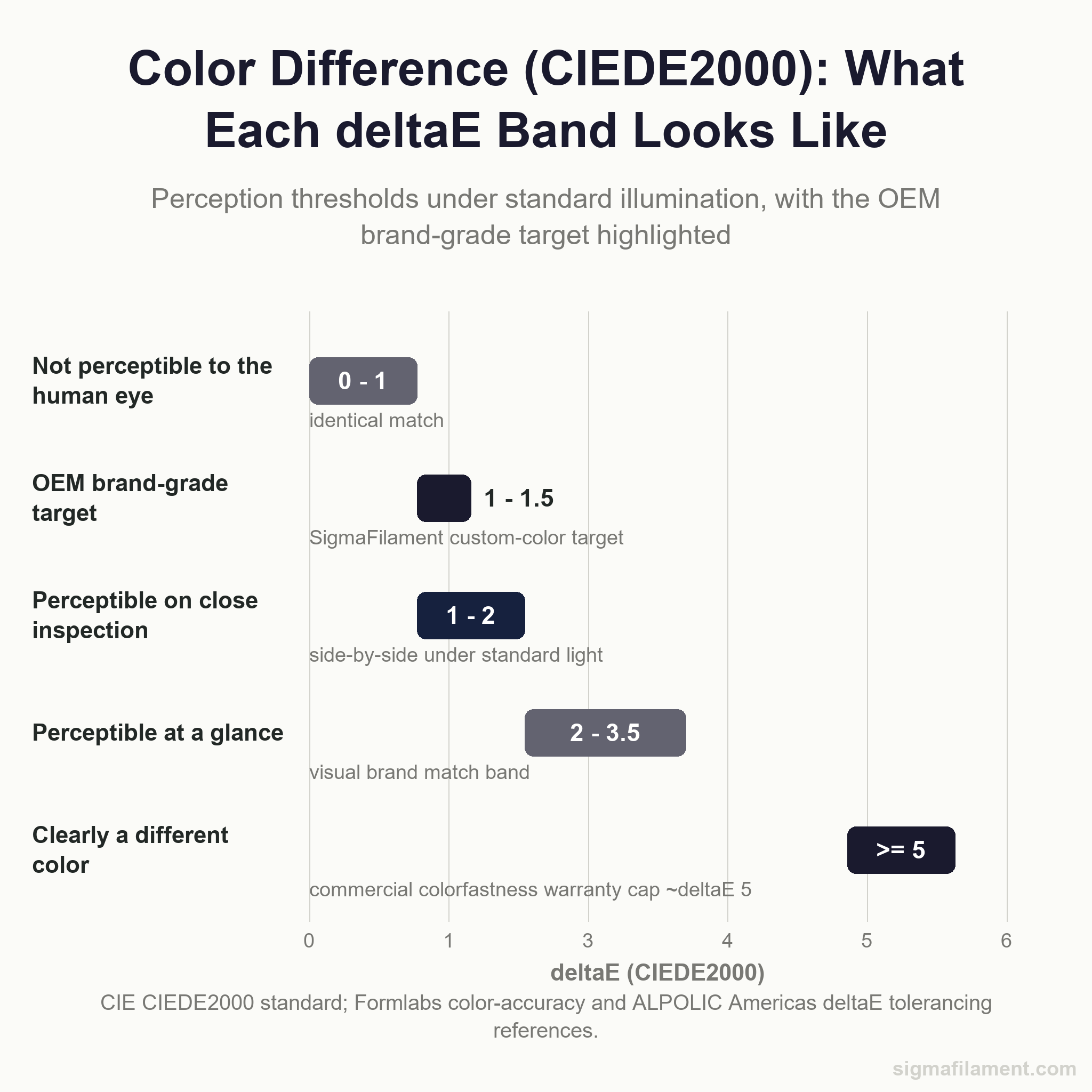
The perception scale is well established. A deltaE below 1.0 sits below the threshold most observers can distinguish under standard illumination. Between 1 and 2, a difference becomes visible only on close inspection with the samples touching. From 2 to 3.5, the difference is perceptible at a glance. Above 5, the two colors read as clearly different.
A realistic OEM color-match target lives inside this scale rather than below it. A ΔE under 1.5 is considered an excellent match for pigmented plastics, tighter than a typical visual brand match (ΔE 2 to 3) and well inside the band a customer accepts as "the same color" across a product line.
Choosing a tolerance for branding versus outdoor use
Outside the lab, the reference point shifts. Cross-industry colorfastness warranties use a much looser band: fluoropolymer-coated aluminum composite panels, for example, are commonly warranted to drift no more than ΔE 5 over a 10 to 30 year exposure life (Finn, 2021). That figure is not a match target. It is the maximum acceptable change over decades of UV and weather.
For a brand logo on a printed enclosure, ΔE under 1.5 at sign-off is the right number to write into the spec.
Matching a Pantone, RAL, or Brand Color to Filament: The Workflow That Works
A working brand-color match in 3D printer filament follows a defined production workflow, not a single tool lookup. The path runs from a clearly specified color target, through a lab dispersion and a measured plaque, into a sample-approval loop against a physical master, and finally into locked production with batch QC. Each step removes a category of error the prior one cannot catch.
What information a color match actually needs
A factory cannot quote, develop, or repeat a color from a vague brief. Four inputs are non-negotiable, and the brief stalls without all of them.
The first is the color reference itself: a Pantone PMS code with the coated or uncoated state declared, a RAL Classic or RAL Design number, a physical swatch or reference object, or a measured CIELAB or spectrophotometer reading. Digital RGB or HEX values are accepted only as a fallback, because their mapping to physical pigment is ambiguous. Second comes the target substrate. PLA, PETG, ABS, ASA, or a composite each render the same pigment dispersion differently, a consequence of resin tint, melt clarity, and crystallinity (the types of filament guide sorts these material families by how they take pigment). Finish is the third input. Gloss, matte, silk, transparent, or a filled grade (glitter, metallic, marble) shifts perceived color before any pigment is changed, because matte additives and silk copolymers alter how light leaves the surface. The fourth input is the acceptance tolerance: a deltaE target in CIEDE2000, scoped to the rendered substrate and finish under a stated illuminant. A visual brand match commonly lands in the deltaE 2 to deltaE 3 band, while OEM-grade matching targets under deltaE 1.5.
Why Pantone in plastic is an approximation
Pantone PMS is defined for ink-on-paper printing, calibrated against specific substrates and pressroom conditions. Reproducing a PMS color in extruded filament is universally treated by color-matching services as a closest-achievable approximation rather than a certified equivalent, because pigment behavior in molten polymer differs from ink on paper (Formlabs, 2023). The same caveat applies to RAL Classic, which was developed for coated metal surfaces. The deliverable is the nearest achievable plastic color to the named reference under defined viewing conditions, signed off against a physical master, not an ink-system equivalency claim.
The sample-approval loop, lead time, and sign-off
The production loop is short and measurable, and it hinges on a physical reference. After the brief is accepted, the factory develops a masterbatch recipe, extrudes a trial, measures the plaque against the target in CIEDE2000 with a spectrophotometer, and iterates the recipe until the deltaE target is reached. The customer then signs off on a physical master sample, which becomes the production reference. Industry-typical lead times run 4 to 6 weeks, extending to 8 to 10 weeks under seasonal load, with small-batch development fees commonly in the US$75 to US$350 range and frequently credited toward the first bulk order (Formlabs, 2023). Once locked, the color formula is held under NDA for ODM customers and reproduced batch to batch via automated gravimetric dosing and per-batch spectrophotometer QC against the signed master.
Industry custom-color filament services publish typical lead times of 4 to 6 weeks and small-batch development fees in the US$75 to US$350 range, with visual brand matches landing in the deltaE 2 to deltaE 3 band and OEM-grade matches at deltaE under 1.5 against a signed physical master (Formlabs, 2023).
Does Filament Color Affect Print Quality and Strength? The Data, Not the Rumor
Color is not a cosmetic layer painted onto an already-finished filament. Pigment is a functional additive compounded into the polymer melt, and it stays inside the printed part. So yes, color can measurably change how a print behaves. The honest answer is that the effect is real but usually smaller than the swing between materials, and consistency within a single supplier matters more than the color label on the spool.
The measured tensile and layer-adhesion swing between colors
Peer-reviewed FDM work shows that the pigment system can shift tensile strength by up to about 32% within one brand at unchanged print parameters (Gao et al., 2022). Testing of five colors of one PLA grade also tied tensile strength to each sample’s crystallinity, which tracked extruder temperature, so color and print temperature interact (Wittbrodt & Pearce, 2015).
These numbers matter for load-bearing parts and brackets, and for any geometry where layer-to-layer bonding is the failure mode. They matter less for decorative prints. They never override the much larger gap between, say, PLA and a glass-filled nylon.
Why pigment changes mechanical behavior
Pigments are insoluble particles dispersed through the melt. Once they harden into the part they act as physical inclusions in the polymer matrix. Some, including many inorganic pigments, behave as nucleating agents that speed crystallization and yield a stiffer, sometimes more brittle structure. Titanium dioxide raises stiffness and reflectivity. Carbon black at low loadings tends to plasticize the polymer slightly. Matte additives, usually silica or other diffusing particles, disrupt the smooth flow at the layer interface and can weaken layer adhesion, which is why matte finishes often score lowest on bond strength.
A separate practical benefit lives in the black-pigment column. Carbon black at loadings below 3% by weight is the most efficient UV absorber among common polymer additives (Liu & Horrocks, 2002). Black-pigmented PLA, PETG, or ABS therefore holds mechanical and visual properties far longer under sunlight than natural or pastel variants. For outdoor brackets, fixtures, or anything in a window, black is a defensible default before any aesthetic argument starts.
White, black, and surface-imperfection visibility
Color also changes what the eye sees on the surface. Titanium dioxide is the most widely used white pigment because of its brightness and very high refractive index (Wikipedia contributors, 2026), and white PLA typically relies on it. That brightness shows up shadow-cast surface variation, small under-extrusions, layer shifts, and stringing that darker, more absorbent filaments visually mask. This is why white prints look noisier even when the printer is dialed in. Black prints often look cleaner not because they are cleaner, but because their surface drinks the same shadows that white reflects.
The practical buyer rule is simple. Choose by material first, then by color within that material, then ask the supplier whether color-to-color consistency has been measured for the specific spool family on order.
Tools and Resources for Finding a Stock Filament Color
For a stock color you can buy today, four classes of resource cover most of the work: community color databases, brand color charts, slicer color libraries, and physical swatch packs. Each answers a different question, and using them in combination is what makes a filament color finder workflow reliable rather than a hopeful screen-color guess.
Community color databases and deltaE match tools
Community-driven databases are the closest thing to a true search engine for spool color. Two colors with similar RGB values can sit visibly apart in CIELAB, while two with very different hex codes may read as the same color to the eye, so any serious filament color finder match should run against measured swatches.
FilamentColors.xyz catalogues 3,349 measured swatches across 242 manufacturers as of mid-2026, scanned with a spectrophotometer and matched on perceptual color distance (deltaE) rather than naive RGB distance, which makes it the standard reference of this kind for stock 3D printer filament colors (FilamentColors.xyz, 2026). Treat HEX or RGB upload as a starting point, not a verdict.
Brand color tables and HEX/RAL/Pantone cross-references
Several manufacturers publish color tables that map each stock filament to its nearest RAL Classic number, Pantone PMS code, and HEX value. These are useful for narrowing candidates against a brand reference, but the cross-reference is approximate, since the underlying targets are defined for ink on paper rather than pigment in molten polymer.
Slicer color libraries, AMS pickers, and swatch packs
Slicer color libraries and the Bambu Lab AMS picker let you assign and preview stock colors at print time for multi-color jobs. None of these replace a physical sample. Screen colors lie under unknown viewing conditions, so ordering a swatch pack and judging the spool side by side under a consistent D65 light source is the only reliable final step in any filament color finder workflow before committing to a bulk order or a brand-critical part.
When Stock Won’t Do: B2B Custom-Color Filament (MOQ, Lead Time, and How a Factory Matches Your Color)
A stock palette runs out of answers the moment a brand color has to be exact, identical across every batch, and stable across years of reorders. At that point the filament color finder stops being a database lookup and becomes a manufacturing brief. This section covers when that switch is worth making, what production volumes and timelines look like, and how a factory actually walks a color from a reference card to a locked formula.
When custom color is the right call
Three buyer situations justify custom-color filament. First, a brand-critical product where the color IS the recognition (corporate red on enclosures, signature pastel on a consumer device, school colors on a merchandise line). Second, a product line that needs the same color across many SKUs, batches, and reorders, because stock colors drift between supplier lots and between supplier brands, a problem resellers handle by optimizing their SKU mix around colors that sell. Third, a shade or finish stock simply cannot reach: pearl-effect navy, a specific RAL Design number, a Pantone with a coated finish call-out, or a translucent tinted in a non-catalog hue. For prototypes, single-spool jobs, or color-flexible runs, stock plus a good chart still wins on cost and speed.
MOQ tiers and lead time
Industry-typical custom-color filament services quote small-batch development fees in the US$75-350 range for hobbyist single-spool color matches, often credited toward a first bulk order, with lead times of 4-6 weeks for standard custom production and 8-10 weeks on seasonal peak demand (Formlabs, 2023). Before committing to either path, the checklist for vetting a wholesale filament maker covers the seven supplier-quality factors that decide whether a quoted MOQ actually translates into usable production output.
Recurring branded production sits at production MOQs. Sigma Filament’s published terms are samples at 1-3 spools, stock-color OEM from 100 spools, and custom-color OEM from 500 spools, with 100% virgin NatureWorks PLA pellet input, ISO 9001:2015 quality system, automated gravimetric masterbatch dosing, and dual-axis laser diameter monitoring on every extrusion line. For the broader B2B sourcing picture across PLA grades and supplier types, our bulk PLA filament sourcing guide walks through MOQ tiers, pricing benchmarks, and quality criteria.
| Path | Typical MOQ | Typical lead time | Typical deltaE target | Best-fit buyer |
|---|---|---|---|---|
| Stock OEM (private label, stock color) | 100 spools | 2-3 weeks | n/a (stock color) | Resellers, print farms |
| Small-batch custom (single-color trial) | 1 spool + dev fee US$75-350 | 3-5 weeks | deltaE 2-3 | Hobby prototypes, color trials |
| OEM custom color (branded production) | 500 spools | 4-6 weeks (8-10 peak) | deltaE under 1.5 | Brand-critical product lines |
How a factory matches and locks a color to deltaE under 1.5
The match process is a closed loop, not a one-shot pour. The factory receives the target reference: a Pantone PMS code with coated or uncoated state, a RAL Classic or RAL Design number, a physical swatch, a reference object, or a measured CIELAB reading. Color engineers then formulate a masterbatch recipe sized to the resin and finish, extrude a small trial, and read the cooled filament on a spectrophotometer against the target using the CIEDE2000 formula. The CIE-defined CIEDE2000 (deltaE*00) is the current industry standard for quantifying perceived color difference, with deltaE under 1.0 sitting below the threshold of human discrimination under standard illumination (Sharma et al., 2005; Mokrzycki & Tatol, 2011). Trial-and-read cycles iterate until the measured difference falls under the target tolerance, at which point a physical reference is signed off and the masterbatch formula is locked. For ODM work the locked formula is protected under NDA so the same color reproduces, batch after batch, for the life of the program.
Buyers ready for that loop can request samples or a quote from the Sigma Filament OEM/ODM team, or browse the wholesale PLA and product catalog for stock-color baselines.
Buyer Decision Framework: Choosing the Right Color and the Right Path
A filament color finder is only as useful as the path it points you to. The right path is set by three variables, in this priority order: how exact the color must be, how many spools have to match each other, and whether the part will see sun, load, or wear. Most buyer guides invert this order and lead with cost, which pushes brand-critical jobs onto stock palettes and load-bearing parts onto whichever color the print farm has in stock.
Match the path to the buyer
Map the scenario to the path before shopping. Prototyping and one-off prints sit on Path 1: pick a stock color through a finder tool, order a swatch pack or one spool, and accept whatever deltaE the brand happens to produce. A small commercial run with flexible color sits between Path 1 and Path 2: choose the closest stock to a RAL or Pantone reference and confirm with a physical sample. Brand-critical product lines belong on Path 3: a custom OEM batch matched to deltaE under 1.5, with a defined MOQ, sample-approval loop, and a locked masterbatch formula for repeat orders. Buyers who land on stock at production volume can cross-reference the bulk 3D printer filament buyer’s guide for current pricing tiers and supplier categories.
When color preference yields to durability
Pigment chemistry decides outdoor life and part strength, not just shade. Carbon-black-pigmented filament absorbs UV more efficiently than any common alternative at under 3% loading, so outdoor or load-bearing parts default to black regardless of the original color brief (Liu & Horrocks, 2002). Where a brand color is non-negotiable on an outdoor part, plan on overprinting, painting, or stepping up to a UV-stable resin family rather than fighting the pigment.
| Buyer scenario | Recommended path | Color tolerance to expect | Key trade-off |
|---|---|---|---|
| Hobby or single prototype | Path 1: stock finder + swatch pack | deltaE 3 to 5, brand-dependent | Lowest cost; no consistency guarantee batch to batch |
| Small commercial run, flexible color | Path 1 plus RAL or Pantone close-match | deltaE 2 to 3 typical visual match | Faster than custom; color drifts between brands |
| Brand-critical product line at volume | Path 3: custom OEM batch | deltaE under 1.5, locked formula | Higher MOQ from 500 spools, 4 to 6 week lead time |
| Outdoor or load-bearing part | Carbon-black PLA or ASA, any path | Color preference yields to UV and strength | Limited shade choice; durability wins |
Frequently Asked Questions
How do I find the exact filament color I need?
Pick one of three paths based on need. For a stock color, use a community color database that catalogues thousands of measured swatches and matches on perceptual deltaE rather than naive RGB (FilamentColors.xyz, 2026). For a brand-color match, cross-reference RAL, Pantone, or HEX charts. For an exact, repeatable production color, commission a custom batch matched to a stated deltaE tolerance.
Is there a color chart for 3D printer filament?
Yes. Two kinds exist. Brand color charts list each stock SKU with its nearest RAL and Pantone codes plus a HEX cross-reference. Community databases such as FilamentColors.xyz catalogue measured swatches across hundreds of brands and rank candidates by CIEDE2000 distance from a target (FilamentColors.xyz, 2026), which is more accurate than HEX-only matching.
Can I match a Pantone or RAL color in 3D printer filament?
Yes, but treat it as an approximation. Pantone PMS codes are defined for ink on paper, so pigment behavior in molten polymer can shift the perceived color (Formlabs, 2023). For visual brand work, a deltaE 2 to 3 match is typical. Custom-color OEM production can lock a match to deltaE under 1.5 against the physical reference.
What deltaE value is acceptable for filament color matching?
Use the CIEDE2000 perception bands. Below 1.0 is imperceptible to the human eye under standard light, 1 to 2 is perceptible only on close inspection, and 2 to 3.5 is perceptible at a glance (Sharma et al., 2005; Mokrzycki & Tatol, 2011). Brand-grade OEM matching typically targets deltaE under 1.5, which sits between imperceptible and just-noticeable.
Does filament color affect strength?
Yes, measurably. A peer-reviewed FDM study found the pigment system can shift tensile strength by up to about 32 percent within one brand at unchanged print settings (Gao et al., 2022). Pigments act as nucleating agents or interferents during crystallization, so color choice matters for load-bearing parts.
How are 3D printer filaments colored, pigment or dye?
Pigment, not dye. Filament makers extrude natural virgin resin pellets with a pigment-laden masterbatch concentrate dosed at roughly 1 to 4 percent by weight (Alsadi et al., 2024). Dyes dissolve in the polymer and tend to bleed or migrate, so they are rarely used. Carbon black and titanium dioxide are the workhorse pigments for black and white.
What is the MOQ and lead time for custom color filament?
Industry-typical lead time for custom-color production runs 4 to 6 weeks, extending to 8 to 10 weeks during seasonal demand (Formlabs, 2023). Small-batch development fees fall in the rough US$75 to US$350 range. Stock-color OEM MOQ commonly starts around 100 spools, with custom-color OEM MOQ from 500 spools and 1 to 3 spool samples available.
What information does a filament factory need to match a custom color?
Four inputs. The color reference, ideally a Pantone PMS code with coated or uncoated state, a RAL number, or a measured CIELAB reading from a spectrophotometer. The substrate (PLA, PETG, or ABS shifts achievable color). The finish (gloss, matte, or silk changes perceived color). And the acceptance tolerance expressed as a deltaE target (Sharma et al., 2005; Mokrzycki & Tatol, 2011).
Why does white PLA show every imperfection?
Titanium dioxide, the most widely used white pigment, is prized for its brightness and very high refractive index (Wikipedia contributors, 2026); on a print, that brightness shows every shadow cast by minor extrusion artifacts, layer shifts, or stringing. Darker pigments absorb that light instead of scattering it, masking the same imperfections. Use a matte or darker color when surface forgiveness matters more than visual brightness.
Are Pantone-certified 3D printer filaments worth it?
Worth it when brand color is critical across a product line, but understand the limit. Pantone in plastic is always an approximation because pigment in polymer differs from ink on paper (Formlabs, 2023). A factory matched to deltaE under 1.5 against a physical Pantone chip, with the formula locked for repeat batches, delivers consistent results even though the match is not a certified equivalent.
Conclusion
A filament color finder is not one tool but three paths, and the right one depends on how exact the color must be, how much spool volume the run demands, and how tightly batches need to match across a product line. Browsing a stock palette through a community database or brand chart solves casual and prototype needs. Measuring a target against a Pantone, RAL, or CIELAB reference and accepting a visual approximation handles most small commercial runs. Commissioning a custom-color batch is the only path that locks an exact, repeatable color into production, with CIEDE2000 deltaE under 1.5 as the practical bar for an excellent brand-grade match. Color is also a functional choice, since pigment chemistry quietly shifts tensile behavior, layer adhesion, and UV life alongside appearance.
Buyers needing an exact or consistent custom color across a product line can browse the SigmaFilament product catalog or request a custom-color quote and samples from the SigmaFilament team.
References
- Gao, G., Xu, F., Xu, J., & Liu, Z. (2022). Study of material color influences on mechanical characteristics of fused deposition modeling parts. Materials, 15(19), 7039. https://doi.org/10.3390/ma15197039
- Wittbrodt, B., & Pearce, J. M. (2015). The effects of PLA color on material properties of 3-D printed components. Additive Manufacturing, 8, 110-116. https://doi.org/10.1016/j.addma.2015.09.006
- Wikipedia contributors. (2026). Titanium dioxide. In Wikipedia, The Free Encyclopedia. https://en.wikipedia.org/wiki/Titanium_dioxide
- Alsadi, J., Alawneh, A., Khatatbeh, A. A., Abdel Wahed, M., Alseafan, M., & Alomari, S. (2024). Evaluating processing parameter effects on polymer grades and plastic coloring: Insights from experimental design and characterization studies. Polymers, 16(23), 3409. https://doi.org/10.3390/polym16233409
- Sharma, G., Wu, W., & Dalal, E. N. (2005). The CIEDE2000 color-difference formula: Implementation notes, supplementary test data, and mathematical observations. Color Research & Application, 30(1), 21-30. https://doi.org/10.1002/col.20070
- Mokrzycki, W. S., & Tatol, M. (2011). Palette generation in Lab* colour space using ΔE. Advances in Intelligent and Soft Computing, 95, 279-285. https://doi.org/10.1007/978-3-642-20320-6_29
- Formlabs. (2023). Color accuracy and Delta E explained: Considerations for color tolerancing. Formlabs Blog. https://formlabs.com/blog/color-accuracy-delta-e/
- Finn, J. (2021, April 7). How is color measured? Calculating Delta E. ALPOLIC Americas. https://alpolic-americas.com/blog/how-is-color-measured-calculating-delta-e/
- Liu, M., & Horrocks, A. R. (2002). Effect of carbon black on UV stability of LLDPE films under artificial weathering conditions. Polymer Degradation and Stability, 75(3), 485-499. https://doi.org/10.1016/S0141-3910(01)00252-X
- FilamentColors.xyz. (2026). Real colors, auto-generated color palettes, color match tool. https://filamentcolors.xyz/
Last reviewed and updated: June 2026. Author: SigmaFilament team. For tailored guidance, contact our team.