Black PLA: The Complete 2026 Guide to Properties & Sourcing


TL;DR
Black is the most-printed filament color, but black PLA is not just PLA that happens to be black. The color comes from a carbon black masterbatch dispersed at about 1-3 wt% in virgin PLA, and carbon black acts as a heterogeneous nucleating agent: it raises crystallinity without moving the glass transition (~60 C), and it changes mechanical properties non-linearly (tensile peaks near 0.5 wt%, Izod impact rises about 24.6% near 1.0 wt%, flexural peaks near 2.5 wt%). Peer-reviewed testing ties a colored PLA’s tensile strength to its crystallinity, which tracks print temperature. Print settings stay inside the standard PLA window. At volume, the variables that matter are virgin resin, batch DeltaE2000 color consistency, and carbon-black-content verification by ASTM D1603.
Abstract
Black is the most-printed filament color, yet black PLA is not simply PLA that happens to be black. It is virgin polylactic acid pigmented with a carbon black masterbatch at roughly 1 to 3 percent by weight, and that pigment is a functional additive rather than a cosmetic one. Carbon black acts as a nucleating agent, raising the crystallinity of PLA while leaving its glass transition near 60 degrees Celsius effectively unchanged, which is why color is a material decision and not just an aesthetic one.
The sections that follow define what black PLA actually is and why black dominates demand. They quantify how carbon black shifts mechanical and thermal behavior in non-linear ways, then set out the print settings that work, which stay inside the standard PLA window. The finish variants (matte, glossy, silk, satin) get a side-by-side treatment, followed by when to choose black PLA over black PETG or ABS, real applications, the B2B sourcing factors that matter at production volume, and whether carbon black is safe to print. Every quantitative claim is tied to peer-reviewed work or a recognized standard, so an engineer, reseller, or print-farm buyer can make a defensible decision rather than relying on forum folklore.
Key Takeaways
- Black PLA is virgin PLA colored with a carbon black masterbatch at about 1 to 3 percent by weight, not a different polymer.
- Carbon black nucleates PLA, raising crystallinity while leaving the roughly 60 degree Celsius glass transition unchanged.
- Properties shift non-linearly with pigment loading: tensile strength peaks near 0.5 percent, and Izod impact rises about 24.6 percent near 1.0 percent.
- Color and print temperature interact: in peer-reviewed testing of five colors of one PLA grade, tensile strength tracked crystallinity, and crystallinity tracked extruder temperature.
- Print settings stay in the standard PLA window: nozzle roughly 190 to 220 degrees, bed 45 to 65 degrees, with full part cooling. Black needs no special temperatures.
- Finish drives the practical choice: matte, glossy, silk, and satin black differ by additive, surface look, and small strength trade-offs.
- At volume, sourcing matters most: virgin resin, batch deltaE2000 consistency at or below 5, and carbon-black content verified to ASTM D1603.
Table of Contents
- TL;DR
- Abstract
- Key Takeaways
- Table of Contents
- What Is Black PLA? Carbon Black, Masterbatch, and the Pigment Behind the Color
- Why Black Is the Most-Printed Color: Demand, Aesthetics, and Function
- How Carbon Black Affects PLA Mechanical and Thermal Properties
- Black PLA Print Settings: Nozzle, Bed, Speed, Retraction, and Cooling
- Matte vs Glossy vs Silk vs Satin: Black PLA Finish Variants and When to Use Each
- Black PLA vs Black PETG vs Black ABS: Choosing the Right Black Filament
- Common Applications for Black PLA in Functional and Visible Parts
- B2B Sourcing: MOQ, Virgin Resin, Batch DeltaE Consistency, and OEM Customization
- Carbon Black Safety, REACH, and RoHS: Is Black PLA Safe to Print?
- Frequently Asked Questions
- Conclusion
- References
What Is Black PLA? Carbon Black, Masterbatch, and the Pigment Behind the Color
Black PLA is virgin polylactic acid colored by a carbon black masterbatch, a concentrate of carbon black pre-dispersed in a PLA carrier resin, let down into the finished filament at typically 1 to 3 wt% pigment loading (Masiuchok et al., 2022; SpecialChem, 2024). The polymer backbone is the same PLA used in any other color. The pigment is a functional additive, not just a tint.
Carbon black masterbatch and typical 1-3 wt% loading
Carbon black is a fine engineered form of elemental carbon, produced from controlled hydrocarbon combustion or thermal decomposition, with primary particle sizes in the 10 to 500 nm range. It is the dominant black pigment used across the plastics industry because no other colorant matches its tinting strength per unit mass, opacity, or UV-light absorption. Raw carbon black powder, however, is light and dusty, and it agglomerates readily. Compounding it directly into PLA pellets on a desktop extruder produces poor dispersion and streaking, with loading that drifts from one meter of filament to the next.
A masterbatch fixes both problems at once. The pigment is pre-dispersed at high concentration into a PLA carrier resin under controlled shear, then pelletized. The filament producer meters the concentrate into virgin PLA at a calibrated let-down ratio, usually targeting 1 to 3 wt% carbon black in the final extrudate. That window is wide enough to reach full opacity on a 0.4 mm nozzle, narrow enough to keep cost in check, and consistent with the loadings most widely studied in the peer-reviewed PLA literature.
How the pigment disperses in the PLA matrix
Black PLA is chemically still PLA. The lactide backbone, the molecular weight distribution, and the residual catalyst chemistry track the input resin. What changes is the solid-state structure. Carbon black particles act as heterogeneous sites within the polymer matrix, and how evenly they sit there governs both surface uniformity and the mechanical effects covered in a later section. Good dispersion produces an even matte or gloss surface and predictable layer-to-layer extrusion. Poor dispersion shows up as visible specks, gray streaking, or local viscosity spikes that read on print as inconsistent flow.
Quantifying and grading: ASTM D1603 and ISO 18553
Two test methods anchor quality control at the spool level. ASTM D1603 quantifies carbon black content in olefin-based plastics by thermogravimetric pyrolysis, and the same protocol is used by labs to verify pigment loading in finished black PLA. ISO 18553 is the rating standard for pigment dispersion, scoring how evenly the carbon black is distributed across a thin cross-section under microscopy (ASTM International, 2020; ISO, 2025). Buyers sourcing at volume should expect both numbers on the certificate of analysis.
Why Black Is the Most-Printed Color: Demand, Aesthetics, and Function
Black sits at or near the top of filament sales across hobbyist storefronts, marketplace category pages, and B2B catalogs, with retailer SKU breadth and community surveys consistently placing it in the top 1-3 colors (SpecialChem, 2024). The pull is part visual, part functional, and part operational.
Aesthetic neutrality and prototyping
Black reads as the default "finished" surface. It pairs with any design, hides minor color drift between batches, and looks like an intentional product rather than a colored sample. For design-review prototypes and client-facing mockups, a black part communicates form without the distraction of a saturated hue. Matte black PLA goes further by scattering specular highlights, which softens visible layer lines on curved surfaces and makes FDM parts photograph closer to injection-molded references.
Hidden internal parts and low specular reflectance
Many printed parts are never seen once installed: brackets, mounts, cable guides, internal fixtures. Black is the conventional choice because it disappears into shadow. The same low-reflectance behavior carries a functional payload. The material is a frequent pick for photography props, light-tight camera enclosures, telescope baffles, and lens-rig adapters where stray reflection degrades the optical path (SpecialChem, 2024). A filament built around a carbon black masterbatch absorbs across the visible spectrum, which is why it outperforms tinted dark colors for these uses rather than just looking similar.
Default-color economics for print farms
Operations that run multiple printers around the clock concentrate volume on one or two SKUs. Black is the orthodox pick because reorders match prior batches with little visible color shift, color-matching tolerance is forgiving, and one high-volume SKU simplifies inventory. Across retailer SKU breadth and community-reported purchasing, black filament consistently ranks among the top one to three colors sold, a community signal triangulated by manufacturer catalog depth rather than treated as standalone evidence.
How Carbon Black Affects PLA Mechanical and Thermal Properties
The carbon black masterbatch that pigments the filament is not inert. At print-relevant loadings of roughly 1 to 3 wt%, the pigment particles measurably shift how the polymer crystallizes, how it absorbs energy under impact, and how the melt flows through a 0.4 mm nozzle. The differences are real, modest, and non-linear with loading, which means more pigment is not uniformly better.
Carbon black as a heterogeneous nucleating agent
Carbon black acts as a heterogeneous nucleating agent inside the PLA matrix. Each well-dispersed particle gives a growing spherulite a surface to start on, so the same polymer crystallizes faster and to a higher degree of crystallinity Xc than the unpigmented base resin (Vidakis et al., 2021). The thermal landmarks that buyers actually care about, however, barely move. Higher crystallinity does not raise the glass transition, which stays at about 60 degrees Celsius with or without pigment, and the melting point Tm shifts only slightly. In practical terms, the heat ceiling of black PLA is the heat ceiling of PLA, and the gain from nucleation shows up as slightly tougher crystalline regions rather than as a higher service temperature.
Non-linear mechanical response to loading level
Mechanical properties do not climb monotonically with carbon black content. A peer-reviewed Vidakis et al. (2021) loading series on FFF-printed PLA (N=6 loading levels spanning 0.5 to 5.0 wt% carbon black) reports three distinct peaks at different loadings: tensile strength peaks near 0.5 wt% CB, Izod impact strength rises approximately 24.6% near 1.0 wt% CB (Vidakis et al., 2021), and flexural strength peaks near 2.5 wt%. The same non-monotonic pattern shows up in other carbon-additive PLA grades, where loading windows that maximize stiffness do not also maximize toughness. Past those peaks, particle agglomeration becomes the limiting factor and the same property reverses direction. The takeaway for a buyer reading a spec sheet is structural: a "more black" formulation is not automatically stronger, and the loading window that maximizes one property is not the same window that maximizes another.
Empirical color-vs-strength testing
Printed-part testing points the same way. A peer-reviewed study printed five colors of the same 4043D PLA grade (white, black, blue, grey and natural) and found tensile strength tracked each sample’s crystallinity, which in turn tracked extruder temperature (Wittbrodt & Pearce, 2015). Filament color is a carrier of additive chemistry, so test the exact black grade you plan to stock at your production temperature rather than assume it behaves like another color.
Rheology and the evidence gap at print-relevant loadings
Melt behavior follows the same theme of measurable but bounded effect. The shear viscosity of carbon-black-filled PLA is well described by the Carreau-Yasuda model with a Newtonian plateau at low shear and a shear-thinning region above it; an apparent activation energy of viscous flow near 143.7 kJ per mole has been measured at high loadings around 21 wt% (Marion et al., 2024; Vidakis et al., 2021). Two honest caveats apply for FDM black PLA. First, those rheology numbers come from loadings far above the 1 to 3 wt% used in pigmentation. Second, systematic rheology across the 190 to 220 degrees Celsius print window at each step from 1 to 3 wt% remains an evidence gap in the published literature.
Vidakis et al. (2021, MDPI C, 7(3), 52) characterized PLA/carbon-black nanocomposites at 0.5-5.0 wt% loading and observed an Izod impact gain on the order of 25% near 1.0 wt% carbon black, with tensile and flexural strength peaking at separate loadings.
Black PLA Print Settings: Nozzle, Bed, Speed, Retraction, and Cooling
Black PLA prints in the same window as natural, white, or any other PLA color. The pigment changes crystallization behavior at the polymer-physics level, but it does not move the operating envelope a typical slicer ships with. Anyone advising a hotter nozzle just because the filament is black is repeating a myth that the data does not support (Forster, 2015). Speed and flow trade-offs follow the same PLA print-speed envelope regardless of color.
Temperature, bed, and cooling
A workable starting point for black PLA on a 0.4 mm nozzle sits squarely inside the standard PLA window: nozzle 190 to 220 C (most spools land at 200 to 215 C), bed 45 to 65 C, and part cooling at 100% after the first one or two layers. First-layer bed adhesion benefits from the higher end of the bed range on PEI or textured plates. Glossy black behaves identically to natural PLA across the same window. Matte and silk variants may prefer the upper third of the nozzle window because their additive packages slightly raise melt viscosity.
Speed, retraction, and volumetric flow
Print speeds of 40 to 80 mm/s work without drama, and modern high-flow hotends extend that further provided volumetric flow stays at or below roughly 9 mm3/s on a 0.4 mm nozzle. Retraction follows standard PLA practice: 1 to 2 mm on direct-drive, 2 to 5 mm on Bowden, with retraction speed near 35 to 45 mm/s. Layer heights from 0.05 to 0.2 mm are all viable; the pigmented filament does not punish thin layers or coarse drafts differently than other colors.
Does black PLA need different settings? Matte abrasion and heat absorption
Two real nuances justify mention. First, matte black grades carry a matting additive that is mildly more abrasive than glossy black, so a hardened steel nozzle pays off on long production runs even though the filament is unfilled. Second, a printed black surface absorbs more radiant and ambient heat than light colors, which combined with the nucleation effect of carbon black means crystallinity and heat resistance can climb slightly with marginally slower cooling on thick walls. On fine detail and bridges, the standard advice still applies: keep the fan at 100% and let geometry, not color, dictate cooling tweaks.
Matte vs Glossy vs Silk vs Satin: Black PLA Finish Variants and When to Use Each
Black PLA is sold in four common surface finishes, and the difference is not cosmetic dressing. Each finish reflects a specific additive package on top of the carbon black masterbatch, and each package shifts how the printed part looks, how forgiving it is of layer lines, and how it behaves under load. The comparison table below maps the four black pla finishes against the trade-offs that matter at the slicer and on the bench.
| Finish | Additive or mechanism | Appearance | Hides layer lines | Strength note | Best use |
|---|---|---|---|---|---|
| Matte black | Carbon black plus a matting filler (often a mineral or amorphous silica) | Low gloss, deep velvety surface | Best of the four | Depends on the matting filler; test the exact grade before load-bearing use | Visible enclosures, photography props, prototypes shown to stakeholders |
| Glossy (standard) black | Standard carbon black masterbatch only | Smooth, specular highlights | Lowest | Baseline reference for tensile and impact in PLA color studies | High-detail visual parts, parts that are polished or painted afterward |
| Silk black | Carbon black plus a sheen modifier, typically a co-polyester or elastomer blend | High-luster, near-metallic reflective sheen | Moderate | Lower interlayer adhesion and reduced tensile strength than standard PLA in most vendor data | Decorative models, display pieces, low-stress aesthetic parts |
| Satin black | Carbon black plus a partial matting package | Semi-gloss, between matte and standard | Moderate to good | Close to standard PLA mechanically; small drop versus glossy | Functional-visible hybrids, fixtures shown to clients, signage backers |

Matte black is the workhorse when a part has to look finished straight off the bed. The matting filler scatters reflected light across the layer surfaces, so seams disappear visually, and the same filler stiffens the melt slightly during crystallization. The broader matte versus standard PLA comparison covers how the matting additive shifts surface finish and abrasion resistance, alongside its measured strength penalty, across every color the additive ships in. Glossy standard black is the baseline carbon black formulation and prints with the smoothest extrusion. Its specular highlights, though, make every layer line and every minor under-extrusion visible.
Silk black trades mechanical performance for sheen, which is acceptable for display work and a poor choice for parts under load. Satin black sits between matte and glossy and is the safe pick when visual polish and structural reliability are both required.
Black PLA vs Black PETG vs Black ABS: Choosing the Right Black Filament
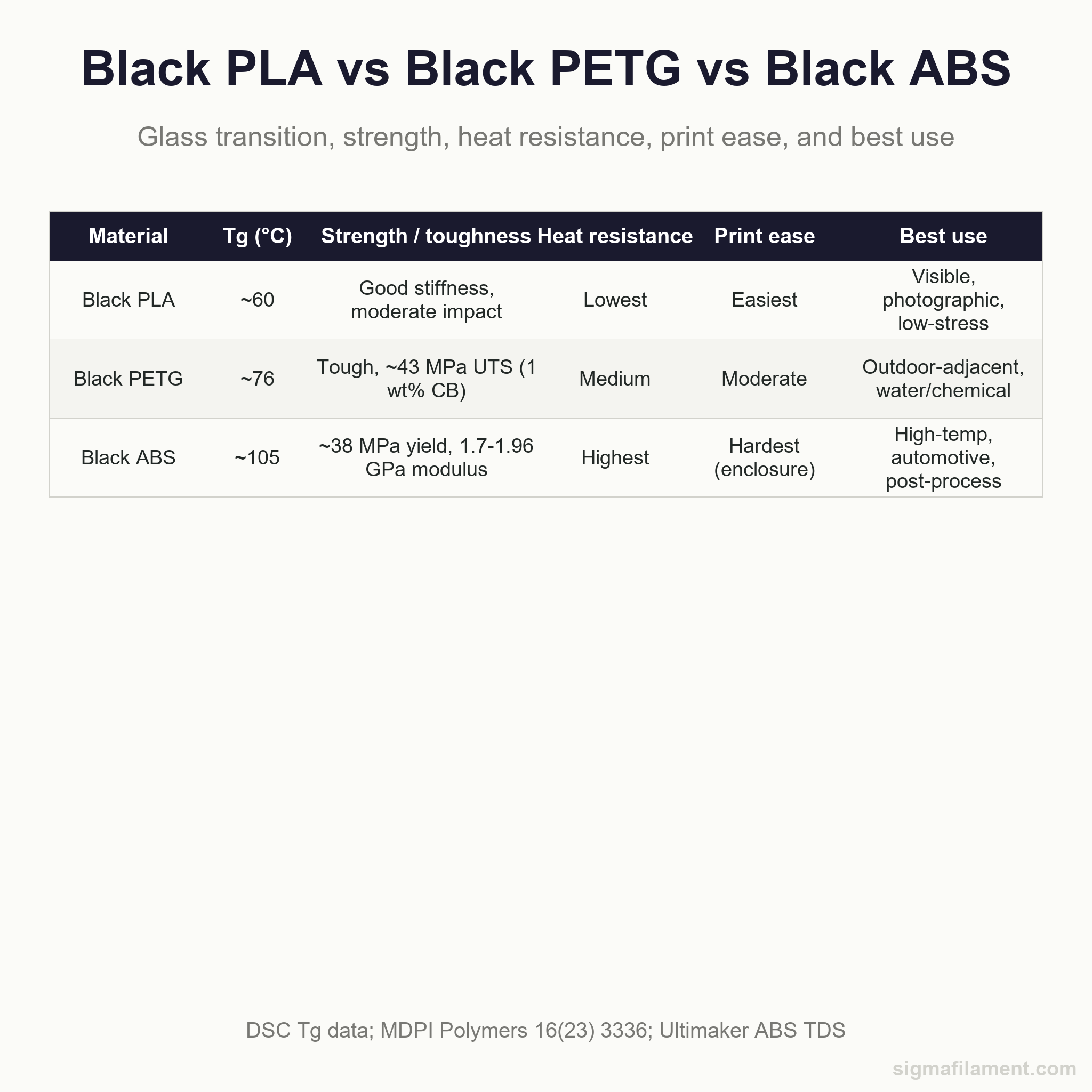
Choosing among the three dominant black FDM materials comes down to one trade-off triangle: heat resistance versus print ease versus toughness. Black PLA wins on print ease and dimensional precision, black PETG wins on water and chemical contact resistance, and black ABS wins on heat tolerance and post-processability. The hard numbers are glass transition temperature (Tg), tensile and yield strength, and the size of the printable process window (Vidakis et al., 2021).
| Material | Tg (°C) | Strength / toughness | Heat resistance | Print ease | Best use |
|---|---|---|---|---|---|
| Black PLA | ~60 | Good stiffness, moderate impact | Lowest | Easiest | Visible, photographic, low-stress |
| Black PETG | ~76 | Tough, ~43 MPa UTS (1 wt% CB) | Medium | Moderate | Outdoor-adjacent, water/chemical |
| Black ABS | ~105 | ~38 MPa yield, 1.7-1.96 GPa modulus | Highest | Hardest (enclosure) | High-temp, automotive, post-process |
Glass transition and heat resistance: ~60 vs ~76 vs ~105 C
Glass transition is the temperature at which the amorphous regions of the polymer soften and the part begins to creep under load. For black PLA, Tg sits near 60 C, which is why an unmodified PLA part deforms inside a parked car on a summer afternoon. Black PETG raises that ceiling to roughly 76 C, and black ABS clears 100 C with a Tg near 105 C. The pigment loading does not meaningfully shift Tg in any of the three; the matrix polymer sets the ceiling, and carbon black acts as a nucleating additive rather than a thermal modifier.
Strength, toughness, and ease of printing
PLA prints stiffest and most dimensionally accurate at low temperatures (190 to 220 C nozzle), with minimal warp. Black PETG with about 1 wt% carbon black reaches an ultimate tensile strength near 43 MPa and is meaningfully tougher in impact than PLA, though it strings more and demands tighter retraction tuning; the head-to-head PLA versus PETG breakdown covers the full mechanical and processing delta. Black ABS yields around 38 MPa with a modulus of 1.7 to 1.96 GPa and offers acetone-vapor smoothing, but it warps without an enclosure and emits styrene during printing, so an enclosed chamber and active filtration are baseline requirements; the PLA versus ABS decision matrix for functional parts walks through when the ABS workflow is worth the operational cost.
UV stability and outdoor warning
Black PLA is not UV stable for sustained outdoor service. Even with carbon black absorbing some incident radiation, the polylactic acid backbone hydrolyzes and embrittles under combined UV and humidity exposure within months. For outdoor brackets, irrigation parts, or anything that lives on a vehicle, black PETG or black ABS is the safer specification.
Across the published thermomechanical literature on FDM-printed PLA, PETG, and ABS, the three materials separate cleanly on glass-transition and heat-deflection temperature in the same roughly 60 / 76 / 105 C rank order, with PETG showing the higher impact energy of the trio and ABS the highest service temperature ceiling.
Use-case mapping by material
Specify PLA for visible, photographic, indoor, low-stress parts where print speed and surface fidelity matter. Specify PETG for parts touching water, mild chemicals, or partial outdoor exposure. Specify ABS for under-hood automotive, jigs that see soldering iron heat, or any part that needs acetone-smoothed finishing.
Common Applications for Black PLA in Functional and Visible Parts
The strongest case for the material is anywhere a part must look uniform, stay indoors, and absorb stray light rather than scatter it. Carbon-black pigmentation lowers specular reflectance and removes the translucency natural PLA shows under direct lighting, which makes black PLA the default for several distinct workflows (SpecialChem, 2024).
Photography props and light-tight enclosures
Matte black is widely printed for photography accessories: lens hoods, flag adapters, follow-focus knobs, cold-shoe extensions, gobo holders, and rod-rig brackets. The same low-reflectance behavior suits light-tight optical parts such as telescope baffles, internal projector housings, machine-vision lens shrouds, and DIY camera obscura panels. Glossy variants are avoided in these roles because specular highlights re-enter the optical path; a matte finish keeps internal flare to a minimum.
Hidden mechanism parts, jigs, and fixtures
Inside consumer enclosures, kiosk housings, and small appliances, the material covers brackets, cable retainers, button caps, gear covers, and snap-fit panels that are visible but expected to disappear visually. Workshops also rely on it for soft jigs, drill guides, sanding fixtures, alignment blocks, and assembly nests where the part sees low-to-moderate mechanical stress and stays at room temperature. The material remains inside its standard process window, but any fixture that sits near a heated bed, in a parked car, or in direct sun should step up to PETG or ABS to clear the roughly 60 C glass-transition ceiling. A wider survey of FDM filament families maps the realistic step-ups when PLA service-temperature ceiling is the actual constraint.
Prototyping, model-making, and signage backers
For design-review prototypes, dimensional mockups, architectural massing models, miniatures, props, cosplay accessories, and signage backers, the pigmented filament reads as color-neutral and photographs well. It is not the right pick for outdoor signage faces or load-bearing brackets, where sustained UV exposure and creep eventually degrade unpigmented PLA. According to a peer-reviewed PLA biodegradation review, polylactic acid retains structural integrity for years at typical indoor conditions but loses tensile properties measurably under combined UV and humidity stress, which is the practical boundary between indoor display use and outdoor service.
B2B Sourcing: MOQ, Virgin Resin, Batch DeltaE Consistency, and OEM Customization
At single-spool volume, color drift and a tenth of a millimeter of diameter wander are nuisances. At print-farm and OEM volume, they are defects that scrap parts, jam nozzles, and break customer trust. The sourcing factors below are the ones that actually separate a production-grade supply from a hobby-grade one.
Virgin NatureWorks resin and why it matters at volume
Virgin PLA resin and recycled or regrind PLA do not extrude into the same filament. Regrind streams pick up trace contamination, oxidative degradation from prior heat history, and lot-to-lot molecular-weight scatter that change how carbon black disperses and how the melt behaves at the nozzle. Sigma Filament runs 100% virgin NatureWorks Ingeo PLA pellets through its extrusion lines to remove that variable: the resin baseline is the same from one ton to the next, so the only thing that changes between batches is the masterbatch dose, which is controlled separately. The result is consistent carbon-black dispersion, predictable mechanical behavior, and a defect rate held below 0.01% across 70+ inline QC checks per spool.
Color acceptance: DeltaE2000 below 5 and carbon-black-content verification
Black looks like one color until you place two spools next to each other. The objective measure is ΔE2000, a perceptual color-difference metric from the CIE: industry contracts commonly write ΔE2000 ≤5 as the batch acceptance ceiling for black, and Sigma Filament holds Pantone and RAL matches to ΔE under 1.5, measured by spectrophotometer on cured print swatches. The same color-acceptance discipline runs across other high-volume SKUs, including the blue PLA sourcing checklist where deltaE drift is most visible to end customers. Two laboratory checks back the color number with composition data. ASTM D1603 quantifies carbon-black content in the finished filament by pyrolysis, confirming the masterbatch was actually let down at the contracted 1-3 wt% rather than over- or under-dosed. ISO 18553 grades pigment dispersion under microscope so agglomerates that would show as gloss specks or streaks are rejected before the spool ships (ASTM International, 2020; ISO, 2025).
ASTM D1603 is the standard test method for determining carbon-black content in olefin plastics by muffle-furnace pyrolysis, reported as a weight percent. ASTM D1603-20 is formally scoped to olefin plastics, but it is the de facto industry-adapted protocol that filament labs use to measure carbon-black content in PLA. Pairing a D1603 result with an ISO 18553 dispersion grade gives buyers a two-number certificate that locks both how much pigment is in the polymer and how well it is distributed inside it.
MOQ, OEM/ODM, documentation, and Incoterms
Minimums are tiered so buyers can de-risk the relationship. Sample orders run 1 to 3 spools for print qualification. Stock-color black pla begins at a 100-spool MOQ on 1 kg, 3 kg, or 5 kg spools in 1.75 mm or 2.85 mm at ±0.02 mm diameter tolerance, verified by dual-axis laser monitoring and gravimetric dosing on every line. OEM custom black formulations, including matte, silk, conductive-grade, or private-label color matches, start at 500 spools with bulk-discount tiers at 500+ and 1,000+ spools (ASTM International, 2020; ISO, 2025). Documentation expected with every shipment: ISO 9001:2015 quality certificate, SDS, REACH and RoHS declarations, and SVHC content below 0.1%. Incoterms are flexible: FOB and CIF for buyers who manage their own import, or delivered terms (DDP/DAP) into North America, Europe, the UK, and Australia.
For wholesale and OEM black pla inquiries, the wholesale PLA filament and OEM/ODM filament pages list current stock SKUs, MOQ tiers, and the documentation pack each buyer receives.
Carbon Black Safety, REACH, and RoHS: Is Black PLA Safe to Print?
The safety question usually starts with one fact: carbon black, the pigment that makes the filament black, is classified by the International Agency for Research on Cancer (IARC) as Group 2B, possibly carcinogenic to humans. That classification is real, but it is also narrower than it sounds, and reading it well is the difference between a sensible print-farm policy and unnecessary alarm.
IARC Group 2B context and embedded-polymer exposure
The IARC Group 2B classification rests on inhalation-route animal evidence at high concentrations of free, airborne carbon black powder, the kind of exposure that occurs in raw pigment handling at masterbatch plants. Once carbon black is dispersed inside a formulated PLA matrix, the particles are bound in the polymer; industry consortium data treats consumer exposure from finished articles as negligible (IARC, 2010; CAREX Canada, 2024). The occupational powder-handling case and the printed-filament case are not the same scenario, and reputable suppliers manage the former under standard occupational hygiene controls.
REACH, RoHS, and SVHC documentation
For B2B buyers, the relevant assurance is paperwork, not pigment fear. Reputable black PLA is REACH-registered, RoHS compliant for restricted heavy metals and phthalates, and shipped with a Safety Data Sheet plus SVHC declaration confirming Substances of Very High Concern below the 0.1 wt% threshold. According to the IARC Monographs (Volume 93, 2010), carbon black is classified as Group 2B based on inhalation-route evidence in animals, while the European REACH framework requires the manufacturer to register and document the substance for end-use safety. Procurement teams should ask for those documents by name.
Ventilation and enclosure best practice for print farms
Independent of pigment, every FDM filament emits ultrafine particles and volatile organic compounds during extrusion. For continuous high-volume print farms, an enclosed printer with HEPA and activated-carbon filtration, plus general room ventilation, is the right baseline. The control target is total particulate and VOC load from the process, which is good practice for any color of PLA.
Frequently Asked Questions
What is the difference between black PLA and regular PLA?
Black PLA is virgin polylactic acid pigmented with a carbon black masterbatch at roughly 1 to 3 wt% (Masiuchok et al., 2022; SpecialChem, 2024). Regular (natural) PLA carries no pigment. The carbon black is functional: it acts as a heterogeneous nucleating agent that raises crystallinity and shifts mechanical behavior, while the glass transition near 60 C stays effectively unchanged (Vidakis et al., 2021).
Does black PLA print at a different temperature than other colors?
No. Black PLA prints inside the standard PLA window: nozzle 190 to 220 C and bed 45 to 65 C, with full part cooling after the first one or two layers (Forster, 2015). Matte grades carry a mildly abrasive matting additive, so hardened nozzles help on long production runs.
Is black PLA stronger than other PLA colors?
It can be. Peer-reviewed lab data shows Izod impact strength rising about 25% near 1.0 wt% carbon black loading (Vidakis et al., 2021), and testing of five colors of one PLA grade tied tensile strength to crystallinity, which tracked extruder temperature (Wittbrodt & Pearce, 2015).
What is the difference between matte black PLA and glossy black PLA?
Glossy black uses a standard carbon black masterbatch, giving the smoothest extrusion but the most visible layer lines and specular highlights. Matte black adds a matting filler that scatters light, hides layer lines, and drops gloss.
Is carbon black in PLA safe to print?
Carbon black is classified IARC Group 2B (possibly carcinogenic) based on inhalation evidence at high airborne dust concentrations in occupational settings (IARC, 2010; CAREX Canada, 2024). Once embedded in a formulated polymer matrix, industry consortium guidance treats exposure as negligible. General FDM enclosure with filtration is best practice for high-volume print farms.
Can I use black PLA for photography or light-tight enclosures?
Yes. Low specular reflectance makes the material a strong fit for camera rigs, telescope baffles, lens adapters, projector internals, and light-tight enclosures where stray reflection must be suppressed. Heat exposure stays modest in these applications, which keeps the use case inside the PLA glass transition ceiling near 60 C.
Black PLA vs black PETG vs black ABS, which should I choose?
Pick by heat ceiling. Glass transitions sit near 60 C (PLA), 76 C (PETG), and 105 C (ABS) (Vidakis et al., 2021). Use PLA for visible, photographic, and low-stress parts that print easily on any FDM machine. Use PETG for outdoor-adjacent and chemical-contact parts. Use ABS for high-temperature and automotive duty.
What is the MOQ for bulk black PLA from a manufacturer?
At SigmaFilament, sample orders run 1 to 3 spools, stock-color MOQ starts at 100 spools, and OEM custom-color MOQ begins at 500 spools (ASTM International, 2020; ISO, 2025). Volume buyers should also confirm virgin-resin sourcing and an ISO 9001:2015 quality system, then require the full compliance pack: SDS, REACH and RoHS declarations, plus an SVHC statement, before placing a production order.
How do I verify color consistency batch-to-batch for black PLA?
Use spectrophotometric DeltaE2000 measurement on printed swatches against a reference. A practical buyer threshold for black is DeltaE2000 below 5, with stricter Pantone or RAL matching under 1.5 (ASTM International, 2020; ISO, 2025). Pair color data with ASTM D1603 carbon black content verification and ISO 18553 dispersion grading to lock in true batch-to-batch consistency.
Conclusion
Black PLA is virgin polylactic acid pigmented with a carbon black masterbatch at roughly 1 to 3 wt%, and that pigment behaves as a functional nucleating additive rather than a cosmetic dye. Crystallinity rises, the glass transition stays near 60 C, and mechanical properties shift non-linearly with loading: tensile peaks near 0.5 wt%, Izod impact climbs about 24.6% near 1.0 wt%, and flexural strength peaks near 2.5 wt%. None of those shifts moves the print window. Nozzle 190 to 220 C, bed 45 to 65 C, and standard PLA cooling all still apply.
For most buyers, the practical decision tree is short. Pick a finish (matte, glossy, silk, or satin) for how the part should look and feel. Step up to black PETG when parts contact water or sit near 60 C, and to black ABS when service temperatures cross 90 C. At volume, the variables that protect a print farm are virgin resin, batch DeltaE2000 consistency, and ASTM D1603 verified pigment content. For production-grade spools, bulk pricing, or OEM custom-color runs, see the SigmaFilament catalog or contact the team.
References
- Vidakis, N., Petousis, M., Velidakis, E., Mountakis, N., Fischer-Griffiths, P. E., Grammatikos, S., & Tzounis, L. (2021). Fused filament fabrication three-dimensional printing multi-functional of polylactic acid/carbon black nanocomposites. C: Journal of Carbon Research, 7(3), 52. https://doi.org/10.3390/c7030052
- Masiuchok, O., Iurzhenko, M., Kolisnyk, R., Mamunya, Y., Godzierz, M., Demchenko, V., Yermolenko, D., & Shadrin, A. (2022). Polylactide/carbon black segregated composites for 3D printing of conductive products. Polymers, 14(19), 4022. https://doi.org/10.3390/polym14194022
- Wittbrodt, B., & Pearce, J. M. (2015). The effects of PLA color on material properties of 3-D printed components. Additive Manufacturing, 8, 110-116. https://doi.org/10.1016/j.addma.2015.09.006
- Marion, S., Joffre, T., Jaxel, J., & Pigeonneau, F. (2024). Improved printability and electrical conductivity of carbon black polymer composite with a customized nozzle of material extrusion process. Additive Manufacturing, 79, 103939. https://doi.org/10.1016/j.addma.2023.103939
- SpecialChem. (2024). Carbon black for plastics: Uses, properties & applications. Polymer additives selector guide. SpecialChem. https://www.specialchem.com/polymer-additives/guide/selecting-carbon-black-for-plastics
- ASTM International. (2020). ASTM D1603-20: Standard test method for carbon black content in olefin plastics. ASTM International. https://www.astm.org/d1603-20.html
- International Organization for Standardization. (2025). ISO 18553:2025: Method for the assessment of the degree of pigment or carbon black dispersion in polyolefin pipes, fittings and compounds. ISO. https://www.iso.org/standard/87843.html
- International Agency for Research on Cancer. (2010). Carbon black, titanium dioxide, and talc (IARC Monographs on the Evaluation of Carcinogenic Risks to Humans, Volume 93). World Health Organization. https://publications.iarc.who.int/Book-And-Report-Series/Iarc-Monographs-On-The-Identification-Of-Carcinogenic-Hazards-To-Humans/Carbon-Black-Titanium-Dioxide-And-Talc-2010
- CAREX Canada. (2024). Carbon black occupational profile. School of Population and Public Health, University of British Columbia. https://www.carexcanada.ca/profile/carbon_black/
- Forster, A. M. (2015). Materials testing standards for additive manufacturing of polymer materials: State of the art and standards applicability (NIST IR 8059). National Institute of Standards and Technology. https://nvlpubs.nist.gov/nistpubs/ir/2015/NIST.IR.8059.pdf
Last reviewed and updated: June 2026. Author: SigmaFilament team. For tailored guidance, contact our team.