Density of PLA: The Complete 2026 Guide to Values, Variants and Print Weight


TL;DR
Standard PLA filament density is about 1.24 g/cm3 (1240 kg/m3). It is denser than water, slightly less dense than PETG (~1.27), and noticeably denser than ABS (~1.04). Foaming LW-PLA drops as low as ~0.4-0.8 g/cm3; metal-fill PLA climbs to ~2.0-2.7. At 1.24 g/cm3, one meter of 1.75 mm PLA weighs ~2.98 g, so a 1 kg spool holds ~335 m (1.75 mm) or ~126 m (2.85 mm). Material density (g/cm3) is not infill density (%): the first is fixed by the polymer, the second is set in your slicer.
Abstract
The headline density of PLA is 1.24 g/cm3, or 1240 kg/m3, and that single number is correct often enough to anchor a quote, a slicer setting, or a freight calculation. The useful answer, however, spans grade-level resin variation between suppliers, a wide variant range that runs from foaming LW-PLA near 0.4 to 0.8 g/cm3 up to steel-filled PLA near 2.70 g/cm3, and the conversion math that turns a g/cm3 figure into spool length, finished part weight, and landed cost per kilogram. PLA is denser than water and denser than ABS, but it sits slightly below PETG on the same scale. Those numbers only become useful once they are anchored to a measurement standard, which in practice means ASTM D792 or ISO 1183-1. Without that anchor, two datasheets reporting "1.24" can disagree by enough to break a tolerance.
The guide is written for B2B procurement leads, print-farm operators, and filament resellers who cost and spec parts at production volume, where a 3 percent density error multiplied across a 10,000-spool order stops being a rounding issue. The path runs in order: the headline PLA density value and why it varies, the difference between material density and effective infill density, density by variant (standard, high-flow, foaming, fiber-filled, metal-filled), how density is actually measured in the lab, PLA density versus other common filaments, the spool-length, part-weight, and cost math that procurement teams need, and finally what to ask an OEM supplier when density tolerance matters to your bill of materials.
Key Takeaways
- Standard PLA density sits near 1.24 g/cm3 (1240 kg/m3), with published grades spanning 1.21 to 1.43.
- Material density and infill density are different things. Polymer density is fixed; infill percent is a slicer setting.
- Variants cover a wide band: foaming LW-PLA 0.4 to 0.8, wood-fill 1.15 to 1.28, CF/GF-PLA 1.25 to 1.45, metal-fill 2.0 to 2.7 g/cm3.
- PLA is denser than water and ABS (about 1.04), yet slightly lighter than PETG (about 1.27).
- Two standards govern measurement: ASTM D792 water displacement at 23 C and ISO 1183-1; results are not interchangeable.
- A 1 kg spool of 1.24 g/cm3 PLA yields about 335 m of 1.75 mm filament or 126 m of 2.85 mm, roughly 2.98 g per meter at 1.75 mm.
- Density drives part weight, parts-per-kilogram yield, freight class, and per-part cost, making it a core procurement metric.
Table of Contents
- TL;DR
- Abstract
- Key Takeaways
- Table of Contents
- What Is the Density of PLA? The 1.24 g/cm3 Headline (and Why It Varies)
- Material Density vs Infill Density: The Distinction Buyers Conflate
- PLA Density by Variant: PLA+, Silk, Matte, Wood, CF/GF, Metal-Fill, Glow and LW-PLA
- How PLA Density Is Measured: ASTM D792 vs ISO 1183-1
- PLA vs Other Filaments: A Density Comparison Table
- From Density to Spool Length: Grams per Meter, Meters per Kilogram and Net Weight
- From Density to Part Weight and Cost: The Print-Costing Math
- Does PLA Density Change? Temperature, Annealing and Moisture
- OEM and Wholesale: How Density Drives Freight, MOQ and Per-Part Cost
- Frequently Asked Questions
- Conclusion
- References
What Is the Density of PLA? The 1.24 g/cm3 Headline (and Why It Varies)
The density of PLA is approximately 1.24 g/cm3, or 1240 kg/m3, for standard injection-grade and filament-grade resin at room temperature. That single number drives almost every downstream calculation a print farm or reseller cares about: spool length per kilogram, part weight from CAD volume, shipping weight per pallet, and cost per cubic centimeter of printed plastic.
The standard answer: 1.24 g/cm3 (1240 kg/m3)
For day-to-day procurement and quoting, treat PLA density as 1.24 g/cm3 unless a supplier datasheet says otherwise. The figure is equivalent to 1240 kg/m3 in SI units and gives a specific gravity of roughly 1.24 against water at 4 degrees C. (Kg-m3.com, n.d.) It is the value used in most slicer cost calculators, in the default material profiles shipped with Cura and PrusaSlicer (and Bambu Studio), and in nearly every published filament spec sheet from the major resin producers.
Standard polylactic acid resin has a density of approximately 1.24 g/cm3 (1240 kg/m3), with published values typically falling between 1.21 and 1.43 g/cm3. The spread depends on the grade and its additive package, on the crystallinity reached in processing, and on whether the figure describes neat resin or a compounded filament. The 1.24 g/cm3 headline is the working number for spool-length math, part-weight estimates, and procurement quoting (Kg-m3.com, n.d.).
Why sources quote 1.21 to 1.43
Look across a few datasheets and you will see PLA density quoted anywhere from 1.21 g/cm3 at the low end up to 1.43 g/cm3 at the high end. Wikipedia, citing the MATBASE materials database, gives the wider 1.21 to 1.43 range, while kg-m3.com (drawing on Omnexus and SpecialChem) reports a tighter 1230 to 1250 kg/m3 band (Wikipedia contributors, 2026). The spread is real, not a measurement error. It reflects four variables: the specific PLA grade (Ingeo 4032D versus 3D850, for example), the additive and colorant package, the degree of crystallinity reached during processing, and whether the figure is for neat resin pellets or a finished filament that may contain fillers such as wood, carbon fiber, or metal powder. For procurement, the practical rule is to use 1.24 g/cm3 for standard PLA and to ask the supplier for a datasheet figure on any specialty or filled grade.
PLA is denser than water – the shop-floor sink test
Because PLA density (1.24 g/cm3) exceeds water (1.00 g/cm3), PLA prints sink (Kg-m3.com, n.d.). That is the basis of a five-dollar quality check any operator can run at the bench: drop a flushed purge cube or a small printed coupon into a beaker of tap water. A solid PLA part sinks fast; if it floats or hangs at the surface, you are looking at trapped voids, under-extrusion, or a contaminated filament batch that is not actually PLA. The same principle scales up: if a shipment of pellets floats in a water-displacement check, it is not standard PLA, and the receiving team should hold the lot pending supplier confirmation.
Material Density vs Infill Density: The Distinction Buyers Conflate
Material density is the fixed polymer property (about 1.24 g/cm3 for PLA, per ASTM D792), while infill density is a slicer percentage that scales only the internal lattice of a printed part. They use the same word but measure different things. Search "density of pla" and the top results blur two very different numbers into one figure. Procurement teams buying filament by the spool, and print-farm operators quoting parts by weight, pay for the confusion. The two values control different things and are set by different people, so untangling them is the first step toward accurate per-part costing.
Material density (g/cm3): a fixed polymer property
Material density is an intrinsic property of the polymer itself. For standard PLA it sits at roughly 1.24 g/cm3, measured on a solid, fully dense specimen using ASTM D792 or ISO 1183 displacement methods. It does not change when a slicer opens, when an operator drops infill from 50% to 15%, or when a part is hollowed out. The number describes the resin, not the printed object (ASTM International, 2020).
PLA’s material density is a fixed polymer property of roughly 1.24 g/cm3, measured on a solid specimen per ASTM D792. It is set by the resin chemistry and never changes with slicer settings. The infill percentage entered in Cura, PrusaSlicer, or Bambu Studio is a separate parameter that scales internal lattice volume only (ASTM International, 2020).
Infill density (%): a slicer setting
Infill density is a slicer percentage. It controls how much of the part’s internal volume is solid lattice versus air. A 20% setting tells the slicer to fill the interior with a gyroid, grid, or cubic pattern occupying one-fifth of that internal volume. Walls, top layers, and bottom layers remain solid regardless of the percentage. They are governed by separate wall-count and top/bottom-layer settings.
What each one actually changes about part weight
Part weight equals solid-equivalent volume multiplied by material density, where infill scales only the internal-lattice contribution. A 20% infill bracket therefore weighs far more than 20% of a solid bracket of the same outer dimensions, because the perimeter shells and surface layers still consume full-density resin. Drop infill from 100% to 20% and a typical functional part loses 35% to 55% of its mass, not 80%. The polymer’s 1.24 g/cm3 value stays constant throughout. Infill changes finished-part weight; it never changes the density of PLA itself.
PLA Density by Variant: PLA+, Silk, Matte, Wood, CF/GF, Metal-Fill, Glow and LW-PLA
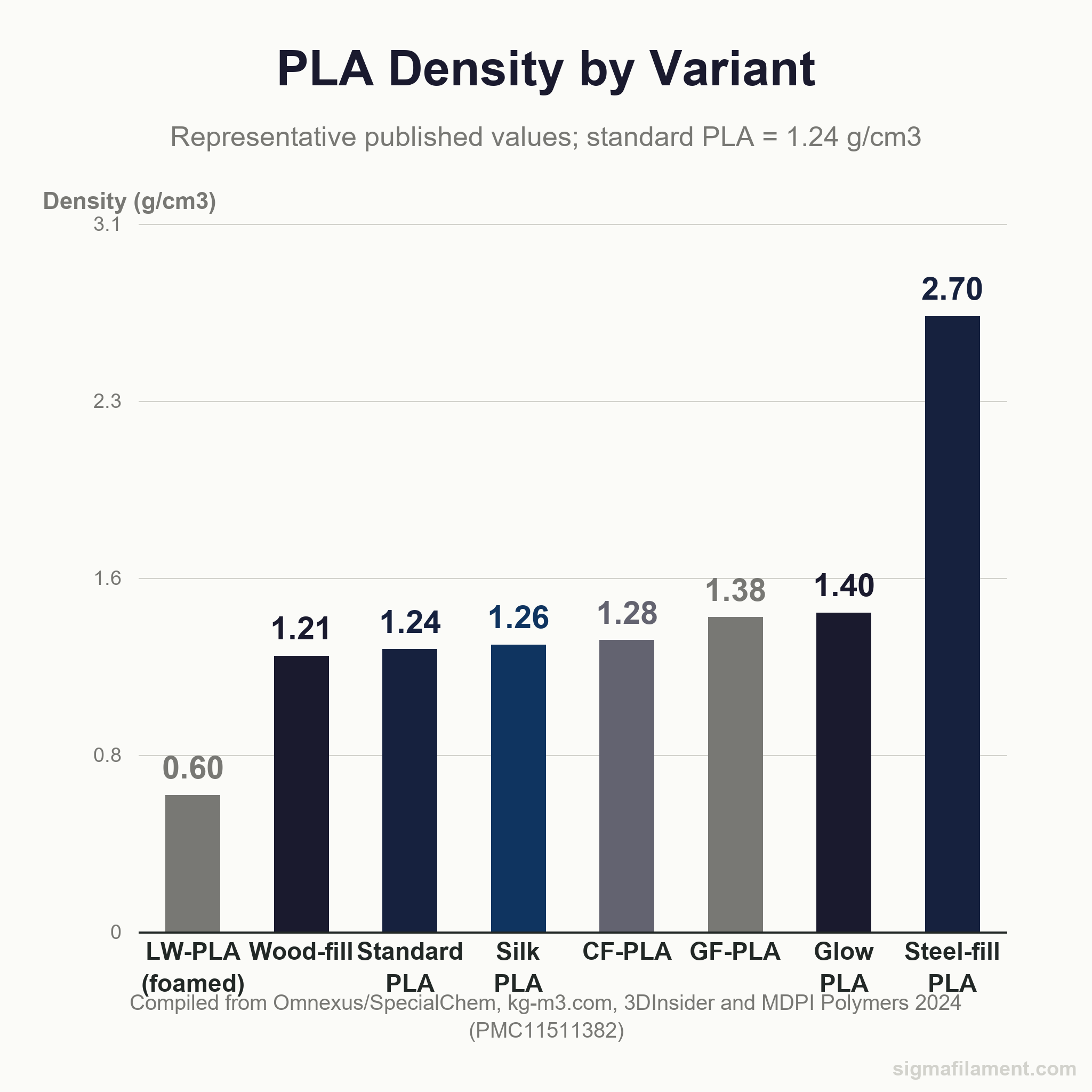
The density of PLA varies far more between commercial variants than the headline figure of 1.24 g/cm3 suggests. The underlying polylactic-acid matrix barely moves. What shifts the as-measured number is whatever has been mixed into the pellet (mineral filler, chopped fiber, metal powder, glow pigment) or whatever is happening in the nozzle during extrusion (chemical foaming). For procurement teams comparing spool-to-spool yield, the table below is the working reference.
| Variant | Density (g/cm3) | Why it differs |
|---|---|---|
| Standard PLA (neat) | 1.24 | industry headline value |
| PLA+ (toughened) | 1.23-1.25 | low-mass impact modifier, near neat |
| Silk PLA | 1.24-1.27 | gloss additives, trivial delta |
| Matte PLA | 1.24-1.28 | mineral filler (chalk/talc) raises it slightly |
| Wood-fill PLA (~20-30% wood flour) | 1.15-1.28 | filler porosity often makes it lighter |
| CF-PLA (10-20% chopped carbon fiber) | 1.25-1.31 | CF (~1.8) raises composite density modestly |
| GF-PLA (glass fiber) | 1.30-1.45 | glass (~2.5) raises density meaningfully |
| Metal-fill PLA (copper/bronze/steel/iron) | 2.0-4.0 | metal powder; ProtoPasta stainless ~2.70 (3D Insider, n.d.) |
| Glow-in-the-dark PLA | 1.30-1.50 | strontium aluminate filler is dense and abrasive |
| LW-PLA / foaming / lightweight PLA | 0.40-0.80 (as printed) | density drop is from in-print foaming, not the resin (Park & Lee, 2024) |
Near-neat variants: PLA+, silk, matte
PLA+ grades, silk grades, and most matte grades land within a narrow window of the 1.24 g/cm3 baseline. PLA+ adds a small fraction of impact modifier (often a thermoplastic elastomer or chain extender) that has minimal effect on bulk density. Silk variants stay near neat because the gloss-producing additives are present in trace amounts. Matte PLA is the slight outlier of the near-neat set: it carries chalk or talc filler to scatter light, and that mineral content nudges the density up toward 1.28 g/cm3, a band we unpack further in our matte versus standard PLA comparison. For spool-weight planning, treating all three as 1.24 g/cm3 introduces less than 3% error.
Lighter and heavier composites: wood, CF, GF, metal-fill, glow
Composite grades break the 1.24 g/cm3 rule in both directions. Wood-fill PLA frequently prints lighter than neat PLA, not heavier, because the wood-flour particles carry porosity that the polymer cannot fully wet out. Carbon-fiber-reinforced PLA pushes density up only modestly because carbon itself sits near 1.8 g/cm3. Glass-fiber grades go further, since glass sits near 2.5 g/cm3 and loadings of 15-25% by weight pull composite density into the 1.30-1.45 g/cm3 range. Metal-fill grades are the high-end outlier. Bronze and copper fills, along with steel and iron, land anywhere from 2.0 to 4.0 g/cm3 depending on loading; our broader metal-filled and sinterable filament guide walks through the trade-offs at the buying stage. Glow-in-the-dark filaments use strontium aluminate, a dense and notoriously abrasive ceramic that lifts density toward 1.50 g/cm3 and chews through brass nozzles within a kilogram.
The outlier: foaming LW-PLA below 1.0 g/cm3
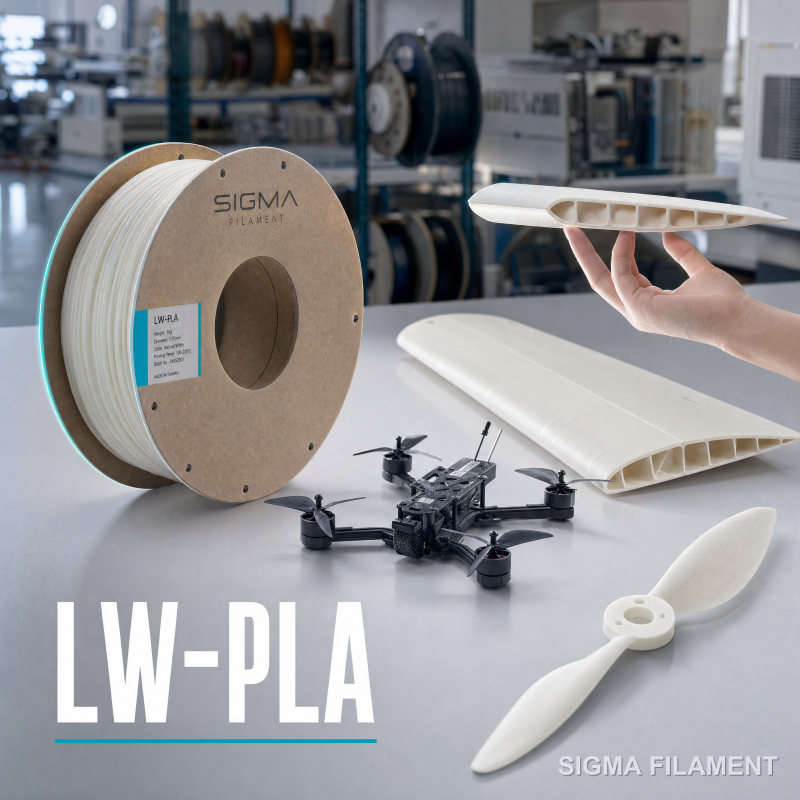
LW-PLA is the only variant where the as-printed part actively becomes less dense than water. The polymer is still ~1.24 g/cm3 polylactic acid. What changes is an active chemical foaming agent that triggers around 230-240 C, expanding the extrudate into a cellular cross-section. As-printed densities of 0.40-0.80 g/cm3 are routine when the operator dials in temperature and flow. A peer-reviewed 2024 study reports that foaming makes printed parts up to 9.25% lighter than the slicer model predicts while improving toughness by up to 246.5% (Park & Lee, 2024). For RC airframes, drone bodies, and any weight-sensitive bracket, that is the design tradeoff that justifies the variant.
Density of PLA spans a wider range than the 1.24 g/cm3 headline implies. Foaming LW-PLA prints near 0.60 g/cm3 in the cell, while stainless-fill grades reach ~2.70 g/cm3 (ProtoPasta data). The polylactic-acid matrix itself barely moves; fillers and in-print foaming are what set the as-measured value (3D Insider, n.d.; Park & Lee, 2024).
How PLA Density Is Measured: ASTM D792 vs ISO 1183-1
PLA density is measured by Archimedes-style water displacement under one of two recognized standards: ASTM D792 (Method A water at 23 C; Method B non-aqueous liquid) and ISO 1183-1 (immersion, liquid pycnometer, or density-gradient titration). The density of PLA listed on a supplier datasheet is only as trustworthy as the standard behind it. Two methods dominate the industry: ASTM D792 in North American supply chains and ISO 1183-1 in European and international ones. They look similar on paper, both rely on Archimedes-style displacement, and both report a number to three decimal places in g/cm3. Procurement teams routinely treat the two values as interchangeable. They are not.
ASTM D792: water displacement at 23 C
ASTM D792 measures plastic density by water displacement, applying the Archimedes principle to a solid specimen. Method A uses water at 23 plus or minus 2 C; Method B substitutes a non-aqueous liquid held at 23 plus or minus 0.5 C for grades that absorb water or float (ASTM International, 2020; InfinitaLab, n.d.). The reference value for water density at 23 C in the calculation is approximately 0.9975 g/cm3, which is the divisor that converts the measured buoyant mass back to a true density figure (Materials Testing Laboratories, n.d.). To produce a defensible number, the specimen must meet a minimum volume of 1 cm3 and a minimum thickness of 1 mm (ASTM International, 2020; InfinitaLab, n.d.). Below those dimensions, surface tension and trapped air dominate the reading and the result drifts outside the standard’s repeatability band.
ISO 1183-1: immersion, pycnometer, titration
ISO 1183-1 covers the same property but offers three distinct methods for solid non-cellular plastics. Method A is immersion, conceptually similar to ASTM D792 Method A. Method B uses a liquid pycnometer, better suited to small or irregular particles such as pellets and regrind. Method C is titration in a density-graded liquid column, where the specimen is placed in a calibrated gradient and its equilibrium depth gives the density directly (International Organization for Standardization, 2019; Materials Testing Laboratories, n.d.). The pycnometer route is the workhorse for incoming-QC labs measuring virgin PLA pellets before extrusion.
Why the two standards are not interchangeable
ASTM D792 fixes the test temperature at 23 C. ISO 1183-1 permits an additional 27 plus or minus 2 C option, and PLA contracts measurably between those points. A datasheet number is only directly comparable when the standard reference and the test temperature both match.
ASTM D792 measures plastic density by water displacement at 23 C, using either water (Method A) or a non-aqueous liquid (Method B). It is not interchangeable with ISO 1183-1: the ASTM standard fixes the temperature, while ISO 1183 permits a 27 C option, so a datasheet number is comparable only when both the standard and temperature match (ASTM International, 2020; InfinitaLab, n.d.).
| Standard | Principle | Temperature | Methods / specimen |
|---|---|---|---|
| ASTM D792 | Archimedes water displacement | 23 plus or minus 2 C (Method A); 23 plus or minus 0.5 C (Method B) | A: water; B: non-aqueous liquid. Minimum specimen 1 cm3, 1 mm thick |
| ISO 1183-1 | Displacement, pycnometer, or density column | 23 C, with optional 27 plus or minus 2 C | A: immersion; B: liquid pycnometer; C: titration in density-gradient column |
For buyers comparing two PLA grades from different suppliers, the practical rule is to confirm three fields before trusting the density value: the standard cited, the method letter, and the test temperature. A 1.24 g/cm3 figure tested under ASTM D792 Method A at 23 C and a 1.24 g/cm3 figure tested under ISO 1183-1 Method C at 27 C are not the same measurement, and the difference compounds when those numbers feed into spool-weight math at scale.
PLA vs Other Filaments: A Density Comparison Table
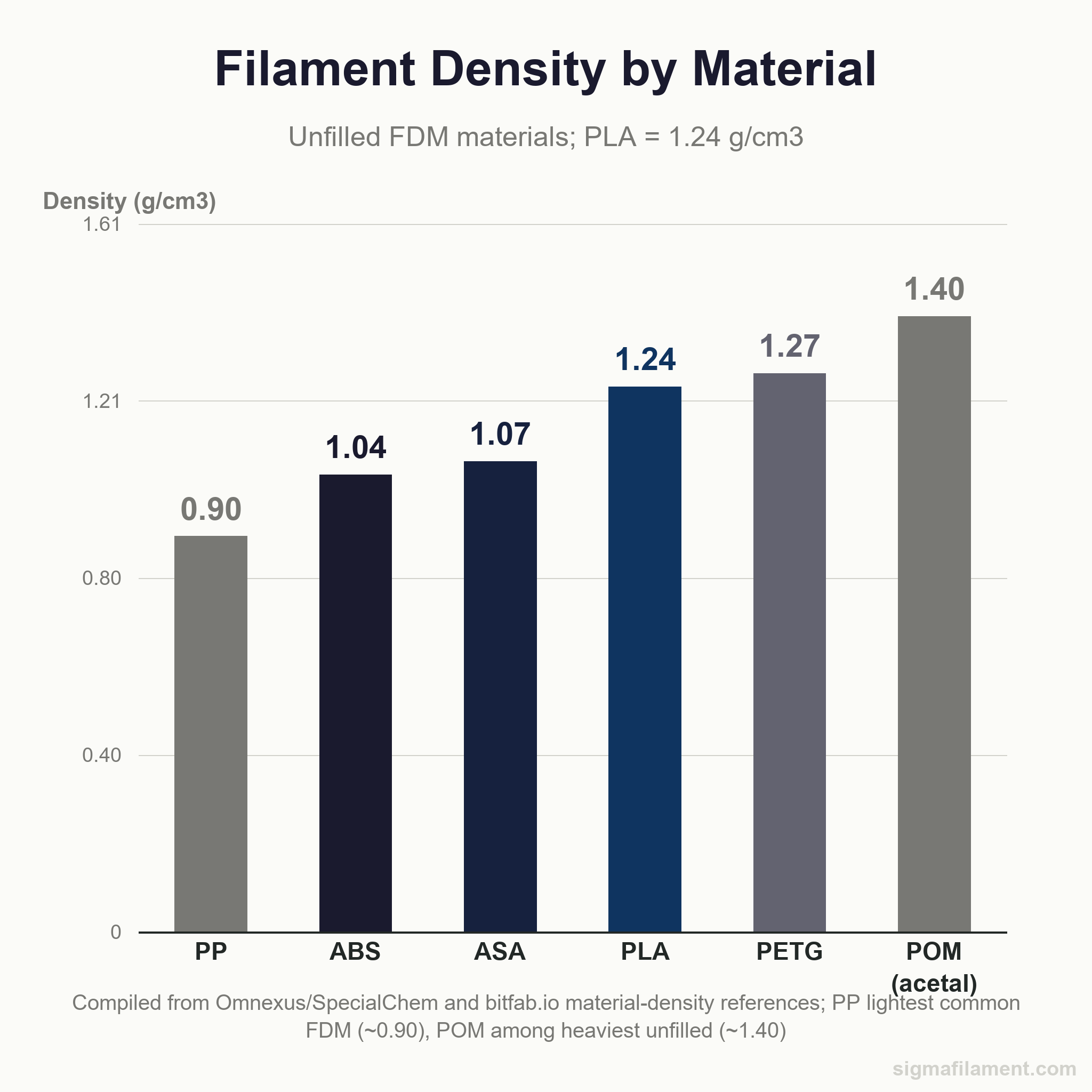
Among common unfilled FDM polymers, PLA at 1.24 g/cm3 sits in the upper-middle of the density range: lighter than PETG (1.27) and POM (1.40), heavier than ABS (1.04), ASA (1.07), and polypropylene (0.90). Procurement decisions rarely turn on a single number, yet the density of PLA sets the baseline that every other common FDM material is judged against. The full landscape of options is mapped in our types of 3D printer filament overview, and the table here lifts the density column out of it. The table below ranks unfilled polymers from lightest to heaviest, giving operators a quick reference for spool-weight forecasts, freight class estimates, and per-part cost models. Buyers comparing the wider FDM material set can cross-check the density-and-property table with our FDM filament materials buyer’s guide. Polycarbonate and nylon sit in the mid-range, as does TPU, and all three are noted in prose because their values shift more with grade and moisture content.
| Material | Density (g/cm3) | Relative to PLA |
|---|---|---|
| PP (polypropylene) | 0.90 | much lighter (lightest common FDM) |
| ABS | 1.04 | lighter |
| ASA | 1.07 | lighter |
| PLA | 1.24 | reference |
| PETG | 1.27 | slightly denser |
| POM (acetal) | 1.40 | denser (among heaviest unfilled) |
Lighter than PLA: PP, ABS, ASA
Polypropylene anchors the low end at roughly 0.90 g/cm3, which makes it the lightest common FDM material and the only one that floats in water. For a print farm running PP, a 1 kg spool yields about 27% more part volume than the same mass of PLA. ABS at 1.04 g/cm3 and ASA at 1.07 g/cm3 land between PP and PLA, which is why automotive housings and outdoor enclosures often spec these grades when finished-part weight is a constraint (Bitfab, 2019).
Denser than PLA: PETG, POM and filled grades
PETG sits just above PLA at roughly 1.27 g/cm3, a 2-3% difference that rarely shifts a quote but does add up across pallet-scale orders; the wider mechanical and thermal contrast is broken out in our PLA vs PETG comparison. Acetal (POM) is the heavy end of the unfilled FDM range at around 1.40 g/cm3, about 13% denser than PLA (Bitfab, 2019). Filled grades, including glass-fiber and metal-filled composites, climb higher still because the additive itself outweighs the base polymer. A reseller quoting on a 500-unit POM run should expect freight class and per-part stock cost to track that 1.40 figure, not the 1.24 PLA baseline.
Why density ranking does not equal strength ranking
PLA is relatively dense yet brittle, while ABS is lighter yet tougher in impact and fatigue tests, a contrast we cost out for functional parts in our PLA vs ABS decision guide. Polycarbonate and nylon, both in the mid-density range near PLA, outperform it on heat resistance and ductility by wide margins. Density is a weight-and-cost variable, not a strength proxy. Use it to forecast spool yield, freight, and per-part material cost; choose the polymer itself on the mechanical and thermal specs (and the chemical resistance) the application actually requires.
Among unfilled FDM polymers, PLA sits at roughly 1.24 g/cm3, between lighter grades like PP (0.90), ABS (1.04), and ASA (1.07) and denser ones like PETG (1.27) and POM (1.40). The ranking is a weight-and-cost map, not a strength map: denser does not mean stronger, as brittle PLA versus tougher ABS shows (Bitfab, 2019).
From Density to Spool Length: Grams per Meter, Meters per Kilogram and Net Weight
A 1 kg spool of standard 1.24 g/cm3 PLA holds about 335 meters of 1.75 mm filament or about 126 meters of 2.85 mm, because per-meter mass equals cross-sectional area times density (roughly 2.98 g/m at 1.75 mm, 7.9 g/m at 2.85 mm). The density of PLA is only half the procurement equation. The other half is geometry. Once a buyer knows the resin density, the diameter of the filament determines how many grams sit inside every meter of strand, and therefore how many meters a 1 kg spool actually delivers to the print farm.
The cross-section math for 1.75 mm and 2.85 mm
Filament is a long cylinder, so the mass of any segment is cross-sectional area multiplied by length multiplied by density. For 1.75 mm stock the circular cross-section works out to roughly 0.0240 cm2. At a typical PLA density of 1.24 g/cm3, one meter (100 cm of length) carries about 2.98 grams of plastic.
Step up to 2.85 mm and the cross-section grows to about 0.0638 cm2, more than 2.6 times larger. At the same 1.24 g/cm3, one meter of 2.85 mm filament weighs about 7.9 g. The diameter change is modest on paper, yet the per-meter mass nearly triples because area scales with the square of the radius.
Grams per meter and meters per 1 kg spool
Inverting the per-meter figure gives the more useful number for slicer estimates and quoting: meters per kilogram. A 1 kg spool of 1.75 mm PLA at 1.24 g/cm3 yields roughly 1000 / 2.98 = 335 m of usable strand. The same kilogram in 2.85 mm yields about 1000 / 7.9 = 126 m. For per-standard-size yield across 200 g samples, 1 kg, 3 kg, and 5 kg formats, see our PLA spool sizes and weight buyer’s guide.
| Diameter | Cross-section (cm2) | Grams per meter | Meters per 1 kg spool |
|---|---|---|---|
| 1.75 mm | 0.0240 | 2.98 g | ~335 m |
| 2.85 mm | 0.0638 | 7.9 g | ~126 m |
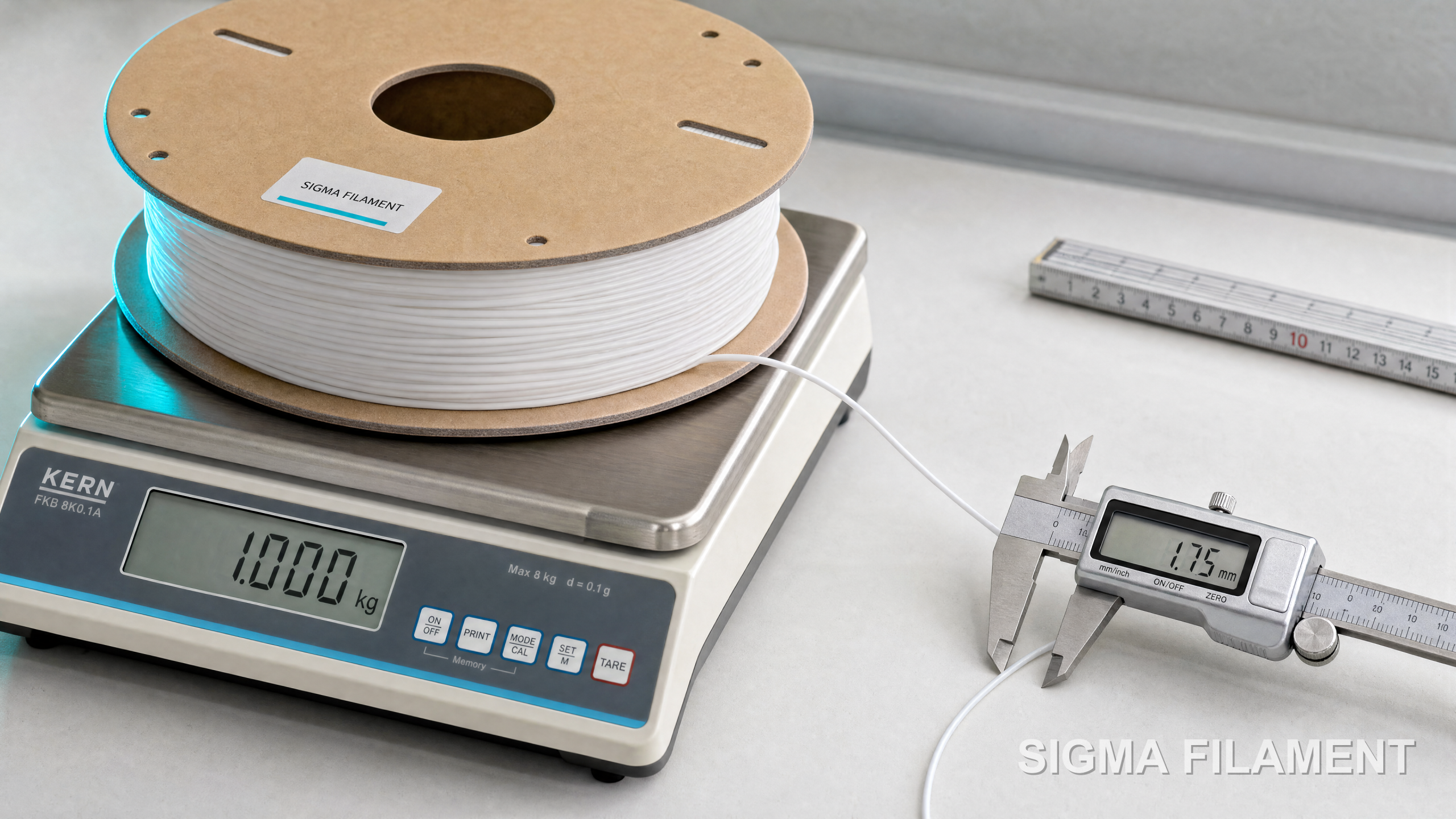
A 1.75 mm PLA strand at a density of 1.24 g/cm3 weighs about 2.98 grams per meter, which means a true 1 kg net spool yields roughly 335 meters of usable filament. The same calculation for 2.85 mm yields about 126 meters per kilogram.
Variant chemistry shifts both numbers in predictable directions. A denser carbon-fiber, glass-fiber, or metal-filled PLA weighs more per meter, so a buyer gets fewer meters per kilogram of spool. A lighter foaming variant such as LW-PLA pushes the other way, delivering more meters per kilogram for the same spool mass. Print farms quoting cost per part should price against meters, not grams, whenever variant density drifts away from the 1.24 g/cm3 baseline. For a worked example of filament-per-roll math across multiple materials and spool sizes, see our companion guide on how many grams of filament are in a roll.
Why a 1 kg spool sometimes holds less than 1 kg
Procurement teams should also separate gross weight from net weight. Gross weight is the spool plus the filament; net weight is the filament alone. A lower-density material takes more room per kilogram, so a spool sized like a standard 1 kg reel can hold less than a kilogram of it; read the net weight on the label rather than the spool size. PLA’s higher density makes a true 1 kg coil easier to wind onto a standard reel. Before any bulk order, the spec sheet should be checked for three lines: net filament weight, diameter tolerance, and resin source.
From Density to Part Weight and Cost: The Print-Costing Math
Estimated part weight in grams equals solid-equivalent volume (cm3) multiplied by material density (g/cm3), with infill percentage scaling only the internal-lattice contribution; parts per kilogram equals 1000 divided by that part weight, and material cost per part equals spool price divided by parts per kilogram. Density turns geometry into a number you can quote and invoice against, then ship to. For a procurement team comparing PLA grades or a print farm pricing a 500-unit run, the math below is the link between a CAD volume and a per-part bill of material.
Estimating a print’s weight from its volume
The baseline equation is simple. Part weight in grams equals the solid-equivalent volume in cubic centimetres multiplied by the material density in grams per cubic centimetre. Standard PLA sits near 1.24 g/cm3, so a fully solid 30 cm3 model lands at 37.2 g (Kg-m3.com, n.d.). Real prints are not fully solid. Slicers report walls, top and bottom layers, and infill separately, and only the internal lattice scales with the infill percentage. Solid shells always count at full density. A useful shortcut is the effective solid fraction: the slicer’s reported gram figure divided by the fully-solid weight. For typical 3-perimeter walls and 20% gyroid infill, that fraction lands near 0.4 to 0.5 on most geometries.
For any thermoplastic, part weight equals solid-equivalent volume times material density. Anchoring on PLA at 1.24 g/cm3, a 30 cm3 model would weigh 37.2 g if printed solid. Walls and top and bottom layers always count at full density; only the infill lattice scales with the infill percentage (Kg-m3.com, n.d.).
Parts per kilogram and material cost per part
Once you have a part weight, two follow-on numbers drive procurement. Parts per kilogram equals 1000 divided by the part weight in grams. Material cost per part equals the spool price divided by parts per kilogram; our 3D printing cost per gram calculator guide walks through the full per-unit math with worked numbers. The slicer already prints the gram figure, but cross-checking it against volume times density catches profile errors, wrong-material assignments, and stale spool settings before a 200-unit job goes to the build plate.
A worked example end to end
Take the same 30 cm3 model in standard PLA. With 3 perimeters and 20% gyroid infill, an effective solid fraction near 0.45 puts the part at roughly 17 g. That yields 1000 / 17, or about 59 parts per kilogram. At an example spool price of $22 per kilogram (labelled as illustrative, not a quoted SigmaFilament rate), the material cost lands near $0.37 per part. Now hold the geometry constant and swap the material. In LW-PLA, where the as-printed density falls near 0.6 g/cm3 once the foaming agent activates, the same part drops to roughly 8 g. In a steel-fill PLA at about 2.70 g/cm3, it climbs to roughly 36 g. Same CAD file, same printer, three very different freight weights and per-part material costs. Density is the variable that moves both.
Does PLA Density Change? Temperature, Annealing and Moisture
The short answer for procurement spreadsheets is yes, but only at the second decimal place. The density of PLA shifts with temperature, crystallinity, post-processing, and moisture content. For weight estimation on a print farm, the bulk filament figure of about 1.24 g/cm3 stays a reliable input. For the finished part, several variables pull the effective density down or, in narrow cases, slightly up.
Temperature and crystallinity effects
Bulk PLA density moves slightly with temperature, and more meaningfully with crystallinity. Crystalline regions pack their polymer chains more tightly than amorphous regions, so a more crystalline part is marginally denser than a glassy one of the same composition (Wikipedia contributors, 2026). In practical terms, a freshly printed PLA part cooled quickly off the bed sits at the amorphous end of the range. The same geometry held above its glass-transition temperature, then cooled slowly, ends up denser and stiffer because crystallites form and consolidate.
Annealing: density, Tg and rigidity
Annealing is the standard lever for shifting these numbers on purpose. Heating a printed PLA part above its glass-transition temperature and holding it changes its density, glass-transition temperature, and thermal conductivity, and can lift compressive strength and rigidity by roughly 80% (Wikipedia contributors, 2026).
Annealing PLA above its glass-transition temperature drives recrystallization that changes density, raises Tg and thermal conductivity, and can improve compressive strength and rigidity by roughly 80%, while the underlying filament density stays near 1.24 g/cm3 (Wikipedia contributors, 2026).
The trade-off is dimensional change. Parts shrink as crystallites form, so functional fixtures need post-anneal verification before they ship to the customer.
Filament density vs printed-part density
Two numbers get confused in procurement: filament density (the solid strand at roughly 1.24 g/cm3) and printed-part density (what the customer actually weighs). A printed part contains infill voids, under-extrusion gaps, and trapped air, so its effective density is almost always lower than the solid filament value. Wet filament prints worse, with steam-driven voids that further lower effective density and weaken the part. Dry storage and a sealed feed path give print farms denser, more consistent finished pieces from the same spool; for the active-drying side, see our PLA drying procedure walkthrough.
OEM and Wholesale: How Density Drives Freight, MOQ and Per-Part Cost
At pallet scale, PLA density sets three line items at once: shipping weight per spool (and therefore freight cost and container fill), parts-per-kilogram yield across the catalog, and per-part material cost in every quote. For buyers spec’ing PLA at pallet scale, density stops being a materials-science footnote and starts behaving like a line item. It shows up in freight invoices, in container fill rates, and in the per-part quote a reseller hands a customer. Treating it as a controlled variable, rather than a number copied from a generic datasheet, is what separates a stable wholesale PLA filament program from one that drifts quarter to quarter.
Density, shipping weight and freight class
At volume, density sets shipping weight, and shipping weight drives both freight cost and how much product fits inside a sea container or LTL pallet. A denser filament is heavier to move per spool, so a full container ships fewer spools by count but more kilograms of resin. A lighter variant such as LW-PLA cuts gross weight on shipping-sensitive parts, which matters when the freight quote is graded by actual weight rather than dimensional weight. The right call depends on the part, not on a universal preference.
Per-part costing across a product line
Density also sets parts-per-kilogram yield across an entire catalog. A reseller quoting a fleet of 50-gram brackets, 12-gram clips, and 180-gram enclosures is really quoting grams, and those grams trace back to filament density and slicer flow. When density drifts spool to spool, per-part material cost drifts with it, and margin assumptions on a yearly purchase order quietly erode. Locking density tightens the cost model that sits underneath every quote.
Spec controls a source manufacturer can hold
A source manufacturer controls the levers density depends on. 100% virgin NatureWorks resin keeps batch-to-batch density consistent, where regrind blends introduce contamination and density variability. A +/-0.02 mm diameter tolerance on PLA and PETG keeps grams-per-meter and spool length predictable, which stabilises slicer flow calibration across an entire print farm. And custom variant formulation, from lighter LW-PLA through denser composite grades where added mass is wanted, lets the spec match the part instead of forcing the part to accept whatever the catalog ships.
Virgin NatureWorks resin and a +/-0.02 mm diameter tolerance are the two controls that keep PLA density and grams-per-meter predictable at pallet volume. Regrind blends introduce density variability batch to batch; a tight diameter spec keeps spool length and per-part yield consistent across a print farm.
Buyers spec’ing PLA with controlled density and tolerance can contact our team to scope a program against a specific part mix and freight lane.
Frequently Asked Questions
What is the density of PLA filament in g/cm3 and kg/m3?
Standard PLA filament has a density of about 1.24 g/cm3, which is the same as 1240 kg/m3. Reported as specific gravity, the value is also 1.24, since specific gravity is the ratio of polymer density to water at 4 C.
Is PLA denser than water?
Yes. At 1.24 g/cm3, PLA is roughly 24% denser than fresh water (1.00 g/cm3), so loose PLA pellets and finished PLA prints sink in a water bath. That sinking behavior is the basis of the ASTM D792 water-displacement density test.
Is PLA denser than PETG or ABS?
PLA at 1.24 g/cm3 sits between PETG and the styrenics. PETG is slightly heavier at about 1.27 g/cm3, while ABS is around 1.04 g/cm3 and ASA around 1.07 g/cm3. Two parts of identical geometry will weigh noticeably less in ABS than in PLA.
What is the density of LW-PLA, CF-PLA and metal-fill PLA?
Foaming LW-PLA prints at roughly 0.40 to 0.80 g/cm3 once it has expanded in the hot end. Carbon-fiber PLA runs about 1.25 to 1.31 g/cm3 depending on fiber loading, and metal-fill PLA spans about 2.0 to 2.7 g/cm3, with steel-fill landing near 2.70.
How is the density of PLA measured?
The two recognized standards are ASTM D792, which uses water displacement at 23 C, and ISO 1183-1, which covers immersion, pycnometer and titration variants. The two are not interchangeable, so a supplier datasheet should state which method produced the reported figure.
How many meters of PLA are in a 1 kg spool?
At 1.24 g/cm3, a 1 kg spool of 1.75 mm filament holds about 335 meters of usable material. The same kilogram of 2.85 mm filament holds about 126 meters, because the larger cross section uses mass faster per unit length.
How many grams does 1 meter of 1.75 mm PLA weigh?
About 2.98 g. The math is a cross section of roughly 0.0240 cm2 multiplied by 1.24 g/cm3, giving the per-meter mass that print farms use to budget filament for queued jobs.
What is the difference between material density and infill density?
Material density, expressed in g/cm3, is a fixed property of the polymer and does not change between slicer profiles. Infill density, expressed as a percent in the slicer, controls how much of the internal volume is solid plastic versus air, and it changes finished part weight without changing the underlying material density.
Does annealing or temperature change PLA’s density?
Annealing shifts crystallinity, which changes bulk density, glass-transition behavior and rigidity, with stiffness gains reported up to about 80%. Print and ambient temperature also move bulk density slightly through thermal expansion, though the change is small compared with the annealing effect.
Conclusion
The headline density of PLA is 1.24 g/cm3, and that figure is correct for a clean, amorphous, room-temperature baseline. The practical answer for a production line is the density of the specific variant on the spool: foaming LW-PLA can drop near 0.6 g/cm3 after active expansion, standard PLA and PLA+ sit in the 1.21 to 1.30 g/cm3 band, glass and carbon blends climb into the 1.3 to 1.5 g/cm3 range, and metal-fill grades reach as high as 2.70 g/cm3. Trust a datasheet only when the value is tied to a recognized method (ASTM D792 or ISO 1183-1) and a stated test temperature.
Carry that verified number into the math that drives your P&L: spool length from coil weight, part mass from sliced volume, and per-part cost from kilogram price. For OEM and wholesale PLA with controlled density and tight diameter tolerance, contact the SigmaFilament engineering team.
References
- Park, Y.-E., & Lee, S. (2024). Characterization of PLA/LW-PLA composite materials manufactured by dual-nozzle FDM 3D-printing processes. Polymers, 16(20), 2852. https://doi.org/10.3390/polym16202852
- ASTM International. (2020). ASTM D792-20: Standard test methods for density and specific gravity (relative density) of plastics by displacement. ASTM International. https://store.astm.org/d0792-20.html
- International Organization for Standardization. (2019). ISO 1183-1:2019: Plastics. Methods for determining the density of non-cellular plastics, Part 1: Immersion method, liquid pycnometer method and titration method. ISO. https://www.iso.org/standard/74040.html
- Materials Testing Laboratories. (n.d.). ASTM D792, ISO 1183 density and specific gravity of plastics. Matestlabs. Retrieved June 21, 2026, from https://matestlabs.com/test-standards/astm-d792-iso-1183/
- InfinitaLab. (n.d.). ASTM D792 plastic density & specific gravity testing. Retrieved June 21, 2026, from https://infinitalab.com/services/astm-d792-plastic-density-specific-gravity-testing/
- Kg-m3.com. (n.d.). PLA: Polylactide density (1240 kg/m³). Retrieved June 21, 2026, from https://kg-m3.com/material/pla-polylactide
- Wikipedia contributors. (2026). Polylactic acid. In Wikipedia. Retrieved June 21, 2026, from https://en.wikipedia.org/wiki/Polylactic_acid
- Bitfab. (2019). The densities of all 3D printing materials. Retrieved June 21, 2026, from https://bitfab.io/blog/the-densities-of-all-3d-printing-materials/
- 3D Insider. (n.d.). What is the density of PLA? Retrieved June 21, 2026, from https://3dinsider.com/pla-density/
Last reviewed and updated: June 2026. Author: SigmaFilament team. For tailored guidance, contact our team.