Data-Backed PLA vs ABS: 5 Decisive Factors for Functional Parts in 2026


Abstract
This analysis provides a detailed comparative examination of Acrylonitrile Butadiene Styrene (ABS) and Polylactic Acid (PLA), two of the most prevalent thermoplastic filaments in fused deposition modeling (FDM) 3D printing. The discourse evaluates these materials based on their fundamental mechanical, thermal, and chemical properties to guide material selection for functional engineering parts and prototypes in 2026. While PLA is recognized for its ease of printing, low warping, and plant-based origins, its utility is constrained by a low glass transition temperature and inherent brittleness. Conversely, ABS offers superior impact resistance, ductility, and thermal stability, making it suitable for more demanding applications. However, its successful implementation requires managing challenges such as significant thermal contraction, which leads to warping, and the emission of volatile organic compounds during extrusion. This guide moves beyond a superficial comparison, delving into material science principles, practical printing considerations, post-processing techniques, and the impact of modern composite variants to provide a nuanced framework for making an informed decision between ABS or PLA.
Key Takeaways
- ABS offers superior heat resistance and impact strength for functional parts.
- PLA is easier to print with minimal warping, making it ideal for beginners.
- Ventilation is necessary when printing ABS due to potentially harmful fumes.
- The choice between abs or pla depends entirely on the part’s final application.
- An enclosed printer is highly recommended for reliable, high-quality ABS prints.
- PLA has a lower environmental impact due to its plant-based origins.
- Post-processing options like acetone smoothing are unique to ABS prints.
Table of Contents
- A Foundational Comparison: Quantitative Material Properties
- Factor 1: Mechanical Performance and Structural Integrity
- Factor 2: Thermal Resistance and Environmental Stability
- Factor 3: The Printing Experience and Hardware Demands
- Factor 4: Post-Processing and Aesthetic Finish
- Factor 5: Cost, Sustainability, and Application-Specific Choices
- Frequently Asked Questions (FAQ)
- A Final Perspective on Material Selection
- References
A Foundational Comparison: Quantitative Material Properties
Before we delve into the nuanced, qualitative aspects of these materials, it is helpful to establish a baseline. Think of this table as a spec sheet, providing the raw data from which we can build a deeper understanding. These numbers, while useful, do not tell the whole story. The true character of a material reveals itself in how it behaves under stress, during printing, and over time.
| Property | Polylactic Acid (PLA) | Acrylonitrile Butadiene Styrene (ABS) | Unit | Significance for Design |
|---|---|---|---|---|
| Tensile Strength | ~50 – 70 | ~40 – 50 | MPa | Resistance to being pulled apart. Higher is stronger under tension. |
| Flexural Modulus | ~3.0 – 4.0 | ~2.0 – 2.6 | GPa | Stiffness or resistance to bending. Higher is more rigid. |
| Impact Strength (Izod) | ~15 – 30 | ~180 – 250 | J/m | Ability to absorb sudden energy without fracturing. Higher is tougher. |
| Glass Transition Temp. (Tg) | ~60 – 65 | ~105 | °C | Temperature at which the material begins to soften and deform. |
| Printing Temperature | 190 – 220 | 220 – 250 | °C | Required nozzle temperature for proper extrusion and layer fusion. |
| Bed Temperature | 25 – 60 | 90 – 110 | °C | Required build plate temperature to ensure adhesion and prevent warping. |
| Density | ~1.24 | ~1.04 | g/cm³ | Mass per unit volume. PLA is slightly denser and heavier for the same volume. |
This data provides our starting point. We see that PLA appears stiffer and has a higher tensile strength, yet ABS has a dramatically higher impact strength and thermal tolerance. This initial paradox—why one material is “stronger” in one context but “weaker” in another—is central to the debate of ABS or PLA. It is the question we will spend the rest of our time exploring.
Factor 1: Mechanical Performance and Structural Integrity
When we speak of creating “functional parts,” we are fundamentally concerned with how a component behaves under physical stress. The mechanical properties of a material dictate its ability to bear loads, resist impacts, and maintain its shape over its service life. The discussion of ABS or PLA in this context moves beyond simple aesthetics into the realm of engineering and reliability.
Tensile Strength and Stiffness: A Deceptive Metric
At first glance, raw datasheets often show standard PLA exhibiting a higher ultimate tensile strength and flexural modulus than standard ABS (Gnanavel, 2022). This can lead to the premature conclusion that PLA is the “stronger” material. This is a common point of confusion, and it is worth pausing to dissect it.
Imagine holding a piece of uncooked spaghetti and a licorice stick. The spaghetti is very rigid (high flexural modulus) and can resist a surprising amount of pulling force before it snaps (high tensile strength). The licorice, by contrast, is flexible and will stretch significantly before breaking. The spaghetti is analogous to PLA; the licorice is analogous to ABS.
PLA’s stiffness makes it excellent for parts that need to be rigid and not deflect under load, such as a bracket holding a lightweight, static object or a decorative model that needs to maintain crisp details. However, this rigidity comes at a cost: brittleness. Like the spaghetti, once PLA reaches its breaking point, it fails suddenly and catastrophically. There is very little “give.”
ABS, with its lower stiffness and tensile strength, behaves differently. It is more ductile. When subjected to stress that exceeds its elastic limit, it will begin to deform and stretch before it ultimately fails. This property is often far more desirable in real-world applications where parts might experience unexpected overloads or impacts. A phone case, a car bumper trim piece, or a gear in a mechanism benefits from this ability to bend without breaking. The failure is more predictable and less abrupt.
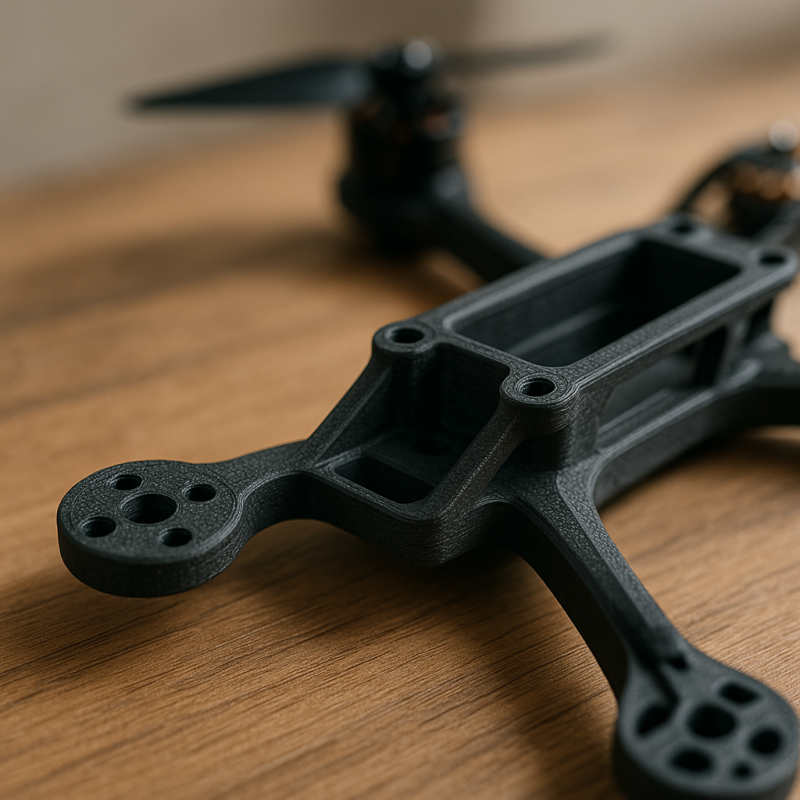
Therefore, when choosing between ABS or PLA for a load-bearing part, ask yourself: is it more important for the part to be extremely rigid, or is it more important for it to absorb energy and fail gracefully? For a simple shelf bracket holding a static load well within its limits, PLA might suffice. For a drone arm that might clip a tree branch, the ductility of a high-strength ABS filament is unquestionably superior.
Impact Resistance and Ductility: Where ABS Truly Shines
The most significant mechanical differentiator between these two plastics is impact resistance. As the comparison table shows, the Izod impact strength of ABS is an order of magnitude higher than that of PLA xometry.com. This is not a subtle difference; it is a chasm that defines their respective applications.
ABS is a terpolymer, meaning it is composed of three distinct monomers: Acrylonitrile, Butadiene, and Styrene. The “B” in ABS, Butadiene, is a synthetic rubber. At a microscopic level, you can imagine tiny particles of rubber dispersed throughout a more rigid matrix of Acrylonitrile and Styrene. When the part is struck, these rubber particles compress and absorb the energy, preventing cracks from propagating through the material. This is the source of its toughness.
PLA, a simple polyester, lacks this internal shock-absorbing mechanism. An impact creates a stress concentration that quickly becomes a crack, which then travels rapidly through the rigid polymer chains, leading to fracture.
Think about dropping two identical phone cases from waist height, one made of PLA and one of ABS. The PLA case is likely to crack or shatter upon impact. The ABS case will likely bounce, perhaps showing a scuff mark, but will remain structurally intact. This is why ABS is a dominant material in applications like power tool housings, automotive interior parts, and protective gear. It is designed to take a beating.
For any part that will be handled, dropped, or subjected to sudden loads in its lifetime, the choice of ABS or PLA becomes clear. The inherent toughness of ABS provides a level of reliability that PLA simply cannot match in its standard form.
Layer Adhesion: The Unseen Factor in Part Strength
A 3D printed part is not a monolithic object like an injection-molded one. It is an assembly of hundreds or thousands of individual layers fused together. The strength of the bond between these layers—the layer adhesion—is often the weakest link in the entire structure. Anisotropy, the property of being directionally dependent, is a core concept in FDM printing; a part is almost always weaker along its Z-axis (perpendicular to the layers) than in the XY-plane (parallel to the layers).
Here, the printing process itself plays a huge role. ABS is printed at higher temperatures, both at the nozzle and on the build plate 3devo.com. This higher thermal energy allows the newly extruded layer to more effectively re-melt and fuse with the layer beneath it. When printed correctly within a heated, stable environment, ABS can achieve excellent interlayer adhesion, resulting in parts that are remarkably strong in all directions.
PLA, printed at lower temperatures, can sometimes struggle with layer adhesion, particularly if the print cooling fan is too aggressive. The lower temperature means there is less energy available to form a strong weld between layers. While a well-tuned PLA print can be very strong, it is often more susceptible to delamination (splitting along the layer lines) under stress than a well-printed ABS part.
This is a crucial consideration for functional design. If you are printing a hook, for instance, you would orient it on the build plate so that the layers are not bearing the primary load in shear. However, in complex geometries, this is not always possible. In those cases, the superior layer bonding of ABS, facilitated by its higher printing temperature and the use of a heated chamber, provides a significant advantage in overall part durability.
The Rise of Composites: How Carbon Fiber Changes the Equation
The landscape of 2026 is not limited to pure polymers. The advent of affordable composite filaments has blurred the lines between materials. Carbon fiber-reinforced filaments, such as PLA-CF and PETG-CF, are particularly relevant to this discussion.
Adding chopped carbon fibers to a polymer base dramatically increases its stiffness (flexural modulus) and dimensional stability. The fibers act like rebar in concrete, resisting bending and preventing the part from deforming under load. An interesting development is how this reinforcement affects the base properties of PLA.
A filament like Carbon Fiber PETG takes the user-friendliness and low warp of PETG (a material with properties between PLA and ABS) and adds significant rigidity. This creates a material that is much easier to print than ABS but offers mechanical performance that can, in some cases, exceed it, particularly in terms of stiffness. The carbon fibers also help control thermal expansion, leading to better dimensional accuracy and less warping than even standard PLA.
However, these composites are not a universal solution. The addition of fibers can sometimes reduce the interlayer adhesion if not printed correctly, and it does not necessarily improve the base polymer’s impact strength. The part becomes stiffer, but not necessarily tougher. It also introduces new challenges, like increased nozzle wear due to the abrasive nature of the fibers. Still, for applications requiring extreme rigidity, such as drone frames, jigs, or fixtures, a carbon fiber composite can be a compelling alternative to ABS.
Factor 2: Thermal Resistance and Environmental Stability
A part’s function is not defined solely by its ability to withstand mechanical force. Its environment—specifically the ambient temperature—can be an equally important factor in its survival. Here, the difference between ABS and PLA is stark and often serves as the single most decisive factor in material selection.
Glass Transition Temperature: The Decisive Environmental Limit
Every amorphous polymer has a glass transition temperature (Tg). This is not a melting point, but rather the temperature at which the material transitions from a hard, glassy state to a soft, rubbery one. Below its Tg, the polymer chains are locked in place. Above its Tg, they have enough energy to begin sliding past one another, causing the material to lose its structural integrity.
PLA has a very low glass transition temperature, typically around 60 to 65°C (140 to 149°F) (Wikipedia contributors, n.d.). This is its greatest weakness for functional applications. A part printed in PLA and left inside a car on a sunny day will warp and deform under its own weight. A motor mount on a robotics project may soften from the waste heat of the motor. Any application where temperatures could even briefly exceed that of a hot beverage is unsuitable for PLA.
Imagine a PLA part as a bar of chocolate. At room temperature, it is solid and brittle. Leave it on a dashboard, and it quickly becomes a soft, useless mess.
ABS, on the other hand, boasts a much higher glass transition temperature of around 105°C (221°F) . This thermal headroom makes it vastly more suitable for parts that will be used in electronically heated environments, outdoors in hot climates, or in automotive engine bays (for non-critical components). It maintains its rigidity and strength at temperatures that would cause PLA to fail completely.
For any application where the operating temperature might exceed 50°C (122°F), the debate over ABS or PLA ends abruptly. ABS is the only viable choice of the two. This single property is responsible for ABS’s continued dominance in engineering and prototyping despite its printing difficulty.
Warping and Dimensional Accuracy: Taming Thermal Contraction
The very property that gives ABS its thermal resistance—its high printing temperature—is also the source of its greatest printing challenge: warping.
All materials expand when heated and contract when they cool. The greater the temperature change, the greater the contraction. ABS is printed at a high temperature (around 230-250°C) onto a hot bed (around 100-110°C) and then cools to room temperature (around 20°C). This large temperature delta causes significant internal stress as the material tries to shrink.
When printing a large, flat part, the bottom layers are held in place by their adhesion to the build plate. As the upper layers are printed and begin to cool, they shrink and pull inwards. This force can become so great that it lifts the corners or edges of the print off the build plate, a phenomenon known as warping. The result is a dimensionally inaccurate part with a bowed base.
PLA, by contrast, is printed at lower temperatures and has a much lower coefficient of thermal expansion. The internal stresses generated during cooling are far less severe. This is why PLA can be printed reliably on an open-frame printer with little to no bed heat and exhibits almost no warping. It is dimensionally stable and forgiving.
Successfully printing ABS requires mitigating this thermal contraction. This is primarily achieved by using a heated build plate to keep the base of the model warm and adhered, and more importantly, by using an enclosed printer. An enclosure traps heat from the build plate, raising the ambient temperature around the part. By keeping the entire model at an elevated, stable temperature throughout the print, the rate of cooling is slowed dramatically, minimizing the buildup of internal stresses. A stable environment of 40-50°C inside an enclosure is the key to warp-free ABS printing.
Chemical and UV Resistance: Long-Term Durability
Beyond thermal stability, the long-term performance of a part can be affected by exposure to chemicals and ultraviolet (UV) radiation from sunlight.
PLA is susceptible to degradation from moisture over long periods, though this is less of a concern for indoor applications. It has poor resistance to many common solvents. For example, acetone will not affect it, but stronger chemicals can cause it to break down.
ABS exhibits good general chemical resistance to many acids, alkalis, and oils. Its most notable chemical interaction is its solubility in acetone, a property exploited for post-processing, which we will discuss later. However, a significant drawback of ABS is its poor resistance to UV radiation. When exposed to direct sunlight for extended periods, the Butadiene component of the polymer breaks down. The material becomes brittle, loses its impact strength, and often turns a yellowish color. For this reason, standard ABS is not recommended for long-term outdoor applications unless it is painted or coated with a UV-protectant layer.
For outdoor applications, a related material called ASA (Acrylonitrile Styrene Acrylate) is often the preferred choice. ASA is chemically very similar to ABS but uses an acrylate rubber instead of butadiene rubber. This gives it comparable mechanical properties and printing requirements to ABS but with vastly superior UV resistance, making it ideal for parts like garden equipment, outdoor sensor housings, and exterior vehicle trim.
Factor 3: The Printing Experience and Hardware Demands
The theoretical properties of a material are meaningless if you cannot successfully transform the filament into a physical object. The practical experience of printing—the ease, the reliability, and the required hardware—is a major factor in choosing between ABS or PLA.
Printability and Forgiveness: The Gentle Learning Curve of PLA
There is a reason why nearly every new 3D printer ships with a sample spool of PLA. It is, by a wide margin, the easiest and most forgiving material to print .
PLA flows smoothly from the nozzle at relatively low temperatures. It exhibits minimal warping, meaning it does not require a heated bed for small prints and can be printed successfully on inexpensive, open-frame machines. It sticks well to a variety of build surfaces, from blue painter’s tape to glass to PEI sheets. Its low thermal contraction results in excellent dimensional accuracy straight off the printer. For a beginner learning the fundamentals of 3D printing—leveling the bed, setting temperatures, slicing models—PLA provides a gentle learning curve with a high success rate. This reliability also makes it a favorite for printing large, complex models or aesthetic pieces where dimensional precision and ease of printing are paramount. When you need a print to just work, you reach for an engineering-grade PLA+.
ABS is the opposite. It is demanding and unforgiving. Getting a successful first print with ABS can be a frustrating experience for a newcomer. It requires higher temperatures, a precisely calibrated heated bed, and, for anything other than small parts, a heated enclosure. Failure to control the thermal environment will result in warping, layer splitting (delamination), or the print detaching from the bed entirely. It is a material that requires patience, tuning, and a more capable printer.
Fumes and Safety: The Invisible Aspect of Material Choice
During the melting and extrusion process, all thermoplastics release a combination of volatile organic compounds (VOCs) and ultrafine particles (UFPs). The type and quantity of these emissions vary significantly between materials.
PLA, being derived from plant starches, is largely benign. When heated, it emits a faint, slightly sweet smell that is often compared to waffles or syrup. While ventilation is always a good practice in any workshop, printing PLA in a well-aerated room is generally considered safe and does not pose significant health concerns (Azimi et al., 2016).
ABS, a petroleum-based plastic, is a different story. When heated, it releases Styrene, a VOC that is classified as a possible human carcinogen. The smell is acrid and pungent, often described as burning plastic. Inhaling these fumes can cause headaches, dizziness, and respiratory irritation. Long-term exposure in an unventilated space is a serious health risk.
Therefore, when printing with ABS, proper ventilation is not optional; it is a requirement. The printer should be located in a room with active air exchange, such as an open window with a fan, or be equipped with an activated carbon and HEPA filtration system. Many modern enclosed printers designed for ABS incorporate such filters. For anyone considering printing ABS, especially in a home or office environment, a plan for fume management must be part of the initial setup. This safety consideration alone is often enough for hobbyists to stick with PLA or PETG for their projects.
Hardware Requirements: Enclosures, Beds, and Hotends
The choice between ABS or PLA has direct implications for the hardware you need.
- For PLA:
- Printer Type: Any FDM printer, including inexpensive open-frame models, will work.
- Enclosure: Not required. In fact, an enclosure can sometimes be detrimental, as it can trap too much heat and cause the cold end of the extruder to soften the filament, leading to jams (heat creep).
- Heated Bed: Optional for small prints, but recommended for larger ones (set to 50-60°C) to ensure a flat base.
- Hotend: A standard PTFE-lined hotend is perfectly adequate, as PLA’s printing temperature is well below the degradation temperature of PTFE tubing.
- For ABS:
- Printer Type: An enclosed printer is strongly recommended for reliability and part quality. While small parts can be printed on an open machine, it is a constant battle against the environment.
- Enclosure: A passive or actively heated enclosure is the single most important piece of hardware for successful ABS printing. It stabilizes the ambient temperature, preventing warping and delamination.
- Heated Bed: Mandatory. A bed temperature of 90-110°C is required to keep the part adhered to the build surface. The bed must be powerful enough to maintain this temperature consistently.
- Hotend: An all-metal hotend is recommended. While some PTFE-lined hotends can handle the lower end of ABS temperatures (~230°C), prolonged printing above 240°C can degrade the PTFE liner, releasing toxic fumes and causing jams. An all-metal hotend provides a wider and safer operating window.
The hardware demands of ABS represent a higher barrier to entry, both in terms of cost and complexity, compared to the plug-and-play nature of PLA.
Factor 4: Post-Processing and Aesthetic Finish
A 3D print is rarely finished when it comes off the build plate. The ability to sand, glue, paint, or otherwise modify a part is critical for creating professional-looking models and functional assemblies. ABS and PLA offer distinctly different options in this regard.
| Post-Processing Technique | PLA Suitability | ABS Suitability | Notes |
|---|---|---|---|
| Sanding | Fair | Excellent | PLA’s low Tg can cause it to gum up and melt from friction. Wet sanding is recommended. ABS sands easily to a smooth finish. |
| Gluing | Good | Excellent | PLA can be glued with cyanoacrylate (super glue) or specific plastic cements. ABS bonds extremely well with cyanoacrylate and can be chemically welded with acetone. |
| Painting | Excellent | Excellent | Both materials take acrylic paints well after proper priming. A filler primer is useful for hiding layer lines on both. |
| Vapor Smoothing | Not Possible | Excellent | Acetone vapor will melt the surface of ABS, creating a glossy, injection-molded appearance. This process does not work on PLA. |
| Drilling/Tapping | Poor | Good | PLA’s brittleness can cause it to crack or shatter when drilled. ABS is more ductile and can be machined more reliably. |
Sanding, Filling, and Painting
Both materials can be sanded to achieve a smoother surface and hide layer lines. However, the process is easier with ABS. The higher thermal resistance of ABS means it can withstand the friction and heat generated by sanding without melting or gumming up. It powders nicely and can be worked down to a very fine finish.
Sanding PLA can be more challenging. Its low glass transition temperature means that the heat from aggressive sanding can cause the surface to soften and melt, creating a messy, gummy texture. The key to sanding PLA is to work slowly, use light pressure, and employ wet sanding. Using water as a lubricant and coolant prevents heat buildup and helps carry away the plastic dust, resulting in a much cleaner finish.
Once sanded, both materials are excellent candidates for painting. Using a high-build filler primer is a great first step, as it helps to fill in any remaining layer lines and provides a uniform surface for the color coats to adhere to. Standard acrylic or enamel model paints work well on both plastics.
Acetone Vapor Smoothing: The Signature Finish of ABS
The most dramatic post-processing technique, and one that is unique to ABS, is acetone vapor smoothing. As noted earlier, ABS is soluble in acetone. By exposing an ABS print to a controlled environment filled with acetone vapor, the outer surface of the print is slightly dissolved. This melting action causes the distinct layer lines to flow together and merge, creating a perfectly smooth, glossy surface that is virtually indistinguishable from an injection-molded part.
This process not only enhances the aesthetics of the part but can also improve its mechanical properties. By sealing the outer surface, it can make the part more watertight and can even slightly improve its tensile strength by better fusing the outer perimeters.
This process must be performed with extreme caution in a well-ventilated area, away from any ignition sources, as acetone is highly flammable and its fumes are harmful to inhale. There are commercially available smoothing stations that automate this process safely.
PLA cannot be smoothed in this way. It is not soluble in acetone. While other, more hazardous chemicals can affect PLA, there is no simple, safe, and effective vapor smoothing process for it, which is a significant disadvantage for those seeking a perfectly smooth surface finish without extensive sanding.
Inherent Surface Finish and Layer Line Visibility
Straight off the printer, PLA and ABS have different default finishes. PLA typically has a slightly glossy or semi-gloss finish, which tends to highlight layer lines and surface imperfections. Some modern variants, like Matte PLA, are formulated to produce a non-reflective surface that is exceptionally good at hiding layers, giving the print a more uniform and professional appearance from the start.
Standard ABS naturally has a more matte or satin finish. This less reflective surface is inherently better at diffusing light and concealing the fine ridges of the layer lines. This can make an un-processed ABS print look cleaner and more “finished” than a comparable glossy PLA print, even before any sanding or smoothing.
Factor 5: Cost, Sustainability, and Application-Specific Choices
The final considerations in the ABS or PLA debate often come down to budget, environmental impact, and a pragmatic assessment of the project’s specific needs.
A Holistic Cost Analysis: Filament Price vs. Total Effort
On a per-kilogram basis, standard PLA and standard ABS filaments are very similarly priced. Both are commodity plastics, and the cost is generally quite low, making them accessible for prototyping and hobbyist use . The price difference between a generic spool of PLA and ABS is often negligible.
However, the true cost extends beyond the price of the spool.
- Energy Cost: Printing ABS requires a significantly higher bed temperature (100°C vs. 60°C) and often a heated chamber, consuming more electricity over the course of a print. For a print farm running machines 24/7, this difference can become substantial over time.
- Failure Rate: Especially for those new to the material, ABS has a higher failure rate due to warping and delamination. A failed 10-hour print is not just a loss of time but also a waste of filament and energy. PLA’s reliability translates to a lower effective cost through fewer failed prints.
- Hardware Cost: As discussed, reliable ABS printing often necessitates an enclosed printer, which typically carries a higher upfront cost than an open-frame machine suitable for PLA.
When all these factors are considered, PLA is almost always the more economical choice, especially when its properties are sufficient for the application. The decision to use ABS is an engineering choice made when its superior thermal and mechanical properties are required, and the associated costs in energy, time, and hardware are justified.
The Environmental Question: A Nuanced Look at Sustainability
The environmental narrative often presents PLA as the “green” choice and ABS as the polluter. The reality is more complex.
PLA is a bioplastic, typically derived from fermented plant starch from crops like corn, sugarcane, or sugar beet. This makes it a renewable resource, which is a significant advantage over petroleum-based plastics. It is also industrially compostable, meaning under specific conditions of high temperature and humidity found in an industrial composting facility, it will break down into water, carbon dioxide, and organic material. However, it is important to understand that PLA will not biodegrade in a backyard compost bin, in a landfill, or if left in the ocean. Its “biodegradability” is conditional.
ABS is derived from crude oil, a non-renewable resource. Its production is more energy-intensive than PLA’s. It is not biodegradable or compostable under any practical conditions. However, ABS is highly recyclable. It is classified as a Type 7 plastic, and many municipal recycling programs can process it, although availability varies.
The fumes produced during printing also have an environmental and health component, with ABS releasing Styrene and PLA being largely innocuous, as previously discussed.
From a lifecycle perspective, PLA has a clear advantage due to its renewable origins and lower printing energy. However, the choice is not as simple as “good vs. bad.” Both are plastics that require responsible disposal. For a part that needs longevity and durability, creating it once from the more durable ABS may be more sustainable than having to reprint a failed PLA part multiple times.
Decision Matrix: Application-Specific Scenarios
To synthesize all this information, let’s consider some practical scenarios. When faced with a new project, where should you start?
- You are a beginner just learning 3D printing: Start with PLA. Its ease of use will allow you to learn the fundamentals of printing without fighting the material itself.
- You are printing visual prototypes, architectural models, or decorative objects: Use PLA. Its dimensional accuracy, crisp details, and wide range of colors and finishes (like silk and matte) are ideal.
- You are printing a part that needs to withstand impacts or be dropped (e.g., a phone case, a tool handle, a drone frame): Use ABS. Its superior impact strength and ductility are non-negotiable for toughness.
- You are printing a part that will be used in a hot environment (e.g., inside a car, near a motor, a fan shroud for your printer’s hotend): Use ABS. Its high glass transition temperature is a strict requirement.
- You are printing large, flat-bottomed parts and do not have an enclosed printer: Use PLA. You will have a much higher success rate and avoid the frustration of ABS warping.
- You need to create a part with a perfectly smooth, glossy finish: Use ABS and plan to acetone vapor smooth it. This produces a finish that is difficult to achieve with any other material through other means.
- You are printing jigs, fixtures, or functional parts that require high stiffness but not necessarily high-temperature resistance: Consider a composite like Carbon Fiber PETG or PLA-CF as a high-performance alternative to both.
This decision-making process, which weighs the application’s demands against the material’s properties, is the core skill of effective 3D printing. The question is never simply “ABS or PLA?” but rather “What does this part need to do?”
Frequently Asked Questions (FAQ)
Is ABS stronger than PLA?
This depends on the definition of “strong.” PLA often has a higher tensile strength (resistance to being pulled apart) and is stiffer. However, ABS has vastly superior impact strength (toughness) and is more ductile, meaning it can bend and deform before breaking. For parts that need to resist impacts, ABS is much stronger.
Can I print ABS without an enclosure?
It is possible to print small ABS parts without an enclosure, but it is very challenging. You will need a high bed temperature, excellent bed adhesion (using a brim and perhaps an adhesive like ABS slurry), and a draft-free room. For any part larger than a few cubic inches, an enclosure is highly recommended to prevent warping and layer splitting.
Are the fumes from printing ABS dangerous?
ABS releases Styrene gas when printed, which has a strong, unpleasant odor and is considered a potential health hazard. It is essential to print ABS in a well-ventilated area or use a printer with an activated carbon and HEPA filtration system to manage these fumes.
What is PLA+ or Tough PLA?
PLA+ and Tough PLA are improved formulations of standard PLA. Manufacturers add various impact modifiers and other additives to make the material less brittle and increase its toughness. While they are a significant improvement over standard PLA and can approach the impact strength of some other materials, they still retain PLA’s low glass transition temperature, meaning they are not suitable for high-temperature applications.
Why did my PLA print warp and deform in my car?
PLA has a low glass transition temperature of around 60°C (140°F). The interior of a car parked in the sun can easily exceed this temperature, causing the PLA to soften, deform, and lose its structural integrity. For any parts used in a car, ABS or ASA are much better choices.
Is ABS or PLA food-safe?
Neither standard ABS nor PLA should be considered food-safe for finished prints. While the raw filament may be made from food-safe base materials, the microscopic layer lines in a 3D print can trap bacteria that are impossible to clean effectively. Additionally, pigments and additives in the filament may not be food-safe, and brass nozzles can potentially leach small amounts of lead. For food-contact items, it is best to use a filament specifically certified as food-safe and to coat the final print with a food-grade epoxy.
Can I glue ABS and PLA parts together?
Yes, you can. The most effective adhesive for joining different types of plastics like ABS and PLA is a cyanoacrylate (super glue). For a stronger bond, scuffing the surfaces to be joined with sandpaper will increase the surface area and improve adhesion.
A Final Perspective on Material Selection
The journey through the respective virtues and vices of ABS and PLA reveals a fundamental truth about engineering: there is no universally “best” material. There is only the right material for the task at hand. PLA, with its simplicity and reliability, has rightfully earned its place as the default workhorse of the 3D printing world. It allows for the rapid, inexpensive, and beautiful realization of ideas. It is the language of form.
ABS, in contrast, is the language of function. It is a more demanding and temperamental material, but it rewards the patient practitioner with parts that possess the toughness and thermal resilience required for the rigors of the physical world. Choosing to print with ABS is a deliberate step from making models to making machines. The decision between ABS or PLA is, therefore, less of a simple choice and more of a declaration of intent for the object you wish to create. As you continue your journey in digital fabrication, learning the distinct personalities of each material will be one of the most valuable skills you acquire.
References
- Azimi, P., Zhao, D., Pouzet, C., Crain, N. E., & Stephens, B. (2016). Emissions of ultrafine particles and volatile organic compounds from commercially available desktop 3D printers with multiple filaments. Environmental Science & Technology, 50(3), 1260–1268. https://doi.org/10.1021/acs.est.5b04983
- Gnanavel, C., Senthil, P., & Elangovan, M. (2022). A review of mechanical properties of PLA and ABS used in FDM. Materials Today: Proceedings, 65(3), 1836-1841.
- Hubs. (n.d.). 3D printing with PLA vs. ABS: What’s the difference? Retrieved January 31, 2026, from
- Reddit. (2022). PLA+ vs ABS. Retrieved January 31, 2026, from
- SigmaFilament. (2026). Actionable Buyer’s Guide: 7 Factors for Success with Carbon Fiber PETG in 2026. Retrieved January 31, 2026, from https://sigmafilament.com/carbon-fiber-petg-printing-guide/
- Wikipedia contributors. (n.d.). Polylactic acid. Wikipedia. Retrieved November 3, 2026, from https://en.wikipedia.org/w/index.php?title=Polylactic_acid&oldid=1380574881
- Xometry. (n.d.). PLA vs. ABS: Differences between ABS and PLA Filaments. Retrieved January 31, 2026, from https://www.xometry.com/resources/3d-printing/pla-vs-abs-3d-printing/
- 3DEVO. (n.d.). ABS vs PLA Filament: A Comprehensive Guide. Retrieved January 31, 2026, from https://www.3devo.com/blog/abs-vs-pla-filament-whats-the-difference
Last reviewed and updated: January 2026. Author: SigmaFilament Engineering Team. For custom filament solutions and wholesale inquiries, contact our team.