Gold Filament: The Complete 2026 Guide to 4 Gold Finishes

TL;DR
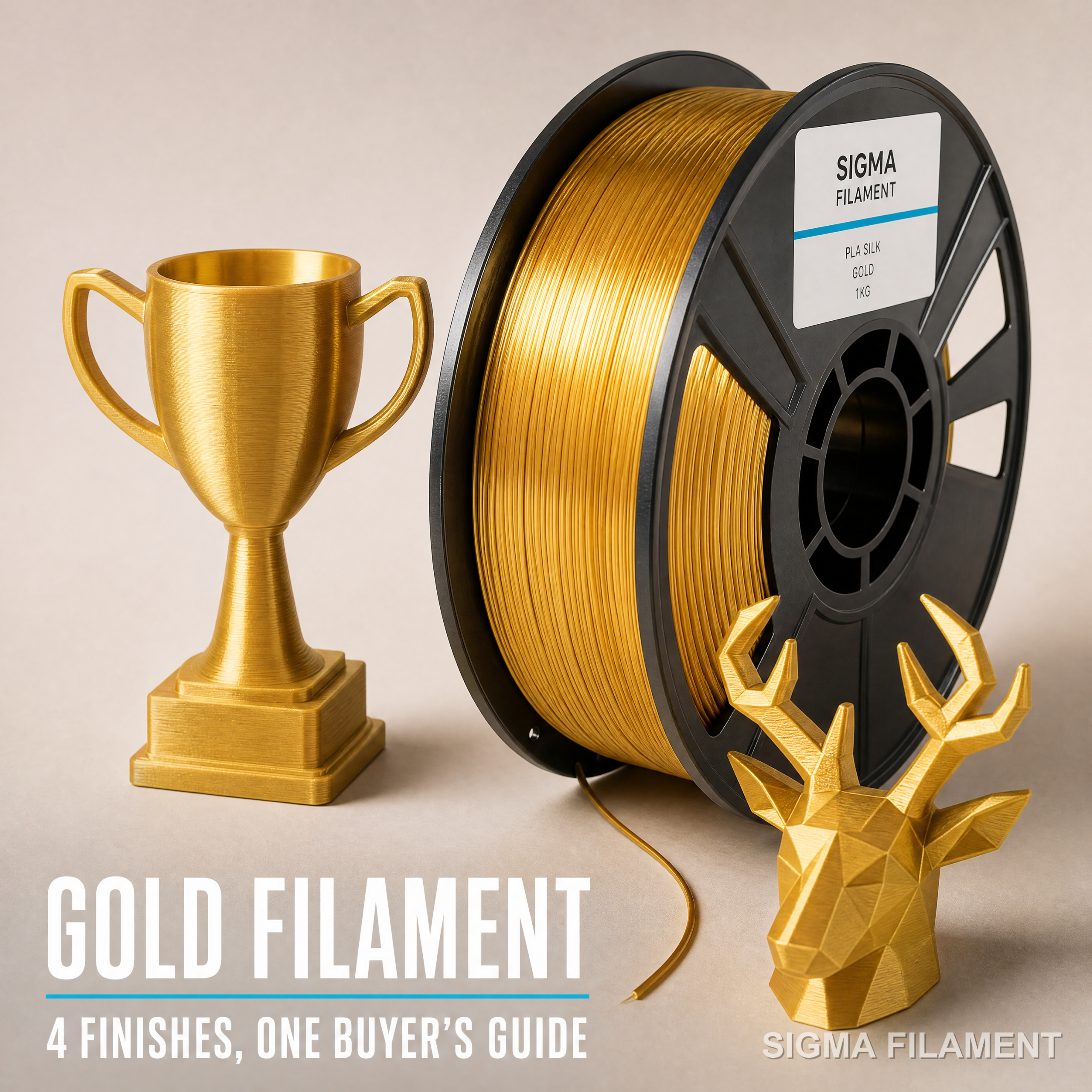
For the shiniest, most gold-looking print with zero post-processing, choose silk gold PLA. For a part that looks and feels closest to real metal, choose a metal-filled gold (and fit a hardened nozzle). For a subtle brushed look choose matte gold PLA; for tougher or semi-outdoor parts choose gold PETG. No standard gold filament actually contains gold. For a repeatable brand gold, match to a Pantone or RAL reference with a custom masterbatch at OEM volume.
Abstract
TL;DR: Gold filament is not one product but four distinct routes, and picking the wrong one is why so many gold prints disappoint on arrival. The category splits into silk gold PLA for the brightest pearlescent shine at the lowest cost (Malayoglu & Besun, 2020), metal-filled gold that loads bronze or brass powder into a PLA or PETG base for real metallic weight and a polishable patina (Kantaros et al., 2023), matte gold PLA for a muted brushed or antique look that also hides layer lines, and gold PETG for tougher, more heat- and moisture-tolerant parts with a glossy rather than silk finish (Wickramasinghe et al., 2020). Each route trades sheen against printability, durability, and cost, so the right choice depends on the end use, not the swatch photo on a product page.
The guide is written for three buyer profiles. Resellers building an aesthetic-filament shelf need a clean four-route decision matrix and a shortlist of colors that convert. OEM brand owners specifying a custom gold need Pantone or RAL matching, deltaE tolerance, and workable private-label MOQ. Makers printing trophies, jewelry prototypes, decor, or props need the print settings that deliver shine, along with the honest tradeoffs on UV yellowing, scuffing, and nozzle wear. The sections that follow deliver a route-by-route comparison matrix, print-setting tables, color-matching methodology in the CIELAB space, durability and sealing guidance, application recommendations, and OEM sourcing notes for wholesale buyers.
Key takeaways
Six decisions define every gold filament purchase, from the trophy shop buying one spool to the brand owner specifying a custom masterbatch across containers.
- Four gold routes cover the modern filament market: silk gold PLA, metal-filled gold, matte gold PLA, and gold PETG.
- Silk gold PLA produces the brightest shine of the four straight off the printer, with no post-processing step required (Malayoglu & Besun, 2020).
- Metal-filled gold reads closest to real metal because it carries bronze or brass powder, but requires a hardened nozzle (Kantaros et al., 2023).
- No standard gold filament contains actual gold: the color comes from optical pigment or fine non-precious metal powder (Kantaros et al., 2023).
- Gold PLA yellows under prolonged UV or sunlight. Seal outdoor parts with a UV-resistant clear coat, or switch to PETG (Tsuji et al., 2013).
- Repeatable brand gold at scale needs a custom masterbatch: match Pantone or RAL to a deltaE below 1.5 (Datacolor, 2023).
Table of Contents
- TL;DR
- Abstract
- Key takeaways
- Table of Contents
- What gold filament actually is (and the four routes to a gold look)
- Glossary
- The four gold routes compared: silk PLA, metal-filled, matte, and gold PETG
- By the numbers
- How to choose: match the gold finish to your project
- Print settings for the shiniest gold finish
- Color matching: hitting Pantone and RAL golds
- By the numbers
- Does gold PLA fade or yellow? Durability, UV, and sealing
- Applications: the right gold for trophies, jewelry, decor, and signage
- Sourcing gold filament at wholesale and OEM scale
- By the numbers
- Frequently Asked Questions
- Conclusion
- References
What gold filament actually is (and the four routes to a gold look)
No consumer FDM filament marketed as "gold" in 2026 contains real gold metal. The metallic color comes from one of two routes: pearlescent or matte pigments in a plastic base (silk and matte varieties), or a fine non-precious metal powder like bronze or brass blended into a polymer (metal-filled varieties) (Kantaros et al., 2023). Printing actual gold metal is not a consumer FDM process.
That distinction matters when specifying stock for a reseller shelf or matching an OEM color to a physical reference. Four production routes deliver a gold look on desktop FDM (fused deposition modeling) printers today, and each one sits differently on cost, finish quality, and durability.
Is there real gold in gold filament?
No. Consumer 3D printing gold filament is either pigmented plastic or a plastic loaded with a cheaper metal powder. Silk gold and matte gold rely on pearlescent or matte pigments dispersed in a PLA base to simulate the metal look optically (Malayoglu & Besun, 2020). Metal-filled gold uses fine bronze or brass powder in a PLA or PETG base for real metallic heft and polishability, and because that powder is abrasive, a hardened-steel or ruby nozzle is required to protect the hotend (Kantaros et al., 2023). Actual gold metal costs orders of magnitude more per gram than any of these composites at retail, and it belongs to metal-additive manufacturing hardware, not desktop FDM. For an OEM buyer, that means a gold filament spec sheet is really a pigment or metal-powder recipe, and matching a reference gold across production lots is a colorimetry problem, not a metallurgy one.
The four routes at a glance
The four routes cover most gold-print buying decisions. The comparison below anchors the deeper feature matrix in the next section.
| Route | How the gold color is made | Headline trait |
|---|---|---|
| Silk gold PLA | Pearlescent optical pigment in a PLA base (Malayoglu & Besun, 2020) | Shiniest, near-mirror finish with no post-processing |
| Metal-filled gold | Bronze or brass powder in a PLA or PETG base (Kantaros et al., 2023) | Real metal heft and polishability, requires a hardened nozzle |
| Matte gold PLA | Matte pigment in a PLA base | Subtle brushed or antique look, hides layer lines well |
| Gold PETG | Gold pigment in a PETG base | Tougher, better heat and moisture tolerance for functional parts |
Glossary
- Silk: a pearlescent additive that produces a shiny, near-mirror surface without post-processing.
- Metal-filled: a filament with fine metal powder, typically bronze or brass (not gold), blended into a plastic base.
- Matte: a pigment finish that scatters light rather than reflecting it, giving a low-sheen, muted appearance.
- PETG: polyethylene terephthalate glycol, a tougher and more heat- and moisture-tolerant polymer than PLA.
- deltaE: the CIELAB colorimetric distance between two colors; a deltaE below 1 is imperceptible to the human eye (Sharma et al., 2005).
The four gold routes compared: silk PLA, metal-filled, matte, and gold PETG
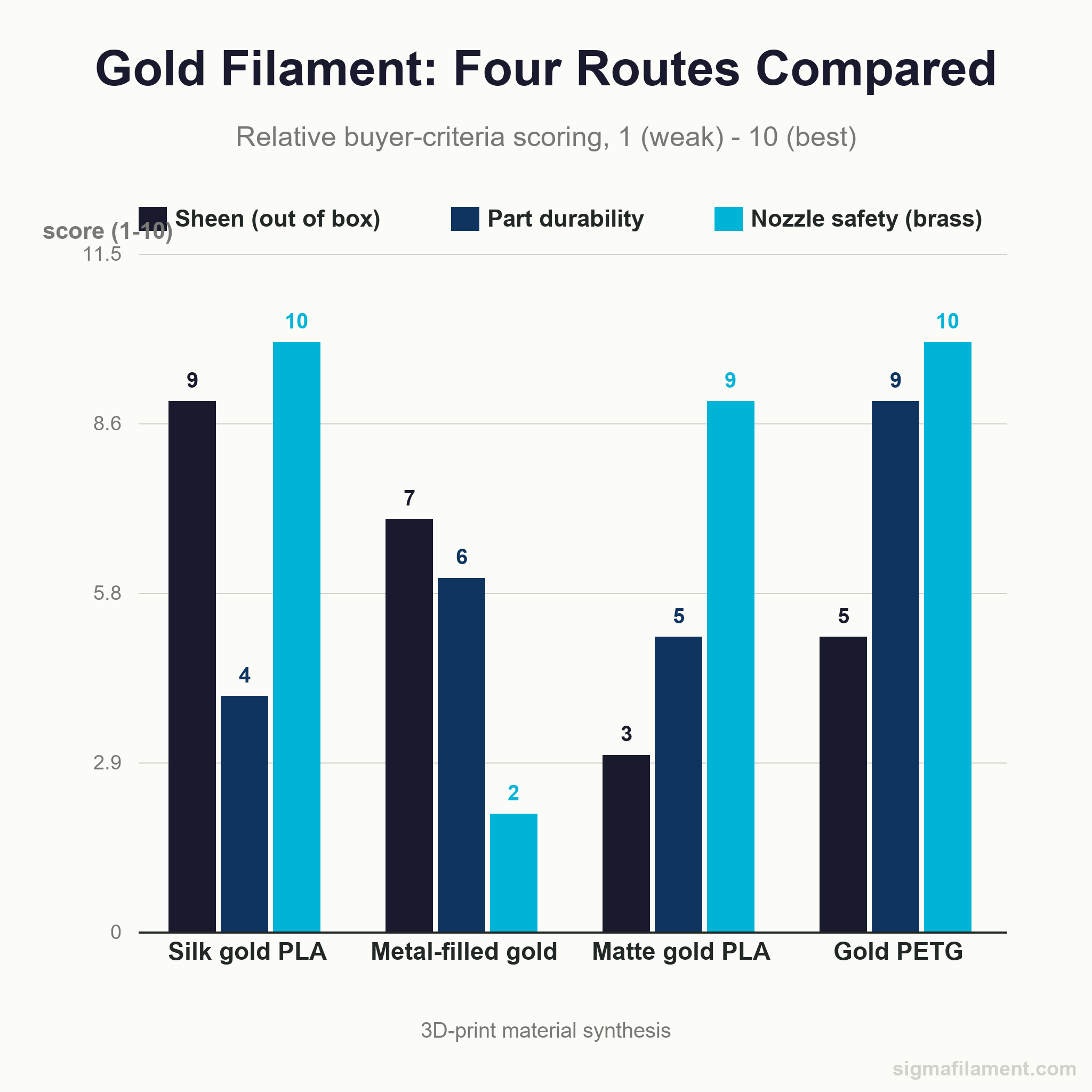
Four routes dominate the gold filament market in 2026, and each optimizes a different trade among shine, durability, cost, and printer wear. Silk gold PLA wins on brightness and price. Metal-filled gold wins on weight and polish potential. Matte gold PLA wins on layer-line camouflage. Gold PETG wins on toughness. Choosing the wrong route wastes spools and, in the case of metal-filled, can destroy a nozzle inside a single print job (Xometry, 2024). The four routes are not competing versions of the same product. They are four material systems that share a color family, and each one wins a different job on the reseller’s shelf.
Across the four gold routes, silk gold PLA gives the highest sheen at the lowest cost, while metal-filled gold blends real bronze or brass powder for a polishable, metal-weight finish whose abrasive powder mandates a hardened-steel nozzle instead of standard brass (Kantaros et al., 2023; Xometry, 2024).
Silk gold PLA
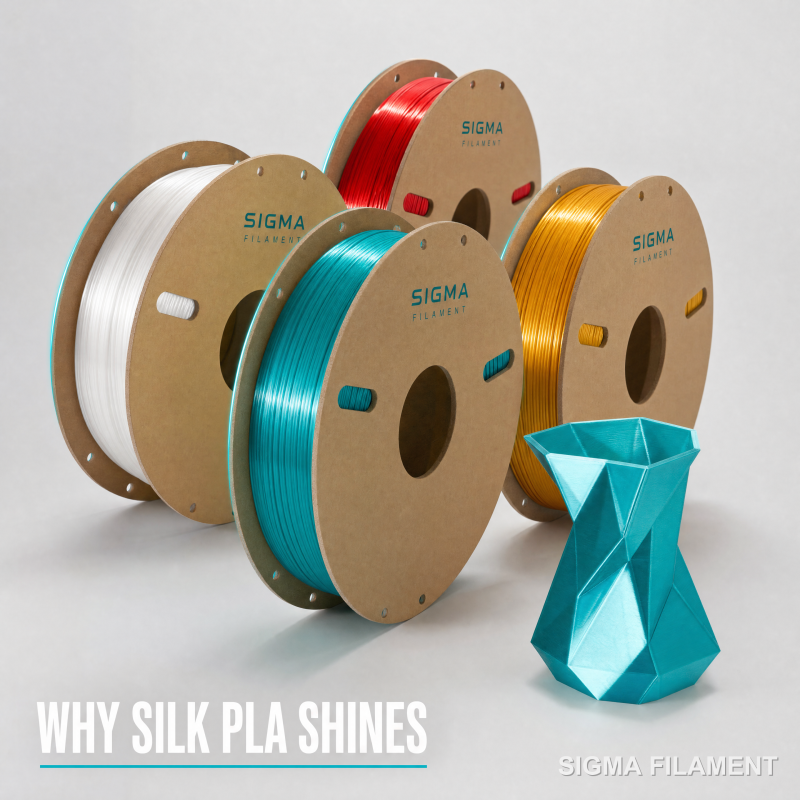
Silk gold PLA uses pearlescent optical pigments in a PLA base to deliver a bright, near-mirror gold with no post-processing (Malayoglu & Besun, 2020). It prints on any consumer FDM machine with a standard brass nozzle, sits at the lowest price of the four, and produces the highest sheen straight off the printer. Two limits keep it out of functional roles: the pearlescent surface scuffs with repeated handling, and PLA is not heat- or UV-stable (Tsuji et al., 2013). Best for indoor trophies, decor, and photography-facing display prints.
Metal-filled gold
Metal-filled gold blends fine bronze or brass powder into a PLA or PETG carrier, giving prints real-metal density and the ability to be sanded and polished to a genuine metallic patina (Kantaros et al., 2023). The mechanical cost is real. That powder is abrasive, so a hardened-steel or ruby nozzle is mandatory (Xometry, 2024). A standard brass nozzle drifts out of diameter tolerance well before the spool finishes, and it drags print quality down as it goes. Filament cost is the highest of the four, and finished parts weigh visibly more than the pigmented alternatives. Best for jewelry prototypes, weighted props, and awards where a true metal feel is the deliverable.
Matte gold PLA
Matte gold PLA uses a non-reflective pigment system for a brushed or antique-gold look. Sheen is intentionally low, but the matte surface hides layer lines materially better than a glossy finish, which lowers the perceived defect rate on parts printed at higher layer heights. Print settings match standard PLA, cost sits between silk and metal-filled, and the finish reads as understated rather than showy. Best for architectural models, muted signage, and any brief that calls for a subdued gold.
Gold PETG
Gold PETG swaps the base polymer for a tougher, more heat- and moisture-tolerant material (Wickramasinghe et al., 2020). The finish is typically glossy rather than silk-shiny, and PETG stringing calls for tuned retraction, but the payoff is real: parts survive handling, humidity, and short outdoor stints better than any PLA gold (Wickramasinghe et al., 2020). Best for functional hardware, semi-outdoor signage, and shipped goods that will be handled repeatedly along the supply chain.
| Route | Sheen | Look and feel | Durability | Nozzle needed | Relative cost | Best for |
|---|---|---|---|---|---|---|
| Silk gold PLA | Highest | Bright, near-mirror | Low | Standard brass | Lowest | Trophies, decor |
| Metal-filled gold | Medium, polishable | Real-metal weight and patina | Medium, polish improves it | Hardened steel or ruby (Xometry, 2024) | Highest | Jewelry, awards, props |
| Matte gold PLA | Low by design | Brushed or antique | Low | Standard brass | Mid | Architectural, muted signage |
| Gold PETG | Glossy | Solid, plastic-looking | High | Standard brass | Mid | Functional, semi-outdoor parts |
By the numbers
- Highest sheen and lowest cost both belong to silk gold PLA, the only route in the four that delivers both attributes at once.
- Hardened-steel or ruby nozzle mandatory for metal-filled gold; a standard brass nozzle will not survive a single spool of abrasive bronze or brass powder (Xometry, 2024).
- Only tough gold route among the four is gold PETG, the pick for handled or semi-outdoor parts.
- Best layer-line camouflage comes from matte gold PLA, which reads cleaner off the printer than any glossy alternative at the same layer height.
Across the 2026 gold filament market, silk gold PLA delivers the highest sheen at the lowest cost, matte gold PLA hides layer lines with a brushed finish, metal-filled gold gives real-metal weight at the price of a mandatory hardened-steel nozzle, and gold PETG is the tough pick for parts that will be handled or briefly go outdoors.
How to choose: match the gold finish to your project
There is no single "best gold filament." The winning route depends on five criteria: the sheen you want, the environment the part faces, the equipment on hand, the finishing plan, and cost and volume. Score each criterion against the four routes (silk gold PLA, metal-filled gold, matte gold PLA, gold PETG) and one route will fit.
Sheen and look
For maximum shine straight off the printer, silk gold PLA is the pick. Its pearlescent optical additive gives the highest sheen of the four routes with no post-processing (Malayoglu & Besun, 2020). For a genuine metal look and heft, choose metal-filled gold: the bronze or brass powder inside can be sanded and polished to a true metallic patina, though the base polymer is still PLA or PETG (Kantaros et al., 2023). For a muted or antique aesthetic that also hides layer lines, matte gold PLA wins. Gold PETG reads as a clean glossy gold rather than a silk shine.
Durability and environment
Indoor display parts handled rarely can use any PLA route. Parts that get touched, packed, shipped, or run warm need more toughness: gold PETG resists scratches, moisture, and higher service temperatures than PLA (Wickramasinghe et al., 2020). For semi-outdoor signage or fixtures, gold PETG is the default gold filament. PLA also yellows under prolonged UV, so any PLA route bound for sunlight needs a sealed clear coat (Tsuji et al., 2013).
Per widely used colorimetry practice, a deltaE below 1.5 is a common OEM tolerance for perceived color match, and a deltaE below 1 is imperceptible to the human eye (Datacolor, 2023), which sets a realistic bar when a client references a Pantone or RAL gold across mixed batches and mixed routes on the same shelf.
Equipment and printability
Metal-filled gold is abrasive and grinds standard brass nozzles quickly. A hardened-steel or ruby nozzle is mandatory, and a 0.6 mm size runs cleaner (Xometry, 2024). Silk and matte PLA print on standard brass nozzles at normal PLA temperatures. Gold PETG runs hotter and stringier and rewards tuned retraction. If your shop has only stock nozzles, either upgrade the hot end for metal-filled or route the order to a silk or matte PLA.
Finishing plan
Silk gold PLA looks best off the plate; polishing usually dulls the sheen. Metal-filled gold is the opposite: it rewards sanding and polishing, and the finish deepens the longer you work it. Matte gold PLA ships as printed. Gold PETG accepts a clear UV-resistant top coat when the part goes outdoors.
Cost and volume
Silk and matte gold PLA carry the lowest per-kilogram cost and the fastest extrusion lines, which suits high-volume aesthetic runs and OEM color programs. Metal-filled costs clearly more, driven by the loaded metal powder, and cycle times run longer at slower recommended speeds (Xometry, 2024). Gold PETG runs a modest step above standard PETG on price. A resellable shelf of silk PLA plus gold PETG covers most demand, with metal-filled added as a costlier line reserved for jewelry and award work.
The five-question checklist
- Sheen target. Highest shine wants silk gold PLA; real-metal look wants metal-filled; muted or antique wants matte PLA; clean gloss wants gold PETG.
- Environment. Indoor low-handling accepts PLA; handled or semi-outdoor points to gold PETG.
- Nozzle on hand. No hardened nozzle rules out metal-filled; brass is fine for the other three.
- Finishing intent. Print-and-ship favors silk, matte, or PETG; sand-and-polish favors metal-filled.
- Budget and MOQ. Lowest cost and easiest custom-color runs favor the PLA routes; a higher unit budget opens the door to metal-filled.
Ready when you are
40+ stock colors and 100% virgin NatureWorks Ingeo resin back every spool we extrude, the same base line the silk, matte, and metal-filled gold routes in this guide draw from. Whether you are stocking an aesthetic-PLA gold SKU or spec’ing a custom color-matched masterbatch, the standard first step is the same: a sample spool checked against your own printer and QC bench before any bulk commitment. Request a sample spool and wholesale quote to start qualifying us on your next gold order.
Print settings for the shiniest gold finish
Silk gold PLA delivers the shiniest 3D-printed gold, and among the four gold filament routes it is the easiest to tune. Print smooth outer walls at moderate speed, hold consistent part cooling, and leave ironing off. The other three routes each need their own profile. The table below is the buyer-decision snapshot; the notes that follow tune each route.
| Setting | Silk gold PLA | Metal-filled gold | Matte gold PLA | Gold PETG |
|---|---|---|---|---|
| Nozzle temp | 205 to 235 °C | 205 to 235 °C | 200 to 225 °C | 230 to 250 °C |
| Bed temp | 50 to 60 °C | 50 to 60 °C | 50 to 60 °C | 70 to 80 °C |
| Outer-wall speed | 30 to 60 mm/s | Slower than silk PLA | 30 to 60 mm/s | Slower, retraction-tuned |
| Layer height | 0.12 to 0.20 mm | Standard, often a 0.6 mm nozzle | Standard PLA | Standard |
| Ironing | Off | Off | Optional | Off |
| Nozzle type | Standard brass | Hardened steel or ruby (Xometry, 2024) | Standard brass | Standard brass |
Warning: metal-filled gold filament carries fine bronze or brass powder that abrades a standard brass nozzle within a single large spool (Xometry, 2024). Fit a hardened-steel or ruby nozzle before the first purge, or the wear pattern will silently degrade dimensional accuracy on every subsequent print.
Silk gold PLA: smooth walls, moderate speed
The silk sheen is a surface-optical effect from a pearlescent additive, not a bulk color, so the finish is only as bright as the outer wall is smooth. Keep the outer-wall speed near the low end of the 30 to 60 mm/s window. Slower walls print flatter, and flat walls reflect more coherently. Run a single outer perimeter, hold flow at 95 to 100 percent, and cool with a steady part fan from layer two onward. Ironing generally hurts silk finishes because the ironing pass re-melts the additive at the top surface and dulls the pearlescent scatter. We ship our silk profiles with ironing disabled by default and only re-enable it on top faces that will be viewed edge-on.
Metal-filled gold: hardened nozzle, patient flow
Metal-filled gold filament loads a PLA or PETG carrier with fine bronze or brass powder (Kantaros et al., 2023). The powder is what gives real metallic weight and polishability, and it is also what destroys unshielded brass nozzles. Move to a hardened-steel or ruby nozzle, size up to a 0.6 mm orifice if the geometry allows, and drop outer-wall speed noticeably below the silk-PLA baseline to give the abrasive melt time to shear cleanly. A small flow bump, roughly 3 to 5 percent above nominal, counters the mild under-extrusion these blends show at speed.
Matte gold PLA and gold PETG variants
Matte gold PLA prints cleanly on default PLA profiles; the pigment does the heavy lifting, so tuning targets layer-line neutrality rather than sheen. Across the aesthetic-PLA range we produce, matte grades hold diameter within ±0.02 mm at ship, which keeps the flat finish uniform on long single-piece walls. Gold PETG asks for the opposite of silk PLA: turn stringing controls up, lift the bed into the 70 to 80 °C band, and slow outer walls to hold glossy, string-free seams.
Pearlescent silk gold PLA reaches peak sheen when the outer wall is printed as a single perimeter near the low end of the 30 to 60 mm/s speed window, because the mica-family additive relies on flat, uninterrupted layer facets to scatter light coherently rather than on bulk color (Malayoglu & Besun, 2020).
Color matching: hitting Pantone and RAL golds
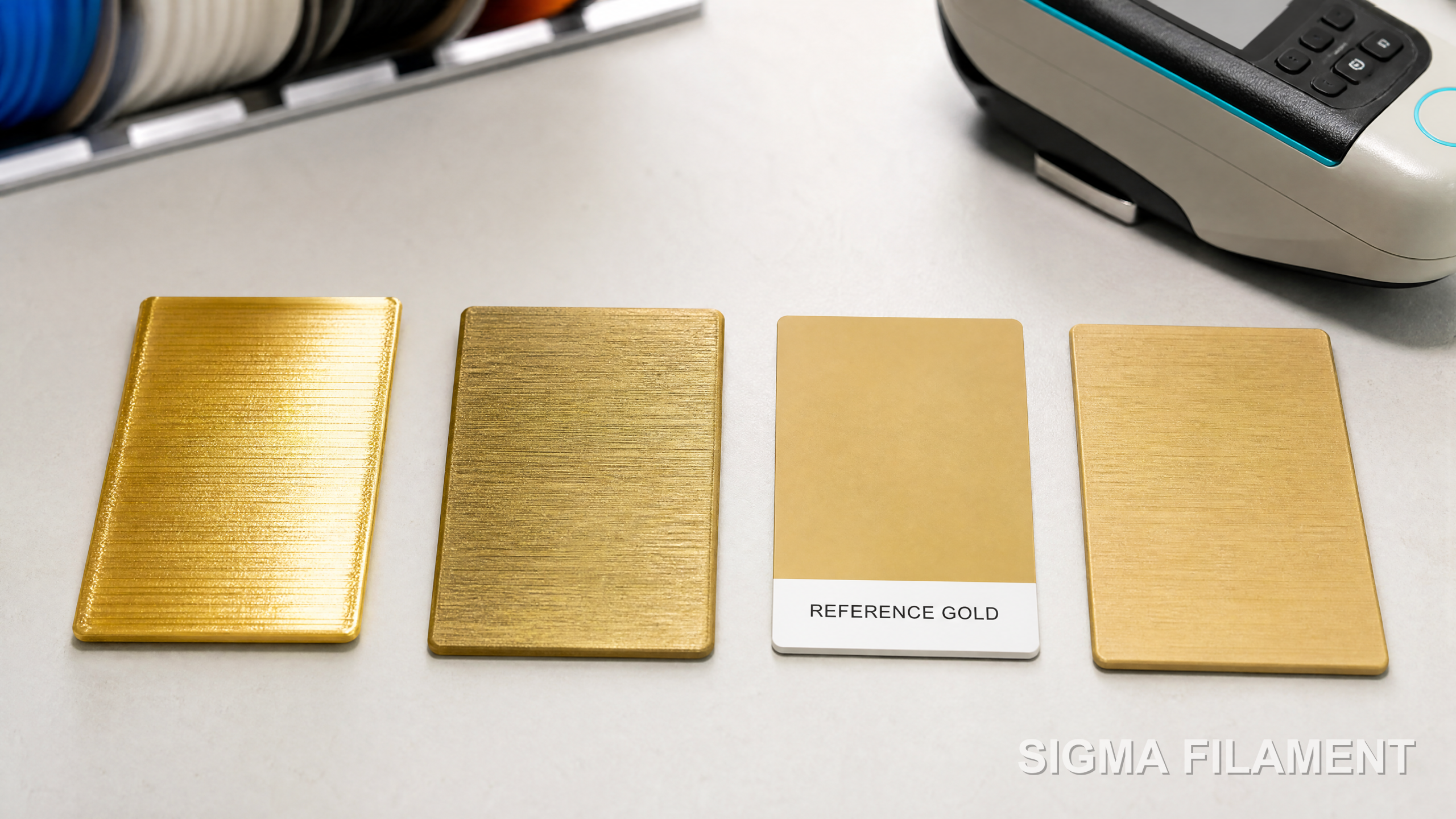
Yes, a gold filament can be matched to a specific Pantone Metallic gold or RAL 1036 Pearl Gold reference, but the pigment work happens in the color lab, not on the printer. Brand owners send the target chip or code to our compound team; we blend a masterbatch, extrude trial spools, then measure each swatch against the reference under standardized lighting and viewing geometry. The read comes back as a single number, deltaE, and that number decides pass or fail before any customer sees the spool.
A gold filament match is judged by deltaE, the single distance score between a measured swatch and the target in the CIELAB color space. A deltaE below 1.0 is imperceptible to a trained observer, and most OEM color contracts accept deltaE 1.5 or better as a pass (Datacolor, 2023).
How the measurement works
Filament swatches and the reference chip are read on a spectrophotometer that reports color in the CIELAB space: L* for lightness, a* for the green-red axis, b* for the blue-yellow axis (Sharma et al., 2005). deltaE is the geometric distance between the sample point and the target point in that space, so it collapses a full spectral comparison into one score a QC operator can act on (Sharma et al., 2005). Modern OEM programs use the deltaE 2000 formula, which weights the axes closer to how the human eye perceives shifts in hue, chroma, and lightness (Sharma et al., 2005).
By the numbers
- deltaE below 1.0: not perceptible to a trained human observer under D65 daylight (Datacolor, 2023).
- deltaE below 1.5: the widely accepted tolerance most OEM color contracts sign off on (Datacolor, 2023), including our own custom color program.
- deltaE 2 to 3: perceptible on close inspection, acceptable for everyday decor (Datacolor, 2023).
- deltaE above 5: reads as a visibly different color to most viewers (Datacolor, 2023).
In color science, deltaE is the numeric distance between a measured sample and its target in the CIELAB color space; a deltaE below 1.0 is imperceptible to a trained observer under D65 daylight, and OEM color contracts commonly sign off at deltaE 1.5 or better, including the tolerance our custom color program guarantees to brand owners (Datacolor, 2023).
Why metallic and pearl golds resist a perfect match
Pantone Metallic gold and RAL 1036 Pearl Gold both rely on flake pigments that reflect directionally, so the measured a* and b* values shift with the angle of the light source and the angle of view (Malayoglu & Besun, 2020). A swatch that clears deltaE 1.2 head-on can drift past 3 at a 45 degree tilt, which is why serious color specs require multi-angle spectrophotometry and a stated viewing geometry rather than a single number. Plan the spec around the lighting the finished part will live under.
Does gold PLA fade or yellow? Durability, UV, and sealing
Gold PLA prints easily and reads well under interior lighting, but the base polymer was not engineered for outdoor service. For buyers spec’ing gold filament for signage, retail displays, or awards shipped across climates, the finish system deserves the same planning as the color match itself.
UV and yellowing
Standard PLA is a poly(lactic acid) bio-based thermoplastic, and it is not UV-stable (Tsuji et al., 2013). Under prolonged sunlight, unstabilized PLA undergoes photodegradation: main-chain scission proceeds, the surface embrittles, and pigmented parts drift toward a duller, yellower tone (Yasuda et al., 2010). Bright silk gold filament shows the shift earliest, because the sheen depends on a thin pearlescent additive layer at the surface, and any change in that layer is visible long before bulk color drift.
Under ASTM D5208 fluorescent-UV accelerated-weathering protocols, unstabilized PLA reaches a measurable color change of deltaE above 2, a trained-eye threshold, within a few hundred hours of exposure (ASTM International, 2022). That interval corresponds to well under one year of outdoor equivalent in a temperate climate, and pigmented golds tend to drift faster than uncolored baseline PLA in the same window.
Handling scuffs surface earliest on flat top layers, where fingernail and lanyard-clip contact concentrates on the outermost pearlescent oriented layer; textured or curved geometries mask the effect for longer.
Sealing and when to switch to PETG
For indoor decor, awards, or short-run retail displays, a clear UV-resistant coat handles both failure modes at once. The coating absorbs incoming UV energy, shields the sheen layer from abrasion, and locks pigment orientation in place.
Tip: Print the part, let it rest 24 hours for full crystallization, wipe with isopropyl alcohol, then spray two thin cross-coats of a clear acrylic sealer rated for UV protection (matte for silk gold, gloss for metal-filled). Follow with a third pass after a 30 minute flash, and avoid heavy single coats that pool in the layer valleys.
For outdoor signage, high-touch props, or any part that will see sustained sun, sealing alone is not the right specification. Move the base material to gold PETG filament, which is tougher, more moisture-tolerant, and holds pigment better under UV than PLA, or step up to gold ASA if the piece has to survive full-weather exposure for multiple years (Wickramasinghe et al., 2020). Gold PETG gives up a small amount of the silk pop, but earns it back in service life.
Applications: the right gold for trophies, jewelry, decor, and signage
Every gold filament route has an application it wins outright. Match by handling frequency, viewing distance, and whether the part will sit indoors on a shelf or take weather, hands, and heat. The four routes split cleanly across four buyer scenarios, and the pigment vs metal-powder tradeoff drives most of the decision.

Trophies, awards, and plaques
For a bright, camera-ready trophy that ships fast and stays on a mantel, silk gold PLA is the pragmatic default. The pearlescent optical additive (Malayoglu & Besun, 2020) delivers a near-mirror finish straight off the printer with no polishing step. When the recipient will pick the award up, weigh it, and expect a real metal feel, metal-filled gold shifts the calculus. Its bronze or brass powder (Kantaros et al., 2023) adds heft and can be sanded then buffed to a genuine metallic patina that survives close inspection. Metal-filled awards cost more per spool and require a hardened-steel or ruby nozzle (Xometry, 2024), but the perceived value of a polished, weighted piece justifies the upgrade for high-value recognition programs.
Jewelry, cosplay props, and prototype hardware
Jewelry blanks, ring prototypes, sword pommels, and armor accents all favor metal-filled gold. Weight sells the illusion; a polished bronze-filled ring reads as brass or aged gold in product photographs (Kantaros et al., 2023), which matters for e-commerce listings and convention displays. The finish accepts chemical patinas and darkening solutions, so makers can age a piece intentionally rather than accept a plastic sheen. For fitted wearables, print at higher shell counts and slower speeds to keep the metal loading consistent through the polish stage.
Weight is a signal. Sheen is a signal. Pick the route whose signal your buyer will actually touch.
Decor, signage, and architectural models
Indoor decor, retail displays, and architectural presentation models lean silk gold PLA for the same reason trophies do: the shine reads across a room and holds under showroom lighting. Building numerals, exterior letter signage, and semi-outdoor accents move to gold PETG. The tougher polymer tolerates moisture, sun, and daily handling far better than PLA (Wickramasinghe et al., 2020), at the cost of a glossier rather than silk-shiny appearance. For matte antique-gold decor (picture frames, mock-metal statues, gilded moldings), matte gold PLA carries the aesthetic and hides layer lines without added post-processing.
Trade coverage of 3D-printed awards and display work consistently sorts silk gold PLA into decorative and lower-cost recognition tiers, metal-filled gold into weighted, higher-priced awards and prop hardware, and gold PETG into signage or exterior work where PLA’s UV and moisture limits would shorten service life.
Sourcing gold filament at wholesale and OEM scale
Reseller shelves and OEM brand programs sit on two different gold filament sourcing tracks. Stock SKU procurement gets a proven gold onto pallets in weeks. Custom-color OEM development produces a repeatable brand gold that survives reorders across years and factory shifts. Both routes converge on the same question, how tightly can the supplier hold color, diameter, and spool-level quality at volume.
Stock gold SKUs (the fastest path to a shelf)
Stock silk, matte, metal-filled, and PETG gold filament is already extruded, indexed, and QC-passed. Lead time is packaging and freight, not development. For a distributor testing gold across the four routes, stock is the right first order: known formulation, known print behavior, known landed cost. As a source manufacturer, SigmaFilament runs stock aesthetic-PLA orders with an MOQ from 100 spools, which lets a reseller build a four-SKU gold flight without a full container commitment.
OEM custom color (a repeatable brand gold)
A gold that must match a logo, a packaging foil, or a metal fitting is an OEM job, not a stock pick. The professional route is a custom color masterbatch developed against a physical Pantone or RAL reference (RAL 1036 pearl gold is common), verified in a spectrophotometer, and signed off at a deltaE tolerance the supplier will guarantee in writing.
Per accepted OEM colorimetry practice, deltaE below 1.5 in the CIELAB space is the working ceiling for a reorder-stable brand color (Datacolor, 2023); SigmaFilament’s OEM/ODM program matches Pantone or RAL to deltaE < 1.5 and archives the recipe so a second production run reproduces the first.
The archived recipe is the point. Our internal testing reads every trial swatch against the target Pantone or RAL chip in the CIELAB space on a spectrophotometer, and only recipes that clear the deltaE 1.5 ceiling get archived for reorder. It converts "a gold we made once" into a spec a purchase order can reference for years, across staff turnover and line changeovers.
Spool branding, tolerance, and MOQ
Beyond color, the OEM contract covers private-label spools and packaging design, the diameter tolerance the extrusion line will hold under continuous run, and the MOQ at which custom becomes economic against stock. A tighter tolerance means fewer print failures at the reseller’s customer, fewer returns on the SKU, and a longer usable shelf life on the reel, which is the durable margin driver over a multi-year private-label program.
By the numbers
- ±0.02 mm diameter tolerance held on PLA and PETG extrusion lines
- 100 spools MOQ for stock aesthetic-PLA, or 500 spools for OEM custom color
- 200+ brands served across 50+ export countries under private-label programs
Frequently Asked Questions
Is there real gold filament?
No. Standard gold filament sold for desktop 3D printing contains no elemental gold (Kantaros et al., 2023). Silk and matte grades take their color from pigments; metal-filled grades are loaded with fine non-precious powder, typically bronze or brass, which gives real metallic heft without the price of gold (Kantaros et al., 2023). Genuine gold is used only in industrial powder-bed processes, not in consumer FDM.
What is the best gold filament?
The best gold filament depends entirely on the goal. For maximum shine on trophies or decor, choose silk gold PLA. For a real-metal look and weight on awards or jewelry masters, choose a bronze- or brass-filled metal PLA (Kantaros et al., 2023). For an antique or brushed aesthetic, choose matte gold PLA. For tougher, semi-outdoor parts, choose gold PETG (Wickramasinghe et al., 2020).
What is the difference between silk gold and metallic gold PLA?
Silk gold PLA uses a pearlescent optical additive that produces a bright, near-mirror sheen, but the base is still plastic (Malayoglu & Besun, 2020). Metallic or metal-filled gold PLA carries real metal powder such as bronze or brass, so it weighs more, can be sanded and polished to a genuine metallic patina, and prints only through a hardened-steel or ruby nozzle because the powder is abrasive to standard brass tips (Xometry, 2024).
How do I get the shiniest gold 3D print?
Use silk gold PLA on smooth outer walls, printed at moderate outer-wall speed of about 30 to 60 mm/s. Keep layer height between 0.12 and 0.20 mm, hold cooling consistent, and leave ironing OFF, because ironing tends to dull the silk sheen. The shine is a surface-optical effect, so any wall imperfection reads as a dull streak, and slower outer-wall passes usually look brighter than fast ones.
Does gold PLA fade or yellow in sunlight?
Yes, over time. PLA is not UV-stable, so prolonged sunlight can yellow the base resin and degrade the pigment, and silk finishes also scuff visibly with handling (Tsuji et al., 2013). Indoors, within a normal service life, the effect is rarely a problem. For outdoor signage, garden props, or high-touch parts, seal the print with a clear UV-resistant coat, or specify gold PETG or ASA instead of gold PLA for a tougher, more UV-tolerant substrate (Wickramasinghe et al., 2020).
Can I match Pantone Metallic gold with 3D printer filament?
Yes, within instrument tolerance. Matching is done with a spectrophotometer in the CIELAB color space, using deltaE as the metric (Sharma et al., 2005). A deltaE below 1 is imperceptible to the eye, and below 1.5 is a common OEM tolerance (Datacolor, 2023). Metallic and pearlescent references remain harder to hit exactly because sheen shifts with lighting and view angle. SigmaFilament runs custom OEM color development to Pantone and RAL targets at deltaE below 1.5 from an MOQ of 500 spools.
Is it possible to 3D print with real gold?
Not on a consumer FDM printer. Actual gold parts are produced on industrial powder-bed systems such as direct metal laser sintering (DMLS), which sinters fine gold powder layer by layer under a high-power laser. The machines, feedstock, and safe-handling requirements sit far outside the desktop workflow. For an on-desk substitute, a bronze- or brass-filled metal PLA, polished after printing, is the closest visual and tactile match to a true gold surface (Kantaros et al., 2023).
Conclusion
The four gold filament routes solve distinct jobs, and no single route is universally correct. The right choice depends on how the finished part has to look, what it has to survive, and at what production scale the color has to stay identical.
Pick silk gold PLA when maximum shine at zero post-processing cost is the priority and the part is decorative, handled gently, and lives indoors. Pick metal-filled gold when a real-metal feel, weight, and a polished patina outrank print speed, and the printer runs a hardened-steel or ruby nozzle to survive the abrasive powder (Xometry, 2024). Pick matte gold PLA for a subtle brushed or antique look that also hides layer lines. Pick gold PETG when the part is functional or semi-outdoor and toughness, heat, and moisture tolerance beat sheen (Wickramasinghe et al., 2020).
For a brand gold that has to render identically across batches and years, none of the four stock routes will hold the target on its own. That is an OEM color job, matched to a Pantone or RAL reference in CIELAB and controlled to deltaE below 1.5 (Datacolor, 2023).
The gold in one line: pick the finish that fits the job, then buy at the scale that lets you keep it consistent.
References
- Kantaros, A., Soulis, E., Petrescu, F. I. T., & Ganetsos, T. (2023). Advanced composite materials utilized in FDM/FFF 3D printing manufacturing processes: The case of filled filaments. Materials, 16(18), 6210. https://doi.org/10.3390/ma16186210
- Wickramasinghe, S., Do, T., & Tran, P. (2020). FDM-based 3D printing of polymer and associated composite: A review on mechanical properties, defects and treatments. Polymers, 12(7), 1529. https://doi.org/10.3390/polym12071529
- Sharma, G., Wu, W., & Dalal, E. N. (2005). The CIEDE2000 color-difference formula: Implementation notes, supplementary test data, and mathematical observations. Color Research & Application, 30(1), 21-30. https://doi.org/10.1002/col.20070
- Tsuji, H., Sugiyama, H., & Sato, Y. (2013). Photodegradation of poly(lactic acid) stereocomplex by UV-irradiation. Journal of Polymers and the Environment, 20(3), 706-712. https://doi.org/10.1007/s10924-012-0424-7
- Yasuda, N., Wang, Y., Tsukegi, T., Shirai, Y., & Nishida, H. (2010). Quantitative evaluation of photodegradation and racemization of poly(L-lactic acid) under UV-C irradiation. Polymer Degradation and Stability, 95(7), 1238-1243. https://doi.org/10.1016/j.polymdegradstab.2010.03.034
- Malayoglu, U., & Besun, N. (2020). Development of nanosized mica particles from natural mica by sonication/organic intercalation method for pearlescent pigment. Minerals, 10(6), 572. https://doi.org/10.3390/min10060572
- ASTM International. (2022). Standard practice for fluorescent ultraviolet (UV) exposure of photodegradable plastics (ASTM D5208-14(2022)). ASTM International. https://store.astm.org/d5208-14r22.html
- Datacolor. (2023). Best practices for delta E tolerances. Datacolor Business Solutions Blog. https://www.datacolor.com/business-solutions/blog/best-practices-delta-e-tolerances/
- Xometry. (2024). Metal filled filament: Properties, printing behavior, and applications. Xometry Resources. https://www.xometry.com/resources/3d-printing/metal-filled-filament/
Last reviewed and updated: July 2026. Author: SigmaFilament team. For tailored guidance, contact our team.