

The 2026 Data-Backed 3D Printer Filament Comparison Chart: 7 Materials Tested for Strength & Printability

Abstract
The selection of a thermoplastic filament is a foundational decision in Fused Deposition Modeling (FDM) 3D printing, profoundly influencing the functional and aesthetic outcomes of a project. This analysis provides a comprehensive examination of the most prevalent filaments, including Polylactic Acid (PLA), Polyethylene Terephthalate Glycol (PETG), and Acrylonitrile Butadiene Styrene (ABS), alongside advanced engineering-grade materials like ASA, TPU, Nylon, and Polycarbonate. It investigates the distinct chemical compositions, mechanical properties, and thermal characteristics of each material, presenting the data within a practical 3D printer filament comparison chart framework. The discussion navigates the practicalities of printing, including requisite hardware modifications and slicer settings, alongside the emission of volatile organic compounds and safety protocols. Furthermore, the post-processing potential, environmental considerations, and typical applications for each filament are evaluated. The aim is to equip both novice and experienced practitioners with a nuanced understanding, enabling an informed material choice that aligns with specific design intents, whether for rapid prototyping, functional end-use parts, or high-strength mechanical components.
Key Takeaways
- PLA is ideal for beginners, offering ease of printing for detailed visual prototypes.
- PETG provides a great balance of strength, temperature resistance, and flexibility.
- ABS is the choice for strong, lightweight parts that can withstand high temperatures.
- ASA excels in outdoor applications due to its superior UV and weather resistance.
- Use a detailed 3d printer filament comparison chart to match material properties to your project’s needs.
- Composite filaments like Carbon Fiber PETG offer enhanced stiffness for functional parts.
- Proper filament storage and drying are non-negotiable for achieving quality prints.
Table of Contents
- Understanding the Language of Materials: A Primer on Filament Properties
- The Foundational Trio: An In-Depth Comparison of PLA, PETG, and ABS
- Venturing into Engineering Applications: ASA and TPU
- Reaching for Peak Performance: Nylon and Polycarbonate (PC)
- The Power of Reinforcement: An Introduction to Composite Filaments
- Applying Knowledge: How to Use a 3D Printer Filament Comparison Chart Effectively
- Beyond the Print: Critical Factors of Filament Handling, Safety, and Sustainability
- FAQ
- Conclusion
- References
Understanding the Language of Materials: A Primer on Filament Properties
Before we can intelligently compare materials, we must first establish a common language. When you look at a technical data sheet or a 3d printer filament comparison chart, you are met with a series of terms and numbers that describe a material’s behavior. To the uninitiated, these can feel like an insurmountable wall of jargon. Let us, together, dismantle that wall, brick by brick. Think of these properties not as abstract figures, but as a personality profile for each material. Understanding this profile allows you to predict how a material will behave, both in the printer and in its final form.
Mechanical Properties: The Measure of Might
Mechanical properties describe how a material responds to physical forces. They are the heart of any discussion about functional parts.
- Tensile Strength (MPa): Imagine pulling on a strand of the material from both ends until it snaps. The amount of force required to break it is its tensile strength, measured in megapascals (MPa). A high tensile strength indicates a material is strong and resistant to being pulled apart. PLA, for instance, is quite rigid and has good tensile strength, but it is also brittle.
- Flexural Strength (MPa): Now, instead of pulling, imagine trying to bend a printed bar of the material until it breaks. Its resistance to that bending force is its flexural strength. This is particularly relevant for parts that will bear loads across their length.
- Impact Strength (kJ/m²): Picture dropping a heavy object onto your printed part. Will it shatter, or will it absorb the blow? Impact strength measures a material’s ability to resist sudden, high-energy impacts. It is a measure of toughness. ABS and PETG are known for their superior impact strength compared to the more brittle PLA.
- Elongation at Break (%): When you pull on that strand of material, how much does it stretch before it finally snaps? This percentage of stretch is its elongation at break. A high value, like that seen in TPU, signifies a flexible, ductile material. A low value indicates a rigid, brittle material like PLA.
Thermal Properties: How Materials Handle the Heat
Thermal properties dictate how a material behaves at different temperatures, a vital consideration for both the printing process and the part’s final operating environment.
- Glass Transition Temperature (Tg): Every amorphous polymer, like the ones we use in 3D printing, has a temperature at which it transitions from a hard, glassy state to a soft, rubbery one. This is the glass transition temperature. It is not a melting point. Below Tg, the material is rigid. Above Tg, it becomes soft and can be easily deformed. A PLA print left in a hot car on a summer day will likely warp because the interior temperature has exceeded its Tg (around 60°C).
- Heat Deflection Temperature (HDT): This is a more practical measure. It tells you the temperature at which a printed part, under a specific load, will begin to deform. It is generally a better indicator than Tg for predicting a part’s performance in a warm environment. Materials like ABS and ASA have a much higher HDT than PLA, making them suitable for parts used in cars or machine enclosures.
- Printing Temperature (°C): This is the temperature range at which the filament must be heated in the printer’s hotend to melt and flow correctly. Each material has an optimal range. Printing too cold leads to poor layer adhesion and clogs; printing too hot can cause stringing, oozing, and material degradation.
- Bed Temperature (°C): To prevent a print from warping or detaching from the build surface, a heated bed is often used. The bed temperature helps the first layer of the print stay warm and adhered. Different materials require different bed temperatures to manage thermal contraction.
Printability and Other Considerations
Beyond raw numbers, several qualitative factors determine the experience of working with a filament.
- Ease of Printing: How forgiving is the material? Does it require a finely tuned printer, or can a beginner achieve good results on a basic machine? PLA is the undisputed champion of easy printing.
- Warping and Shrinkage: As plastic cools, it contracts. If this happens unevenly, the corners of a print can lift off the bed, a frustrating phenomenon known as warping. ABS is notorious for its high rate of shrinkage and tendency to warp, often requiring an enclosed printer to manage.
- Hygroscopicity: This is a fancy word for a material’s tendency to absorb moisture from the air. Many filaments, especially PETG, Nylon, and TPU, are hygroscopic. When wet filament is heated in the hotend, the water turns to steam, causing pops, voids, and a fuzzy surface finish. Proper storage and drying are therefore non-negotiable for these materials.
- Solubility: Can the material be dissolved in a common solvent? This is relevant for post-processing. For example, ABS can be smoothed with acetone vapor to create a glossy, injection-molded appearance. PVA, a support material, is desirable specifically because it dissolves in water.
By internalizing these concepts, you transform a confusing chart of numbers into a powerful decision-making tool. You are no longer just picking a color; you are selecting a specific set of behaviors to bring your digital design into the physical world.
The Foundational Trio: An In-Depth Comparison of PLA, PETG, and ABS
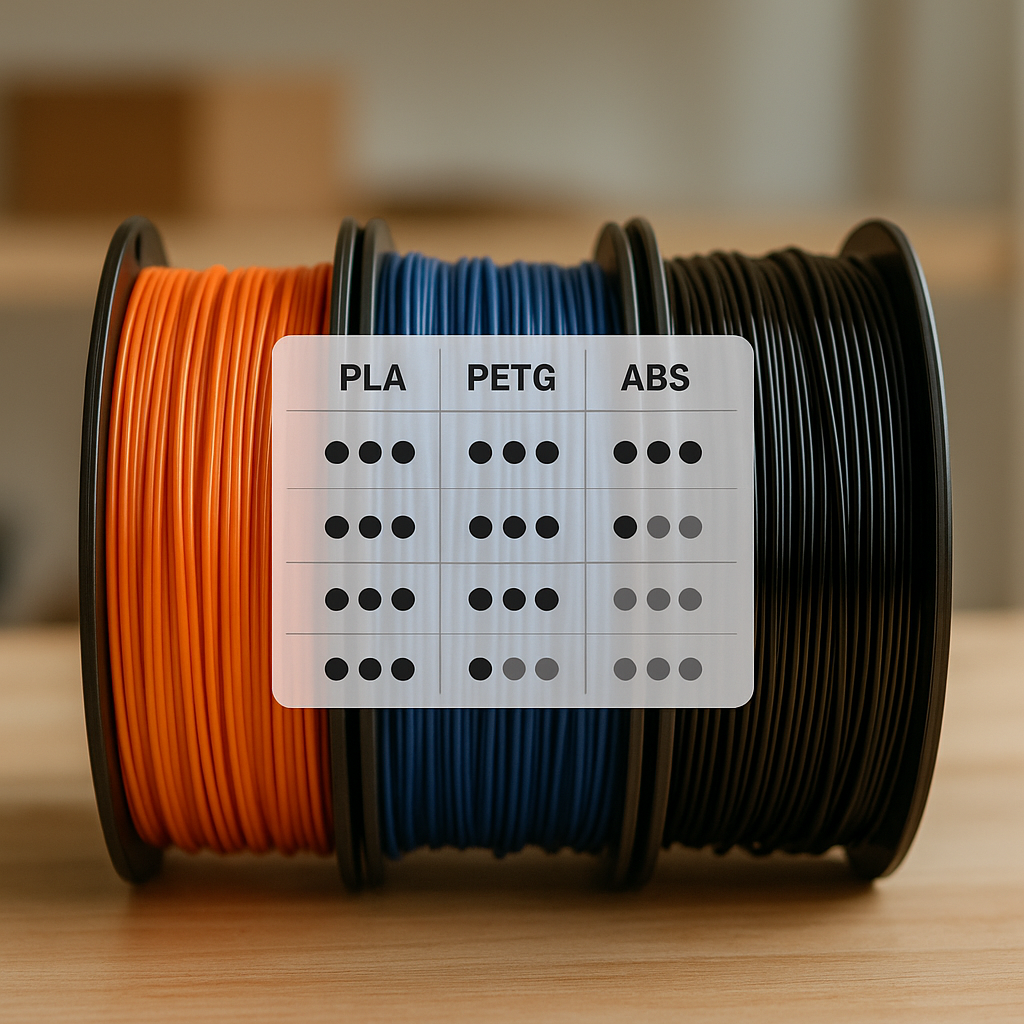
For anyone beginning their journey in 3D printing, or even for seasoned professionals stocking their workshop, three materials form the bedrock of the filament world: PLA, PETG, and ABS. Their prevalence is no accident; they represent a fantastic spectrum of properties, costs, and printing requirements. Understanding the profound differences between them is the first and most vital step toward mastering material selection. Let us treat them as three distinct personalities, each with its own strengths, weaknesses, and ideal roles. A comprehensive 3d printer filament comparison chart is an excellent starting point, but a true understanding comes from exploring the nuances behind the numbers.
The following table provides a high-level overview, a map to guide our deeper exploration. Think of it as the summary on the back of a book; the real story is in the chapters that follow.
| Property | Polylactic Acid (PLA) | Acrylonitrile Butadiene Styrene (ABS) | Polyethylene Terephthalate Glycol (PETG) |
|---|---|---|---|
| Primary Strength | Ease of Use, Rigidity, Detail | Durability, Temperature Resistance | Toughness, Chemical Resistance, Clarity |
| Print Temperature | 190 – 220°C | 230 – 260°C | 220 – 250°C |
| Bed Temperature | 20 – 60°C (or none) | 90 – 110°C | 70 – 90°C |
| Print Speed | 40 – 100 mm/s | 40 – 60 mm/s | 30 – 60 mm/s |
| Enclosure Needed? | No | Highly Recommended | No (but can help) |
| Tensile Strength | High (but brittle) | Medium | High |
| Impact Strength | Low | High | Very High |
| Heat Resistance (Tg) | Low (~60°C) | High (~105°C) | Medium (~80°C) |
| UV Resistance | Poor | Poor | Good |
| Warping Tendency | Very Low | High | Low to Medium |
| Hygroscopicity | Low | Low | High |
| Food Safe Potential | Yes (Virgin material) | No | Yes (Virgin material) |
| Odor / Fumes | Minimal, sweet smell | Strong, potentially harmful (VOCs) | Very Low |
| Common Uses | Visual Prototypes, Models, Toys | Functional Parts, Enclosures, Car Parts | Mechanical Parts, Containers, Guards |
Polylactic Acid (PLA): The Prototyping Standard
If 3D printing filaments were a family, PLA would be the friendly, reliable older sibling who is always easy to get along with. Polylactic Acid is a thermoplastic polyester derived from renewable resources like corn starch or sugarcane, a fact that gives it an eco-friendly reputation (Singh, 2025). This biological origin also accounts for the faintly sweet, pleasant smell it produces when printing, a stark contrast to the acrid fumes of other plastics.
Its primary virtue, and the reason it is the default material for most hobbyists and educators, is its sheer printability. PLA has a relatively low melting point and, most significantly, a very low thermal shrinkage rate. This means it is far less prone to warping than other materials. You can successfully print PLA on almost any FDM printer, often without a heated bed at all, and achieve stunningly sharp details and crisp corners. Its rigidity allows it to hold complex shapes well, making it perfect for aesthetic models, architectural mockups, and visual prototypes where dimensional accuracy and fine features are paramount.
However, PLA’s strengths are also the source of its limitations. Its rigidity comes at the cost of brittleness. A part printed in PLA will be stiff, but if you bend it too far or subject it to a sharp impact, it is more likely to snap than to flex. Think of it like uncooked spaghetti. This brittleness makes it a poor choice for mechanical parts that need to withstand stress or impact. The other major drawback is its low glass transition temperature, which sits around a mere 60°C (140°F). As mentioned, this means a PLA part can deform and sag if left in a hot car or used to enclose heat-generating electronics. Its poor UV resistance also means it will become even more brittle and discolored if left outdoors for extended periods.
So, when should you reach for PLA?
- When you are learning to 3D print. Its forgiveness will build your confidence.
- When you are printing something for its looks: figurines, decorative objects, or cosplay props that won’t see heavy combat.
- When you need a quick, dimensionally accurate prototype to test the fit and form of a design.
- For educational settings, where ease of use and low fume emission are top priorities.
Acrylonitrile Butadiene Styrene (ABS): The Engineering Workhorse
If PLA is the friendly sibling, ABS is the tough, industrial cousin who works in a factory. Acrylonitrile Butadiene Styrene is the same durable plastic used to make LEGO bricks, car dashboards, and power tool housings. It is a petroleum-based polymer, and its reputation is built on three pillars: strength, temperature resistance, and post-processability.
Compared to PLA, ABS is significantly more durable and less brittle. It possesses superior impact strength, meaning it can absorb energy and deform under stress rather than shattering. It is a tougher material overall. Its most significant advantage for many functional applications is its high heat resistance. With a glass transition temperature of around 105°C (221°F), an ABS part can function in much hotter environments than PLA without losing its shape. This makes it a go-to choice for parts that will be used in machinery, automotive applications, or electronics enclosures. Furthermore, ABS is soluble in acetone. This property allows for a post-processing technique called acetone vapor smoothing, which melts the outer surface of the print, fuses the layer lines, and creates a glossy, smooth finish that looks almost identical to an injection-molded part.
However, this performance comes at a cost, primarily in printing difficulty. ABS has a high rate of thermal contraction. As it cools from its printing temperature of 230-260°C, it shrinks considerably. If this cooling happens too quickly or unevenly, the corners of the print will pull inward and lift off the build plate, causing severe warping. To combat this, printing ABS successfully requires a heated bed set to a high temperature (90-110°C) and, crucially, an enclosure around the printer. The enclosure traps heat, maintaining a stable, elevated ambient temperature that allows the part to cool slowly and uniformly. Printing ABS also releases styrene gas, which has a strong, unpleasant plastic smell and is a potentially harmful volatile organic compound (VOC). Therefore, printing should always be done in a well-ventilated area.
Choose ABS when your project demands:
- High durability and impact resistance, like for a drone frame or a protective case.
- High temperature resistance, such as a fan shroud for your printer’s hotend or a part for your car’s engine bay.
- A smooth, glossy surface finish achievable through acetone smoothing.
- A lightweight yet strong material for functional prototypes that will be subjected to mechanical stress.
Polyethylene Terephthalate Glycol (PETG): The Best of Both Worlds?
Enter PETG, the pragmatic mediator attempting to bridge the gap between PLA and ABS. Polyethylene Terephthalate Glycol is a modified version of PET, the plastic used to make water bottles. The “G” for “Glycol” is key; its addition prevents the material from crystallizing and becoming hazy and brittle when heated, making it suitable for 3D printing.
PETG’s appeal lies in its balanced profile. It is significantly stronger and more durable than PLA, with excellent impact resistance that rivals ABS. It is less rigid than PLA, having a bit more flex, which contributes to its toughness. It also boasts a higher heat resistance than PLA, with a Tg of around 80°C (176°F), making it a safer choice for many functional parts. Unlike ABS, it has a much lower shrinkage rate, meaning it is far less prone to warping and does not strictly require an enclosure to print successfully. It adheres well to a variety of build surfaces and produces very low odors and VOCs during printing, making it a more pleasant indoor printing experience than ABS. Additionally, many PETG formulations are certified as food-safe (for the raw filament), and its excellent chemical resistance makes it suitable for containers.
So, is PETG the perfect filament? Not quite. It presents its own unique set of challenges. PETG is highly hygroscopic, meaning it readily absorbs moisture from the atmosphere. Printing with “wet” PETG is a recipe for frustration, leading to excessive stringing (fine, web-like strands of plastic between parts of your model), oozing, and weak, brittle prints with poor surface finish. A filament dryer is an almost essential accessory for anyone serious about printing with PETG. It can also be tricky to dial in your printer settings. It likes to stick—not just to the bed, but to the nozzle. This can result in blobs and zits on the print surface. It also requires slower printing speeds than PLA to achieve good layer adhesion and quality.
PETG is your best bet when:
- You need a part that is stronger and more temperature-resistant than PLA, but you don’t want the printing headaches of ABS.
- The part needs to be tough and have some flex, such as mechanical parts, protective components, or snap-fit enclosures.
- The application requires chemical resistance or potential food contact (always check the manufacturer’s specific data sheet).
- You are printing large objects where the risk of warping with ABS would be too high.
The choice between PLA, PETG, and ABS is a classic engineering trade-off. There is no single “best” material; there is only the best material for your specific application. By understanding their core personalities, you can move beyond simply reading a 3d printer filament comparison chart and start making truly informed design decisions.
Venturing into Engineering Applications: ASA and TPU
Once you have mastered the foundational trio of PLA, PETG, and ABS, a whole new world of specialized materials opens up. These filaments are designed to solve specific engineering problems that the standard plastics cannot. They often require more attention to printer setup and slicer settings, but the performance they unlock is well worth the effort. Let’s examine two of the most useful and accessible engineering materials: ASA, the weather-resistant evolution of ABS, and TPU, the flexible powerhouse.
This second comparison table introduces these materials alongside their closest common counterparts to highlight their unique advantages.
| Property | ABS (for reference) | Acrylonitrile Styrene Acrylate (ASA) | TPU (95A Shore Hardness) |
|---|---|---|---|
| Primary Strength | Durability, Temperature Resistance | UV & Weather Resistance, Durability | Flexibility, Durability, Abrasion Resistance |
| Print Temperature | 230 – 260°C | 240 – 260°C | 210 – 230°C |
| Bed Temperature | 90 – 110°C | 90 – 110°C | 40 – 60°C |
| Enclosure Needed? | Highly Recommended | Highly Recommended | No |
| Tensile Strength | Medium | Medium | Very Low (but stretches) |
| Impact Strength | High | High | Extremely High (absorbs impact) |
| Heat Resistance (Tg) | High (~105°C) | High (~100°C) | Low (~60°C) |
| UV Resistance | Poor | Excellent | Good |
| Warping Tendency | High | High (slightly less than ABS) | Very Low |
| Key Feature | Acetone-soluble | Withstands sun and rain | Rubber-like elasticity |
| Common Uses | Indoor functional parts | Outdoor parts, garden tools, car exterior trim | Phone cases, flexible joints, vibration dampers |
Acrylonitrile Styrene Acrylate (ASA): The Outdoor-Ready Alternative
Think of ASA as ABS’s more sophisticated, worldly sibling. Chemically, it is very similar to Acrylonitrile Butadiene Styrene. The key difference lies in the replacement of the ‘B’ (Butadiene rubber) with an ‘A’ (Acrylate rubber). This seemingly small chemical tweak has a profound real-world consequence: ASA possesses exceptional resistance to ultraviolet (UV) radiation and weathering.
Have you ever seen old, white outdoor plastic furniture that has turned yellow and brittle over time? That is often the result of UV degradation. If you were to place a part printed in ABS outdoors, it would suffer the same fate. It would lose its color and, more importantly, its mechanical integrity, becoming weak and fragile. ASA, on the other hand, is specifically designed to withstand the elements. It maintains its color and, crucially, its strength and toughness even after prolonged exposure to sunlight and rain.
In most other respects, ASA behaves very much like ABS. It has similar high strength, stiffness, and a high glass transition temperature, making it suitable for demanding, high-temperature applications. It can also be smoothed with acetone to achieve that same desirable injection-molded finish. Unfortunately, it also shares ABS’s main printing challenges. It has a high rate of thermal shrinkage and is very prone to warping. Just like with ABS, a heated bed cranked up to 90-110°C and a fully enclosed print chamber are essentially mandatory for reliable, high-quality results. It also releases styrene fumes during printing, so proper ventilation is just as critical. Some users find the smell of ASA to be slightly less pungent than ABS, but the safety precautions remain the same.
When should you choose ASA over ABS? The answer is simple:
- Anytime a functional part is intended for long-term outdoor use.
- For automotive exterior parts, like custom mirror housings or grille inserts.
- For garden equipment, custom sprinkler heads, or enclosures for outdoor sensors.
- In any application where the strength and heat resistance of ABS are needed, but UV stability is also a requirement.
Essentially, if your design would normally call for ABS but it will live its life under the sun, ASA is the superior choice.
Thermoplastic Polyurethane (TPU): The Flexible Champion
Moving to the opposite end of the rigidity spectrum, we find Thermoplastic Polyurethane, or TPU. Where materials like PLA and ASA are defined by their stiffness, TPU is defined by its elasticity. It is a rubber-like material that allows you to print objects that can be bent, stretched, squashed, and twisted, all while returning to their original shape.
TPU belongs to a broader class of materials called Thermoplastic Elastomers (TPEs). Its properties can vary widely based on its chemical formulation, which is often described by its Shore hardness rating. A lower Shore hardness (e.g., 85A) indicates a softer, more flexible material, while a higher rating (e.g., 95A or 98A) indicates a stiffer, but still flexible, material. 95A is a common and good starting point as it is generally easier to print than its softer counterparts.
The primary benefit of TPU is, of course, its flexibility. This opens up a vast range of applications impossible with rigid plastics. Beyond just being bendy, TPU is also incredibly durable. It has outstanding abrasion resistance, meaning it can withstand scraping and rubbing without wearing down. Its impact resistance is off the charts; because it is soft, it absorbs impact energy rather than cracking. Think of the difference between dropping a glass plate and a rubber ball.
Printing TPU, however, requires a different approach. The filament itself is flexible, like a wet noodle. If you try to push it too quickly through the printer’s extruder mechanism, it can bend, buckle, and jam. This is especially problematic in “Bowden” style extruders, where there is a long tube between the drive gear and the hotend. A “Direct Drive” extruder, where the drive gears are mounted directly on top of the hotend, provides a much shorter and more constrained filament path, making it far superior for printing flexible materials. Key slicer settings for TPU include:
- Slow Print Speeds: Printing slowly (e.g., 20-40 mm/s) is the single most important factor. It reduces the back-pressure in the nozzle and gives the filament time to melt properly without jamming.
- Disabled Retraction: Retraction is a feature where the extruder pulls the filament backward to prevent stringing. With flexible filaments, this rapid back-and-forth movement is a primary cause of jams. It is often best to disable retraction entirely and accept that you will need to clean up some stringing post-print.
- Consistent Temperature: Maintaining a steady print temperature is key to good layer adhesion, which is naturally excellent with TPU.
TPU is the perfect material for:
- Protective parts like custom phone cases, GoPro mounts, or drone landing gear.
- Wearable items, such as watch bands or flexible parts for cosplay costumes.
- Functional parts that require flexibility, like custom gaskets, seals, vibration dampers, or compliant mechanisms.
- Living hinges that can be bent repeatedly without breaking.
By adding ASA and TPU to your material vocabulary, you dramatically expand your problem-solving toolkit. You gain the ability to create parts that can not only withstand mechanical stress and heat but also endure the weather and flex on demand.
Reaching for Peak Performance: Nylon and Polycarbonate (PC)
When standard and even intermediate engineering plastics are not enough, we turn to the high-performance category. Nylon and Polycarbonate represent the next tier of material capability, offering exceptional mechanical and thermal properties. They are not for the faint of heart; printing them successfully demands a capable printer, meticulous material handling, and a deep understanding of their unique behaviors. Think of them as specialist tools. You would not use a micrometer to measure a 2×4, and you would not use PC to print a decorative vase. But when the application demands the utmost in strength, durability, or temperature resistance, these materials are often the only answer.
Nylon (Polyamide): The High-Durability Specialist
Nylon is not a single material but a family of polymers called polyamides (PA). In 3D printing, you will commonly see designations like PA6, PA12, and various carbon-fiber-filled blends. What unites them is a reputation for outstanding durability, a low coefficient of friction, and excellent chemical resistance.
The standout characteristic of Nylon is its toughness, which is a combination of strength and ductility. It can bend and deform significantly under load before failing, and its impact resistance is superb. This makes it an ideal choice for printing functional parts that will be subjected to repeated stress, wear, and impact. Its low coefficient of friction means it is naturally slippery, making it perfect for printing gears, living hinges, bearings, and other parts that need to slide against each other with minimal wear. You can print a set of Nylon gears that will run smoothly against each other for a long time without lubrication.
However, Nylon’s greatest strength is accompanied by its greatest weakness: it is extraordinarily hygroscopic. It can absorb more than 10% of its weight in water from the ambient air in less than 24 hours. As we have discussed, printing with wet filament is a disaster. With Nylon, it is not just a matter of poor surface finish; the moisture chemically alters the printing process (hydrolysis), resulting in parts that are dramatically weaker than they should be. Therefore, a non-negotiable prerequisite for printing Nylon is a dedicated filament dryer and a dry storage solution. The filament should be dried for several hours right before printing and ideally fed directly from a dry box to the printer.
Printing Nylon also requires high temperatures. A nozzle temperature of 250-280°C is typical, and an all-metal hotend (one without a PTFE liner) is required to safely reach these temperatures. While it does not warp as severely as ABS, a heated bed (around 70-90°C) is still recommended, and an enclosure helps ensure consistent layer adhesion. For bed adhesion, a standard PEI sheet is often insufficient. A layer of PVA glue stick or specialized bed adhesive like Magigoo PA is usually necessary to get the first layer to stick properly.
Select Nylon for applications such as:
- Functional gears, bearings, and bushings.
- Living hinges and snap-fit parts that need to endure repeated bending.
- Durable mechanical components for robotics or drones.
- Jigs, fixtures, and tooling that require high impact and wear resistance.
Polycarbonate (PC): The Apex of Strength and Temperature Resistance
If you need a printable polymer that offers the highest possible strength, stiffness, and heat resistance, you will likely arrive at Polycarbonate (PC). This is an industrial-grade thermoplastic known for its use in making bulletproof glass, riot shields, and durable electronic casings. When printed correctly, PC parts are incredibly strong, with tensile strength that can exceed that of all the other common filaments we have discussed.
PC’s most lauded property is its thermal performance. With a glass transition temperature that can be as high as 140°C or more, it can maintain its structural integrity in environments that would cause every other material on our list to fail. This makes it an indispensable material for high-temperature applications, such as parts near motors, in hot industrial settings, or for scientific apparatus. It is also optically transparent in its natural form, though additives and pigments in filament can make it translucent or opaque.
Printing PC is arguably the most challenging of all the materials discussed so far. It demands extremely high temperatures. You will need an all-metal hotend capable of reaching and sustaining 270-310°C. More importantly, you need a very high bed temperature, typically 110-130°C, and an actively heated print chamber is strongly recommended. PC has an even greater propensity to warp than ABS. Without an enclosure that can maintain an ambient temperature well above room temperature (e.g., 70°C or higher), large PC prints are almost guaranteed to warp and detach from the bed. Like Nylon, PC is also hygroscopic and must be meticulously dried before printing to achieve its full mechanical potential.
Due to its extreme strength and stiffness, PC parts can also be prone to cracking along layer lines if layer adhesion is not perfect. This is another reason why a hot, stable print environment is so critical—it promotes strong bonding between layers. Slower print speeds and optimal part cooling (often using very little or no fan) are necessary to manage the internal stresses that build up in the part.
Polycarbonate is the material of choice when nothing else is strong or heat-resistant enough:
- High-strength, load-bearing mechanical components.
- Parts that must operate in very high-temperature environments.
- Protective housings and enclosures requiring maximum impact resistance.
- Jigs and fixtures for manufacturing processes that involve heat.
Working with Nylon and PC is a significant step up in difficulty, but it allows you to move from making models and prototypes to manufacturing true, high-performance engineering-grade parts with your desktop 3D printer. These materials push the boundaries of what is possible with FDM technology. For those looking to source these advanced materials or even develop unique blends, exploring options for custom filament solutions can be a logical next step for specialized projects.
The Power of Reinforcement: An Introduction to Composite Filaments
We have explored a range of pure polymers, each with a distinct profile of strengths and weaknesses. But what if we could take a familiar, easy-to-print polymer and give it a significant boost in performance? That is the compelling idea behind composite filaments. These materials are not new polymers; rather, they are a base polymer, like PLA, PETG, or Nylon, that has been infused with short, chopped fibers of a much stronger material. The most common reinforcing fibers are carbon fiber and glass fiber.
The introduction of these fibers creates a composite material where the properties are a blend of the polymer matrix and the reinforcing fiber. The goal is typically to increase stiffness (modulus) and strength without dramatically increasing weight or printing difficulty. The result is a class of materials that bridges the gap between standard plastics and high-performance engineering polymers, often providing an exceptional stiffness-to-weight ratio.
Carbon Fiber Composites: Stiffness and Strength Redefined
When you hear “carbon fiber,” you might picture the sleek, woven fabric used in supercars and aerospace. The carbon fiber in 3D printer filament is different; it consists of microscopic, chopped fibers mixed into the molten plastic during manufacturing. Even in this form, it has a transformative effect on the base polymer.
- Increased Stiffness: The primary benefit of adding carbon fiber is a dramatic increase in rigidity or stiffness. A part printed in Carbon Fiber PETG (often abbreviated as PETG-CF) will be significantly stiffer and less prone to flex under load than a part printed in standard PETG. This is invaluable for applications like drone frames, robotic arms, or mounting brackets where maintaining precise shape under load is critical.
- Improved Dimensional Stability: The carbon fibers constrain the polymer’s movement as it cools. This leads to less shrinkage and warping compared to the unfilled parent polymer. A Carbon Fiber Nylon (PA-CF), for example, is often easier to print than standard Nylon because it is less prone to lifting off the build plate.
- Enhanced Appearance: Carbon fiber filaments produce a beautiful, matte black surface finish that does an excellent job of hiding layer lines. This can give parts a very professional, high-tech look straight off the printer with minimal post-processing.
However, these benefits come with a critical consideration: abrasiveness. Carbon fiber is extremely hard and abrasive. Printing a carbon fiber composite filament with a standard brass nozzle will destroy it in a matter of hours, widening the orifice and ruining print quality. A hardened steel, ruby, or other wear-resistant nozzle is not just recommended; it is absolutely required. Because the fibers can clog smaller orifices, it is also advisable to use a nozzle with a diameter of 0.5mm or larger (Singh, 2025). The addition of fibers can also sometimes make the material more brittle, reducing its impact strength compared to the tough, unfilled parent polymer.
Choose a carbon fiber composite when:
- Your part needs to be as stiff and rigid as possible.
- You need the dimensional stability and strength of an engineering polymer but want an easier printing experience.
- A professional, matte finish that hides layer lines is desired.
- You are printing functional prototypes, jigs, fixtures, or end-use parts that require a high stiffness-to-weight ratio.
Glass Fiber Composites: A Balance of Performance and Cost
Glass fiber (GF) reinforced filaments serve a similar purpose to their carbon fiber counterparts but offer a different set of trade-offs. Chopped glass fibers are mixed into a base polymer like PETG or Nylon to enhance its mechanical properties.
Compared to carbon fiber, glass fibers provide a good increase in stiffness and strength, though typically not to the same extreme degree. Their primary advantage lies in their impact strength and cost. Glass fiber composites tend to be less brittle than carbon fiber ones, offering better toughness and impact resistance. They are also generally less expensive to produce, making Glass Fiber Nylon (PA-GF), for instance, a more economical choice than PA-CF for applications where the absolute maximum stiffness is not required.
Like carbon fiber, glass fibers are also highly abrasive and necessitate the use of a hardened nozzle. They can also be quite hygroscopic, inheriting the properties of their base polymer (especially if it is Nylon), so proper drying is still essential. The surface finish is typically a matte, slightly fibrous look, which can be very appealing but is distinct from the deep black of carbon fiber.
Glass fiber composites are an excellent choice for:
- Functional parts that require a balance of stiffness, toughness, and impact resistance.
- Cost-sensitive applications where enhanced mechanical properties are needed without the premium price of carbon fiber.
- Parts subjected to dynamic loads where some impact absorption is beneficial.
Wood and Metal Fills: The Aesthetic Specialists
While carbon and glass fibers are added for mechanical performance, another class of “composite” filaments uses additives for purely aesthetic purposes. These are typically based on an easy-to-print polymer like PLA and are filled with fine powders of other materials.
- Wood-Filled PLA: This filament contains actual wood fibers or cork powder. It prints parts that look, feel, and even smell like wood. The surface finish is a matte, fibrous texture. By varying the print temperature during the print, you can even create darker and lighter bands, simulating a wood grain effect. The resulting parts can be sanded, stained, and finished just like real wood. The trade-off is that the wood particles make the filament somewhat more brittle and abrasive than standard PLA (though not nearly as abrasive as carbon fiber).
- Metal-Filled PLA: These filaments are infused with a high percentage (sometimes up to 80% by weight) of fine metal powders like bronze, copper, brass, or stainless steel. The raw printed parts are heavy and have a matte, cast-metal appearance. Their true potential is unlocked through post-processing. These parts can be extensively sanded, polished, and even patinated (aged) to create objects with a genuine metallic luster and feel. They are not, however, as strong as solid metal; they are essentially a plastic part with a high metal content. They are also highly abrasive and require a hardened nozzle.
These aesthetic composites are perfect for:
- Architectural models, busts, and sculptures.
- Cosplay props and replicas that require a specific material look.
- Decorative objects where the weight and finish of metal or the texture of wood are desired.
Composite filaments demonstrate a key principle in material science: by combining different materials, we can create a new material with properties superior to the individual components. They allow you to take a familiar printing process and achieve results—whether in mechanical performance or aesthetic finish—that were previously out of reach.
Applying Knowledge: How to Use a 3D Printer Filament Comparison Chart Effectively
We have journeyed through the properties and personalities of a wide array of 3D printing filaments. We have constructed tables and discussed the data within them. Now, we arrive at the most important part of our inquiry: how do we translate this theoretical knowledge into practical wisdom? A 3d printer filament comparison chart is a map, but a map is useless if you do not know how to read it in the context of your specific journey. The art of material selection is not about finding the “best” material in the absolute sense, but about identifying the most appropriate material for the task at hand.
Matching Material to Application: A Thought Experiment
Let’s engage in a series of thought experiments. Imagine you have a design you wish to bring to life. By asking a series of structured questions, we can navigate the decision-making process logically.
Scenario 1: A Detailed Miniature Figurine for a Board Game
- What is the primary function? Aesthetics. The part needs to have very fine details, sharp edges, and a smooth surface. It will be handled but not subjected to significant mechanical stress.
- What is the operating environment? Indoors, at room temperature. It will not be exposed to heat or UV light.
- What are the printing constraints? The details are small, so printability is paramount. Warping must be minimal to preserve the delicate features. Ease of printing is highly valued.
- Conclusion: The clear choice here is PLA. Its ability to reproduce fine details, its rigidity for holding shape, and its extremely low warping tendency make it perfect. The low impact strength and heat resistance are irrelevant for this application. A material like ABS would be overkill and its tendency to warp would risk ruining the fine details.
Scenario 2: A Replacement Bracket for an Outdoor Security Camera
- What is the primary function? Structural support. The part must be strong enough to hold the camera’s weight without flexing, and durable enough to last for years.
- What is the operating environment? Outdoors. It will be exposed to direct sunlight, rain, and a wide range of temperatures, from freezing winters to hot summers.
- What are the printing constraints? The part is functional, not aesthetic, so minor layer lines are acceptable. It needs to be strong and not warp during printing, but the geometry is relatively simple.
- Conclusion: PLA is out due to its poor UV resistance and low heat resistance. ABS is a possibility for its strength and heat resistance, but its poor UV resistance means it would become brittle over time. PETG has good UV resistance and strength, making it a strong contender. However, the ideal choice is ASA. It was designed for precisely this scenario, offering the strength and heat resistance of ABS combined with excellent, long-term UV and weather resistance. The printing difficulty is a worthwhile trade-off for a part that will not fail after a year in the sun.
Scenario 3: A Custom-Fitted Protective Case for a Handheld Scanner in a Warehouse
- What is the primary function? Impact protection. The case must absorb the shock of being dropped onto a concrete floor without breaking and without transferring the impact to the device inside. It also needs to withstand daily handling and scrapes.
- What is the operating environment? A busy warehouse. It will be handled frequently, possibly with greasy hands, and subjected to bumps and scrapes.
- What are the printing constraints? The case needs to fit the device snugly. It should be easy to grip.
- Conclusion: Rigid materials like PLA, ABS, or even PETG are poor choices. Upon impact, they would either shatter or transfer the force directly to the scanner. The application screams for flexibility and impact absorption. The perfect material is TPU. Its rubber-like elasticity will cushion the device from drops, and its excellent abrasion resistance will hold up to the rough handling of a warehouse environment. The choice of Shore hardness (e.g., 95A) would provide a good balance of flexibility for protection and stiffness for a secure fit.
This question-based process—Function, Environment, Constraints—is a powerful framework for navigating any 3d printer filament comparison chart and making a rational choice.
Reading Between the Lines: What the Data Doesn’t Tell You
A chart is an abstraction. It is a wonderfully useful one, but it cannot capture the full character of a material. There are qualitative factors and nuances that you learn through experience, but we can highlight a few here.
- Surface Finish: PLA can produce both glossy and matte finishes depending on the brand and color. PETG is known for its glossy, almost wet look. ABS, when smoothed, is perfectly glossy. Composites like PETG-CF produce a distinct matte, fibrous texture. This can be a deciding factor for aesthetic parts.
- Post-Processing: How easy is it to sand, paint, or glue the material? PLA and ABS are generally easy to sand and paint. PETG can be more challenging to sand smoothly and is notoriously difficult to glue. ABS and ASA have the unique advantage of solvent smoothing.
- The “Feel” of a Material: Sometimes, the subjective feel is important. A PLA part feels hard and light. A PETG part feels tough and slightly flexible. A metal-filled part feels dense and cold to the touch. A TPU part feels like firm rubber. These tactile qualities do not appear on a data sheet but are critical for parts that will be handled.
- Brand-to-Brand Variation: A crucial point often missed by beginners is that “PLA” is not a monolith. The specific additives, colorants, and quality control processes used by a manufacturer can have a significant impact on a filament’s properties. A high-quality PLA+ or “Pro” PLA from a reputable supplier like SigmaFilament wholesale & bulk 3D printer filament may have significantly better impact strength and printing performance than a generic, low-cost PLA (Singh, 2025). Always be prepared to do some minor tuning when you switch brands, even if it is the “same” material.
The Influence of Printer and Slicer Settings
Finally, it is paramount to recognize that the material is only one part of the equation. The final properties of your printed part are a result of a complex interplay between the material, the printer’s hardware, and the slicer settings you choose.
- Layer Adhesion: The strength of your part is fundamentally limited by how well the layers are bonded together. Printing too cold, too fast, or with too much cooling can result in poor layer adhesion and a part that easily splits. The strongest parts are often printed at the higher end of a material’s recommended temperature range with minimal cooling fan.
- Infill Percentage and Pattern: The density and pattern of the internal structure of your print have a massive effect on its strength, weight, and print time. A part with 100% infill will be strong but will take a long time to print and use a lot of material. A part with 20% infill will be much quicker and lighter.
- Part Orientation: Because of the layered nature of FDM printing, a part is always weakest along its layer lines. When designing and orienting a part for printing, you should always try to align the layers in a way that minimizes stress across them. For example, a hook should be printed lying on its side, not standing up, so that the layers run the length of the hook.
A 3d printer filament comparison chart is your starting point, not your destination. Use it to narrow down your options, then apply your understanding of the application, the material’s unquantifiable traits, and the power of your slicer to create a part that is not just printed, but truly engineered.
Beyond the Print: Critical Factors of Filament Handling, Safety, and Sustainability
A successful 3D print is not born solely from a well-calibrated printer and a good slicer profile. The ecosystem surrounding the printing process plays an equally vital role in determining the quality and safety of the outcome. We must extend our thinking beyond the moment the filament enters the extruder and consider its entire lifecycle, from storage before printing to its environmental impact after its use is fulfilled. Overlooking these factors is a common source of frustration for newcomers and a mark of unprofessionalism for experts.
The Battle Against Moisture: Why Filament Drying is Non-Negotiable
We have touched on this before, but its importance cannot be overstated. Many of the most useful 3D printing filaments are hygroscopic, meaning they act like sponges, eagerly absorbing moisture from the surrounding air. The primary culprits are PETG, Nylon, TPU, and PC, but even PLA can absorb enough moisture to affect print quality in a humid environment.
What happens when you try to print “wet” filament? As the filament passes into the hotend, which is heated to well over 200°C, the trapped water instantly boils into steam. This tiny, violent explosion inside the nozzle has several disastrous effects:
- Pops, Crackles, and Hissing: You can often hear wet filament printing. The sound of steam escaping is a clear audible indicator that your material is saturated.
- Poor Surface Finish: The steam bubbles create voids and inconsistencies in the extruded plastic, leading to a rough, fuzzy, or pockmarked surface.
- Excessive Stringing and Oozing: The steam pressure forces molten plastic out of the nozzle uncontrollably, resulting in terrible stringing and blobs on your print.
- Weak and Brittle Parts: For materials like Nylon and PC, the water does more than just create steam; it causes a chemical reaction called hydrolysis at high temperatures. This reaction breaks down the polymer chains, permanently and irreversibly degrading the material’s mechanical properties. A wet Nylon print might look okay, but it will be dramatically weaker and more brittle than a print from dry filament.
How do we fight this invisible enemy?
- Proper Storage: When not in use, filaments should be stored in airtight containers or resealable bags, preferably with desiccant packets (the little silica gel bags that come with new electronics) to absorb any trapped moisture. Vacuum-sealed bags are even better.
- Active Drying: Storage alone is not enough, especially in humid climates or for highly hygroscopic materials. An active filament dryer is an essential piece of equipment for anyone serious about printing with engineering-grade materials. These devices are essentially specialized, low-temperature ovens that heat the spool of filament for several hours to gently bake out the absorbed moisture. You can also use a food dehydrator or a convection oven (with extreme care to ensure the temperature is low and stable) for this purpose. A typical drying cycle might be 4-6 hours at 65°C for PETG or 8-12 hours at 80°C for Nylon. Always check the manufacturer’s recommendation.
- Print from a Dry Box: For the most critical applications and materials, many users build or buy a “dry box” that allows them to feed the filament directly from the heated, moisture-controlled environment to the printer, ensuring it has zero opportunity to reabsorb moisture.
Treating filament drying as an optional step is a recipe for failure. It is a fundamental part of the process required to unlock the true potential of your materials.
Safe Printing: Ventilation, Enclosures, and VOCs
When we melt plastic, we are not just changing its shape; we are initiating complex chemical processes that can release more than just molten polymer. Many filaments emit Volatile Organic Compounds (VOCs) and Ultrafine Particles (UFPs) during printing. While the health risks are still a subject of ongoing research, prudence dictates that we take sensible precautions.
- ABS and ASA: These styrene-based plastics are the primary concern. They are known to release styrene, a VOC with a strong, unpleasant odor that is classified as a possible carcinogen. Printing these materials for long periods in an unventilated room is unwise. The best practice is to place the printer in a room with an active exhaust fan that vents to the outdoors, or to use a dedicated enclosure with a carbon and HEPA filtration system.
- PLA: Generally considered the safest filament, PLA releases minimal VOCs. The primary emission is lactide, which is not considered particularly harmful and produces a faintly sweet smell. Even so, good ventilation is never a bad idea.
- Other Materials: PETG, TPU, and Nylon generally emit very low levels of VOCs and are considered much safer to print indoors than ABS or ASA.
An enclosure, which is already recommended for printing high-temperature materials like ABS, ASA, and PC to prevent warping, also serves as an excellent safety feature. It contains the majority of the fumes and particles, which can then be either vented away or scrubbed from the air by an internal filter before being released into the room.
Sustainability and Material Lifecycle
As 3D printing moves from a niche hobby to a mainstream manufacturing technology, we must grapple with its environmental impact. The plastic waste generated from failed prints, supports, and discarded prototypes is not insignificant.
- PLA’s “Green” Credentials: PLA is often marketed as a biodegradable and eco-friendly plastic because it is derived from plant-based resources. While it is true that it is more sustainable to produce than petroleum-based plastics, the “biodegradable” claim requires careful qualification. PLA will not biodegrade in a landfill or your backyard compost pile. It requires specific conditions found only in industrial composting facilities—high temperatures and specific microbes—to break down in a reasonable timeframe. Unfortunately, access to such facilities is limited.
- Recycling: Most municipal recycling programs are not equipped to handle 3D printing waste. The variety of materials, colors, and additives makes it difficult to sort and process effectively. While PETG is chemically similar to the PET used in bottles, it is different enough that it is considered a contaminant in the PET recycling stream.
- The Path Forward: The industry is moving in a positive direction. There is a growing market for recycled filament, made from post-industrial plastic waste. Some companies offer spool-return programs to encourage reuse. As consumers and creators, we can contribute by printing more responsibly—calibrating our printers to minimize failed prints, using slicer features like “make overhang printable” to reduce support waste, and supporting manufacturers who are investing in recycled materials and sustainable practices.
Thinking about the entire lifecycle of our chosen material—from its pre-print preparation to its post-use disposal—elevates our craft from simple making to responsible engineering.
FAQ
What is the best all-around 3D printer filament for a beginner in 2026?
For someone just starting their journey in 3D printing, Polylactic Acid (PLA) remains the undisputed champion. Its exceptional ease of use, low warping tendency, and minimal printing requirements make it incredibly forgiving. You can achieve high-quality, detailed prints on almost any entry-level machine without the need for an enclosure or a high-temperature heated bed. It allows you to focus on learning the fundamentals of design and slicing without battling complex material-related issues.
My PETG prints are always stringy and weak. What am I doing wrong?
The most common culprit for poor PETG performance is moisture. PETG is highly hygroscopic, meaning it readily absorbs water from the air. When printed, this water turns to steam, causing stringing, oozing, and poor layer adhesion that results in weak, brittle parts. Before you even think about changing slicer settings, you must thoroughly dry your PETG filament in a dedicated filament dryer or food dehydrator for at least 4-6 hours at around 65°C (150°F). Printing from a dry box is even better. Only after confirming your filament is dry should you begin tuning retraction settings and print temperature to further reduce stringing.
Do I really need an enclosure to print ABS?
While it might be possible to print a very small object in ABS without an enclosure, for any part of significant size, an enclosure is not just recommended; it is practically mandatory for consistent success. ABS shrinks considerably as it cools, and this thermal contraction causes the corners of the print to lift off the bed (warping). An enclosure traps heat from the printer’s bed, creating a stable, heated ambient environment. This allows the part to cool down much more slowly and uniformly, dramatically reducing internal stresses and preventing warping. It also helps contain the strong fumes emitted during printing.
Can I use a standard brass nozzle to print with carbon fiber filament?
No, you absolutely should not. Carbon fiber particles are extremely abrasive. A standard brass nozzle is very soft and will be rapidly worn down by a carbon fiber composite filament, often in just a few hours of printing. The nozzle’s orifice will widen and become misshapen, leading to severe over-extrusion, loss of detail, and a complete failure of print quality. When printing any abrasive material, including carbon fiber, glass fiber, or metal-filled filaments, you must use a wear-resistant nozzle made from hardened steel, a ruby-tipped nozzle, or another specialty material designed for abrasion resistance.
Is it safe to print food containers or cookie cutters with PLA or PETG?
This is a complex question. While the raw, virgin PLA and PETG filaments are often certified as food-safe by the manufacturer, the FDM 3D printing process itself introduces potential issues. The microscopic layer lines inherent in a printed object can trap food particles and harbor bacteria, making them very difficult to clean thoroughly. Furthermore, contaminants could potentially be introduced from the printer’s extruder components (like a brass nozzle containing lead). For one-time use items like a custom cookie cutter, using food-safe PLA or PETG is generally considered low-risk. However, for items intended for repeated use, it is safer to either coat the printed part in a certified food-safe epoxy or to use the 3D print to create a mold for casting the final part in a truly food-safe material.
What is the difference between PLA and PLA+ (or PLA Pro)?
PLA+ and PLA Pro are marketing terms for enhanced formulations of PLA. There is no industry standard for what constitutes a “plus” or “pro” version, but generally, these filaments include proprietary additives designed to improve upon the weaknesses of standard PLA. Typically, they offer significantly better impact strength and layer adhesion, making them less brittle and more durable. They often feel tougher and may have a slightly higher printing temperature recommendation. While they are not as strong as PETG or ABS, they provide a good middle ground for functional prints where the ease of printing PLA is still desired.
Why are my Nylon prints so weak and brittle?
If your Nylon prints are weak and easily break along the layer lines, the cause is almost certainly moisture. Nylon is one of the most hygroscopic filaments available and must be bone-dry to print successfully. The moisture causes a chemical reaction (hydrolysis) at printing temperatures that breaks down the polymer, destroying its inherent strength and toughness. You must dry the filament in a dryer for 8-12 hours at around 80°C immediately before printing. Additionally, poor layer adhesion can also be caused by printing too cold or with too much part cooling fan. Try increasing your nozzle temperature and reducing or disabling the cooling fan to promote better bonding between layers.
Conclusion
The journey through the world of 3D printing materials is one of expanding possibilities. We began with the foundational understanding that a 3d printer filament comparison chart is not merely a collection of data, but a guide to the distinct personalities and capabilities of different polymers. From the accessible and detailed nature of PLA to the rugged durability of ABS and the balanced toughness of PETG, the initial choice sets the stage for a project’s success. As we ventured into materials like weather-resistant ASA, flexible TPU, and the high-performance strength of Nylon and Polycarbonate, we saw how specific engineering challenges can be met with specialized solutions. The introduction of composite filaments further demonstrated how we can augment base polymers to achieve exceptional stiffness or unique aesthetic finishes. Ultimately, selecting the right filament is an act of thoughtful deliberation, a process of aligning the material’s intrinsic properties with the functional demands and environmental context of the final part. It is a dialogue between the designer’s intent, the material’s character, and the physics of the printing process itself. Mastering this dialogue is the key to transforming a digital concept into a physical object that performs precisely as it was imagined.
References
Bambu Lab. (n.d.). 3D printer filament comparison guide. Bambu Lab. Retrieved February 11, 2026, from
FIRST. (n.d.). Filament choice. FIRST Tech Challenge Docs. Retrieved February 11, 2026, from
SIGMAFILAMENT. (2026, January 25). Actionable buyer’s guide: 7 factors for success with carbon fiber PETG in 2026. SigmaFilament. https://sigmafilament.com/carbon-fiber-petg-printing-guide/
SIGMAFILAMENT. (2026, January 27). A practical 2026 buyer’s guide: PLA vs PETG vs ABS. SigmaFilament. https://sigmafilament.com/pla-vs-petg-vs-abs-filament-guide/
Sigma Unlimited. (n.d.). 3D prints materials catalog. Retrieved February 11, 2026, from
Singh, S. (2026, January 12). The complete 3D printer filament guide: Technical data, brand analysis & scientific research (2025). 3D Printed Decor.
ThreeDotZero. (2018). 3D printing filament comparison. learnbylayers.
Tymrak, B. M., Kreiger, M., & Pearce, J. M. (2014). Mechanical properties of components fabricated with open-source 3-D printers under realistic environmental conditions. Materials & Design, 58, 242–246.
Valerga, A. P., Batista, M., Salguero, J., & Fernández-Vidal, S. R. (2018). Influence of PLA filament conditions on characteristics of FDM printed parts. Materials, 11(8), 1322. https://doi.org/10.3390/ma11081322