LW-PLA Filament: The 2026 Guide to Lightweight Foaming PLA and Sourcing


TL;DR
LW-PLA is lightweight PLA that foams in the nozzle to cut printed density well below standard PLA’s 1.24 g/cm3; pre-foamed grades print about 20-30% less dense, and active-foaming grades go further. Because the filament expands as it foams, you drop flow to roughly half (an extrusion multiplier of about 0.48-0.56) to keep parts dimensionally accurate. Print active-foaming grades at ~240-260 C, ideally through a 0.4 mm or larger nozzle, and dry it first. It is weaker than neat PLA (tensile ~20-45 MPa vs 50-70 MPa), which is the trade for the weight saving that makes it popular for RC aircraft and cosplay.
Abstract
LW-PLA, short for lightweight PLA, is an active-foaming filament. An endothermic chemical blowing agent inside the pellet expands the polymer as it leaves the hot end, dropping printed-part density well below standard PLA’s 1.24 g/cm3 on the same geometry, with no change in print path. The hotter the nozzle, the more the extrudate expands, and print profiles for active-foaming grades call for about 240 to 260 C. To hold nominal wall thickness and outer dimensions, the extrusion multiplier (flow) must drop to about 0.48 to 0.56, roughly half the value used for standard PLA. The lightness is paid for in mechanical strength, and there is a real, measurable difference between true active-foaming grades and so-called pre-foamed materials sold under similar names.
The audience here is anyone who has to specify, test, or buy LW-PLA in volume: B2B procurement teams and print-farm operators, resellers stocking it for the hobby channel, and the RC and engineering buyers who actually print the parts. It walks the path end to end: what LW-PLA actually is and where it sits in the broader filament material landscape, how active-foaming grades differ from pre-foamed material, the chemistry behind the expansion, weight savings at the part level, the print settings that make the process repeatable, the common failure modes seen on the line, the strength tradeoff in numbers, the applications where LW-PLA pays back, and what to look for when sourcing from an OEM supplier.
Key Takeaways
- LW-PLA foams inside the nozzle, cutting printed density well below standard PLA’s 1.24 g/cm3.
- Pre-foamed grades save about 20 to 30% of the weight, and active-foaming grades go further, which is why designers of 3D-printed RC airplanes favor it.
- Active-foaming grades print at about 240 to 260 C; the hotter the nozzle, the more the filament expands.
- The filament expands as it foams, so drop the extrusion multiplier to about 0.48 to 0.56, roughly half of standard PLA, to hold target dimensions.
- Active-foaming grades foam in the nozzle, while pre-foamed grades arrive low-density and will not foam further.
- LW-PLA is weaker than neat PLA, with tensile strength near 20 to 45 MPa versus 50 to 70 MPa for standard PLA.
- Use a 0.4 mm or larger nozzle, dry the filament at 45 to 55 C, and tune a temperature tower before any real print.
Table of Contents
- TL;DR
- Abstract
- Key Takeaways
- Table of Contents
- What Is LW-PLA? Lightweight Foaming PLA Explained
- Active-Foaming vs Pre-Foamed LW-PLA
- The Foaming Mechanism: Chemical Blowing Agents and Temperature
- How Much Weight Can You Save? Density vs Foaming Level
- LW-PLA Print Settings: Temperature, Flow and Retraction
- Nozzle Size, Drying and Avoiding Common Problems
- Strength and Mechanical Properties: The Lightness Tradeoff
- Applications: RC Aircraft, Cosplay and Lightweight Parts
- OEM and Wholesale LW-PLA: Lot Consistency, Certification and MOQ
- Frequently Asked Questions
- Conclusion
- References
What Is LW-PLA? Lightweight Foaming PLA Explained
LW-PLA is a polylactic acid filament compounded with a chemical blowing agent that activates inside the hotend, foaming the molten polymer as it leaves the nozzle. The result is a printed part noticeably lighter than the same geometry printed in standard PLA, with a soft matte surface, visibly cellular cross-section, and a finish closer in feel to a matte PLA than a gloss grade.
What LW stands for and what it does
LW is short for lightweight. The "lw pla" category was first popularized by ColorFabb’s LW-PLA in 2019 and has since become a generic descriptor for any PLA grade engineered to expand during extrusion. Unlike a conventional PLA that flows through the nozzle at a 1:1 volume ratio, a lightweight grade carries a thermally activated blowing agent (typically a controlled-release chemical foaming agent dispersed during compounding) that releases gas when the melt crosses an activation threshold above roughly 215 to 230 °C and foams most aggressively as the temperature climbs toward 240 to 250 °C. The expanding gas creates a closed-cell microstructure inside each extruded road, which is why a foamed wall feels noticeably less dense than a solid PLA wall of the same dimension.
For B2B buyers, the practical takeaway is that LW-PLA is not a coating, additive pack, or post-process. Unlike a PolyTerra-style aesthetic PLA that ships with a fixed lowered density and a matte finish but no in-nozzle expansion, LW-PLA is a fully compounded master batch that prints on standard 1.75 mm and 2.85 mm hardware, with the foaming behavior baked into the pellet before the filament is ever spooled.
Density: well below PLA’s 1.24 g/cm3
Standard PLA prints at a measured density of approximately 1.24 g/cm3 (Kmetty et al., 2018), the same value reported on the resin supplier datasheets used across the industry. Pre-foamed LW-PLA is about 20 to 30 percent less dense than normal PLA (Slusarczyk, 2025), and active-foaming grades can go much further: a radiotherapy-phantom study reached effective densities as low as 0.28 g/cm3 (Crowe et al., 2023). Where a given print lands depends on hotend temperature, flow compensation, and line width.
LW-PLA foams well below standard PLA’s 1.24 g/cm3 baseline, and how far depends on nozzle temperature and extrusion multiplier: one study reached effective densities as low as 0.28 g/cm3 after optimizing the printing flow rates (Crowe et al., 2023).
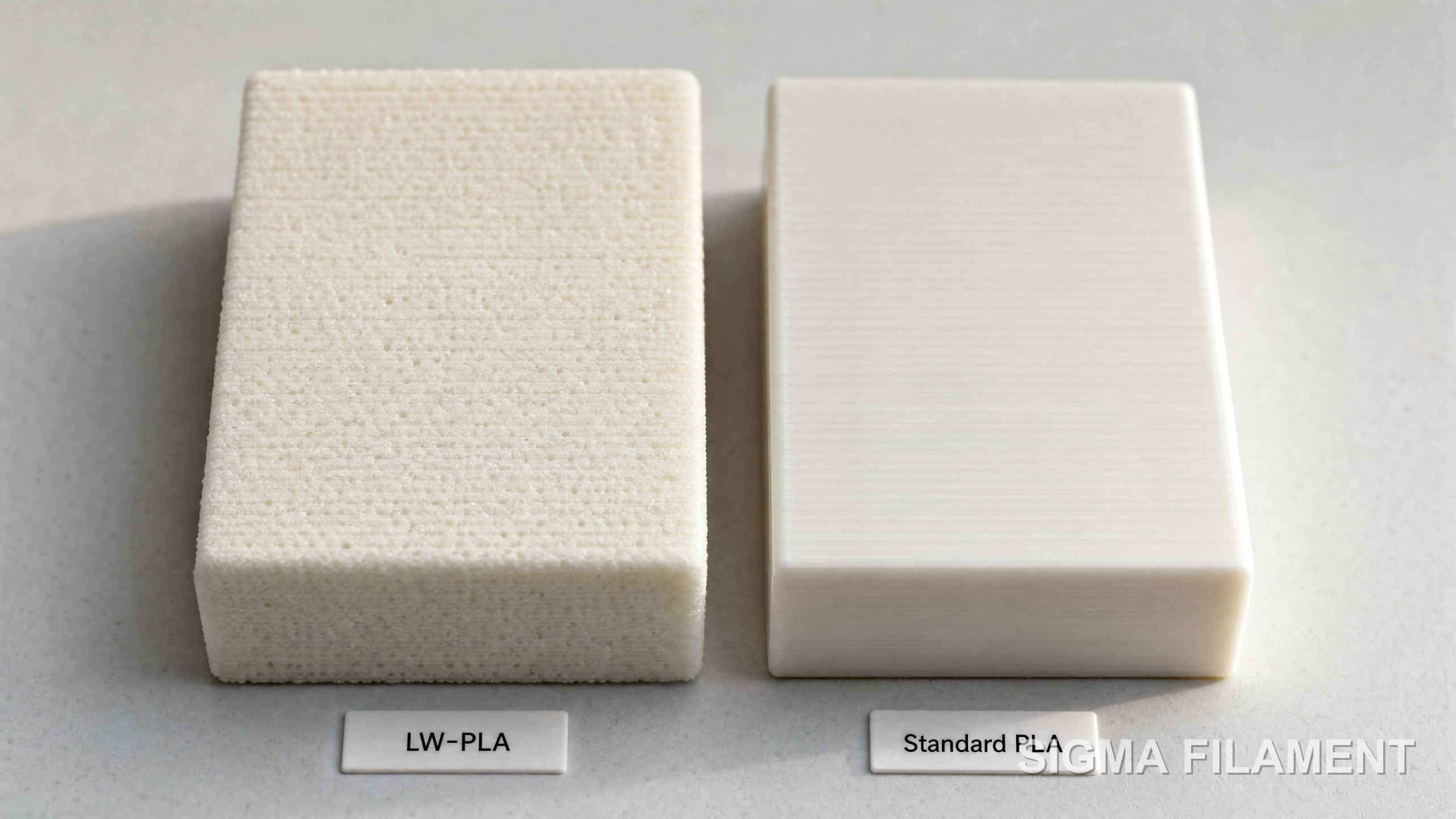
For an RC airframe builder, that delta is the difference between a 220 g wing and a 110 g wing of identical geometry. For a print farm running cosplay props, it is the difference between a shippable helmet and an oversized parcel surcharge.
Why it foams the hotter you print
LW-PLA inverts the intuition most operators carry from standard thermoplastics. With ABS or PETG, hotter prints flow faster and pack denser; with a lightweight foaming grade, hotter prints get lighter. Above the blowing agent’s activation threshold, every additional 5 to 10 °C releases more gas per unit volume of melt, expanding the extrudate further and dropping the finished density. The mechanism, the recommended temperature ladder, and the flow compensation math get a full breakdown in the sections below.
Active-Foaming vs Pre-Foamed LW-PLA
Two product classes ship under the LW-PLA label, and they behave so differently on the print farm that buyers should treat them as separate SKUs in any sourcing brief. One foams on demand inside the hot end; the other arrives at the spool already low-density. Both can produce a 30 to 65 percent weight reduction in the finished part, but the levers an operator pulls to get there are not interchangeable.
Active-foaming grades that foam in the nozzle
Active-foaming LW-PLA carries a chemical blowing agent in the pellet. When the filament crosses the activation threshold inside the hot end (typically above 215 to 230 C, brand-dependent), the agent releases gas and the extrudate expands. Density becomes a tunable output of temperature and flow rather than a property of the spool. Print profiles for active-foaming grades quote a nozzle temperature of 240 to 260 C alongside a flow rate of about 0.48 to 0.56, roughly half that of non-foaming filament (Slusarczyk, 2025).
Pre-foamed grades that arrive low-density
Pre-foamed LW-PLA has already been expanded during pellet compounding or filament extrusion. The spool measures low density at room temperature and the material does not foam further in the nozzle. Operators print it at a fixed flow setting close to 100 percent, the same way they would run a standard light PLA. There is no temperature window to tune, no foaming curve to characterise per spool. The trade-off is fewer dials to turn, so weight per part is locked in by the supplier rather than chosen by the operator.
How to tell which one you have
Spec sheets settle the question faster than print tests. Active-foaming grades publish a foaming temperature range and a reduced flow target (often 45 to 50 percent flow multiplier at peak expansion). Pre-foamed grades publish a fixed low density figure (commonly 0.7 to 0.85 g/cc) and recommend normal flow. If a datasheet shows neither, request a foaming temperature ramp test report before buying volume.
| Attribute | Active-foaming LW-PLA | Pre-foamed LW-PLA |
|---|---|---|
| Foaming behaviour | Foams inside the hot end above threshold temperature | Already foamed at the spool, no in-nozzle expansion |
| Density control | Tunable by temperature and flow per print | Fixed by the supplier, not adjustable |
| Flow setting | Reduced multiplier, about 0.48 to 0.56 (roughly half) | Normal, near 100 percent |
| Tuning effort | High, requires temperature tower per spool batch | Low, treat like a light PLA |
| Best use | Variable-weight parts, model aircraft, wall optimisation | Predictable bulk runs, resale to non-tuning end users |
Active-foaming LW-PLA expands inside the hot end as a chemical blowing agent releases gas above roughly 220 to 260 C, letting operators dial density by temperature and flow within one spool. Pre-foamed LW-PLA arrives already low-density from the factory and prints at fixed flow like a standard light PLA (Slusarczyk, 2025).
The Foaming Mechanism: Chemical Blowing Agents and Temperature
LW-PLA is a standard PLA carrier compounded with a small fraction of a heat-activated chemical blowing agent. Under nozzle heat, that agent decomposes, releases gas inside the molten polymer, and produces a foam structure with sealed microvoids. The behavior is predictable, but only inside a narrow processing window that print farms need to dial in once and then lock.
Endothermic chemical blowing agents
The active ingredient in LW-PLA is an endothermic chemical blowing agent. In practice this is typically a sodium-bicarbonate or citrate-based system (the Tracel family is common), and some formulations use azodicarbonamide instead. When the pellet melt crosses the agent’s decomposition threshold, it releases gas, nitrogen or carbon dioxide depending on chemistry, that nucleates microbubbles throughout the polymer melt. The Kmetty extrusion study measured void fractions reaching 57.6 percent in PLA foamed with Tracel-class endothermic agents, which is the structural basis for the density numbers buyers see on spec sheets (Kmetty et al., 2018). Endothermic systems are preferred for desktop FDM because they absorb heat as they react, giving operators a softer activation curve and less risk of a runaway foam event inside the hot end.
The foaming temperature window
Activation is temperature-gated. Below roughly 215 C the blowing agent does not trigger, and the filament extrudes as ordinary PLA with no density reduction. Foaming begins around 215 to 230 C, and maximum density reduction is reached near 240 to 250 C. (Park & Lee, 2024) Pushing past that ceiling rarely improves foam and usually degrades surface finish. The operator playbook is therefore a temperature sweep tower from 210 C to 260 C in 5 C steps, then locking the lowest temperature that delivers the target density.
Volumetric expansion and why flow must drop
Fully foamed LW-PLA expands roughly 2.4 to 3 times its solid volume (Matuana et al., 2009). A printer commanded to deposit one millimeter of filament will lay down two to three millimeters of foamed bead, so flow has to come down by the same ratio. Skip that step and the part over-extrudes into blobs that miss their target dimensions.
An endothermic blowing agent foams LW-PLA above roughly 215 to 230 C, peaks near 240 to 250 C, and expands the polymer 2.4 to 3 times in volume, which is why both nozzle temperature and extrusion multiplier must be tuned together rather than in isolation (Park & Lee, 2024).
How Much Weight Can You Save? Density vs Foaming Level
The whole point of LW-PLA is mass reduction. A printed part comes out markedly lighter than the same geometry in standard PLA, with no change to wall count, infill, or model file. The lever is the foaming agent in the pellet, and the dial you turn is nozzle temperature.
Printed density from 1.24 down to 0.28 g/cm3
Standard PLA prints at roughly 1.24 g/cm3, which is the solid density of the polymer once a layer cools. Lw pla, by contrast, holds expandable microspheres or a chemical blowing agent that activates above about 230 C. As the foam expands inside the melt, the deposited bead traps voids. Printed density falls depending on how hot you run the hotend and how far you cut volumetric flow; one study reached effective densities as low as 0.28 g/cm3 (Crowe et al., 2023).
Higher temperature, lower density
The hotter the nozzle, the more the filament expands as it comes out (Slusarczyk, 2025), so a hotter nozzle gives a lighter bead. The same spool can produce a denser, stronger skin at the cool end of the band and a much lighter core at the hot end if your slicer supports temperature changes mid-print. Operators use this to print a stiff outer shell over a foam core in one pass, which mimics a sandwich panel without a second filament. Every hotend, nozzle diameter, and pellet lot drifts a few degrees, so calibrate per spool using a 20 mm cube and a scale before committing to a long print; in one published study the printing flow rate had to be optimized separately on each of two printers (Crowe et al., 2023).
What the weight saving means in practice
That reduction in printed mass changes what is possible in weight-sensitive assemblies without a redesign. An RC plane wing that weighed 220 g in standard PLA drops to around 100 g at heavy foam, which moves the entire airframe into a different power and wing-loading class. A 5-inch FPV drone frame plate falls from 38 g to under 20 g, freeing budget for a larger battery on the same all-up-weight target. The math also reshapes how a buyer reads a PLA spool spec sheet: a 1 kg foamed LW-PLA reel deposits roughly the same printed volume as 2.0 to 2.5 kg of standard PLA. For resellers serving the hobby and light-aerospace channel, that mass delta is the headline spec, the one buyers compare across brands before they ever look at price per kilogram.
Lw pla prints well below standard PLA’s 1.24 g/cm3, and the hotter the nozzle, the more it expands (Slusarczyk, 2025). Varying temperature mid-print is how a single spool can give a denser skin and a lighter core.
LW-PLA Print Settings: Temperature, Flow and Retraction
LW-PLA only behaves like LW-PLA when two settings are correct at the same time: a hot enough nozzle to activate the blowing agent, and an extrusion multiplier low enough to account for the resulting expansion. Get either one wrong and the spool either prints like ordinary PLA or over-extrudes into a blobby, dimensionally inaccurate part. The starting point for every new spool is a temperature-and-flow tower.
| Setting | Recommended range | Note |
|---|---|---|
| Nozzle temperature | 240-260 C | Run too cool and it foams little |
| Bed temperature | 50-60 C | Standard PLA range, no change needed |
| Extrusion multiplier (flow) | About 0.48-0.56 (roughly half) | Lower the value as nozzle temperature rises |
| Retraction | Increased vs PLA | Foaming raises stringing risk on travel moves |
| Print speed | Moderate | Standard PLA speeds; no need to slow dramatically |
Nozzle temperature 240-260 C
With most thermoplastics a hotter nozzle means denser, glossier flow. With LW-PLA the opposite is true. The chemical blowing agent in active-foaming LW-PLA needs heat to activate: print profiles for it call for 240-260 C, and the hotter the nozzle, the more the filament expands as it leaves the tip (Slusarczyk, 2025). Run it too cool and it foams little, so the weight saving disappears. Higher temperatures inside the band produce more aggressive foaming and lower density; lower temperatures produce a denser, stiffer surface. Treat the temperature as the density dial, not a comfort setting.
Extrusion multiplier about 0.5
Because active-foaming LW-PLA expands as it leaves the nozzle, the slicer needs to push far less filament per millimeter of travel: designers’ print profiles typically set the flow rate (extrusion multiplier) around 0.48 to 0.56, about half that of non-foaming filament (Slusarczyk, 2025). The exact value tracks the nozzle temperature you chose in the previous step, which is why a combined temperature-and-flow tower is the correct first calibration on any new spool or new printer.
Active-foaming LW-PLA prints at about 240-260 C with the extrusion multiplier cut to roughly 0.48 to 0.56, because the filament expands as it foams (Slusarczyk, 2025). The method is to dial nozzle temperature for target density, then dial flow for dimensional accuracy on a single calibration tower.
Retraction, speed and cooling
Foaming raises the stringing risk on travel moves, so retraction distance and travel-move tuning both need a bump above your normal PLA profile. Speed and cooling, though? Leave them alone. Print speed stays moderate, in the same band as standard PLA, and the part-cooling fan runs at the same duty cycle you already use for ordinary PLA. The pattern for every new LW-PLA spool is the same: tune temperature for density first, then flow for accuracy, then retraction for surface finish.
Nozzle Size, Drying and Avoiding Common Problems
Most LW-PLA print failures trace back to three controllable variables: nozzle bore, filament moisture, and a temperature window that actually triggers the blowing agent. Procurement teams evaluating bulk LW-PLA spools should verify that printers in the production fleet meet these mechanical and handling baselines before scaling an order. Skipping any of the three turns a foaming-grade pellet into a brittle, under-expanded part with inconsistent layer adhesion.
Why a 0.4 mm or larger nozzle helps
A 0.4 mm nozzle is the practical minimum for LW-PLA. Smaller bores trap blowing-agent residue and clog within a few hours of continuous printing. Stepping up to 0.6 mm or 0.8 mm widens the melt channel, lets the foaming reaction expand cleanly inside the nozzle, and produces more uniform density across a part. For RC fuselage panels and large prop covers, the larger nozzle also cuts print time roughly in half while keeping wall strength acceptable for the lighter target weight (Flightory, 2024).
Drying LW-PLA before printing
LW-PLA is hygroscopic, the same as every standard PLA grade. Spools pull water from ambient air within 48 hours of opening the vacuum bag, and wet filament foams unpredictably: bubbles form before the melt zone, then collapse as the extruder pressurizes them. The result is rough surfaces, popping sounds at the hotend, and density that varies by 15 to 20 percent across a single part. Dry the spool at 45 to 55 degrees Celsius for 4 to 6 hours in a dedicated filament dryer or a low-temperature oven with a probe thermometer; the same drying protocol detailed in our PLA filament drying guide applies, with the temperature held at the lower end of the band to protect the blowing agent (Park & Lee, 2024).
LW-PLA prints best through a 0.4 mm or larger nozzle, and the spool should be dried at 45 to 55 degrees Celsius for 4 to 6 hours before any production run because the polymer is hygroscopic and absorbs water from ambient air within two days of opening (Flightory, 2024).
Stringing, weak layers and no-foaming fixes
Three failure modes account for most LW-PLA support tickets. Stringing between perimeters usually means retraction is too low for the expanded melt volume; raise retraction by 1 to 2 mm and drop print temperature by 5 degrees Celsius. Weak interlayer bonding shows up as parts that split along Z under light hand pressure; lower extrusion flow by 2 to 3 percent or reduce temperature by another 5 degrees so the foam structure stabilizes before the next layer lands. No foaming at all, where parts come out at full PLA density, means the temperature is below the activation threshold; raise the hotend into the 240 to 260 degrees Celsius band and confirm with the supplier that the grade is an active-foaming formulation rather than a low-density filler blend.
Strength and Mechanical Properties: The Lightness Tradeoff
LW-PLA is not stronger than standard PLA. It is weaker, and that weakness scales directly with the foaming ratio. Procurement teams evaluating LW-PLA for end-use parts should treat this section as the load-bearing decision filter: the same property that makes the material valuable (low density through active foaming) is the property that lowers tensile capacity and interlayer bond strength. Spec the material for the use case, not the marketing.
Tensile strength 20-45 MPa vs 50-70 MPa
Conventional wisdom holds that a printed part is as strong as its base polymer. With LW-PLA that is not true: the same foaming reaction that drops density also drops tensile capacity, almost in lockstep. Neat PLA prints in the 50-70 MPa tensile range under standard test geometries (the benchmark used across our best PLA filament buyer’s guide). Foamed LW-PLA falls into roughly 20-45 MPa depending on how aggressively the operator pushes the active foaming temperature (Standau et al., 2019). A mild foam at the low end of the window (around 230 C with modest flow reduction) preserves more of the polymer matrix and lands closer to the upper bound. A full lightweight setup targeting 0.5-0.6 g/cm3 will sit near the lower bound. The relationship is roughly linear with density loss, and there is no setting combination that recovers neat-PLA tensile numbers in a foamed print.
LW-PLA tensile strength typically measures 20-45 MPa against neat PLA at 50-70 MPa, with interlayer adhesion dropping in step with foam expansion. The lighter the print, the weaker each layer bond becomes, because less solid polymer is available at the fusion interface to carry load across the Z-axis (Standau et al., 2019).
Interlayer adhesion and the foam structure
Interlayer adhesion in LW-PLA degrades for a mechanical reason, not a chemical one. The foaming agent expands gas pockets inside each extruded road, so when the next layer deposits on top, the contact patch contains less continuous polymer and more void space. Adhesion drops in proportion to the density reduction (Matuana et al., 2009). A part foamed to 60 percent of neat density has roughly 60 percent of the solid material available at each layer bond. Z-axis tensile and impact resistance fall accordingly, and parts loaded perpendicular to the print plane fail earlier than testing on solid PLA would predict.
What LW-PLA should and should not carry
| Property | LW-PLA | Neat PLA |
|---|---|---|
| Tensile strength | 20-45 MPa | 50-70 MPa |
| Interlayer adhesion | Lower (scales with foam ratio) | Higher |
| Printed density | Well below 1.24 g/cm3 (varies with temperature and flow) | 1.24 g/cm3 |
| Best use | Weight-critical, low-load parts | General-purpose, structural |
Specify LW-PLA for RC airframes, lightweight enclosures and shells, large display props, cosplay armor, and any application where mass reduction outranks ultimate strength. Do not specify it for structural brackets, load-bearing fixtures, tooling, snap-fit assemblies under cyclic stress, or high-impact parts. For dual-purpose designs, print structural zones in neat PLA or PETG (our PLA vs PETG comparison walks through which one to pick by load case) and reserve LW-PLA for the geometry where every gram counts.
Applications: RC Aircraft, Cosplay and Lightweight Parts
LW-PLA earns its place wherever finished part mass is a harder constraint than tensile load. The same foaming behavior that makes the material awkward to dial in on a benchy turns into a measurable competitive edge once the part has to fly, be worn, or hang from a moving assembly. Three application clusters now drive most B2B spool volume.
RC aircraft, drones and props
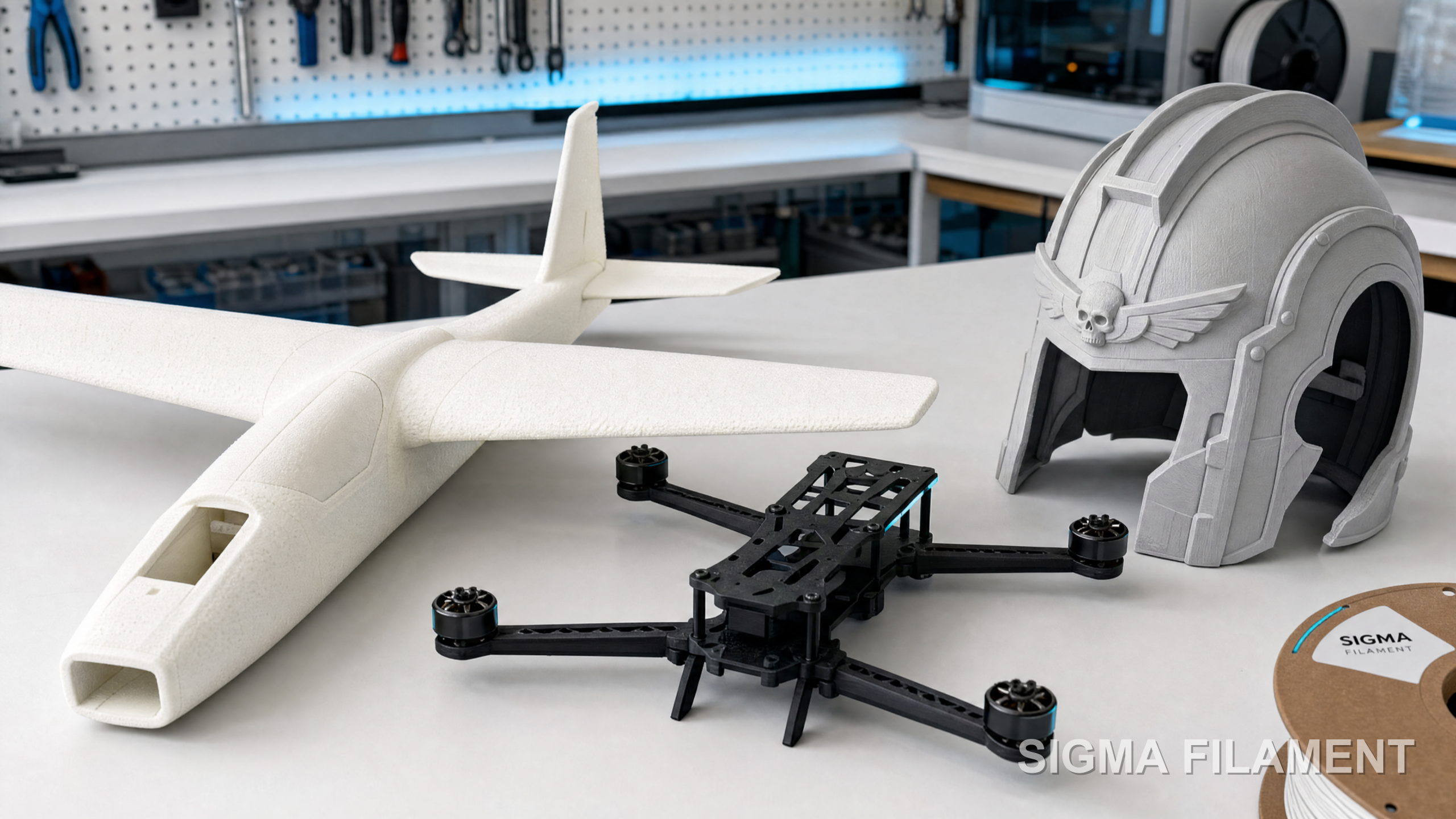
The density reduction is decisive in RC aircraft and drones, where every gram of airframe costs flight time and agility. Models are now being designed for active-foaming LW-PLA, and its lighter airframes have made it a very popular choice for designers of 3D-printed airplanes (Slusarczyk, 2025). A lighter wing skin, control surface or tail boom translates directly into longer flight times on the same battery and tighter aerobatic response. FPV racing frames, glider fuselages and electric ducted fan housings sit in the same procurement bucket.
Cosplay and wearable builds
Cosplay studios and prop houses use LW-PLA for large helmets, pauldrons, gauntlets and full chest pieces that have to be worn through six to eight hour convention days. A standard PLA pauldron at 0.4 kg becomes a 0.2 kg part in foamed LW-PLA, which is the difference between a shoulder bruise by hour three and a wearable build. The same logic applies to film and theatre props, theme park costume parts, and large lightweight signage where rigidity matters more than impact strength; smaller detail work, such as the materials used for tabletop minis and figures, is usually printed in a different grade because the strength tradeoff hurts thin-walled detail.
When weight beats strength
The common thread across these segments is parts where weight matters more than load capacity. LW-PLA is not the right pick for functional brackets, gears, jigs or anything seeing repeated mechanical load. It is the right pick the moment a buyer specifies flight time, wear time, or hand-held balance as the primary acceptance criterion.
Its weight reduction over standard PLA has made LW-PLA a very popular choice for designers of 3D-printed airplanes (Slusarczyk, 2025), and it suits drone components and wearable cosplay armor for the same reason: these are segments where finished-part mass is the binding constraint and tensile load is secondary.
OEM and Wholesale LW-PLA: Lot Consistency, Certification and MOQ
Buying LW-PLA at OEM volume is a different problem from buying a single spool. The foaming chemistry that gives the material its weight saving also makes it the most sensitive PLA grade in a print farm’s catalog, and the sourcing decision has to be evaluated against that sensitivity rather than against headline price.
Lot-to-lot foaming consistency
The foaming behaviour of LW-PLA is only as consistent as the blowing-agent dosing inside the pellet compound. Small drifts in active concentration shift the expansion window by 5 to 15 degrees Celsius, which is enough to break a calibrated profile on a production fleet. Lot-to-lot consistency, not absolute density, is the buyer’s real risk. A source manufacturer running automated gravimetric dosing with full QC and batch traceability holds the foaming window steady across an entire production run; a trading-company or rebranded lot, blended from mixed inputs, does not. One inconsistent reel ruins the calibration that an operator spent two days dialing in.
Lot-to-lot foaming consistency, governed by automated gravimetric dosing of the blowing agent and full batch traceability from pellet to spool, is the central LW-PLA sourcing risk that print-farm and OEM buyers must control before any conversation about price or MOQ.
Certification and the virgin-resin base
A 100% virgin NatureWorks PLA resin base is what keeps the underlying matrix density predictable from lot to lot; recycled or blended regrind adds an unknown variable on top of the already-sensitive foaming step. For regulated end uses, certification matters as much as the resin itself: FDA-grade base material, RoHS, REACH and ISO 9001 process control are the minimum documentation set a serious procurement team will require before issuing a PO.
MOQ, the price gap and spec control
LW-PLA costs more per kilogram than standard PLA, because the specialty compounding step adds cost that commodity grades do not absorb. That price gap has to be weighed against the finished-part weight saving and the reduced material draw per print, alongside the bulk PLA economics buyers are already running for their commodity reels. For wholesale PLA filament buyers, a flexible MOQ from 100 spools keeps inventory risk manageable while qualifying the lot, and a custom OEM filament program lets resellers and integrators lock spec sheets, diameter tolerance and branded packaging to their own application.
For a quote on LW-PLA at OEM or wholesale volume, talk to the SigmaFilament team.
Frequently Asked Questions
What is LW-PLA and what does LW stand for? LW stands for lightweight. LW-PLA is a PLA grade compounded with a chemical blowing agent that foams inside the nozzle, cutting printed density well below standard PLA’s roughly 1.24 g/cm³.
How much weight can you save with LW-PLA? Pre-foamed grades print about 20 to 30% lighter than standard PLA, and active-foaming grades go further. The exact figure depends on foaming temperature and the flow rate you dial in.
What temperature should I print LW-PLA at? Print active-foaming grades between 240 and 260 °C; pre-foamed grades print close to 200 °C. Run an active-foaming grade too cool and it foams little, so parts come out close to ordinary PLA density.
What flow rate or extrusion multiplier should I use for LW-PLA? Expect an extrusion multiplier of about 0.48 to 0.56, roughly half of standard PLA, since the material expands as it foams. Calibrate with a combined temperature-and-flow tower for each spool.
Is LW-PLA stronger than PLA? No. Tensile strength sits around 20 to 45 MPa, compared with 50 to 70 MPa for standard PLA, and interlayer adhesion drops further as foaming increases.
What is the difference between active-foaming and pre-foamed LW-PLA? Active-foaming grades foam in the nozzle, so density is tunable through temperature and flow. Pre-foamed grades ship at low density already and do not foam further during printing.
Does LW-PLA absorb moisture, and should I dry it? Yes. LW-PLA is hygroscopic, and wet filament foams unpredictably. Dry spools at 45 to 55 °C for 4 to 6 hours before any production run.
What nozzle size is best for LW-PLA? A 0.4 mm nozzle is the practical minimum. Stepping up to 0.6 or 0.8 mm improves foaming consistency, lowers back-pressure, and reduces clogging on long prints.
What is LW-PLA used for? LW-PLA targets weight-sensitive, low-load parts. Typical applications include RC aircraft, drones, propellers, and lightweight cosplay builds where stiffness-to-weight matters more than absolute strength.
Conclusion
Working with LW PLA productively starts with one decision: confirm whether the spool is an active-foaming grade or a pre-foamed grade, because that choice sets every tuning parameter that follows. From there, sweep nozzle temperature to hit your target density, hold flow between 35% and 65% for dimensional accuracy, dry the filament before every run, and pair it with a 0.4 mm or larger nozzle to keep expanded melt moving cleanly. Accept the structural tradeoff honestly. Lighter parts are weaker parts, with tensile strength landing near 20 to 45 MPa, so reserve LW PLA for weight-sensitive, low-load applications such as RC airframes, props, cosplay shells, and lightweight tooling jigs. The variable that beats every print setting is supply: lot-to-lot consistency in the foaming window decides whether your tuned profile holds across reorders.
For OEM and wholesale LW PLA with lot-consistent foaming and certification documentation, contact the SigmaFilament engineering team.
References
- Kmetty, A., Litauszki, K., & Reti, D. (2018). Characterization of different chemical blowing agents and their applicability to produce poly(lactic acid) foams by extrusion. Applied Sciences, 8(10), 1960. https://doi.org/10.3390/app8101960
- Crowe, S. B., Maxwell, S., Brar, H., Yu, L., & Kairn, T. (2023). Use of light-weight foaming polylactic acid as a lung-equivalent material in 3D printed phantoms. Physical and Engineering Sciences in Medicine, 46(4), 1811-1817. https://doi.org/10.1007/s13246-023-01318-4
- Park, Y. E., & Lee, S. (2024). Characterization of PLA/LW-PLA composite materials manufactured by dual-nozzle FDM 3D-printing processes. Polymers, 16(19), 2818. https://doi.org/10.3390/polym16192818
- Standau, T., Zhao, C., Murillo Castellon, S., Bonten, C., & Altstadt, V. (2019). Chemical modification and foam processing of polylactide (PLA). Polymers, 11(2), 306. https://doi.org/10.3390/polym11020306
- Matuana, L. M., Faruk, O., & Diaz, C. A. (2009). Cell morphology of extrusion foamed poly(lactic acid) using endothermic chemical foaming agent. Bioresource Technology, 100(23), 5947-5954. https://doi.org/10.1016/j.biortech.2009.06.063
- Slusarczyk, D. (2025). Selecting the correct LW-PLA. Model Aviation. https://www.modelaviation.com/article/Selecting-the-Correct-Lw-Pla
- Flightory. (2024). LW-PLA print settings. https://flightory.com/lw-pla-print-settings/
Last reviewed and updated: June 2026. Author: SigmaFilament team. For tailored guidance, contact our team.