Marble PLA Filament: The 2026 Guide to Stone-Effect Printing and Sourcing

TL;DR
Marble PLA is PLA loaded with calcium carbonate (CaCO3), usually around 30 wt%, to create a speckled stone look. It is mildly abrasive (CaCO3 Mohs ~3, far below carbon fiber), so a brass nozzle survives short runs but a hardened nozzle is the safe choice for production. Print it like standard PLA at roughly 200-220 C nozzle and 50-60 C bed. It is stiffer but more brittle than neat PLA, not stronger. The CaCO3 raises composite density to ~1.40-1.50 g/cm3, so a 1 kg spool yields about 10-15% fewer meters.
Abstract
Marble PLA ships under one label as two genuinely different materials, and the difference governs every downstream procurement decision. The first family is mineral-filled stone-effect PLA, in which calcium carbonate (CaCO3, typically around 30 wt%, commercial range 20-50 wt%) is compounded into the polymer to deliver real stone heft, a matte mineral surface, and a measurable nozzle-wear cost. The second is pigment-only marble-LOOK PLA, which prints the marbled vein pattern through color masterbatches alone, carries no mineral filler, and produces no abrasion. The mineral-filled grade prints close to standard PLA conditions, roughly 200-220 C at the nozzle and 50-60 C on the bed, but it behaves as a different mechanical material: stiffer and noticeably more brittle than neat PLA, not stronger. Because CaCO3 has a specific gravity near 2.7, composite density rises to about 1.40-1.50 g/cm3, so a 1 kg spool yields roughly 10-15% fewer printed meters than neat PLA.
This guide is written for the people who carry the risk on a stone-effect filament order: B2B procurement teams and print-farm operators, plus the resellers and design engineers who have to specify it, source it, and keep it running without surprises. It walks the full decision path in order: what the material is and how the two families diverge, how it is compounded, the print settings and hardware that match each family, realistic nozzle-wear behavior, mechanical performance under load, post-processing options including sanding and sealing, and direct comparisons against PETG, silk PLA, and matte PLA. It closes on density-driven cost math and OEM sourcing criteria for private-label and contract-manufactured supply.
Key Takeaways
- Two distinct products share the name. Mineral-filled stone-effect PLA and pigment-only marble-look PLA behave very differently.
- Filler loading defines the category. Mineral grades sit near 30 wt% CaCO3 (commercial range 20 to 50 wt%); pigment-look grades carry none.
- CaCO3 is mildly abrasive at Mohs ~3. Brass nozzles survive short runs; hardened steel is the production-safe choice.
- Settings stay close to standard PLA. Run roughly 200 to 220 C nozzle, 50 to 60 C bed, and 40 to 60 mm/s for clean walls.
- Stiffness rises while toughness drops. CaCO3 lifts modulus but lowers tensile strength, so parts feel rigid yet break more easily.
- Density rises with mineral content. CaCO3 at SG ~2.7 pushes composite density to about 1.40 to 1.50 g/cm3, cutting meters per kilogram by 10 to 15%.
- OEM cost is driven by four levers. Filler percentage, marble pattern and color, virgin-resin base grade, and lead time set the landed price at volume.
Table of Contents
- TL;DR
- Abstract
- Key Takeaways
- Table of Contents
- What Is Marble PLA? Mineral-Filled vs Pigment-Only Marble-Look
- How Marble PLA Is Made: Calcium Carbonate, Loading and Recycled Sources
- Marble PLA Print Settings: Temperature, Bed, Speed and Layer Height
- Is Marble PLA Abrasive? Nozzle Wear and the Hardened-Steel Decision
- Is Marble PLA Stronger? The Stiffer-Not-Stronger Truth
- Post-Processing Marble PLA: Sanding, Sealing and the Stone Illusion
- Marble PLA vs Marble PETG, Silk PLA and Matte PLA: A Decision Matrix
- Density and Cost: Why Marble PLA Yields Fewer Meters per Kilogram
- OEM and Wholesale Marble PLA: Custom Formulation, MOQ and Lead Time
- Frequently Asked Questions
- Conclusion
- References
What Is Marble PLA? Mineral-Filled vs Pigment-Only Marble-Look
"Marble PLA" is two different materials sold under one search term. The first is a mineral-filled composite that carries real calcium carbonate inside the polymer matrix. The second is a standard PLA colored with a marbling masterbatch. They print differently, weigh differently, and cost differently to run at scale. A procurement team that orders the wrong one for a print-farm queue will see surprises in nozzle wear, part weight, and bed adhesion within the first kilogram. Like other aesthetic and engineering filament types sold under one shelf label, this section sorts the two families before any settings, sourcing, or pricing conversation begins.
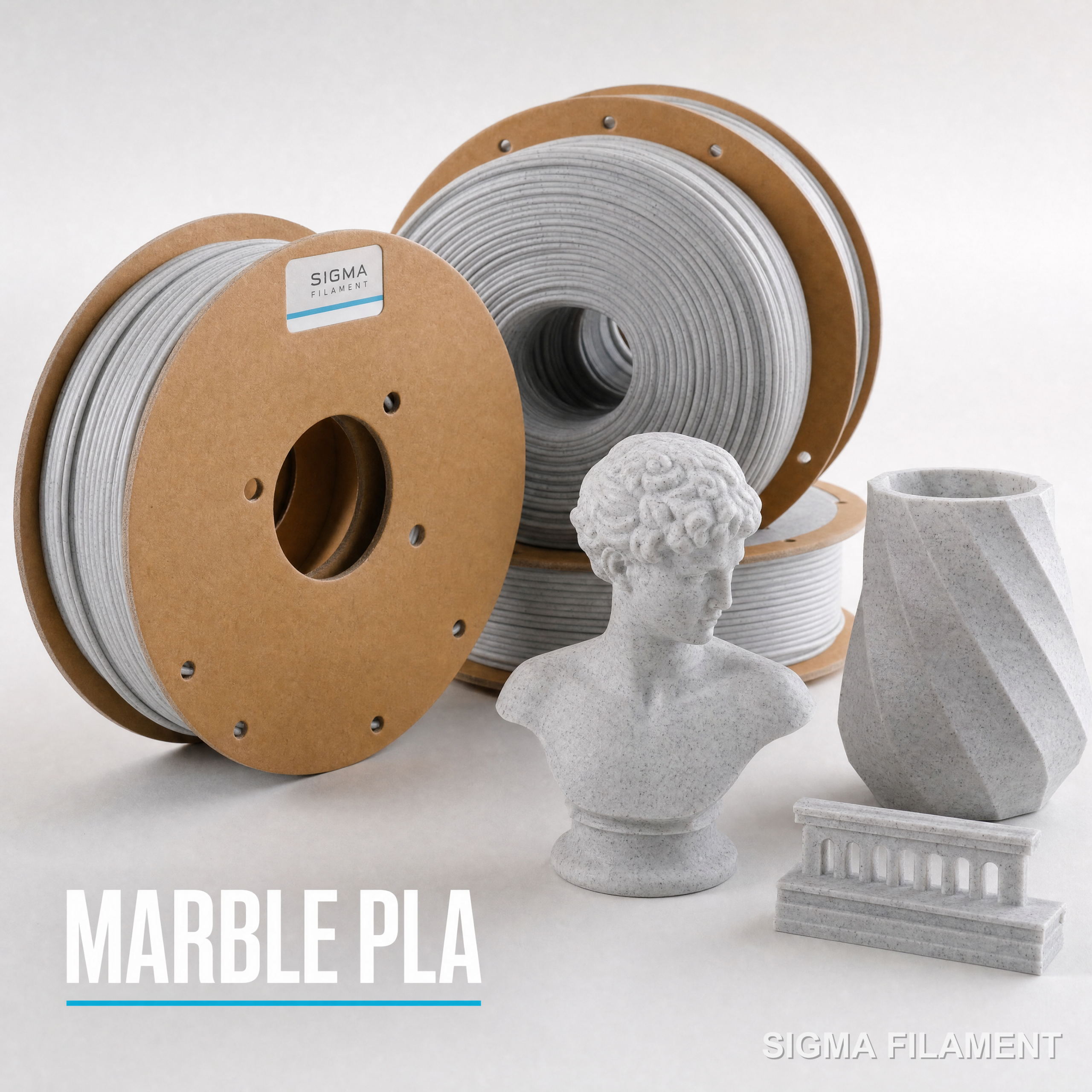
Marble PLA splits into two distinct product families. Mineral-filled grades compound calcium carbonate (CaCO3) into the PLA matrix, typically near 30 wt% with a commercial range of 20 to 50 wt%, which produces real stone density and a matte speckled surface. Pigment-only marble-look grades carry no mineral filler and behave exactly like standard PLA (Sousa et al., 2025; Faba et al., 2024).
Calcium-carbonate-filled stone-effect PLA
The mineral-filled grade is a compounded composite. Calcium carbonate, usually in the form of ground calcite, is blended into the PLA pellet during extrusion at roughly 30 wt%, with commercial offerings ranging from 20 to 50 wt% depending on the supplier’s target between print stability and stone feel (Sousa et al., 2025; Faba et al., 2024). The filler raises composite density into the 1.40 to 1.50 g/cm3 band, well above neat PLA, so finished parts feel noticeably heavier in the hand and read as ceramic or stone rather than plastic. The surface comes off the nozzle matte, with visible mineral speckle, and accepts light sanding without losing the look.
Nozzle abrasion is real but limited. Calcite sits at Mohs 3 on the mineral hardness scale, about the same as brass (Wikipedia contributors, 2026), so a standard brass nozzle is not ground down by it the way carbon-fiber and other abrasive fills wear brass rapidly (E3D-Online, 2015). Print-farm operators running thousands of hours per month often swap to a wear-resistant nozzle as a precaution, while hobby-volume users typically stay on brass and replace it on a normal schedule.
Pigment-only marble-LOOK PLA (no mineral filler)
Pigment-only marble-look PLA is standard polylactic acid colored to mimic a marbled stone pattern. The marbling effect is produced by a multi-color masterbatch that swirls through the extrusion, not by any mineral content. There is no calcium carbonate in the matrix, no added weight, and no abrasive load on the nozzle. Density sits at the standard PLA value of about 1.24 g/cm3, and the spool prints with the same temperatures and speeds, on the same bed settings, as any plain PLA in the same catalog. Parts look stone-adjacent under casual viewing but feel like normal plastic when handled, which matters for display models, retail props, and any application where weight or surface tactility is part of the buying decision.
How to tell them apart before you buy
The spec sheet usually settles it before the first sample print. Mineral-filled grades disclose a filler percentage, list a composite density above 1.30 g/cm3, and often add a note recommending a hardened or wear-resistant nozzle. Pigment-look grades list standard-PLA density near 1.24 g/cm3, give the same temperature and speed window as the supplier’s plain PLA, and make no reference to filler content or nozzle hardness.
| Attribute | Mineral-filled stone-effect PLA | Pigment-only marble-look PLA |
|---|---|---|
| Filler | CaCO3 ~30 wt% (range 20-50 wt%) | None |
| Density | ~1.40-1.50 g/cm3 | ~1.24 g/cm3 (standard PLA) |
| Abrasiveness / nozzle | Mildly abrasive; hardened nozzle recommended at volume | Non-abrasive; standard brass nozzle |
| Surface / weight | Matte speckled, stone-like heft | Standard PLA finish and weight |
| Best use | Decor, busts, vases, architectural models needing real stone feel | Display props, low-cost marbled aesthetics, standard PLA workflows |
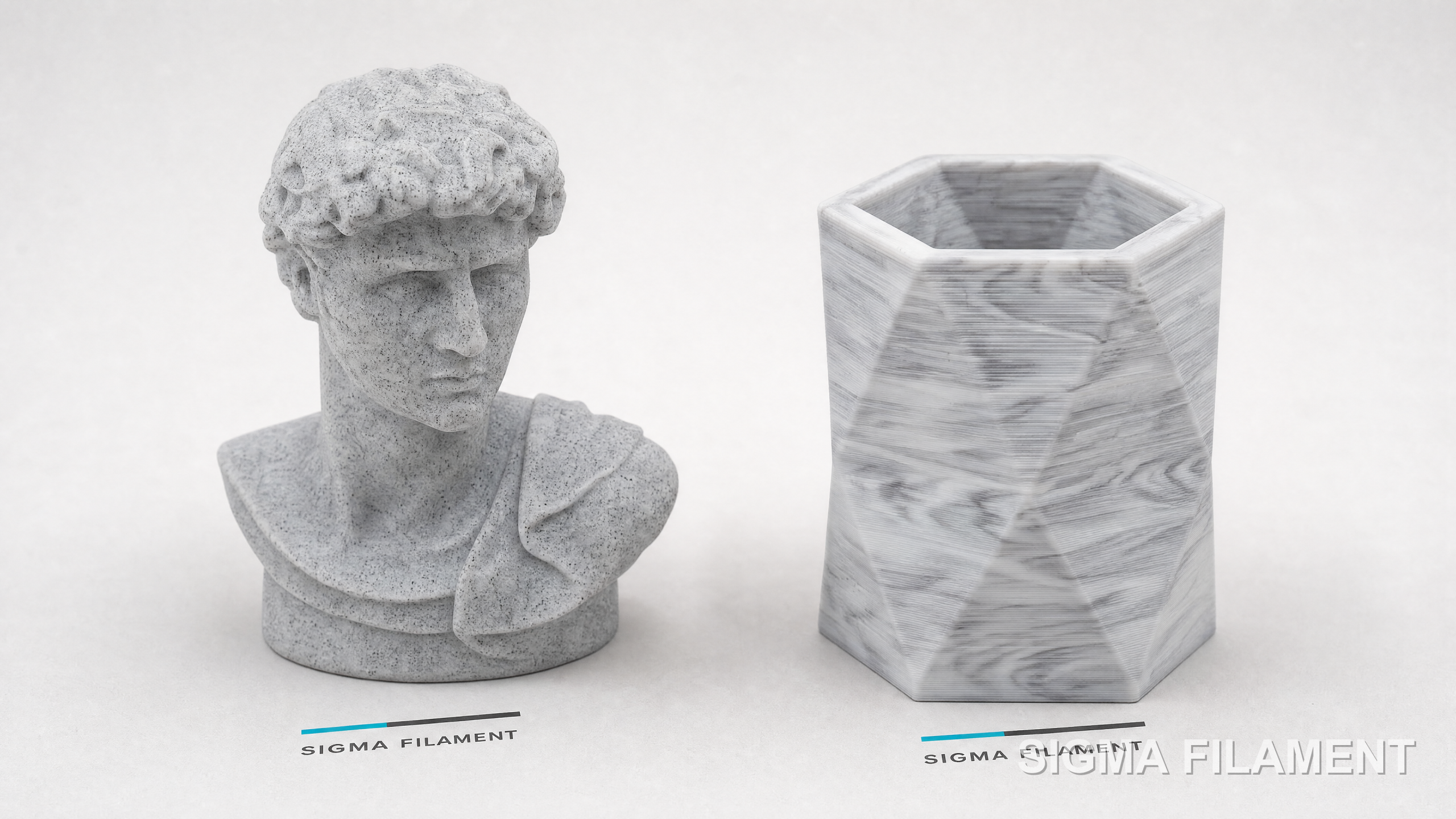
For procurement, the practical rule is to request the technical data sheet and read three lines: filler percentage, composite density, and the recommended nozzle. Any catalog page that hides those is selling pigment-look material at marble-filled prices, or marble-filled material without telling buyers what their nozzles are about to see.
How Marble PLA Is Made: Calcium Carbonate, Loading and Recycled Sources
Marble PLA is not a dye or a surface coating. The mineral-filled grade is a composite, built by compounding fine calcium carbonate powder into a polylactic acid base matrix before the strand is drawn into 1.75 mm or 2.85 mm filament. The visual identity, the print feel, and most of the procurement trade-offs come from one variable: how much CaCO3 sits inside the polymer, and where it came from.
The CaCO3 filler and how the marble effect forms
The filler itself is calcium carbonate powder with a particle size of roughly 0.5 to 10 micrometres, a specific gravity near 2.7, and a powder density between 800 and 1700 kg/m3 depending on grade and packing (Homavand et al., 2024). During compounding the mineral disperses unevenly through the PLA, and on the printed surface it reads as a matte, slightly granular skin with darker and lighter veins. That uneven dispersion is the marble effect. It is a physical property of the blend, not a print parameter, so it shows up consistently layer to layer rather than as a stochastic pattern.
Marble PLA is standard PLA compounded with calcium carbonate at roughly 30 wt%, within a commercial range of 20 to 50 wt%. The mineral has a specific gravity of about 2.7, so spool weight and printed part density rise predictably with loading, and the matte stone surface is intrinsic to the compound rather than a post-process finish (Sousa et al., 2025; Faba et al., 2024).
Filler loading: 20-50 wt% and what it changes
Most commercial mineral-filled grades land near 30 wt% CaCO3. Smarfil Limestone, for example, is formulated at 70 wt% PLA and 30 wt% CaCO3, which is a useful reference point when evaluating private-label offers (Sousa et al., 2025; Faba et al., 2024). Push loading toward the 40 to 50 wt% end and the print picks up more stone character, more part density, and more abrasive wear on brass nozzles. Pull it down toward 20 wt% and the surface starts to look closer to a chalk-filled matte grade like PolyTerra. For procurement, the loading percent is the single most informative spec on the datasheet, ahead of color name or finish marketing copy.
Recycled CaCO3 sources such as eggshell
The filler does not have to be virgin mined limestone. Recycled CaCO3 streams are emerging as a sustainable feedstock, and eggshell is the most studied input because it is roughly 96 to 97% calcium carbonate by composition (Homavand et al., 2024). For brands building an ESG narrative, asking suppliers about CaCO3 origin is a low-cost differentiator that maps directly onto the product story buyers see on the spool.
Marble PLA Print Settings: Temperature, Bed, Speed and Layer Height
Marble PLA prints on almost any FDM machine that already handles standard PLA. The base polymer is the same, and the stone-effect particles (typically chalk, mineral powder, or recycled grit) sit in the matrix without changing the thermal window in any major way. Procurement teams running mixed fleets can usually drop a stone-effect grade into existing PLA profiles, then adjust two or three values for the look they want.
The table below captures the working envelope that print-farm operators report for the common grades shipped under "marble PLA" labels.
| Setting | Recommended range | Note |
|---|---|---|
| Nozzle temperature | 200-230 C | Most grades run cleanest at 210-220 C |
| Bed temperature | 50-60 C | A heated bed is enough, an enclosure is not required |
| Print speed | 30-100 mm/s | 40-60 mm/s gives the most consistent finish |
| Layer height | 0.1-0.3 mm | 0.2 mm is the typical default for visible stone banding |
| Nozzle material | Brass for short runs, hardened for production | Mineral fillers accelerate brass wear over long jobs |
Nozzle and bed temperature
Hot end temperatures land in the 200-230 C window, with most spools settling at 210-220 C for clean extrusion and minimal stringing. Bed adhesion holds at 50-60 C on standard PEI, glass, or textured plates, the same range used for unfilled PLA; if first-layer behavior wanders, our PLA bed-temperature guide walks through plate-by-plate calibration. No chamber heater or enclosure is required. Operators running first articles for a new lot should print a temperature tower across 200-230 C in 5 C steps to lock in the cleanest layer bonding for that specific batch (FacFox, n.d.-b).
Speed, layer height and cooling
Print speed has the widest practical range of any setting here, from 30 mm/s on detailed display parts to 100 mm/s on bulk prototyping. The 40-60 mm/s band is the conservative default that gives the best surface finish, and it is what most stone-effect filament datasheets recommend for visible-face work. Layer heights of 0.1 to 0.3 mm all print reliably, with 0.2 mm as the typical compromise between throughput and detail. Standard part-cooling settings apply, the same fan curves used for unfilled PLA work without modification.
Tuning the speckle and matte finish
The visual character of the printed part is partly a function of slicer settings, not just the spool. Taller layer heights at 0.25 to 0.3 mm and visible layer lines tend to read as sedimentary stone banding, which works well on vases and planters, and on large architectural mockups. Finer layers at 0.1 to 0.15 mm produce a smoother, more uniform surface that reads as polished stone or terrazzo. Slower outer-wall speeds in the 25-35 mm/s range sharpen the speckle definition by giving the mineral particles time to settle against the nozzle face.
Marble PLA prints on the same envelope as standard PLA: nozzle 200-220 C, bed 50-60 C, 40-60 mm/s for visible-face work, and a 0.2 mm layer height as the default. No enclosure is needed, standard part cooling applies, and a hardened nozzle is the only hardware change worth making for sustained production runs (FacFox, n.d.-b).
Is Marble PLA Abrasive? Nozzle Wear and the Hardened-Steel Decision
Procurement teams ask this before placing any pallet-scale order, and the short answer is yes, but only mildly. The stone surface comes from calcium carbonate (CaCO3) particles compounded into the PLA matrix at roughly 20 to 50 wt% loading, typically near 30 wt%. That mineral content does scratch a brass nozzle over time, yet the wear curve sits well below what a carbon-fiber composite, glass fiber, or a metal-filled PLA grade will inflict on the same hot end.
CaCO3 hardness and why it is only mildly abrasive
Calcite, the crystalline form of calcium carbonate used as the visual aggregate in the mineral-filled grade, registers a Mohs hardness of 3, and brass sits at 3 as well (Wikipedia contributors, 2026), which is why a brass tip can co-exist with the filament rather than be ground down on contact. The abrasion that does occur comes from particle geometry and shear at the melt zone, not from a hardness mismatch.
Calcium carbonate (calcite) sits at Mohs ~3, putting the mineral-filled grade in the mildly abrasive band and far below carbon-fiber filament, which had significantly degraded a standard brass nozzle after 250 g in E3D’s controlled test. For continuous production runs, that gap is the entire basis for the hardened-steel upgrade (E3D-Online, 2015).
Brass versus hardened steel by run length
For short prototype batches or occasional vase-mode prints, a 0.4 mm brass nozzle handles the mineral-filled grade without measurable diameter drift over a few spools. The economics flip once a print farm pushes past continuous duty cycles. A hardened-steel or tool-steel nozzle is the production-safe choice for high-volume CaCO3-filled runs, because the failure mode on brass is not catastrophic breakage but a slow widening of the orifice that degrades line-width accuracy and surface finish before any operator notices. Pigment-only marble-look PLA, which uses dye rather than mineral fill, needs no hardened nozzle at all.
Where marble PLA sits against carbon-fiber composites
Carbon-fiber filament had significantly degraded a standard brass nozzle after only 250 g in E3D’s controlled test, a useful upper bound for buyers evaluating composite risk (E3D-Online, 2015). CaCO3-filled stone-effect grades sit well below that ceiling because mineral particles are blunter and softer than chopped fiber. The procurement rule of thumb, also reflected in our broader 3D printer filament comparison chart, is to treat this material as one tier above neutral PLA on the wear scale, and two tiers below carbon-fiber composites. Spec hardened steel when the print queue runs 24/7, brass when it does not.
Is Marble PLA Stronger? The Stiffer-Not-Stronger Truth
Most listings imply that adding stone makes the part tougher. The mechanics say otherwise, and procurement decisions made on the marketing claim end up failing in the field. Calcium carbonate (CaCO3) is a rigid mineral filler, not a reinforcing fiber. It changes the modulus profile of the matrix, but it does not add load-bearing structure.
What calcium carbonate does to strength and modulus
Neat PLA prints at roughly 50 to 70 MPa tensile strength, depending on grade, layer adhesion and print orientation. Loading the resin with CaCO3 particles lowers tensile and flexural strength, because the filler interrupts the polymer chains that carry the load. The same rigid particles raise tensile and flexural modulus at the same time, so the part resists deflection under small loads better than neat PLA does. Stiffer, not stronger (Homavand et al., 2024; Conniff & Zidonis, 2022). A coated-CaCO3 study reported up to roughly 14% higher compression modulus in PLA composites, consistent with that signature (Donate et al., 2023).
Stiffer but more brittle in practice
The trade-off shows up on the print bed. The mineral-filled part feels more rigid in the hand, holds fine surface detail, and resists casual flex. Drop it, snap-fit it, or load it in shear and it cracks earlier than the same geometry printed in neat PLA. Buyers comparing spec sheets should weigh modulus and strength as separate axes, not collapse them into one "stronger" claim.
| Property | Marble PLA | Neat PLA |
|---|---|---|
| Tensile strength | Lower than baseline | ~50 to 70 MPa |
| Stiffness / modulus | Higher | Lower |
| Brittleness | More brittle | More ductile |
| Best use | Display, decor, models | General-purpose parts |
What to print, and what not to
Mineral-filled stone-effect grades earn their place on vases, busts, lithophanes, architectural maquettes, planters, sculptural lighting and retail display props. Rigidity helps these parts hold shape, and the stone look is the whole selling point. Avoid it for snap-fits, hinges, brackets, drone arms, RC chassis, tool handles, or any part that sees impact, vibration or repeated flex. For load-bearing work, route customers toward the data-backed PLA vs PETG comparison, PLA+, or ASA instead.
Calcium carbonate filler raises the modulus of PLA composites by roughly 14% in compression while lowering tensile and flexural strength relative to neat PLA. The practical result for buyers and print farms is that the mineral-filled material is stiffer, not stronger, and belongs on decor parts rather than load-bearing assemblies (Homavand et al., 2024; Conniff & Zidonis, 2022).
Post-Processing Marble PLA: Sanding, Sealing and the Stone Illusion
Prints leave the bed looking matte and slightly chalky. The stone illusion does not appear at the nozzle. It appears at the sandpaper. The calcium-carbonate fillers that make the part dimensionally stable also create a thin matte skin during extrusion, and that skin hides the speckle until it is cut away. How aggressively you cut, and what you put on top afterward, is the whole game.
Progressive sanding to reveal the speckle
Work through the grits in order and do not skip stages. Start with 150-220 grit to knock down layer ridges and break the matte skin. Move to 320-400 grit to remove the coarse scratches and even the surface. Then switch to wet-sanding from 600 grit up through 1500 or 2000 grit, keeping the part wet to flush the calcium-carbonate dust away. The speckle pattern intensifies as you climb the grits, because each pass exposes more filler particles trapped in the matrix (Fictiv, n.d.; FacFox, n.d.-a).
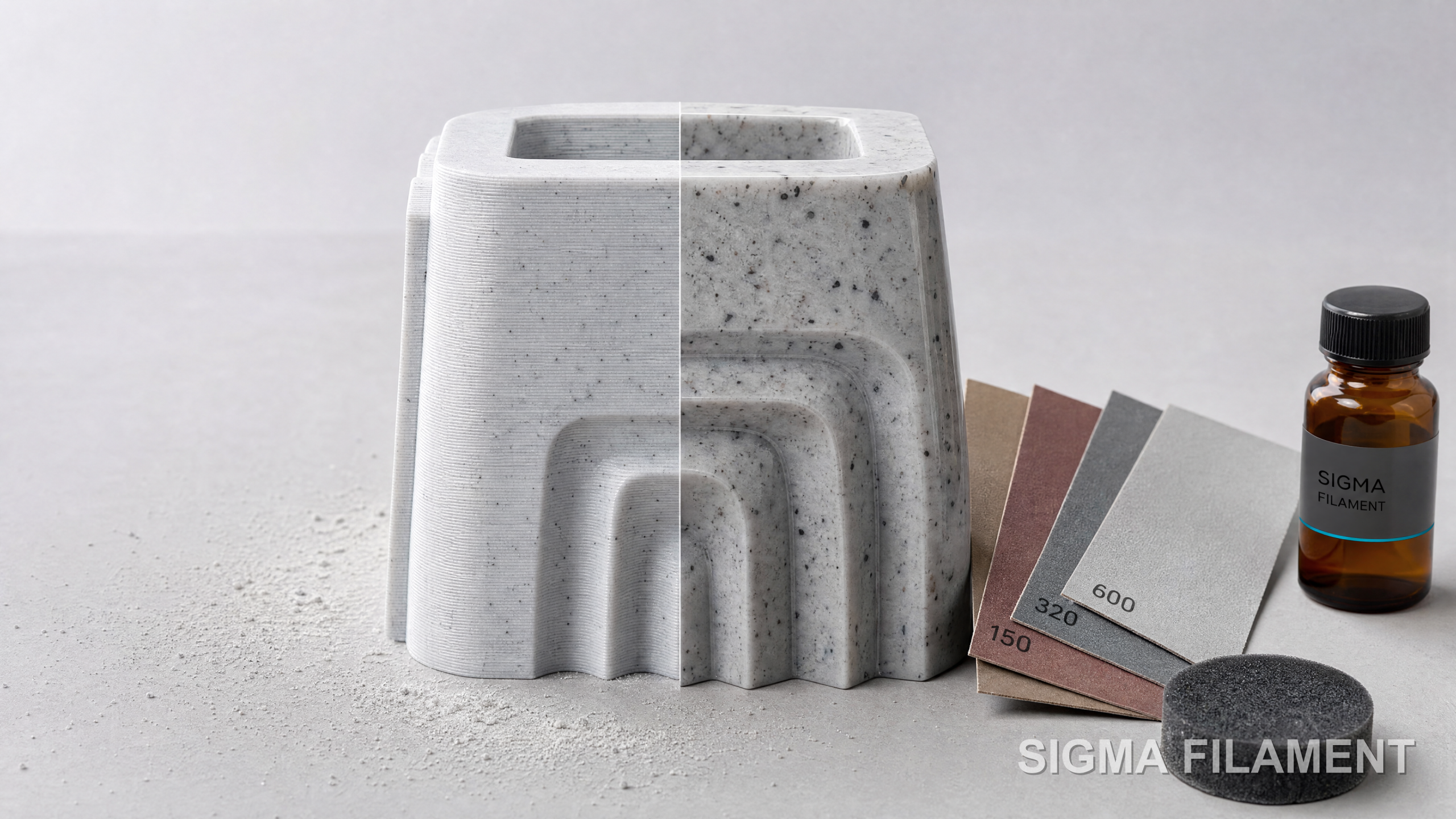
Sand the mineral-filled grade in three stages: 150-220 grit to break the matte extrusion skin, 320-400 grit to smooth, then wet-sand from 600 grit through 2000 grit for a polished slab. Finish with a 2-part epoxy or XTC-3D for gloss, satin polyurethane for a softer feel, or a matte sealer to preserve a natural-stone look (Fictiv, n.d.; FacFox, n.d.-a).
Sealing for a polished-stone finish
The sealer choice sets the final read of the part. A 2-part epoxy or XTC-3D self-leveling coating gives the deep, wet gloss associated with polished marble countertops, and it fills any micro-pores the sandpaper left behind. A satin polyurethane lands in the middle, with a soft sheen closer to honed limestone or soapstone. A matte clear sealer preserves the look of raw, freshly cut stone and keeps the surface from reading as plastic under direct light. For B2B sample kits, the satin option photographs most consistently across showroom lighting conditions.
When to leave layer lines for a sedimentary look
Sanding is not always the right answer. Visible horizontal layer lines, printed at 0.2 or 0.28 mm and left untouched, read convincingly as sedimentary banding in stones like travertine, sandstone, or banded onyx. For decor pieces and vases, and for the kind of architectural samples where geological realism matters more than slab smoothness, skip the 150 grit entirely and apply a matte sealer directly over the as-printed surface. The layer artifact becomes a feature, not a defect.
Marble PLA vs Marble PETG, Silk PLA and Matte PLA: A Decision Matrix
Procurement decisions on stone-effect filament usually collapse into one question: do you need the look, or do you need the part to survive a job site. The four candidates that show up on most B2B shortlists, marble PLA, marble PETG, silk PLA, and matte PLA, all share shelf space and overlap in marketing copy, but they behave differently on the bed and in the hand. The matrix below is the short version that print-farm operators and resellers can hand to a buyer in under a minute.
| Material | Finish | Print difficulty / toughness | Service temp | Best use |
|---|---|---|---|---|
| Marble PLA | True matte stone, visible mineral speckle, slight weight gain from CaCO3 | Easy print (200-220 C / 50-60 C bed); brittle under impact | ~50-60 C | Decor, busts, vases, retail display props, photo-shoot SKUs |
| Marble PETG | Matte stone look with the speckle pattern carried over | Hotter and slower (230-250 C / 80-90 C bed); higher impact resistance | ~70-80 C | Functional stone-look parts, outdoor pieces, garden planters, fixtures in warm rooms |
| Silk PLA | Glossy pearlescent sheen, no mineral texture | Easy print, low toughness | ~50-60 C | Statues and giftware where a high-gloss finish sells the piece |
| Matte PLA | Flat finish, uniform color, no speckle, no added weight | Easy print, low toughness | ~50-60 C | Cosplay, props, low-glare photography models |
Marble PLA vs marble PETG
The two stone-look options solve different problems. The PLA version prints on almost any FDM machine at 200-220 C nozzle and 50-60 C bed, lays down a true matte finish straight off the plate, and rarely needs an enclosure. It also chips. Marble PETG asks for 230-250 C extrusion and an 80-90 C bed, and it benefits from an enclosure, but it shrugs off the drops and stress fractures that retire PLA parts. For a planter that lives on a south-facing patio, PETG is the safer spec; the practical differences between PLA and PETG cover the heat, UV, and impact picture in full.
Marble PLA wins on print ease and finish quality: a forgiving 200-220 C / 50-60 C window, true matte stone surface with no post-processing, and brittle behavior with a service ceiling near 50-60 C. Marble PETG trades that simplicity for heat and impact tolerance, printing at 230-250 C / 80-90 C with a service ceiling around 70-80 C (Conniff & Zidonis, 2022).
Marble PLA vs silk and matte PLA
Silk PLA and matte PLA both print as easily as the stone-effect grade, and both stay in the same brittle, low-temperature category. The split is purely visual. Silk PLA carries a glossy pearlescent sheen that reads as polished resin or glazed ceramic. Matte PLA, benchmarked here against standard PLA, gives a flat, uniform color with no shine, useful when on-camera glare is a problem. Neither carries the calcium carbonate filler that gives the mineral-filled grade its speckle and slight added heft, so neither produces a convincing stone surface no matter how you tune the slicer.
Choosing by use case
Three rules cover most B2B orders. Decor and display SKUs that never see heat or hard knocks go to the PLA option on cost and finish. Functional or outdoor stone-look parts, especially anything shipped to warmer climates, go to marble PETG. Print-farm operators stocking only one stone-effect line should default to the PLA grade for the easier process window and route PETG inquiries as a separate quoted SKU.
Density and Cost: Why Marble PLA Yields Fewer Meters per Kilogram
Marble PLA looks like a cosmetic upgrade on the spool, but on the procurement spreadsheet it behaves like a different commodity. The mineral loading that produces the stone-effect surface also raises the composite density, and density is the variable that quietly governs how many parts a kilogram of filament will actually print. Buyers who price the mineral-filled grade the way they price neat PLA will under-quote every job that uses it.
How CaCO3 raises composite density
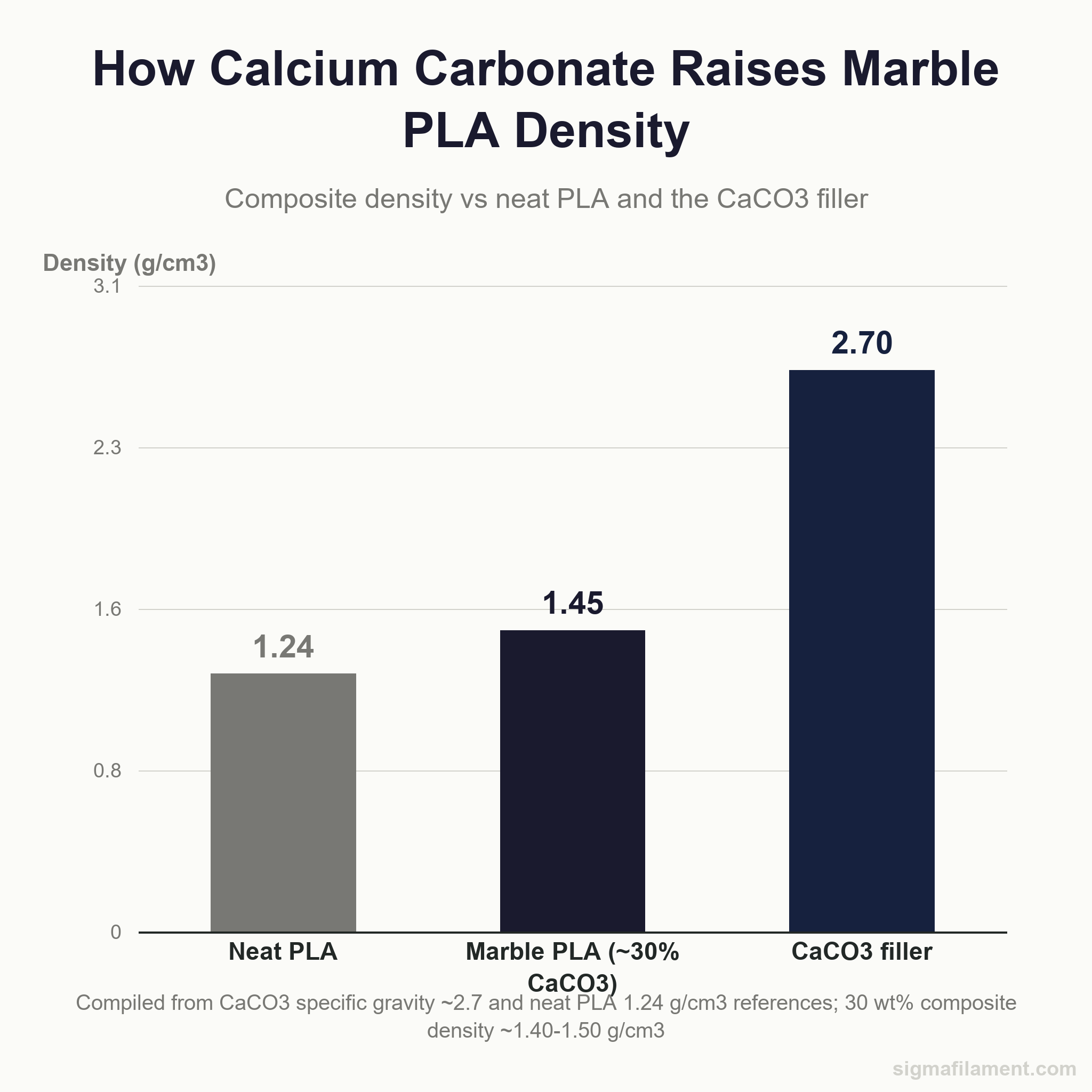
Neat PLA has a polymer density of about 1.24 g/cm3. Calcium carbonate, the most common mineral filler used to create the marble effect, has a specific gravity of roughly 2.7, more than twice that of the base resin. At a typical 30 wt% loading the composite density lands in the 1.40 to 1.50 g/cm3 range, depending on filler grade, dispersion quality, and any residual voids introduced during compounding (Homavand et al., 2024).
Meters per kilogram and cost per part
Filament is sold by mass but consumed by volume. A 1.75 mm strand of neat PLA at 1.24 g/cm3 yields close to 330 meters per kilogram. The same strand in a 1.40 to 1.50 g/cm3 stone-effect grade drops to roughly 280 to 295 meters per kilogram, about 10 to 15% fewer meters on the spool (Homavand et al., 2024). For a print farm pricing per part, that gap shows up as a higher effective 3D printing cost per gram before any per-kilogram price uplift is factored in, and it compounds across every fixture, vase, or statue queued for the build plate.
Budgeting marble PLA against neat PLA
Neat PLA has a polymer density near 1.24 g/cm3, while a 30 wt% calcium carbonate composite reaches 1.40 to 1.50 g/cm3 because CaCO3 carries a specific gravity around 2.7. The added mass yields roughly 10 to 15% fewer meters per kilogram, raising the effective material cost per printed meter (Homavand et al., 2024).
The procurement takeaway is to cost the mineral-filled grade on grams-per-part and meters-per-kilogram, not on the headline spool price. Quote sheets that hold meter consumption constant across resin grades will systematically under-recover material cost on every stone-effect job, and the gap grows with part wall thickness and infill percentage. For the underlying math on how many grams of filament sit on a spool, buyers can cross-check spool net weight against the meters their slicer reports per print.
OEM and Wholesale Marble PLA: Custom Formulation, MOQ and Lead Time
Stone-effect filament sourced from a stocked spool catalogue is convenient, but for resellers and print farms the more interesting question is what a source manufacturer can change about the material itself. Owning the factory and the resin intake means three levers are tunable per order: the mineral loading, the visual signature of the marbling, and the diameter discipline the downstream process depends on.
Custom marble formulation and filler percentage
Calcium-carbonate loading on a 100% virgin NatureWorks PLA base can be tuned from roughly 20 wt% (a lighter speckle on a near-standard PLA feel) up to 50 wt% (a denser, more stone-like print with more matte surface). Speckle density, base color and contrast color are formulated to a brand reference, including Pantone or RAL targets where a private-label SKU needs to sit beside an existing product family. Using virgin resin rather than regrind keeps the melt rheology, density and color batch-to-batch predictable, which is the part of the spec that quietly determines whether a print farm can run the same slicer profile across reorders. Buyers new to mineral grades often work through a vetting checklist for the filament maker before signing any first PO.
MOQ, lead time and virgin-resin base
For wholesale PLA filament on standard marble SKUs, MOQ starts at 100 to 500 spools. A fully custom marble formulation, where the filler percentage, speckle pattern and color are dialed in for one buyer, typically starts at 500+ spools and runs a 4 to 6 week lead time from sign-off to shipment.
Source-manufacturer supply of this material scales across two MOQ tiers: 100 to 500 spools for standard stock SKUs, and 500+ spools for a fully custom marble formulation with buyer-specified filler loading (20 to 50 wt%), speckle pattern and color match, on a 100% virgin NatureWorks PLA base, with lead times of roughly 4 to 6 weeks.
Spec controls that protect a reseller’s margin
Mineral-filled filaments are where loose tolerance hurts a reseller fastest, because flow rate is set by grams per meter, and grams per meter is set by diameter squared. Holding diameter to +/-0.02 mm across a custom marble batch keeps slicer flow, retraction and first-layer behavior consistent from spool to spool, so a print farm is not re-tuning profiles or absorbing failed prints into its margin. Pair that with documented filler percentage and resin lot, and warranty conversations with end customers stay short. Resellers building a long-term filament product line and brand typically write these tolerances into the spec before sampling, not after.
For a custom marble spec sheet, sample spools, or a price-per-kilo quote at your target volume, contact our team.
Frequently Asked Questions
What is marble PLA filament? Marble PLA is a PLA filament engineered to look like natural stone. Two formulations share the name: mineral-filled grades that blend roughly 30 wt% calcium carbonate into the PLA matrix for a true stone effect, and pigment-only grades that mimic the marble appearance with colorants alone and contain no filler.
Is marble PLA abrasive, and do I need a hardened nozzle? Mineral-filled marble PLA is mildly abrasive because the CaCO3 particles register about 3 on the Mohs hardness scale. Standard brass nozzles survive short runs and prototypes, but hardened steel is the right choice for production print farms running continuous hours. The pigment-only marble-look variant contains no mineral and is not abrasive.
What temperature should I print marble PLA at? Run the nozzle between 200 and 230 C, with most spools landing in the 210 to 220 C sweet spot. Set the bed to 50 to 60 C and tune in 5 C steps if first-layer adhesion or surface texture needs refinement.
Does marble PLA need a heated bed? A heated bed at 50 to 60 C is recommended for reliable first-layer adhesion. No enclosure is required, which makes the filament compatible with open-frame and entry-level desktop printers.
Is marble PLA stronger than regular PLA? No. Adding calcium carbonate raises stiffness and modulus but reduces tensile and flexural strength, so the printed part is stiffer and more brittle rather than stronger. Buyers specifying load-bearing parts should reach for PLA+ or PETG instead.
Can you sand and seal marble PLA? Yes, and the mineral content takes finishing well. Start with 150 to 220 grit, step up through 320 to 400, then wet-sand from 600 to 2000 grit. Seal the surface with epoxy resin such as XTC-3D or a polyurethane topcoat for a polished stone look suitable for retail display pieces.
What is the difference between marble PLA and stone PLA? The two terms overlap heavily. Both describe CaCO3 or mineral-filled PLA that prints with a stone-like surface, and most factories use the labels interchangeably. The marble label usually emphasizes the speckled, veined pattern, while stone often signals a flatter, more uniform mineral finish.
How is marble PLA made? Producers compound calcium carbonate powder into PLA pellets through twin-screw extrusion. The CaCO3 carries a specific gravity around 2.7 with particle sizes from 0.5 to 10 micrometers, and typical loadings sit between 20 and 50 wt% depending on the target stiffness and visual effect.
What is the MOQ and lead time for OEM or wholesale marble PLA? Stock-color marble grades usually start at 100 to 500 spools per order, while custom formulations, private-label spools, or bespoke marble patterns push minimums above 500 spools. Plan on 4 to 6 week lead times from purchase order to shipment, longer if branded packaging is part of the scope.
Conclusion
Marble PLA is two materials wearing one name, and the family decision drives every choice that follows. If the spool is a mineral-filled stone-effect compound (calcium carbonate or marble powder in a PLA matrix), plan for hardened steel nozzles in any production cell, brass only for one-off prototypes. If it is a pigment-only marble-look PLA with no mineral load, standard brass is fine and the part will look the part without behaving like stone. Either way, hold the nozzle around 200 to 220 C, the bed around 50 to 60 C, and expect stiffer rather than stronger output; sanding, sealing, or a light wax pass is what makes the surface read as real stone. Budget at composite density of roughly 1.40 to 1.50 g/cm3, which yields about 10 to 15 percent fewer meters per kilogram than neutral PLA, and source the grade that matches the SKU. For OEM and wholesale marble PLA with custom calcium-carbonate loading and color matching, contact the SigmaFilament engineering team.
References
- Donate, R., Paz, R., Quintana, A., Bordon, P., & Monzon, M. (2023). Calcium Carbonate Coating of 3D-Printed PLA Scaffolds Intended for Biomedical Applications. Polymers, 15(11), 2506. https://doi.org/10.3390/polym15112506
- Homavand, A., Cree, D. E., & Wilson, L. D. (2024). Polylactic Acid Composites Reinforced with Eggshell/CaCO3 Filler Particles: A Review. Waste, 2(2), 169-185. https://doi.org/10.3390/waste2020010
- Sousa, D., Baleia, C., Amaral, P., Vaz, M. F., & Bordado, J. C. (2025). PLA Reinforced with Limestone Waste: A Way to Sustainable Polymer Composites. Polymers, 17(5), 662. https://doi.org/10.3390/polym17050662
- Faba, S., Aguero, A., Arrieta, M. P., Martinez, S., Romero, J., Torres, A., & Galotto, M. J. (2024). Foaming of 3D-Printed PLA/CaCO3 Composites by Supercritical CO2 Process for Sustainable Food Contact Materials. Polymers, 16(6), 798. https://doi.org/10.3390/polym16060798
- E3D-Online. (2015, September 9). Are abrasives killing your nozzle? E3D-Online Blog. https://e3d-online.com/blogs/news/are-abrasives-killing-your-nozzle
- Wikipedia contributors. (2026). Mohs scale. In Wikipedia, The Free Encyclopedia. https://en.wikipedia.org/wiki/Mohs_scale
- Conniff, M., & Zidonis, A. (2022, July 27). PETG vs. PLA: Strength and printing comparison. Xometry. https://www.xometry.com/resources/3d-printing/petg-vs-pla-3d-printing/
- Fictiv. (n.d.). How to finish 3D printed parts: The ultimate guide. Fictiv. https://www.fictiv.com/articles/how-to-finish-3d-printed-parts
- FacFox. (n.d.). 10 methods for 3D printing post-processing (PLA & more). FacFox Docs. https://facfox.com/docs/kb/10-methods-for-3d-printing-post-processing-pla-more
- FacFox. (n.d.). Marble PLA: Marble filament brands compared. FacFox Docs. https://facfox.com/docs/kb/marble-pla-marble-filament-brands-compared
Last reviewed and updated: June 2026. Author: SigmaFilament team. For tailored guidance, contact our team.