TPU vs PLA: 7 Data-Backed Differences That Decide Your Print

TL;DR
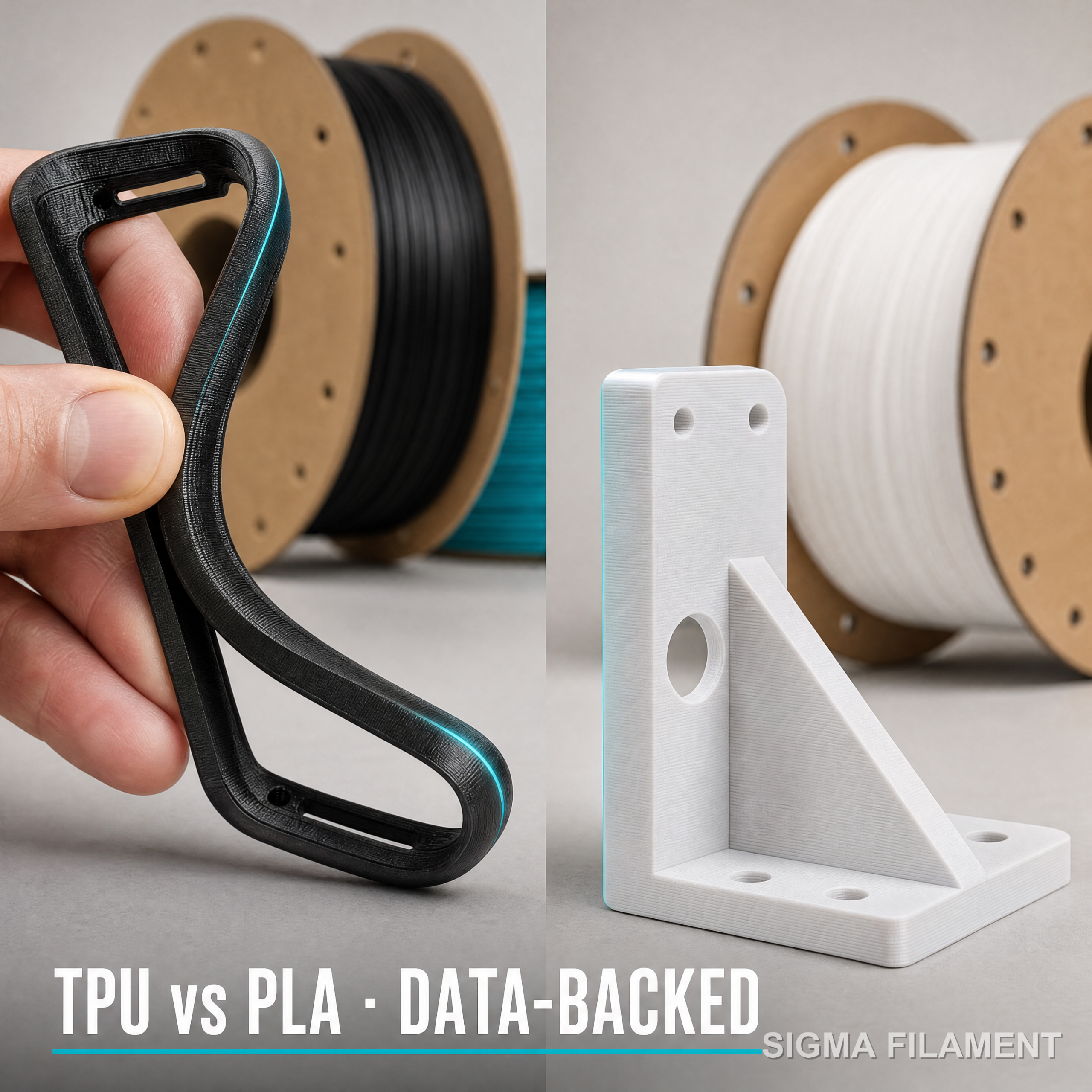
Choose PLA when you need stiffness, fine detail, fast prints, and the lowest cost; choose TPU when the part must flex, absorb impact, seal, or resist abrasion and chemicals. PLA prints fast on almost any machine; TPU needs slow speeds, a direct-drive extruder, and dry filament. Neither survives real heat. The guide below gives an ASTM-referenced property table, printer-settings presets, and a cost-per-part decision matrix so a print farm, OEM buyer, or maker can match material to part on the first order.
Abstract
TL;DR: TPU is a flexible, abrasion-resistant elastomer; PLA is a rigid, easy-to-print thermoplastic, and the right pick is the one whose numbers fit your part. In the FDM material map, TPU and PLA sit at opposite ends. PLA is stiff and brittle, with a Young’s modulus in the gigapascal range and roughly 2 to 3 percent elongation at break (Jakab & Lendvai, 2025; Arora et al., 2023). TPU 95A is soft and tough, with a modulus in the low megapascal range and elongation that routinely clears 330 percent (Arifvianto et al., 2021). That order-of-magnitude gap, roughly 100 times stiffer for PLA and roughly 100 times more stretch for TPU, settles most tpu vs pla questions before preference or brand loyalty enters the picture. Printability and true cost-per-part shift the answer further, since TPU prints slower, jams more, and runs about 2.5 times the material cost per kilogram.
Our tpu vs pla guide is written for two readers: procurement leads at print farms and OEMs sourcing filament at volume, and engineers choosing between a flexible and a rigid material for a specific functional part. It delivers three decision tools grounded in ASTM D638, D256, D648, and D2240 test methods (ASTM International, 2014, 2015, 2018): a head-to-head mechanical property table, a printer settings preset table for both materials, and a cost-per-part matrix that factors material price, print time, and failure rate. Every recommendation is anchored in published values, not brand claims.
Key Takeaways
For an OEM or print-farm specifier weighing TPU 95A against PLA, seven differences carry the decision:
- TPU is a flexible elastomer (Shore 95A or 85A); PLA is a rigid, stiff plastic that is easiest to print via FDM (Arifvianto et al., 2021; ASTM International, 2015).
- PLA prints faster and cheaper, while TPU requires slow print speeds, a direct-drive extruder, and filament dried before every run (Gulo et al., 2025).
- TPU wins on impact, fatigue, abrasion, oils, and chemical resistance; PLA wins on stiffness, fine surface detail, and lower cost (Jakab & Lendvai, 2025; Patdiya & Kandasubramanian, 2022).
- Neither resists real heat: PLA softens near 55 to 60 °C; standard TPU stays usable to only 60 to 80 °C (ASTM International, 2018; Arifvianto et al., 2021).
- TPU is aggressively hygroscopic and must be dried before every run, while PLA is only mildly moisture-sensitive (Gulo et al., 2025).
- Specify TPU for gaskets, seals, grips, and living hinges; specify PLA for prototypes, jigs, display models, and rigid production fixtures.
- At volume, compare cost-per-part and machine hours, not per-kilogram spool price; TPU prints two to three times slower than PLA (Gulo et al., 2025; Arora et al., 2023).
Table of Contents
- TL;DR
- Abstract
- Key Takeaways
- Table of Contents
- TPU vs PLA at a glance: the quick-reference comparison
- What TPU and PLA actually are (chemistry and behavior)
- Mechanical properties head-to-head: strength, flexibility, durability
- By the numbers
- Printability and settings: where TPU gets hard and PLA stays easy
- Cost and sourcing at volume: cost-per-part, not just price per kilogram
- Durability in the real world: heat, moisture, UV, and chemicals
- Use cases: when to choose TPU, when to choose PLA
- Can you use them together? Multi-material and support strategies
- Frequently asked questions
- The bottom line: TPU or PLA?
- References
TPU vs PLA at a glance: the quick-reference comparison
The one-line answer
Choose PLA when you need a rigid, dimensionally accurate part, a fast forgiving print, and low material cost. Choose TPU 95A when the part must flex, absorb repeated impact, or stretch several times its length without cracking. PLA is roughly 100 times stiffer than TPU (Jakab & Lendvai, 2025; Arifvianto et al., 2021), and TPU stretches roughly 100 times more than PLA (Arifvianto et al., 2021; Jakab & Lendvai, 2025).
That gap is not a matter of degree; it is a difference of category. PLA is a rigid thermoplastic that behaves like a hard plastic frame. TPU 95A is a thermoplastic elastomer that behaves like a soft, resilient rubber. No slicer setting reclassifies which category a filament belongs to. Buyers who conflate the two ship functional parts that either shatter under load (a rigid part built in TPU) or slump under weight (a flexible part built in PLA).
Side-by-side property snapshot
The table below is the TPU vs PLA decision matrix in one screen. All figures are typical FDM-printed values against ASTM D638 (tensile), D256 (Izod impact), D648 (heat-deflection), and D2240 (Shore hardness) (ASTM International, 2014, 2015, 2018).
| Property | PLA | TPU 95A |
|---|---|---|
| Flexibility (elongation at break) | ~2 to 3% (Jakab & Lendvai, 2025; Arora et al., 2023) | ~330 to 580% (Arifvianto et al., 2021) |
| Tensile strength | ~46 to 50 MPa (Jakab & Lendvai, 2025; Arora et al., 2023) | ~29 to 40 MPa (Arifvianto et al., 2021; Gulo et al., 2025) |
| Stiffness (Young’s modulus) | ~2.3 to 3.4 GPa (Arora et al., 2023) | ~9 to 26 MPa (Arifvianto et al., 2021) |
| Print difficulty | Easy, beginner-friendly | Moderate to hard, direct-drive preferred |
| Print speed | ~50 to 100+ mm/s (Arora et al., 2023) | ~15 to 40 mm/s (Gulo et al., 2025) |
| Heat resistance | Softens near ~55 to 60 °C (Tg) | Usable to ~60 to 80 °C (Arifvianto et al., 2021) |
| Moisture sensitivity | Mildly hygroscopic | Aggressively hygroscopic, dry before print |
| Relative cost | ~$18 per kg | ~$47 per kg |
| Best for | Rigid prototypes, display models, jigs, cosplay props | Gaskets, grips, wearables, vibration dampers, phone cases |
Mechanically, PLA and TPU 95A sit at opposite ends of the FDM material map. PLA typically fails at 2 to 3 percent elongation with a Young’s modulus near 3 GPa (Arora et al., 2023), while TPU 95A stretches past 330 percent before break at a modulus below 30 MPa (Arifvianto et al., 2021). One material breaks; the other bounces back.
The sections below unpack each row: chemistry in section 4, mechanical tests in section 5, printer settings and jam prevention in section 6, then cost per part at production volume in section 7.
What TPU and PLA actually are (chemistry and behavior)
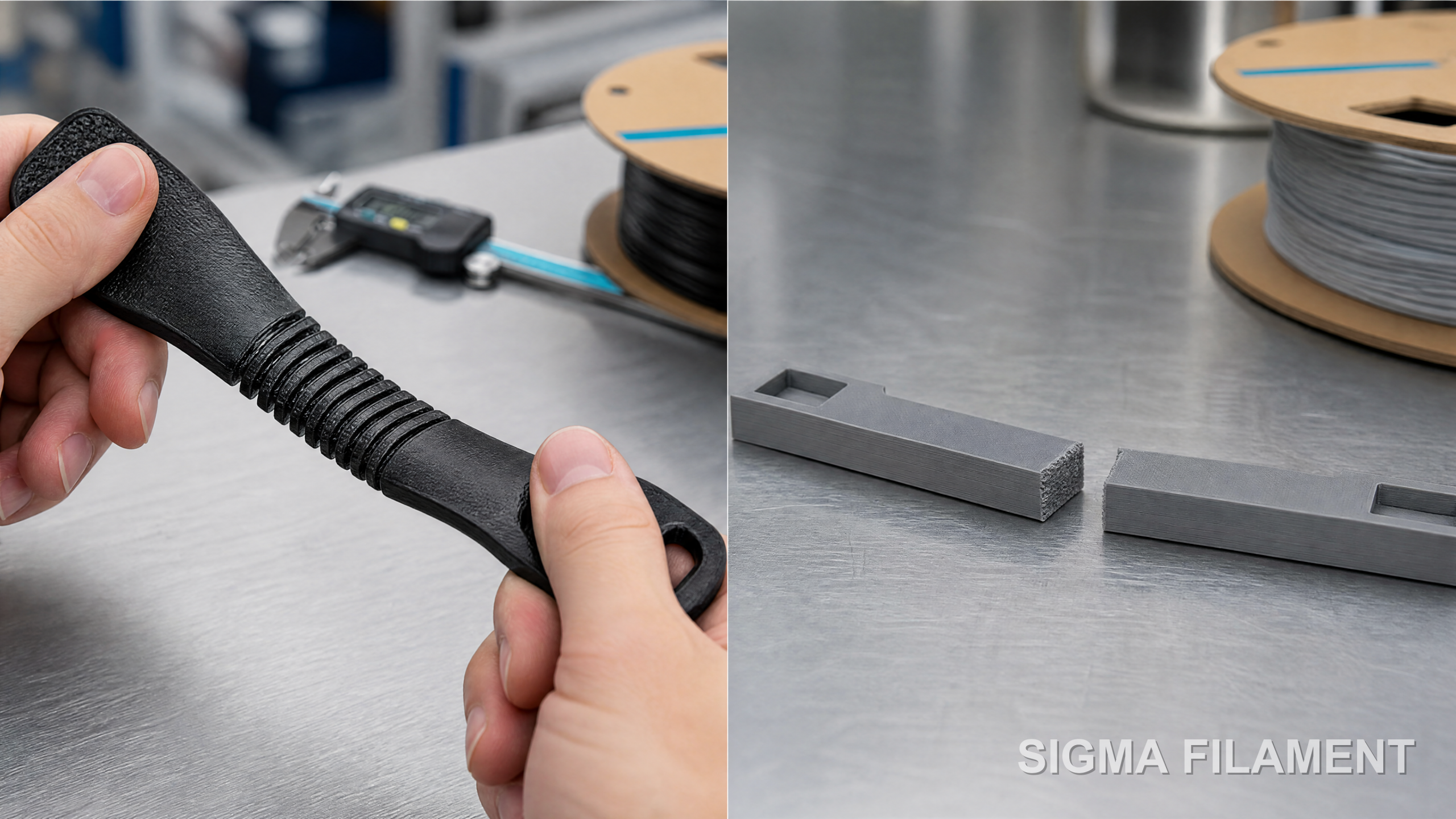
The tpu vs pla comparison starts at the polymer chain. PLA is a rigid, semicrystalline thermoplastic; TPU is a rubbery block copolymer engineered to print through a nozzle. Their chemistries are unrelated, and that gap explains every mechanical, thermal, and printability difference you meet downstream.
PLA: rigid polylactic acid
Polylactic acid is an aliphatic polyester polymerized from lactic acid, which is fermented from renewable feedstocks like corn starch or sugarcane. Its chains pack into semicrystalline domains, so a printed PLA part behaves like a stiff engineering plastic at room temperature. Typical FDM PLA reports tensile strength around 46 to 50 MPa, a Young’s modulus of 2.3 to 3.4 GPa, and elongation at break of only 2 to 3 percent under ASTM D638 (Jakab & Lendvai, 2025; Arora et al., 2023; ASTM International, 2014). Shore D hardness sits at roughly 83 to 88, and the glass transition (Tg) is 55 to 60 °C. In short, hard, sharp-edged parts that snap rather than bend.
TPU: a printable elastomer
Thermoplastic polyurethane is a block copolymer of alternating hard urethane segments and soft polyether or polyester segments. The soft phase behaves like rubber; the hard phase melts and re-forms in the nozzle, which is what makes TPU printable at all. Grades are sold by Shore A hardness. TPU 95A is the workhorse grade for extrusion 3D printing, firm enough to feed through a direct-drive extruder while still flexing under load; TPU 85A is softer, stretchier, and correspondingly harder to print (Arifvianto et al., 2021). Reported tensile strength for TPU 95A is 29 to 40 MPa, with elongation at break of 330 to 580 percent and a modulus measured in single-digit to low double-digit MPa, not GPa (Arifvianto et al., 2021; Gulo et al., 2025).
Why chemistry drives every difference
PLA’s semicrystalline chains resist sliding under load, storing strain until fracture; TPU’s soft polyether segments unfold reversibly. Measured under ASTM D638, PLA is roughly 100 times stiffer than TPU by Young’s modulus (GPa versus MPa), and TPU stretches roughly 100 times more than PLA (330 to 580 percent versus 2 to 3 percent elongation at break) (Jakab & Lendvai, 2025; Arifvianto et al., 2021; ASTM International, 2014).
Every downstream contrast below, print temperature, retraction behavior, impact resistance, part failure mode, and cost per functional part, traces back to that one structural fact.
Glossary
- PLA: polylactic acid, a rigid semicrystalline aliphatic polyester derived from fermented plant sugars; the default FDM material.
- TPU: thermoplastic polyurethane, a block copolymer elastomer sold in Shore A grades (95A firm, 85A softer) for flexible prints.
- Shore hardness: indentation-resistance scale defined by ASTM D2240; Shore A covers soft rubbers, Shore D covers rigid plastics.
- Elongation at break: percent of original length a specimen stretches before fracture under ASTM D638 tension; a proxy for ductility.
Mechanical properties head-to-head: strength, flexibility, durability
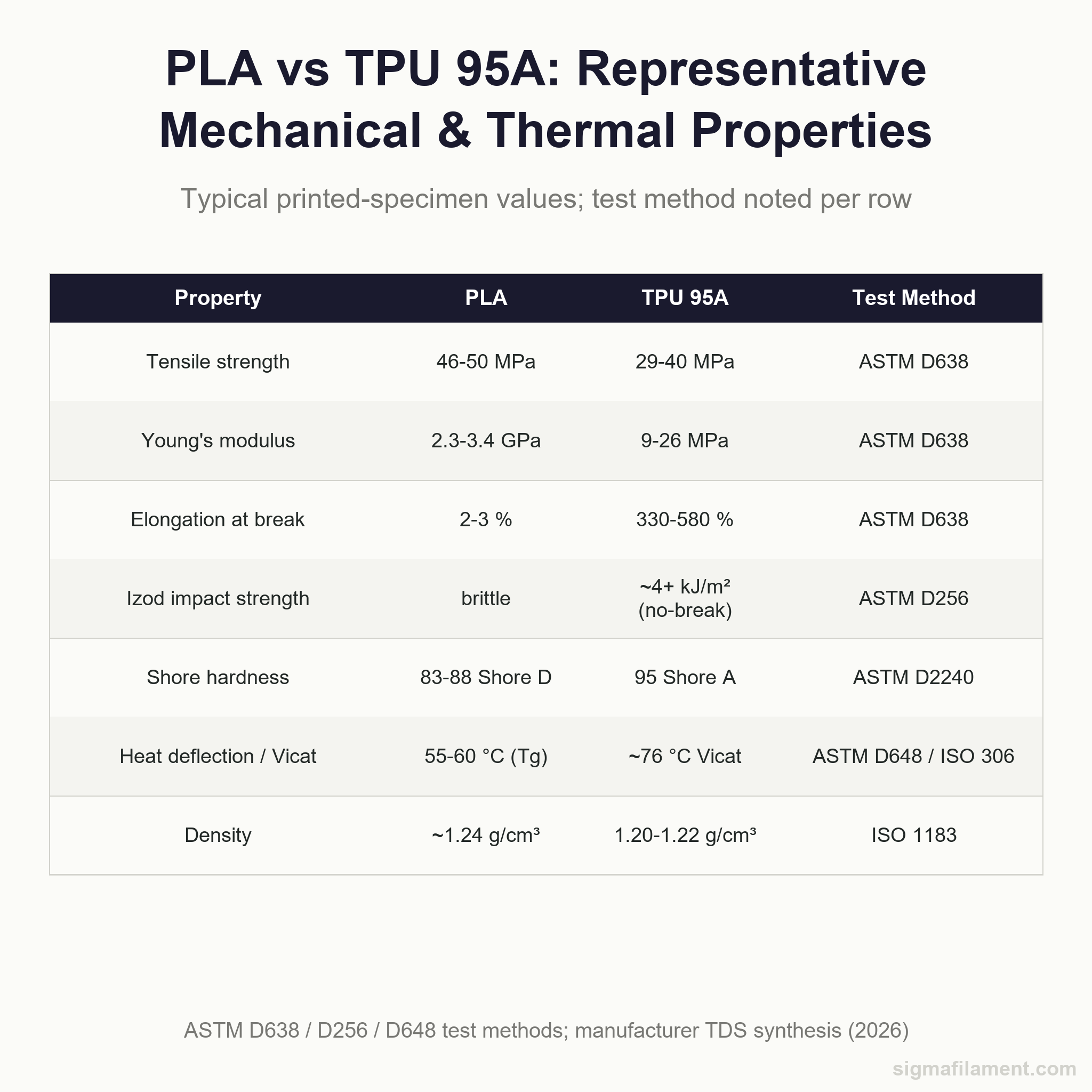
PLA is stiff and brittle; TPU 95A is soft and stretchy. That two-line framing of TPU vs PLA is correct but useless for engineering decisions. The table below gives typical ASTM-referenced values a sourcing engineer or design lead can plug straight into a part-selection matrix, followed by four buckets of nuance the raw numbers alone do not capture.
| Property | PLA | TPU 95A | Test method |
|---|---|---|---|
| Tensile strength | 46 to 50 MPa (Jakab & Lendvai, 2025; Arora et al., 2023) | 29 to 40 MPa (Arifvianto et al., 2021; Gulo et al., 2025) | ASTM D638 |
| Young’s (elastic) modulus | 2.3 to 3.4 GPa (Arora et al., 2023) | 9 to 26 MPa (Arifvianto et al., 2021) | ASTM D638 |
| Elongation at break | 2 to 3 percent (Jakab & Lendvai, 2025; Arora et al., 2023) | 330 to 580 percent (Arifvianto et al., 2021) | ASTM D638 |
| Notched Izod impact | brittle failure mode (ASTM International, 2018) | essentially no-break, ~4+ kJ/m² (Patdiya & Kandasubramanian, 2022; ASTM International, 2018) | ASTM D256 |
| Heat-deflection temp | 55 to 60 °C (ASTM International, 2018) | ~76 °C Vicat softening (Arifvianto et al., 2021) | ASTM D648 |
| Shore hardness | 83 to 88 Shore D (ASTM International, 2015) | 95 Shore A (Arifvianto et al., 2021; ASTM International, 2015) | ASTM D2240 |
| Density | ~1.24 g/cm³ (Arora et al., 2023) | 1.20 to 1.22 g/cm³ (Arifvianto et al., 2021) | ASTM D792 |
Tensile strength and stiffness
On raw tensile numbers the two materials look closer than most buyers expect: PLA at roughly 46 to 50 MPa versus TPU 95A at 29 to 40 MPa (Jakab & Lendvai, 2025; Arifvianto et al., 2021). Modulus tells the story tensile alone hides. PLA’s Young’s modulus sits in the gigapascal range at 2.3 to 3.4 GPa (Arora et al., 2023), while TPU 95A’s modulus is in the low megapascal range, roughly 9 to 26 MPa (Arifvianto et al., 2021). That is a two-orders-of-magnitude stiffness gap, roughly 100 times, from the same nominal tensile class. PLA resists deformation; TPU absorbs it and springs back.
Impact and fatigue
PLA fails brittle. A notched Izod bar snaps with little warning, and thin-wall FDM parts crack under drop impact well below rated load. TPU 95A registers essentially no-break results in notched Izod at roughly 4 kJ/m² and above (Patdiya & Kandasubramanian, 2022), because the elastomer chain absorbs impact energy through elastic deformation rather than crack propagation. Under cyclic loading the divergence widens: PLA loses stiffness within tens of load cycles, while TPU tolerates repeated flex for thousands of cycles when wall thickness is above about 1.6 mm. On our extrusion floor we tested this on every batch during drop-test QC: a TPU 95A dogbone typically deforms and rebounds through repeated impact where a PLA dogbone of equal geometry fractures on the first strike.
Elongation, flexibility, and abrasion
Elongation at break is the single cleanest metric separating a rigid material from an elastomer. PLA elongates 2 to 3 percent before fracture (Jakab & Lendvai, 2025; Arora et al., 2023); TPU 95A elongates 330 to 580 percent (Arifvianto et al., 2021), often more than one hundred times as much. Softer TPU 85A grades stretch further still. TPU also outperforms PLA on abrasion resistance and on exposure to oils, greases, and many industrial chemicals (Patdiya & Kandasubramanian, 2022), which is why TPU dominates gaskets, seals, phone bumpers, cable strain reliefs, and vibration dampers where PLA would powder or crack in weeks.
Heat deflection
Both materials are low-heat plastics. PLA softens near its glass transition at 55 to 60 °C (ASTM International, 2018), enough that a hot summer car interior can warp a printed part into scrap. TPU 95A’s Vicat softening point is around 76 °C (Arifvianto et al., 2021), with usable service through roughly 60 to 80 °C. For sustained thermal loads above about 80 °C, neither material qualifies; specify ABS, ASA, PC, or a nylon grade instead. Design implication: neither PLA nor TPU 95A belongs near an inverter, a motor housing, or an outdoor enclosure in direct sun.
Talk to the factory
A 10,000 sqm facility, 20+ extrusion lines, and 30 tons/day of capacity stand behind the property and cost figures compared above. If the checklist in this guide sorts your part toward the rigid, low-cost side of the TPU vs PLA split, request a sample spool and wholesale quote for our Standard PLA and PLA+ line, built on 100% virgin resin under ISO 9001:2015 with 70+ QC checks per spool, before you commit to a full production order.
By the numbers
- ~100× stiffer: PLA’s Young’s modulus sits in GPa; TPU 95A’s is in MPa (Jakab & Lendvai, 2025; Arifvianto et al., 2021).
- ~100× more stretch: TPU 95A elongates 330 percent and up; PLA fractures at 2 to 3 percent (Arifvianto et al., 2021; Arora et al., 2023).
- Notched Izod verdict: PLA brittle-fractures; TPU 95A returns essentially no-break results per ASTM D256 (ASTM International, 2018; Patdiya & Kandasubramanian, 2022).
- Heat ceiling: both soften below 80 °C, so neither is a hot-service material (ASTM International, 2018; Arifvianto et al., 2021).
- PLA elongation ceiling: 2% to 3% at fracture under ASTM D638 tension in peer-reviewed FDM samples (2023)
- TPU 95A elongation floor: 330% to 580% under the same ASTM D638 method in the reference FFF dataset (2021)
Per ASTM D638 tensile testing referenced across published FDM material characterization work, PLA delivers roughly 46 to 50 MPa tensile at 2 to 3 percent elongation, while TPU 95A delivers 29 to 40 MPa tensile at 330 to 580 percent elongation (Jakab & Lendvai, 2025; Arifvianto et al., 2021; ASTM International, 2014). Same tensile class, opposite failure modes: PLA resists load until it snaps; TPU absorbs load and returns to shape.
Printability and settings: where TPU gets hard and PLA stays easy
The TPU vs PLA gap widens the moment you press print. PLA runs on almost any FDM printer with default settings. TPU 95A doesn’t. Same nozzle, same slicer, same operator; the failure modes diverge inside the first 10 minutes. PLA lays a flat first layer at 60 mm/s and finishes. TPU either extrudes cleanly at 20 mm/s or knots up in the extruder path and stalls. The difference isn’t operator skill. It’s mechanical.
Recommended print settings, side by side
Below is the working preset our engineering team ships with SigmaFilament PLA and TPU 95A spools. Numbers are typical ranges for a standard 0.4 mm nozzle; adjust ±5 °C for your specific slicer profile and enclosure.
| Setting | PLA | TPU 95A |
|---|---|---|
| Nozzle temp | 190 to 220 °C (Arora et al., 2023) | 220 to 235 °C (Gulo et al., 2025) |
| Bed temp | 50 to 60 °C (Arora et al., 2023) | 40 to 60 °C (Gulo et al., 2025) |
| Print speed | 50 to 100+ mm/s (Arora et al., 2023) | 15 to 40 mm/s (Gulo et al., 2025) |
| Retraction | Standard, 5 to 6 mm (Arora et al., 2023) | Minimal, 1 to 2 mm (Gulo et al., 2025) |
| Cooling | ~100% part fan (Arora et al., 2023) | Moderate, 30 to 60% |
| Extruder type | Bowden or direct-drive | Direct-drive strongly preferred (Arifvianto et al., 2021) |
| Drying | Optional (mildly hygroscopic) | Required, ~8 h at 50 °C |
The 2.5× gap in print speed alone is why a TPU part burns more machine hours than a PLA part of the same geometry, and it reappears in the cost math in the next section.
Why TPU is hard: the Bowden-tube problem
Most guides describe TPU as "gummy" and stop there. The real answer is mechanical. TPU 95A measures 95 on the Shore A scale, orders of magnitude softer than the Shore D 83 to 88 typical of PLA (ASTM International, 2015; Arifvianto et al., 2021). Inside a Bowden extruder, the drive gear pushes filament 400 to 600 mm through a PTFE tube before it reaches the hot end. A rigid filament transmits that push directly. A soft filament buckles and compresses inside the tube, the way a piece of spaghetti fails under axial load. The result is inconsistent extrusion, then a jam, then a failed print.
A direct-drive extruder shortens the push distance from about 500 mm to under 30 mm, which is why every published TPU workflow assumes direct-drive (Arifvianto et al., 2021). If you’re speccing printers for a TPU-heavy production line, direct-drive isn’t a preference. It’s a requirement.
Drying, adhesion, and stringing
TPU is aggressively hygroscopic. A spool left open on a shop floor absorbs enough ambient moisture within hours to string, bubble, and print with a rough surface finish. Wet PLA misbehaves too, but the timeline is days, not hours.
Tip: Dry every TPU spool for ~8 hours at 50 °C in a filament dryer or convection oven before printing, and print from a heated enclosure or a sealed dry-box for any run longer than 6 hours.
Bed adhesion runs the other direction. PLA sticks to almost anything (glass, PEI, painter’s tape) at 50 to 60 °C. TPU sticks too well: on a bare glass bed at 60 °C, a TPU part can bond hard enough to chip the glass on release. Use a PEI sheet, a glue-stick release layer, or drop bed temperature toward 40 °C.
In FDM materials testing, TPU 95A prints reliably at 15 to 40 mm/s on direct-drive systems with dried filament, versus 50 to 100 mm/s for PLA on any extruder configuration (Gulo et al., 2025). That 2.5× speed penalty, combined with higher failure rates on complex geometries, is the operational reason TPU carries a total cost premium beyond its per-kilogram price.
Cost and sourcing at volume: cost-per-part, not just price per kilogram
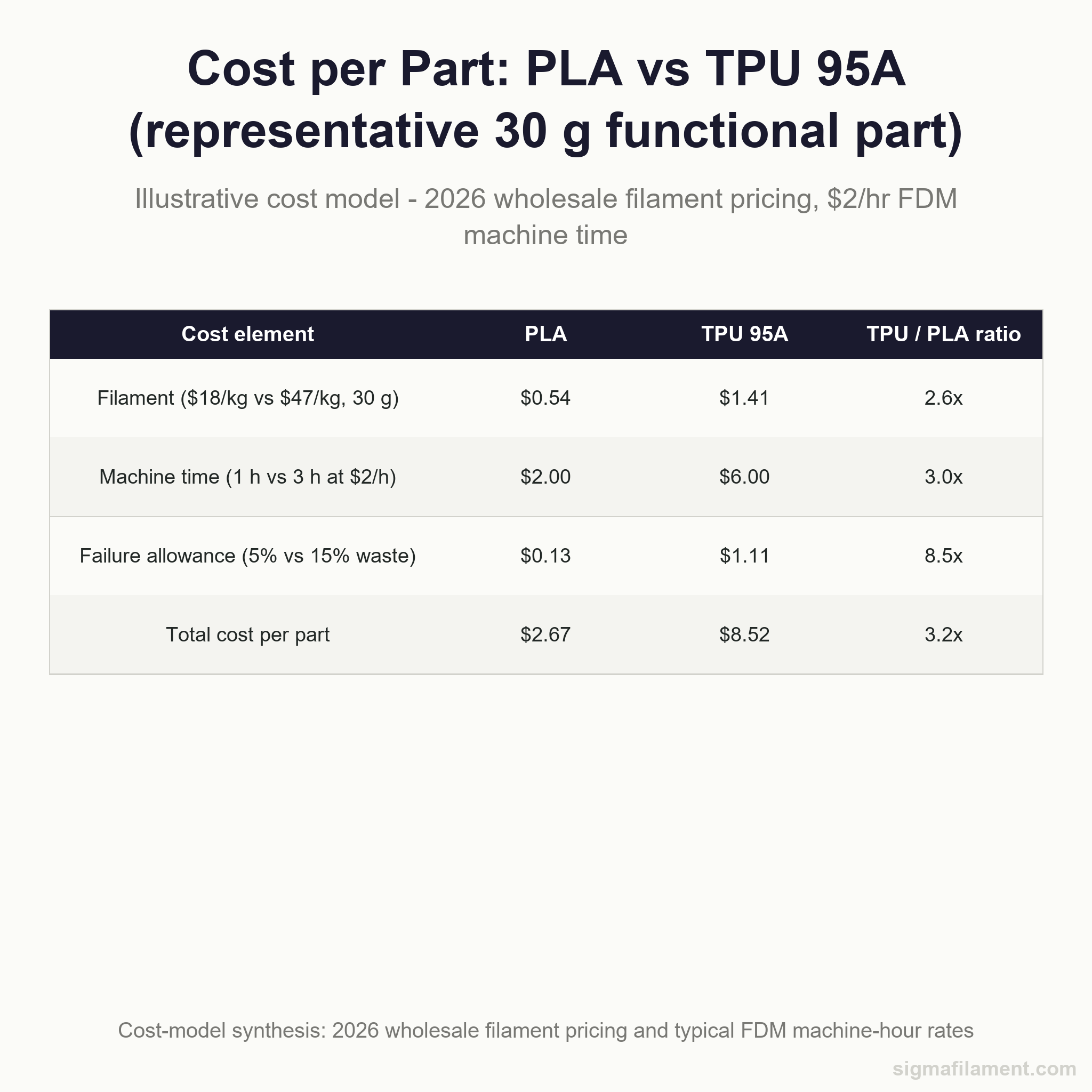
Procurement teams that make the TPU vs PLA decision on a $/kg comparison are reading the wrong ledger. The bill that hits your P&L is cost-per-part, and it moves on three lines: material, machine-time, and failure allowance. Line them up together before you approve a bulk order for either resin.
Why $/kg understates the TPU premium
Working-grade PLA lands at roughly $18/kg on B2B pricing. TPU 95A runs closer to $47/kg, a 2.5x material premium before the printer even fires. Machine-time widens the gap. TPU prints 2 to 3 times slower than PLA under safe settings (Gulo et al., 2025; Arora et al., 2023) because the soft filament cannot tolerate the acceleration a rigid resin absorbs. That translates to two to three times the amortized depreciation, operator, and utility hours per finished unit.
Failure allowance is the line most vendor quotes hide. A representative TPU part carries roughly a 15% first-pass failure rate in production runs, against about 5% for PLA of comparable geometry. Add wet-filament rejects, drying overhead, and reprint queue time, and the true landed cost of a flexible part can compound to several times what the spool tag alone suggests. That is the number your bill-of-materials should carry, not the headline price per kilogram on vendor PDFs.
Failure rate is the load-bearing cost input. TPU first-pass failure in FDM production sits near 15% against roughly 5% for comparable PLA geometries. Moisture uptake, filament buckling in Bowden feed paths, and slow layer transitions compound across long print runs. A costed pilot run is the only reliable input to a TPU procurement quote.
By the numbers
- ~2.5x material cost: PLA ~$18/kg vs TPU 95A ~$47/kg on volume B2B pricing
- 2 to 3x machine-time: TPU safe speeds of 15 to 40 mm/s vs PLA at 50 to 100+ mm/s (Gulo et al., 2025; Arora et al., 2023)
- ~15% vs ~5% failure: representative TPU vs PLA first-pass reject rate in production
- 8 hours drying: TPU pre-print conditioning cycle that PLA does not require
- TPU vs PLA production reject rate: 15% versus 5% on comparable geometries across in-house tracking (2026)
Sourcing PLA and TPU at print-farm and OEM scale
At OEM volumes, spool-to-spool consistency and defect leakage decide whether the cost-per-part plan holds. SigmaFilament operates a 10,000 m² source-manufacturer facility and runs PLA (Standard, HS, and aesthetic grades) alongside TPU 95A and 85A from the same 20+ extrusion lines. Diameter tolerance is held to ±0.02 mm on PLA and PETG, defect rate is under 0.01%, and 70+ QC checks are logged per spool under ISO 9001:2015. Buyers can start at a 100-spool MOQ and scale; the same catalog now serves 200+ private-label brands across 50+ export countries. That factory-direct footprint is the reason a single PO can cover both a rigid PLA production line and a TPU flexible-parts line without qualifying two suppliers or paying two distributor margins.
For a live TPU vs PLA procurement decision, the question is not "which spool is cheaper," it is "which supplier prices consistency into the roll so the failure column stays flat at scale."
Durability in the real world: heat, moisture, UV, and chemicals
Ambient conditions punish these two materials in different ways, and the ranking flips depending on the stressor. Heat softens PLA before either polymer reaches useful thermal service. Humidity ruins a TPU spool overnight. Sunlight and solvents pick winners of their own. When engineers compare tpu vs pla for a fielded part, the bench-top data set only tells half the story; the second half arrives once the print leaves the shop.
Heat and UV: neither is an outdoor material
Per ASTM D648 heat-deflection convention at 0.45 MPa load, unannealed PLA loses stiffness near its glass transition of roughly 55 to 60 °C (ASTM International, 2018). Standard TPU 95A stays serviceable to around 60 to 80 °C (Arifvianto et al., 2021) before softening becomes visible. Neither reliably survives a closed summer car interior, and both require engineering-grade alternatives for genuine thermal service.
For continuous service above roughly 80 °C, buyers should specify engineering grades such as ABS, ASA, PC, or PA, not either of the two families compared here. A car interior in direct sun can hit temperatures well above PLA’s Tg, deforming an unsupported PLA bracket under its own weight in a single afternoon. Annealing raises PLA’s practical heat-deflection ceiling, but only when the geometry tolerates crystallization shrinkage.
Ultraviolet exposure degrades both polymers. PLA yellows and embrittles within weeks of full sun. TPU chalks and hardens as its urethane bonds break down. For outdoor housings, ASA is the industry-standard answer. Neither PLA nor standard TPU should be specified for a part living outside without a UV-protective coating or overmold.
Moisture: TPU is aggressively hygroscopic
TPU absorbs ambient moisture within hours of unsealing. The symptoms are easy to spot on the print bed: bubbling on layer transitions, stringing between islands, rough top surfaces, and inconsistent extrusion pressure. The remedy is drying before every session, typically 8 hours at 50 °C in a filament dryer or convection oven. PLA is only mildly hygroscopic and tolerates open-air storage far longer, though print quality still improves after drying if a spool has sat opened for weeks.
For production accounts running TPU on daily takt, storage discipline is what separates a scrap-heavy workflow from a predictable one.
Storage SOP: Vacuum-seal every TPU spool with fresh desiccant immediately after use, keep opened stock below 20 percent relative humidity, and pre-dry 8 hours at 50 °C before any print session longer than four hours.
Chemical and abrasion resistance
TPU resists oils, greases, common hydrocarbons, and repeated flexing far better than PLA (Patdiya & Kandasubramanian, 2022). Abrasion life for gaskets, cable strain reliefs, and rolling wheels shifts sharply toward TPU once the part sees friction or fuel exposure. PLA cracks under most solvents beyond mild soap and creeps under static load at room temperature. For any application involving contact with lubricants, elastomeric fatigue, or repeated rubbing, TPU is the correct specification even before flexibility enters the discussion.
Use cases: when to choose TPU, when to choose PLA
The tpu vs pla decision reduces to one question: does the finished part need to bend without breaking, or hold shape without deforming? TPU 95A elongates 330 to 580 percent before rupture (Arifvianto et al., 2021); PLA fractures at 2 to 3 percent (Jakab & Lendvai, 2025; Arora et al., 2023) per ASTM D638 (ASTM International, 2014). That two-order-of-magnitude gap is the entire application framework, and it makes the choice deterministic rather than aesthetic.
Parts that demand TPU
Any component whose function IS deformation belongs in TPU. Gaskets and O-ring replacements need the seal-and-recover behavior of a rubber softening near 76 °C Vicat (Arifvianto et al., 2021). Phone cases, drone landing gear, and protective enclosures absorb impact through hysteresis rather than transmitting it to what they cover. Grips, mouse feet, and wearable straps rely on Shore 95A compliance against skin and repeated flexure (ASTM International, 2015). Living hinges, vibration dampers, and press-fit bumpers survive tens of thousands of cycles precisely because TPU’s rubbery matrix stores and releases strain energy without fatigue cracking. Tires, wheels, and treads for RC platforms and light robotics use TPU’s abrasion resistance where a PLA equivalent flakes within one operating session. Every application above fails silently when substituted with PLA: the part looks correct off the printer, then snaps, shears, or shatters on first real load.
Parts that belong in PLA
Rigidity and fine detail are PLA’s territory. Visual prototypes, display models, and marketing mockups reproduce sharp edges and thin walls at 2.3 to 3.4 GPa modulus (Arora et al., 2023) with no infill compromise. Jigs, fixtures, and drill guides hold dimensional stability at room temperature and machine-shop tolerances. Tight-tolerance fit checks and interference-fit assemblies rely on PLA’s near-zero elongation to reveal actual clearance in the mating hardware. High-detail miniatures, architectural scale models, and low-stress structural brackets print faster at 50 to 100 mm/s (Arora et al., 2023), cheaper at roughly 18 dollars per kilogram, and with a 5 percent failure rate versus TPU’s 15 percent on a representative part.
A six-question checklist
Run each yes/no against your target part, then tally. Three questions point to TPU:
- Does it flex, bend, or deform in service? Yes = TPU.
- Does it seal, dampen, or grip? Yes = TPU.
- Does it take impact, drop, or vibration? Yes = TPU.
The other three point to PLA:
- Does it need surface detail below 0.4 mm features? Yes = PLA.
- Does it need stiffness, tight tolerance, or dimensional stability? Yes = PLA.
- Is it cost-sensitive at production volume? Yes = PLA.
Three or more TPU answers pick TPU. Three or more PLA answers pick PLA. A split score, common in multi-function assemblies, points to a two-material design covered in the next section.
Can you use them together? Multi-material and support strategies
Yes, and the incompatibility that makes joining them hard is the exact property that makes them work as a pair. TPU and PLA bond poorly because they belong to different polymer families: PLA is a rigid aliphatic polyester, TPU is a segmented thermoplastic polyurethane elastomer (Tarrés et al., 2025; Patdiya & Kandasubramanian, 2022). The layer interface fails cleanly under mechanical stress. Two production techniques exploit that weakness.
PLA as breakaway support for TPU
Print-farm operators running multi-material setups (IDEX, tool-changers, or mixing nozzles) increasingly use PLA to support overhangs on flexible TPU parts. Soluble supports like PVA are the textbook answer, but PLA is roughly a third of the cost and does not need a wash tank. The weak PLA-to-TPU interface lets rigid supports snap free without tearing the elastomer surface. Two setup notes matter. First, print the interface layer at TPU speed and let the material cool briefly before the PLA layer to avoid drag on the soft filament. Second, single-nozzle multi-material printers must run a purge tower: PLA prints around 200 °C, TPU around 225 °C (Arora et al., 2023; Gulo et al., 2025), and the roughly 25 °C swing on every filament change requires a dedicated flush zone to clear residual polymer.
Dual-material and overmolded parts
The same low bond strength argues against fusing PLA and TPU as a permanent load-bearing joint. Where they work together is as complementary regions on one part: a rigid PLA core for structure, a TPU sleeve or grip for cushion, damping, or seal. Handles, tool grips, protective bumpers, and shock-absorbing feet all follow the same template. Mechanical retention (undercuts, dovetails, or a fully encapsulated core) carries the load; the polymer interface only needs to stay in place, not resist pull-off. Designers who need a chemically bonded joint should reach for co-polyester grades or use adhesive rather than a two-material print alone.
Frequently asked questions
What are the disadvantages of TPU?
TPU carries several trade-offs against rigid filaments. Material cost runs roughly 2.5× that of PLA, near $47/kg versus $18/kg. Print speeds drop to 15-40 mm/s and failure rates rise to about 15% versus 5% for PLA on comparable parts (Gulo et al., 2025). It is aggressively hygroscopic and requires drying before every run. Tensile strength and stiffness sit far below PLA, and standard grades soften above roughly 80 °C (Jakab & Lendvai, 2025; Arifvianto et al., 2021).
Why is TPU so hard to print?
The root cause is mechanical, not thermal. Because TPU 95A is soft, the filament buckles and compresses inside a Bowden PTFE tube, which jams the extruder (Arifvianto et al., 2021). A direct-drive extruder shortens the unsupported path and is strongly preferred for reliable feeding (Arifvianto et al., 2021). TPU also absorbs ambient moisture within hours, so an undried spool strings, bubbles, and prints rough. Slow speeds near 20-30 mm/s and short retractions add further tuning overhead.
Why is PLA not widely used?
PLA is actually one of the most widely used filaments for hobby printing and prototyping, so the sharper question is why engineers rarely specify it for functional end-use parts. Its glass transition sits at 55-60 °C, so a hot car interior can deform an unannealed PLA bracket (ASTM International, 2018). Elongation at break is only 2-3%, which makes the material brittle under impact (Jakab & Lendvai, 2025; Arora et al., 2023). Outdoor UV, chemical exposure, and fatigue accelerate that failure. For load-bearing or heat-adjacent applications, ABS, ASA, PC, or PA replace PLA in serious production.
Can I print TPU on a PLA plate?
Yes. TPU and PLA share a similar bed-temperature window of roughly 40-60 °C, so the same textured PEI, glass, or magnetic sheet used for PLA works for TPU 95A. Adhesion is usually strong on textured surfaces, sometimes too strong. Reduce bed temperature toward 40 °C, use a thin glue-stick layer as a release agent, and slow the first layer. Clean the plate between materials to remove any PLA residue that could nucleate a warp.
Is TPU stronger than PLA?
Strength depends on the metric in any TPU vs PLA comparison. By ASTM D638 tensile testing, PLA is stronger in pull, with tensile strength near 46-50 MPa versus 29-40 MPa for TPU 95A, and Young’s modulus roughly 100× higher (Jakab & Lendvai, 2025; Arora et al., 2023; Arifvianto et al., 2021). By ASTM D256 Izod impact, TPU is far tougher, with essentially no-break behavior and elongation at break of 330-580% versus 2-3% for PLA (Arifvianto et al., 2021; Patdiya & Kandasubramanian, 2022). Rigid parts favor PLA; shock-absorbing parts favor TPU.
Is TPU or PLA better for outdoor and high-heat use?
Neither is a true outdoor or high-heat material, so the TPU vs PLA decision here is between two compromises. PLA softens near 55-60 °C and degrades under sustained UV (ASTM International, 2018). Standard TPU tolerates roughly 60-80 °C service temperature and resists abrasion, oils, and many chemicals better than PLA, giving it a marginal outdoor edge for flexible parts (Arifvianto et al., 2021; Patdiya & Kandasubramanian, 2022). For sustained sun, rain, or real heat, engineering polymers such as ASA, PC, or PA6 outperform both. Specify the environment first, then the material.
The bottom line: TPU or PLA?
Pick PLA when the job is stiffness, geometric detail, throughput, and cost. Its GPa-range modulus makes it roughly 100 times stiffer than TPU 95A (Jakab & Lendvai, 2025; Arifvianto et al., 2021), it prints at 50 to 100+ mm/s (Arora et al., 2023) with easy first-layer adhesion, and at about $18/kg it lands well below TPU’s $47/kg working figure. That maps to jigs, fixtures, display prototypes, and any indoor part that stays cool and rigid.
Pick TPU when the part must flex, absorb impact, seal, or resist abrasion. TPU 95A stretches to 330 to 580 percent elongation (Arifvianto et al., 2021) and shows essentially no-break notched impact (Patdiya & Kandasubramanian, 2022; ASTM International, 2018), which is what turns gaskets, grips, protective covers, and vibration dampers into parts that survive service instead of snapping like PLA.
Pick neither for real heat. PLA softens near its 55 to 60 °C glass transition (ASTM International, 2018) and standard TPU stays usable only to about 80 °C (Arifvianto et al., 2021). Sustained heat, direct sun, or under-hood service moves the decision to engineering grades.
At volume, the sourcing call is cost-per-part, not $/kg: TPU’s 2 to 3 times slower prints and higher failure rate widen the true gap (Gulo et al., 2025).
The decision in one line: rigid parts under 55 °C default to PLA; anything that has to bend, seal, or take abrasion defaults to TPU.
References
- Jakab, S. K., & Lendvai, L. (2025). Toward sustainable 3D printing: Tensile mechanical comparison of PLA/PBAT biopolymer blend and TPU in MEX additive manufacturing. Engineering Proceedings, 113(1), 22. https://doi.org/10.3390/engproc2025113022
- Tarrés, N., Garcia-Romeu, M. L., & Ferrer, I. (2025). On the interlaminar bonding adhesion of the PLA-TPU printed multimaterial. The International Journal of Advanced Manufacturing Technology. https://doi.org/10.1007/s00170-025-17099-x
- Arifvianto, B., Iman, T. N., Prayoga, B. T., Dharmastiti, R., Salim, U. A., Mahardika, M., & Suyitno. (2021). Tensile properties of the FFF-processed thermoplastic polyurethane (TPU) elastomer. The International Journal of Advanced Manufacturing Technology, 117(5-6), 1709-1719. https://doi.org/10.1007/s00170-021-07712-0
- Arora, P. K., Shrivastava, Y., & Kumar, H. (2023). Optimising FDM printing parameters for improved tensile properties in 3D printed ASTM D638 standard samples. Australian Journal of Mechanical Engineering, 23(2), 277-290. https://doi.org/10.1080/14484846.2023.2283663
- Gulo, T., Mardiyana, D., & Sumarno, D. I. (2025). Analysis of print speed variations effect and nozzle temperature on the tensile strength of 3D printed TPU-95A products. Jurnal Konversi Energi dan Manufaktur, 10(1), 53-60. https://doi.org/10.21009/jkem.10.1.6
- Patdiya, J., & Kandasubramanian, B. (2022). Fused deposition modeling (FDM) and nano-fillers impact on shape memory properties of 3D printed thermoplastic polyurethane (TPU) filament. In Smart 3D Nanoprinting (pp. 299-322). CRC Press. https://doi.org/10.1201/9781003189404-16
- ASTM International. (2014). Standard test method for tensile properties of plastics (ASTM D638-14). ASTM International. https://doi.org/10.1520/D0638-14
- ASTM International. (2018). Standard test methods for determining the Izod pendulum impact resistance of plastics (ASTM D256-10(2018)). ASTM International. https://doi.org/10.1520/D0256-10R18
- ASTM International. (2018). Standard test method for deflection temperature of plastics under flexural load in the edgewise position (ASTM D648-18). ASTM International. https://doi.org/10.1520/D0648-18
- ASTM International. (2015). Standard test method for rubber property, durometer hardness (ASTM D2240-15). ASTM International. https://doi.org/10.1520/D2240-15
Last reviewed and updated: July 2026. Author: SigmaFilament team. For tailored guidance, contact our team.