Metal 3D printer filament: the complete 2026 printing guide

TL;DR
Metal 3D printer filament comes in two families that behave nothing alike. Metal-filled PLA and PETG print on almost any FDM machine at normal temperatures but contain only 40 to 80 percent metal and stay non-structural. Sinterable filament such as BASF Ultrafuse 316L is over 80 percent metal by weight and becomes real metal only after debinding and sintering, with about 16 to 20 percent shrinkage to plan for. Both abrade brass nozzles fast, so a hardened steel, tungsten-carbide, or ruby nozzle is mandatory. This guide covers which family to pick, the printer hardware you need, slicer settings, the two post-processing paths, the cost math against DMLS and binder jetting, and how to source it in volume.
Abstract
Metal 3d printer filament splits into two families that behave nothing alike, and most failed prints trace back to confusing them. Metal-filled PLA and PETG hold metal powder in a polymer matrix, measured at about 48 to 81 percent by weight across four commercial PLA filaments; they print on almost any FDM machine and stay decorative rather than structural, because the metal particles lower strength and fracture toughness (Simplify3D, 2024; Vakharia et al., 2021). Sinterable filament such as BASF Ultrafuse 316L is over 80 percent metal by weight and becomes a 316L stainless steel part only after a debinding and sintering step that shrinks the part by roughly 16 to 20 percent (Iyibilgin, 2025; Rosnitschek et al., 2021).
This guide is written for makers moving into metal, plus OEM brand owners, print-farm operators, and resellers who need to print or stock it reliably (Iyibilgin, 2025). It is the printing and sourcing playbook, not a materials-science primer: it classifies the two families, sets out the printer hardware and slicer settings each needs, walks the two post-processing paths, runs the cost math against DMLS and binder jetting, and covers how to source filament in volume. For the underlying metallurgy and sintering chemistry, see our companion guide to metal-filled and sinterable filaments. All figures are manufacturer-stated or peer-reviewed and time-sensitive.
Key Takeaways
- Two families, not one: metal-filled PLA/PETG is decorative and prints easily; sinterable 316L or 17-4 PH becomes real metal after sintering.
- Sinterable filament is over 80% metal by weight and shrinks roughly 16 to 20 percent during sintering, so green parts are scaled up about 120 percent.
- All metal filament is abrasive: a hardened steel, tungsten-carbide, or ruby nozzle is mandatory because brass fails within hours.
- Settings differ by family: metal-filled PLA runs 190 to 220 C, while sinterable 316L needs 230 to 250 C and a 100 to 120 C bed.
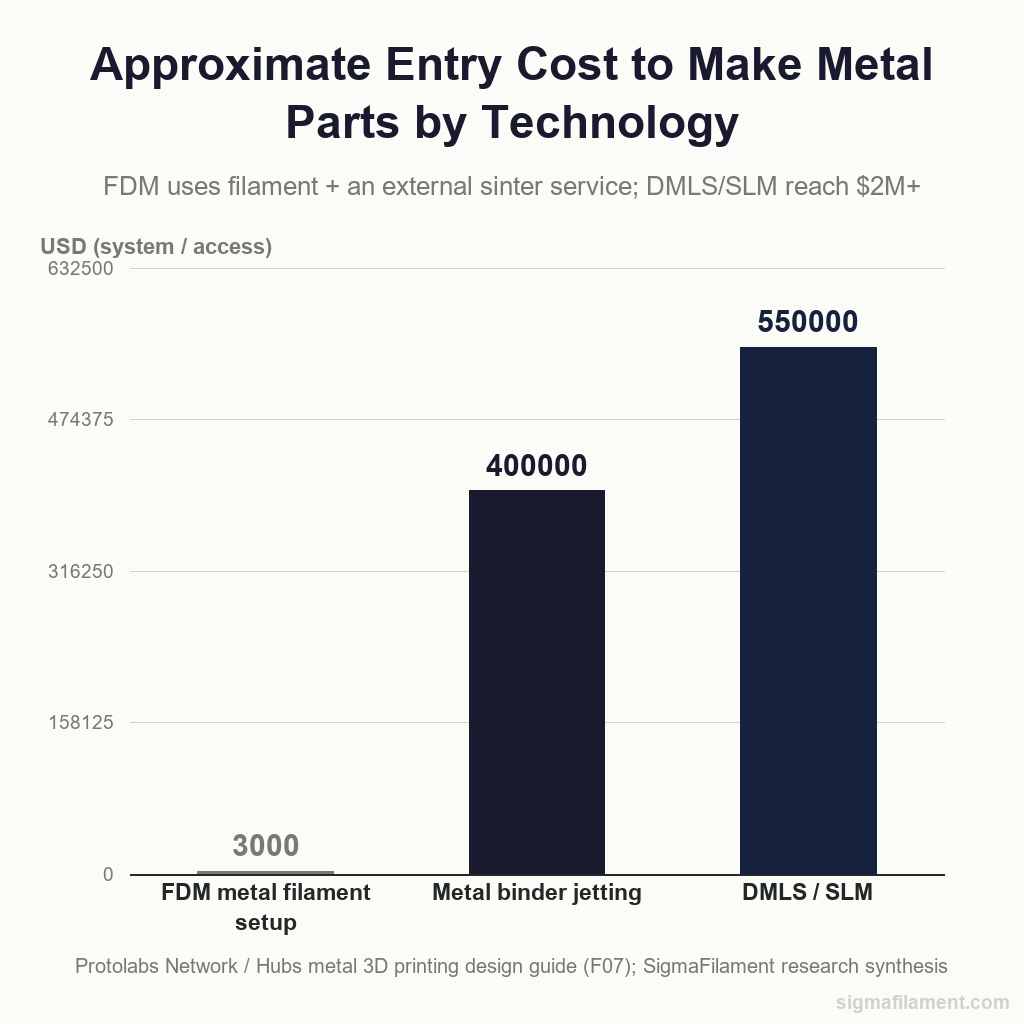
- FDM metal printing is cheap to enter, a few thousand dollars versus roughly $400,000 for binder jetting and $550,000 for DMLS.
- For B2B, specify metal loading, diameter tolerance, batch consistency, MOQ, and access to a debinding and sintering service.
Table of Contents
- TL;DR
- Abstract
- Key Takeaways
- Table of Contents
- Two Families of Metal 3D Printer Filament: Metal-Filled vs Sinterable
- Printer Requirements: Hardened Nozzles, All-Metal Hotends, and Chamber
- Slicer Settings That Actually Work (by Filament Family)
- Bed Adhesion, Layer Adhesion, and Common Print Failures
- Post-Processing: Two Completely Different Workflows
- Cost Economics: Metal Filament vs DMLS, SLM, and Binder Jetting
- Best Metal Filament by Use Case: A 2026 Buyer’s Matrix
- Sourcing Metal Filament at Scale: B2B Considerations
- Frequently Asked Questions
- Conclusion
- References
Two Families of Metal 3D Printer Filament: Metal-Filled vs Sinterable
Metal 3D printer filament is a composite FFF feedstock that combines a thermoplastic binder (typically PLA, PETG, or a MIM-grade polymer) with metal powder loaded between 5 and 90 percent by weight. It splits into two technically distinct families. Metal-filled PLA and PETG load roughly 40 to 80 percent metal powder into a polymer matrix and finish as a decorative or weighted composite. Sinterable filaments such as BASF Ultrafuse 316L exceed 80 percent metal by weight and, after debinding and furnace sintering, become true metal parts (Iyibilgin, 2025).
Treating the two families as interchangeable is the common buyer mistake here: printer choice, slicer profiles, and post-processing budgets that work for one collapse on the other. The decision is not "which brand" but "which family fits the use case." For composition chemistry, sintering metallurgy, and metal-powder grades, read the deep-dive material science breakdown. Buyers comparing this family to the broader catalog can cross-reference the full 2026 material overview of FDM filament types.
| Property | Metal-filled (PLA/PETG base) | Sinterable (BASF Ultrafuse / Filamet) |
|---|---|---|
| Metal content by weight | ~40-80% for high-load lines; entry SKUs 5-30% | >80% |
| Base behavior | Polymer composite with embedded metal powder | MIM-style feedstock; polymer binder vehicle for metal |
| Prints on a normal FDM printer | Yes, with a hardened-steel nozzle | Yes, plus a heated bed (100-120°C) and enclosed chamber |
| Becomes real metal | No, stays a plastic composite (Kedziora et al., 2022) | Yes, after solvent or thermal debind plus furnace sinter |
| Density | 2.3-4.5 g/cm³ depending on metal load | ~7.85 g/cm³ for sintered 316L (>95% theoretical) |
| Typical use | Decorative, weighted, or visually metallic parts | Functional metal parts: brackets, jigs, low-volume production |
| Example products | Copper, bronze, brass, steel-filled PLA (ProtoPasta, Gizmo Dorks, ColorFabb, Formfutura, Spectrum) | BASF Ultrafuse 316L and 17-4 PH, Virtual Foundry Filamet, Filabot Bronze (~88-90% bronze) |
Metal-filled PLA and PETG: decorative and weighted
Metal-filled PLA is, structurally, PLA. Embedded copper, bronze, brass, or steel powder gives the spool heft and the printed part a metallic sheen after polishing, but mechanical behavior tracks the host polymer: glass transition near 60°C, tensile strength in the 60 to 70 MPa range, creep under sustained load. Correct material for display models, props, weighted handles, jewelry blanks, and architectural visualization. Wrong material for a load-bearing bracket or any part seeing sustained heat.
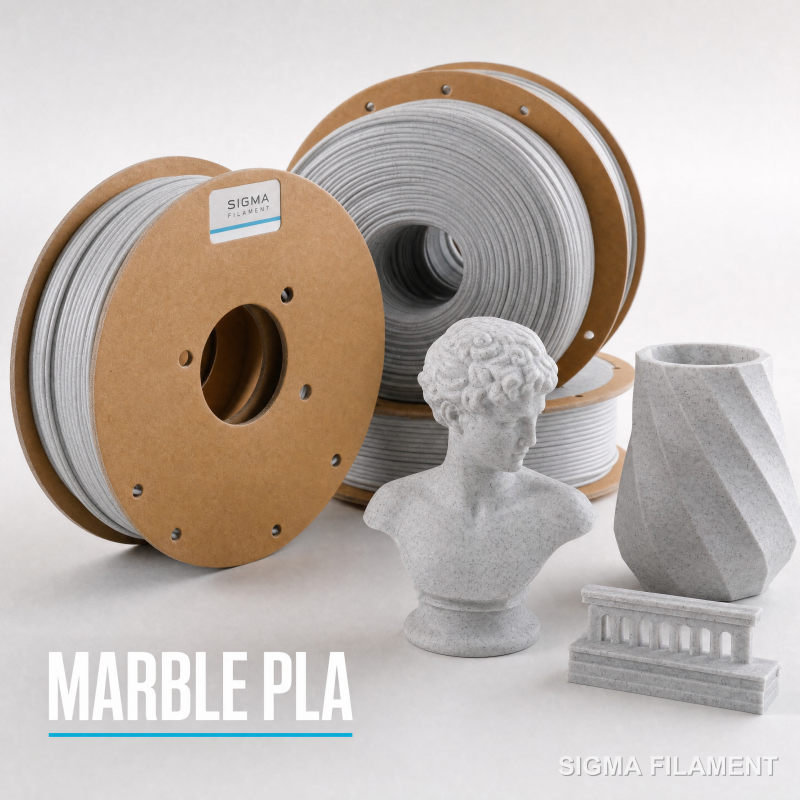
Loading varies widely. ProtoPasta and Gizmo Dorks decorative lines sit at 5 to 30 percent metal; Formfutura MetalFil Ancient Bronze runs around 60 percent at 3.5 g/cm³; Filabot Bronze pushes 88 to 90 percent for buyers seeking maximum density without a sinter step.
Sinterable filament: real metal after debind and sinter
Sinterable filament is metal injection moulding (MIM) feedstock reformatted for FFF: a thermoplastic and wax binder that carries fine metal powder above 80 percent by weight. Debinding removes most of the binder by a solvent, catalytic or low-temperature thermal step; a furnace sinter (about 1380°C for Ultrafuse 316LX in one study) then consolidates the residual metal powder into a dense metal part. BASF Ultrafuse 316L, Ultrafuse 17-4 PH, and Virtual Foundry Filamet are the established stock options, suitable for prototypes, jigs, fixtures, and near-net-shape production runs at a fraction of DMLS cost. Slicer compensation and debind-sinter logistics are covered in later sections.
Printer Requirements: Hardened Nozzles, All-Metal Hotends, and Chamber
No, a stock FDM machine cannot print metal 3D printer filament safely. The minimum upgrade is a wear-resistant nozzle plus an all-metal hotend; sinterable grades like BASF Ultrafuse 316L also need a heated bed and an enclosed chamber, and one published Ultrafuse 316L build ran a 100°C bed inside a 100°C chamber (Kedziora et al., 2022).
Why brass nozzles fail and what to use instead
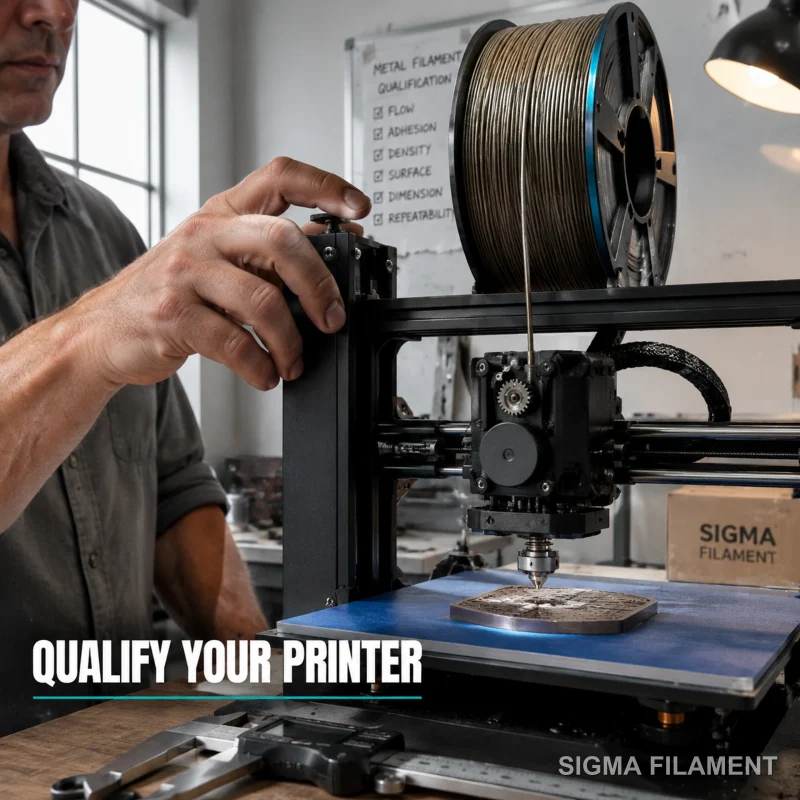
A hardened nozzle is any extrusion nozzle whose tip material exceeds the Mohs or Rockwell hardness of the embedded abrasive powder, so the orifice keeps its 0.4 mm geometry through long abrasive runs. Brass is the default nozzle material on nearly every consumer FDM printer because it conducts heat well and machines cheaply. It is also far softer than the iron, stainless, and copper or bronze powders embedded in metal filament. The same wear pattern hits any abrasive feedstock, including the carbon-fiber composites that change PLA, PETG, and nylon on the same hardware. On metal-filled filament a standard brass nozzle is too soft and wears down quickly, and a worn nozzle gives inconsistent extrusion and lower part quality before it fails outright (Simplify3D, 2024). For a B2B print farm, that wear shows up as parts drifting out of dimensional tolerance, so check the orifice on a schedule rather than waiting for a failed print.
Three replacement classes are used for metal 3D printer filament work, each with a different cost-per-print-hour profile. Hardened steel is the entry baseline and the wear-resistant nozzle a metal-filled filament calls for (Simplify3D, 2024). Tungsten carbide and ruby-tipped nozzles (a synthetic ruby insert at the orifice) are the harder, costlier step up. Prices and rated lifetimes vary by maker, so compare current listings and each maker’s wear rating for abrasive filament before you standardize a fleet on one.
For OEM and print-farm operators, hardened steel on a quarterly rotation is the standard cost-optimized choice. Ruby and tungsten carbide are appropriate when 24/7 abrasive throughput makes the swap labor itself the dominant expense.
Hotend, chamber, and feed-system requirements
The nozzle is one third of the upgrade. An all-metal hotend, with no PTFE liner reaching the melt zone, is required because Ultrafuse 316L runs at 230-250°C and PTFE degrades above 240°C. Sinterable grades also call for a heated bed and a dual-gear direct-drive extruder; Bowden setups push the abrasive feedstock through a long PTFE tube, which both wears faster and reduces extrusion control on the high-infill walls sintering demands.
Chamber temperature matters for sinterable grades because the green part must stay dimensionally stable through long, slow prints. Enclosed printers such as the Bambu Lab X1E, Ultimaker S5, Raise3D Pro3 HS, and Markforged Metal X are validated platforms.
One hardware note specific to Bambu Lab owners: metal-filled filament is abrasive and can cause partial clogs over time (Simplify3D, 2024), so feed it directly from a filament dryer rather than through the Automatic Material System (AMS), and check the printer maker’s compatibility list before routing an abrasive grade through any multi-material feeder. Bambu users running non-abrasive workloads through the AMS should consult our data-backed roundup of the best filaments for the Bambu P1S for AMS-friendly options.
Slicer Settings That Actually Work (by Filament Family)
Metal 3d printer filament splits into two slicer profiles that share almost no parameters. Metal-filled PLA and PETG print near standard PLA temperatures with mild speed reductions. Sinterable Ultrafuse 316L runs hotter and slower, in the 15 to 40 mm/s band that published 316L print parameters use (Jasik et al., 2025), and needs mandatory dimensional scaling (Rosnitschek et al., 2021).
| Setting | Metal-filled PLA / PETG | Sinterable 316L |
|---|---|---|
| Nozzle temperature | 190 to 220 C | 230 to 250 C |
| Bed temperature | 45 to 60 C (PEI or glass) | 100 to 120 C (glass + Dimafix) |
| Print speed | 40 to 60 mm/s (moderate) | 15 to 40 mm/s (slow) |
| Flow / extrusion multiplier | 100 to 105% (tune per spool) | 100% (vendor-specified) |
| Retraction | 1 to 2 mm direct drive; 4 to 6 mm bowden | 1 to 2 mm direct drive (bowden discouraged) |
| Cooling | Fan on after layer 2 to 3 | Minimal to zero part cooling |
| Nozzle | 0.4 mm hardened steel, tungsten carbide, or ruby | 0.4 mm hardened steel |
| Enclosure | Optional | Recommended (enclosed, heated chamber) |
Metal-filled PLA and PETG settings
Treat metal-filled PLA as standard PLA with three discipline adjustments. Hotend 190 to 220 C and bed 45 to 60 C (Simplify3D, 2024), and a print speed below your pure-PLA profile to keep extrusion consistent through the abrasive matrix. Shorten retraction to 1 to 2 mm on direct drive, 4 to 6 mm on bowden, to suppress stringing without grinding the filament against the drive gear. Turn off the layer fan for the first two layers, then enable cooling for overhangs.
Layer height 0.15 to 0.25 mm reads well on copper and bronze fills. Use a 0.4 mm or larger hardened-steel nozzle. Brass at 5 to 30% metal content erodes externally and loses tip geometry inside a few weeks of daily abrasive printing, so reserve brass nozzles for non-abrasive jobs.
Sinterable 316L settings and shrinkage scaling
Ultrafuse 316L requires the vendor-specified profile: 0.4 mm hardened steel, hotend 230 to 250 C, bed 100 to 120 C on glass with Dimafix, 15 to 40 mm/s, 100% infill in lines or concentric, and no part cooling. A dual-gear direct-drive extruder is preferred; bowden setups feed inconsistently on the dense binder.
Sintering shrinks the green part roughly 16 to 20% linearly. Compensate in the slicer before print: scale the green part to 120% on X and Y and 126% on Z, the factors the material data sheet advises (Rosnitschek et al., 2021), so the sintered output lands on nominal CAD dimensions at approximately 7.85 g per cubic centimeter, the sintered density listed for Ultrafuse 316L (Kedziora et al., 2022). Walls should stay below a 3 to 1 height-to-width ratio to avoid slumping during sinter, and supports above 45 degrees benefit from roughly 70% support infill.
Bed Adhesion, Layer Adhesion, and Common Print Failures
Metal filament fails in patterns its base polymer does not. The recurring issues with Ultrafuse 316L fall into four classes: warping on large sinterable footprints, green parts that fracture during removal from a flexible plate, clogs traced to abrasive wear or aged binder, and under-extrusion that surfaces as porous walls.
Bed and first-layer adhesion
Bed surface drives first-layer success more than any single slicer setting. For metal-filled PLA and PETG, smooth PEI or glass at 45 to 60 °C holds the part without scarring the underside. For sinterable Ultrafuse 316L and 17-4 PH, use a glass bed at 100 to 120 °C with a Dimafix or glue-stick layer, applied thin and renewed between prints; Jasik et al. (2025) report a 316L study in which beds at 100 and 120 °C made no significant difference to tensile strength or density. Run the first layer at 50 to 60 percent of cruise speed and increase initial layer height to 0.2 to 0.25 mm so the squish locks the part in place.
Two design rules cut warping on sinterable parts. Keep height-to-width ratio under 3:1 so the lower layers carry the heat-soak during furnace consolidation, and break large flat footprints into ribbed geometry to redistribute shrinkage stress. An enclosed chamber is mandatory for 316L and 17-4 PH because cooler ambient air drops the lower-layer temperature, hardens the binder unevenly, and detaches the corners before the print finishes.
Brittleness, clogs, and under-extrusion
Green parts (the as-printed sinterable shape, pre-debind) come off the plate heavy and should be handled as fragile. Ultrafuse 316L green stock carries more than 80 percent metal powder in a polymer binder (Iyibilgin, 2025), so do not pry the part off: lay a flexible PEI sheet flat on the bench and walk the part off with a thin spatula rather than flexing the plate vertically.
Clogs and under-extrusion track back to two sources. A brass nozzle wears down externally on abrasive metal powder and loses tip geometry well before the extruder shows skipped steps, and an undersized 0.4 mm orifice on heavily loaded filament throttles flow long before the printer reports an error. Fit a 0.4 to 0.6 mm hardened-steel or tungsten-carbide nozzle, keep sinterable feedstock in the 15 to 40 mm/s band that published 316L print parameters use (Jasik et al., 2025), and feed the spool directly from a dry box rather than through the Bambu AMS. Handle finished green parts gently, store them dry, and ship them flat for debinding.
Post-Processing: Two Completely Different Workflows
Post-processing for metal 3D printer filament splits cleanly along the family line. A green part is the as-printed shape from a sinterable filament, still bound by polymer at roughly half its volume; debinding is the chemical or thermal step that removes that binder; sintering then consolidates the remaining metal powder at high temperature into a near-solid metal part. Metal-filled prints, by contrast, are cosmetic objects finished by hand at a workbench. Costs differ sharply between the two paths, so price the furnace step before you choose one.
Metal-filled: sand, polish, and patina
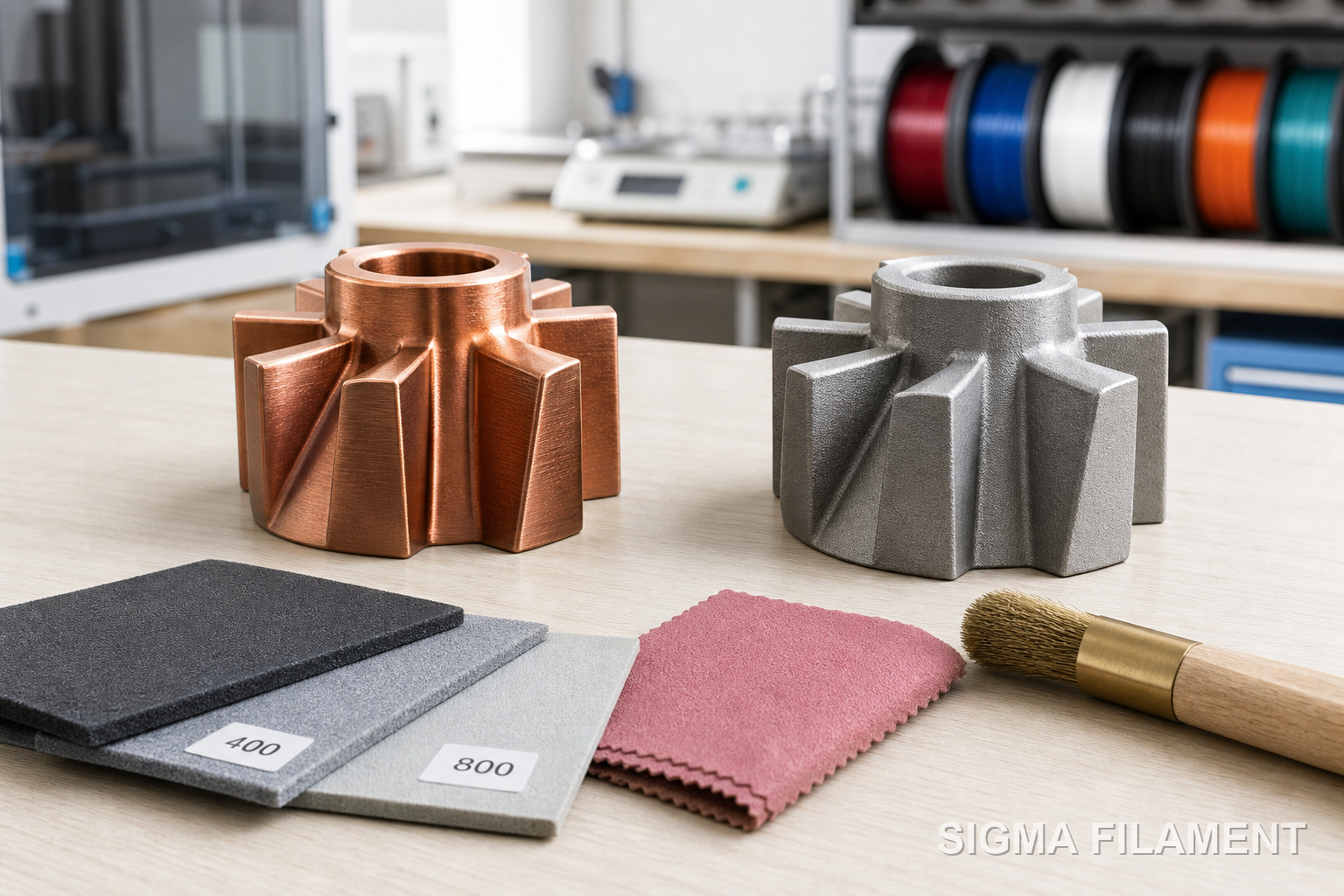
A copperfill, bronzefill, or steelfill print comes off the bed looking like a slightly heavier matte PLA part. The metal sheen hides under a thin polymer-rich skin that the printer deposits on every outer wall. Three steps remove that skin and expose the metal.
First, wet-sand progressively at 400, then 800, then 1500 grit. Work in one direction per stage. Rinse and dry before stepping up. The 400 grit cuts the plastic skin, the 800 levels the scratch pattern, and the 1500 brings the surface close to a polish-ready finish (Simplify3D, 2024). Second, brass-brush the part or apply a jeweler’s rouge with a soft buff wheel to develop the metallic luster. Third, if an aged look is wanted, apply a patina: liver of sulfur darkens copper to a near-black bronze tone in under a minute, and a salt-and-vinegar bath builds verdigris on copper or bronze over 12 to 24 hours. Supplies for the entire workflow run about ten dollars per part.
Sinterable: debind and sinter
A green Ultrafuse 316L or Filamet part is roughly half binder by volume. Two stages convert it to dense metal. Debinding removes the binder chemically (solvent bath) or thermally (low-temperature furnace ramp), leaving a fragile brown part held together by particle contact. Sintering then ramps the brown part to an alloy-specific temperature; in one study, Ultrafuse 316LX parts were heated to 1380 degrees Celsius and held there for 3 hours (Rosnitschek et al., 2021). Linear shrinkage runs 16 to 20 percent, so the slicer scales the green part 120 percent on X and Y and 126 percent on Z.
Few shops own the required equipment. The common path is a commercial debind-and-sinter service. Makers of sinterable filament route green parts to a debind-and-sinter service partner, so confirm in writing what a processing run covers and what it costs before you print.
Cost Economics: Metal Filament vs DMLS, SLM, and Binder Jetting
The buy-vs-route decision usually comes down to one number. Protolabs Network puts DMLS and SLM systems at an average selling price of about $550,000, with high-end machines reaching $2 million, while metal binder-jetting platforms list near $400,000 and metal-extrusion (FDM-sinter) setups land around $140,000 including post-processing units (Protolabs Network, 2024). That gap shapes every downstream quote.
What the filament and the equipment cost
Consumables are a separate, much smaller line item. Spool prices for BASF Ultrafuse 316L, Ultrafuse 17-4 PH, and The Virtual Foundry 316L Filamet change with the reseller, so compare current listings or request a written quote, and ask whether a debind-and-sinter processing run is included. An FDM-sinter shop can stand up a capable workflow for a few thousand dollars in hardened-nozzle printers plus an external sinter service contract, which is why the metal 3d printer filament route now competes for jobs that used to default to powder-bed fusion.
The equipment math runs in the opposite direction. A DMLS or SLM cell at $550,000 to $2 million carries amortization, inert-gas handling, powder-management overhead, and a trained operator that a metal binder-jetting line near $400,000 only partly reduces. Per Protolabs Network, a typical DMLS or SLM finished part runs $5,000 to $10,000, while binder-jetting and metal-extrusion routes come in five to ten times lower per part for comparable geometry (Protolabs Network, 2024). For a procurement team running 5 to 50 units a month, the filament path often clears the budget gate that powder bed cannot.
When FDM-sinter makes sense, and when it does not
Density is where the tradeoff bites. DMLS and SLM parts typically register under 0.2 to 0.5% porosity and reach near-full theoretical density, binder-jetting parts come in between 0.2 and 2% porosity, and FDM-sintered Ultrafuse 316L finishes at 95 to 98% density (2 to 5% porosity) depending on shrinkage compensation strategy (Protolabs Network, 2024). That spread is why FDM-sinter is described as a near-net-shape process rather than a one-to-one DMLS substitute. For prototype iteration, jewelry and decor, low-volume tooling, and metal parts where fatigue loading is moderate, the cost savings are easy to defend; teams weighing the same tradeoff in polymer should also see our ranked materials for end-use production parts. For aerospace brackets, medical implants, and high-cycle structural components, the density delta still favors DMLS or SLM at the higher quote.
| Technology | Approx system / access cost | Per-part economics | Density / porosity | Best for |
|---|---|---|---|---|
| FDM metal filament (sinterable) | A few thousand dollars + spools + external sinter service | Low setup, higher per-part labor | Higher porosity than DMLS | Prototypes, low volume, jewelry/decor |
| Metal binder jetting | ~$400,000 | Moderate | ~2% porosity | Mid-to-high volume |
| DMLS / SLM | ~$550,000 (up to $2M) | High | 0.2 to 0.5% porosity, near-full density | Aerospace, medical, functional metal |
Best Metal Filament by Use Case: A 2026 Buyer’s Matrix
Choosing a metal 3d printer filament starts with a single question: does the finished part need to look like metal, weigh like metal, or be metal? The 2026 catalog splits cleanly along that line. Sinterable options include BASF Forward AM’s Ultrafuse 316L and Ultrafuse 17-4 PH and The Virtual Foundry’s 316L Filamet; compare current listings for spool prices and confirm in writing whether a debind-and-sinter processing ticket is included.
Appearance, weight, and functional-metal use cases
The matrix below sorts every reputable 2026 product by the job it actually does on the print bed and after post-processing. Decorative metal-filled PLA finishes as a plastic part with a metal skin, so it polishes and patinas but carries no structural load. Sinterable filament becomes a real metal part after furnace processing, with the corresponding cost, hardware, and shrinkage compensation that real metal demands. Teams whose application list is heavy on production tooling can also consult our comparison of materials for jigs and fixtures before deciding whether sintered 316L is the right answer. Match the row, then size the printer and nozzle to suit.
| Use case | Recommended filament | Base / process | Printer + nozzle | Why |
|---|---|---|---|---|
| Decorative or jewelry look | ProtoPasta or Gizmo Dorks Copperfill / Bronzefill PLA | Metal-filled PLA, finished as printed | Any FDM with a hardened-steel 0.4 mm nozzle, 190 to 220 C hotend, 45 to 60 C bed | Low spool cost, sands and polishes to a metal sheen, no furnace required |
| Weighted or balanced parts | ProtoPasta Stainless Steel PLA (Steelfill class) | Metal-filled PLA, ~30 percent steel loading | FDM with hardened-steel 0.4 mm nozzle, direct drive preferred | Adds 1.5 to 3x standard PLA mass for counterweights, props, and tactile heft |
| Museum or aged-patina finish | Formfutura MetalFil Ancient Bronze (~60 percent bronze) | Metal-filled PLA, polished then chemically patinated | FDM with hardened-steel 0.4 mm nozzle, 195 to 215 C hotend | Density 3.5 g/cm3 takes liver-of-sulfur darkening and salt-vinegar verdigris cleanly |
| Functional stainless parts | BASF Ultrafuse 316L | Sinterable, requires debinding and a furnace sinter (about 1380 C in one study) | Enclosed-chamber FDM (Bambu X1E, Ultimaker S5, Raise3D Pro3 HS, Markforged Metal X), hardened-steel 0.4 mm nozzle, 230 to 250 C hotend, 100 to 120 C bed | Corrosion-resistant real 316L stainless at 95 to 98 percent density for prototype and low-volume production |
| Hard or strong functional parts | BASF Ultrafuse 17-4 PH | Sinterable, same furnace path as 316L | Same enclosed-chamber FDM platform and hardened nozzle as 316L | Precipitation-hardening grade reaches higher tensile and hardness than 316L for brackets, jigs, and tooling |
| Bronze or copper sinter | The Virtual Foundry Filamet (Bronze, Copper, or 316L) | Sinterable, high metal loading, furnace sinter required | Any third-party FFF machine with a hardened-steel nozzle; take settings from the maker’s datasheet | Yields a solid bronze or copper part once a debind-and-sinter service has processed it |
Two guardrails apply across the table. Every row assumes a hardened-steel nozzle at minimum; under abrasive feedstock a brass nozzle wears down quickly (Simplify3D, 2024). The sinterable rows are also only honest if a debinding-and-sintering path is committed to before printing begins. Skipping that step turns Ultrafuse 316L or Filamet into an expensive brown part with no mechanical value. Decorative PLA, by contrast, is finished the moment the print head parks.
Sourcing Metal Filament at Scale: B2B Considerations
B2B sourcing of metal 3D printer filament is the procurement discipline of locking metal loading, diameter tolerance, packaging integrity, and batch traceability into every purchase order so a print farm or reseller can rerun the same slicer profile across batches. Specifically, lock four variables on every PO: metal loading by weight, diameter tolerance class (stated as a ± value in millimeters), sealed moisture-controlled spool packaging, and batch-level QC traceability. Generic "metal-filled" SKUs vary 4 to 12 times in abrasive content across nominally identical batches. The four-variable discipline mirrors the broader bulk filament procurement playbook we publish for B2B buyers.
What to specify: loading, tolerance, batch consistency
Resellers and print-farm operators should write the technical sheet before negotiating the unit price. Four specifications carry most of the downstream risk. Operators stocking standard polymers alongside the metal SKUs can reuse the 9-point checklist for buying filament in bulk for print farms as the procurement spine, then bolt the metal-specific clauses below onto it. First, metal loading by weight: 5 to 30% for decorative PLA, 60% range for products like Formfutura MetalFil Ancient Bronze, 80 to 90% for sinterable lines such as BASF Ultrafuse 316L and Filabot Bronze. Loading drives density and abrasion, plus whether a furnace step is even on the table. Second, diameter tolerance and roundness across the spool and across batches. A ±0.02 to ±0.03 mm tolerance class lets the same slicer profile move from one machine to the next without re-tuning flow rate or pressure advance. Third, spool packaging: vacuum-sealed bag with silica desiccant, opaque PET or cardboard core with the moisture content stated on the QC tag. Metal-filled PLA absorbs water in days, and a wet spool hisses through the hotend and prints brittle layers. Fourth, batch traceability: each spool tagged with extrusion-line ID, lot number, and a retained QC sample, so a print-farm can correlate any failure back to a specific run rather than a vague brand.
MOQ, QC, and OEM private label
MOQ tiers from source manufacturers typically begin around 100 spools per SKU for stock formulations and step up to 500 spools for OEM private-label runs with custom packaging or branded color. Buyers who want benchmark MOQ and pricing on the standard polymer that often anchors the rest of the order can cross-reference our B2B sourcing guide for bulk PLA and the seven-factor framework for vetting a wholesale filament maker before negotiating the metal SKU lines. ODM custom-formula development, where the metal powder, binder system, or loading percentage is tuned to the buyer’s application, sits behind an NDA and usually carries a higher minimum plus a sampling round (Kokai & Simon, 2025). For sinterable lines, confirm that the supplier either operates an in-house debind-sinter service or has a documented partnership with one, because a green part without a furnace path is not a finished product. SigmaFilament operates as a source manufacturer on this model, offering OEM private label and ODM custom formulas alongside stock bulk supply, and is one of several factories that can quote against these tiers. The selection criterion that matters most for B2B buyers is not price per kilogram in isolation but the combination of declared loading, tolerance class, packaging integrity, and traceability, because those four are what keep a print farm’s slicer profiles stable and a reseller’s return rate low.
Frequently Asked Questions
What is metal 3D printer filament?
Metal 3D printer filament is a composite FDM/FFF feedstock that combines a thermoplastic binder (typically PLA, PETG, or a specialized polymer matrix) with metal powder. Two families exist: metal-filled filaments (roughly 40 to 80% metal by weight in typical grades, lower in entry decorative SKUs, finished as printed for a metallic look) and sinterable filaments (above 80% metal, requiring furnace post-processing to yield a true metal part) (Kokai & Simon, 2025).
Can any FDM 3D printer print metal filament?
No. Metal filament is abrasive and wears a standard brass nozzle down quickly (Simplify3D, 2024). Three hardware upgrades are required: a hardened steel, tungsten-carbide, or ruby-tipped nozzle; an all-metal hotend rated above the filament’s print temperature; and for sinterable grades, an enclosed chamber with a heated bed. Direct-drive extrusion is strongly preferred over Bowden.
What is the best nozzle for metal filament?
Hardened steel is the baseline for OEM and print-farm use: metal-filled filament wears a brass nozzle down quickly (Simplify3D, 2024). Tungsten-carbide and ruby-tipped nozzles are harder, costlier upgrades; compare current listings and each maker’s wear rating. Published Ultrafuse 316L print settings use a 0.4 mm nozzle (Kedziora et al., 2022).
Can you print real metal with a regular 3D printer?
Yes. Using a sinterable filament such as BASF Ultrafuse 316L, 17-4 PH, or Virtual Foundry Filamet, you print a green part on a hardened-steel-equipped FDM machine, then debind and sinter it in an industrial furnace; Ultrafuse 316L carries approximately 88% metal powder (Iyibilgin, 2025). The result is a metal part, with about 16% linear shrinkage in the printing plane and 20% in the stacking direction that slicer scaling must compensate (1.2 on X/Y, 1.26 on Z) (Rosnitschek et al., 2021).
How much does metal 3D printer filament cost?
Metal-filled PLA and PETG run $35 to $90 per kg, roughly 4 to 10 times standard PLA. For sinterable grades such as BASF Ultrafuse 316L, Ultrafuse 17-4 PH, and Virtual Foundry Filamet 316L, compare current listings or request a written quote, since reseller prices change often. Add the debinding and sintering service fee, which varies by provider.
What slicer settings should I use for metal filament?
For metal-filled PLA and PETG: hotend 190 to 220°C, bed 45 to 60°C, print speed 40 to 60 mm/s, layer height 0.15 to 0.25 mm, retraction 1 to 2 mm at 25 to 35 mm/s for direct drive, and minimal part cooling on the first two layers. For Ultrafuse 316L: hotend 230 to 250°C, bed 100 to 120°C, 0.4 mm hardened nozzle, 15 to 40 mm/s, 100% infill (lines or concentric), and +120% X/Y plus +126% Z compensation.
What is the difference between metal-filled and sinterable metal filament?
Metal-filled filaments carry 5 to 80% metal in a PLA or PETG matrix and ship as printed for decorative or weighted parts. The final piece is mostly plastic. Sinterable filaments carry above 80% metal in a MIM-style binder; after printing, solvent or thermal debinding removes the binder, then a high-temperature furnace cycle (about 1380°C for Ultrafuse 316LX in one study) consolidates the part into dense metal.
Is metal-filled PLA actually metal?
No. Metal-filled PLA at 5 to 30% loading produces a PLA part with embedded metal particles. It looks and feels metallic, weighs 1.5 to 3 times standard PLA, and polishes to a shine, but it behaves mechanically like PLA (60 to 70 MPa tensile, glass transition around 60°C). Only sinterable grades above 80% metal content yield a true metal part after furnace processing.
How do you sinter 3D printed metal filament parts?
Send the green part to a debinding and sintering service such as BASF Forward AM, The Virtual Foundry, or Elnik MIM Solutions. The service removes the binder, then sinters the part in a furnace under a controlled atmosphere; in one study, Ultrafuse 316LX parts were sintered at 1380°C with a 3-hour hold (Rosnitschek et al., 2021). Plan for 16 to 20% linear shrinkage. In-house sintering requires a vacuum or atmosphere-controlled furnace.
Conclusion
Pick the family before anything else. Metal-filled PLA or PETG is the right call when the goal is the look, the weight, and the cold-cast feel of bronze, copper, or steel on parts that stay polymer at the core. Sinterable filaments (BASF Ultrafuse 316L, 17-4 PH, and the H13 grades) are the right call when the part has to end up as real metal after debinding and sintering, with roughly 16 to 20 percent shrinkage planned into the CAD.
Fit the printer to the choice. Hardened steel or ruby nozzles, an all-metal hotend, a heated bed, and an enclosure are the baseline for sinterable work; metal-filled prints tolerate lighter hardware but still chew brass nozzles fast. Slow the flow, lower the layer, and accept longer print times.
Post-processing decides the finish: tumbling and patina for decorative metal-filled; debind and sinter for structural 316L. Against DMLS and binder jetting, FDM-sinter wins on capex and on small-batch flexibility, and concedes density and tolerance.
Buyers sourcing metal-filled or composite filament at scale can review the SigmaFilament OEM and ODM program or reach the team for wholesale quotes.
References
- Rosnitschek, T., Seefeldt, A., Alber-Laukant, B., Neumeyer, T., Altstädt, V., & Tremmel, S. (2021). Correlations of geometry and infill degree of extrusion additively manufactured 316L stainless steel components. Materials, 14(18), 5173. https://doi.org/10.3390/ma14185173
- Vakharia, V. S., Kuentz, L., Salem, A., Halbig, M. C., Salem, J. A., & Singh, M. (2021). Additive manufacturing and characterization of metal particulate reinforced polylactic acid (PLA) polymer composites. Polymers, 13(20), 3545. https://doi.org/10.3390/polym13203545
- Protolabs Network. (2024). Metal 3D printing: An overview of the most common technologies. Protolabs. https://www.hubs.com/guides/metal-3d-printing
- Iyibilgin, O. (2025). Investigation of the effect of layer thickness on the mechanical properties of 316L austenitic stainless steel in additive manufacturing with metal filament. Applied Sciences, 15(5), 2584. https://doi.org/10.3390/app15052584
- Kókai, E., & Simon, N. (2025). Comparative study of BASF Ultrafuse 316L and Markforged 17-4 PH stainless steel filaments processed by fused filament fabrication. International Journal of Automotive Science and Technology, 9(1st Future of Vehicles Conf.), 77-81. https://doi.org/10.30939/ijastech..1767208
- Kedziora, S., Decker, T., Museyibov, E., Morbach, J., Hohmann, S., Huwer, A., & Wahl, M. (2022). Strength properties of 316L and 17-4 PH stainless steel produced with additive manufacturing. Materials, 15(18), 6278. https://doi.org/10.3390/ma15186278
- Simplify3D. (2024). Ultimate materials guide: 3D printing with metal filled filament. Simplify3D Resources. https://www.simplify3d.com/resources/materials-guide/metal-filled/
- Jasik, K., Śnieżek, L., & Kluczyński, J. (2025). Additive manufacturing of metals using the MEX method: Process characteristics and performance properties–A review. Materials, 18(12), 2744. https://doi.org/10.3390/ma18122744
- Ruiz, P., & Ruiz, R. (2015). How to polish copperFill & bronzeFill filament. Adafruit Learning System. https://learn.adafruit.com/copperfill-filament/overview
Last reviewed and updated: June 2026. Author: SigmaFilament team. For tailored guidance, contact our team.