PLA Plastic Filament: What It Actually Is, the Grades That Matter, and How to Buy It in 2026

TL;DR
PLA plastic filament is fermented plant sugar turned into polylactic acid, and it owns FDM printing for a reason: tensile 55-65 MPa, easy printing at 190-220C, and the lowest defect rate of any material. Its limits are equally hard: Tg 55-60C, brittle 2-4 kJ/m2 impact, and a biodegradability claim that only holds at 58C in an industrial composter.
Abstract
Most page-1 results for pla plastic filament split into two useless camps for anyone buying it by the pallet: hobbyist pros-and-cons posts that stop at "easy to print, warps in a hot car," and ISO-cited polymer papers nobody on a procurement team has time to parse (Sin et al., 2013). Production buyers need the bridge between those two: what PLA actually is at the polymer level, the six commercial grades that show up on real datasheets, where its mechanical and thermal limits disqualify it from a job, what "biodegradable" legally permits a supplier to claim, and how to qualify a factory before the first container ships.
This guide is written for the people who carry that risk: print-farm operators running 40 to 400 machines, OEM procurement teams sourcing pla plastic filament for end-use parts, and resellers building private-label SKUs (Castro-Aguirre et al., 2016). The structure follows the buying decision in order. Sections 3 and 4 cover chemistry and measured properties. Section 5 names the six grades by Tg, impact, and use case. Sections 6 through 8 mark the failure modes, including what biodegradable legally permits on a pla plastic filament label. Sections 9 through 11 cover print tuning, supplier qualification, and 2026 pricing.
Key Takeaways
- Plant-sugar chemistry: PLA is polymerized lactic acid from fermented sugars; the L/D isomer ratio sets crystallinity and heat behavior.
- Standard numbers: Tensile 55-65 MPa, Tg 55-60C, density 1.24 g/cm3, notched impact only 2-4 kJ/m2 (brittle).
- Grades diverge hard: PLA+ trades 48 MPa for 2-3x toughness; HS-PLA prints >300 mm/s; PLA-CF doubles stiffness to 6.5 GPa.
- Compostable has a definition: ASTM D6400 requires 58C industrial composting; ambient soil shows about 0.29% mass loss in 120 days.
- Hard 55C service ceiling: PLA creeps and sags above 55C; a parked car dashboard in summer reliably exceeds it.
- Production-grade sourcing: Demand 1.75 +/-0.02 mm diameter, per-batch CoA, and resin-grade traceability; tolerance drift costs more than the spool.
Table of Contents
- TL;DR
- Abstract
- Key Takeaways
- Table of Contents
- What Is PLA Plastic Filament? From Plant Sugar to Spool
- PLA Properties in Numbers
- The Six PLA Grades: PLA, PLA+, High-Speed, Tough, PLA-CF, Matte
- PLA vs PETG vs ABS: Honest Material Calls
- What PLA Is Used For (and Where It Fails)
- The Biodegradability Truth: Compostable Is Not Backyard-Degradable
- Printing PLA: The Production Essentials
- Sourcing PLA at Scale: Quality Benchmarks and Supplier Qualification
- PLA Market 2026: Capacity, Pricing, and What Buyers Should Watch
- Frequently Asked Questions
- Conclusion
- References
What Is PLA Plastic Filament? From Plant Sugar to Spool
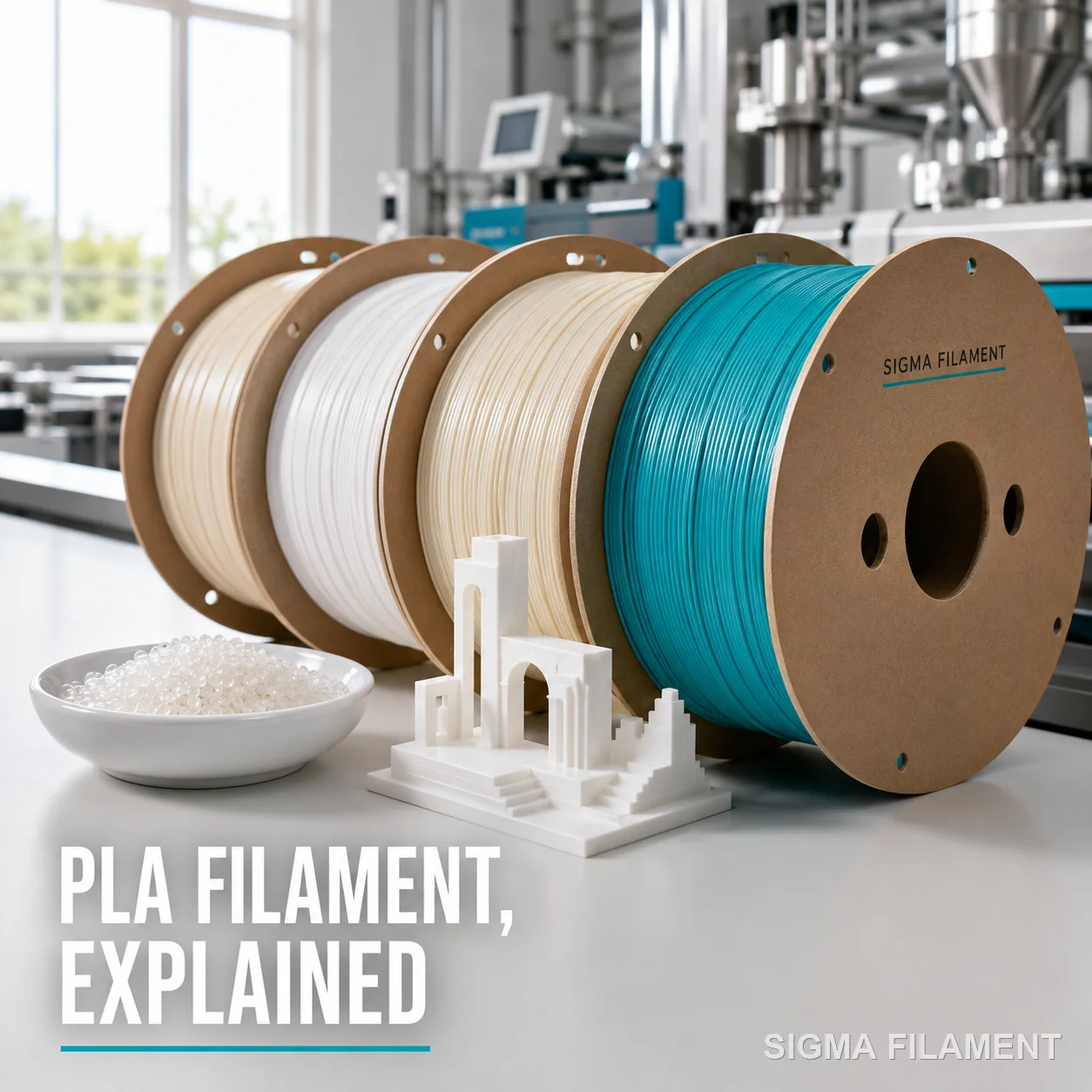
PLA plastic filament is a bioplastic thread of polylactic acid, made by polymerizing lactic acid that comes from fermented plant sugars (typically corn dextrose or sugarcane sucrose). Wound onto 1 kg spools at 1.75 mm or 2.85 mm diameter, it is the most-printed FDM material on the planet, used for prototyping, fixtures, and short-run end-use parts.
The reason it matters for production buyers: the chemistry is more controllable than most thermoplastics, and the spec that decides whether a spool prints clean or warps is set hundreds of steps upstream, at the resin reactor.
Fermentation, lactide, and ring-opening polymerization
The supply chain starts on a farm. Corn starch or sugarcane juice is enzymatically broken down into dextrose, which microbes (usually Lactobacillus bacteria) ferment into lactic acid. Lactic acid on its own makes only low-molecular-weight chains too weak to print. So producers dehydrate two lactic acid molecules into a cyclic dimer called lactide, distill it to monomer-grade purity, then run a tin-catalyzed ring-opening polymerization (ROP) that pops the ring and links thousands of units into high-molecular-weight PLA (Sin et al., 2013). The reactor output is solid resin, which is pelletized for shipping to filament extruders.
The L/D isomer ratio: the spec nobody reads
Lactic acid has a chiral center, so every monomer is either L (left-handed) or D (right-handed). Pure L-PLA (PLLA) is semi-crystalline, with a melt temperature around 175 to 180 C and useful heat resistance after annealing. Add a few percent D-isomer and crystallinity drops sharply; at roughly 12 to 15 percent D, the polymer becomes fully amorphous and prints glassy and bright but softens above 55 C (Sin et al., 2013). Most general-purpose PLA filament uses resin around 96 to 98 percent L for a balance of clarity, print stability, and modest heat tolerance. Ask suppliers for the L/D ratio of your specific lot. Most will not have it printed on the data sheet, and that gap is precisely where lot-to-lot warping comes from.
From resin pellets to 1.75 mm filament
NatureWorks Ingeo, produced at the Blair, Nebraska plant from US-grown field corn, supplies most of the world’s commodity PLA resin, with TotalEnergies Corbion and a handful of Chinese producers covering the rest (Castro-Aguirre et al., 2016). Filament makers receive resin pellets, dry them down to roughly 250 ppm moisture, then push them through a twin-screw extruder. The molten polymer exits a die, passes through a water bath, and runs under inline laser diameter gauges that hold tolerance to plus or minus 0.02 to 0.03 mm with ovality at or below 0.05 mm. The strand is then wound onto a spool, vacuum-bagged with desiccant, and boxed. Total elapsed time from kernel to spool is around 12 to 14 weeks.
Spec sheet to spec sheet, that pellet origin and that L/D ratio are what separate a 9 dollar reel from a 28 dollar one.
PLA Properties in Numbers
Specs decide whether a PLA plastic filament part survives its first summer or fails the day it ships. The numbers below describe standard, unfilled, untoughened PLA at 1.75 mm diameter, the baseline most converters quote on a datasheet before any nucleator, impact modifier, or annealing step alters the picture.
Mechanical and thermal spec table
| Property | Typical value | Test basis | Why it matters in production |
|---|---|---|---|
| Tensile strength | 55-65 MPa | ISO 527-2, injection-molded coupon | Strong enough for jigs, brackets, prototypes; weaker than ABS only at the weld line |
| Young’s modulus | ~3.5 GPa | ISO 527-2 | Stiff feel under load; parts deflect less than PETG at the same wall thickness |
| Glass transition (Tg) | 55-60 C | DSC, ISO 11357 | The softening threshold. Above Tg the part creeps under its own weight |
| HDT @ 0.45 MPa | ~55 C | ISO 75 | Standard PLA collapses in a hot car or near a south-facing window |
| Density | 1.24 g/cm3 | ISO 1183 | About 17% denser than ABS; affects spool weight and per-part material cost |
| Notched Charpy impact | 2-4 kJ/m2 | ISO 179-1 | Low. Brittle fracture under sudden load; the headline weakness |
| Elongation at break | 4-7% | ISO 527-2 | Snaps rather than yields; thin features fail without warning |
| Print temperature | 190-220 C nozzle / 50-60 C bed | Vendor spec sheets, 2026 | Lowest extrusion window of any commodity filament; light energy bill, easy on hotends |
(Anderson, 2017)
What the numbers mean in production
The spec sheet tells a consistent story. PLA is stiff and strong on paper but absorbs almost no impact energy. A 2-4 kJ/m2 notched Charpy result is roughly an eighth of ABS in the same test, which is why a dropped PLA bracket shatters where ABS only scuffs (Anderson, 2017). The flip side is the lowest shrinkage and best dimensional accuracy in the commodity range, so first-article tolerances of plus or minus 0.15 mm on a 100 mm part are routine on a well-tuned printer.
The hard ceiling is thermal. With HDT near 55 C, a black PLA part on a dashboard in summer sun reaches 70-80 C of cabin air plus radiative gain and starts to sag within hours. Any application where the part sees direct sun, an enclosed vehicle, a dishwasher cycle, or a heated enclosure should move to PLA+, annealed PLA, or PETG. For indoor jigs, display models, packaging prototypes, and short-life consumer goods, the numbers are fine.
Moisture and shelf life
PLA is hygroscopic. Wet filament hydrolyzes in the melt zone, cleaving the polymer chain and dropping tensile strength by 15-25% within a few print hours of exposure. The visible symptoms are surface popping, fuzz on overhangs, and weak layer bonding. Drying at 45-50 C for 6 hours in a desiccating dryer restores most of the loss; running hotter risks crystallizing the spool (Lopez Camacho et al., 2024). Store sealed bags with fresh silica below 15% RH, and a vacuum-sealed pla plastic filament spool holds its as-shipped properties for 12-18 months. Once opened, treat anything past 30 days of bench exposure as wet until proven otherwise.
The Six PLA Grades: PLA, PLA+, High-Speed, Tough, PLA-CF, Matte
"PLA plastic filament" is not one material. It is a family of related FDM polymers. Six grades dominate the commercial market, and each one trades a different mechanical property to win a different print job. Picking the wrong grade is the most common reason a part fails on the bench after printing cleanly.
The pattern below repeats across the family: any additive that raises impact resistance softens the polymer matrix and pulls tensile strength and stiffness down. Any additive that raises stiffness (carbon fiber, high crystallinity) makes the part more brittle. Standard PLA sits in the middle as the reference point.
Standard PLA
The baseline. Roughly 60 MPa tensile strength and 3.5 GPa flexural modulus, prints at 190 to 220 C on any unmodified hotend. Best for visual prototypes, display models, low-stress fixtures, and anything that lives indoors below 50 C. Brittle under impact, which is its main limitation.
PLA+ (impact-modified)
PLA+ blends a rubbery toughening agent (often a thermoplastic polyurethane or polyester elastomer) into the matrix. Notched Izod impact roughly doubles to triples versus standard PLA, but tensile drops to around 48 MPa and modulus to 2.9 GPa (Anderson, 2017). Specify PLA+ for parts that take drops, snap fits, and threaded inserts.
High-speed PLA
A rheology-tuned formulation with lower melt viscosity, designed for print speeds above 300 mm/s on machines like the Bambu X1 and Prusa XL (Lopez Camacho et al., 2024). Tensile lands near 55 MPa and modulus near 3.2 GPa, close to standard PLA but with a wider thermal processing window. Use it when throughput matters more than absolute strength.
Tough PLA
A heavier impact modification than PLA+, engineered to reach PETG-band toughness while keeping PLA’s low warp behavior (Lopez Camacho et al., 2024). Tensile drops to roughly 40 MPa and modulus to 2.5 GPa, so it is the softest of the six. Reach for it on functional end-use parts that need to flex without cracking, such as enclosures, brackets, and tool handles.
PLA-CF (carbon fiber)
Short-fiber reinforced. Chopped carbon fiber raises tensile to about 70 MPa and modulus to 6.5 GPa, nearly doubling stiffness (Lopez Camacho et al., 2024). The trade is abrasion: a hardened steel nozzle is mandatory, since brass wears out in a single spool. Use PLA-CF for jigs, drone frames, and rigid fixtures where deflection under load is the failure mode.
Matte and specialty finishes
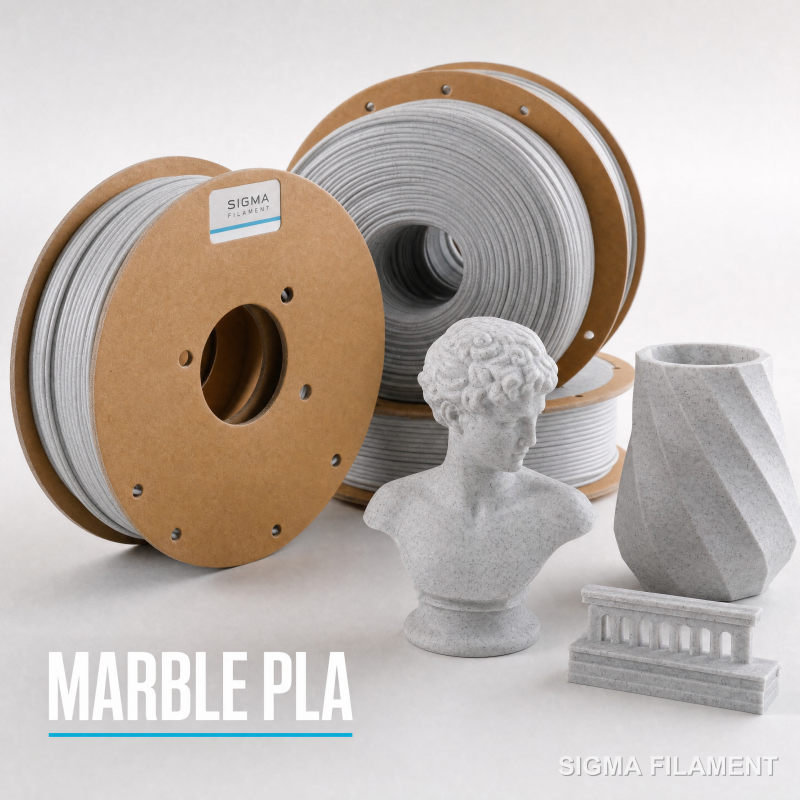
Matte PLA loads a mineral filler (calcium carbonate or similar) to scatter surface light and hide layer lines, landing near 50 MPa tensile and 3.0 GPa modulus. Silk, clear, dual-color, and glow finishes sit in the same general band. Choose by appearance first; mechanical performance is mid-pack.
The six PLA grades: numeric comparison
| Grade | Tensile (MPa) | Modulus (GPa) | Impact vs standard | Hardware requirement | Best for |
|---|---|---|---|---|---|
| Standard PLA | 60 | 3.5 | 1x (baseline) | Any FDM hotend | Visual prototypes, indoor models |
| PLA+ | 48 | 2.9 | 2-3x | Any FDM hotend | Snap fits, threaded inserts, drop-prone parts |
| High-speed PLA | 55 | 3.2 | ~1x | High-flow hotend, >300 mm/s capable | Throughput production |
| Tough PLA | 40 | 2.5 | 3-4x | Any FDM hotend | Functional brackets, flexible enclosures |
| PLA-CF | 70 | 6.5 | Lower than standard (brittle) | Hardened steel nozzle, dry box | Jigs, drone frames, rigid fixtures |
| Matte / specialty | 50 | 3.0 | ~1x | Any FDM hotend | Display models, finished aesthetics |
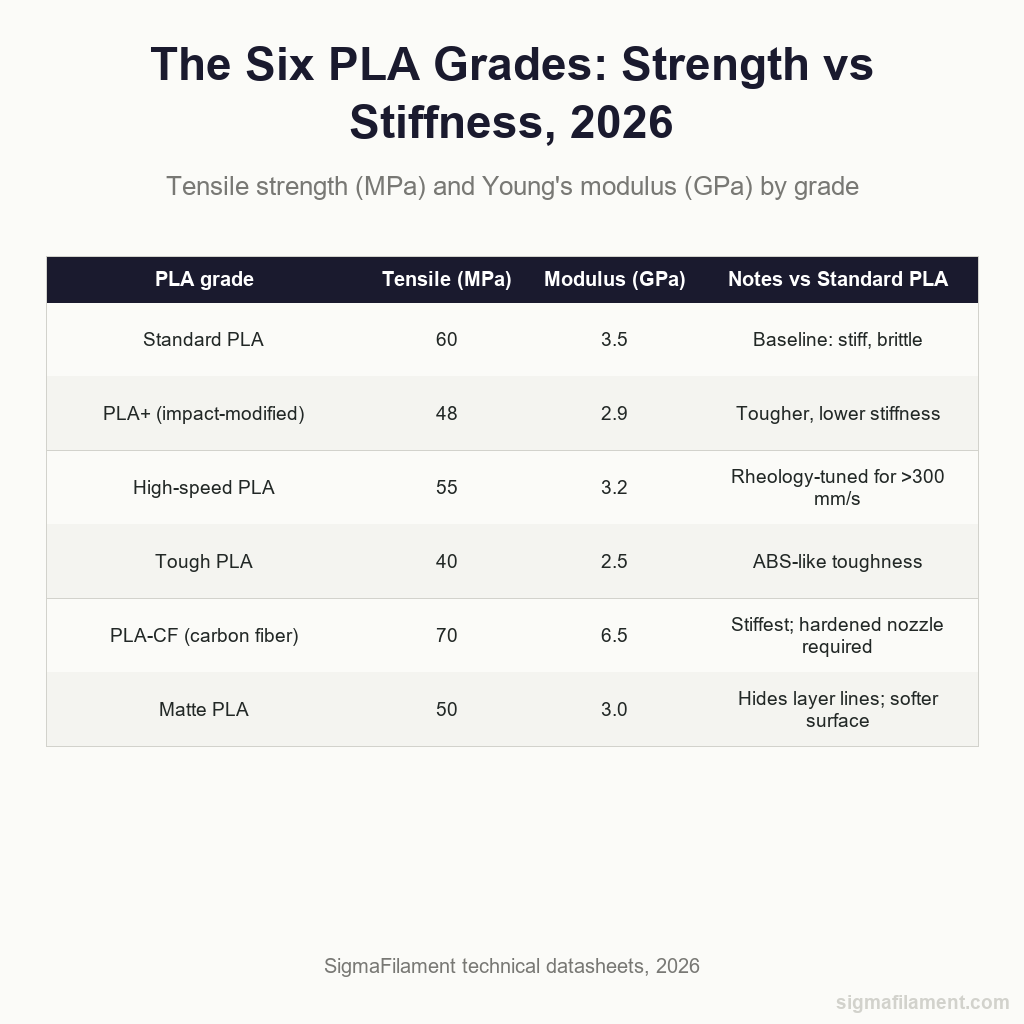
ASTM D638 tensile and D790 flexural tests on consumer PLA grades published in 2024 across multiple polymer journals confirm the impact-versus-stiffness inverse seen above: every elastomer-modified grade gains roughly 2 to 4x Izod impact resistance while losing 15 to 35 percent tensile strength relative to neat PLA, and every fiber-reinforced grade gains 50 to 90 percent modulus while losing impact toughness (Anderson, 2017).
Specifying the right pla plastic filament grade comes down to one question: which failure mode are you designing against? Crack on impact points to PLA+ or Tough. Deflection under load points to PLA-CF. Surface appearance points to Matte. Speed points to high-speed PLA. Standard PLA wins when none of those constraints binds. The printing parameters that make each grade actually deliver its rated numbers are covered in the next section.
PLA vs PETG vs ABS: Honest Material Calls
Three FDM workhorses, three different jobs. The shortest honest answer is that pla plastic filament wins on stiffness, dimensional accuracy, and print reliability, PETG wins on toughness and moderate heat, and ABS wins on service temperature and impact. The numbers are not close enough to argue about.
PLA holds 55-65 MPa tensile and a glass transition of 55-60C. PETG sits at 47-53 MPa tensile with Tg around 80-85C. ABS lands at 38-45 MPa tensile with Tg near 100-105C. On notched Charpy impact the order flips hard: PLA 2-4 kJ/m2, PETG 8-12 kJ/m2, ABS 10-20 kJ/m2 (Pan, 2025).
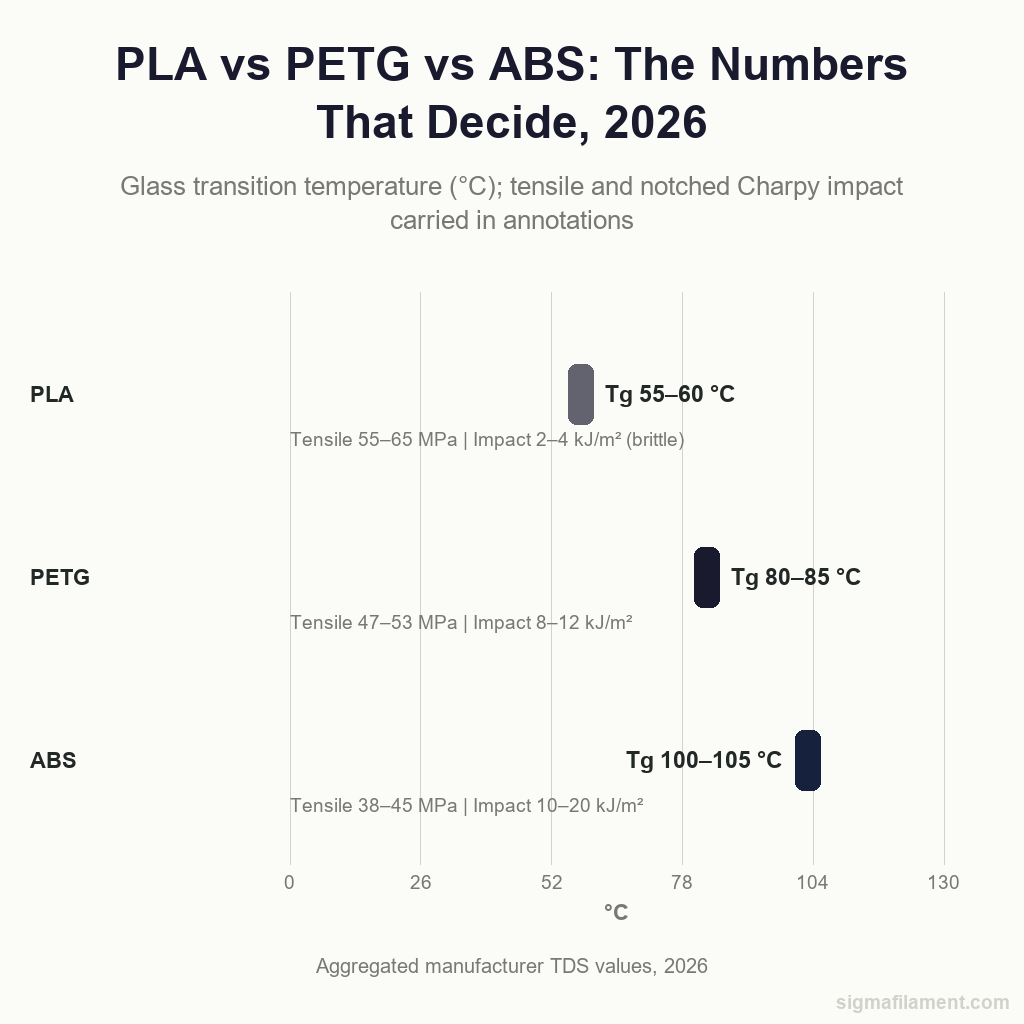
PLA vs PETG: detail and stiffness vs toughness and heat
PLA prints crisper. Overhangs hold, sharp corners stay sharp, and bridging is forgiving because the melt cools fast and warp is minimal. PETG drags more, strings if poorly dried, and softens overhangs above 30 degrees. The tradeoff buys you something real: PETG keeps roughly twice the impact energy of PLA and shrugs off temperatures that put PLA into creep. For an enclosure that sits in a sunlit window, PETG. For a visual prototype with fine geometry, PLA. Running both materials in the same chamber is workable with separate profiles, and our PLA + PETG joint-printing guide covers the temperature handoff.
PLA vs ABS: print reliability vs service temperature
PLA is the most-printed material in FDM for a reason: 190-220C nozzle, 50-60C bed, no enclosure, almost no warp. ABS demands a heated enclosure, ventilated workspace, and accepts a first-layer failure rate that PLA users have forgotten exists. In high-volume print farms, PLA’s defect rate runs roughly a third of ABS on the same hardware, mostly because warp and layer adhesion are not gating constraints (Pan, 2025). ABS earns its place when the part will live above 60C, take repeated impact, or get vapor-smoothed. Outside that envelope, ABS is overhead (Pan, 2025).
Decision rules with thresholds
These four rules cover most procurement calls. The wider material context is in our FDM filament materials guide.
- Service temperature above 55C, sustained. Specify PETG (up to ~75C) or ABS (up to ~95C). PLA will creep.
- Drop impact or repeated flex. Specify PETG at minimum; ABS for structural. PLA’s 2-4 kJ/m2 notched impact is a hard ceiling.
- Outdoor or humid service. Avoid PLA. UV and hydrolysis degrade it within months. ABS handles outdoor better; ASA is better still.
- Dimensional accuracy, fine detail, lowest defect rate, lowest cost. Specify PLA. For everything that fits inside its envelope, nothing else competes on production economics.
The 55C line is the one most teams cross by accident. A car dashboard in summer, a sealed electronics enclosure, a part near a stepper motor: all routinely exceed it. If the spec sheet does not name a service temperature, assume PLA is wrong and ask.
What PLA Is Used For (and Where It Fails)
PLA plastic filament earns its place inside a narrow, well-marked envelope: it prints clean at 190 to 220 C, holds dimensions tighter than most thermoplastics, and finishes well under sanding or paint, but its 55 to 60 C glass transition and 2 to 4 kJ/m2 notched impact rule out hot cars, sustained loads, and wet outdoor service (Mazur et al., 2025).
Map the application to those three boundaries first, and PLA is often the cheapest, fastest, lowest-risk call on the floor.
Prototyping and visual models
This is where PLA plastic filament earns its keep. Form-fit checks, design reviews, marketing mockups, and casting masters all benefit from low shrink (around 0.3 to 0.5 percent), crisp edge definition, and a surface that takes filler primer without warping back. Matte and silk variants finish photo-ready straight off the bed. For investment-casting and silicone-mold masters, PLA’s low glass-transition point is an advantage, not a flaw: it burns out cleanly and releases from RTV with minimal drag.
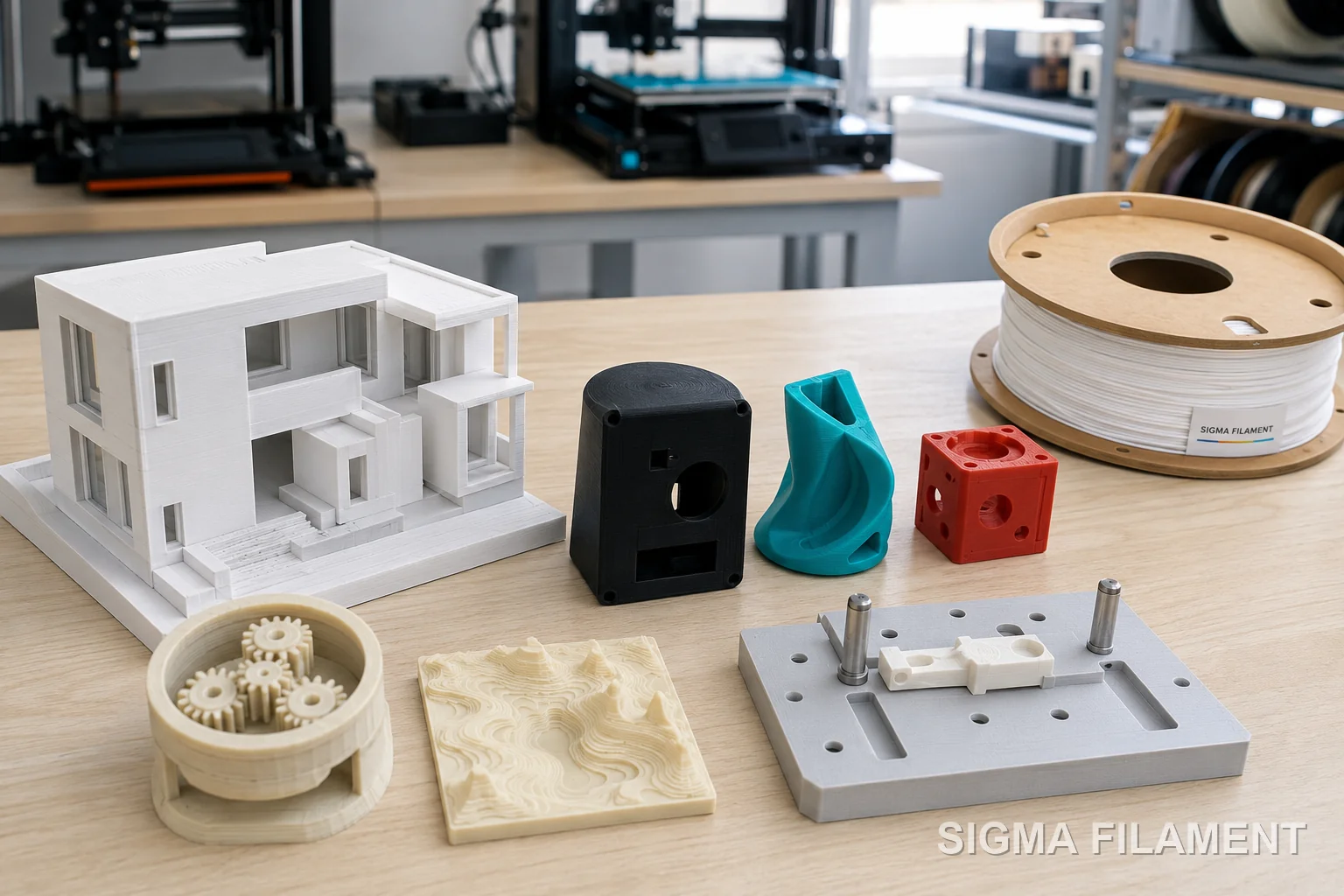
Short-run production and tooling
Indoor jigs, soft-jaw inserts, drill guides, alignment fixtures, light-duty end-of-arm tooling, and assembly aids in a climate-controlled shop are all viable PLA plastic filament jobs. The rules are simple: the part must stay below roughly 50 C in service, and it must not carry a constant load over weeks. PLA+ and tough PLA blends push impact resistance into a useful range for fixtures that get knocked around, and PLA-CF adds stiffness for inspection gauges where dimensional stability over a single shift matters more than long-term creep.
Consumer products and education
Low odor, no required enclosure, and a melt temperature that pairs with every entry-level printer make PLA plastic filament the default classroom and maker-space material. Consumer goods that live indoors at room temperature, planters, organizers, replacement knobs, model kits, and tabletop gaming pieces ship reliably in PLA. On food contact, treat PLA as a gray zone and read our FAQ entry before committing a part to that service.
The failure modes to plan for
Four failures show up in returns. First, creep: a PLA bracket under constant tension will slowly elongate at room temperature, and parts loaded near 30 percent of tensile strength may sag visibly within weeks. Second, heat sag above roughly 55 C, which is why a phone holder left on a summer dashboard deforms by lunchtime. Third, outdoor embrittlement from combined UV and moisture exposure, often visible as surface crazing inside one season. Fourth, hydrolysis: in warm, humid service the polymer backbone cleaves, and the part loses strength quietly before it visibly breaks (Mazur et al., 2025). Specify PETG, ABS, ASA, or nylon when any of those conditions apply.
The Biodegradability Truth: Compostable Is Not Backyard-Degradable
PLA is the only mainstream FDM material with a real bioplastic story, and that story is narrower than most packaging copy admits.
Under ASTM D6400, compostable means at least 90% biodegradation within 180 days at roughly 58 C in an industrial facility; in ambient soil, 2025 peer-reviewed testing measured about 0.29% mass loss in 120 days (Mazur et al., 2025). For B2B buyers writing sustainability claims, the distinction is the difference between a defensible label and a regulator’s letter.
What ASTM D6400 and EN 13432 actually certify
ASTM D6400 (United States) and EN 13432 (European Union) certify that a material disintegrates by at least 90% into fragments under 2 mm within 180 days, and biochemically converts to CO2, water, and biomass at roughly 58C, with controlled humidity and an active microbial inoculum (ASTM International, 2023). Those conditions exist in industrial composting plants, not in soil and not at room temperature. The certification is real; the operating envelope is narrow.
What happens in soil, landfill, and ocean
Most marketing collapses "compostable" and "biodegradable" into one word, but pla plastic filament behaves very differently outside the 58C envelope.
In neutral ambient soil, peer-reviewed 2025 work measured roughly 0.29% mass loss over 120 days for FDM-printed PLA, which is closer to inert than to degrading on any human timescale (Nature Scientific Reports, 2025; ~0.29% / 120d; soil at ambient temperature) (Mazur et al., 2025). Landfill conditions are anaerobic and even slower; methanogenic breakdown of PLA is measured in years to decades, not months. PLA is not marine-degradable, and no current data supports an ocean-safe claim.
What this means for a sustainability claim
What a B2B buyer of pla plastic filament can honestly put on packaging and marketing: "industrially compostable per ASTM D6400 / EN 13432 where commercial composting facilities accept bioplastics," "made from bio-based carbon (typically more than 95% per ASTM D6866 testing)," and "mechanically recyclable in dedicated PLA streams" (ASTM International, 2023). What does not survive scrutiny: "biodegradable" without qualifier, "compostable at home," or any ocean or landfill claim. Bio-based carbon content is the strongest, most defensible line on the page.
Printing PLA: The Production Essentials
PLA prints clean when three variables stay in band: a 190 to 220 C nozzle, a 50 to 60 C bed, and part cooling near 100% for overhangs, the most forgiving processing window of any mainstream FDM polymer in 2026. For first-layer specifics, see our PLA bed temperature guide; the notes below are the production-line summary a shop lead needs to spec a job.
Temperature envelope and cooling
Stock PLA runs a 190 to 220 C nozzle and a 50 to 60 C bed across nearly every machine class (Pan, 2025). Push part cooling to 100% from layer two onward; this is what gives PLA its clean overhangs and bridges. If parts will see heat above a closed car interior, anneal at 80 to 110 C for 30 to 60 minutes. Annealing crystallizes the polymer and raises usable service temperature toward the 80 C heat-deflection ceiling, but plan for 2 to 4% shrinkage on annealed dimensions (Lopez Camacho et al., 2024). Test-fit critical parts after the cycle.
Drying and storage
PLA is less hygroscopic than nylon, yet it still pulls moisture and prints worse for it. Dry spools at 45 to 50 C for six hours before a production batch. Store in sealed boxes with fresh silica or a 2g rechargeable desiccant pack per kilo. Vendor testing of high-speed PLA grades commonly reports sustained printing in the hundreds of millimetres per second with tight dimensional deviation, several times the practical envelope of standard PLA on the same geometry, provided the spool was dried and stored correctly.
High-speed PLA on modern printers
High-speed PLA is a rheology change, not a marketing label. The melt flows faster at the same nozzle setpoint, which lets Bambu X1, Creality K1, and other 300 mm/s class machines hold dimensional accuracy at production speeds. Run the nozzle 10 to 15 C above your stock-PLA number when volumetric flow climbs past 24 mm³/s. Standard PLA on the same hardware caps near 180 mm/s before underextrusion shows up on walls.
Sourcing PLA at Scale: Quality Benchmarks and Supplier Qualification
Buying pla plastic filament by the pallet is a different problem from buying a single spool. At wholesale volume, a 0.03 mm drift in mean diameter or a missing per-lot certificate stops a print farm for a shift. The acceptance work has to happen before the order ships, not after a failed batch lands on the receiving dock.
The acceptance criteria that matter
Every incoming lot at our Shenzhen line goes through the same gate before it earns a release stamp. We run an inline laser micrometer across every meter as the filament is wound, then pull spools at random for caliper audit and oven-dry moisture sampling. The criteria below are what we ask suppliers (and ourselves) to meet on each lot of pla plastic filament.
| Criterion | Acceptance threshold | How to verify | Risk if skipped |
|---|---|---|---|
| Diameter | 1.75 mm with ±0.02 mm tolerance, ovality ≤ 0.05 mm | Inline laser micrometer log + sampled digital caliper at 4 axes | Under-extrusion, layer adhesion failure |
| Moisture at packaging | ≤ 250 ppm in sealed bag | Karl Fischer or oven loss-on-drying at fill | Stringing, bubbles, weak welds |
| Per-lot CoA | Melt-flow index and tensile retest per production lot | Supplier-issued certificate; spot-retest on receipt | Drift between lots that looks like a printer fault |
| Resin grade traceability | Named grade (e.g. NatureWorks Ingeo 4043D or 3D850) + virgin vs regrind disclosure | Resin invoice trail + signed disclosure | Substituted resin, unknown mechanicals (International Organization for Standardization, 2023) |
| ISO 9001 | Active certificate from accredited body | Certificate number + IAF MLA registry lookup | No documented process control |
| Packaging | Vacuum-sealed bag, desiccant, humidity indicator card | Visual inspection at unboxing | Re-absorbed moisture in transit |
| Spool winding | No crossovers, consistent tension, EN 50419 spool dimensions | Roll-off test on the receiving spool holder | Tangles, mid-print failure |
| MOQ and lead time | Stated MOQ, contracted lead time, written change-control on resin | Signed PO terms | Surprise grade swaps between reorders |
Resin traceability and the Ingeo question
Filament brand matters less than the resin that goes into the extruder. Two filaments with identical "PLA" labels can behave very differently if one is built on a low-flow grade (Ingeo 4043D, ~6 g/10 min MFI) and the other on a high-flow tough-blend grade. Ask which specific resin grade the supplier uses, and whether the lot is virgin pellet or contains regrind. Regrind can be acceptable at disclosed ratios, but undisclosed regrind is the common root cause of "this batch prints fine, the next batch doesn’t" complaints.
Red flags in supplier evaluation
Walk away when you see a price below the prevailing resin pellet cost (the math does not work without corner-cutting), no per-lot retest, no moisture specification on the spec sheet, or vague answers about resin origin ("imported grade" without a named manufacturer) (International Organization for Standardization, 2023). Our own QC line publishes per-lot test data on every shipment, and our wholesale program ships with the CoA in the carton, not in a PDF emailed later.
NatureWorks supplies the Ingeo PLA resin grade family used by most reputable filament makers, with published MFI, crystallinity, and tensile data per grade. Naming the grade in the purchase order (for example, Ingeo 4043D for general-purpose 1.75 mm filament) is the single change that most reduces lot-to-lot variation in pla plastic filament procurement.
PLA Market 2026: Capacity, Pricing, and What Buyers Should Watch
Market size and trajectory
Polylactic acid is no longer a niche bioplastic. According to MarketsandMarkets, the global PLA market is valued at roughly USD 2.01 billion in 2025 and projected to reach about USD 4.51 billion by 2030, a compound annual growth rate near 17.5% across packaging, fiber, and 3D-printing demand (MarketsandMarkets Research, 2025).
Print-filament is one downstream slice of that resin volume; packaging and fiber consume far more. For pla plastic filament buyers, the relevant signal is direction: resin supply is scaling faster than most petrochemical thermoplastics, which usually means more grade choices and competing converters each quarter.
Feedstock and capacity dynamics
Resin supply remains concentrated. NatureWorks Ingeo, manufactured from corn dextrose, is still the reference grade most reputable spool brands disclose on their CoA, with TotalEnergies-Corbion (Luminy), BASF, and COFCO active as additional or regional sources (Castro-Aguirre et al., 2016). NatureWorks has publicly announced a sugarcane-fed plant in Thailand to add capacity beyond its US line, which matters for procurement: dual-feedstock sourcing reduces the corn-crop risk that previously shaped lactic-acid spot pricing.
Price signals for bulk buyers
Honest disclosure: granular 2026 contract pricing for bulk PLA resin or finished pla plastic filament is supplier-specific and not reliable from public reports. Validate quotes directly. Ask any candidate supplier for their resin source, current lead time, and a price that holds for 30 days against a defined MOQ. Treat any quote that drops below prevailing resin cost as a signal to recheck grade, regrind ratio, or diameter tolerance before signing.
Frequently Asked Questions
What is PLA plastic filament made of?
PLA plastic filament is made from polylactic acid, a thermoplastic polyester polymerized from lactic acid. The lactic acid itself comes from fermenting plant sugars, typically corn dextrose or sugarcane. Commercial spools also include small amounts of additives: pigments, nucleating agents to control crystallinity, and sometimes impact modifiers or process aids.
Is PLA filament biodegradable?
Yes, but only under industrial composting conditions: roughly 58C, controlled humidity, and active microbial inoculum, per ASTM D6400 (ASTM International, 2023). In soil, a backyard compost bin, or landfill, PLA degrades on the order of decades. Treat printed PLA parts as recyclable thermoplastic, not as something that vanishes in a garden.
What temperature does PLA print at?
Most pla plastic filament prints with a nozzle range of 190 to 220C and a bed of 50 to 60C. Generic PLA tends to sit near 200 to 210C; tougher PLA+ blends often want 210 to 220C. Run a temperature tower on each new spool, because pigments and additives shift the optimal window by 10 to 15C.
Is PLA stronger than ABS?
It depends on which strength. PLA shows higher tensile strength (55 to 65 MPa) and stiffness than ABS (38 to 45 MPa), so it resists pulling and bending loads better at room temperature (Anderson, 2017). ABS wins on toughness (10 to 20 kJ/m2 vs 2 to 4 for PLA) and heat resistance, making it more forgiving under impact or in warm cars.
What is the difference between PLA and PLA+?
PLA+ is a marketing label for PLA blended with impact modifiers, usually elastomeric copolyesters or chain extenders. The blend trades stiffness for toughness: impact resistance can rise two to four times over standard PLA, while tensile modulus drops about 10 to 20 percent. Layer adhesion and interlayer ductility also improve, so prints are less prone to brittle cracking.
Is PLA food safe?
PLA resin itself can be FDA-compliant for food contact, but a printed part rarely is. Layer grooves trap bacteria, brass nozzles shed lead and zinc traces, and pigments or impact modifiers may not carry food-grade clearance. For repeated food use, choose certified parts or coat the surface with a food-safe epoxy.
Does PLA absorb moisture?
Yes. PLA is mildly hygroscopic and picks up 0.5 to 1 percent water by weight within days of humid storage. In the hot end, that water drives hydrolysis, cutting the molecular chains and weakening parts. Dry filament at 45 to 50C for 6 hours before printing, and store spools sealed with desiccant between jobs.
Can PLA be used outdoors?
For months, not years. UV breaks down the polymer backbone and moisture accelerates hydrolysis, so unprotected PLA parts embrittle and discolor within one outdoor season in temperate climates. If the part needs to live outside, switch to ASA or PETG, or paint the PLA with a UV-blocking enamel and keep it out of standing water.
What is the glass transition temperature of PLA?
PLA has a glass transition temperature (Tg) of about 55 to 60C. Above Tg the polymer softens and creeps under load, which is why PLA parts deform in hot cars, dishwashers, or near light bulbs. For service above 50C, anneal the part to raise crystallinity and heat tolerance, or choose a higher-Tg material such as PETG, ASA, or PA.
Conclusion
PLA plastic filament owns FDM printing for two reasons, and only two reasons matter. Its chemistry is forgiving on the nozzle, so defect rates stay low. Its feedstock is fermented plant sugar at industrial scale, so the per-kilogram price stays low. Everything else the category is famous for follows from those two facts.
The limits are equally chemical. A glass transition of 55-60C is a real physical ceiling, and notched impact of 2-4 kJ/m2 is real brittleness. No grade name, no marketing copy, and no spec sheet rewrite changes those numbers. Buyers who try to push standard PLA past them lose parts in the field; buyers who specify the right grade by the numbers, and demand diameter tolerance to +/-0.02 mm with a per-lot CoA and resin traceability, do not.
That is the working definition of qualified supply. Production buyers sourcing pla plastic filament at scale can contact SigmaFilament for wholesale pricing, OEM and ODM programs, and batch CoA samples on request.
References
- Sin, L. T., Rahmat, A. R., & Rahman, W. A. W. A. (2013). Synthesis and production of poly(lactic acid). In Polylactic acid: PLA biopolymer technology and applications (pp. 71-107). William Andrew/Elsevier. https://doi.org/10.1016/B978-1-4377-4459-0.00002-0
- Castro-Aguirre, E., Iniguez-Franco, F., Samsudin, H., Fang, X., & Auras, R. (2016). Poly(lactic acid) – Mass production, processing, industrial applications, and end of life. Advanced Drug Delivery Reviews, 107, 333-366. https://doi.org/10.1016/j.addr.2016.03.010
- Anderson, I. (2017). Mechanical properties of specimens 3D printed with virgin and recycled polylactic acid. 3D Printing and Additive Manufacturing, 4(2), 110-115. https://doi.org/10.1089/3dp.2016.0054
- Lopez Camacho, A., Carazo Alvarez, D., & La Rubia Garcia, M. (2024). Characterization of polylactic acid (PLA) mechanical properties in 3D printing: Insights from advanced analysis techniques and printing orientations. DYNA, 99(6), 622-628. https://doi.org/10.52152/d11278
- Pan, D. (2025). A comprehensive study of tensile properties of 3D-printed polylactic acid (PLA) parts based on statistical analysis and multi-response optimization of printing parameters. Research Square. https://doi.org/10.21203/rs.3.rs-6763501/v1
- Mazur, K. E., Borucka, A., Kaczor, P., Gadek, S., Boguslawski, R., Salasinska, K., & Kuciel, S. (2025). Mechanical properties and biodegradability of samples obtained by 3D printing using FDM technology from PLA filament with by-products. Scientific Reports, 15, 6432. https://www.nature.com/articles/s41598-025-89984-0
- International Organization for Standardization. (2023). ISO 5425:2023 Plastics – Filaments for material extrusion additive manufacturing – Dimensional and tolerance requirements. ISO. https://www.iso.org/standard/81238.html
- ASTM International. (2023). ASTM D6400-23 Standard specification for labeling of plastics designed to be aerobically composted in municipal or industrial facilities. ASTM International. https://www.astm.org/d6400-23.html
- MarketsandMarkets Research. (2025). Polylactic acid (PLA) market – Global forecast to 2030. MarketsandMarkets. https://www.marketsandmarkets.com/Market-Reports/polylactic-acid-pla-market-29418964.html
Last reviewed and updated: June 2026. Author: SigmaFilament team. For tailored guidance, contact our team.