3D Filament Deals in 2026: A B2B Buyer’s Guide to True Bulk Economics


TL;DR
Most 3D filament deals content chases the lowest sticker price per spool. For production buyers (OEM brand owners, print farms, resellers), the real KPI is landed cost per kilogram of consistent filament. Per-kilogram prices fall from single retail spools to multipacks to wholesale and OEM tiers, and bulk-deal collection prices move with each sale. But a deal carrying a 5% defect rate erases its discount on the first failed production run, so every price must be quality-adjusted: true $/kg = (sticker $/kg) x (1 + expected defect rate) + freight + duty. This guide taxonomizes seven deal structures, benchmarks 2026 prices per channel, walks a 1,000-spool landed-cost example, and compares six wholesale programs so each buyer type can pick the right deal lane.
Abstract
Most coverage of 3d filament deals optimizes the wrong number: sticker price per spool. Production buyers should be optimizing landed cost per kilogram of consistent filament, because a deal carrying a 5% defect rate erases its 5% discount on the first failed batch and then keeps costing money in reprint labor and scrapped output (Akande et al., 2015). Quality-adjusted price, not headline price, decides whether a filament deal makes or loses money on a production run (Akande et al., 2015).
This guide is written for OEM brand owners, print-farm operators, resellers and distributors, and prosumers stepping up to bulk procurement (SigmaFilament, 2026). It splits the 3d filament deals market into a hobbyist per-spool lane and a B2B per-kilogram lane, then taxonomizes seven deal structures from multipacks to OEM private label, publishes 2026 price-per-kg benchmarks by material and channel for PLA, PETG, ABS, TPU, and PA-CF, decodes MOQ tiers as distinct market segments rather than points on one curve, walks a 1,000-spool FOB Shenzhen landed-cost example end to end, compares six wholesale programs side by side in a neutral frame, lays out a seasonal stockpile-versus-JIT playbook with carrying-cost math, sets the rules for clearance and refill stock, and closes with the red flags that turn a headline filament deal into a production loss.
Key Takeaways
- Sticker price and landed cost are different numbers. Production buyers must optimize landed cost per kilogram, not price per spool.
- Seven deal structures exist in 2026: multipack, bulk-tier, clearance, seasonal, refill, wholesale MOQ, and OEM private label, each fitting a different buyer.
- PLA benchmarks: read current per-kg listings for retail spools and multipacks, and get written quotes for wholesale and OEM tiers.
- Quality-adjusted price = sticker $/kg x (1 + expected defect rate). A 5% defect rate erases a 5% discount on the first failed run.
- A 1,000-spool FOB Shenzhen order lands near $8-9/kg all-in, with batch-level QC traceability; compare it against current per-kg listings for retail bulk deals.
- Black Friday and Cyber Monday discounts reach 20-30%, but stockpiling beats JIT only when carrying cost stays under the captured discount.
- Clearance and open-box filament suits prototyping only, never production runs or branded resale where one bad batch damages downstream customers.
Table of Contents
- TL;DR
- Abstract
- Key Takeaways
- Table of Contents
- Two Buyers, Seven Deal Structures: What ‘3D Filament Deals’ Actually Means in 2026
- 2026 Price-per-Kg Benchmarks: Retail, Deal, Wholesale, and OEM Tiers
- MOQ Math: Why Spool-Count, Cart-Minimum, and 500-Spool Tiers Aren’t Comparable
- Landed Cost: The Real Number Behind Every Filament Deal
- Six Wholesale and Bulk Programs Compared
- The Seasonal Sales Playbook: When to Stockpile and When to Stay JIT
- Clearance, Open-Box, and Refill Deals: When Discounted Filament Is Safe to Buy
- OEM Private Label and the Red Flags That Turn a Deal Into a Loss
- Frequently Asked Questions
- Conclusion
- References
Two Buyers, Seven Deal Structures: What ‘3D Filament Deals’ Actually Means in 2026
3D filament deals split into two distinct lanes in 2026. The hobbyist lane is priced per spool and runs on multipacks, seasonal sales, and clearance stock. The B2B lane is priced per kilogram across wholesale MOQ tiers, where MOQ (minimum order quantity) is the threshold of spools, kilograms, or cart dollars a supplier requires before a tier of per-kg pricing activates. The same lane also runs refill programs and OEM (original equipment manufacturer) private-label contracts, where the buyer brands and resells the finished spool. Same word, different markets.
That split is why most "best 3d filament deals" roundups stay useless to production buyers, and why the same 3d filament deals page can be either a great resource or a misleading benchmark depending on who clicked through. A Sunlu 8-pack at $13/kg is a great hobbyist deal and a poor wholesale benchmark. A gated print-farm wholesale account is a great print-farm deal and overkill for a tinkerer who burns 3 kg a month. Lane first, then structure.
The hobbyist spool-deal lane vs the B2B wholesale lane
The retail lane optimizes for sticker price on a single SKU. The buyer wants the lowest dollar number on the cart page, with shipping included, and is happy to wait for Black Friday. Channels are Amazon, brand DTC stores, and 3D-print retailers like MatterHackers.
The B2B lane optimizes for landed cost per consistent kilogram across a 6 to 12 month horizon. The buyer wants a published tolerance spec, batch traceability, a sample policy, and a per-kg curve that holds across reorders. Channels are manufacturer-direct programs, regional distributors, and gated wholesale portals. Bulk-weight collections sold on a brand’s own storefront bridge the two; ask what batch QC documentation comes with a lot before treating one as a substitute for a contracted wholesale account.
The reason competitor roundups conflate the lanes is that retailers monetize click-throughs, not procurement outcomes. A B2B reader scanning a top-10 list sees the same multipack the hobbyist sees, and assumes the per-spool savings scale. They do not. The per-kg curve resets at every MOQ tier.
The seven deal structures, ranked by buyer fit
Seven structures cover every 3d filament deal a 2026 buyer will encounter. Discount depth in the table below is measured against single-spool MSRP, drawn from the research data bank.
| Deal structure | Typical discount vs single-spool MSRP | Best-fit buyer | Primary risk |
|---|---|---|---|
| Spool multipacks (8/10-packs, vacuum-sealed) | 10-20% | Prosumers, small studios | Color mix locked at purchase |
| Bulk-weight collections (manufacturer-direct) | 30-50% | Small print farms, prosumers going pro | Limited batch QC documentation |
| Print-farm wholesale programs (gated, MOQ-anchored) | 30-45% | Print farms, resellers | Application gating, cart minimums |
| Seasonal sales (BF/CM, Prime Day, LNY clearance) | 20-30% peak | Stockpilers in either lane | Carrying cost, moisture exposure |
| Clearance and open-box (condition-tiered) | 25-50% | Prototype shops only | Discontinued colors, aged stock |
| Refill and cardboard-spool programs | 10-15% structural | ESG-reporting print farms | AMS/dryer-box compatibility |
| OEM private label and ODM custom | 55-75% lower per-kg | Brand owners, distributors | MOQ commitment, NDA, lead time |
Spool-count auto-discount tiers, where the per-spool price steps down once one order reaches a set number of spools, sit at the entry end of the print-farm wholesale band, and each program sets its own thresholds, so read the current terms before planning an order around one. Cardboard-core refill programs, which mount a light-core coil onto a reusable spool (Vela, 2026), carry a packaging saving that does not depend on a seasonal window. The OEM lane is its own market: 500 to 1,000 spool MOQs per SKU, 30 to 60 day lead, and a per-kg floor set by resin and processing cost rather than channel margin.
3d filament deals worth chasing are the ones that match a buyer’s lane and burn rate (SigmaFilament, 2026).
2026 Price-per-Kg Benchmarks: Retail, Deal, Wholesale, and OEM Tiers
A kilogram of PLA bought as a single name-brand retail spool can cost several times as much as the same kilogram bought in bulk from a factory (Fabbaloo, 2025). That spread is the central fact of every 3d filament deals decision, and it is not a quirk of vendor greed. It is the COGS stack.
PLA, PETG, ABS, TPU, and PA-CF by channel
Per-kilogram prices for each material move by channel and change often, so read current listings for retail spools and multipacks and ask for written quotes for wholesale and OEM tiers; specialty resins almost never appear in standard retail packs.
Contracts above 1,000 kg are quoted individually, with the price shaped by formulation, color complexity, and packaging spec.
Brand-name domestic wholesale programs publish their own per-kg prices and cart minimums, and those terms change, so compare each program’s current price list against a written quote for manufacturer-direct PETG wholesale, and weigh what any premium buys in US-warehouse lead time and brand recognition. Bulk-weight lots bought on a retailer storefront rather than under a B2B account move in price with each sale, so the current listing is the number to use.
Why the same spool spans such a wide price range
PLA pellet stock from NatureWorks-grade resin runs $2.20-3.50 per kg in bulk, PETG resin $1.80-2.80, ABS $1.60-2.40 (Fales et al., 2026). On a finished retail spool, each component takes a share of the final price: pellet stock 20-30%, extrusion energy and labor 15-25%, the plastic or cardboard spool itself 8-15%, packaging and shrink wrap 5-10%, ocean and inland freight 10-25%, and brand markup 20-40%. A wholesale buyer absorbing freight in 1-ton lots collapses the per-kg freight share; a retail buyer pays for one spool of shipping per spool of filament. QC depth also costs money. A 70-checks-per-spool quality regime with ISO 9001:2015 traceability and a published sub-0.01% defect rate is a different product from a no-doc lot that may or may not hold tolerance, and the price gap reflects that difference more than it reflects margin.
In 2026, a single spool of name-brand PLA, a multipack, and an OEM order are not three deals on one curve. They are three different products, sold to three different buyers, with three different risk profiles priced in.
MOQ Math: Why Spool-Count, Cart-Minimum, and 500-Spool Tiers Aren’t Comparable
Buyers scanning 3d filament deals often treat MOQ thresholds as one rising staircase, with a low spool count at the bottom and 500 spools at the top. That mental model is wrong. Each tier targets a different market with a different cost-to-serve, and stepping up only pays off when your monthly burn rate already lives in that tier.
Reading MOQ tiers as market segmentation
The four headline MOQ structures in the 2026 filament market are not four points on one curve. They are four separate sales models, each with its own packaging, fulfillment lane, and target buyer.
Spool-count auto-discount tiers, where a checkout discount applies once the cart reaches a set number of spools, are a prosumer model. Single-checkout, retail packaging, no account application. A maker running one or two printers can clear a low spool-count threshold in a quarter and capture the first discount step, which is what most published 3d filament deals roundups actually mean when they cite a wholesale price.
A cart-dollar minimum on a gated wholesale account is a print-farm model. A threshold set in dollars rather than spools segments buyers by purchase frequency, not by SKU mix. A 10-printer farm refilling monthly hits the cart minimum easily; a hobbyist with a single Bambu does not.
The 100-spool standard, 200-spool high-speed, and 500-spool OEM custom-color tiers at SigmaFilament are a brand-owner and distributor model (SigmaFilament, 2026). The 500-spool step enables custom color matching and branded packaging under NDA, which only matters if you are reselling under your own label. European distributors typically operate inside a 50 to 500 kg MOQ band on top of those manufacturer tiers, layering a second cost-to-serve cushion before product reaches a regional reseller (SigmaFilament, 2026).
Matching your monthly burn rate to the right tier
A simple rule keeps capital from sitting on shelves: monthly consumption times 1.5 to 2 months of stock equals the right order size, and that order size points to one tier. A small studio burning 15 spools per month belongs in a spool-count auto-discount lane, ordering every three to four weeks. A 100-kg-per-month print farm sits at the domestic wholesale tier and refills bimonthly, ideally against a 9-point bulk-buying checklist that pins MOQ to monthly throughput. A 500-kg-per-month brand owner is already inside the OEM lane and should be talking sample-first contracts, not chasing seasonal sticker prices.
Stepping up a tier before your burn rate justifies it is the most common procurement mistake we see. Buying a full cart-dollar wholesale minimum when monthly demand is 8 spools can mean months of inventory tying up working capital, plus moisture and shelf-life risk on the back end of the lot. Conversely, staying in a spool-count retail-discount lane while burning 80 spools a month leaves 35 to 50 percent on the table versus the wholesale price the same volume would open up, which is the core economics print farms cite when switching to 3 kg, 5 kg, and 10 kg formats.
Most roundups of 3d filament deals list MOQ thresholds as raw numbers next to a sticker price; the segmentation framing above is missing from the current top-10 SERP, so buyers routinely apply for a wholesale program they do not yet qualify for, or accept retail pricing on volumes that should have moved them up a lane months ago.
Landed Cost: The Real Number Behind Every Filament Deal
A sticker price per spool is only the first line item in a procurement spreadsheet. The number that decides whether a filament deal is profitable is landed cost per kilogram of usable, on-spec material delivered to your shelf. Landed cost is the total spend per kilogram once FOB price, ocean freight, import duty, inland and warehouse handling, and the quality multiplier from expected defect rate are added in. FOB (Free On Board) is the Incoterm that sets price at the supplier’s port of origin, with onward freight, duty, and inland costs on the buyer’s ledger. Quote a deal in landed terms from the start, or the discount captured at checkout will quietly evaporate against freight, import duty, and reprint labor.
The quality-adjusted price formula
The full landed-cost equation a buyer should run before clicking purchase:
True landed $/kg = (FOB or sticker $/kg
                  + freight $/kg
                  + duty $/kg
                  + inland and warehousing $/kg)
                  × (1 + expected defect rate)
Four cost layers plus one quality multiplier. The multiplier is the lever most retail-side analyses ignore (Akande et al., 2015). A 5% defect rate behaves like a 5% price surcharge before you add the labor cost of reprinting the failed parts, scrapping the failed spool, and rebooking the printer time.
Worked example: 1,000 spools FOB Shenzhen to a US warehouse
Take a one-metric-ton PLA order, 1,000 spools at 1 kg each, sourced FOB Shenzhen and compare it with a 20 kg retail bulk-deal collection bought domestically at its current listed price (Sales Plastics, 2026).
| Cost layer | Wholesale FOB order, $/kg | Retail bulk deal, $/kg |
|---|---|---|
| FOB or sticker price | 5.50 | Current listing |
| Ocean freight | 1.85 | n/a |
| Import duty | 0.55 | n/a |
| Inland and warehousing | 0.40 | Domestic shipping |
| Landed total | 8.30 | Listing plus shipping |
| QC traceability | Batch-level | Ask the seller |
Compare the $8.30/kg FOB landed total with the retail deal’s current listing plus shipping: the difference is the per-kg gap before quality adjustment, and on a one-ton order each dollar of gap per kilogram is $1,000 of margin. The FOB lane also ships with batch-level traceability, which a retail collection may not document, and the right to source-attribute every failed print back to a specific lot.
Now apply the defect multiplier. Push the retail deal through a 5% defect rate and its effective price rises 5% above listing plus shipping, before you cost the reprint labor, the lost printer hours, and any downstream warranty exposure on branded resale. The same 5% defect rate on the wholesale lane lifts $8.30 to about $8.72/kg.
The defect rate is not a hypothetical. Akande and colleagues built one of the first low-cost QA frameworks for fused-filament fabrication around the observation that dimensional and extrusion-consistency failures in commodity filament cluster well above what production buyers can absorb (Akande et al., 2015). Their framework is the reason any serious supplier publishes tolerance, batch number, and per-spool QC counts on the spec sheet rather than a marketing one-liner.
Wholesale-tier QC should deliver an order of magnitude better than 5%. Sigma publishes a defect rate below 0.01% backed by more than 70 in-line QC checks per spool, ±0.02 mm diameter tolerance, and ISO 9001:2015 process control (SigmaFilament, 2026). Plug those figures into the formula and the quality multiplier collapses toward 1.0, which is the actual point of buying wholesale rather than chasing the next consumer-grade flash sale; the 12 QC checks worth asking any wholesale manufacturer before signing tell you whether a supplier can actually hold that floor.
Run the math at portfolio scale and the gap compounds. A print farm consuming 2,000 kg of PLA per year multiplies the per-kg gap from the table above by 2,000, so each dollar of gap per kilogram is $2,000 a year of pure landed cost, and that figure does not yet credit the reprint hours avoided when defect rates drop from a few percent to a few hundredths of a percent. Push the same numbers further and you arrive at true cost per printed gram once machine time, labor, and consumables are layered in, which is the unit that actually appears on a customer quote. The deal worth signing is the one whose landed, quality-adjusted dollars per kilogram beats every other lane on your spreadsheet, not the one with the largest percentage discount on the sticker.
Six Wholesale and Bulk Programs Compared
Six programs cover most of the 2026 wholesale and bulk lanes for 3d filament deals: Polymaker US Wholesale, 3D-Fuel, Anycubic bulk lots, Overture, MatterHackers and SigmaFilament. They sit at different MOQ floors, country-of-origin profiles, and program depths, so the right pick depends on monthly burn rate, brand control, and lead-time tolerance, plus running each candidate through the seven-factor framework for vetting a wholesale filament maker before any commitment.
| Program | MOQ / entry threshold | Starting PLA $/kg | Lead time | Country of origin | Refill option | OEM private label |
|---|---|---|---|---|---|---|
| Polymaker US Wholesale | Cart-dollar minimum on a gated account; check current terms | Check the current price list | Not published | US warehouse, China manufacturing | Cardboard-spool refill program | No |
| 3D-Fuel Wholesale | Spool-count auto-discount; check current tiers | Not published (gated) | Not published | Made in USA (Fargo, ND) | Not published | Not published |
| Anycubic deals collection | No B2B account; bulk-weight cart lots | Varies by sale; check the current listing | Not published | China | Not published | No |
| Overture bulk lane | Multipack via Amazon and own store | Not published per kg | Not published | China | Not published | Not published |
| MatterHackers Filament by Deals | Per listing; check current terms | Variable by listing; not published as a floor | Not published | Multi-vendor reseller | Not published | No |
| SigmaFilament | 100 spools standard, 200 high-speed, 500 OEM custom color (SigmaFilament, 2026) | Quote-based; volume discounts up to 20% at 1,000+ spools | Stock SKUs ship from inventory; OEM 30-60 days from sample approval | China (Shenzhen) | Available on request | Yes, full OEM/ODM under NDA |
Program-by-program notes
Polymaker US Wholesale is the deepest pure-domestic program in the comparison, with published partner logos including SpaceX and Slant3D and a cardboard-spool refill program. Its strength is US-warehouse lead time and brand recognition, not the lowest per-kg floor, and there is no OEM private-label lane on the published terms. 3D-Fuel anchors on Made-in-USA positioning out of Fargo, ND, but the per-kg detail page is gated behind a wholesale application, so a published PLA floor is not available without an account. Both are strong fits when domestic origin is a procurement requirement rather than a preference.
Anycubic’s deals collection sells bulk-weight PLA lots on a consumer storefront without a true wholesale account; check the current listing for the per-kg price and ask whether batch QC documents come with a lot, because without them it suits prosumers and small farms rather than resellers. Overture’s bulk lane reaches buyers through Amazon multipacks and its own store, with no published B2B floor or OEM lane. MatterHackers operates as a reseller catalog rather than a program, which suits opportunistic per-spool buyers more than scheduled production.
SigmaFilament prices its PLA wholesale program by quote, with a 100-spool standard MOQ, FOB, CIF, DDP and DAP Incoterms, samples from 1-3 spools, ISO 9001 certification, ±0.02mm tolerance, and 70+ QC checks per spool. Volume discounts apply at 500+ spools and run up to 20% at 1,000+, and the OEM lane covers custom color, branded packaging, and formulation work under NDA.
Which program fits which buyer
These six 2026 programs cover most of the published 3d filament deals lanes, and they sort cleanly by monthly burn rate. Prosumers ordering bulk-weight lots stay in consumer collections like Anycubic’s. Print farms running under 100 kg per month land best in domestic wholesale (Polymaker US Wholesale or 3D-Fuel), where US-stocked inventory protects production schedules and refill programs trim spool packaging.
Operations consuming 100+ kg per month gain margin moving to manufacturer-direct tiers, where 100-spool MOQs become economic (SigmaFilament, 2026). Brand owners and resellers belong in the OEM private-label lane, which only one of the six programs (SigmaFilament) runs in-house, with 500-1,000 spool MOQs covering custom color, branded packaging, and NDA formulation work. Treat the published 3d filament deals tiers as buyer segmentation, not as a single discount curve.
The Seasonal Sales Playbook: When to Stockpile and When to Stay JIT
Retail 3d filament deals cluster around four predictable windows each year, but stockpiling for those windows only pays when the discount captured beats the cost of holding inventory. The opposite posture is JIT (just-in-time) procurement: ordering only the filament needed for the next one to four weeks of production, accepting the higher per-kg sticker in exchange for near-zero carrying cost and tighter cash flow. For B2B buyers running wholesale or OEM contracts, the calendar matters far less than it does in the consumer lane, and JIT against a contracted per-kg tier often wins on total economics over a stockpile-and-discount loop.
The 2026 discount calendar
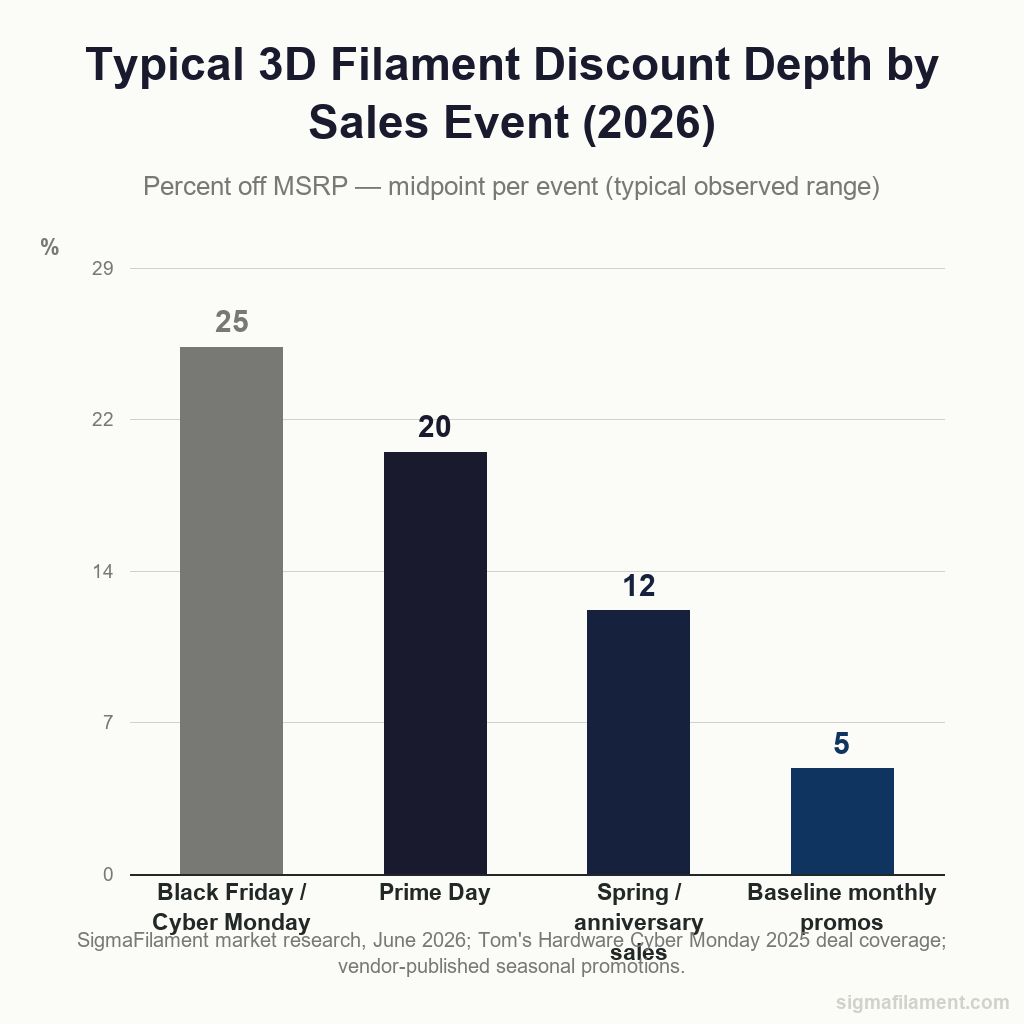
Four windows account for nearly all meaningful retail filament discounts. Black Friday and Cyber Monday sit at the deepest end, with typical promotions landing around 25% off MSRP (2025) and a working band of 20-30% (Tom’s Hardware, 2025). Tom’s Hardware coverage of Cyber Monday 2025 highlighted Sunlu 8-pack vacuum-sealed PLA bundles inside that window, alongside multi-spool Amazon promotions across the major budget brands (Tom’s Hardware, 2025). Prime Day in July averages 20% (2025), inside a 15-25% range (2025), and skews toward Amazon-exclusive SKUs. Spring and brand-anniversary sales midpoint near 12.5% (2025), within a 10-15% band. Baseline monthly promotions sit at roughly 5% (2025), inside a 0-10% range, and rarely justify a buying decision on their own (Tom’s Hardware, 2025).
Stockpile math: carrying cost vs discount captured
The decision rule is one inequality: stockpile only when the discount captured exceeds months of inventory times monthly carrying cost. A workable carrying-cost estimate is about 1.5% per month, covering tied-up capital, warehouse space, and moisture-degradation risk on filament stored beyond a few months (Sales Plastics, 2026). Vacuum-sealed bags with active desiccant materially extend usable shelf life and lower that degradation share, but they do not zero it out (Sales Plastics, 2026); the five most common 3D filament storage mistakes all surface inside that 1.5% monthly figure and are worth screening before any seasonal stockpile decision.
Run the numbers. A 25% Black Friday discount on 6 months of stock costs 6 × 1.5% = 9% in carrying, netting a +16% effective saving. The same 25% discount on 18 months of stock costs 27% in carrying, turning the deal slightly negative before any spoilage write-offs are counted. Breakeven sits near 16-17 months at that carrying rate, and shifts earlier if your warehouse runs uncontrolled humidity or you cannot rotate FIFO.
B2B note: wholesale and OEM contract pricing stays comparatively flat across the year, since per-kilogram tiers and MOQ floors are negotiated, not promotional. Seasonal timing is a retail-lane lever; production buyers optimize MOQ and lead time instead.
Clearance, Open-Box, and Refill Deals: When Discounted Filament Is Safe to Buy
Two discount mechanisms get lumped together under "clearance" but behave nothing alike. One is a quality compromise priced to clear inventory risk. The other is a structural packaging saving with no quality penalty at all. Treating them the same is how production buyers lose money on 3d filament deals.
The prototype-only rule for clearance stock
Clearance, open-box, and sale stock each carry a different combination of age, storage history, and packaging integrity, and storage history shows up in the part: moisture absorbed by hygroscopic FDM filament can diminish mechanical properties, and test samples printed from four grades of PLA filament that had been exposed to room temperature and humidity for three months lost 24 to 36 percent of their strength (Quader et al., 2024). That points to the right rule: clearance and open-box filament is acceptable for prototyping, jigs, and fit-check parts where one moisture-degraded spool costs a reprint, never for production runs or branded resale where one bad batch propagates into customer returns.
Tie it back to the quality-adjusted price formula from the Landed Cost section above. A 35% clearance discount on a $20 spool looks like $7 saved. If the spool’s brittleness from absorbed moisture lifts your defect rate by even three percentage points on a 50-spool production batch, the math reverses inside one job. Hobby use absorbs that variance. A reseller’s brand reputation does not.
Refill and cardboard-spool economics
Refill programs are a different animal. A cardboard-core refill ships the filament around a light core that mounts onto a compatible reusable spool, which reduces the need for a new rigid plastic spool body with every order and the plastic waste that comes with it (Vela, 2026). The saving is structural, not a quality compromise, and the five reasons print farms switch to refill programs in 2026 line up with the same packaging, ESG, and unit-economics math. The one caveat: cardboard cores can rub or shed inside enclosed dryer boxes and certain AMS-style automatic feeders, so compatibility check the feed path before standardizing across a print farm.
Before accepting any discounted lot, clearance or refill, run a four-point acceptance checklist: a stamped extrusion date you can check against your own shelf-life limit, vacuum seal intact with no creases, desiccant pack still loose and color-active, and a batch number that traces back to a QC record on request. A vendor that cannot produce three of those four is selling a deal you should not buy.
OEM Private Label and the Red Flags That Turn a Deal Into a Loss
At the deep end of bulk buying, a filament deal stops being a discount and becomes a brand. OEM private label is the lane where the spool, the box, the color, and the formulation are yours. It is also the lane where the largest 3d filament deals quietly turn into write-offs when a buyer skips the diligence that wholesale-tier procurement requires.
When a deal becomes a brand: the OEM lane
A true OEM program in 2026 starts at 500 to 1,000 spools per SKU, with 30 to 60 day lead times measured from sample approval, not from purchase order (SigmaFilament, 2026). Custom color matching runs against Pantone or RAL targets with a deltaE under 1.5, so a brand’s hex code on the website matches the spool a customer unboxes. Custom formulations (filled grades, impact-modified PLA, regulated flame-retardant blends) are developed under NDA and add a one-time R&D fee on top of per-kilogram pricing.
The economics are what makes the lane work. The gap between a factory OEM quote and the reseller’s retail price is the gross margin, before freight, warehousing costs, and returns. That margin is what funds the brand: photography, listings, customer support, the next product, and the seven-step product-line build-out that turns OEM orders into a defensible filament brand. Skip the diligence below and the margin disappears on the first batch.
Seven red flags in filament deals
Bulk PLA resin (NatureWorks Ingeo-grade pellets) sits at $2.20 to $3.50 per kilogram in 2025-26 (Fabbaloo, 2025). Add extrusion energy and labor, a spool, packaging, and freight, and the manufacturing floor lands near $4 per kilogram before any margin. A retail "deal" priced below that floor is not a deal. It is recycled content, off-spec resin, or skipped QC.
The seven red flags to walk away from:
- No published tolerance spec or technical data sheet. A supplier that cannot quote diameter tolerance is not measuring it (Fabbaloo, 2025).
- "100% virgin" claims with no resin certificate. Recycled or regrind blending is the easiest hidden cost cut.
- No batch number on the spool. Without traceability a defect cannot be isolated or returned.
- Sub-$4 per kilogram retail pricing. Below the resin-plus-processing floor, corners are cut.
- "Asia" or "imported" as the stated origin. Vague country-of-origin labeling hides supply-chain accountability.
- No sample policy before MOQ commitment. Wholesale buyers should qualify a supplier with 1 to 3 spools before placing 500.
- Prepayment to personal or unverifiable accounts. Legitimate OEM contracts settle through corporate banking with documented Incoterms.
Frequently Asked Questions
How much money do I save by purchasing a filament bundle deal?
A spool bundle typically saves 10 to 20 percent versus single-spool MSRP, with eight and ten-pack vacuum bundles from brands like Sunlu and Amolen anchoring that band (Tom’s Hardware, 2025). Real B2B savings are larger: pallet-scale and wholesale buys land 30 to 50 percent below single-spool retail, and OEM private-label tiers run 55 to 75 percent lower per kilogram once landed and quality-adjusted.
What is the cheapest place to order filament that isn’t Amazon?
For consumer quantities, look at manufacturer-direct stores running bulk-weight lots and compare their current per-kilogram prices during anchored sales, since those prices change with each promotion. For production volumes, application-gated wholesale programs and direct-from-manufacturer FOB orders price meaningfully lower.
How much does PLA filament cost per kg wholesale in 2026?
Manufacturer-direct wholesale PLA is priced by quote: volume discounts apply at 500+ spools and run up to 20% at 1,000+ (SigmaFilament, 2026). OEM private-label contracts are quoted too, with the figure shaped by formulation, color complexity, and packaging spec.
What is the MOQ for wholesale 3D printer filament?
MOQ depends on lane: domestic wholesale programs set spool-count discount tiers or cart-dollar minimums, so check each program’s current terms; European distributors typically transact at 50 to 500 kilograms; OEM private label begins at 500 to 1,000 spools per SKU (SigmaFilament, 2026). Pick the tier whose MOQ matches one to two months of burn.
When is the best time to buy 3D filament cheap?
Black Friday and Cyber Monday post the deepest cuts at roughly 25 percent off MSRP (band 20 to 30 percent), followed by Amazon Prime Day in July at about 20 percent (15 to 25 percent), spring and anniversary sales near 12.5 percent, and baseline monthly promos around 5 percent (Tom’s Hardware, 2025). Wholesale and OEM contract pricing is flatter year-round; timing matters far less on those lanes.
Why is some 3D filament so much cheaper than others?
The spread between budget and name-brand filament reflects resin grade, dimensional tolerance, batch traceability, and brand markup, not random pricing. Name-brand spools hold plus-minus 0.02 mm tolerance with 70-plus QC checks per spool and sub-0.01 percent defect rates, while budget lots often ship at plus-minus 0.05 mm with no batch documentation (SigmaFilament, 2026). Untraceable no-doc filament is a different category, not a cheaper version of the same product.
How do I calculate the landed cost of imported filament?
Landed cost per kilogram = (FOB price + ocean freight + import duty + inland and warehousing) multiplied by (1 plus expected defect rate) (Akande et al., 2015). A 1,000-spool PLA order at $5.50 FOB per kilogram, $1.85 freight, $0.55 duty, and $0.40 inland lands near $8.30 per kilogram before defect adjustment; compare that with the current per-kilogram listing for a 20 kg retail bulk deal plus domestic shipping.
Are clearance or open-box filament deals safe for production printing?
Clearance and open-box filament is acceptable for prototyping, jigs, and in-house fixtures, where a moisture-compromised or aged spool only costs a reprint. It is not safe for production runs or branded resale, where one bad batch ripples into downstream customer failures. Before accepting any clearance lot, verify extrusion date, vacuum seal integrity, desiccant state, and batch traceability.
Conclusion
The best of the 2026 3d filament deals is not the lowest sticker price on a single spool. It is the lowest landed, quality-adjusted cost per kilogram inside the buyer lane that matches your monthly burn rate and your tolerance for production risk (SigmaFilament, 2026). Read every deal back through that formula before the purchase order goes out.
Three lanes, three correct answers. Hobbyists and prototypers buy in the retail lane, where multipacks, seasonal events, and acceptable-condition clearance lots compress per-spool cost without disturbing weekend workflow. Print farms running 100 kilograms or more per month belong in the domestic wholesale lane, where cart-minimum programs and 100-spool tiers trade flexibility for predictable per-kg pricing. OEM brand owners, filament resellers, and distributors graduate to the manufacturer-direct lane, where 500-spool MOQs, FOB pricing, Pantone-matched private label, and batch-level QC documentation set the economic floor for resale margins.
For OEM and wholesale buyers evaluating that manufacturer-direct tier, the SigmaFilament team publishes its MOQ tiers and Incoterms openly and accepts sample orders of 1 to 3 spools before any committed bulk run. That sample-first step is the safest way to verify a wholesale 3d filament deal against your own printers and your own QC bench.
References
- Akande, S. O., Dalgarno, K. W., & Munguia, J. (2015). Low-Cost QA Benchmark for Fused Filament Fabrication. 3D Printing and Additive Manufacturing, 2(2), 78-84. https://doi.org/10.1089/3dp.2015.0012
- Fales, A., Cernohlavek, V., Suszynski, M., Sterba, J., Balcar, P., & Houska, P. (2026). 3D Printing – Weight Optimization of FDM-Printed Components Using PLA and PETG. Manufacturing Technology, 26(2). https://doi.org/10.21062/mft.2026.026
- Vela, K. S. (2026). Reusable Spools and Refill Systems Compared. FilamentSpecs. https://filamentspecs.com/reusable-spools-refill-systems
- Quader, R., Dramko, E., Grewell, D., Randall, J., & Narayanan, L. K. (2024). Characterizing the Effect of Filament Moisture on Tensile Properties and Morphology of Fused Deposition Modeled Polylactic Acid/Polybutylene Succinate Parts. 3D Printing and Additive Manufacturing, 11(3), 1151-1161. https://doi.org/10.1089/3dp.2022.0222
- Tom’s Hardware. (2025). Best filament and resin deals for 3D printing: Cyber Monday 2025. Tom’s Hardware. https://www.tomshardware.com/3d-printing/the-best-filament-and-resin-deals-for-3d-printing-this-cyber-monday-2025
- SigmaFilament. (2026). Wholesale PLA filament: MOQ tiers, per-kg pricing, ISO 9001:2015 manufacturing. SigmaFilament. https://sigmafilament.com/wholesale-pla-filament/
- SigmaFilament. (2026). OEM and ODM 3D printing filament: Private-label manufacturing program. SigmaFilament. https://sigmafilament.com/oem-odm-3d-printing-filament/
- Fabbaloo. (2025). 3D printer filament prices in 2025: From $5 bulk deals to premium brands. Fabbaloo. https://www.fabbaloo.com/news/3d-printer-filament-prices-in-2025-from-5-bulk-deals-to-premium-brands
- Sales Plastics. (2026). PLA vs PETG vs ABS: 3D printing material price and property comparison. Sales Plastics. https://salesplastics.com/pla-vs-petg-vs-abs
Last reviewed and updated: June 2026. Author: SigmaFilament team. For tailored guidance, contact our team.