3D Printer Ink: What It Actually Is (Filament, Resin, and Real Inks Explained)

TL;DR
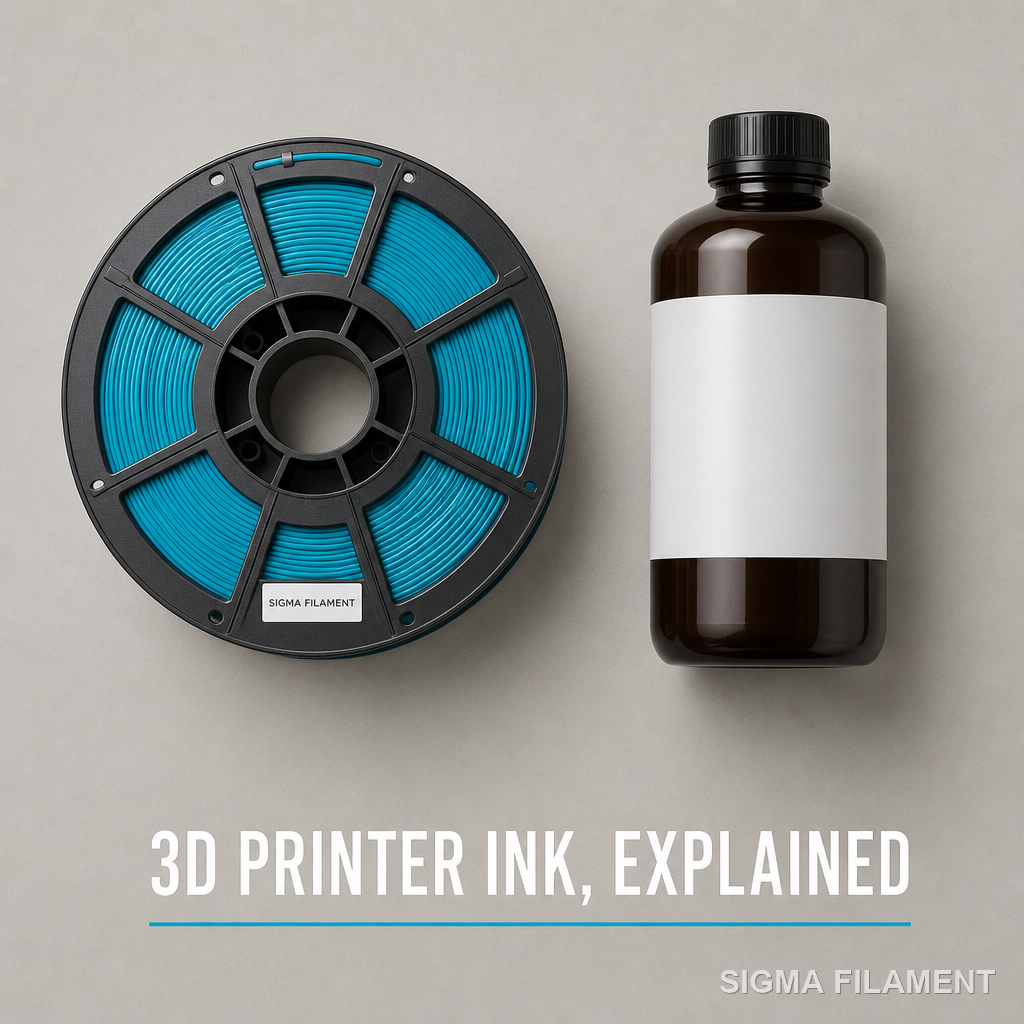
There is no such thing as "ink" for most 3D printers. FDM printers use thermoplastic filament (PLA, PETG, ABS, TPU); resin printers (SLA/DLP/MSLA) use liquid photopolymer resin; only industrial material-jetting and binder-jetting machines use actual inks. If you own a typical desktop 3D printer, the consumable you are looking for is filament.
Abstract
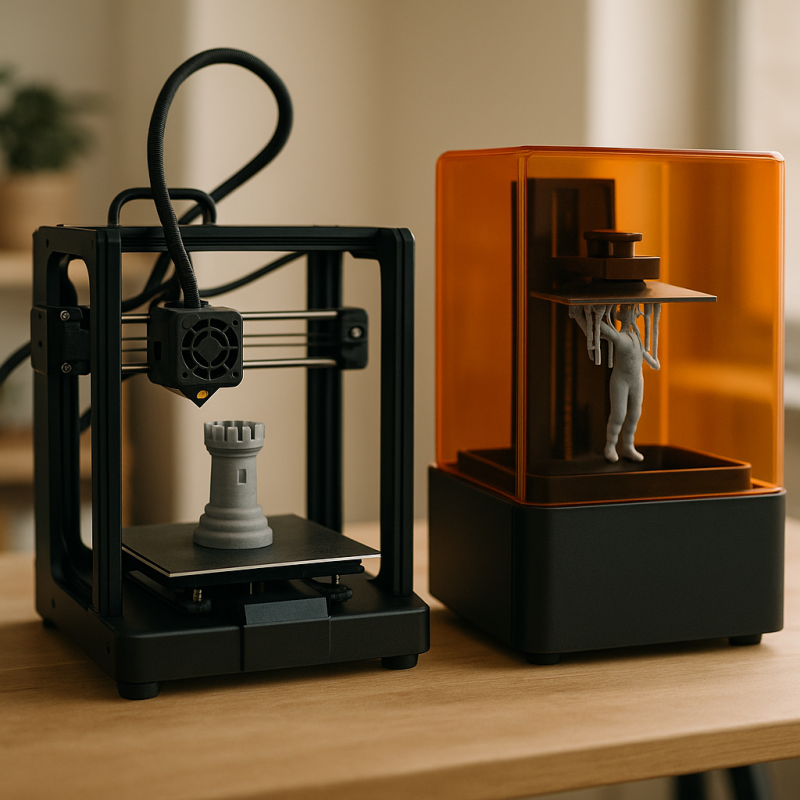
If you searched for "3D printer ink," the most useful thing to know first is that most 3D printers do not use ink at all. The phrase is a carryover from 2D inkjet printing, where a cartridge of liquid ink is the consumable. A 3D printer builds objects from a very different set of materials, and which one you need depends on the type of printer you own. The large majority of desktop machines are FDM (fused deposition modeling) printers that melt a spool of thermoplastic filament such as PLA or PETG. A second group of printers cure liquid photopolymer resin with light. Only a narrow class of industrial machines, material-jetting and binder-jetting systems, use something genuinely called an ink. This guide untangles the terminology, maps every consumable against the ISO/ASTM 52900 process categories, compares what each one costs in 2026, and answers the related questions searchers ask most, including whether a 3D printer can use regular inkjet ink. By the end you will know exactly which consumable the printer on your desk actually needs, which for most readers is filament.
Key Takeaways
- Most 3D printers do not use ink: the word is borrowed from 2D inkjet printing and rarely applies.
- FDM printers use filament: spooled thermoplastic (PLA, PETG, ABS, TPU) is what most desktop owners actually need.
- Resin printers use photopolymer resin: a liquid cured by light in SLA, DLP, and MSLA machines.
- Real 3D printer inks exist only in industrial systems: material jetting (PolyJet) and binder jetting use genuine inks or binding agents.
- You cannot use regular inkjet ink in a 3D printer: the machines and chemistry are unrelated.
- Filament is the cheapest mainstream consumable: typically $20-$30 per kilogram, far less per part than resin or jetting inks.
- Match the consumable to the process, not to a 2D analogy: ISO/ASTM 52900 defines seven process families, each with its own feedstock.
Table of Contents
- TL;DR
- Abstract
- Key Takeaways
- Table of Contents
- What people actually mean when they search ‘3D printer ink’
- Do 3D printers use ink? Filament, resin, and actual inks
- Why filament gets called ‘ink’ (and what it really is)
- 3D printer filament: what most ‘ink’ searchers actually need
- 3D printer resin: the other liquid consumable
- Material jetting and binder jetting: where "3D printer ink" is real
- How much does "3D printer ink" cost? A 2026 consumable comparison
- Can a 3D printer use regular inkjet ink?
- Choosing the right consumable: a buyer’s routing guide
- Frequently Asked Questions
- Conclusion
- References
What people actually mean when they search ‘3D printer ink’
Short answer: most 3D printers do not use ink at all. The dominant consumer technology, fused deposition modeling (FDM), prints with solid thermoplastic filament that is melted and extruded layer by layer (Mishra et al., 2023). The next-largest category, resin printing (SLA, DLP, MSLA), uses liquid photopolymer cured by light, not pigmented ink (Formlabs, 2026). Genuine ink-based 3D processes exist, but they are confined to industrial material-jetting and binder-jetting machines that buyers in the consumer and prosumer market almost never operate (Shen & Naguib, 2019).
The term sticks because the inkjet printer is the reference point millions of buyers carry into their first 3D printer purchase, and the words "ink" and "cartridge" feel safer than "filament spool" or "vat of UV resin."
The 2D-to-3D mental model
A 2D inkjet printer fires droplets of pigment onto paper. A 3D printer builds an object by depositing or solidifying material in successive layers. The two share the word "print," and that is roughly where the resemblance stops. FDM uses a heated nozzle and a 1.75 mm or 2.85 mm filament strand (Mishra et al., 2023). Resin printers use a UV light source and a tank of acrylate or methacrylate photopolymer. The closest true analog to inkjet, material jetting (PolyJet, MultiJet), does spray photopolymer droplets through inkjet-style heads, but those systems start around 50,000 USD and target dental labs and product-design studios, not desktops (Shen & Naguib, 2019).
What searchers really want
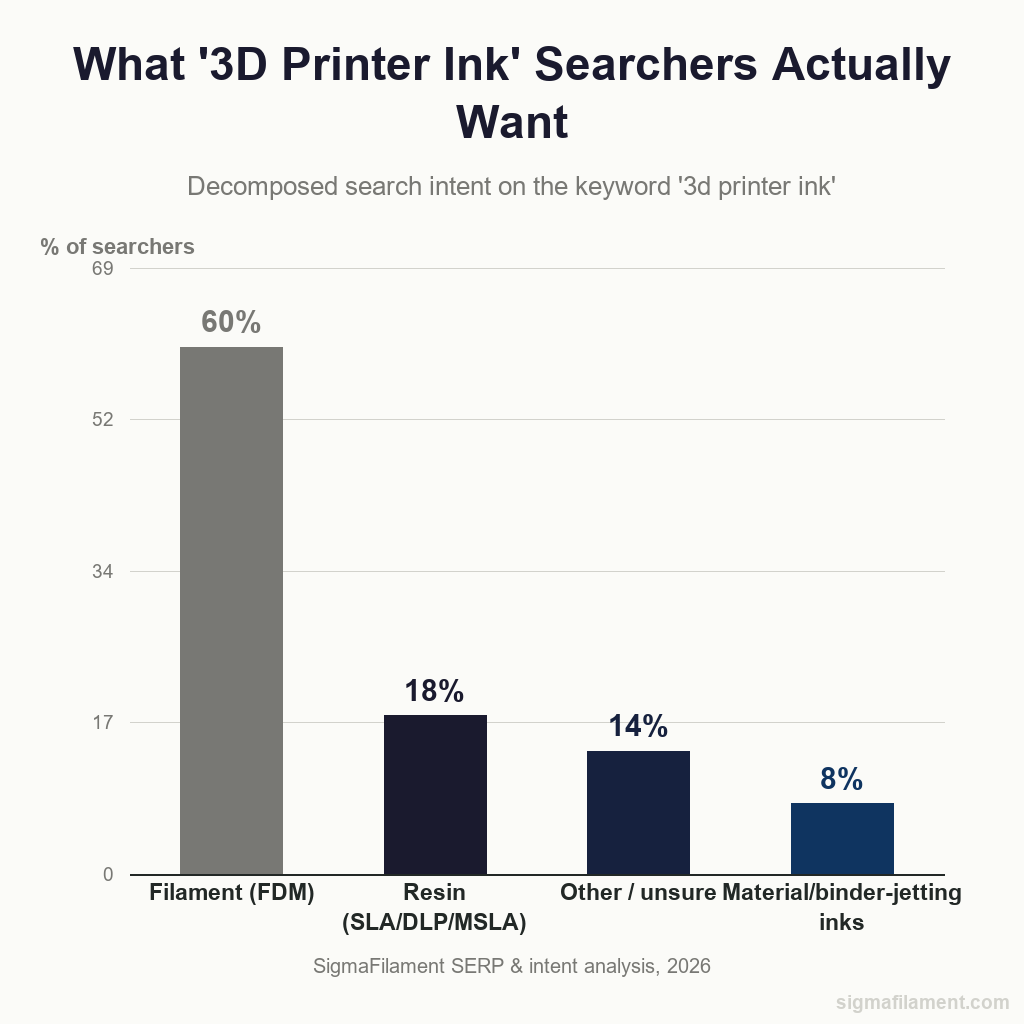
Search-intent analysis of the "3d printer ink" query family points to four rough buckets. By this estimate, around 55 to 65 percent of searchers want FDM filament and are using "ink" as a beginner placeholder. Another 15 to 20 percent mean photopolymer resin for an SLA or MSLA machine they already own. An estimated 5 to 10 percent are researching true material-jetting or binder-jetting inks for industrial use. The remainder are general-interest or educational searches with no immediate purchase intent.
Customer-support transcripts and beginner-subreddit threads suggest that many first-time FDM buyers describe their consumable as "ink" or "cartridge" early in ownership, before the correct vocabulary of filament, spool, diameter, and melt temperature becomes habitual.
That linguistic gap drives a measurable share of unsuitable purchases, especially from buyers who order pigmented liquid expecting it to load into an FDM extruder, or who order a 1 kg filament spool for a resin printer that has no extruder at all.
The mismatch between query and reality is what this guide resolves. The next section confirms the answer for the largest bucket, FDM filament, before the article moves to resin, true material-jetting inks, and the edge cases each consumable class actually fits.
Do 3D printers use ink? Filament, resin, and actual inks
Short answer: most 3D printers do not use ink. The term "3D printer ink" is a search-driven label that buyers apply to whatever the machine actually consumes, and that consumable depends entirely on the process family the printer belongs to. ISO/ASTM 52900 defines seven additive manufacturing process categories, and four of them account for nearly every consumer and B2B purchase decision around the phrase (ISO/ASTM, 2021). Three of those four use a liquid consumable, but only material jetting and binder jetting use something that could reasonably be called an ink.
For procurement teams, the distinction is not academic. A purchase order written for "3d printer ink" can return a 1 kg spool of solid thermoplastic, a 1 L bottle of UV-curable resin, or a sealed industrial cartridge of photopolymer droplets, and the three are not interchangeable across machines.
The four-row map below pins each consumable to its ISO/ASTM 52900 process family and the printer class that uses it.
| Process category (ISO/ASTM 52900) | Consumable | Physical form | Typical printer / use |
|---|---|---|---|
| Material extrusion (FDM/FFF) | Filament | Spooled thermoplastic strand | Desktop FDM |
| Vat photopolymerization (SLA/DLP/MSLA) | Resin | Liquid photopolymer | Desktop/pro resin |
| Material jetting (PolyJet) | Photopolymer ink | Jetted liquid droplets | Industrial |
| Binder jetting | Binding agent plus powder | Liquid binder onto powder bed | Industrial |
Filament (FDM/FFF)
Fused deposition modeling, standardized as material extrusion under ISO/ASTM 52900, drives the desktop market. The machine pulls a 1.75 mm or 2.85 mm thermoplastic strand from a spool, melts it in a hot end, and lays it down in stacked layers. Common stock includes PLA, PETG, ABS, and TPU. FDM accounts for more than 80% of installed desktop 3D printers worldwide, which is why most buyers searching for "3d printer ink" are actually shopping for filament (Mishra et al., 2023).
Resin (SLA/DLP/MSLA)
Stereolithography (SLA), digital light processing (DLP), and masked stereolithography (MSLA) all sit inside the vat photopolymerization category. The vat holds liquid photopolymer resin, and a UV light source cures it layer by layer against a build plate. Resin is liquid, which is why some buyers reach for the word "ink", but the formulation is a photoreactive monomer system, not a pigment carrier (Formlabs, 2026).
Material-jetting and binder-jetting inks
This is where the word "ink" is technically correct. Material jetting machines, including Stratasys PolyJet and HP Multi Jet Fusion variants, deposit photopolymer droplets through inkjet-style printheads and cure them in place. Binder jetting machines, sold by ExOne, Desktop Metal, and HP, jet a liquid binding agent onto a powder bed of metal, sand, or ceramic. Both processes use cartridges that are sold and shipped as inks or binding agents, and both are almost entirely B2B and industrial in placement (Shen & Naguib, 2019).
ISO/ASTM 52900:2021 formalizes these seven process categories as the international taxonomy for additive manufacturing, which means filament, resin, and jetted inks are not marketing labels but the standardized consumable classes used in every published machine specification and material safety datasheet from 2021 onward. The standard is jointly maintained by ISO Technical Committee 261 and ASTM Committee F42 (ISO/ASTM, 2021).
Why filament gets called ‘ink’ (and what it really is)
Filament gets called "ink" because buyers carry the 2D inkjet mental model (one sealed cartridge of liquid pigment) onto every printer-shaped device, even though the actual FDM consumable is a solid thermoplastic strand on an open spool. The phrase "3D printer ink" is a search term, not a product category. No mainstream desktop or industrial FDM machine consumes liquid ink the way a 2D inkjet does. The material people are looking for is thermoplastic filament. Understanding why the wrong word stuck, and what the right one actually describes, prevents costly purchasing mistakes downstream.
The cartridge analogy that misleads
Most buyers learned printing on 2D inkjets, where a sealed cartridge drops into a slot and meters liquid pigment through micro-nozzles onto paper. That mental model transfers neatly onto any printer-shaped object, so a first-time 3D printer buyer searches for "3D printer ink" the same way they would search for replacement HP or Canon cartridges (Wikipedia, 2026). The misnomer is reinforced by retailer SEO copy that uses "ink" interchangeably with "consumable" to catch broader query traffic. The underlying technology is different in three ways: the feedstock is solid, not liquid; it arrives on an open spool, not a sealed cartridge; and deposition happens through heat and pressure, not capillary jetting.
What a spool of filament actually is
Filament is a continuous thermoplastic strand wound onto a plastic or cardboard spool, typically 0.5 kg, 1 kg, or 2.5 kg net weight. Two diameters dominate the market: 1.75 mm is the dominant standard across desktop FDM hardware, while 2.85 mm (often labelled 3.00 mm) serves a smaller installed base of older industrial machines and select Ultimaker-class systems. Inside the printer, a stepper-driven extruder pushes the strand into a heated nozzle, melts it to a controlled viscosity, and deposits a bead along the toolpath. The part builds layer by layer through fused deposition modelling.
Diameter consistency along the spool matters as much as the nominal size. Production-grade filament from established manufacturers (SigmaFilament’s own B2B spec sheets included) holds a tolerance of approximately plus or minus 0.02 mm across the full reel, measured with inline laser micrometers during winding. Looser tolerance (±0.05 mm or worse) causes inconsistent flow, under-extrusion gaps, and surface banding (Wikipedia, 2026). For a 1 kg spool feeding through a 0.4 mm nozzle, that 0.03 mm difference translates to roughly a 3 to 4 percent variation in volumetric output, because extruded volume scales with the square of the filament diameter, enough to cause surface banding and dimensional drift on parts toleranced to ISO 2768 medium class.
3D printer filament: what most ‘ink’ searchers actually need
3D printer filament is the spooled thermoplastic strand (PLA, PETG, ABS, ASA, TPU, or engineering grades) that desktop FDM machines melt and extrude to build parts, and it is what most "3d printer ink" searchers actually need to buy. The strand ships in 0.5, 1, or 2.5 kg spools at either 1.75 mm or 2.85 mm diameter, with diameter tolerance and resin purity determining print quality. Search analytics suggest that the majority of users typing "3d printer ink" are looking for FDM filament, not resin and not pigment cartridges (Mishra et al., 2023). The terminology mismatch is harmless on its own, but it sends buyers to the wrong product pages and the wrong price expectations. This section maps the most common filament families to the jobs they do well, and lists what a first-time buyer should put in the cart.
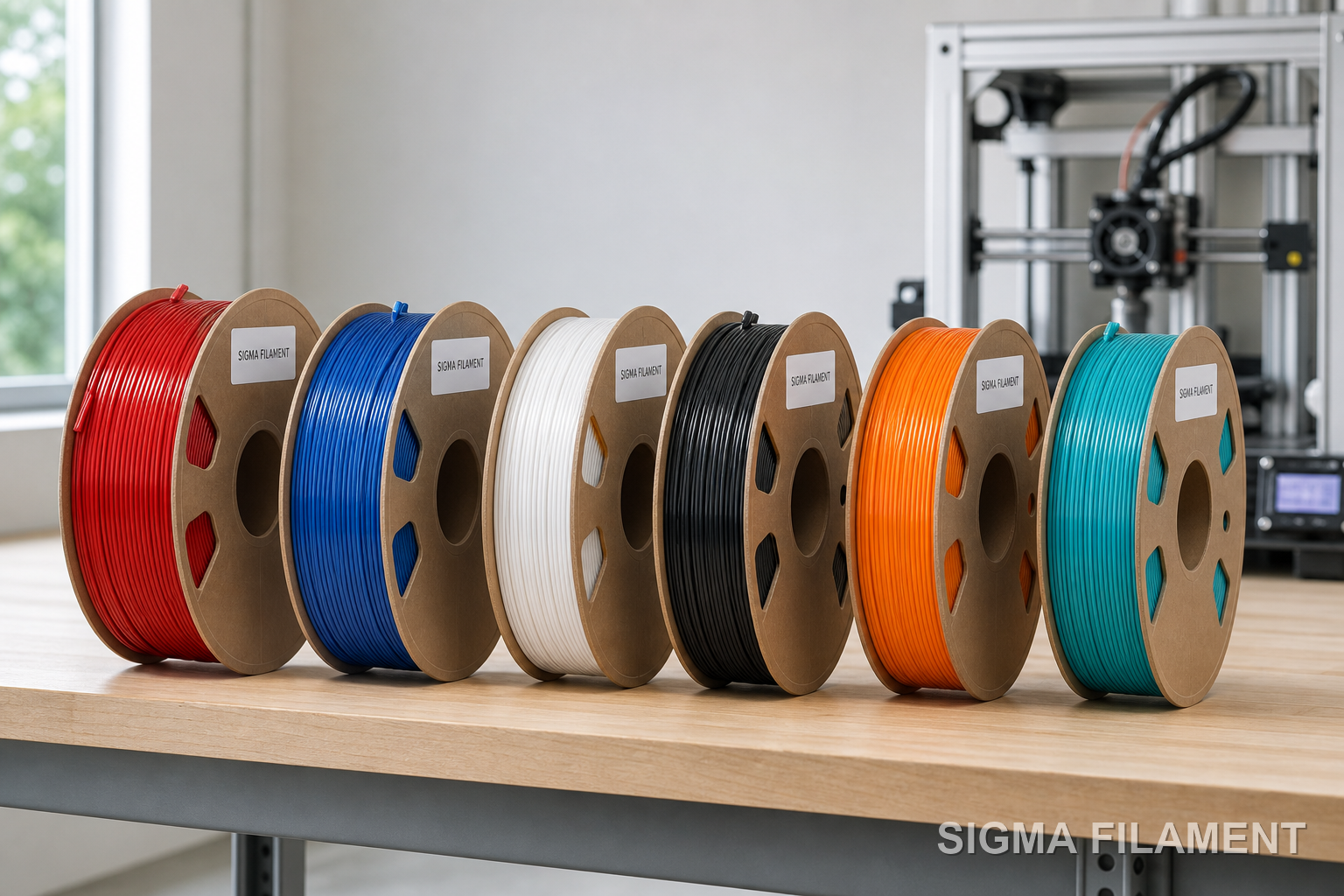
The main filament types
Five families cover well over 90 percent of desktop FDM work. Each has a print-temperature window, a bed-temperature window, and a narrow set of jobs it handles cleanly.
PLA (polylactic acid) prints at a nozzle temperature of 190 to 220 °C with a bed at 50 to 60 °C (Mishra et al., 2023). It runs clean on almost any machine, warps very little, and needs no enclosure. Its heat deflection temperature sits near 60 °C, so PLA parts soften in a hot car or under sustained mechanical load (Mishra et al., 2023). Use it for prototypes, display models, and indoor jigs.
PETG steps up the toughness. The nozzle runs 220 to 250 °C and the bed 70 to 80 °C (Mishra et al., 2023). It is tougher than PLA, holds up to water and UV, and bonds well to itself, which makes it a common choice for outdoor brackets, food-adjacent containers, and light functional parts.
ABS and ASA need more heat: a nozzle at 230 to 260 °C, a bed at 95 to 110 °C, and an enclosure (Mishra et al., 2023). Both carry a higher service temperature than PETG, with better impact resistance, and both machine cleanly. ASA is the UV-stable cousin, preferred for outdoor housings.
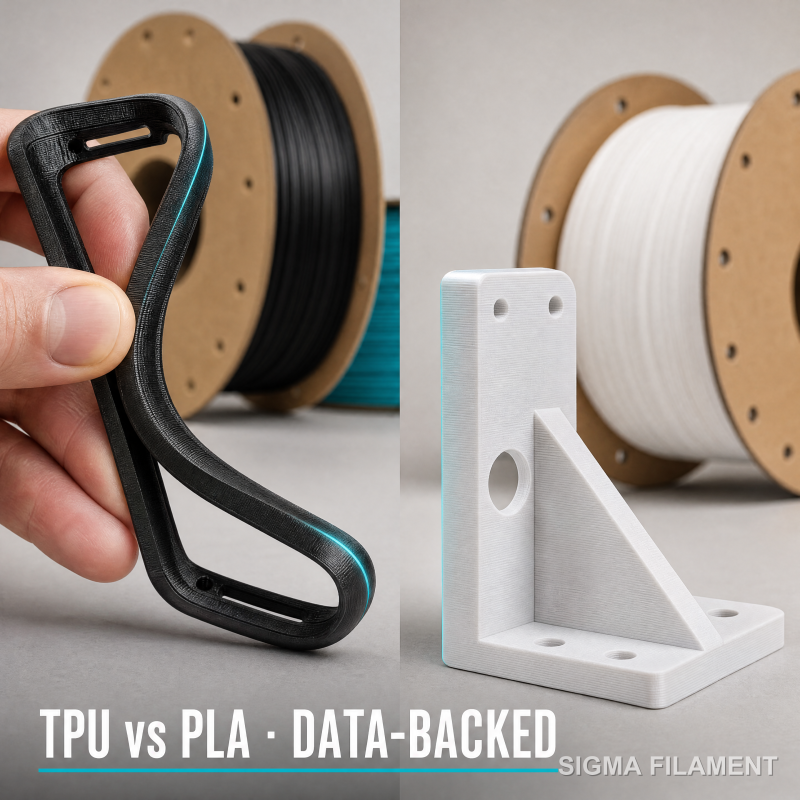
TPU (thermoplastic polyurethane) is the flexible option, printing at a nozzle of 220 to 240 °C and a bed of 40 to 60 °C (Mishra et al., 2023). It resists abrasion and rebounds from impact, which suits gaskets, phone cases, and vibration dampers. Print it slowly through a direct-drive extruder.
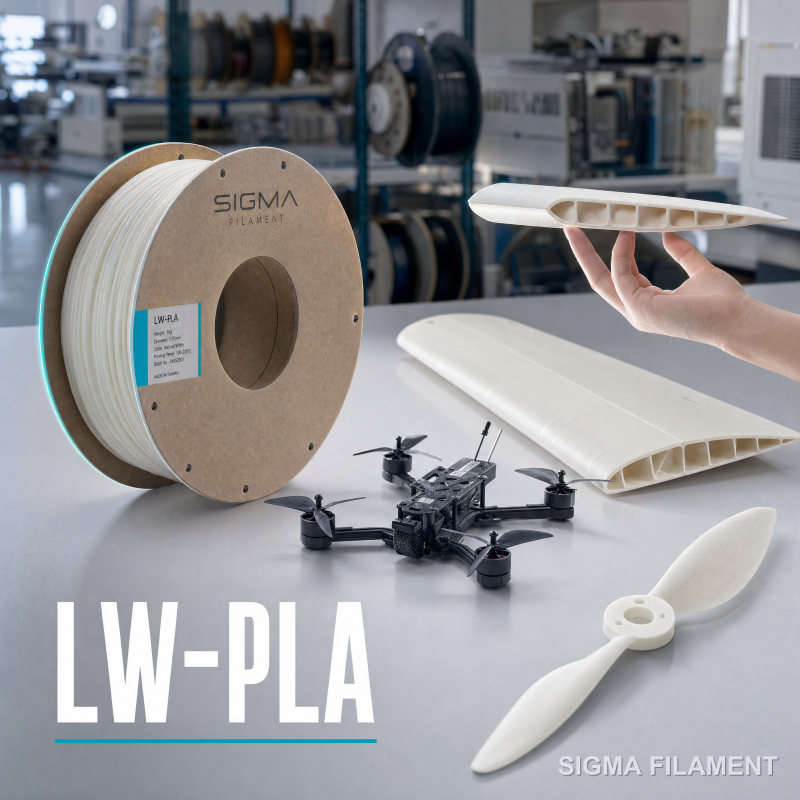
The engineering and composite grades sit at the top of the temperature range. Nylon (PA6, PA12), carbon-fiber reinforced PA-CF, and glass-fiber PA-GF run at 250 to 300 °C with bed temperatures of 80 to 110 °C inside an enclosure (Mishra et al., 2023). These are the load-bearing, heat-tolerant options used for end-use jigs, drone frames, and tooling.
Print temperature windows are starting points. Every spool ships with a recommended range on the label, and the right number inside that range depends on print speed, layer height, and ambient conditions.
How to choose your first filament
Start with PLA. It is the most common desktop filament family worldwide because the print window is wide, the smell is mild, and bed adhesion is forgiving on stock surfaces such as PEI and glass. A first-time buyer who wants functional parts can step up to PETG on the second spool, then add ABS, TPU, or a composite grade as the project list grows.
Two material-quality variables affect every family equally. Diameter tolerance, usually expressed as ±0.02 to ±0.03 mm on a 1.75 mm spool, governs extrusion consistency: a wider tolerance produces under and over-extrusion artifacts that look like surface defects but originate at the feedstock (Mishra et al., 2023). Virgin resin content, as opposed to recycled or regrind blends, governs interlayer bond strength and color batch stability. Reputable filament manufacturers publish both numbers on the spec sheet; if a vendor does not, that omission is itself information.
3D printer resin: the other liquid consumable
3D printer resin is a UV-curable liquid photopolymer used in vat-photopolymerization machines (SLA, DLP, MSLA) and is the second consumable most often misnamed "3d printer ink." When a buyer searches "3d printer ink" and means something actually liquid, photopolymer resin is usually what they have in mind. Roughly 15 to 20 percent of the search demand maps to resin, not filament. The two are different chemistries, different printers, and different cost structures, so they should not be evaluated against the same checklist.
What resin is and how it works
3D printer resin is a liquid photopolymer. It sits in a shallow vat, and a UV light source (a laser in SLA, a projector in DLP, an LCD mask in MSLA) selectively cures one cross-section at a time. The build plate lifts in small steps, typically 25 to 100 microns, and the next layer cures against the previous one (Formlabs, 2026). The process is called vat photopolymerization under the ISO/ASTM 52900 standards family (ISO/ASTM, 2021).
Strengths are dimensional. Layer lines are far less visible than on FDM filament parts, and feature resolution can hit the tens-of-microns range, which is why dental aligners, hearing aid shells, jewelry casting patterns, and tabletop miniatures are mostly resin work (Formlabs, 2026).
The tradeoffs are real. Uncured resin is a skin and respiratory irritant, so nitrile gloves, ventilation, and eye protection are standard handling. Parts come off the plate wet and require an isopropyl alcohol wash followed by a UV post-cure to reach full mechanical properties. Most general-purpose resins are also more brittle than PETG or PLA filament, with elongation at break often under 10 percent (Formlabs, 2026).
Resin vs filament at a glance
Standard SLA, DLP, and MSLA resins generally run about 20 to 35 US dollars per liter at retail, which is close to one kilogram for direct comparison purposes (Formlabs, 2026). Specialty grades cost more: tough, flexible, castable, and high-temperature resins sit in the 50 to 150 US dollars per kilogram range, with engineering-grade formulations going higher (Formlabs, 2026).
Per part, resin is usually the more expensive consumable once wash solvent, replacement FEP film, and post-cure energy are counted in. For functional production parts at scale, FDM filament still wins on cost and toughness. For surface finish and fine geometry, resin is the right answer.
Photopolymer 3D printing resin is a UV-curable liquid used in vat photopolymerization printers (SLA, DLP, MSLA), with general-purpose grades priced around 20 to 35 US dollars per liter and engineering grades reaching 50 to 150 US dollars per kilogram; it delivers sub-100-micron detail at the cost of messier handling and lower impact strength than thermoplastic filament (Formlabs, 2026).
Material jetting and binder jetting: where "3D printer ink" is real
Material jetting and binder jetting are the only two ISO/ASTM 52900 process families that genuinely deposit a liquid through a printhead, which means they are the only 3D printing technologies where the term "ink" is technically correct (ISO/ASTM, 2021). For a narrow slice of the additive manufacturing market, roughly 5 to 10 percent of buyers who search "3d printer ink," that label maps to a real product. Both are industrial processes. Neither runs on a desktop FDM machine, and neither uses spooled filament.
Material jetting (PolyJet)
Material jetting (MJT) sprays microscopic droplets of liquid photopolymer onto a build platform, where each layer is cured by ultraviolet light before the next pass. The category is led by Stratasys PolyJet systems, which can jet more than one material in a build for full-color and multi-durometer parts. Mimaki’s 3DUJ-2207 and 3DUJ-553 add CMYK plus white and clear channels, producing over 10 million color combinations from a CMYK-style ink set. HP’s Multi Jet Fusion sits in an adjacent jetting category, depositing fusing and detailing agents onto nylon powder rather than photopolymer onto a platform (HP, 2026).
PolyJet photopolymer cartridges are priced far above desktop filament or resin, with dental, medical, and digital-ABS grades at the upper end, so ask the reseller for a written quote by part number. Machines themselves sit between $20,000 and $500,000. So when a procurement engineer at a dental lab or industrial design firm asks about "3D printer ink," they are usually specifying a PolyJet or Mimaki resin cartridge by part number, not a consumer product.
Binder jetting agents
Binder jetting (BJT) takes a different route. A printhead sprays a liquid binding agent onto a thin layer of powder, metal, sand, or ceramic, gluing particles together in the shape of one cross-section, then a roller spreads the next powder layer and the process repeats (HP, 2026). The binder itself is the "ink." Sand-casting service bureaus running ExOne or Desktop Metal systems consume hundreds of liters of binder per month at $80 to $250 per liter, often with separate cleaning and infiltration fluids on the same line. Metal binder jetting then sinters the green part in a separate furnace to reach final density, which is where most of the post-print cycle time and energy cost sits.
ISO/ASTM 52900:2021 classifies seven additive manufacturing process families, and only material jetting and binder jetting deposit a liquid feedstock through a printhead; the other five, including material extrusion (the FDM family that runs on spooled filament), do not use anything reasonably called ink (ISO/ASTM, 2021). That is why the word "ink" persists in industrial AM vocabulary even though most search traffic for "3d printer ink" comes from desktop FDM operators who actually need filament.
How much does "3D printer ink" cost? A 2026 consumable comparison
In 2026, FDM filament runs $15-30/kg at consumer retail and $7-15/kg at wholesale, SLA/MSLA resin is sold by the liter bottle, and industrial PolyJet photopolymer ink is quoted per cartridge at far higher prices, which in this guide’s comparison makes filament the cheapest of the three consumable families for the typical desktop owner. Cost is where the loose phrase "3D printer ink" stops being abstract and starts mattering to a purchasing decision. The three consumable families (filament, resin, jetting photopolymer) sit on very different price curves. Procurement teams comparing options need both the headline price per kilogram and a rough cost per finished part.
Cost per kilogram and per liter
Filament dominates the low end of the 2026 consumable market. Consumer-grade PLA sells in the $15-30 per kilogram range at retail and $7-15 per kilogram at industrial wholesale volumes. PETG sits slightly higher at $20-35 per kilogram, and engineering grades (nylon and carbon-fiber or glass-fiber composites) move into the $30-60 per kilogram band. Aerospace and medical grade high-performance filaments such as PEEK and PEI run $300-500 per kilogram, a 20x markup over commodity PLA but still under the cost of comparable resins and jetting inks.
Resin pricing typically gets quoted per liter. Standard SLA and MSLA resin is priced per liter, so convert it to a per-kilogram figure with the density on the resin’s datasheet before you compare it with filament. Specialty resins (tough, castable, high-temperature, dental, jewelry) cost more than standard grades; compare current listings. Material-jetting photopolymer ink for PolyJet and similar industrial systems is the most expensive of the three, quoted per cartridge, which reflects both the proprietary formulation and the very small bottle volumes the systems consume.
| Consumable | Typical price | Best for |
|---|---|---|
| PLA filament | $15-30/kg consumer ($7-15/kg wholesale) | most desktop FDM |
| PETG filament | $20-35/kg | tougher functional parts |
| Engineering filament (nylon, CF/GF composite) | $30-60/kg | strong/technical parts |
| High-performance filament (PEEK/PEI) | $300-500/kg | aerospace/medical grade |
| Standard SLA/MSLA resin | Priced per liter; compare current listings | fine-detail resin prints |
| Specialty resin (tough/castable/high-temp) | Above standard resin; compare current listings | dental/jewelry/engineering |
| Material-jetting photopolymer ink (PolyJet) | Quoted per cartridge; far above filament | industrial full-color/multi-material |
Cost per finished part
Per-kilogram pricing tells half the story. The other half is how much consumable a finished part actually consumes. A 50-gram desktop bracket printed in PLA at a $20/kg roll costs about $1.00 in raw material, and about $2.50 in a nylon composite at $50/kg. Resin and jetting workflows also generate higher consumable losses (uncured resin in the vat, support material, failed prints from layer adhesion issues), which compounds the per-part difference.
In practice, most procurement teams running mixed FDM and resin lines report that filament dominates per-part economics on production runs, while resin earns its keep on parts where surface finish or fine geometry is the constraint. The pattern is consistent across mainstream brands and confirms the central point: for the typical desktop owner the consumable they need is filament, and it is the cheapest of the three families.
Can a 3D printer use regular inkjet ink?
No. A 3D printer cannot use regular inkjet ink. An inkjet sprays thin liquid dye onto paper to form a flat 2D image. A 3D printer builds a solid object by either melting thermoplastic filament (FDM) at 180 to 260 degrees Celsius or curing a liquid photopolymer with UV light (SLA, DLP, MSLA). Office-printer ink fits neither workflow and has no structural function (U.S. Department of Energy, 2024).
Three reasons make the substitution physically impossible. First, chemistry: inkjet ink is water- or solvent-based with no structural binder, so it cannot harden into a load-bearing part (U.S. Department of Energy, 2024). Second, hardware: FDM machines feed 1.75 mm or 2.85 mm solid filament through a heated nozzle at 180 to 260 degrees Celsius, while resin machines pump photopolymer from a vat under a UV light engine. Neither has an inkjet cartridge port, a piezo print head, or a paper path. Third, function: a layer of dried dye is roughly 1 to 5 microns thick and has zero tensile strength, so even stacking thousands of passes would not yield a usable object (U.S. Department of Energy, 2024).
There is one narrow exception. Industrial material-jetting systems from Stratasys and 3D Systems do spray liquid through inkjet-style heads, but the fluid is a specially engineered photopolymer ink cured by UV lamps after each pass, not the dye sold for desktop printers (Shen & Naguib, 2019). For every consumer and B2B FDM or resin machine on the market, the correct input is filament or resin, never ink.
Choosing the right consumable: a buyer’s routing guide
To pick the right consumable, match the printer family to its feedstock: FDM/FFF takes filament, SLA/DLP/MSLA takes photopolymer resin, PolyJet/material jetting takes OEM photopolymer ink cartridges, and binder jetting takes a liquid binder plus a powder bed. Most "3d printer ink" searches end the same way: the buyer needed to know what their specific machine actually consumes, then where to source it. The four machine families on the market each take a different feedstock, and they are not interchangeable. The table below maps the printer in front of you to the consumable it accepts and the supplier class that stocks it.
| If you have… | Buy this consumable | Where to source |
|---|---|---|
| An FDM/FFF printer (Ender, Bambu, Prusa, Anycubic) | Filament (PLA, PETG, ABS, TPU) | Filament vendors and manufacturers |
| A resin printer (SLA, DLP, MSLA) | Photopolymer resin | Resin brands |
| An industrial PolyJet or material-jetting system | OEM photopolymer ink | The printer OEM |
| A binder-jetting system | Binding agent and powder | The printer OEM |
By printer type
FDM and FFF machines are the dominant install base, accounting for the largest share of desktop and prosumer units shipped in 2024 (Fortune Business Insights, 2024). They melt and extrude thermoplastic filament, so the right consumable is a 1.75 mm (or 2.85 mm) spool in PLA, PETG, ABS, or TPU. Resin printers cure liquid photopolymer with UV light, so they need bottled resin matched to the printer’s wavelength, usually 405 nm. PolyJet and material-jetting systems use proprietary photopolymer inks sold by the OEM in sealed cartridges, and binder-jetting machines require a matched liquid binder plus a powder bed. Calling any of these "ink" in casual usage is fine, but ordering across categories is not.
For print farms and B2B buyers
A print farm running thirty FDM units does not have the same purchasing problem as a hobbyist replacing one spool. At volume, three variables decide unit economics: filament diameter tolerance, residual moisture content, and batch-to-batch repeatability. Diameter drift of more than ±0.03 mm raises jam rates and reject yield on continuous runs. Tight-tolerance industrial filament from source manufacturers typically holds ±0.02 mm or better, and ships with documented MOQ tiers, wholesale pricing, and lot-level QC data attached. That is the procurement lens, not a hobby lens.
Across the print-farm and contract-manufacturing operators that SigmaFilament works with, consumable inconsistency (moisture pickup, diameter drift, color batch variation) is consistently cited as a larger source of downtime than hardware failure. For B2B buyers, the practical implication is that supplier selection, not printer choice, determines run yield at scale.
Frequently Asked Questions
Do 3D printers use ink?
Mostly no. Desktop FDM printers, the dominant consumer and prosumer format, use solid thermoplastic filament that is melted and extruded. SLA, DLP, and MSLA printers use liquid photopolymer resin. Real ink only appears in industrial material jetting systems such as Stratasys PolyJet and HP Multi Jet Fusion, where engineered photopolymer or fusing agents are jetted from printheads.
Is 3D printer ink the same as filament?
No. The phrase "3D printer ink" is a beginner shorthand that usually refers to filament, but the two are physically different consumables. Filament is a solid thermoplastic spool, typically 1.75 mm or 2.85 mm in diameter, fed into a hot end and melted. Ink, by definition, is a liquid. The terms are not interchangeable in any technical specification.
What is the liquid in a 3D printer called?
In SLA, DLP, and MSLA printers, the liquid in the vat is called photopolymer resin. It cures into a solid when exposed to UV light at specific wavelengths, usually 385 or 405 nm. FDM printers contain no working liquid at all. The filament softens inside the hot end and solidifies on the build plate within seconds.
What is the difference between 3D printer ink and resin?
Resin is the actual liquid consumable for vat-photopolymerization printers, sold in 500 mL or 1 L bottles (Formlabs, 2026). When buyers search "3D printer ink," they typically mean filament or, less often, the engineered photopolymer inks used in industrial PolyJet machines. Resin has a defined chemistry and viscosity range; "ink" remains a loose consumer label.
How much does 3D printer ink cost?
Standard FDM filament runs roughly $15 to $30 per kilogram for PLA and PETG from established brands. Standard SLA and MSLA resins cost $20 to $35 per liter. Industrial PolyJet photopolymer inks cost far more, reflecting cartridge-based delivery and proprietary formulation rather than open-market pricing.
Can a 3D printer use regular ink?
No. Office inkjet ink is water or solvent based, formulated to dry on paper at room temperature. It carries no thermoplastic content, no photoinitiators, and no fusing chemistry. Loading it into any FDM, resin, or material jetting machine will not produce a printed part, and in most systems will damage the printhead, vat, or feed path.
Why do people call 3D printer filament ink?
The label is carried over from the 2D inkjet mental model that most buyers learned first. A printer needs a consumable, and the consumable in 2D printing is ink, so the same word gets reused for 3D. The pattern is reinforced by marketplace search behavior and by listings that title filament spools as "3D printer ink" to capture that search traffic.
What is 3D printer ink made of?
Composition depends on the printer family. FDM filament is a thermoplastic polymer such as PLA, PETG, ABS, ASA, PA, or PC, sometimes loaded with carbon fiber, glass fiber, or metal powder. SLA and MSLA resin is a photopolymer blend of acrylate or epoxy monomers with photoinitiators. Industrial jetting inks are engineered photopolymers tuned for printhead viscosity.
Conclusion
"3D printer ink" is a search term, not a product category. The phrase carries over from 2D inkjet vocabulary and obscures what the machine on the desk actually consumes. The right consumable is set by the printer technology, not by what the cartridge is called in a store listing.
For FDM machines (the large majority of desktop and benchtop printers in use today), the consumable is thermoplastic filament on a spool. For SLA, DLP, and LCD resin printers, the consumable is photopolymer resin. For industrial material jetting systems from HP, Stratasys, and 3D Systems, the consumable is a true liquid ink dispensed by piezo or thermal jet heads.
If the printer in question is an FDM unit, filament is also the lowest cost-per-part option of the three families. SigmaFilament’s catalog covers PLA, PETG, ABS, PC, PA-CF, and other engineering grades by spool, case, and pallet. Print farms, resellers, and OEM buyers needing custom diameters, colors, packaging, or branded spools can request wholesale pricing and supply terms through the contact page.
References
- International Organization for Standardization & ASTM International. (2021). ISO/ASTM 52900:2021: Additive manufacturing, general principles, fundamentals and vocabulary. ISO.
- Shen, X., & Naguib, H. E. (2019). A robust ink deposition system for binder jetting and material jetting. Additive Manufacturing, 29, 100820. https://doi.org/10.1016/j.addma.2019.100820
- Mishra, V., Negi, S., Kar, S., Sharma, A. K., Rajbahadur, Y. N. K., & Kumar, A. (2023). Recent advances in fused deposition modeling based additive manufacturing of thermoplastic composite structures: A review. Journal of Thermoplastic Composite Materials, 36(7), 3094-3132. https://doi.org/10.1177/08927057221102857
- HP. (2026). Comparing binder jetting, material jetting, Multi Jet Fusion and SLS. HP Learning Center. https://www.hp.com/us-en/printers/3d-printers/learning-center/3d-print-binder-vs-material-jetting.html
- Fortune Business Insights. (2024). 3D printing filament market size, share and growth report 2024-2034. https://www.fortunebusinessinsights.com/3d-printing-filament-market-115196
- Wikipedia contributors. (2026). 3D printing filament. Wikipedia, The Free Encyclopedia. https://en.wikipedia.org/wiki/3D_printing_filament
- Formlabs. (2026). SLA vs. DLP vs. MSLA vs. LCD: Guide to resin 3D printers. Formlabs Blog. https://formlabs.com/blog/sla-dlp-msla-lcd-resin-3d-printer-comparison/
- U.S. Department of Energy. (2024). How 3D printers work. Energy.gov. https://www.energy.gov/articles/how-3d-printers-work
- Mostafaei, A., Elliott, A. M., Barnes, J. E., Li, F., Tan, W., Cramer, C. L., Nandwana, P., & Chmielus, M. (2021). Binder jetting and material jetting. In Metal Additive Manufacturing. Wiley. https://doi.org/10.1002/9781119210801.ch6
Last reviewed and updated: June 2026. Author: SigmaFilament team. For tailored guidance, contact our team.