ABS Melting Point: 5 Critical Temperatures That Actually Matter


TL;DR
ABS has no melting point because it is amorphous (no crystalline domains). The temperatures that matter are: Tg ~105 C (range 100-115 C), FDM nozzle 220-250 C, heated bed 95-110 C with a 40-60 C enclosure, HDT 88-100 C at 1.8 MPa per ASTM D648, and degradation onset ~340-350 C per TGA. At production volume, batch-to-batch Tg variance from virgin-resin SAN/butadiene ratio control is the difference between predictable and unpredictable thermal behavior.
Abstract
Search "abs melting point" and most pages hand you a single number, yet that number is physically meaningless. ABS (acrylonitrile butadiene styrene) is an amorphous thermoplastic with no crystalline domains, so it has no true melting point and no latent heat of fusion. It does not transition sharply from solid to liquid the way a semi-crystalline polymer such as PLA does. Instead it softens progressively as temperature rises, which is exactly why "ABS melts at 105°C" and "ABS melts at 220°C" are both wrong despite both numbers appearing in real datasheets.
This guide replaces the melting-point myth with the five temperatures that actually govern how ABS prints, deforms, and fails: glass transition (Tg ~105°C), the FDM nozzle window (220-250°C), the heated-bed and enclosure range (95-110°C bed, 40-60°C ambient), heat deflection temperature (88-100°C at 1.8 MPa per ASTM D648), and thermal degradation onset (~340-350°C). Each value is tied to a standardized test method and peer-reviewed or industry data. The final section covers what engineering and print-farm buyers should ask suppliers, because at production volume, batch-to-batch Tg consistency from virgin-resin formulation control is what separates predictable thermal behavior from unpredictable scrap.
Key Takeaways
- ABS has no true melting point. It is amorphous, so it has no crystalline melt transition and no latent heat of fusion; it softens gradually instead.
- Glass transition (Tg) is the number that matters: ~105°C, with a practical range of 100-115°C, measured by DSC per ASTM D3418.
- The FDM nozzle window is 220-250°C. This is a processing range where viscosity drops enough to extrude, not a phase change or a melting point.
- ABS needs a 95-110°C heated bed and a 40-60°C enclosure to slow cooling through Tg and control warping.
- Heat deflection temperature (HDT) is 88-100°C at 1.8 MPa per ASTM D648, the realistic ceiling for loaded parts in service.
- Thermal degradation onset is ~340-350°C; running a nozzle far above 250-270°C risks chain scission, styrene release, and embrittlement.
- Batch-to-batch Tg consistency depends on virgin-resin SAN and butadiene ratio control, which is why resin sourcing is a thermal-performance decision at volume.
Table of Contents
- TL;DR
- Abstract
- Key Takeaways
- Table of Contents
- The Honest Answer: ABS Has No True Melting Point
- ABS Glass Transition Temperature (Tg): The Number That Actually Matters
- ABS Print Temperature for FDM (Nozzle, Bed, Enclosure)
- Heat Deflection Temperature (HDT): When ABS Parts Actually Deform Under Load
- Thermal Degradation: The Upper Hard Ceiling
- ABS vs ABS+ vs ASA vs PETG vs PLA: Thermal Comparison
- Why ABS Warps: The Tg-Shrinkage Connection
- B2B Sourcing: Virgin Resin and Batch-to-Batch Thermal Consistency
- Frequently Asked Questions
- Conclusion
- References
The Honest Answer: ABS Has No True Melting Point
ABS has no true melting point. Acrylonitrile butadiene styrene (ABS) is a fully amorphous thermoplastic terpolymer of acrylonitrile, 1,3-butadiene, and styrene, so it never undergoes a sharp solid-to-liquid phase change. The number most often quoted as the "abs melting point", around 105 °C, is the glass transition temperature (Tg). The 220-250 °C figure quoted for FDM is a processing window, not a phase transition (Wikipedia contributors, 2026; Balart et al., 2019).
Amorphous vs semi-crystalline thermoplastics
Semi-crystalline polymers such as nylon and PEEK, along with PLA, contain ordered crystalline domains that melt at a discrete temperature called Tm. Amorphous polymers do not. ABS is a two-phase blend of a styrene-acrylonitrile (SAN) matrix with dispersed polybutadiene rubber particles; neither phase forms crystalline lattices that can melt. Without crystallinity, there is no Tm to report, which is why every authoritative ABS datasheet lists Tg and heat deflection temperature instead of a single melting value. The two polymer architectures behave differently on cooling as well: semi-crystalline grades recrystallize at a sharp temperature and shrink sharply with it, while amorphous ABS contracts gradually from the SAN matrix as it passes through Tg.
Why "ABS melts at 105 °C" and "ABS melts at 220 °C" are both wrong
The 105 °C figure describes the glass transition, where the SAN matrix softens from a rigid glass into a rubbery state. The material does not flow at 105 °C, it just loses stiffness. The 220-250 °C nozzle range describes the viscosity-drop window where ABS becomes shear-thinnable enough to extrude through a 0.4 mm orifice. Energy input at these temperatures lowers viscosity continuously rather than triggering a discrete melt event, so neither value is a melting point in the thermodynamic sense.
First-order vs second-order phase transitions
A true melting point is a first-order transition, marked by a sharp peak in a differential scanning calorimetry (DSC) trace and a measurable latent heat of fusion. ABS shows neither. The Tg appears in DSC as a step change in the heat-flow baseline, a classic second-order transition with no enthalpy spike (SpecialChem, 2024). There is no latent heat to absorb because no crystals are dissolving; the polymer simply gains free volume as the SAN backbone gains mobility (SpecialChem, 2024). Practically, this is why ABS softens over a broad temperature band instead of liquefying at a knife-edge value, and why the question has no single-number answer.
Reference DSC data for ABS places the glass transition near 105 °C measured per ASTM D3418, with no melting endotherm anywhere on the curve up to thermal degradation onset around 340 °C (Wikipedia contributors, 2026; ASTM International, 2021). The absence of a Tm peak is the defining DSC signature of an amorphous polymer.
For engineers and OEM buyers, the takeaway is operational. A single "ABS melting point" figure is the wrong variable to specify on a drawing or a purchase order. Tg governs service ceiling and warp behavior, the FDM nozzle window governs processability, and HDT governs load-bearing limits under stress. The next five sections quantify each of these numbers, walk through the ASTM and ISO test methods that produce them, and tie them back to the underlying material science.
ABS Glass Transition Temperature (Tg): The Number That Actually Matters
Most pages ranking for "ABS melting point" are quoting the glass transition temperature without admitting it. The honest number is Tg, not a melting point, and for standard injection and FDM grades it sits at roughly 105 °C, with a documented range of 100 to 115 °C (Wikipedia contributors, 2026). That single value sets the heated bed setpoint, the enclosure target, the continuous service ceiling, and the warp behavior of any printed part.
What Tg is and why it governs ABS behavior
Glass transition is the temperature at which the amorphous polymer chains in the styrene-acrylonitrile (SAN) matrix gain enough thermal energy for long-range segmental mobility. Below Tg the polymer is a hard glassy solid; above Tg it relaxes into a rubbery state where chains can slide past one another under stress. This is a second-order phase transition, meaning there is no latent heat of fusion and no sharp solid-to-liquid event (SpecialChem, 2024). Energy input drives a continuous modulus and viscosity drop, not a step. That is why describing the material with a single melting number is physically incorrect, even when the number quoted is roughly right.
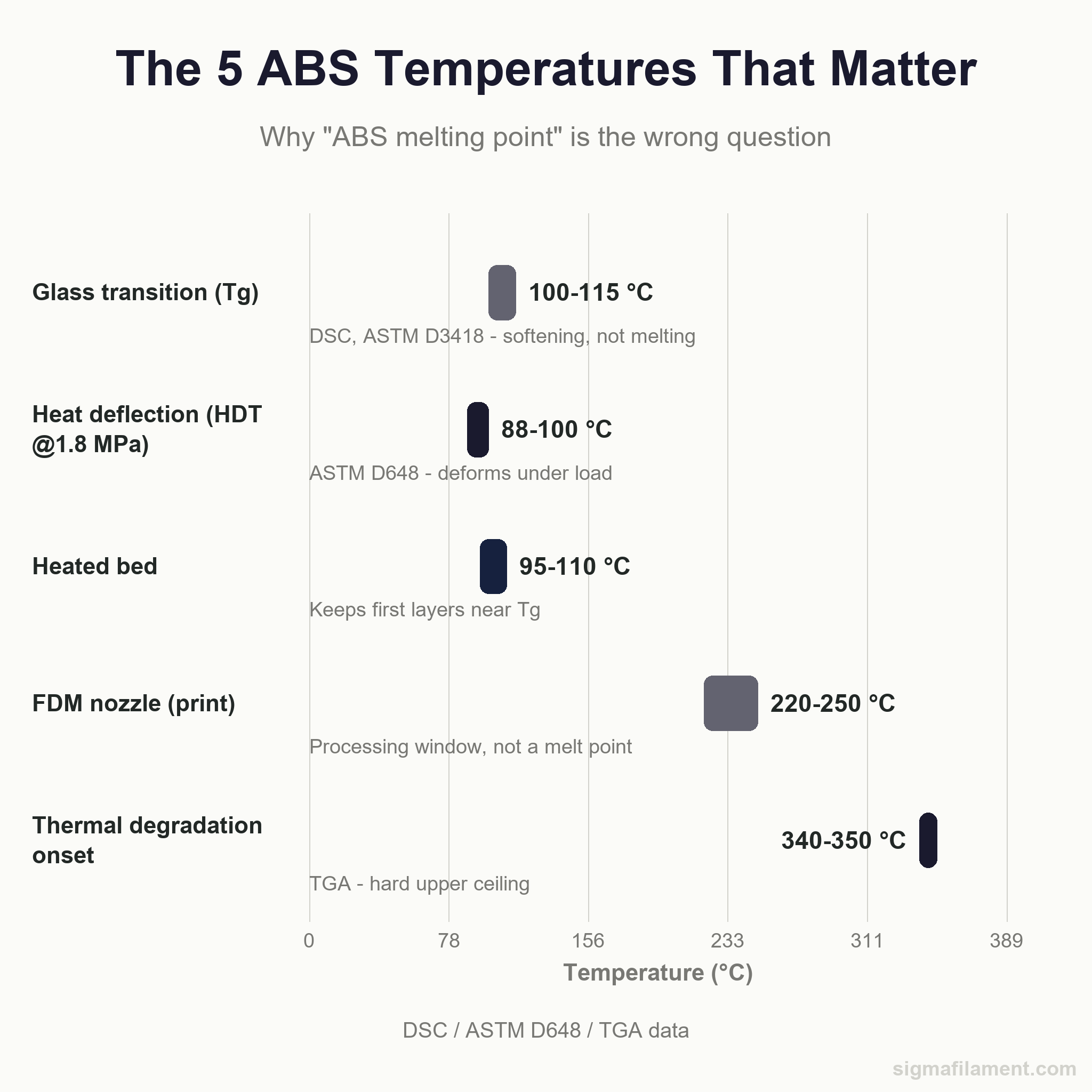
The ladder above shows where Tg sits against the four other zones engineers have to manage: the heated bed window at 95 to 110 °C, the FDM nozzle window at 220 to 250 °C, the HDT band at 88 to 100 °C under load, and degradation onset above 340 °C.
Measuring Tg by DSC (ASTM D3418 / ISO 11357)
Tg is measured by Differential Scanning Calorimetry per ASTM D3418, with the equivalent international method ISO 11357 (ASTM International, 2021). A 5 to 10 mg sample is heated at a controlled rate (10 °C/min is the standard) while heat flow into the pan is compared against an empty reference. Because the transition has no latent heat, it does not appear as a peak; it appears as a step change in the baseline heat-flow curve, and Tg is reported at the midpoint of that step. Dynamic Mechanical Analysis (DMA) is the second method of record and tends to report Tg a few degrees higher because it tracks the mechanical loss peak rather than the thermodynamic baseline shift.
ABS exhibits a glass transition near 105 °C measured by DSC per ASTM D3418, and the transition is a second-order shift in heat-flow baseline with no latent heat of fusion, which is why a single "ABS melting point" number cannot describe the thermal behavior of the material accurately (Wikipedia contributors, 2026; ASTM International, 2021).
Why Tg drives warping, service ceiling, and enclosure spec
Three downstream decisions follow directly from Tg. First, the continuous-service ceiling for unloaded ABS parts sits roughly 20 to 30 °C below Tg, because chain mobility starts climbing before the formal transition midpoint. Second, the heated bed runs at 95 to 110 °C specifically to hold the first layers close to Tg so they bond and resist lift. Third, an enclosure that holds ambient at 40 to 60 °C slows the rate at which each new layer cools through Tg, which suppresses the differential shrinkage that causes corner curl. Treat Tg as the anchor number, and every other ABS print or service decision becomes a derivation rather than a guess at a temperature that does not exist.
ABS Print Temperature for FDM (Nozzle, Bed, Enclosure)
Across the core FDM filament materials, slicer profiles ask for three temperatures, and none of them is an abs melting point for ABS. They are a viscosity-drop processing window at the nozzle, a Tg-anchored adhesion temperature at the bed, and a chamber ambient that controls how fast the part cools through Tg. Setting each one correctly, with the right hardware behind it, is the difference between a clean 200 mm corner and a delaminated lift.
Nozzle temperature: 220-250 C
Standard ABS extrudes well at 220-250 C, with some toughened or high-flow grades pushed to 260 C for fast print speeds (Wevolver, 2025). This range is not an abs melting point; the polymer never undergoes a first-order phase transition because there are no crystalline domains to melt. Heat lowers the SAN-matrix viscosity continuously until the filament flows through a 0.4 mm orifice at print-head speeds. Start tuning at 235 C, run a temperature tower in 5 C steps from 220 to 250 C, and pick the lowest temperature that gives clean overhangs and full inter-layer bonding. Higher nozzle settings improve layer adhesion and tensile strength along the Z axis, but they also raise styrene VOC emissions and accelerate filament oxidation. Never run sustained above 270 C; degradation kinetics dominate above that line and mechanical properties fall off sharply.
Heated bed: 95-110 C
A 95-110 C heated bed is required, not optional, for any ABS print above a 50 mm footprint (Wevolver, 2025). The number comes straight from Tg: holding the first 2-3 layers within ~10 C of the 105 C glass transition keeps them in the rubbery state long enough to bond to the build surface and to the layers stacked above. Drop below 90 C and the first layer locks in differential shrinkage almost immediately, lifting corners off the bed. PEI sheets, garolite, and ABS slurry on glass all work; the bed temperature matters more than the surface chemistry. For first-layer adhesion, run 110 C for the first layer and step down to 100 C for the rest of the print to reduce elephant’s foot.
Enclosure / chamber: 40-60 C ambient
A passive or actively heated enclosure holding 40-60 C ambient is standard practice for ABS, and mandatory for parts over roughly 150 mm in any axis (Samy et al., 2022). Raising chamber temperature toward Tg slows the cooling rate through the glass transition, so shrinkage is uniform rather than locked in layer-by-layer. Commercial enclosed printers such as the Bambu Lab X1C and similar chamber-heated machines and the Voron Trident hit this band passively from bed and motor heat alone; bed-slinger machines need an added enclosure panel kit and a chamber thermistor. Side benefit: an enclosure captures the styrene and 1,3-butadiene VOCs that ABS evolves during extrusion, so vent the cabinet to outside air or a HEPA + activated-carbon filter when printing indoors.
Hardware: all-metal hotend and filament dryness
The 220-250 C nozzle window is above the PTFE-lined-hotend safe ceiling of about 240 C, so an all-metal hotend (titanium heat break, hardened-steel or copper nozzle) is required for ABS. PTFE liners degrade above 240 C and outgas fluorine compounds that contaminate the melt. Filament moisture is the second hardware variable: ABS is mildly hygroscopic and absorbs 0.2-0.4% water by weight at 50% relative humidity within 48 hours, which causes steam bubbles, surface popping, and 10-15% tensile-strength loss. Dry virgin ABS at 80 C for 4 hours before printing and run from a sealed dry-box at <15% RH for any print over 6 hours; the same filament storage discipline that protects nylon and TPU applies to ABS for any long print job.
Wevolver’s 2025 ABS print-temperature guide consolidates the three numbers used across the FDM industry: nozzle 220-250 C, heated bed 95-110 C, and enclosure ambient 40-60 C. None of these is the abs melting point. ABS is amorphous, and the three temperatures govern viscosity at the nozzle, adhesion at the bed, and shrinkage through the glass transition at 105 C.
Heat Deflection Temperature (HDT): When ABS Parts Actually Deform Under Load
Glass transition tells you when an unloaded ABS specimen begins to soften. Heat deflection temperature (HDT) tells you when a loaded ABS part bends out of spec in service, and it sits at the center of any heat-resistant filament selection for production use. For any functional bracket, enclosure, or housing, HDT is the in-service ceiling that governs how a part behaves under real mechanical stress, and it sits below Tg for a reason. Searches for the "abs melting point" almost always mean this number, not the extrusion window.
What HDT measures and the ASTM D648 method
Under ASTM D648, a rectangular bar 127 mm long is supported on a 100 mm span, immersed in a stirred oil bath, and loaded at its midpoint. The bath is heated at 2 °C per minute. HDT is the temperature at which the bar deflects 0.25 mm under that load (ASTM International, 2018). The result is a single number that bundles modulus loss and creep-driven softening into one practical threshold.
0.46 MPa vs 1.8 MPa loading
ASTM D648 reports two values. At the lighter 0.46 MPa load, ABS HDT lands at roughly 68-100 °C, depending on grade and rubber content. At the structural 1.8 MPa load, standard ABS HDT is 88-100 °C, with general-purpose injection grades clustering near 98 °C (ASTM International, 2018). The 1.8 MPa value is the one engineers use to qualify a part for load-bearing duty; the 0.46 MPa value applies to lightly stressed covers and decorative pieces.
HDT vs Tg and the continuous-use ceiling
HDT falls below Tg (~105 °C) because applied load accelerates segmental motion in the SAN matrix. Once chains can flow, even a small force closes the deflection gap. For continuous load-bearing service, the practical safe ceiling is HDT minus 10-20 °C, which puts standard ABS at about 70-80 °C (SpecialChem, 2024). An ABS dashboard panel can sit in a 70 °C cabin without visible creep; raise that to 90 °C and the same part starts to bow within hours. The same HDT reasoning drives material picks for electronic enclosure builds where internal heat sinks and power supplies hold the housing well above room ambient.
This is why the "abs melting point" framing misleads designers. No such number exists; the in-service ceiling does, and HDT is how engineers quantify it. An ABS part softens and creeps well below any extrusion temperature. ABS still beats PLA in functional-part service (HDT ~55 °C) and PETG (60-70 °C) for any housing, jig, or enclosure that sees direct sun, motor heat, or dishwasher cycles, which is the reason ABS remains the default for heat-exposed functional parts.
ASTM D648 defines HDT as the temperature at which a loaded polymer bar deflects 0.25 mm under either 0.46 MPa or 1.8 MPa, ramped at 2 °C per minute. Standard ABS reports 88-100 °C at 1.8 MPa, with general-purpose injection grades near 98 °C, well below the ~105 °C Tg.
Thermal Degradation: The Upper Hard Ceiling
Above the FDM print window, ABS hits a chemical ceiling that no process tuning can move. Thermogravimetric analysis (TGA) places the onset of measurable mass loss at roughly 340 to 350 °C, where the styrene-acrylonitrile (SAN) matrix begins to break apart faster than it can be reformed (Tiganis et al., 2002; Balart et al., 2019). This is the temperature at which "ABS melting point" stops being a useful framing entirely: the polymer does not melt cleanly, it decomposes.
The TGA trace then shows the main SAN-phase mass-loss step centered around 425 °C, with the butadiene-phase contribution overlapping the styrenic step closely enough that dynamic TGA cannot cleanly separate the two processes (Tiganis et al., 2002). Chemically, the chain scission liberates styrene monomer, 1,3-butadiene, acrylonitrile fragments, and a family of volatile organic compounds (VOCs) and ultrafine particles. Mechanically, the part that survives the heat is no longer the same material: color shifts toward yellow-brown, impact strength drops, and the surface becomes brittle.
Thermogravimetric analysis by Tiganis et al. (2002) places the ABS degradation onset near 340 to 350 °C, with the dominant SAN mass-loss step centered around 425 °C. Because chain scission accelerates well before that onset, any nozzle setpoint above 270 °C trades short-term flow for permanent embrittlement and out-of-spec parts.
Balart et al. (2019), in their kinetic analysis of ABS by non-isothermal thermogravimetry, report a degradation onset in the 340-350 °C band and a dominant mass-loss event in which the styrenic and butadiene degradation processes overlap and cannot be separated in dynamic TGA. That data confirms the upper hard ceiling for any ABS thermal process and is corroborated by Tiganis et al. (2002), who place the main step centered near 425 °C for ABS blends.
The practical takeaway for the abs melting point question is firm: stay well under the onset. Sustained processing above approximately 274 to 288 °C accelerates decomposition long before TGA shows a clear mass loss, and any nozzle setpoint above ~270 °C trades short-term flow for long-term embrittlement and out-of-spec parts. The "hotter is better" instinct that solves stringing or under-extrusion has a hard limit, and that limit is set by SAN chemistry, not by the heater block.
This is also where ventilation matters. The same chain-scission reactions that erode mechanical properties release styrene monomer and related VOCs into the print enclosure, and SDS guidance for ABS recommends both an enclosed chamber and active exhaust whenever processing temperature climbs toward this regime (Tiganis et al., 2002). For B2B production, the engineering rule is simple. Keep the nozzle inside the validated 220 to 250 °C window for the abs melting point use case, treat 270 °C as a hard alarm, and never push beyond. Treat the abs melting point not as a single number but as a thermal envelope bounded above by the 340 to 350 °C degradation onset. Operate inside the envelope, document the setpoints, and the resin behaves predictably batch after batch.
ABS vs ABS+ vs ASA vs PETG vs PLA: Thermal Comparison
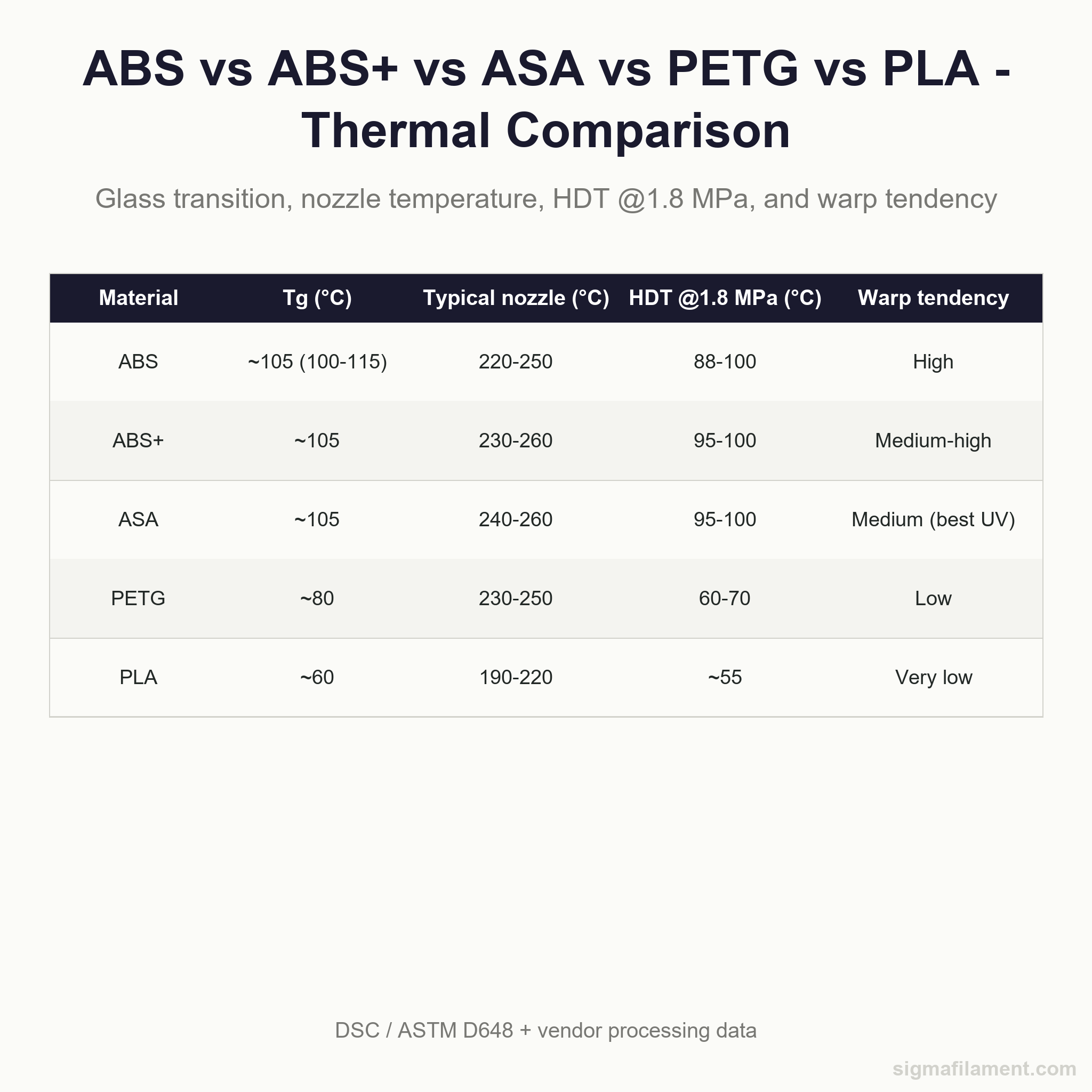
The phrase "abs melting point" only makes sense when read against the other styrenic and polyester filaments engineers actually choose between in a side-by-side material comparison. The table below sets ABS, ABS+, ASA, PETG, and PLA side by side on the four thermal numbers that drive material selection: glass transition (Tg), typical FDM nozzle window, heat deflection temperature (HDT) at 1.8 MPa per ASTM D648, and warp tendency on an open bed.
| Material | Tg (°C) | Typical nozzle (°C) | HDT @ 1.8 MPa (°C) | Warp tendency |
|---|---|---|---|---|
| ABS | ~105 (100-115) (Wikipedia contributors, 2026) | 220-250 | 88-100 | High |
| ABS+ | ~105 | 230-260 | 95-100 | Medium-high |
| ASA | ~105 (Wikipedia contributors, 2026) | 240-260 | 95-100 | Medium (best UV) |
| PETG | ~80 (Wevolver, 2025) | 230-250 | 60-70 | Low |
| PLA | ~60 (NETZSCH Analyzing & Testing, 2024) | 190-220 | ~55 | Very low |
Four of these five are amorphous: ABS, ABS+, ASA, and PETG have no first-order melting transition. The table’s nozzle column is a viscosity-drop processing window, not a true abs melting point or PETG melting point. PLA is the only semi-crystalline material in the group, with a crystalline melt (Tm) near 150-160 °C, which is the one genuine melting point in the set. That asymmetry explains why PLA flows at a far lower nozzle temperature than ABS yet collapses under load at ~55 °C: its Tg sits at ~60 °C, well below room temperature on a sunny dashboard.
Reading the table by application clarifies the trade-offs. ABS and ABS+ share the highest practical heat ceiling in the group, with HDT clustering near 95-100 °C and Tg near 105 °C, so parts hold geometry inside warm enclosures, automotive interiors, and electronic housings. The cost is the highest warp tendency on the list, driven by ~0.7-0.8% mold shrinkage and that same high Tg, which is what makes ABS print difficulty higher than ASA on otherwise comparable hardware. ABS+ trades a slightly hotter nozzle for tougher impact response, while still demanding an enclosure, which is why it shows up so often in end-use functional part shortlists.
ASA matches ABS thermally almost number for number, but the acrylate substitution for butadiene gives it the best UV and weathering stability in the set, making it the right choice for outdoor signage, mounts, and enclosure panels that need both heat resistance and sun resistance. PETG splits the difference: easier to print than ABS, low warp, no enclosure required for small parts, but with a Tg near 80 °C and HDT of 60-70 °C it is not a structural choice for anything near boiling water or a hot engine bay. PLA is the easiest material to print and the worst for any thermal duty.
Across the major standards-aligned material datasheets and peer-reviewed thermal characterization (DSC per ASTM D3418 and HDT per ASTM D648), the gap between PLA Tg ~60 °C and ABS/ASA Tg ~105 °C is roughly 45 °C, the largest single-property delta in the common FDM material set and the dominant reason ABS and ASA dominate functional-part production despite their warp penalty.
Why ABS Warps: The Tg-Shrinkage Connection
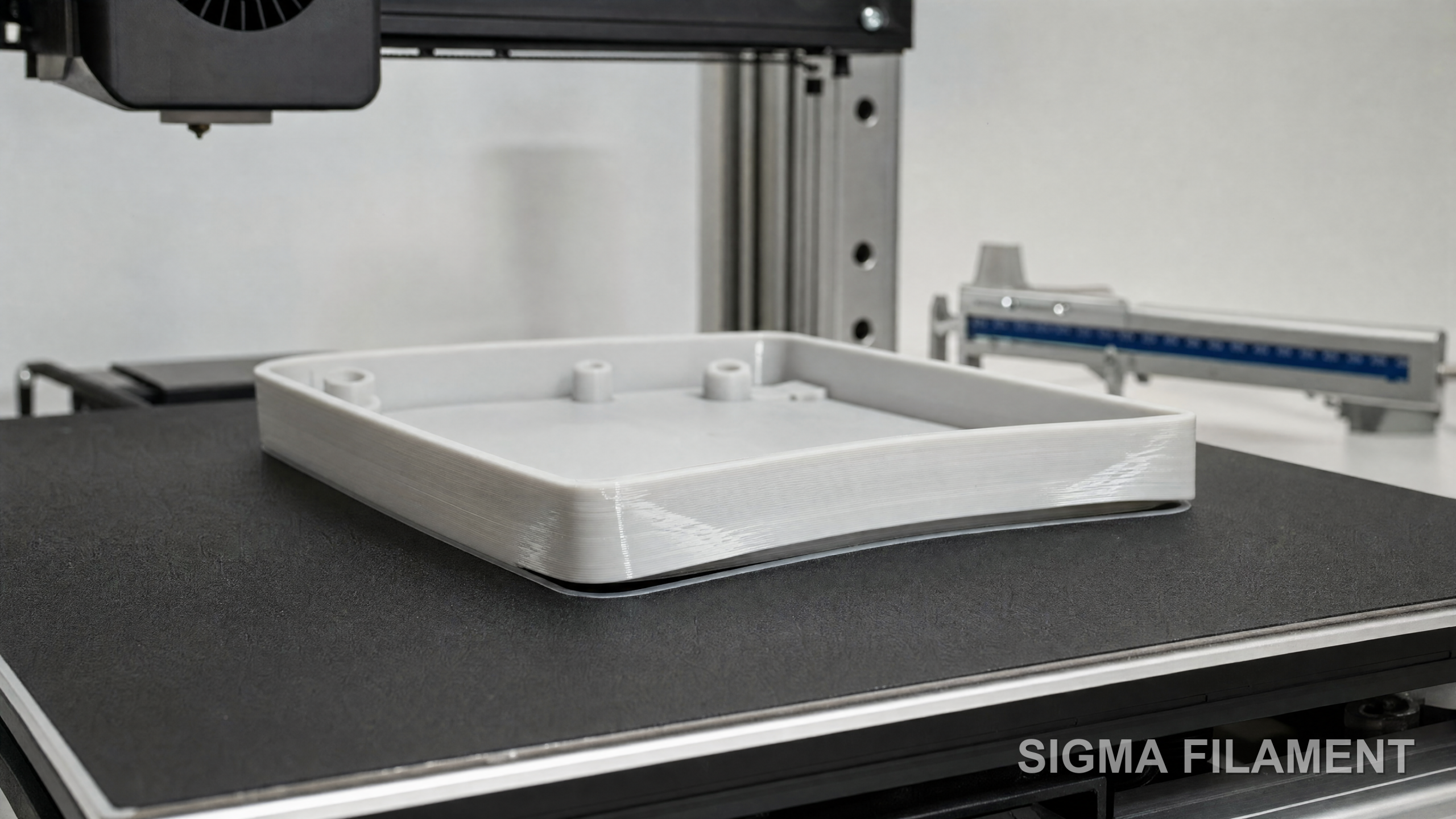
Warping is not a melting problem. It is a Tg-and-cooling problem, and that distinction sits at the heart of why the ABS melting point question keeps producing wrong answers. Treating the ABS melting point as the relevant thermal number is the single most common cause of misdiagnosed warp on a print farm. When molten ABS leaves the nozzle at 230-250 °C, it contracts the entire way down to room temperature. The decisive segment of that contraction happens as the polymer crosses its glass transition near 105 °C, where the chains lose mobility and freeze into a rigid amorphous solid. Any cooling gradient across the part at that moment is converted directly into locked-in internal stress (Samy et al., 2022).
Per the Terluran GP-22 datasheet from INEOS Styrolution (2023), ABS contracts 0.7 to 0.8 percent linearly from melt to ambient, roughly double PLA at 0.3 to 0.4 percent. The bulk of that shrinkage occurs as each layer crosses the 105 °C glass transition, which is why differential cooling, not melting, drives warp.
Differential cooling and shrinkage physics
The total mold shrinkage of ABS from melt to ambient is roughly 0.7-0.8% linear, compared with about 0.3-0.4% for PLA (INEOS Styrolution, 2023). That gap is the whole story behind the classic corner-curl failure. In an unenclosed printer, the first layers sit on a 100-110 °C bed while upper layers see 25-30 °C room air. Each fresh layer cools through Tg in seconds and shrinks against the still-warm geometry below it. Corners, being the thinnest cross-section with the highest surface-to-volume ratio, lose heat fastest, contract first, and lift off the bed. The high Tg that makes ABS heat-resistant under load is the same property that makes it warp-prone during print: a stiffer glass transition produces a steeper cooling gradient and stores more residual stress per unit of shrinkage.
Mold shrinkage ~0.7-0.8% vs PLA
Roughly doubling shrinkage relative to PLA is what shifts ABS from a forgiving filament to one that demands process control. A 200 mm ABS part can move 1.4-1.6 mm corner-to-corner before the layer stack is even complete, which is enough to delaminate at sharp inside corners or pop a brim. PLA at the same geometry moves 0.6-0.8 mm and its Tg sits near 60 °C, so most contraction happens after the part is already mechanically locked.
The enclosure as a Tg-management tool
Mitigation is a Tg-cooling problem, so the fixes target the cooling curve, not the nozzle. A 95-110 °C heated bed holds first layers in the Tg neighborhood for adhesion. A 40-60 °C enclosure ambient raises the surrounding air far enough above room temperature that upper layers cool slowly and uniformly through Tg, draining stress instead of locking it in. Brims, large bottom contact area, controlled part-cooling fan duty, and draft elimination round out the recipe. Commercial enclosed printers such as the Bambu Lab X1C and Voron Trident exist because this ambient-control envelope is the cheapest way to convert an amorphous high-Tg polymer into a printable one.
B2B Sourcing: Virgin Resin and Batch-to-Batch Thermal Consistency
At hobby volume, a 3 to 5 C Tg drift between spools is invisible. At production volume, it is the difference between a print farm that runs unattended for a week and one that re-tunes nozzle, bed, and chamber settings every time a new pallet arrives. The phrase abs melting point hides this problem, because operators tend to treat ABS thermal behavior as a fixed material constant rather than a sourcing variable that depends on the resin supply chain behind the spool. A 5 C Tg shift over 100 spools means corner-lift, layer-separation scrap, and four-hour reprints across the floor.
Why virgin resin keeps Tg within a tight band
ABS is a copolymer of styrene, acrylonitrile, and polybutadiene. The glass transition temperature sits at roughly 105 C only when the SAN matrix ratio and the rubber phase loading stay within the grade’s design window (Tiganis et al., 2002). Virgin pellets from a single resin supplier hold that window. Regrind and post-consumer recycled streams do not, because the AN/butadiene/styrene ratio drifts with each reprocessing cycle, and trace contaminants from mixed feedstock shift both Tg and the degradation onset temperature. The published thermal figures most engineers cite assume virgin-grade chemistry.
DSC qualification of inbound pellets and ratio drift
Differential scanning calorimetry per ASTM D3418 is the standard inbound check. A heat-flow scan from 40 C to 180 C resolves Tg as a step in the baseline, and a shift greater than about 2 C from the qualified reference batch flags an upstream change in resin composition (ASTM International, 2021). Pairing DSC with melt flow index per ASTM D1238 catches viscosity drift that nozzle temperature alone will not surface. Inline diameter monitoring then confirms the extrudate behaves the same way the qualified pellet predicted.
ASTM International’s D3418 test method defines DSC measurement of polymer transition temperatures with a reported repeatability of better than 1 C for second-order transitions on properly conditioned amorphous samples, making it the reference method for batch qualification of ABS resin lots across the 100 to 115 C glass transition band cited in the ABS thermal property literature.
What production-grade thermal consistency requires
A reputable filament line treats thermal behavior as a controlled output, not an assumed property, which is the core of any filament-maker vetting checklist for production buyers. Sigma Filament operates under an ISO 9001:2015 quality system with 70+ QC checks per spool, dual-axis laser diameter monitoring on every extrusion line, batch traceability from pellet to packaged spool, and a documented defect rate below 0.01% across roughly 30 tons of daily output, the same controls that govern every SKU in the filament product catalog. The combination keeps the effective thermal behavior, meaning Tg, processing window, and HDT, inside a predictable band between batches. For OEM brand owners and print-farm operators evaluating production supply, that band is what determines whether a slicer profile holds through the year, and it is the engineering rationale behind OEM and ODM filament manufacturing programs that lock spec windows under NDA.
Frequently Asked Questions
Does ABS actually have a melting point?
No. ABS is an amorphous thermoplastic with no crystalline domains, so it has no true melting point and no latent heat of fusion (Wikipedia contributors, 2026; Balart et al., 2019). Heat input causes a continuous viscosity decrease, not a sharp solid-to-liquid change. The number often called the "ABS melting point" is actually the glass transition near 105 °C.
What is the glass transition temperature of ABS?
The glass transition temperature (Tg) of ABS is approximately 105 °C, with a typical grade range of 100-115 °C measured by DSC per ASTM D3418 (Wikipedia contributors, 2026). Tg is a second-order transition where the rigid solid softens into a rubbery state. It governs warping, the continuous-use ceiling, and enclosure targets.
What temperature does ABS melt for 3D printing?
ABS does not melt for FDM; it softens into a flowable viscosity range. The standard nozzle window is 220-250 °C, with toughened grades extending to 260 °C (Wevolver, 2025). This is a processing range, not a phase change. Operating above 270 °C accelerates thermal degradation and styrene VOC evolution.
What bed temperature is needed for ABS?
A heated bed of 95-110 °C is the standard ABS print range, keeping first layers near Tg so they bond and resist lifting (Wevolver, 2025). Pair the heated bed with a 40-60 °C enclosure ambient to slow cooling through Tg. Lower bed temperatures cause corner curl, especially on prints over 100 mm.
What is the heat deflection temperature of ABS?
ABS heat deflection temperature (HDT) is 88-100 °C at 1.8 MPa loading, measured per ASTM D648 (ASTM International, 2018). Standard injection grades sit near 98 °C. A safe continuous load-bearing service ceiling is HDT minus 10-20 °C, roughly 70-80 °C for general-purpose ABS under sustained load.
At what temperature does ABS start to degrade?
Thermal degradation onset for ABS is approximately 340-350 °C by TGA, with the main SAN mass-loss step centered near 425 °C (Tiganis et al., 2002; Balart et al., 2019). Sustained processing above 274-288 °C accelerates decomposition. Nozzle temperatures above 270 °C destroy mechanical properties and evolve styrene and 1,3-butadiene VOCs, so ventilation is required.
Why does ABS warp when printing?
ABS exhibits 0.7-0.8% mold shrinkage from melt to room temperature, roughly double PLA’s 0.3-0.4% (INEOS Styrolution, 2023). Its high Tg near 105 °C means layers cool through Tg quickly when ambient is low, locking in differential shrinkage and pulling corners off the bed. A 95-110 °C bed plus a 40-60 °C enclosure keeps cooling uniform.
ABS vs PETG vs PLA: which has the highest melting point?
PLA is the only one with a true melting point. It is semi-crystalline, with a crystalline melt (Tm) near 150-160 °C, while ABS and PETG are amorphous and have no melting point. So the practical answer is heat resistance by glass transition: ABS leads at Tg ~105 °C, then PETG near 80 °C, then PLA near 60 °C (Wikipedia contributors, 2026). For load-bearing heat at 1.8 MPa, ABS HDT of 88-100 °C also leads.
Conclusion
The phrase abs melting point describes a property ABS does not have. As an amorphous thermoplastic, ABS lacks crystalline domains, so it has no first-order phase change and no latent heat of fusion. The five temperatures that actually govern its behavior are the glass transition (Tg) at roughly 105 °C, the FDM nozzle window of 220 to 250 °C, a 95 to 110 °C heated bed paired with a 40 to 60 °C enclosure, the heat deflection temperature (HDT) of 88 to 100 °C at 1.8 MPa per ASTM D648, and a thermal degradation onset near 340 to 350 °C from TGA data.
Reading these five numbers correctly is what separates a predictable production run from warped scrap. The other variable engineers tend to underestimate is feedstock: an abs melting point question on a datasheet is meaningless without tight Tg consistency from batch to batch, which only DSC-qualified virgin resin delivers.
For production-volume ABS and ABS+ with verified thermal consistency, request a wholesale or OEM quote from the SigmaFilament team at https://sigmafilament.com/contact-us/.
References
- Wikipedia contributors. (2026). Acrylonitrile butadiene styrene. In Wikipedia. Retrieved June 20, 2026, from https://en.wikipedia.org/wiki/Acrylonitrile_butadiene_styrene
- Balart, R., Garcia-Sanoguera, D., Quiles-Carrillo, L., Montanes, N., & Torres-Giner, S. (2019). Kinetic analysis of the thermal degradation of recycled acrylonitrile-butadiene-styrene by non-isothermal thermogravimetry. Polymers, 11(2), 281. https://doi.org/10.3390/polym11020281
- Tiganis, B. E., Burn, L. S., Davis, P., & Hill, A. J. (2002). Thermal degradation of acrylonitrile-butadiene-styrene (ABS) blends. Polymer Degradation and Stability, 76(3), 425-434. https://doi.org/10.1016/S0141-3910(02)00045-9
- Samy, A. A., Golbang, A., Harkin-Jones, E., Archer, E., Dahale, M., & McIlhagger, A. (2022). Influence of ambient temperature on part distortion: A simulation study on amorphous and semi-crystalline polymer. Polymers, 14(5), 879. https://doi.org/10.3390/polym14050879
- ASTM International. (2018). Standard test method for deflection temperature of plastics under flexural load in the edgewise position (ASTM D648-18). ASTM International. https://www.astm.org/d0648-18.html
- ASTM International. (2021). Standard test method for transition temperatures and enthalpies of fusion and crystallization of polymers by differential scanning calorimetry (ASTM D3418-21). ASTM International. https://www.astm.org/d3418-21.html
- SpecialChem. (2024). Glass transition temperature (Tg) of plastics: Definition & values. SpecialChem Polymer Selector. Retrieved June 20, 2026, from https://www.specialchem.com/plastics/guide/glass-transition-temperature
- Wevolver. (2025). ABS print temperature considerations: Nozzle, bed, enclosure. Wevolver Engineering Resources. Retrieved June 20, 2026, from https://www.wevolver.com/article/abs-bed-temperature
- NETZSCH Analyzing & Testing. (2024). PLA: Polylactide (polylactic acid) – thermal characterization. NETZSCH Polymers. Retrieved June 20, 2026, from https://analyzing-testing.netzsch.com/en/polymers-netzsch-com/commodity-thermoplastics/pla-polylactide-polylactic-acid
- INEOS Styrolution. (2023). Terluran GP-22 ABS technical data sheet. INEOS Styrolution Group. Retrieved June 20, 2026, from https://www.ulprospector.com/plastics/en/datasheet/37722/terluran-gp-22
Last reviewed and updated: June 2026. Author: SigmaFilament team. For tailored guidance, contact our team.