A Practical 2026 Guide: Nylon vs ABS — 5 Data-Backed Metrics for Functional Parts

Abstract
An inquiry into the selection of engineering thermoplastics for fused deposition modeling (FDM) reveals a pivotal choice between two foundational materials: Acrylonitrile Butadiene Styrene (ABS) and Nylon (Polyamide). This analysis provides a comprehensive examination of the nylon vs abs decision, contextualized within the landscape of 2026 professional and industrial 3D printing. It moves beyond a superficial comparison to a deep, data-backed evaluation across five critical metrics: mechanical performance, thermal and environmental resilience, printability, total cost of ownership, and application-specific suitability. The investigation dissects the inherent chemical and structural differences between the amorphous nature of ABS and the semi-crystalline structure of Nylon, linking these polymer fundamentals to tangible outcomes in part performance. By systematically evaluating properties such as impact toughness versus stiffness, heat deflection temperature, chemical resistance, and the profound effects of hygroscopy in Nylon, this guide aims to furnish engineers, designers, and manufacturers with a robust framework for making an informed material selection. The objective is to empower the user to move from a generalized understanding to a nuanced capability, selecting the precise material that aligns with the functional demands of high-performance components, jigs, fixtures, and end-use parts.
Key Takeaways
- Nylon offers superior toughness and wear resistance, ideal for gears and living hinges.
- ABS provides high rigidity and is easier to post-process, suiting structural prototypes.
- Properly managing moisture by drying Nylon filament is non-negotiable for print quality.
- The nylon vs abs choice impacts hardware needs, like enclosures for ABS and all-metal hotends for Nylon.
- ABS requires stringent ventilation due to VOC emissions, whereas Nylon is mostly odorless.
- Evaluate total cost, including failed prints and hardware, not just filament price per kilogram.
Table of Contents
- Unpacking the Contenders: A Foundational Look at Nylon and ABS
- Metric 1: Mechanical Performance and Durability
- Metric 2: Thermal and Environmental Resistance
- Metric 3: The Practicalities of Printability
- Metric 4: A Holistic View of Cost and Accessibility
- Metric 5: Application Suitability for Real-World Problems
- Frequently Asked Questions (FAQ)
- Conclusion
- References
Unpacking the Contenders: A Foundational Look at Nylon and ABS
The journey into engineering-grade 3D printing materials often begins after one has reached the functional limits of standard thermoplastics like PLA and PETG. When parts must not merely exist as physical representations of a digital file but must perform a function, bear a load, resist heat, or endure wear, the material choice becomes an act of engineering itself. In this arena, two of the most established and distinct options are Acrylonitrile Butadiene Styrene (ABS) and the family of polymers known as Nylon. To the uninitiated, they may seem like similar plastics, both promising a step up in performance. Yet, their inner worlds, their very chemical and structural identities, are fundamentally different. Understanding this difference is the first step toward mastering their use. The debate of nylon vs abs is not about finding a single “better” material, but about cultivating the wisdom to choose the right material for a specific, real-world problem.
The Chemical Identity of ABS
Let us first consider ABS. The name itself, Acrylonitrile Butadiene Styrene, is a map to its character. It is a terpolymer, meaning it is composed of three distinct monomer units, each contributing a specific set of attributes to the final material. Think of it as a team of three specialists working in concert.
First is Styrene. This is the most significant component by mass. Styrene, when polymerized on its own, creates polystyrene, a material known for its rigidity and unfortunately, its brittleness (think disposable plastic cups). In ABS, styrene provides the structural backbone, giving the material its stiffness and a glossy, processable surface.
Second is Acrylonitrile. This monomer brings thermal and chemical resistance to the partnership. It raises the material’s ability to withstand higher temperatures before softening and provides a defense against a range of chemicals, including many acids and oils.
Finally, and perhaps most importantly, is Butadiene. Butadiene is a synthetic rubber. Its long, flexible polymer chains are interspersed throughout the rigid matrix of styrene and acrylonitrile. When the material experiences a sudden shock or impact, these rubbery particles compress and absorb the energy, preventing the rigid structure from cracking. This is what gives ABS its celebrated toughness and impact strength, elevating it far beyond brittle polystyrene. It is this clever combination that made ABS the material of choice for everything from LEGO bricks to automotive dashboards for decades. It is an amorphous polymer, meaning its molecular chains are arranged in a random, tangled structure, like a plate of spaghetti. This amorphous nature is key to its properties, particularly how it behaves when heated and cooled.
The Polyamide Family: Understanding Nylon
Now, let us turn our attention to Nylon. Unlike ABS, “Nylon” is not a single material but a trade name for a whole family of polymers called polyamides (PA). You will encounter different types, most commonly PA6, PA66, and PA12 in the world of 3D printing. The name comes from the amide link (-CO-NH-) that connects its monomer units. This chemical bond is the same type of link that holds proteins together in our bodies, and it is exceptionally strong and resilient.
The fundamental difference between Nylon and ABS at the molecular level is its structure. Nylon is a semi-crystalline polymer. This means that as it cools from a molten state, its long polymer chains have a tendency to fold and stack together into ordered, tightly packed crystalline regions. These regions are embedded within a sea of disordered, amorphous regions, much like the structure of ABS. Imagine tiny, incredibly strong crystals reinforcing a softer, more flexible matrix.
This semi-crystalline nature is the source of Nylon’s most famous characteristics. The crystalline regions impart incredible strength, wear resistance, and chemical resistance. The amorphous regions contribute to its flexibility and toughness. This dual nature is what makes Nylon such a formidable engineering material. It possesses a unique combination of high tensile strength and significant flexibility, resulting in a material of exceptional durability. Its surface is inherently slippery, giving it a very low coefficient of friction, a property that is almost impossible to replicate in ABS.
High-Level Material Property Comparison
To synthesize these foundational differences, a direct comparison can be helpful. The following table provides a high-level overview of the key characteristics that define the nylon vs abs choice.
| Feature | Acrylonitrile Butadiene Styrene (ABS) | Nylon (Polyamide) |
|---|---|---|
| Polymer Structure | Amorphous | Semi-Crystalline |
| Key Mechanical Trait | High Stiffness (Rigidity) | High Toughness (Durability) & Flexibility |
| Surface Property | Hard, Glossy | Slippery, Low Coefficient of Friction |
| Moisture Interaction | Low Hygroscopy | High Hygroscopy (Requires Drying) |
| Printing Odor | Strong, Pungent (Styrene) | Minimal to None |
| Common Application | Rigid Housings, Jigs, Prototypes | Gears, Bearings, Living Hinges, High-Impact Parts |
Metric 1: Mechanical Performance and Durability
When we speak of creating “functional” parts, we are primarily concerned with their mechanical behavior. How does a part respond when pushed, pulled, bent, or struck? This is the domain of mechanical properties, and it is here that the differences between Nylon and ABS become most pronounced and consequential. The choice is not merely one of degree but of kind. One material offers unyielding rigidity, the other offers tenacious durability. A deep dive into the data reveals a story of two fundamentally different approaches to handling mechanical stress.
Tensile Strength and Stiffness (Young’s Modulus)
Imagine pulling on a rope from both ends. The amount of force the rope can withstand before it snaps is its ultimate tensile strength. Now imagine how much that rope stretches under a given load before it breaks; the resistance to that stretching is a measure of its stiffness, or Young’s Modulus.
ABS is defined by its stiffness. A typical value for the Young’s Modulus of 3D printed ABS is around 2000-2400 MPa (Megapascals). Its tensile strength is respectable, generally falling in the 40-50 MPa range. What this means in practice is that an ABS part will resist bending quite strongly. It feels solid and rigid in the hand. However, when you push it past its limit, it does not have much give. It will deform only slightly before it fails, often in a sudden, brittle fracture. This high stiffness is excellent for applications where maintaining precise shape under load is paramount, such as a mounting bracket or an electronics enclosure.
Nylon, on the other hand, tells a different story. Its stiffness is significantly lower than ABS. For a common variant like PA6, the Young’s Modulus might be closer to 1200-1800 MPa, and even lower for the more flexible PA12. However, its tensile strength can be higher than ABS, often in the 50-80 MPa range depending on the specific type and whether it has absorbed moisture. The key takeaway is in its behavior. Nylon will bend and deform much more readily under load compared to ABS. But it can endure a great deal of this deformation before it fails. This is a direct result of its semi-crystalline structure, where molecular chains in the amorphous regions can uncoil and stretch, absorbing energy.
Think of it this way: an ABS part is like a ceramic plate—very rigid, but it shatters when dropped. A Nylon part is like a high-quality rubber mallet—it can deform to absorb an impact and then return to its original shape.
Impact Resistance and Toughness (Izod)
Toughness is a material’s ability to absorb energy and deform plastically before fracturing. It is often measured using standardized tests like the Izod or Charpy impact tests, where a weighted pendulum strikes a notched sample and the energy absorbed during the fracture is measured. This is where Nylon truly distinguishes itself.
ABS possesses decent impact strength, thanks to its butadiene rubber component. Its Izod impact values are typically in the range of 150-250 J/m (Joules per meter). This is sufficient for many general-purpose applications and is a significant improvement over more brittle materials like PLA or standard polystyrene. It can handle everyday bumps and knocks reasonably well.
Nylon, however, is in a completely different league. The impact strength of Nylon is exceptionally high, with values for PA6 often exceeding 300 J/m and sometimes reaching much higher depending on conditioning (moisture content). What this number represents is a profound capacity to absorb sudden, violent shocks without breaking. This makes Nylon the undisputed champion for parts that are expected to survive impacts. Consider the landing gear for a drone, a protective case for a sensitive instrument, or the components of a high-speed robotic arm. In these scenarios, the rigidity of ABS could be a liability, leading to catastrophic failure on first impact. The toughness of Nylon provides a resilience that allows the part to survive, deform, and continue functioning.
Flexibility and Elongation at Break
Closely related to toughness is the concept of flexibility, quantified by a property called “elongation at break.” This is a percentage that tells you how much a material can be stretched before it snaps.
ABS is a relatively brittle material. Its elongation at break is typically low, often in the range of 5-20%. It will stretch a small amount and then fracture. This is consistent with its rigid nature. You cannot use ABS to create a part that is designed to bend repeatedly.
Nylon is defined by its ductility and flexibility. Its elongation at break is dramatically higher, frequently exceeding 50% and in some cases, for specific grades like PA12, reaching over 200%. This means a sample of Nylon can more than double its original length before it finally breaks. This property is not just a number on a datasheet; it unlocks entire categories of functional design. It is what allows for the creation of robust snap-fit closures that can be opened and closed thousands of times. It enables the design of “living hinges”—thin sections of material that can flex repeatedly without fatigue. Trying to design such a feature with ABS would result in failure after only a few cycles.
Detailed Mechanical Property Comparison Table
To provide a clearer, data-driven perspective, the table below summarizes the typical mechanical properties for standard unfilled ABS and two common grades of Nylon. Note that these values can vary based on the specific manufacturer, printing conditions, and part orientation. The values for Nylon are particularly sensitive to moisture content.
| Mechanical Property | Test Standard | ABS (Typical) | Nylon PA6 (Dry) | Nylon PA12 (Dry) | Unit |
|---|---|---|---|---|---|
| Tensile Strength | ASTM D638 | 45 | 80 | 50 | MPa |
| Young’s Modulus (Stiffness) | ASTM D638 | 2200 | 1800 | 1200 | MPa |
| Elongation at Break | ASTM D638 | 15 | 100 | >200 | % |
| Flexural Strength | ASTM D790 | 75 | 90 | 50 | MPa |
| Notched Izod Impact | ASTM D256 | 200 | 350 | 400 | J/m |
| Hardness (Rockwell/Shore D) | ASTM D785/D2240 | R105 | R120 | D75 | – |
| Coefficient of Friction (vs Steel) | – | ~0.35 | ~0.25 | ~0.20 | – |
(Data compiled from various material datasheets and academic sources like (Syrlybaev et al., 2021). Values are representative and for comparison purposes.)
This table crystallizes the trade-off at the heart of the nylon vs abs debate. If your primary need is stiffness and you are operating under a tight budget, ABS is a compelling choice. However, if your application demands durability, impact resistance, wear resistance, or flexibility, Nylon is unequivocally the superior engineering material.
Metric 2: Thermal and Environmental Resistance
A functional part does not exist in a vacuum. It must operate within an environment, and that environment subjects it to thermal stresses and potential chemical exposure. A material’s ability to maintain its shape, integrity, and properties under these conditions is a critical aspect of its performance. In this domain, the distinct chemical makeups of ABS and Nylon once again lead to divergent, and highly consequential, outcomes.
Heat Deflection Temperature (HDT) and Glass Transition Temperature (Tg)
Every thermoplastic has a temperature at which it begins to lose its rigidity and soften. For amorphous polymers like ABS, this is characterized by the Glass Transition Temperature (Tg). Below its Tg, ABS is a hard, glassy solid. Above its Tg, it becomes rubbery and pliable. The Tg for ABS is approximately 105°C (221°F). This means that on a hot summer day, an ABS part left inside a car, where temperatures can easily exceed 80°C, will begin to lose its stiffness and may permanently deform under even a small load. The Heat Deflection Temperature (HDT), which measures the temperature at which a sample deforms under a specific load, is typically a bit lower, around 85-95°C for standard ABS.
For semi-crystalline polymers like Nylon, the situation is more complex. They also have a Glass Transition Temperature (Tg), where the amorphous regions soften. For PA6, this is quite low, around 50-60°C. However, because of the reinforcing crystalline structures, the material does not immediately lose all its integrity. These crystals have a much higher melting point (Tm), which for PA6 is around 220°C. Therefore, Nylon maintains a degree of structural integrity well above its Tg. The HDT for standard unfilled PA6 is often similar to or slightly lower than ABS, around 70-90°C.
This might seem disappointing, but it does not tell the whole story. Firstly, the performance of Nylon at elevated temperatures can be dramatically improved with reinforcement, such as glass or carbon fibers. A glass-filled Nylon can have an HDT well over 180°C. Secondly, the failure mode is different. An ABS part approaching its HDT tends to fail catastrophically, while a Nylon part may become more flexible but retain its overall shape. For applications involving high continuous temperatures, especially under load, specialized or composite versions of these materials are often necessary. For intermittent exposure to moderate heat, however, both materials offer a significant step up from PLA (Tg ~60°C).
Chemical Resistance Profile
The ability to withstand chemical exposure is a major differentiator in industrial and automotive applications. Here, Nylon’s polyamide structure gives it a distinct advantage in many scenarios.
ABS is known for its susceptibility to certain solvents. Most famously, it dissolves readily in acetone. While this is a weakness from a chemical resistance standpoint, it is cleverly exploited for post-processing, allowing for “acetone vapor smoothing” to create a perfectly smooth, injection-molded appearance. Beyond acetone, ABS is also vulnerable to chlorinated solvents and aromatic hydrocarbons. However, it exhibits good resistance to many common oils, greases, and weak acids, making it suitable for many workshop environments.
Nylon, by contrast, boasts a much more robust chemical resistance profile. Its semi-crystalline nature and strong amide bonds make it highly resistant to a wide array of chemicals. It is particularly valued for its excellent resistance to oils, fuels (like gasoline and diesel), hydraulic fluids, and most organic solvents. This is why Nylon is so prevalent in automotive engine bays, fuel system components, and industrial machinery where exposure to such substances is constant. It is, however, susceptible to strong acids and bases, which can attack the amide links and break down the polymer.
The Challenge of Hygroscopy: Nylon’s Relationship with Water
Perhaps the single most important environmental factor to understand when working with Nylon is its relationship with water. Nylon is highly hygroscopic, meaning it readily absorbs moisture from the surrounding atmosphere. ABS, in contrast, is much less affected by humidity.
This hygroscopy is a double-edged sword. On one hand, it is the most significant challenge to printing Nylon successfully. Filament that has absorbed even a small amount of moisture (as little as 0.2% by weight) will cause major printing problems. As the wet filament enters the hotend, the trapped water instantly boils into steam, causing an audible popping or sizzling sound. This explosive expansion of steam disrupts the flow of molten plastic, leading to voids in the print, a rough and pimply surface finish, extreme stringing, and, most critically, very poor layer-to-layer adhesion. A part printed with wet Nylon will be incredibly weak and brittle, completely negating the material’s inherent toughness. Therefore, drying Nylon filament in a dedicated dryer or a calibrated oven before every print is not an optional step; it is an absolute requirement for success.
On the other hand, this moisture absorption has a fascinating and sometimes useful effect on the properties of the finished part. The absorbed water molecules act as a “plasticizer,” inserting themselves between the polymer chains and allowing them to move more freely. This has the effect of decreasing the part’s tensile strength and stiffness, but dramatically increasing its toughness, impact strength, and elongation at break. A bone-dry, as-printed Nylon part can be relatively brittle. After conditioning for a few days in a normal room environment (e.g., 50% relative humidity), that same part will become much more flexible and incredibly durable. Engineers sometimes take advantage of this by intentionally conditioning Nylon parts in water to maximize their impact resistance. However, this also means that the dimensions and mechanical properties of a Nylon part can change depending on the ambient humidity, a factor that must be considered in designs requiring tight tolerances.
UV Resistance and Weatherability
For any part intended for long-term outdoor use, resistance to ultraviolet (UV) radiation from the sun is a primary concern. Both standard ABS and standard Nylon perform poorly in this regard.
Prolonged UV exposure attacks the polymer chains in ABS, particularly the butadiene component, causing the material to become brittle, lose its impact strength, and develop a chalky, discolored surface. For this reason, ABS is generally not recommended for outdoor applications. A closely related material, ASA (Acrylonitrile Styrene Acrylate), was developed specifically to solve this problem by replacing the butadiene rubber with an acrylate rubber, which is inherently UV stable.
Standard, un-stabilized Nylon also suffers from UV degradation. It can become discolored (often yellowing), lose its toughness, and become brittle over time with sun exposure. However, many commercial grades of Nylon, particularly those intended for industrial use, are compounded with UV-stabilizing additives. Black-colored Nylons, which use carbon black as a pigment, also offer significantly improved UV resistance, as the carbon black particles effectively block the radiation from penetrating the material. When choosing a material for outdoor use, it is vital to select a grade specifically formulated and rated for UV stability, such as ASA or a UV-stabilized Nylon.
Metric 3: The Practicalities of Printability
A material’s theoretical properties are meaningless if one cannot reliably and repeatably transform it from a spool of filament into a solid, dimensionally accurate part. The printing process itself is a critical part of the equation, involving a delicate dance of temperature, adhesion, and thermal management. In this practical arena, the nylon vs abs comparison reveals distinct sets of challenges and required techniques. Neither is as simple to print as PLA, and each demands a certain degree of respect for its unique temperament.
The Fundamentals: Bed and Nozzle Temperatures
The first step in taming any filament is understanding its thermal requirements. Both ABS and Nylon are considered “high-temperature” materials relative to hobbyist mainstays like PLA.
ABS typically requires a nozzle temperature in the range of 230°C to 260°C. This is necessary to fully melt the polymer and ensure good flow and layer fusion. More critically, it demands a high bed temperature, usually between 90°C and 110°C. The purpose of the heated bed is twofold: first, to promote adhesion of the first layer, and second, to keep the base of the model warm and reduce the rate of cooling, which is the primary driver of warping.
Nylon requires a slightly higher nozzle temperature, generally from 240°C up to 270°C, with some carbon-fiber reinforced variants needing even higher temperatures. This higher temperature is needed to melt its semi-crystalline structure. Interestingly, the bed temperature requirement for Nylon is often lower than for ABS, typically in the 60°C to 90°C range. While a heated bed is still necessary for adhesion and to control cooling, Nylon’s primary printing challenge is not warping to the same degree as ABS, but rather getting it to stick to the build plate in the first place. Printing Nylon, especially at the higher end of its temperature range, often necessitates an all-metal hotend, as the PTFE liner in more basic hotends can begin to degrade above 250°C, releasing harmful fumes (Thompson et al., 2020).
The Warping Dilemma: Managing Thermal Contraction
Warping is the bane of many 3D printing operators, and it is the defining challenge of printing with ABS. The phenomenon is a direct result of thermal contraction. As the molten ABS is extruded, it is at a high temperature. As it cools to room temperature, it shrinks. For ABS, this shrinkage is quite significant. When a large, flat part is printed, the bottom layers are held warm by the heated bed, while the upper layers cool more rapidly in the ambient air. This differential cooling creates immense internal stress, causing the corners and edges of the part to contract and pull upwards, lifting off the build plate.
Mitigating ABS warping is a science in itself. The single most effective tool is a heated enclosure. An enclosure traps the heat radiating from the print bed, raising the ambient air temperature around the part to 50°C or higher. This drastically reduces the thermal gradient across the part, minimizes internal stresses, and dramatically reduces or eliminates warping. It also improves layer adhesion, as the layers have more time to fuse before solidifying. Additional strategies include using large brims or rafts to increase the part’s footprint and hold down the corners, and carefully orienting the part to minimize large, flat surfaces on the bed.
Nylon also experiences thermal shrinkage and can warp, but the problem is often less severe and of a different character than with ABS. Its semi-crystalline nature means its shrinkage behavior is more complex. While an enclosure is still highly recommended for printing Nylon to ensure the best possible layer adhesion and part quality, the primary battle is usually fought at the build surface.
Bed Adhesion Strategies
Getting the first layer to stick securely is paramount. With their different chemical makeups, ABS and Nylon require entirely different approaches to bed adhesion.
ABS sticks reasonably well to several common surfaces, provided the bed is hot enough. A PEI (Polyetherimide) sheet is a popular and effective choice, offering excellent adhesion when heated to 100-110°C and releasing the part as it cools. Kapton tape is another classic solution. A more traditional method involves creating an “ABS slurry” or “ABS juice” by dissolving a small amount of ABS filament in acetone and painting a thin layer onto a glass bed. This creates a perfect bonding surface of the same material.
Nylon is notoriously picky about what it sticks to. It will not adhere well to the PEI or glass surfaces that work for ABS. It has very poor adhesion to most common plastics. The most common and effective solutions for Nylon involve applying an interface layer. A simple coating of PVA glue stick (the kind used in schools) on a glass or Garolite bed works surprisingly well. For more professional and reliable results, specialized bed adhesives like Magigoo PA have been formulated specifically for polyamides. Perhaps the gold standard for printing Nylon is a Garolite (G-10/FR-4) build surface. This is a composite material made of fiberglass cloth and epoxy resin, and Nylon exhibits a unique and powerful affinity for it, sticking firmly when hot and often releasing with a satisfying “pop” when cool.
Fumes and Ventilation: A Critical Safety Consideration
The health and safety implications of the printing process cannot be overlooked. The thermal decomposition of plastics can release volatile organic compounds (VOCs) and ultrafine particles (UFPs) into the air.
Printing ABS is well-known for producing a strong, unpleasant, and characteristic “hot plastic” smell. This odor is primarily due to the emission of styrene, a known VOC and a potential carcinogen (Azimi et al., 2016). In addition to styrene, printing ABS releases a significant quantity of UFPs. Because of these emissions, it is strongly advised to never print ABS in an unventilated living space. The printer should be placed in a room with active ventilation to the outdoors, or, more ideally, housed within an enclosure equipped with a filtration system, such as a HEPA filter for particles and an activated carbon filter for VOCs.
This is a major point of divergence in the nylon vs abs comparison. Nylon, in its pure form, is one of the cleanest and safest materials to print. During printing, it is largely odorless and releases a negligible amount of VOCs and a significantly lower concentration of UFPs compared to ABS. While an enclosure is still recommended for print quality, the urgent need for ventilation due to toxic fumes is much less of a concern. This makes Nylon a far more suitable choice for use in office, studio, or home environments where dedicated ventilation systems may not be feasible.
The Imperative of Filament Drying
As discussed in the previous section, Nylon’s hygroscopy is its defining characteristic from a processing standpoint. It cannot be overstated: you will not succeed with Nylon if you do not actively manage moisture. A brand new, vacuum-sealed spool of Nylon filament should be considered “wet” until proven otherwise. The desiccant packet included in the bag is only sufficient to prevent catastrophic moisture levels during shipping; it does not guarantee a print-ready filament.
The symptoms of wet Nylon are unmistakable:
- An audible popping, crackling, or hissing sound from the nozzle as trapped water turns to steam.
- Excessive stringing and oozing, creating a “hairy” appearance on the print.
- A rough, uneven, or bubbly surface texture.
- Visibly poor layer adhesion and extremely brittle parts that can be easily pulled apart at the layer lines.
The solution is to dry the filament thoroughly before printing and, for long prints, to print directly from a drying unit. A dedicated filament dryer is the best tool for the job, as it is designed to circulate warm, dry air at a controlled temperature for an extended period. A convection oven can also be used, but it must be one that can hold a low temperature accurately (typically 70-85°C for Nylon) and should not be the same oven used for food preparation. A typical drying cycle for a spool of Nylon is 4-8 hours at 80°C. Investing in a reliable drying solution is a non-negotiable part of the cost of entry into printing with Nylon.
Metric 4: A Holistic View of Cost and Accessibility
The decision between engineering materials is not made in a financial vacuum. While performance is paramount, cost and the accessibility of the required hardware and expertise play a significant role in the overall viability of a material for a given project or business. A simple comparison of the price per kilogram of filament tells only a fraction of the story. A truly informed analysis requires a holistic view, encompassing not just the raw material but also the associated hardware investments and the hidden costs of process management.
Per-Kilogram Filament Cost
On the surface, the cost comparison seems straightforward. ABS is one of the most affordable engineering-grade filaments on the market. Thanks to its widespread use in injection molding and other industries, the raw polymer is produced in massive quantities, leading to a low market price. In 2026, a one-kilogram spool of standard, good-quality ABS filament typically costs between $20 and $35.
Nylon is positioned a significant step above ABS in the price hierarchy. As a more specialized family of polymers, its production costs are higher. A spool of standard PA6 or PA66 Nylon filament generally falls in the range of $40 to $70 per kilogram. More specialized variants, such as the more flexible and less hygroscopic PA12, can cost even more. When you move into the realm of composite materials, the price increases substantially. A kilogram of carbon fiber reinforced Nylon (CF-Nylon), which offers a dramatic increase in stiffness and thermal resistance, can easily cost from $70 to over $100.
This raw price difference is a major factor, especially for high-volume applications or for businesses operating on tight margins. For a print farm producing hundreds of parts, a 100% increase in material cost is a substantial consideration.
The “Hidden Costs” of Printing
The price tag on the spool is merely the beginning of the economic calculation. Each material brings with it a set of “hidden costs” related to the hardware and processes required to use it effectively.
For ABS, the primary hidden cost is environmental control. As established, printing ABS reliably and safely requires an enclosure and ventilation. While many modern printers now include enclosures, for open-frame machines, this represents an additional investment, which can range from a simple DIY box to a sophisticated commercial unit with integrated heating and filtration, costing anywhere from $50 to several hundred dollars. There is also the cost of failed prints due to warping, which can consume significant amounts of time and material until the process is perfectly dialed in.
For Nylon, the hidden costs are different but no less significant. The most immediate is moisture management. A reliable filament dryer is an essential piece of equipment, representing an upfront cost of $50 to $200. The second potential cost relates to the printer’s hotend. To safely print many Nylon grades, an all-metal hotend is required, which can be a $30 to $80 upgrade for many consumer-level printers. If one plans to print with abrasive, fiber-filled Nylons, a hardened steel or ruby-tipped nozzle is a necessity to prevent rapid wear of standard brass nozzles. These specialized nozzles cost significantly more than their brass counterparts. Finally, there is the cost of specialized build surfaces or adhesives, like a Garolite sheet or bottles of Magigoo PA, which add to the operational expenses.
When you factor in these associated costs, the economic picture of the nylon vs abs choice becomes much more nuanced. A cheap spool of ABS is not truly cheap if it requires a $200 enclosure to print successfully, just as a spool of Nylon is more than its sticker price when it necessitates a $100 investment in drying and nozzle hardware.
Hardware Requirements and Printer Compatibility
The accessibility of a material is also determined by the range of machines capable of printing it.
ABS is compatible with a very wide range of 3D printers. The key requirement is a heated bed capable of reaching and holding at least 100°C. Most mid-range and professional FDM printers on the market in 2026 can achieve this. While an enclosure is highly recommended for best results, small ABS parts can sometimes be printed successfully on an open-frame machine with a large brim and no drafts. This wide compatibility makes ABS a very accessible entry point into engineering filaments.
Nylon has slightly more stringent hardware requirements, which can limit its accessibility for users with entry-level equipment. The need for an all-metal hotend capable of reaching 250°C or more is a significant barrier for some older or cheaper printers that use PTFE-lined hotends. While many modern printers, even at the prosumer level, now come standard with all-metal hotends, it is a critical specification to check. The need for a specialized bed surface or adhesive also means it is less of a “plug and play” material than ABS. However, for a user with a well-equipped, modern printer, these barriers are relatively low. For those seeking to produce parts with the highest performance, sourcing from a reliable supplier that provides consistent, high-quality material like a wholesale 3d printer filament manufacturer becomes a key part of managing both cost and quality, ensuring that investments in hardware are not wasted on inconsistent feedstock.
Metric 5: Application Suitability for Real-World Problems
The ultimate purpose of this entire analysis is to answer a single question: which material should I use for my specific application? The preceding metrics—mechanical, thermal, and practical—all converge here, informing a decision rooted in the functional requirements of the final part. The choice is not an abstract exercise but a concrete engineering decision. By understanding the core strengths and weaknesses of each material, we can map them to real-world problems and select the one whose character is best suited to the task at hand.
When to Choose ABS: Rigidity, Post-Processing, and Prototyping
ABS shines in applications where stiffness, dimensional stability, and surface finish are the primary drivers. Its character is that of a reliable, cost-effective workhorse for parts that need to hold their shape and look good doing it.
- Use Case 1: Functional Prototypes and Enclosures. Imagine you are designing an enclosure for a new piece of electronics. The part needs to be rigid to protect the internal components, dimensionally accurate to ensure the circuit board and connectors fit perfectly, and it needs to look like a finished product for a client demonstration. ABS is the ideal choice here. Its high stiffness prevents flexing, and its ability to be solvent-welded and acetone vapor smoothed allows for the creation of beautiful, seamless enclosures that are difficult to distinguish from injection-molded parts.
- Use Case 2: Jigs, Fixtures, and Tooling. In a manufacturing or assembly environment, jigs and fixtures are used to hold workpieces in precise locations. These tools must be extremely rigid and dimensionally stable to do their job. They are not typically subjected to high-impact loads or extreme wear. The high Young’s Modulus and low cost of ABS make it a perfect material for these applications. You can quickly and cheaply produce custom tooling that improves the accuracy and efficiency of a workflow.
- Use Case 3: General Purpose Mechanical Parts. For many mechanical components that are not subjected to high wear, impact, or chemical exposure, the balanced properties and low cost of ABS make it a default choice. Mounting brackets, support structures, and components of static assemblies are all excellent candidates for ABS. Its performance is a significant step up from PLA, offering better temperature resistance and toughness for more demanding everyday applications.
When to Choose Nylon: Toughness, Durability, and Low Friction
Nylon is the specialist you call in when the going gets tough. Its domain is applications where parts must survive impact, endure repeated flexing, slide against other components, or withstand harsh chemical environments. Its character is one of tenacious, resilient durability.
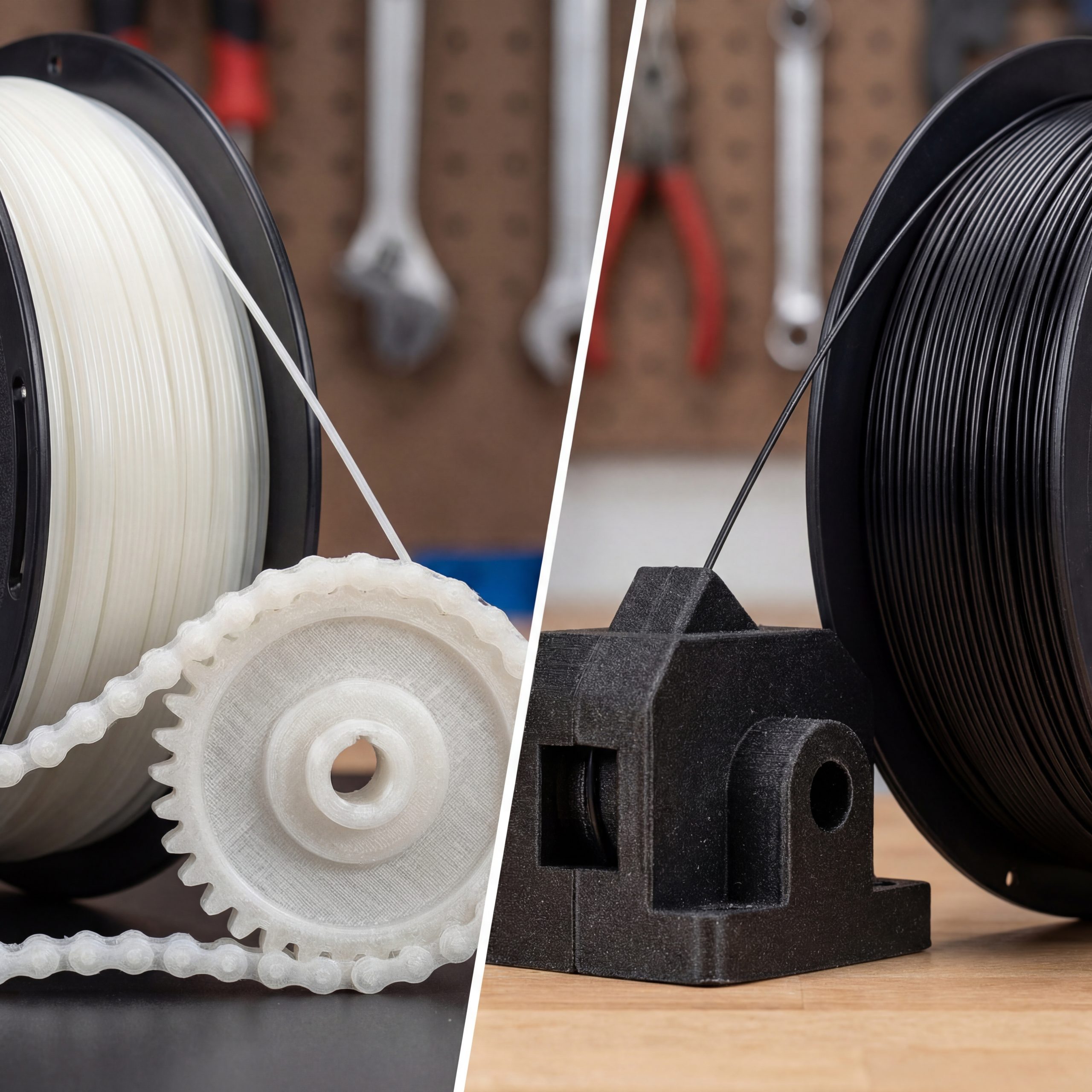
- Use Case 1: Gears, Bearings, Bushings, and Sliding Parts. This is Nylon’s signature application. Its semi-crystalline structure gives it an inherently low coefficient of friction and excellent wear resistance. A set of 3D printed Nylon gears can operate smoothly and quietly for thousands of cycles in applications where ABS gears would quickly wear down and fail. For any part that involves sliding contact, from linear rail carriages to simple bushings, Nylon’s self-lubricating nature makes it the superior choice.
- Use Case 2: High-Impact Components. Consider the parts that are most likely to fail when a device is dropped or crashed: the arms of a quadcopter, the bumper on a remote-control car, or the handle of a power tool. These are the applications where Nylon’s phenomenal toughness and high elongation at break are mission-critical. Where an ABS part would shatter, a Nylon part will deform, absorb the energy of the impact, and often survive to function another day. This resilience makes it the go-to material for anything that needs to be “unbreakable.”
- Use Case 3: Living Hinges and Snap-Fit Enclosures. Nylon’s ability to bend repeatedly without fatiguing makes it the only viable choice between the two for designing parts with integrated living hinges, such as the lid on a small container. Similarly, its flexibility allows for the creation of robust snap-fit latches that can be engaged and disengaged hundreds or thousands of times without breaking. An ABS snap-fit is a fragile, one-time-use feature by comparison.
- Use Case 4: Industrial and Automotive Applications. As discussed, Nylon’s excellent resistance to fuels, oils, and solvents makes it a prime candidate for parts used in and around machinery. Custom fluid reservoirs, brackets for engine bays, or protective covers for industrial sensors are all applications where Nylon’s chemical resilience allows it to survive where ABS would degrade.
The Rise of Composites: Carbon Fiber Nylon vs. ABS
It is also worth noting the growing importance of composite materials, particularly Carbon Fiber reinforced Nylon (CF-Nylon). By infusing short, chopped carbon fibers into a Nylon matrix (typically PA6 or PA12), manufacturers create a material that elevates the nylon vs abs discussion to a new level. CF-Nylon retains the base polymer’s toughness, chemical resistance, and high-temperature resistance, but the carbon fibers add incredible stiffness and dimensional stability. The Young’s Modulus of a good CF-Nylon can be two to three times that of ABS, approaching that of aluminum. This creates a material that offers the stiffness of ABS, the toughness and temperature resistance of Nylon, and superior strength-to-weight performance. It is an ideal choice for high-performance applications like lightweight robotic end-effectors, professional drone frames, and metal-replacement jigs and fixtures. While more expensive and abrasive (requiring a hardened nozzle), CF-Nylon represents a powerful synthesis of the best qualities of both material families.
Frequently Asked Questions (FAQ)
Which is stronger, Nylon or ABS?
This question requires a more nuanced answer than a simple declaration. The term “strong” can refer to several different mechanical properties. If “strong” means stiff or rigid (resisting bending), then ABS is generally “stronger.” It has a higher Young’s Modulus. If “strong” means tough (resisting impact and shattering), then Nylon is vastly “stronger.” It has a much higher Izod impact strength. If “strong” means able to withstand pulling forces (tensile strength), they are often comparable, with some grades of Nylon exceeding ABS. For functional parts, toughness is often a more desirable trait than pure rigidity, so in many practical scenarios, Nylon is considered the more durable and robust material.
Can I print Nylon on an open-frame printer like a Creality Ender 3?
It is challenging but possible with the right upgrades and precautions. The two main hardware requirements are an all-metal hotend to safely reach temperatures of 250°C and above, and a suitable build surface for adhesion (like Garolite or a glue stick-coated plate). While an enclosure is not as strictly necessary for warping as it is with ABS, it is still highly recommended for Nylon. An enclosure will help maintain consistent ambient temperature, which dramatically improves layer adhesion and prevents delamination, resulting in a much stronger part. Printing without one, especially for larger parts, is likely to yield weak and unreliable results.
Why are my Nylon prints so weak and stringy?
The overwhelming cause of weak, stringy, and poor-quality Nylon prints is moisture. Nylon is extremely hygroscopic and absorbs water from the air. When this wet filament is heated in the nozzle, the water turns to steam, disrupting extrusion and destroying layer adhesion. Before suspecting any other issue with your printer or settings, you must dry your Nylon filament thoroughly in a dedicated filament dryer or a calibrated oven for at least 4-8 hours at around 80°C (176°F). Printing with properly dried Nylon is a completely different experience and is the key to unlocking its excellent mechanical properties.
Is ABS safe to print indoors?
Printing ABS is not recommended in an inhabited, unventilated indoor space. The process releases styrene, a volatile organic compound (VOC), and a high concentration of ultrafine particles (UFPs), which can be harmful to inhale. If you must print with ABS, it should be done in a well-ventilated area, preferably with an active exhaust fan to the outside. The best practice is to use an enclosed 3D printer that is equipped with both a HEPA filter (to capture particles) and an activated carbon filter (to adsorb VOCs), which significantly reduces emissions into the room.
What is the best way to glue or join Nylon parts?
Nylon is notoriously difficult to glue. Its chemical resistance and low surface energy mean that most common hobbyist adhesives, including superglue (cyanoacrylate) and model cement, will not form a strong bond. Acetone, which works for welding ABS parts, has no effect on Nylon. For the strongest joints, mechanical fasteners like screws and bolts are the most reliable method. For adhesive bonding, specialized industrial-grade adhesives are required, often two-part epoxies or structural cyanoacrylates designed specifically for polyamides and other low surface energy plastics. These often require careful surface preparation, such as abrasion and cleaning with a solvent like isopropanol.
Do I need a hardened nozzle to print Nylon?
You only need a hardened nozzle if you are printing a composite or filled grade of Nylon. Pure, unfilled Nylon (like PA6, PA66, or PA12) is not abrasive and can be printed safely with a standard brass nozzle. However, if you are printing a Nylon that is reinforced with carbon fiber, glass fiber, or any other hard particulate, then a hardened nozzle is absolutely mandatory. These abrasive additives will wear out a brass nozzle in a matter of hours, leading to poor print quality and failed prints. A hardened steel, nickel-plated copper, or ruby-tipped nozzle should be used for all abrasive filaments.
Conclusion
The examination of Nylon versus ABS is an exploration into two distinct philosophies of material engineering. It is a choice not between good and bad, but between different sets of capabilities tailored for different purposes. ABS presents itself as the reliable, rigid workhorse. Its stiffness, ease of post-processing, and low cost make it an exceptional material for producing dimensionally accurate prototypes, static fixtures, and visually appealing enclosures. It is a known quantity, a familiar standard, but its performance is bounded by its brittleness and its need for a controlled thermal environment.
Nylon, in its various polyamide forms, emerges as the resilient specialist. It trades some of the stiffness of ABS for a profound gain in toughness, durability, and wear resistance. It is the material for parts that must move, bend, and survive impact—gears that must turn, clips that must snap, and frames that must endure crashes. Its chemical resilience opens doors to industrial and automotive applications, while its primary challenge, hygroscopy, demands a more disciplined and prepared approach from the operator. The journey to mastering Nylon is steeper, requiring investments in drying equipment and process control, but the reward is access to a level of mechanical performance that ABS cannot match.
Ultimately, the right decision in the nylon vs abs debate is not found on a datasheet, but in a deep understanding of the problem you are trying to solve. By aligning the inherent character of the material with the functional demands of the part, the engineer, designer, and innovator can move beyond simply making objects and begin to create truly functional solutions. The continuous evolution of these polymers, especially in composite forms, promises an even more exciting future where the boundaries of what is possible with 3D printing are constantly being redefined.
References
- Azimi, P., Zhao, D., Pouzet, C., Crain, N. E., & Stephens, B. (2016). Emissions of ultrafine particles and volatile organic compounds from commercially available desktop 3D printers with multiple filaments. Environmental Science & Technology, 50(3), 1260–1268. https://doi.org/10.1021/acs.est.5b04983
- Syrlybaev, D., Zharylgapov, A., Seisekenova, A., Talamona, D., & Pernebayeva, D. (2021). A review on the mechanical properties of FDM-printed polymer materials. Polymers, 13(19), 3326. https://doi.org/10.3390/polym13193326
- Thompson, A., Sempere-Torregrosa, J., & Rojas-Ledesma, D. (2020). Occupational health and safety in FDM 3D printing: A review of the literature. Safety Science, 129, 104803.
Last reviewed and updated: February 2026. Author: SigmaFilament Engineering Team. For custom filament solutions and wholesale inquiries, contact our team.