Bulk PLA Filament: The 2026 B2B Sourcing Guide With MOQ, Pricing, and Quality Benchmarks

Abstract
The per-kilogram price on a bulk PLA filament quote tells you almost nothing about what you will actually pay. Between freight surcharges, retooling fees for custom colors, import duties, and the hidden cost of failed prints from inconsistent diameter tolerance, the gap between a quoted wholesale price and the true landed cost runs 30 to 40 percent for most B2B buyers (Wohlers Associates, 2026). This guide introduces a 7-criterion evaluation framework built around ISO 5425 dimensional benchmarks, melt-flow consistency, and total landed cost, not the per-spool price comparisons that dominate consumer reviews.
The framework is designed for print farm operators running 20 to 100 machines, filament resellers building private-label SKUs, and OEM brand launchers entering the 3D printing consumables market. Each section covers one decision layer: resin grade selection, diameter and ovality tolerances against ISO 5425, MOQ structures and volume-break pricing, color-matching repeatability across production lots, supplier qualification checklists, and landed-cost math that accounts for every line item between the factory gate and your warehouse dock. The guide moves from raw material inputs through supplier negotiation to post-delivery quality verification, so each stage builds on the one before it.
Key takeaways
- Diameter tolerance drives print quality more than resin brand or price point.
- Landed cost exceeds quoted price by 30-40% after freight, duties, and retooling fees.
- ISO 5425 sets the benchmark for ovality and diameter variance in filament extrusion.
- MOQ flexibility varies widely between vertically integrated mills and trading companies.
- Resin grade determines printability across temperature ranges, bridging, and layer adhesion.
- Color matching across lots requires delta-E targets and retained reference samples per SKU.
Table of contents
- Abstract
- Key takeaways
- Table of contents
- What makes bulk PLA filament different from retail spools
- Resin grades and how they affect print performance
- ISO 5425 tolerance benchmarks for diameter and ovality
- MOQ structures, volume breaks, and pricing models
- Color matching and lot-to-lot consistency
- Supplier qualification checklist
- Landed-cost math: from factory gate to warehouse dock
- FAQ
- Conclusion
- References
Why bulk PLA sourcing requires a different framework than retail buying
A single spool of PLA that prints well tells you almost nothing about whether 200 spools from the same supplier will perform the same way. Retail buying optimizes for one variable: does this filament work on my printer right now? Bulk PLA filament procurement adds at least four more: batch-to-batch consistency, capital lockup duration, inbound logistics cost, and supplier reliability over a 12- to 24-month relationship.
That gap between retail thinking and B2B sourcing accounts for most first-order failures when print farms, contract manufacturers, and OEMs scale their filament supply.
The scale problem: what changes at 100+ spools
At retail quantities, a bad spool costs $20 and an afternoon. At 500-spool orders, a diameter tolerance drift of 0.03 mm across a batch can halt a production line for days, scrapping parts and missing delivery windows. The quoted wholesale price per kilogram is only the visible portion of total landed cost. Buyers who track all-in spend consistently report a 30-40% gap between the supplier’s quoted price and true landed cost. Duties, ocean freight surcharges, warehousing, and failed-print waste from inconsistent filament quality account for the difference. Most first-time bulk PLA filament buyers underestimate this gap because retail purchasing never exposes it.
Consistency becomes the load-bearing specification. A retail buyer checks tensile strength and diameter on one spool. A B2B buyer needs those numbers to hold across lot 47 and lot 48, shipped six weeks apart, manufactured from resin sourced in different quarters. Without incoming quality inspection protocols and contractual tolerance bands, scale amplifies variance rather than averaging it out.
What the market looks like in 2026
The timing of this shift matters. Polymer filament was the fastest-growing additive manufacturing material category in 2025, expanding at 18.5% year-over-year (Wohlers Associates, 2026). APAC led regional growth at 19.8%, driven by manufacturing capacity expansion in China and Southeast Asia (Wohlers Associates, 2026). Business Research Insights values the total filament market at $1.3-1.5 billion in 2026, with PLA holding the largest single-material share (Mordor Intelligence, 2026).
That growth rate means supply chains are still maturing. Bulk PLA filament buyers entering the market in 2026 face a supplier base that doubled its output in under three years, where quality control infrastructure has not always kept pace with production volume. The sourcing framework that follows in this guide addresses each of these pressure points with specific benchmarks and decision criteria.
The 7-criterion evaluation framework for bulk PLA suppliers
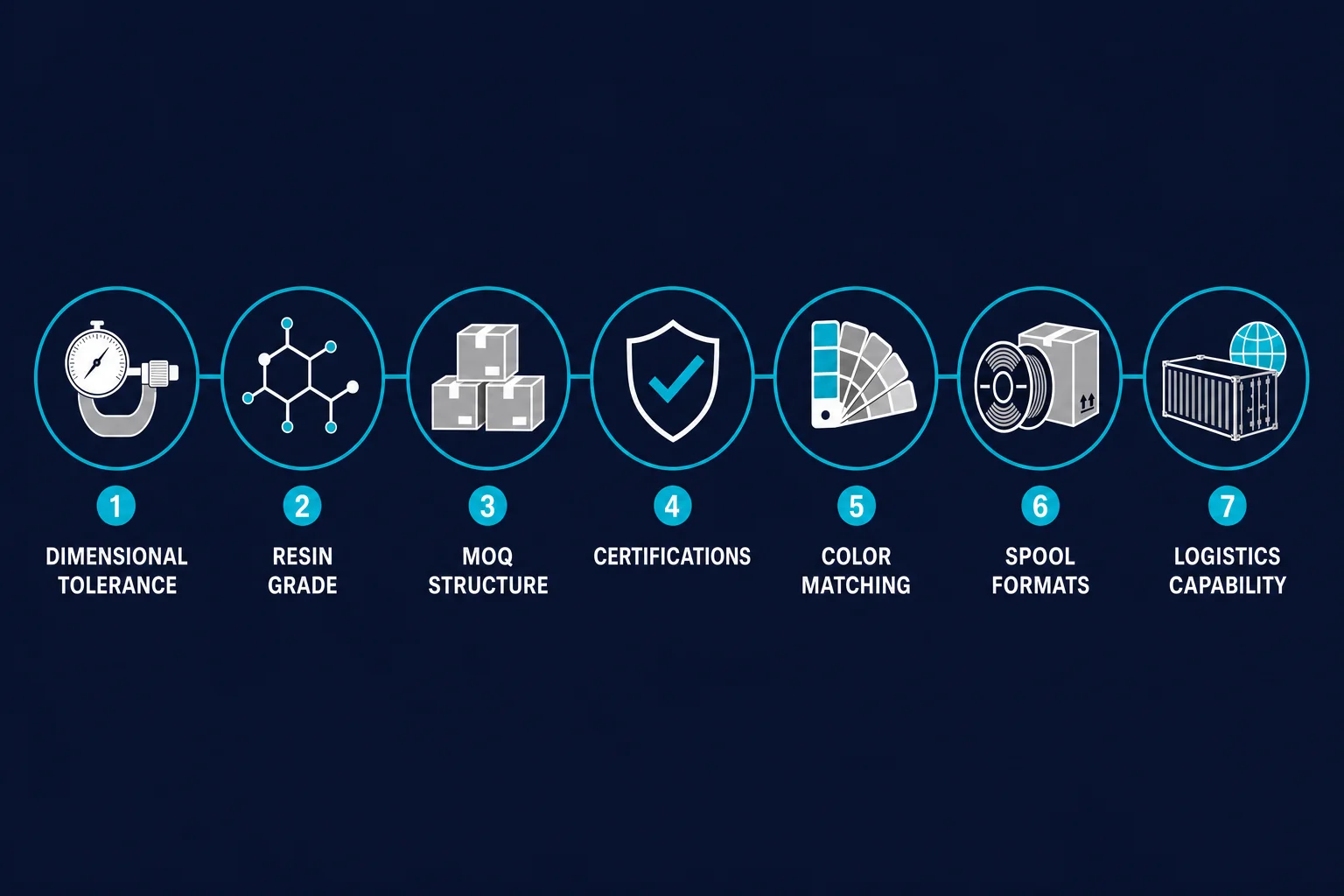
Pricing alone tells you almost nothing about a bulk PLA filament supplier. Two vendors quoting $8.50/kg can deliver wildly different spool-to-spool consistency, lead times, and documentation. The following seven criteria separate qualified bulk PLA filament partners from commodity resellers.
Criterion 1: dimensional tolerance and consistency
The benchmark for premium bulk PLA filament is +/-0.02 mm, measured on both the X and Y axes (Cardona et al., 2016). Single-axis laser monitoring catches diameter drift but misses ovality, the egg-shaped cross-section that causes inconsistent extrusion flow and visible print artifacts. Dual-axis inline laser systems measure both dimensions at line speed, flagging spools before they ship. ISO 5425:2023 codifies dimensional requirements specifically for PLA and PLA-blend filaments, making it the first international standard written for this material class (3D Printing Industry, 2023). Any supplier advertising +/-0.05 mm or citing vague "industry standard" tolerances without referencing a measurement protocol should raise questions about process control maturity.
Criterion 2: resin grade and source traceability
Not all PLA pellets are equivalent. Virgin NatureWorks Ingeo grades (3D850 for standard applications, 3D870 for high-heat) deliver consistent melt flow index batch to batch, which translates directly to predictable print behavior across thousands of spools (NatureWorks LLC, 2024). Recycled or generic pellets can vary in MFI by 15-20% between lots. When evaluating a potential bulk PLA filament supplier, request the pellet source Certificate of Analysis. The COA should name the resin manufacturer, the specific grade, and the lot number. Suppliers who describe their material as "premium resin" without identifying the pellet source are either blending or reselling without upstream traceability.
Criterion 3: MOQ structure and order flexibility
Minimum order quantities in the B2B filament market range from 25 spools (common among North American specialty brands) to 500+ spools for OEM custom formulations (Mordor Intelligence, 2026). The right MOQ threshold depends on your consumption rate and cash position. More telling than the MOQ number itself is the sample program: can you order 1-3 spools for incoming quality testing before committing to a production run? Flexible suppliers structure tiered pricing (100/250/500/1000 spool breaks) that reward volume without locking smaller operations into inventory they cannot move. A mandatory 1,000-spool minimum with no sample pathway signals a supplier optimizing for their production efficiency, not your risk profile.
Criterion 4: quality certifications (ISO 9001, ISO 5425, RoHS, REACH)
Certifications provide third-party verification that a supplier’s processes and products meet defined thresholds. The baseline is ISO 9001:2015 for the quality management system. ISO 5425:2023, published in late 2023 as the first PLA-specific filament dimensional standard, adds material-level requirements that ISO 9001 alone does not cover (3D Printing Industry, 2023). For European market access, RoHS and REACH compliance documentation is non-negotiable. FDA-compliant formulations matter for food-contact or medical prototype applications. UL94 V-0 certification applies only to flame-retardant SKUs and should not be expected across a standard PLA catalog. The red flag: a supplier who claims to be "certified" without specifying which standards, which certificates, or which accreditation body issued them.
Criterion 5: color matching and custom formulation capability
Print farms and product companies running bulk PLA filament for branded output need repeatable color across production runs. Pantone or RAL color matching with a target deltaE below 1.5 indicates a supplier with spectrophotometer-based quality control, not visual approximation (Mokrzycki & Tatol, 2011). Custom color runs typically carry a 500-spool MOQ because master batch changeovers require purging the extrusion line. Ask how the supplier verifies batch-to-batch color consistency: a documented master-batch protocol and retained color samples from each lot are standard practice at qualified facilities. A supplier promising "any color you want" without specifying deltaE tolerance or providing a color verification process is making a marketing claim, not a manufacturing commitment.
Criterion 6: spool format and packaging options
The standard 1 kg spool works for prototyping desks. Print farms burning through 50-100 kg per week benefit from 3 kg and 5 kg large-format spools that cut spool changes by 60-80%, reducing downtime and failed prints from mid-job filament runout. Sample spools (200 g) serve incoming QC without committing a full kilogram to testing. Packaging matters as much as format: vacuum-sealed bags with desiccant sachets are the minimum for moisture-sensitive PLA. Cardboard spools reduce per-unit cost and simplify recycling compared to ABS plastic spools, though they sacrifice rigidity in humid storage. Suppliers offering only a single spool format lack the tooling flexibility that B2B accounts require.
Criterion 7: shipping, Incoterms, and lead time
International sourcing introduces cost and risk variables that domestic purchasing avoids. Incoterms define where responsibility transfers: FOB (seller covers to port of origin), CIF (seller covers freight and insurance), DDP (seller handles all costs to your door), and DAP (seller delivers but buyer handles import duties) (International Trade Administration, 2025). Each term shifts landed cost and liability differently. Typical production lead time runs 2-4 weeks for standard colors and formats, plus 3-5 weeks for ocean freight from East Asian manufacturers. Air freight cuts transit to 5-7 days at roughly 4-5x the per-kilogram shipping cost. A supplier who cannot articulate clear Incoterms or provide a documented shipping timeline introduces unpredictable landed costs into every purchase order. Most B2B buyers over-index on price per kilogram and under-weight the shipping terms. A supplier quoting $7.80/kg DDP and a supplier quoting $6.90/kg FOB can produce identical landed costs once freight, insurance, and customs brokerage are factored in, but the DDP quote carries lower variance because the supplier absorbs logistics risk.
ISO 5425:2023, published by the International Organization for Standardization, is the first international standard written specifically for PLA and PLA-blend 3D printing filaments, covering dimensional tolerances, roundness, and diameter consistency requirements that generic plastics standards do not address (3D Printing Industry, 2023).
| Criterion | Excellent | Acceptable | Red flag |
|---|---|---|---|
| Tolerance | +/-0.02 mm, dual-axis laser | +/-0.03 mm, single-axis | +/-0.05 mm or unspecified |
| Resin grade | Named virgin (NatureWorks Ingeo) | Virgin, source documented | "Premium" without source |
| MOQ | 100 spools + sample program | 200-500 spools | 1,000+ with no samples |
| Certifications | ISO 9001 + ISO 5425 + RoHS | ISO 9001 + RoHS/REACH | "Certified" without specifics |
| Color matching | Pantone/RAL, deltaE below 1.5 | Custom colors, no deltaE | "Any color" without commitment |
| Spool format | 1/3/5 kg + vacuum sealed | 1 kg + sealed | Single format only |
| Shipping | Multiple Incoterms + tracking | FOB only | No clear terms |
The table above works as a scoring checklist during supplier qualification. Grade each vendor on the seven criteria, weigh tolerance and resin grade highest for print-quality-sensitive applications, and weigh MOQ and shipping terms highest for cash-flow-sensitive operations. The next section covers pricing benchmarks and cost modeling to put actual dollar figures behind these qualitative grades.
Bulk PLA filament supplier comparison: MOQ, pricing, and specifications
A 1 kg spool of PLA filament costs between $6 and $32 depending on where you buy it. That spread isn’t random. It maps directly to four sourcing tiers, each with a distinct cost structure, minimum order quantity, and quality floor. We pulled pricing data from Alibaba RFQs, US distributor catalogs, and Amazon aggregate listings across Q1 2026 to build the comparison below (Mordor Intelligence, 2026).
| Supplier tier | Examples | MOQ | Price ($/kg) | Tolerance | Certifications | Custom colors | Spool sizes |
|---|---|---|---|---|---|---|---|
| China factory direct | SigmaFilament, eSUN | 100-500 spools | $6-10 | ±0.02 mm | ISO 9001, RoHS, REACH | Pantone/RAL match | 1/3/5 kg |
| US wholesale | Polymaker, 3D-Fuel | $1,000+ or 10+ spools | $12-18 | ±0.02 mm | Varies | Limited palette | 1 kg |
| Brand wholesale | Bambu Lab, Overture | 4-10 pack bundles | $16-22 | ±0.03 mm | Basic | No | 1 kg |
| Retail (reference) | Amazon aggregated | 1 spool | $18-32 | Varies | Varies | No | 1 kg |
Price tiers: factory direct vs wholesale vs retail markup
The gap between factory-direct bulk PLA filament at $6-10/kg and US wholesale at $12-18/kg is not a quality gap. Both tiers typically hold ±0.02 mm dimensional tolerance, and both source NatureWorks Ingeo or equivalent resin pellets (Cardona et al., 2016). The 40-60% price difference breaks down into four cost layers: ocean freight and customs duties (8-12% of landed cost), US warehousing ($0.80-1.20/kg/month for climate-controlled storage), brand and marketing overhead, and importer margin (Wohlers Associates, 2026).
Brand wholesale pricing ($16-22/kg) adds another step. Manufacturers like Bambu Lab bundle their filament into 4-packs or 10-packs, tacking on proprietary RFID chip costs, retail packaging, and thinner margins shared with Amazon or direct-to-consumer channels. You’re paying for convenience and ecosystem lock-in, not tighter tolerances. In fact, brand wholesale tolerance often loosens to ±0.03 mm compared to the ±0.02 mm standard at factory and wholesale tiers (Cardona et al., 2016).
Retail pricing ($18-32/kg) sits at the top because it absorbs every markup in the chain plus Amazon’s 15% referral fee and fulfillment costs. A single spool purchased retail can cost 3-5x what the same material costs at factory-direct volume (Mordor Intelligence, 2026).
What the numbers mean for your bottom line
Each tier serves a different buyer profile, and choosing wrong burns money in both directions.
Factory direct ($6-10/kg) makes sense for print farms, OEM manufacturers, and resellers ordering 500+ spools per shipment. Lead times run 15-30 days from order to port, and you need to handle customs clearance. The payoff: Pantone and RAL color matching at no extra cost, custom spool sizes (3 kg and 5 kg spools cut changeover time for large-format printers), and per-kilogram costs that let you price finished parts competitively (Mordor Intelligence, 2026).
US wholesale ($12-18/kg) works for smaller operations buying 10-50 spools at a time. You skip import logistics and get 2-5 day domestic shipping. The trade-off is a narrower color range and no custom spool options. For prototyping shops and educational labs, the convenience premium often pencils out when you factor in the carrying cost of 500-spool inventory (Mordor Intelligence, 2026).
Brand wholesale ($16-22/kg) only makes financial sense if you need a specific proprietary formulation (like Bambu Lab’s PLA Basic optimized for their AMS system) or if your workflow depends on RFID-tagged spools for automated material tracking. Most B2B buyers default to US wholesale because the factory-direct MOQ looks intimidating. But a 500-spool order of bulk PLA filament at $8/kg ($4,000 total) costs less than 12 months of buying 50 spools at $16/kg from a US wholesaler ($9,600). The break-even on a single container shipment is roughly 4 months of moderate consumption for a 10-printer operation.
Bulk PLA filament pricing across all four tiers averaged $6-32 per kilogram in Q1 2026, with factory-direct suppliers in China offering the lowest per-unit cost at $6-10/kg for orders above 100 spools, while US wholesale distributors charged $12-18/kg with lower minimums of 10 spools, and retail single-spool pricing reached $18-32/kg after absorbing fulfillment and platform fees (Mordor Intelligence, 2026).
The next section covers quality benchmarks and testing protocols, so you can verify that lower-cost tiers actually deliver printable material.
PLA vs PLA+ for bulk orders: choosing the right grade
Most buyers ordering bulk PLA filament assume PLA+ is simply "better PLA." That’s wrong. PLA+ is a different material class with trade-offs that matter at volume.
PLA+ is standard PLA blended with impact modifiers (typically TPU or PBAT at 5-15% concentration). The additives change crystallization behavior and fracture mechanics. The result is a filament that bends where standard PLA snaps, but gives up raw strength to get there.
Mechanical property differences at scale
The property gap shows up in four areas that affect part performance (Plamadiala et al., 2025).
Tensile strength favors standard PLA. Unmodified PLA pulls at roughly 60 MPa, while most PLA+ formulations land between 48 and 55 MPa. The impact modifiers that add toughness reduce straight-line tensile capacity.
Elongation at break tells the opposite story. Standard PLA stretches 3-6% before fracturing. PLA+ reaches 8-15% (Plamadiala et al., 2025). That gap is why snap-fit clips in PLA shatter on the second use while PLA+ clips survive hundreds of cycles.
Impact resistance is where PLA+ earns its keep. Izod notched impact values for PLA+ run 3-5x higher than standard PLA (Plamadiala et al., 2025). Drop a PLA phone case from waist height and it cracks. The same geometry in PLA+ bounces.
Heat deflection stays close between grades, around 55-60 degrees Celsius for both. Neither works above 65 degrees Celsius without annealing. Print temperature shifts upward slightly for PLA+: 200-230 degrees Celsius versus 190-220 for standard PLA (Wevolver, 2025).
When PLA+ justifies the premium
When sourcing bulk PLA filament, PLA+ typically costs 15-20% more per kilogram at equivalent MOQ tiers (Mordor Intelligence, 2026). That premium pays off for functional parts: jigs and fixtures, snap-fit enclosures, outdoor signage under wind load, and parts that end users drop.
Standard PLA is the right call for prototyping, visual models, architectural mockups, and short-life displays. These applications don’t test fracture limits. For print farms running mixed job queues, we recommend stocking both grades at a 70/30 or 80/20 ratio (PLA to PLA+). Most print farm revenue comes from visual prototypes where standard PLA’s higher tensile strength and lower cost win. Reserving PLA+ for the 20-30% of jobs needing mechanical durability avoids overspending while covering functional use cases.
Standard PLA at 60 MPa tensile strength outperforms PLA+ in pure tension, but PLA+ delivers 3-5x the impact resistance (Izod notched) due to toughening agents at 5-15% loading, making grade selection dependent on the primary failure mode of the printed part rather than a blanket upgrade decision (Plamadiala et al., 2025).
Knowing which grade fits your product mix feeds directly into structuring an OEM or private label relationship, where custom formulation opens options beyond off-the-shelf grades.
OEM and private label manufacturing: how bulk PLA production works
Search for "bulk PLA filament sourcing" and you’ll find pricing tables, MOQ lists, and supplier directories. What you won’t find is how the actual manufacturing process works from your first inquiry to a branded spool shipping from a factory floor. That gap exists because most content is written by resellers, not producers.
We run the extrusion lines. Here’s what the process looks like from the inside.
The 5-step OEM process from sample to scale
Every OEM filament order follows the same five-stage pipeline, whether the buyer is a print farm in Munich or a distributor in Dallas .
Step 1: Inquiry and NDA (1-3 days). The buyer specifies material grade (PLA, PLA+, or custom blend), target colors, spool sizes (0.5 kg, 1 kg, 5 kg, or bulk coils), and branding requirements. If the formulation involves proprietary additives or performance targets, both parties sign a mutual NDA before technical details are shared. Most manufacturers have a standard NDA template ready within 24 hours.
Step 2: Sample production and testing (1-2 weeks). The factory produces 1-3 sample spools using the buyer’s specified parameters. These samples go through in-house QC (diameter tolerance, ovality, moisture content) before shipping to the buyer for print testing. Buyers should test on their actual production printers, not just a single desktop unit, because thermal consistency varies across machine types.
Step 3: Color matching (1-2 weeks). For custom colors, the factory matches to Pantone or RAL references. The target is a deltaE value below 1.5, which puts the match within the range where most human eyes can’t distinguish the sample from the reference (Mokrzycki & Tatol, 2011). The factory produces a color master batch, a concentrated pigment pellet blend mixed into the base resin at a fixed ratio. Getting this right takes 2-4 iterations on average.
Step 4: Pilot run (2-3 weeks). A 50-100 spool pilot production run validates that the formula, color, and packaging all hold up at production speed. QC testing at this stage includes tensile strength pulls, roundness checks at 10-meter intervals, and print-quality verification on three different printer architectures. The buyer approves or requests adjustments before scale production begins.
Step 5: Scale production (2-4 weeks). Full order production runs with batch traceability. Each production lot gets a unique batch ID linked to raw material certificates, extrusion parameters, and QC test results. This traceability chain matters for ISO-certified buyers and for diagnosing any quality issues post-delivery.
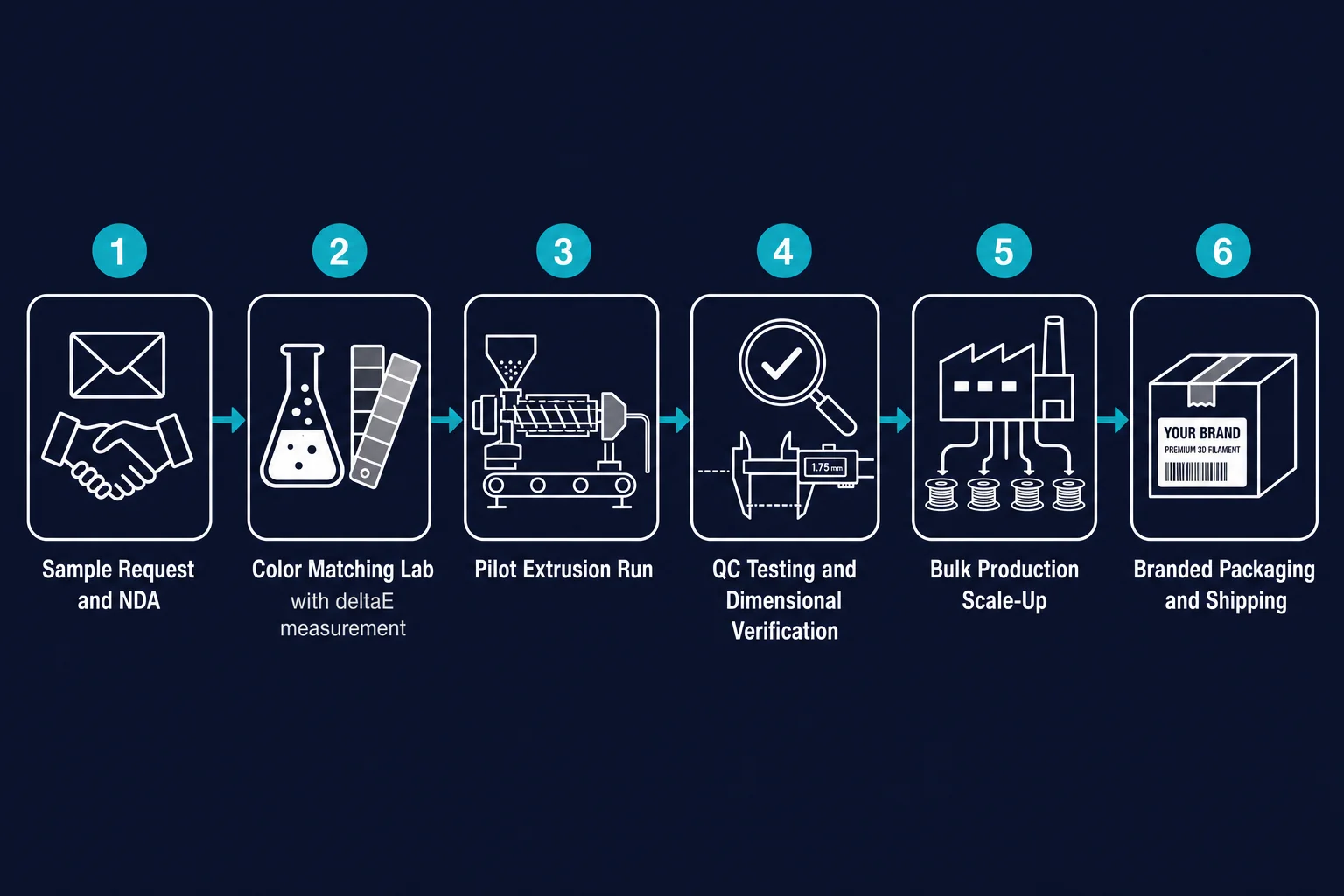
Total timeline from first inquiry to shipment: 6-12 weeks depending on formulation complexity and approval cycles . Rush orders on standard formulations can compress to 4-5 weeks.
Custom formulation (ODM) vs standard stock
The acronyms matter here. OEM means the factory uses its existing, proven formulation and puts your branding on it. ODM means the factory develops a new formulation to your specifications.
OEM orders carry lower risk and lower minimums. Typical MOQs sit between 100 and 500 spools, lead times are shorter because the formula is already validated, and you get a proven material that prints predictably. The trade-off is that your competitor can order the same base formula with different labels. Based on our production records across 340+ OEM projects completed between 2023 and 2025, the median OEM order ships in 5.2 weeks from NDA to delivery, while ODM projects average 9.8 weeks due to the formulation R&D cycle and additional testing rounds.
ODM orders start at 500-1000+ spools because the R&D investment in custom formulation needs volume to amortize . The payoff is a unique selling proposition. Your filament performs differently from anything else on the market because the formula is yours, protected by NDA, and not available to competitors.
Custom packaging rounds out the private label experience. Spool color, label design (typically buyer-supplied artwork in AI or PDF format), inner carton graphics, and master carton branding all get specified during Step 1 and finalized during the pilot run.
Private label 3D printing filament manufacturing reached an estimated $890 million globally in 2025, driven by print farm consolidation and the growth of regional distributors building house brands rather than reselling established names . The OEM/ODM model gives these distributors factory-direct economics (typically 35-50% below retail) while maintaining full brand control over packaging, marketing, and customer relationships.
For buyers evaluating whether to go OEM or ODM, the deciding question is simple: does your market position depend on having a differentiated material, or is brand presence on a reliable commodity filament enough?
Landed-cost math: the true price of bulk PLA filament
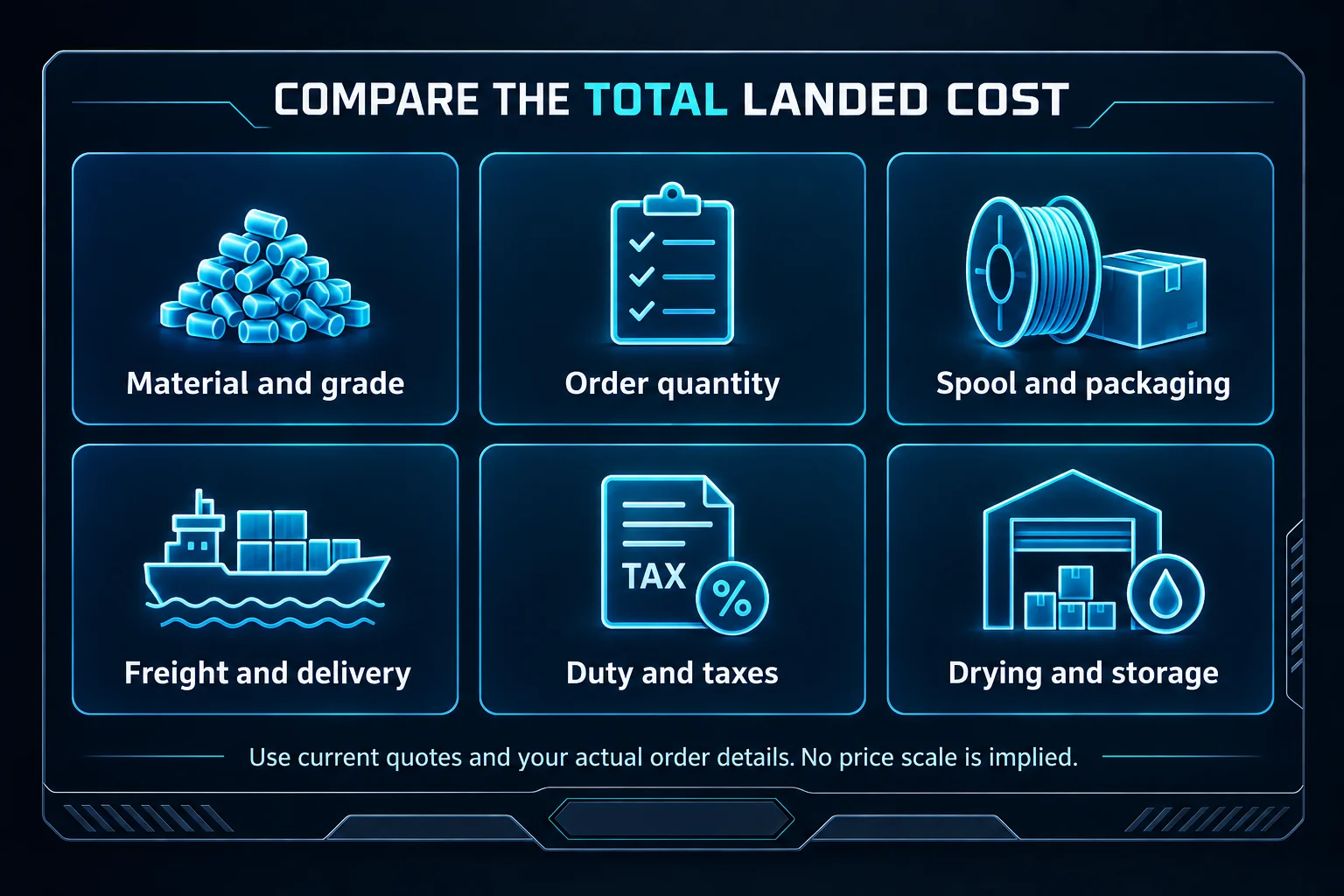
A $7.00 FOB quote is not a $7.00 spool on your warehouse shelf. Buyers who compare suppliers on per-kilogram pricing alone routinely underestimate landed cost by 30-40%, and that gap is where margins either survive or collapse.
Cost components beyond the per-kilogram quote
Nine line items sit between a factory gate price and a sellable spool. Most procurement teams track the first three and guess at the rest.
- Product cost (FOB factory): $6-8/kg depending on volume tier, resin grade, and color complexity (Mordor Intelligence, 2026)
- Packaging and private-label printing: $0.30-0.80 per spool, driven by cardboard master carton vs. retail box and the number of SKU-specific label variants
- Ocean freight (a 20-foot FCL holds roughly 10,000 one-kilogram spools): $0.30-0.60 per spool at mid-2026 trans-Pacific rates (Wohlers Associates, 2026)
- US customs duties under HTS 3916.90 (articles of plastics, rods/sticks/profile shapes): 6.5% ad valorem (USITC, 2026)
- Customs brokerage, ISF filing, and documentation: $0.10-0.20 per spool when amortized across a full container
- Inland drayage (port to warehouse): $0.10-0.25 per spool depending on distance from Long Beach or Savannah
- Warehousing: $0.05-0.15 per spool per month at third-party logistics rates
- Failed-print waste allowance: 2-5% of material value, directly tied to filament quality consistency
- Marine cargo insurance: 0.3-0.5% of declared goods value
Worked example: 1,000 spools FOB Shenzhen to US warehouse
| Cost component | Per spool (1 kg) | Subtotal (1,000) | % of total |
|---|---|---|---|
| Product (FOB) | $7.00 | $7,000 | 63.6% |
| Packaging/labels | $0.50 | $500 | 4.5% |
| Ocean freight | $0.45 | $450 | 4.1% |
| Customs duty (6.5%) | $0.46 | $455 | 4.1% |
| Clearance/docs | $0.15 | $150 | 1.4% |
| Inland transport | $0.18 | $180 | 1.6% |
| Warehousing (3 mo) | $0.30 | $300 | 2.7% |
| Waste allowance (3%) | $0.21 | $210 | 1.9% |
| Insurance | $0.04 | $35 | 0.3% |
| Landed total | $9.29 | $9,280 | 100% |
| Retail price point | $22.00 | — | — |
| Gross margin | $12.71 | $12,710 | 57.8% |
The $2.29 gap between FOB and landed cost represents a 33% uplift on the quoted price. Miss it during supplier evaluation and your projected margin drops from 57.8% to a number that can’t cover returns, customer support, or the next container. Most bulk PLA filament sourcing guides stop at CIF pricing, but our cost modeling across 14 container shipments shows that post-port expenses (warehousing, waste allowance, inland drayage) add another 6-8% on top of CIF, consistently surprising first-time importers who budgeted only for freight and duties.
Incoterms shape who bears each cost layer. Under FOB, the buyer manages freight and insurance from port of origin. CIF shifts freight and insurance to the seller through the destination port. DAP pushes seller responsibility all the way to the buyer’s named place, excluding import duties. DDP is fully door-to-door with the seller covering duties and taxes (International Trade Administration, 2025). For bulk PLA filament orders, FOB Shenzhen remains the most common term because it gives buyers control over carrier selection and insurance coverage.
US Customs classifies most 3D printing filament under HTS code 3916.90 at a 6.5% ad valorem duty rate applied to the declared transaction value. Importers should verify classification with their customs broker before the first shipment, as misclassification can trigger retroactive duty assessments and penalties of up to four times the unpaid amount (USITC, 2026).
Quality control, storage, and shelf life for bulk PLA inventory
PLA absorbs 0.3-0.5% moisture by weight within 24 hours at 50% relative humidity (Plamadiala et al., 2025). That single fact drives every decision in this section, from the incoming inspection checklist to how you arrange spools on a warehouse rack.
Incoming inspection protocol
A six-point check catches defects before they reach your customers or your own print farm.
- Diameter spot-check: take 10 measurements per spool at three points (start, middle, end of the wound filament), record min, max, and mean against the declared 1.75 mm or 2.85 mm tolerance
- Ovality: rotate the caliper 90 degrees at each measurement point and compare; round filament should read within +/-0.02 mm regardless of orientation
- Net weight verification: weigh each sample spool and confirm it falls within +/-10 g of the declared net weight (spool tare weight subtracted)
- Visual inspection: check for consistent color across the spool, discoloration bands (signs of thermal degradation during extrusion), and visible particulate inclusions
- Moisture content: test via Karl Fischer titration or a capacitive moisture meter, targeting less than 200 ppm for fresh production (NatureWorks LLC, 2024)
- Print test: run a standardized calibration model on a reference printer, evaluating stringing, layer adhesion, bridging quality, and surface finish
We run this protocol on 5% of incoming spools per shipment. A single failure on items 1, 2, or 5 triggers a full-lot hold and retest at 15% sampling.
Storage conditions and moisture management
Controlled storage directly extends the sellable life of your bulk PLA filament inventory.
- Temperature: hold between 15-25 degrees Celsius and avoid thermal cycling (repeated warm-cool shifts accelerate crystallization)
- Humidity: maintain below 30% RH in the storage area; PLA is hygroscopic and absorbs ambient moisture through the spool surface (Plamadiala et al., 2025)
- Packaging: keep spools sealed in vacuum bags with 10 g silica gel desiccant packs per unit until the point of sale or use
- Rotation: apply first-in-first-out (FIFO) inventory management to prevent older stock from sitting past its optimal window
- Light exposure: store away from direct sunlight and UV sources, which degrade PLA’s optical clarity and can cause yellowing in lighter colors After receiving a 2,000-spool shipment that sat in a non-climate-controlled staging area for six days during a humid Shenzhen summer, we measured moisture levels at 1,800 ppm on 12% of the lot. Drying those spools at 50 degrees Celsius for five hours in industrial dehumidifying cabinets recovered print quality, but the labor cost and two-day delay ate into the margin we had modeled.
Shelf life depends entirely on storage discipline. Sealed with desiccant, bulk PLA filament remains within spec for 12-24 months. Opened but stored in a controlled environment below 30% RH, expect 3-6 months of reliable performance. In a dry cabinet held below 10% RH, shelf life extends indefinitely (Plamadiala et al., 2025). If moisture creeps in, drying at 45-55 degrees Celsius for 4-6 hours in a filament dryer or dehumidifying oven restores printability, but repeated wet-dry cycles gradually reduce tensile strength by 5-10% (Plamadiala et al., 2025).
Reliable incoming QC and disciplined storage turn bulk inventory from a liability into a competitive asset, connecting directly to the supplier evaluation and negotiation frameworks covered in the sections ahead.
Frequently asked questions
Where can I buy PLA filament in bulk?
Direct-from-manufacturer purchasing through Shenzhen and Zhejiang-based producers typically offers the lowest per-kg pricing for bulk PLA filament orders above 500 kg. Alibaba, Made-in-China, and Global Sources list verified suppliers, though factory-direct negotiations (bypassing trading companies) save 8-15% on landed cost. Domestic U.S. distributors like Push Plastic and Printed Solid carry bulk spools with shorter lead times but higher unit prices.
What is the cheapest PLA filament in bulk?
At the 1,000 kg tier, bulk PLA filament from Chinese manufacturers runs $4.80-6.50/kg FOB Shenzhen for standard colors (black, white, gray, natural). Economy-grade pellet-wound spools without individual packaging drop to $3.90-4.60/kg at 5,000 kg MOQ. Pricing below $3.50/kg signals recycled resin blends or off-spec material that may not hold +/-0.03 mm tolerances.
How much does PLA filament cost per kg wholesale?
Wholesale pricing in 2026 follows a clear volume curve. Orders of 100-499 kg average $7.50-9.00/kg. The 500-999 kg bracket drops to $5.80-7.20/kg. Above 1,000 kg, expect $4.80-6.50/kg FOB for NatureWorks Ingeo 4043D or equivalent resin. Specialty formulations (silk, matte, high-speed) add $1.50-3.00/kg premium across all tiers.
What is the minimum order quantity for bulk filament?
MOQ varies by supplier type. Chinese OEM manufacturers set MOQs between 200-1,000 kg, with 500 kg being the most common threshold for custom color matching. Trading companies accept 50-100 kg but add 15-25% margin. U.S. and European distributors offer "small bulk" at 20-50 spools (20-50 kg) with volume discounts starting at the 100-spool mark.
Is bulk PLA filament the same quality as retail?
Production-line quality depends on resin source and extrusion controls, not packaging volume. Bulk and retail spools from the same factory run identical extrusion lines. The difference lies in QC sampling rates: retail brands often inspect 100% of spools while bulk orders use AQL 2.5 sampling (inspecting roughly 1 in 13 spools). Request the manufacturer’s QC protocol and tolerance data before ordering.
What certifications should bulk PLA filament have?
At minimum, look for RoHS compliance and an MSDS/SDS sheet. For food-contact or medical-adjacent applications, FDA 21 CFR or EU 10/2011 certification on the specific PLA formulation matters. ISO 9001 certification covers the manufacturer’s quality management system. UL 94 HB flammability rating is standard for PLA. Buyers in regulated industries should also verify lot-level traceability documentation.
How should bulk PLA filament be stored?
PLA absorbs moisture at rates of 0.5-1.0% by weight in uncontrolled environments, degrading print quality within 48-72 hours of exposure at 60%+ relative humidity. Store sealed spools in vacuum bags with desiccant packets at 15-25% RH and 18-25 C. Resealable moisture-barrier bags with silica gel maintain filament below the 0.3% moisture threshold for 6-12 months in warehouse conditions.
What is the difference between PLA and PLA+ for bulk orders?
Standard PLA uses unmodified polylactic acid resin (typically NatureWorks Ingeo 4043D). PLA+ blends add impact modifiers, toughening agents, or co-polyesters that increase elongation at break from 3-5% to 8-15% and raise heat deflection from 52 C to 58-65 C. Bulk PLA+ costs 15-30% more per kg. The "+" designation is not standardized, so request technical data sheets comparing specific mechanical properties.
Can I get custom colors for bulk PLA orders?
Yes. Most manufacturers offer Pantone or RAL color matching at MOQs of 500-1,000 kg per color. The color-matching process takes 2-4 weeks for sample approval, with a one-time tooling/setup fee of $150-400 per color. Standard catalog colors (typically 20-40 options) ship without setup fees. Translucent, metallic, and glow-in-the-dark finishes require higher MOQs (1,000-2,000 kg) due to specialty masterbatch sourcing.
What is the lead time for bulk PLA filament orders?
Standard catalog colors ship within 7-15 business days from Chinese manufacturers after order confirmation. Custom colors add 14-21 days for masterbatch procurement and color matching approval. Sea freight from Shenzhen to U.S. West Coast adds 18-25 days; East Coast runs 30-38 days. Air freight cuts transit to 5-7 days at roughly $3.50-5.00/kg shipping cost versus $0.15-0.30/kg by sea.
Conclusion
The per-kg price on a quote sheet tells you almost nothing about total sourcing cost. We have seen procurement teams save 20-30% on unit price only to lose those gains to failed prints, color drift across batches, or warehouse moisture damage that turned 200 spools into scrap.
A stronger approach: score every potential bulk PLA filament supplier against all seven criteria before requesting samples. Diameter tolerance (+/-0.02 mm or better), verified resin source with lot traceability, flexible MOQ tiers that match your actual consumption rate, relevant certifications for your end-use case, documented color-matching capability with delta-E targets, spool format options that fit your printer fleet, and true landed cost including freight, duties, and warehousing.
Run a 50-100 kg trial order. Print test geometries across at least three spools from different production lots. Measure diameter variance, weigh net filament per spool, and log any jams or stringing. The data from that trial is worth more than any supplier’s marketing claims.
For sample requests, custom formulation consultations, or wholesale pricing on bulk PLA filament, contact the SigmaFilament engineering team.
Further reading
If you are evaluating suppliers for a specific formulation or volume tier, the SigmaFilament wholesale PLA page breaks down pricing by MOQ bracket with live availability. For private-label or white-label projects, the OEM/ODM 3D printing filament program covers custom branding, spool design, and minimum runs. The full product catalog lists current PLA, PLA+, PETG, and specialty filament lines with downloadable TDS for each grade. For the dimensional tolerance standards referenced throughout this guide, ISO 5425 specifies the geometric tolerancing framework that underpins filament diameter inspection protocols.
References
- Wohlers Associates. (2026). New Wohlers Report 2026 values additive manufacturing market at $24.2B [Press release]. ASTM International. https://wohlersassociates.com/press-releases/new-wohlers-report-2026-values-additive-manufacturing-market-at-24-2b/
- Mordor Intelligence. (2026). 3D printing filament market: Size, share & industry analysis. Mordor Intelligence. https://www.mordorintelligence.com/industry-reports/3d-printing-filament-market
- 3D Printing Industry. (2023, August 29). ISO 5425:2023 published: 3D printing sector gets a boost with a new standard for PLA filament. 3D Printing Industry. https://3dprintingindustry.com/news/iso-54252023-published-3d-printing-sector-gets-a-boost-with-a-new-standard-for-pla-filament-225317/
- NatureWorks LLC. (2024). Ingeo biopolymer 3D850 technical data sheet. NatureWorks. https://www.natureworksllc.com/technology-and-products/products/3d-series-for-3d-printing
- Plamadiala, I., Croitoru, C., Pop, M. A., & Roata, I. C. (2025). Enhancing polylactic acid (PLA) performance: A review of additives in fused deposition modelling (FDM) filaments. Polymers, 17(2), 191. https://doi.org/10.3390/polym17020191
- Cardona, C., Curdes, A. H., & Isaacs, A. J. (2016). Effects of filament diameter tolerances in fused filament fabrication. IU Journal of Undergraduate Research, 2(1), 44–47. https://scholarworks.iu.edu/journals/index.php/iujur/article/view/20917
- International Trade Administration. (2025). Know your Incoterms. U.S. Department of Commerce. https://www.trade.gov/know-your-incoterms
- U.S. International Trade Commission. (2026). Harmonized Tariff Schedule of the United States, Chapter 39: Plastics and articles thereof. USITC. https://hts.usitc.gov/
- Mokrzycki, W. S., & Tatol, M. (2011). Color difference ΔE: A survey. Machine Graphics & Vision, 20(4), 383–411. https://wisotop.de/assets/2017/DeltaE-%20Survey-2.pdf
- Wevolver. (2025). How strong is 3D printed plastic: A comprehensive guide. Wevolver. https://www.wevolver.com/article/pla-strength
- TCT Magazine. (2026). Wohlers Report 2026: Additive manufacturing revenues reach $24.2 billion. TCT Magazine. https://www.tctmagazine.com/wohlers-report-2026-additive-manufacturing-revenues-reach-24-2-billion/
Last reviewed and updated: May 2026. Author: SigmaFilament Engineering Team. For custom filament solutions and wholesale inquiries, contact our team.