A Practical Buyer’s Guide: 5 Data-Backed Checks for Your Next 3D Filament Bundle in 2026


Abstract
The acquisition of a 3D filament bundle presents a compelling proposition for makers, promising a diverse material palette at an ostensibly reduced cost. An empirical examination of this purchasing decision, however, reveals a complex landscape where perceived value often diverges from functional utility and economic prudence. This analysis deconstructs the multifaceted nature of the 3D filament bundle, moving beyond surface-level attractions like color variety and low initial price points. It proposes a systematic, five-point framework for evaluating these offerings, grounded in material science, manufacturing quality control, economic calculation, and application-specific suitability. The investigation scrutinizes the trade-offs between filament composition, the critical impact of dimensional accuracy tolerances, the true cost-per-meter, the alignment of material properties with project requirements, and the transparency of the manufacturer. The objective is to cultivate a capacity for nuanced judgment in the practitioner, enabling a transition from a consumer of deals to an informed investor in materials. This approach reframes the selection process, not as a search for the cheapest option, but as a deliberate choice that underpins print reliability, part performance, and overall project success.
Key Takeaways
- Evaluate bundles based on material quality, not just the number of colors.
- Verify dimensional accuracy (±0.02mm is ideal) to prevent printing failures.
- Calculate the true cost per kilogram, as smaller spools can be deceptive.
- Choose a 3d filament bundle that matches your specific project needs.
- Investigate the manufacturer’s quality control standards and certifications.
- Specialty bundles are excellent for testing advanced engineering materials.
- Neatly wound spools are a non-negotiable feature for reliable, tangle-free printing.
Table of Contents
- Check 1: Deconstructing the Material Composition
- Check 2: Scrutinizing Quality Control Metrics
- Check 3: Calculating the True Cost Per Meter
- Check 4: Evaluating the Bundle’s Purpose and Application
- Check 5: Investigating the Manufacturer’s Reputation and Support
- Frequently Asked Questions (FAQ)
- Conclusion
- References
Check 1: Deconstructing the Material Composition
When we approach a 3D filament bundle, our eyes are often drawn to the vibrant spectrum of colors, a veritable rainbow of creative potential. It feels like an invitation to experiment, to bring a new chromatic dimension to our projects. Yet, the philosopher in us, the part that seeks to understand the underlying nature of things, must gently push past this immediate sensory appeal. The fundamental question is not “what colors are in the box?” but rather, “what is in the box?” The composition of the filaments themselves is the bedrock upon which every subsequent print will be built. A choice made here, without careful consideration, can be the difference between a flawlessly executed part and a frustrating pile of plastic spaghetti. To choose wisely, we must become amateur material scientists, engaging with the very substance of our craft.
The “Standard” PLA/PETG Mix: Beyond the Basics
The most common offering in the world of filament bundles is a collection of Polylactic Acid (PLA) and, increasingly, Polyethylene Terephthalate Glycol (PETG). These two materials form the backbone of desktop 3D printing for good reason, yet they are fundamentally different beings, each with its own personality, its own strengths, and its own demands. Understanding this difference is the first step toward mastery.
PLA is often lauded as the beginner’s friend. It is derived from renewable resources like corn starch or sugarcane, which gives it a certain environmental appeal. Its defining characteristic is its ease of use. It prints at relatively low temperatures (typically 190-220°C), requires no heated bed for smaller parts (though one is always recommended for adhesion), and exhibits minimal warping as it cools. This low thermal expansion is a consequence of its semi-crystalline structure, which means it transitions from a molten to a solid state quite rapidly and with less internal stress (SIGMAFILAMENT, 2026d). Think of it as an eager student, quick to follow instructions and produce sharp, detailed results. This makes it superb for aesthetic models, detailed miniatures, and prototypes where dimensional accuracy is paramount but mechanical strength is not the primary concern.
PETG, on the other hand, is the tougher, more resilient cousin. It is a modified version of the same polymer used to make water bottles (PET), with glycol added to prevent crystallization and brittleness during heating. This chemical tweak results in a material that is significantly more durable, more flexible, and more resistant to both heat and chemical attack than PLA (SIGMAFILAMENT, 2026a). It demands a bit more from the user—higher printing temperatures (220-250°C) and a heated bed are non-negotiable—and it has a notorious tendency to “string” or “web” if printing parameters are not perfectly dialed in. This is because, as an amorphous polymer, it has a wider, more gradual transition from liquid to solid, like thick honey slowly hardening. The reward for this extra effort is a functional part that can withstand stress, impact, and warmer environments. It is the material you choose for a mechanical bracket, a protective case, or a part that might live in a hot car.
When you see a bundle of PLA and PETG, you are not just seeing colors; you are seeing a choice between form and function, between detail and durability. A bundle containing only PLA is geared toward the artist and the rapid prototyper. A bundle that mixes in PETG is speaking to the engineer and the practical problem-solver.
| Feature | Polylactic Acid (PLA) | Polyethylene Terephthalate Glycol (PETG) | Acrylonitrile Butadiene Styrene (ABS) |
|---|---|---|---|
| Ease of Printing | Very High (Low temps, no enclosure needed) | Medium (Higher temps, prone to stringing) | Low (High temps, enclosure required, warping) |
| Strength & Durability | Low (Brittle, low impact resistance) | High (Durable, good impact resistance) | Very High (Very tough and impact resistant) |
| Temperature Resistance | Low (Deforms ~60°C) | Medium (Deforms ~80°C) | High (Deforms ~100°C) |
| UV Resistance | Low (Becomes brittle in sunlight) | Medium (Better than PLA, but can discolor) | Low (Yellows and becomes brittle in sunlight) |
| Fumes/Odor | Low (Sweet, sugary smell) | Very Low (Essentially odorless) | High (Strong, potentially harmful fumes – VOCs) |
| Bed Adhesion | Good (Heated bed recommended but not always required) | Excellent (Requires a heated bed; can stick too well) | Poor (Heated bed and slurry/adhesives required) |
| Common Applications | Aesthetic models, prototypes, low-stress items | Functional parts, mechanical brackets, containers | Automotive parts, enclosures, high-wear items |
Specialty and Sample Bundles: A Gateway to Advanced Materials
Beyond the standard offerings, a more intriguing type of 3D filament bundle has emerged: the specialty sampler. Instead of multiple colors of the same material, these packs offer single, smaller spools of vastly different polymers. A pack of this kind might pair PLA and PETG with harder-to-print polymers such as ABS or TPU; check the listing for the exact materials. This is not a bundle for mass production; it is a library of possibilities, an educational toolkit.
Let’s consider the new characters this introduces to our story:
- ABS (Acrylonitrile Butadiene Styrene): This was once the king of 3D printing filaments, the same tough plastic used to make LEGO bricks. It boasts superior strength and high-temperature resistance compared to PLA and PETG (SIGMAFILAMENT, 2026a). However, it is a demanding material. It requires an enclosed printer to maintain a hot ambient temperature to prevent dramatic warping and layer separation. It also off-gasses styrene, a volatile organic compound (VOC) with a distinct odor, necessitating good ventilation. A sample spool allows you to determine if your printer setup and environment are suitable for ABS before you commit to a full kilogram.
- TPU (Thermoplastic Polyurethane): This is a flexible, rubber-like filament. Printing with TPU is a completely different experience. It requires slower speeds and carefully managed retraction settings to avoid the filament bunching up in the extruder. A sampler bundle gives you the chance to print a phone case or a flexible coupling, to feel the unique properties of the material, and to decide if the challenge of printing it is worth the reward for your projects.
- Composites (e.g., Carbon Fiber PETG): These are the high-performance athletes of the filament world. By infusing a base polymer like PETG with chopped carbon fibers, manufacturers create a material that is significantly stiffer, stronger, and more dimensionally stable (SIGMAFILAMENT, 2026c). The resulting parts have a beautiful matte finish and are incredibly rigid. However, these filaments are abrasive and will quickly destroy a standard brass nozzle. A sampler allows you to test the material’s properties while also confirming you have the necessary hardware (like a hardened steel nozzle) and print settings to handle it.
Choosing a specialty bundle is an investment in your own education. It is an acknowledgment that the world of materials is vast and that the best choice for a job may be one you have not yet tried.
Assessing Material Purity and Sourcing
The final, and perhaps most subtle, aspect of material composition is its purity. Not all PLA is created equal. The filament on your spool is the end product of a long supply chain. The quality begins with the raw polymer resin. High-quality filaments are made from “virgin” resin, which is newly manufactured polymer with a known and consistent chemical makeup. Lower-quality, cheaper filaments may incorporate recycled material from unknown sources. While recycling is commendable, using post-consumer or industrial scrap without rigorous sorting and cleaning can introduce contaminants. These microscopic impurities can cause havoc in your printer’s hotend, leading to clogs, inconsistent extrusion, and failed prints.
Furthermore, the additives matter. The pigments used to create those beautiful colors can themselves affect the filament’s properties. A study by Singh (2025) found that color pigmentation could have a significant influence on the tensile strength of a printed part. This means that the red PLA in a bundle might behave slightly differently from the black PLA, even if they are from the same brand. A reputable manufacturer works to minimize this variance, selecting high-quality pigments and adjusting their formulas to ensure consistent performance across their color range.
How can you, as a buyer, assess this? Look for signs of a professional manufacturing operation. Does the manufacturer advertise the use of virgin resins? Do they hold certifications like ISO 9001:2015, which indicates a documented quality management system? Do they provide information about compliance with standards like RoHS (Restriction of Hazardous Substances)? These are not just marketing buzzwords; they are indicators of a commitment to a controlled, repeatable process, which is the foundation of high-quality filament. A bundle from such a source is more likely to provide a consistent and reliable experience, spool after spool.
Check 2: Scrutinizing Quality Control Metrics
Having considered the substance of the filament, our inquiry must now turn to its form. In Fused Deposition Modeling (FDM) 3D printing, we are engaged in a process of extraordinary precision. A machine is methodically depositing material, layer by layer, with tolerances measured in fractions of a millimeter. The filament we feed into this machine is not just a passive supply; it is an active mechanical component. Its physical consistency is as vital to the success of a print as any line of code or any setting in our slicer. A 3D filament bundle, therefore, should not be judged merely on its material type, but on the rigor of the manufacturing process that shaped it. When we scrutinize the quality control metrics, we are looking for evidence of discipline, precision, and a respect for the mechanical nature of the printing process.
The Critical Role of Dimensional Accuracy (±0.02mm)
The most frequently cited quality metric for 3D printer filament is its dimensional accuracy. This refers to the variation in the filament’s diameter along its length. It is typically expressed as a tolerance, such as ±0.05mm, ±0.03mm, or, in the case of premium filaments, ±0.02mm. To the uninitiated, this might seem like splitting hairs. Can a deviation of a few hundredths of a millimeter truly matter? The answer is an emphatic yes.
Let’s perform a brief thought experiment. Your 3D printer’s slicer software calculates the exact volume of material that needs to be extruded for every single line of the print. It bases this calculation on the filament diameter you have entered (e.g., 1.75mm). The printer’s extruder then pushes a precise length of this filament into the hotend to produce that volume. Now, imagine the filament’s actual diameter varies. If a section of filament is thicker than expected (say, 1.80mm), the extruder will push the correct length but an incorrect volume of plastic. This leads to over-extrusion, causing ugly blobs, poor surface finish, and dimensional inaccuracy in the part.
Conversely, and more dangerously, if a section is too thin (say, 1.70mm), the printer will under-extrude. This results in weak interlayer adhesion, gaps in the print, and a functionally useless part. In the worst-case scenario, a sudden bulge in the filament can be too thick to pass through the tight tolerances of the extruder or hotend, causing a complete jam. This can result in a catastrophic print failure hours into a job.
This is why the tolerance figure is so important. A filament with a ±0.05mm tolerance can vary in diameter from 1.70mm to 1.80mm. A filament with a state-of-the-art ±0.02mm tolerance, however, is guaranteed to be between 1.73mm and 1.77mm. This narrow, predictable window allows the printer to extrude a consistent volume of material from the beginning of the spool to the end. The result is higher print quality, greater reliability, and fewer failures. This level of precision is typically achieved through advanced manufacturing techniques, such as dual-axis laser micrometers that continuously measure the filament diameter as it is being extruded and provide real-time feedback to the machinery. When you see a manufacturer advertising a ±0.02mm tolerance, you are seeing evidence of a significant investment in quality control.
| Tolerance Level | Minimum Diameter (1.75mm nominal) | Maximum Diameter (1.75mm nominal) | Potential Print Issues |
|---|---|---|---|
| Poor (±0.05mm) | 1.70 mm | 1.80 mm | Frequent jams, severe over/under-extrusion, poor layer adhesion, failed prints. |
| Standard (±0.03mm) | 1.72 mm | 1.78 mm | Visible inconsistencies in layers, minor blobs or gaps, risk of partial clogs. |
| Premium (±0.02mm) | 1.73 mm | 1.77 mm | Highly consistent extrusion, smooth surfaces, reliable performance, minimal risk of jams. |
Spool Winding: The Unsung Hero of Print Reliability
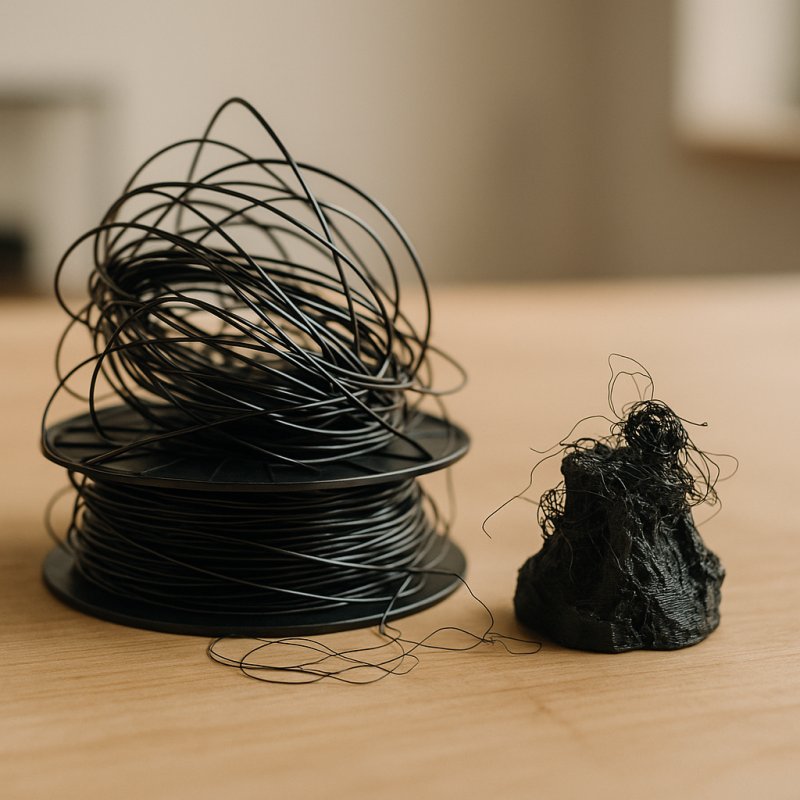
If dimensional accuracy is the most celebrated quality metric, spool winding is the unsung hero. A thousand meters of perfectly consistent filament is utterly useless if it is wound onto the spool in a tangled mess. A poorly wound spool is a ticking time bomb for any long print. The issue arises when one strand of filament becomes trapped underneath another on the spool. As the printer steadily pulls on the filament, it will eventually hit this crossover. The tension will build until one of two things happens: the filament snaps, or the extruder motor is no longer strong enough to pull it, and begins to “grind” the filament, chewing it up until it can no longer be gripped. In either case, the print fails.
This is one of the most frustrating failure modes in 3D printing because it is entirely mechanical and has nothing to do with your print settings. It is purely a function of the manufacturer’s diligence during the spooling process. “Neatly wound” or “tangle-free” is a claim made by many brands, but its execution varies widely [reddit.com]. True neat winding is an automated process where the filament is laid down on the spool in perfect, side-by-side rows, with no crossovers. This requires specialized, computer-controlled machinery that coordinates the traversal of the filament guide with the rotation of the spool.
When you purchase a 3d filament bundle, especially one with smaller spools, inspect the winding if you can. The filament should look like a perfect coil of wire, with no visible gaps or overlapping strands. This visual cue is a powerful indicator of a manufacturer’s attention to detail. It suggests that their quality control extends beyond the filament itself to the entire user experience. A company that invests in high-end winding equipment is a company that understands the practical realities of 3D printing and respects the user’s time. This commitment to process is often linked to broader quality management systems, such as ISO 9001:2015 certification, which mandates documented procedures for all stages of production, including spooling.
Consistency Across Spools and Batches
The final dimension of quality control is consistency over time and across products. When you buy a bundle of ten different colors of PLA, you have a reasonable expectation that they will all print similarly. You should not have to create ten different printing profiles to account for wild variations in optimal temperature or flow rate between the red spool and the blue spool. While minor adjustments are sometimes necessary due to the different properties of pigments, as discussed earlier, these should be minimal. A quality manufacturer works to harmonize their product line, ensuring that their “True Red” PLA behaves almost identically to their “Deep Black” PLA.
This challenge is magnified when you move from one bundle to the next. Imagine you use a specific shade of blue from a bundle to print part of a larger project. A month later, you buy another bundle from the same company, hoping to print a matching part. You find, to your dismay, that the “Royal Blue” in the new bundle is a noticeably different shade. Or perhaps it prints at a different temperature, or has a different surface finish. This inconsistency is a hallmark of a brand that lacks stringent process control. They may be sourcing their filament from different suppliers, or their own internal processes may lack the necessary rigor to ensure batch-to-batch repeatability.
This is where buying from a vertically integrated manufacturer, rather than just a reseller or brand, can be a significant advantage. A manufacturer that controls the entire process—from sourcing the raw resin, to mixing the colorants, to extruding the filament, to spooling the final product—is in a much better position to guarantee consistency. They can implement advanced color-matching technologies, using spectrophotometers to ensure that their colors conform to standards like Pantone or RAL. They can keep meticulous records of production runs, allowing them to maintain consistency over years, not just weeks.
When you select a 3d filament bundle, you are not just making a one-time purchase. You are potentially entering into a relationship with a material supplier. Looking for signs of long-term consistency is a way of ensuring that this relationship will be a stable and productive one, allowing you to get predictable results today, tomorrow, and for the next project.
Check 3: Calculating the True Cost Per Meter
In our consumer-driven culture, the allure of a “deal” is powerful. A 3D filament bundle, with its multiple spools and often attractive upfront price, can feel like an undeniable bargain. We see a box of ten spools for a price that seems much lower than buying ten individual spools, and our economic intuition signals a win. However, a more disciplined and philosophical examination of value requires us to look beyond the sticker price. The true cost of a filament is not what you pay for the box, but what you pay for the usable material within it, and the hidden costs associated with its quality. To make a truly rational economic choice, we must become accountants, meticulously calculating the cost per unit and factoring in all externalities.
Beyond the Price Tag: The Spool Size Deception
The most common format for a 3d filament bundle, particularly those focused on color variety, involves smaller spools. Instead of the standard 1-kilogram (1000g) spool, bundles often contain spools that each hold only a fraction of a kilogram, so check the net weight per spool on the listing. This is a clever marketing strategy. It allows a manufacturer to offer a wide variety of colors in a single package without the high material cost of ten full-kilogram spools. The box looks full, the color variety is high, and the price seems low.
The deception lies in our unit comparison. We are accustomed to thinking of filament in terms of “spools,” but a spool is not a standard unit of measurement. To make an accurate comparison, we must normalize the cost to a standard unit of weight, typically the kilogram. The calculation is simple but essential:
True Cost per kg = (Total Price of Bundle) / (Number of Spools × Weight per Spool in kg)
Let’s consider a practical example. You see two options:
- Option A: A standard 1kg spool of high-quality PLA for $22. The cost per kg is simply $22.
- Option B: A “deal” bundle of 10 different colors of PLA for $80. Each spool is 250g.
At first glance, Option B seems appealing. You get ten colors! But let’s do the math. The total weight of filament in the bundle is 10 spools × 0.250 kg/spool = 2.5 kg. The true cost per kg for the bundle is $80 / 2.5 kg = $32/kg.
Suddenly, the “deal” does not look so good. The filament in the bundle is nearly 50% more expensive per kilogram than the standard, single-color spool. You are paying a significant premium for the variety. This is not to say the bundle is a bad choice—the variety itself has value—but you must be aware of the premium you are paying. Are ten colors you might occasionally use worth paying $10 more per kilogram for your material? For some, the answer is yes. For a small business or someone running a print farm, where material cost is a primary driver, the answer is likely no. This simple calculation transforms you from a passive consumer into an active analyst.
Factoring in Waste: The Hidden Cost of Poor Quality
The calculation above assumes that all the filament you purchase is converted into successful prints. This is a tragically optimistic assumption. The reality of 3D printing is that failures happen. Prints can warp, layers can separate, and nozzles can clog. The crucial insight is that the frequency of these failures is directly linked to the quality of the filament.
Now, let’s revisit our cost comparison, but this time with a more realistic perspective. Let’s assume the $22/kg high-quality filament (Option A) comes from a reputable manufacturer with tight dimensional accuracy (±0.02mm) and neat winding. Your failure rate with this filament is a respectable 5%. This means for every kilogram you buy, 950g becomes successful prints. Your effective cost per usable kilogram is $22 / 0.95 = $23.16/kg.
Now consider the cheaper bundle (Option B), which we already determined is actually $32/kg. Let’s say this filament comes from a less reputable source. The dimensional accuracy is a looser ±0.05mm, and the spools are wound with less care. You find that you experience more frequent clogs and tangles, leading to a higher failure rate of, say, 20%. For every kilogram you buy, only 800g becomes successful prints. Your effective cost per usable kilogram is now $32 / 0.80 = $40/kg.
The difference is staggering. The “deal” bundle is now nearly twice as expensive in terms of actual, usable material. The initial savings are completely erased by the cost of failed prints, wasted material, and lost time. This is the most profound hidden cost in 3D printing. A cheap 3d filament bundle that causes frustration and waste is the most expensive filament you can buy. This principle underscores the importance of the quality metrics we discussed earlier. Investing in filament with documented precision and reliability is a direct investment in reducing waste and lowering your true total cost of printing.
Shipping and Volume: When Bulk Buying Makes Sense
The final element of our cost calculation involves logistics, particularly for those who print in higher volumes, such as small businesses, educational institutions, or dedicated hobbyists. For single-spool purchases, shipping costs can add a significant percentage to the total price. However, as the order volume increases, the per-unit shipping cost decreases. This is where larger format bundles or bulk deals become economically rational.
Some manufacturers offer bundles not for color variety, but for volume discount. A multi-spool pack of one color may carry a lower per-spool price than a single spool, so compare the pack’s per-kilogram price with the current single-spool listing. For a print farm that uses hundreds of kilograms of black PLA a month, this is a straightforward economic win.
This logic extends to the realm of wholesale and OEM (Original Equipment Manufacturer) purchasing. By working directly with a factory, a business can purchase filament by the pallet rather than by the box. This unlocks significant economies of scale. The manufacturer can produce a large, single batch, reducing changeover costs. The material can be shipped via sea freight, which is dramatically cheaper per kilogram than air freight for large quantities. The buyer can take advantage of different shipping terms, like FOB (Free on Board), where they take control of the shipping process, potentially finding more cost-effective logistics solutions.
This is the point where a simple 3d filament bundle evolves into a supply chain strategy. A growing business might start by buying multi-color bundles, graduate to bulk packs of their most-used colors, and eventually partner with a manufacturer to secure a bulk PLA filament supply at wholesale pricing. This progression is a natural part of scaling up a 3D printing operation. Understanding the total landed cost—including the material, shipping, tariffs, and waste—is the key to making intelligent purchasing decisions at every stage of this journey.
Check 4: Evaluating the Bundle’s Purpose and Application
The preceding examinations of material composition, quality control, and cost have been largely analytical, focusing on the objective properties of the filament itself. Now, we must pivot and bring the inquiry back to ourselves, to the creator. We must ask the teleological question: “For what purpose do I print?” A 3D filament bundle is a tool, and the value of any tool can only be judged in relation to the task it is meant to perform. A hammer is a poor tool for driving a screw, just as a vibrant but brittle PLA is a poor choice for a structural gear. The act of choosing a bundle, therefore, requires a moment of introspection, a clear-eyed assessment of our own creative and engineering intentions. The ideal bundle is not the one with the most colors or the lowest price, but the one whose contents are most aligned with the nature of our work.
The “Rainbow” Bundle for Aesthetic Prototyping
Let us first consider the artist, the model maker, the educator, and the hobbyist whose primary goal is visual expression. For this group, the “rainbow” bundle, typically composed of numerous small spools of PLA in different colors, holds immense appeal. Its purpose is to provide a broad palette for creating objects whose primary value is aesthetic.
- Who is this for? This bundle is perfectly suited for someone printing Dungeons & Dragons miniatures, creating colorful tabletop organizers, designing jewelry, or producing visual aids for a classroom. It is for the user who wants to prototype the look and feel of a product without committing to a full kilogram of a single color.
- What to look for: In this context, the most important material properties are surface finish and color vibrancy. Does the bundle include “Silk” PLA, which has a glossy, almost metallic sheen that hides layer lines? Are the colors rich and saturated? How well does the filament capture fine details? For this application, mechanical properties like tensile strength and heat resistance are secondary concerns. The part is not expected to bear a load or survive in a harsh environment; it is expected to look good.
- –The Limitation: The primary drawback of these bundles is the small spool size. A 250g spool contains approximately 84 meters of 1.75mm PLA. This is sufficient for many small models, but it can be frustratingly insufficient for a single larger print. Before starting a project with a spool from a rainbow bundle, it is wise to use your slicer software to estimate the material consumption. There is little more disheartening than a print failing 90% of the way through because the spool ran out.
This type of bundle is a wonderful entry point into the world of multi-color printing. It encourages experimentation and creativity. Its value is not in its cost per kilogram, but in the breadth of creative options it places at your fingertips.
The “Engineering Sampler” for Functional Testing
Now, let us shift our perspective to that of the engineer, the product designer, or the tinkerer who builds things that do things. For this individual, a part’s ability to withstand force, temperature, and wear is paramount. The “engineering sampler” bundle is designed for precisely this user. As mentioned earlier, this bundle typically contains a variety of different material types—such as PETG, ABS, Nylon, PC, or composites—rather than just different colors.
- Who is this for? This is for the person designing a custom drone frame, prototyping a new gearbox, or creating jigs and fixtures for their workshop. Their process is one of iterative testing. They need to answer practical questions: Is PETG strong enough for this bracket, or do I need the superior stiffness of Carbon Fiber PETG? Will this enclosure, printed in ABS, survive the heat generated by the electronics inside? Does this moving part require the low-friction, high-wear properties of Nylon?
- What to look for: The value of this bundle lies entirely in the diversity and quality of the materials offered. The user is purchasing data. Each spool is an opportunity to print a test coupon, a benchmark model, or a prototype part and subject it to real-world conditions. They will perform destructive testing, measure tolerances, and assess long-term durability. Therefore, the bundle should ideally come from a manufacturer that provides detailed Technical Data Sheets (TDS) for each material. A TDS provides hard numbers for properties like tensile strength, flexural modulus, and heat deflection temperature (HDT), allowing for a more scientific and less trial-and-error approach to material selection (SIGMAFILAMENT, 2026b).
- The Commitment: Engaging with an engineering bundle is a commitment to learning. Each material has its own unique printing requirements. ABS needs an enclosure. Nylon is extremely hygroscopic and must be kept perfectly dry. Carbon fiber composites are abrasive and require a hardened nozzle (SIGMAFILAMENT, 2026c). This bundle is not for plug-and-play printing; it is a curriculum for an advanced course in material science. The reward is the ability to choose precisely the right material for any functional application, creating parts that are not just models, but true engineering components.
The “High-Speed” Bundle for Modern Printers
A new category of bundle has begun to emerge in 2026, born from the rapid evolution of 3D printer hardware. The proliferation of affordable, high-speed CoreXY printers has fundamentally changed the printing landscape. Machines capable of speeds exceeding 300, 400, or even 500 mm/s are no longer a niche product. This new paradigm places new demands on the filament.
- Who is this for? This bundle is for the owner of a modern, high-speed printer who wants to maximize their machine’s throughput without sacrificing print quality. They understand that printing at high speeds is not just about moving the print head faster; it is a complex thermal and fluid dynamics problem.
- What to look for: Standard PLA or PETG can struggle at these velocities. The filament is pushed through the hotend so quickly that it may not have enough time to melt completely, leading to under-extrusion and poor layer adhesion. “High-speed” filaments are specifically formulated to address this. They often have a higher melt flow index (MFI), meaning they become less viscous when melted, allowing them to flow more easily through the nozzle. They may also include additives that help the material cool more rapidly and controllably once deposited, preventing the deformation and loss of detail that can occur when printing quickly. A high-speed bundle might contain several colors of a specially formulated “Hyper PLA” or high-flow PETG.
- The System Approach: Success with high-speed printing requires a systems approach. The printer, the slicer settings, and the filament must all work in concert. A high-speed bundle allows the user to find a material that is known to work well in this demanding environment, providing a reliable baseline from which they can fine-tune their profiles. It removes one of the key variables, allowing the user to focus on optimizing their machine’s performance. Choosing a standard, low-cost PLA bundle for a state-of-the-art high-speed printer is a false economy; it’s like putting budget tires on a racing car. You will never achieve the performance the system is capable of.
By first defining our own purpose, we can see the world of 3D filament bundles not as a confusing mess of options, but as a well-ordered catalog of tools, each designed for a specific kind of work. The right choice becomes clear when we know what it is we are trying to build.
Check 5: Investigating the Manufacturer’s Reputation and Support
Our final check transcends the physical object of the filament spool and delves into the realm of the social and the institutional. Who made this filament? What are their values? What is their relationship to the product and to me, the customer? In a globalized marketplace, where products appear on our screens divorced from their origin, these questions are more important than ever. A 3D filament bundle is not an anonymous commodity. It is the product of a specific company, with a specific philosophy of manufacturing and a specific level of commitment to its customers. To investigate the manufacturer is to seek a relationship built on trust, transparency, and competence. It is the final safeguard against the uncertainties of a complex supply chain.
Tracing the Source: From Reseller to Factory-Direct
The company whose brand name is on the box is not always the company that made the filament. The 3D printing market is filled with resellers and “white-label” brands. These companies purchase filament in bulk from various manufacturers, repackage it under their own brand, and sell it to the end consumer. There is nothing inherently wrong with this model, but it introduces layers of separation between you and the actual point of production.
This separation can have several consequences:
- Inconsistent Supply: A reseller may switch between different manufacturing partners based on price. The filament you buy from them today might come from a different factory than the filament you buy in six months. This can lead to the batch-to-batch inconsistency issues we discussed earlier.
- Lack of Deep Knowledge: A reseller’s customer support may have limited technical knowledge about the product. They can handle shipping issues, but if you have a complex question about the filament’s chemical resistance or optimal annealing process, they may not have an answer. They are a step removed from the chemists and engineers who formulated the material.
- Higher Costs: Each step in the supply chain (manufacturer -> reseller -> you) adds a margin, which can inflate the final price.
In contrast, a factory-direct manufacturer controls the entire process. When you buy from them, you are buying from the source. The benefits are the inverse of the reseller’s drawbacks:
- Consistency: The filament comes from a single, known production environment, leading to much greater reliability and batch-to-batch consistency.
- Expert Support: You have a direct line to the people who made the product. They can provide detailed technical specifications and expert advice.
- Better Value: By removing the middleman, a manufacturer can often offer better pricing, especially for bulk or wholesale orders.
How can you tell the difference? Look for clues on the company’s website. Do they talk extensively about their manufacturing process? Do they show pictures or videos of their factory? Do they hold manufacturing-specific certifications like ISO 9001:2015? Do they offer OEM (Original Equipment Manufacturer) and ODM (Original Design Manufacturer) services? An OEM service, where they put your brand on their product, or an ODM service, where they develop a custom filament formula for you, are clear signs that you are dealing with a genuine manufacturer, not just a brand. This investigation into the source is an effort to shorten the distance between you and the producer, building a foundation of transparency and trust.
The Importance of Technical Data Sheets (TDS)
One of the most powerful indicators of a manufacturer’s professionalism and transparency is the availability of Technical Data Sheets (TDS) for their products. A TDS is a formal document that provides detailed, quantitative data about a material’s properties. It moves beyond vague marketing claims like “strong” or “durable” and provides the specific engineering metrics to back them up.
A comprehensive TDS for a 3D printing filament should include:
- Printing Parameters: Recommended nozzle temperature range, bed temperature range, and print speed.
- Physical Properties: Density, Melt Flow Index (MFI).
- Mechanical Properties: Tensile Strength (the force required to pull it apart), Flexural Modulus (its stiffness), and Impact Strength (its ability to resist sudden shocks).
- Thermal Properties: Glass Transition Temperature (Tg, where it begins to soften) and Heat Deflection Temperature (HDT, the temperature at which it deforms under a specific load).
The absence of a TDS is a significant red flag. It suggests one of two things: either the manufacturer has not performed the testing to characterize their materials, or they are not confident enough in the results to share them. A company that claims to produce engineering filaments for industrial applications but does not provide the engineering data to support those claims is not to be trusted.
For the hobbyist, a TDS provides a reliable starting point for dialing in print settings. For the engineer or professional, it is non-negotiable. It is the data required to perform simulations, predict part performance, and make an informed decision about whether a material is suitable for a demanding application. When you choose a 3d filament bundle from a manufacturer that provides a complete library of data sheets, you are choosing a partner who respects the technical nature of your work and is willing to stand behind their product with verifiable data.
Community Feedback and Long-Term Reliability
Finally, while a manufacturer’s own claims and data are important, they should be corroborated by independent, third-party validation from the user community. In the digital age, we have access to a global network of fellow makers who are often brutally honest about their experiences with different products.
However, a discerning approach is necessary here as well. Individual reviews can be skewed by user error or unrealistic expectations. It is more valuable to look for patterns and consensus within a community.
- Go Beyond Amazon: While Amazon reviews can be a starting point, they are often brief. Deeper insights can be found in specialized communities. Look for discussions on Reddit (such as the r/3Dprinting subreddit), dedicated forums, and in the comments sections of long-term reviews by trusted YouTubers.
- Look for Consistency Over Time: Does a brand have a reputation for being great for a year, only for users to start reporting a sudden drop in quality? This can be a sign that a popular reseller has switched to a cheaper supplier. A truly reliable manufacturer maintains its quality standards over the long term.
- Evaluate the Nature of the Feedback: Are users praising the filament for its reliability and consistency, or are they just excited about a low price? Are professionals in the field using this filament for demanding applications? The praise of an experienced user who is running a print farm carries more weight than that of a beginner who has just completed their first successful print.
By synthesizing the manufacturer’s self-representation, their objective data, and the collective experience of the community, we can build a holistic picture of their reputation. Choosing a 3d filament bundle is not just a transaction; it is an act of placing your trust in a supplier. A thorough investigation ensures that this trust is well-placed, paving the way for a more predictable, productive, and ultimately more enjoyable creative process.
Frequently Asked Questions (FAQ)
Is a 3D filament bundle always cheaper?
Not necessarily when measured by cost per kilogram. Many bundles use smaller spools, which can make the per-kilogram price higher than a standard 1kg spool. It is essential to calculate the true cost per kg to make an accurate comparison. The value often comes from color or material variety rather than pure cost savings.
What is the best filament bundle for a beginner?
A bundle focused on standard PLA is the ideal choice for a beginner. PLA is the most forgiving and easiest material to print with, allowing a new user to learn the fundamentals of 3D printing without the added complexities of other materials. A multi-color PLA bundle provides a fun and low-risk way to start experimenting.
Are the small spools in a bundle a waste of plastic?
The spools themselves do represent a higher ratio of plastic packaging to filament compared to a larger 1kg spool. However, their value lies in reducing material waste. They allow you to test a color or material for a small project without committing to a full kilogram that you may never use, which could be considered a greater waste.
How do I store multiple open spools from a bundle?
Proper storage is critical, especially for hygroscopic materials like PETG and Nylon. Once opened, spools should be stored in a sealed, airtight container or a dedicated filament dry box. Including a desiccant packet (like silica gel) inside the container is crucial to absorb moisture and preserve the filament’s print quality.
Can I use a filament bundle for a large project?
It depends on the spool size. Many bundles use spools well under 1 kg, which are often insufficient for large, single-piece prints. Always use your slicer software to estimate the required filament weight before starting a large project with a small spool to avoid the print failing midway due to running out of material.
Why do colors look different between brands?
Color consistency is a significant manufacturing challenge. Differences in raw pigments, base polymer resin, and production processes can all lead to variations in color, even for filaments with the same name (e.g., “Royal Blue”). Reputable manufacturers use spectrophotometers and adhere to color standards like Pantone to ensure their colors are consistent from batch to batch.
Are specialty filament bundles worth it?
For engineers, designers, or advanced hobbyists, specialty bundles are incredibly valuable. They provide a low-cost, low-risk way to experiment with the properties of advanced materials like TPU, ABS, Nylon, or carbon-fiber composites before committing to a full, more expensive spool for a specific functional application. They are an investment in your material knowledge.
Conclusion
The journey through the considerations of selecting a 3D filament bundle reveals a truth applicable to many aspects of our creative and technical lives: the most apparent choice is not always the most judicious one. We began with the simple, attractive promise of variety and value, but have uncovered a deeper set of questions rooted in the very substance of the material, the precision of its creation, the reality of its cost, the purpose of its use, and the character of its maker.
The five checks—deconstructing composition, scrutinizing quality, calculating true cost, evaluating purpose, and investigating the manufacturer—are not merely a consumer guide. They are a framework for thinking, a method for applying rational inquiry and empathetic understanding to a practical decision. They encourage us to move past the surface and engage with the underlying principles that govern success in 3D printing. By embracing this mindset, we transform ourselves from passive purchasers into active partners in the manufacturing process. We learn that a ±0.02mm tolerance is not a trivial number, but a promise of reliability. We understand that a neatly wound spool is not a luxury, but a fundamental requirement for peace of mind. We recognize that a Technical Data Sheet is not just a document, but a gesture of transparency and respect for our work.
Ultimately, the right 3D filament bundle is not the one that offers the most for the least, but the one that best aligns with our specific intentions and is backed by a commitment to quality we can trust. By making this informed choice, we are not just buying plastic; we are investing in the potential of our ideas, ensuring that the bridge between our digital designs and their physical manifestations is as strong, reliable, and beautiful as possible.
References
- SIGMAFILAMENT. (2026a, January 27). A practical 2026 buyer’s guide: PLA vs PETG vs ABS. SigmaFilament Blog. https://sigmafilament.com/pla-vs-petg-vs-abs-filament-guide/
- SIGMAFILAMENT. (2026b, January 26). An expert’s guide to the strongest 3D printer filament: 5 data-backed materials for 2026. SigmaFilament Blog. https://sigmafilament.com/strongest-3d-printer-filament/
- SIGMAFILAMENT. (2026c, January 25). Actionable buyer’s guide: 7 factors for success with carbon fiber PETG in 2026. SigmaFilament Blog. https://sigmafilament.com/carbon-fiber-petg-printing-guide/
- SIGMAFILAMENT. (2026d, January 24). PLA vs PETG: 7 data-backed differences for a practical choice in 2026. SigmaFilament Blog. https://sigmafilament.com/pla-vs-petg-data-backed-comparison/
- Singh, S. (2026, January 12). The complete 3D printer filament guide: Technical data, brand analysis & scientific research (2025). 3D Printed Decor.
- Various Authors. (2023, August 20). Where do you guys go to buy a big bundle of different color filament. Reddit.
- Wick, G. C., & Wern, K. E. (2021). Effects of print orientation and raster angle on the tensile strength of 3D printed PEEK and PLA. Polymers, 13(9), 1404. https://doi.org/10.3390/polym13091404
Last reviewed and updated: February 2026. Author: SigmaFilament Engineering Team. For custom filament solutions and wholesale inquiries, contact our team.