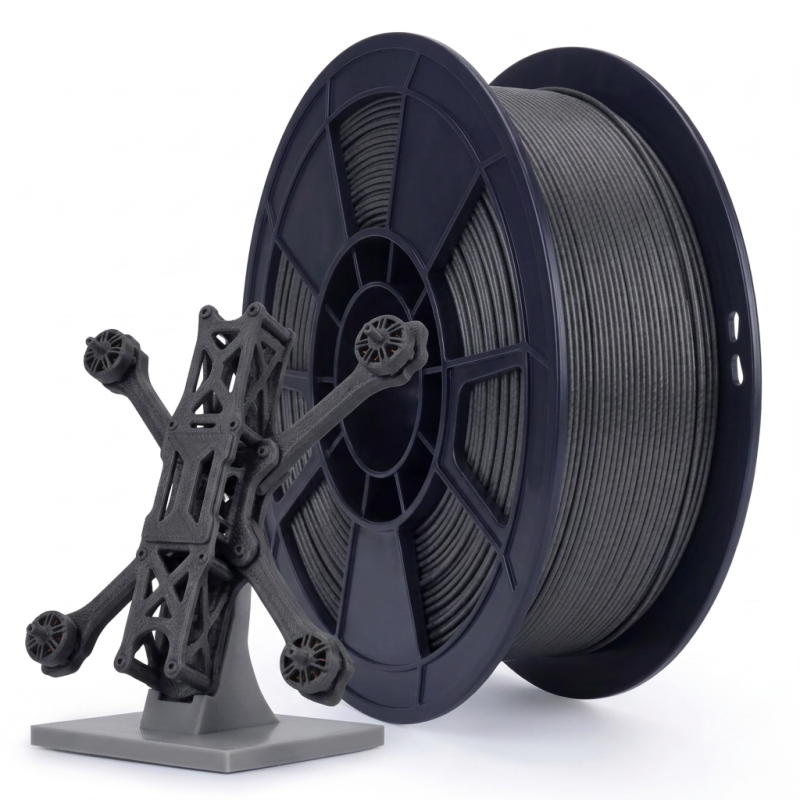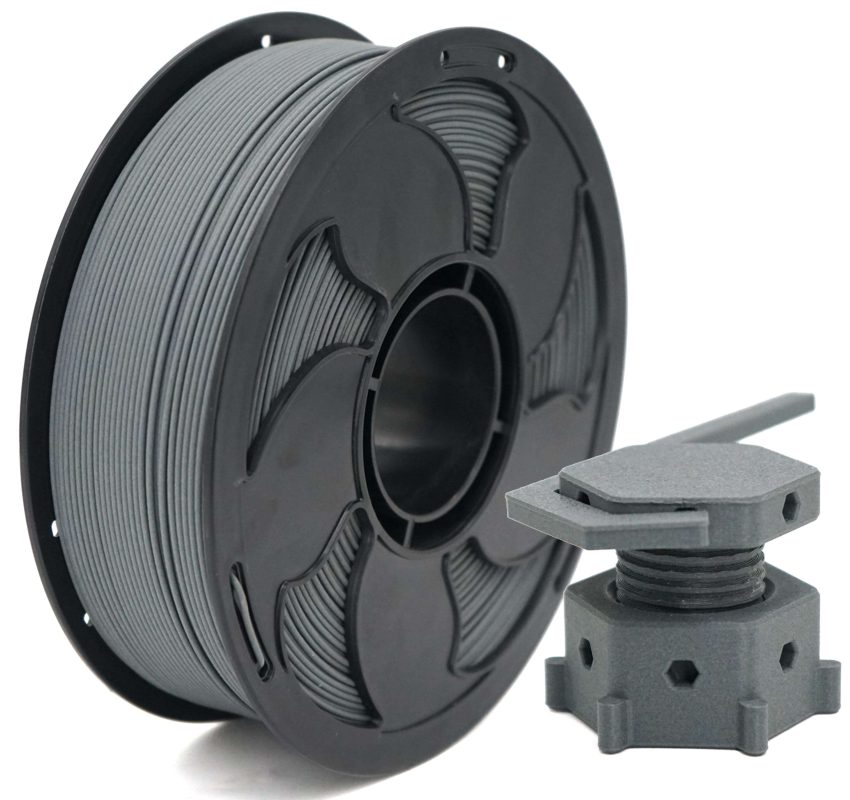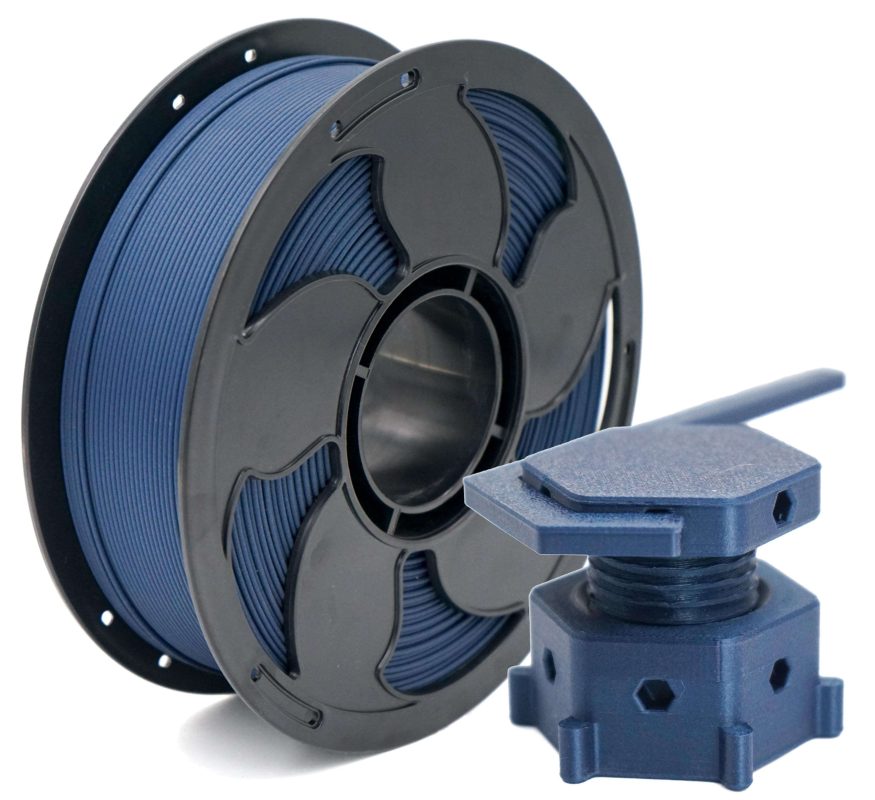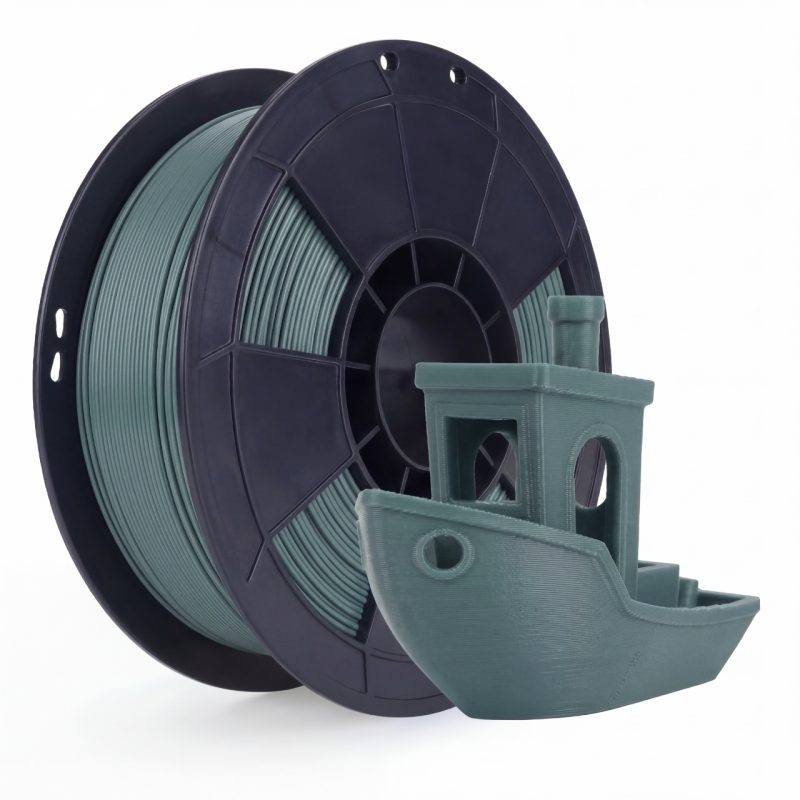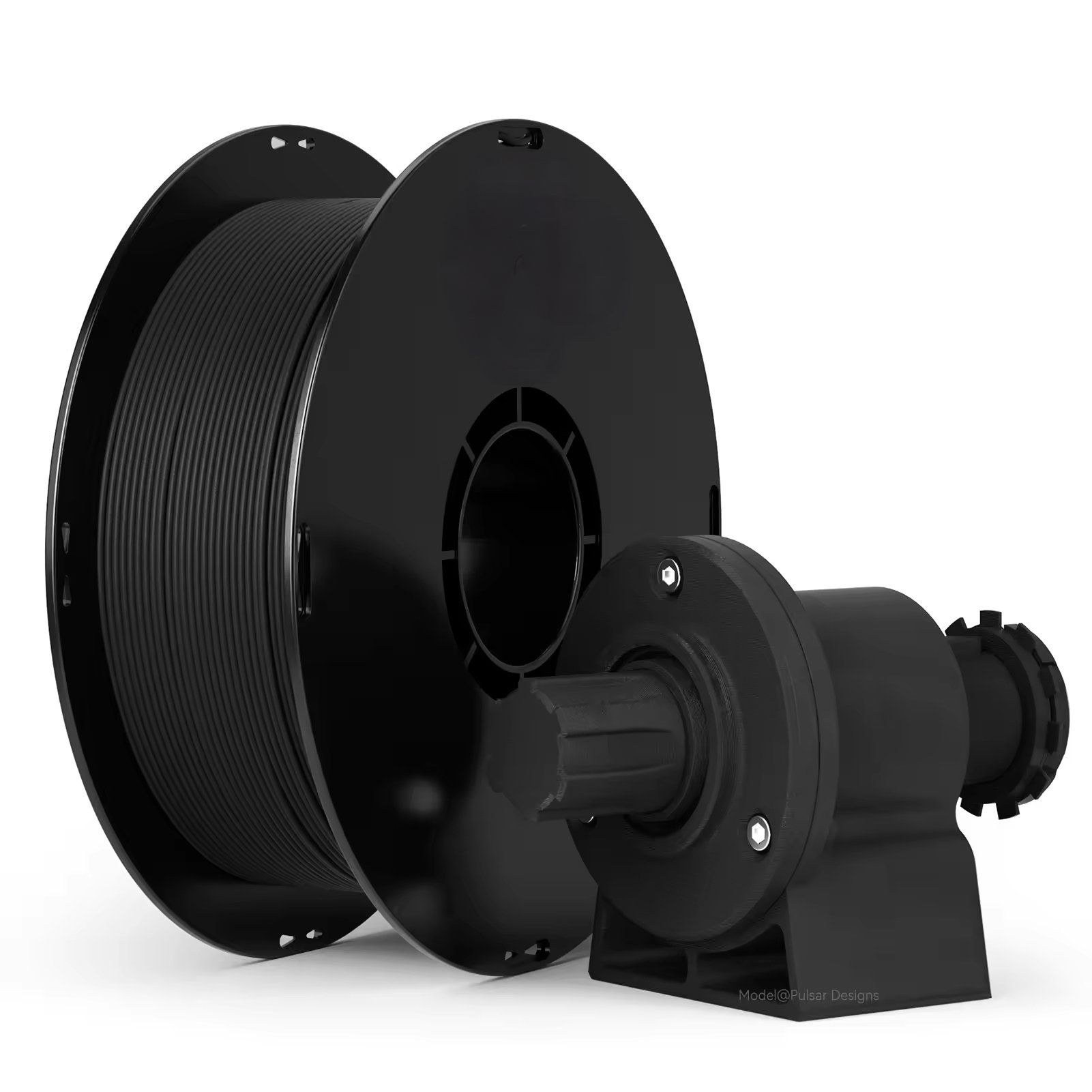
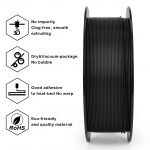
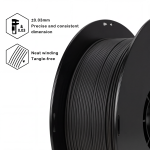
PLA Carbon Fiber Filament – Product Overview
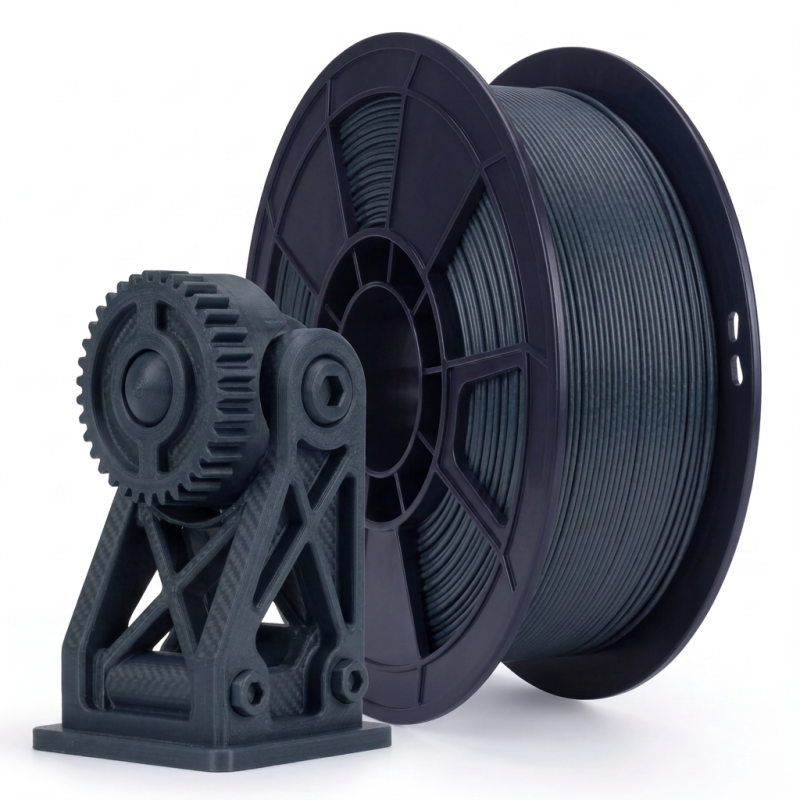
The SigmaFilament PLA Carbon Fiber Filament is an engineering-grade composite material that combines the easy printability of PLA with the structural reinforcement of chopped carbon fiber – delivering 3D printed parts with exceptional rigidity, impressive dimensional stability, and a superior strength-to-weight ratio that standard PLA simply cannot match.
Carbon fiber reinforcement transforms ordinary PLA into a high-performance material. The embedded chopped carbon fibers act as a rigid internal skeleton within the PLA matrix, dramatically increasing the flexural modulus (stiffness) while simultaneously reducing weight, minimizing warping, and improving dimensional accuracy. The result is parts that feel solid and professional – closer to injection-molded engineering components than typical 3D prints. If you’re comparing materials for your project, our comprehensive filament categories guide explains where carbon fiber composites fit in the filament landscape, and our strongest filament guide benchmarks CF-reinforced materials against other high-strength options.
The distinctive matte black carbon fiber surface finish is another significant advantage – it naturally hides layer lines and print imperfections, giving every print a polished, professional appearance straight off the bed without post-processing. This makes PLA carbon fiber filament the go-to choice for client-facing prototypes, trade show models, and production parts where surface appearance matters.
Manufactured under ISO 9001 quality management in Guangdong, China. Full RoHS compliance, OEM/ODM services, and free samples available for qualified business customers.
Why This PLA Carbon Fiber Filament Stands Out
⚡ Engineering-Grade Performance with PLA-Level Ease of Printing
Most high-performance filaments demand high temperatures, enclosures, and specialized hardware. SigmaFilament’s PLA carbon fiber filament delivers composite-grade rigidity and lightweight strength while printing at standard PLA temperatures – no enclosure, no heated chamber, no headaches.
- Dramatically Increased Stiffness – Carbon fiber reinforcement boosts flexural modulus by 2-3x compared to standard PLA. Parts resist bending and deflection under load, maintaining shape integrity in structural applications
- Lightweight Construction – Lower density than standard PLA means parts are noticeably lighter while being significantly stronger and stiffer. Critical for drone frames, RC vehicles, robotics, and any weight-sensitive application
- Near-Zero Warping – Carbon fiber dramatically reduces thermal shrinkage during cooling, virtually eliminating warping even on large flat parts. One of the most dimensionally stable filaments available at any price
- Professional Matte Finish – The carbon fiber content creates a distinctive textured matte black surface that naturally conceals layer lines and printing artifacts – parts look injection-molded, not 3D printed
- Standard PLA Print Settings – Prints at 190-230°C with 35-60°C bed, 30-100mm/s speed. No enclosure required. Compatible with any FDM printer that handles standard PLA
- Reduced Stringing – Carbon fiber improves melt viscosity and flow characteristics, resulting in cleaner prints with significantly less stringing and oozing than standard PLA
The engineering composite that doesn’t demand an engineering-grade printer – delivering professional results on consumer hardware.
Premium PLA Carbon Fiber Filament at Competitive Price
SigmaFilament is a direct manufacturer based in Guangdong, China, offering factory-direct pricing on this PLA carbon fiber filament with high-quality chopped carbon fiber reinforcement.
| 💪 CF Reinforced | 💰 Competitive Pricing | 🔁 Batch Consistency |
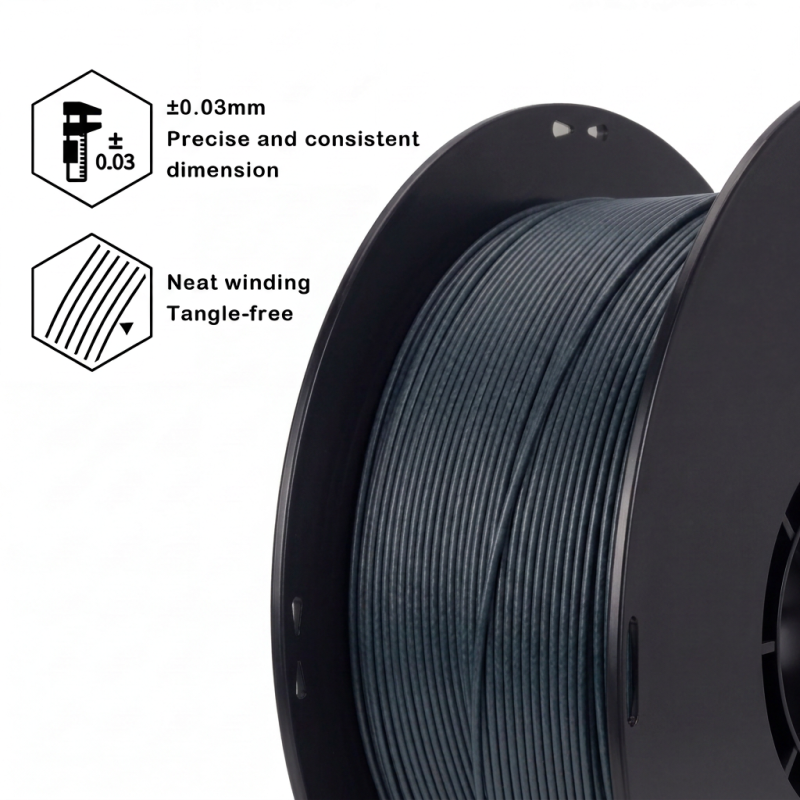
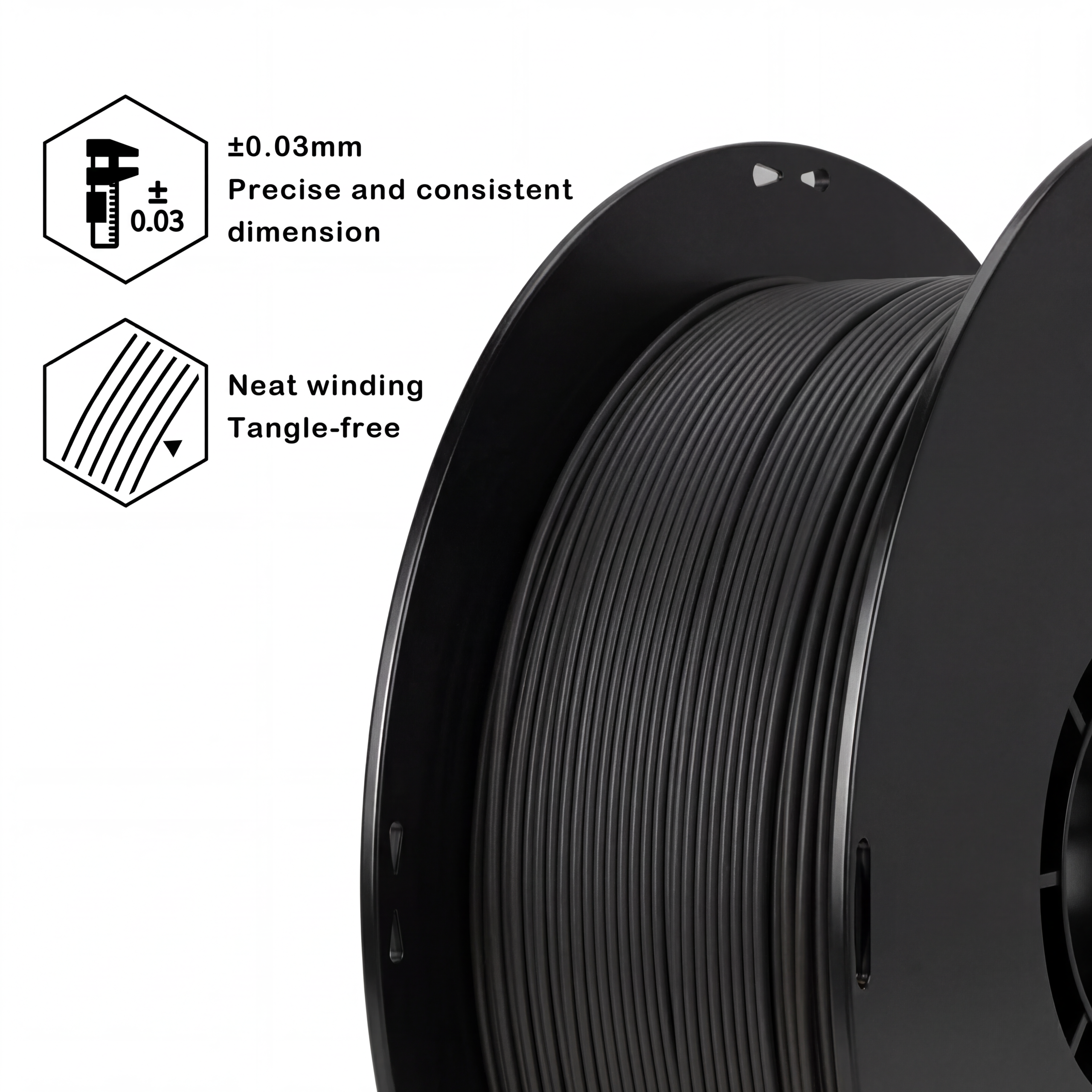
| Chopped carbon fiber reinforcement with ±0.05mm tolerance for precision engineering parts | Factory-direct, no middlemen, volume discounts from 100kg+ | Consistent fiber distribution, stiffness, and dimensional performance across every spool |
Why Choose PLA Carbon Fiber Filament for Your Projects
| 💪 Superior Rigidity | Carbon fiber reinforcement increases flexural modulus by 2-3x compared to standard PLA, producing parts with dramatically less flex and deflection under load. This PLA carbon fiber filament creates structural components, brackets, and housings that maintain their shape under mechanical stress – bridging the gap between hobby-grade PLA and industrial engineering materials like nylon CF or PETG CF. |
| 🪶 Lightweight Advantage | Every gram matters in drone frames, RC car chassis, robotics arms, and aerospace prototypes. This carbon fiber PLA filament has a lower density (~1.20 g/cm³) than standard PLA (~1.24 g/cm³) while offering significantly higher stiffness – delivering a strength-to-weight ratio that makes it the default choice for weight-sensitive engineering applications where aluminum or composites would traditionally be used. |
| 📐 Dimensional Precision | Carbon fiber dramatically reduces thermal shrinkage and warping – two of the biggest accuracy problems in FDM printing. This PLA CF filament produces parts with excellent dimensional accuracy and minimal post-print deformation, making it ideal for precision jigs, fixtures, alignment tools, and components where tight tolerances matter. Large flat surfaces print without lifting or warping. |
| ✨ Matte CF Surface Finish | The carbon fiber content creates a distinctive professional matte black finish with a subtle texture that naturally hides layer lines, Z-seams, and surface imperfections. Prints look injection-molded without sanding, priming, or painting. This makes PLA carbon fiber filament the preferred material for client presentations, trade show models, product mockups, and any visible component where surface quality drives perception. |
| 🖨️ PLA-Level Ease of Use | Unlike nylon CF or PETG CF which demand high temperatures, enclosures, and dry-box feeding, this carbon fiber PLA filament prints at standard PLA temperatures (190-230°C) with a basic heated bed (35-60°C). No enclosure required, no heated chamber, no mandatory dry-box. It’s the most accessible path to carbon fiber composite performance in FDM printing. |
| 🔧 Reduced Stringing & Oozing | Carbon fiber increases melt viscosity, significantly reducing the stringing and oozing problems common with standard PLA. This means cleaner retractions, sharper detail, and less post-processing cleanup – especially beneficial for complex multi-part models, small detailed features, and travel-heavy print geometries. |
PLA Carbon Fiber vs. Standard PLA vs. PETG CF vs. Nylon CF – Material Comparison
| Property | PLA CF (This Product) | Standard PLA | PETG CF | Nylon CF |
|---|---|---|---|---|
| Stiffness / Rigidity | ★★★★☆ (Very High) | ★★★☆☆ | ★★★★☆ | ★★★★★ |
| Weight (Density) | ★★★★☆ (Light, ~1.20) | ★★★☆☆ (~1.24) | ★★★☆☆ (~1.30) | ★★★★☆ (~1.15) |
| Dimensional Stability | ★★★★★ (Excellent) | ★★★★☆ | ★★★★☆ | ★★★☆☆ (Hygroscopic) |
| Ease of Printing | ★★★★★ (PLA settings) | ★★★★★ | ★★★★☆ | ★★☆☆☆ (Enclosure + dry) |
| Impact Toughness | ★★☆☆☆ (Brittle) | ★★☆☆☆ | ★★★☆☆ | ★★★★☆ |
| Heat Resistance | ★★★☆☆ (~60°C) | ★★☆☆☆ (~55°C) | ★★★☆☆ (~80°C) | ★★★★☆ (~120°C) |
| Surface Finish | ★★★★★ (Matte CF) | ★★★☆☆ (Glossy) | ★★★★★ (Matte CF) | ★★★★★ (Matte CF) |
| Best For | Lightweight rigid parts & prototypes | General prototyping | Tough engineering parts | Industrial end-use parts |
Recommended Print Settings for PLA Carbon Fiber Filament
This PLA carbon fiber filament prints with standard PLA temperature settings, making it one of the most accessible carbon fiber composites available. The key consideration is nozzle selection – carbon fiber is abrasive to brass nozzles.
⚠️ Critical: Use a Hardened Steel Nozzle
1. Hardened steel, ruby, or tungsten carbide nozzle required – Carbon fiber particles rapidly wear through brass nozzles (often within 1-2 spools). A hardened steel nozzle ($5-15) will last thousands of hours. Do NOT use standard brass nozzles for extended printing.
2. 0.4mm nozzle works, 0.6mm recommended – Larger nozzle diameter reduces clogging risk and improves flow consistency with fiber-filled materials. A 0.5mm or 0.6mm hardened nozzle is the ideal balance.
3. No enclosure required – PLA CF has even less warping tendency than standard PLA, so open-frame printers work perfectly for all part sizes.
Optimal Print Settings for This PLA Carbon Fiber Filament
| Nozzle Temperature | 190-230°C (210-220°C optimal for most printers) |
| Bed Temperature | 35-60°C (50-55°C recommended) |
| Print Speed | 30-100mm/s (40-60mm/s for best surface quality) |
| Layer Height | 0.12-0.28mm (0.2mm recommended; avoid <0.1mm with fiber content) |
| Cooling Fan | 50-100% (standard PLA cooling works well) |
| Wall Count | 3-4 walls (4+ walls for maximum rigidity) |
| Retraction | 3-5mm at 40-50mm/s (Bowden); 0.5-1.5mm (direct drive) – less retraction needed vs standard PLA |
| Infill | 15-30% (gyroid or grid; 40%+ for structural load-bearing parts) |
| Nozzle Type | Hardened steel required (0.4mm min, 0.6mm recommended); brass nozzles will wear rapidly |
| Bed Adhesion | PEI sheet (best), glass with glue stick, or blue painter’s tape |
| Drying (if needed) | 50°C for 4-6 hours. See our filament dryer settings guide |
💡 Pro Tip – Getting the Best Results with PLA Carbon Fiber Filament: For the stiffest possible parts, orient your print so that the longest dimension aligns with the print’s X/Y plane (horizontal) – carbon fibers align primarily along the extrusion direction, so in-plane stiffness is significantly higher than Z-axis stiffness. Use 4+ walls and gyroid infill at 30%+ for structural components. For the best matte CF surface finish, print at 0.16-0.20mm layer height with 50mm/s outer wall speed. If you’re switching from brass to a hardened steel nozzle, note that steel conducts heat less efficiently – you may need to increase temperature by 5-10°C to achieve the same flow rate. For drone frames and RC parts, design with generous fillets at stress points to compensate for PLA CF’s lower impact resistance compared to nylon CF.
Technical Specifications
| Parameter | Specification |
|---|---|
| Material | PLA Carbon Fiber (PLA + Chopped Carbon Fiber) |
| Color | Black (Matte Carbon Fiber Finish) |
| Model | PLA-CF |
| Filament Diameter | 1.75mm (0.069 inches) |
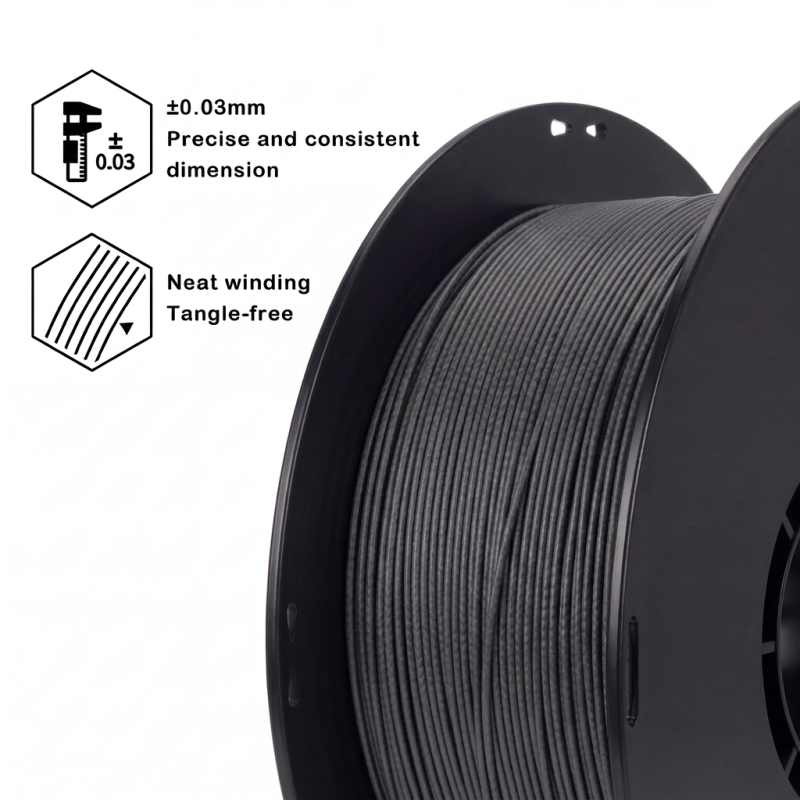
| Diameter Tolerance | ±0.05mm |
| Carbon Fiber Content | Chopped carbon fiber (short fiber reinforcement) |
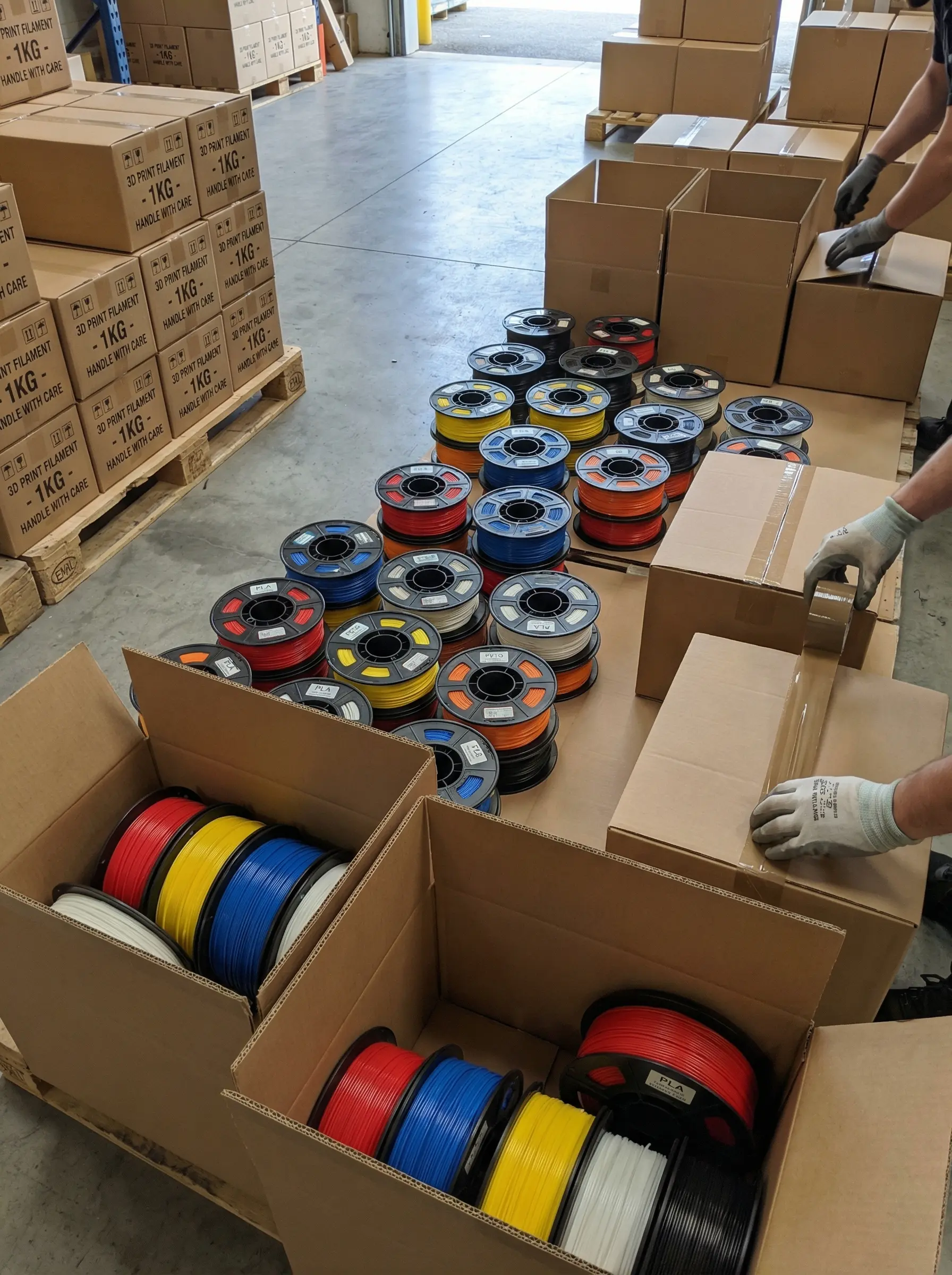
| Net Weight | 1kg (2.2 lbs) per spool |
| Nozzle Temperature | 190-230°C (374-446°F) |
| Optimal Nozzle Temperature | 210-220°C (410-428°F) |
| Bed Temperature | 35-60°C (95-140°F) |
| Print Speed | 30-100mm/s |
| Required Nozzle | Hardened steel, ruby, or tungsten carbide (CF is abrasive to brass) |
| Surface Finish | Matte (textured carbon fiber appearance) |
| Post-Processing | Sanding, painting, CA glue bonding |
| Drying Temperature | 50°C for 4-6 hours |
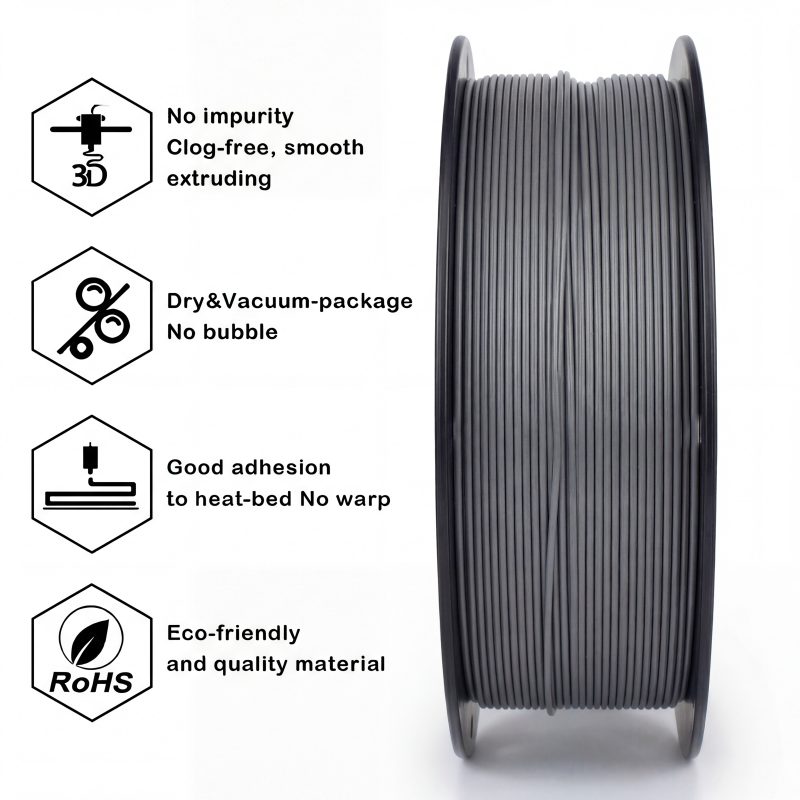
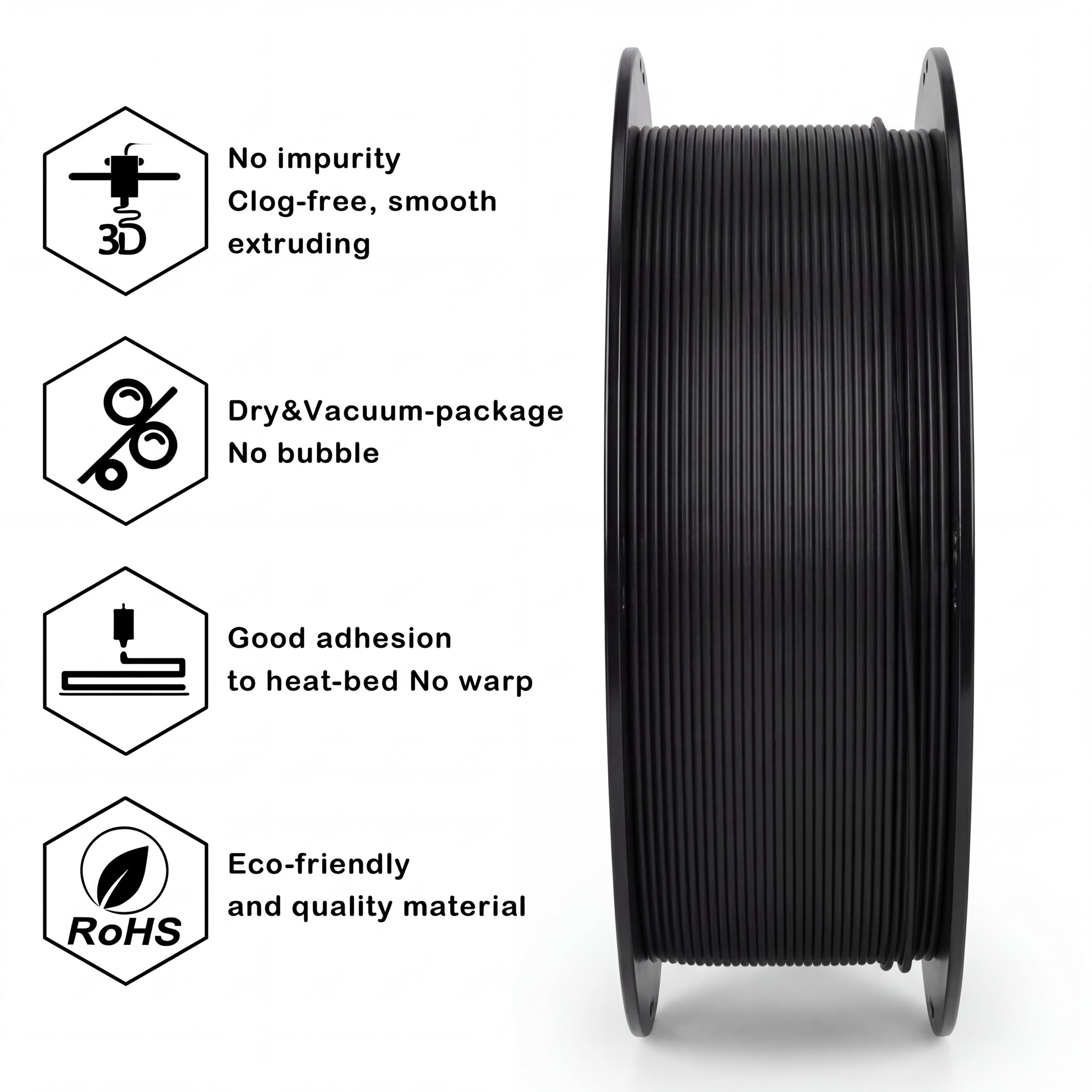
| Packaging | Vacuum sealed with desiccant |
| Manufacturing Origin | Guangdong, China |
| Free Sample | Available |
| OEM/ODM | Available – Learn about our OEM services |
Material Properties & Performance
This PLA carbon fiber filament delivers significantly enhanced mechanical performance compared to standard PLA, with particular advantages in stiffness, dimensional stability, and surface quality. For detailed material comparisons, see our strongest 3D printer filament guide.
Mechanical & Thermal Properties
| Property | Value | Test Standard |
|---|---|---|
| Tensile Strength | 45-55 MPa | ISO 527 / ASTM D638 |
| Flexural Modulus | 5,500-7,500 MPa (2-3x standard PLA) | ISO 178 / ASTM D790 |
| Impact Strength (Izod, Notched) | 2-3 kJ/m² (lower than standard PLA due to CF brittleness) | ISO 180 / ASTM D256 |
| Elongation at Break | 2-5% | ISO 527 / ASTM D638 |
| Glass Transition Temperature | ~60°C (140°F) | ISO 11357 |
| Heat Deflection Temperature | 55-60°C (0.45 MPa) | ISO 75 / ASTM D648 |
| Density | 1.18-1.22 g/cm³ (lighter than standard PLA) | ISO 1183 |
| Shrinkage | 0.2-0.4% (significantly reduced vs standard PLA) | ISO 294-4 |
| Nozzle Abrasion | High (hardened steel nozzle required) | – |
Printer-Specific Settings for PLA Carbon Fiber Filament
| Printer | Nozzle | Bed | Speed | Notes |
|---|---|---|---|---|
| Bambu Lab X1C / P1S | 215°C | 55°C | 40-80mm/s | Use hardened steel nozzle; PLA profile as base, increase temp +5°C |
| Prusa MK4 / MK3S+ | 215°C | 55°C | 40-60mm/s | Hardened steel nozzle (E3D Nozzle X or Prusa); textured PEI sheet |
| Creality K1 / K1 Max | 215°C | 55°C | 50-80mm/s | Hardened nozzle required; PLA base profile with increased temp |
| Creality Ender 3 V2/S1 | 210°C | 55°C | 30-50mm/s | Swap to hardened steel nozzle before printing; glue stick for adhesion |
| Anycubic Kobra 2 | 215°C | 55°C | 40-60mm/s | Hardened nozzle; PLA profile; reduce retraction by 20% |
| Voron 2.4 / Trident | 215°C | 55°C | 50-80mm/s | Hardened nozzle; excellent results with high-flow hotend for CF materials |
Applications for PLA Carbon Fiber Filament
This PLA carbon fiber filament excels wherever you need lightweight, rigid, dimensionally stable parts with a professional matte carbon fiber appearance.
| 🚁 Drone & UAV Frames | Quadcopter frames, camera gimbals, arm extensions, motor mounts, and landing gear. The carbon fiber PLA filament’s exceptional strength-to-weight ratio is critical for flight applications where every gram affects performance, flight time, and payload capacity. The rigid, lightweight construction competes with traditional CNC-cut carbon fiber sheets at a fraction of the cost and with far more design freedom. |
| ⚙️ High-Performance Prototyping | Functional prototypes that need to represent final injection-molded part stiffness during testing. Engineering teams use PLA CF filament for fit-check prototypes, load-bearing test samples, and snap-fit verification where standard PLA’s flexibility gives misleading results. The matte CF finish also makes prototypes client-presentation-ready without post-processing. |
| 🚗 Automotive Jigs & Fixtures | Assembly jigs, alignment fixtures, gauge tools, and production aids for automotive manufacturing. PLA CF’s dimensional stability ensures jigs maintain accuracy over hundreds of uses, and the lightweight construction reduces operator fatigue. Parts resist creep and deflection significantly better than standard PLA or PETG fixtures. |
| 🏎️ RC & Robotics | RC car chassis, robot arm links, competition robot frames, servo mounts, and structural brackets. The combination of rigidity, light weight, and precision is ideal for competitive robotics and RC applications where performance wins depend on material optimization. Carbon fiber PLA is a popular upgrade from standard PLA for serious hobbyists and competition teams. |
| ✈️ Aerospace Models & Mockups | Scale aircraft models, wing rib structures, fuselage mockups, satellite component prototypes, and wind tunnel test models. PLA carbon fiber filament delivers the stiffness and dimensional accuracy aerospace engineers need, with a surface finish that photographs well for documentation and presentations. Light weight is essential for flight-test models and aerodynamic prototypes. |
| 🎯 Precision Tools & Instruments | Custom measurement jigs, camera rig components, scientific instrument housings, telescope adapters, and precision mounting brackets. PLA CF’s near-zero warping and excellent dimensional stability make it the material of choice for applications where positional accuracy is critical. Parts maintain their geometry reliably without creep over time. |
Environmental & Safety Standards
| ✅ RoHS Compliant | Full RoHS compliance for European and global market requirements. |
| 🏭 ISO 9001 Certified | Manufactured under certified quality management for consistent fiber distribution, stiffness, and extrusion quality. |
| 🌿 PLA Base | PLA matrix derived from renewable plant resources. Carbon fiber content is inert and non-toxic. Minimal printing odor. |
| 📦 Vacuum Sealed | Moisture-proof vacuum packaging with desiccant for optimal first-print quality and extended shelf life. |
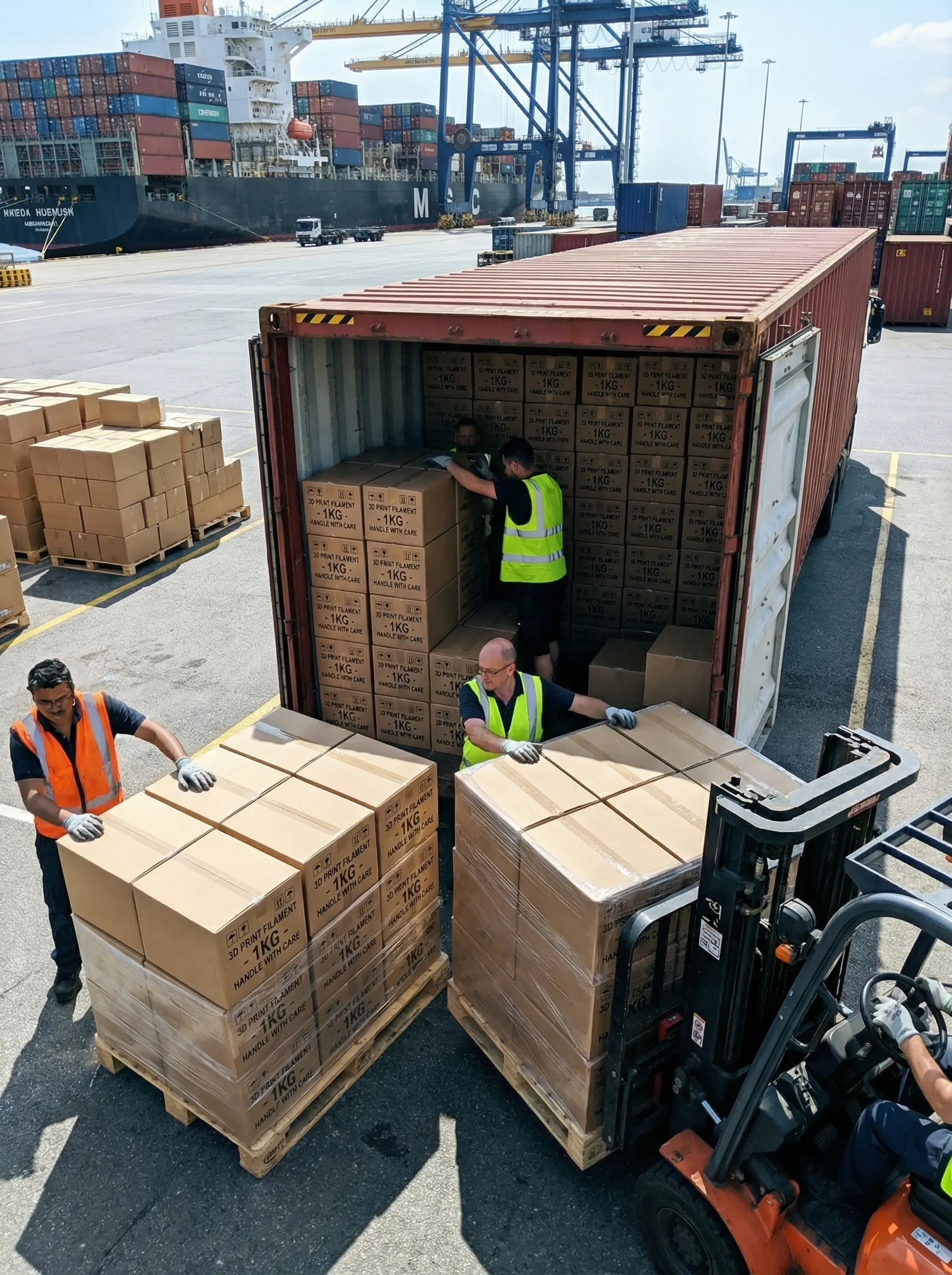
Packaging & Global Shipping
| Destination | Standard Delivery | Express Available |
|---|---|---|
| European Union | 5-10 business days | ✓ 3-5 days |
| United States | 7-12 business days | ✓ 4-6 days |
| United Kingdom | 7-12 business days | ✓ 4-6 days |
| Canada | 8-14 business days | ✓ 5-7 days |
Packaging: Vacuum sealed with desiccant. Customs: DDP and DAP terms available.
Bulk Orders & OEM/ODM Services
| 📊 Flexible MOQ | Trial orders to large-volume production. Free samples available for qualified customers. |
| 💰 Volume Pricing | Tier breakpoints: 100kg+, 500kg+, 1000kg+ with progressive discounts. |
| 🔧 OEM/ODM Services | • Custom carbon fiber percentage (adjustable fiber content for different stiffness levels) – Custom base materials (PETG CF, ABS CF, Nylon CF, ASA CF also available) – Custom fiber types (carbon fiber, glass fiber, or hybrid blends) – Private label packaging – Custom spool sizes (0.5kg, 2kg, 3kg, 5kg) |
| 🎁 Free Sample Program | Evaluation samples available for qualified business customers. Test stiffness, surface finish, and print quality before committing to volume orders. |
Storage & Handling Guidelines
| Storage Guidelines | |
|---|---|
| Temperature | 15-25°C (59-77°F) |
| Humidity | Below 40% RH (PLA absorbs moisture; dry storage essential for best quality) |
| Shelf Life | 12 months (unopened, vacuum sealed) |
| Drying (if needed) | 50°C for 4-6 hours (do not exceed 55°C) |
| Light Exposure | Store away from direct sunlight (PLA base is not UV-resistant) |
Printer Compatibility
This PLA carbon fiber filament is compatible with all FDM/FFF 3D printers using 1.75mm filament. Hardened steel nozzle required. Works with both PTFE-lined and all-metal hotends. No enclosure needed.
| Bambu Lab X1C, P1S, P1P, A1 | Prusa MK4, MK3S+, XL | Creality K1, Ender 3 V2/S1 | Voron 2.4, Trident, 0.2 | Anycubic Kobra 2 series | QIDI X-Max 3, X-Plus 3 |
Why Choose SigmaFilament
| 🏭 Direct Manufacturer | Factory-direct pricing from Guangdong, China with full quality control over carbon fiber sourcing, compounding, extrusion, and packaging. |
| ✅ Quality Assured | ±0.05mm tolerance, ISO 9001, RoHS. Consistent fiber distribution, stiffness, and dimensional performance batch-to-batch. |
| 🌍 Global Service | English-speaking support, EU/US business hours, DDP/DAP shipping terms. |
| 🔧 Full OEM/ODM | Custom CF percentage, custom base materials (PETG/ABS/Nylon/ASA CF), custom fiber types (glass/carbon/hybrid), private label, and custom spools. |
| 🤝 Technical Support | Carbon fiber composite printing optimization, structural design guidance, nozzle selection advice, and material comparison support. |
Frequently Asked Questions About PLA Carbon Fiber Filament
Ready to Get Started with PLA Carbon Fiber Filament?
Contact SigmaFilament today for bulk pricing, free samples, or to discuss your OEM/ODM requirements for custom carbon fiber composite filament solutions.
📧 Email us for a quick quote | 🌍 Worldwide shipping with DDP/DAP terms | 🎁 Free samples for qualified customers
| Filament Diameter | 1.75mm ,2.85mm (3.00mm) |
|---|---|
| Spool Weight | 1kg ,3kg ,5kg ,Sample (200g) |
| Color | Black |