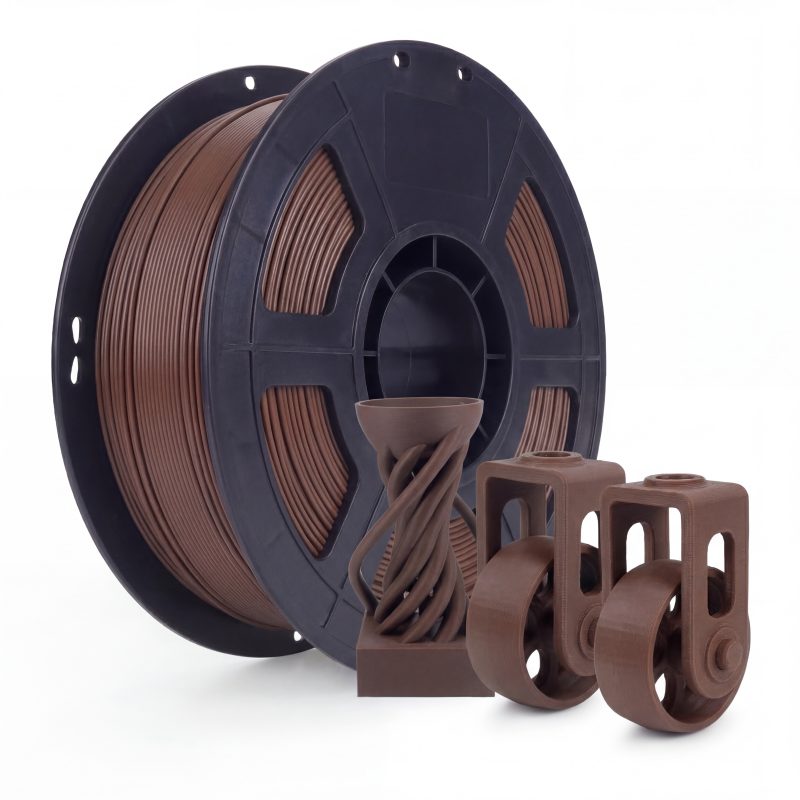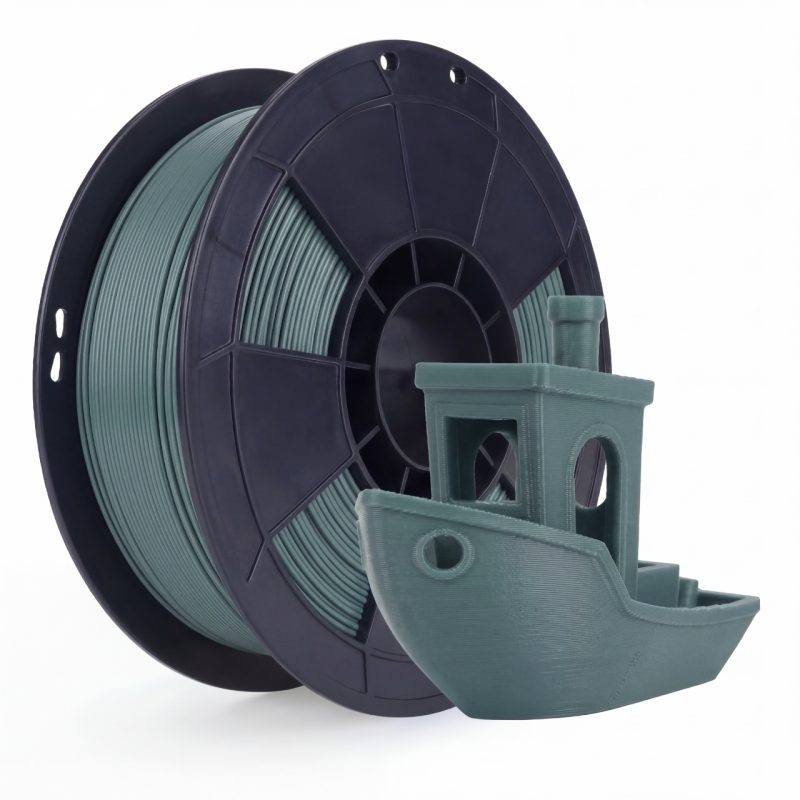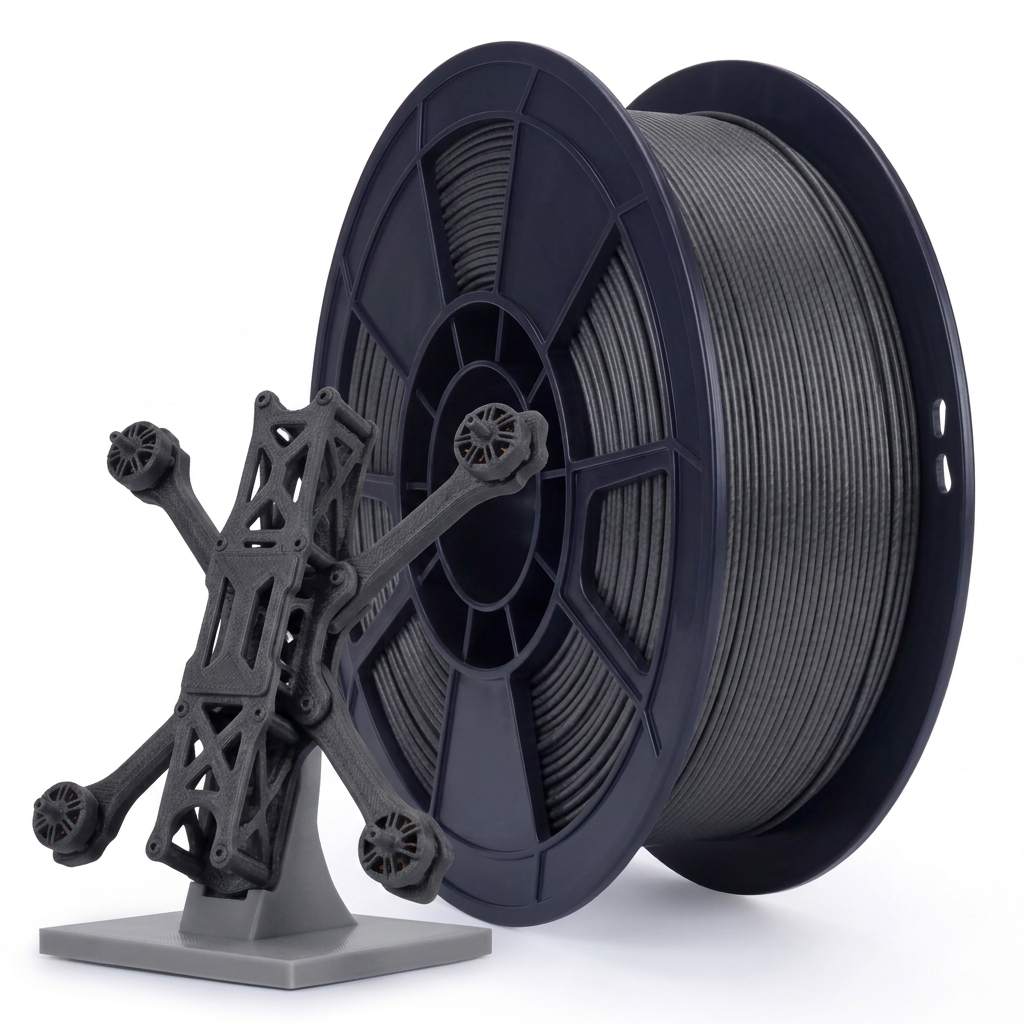
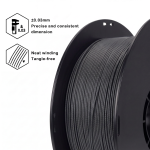
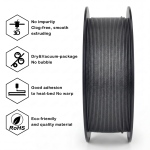
Gray Carbon Fiber PLA (PLA-CF) — Rigid, Lightweight and Ready for Structural Parts
Gray carbon fiber PLA filament is what you reach for when a plain PLA part flexes too much, warps off the bed, or simply looks too glossy for a serious functional build. PLA-CF is standard PLA loaded with chopped carbon fibers, and those fibers change the material in three ways that matter on the bench: they stiffen it, they hold it flat, and they turn a shiny plastic surface into a deep matte finish flecked with fine carbon texture. This 1.75mm gray carbon fiber PLA filament keeps all the easy-printing manners of PLA — low bed temperature, no enclosure, fast cooling — while adding the rigidity and dimensional stability that structural parts, jigs and drone frames demand.
The single most important thing to know before printing this material is simple: carbon fiber is abrasive, so a hardened steel nozzle is required. The same chopped fibers that stiffen the part will chew through a standard brass nozzle in a matter of spools, opening the bore and wrecking your dimensional accuracy long before you notice. A hardened steel or ruby-tipped nozzle, ideally 0.4mm or 0.6mm, is not an optional upgrade for carbon-filled filament — it is the entry ticket. We call this out first because it is the number-one cause of disappointment with any carbon PLA, and it is entirely avoidable.
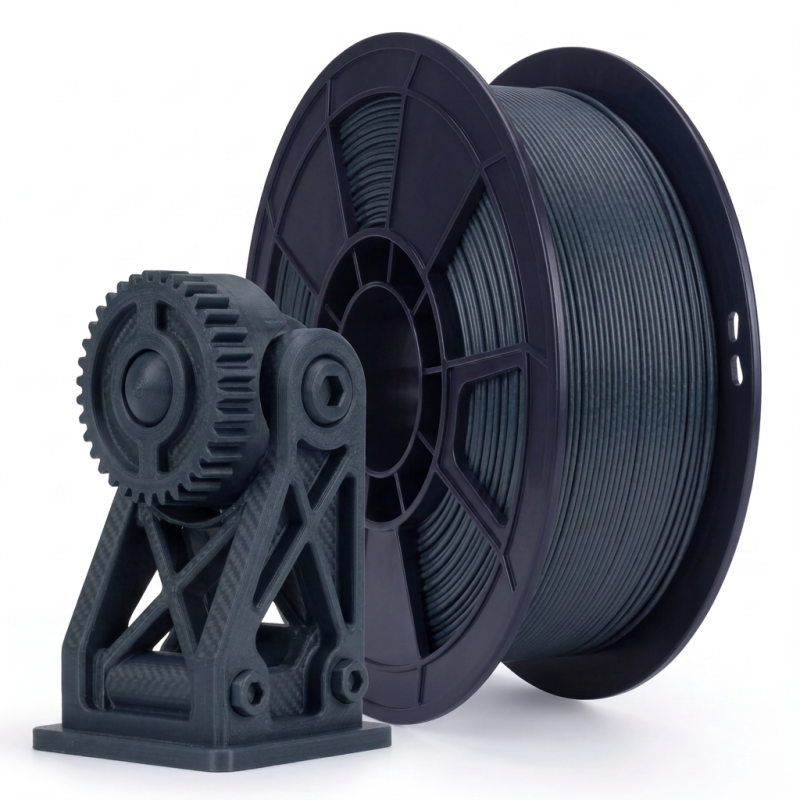
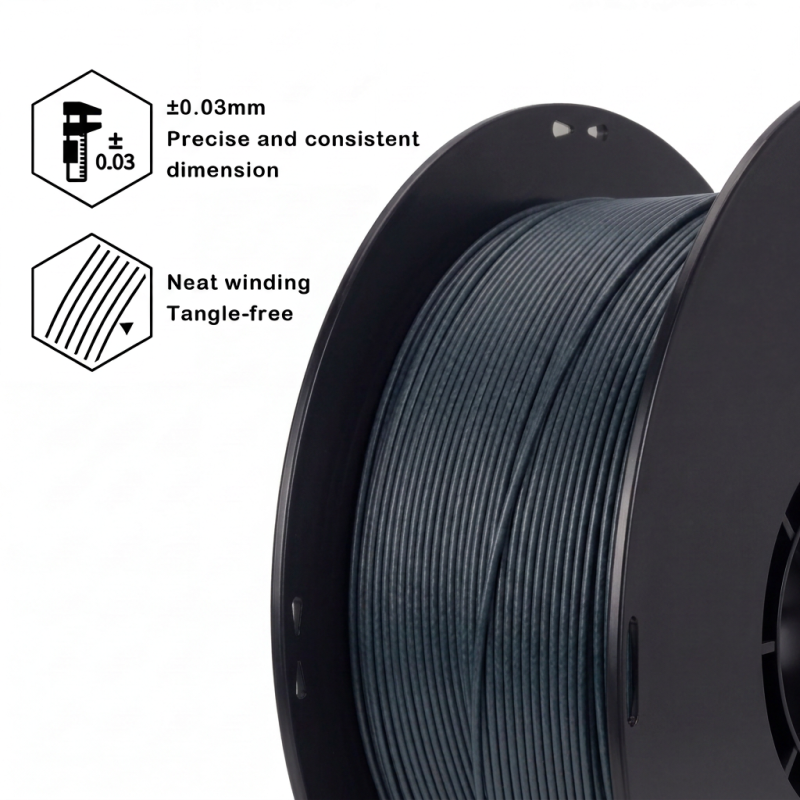
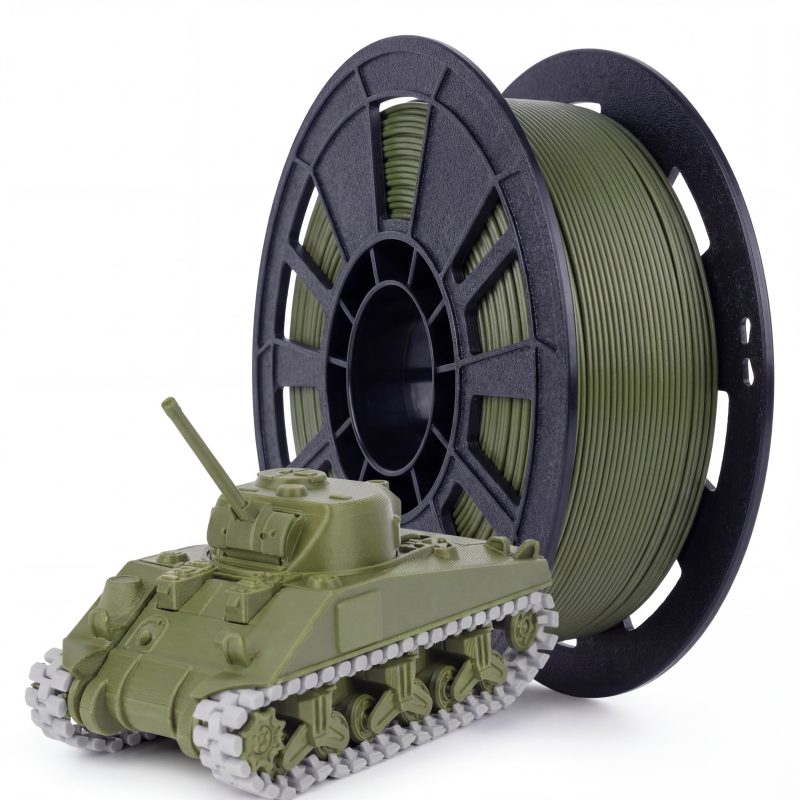
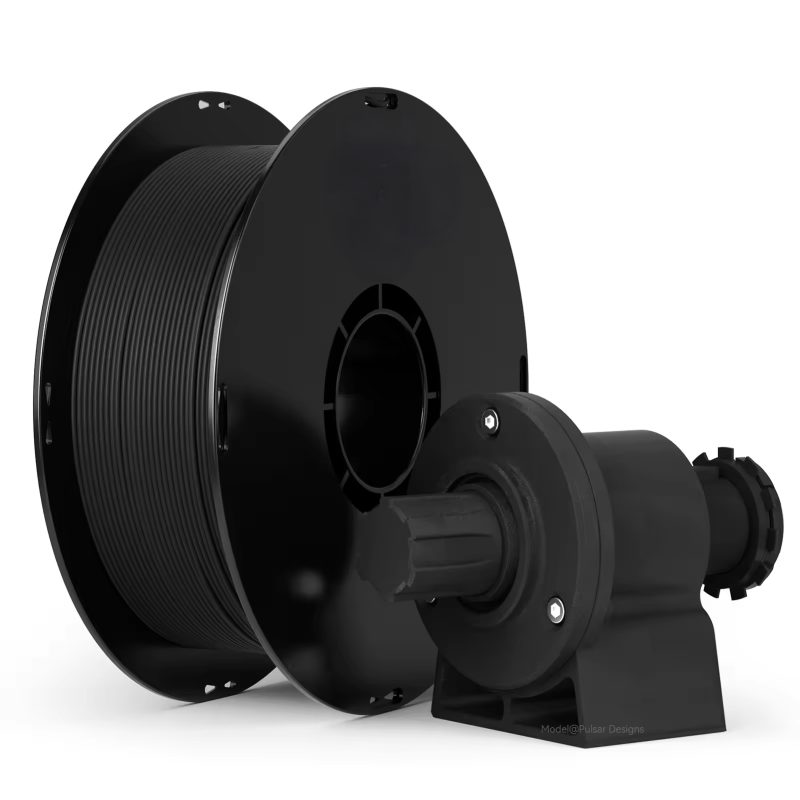
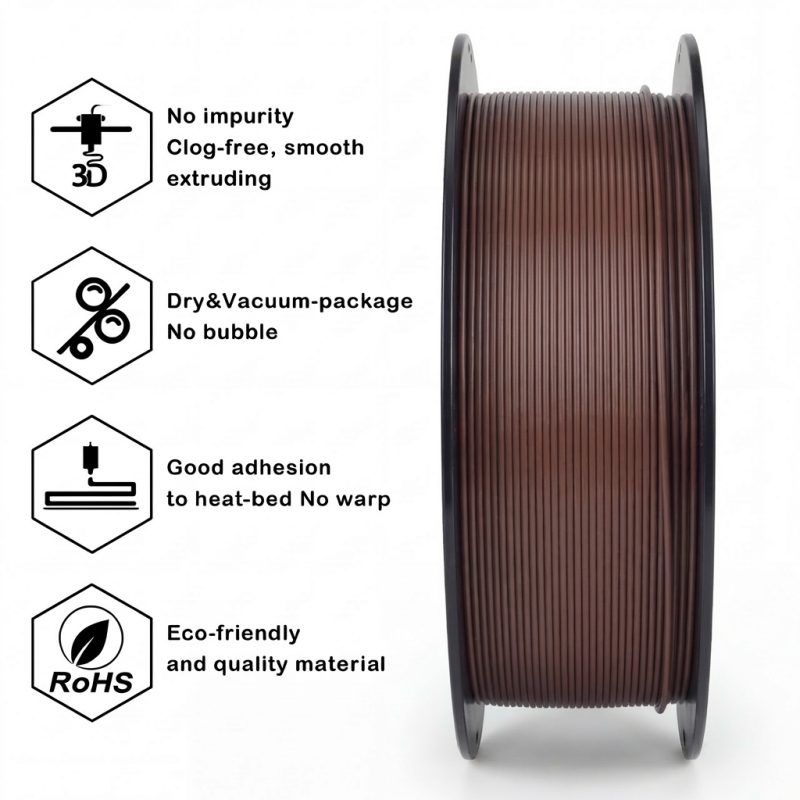
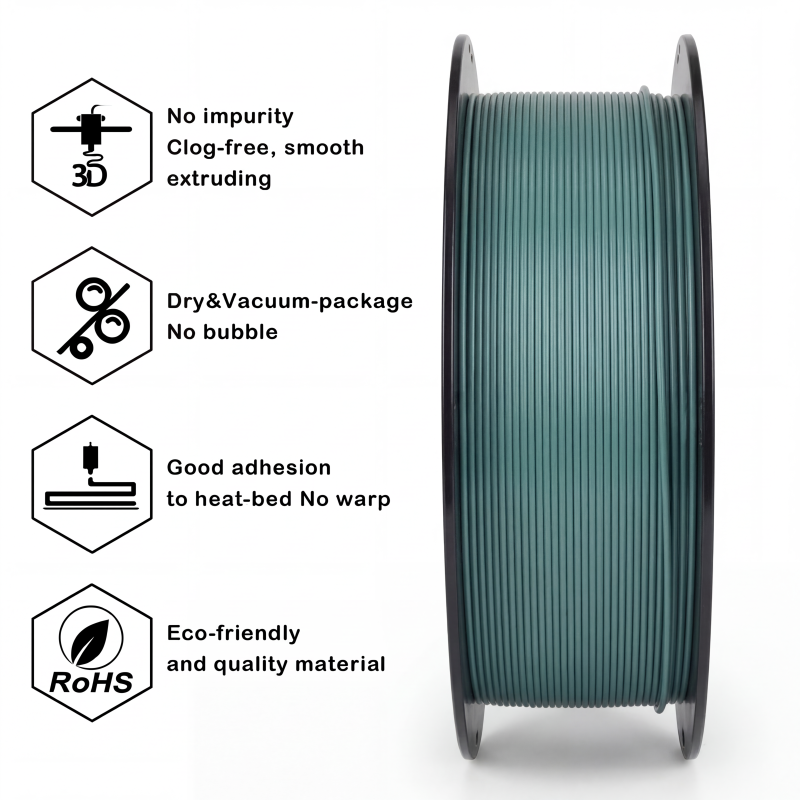
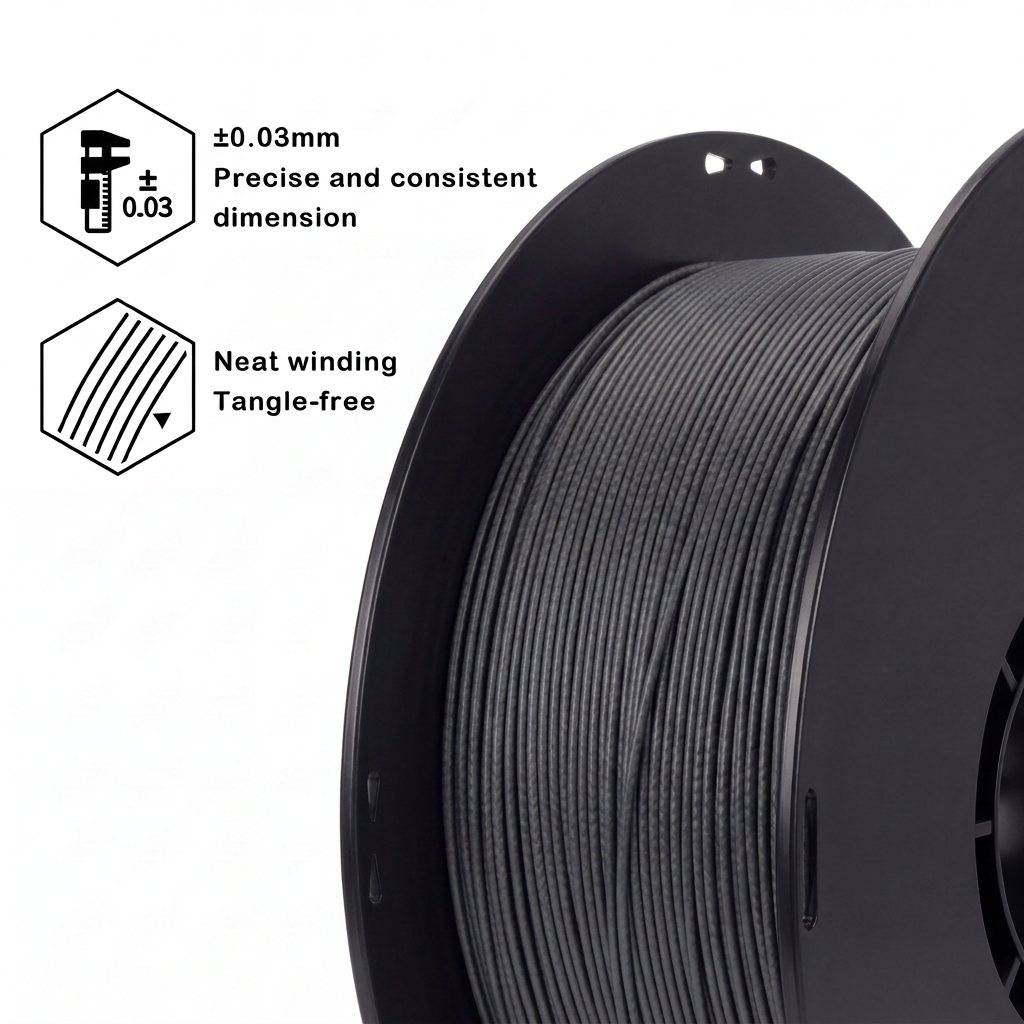
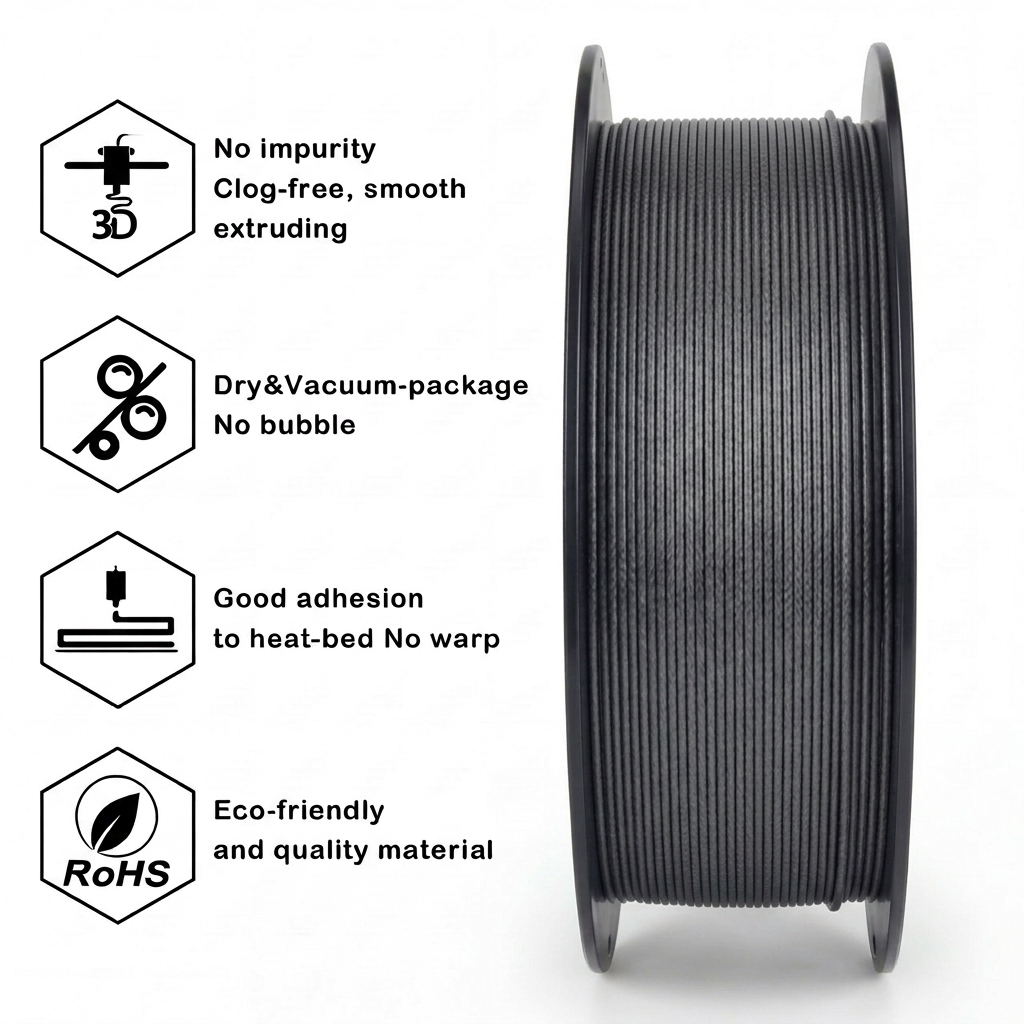
Beyond stiffness, buyers pick this gray carbon fiber PLA filament for how it looks and how it stays true. The matte carbon-fleck surface hides layer lines that would show on glossy PLA, so brackets, housings and frames look finished straight off the printer — no sanding, no fillers, no paint. And because the fibers restrain shrinkage, large flat parts warp far less than they would in unfilled PLA, which is exactly what you want for a wide drone deck or a long fixture rail. Held to a ±0.03mm diameter tolerance and wound tangle-free on a black open-lattice spool, every spool is built to keep a hardened nozzle fed steadily.
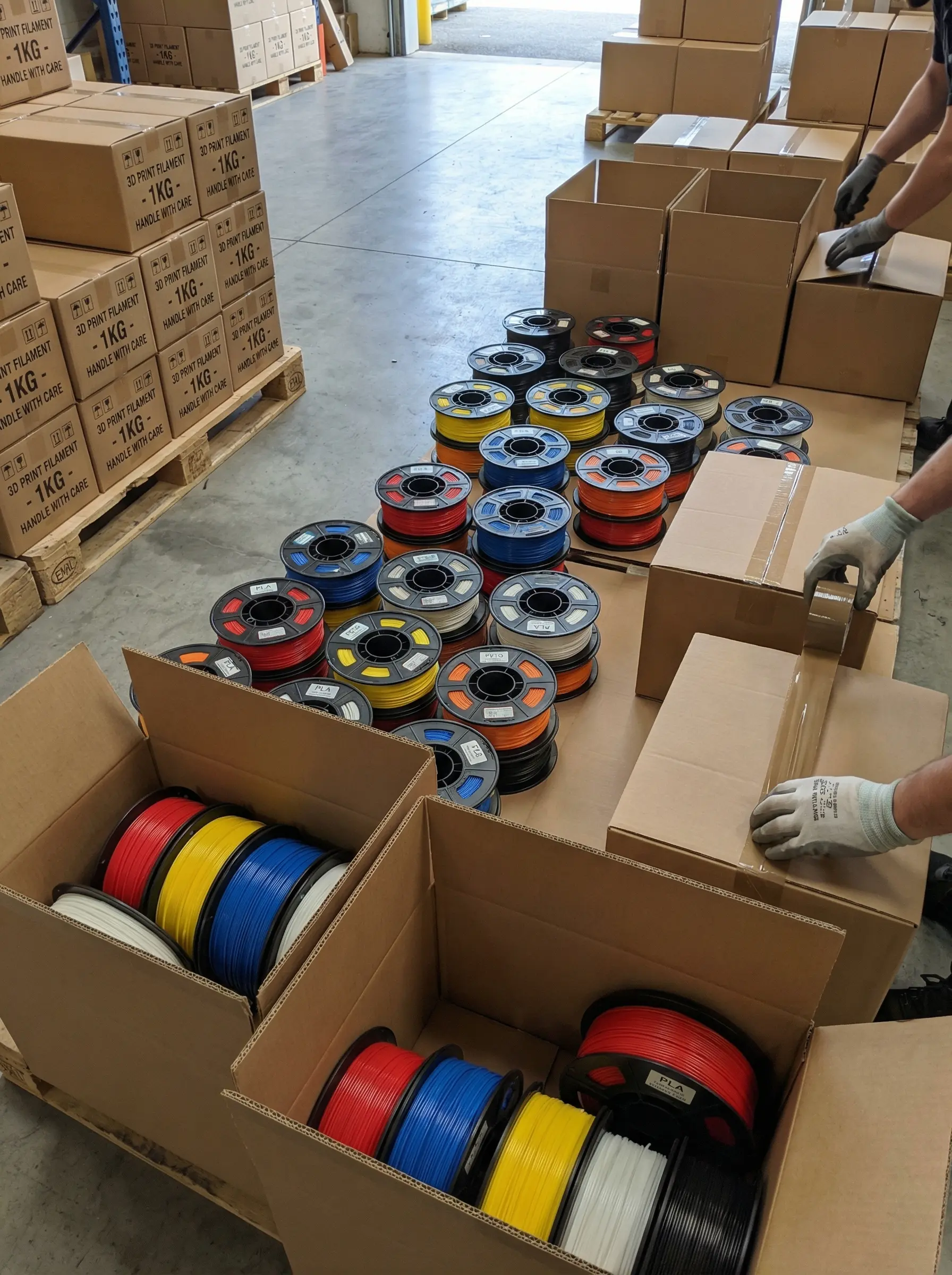
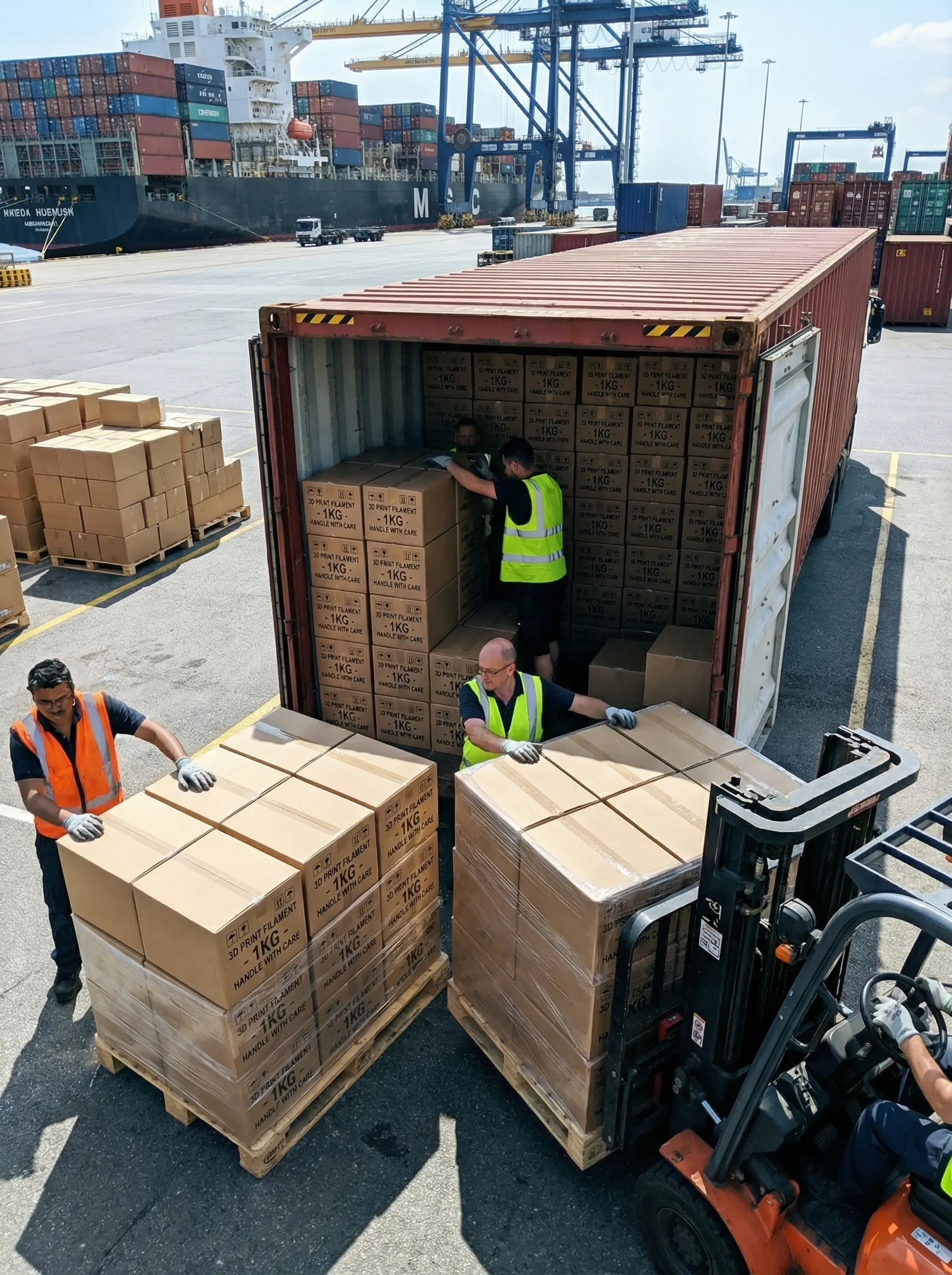
As a factory-direct product, gray PLA-CF is stocked for both single-spool buyers and volume programs. If you are sourcing for production — drone airframes, tooling jigs, structural brackets — it is available through our direct manufacturer wholesale program and through full OEM/ODM services with custom carbon loading, color, spool and private-label packaging. Below you will find the print settings, mechanical data, application guidance and design tips that make this material reliable in practice, not just on paper.
Why This Gray Carbon Fiber PLA Filament Stands Out
- Real rigidity gain: chopped carbon fibers raise the stiffness (flexural modulus) well above plain PLA, so brackets, arms and frames resist bending under load instead of springing or sagging.
- Low warp for big flat parts: the fibers restrain shrinkage as the part cools, so wide decks, plates and long rails stay flat and true — a decisive advantage over unfilled PLA on large footprints.
- High stiffness-to-weight ratio: PLA-CF is light, and its rigidity per gram is what makes it a favorite for drone frames and other parts where every gram of un-needed mass costs flight time.
- Premium matte carbon finish: the fine carbon fleck scatters light and hides layer lines, giving a professional non-glossy look with zero post-processing.
- Easy PLA-style printing: unlike carbon-filled nylon or PC, this material prints cool (200–230 °C), needs no enclosure, and forgives beginners — the fibers add capability without adding a difficult process.
- ±0.03mm tolerance through a hardened nozzle: a consistent diameter keeps flow steady when a slightly abrasive melt is passing through the hotend, so dimensional accuracy holds spool to spool.
Premium Carbon Fiber PLA at Factory-Direct Pricing
| Quality You Get | How We Deliver It | What It Means For You |
|---|---|---|
| Consistent stiffness | Evenly dispersed carbon loading, batch-verified | Parts flex the same, part to part and batch to batch |
| Steady flow through a hardened nozzle | ±0.03mm diameter + tangle-free winding | Fewer clogs and dimension drifts on abrasive material |
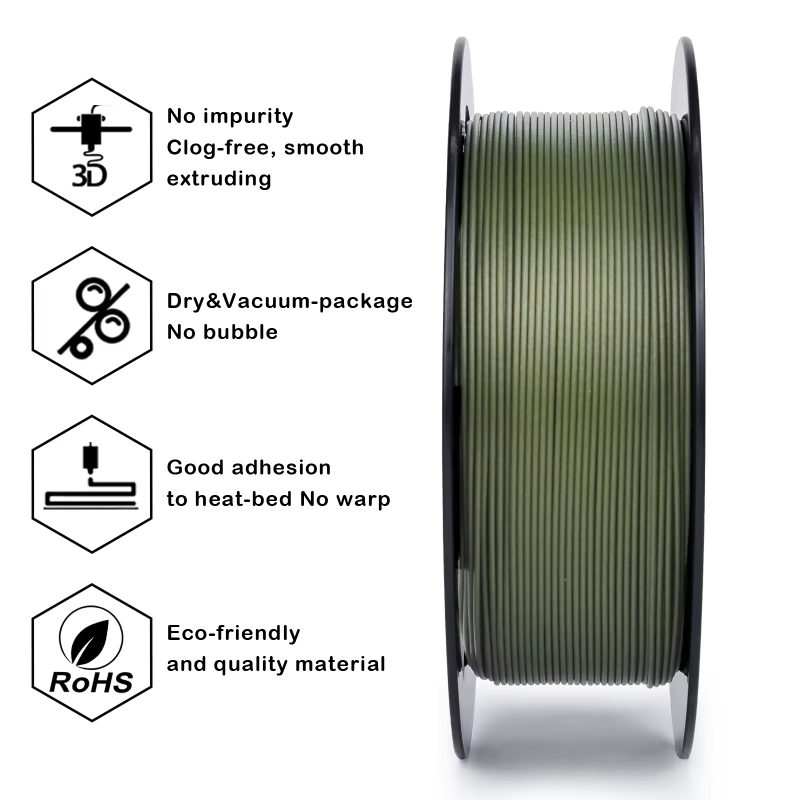
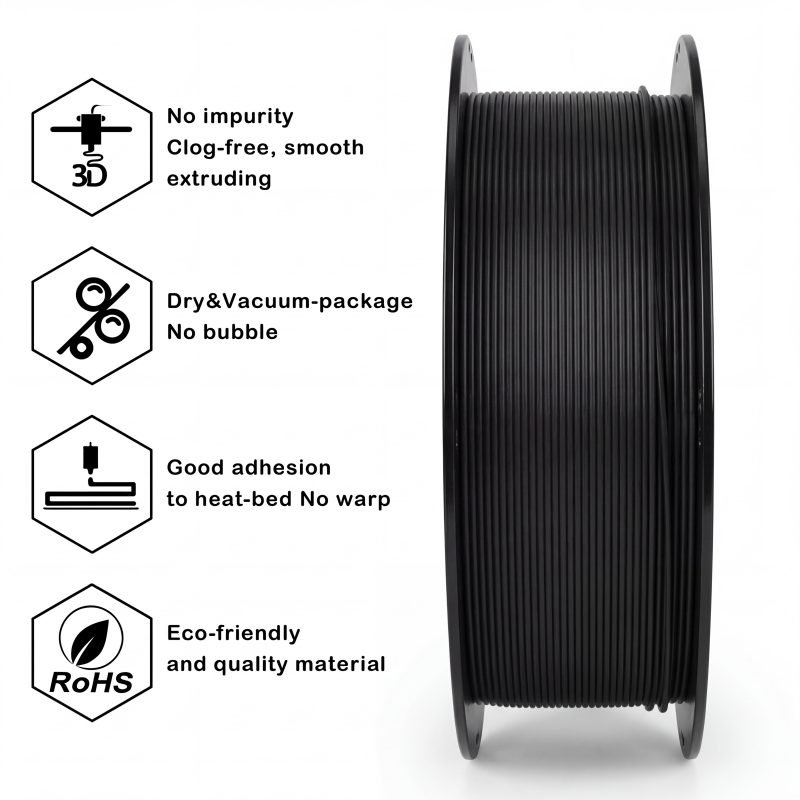
| Dry on arrival | Vacuum seal + desiccant, sealed at packing | Less fuzzing and rough surface out of the box |
Why Choose Gray PLA-CF for Your Projects
| Stiff, not floppy | Holds its shape under load where plain PLA would flex or sag. |
| Stays flat | Low warp keeps large plates and frames dimensionally true. |
| Light for its stiffness | Ideal for drone arms, gimbals and moving structural parts. |
| Looks finished | Matte carbon fleck hides layer lines — no sanding or paint. |
| Easy to run | PLA-style temps and no enclosure — just a hardened nozzle. |
| Volume-ready supply | Consistent stock for production, wholesale and OEM. |
How Gray Carbon Fiber PLA Compares
| Property | Gray PLA-CF | Standard PLA | PETG |
|---|---|---|---|
| Rigidity / stiffness | High — carbon-reinforced | Moderate, can flex | Lower, more compliant |
| Warp / dimensional stability | Low warp, very stable | Low warp but can sag | Moderate |
| Surface finish | Matte carbon fleck, hides lines | Glossy, shows lines | Semi-gloss |
| Nozzle requirement | Hardened steel required | Brass is fine | Brass is fine |
| Best use | Drone frames, brackets, jigs | Models, prototypes | Tough containers, outdoor |
Carbon Fiber PLA vs Plain PLA — A Sourcing Note
The temptation is to treat carbon fiber PLA as “PLA that looks cool,” but the real reason to stock it is engineering, not aesthetics. Chopped carbon fiber acts like rebar inside concrete: the short stiff fibers carry load and restrain the polymer around them, which is what raises the stiffness and cuts the warp. That means a bracket or drone arm printed in this gray carbon fiber PLA filament holds a defined shape under a load that would visibly bend the same part in plain PLA. For a contract shop or a reseller serving makers who build functional hardware — RC, drones, camera rigs, tooling — a spool of PLA-CF covers a class of jobs that unfilled PLA simply cannot. The matte gray finish is a bonus that happens to photograph well and satisfy customers who associate carbon texture with a premium, engineered part.
For buyers standardizing a production BOM, gray PLA-CF also simplifies finishing. Because the surface is already matte and line-hiding, you skip the sand-fill-prime-paint cycle that glossy filaments often need for a professional look, which removes labor from every unit. The one process rule that comes with it — run a hardened nozzle — is a fixed, one-time equipment choice rather than a per-print variable, so it is easy to standardize across a print farm. Combined with the ±0.03mm diameter control and dry vacuum packaging, that makes this gray carbon fiber PLA filament a low-variance input you can design a repeatable process around.
Recommended Print Settings
| Parameter | Recommended |
|---|---|
| Nozzle temperature | 200–230 °C (215 °C typical) |
| Bed temperature | 50–60 °C |
| Print speed | 40–60 mm/s (50 mm/s recommended) |
| Nozzle type | Hardened steel / ruby, ≥0.4mm (0.6mm ideal) |
| Cooling fan | 80–100% (as with PLA) |
| Retraction | 1–2mm (direct) / 3–5mm (Bowden) |
| Enclosure | Not required |
| Drying | 45–55 °C for 6–8h if exposed to humid air |
Troubleshooting Carbon Fiber Prints
| Symptom | Likely Cause | Fix |
|---|---|---|
| Nozzle clogs partway into a print | Fiber bridging a small bore, or a worn brass tip | Switch to a 0.6mm hardened nozzle; raise temp 5–10 °C; never use brass for carbon fill |
| Dimensions drift larger over many prints | Abrasive wear has opened a soft nozzle bore | Replace with hardened steel or ruby; re-calibrate flow |
| Fuzzy or rough surface | Damp filament (most common) | Dry at 45–55 °C for 6–8h; print from a dry box |
| Under-extrusion / gaps in walls | Thicker carbon melt at plain-PLA settings | Raise temp toward 225–230 °C; slow to 40–50 mm/s; bump flow 102–105% |
| Part more brittle than expected | CF trades some impact toughness for stiffness | Add walls/infill for impact zones; design fillets; expect stiff-not-tough behaviour |
Technical Specifications
| Material | Carbon-Fiber-Reinforced PLA (PLA-CF) |
| Reinforcement | Chopped carbon fiber (typ. ~10–15% by weight) |
| Color | Matte carbon gray (#616161 tone, fine fleck) |
| Diameter | 1.75mm |
| Diameter tolerance | ±0.03mm |
| Net weight | 1kg (spool) |
| Approx. length | ~330m at 1.75mm |
| Surface finish | Matte, carbon-textured (line-hiding) |
| Recommended nozzle | Hardened steel / ruby, ≥0.4mm (0.6mm ideal) |
| Nozzle temperature | 200–230 °C |
| Bed temperature | 50–60 °C |
| Print speed | 40–60 mm/s |
| Enclosure | Not required |
| Heated bed | Recommended |
| Warp tendency | Low |
| Odor | Low |
| Moisture sensitivity | Moderate — keep sealed/dry for best finish |
| Compliance | RoHS / REACH |
Material Properties & Performance
The whole point of PLA-CF is what the fibers do to the polymer’s mechanical behaviour. Chopped carbon fiber raises the flexural and tensile modulus — the numbers that describe how much a part resists bending and stretching under load — so a printed bracket or arm deflects noticeably less than the same geometry in plain PLA. That extra stiffness is why carbon PLA is the go-to for parts that must hold a precise form: a drone frame that keeps motors in alignment, a jig that indexes a workpiece the same way every time, a camera mount that does not sag under a lens.
There is an honest trade-off to state plainly: carbon fiber makes PLA stiffer, not tougher. The fibers add rigidity and dimensional stability, but they can slightly reduce impact toughness and elongation compared with unfilled PLA — a highly loaded carbon part is more likely to crack than to bend when abused. That is the correct behaviour for a structural part (you want it to hold its shape, not flex), and you design around it with adequate wall counts, generous fillets and extra material in impact zones. Every quality-control step on this gray carbon fiber PLA filament — even fiber dispersion, ±0.03mm diameter, tangle-free winding, dry vacuum packaging — exists to make that stiffness land on the bed consistently rather than varying spool to spool.
| Property | Typical Value | Note |
|---|---|---|
| Tensile strength | 45–60 MPa | Comparable to / above plain PLA |
| Flexural modulus (stiffness) | High — well above plain PLA | Primary reason to choose PLA-CF |
| Elongation at break | Low (~2–4%) | Stiff, not flexible — designs for rigidity |
| Density | ~1.2–1.3 g/cm³ | Light for its stiffness |
| Heat resistance | Similar to PLA (anneal to raise) | Not a high-temp engineering grade |
Printer-Specific Settings
Every profile below assumes a hardened steel or ruby nozzle — swap in the wear-resistant tip before running carbon fiber on any of these machines.
| Bambu Lab X1/P1 (hardened nozzle) | 215 °C / bed 55 °C / 50 mm/s, PLA-CF profile |
| Prusa MK4 (hardened / ObXidian) | 220 °C / bed 55 °C / 45–50 mm/s |
| Creality K1C (hardened, CF-ready) | 220 °C / bed 55 °C / 50–60 mm/s |
| Creality Ender 3 (hardened swap) | 215 °C / bed 55 °C / 40–50 mm/s |
| Voron (hardened / tungsten) | 220 °C / bed 55 °C / 50–60 mm/s tuned |
| Anycubic Kobra (hardened swap) | 215 °C / bed 55 °C / 45–55 mm/s |
Applications
| Drone & multirotor frames | Light, stiff arms and decks that keep motors aligned in flight. |
| Rigid brackets & mounts | Structural brackets, camera and sensor mounts that must not sag. |
| Jigs & fixtures | Indexing jigs and holding fixtures that need to stay dimensionally true. |
| Structural parts | Frames, plates and load-bearing panels for hobby and pro hardware. |
| RC & robotics chassis | Stiff chassis, arms and mounts where flex would lose precision. |
| Display & functional models | Matte carbon look for premium prototypes and finished-look parts. |
Industry Use Cases
Across the workshop, gray PLA-CF shows up wherever stiffness and a clean finish matter more than impact toughness. In drones and UAV, it is a staple for airframes, arms, gimbal mounts and antenna brackets — the high stiffness-to-weight ratio keeps the frame rigid without adding grams that shorten flight time. In robotics and RC, it prints chassis plates, servo brackets, gearbox housings and camera cages that must hold alignment under vibration. In manufacturing and tooling, PLA-CF becomes indexing jigs, drill guides, soft-touch-free holding fixtures and inspection gauges that stay dimensionally true shift after shift. In product design and engineering, its matte carbon finish makes appearance models and functional prototypes look production-ready straight off the bed. And in camera and cinema rigs, lightweight stiff mounts, cheese plates and adapters carry gear without the sag a softer plastic would show. The common thread is a part that must hold a precise shape while staying light — and a matte gray surface that reads as an engineered component rather than a hobby print.
Because one rigid material spans so many of these jobs, standardizing on a dependable gray carbon fiber PLA filament simplifies purchasing: one input, one dial-in profile, one hardened-nozzle rule — reused across drone frames, brackets, jigs and mounts instead of qualifying a different filament for each product line.
Designing Parts for Carbon Fiber PLA
Getting the most out of gray PLA-CF is as much about design as it is about slicer settings. Because the material is stiff-not-tough, design for rigidity and manage stress: use 3–4 perimeters so walls carry load through the fibers rather than the infill; add generous fillets at every internal corner because sharp corners concentrate stress and are where a rigid carbon part cracks first; and orient the part so the main load runs along the print layers, not across a single weak layer line. For drone frames and structural plates, a higher wall count with moderate infill (25–40%) usually beats thin walls with dense infill — the fibers do their best work in the perimeters. Where a part will see impact rather than steady load, add material or transition to a tougher filament for that zone. Design with those habits and this gray carbon fiber PLA filament rewards you with light, stiff parts that look and behave like engineered hardware.
Environmental & Safety Standards
| ✅ RoHS Restricted substances compliant | ✅ REACH SVHC compliant | ✅ Low odor Comfortable workspace printing | ✅ Vacuum sealed Dry, desiccant-protected |
Packaging & Global Shipping
| Region | Method | Typical Time |
|---|---|---|
| North America | Air / express + sea for bulk | 7–20 days |
| Europe | Air / express + sea for bulk | 7–20 days |
| Asia-Pacific | Air / express | 5–12 days |
| Rest of world | Air + freight forwarding | 10–25 days |
Bulk Orders & OEM/ODM Services
| Custom carbon loading | Tune fiber content for more stiffness or a smoother finish. |
| Custom color | Carbon blends in gray, black and other tones on request. |
| Private label | Your spool, label and packaging design. |
| Volume pricing | Contact us for 10+ spool and pallet quotes via our OEM/ODM services. |
Storage & Handling Guidelines
| Reseal in the vacuum bag with desiccant after each print session. |
| Store below 20% RH; a dry box keeps the matte finish crisp. |
| Dry at 45–55 °C for 6–8h if you see a fuzzy surface. |
| Always run a hardened nozzle — never brass — for carbon fiber. |
| Keep away from direct sunlight and heat sources. |
| Handle spools by the hub to keep windings tight and tangle-free. |
Printer Compatibility
| Bambu Lab | Prusa | Creality | Anycubic | Voron | Elegoo |
|---|---|---|---|---|---|
| ✅ Hardened | ✅ ObXidian | ✅ K1C | ✅ Hardened | ✅ Tungsten | ✅ Hardened |
Any 1.75mm printer with a heated bed can run this PLA-CF once you fit a hardened nozzle — no enclosure needed. For a broader look at material strength and stiffness across the range, see our strongest 3D printer filament guide.
Why Choose SigmaFilament for Carbon Fiber PLA
| Factory-direct | We manufacture the filament — no middle-man markup. |
| Even fiber dispersion | Consistent carbon loading for repeatable stiffness. |
| Dry packaging | Vacuum-sealed to protect the matte carbon finish. |
| OEM/ODM ready | Custom carbon loading, color and private-label programs. |
| Global logistics | Reliable worldwide shipping for samples and pallets. |
For print farms and production buyers, the value of a carbon filament is measured in unattended reliability — how many spools run back-to-back without a clog, a dimension drift or a batch that prints noticeably softer. That is exactly where a manufacturer-controlled input pays off. Fiber dispersion is kept even so stiffness is repeatable part to part; diameter is held to ±0.03mm so a slightly abrasive melt still flows steadily through your hardened nozzle; and vacuum-sealed dry packaging means a fresh spool prints a clean matte surface out of the box. When you are running structural parts all day, those controls are the difference between a process you trust and one you babysit. If you are scaling carbon-reinforced production, talk to us about a standing wholesale supply or an OEM program tuned to your exact part.
Buying Gray PLA-CF With Confidence
Whether you are printing a handful of parts or specifying a production input, this gray carbon fiber PLA filament is built to remove the usual carbon-filament friction. New to carbon fiber? Fit a hardened nozzle, start from the recommended profile above, and you will get stiff, matte, dimensionally stable parts on the first or second attempt — it really does print like an easy PLA once the nozzle is sorted. Already running carbon parts? This gray carbon fiber PLA filament slots into an existing PLA-CF profile with minimal re-tuning, and its even fiber dispersion keeps your stiffness and finish consistent from spool to spool. Buyers who have been burned by inconsistent carbon filament — one spool clogging, the next printing soft — tend to appreciate that a carbon PLA held to tight diameter and dispersion tolerances behaves the same every time.
Every spool of this gray carbon fiber PLA filament is manufactured, wound and packed under the same controls, and we back the material with responsive technical support and sample availability for qualified buyers. If your application needs a higher carbon loading for extra stiffness, a smoother lower-fiber blend, or private-label spools, our team can take this gray carbon fiber PLA filament and adapt it to your specification without you having to re-qualify a new supplier. That combination — a dependable off-the-shelf carbon PLA plus a factory that can customize it — is what makes SigmaFilament a practical long-term source rather than a one-off purchase. Whether you are printing a single drone frame today or standardizing a structural component across a full product line, the same spool, the same tolerances and the same support are behind every order.
Frequently Asked Questions
Do I really need a hardened nozzle for gray carbon fiber PLA filament?
Is carbon fiber PLA stronger than regular PLA?
What makes PLA-CF good for drone frames?
Why does my carbon PLA print look fuzzy?
Does this filament need an enclosure?
Do you offer gray carbon fiber PLA for wholesale or OEM/private-label?
Source Gray Carbon Fiber PLA Direct From the Factory
Rigid, lightweight, low-warp and matte-finished — ready for drone frames, brackets and jigs. Order a spool to test, or request wholesale & OEM pricing for production volumes.
Free samples for qualified buyers · Wholesale & OEM/ODM available
| Material | PLA-CF |
|---|---|
| Color | Carbon Gray |
| Filament Diameter | 1.75mm ,2.85mm (3.00mm) |
| Spool Weight | 1kg ,3kg ,5kg ,Sample (200g) |