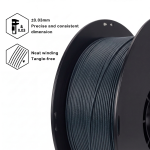
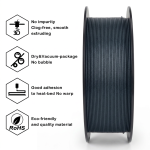
Blue Carbon Fiber PLA Filament — Rigid, Matte and Built to Hold Its Shape
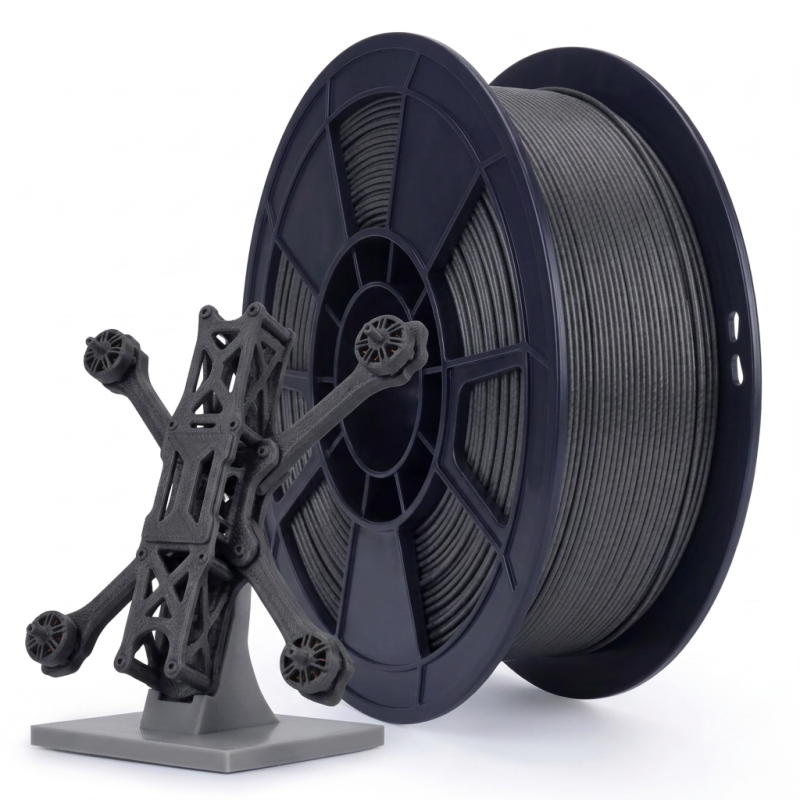
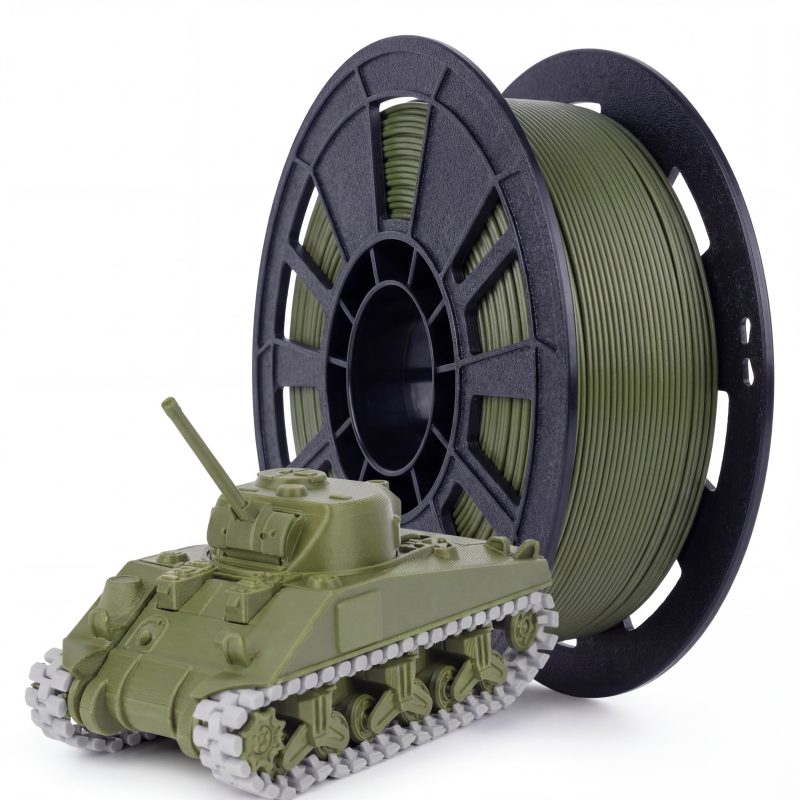
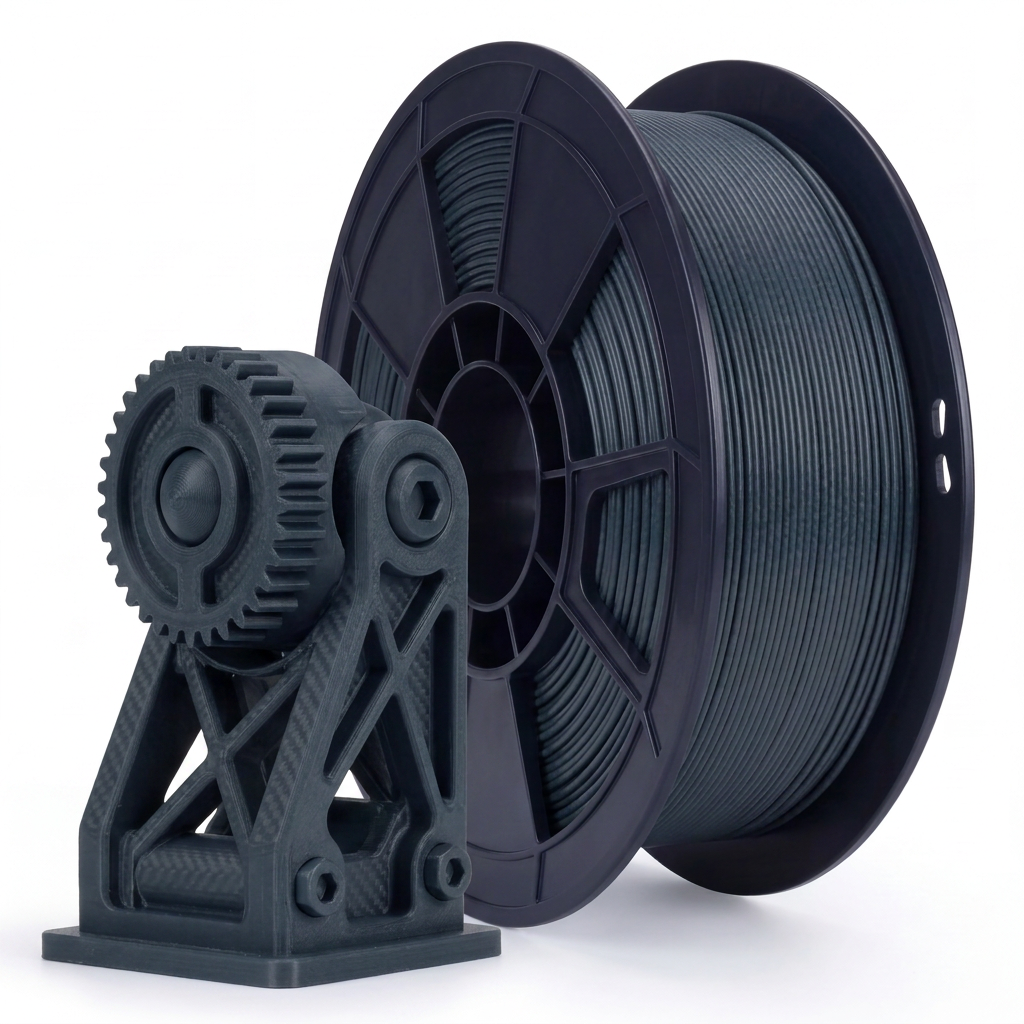
Blue carbon fiber PLA filament is the stiffness upgrade for anyone who has watched a plain-PLA bracket sag, a drone arm twist under vibration, or a jig lose its reference edge over a long print job. This 1.75mm PLA-CF grade blends chopped carbon fibers into a PLA matrix, and those fibers do one thing extremely well: they resist bending. A part printed in this material flexes far less under the same load than the identical part in standard PLA, which is exactly what you want for frames, fixtures and structural components that must stay dimensionally true rather than give. The deep slate-blue base sets it apart from the sea of black carbon filaments — you get the engineered carbon-fiber look with a distinctive color, finished in a matte, lightly speckled surface that hides layer lines instead of showing them off.
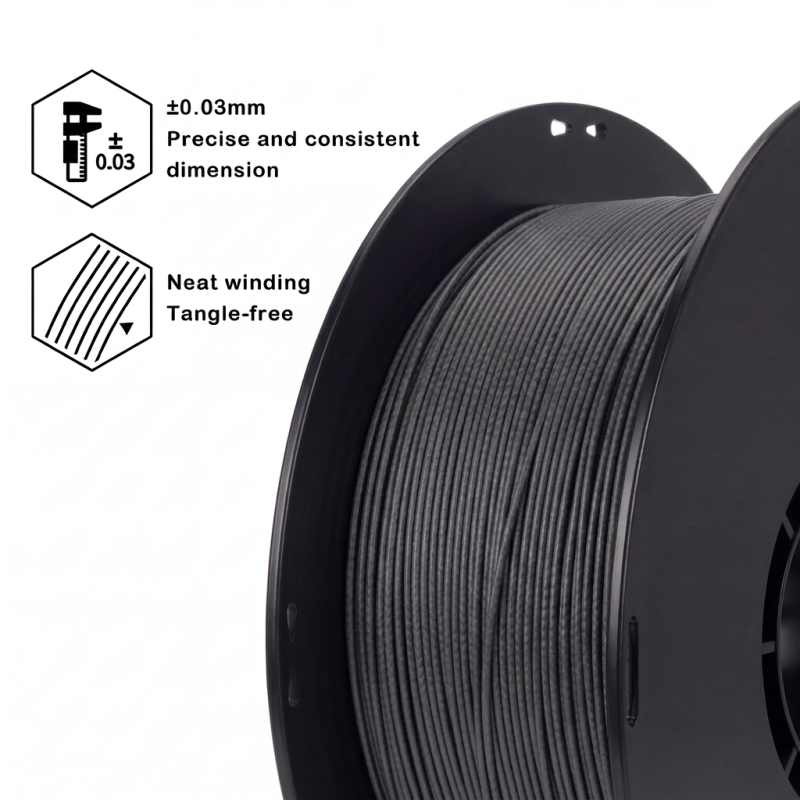
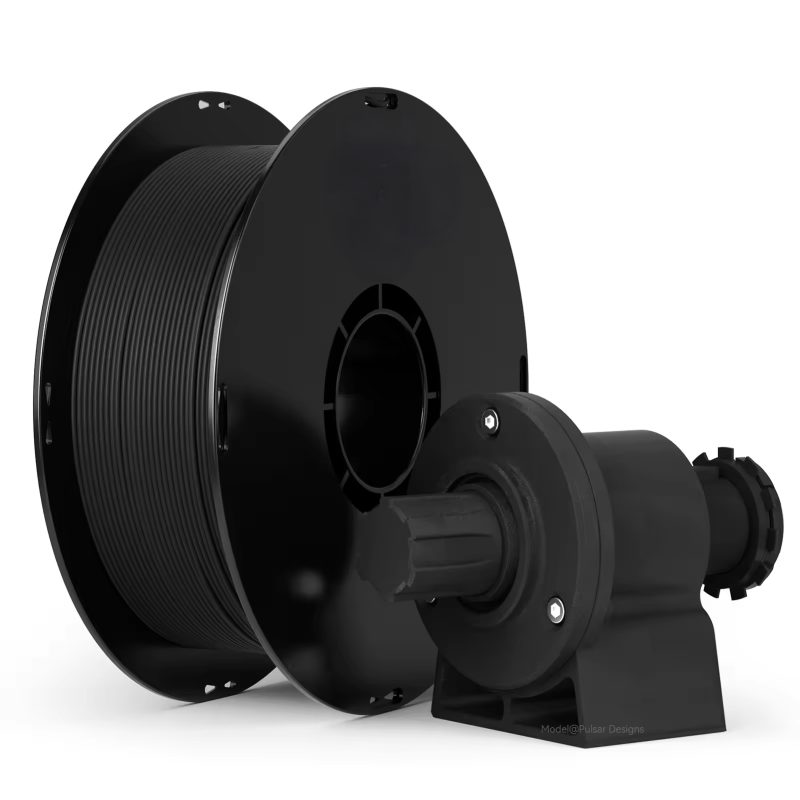
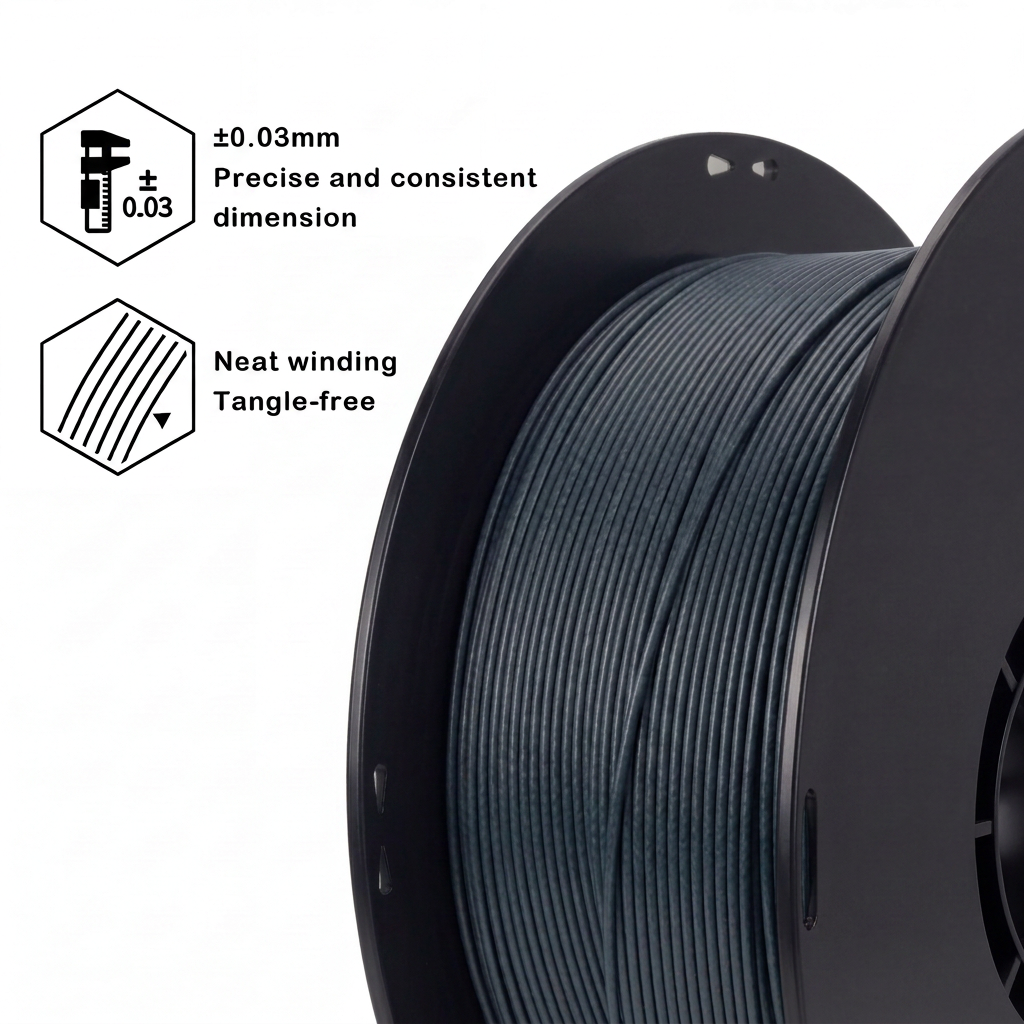
Reinforced filaments print differently from unfilled ones, and the difference starts at the nozzle. Carbon fiber is abrasive; it grinds through a standard brass nozzle in a matter of spools. That is why a hardened steel nozzle is mandatory for this blue carbon fiber PLA filament, and why a slightly larger orifice (0.5–0.6mm) is the smart default — it clears the short fibers cleanly and all but eliminates the clogging that plagues filled materials in a fine 0.4mm tip. To keep that filled melt flowing evenly, the filament is held to a ±0.03mm diameter tolerance and wound tangle-free on a black open-lattice spool. Consistent diameter matters more, not less, when the plastic carries an abrasive filler: it keeps the flow rate steady and the extrusion pressure predictable across a long structural print.
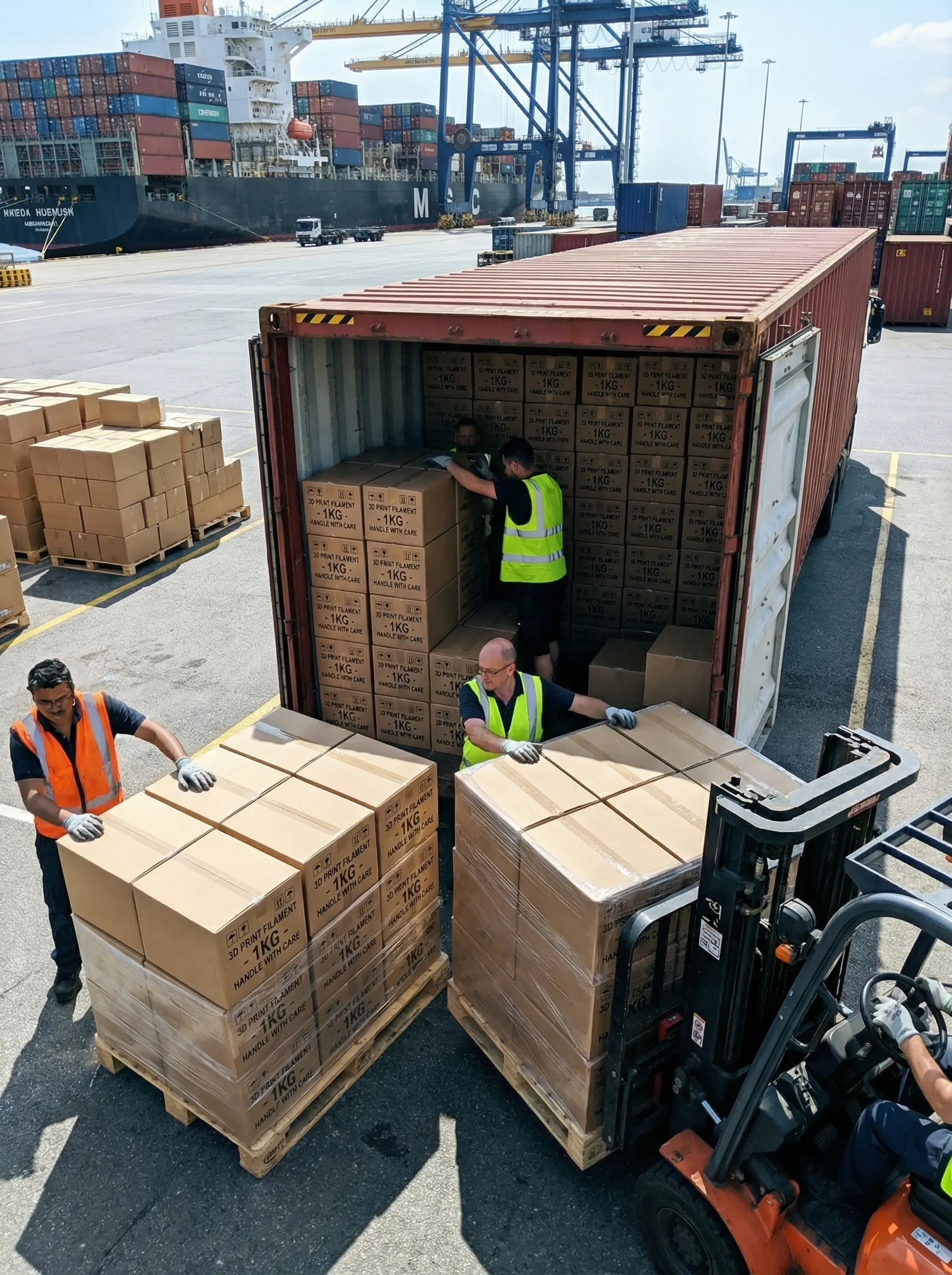
As a factory-direct product, this blue carbon fiber PLA filament is stocked for both single-spool buyers and volume programs. If you are sourcing for production — drone airframes, tooling fixtures, rigid enclosures — it is available through our direct manufacturer wholesale program and through full OEM/ODM services with custom carbon loading, color, spool and private-label packaging.
Stiffness is the whole point of a carbon-fiber composite, and it is worth being precise about what that means. Carbon fiber raises the flexural modulus — the resistance to bending — dramatically, while keeping the part light. It does not turn PLA into an impact-proof engineering plastic; a CF-loaded part is stiffer but a little more brittle than the same part in tough PLA, so it belongs on jobs that call for rigidity and dimensional stability rather than repeated flexing or drop abuse. Below you will find the print settings, mechanical data, application guidance and design tips that make this material reliable in practice — including the carbon-fiber-specific handling that unfilled PLA simply never needs.
Why This Blue Carbon Fiber PLA Filament Stands Out
- Carbon-fiber rigidity where it counts: the embedded fibers sharply raise stiffness and flexural modulus, so brackets, arms and fixtures hold their geometry under load instead of bowing the way plain PLA does.
- Matte speckled carbon finish: the fibers give the surface a low-sheen, textured look that hides layer lines — parts read as finished straight off the bed, no sanding or coating needed.
- Distinctive engineered blue: a deep slate-blue base instead of the default black, so a carbon part can carry a brand color or simply stand out on a shelf while keeping the composite aesthetic.
- Low warp, high dimensional stability: carbon fiber curbs shrinkage and curling, so long flat parts and precise fixtures come off the bed true — no enclosure required on a heated bed.
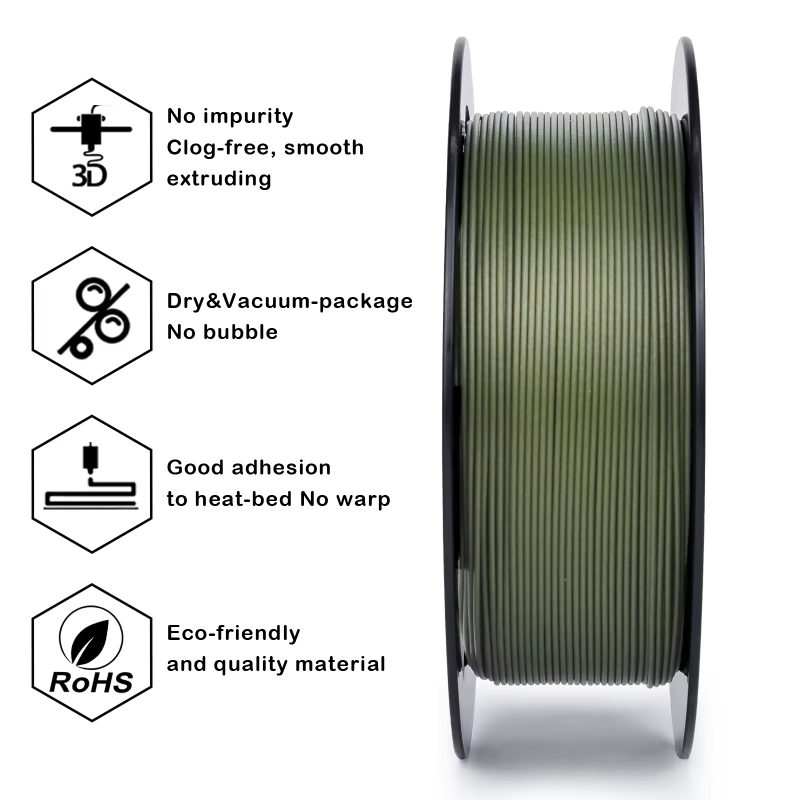
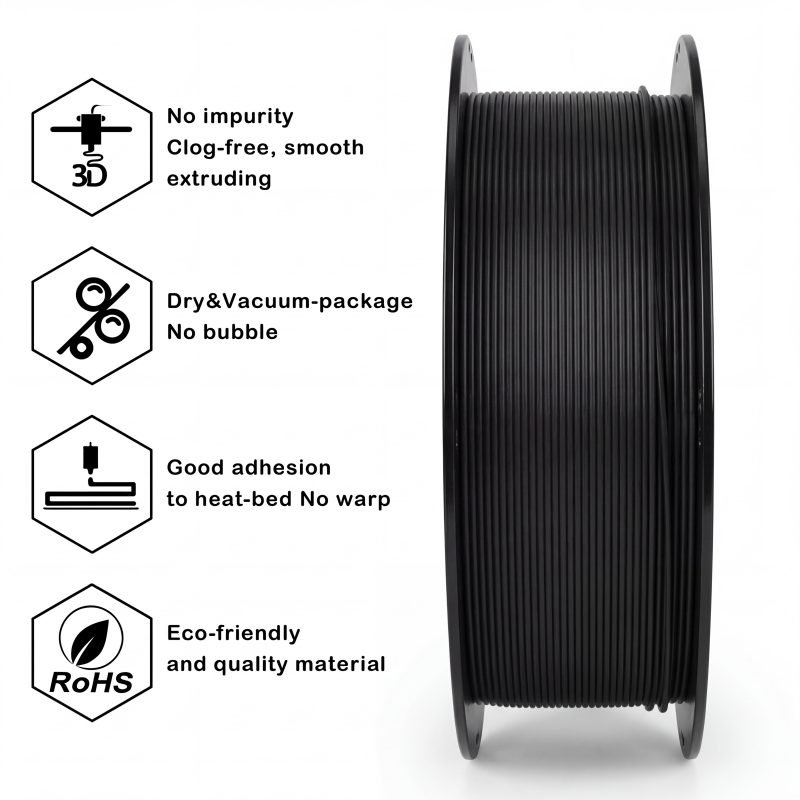
- ±0.03mm tolerance for a filled melt: a consistent diameter keeps the abrasive, fiber-loaded plastic flowing evenly and is the first line of defense against clogging.
- Light stiffness-to-weight: CF-PLA delivers a high rigidity-per-gram, which is why it dominates drone frames and RC parts where every gram of dead weight costs flight time.
Premium Blue Carbon Fiber PLA at Factory-Direct Pricing
| Quality You Get | How We Deliver It | What It Means For You |
|---|---|---|
| Consistent stiffness | Evenly dispersed carbon fiber, batch-verified loading | Parts feel and perform the same rigidity, batch to batch |
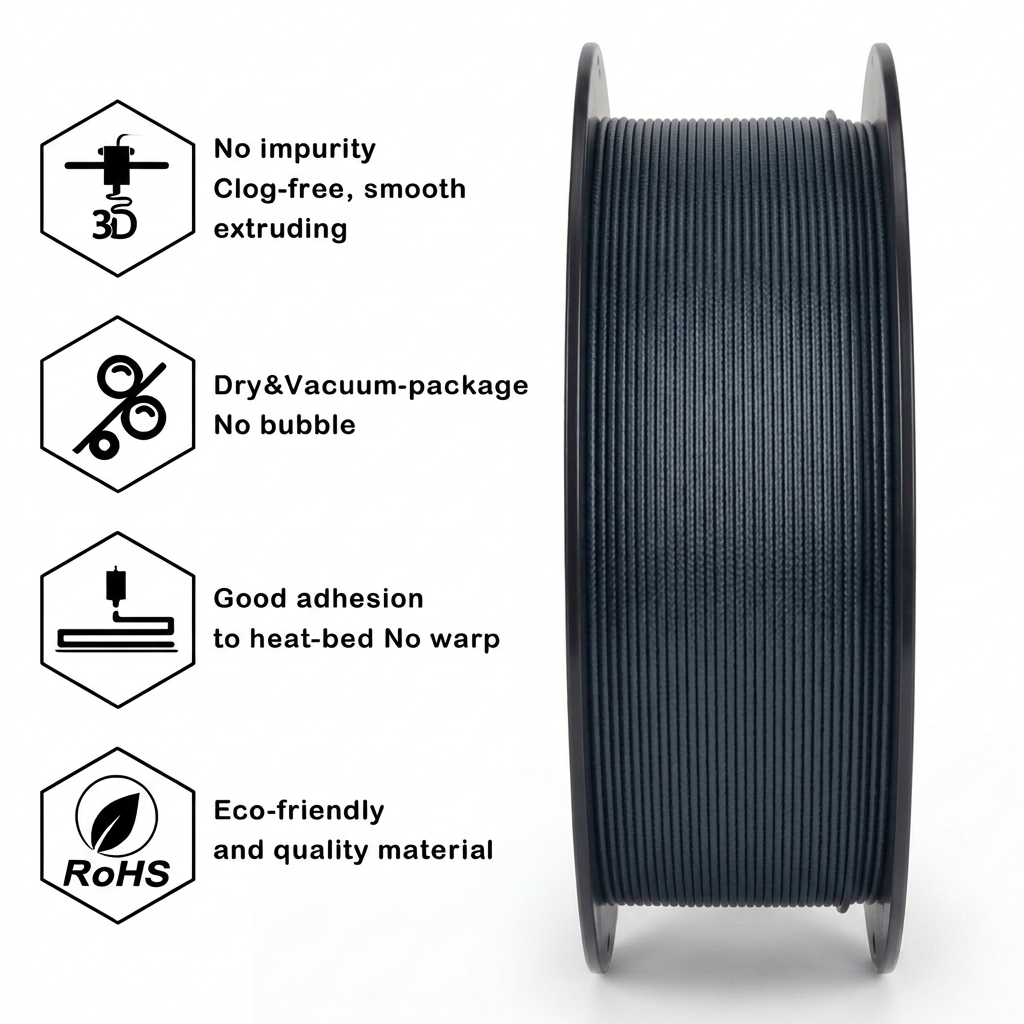
| Clog-free flow | ±0.03mm diameter + tangle-free winding | Fewer jams and failed prints with a filled filament |
| Dry on arrival | Vacuum seal + desiccant, sealed at packing | Clean surface and strong layers straight out of the box |
Why Choose Blue Carbon Fiber PLA for Your Projects
| Stays rigid under load | High flexural modulus keeps frames and brackets from bowing. |
| Matte carbon look | Speckled low-sheen finish that hides layer lines automatically. |
| Light and stiff | High rigidity-to-weight for drone arms and RC parts. |
| Low-warp printing | Flat, dimensionally stable parts with no enclosure needed. |
| Precision fixtures | Jigs and gauges that hold their reference geometry. |
| Volume-ready supply | Consistent stock for production, wholesale and OEM. |
How Blue Carbon Fiber PLA Compares
| Property | Blue Carbon Fiber PLA | Standard PLA | ABS / PETG |
|---|---|---|---|
| Stiffness / rigidity | Very high (CF-reinforced) | Moderate | Moderate |
| Surface finish | Matte, speckled, hides layers | Glossy, shows layers | Semi-gloss |
| Warping | Very low | Low | Higher (ABS) |
| Nozzle needed | Hardened steel required | Brass fine | Brass fine |
| Best use | Drone frames, jigs, rigid brackets | General / decorative | Tough functional parts |
Carbon Fiber PLA — A Sourcing Note
Two things separate a good carbon-fiber filament from a frustrating one, and neither is obvious from a spec sheet. The first is fiber dispersion: cheap CF filament clumps the fibers, producing inconsistent flow, weak spots and a surface that alternates between rough patches and bald streaks. Evenly dispersed carbon gives you a uniform matte finish and steady extrusion pressure, which is what lets a print run for hours without a jam. The second is diameter discipline — a filled filament is far less forgiving of diameter drift than an unfilled one, because every high spot pushes more abrasive material through the melt zone and every low spot starves it. Holding this blue carbon fiber PLA filament to ±0.03mm is a direct response to both problems. For a contract manufacturer or a reseller, that consistency is the difference between a carbon line customers reorder and one that generates support tickets.
It is also worth being honest about the hardware requirement, because it is the single most common reason first-time CF buyers have a bad experience. Carbon fiber is genuinely abrasive — a brass nozzle will visibly wear and start under-extruding within a spool or two. Budget for a hardened steel, tungsten or ruby-tipped nozzle before you load this material, treat a 0.6mm tip as the low-stress default, and you remove ninety percent of the problems people blame on the filament. Do that once and it prints as predictably as any PLA, with the bonus of a finish and rigidity that unfilled plastic cannot touch.
Recommended Print Settings
| Parameter | Recommended |
|---|---|
| Nozzle temperature | 200–230 °C (215 °C typical) |
| Bed temperature | 50–60 °C |
| Print speed | 40–60 mm/s (50 mm/s recommended) |
| Nozzle | Hardened steel, ≥0.4mm (0.5–0.6mm ideal) |
| Cooling fan | 80–100% (as with standard PLA) |
| Enclosure | Not required |
| Drying | 45–55 °C for 4–6h if exposed to air |
Troubleshooting Carbon Fiber Prints
| Symptom | Likely Cause | Fix |
|---|---|---|
| Under-extrusion that worsens over time | Worn brass nozzle or partial fiber clog | Switch to a hardened steel nozzle; go to 0.6mm; cold-pull to clear fiber build-up |
| Complete clog in a 0.4mm tip | Orifice too fine for the fiber load | Use a 0.5–0.6mm hardened nozzle; raise temp toward 230 °C |
| Rough or fuzzy surface | Damp filament or over-fast travel | Dry at 45–55 °C for 4–6h; tune retraction; slow outer walls |
| Part cracks or snaps at a corner | CF-PLA is stiffer but more brittle than plain PLA | Add fillets, more perimeters; avoid designing for repeated flex or impact |
| Weak layer bonding | Temp too low for the filled melt | Raise nozzle temp 5–10 °C; slow slightly to improve fusion |
Technical Specifications
| Material | Carbon-Fiber-Reinforced PLA (PLA-CF) |
| Reinforcement | Chopped carbon fiber, evenly dispersed |
| Color | Slate Carbon Blue (matte, speckled) |
| Surface finish | Matte / low-sheen, hides layer lines |
| Diameter | 1.75mm |
| Diameter tolerance | ±0.03mm |
| Net weight | 1kg (spool) |
| Approx. length | ~330m at 1.75mm |
| Recommended nozzle | Hardened steel, ≥0.4mm (0.5–0.6mm ideal) |
| Nozzle temperature | 200–230 °C |
| Bed temperature | 50–60 °C |
| Print speed | 40–60 mm/s |
| Enclosure | Not required |
| Heated bed | Recommended |
| Rigidity vs plain PLA | Significantly higher flexural modulus |
| Warping | Very low |
| Moisture sensitivity | Moderate — keep sealed/dry |
| Compliance | RoHS / REACH |
Material Properties & Performance
The value of a carbon-fiber composite is in what it does under load: it resists bending. Adding chopped carbon fiber to PLA raises the flexural modulus substantially, so a beam, arm or bracket deflects much less for the same force than the same geometry in unfilled PLA. That stiffness, combined with the low weight of the base polymer, is why CF-PLA has become the default for drone airframes and RC structural parts — you get a rigid frame that does not add dead grams. The fibers also curb the thermal shrinkage that causes warping, so long flat parts and precise fixtures come off the bed dimensionally true.
There is a trade-off, and designing around it is what separates a good carbon part from a failed one. Carbon fiber raises stiffness but lowers ductility — a CF-PLA part is more brittle than a part in tough or standard PLA, meaning it will crack rather than bend if you overload it or drop it on a corner. The material is therefore ideal for parts that must stay rigid and dimensionally stable, and a poor choice for parts that need to absorb impact or flex repeatedly. Every quality control step on this blue carbon fiber PLA filament — even fiber dispersion, ±0.03mm diameter, tangle-free winding, dry vacuum packaging — exists to deliver that stiffness consistently and to keep the abrasive, filled melt flowing through the nozzle without clogging or surface defects.
| Property | Typical Value | Note |
|---|---|---|
| Flexural modulus | High (well above plain PLA) | Primary CF benefit |
| Tensile strength | ~45–55 MPa | Comparable to PLA |
| Elongation at break | Low (2–4%) | Stiff, more brittle |
| Warping tendency | Very low | Fibers curb shrinkage |
| Surface | Matte, speckled | Hides layer lines |
Printer-Specific Settings
| Bambu Lab X1/P1 (hardened nozzle) | 215 °C / bed 55 °C / 50 mm/s, CF/CF-PLA profile, 0.6mm tip |
| Prusa MK4 (hardened nozzle) | 220 °C / bed 55 °C / 45 mm/s |
| Creality K1C (hardened as shipped) | 220 °C / bed 55 °C / 50–60 mm/s |
| Creality Ender 3 (upgrade nozzle) | 210 °C / bed 55 °C / 40 mm/s, hardened 0.5mm |
| Voron (hardened nozzle) | 220 °C / bed 55 °C / 50–60 mm/s tuned |
| Anycubic Kobra (upgrade nozzle) | 215 °C / bed 55 °C / 45 mm/s |
Applications
| Drone & RC frames | Light, stiff airframes and arms that resist vibration and twist. |
| Rigid brackets & mounts | Structural supports that hold geometry under load without bowing. |
| Jigs & fixtures | Tooling and gauges that keep a precise reference edge. |
| Structural enclosures | Stiff panels and housings with a finished matte carbon look. |
| Functional prototypes | Form-and-fit models needing real rigidity, not just shape. |
| Cosmetic carbon parts | Trims and accents where the blue carbon aesthetic is the point. |
Industry Use Cases
Carbon-fiber PLA tends to show up wherever a part needs to be stiff and light at the same time. In drone and RC manufacturing, it is the standard for airframes, motor arms, camera mounts and antenna brackets — parts where added rigidity means less vibration blur and cleaner flight, and where every saved gram buys endurance. In manufacturing and tooling, it prints jigs, drill guides, inspection fixtures and soft-jaw holders that must keep a precise reference dimension through repeated use, exactly the job where plain PLA slowly creeps and loses accuracy. In robotics and automation, it becomes structural links, sensor mounts and end-of-arm brackets that resist deflection under motion. In product design and prototyping, CF-PLA gives a functional prototype the real stiffness of a finished part rather than the wobble of a display model, and the matte carbon surface photographs as a premium engineered component. And in consumer and cosmetic parts, the distinctive blue carbon look turns trims, panels and accessories into a visible feature. The common thread is rigidity — and a blue base that lets each of those markets carry the carbon aesthetic in a color that is not just another black part.
Because one rigid material spans so many of these jobs, standardizing on a dependable blue carbon fiber PLA filament simplifies purchasing: one input, one dial-in profile, one hardened-nozzle setup — reused across frames, fixtures and structural parts instead of qualifying a different filament for each product line.
Designing Parts for Carbon Fiber PLA
Getting the most out of this blue carbon fiber PLA filament is as much about design as slicer settings, because the material is stiff-but-brittle rather than tough. A few habits pay off: favor more perimeters over higher infill — walls carry bending load better than a filled core, and 3–4 perimeters give a rigid part more efficiently than cranking infill to 80%. Add generous fillets at every internal corner, because sharp corners concentrate stress and are where a brittle CF part will crack first. Orient the part so bending loads run along the layers, not across them, since inter-layer bonds are the weak axis in any FDM part and especially in a filled one. Keep wall thickness at a minimum of 3–4 line widths for structural pieces so the carbon reinforcement actually has material to work in. And design for stiffness, not impact — if a part will be dropped or repeatedly flexed, pair it with a tougher material rather than asking carbon PLA to do a job it is not built for. Follow those rules and CF-PLA rewards you with parts that stay dead-straight and look factory-finished.
Environmental & Safety Standards
| ✅ RoHS Restricted substances compliant | ✅ REACH SVHC compliant | ✅ PLA-based Low odor, no enclosure needed | ✅ Vacuum sealed Dry, desiccant-protected |
Packaging & Global Shipping
| Region | Method | Typical Time |
|---|---|---|
| North America | Air / express + sea for bulk | 7–20 days |
| Europe | Air / express + sea for bulk | 7–20 days |
| Asia-Pacific | Air / express | 5–12 days |
| Rest of world | Air + freight forwarding | 10–25 days |
Bulk Orders & OEM/ODM Services
| Custom carbon loading | Adjust fiber content to tune stiffness for your part. |
| Custom color | Carbon-look filaments in colors beyond this slate blue. |
| Private label | Your spool, label and packaging design. |
| Volume pricing | Contact us for 10+ spool and pallet quotes via our OEM/ODM services. |
Storage & Handling Guidelines
| Reseal in the vacuum bag with desiccant after each print session. |
| Store below 20% RH; a dry box during long prints keeps the surface crisp. |
| Dry at 45–55 °C for 4–6h if you see a fuzzy surface or hear popping. |
| Always run a hardened nozzle — brass wears out fast on carbon fiber. |
| Do a periodic cold-pull to clear any fiber build-up in the melt zone. |
| Handle spools by the hub to keep windings tight and tangle-free. |
Printer Compatibility
| Bambu Lab | Prusa | Creality | Anycubic | Voron | Elegoo |
|---|---|---|---|---|---|
| ✅ Hardened | ✅ MK4/Mini | ✅ K1C | ✅ Kobra | ✅ Tuned | ✅ Neptune |
Any 1.75mm printer with a heated bed and a hardened nozzle can run this material; the hardened tip is the one non-negotiable upgrade. For a broader look at high-strength options, see our strongest 3D printer filament guide.
Why Choose SigmaFilament for Carbon Fiber PLA
| Factory-direct | We compound and spool the filament — no middle-man markup. |
| Even fiber dispersion | Uniform carbon loading for steady flow and a clean matte finish. |
| Dry packaging | Vacuum-sealed to protect surface quality and layer bonding. |
| OEM/ODM ready | Custom carbon loading, color and private-label programs. |
| Global logistics | Reliable worldwide shipping for samples and pallets. |
For print farms and production buyers, the value of a filament is measured in unattended reliability — how many spools run back-to-back without a clog, a worn nozzle surprise or a batch that suddenly prints rough. That is exactly where a manufacturer-controlled input pays off with a filled material. Fiber dispersion is verified so flow stays even and the matte surface stays uniform; diameter is held to ±0.03mm so multi-machine profiles keep working across every spool; and vacuum-sealed dry packaging means a fresh spool prints crisp out of the box. When you are running structural parts by the dozen, those controls are the difference between a process you trust and one you babysit. If you are scaling rigid-part production, talk to us about a standing wholesale supply or an OEM program tuned to your exact carbon loading.
Buying Blue Carbon Fiber PLA With Confidence
Whether you are printing a handful of drone arms or specifying a production input, this blue carbon fiber PLA filament is built to remove the usual carbon-fiber friction. New to CF filament? Fit a hardened 0.6mm nozzle, start from the recommended profile above, keep the spool dry, and you will get stiff, clean, matte parts on the first or second attempt. Already running carbon composites? This filament slots into an existing PLA-CF profile with minimal re-tuning, and its slate-blue base gives you a carbon aesthetic that is not just another black part. Buyers who have been burned by clumpy, clog-prone carbon filament tend to appreciate that a blue carbon fiber PLA filament held to even fiber dispersion and tight diameter behaves the same on every spool.
Every spool is compounded, wound and packed under the same controls, and we back the material with responsive technical support and sample availability for qualified buyers. If your application needs a different carbon loading, a custom carbon-look color, or private-label spools, our team can adapt this blue carbon fiber PLA filament to your specification without you having to re-qualify a new supplier. That combination — a dependable off-the-shelf carbon PLA plus a factory that can customize it — is what makes SigmaFilament a practical long-term source rather than a one-off purchase. Whether you are printing a single rigid bracket today or standardizing a structural component across a full product line, the same spool, the same tolerances and the same support are behind every order, so the material you qualify once keeps behaving the same way as your volumes grow.
Frequently Asked Questions
Do I really need a hardened nozzle for carbon fiber PLA?
Is carbon fiber PLA stronger than regular PLA?
Why is the blue carbon fiber PLA filament clogging my nozzle?
Does carbon fiber PLA need an enclosure?
What does the finished surface look like?
Do you offer blue carbon fiber PLA for wholesale or OEM/private-label?
Source Blue Carbon Fiber PLA Direct From the Factory
Rigid, low-warp, matte-finished and consistent — ready for drone frames, brackets and jigs. Order a spool to test, or request wholesale & OEM pricing for production volumes.
Free samples for qualified buyers · Wholesale & OEM/ODM available
| Material | PLA-CF |
|---|---|
| Color | Carbon Blue |
| Filament Diameter | 1.75mm ,2.85mm (3.00mm) |
| Spool Weight | 1kg ,3kg ,5kg ,Sample (200g) |