A Practical 2026 Buyer’s Guide to the 7 Hottest Filament Colors


Abstract
The selection of 3D printing filament colors in 2026 has evolved from a matter of simple aesthetic preference to a complex and strategic decision impacting an object’s perceived value, functionality, and marketability. This analysis provides a comprehensive examination of the seven most influential filament color and finish categories that are currently defining both consumer and industrial applications. It investigates the underlying principles of color psychology, the material science of pigments and additives, and the technical printing considerations associated with each category. The discussion moves from the functional elegance of professional matte finishes, which excel at masking layer lines, to the dynamic visual appeal of multi-color and silk filaments that command premium prices. The objective is to equip designers, engineers, print farm operators, and OEM brands with a nuanced understanding of filament colors, enabling them to make informed sourcing and application decisions that align with both technical requirements and sophisticated market demands.
Key Takeaways
- Matte finishes are the professional standard for prototypes, effectively hiding layer lines.
- Silk and metallic filaments manipulate light to create a high-value, premium aesthetic.
- Dual and tri-color filaments produce unique, non-replicable objects with gradient effects.
- Engineering grays and carbon blacks signal strength and functionality in technical parts.
- The psychology of filament colors influences user perception of an object’s quality and purpose.
- Specialty filaments like transparent PETG require specific print settings for optimal clarity.
- Partner with a manufacturer that offers batch consistency for predictable filament colors.
Table of Contents
- Understanding the Deeper Language of Filament Colors
- 1. The Professional Standard: Matte Finishes (Black, White, Gray)
- 2. The Premium Appeal: Silk and Metallic Filaments
- 3. The Viral Sensation: Dual and Tri-Color Filaments
- 4. The Mark of a Tool: Functional Engineering Grays and Carbon Black
- 5. The Pursuit of Clarity: Transparent and Translucent Colors
- 6. The Organic Connection: Earthy, Wood, and Stone Effects
- 7. The Call to Attention: High-Visibility and Luminescent Colors
- The Manufacturing Backbone: Achieving Color Consistency at Scale
- Frequently Asked Questions (FAQ)
- What is the best filament color for printing miniatures or models with very fine details?
- Do different filament colors of the same material require different print settings?
- How can I make my transparent PETG prints clearer?
- Why is my silk PLA print so brittle and splitting between layers?
- Are wood-fill and carbon fiber filaments safe for my printer’s standard nozzle?
- How do manufacturers ensure that “Navy Blue” is the same color from one batch to the next?
- Can I paint my 3D prints? What is the best filament color to use for painting?
- Conclusion
- References
Understanding the Deeper Language of Filament Colors
The conversation surrounding 3D printing filament has long been dominated by metrics of mechanical performance: tensile strength, heat deflection temperature, and layer adhesion. These are, without question, the bedrock of functional additive manufacturing. Yet, as we navigate 2026, the discourse is undergoing a profound expansion. The aesthetic dimension of a print, governed primarily by filament colors and finishes, is no longer a secondary consideration but a primary driver of value, a critical element of design intent, and a powerful tool for communication. To choose a filament color is to make a statement about the object’s purpose, its intended audience, and its place in the world. It is a decision that engages with deep-seated psychological associations and sophisticated principles of material science.
Beyond Hue: The Dimensions of Color in 3D Printing
To begin this exploration, we must first refine our understanding of “color.” In the context of 3D printing filaments, color is not a monolithic property. It is a multi-dimensional characteristic encompassing hue, saturation, value, and, most critically, finish.
- Hue: This is the property we most commonly associate with color—the reds, blues, greens, and yellows. It is determined by the dominant wavelength of light that is reflected from the surface of the printed object.
- Saturation (or Chroma): This describes the intensity or purity of the hue. A highly saturated red is vivid and bold, while a desaturated red may appear as a muted pink or a deep maroon.
- Value (or Lightness): This refers to the relative lightness or darkness of the color, ranging from pure white to pure black.
- Finish (or Sheen): This is arguably the most transformative dimension for 3D prints. It describes how the surface of the material interacts with light. A high-gloss finish reflects light specularly, creating sharp highlights, while a matte finish reflects light diffusely, scattering it in all directions. Between these extremes lie satin, silk, and metallic finishes, each offering a unique textural and visual experience.
The interplay of these four dimensions creates the vast palette of filament colors available today. A simple “blue” filament can be a high-saturation, high-gloss Royal Blue PLA; a desaturated, matte Pastel Blue PLA; or a value-shifted, metallic Silk Navy Blue PETG. Each of these materials will produce an object with a dramatically different character, even if printed from the same digital file.
The Psychology of Color in Product Design
The choices we make about filament colors are not arbitrary; they tap into a rich, often subconscious, language of psychological association. Decades of research in marketing and design have demonstrated that color is a powerful, non-verbal communicator (Singh, 2006). When we select a filament color, we are imbuing our printed object with a set of implicit messages.
Consider the classic distinction between warm and cool colors. Warm colors like red, orange, and yellow are often associated with energy, passion, and urgency. A bright red prototype might be used to signal a warning or highlight a critical interactive component. Cool colors like blue, green, and purple tend to evoke feelings of calm, stability, and trustworthiness. A product casing printed in a deep, professional blue may inspire more confidence in its reliability than one printed in a playful, vibrant yellow.
This psychological framework becomes even more nuanced when we consider the impact of finish. A high-gloss black can feel luxurious and sleek, suitable for consumer electronics. A matte black, however, feels utilitarian, technical, and serious. It absorbs light rather than reflecting it, drawing attention to the form of the object rather than its surface. This is why matte filament colors have become the de facto standard for professional engineering prototypes, where the focus is on form and function, not flash. Understanding these associations allows a designer or engineer to move beyond personal preference and select filament colors that strategically support the object’s intended purpose and narrative.
| Color/Finish Category | Primary Visual Effect | Common Applications | Psychological Association |
|---|---|---|---|
| Matte Finishes | Diffuse, non-reflective, hides layers | Engineering prototypes, architectural models, functional parts | Professionalism, utility, subtlety |
| Silk & Metallics | Specular, high-sheen, lustrous | Vases, decorative objects, premium consumer goods | Luxury, value, elegance |
| Dual/Tri-Color | Dynamic color-shifting, gradient effect | Artistic models, toys, unique consumer items | Playfulness, magic, uniqueness |
| Engineering Grays | Neutral, functional, industrial | Jigs, fixtures, machine parts, enclosures | Stability, function-over-form, strength |
| Transparents/Translucents | Light-transmitting, clear, glass-like | Light diffusers, fluidics models, visual prototypes | Clarity, lightness, honesty |
| Earthy & Natural | Textured, organic, non-plastic look | Architectural models, decorative items, planters | Naturalness, warmth, sustainability |
| High-Visibility | Fluorescent, glowing, attention-grabbing | Safety equipment, jigs, calibration tools, toys | Urgency, safety, fun, visibility |
1. The Professional Standard: Matte Finishes (Black, White, Gray)
In the world of professional product development, where form is rigorously evaluated and function is paramount, the matte finish has emerged as the undisputed standard. Matte black, white, and gray filaments are not merely color choices; they are a deliberate strategy for managing perception. Their ability to suppress visual noise and emphasize geometry makes them an indispensable tool for engineers, architects, and designers who need to present their ideas with clarity and seriousness.
The Science of a Matte Surface
What gives a matte filament its characteristic non-reflective surface? The secret lies in microscopic surface roughness. Unlike a smooth, glossy polymer that reflects light in a coherent, mirror-like fashion (specular reflection), a matte surface is engineered to be irregular on a microscopic level. When light strikes this surface, it is scattered in countless different directions (diffuse reflection).
This effect is typically achieved by introducing microscopic particulate additives into the base polymer during manufacturing. These additives can be minerals like talc, calcium carbonate, or specialized polymer-based matting agents. These particles do not dissolve into the polymer but remain suspended, creating a composite material. As the filament is extruded through the printer’s nozzle, these particles disrupt the otherwise smooth surface of the molten plastic, creating the micro-texture that defines the matte finish.
The consequence of this diffuse reflection is profound: it dramatically reduces the visibility of layer lines. Layer lines, the visible striations inherent to the Fused Deposition Modeling (FDM) process, are most prominent when they catch and reflect light in sharp, defined highlights. By scattering this light, a matte surface effectively “blurs” the boundaries between layers, allowing the human eye to perceive the object as a more cohesive, unified whole. This creates what is often referred to as an “injection-molded look,” a high compliment in the world of 3D printing that signifies a departure from a visibly layered prototype to a convincing product representation.
Applications and Advantages of Matte Filaments
The unique properties of matte finishes make them ideally suited for a range of professional applications.
- Engineering Prototypes: This is the primary domain of matte filament colors. When an engineering team is evaluating the ergonomics of a new power tool or the fit of a complex assembly, they need to focus on the object’s form, weight, and balance. A glossy, distracting finish can interfere with this critical assessment. Matte black, in particular, is favored for its ability to absorb light and reveal the pure silhouette of a design.
- Architectural Models: Architects use models to communicate complex spatial relationships. Similar to engineering prototypes, the focus is on form, scale, and massing. Matte white is especially popular in this field, as it mimics the look of traditional plaster or foam core models while offering the precision of 3D printing. It provides a neutral canvas that allows clients to project their own understanding of materials and finishes onto the model.
- Photography and Scanning: Objects with glossy surfaces are notoriously difficult to photograph or 3D scan due to specular highlights that can blow out details or create errors in scanning data. Matte surfaces, by their very nature, provide a clean, evenly lit appearance that is far easier to capture accurately.
Printing Considerations for Matte Materials
While matte PLA filaments are generally as easy to print as their standard counterparts, the presence of particulate additives can introduce some nuances. These particles can be mildly abrasive, more so than standard color pigments. Over hundreds or thousands of printing hours, this can lead to accelerated wear on a standard brass nozzle. For high-volume print farms or users who frequently print with matte or other composite filaments, upgrading to a hardened steel nozzle is a sensible long-term investment to maintain dimensional accuracy.
Additionally, the additives can sometimes slightly alter the optimal printing temperature. Some matte filaments may require a slightly higher extrusion temperature (an increase of 5-10°C) compared to a standard PLA from the same manufacturer to ensure proper flow and layer adhesion. As always, printing a temperature tower with a new spool of matte filament is the best practice for dialing in the perfect settings for your specific machine and environment. The result—a clean, professional print that speaks the language of function and form—is well worth this small calibration effort.
2. The Premium Appeal: Silk and Metallic Filaments
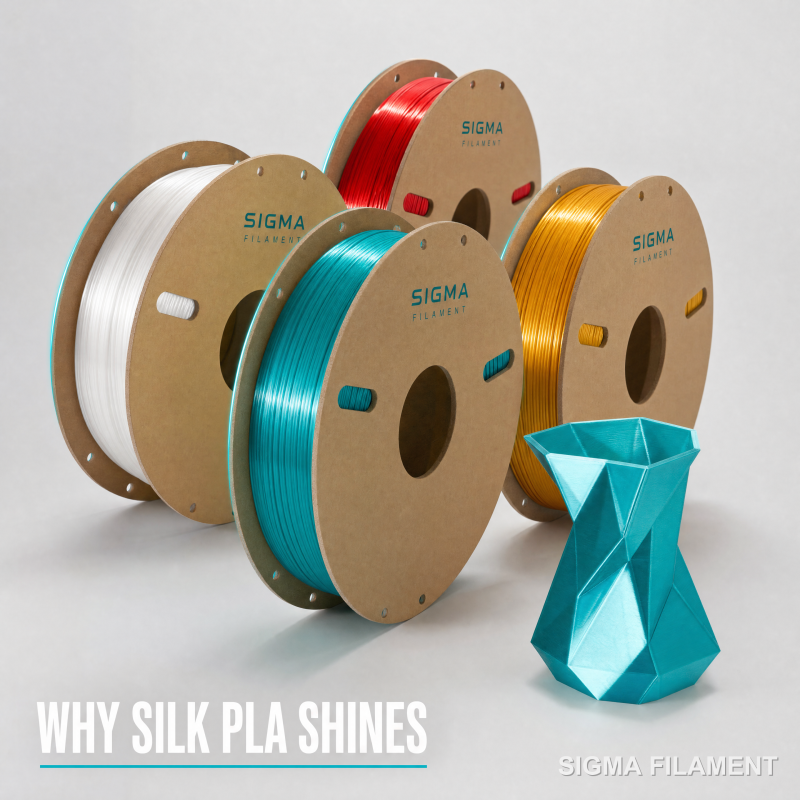
If matte filaments speak a language of professional utility, silk and metallic filaments sing a song of luxury, value, and aesthetic delight. These materials are designed not to hide the printing process, but to celebrate the object itself, transforming simple geometries into eye-catching pieces of art. Their magic lies in their sophisticated interaction with light, creating a deep luster and sheen that standard glossy filaments cannot replicate. For creators, resellers, and brands looking to produce items with high perceived value, silk and metallic filament colors are an essential part of the toolkit.
How Silk Filaments Achieve Their Luster
The term “silk” in the context of filament is a bit of a misnomer; there is no actual silk involved. The name refers to the final appearance of the print, which has a lustrous, semi-gloss sheen reminiscent of silk fabric. This effect is achieved through the careful formulation of a polymer composite, typically based on PLA but sometimes PETG.
The key ingredient is a specific type of additive known as an elastomeric copolymer. A common choice is a thermoplastic copolyester (TPC) or a similar flexible polymer. Unlike the solid particles in matte filament, these elastomeric additives form distinct, microscopic layers or domains within the primary PLA matrix. When the filament is printed, the stresses and flow patterns during extrusion and cooling cause these different polymer domains to align.
This alignment creates a surface that manipulates light in a unique way. Instead of just reflecting light from the very top surface like a standard gloss filament, the semi-translucent nature of the polymer blend allows light to penetrate slightly, reflect off the aligned internal structures, and then exit. This subsurface scattering, combined with the smooth outer surface, creates a deep, pearlescent luster. It is an effect that is highly dependent on the viewing angle and the curvature of the object’s surface, which is why silk filaments are particularly stunning on models with smooth, flowing curves, like vases or organic sculptures.
The Perceived Value of Metallic Finishes
Metallic filaments, such as those mimicking gold, silver, copper, and bronze, operate on a similar principle but with a different additive. Instead of a polymer blend, these filaments are loaded with extremely fine, reflective metallic flakes, often aluminum powder for silver or a brass/bronze powder for gold/bronze effects.
These tiny flakes act like microscopic mirrors suspended within the polymer. As the filament is extruded, the flakes tend to align with the flow of the plastic, creating a surface that sparkles and glints as the viewing angle changes. The psychological effect is immediate and powerful. Humans have associated shiny metals with wealth and value for millennia. An object printed in a convincing silk gold filament is perceived as being more valuable, more special, and more of a “finished product” than the exact same object printed in a standard yellow PLA (J. Schifferstein & Hekkert, 2008).
This makes metallic and silk filament colors a strategic choice for businesses selling 3D printed goods on platforms like Etsy or at local markets. A simple decorative planter printed in matte gray might sell for a modest price, but the same planter printed in a shimmering silk copper filament can command a significant premium, far outweighing the slight additional cost of the specialty filament.
Mastering the Art of Printing Silk PLA
The additives that give silk filaments their beautiful appearance also alter their mechanical properties and printing behavior. The elastomeric components that create the sheen also tend to make the filament weaker and more brittle than standard PLA. Layer adhesion can be a significant challenge with silk filaments. Because the different polymers in the blend may not bond as aggressively as a pure PLA, prints can sometimes delaminate or split along layer lines, especially if not printed correctly.
To counteract this, several adjustments are typically necessary:
- Higher Temperature: Printing silk PLA at the higher end of its recommended temperature range (often 215-230°C) is crucial. This ensures the polymer is fully molten and promotes better bonding between layers.
- Slower Speeds: High printing speeds can introduce stress and prevent the layers from having enough time to fuse properly. Reducing print speeds, especially for outer walls, to the 30-50 mm/s range can dramatically improve layer adhesion and surface finish.
- Increased Flow/Extrusion Multiplier: Slightly over-extruding, by increasing the flow rate in the slicer to 102-105%, can help force more material into the layer interface, physically improving the bond.
- Cooling Adjustments: While PLA generally loves cooling, excessive part cooling with silk filaments can sometimes be detrimental to layer adhesion. If prints are splitting, reducing the part cooling fan speed to 50-70% can keep the layers warmer for longer, allowing for a stronger weld.
Mastering silk filament is a rite of passage for many 3D printing enthusiasts. It requires a more patient and methodical approach to calibration, but the reward is the ability to create objects that possess a beauty and value that transcends the raw plastic from which they are made.
| Property | Standard PLA | Silk PLA | Impact on Printing |
|---|---|---|---|
| Composition | Pure Polylactic Acid + Pigment | PLA + Elastomer Additive (e.g., TPC) | Additive changes melting and flow behavior. |
| Surface Finish | Matte to Glossy | High Sheen, Lustrous, Pearlescent | Finish is sensitive to temperature and speed. |
| Layer Adhesion | Generally Excellent | Fair to Poor (without tuning) | Requires higher temps and slower speeds to prevent splitting. |
| Strength/Toughness | Good | Lower (More Brittle) | Not recommended for functional, load-bearing parts. |
| Optimal Temp. | 190–220°C | 215–230°C | Higher heat is needed for proper polymer fusion. |
| Optimal Speed | 40–100 mm/s | 30–50 mm/s | Slower speeds reduce stress and improve layer bonding. |
3. The Viral Sensation: Dual and Tri-Color Filaments
In the ever-evolving landscape of 3D printing, few innovations have captured the collective imagination quite like dual and tri-color filaments. These materials, which produce a dynamic, color-shifting effect as the object is viewed from different angles, have exploded in popularity on social media platforms and in online marketplaces. They represent a paradigm shift in how we think about filament colors, moving from static, uniform hues to dynamic, orientation-dependent gradients. They allow for the creation of truly unique, one-of-a-kind objects where the final appearance is an emergent property of the model’s geometry and its orientation on the print bed.
The Mechanics of Multi-Extrusion in a Single Filament
How is it possible to have two or three distinct colors within a single 1.75mm strand of filament? The manufacturing process is a marvel of co-extrusion technology. Instead of a single extruder feeding molten plastic into a die, two or three separate extruders, each loaded with a different colored polymer, feed into a specially designed nozzle. This nozzle carefully combines the separate molten streams just before they are cooled and solidified into the final filament strand.
The key is that the colors are not mixed or blended into a new, uniform color. Instead, they are fused side-by-side, maintaining their distinct boundaries along the length of the filament. A dual-color filament, for example, will have a cross-section that is half one color (e.g., blue) and half another (e.g., red). A tri-color filament will have a cross-section divided into three distinct color wedges.
When this filament is printed, the color that is deposited on the outer wall of the print depends entirely on the orientation of the filament as it enters the hotend and exits the nozzle. As the print head moves around a curve, the filament naturally twists slightly, causing the boundary between the colors to transition across the surface of the print. This creates a smooth, mesmerizing gradient effect. A straight wall will show one color on one side and the other color on the opposite side, with a sharp transition line where they meet.
Designing for Orientation-Dependent Color
This unique property opens up a new dimension of design thinking for 3D printing. The designer is no longer just sculpting a form; they are choreographing a color-changing performance. The final look of the print is not determined in the slicer’s color settings, but by the physical interaction between the filament and the model’s geometry.
- Curved vs. Flat Surfaces: Models with many smooth, organic curves, like dragons, vases, or articulated figures, are ideal for showcasing dual and tri-color filaments. The constantly changing surface normal causes the color transitions to sweep across the model, creating a vibrant, iridescent effect. Flat, geometric models will show more distinct blocks of color, which can also be used for dramatic effect.
- Print Orientation: The orientation of the model on the build plate becomes a critical artistic choice. Rotating the model by just a few degrees can completely change where the color transitions occur. An astute creator will experiment with different orientations in the slicer preview to “paint” the color gradients onto their model in the most aesthetically pleasing way.
- Infill and Perimeters: An interesting technique is to use a low infill percentage (e.g., 10%) and a higher number of perimeters (e.g., 4-5). This ensures that the walls of the print are made almost entirely of the color-shifting filament, maximizing the visual impact. Using a decorative infill pattern like “gyroid” can also create stunning internal color patterns if the model is semi-translucent.
Technical Challenges and Solutions
The co-extrusion process and the use of silk-like additives (most multi-color filaments are also silk filaments to enhance the visual effect) introduce some specific printing challenges.
- Color Consistency: The exact position of the color boundaries can vary slightly along the length of a spool and between different manufacturing batches. This is part of what makes each print unique, but it can be a challenge for production environments. Sourcing from a high-quality manufacturer like those offering comprehensive material portfolio that uses precise co-extrusion technology is vital for minimizing this variability.
- Nozzle Clogs: The interface where the different colored polymers are joined can be a point of potential weakness or slight dimensional inconsistency. While rare with quality filament, it can increase the risk of nozzle clogs compared to a standard monofilament. Printing at a slightly higher temperature can help ensure everything flows smoothly.
- Layer Adhesion: As with silk filaments, the additives used in multi-color filaments can compromise layer adhesion. The same solutions apply: print hotter, print slower, and consider reducing part cooling to achieve strong, reliable prints.
Dual and tri-color filaments challenge our assumptions about what a single spool of material can do. They invite a level of experimentation and playfulness into the printing process, turning every print into a small discovery.
4. The Mark of a Tool: Functional Engineering Grays and Carbon Black
In stark contrast to the expressive vibrancy of multi-color filaments, there exists a family of filament colors whose aesthetic is defined by its very lack of expression: the functional grays and carbon blacks. These are the colors of utility, performance, and engineering. When we see an object printed in a neutral, industrial gray or a deep, matte carbon black, our perception shifts. We are no longer evaluating it as a decorative piece, but as a tool, a functional component, a piece of machinery designed for a purpose. This association is not accidental; it is rooted in the history of industrial manufacturing and the material science of high-performance polymers.
Why Gray Signifies Functionality
The prevalence of gray in industrial design is a matter of practicality. Gray is a neutral color that does not distract. It is visually stable and does not show dirt or minor scuffs as readily as pure white or black. For decades, machine casings, electronic enclosures, and workshop tools have been produced in various shades of gray. This has created a powerful cultural association: gray is the color of things that do work, rather than things that are meant to be looked at.
In 3D printing, this translates to the use of gray PLA, PETG, and ABS for printing functional parts. When a design engineer prints a jig for a drill press, a fixture for an assembly line, or a new enclosure for a Raspberry Pi project, they will almost invariably reach for a spool of gray filament.
The choice is partly practical. Gray filament is often among the least expensive, as the gray pigment is cheap and abundant. It also photographs well, showing surface details and shadows clearly without the harsh reflections of white or the detail-absorbing nature of black. But the choice is also psychological. Printing a functional part in gray lends it an air of seriousness and purpose. It signals that this object is a tool, not a toy. This can be surprisingly important in a professional setting when presenting a custom-designed solution to a client or a manager.
Carbon Fiber’s Aesthetic of Strength
The aesthetic of functionality reaches its apex with carbon fiber-reinforced filaments. These materials, which are typically a deep matte black or dark gray, are composite filaments that contain small, chopped carbon fibers mixed into a base polymer like PLA, PETG, or Nylon (PA). The primary purpose of these fibers is to dramatically increase the stiffness and dimensional stability of the printed part.
However, the carbon fibers also create a unique and highly desirable aesthetic. The small fibers give the surface of the print a distinctive matte, slightly textured finish that is instantly recognizable. This “carbon fiber look” is synonymous with high performance, lightweight strength, and advanced technology, thanks to its use in aerospace, Formula 1 racing, and high-end sporting goods.
When you print a part in a carbon fiber-reinforced filament (often abbreviated as PLA-CF or PETG-CF), you are not just getting superior mechanical properties; you are also getting an aesthetic that communicates those properties. A drone arm printed in PETG-CF looks stronger and more advanced than one printed in standard black PETG, even before any physical testing is done. This makes carbon fiber filaments an excellent choice for end-use parts, high-performance prototypes, and any application where communicating strength and technical prowess is part of the design intent.
Material Properties Beyond Color
It is critical to remember that with these functional filament colors, the material itself is as important as the color.
- PETG (Gray): Polyethylene Terephthalate Glycol is a workhorse material for functional prints. It offers better temperature resistance and impact strength than PLA, along with good chemical resistance. A spool of gray PETG is arguably one of the most versatile materials a hobbyist or professional can have in their collection.
- ABS/ASA (Gray/Black): Acrylonitrile Butadiene Styrene (ABS) and Acrylonitrile Styrene Acrylate (ASA) offer even higher temperature resistance (up to ~100°C), making them suitable for parts used in hot environments, like inside a car on a summer day. ASA has the added benefit of being UV-resistant, making it the ideal choice for functional parts intended for outdoor use.
- Nylon-CF (Carbon Black): Nylon (Polyamide) reinforced with carbon fiber is at the top end of consumer-grade FDM printing. It combines the toughness and wear resistance of nylon with the extreme stiffness of carbon fiber, creating parts that can often replace machined aluminum in jigs, fixtures, and some end-use applications.
Printing these materials often requires more advanced hardware and knowledge. PETG can be stringy if not dried properly. ABS and ASA require a heated build chamber to prevent warping and splitting. Carbon fiber filaments are abrasive and mandate the use of a hardened steel nozzle. Yet, for those willing to master them, these functional filament colors provide the ability to move beyond simple prototyping and into the realm of true desktop manufacturing.
5. The Pursuit of Clarity: Transparent and Translucent Colors
In a process defined by building solid objects layer by layer, the ability to print something clear, to create an object that transmits light, feels almost like magic. Transparent and translucent filament colors open up a unique set of possibilities, from creating beautiful, glass-like artistic pieces to building functional components like light pipes, fluidic channels, and see-through enclosures. The pursuit of optical clarity in FDM printing is a challenging but rewarding endeavor that pushes the boundaries of the technology and requires a deep understanding of both material science and the printing process itself.
The Physics of Light Transmission in Polymers
Why is it so difficult to 3D print a truly transparent object? The answer lies in the physics of light. For an object to be transparent, light must be able to pass through it without being significantly scattered or absorbed. This requires two conditions: the material itself must be amorphous and inherently clear, and the object must have perfectly smooth surfaces and no internal voids.
Most pure polymers, like PLA and PETG, are naturally amorphous and colorless in their raw state (before pigments are added). They have the potential to be transparent. However, the FDM process itself works against clarity.
- Layer Lines: The microscopic ridges and valleys of the layer lines act as prisms, scattering light in all directions.
- Internal Voids: Tiny air gaps between extruded lines, both within a layer and between layers, create interfaces between plastic and air. Each time light crosses one of these interfaces, it bends and scatters, reducing clarity.
- Crystallization: If the polymer is cooled too slowly or held at a certain temperature, parts of it can crystallize. These crystalline regions are denser and have a different refractive index than the amorphous regions, causing them to scatter light and make the plastic appear hazy or opaque.
The challenge of printing a clear object, therefore, is a challenge of minimizing these three sources of light scattering.
Achieving Glass-Like Prints with PETG
While several materials are available in “natural” or transparent versions, PETG (Polyethylene Terephthalate Glycol) has emerged as the king of clarity in desktop 3D printing. Its chemical nature makes it less prone to crystallization than PLA during printing, and its excellent layer adhesion helps to minimize internal voids. However, simply loading a spool of transparent PETG and hitting “print” will likely result in a milky, translucent object, not a clear one. Achieving true, glass-like clarity requires a specific and often counter-intuitive set of slicer settings.
- Print Hot and Slow: A higher extrusion temperature (e.g., 240-260°C for PETG) makes the plastic less viscous, allowing it to flow better and fill in any gaps between extrusion lines. A slower print speed gives the layers more time to fuse together completely.
- Over-Extrude: Increasing the extrusion multiplier or flow rate to 105-115% is one of the most critical steps. This intentional over-extrusion forces the molten plastic to squeeze into every possible air gap, eliminating the internal voids that are a primary cause of light scattering.
- Wide Extrusion Width: Setting the extrusion width to be significantly larger than the nozzle diameter (e.g., 0.6mm extrusion width with a 0.4mm nozzle) forces the extruded lines to overlap substantially, further reducing the chance of gaps.
- 100% Infill: For a solid, clear object, 100% infill is a must. A rectilinear or concentric infill pattern is often best, as it creates a more ordered internal structure than patterns like gyroid or cubic.
- No Part Cooling Fan: This is the most counter-intuitive step for those used to printing PLA. Turning the part cooling fan completely off allows the layers to stay hot for as long as possible, promoting a perfect, seamless bond between them. This helps to eliminate the layer boundary as a source of light scattering. The trade-off is that this technique is only suitable for models without significant overhangs or bridges, which would droop without cooling.
When these settings are dialed in correctly, the results can be astonishing. A print made with transparent PETG can achieve a level of clarity that rivals injection-molded or cast parts.
Applications for Transparent Filaments
The ability to print clear objects is more than just a novelty.
- Art and Design: Artists and designers use transparent filament colors to create stunning lithophanes, vases that play with light and shadow, and sculptures with internal features.
- Lighting: Transparent PETG is perfect for creating custom light diffusers, lampshades, and light pipes for electronics projects. Translucent colors can be used to create colored lenses or mood lighting fixtures.
- Prototyping: Engineers can use transparent filaments to create see-through enclosures for electronics to check clearances, or to build models of fluidic systems to visualize flow.
- Scientific Research: Labs use transparent prints to create custom cuvettes, microfluidic chips, and other bespoke research apparatus at a fraction of the cost of traditional glass or acrylic fabrication.
Transparent and translucent filament colors challenge us to think about not just the outer surface of our prints, but the volume within them, and to control the path of light itself through the objects we create.
6. The Organic Connection: Earthy, Wood, and Stone Effects
While much of the innovation in filament colors focuses on creating futuristic, high-tech aesthetics, a parallel trend seeks to do the exact opposite: to make 3D printed objects feel more natural, organic, and grounded. Wood-fill, marble-effect, and other stone-like filaments are part of a growing movement in design known as biophilia—the idea that humans have an innate tendency to seek connections with nature. These filaments allow creators to produce objects that blend the precision of digital fabrication with the warmth and texture of natural materials.
Creating Natural Textures with Polymer Composites
Like matte and carbon fiber filaments, these “natural effect” materials are composites. They consist of a base polymer, usually PLA, mixed with a high percentage of fine, solid particles of another material.
- Wood-Fill Filaments: These contain a significant amount of finely pulverized wood dust or cork powder (often 20-40% by weight). This gives the final print a look, feel, and even a slight smell reminiscent of actual wood or MDF. The printed parts are often lighter than solid PLA and have a slightly fibrous, matte texture. A key advantage of wood-fill filaments is that the printed parts can be treated like wood: they can be sanded, stained, and even varnished to achieve a remarkably convincing finish.
- Marble and Stone-Effect Filaments: These filaments aim to replicate the look of polished stone. Marble-effect filaments are typically a white or off-white PLA base with dark-colored specks or swirls mixed in to mimic the veining of real marble. Other stone-effect filaments, like those labeled “concrete” or “granite,” use a gray or black base with different colored specks to create a textured, mineral-like appearance. Unlike wood-fill, the goal here is usually a smooth, polished look, so post-processing like sanding is less common. The visual effect comes entirely from the distribution of the particulate within the filament.
The Appeal of Biophilic Design in 3D Prints
Why go to the trouble of mimicking natural materials with plastic? The appeal is deeply psychological. In a world increasingly dominated by screens and synthetic surfaces, objects that connect us to the natural world have a calming and grounding effect (Browning et al., 2014). A planter printed in a terracotta-colored filament feels more appropriate for housing a living plant than one made of glossy blue plastic. An architectural model printed with a wood-fill filament has a warmth and tactile quality that a plain white PLA model lacks.
These filaments allow 3D printing to break out of the “plastic-looking” box. They enable the creation of home decor, jewelry, and consumer products that fit seamlessly into lifestyles that value natural aesthetics. For sellers of 3D printed goods, offering products in these natural-effect filament colors can open up entirely new markets that might otherwise be uninterested in 3D printed items.
Printing with Particle-Filled Filaments
The high percentage of solid particles in these filaments presents some significant printing challenges. In fact, they are among the most demanding filaments to print with correctly.
- Extreme Abrasiveness: Wood fibers and mineral particles are highly abrasive. Printing with these filaments will destroy a standard brass nozzle in a matter of hours, or even on a single large print. A hardened steel nozzle is not just recommended; it is absolutely mandatory. A nozzle diameter of 0.5mm or 0.6mm is also highly recommended over the standard 0.4mm. The larger opening is much less likely to clog.
- High Risk of Clogging: The solid particles can easily clump together and cause a clog, especially in the tight confines of a standard 0.4mm nozzle. Printing hotter than usual can help the polymer flow more easily around the particles. It is also crucial to ensure there are no restrictions in the filament path, and that retraction settings are minimized, as frequent retractions can cause particles to accumulate in the cold zone of the hotend.
- Brittleness: The high particle content disrupts the polymer matrix, making these filaments extremely brittle. The raw filament must be handled with care to avoid snapping, and a filament guide tube is often necessary to ensure a smooth path from the spool to the extruder. The final printed parts are also more brittle and have much lower layer adhesion and strength than standard PLA. They are suitable for decorative purposes only and should never be used for functional or load-bearing parts.
Despite these challenges, wood and stone filaments offer a unique artistic palette. They allow a creator to fuse the digital and the natural, producing objects that are both precisely manufactured and organically beautiful.
7. The Call to Attention: High-Visibility and Luminescent Colors
The final category of filament colors in our exploration is defined by its active relationship with light. High-visibility fluorescent and phosphorescent (glow-in-the-dark) filaments are designed to grab attention, either by converting invisible UV light into visible color or by storing light energy and releasing it in the dark. These are not passive colors; they are active participants in their environment. Their applications range from critical safety equipment and functional workshop tools to fun and enchanting toys and decorations.
The Science of Fluorescence and Phosphorescence
Both fluorescence and phosphorescence are forms of luminescence, where a substance emits light without being heated. The difference lies in the timing.
- Fluorescence: Fluorescent materials absorb high-energy light (like the ultraviolet component of sunlight or the light from a blacklight) and almost instantly re-emit it at a lower-energy, longer wavelength, which we perceive as intensely bright color. This is why fluorescent yellow, green, orange, and pink appear to “pop” or glow, especially in daylight. They are literally converting invisible light into more visible light. The effect stops the moment the light source is removed.
- Phosphorescence: Phosphorescent materials, used in glow-in-the-dark filaments, also absorb light energy. However, due to the quantum mechanical properties of their “phosphor” additives (often strontium aluminate), they release this energy very slowly, over a period of minutes or even hours. This is why a glow-in-the-dark object needs to be “charged” with a bright light source and will then continue to glow after the light is turned off.
These luminescent pigments are mixed into a polymer base, typically PLA or PETG, to create the specialty filament.
Functional Uses in Safety and Prototyping
While often associated with toys, these filament colors serve important functional roles.
- Safety Equipment: Fluorescent orange or yellow is ideal for printing safety guards for machinery, warning signs, or protective equipment. Their high visibility makes them impossible to ignore, even in peripheral vision, enhancing workshop safety.
- Jigs and Fixtures: In a cluttered workshop, finding the small jig or tool you just set down can be a frustrating waste of time. Printing these items in a bright, fluorescent color makes them easy to spot at a glance.
- Calibration Tools: Printing calibration objects, like a temperature tower or a bed-leveling test, in a fluorescent color can make it easier to see fine details and imperfections under normal lighting.
- Emergency Signage: Glow-in-the-dark filament is perfect for printing signs that need to be visible during a power outage, such as exit signs or markers for a first-aid kit.
Considerations for Durability and Performance
The additives that create these glowing effects can impact the filament’s properties.
- Abrasiveness: The phosphorescent pigments (strontium aluminate) used in glow-in-the-dark filaments are extremely hard and abrasive, even more so than wood or carbon fiber. A hardened steel nozzle is an absolute requirement for printing glow-in-the-dark filament; a brass nozzle can be ruined by a single small print. Fluorescent pigments are generally not abrasive.
- UV Degradation: Fluorescent pigments, while brilliant, can be susceptible to fading over time with prolonged exposure to direct sunlight. The UV radiation that makes them glow also slowly breaks down the pigment molecules. They are best suited for indoor or short-term outdoor use.
- Glow Performance: The brightness and duration of the glow from a phosphorescent filament depend on the type and concentration of the phosphor. High-quality filaments will use a modern strontium aluminate phosphor, which glows brighter and much longer than the older, cheaper zinc sulfide. Printing with thicker walls and higher infill can also increase the glow, as it creates a larger volume of the active material.
High-visibility and luminescent filament colors remind us that 3D printing is not just about creating static objects, but about creating objects that interact with their environment and with our own sensory perception in dynamic and often surprising ways.
The Manufacturing Backbone: Achieving Color Consistency at Scale
For a hobbyist printing a single object, a slight variation in filament color from one spool to the next may be a minor annoyance. For a print farm producing hundreds of identical products, a reseller stocking a retail line, or an OEM brand building a reputation, color inconsistency is a critical failure. A customer who buys a set of four matching coasters expects them to be identical, not three shades of blue and one slightly different one. Achieving reliable, batch-to-batch color consistency is one of the most significant challenges in filament manufacturing and a key differentiator for high-quality suppliers.
The Role of Pigments and Masterbatches
Filament does not start out colored. The base polymer, such as NatureWorks Ingeo PLA, arrives at the factory as small, translucent pellets. The color is introduced through the addition of a “masterbatch.” A masterbatch is a concentrated mixture of pigments or additives encapsulated during a heating process into a carrier resin.
Instead of trying to mix fine, dusty pigments directly with the raw polymer pellets (a process that is messy and can lead to inconsistent mixing), the filament manufacturer uses a precision dosing system to mix a specific, calculated ratio of the colored masterbatch pellets with the natural polymer pellets just before they enter the extruder.
The quality of the final filament color depends on several factors:
- Pigment Quality: High-quality pigments are more vibrant, more resistant to fading, and more stable at extrusion temperatures. Cheap pigments can degrade or change color when heated in the extruder.
- Masterbatch Quality: The pigments must be perfectly and evenly dispersed within the masterbatch carrier resin. Any clumps or “hot spots” in the masterbatch will lead to streaks or color variations in the final filament.
- Dosing Precision: The equipment used to mix the masterbatch and the base polymer must be extremely precise. Even a tiny variation in the dosing ratio can cause a noticeable shift in the final color.
Quality Control for Color Accuracy
Reputable filament manufacturers employ rigorous quality control procedures to ensure color consistency. This goes far beyond simply looking at the filament and judging by eye.
- Spectrophotometry: The gold standard for color measurement is a device called a spectrophotometer. This instrument measures the exact wavelength of light reflected from a sample and provides a set of numerical data (often in the CIELAB color space) that precisely defines the color.
- Delta E (ΔE) Value: When a new batch of filament is produced, a sample is measured with the spectrophotometer, and its color data is compared to the master standard for that specific color. The difference between the two is calculated as a single number called Delta E. A Delta E of less than 1.0 is generally considered to be imperceptible to the human eye. Manufacturers serving professional clients will often guarantee a specific maximum Delta E value for their products, ensuring that a spool of “Signal Gray” purchased in January is identical to one purchased in June.
- Batch Traceability: Every spool should be marked with a batch or lot number. This allows the manufacturer (and the customer) to trace that specific spool back to the exact production run, date, and set of quality control measurements. If an issue arises, it can be isolated to a specific batch.
For any business that relies on 3D printing at scale, choosing a supplier is about more than just price or the range of their comprehensive material portfolio. It is about choosing a partner in manufacturing who can guarantee the consistency and quality necessary to build a brand and satisfy customers. In the world of filament colors, consistency is quality.
Frequently Asked Questions (FAQ)
What is the best filament color for printing miniatures or models with very fine details?
For showcasing fine details, a neutral matte gray is often the best choice. It provides excellent contrast for viewing surface texture without the distracting reflections of a glossy filament or the detail-absorbing properties of matte black. It acts much like a “primer coat,” making it easy for the eye to see every small detail.
Do different filament colors of the same material require different print settings?
Yes, sometimes they do. The pigments and additives used to create different colors can slightly alter the polymer’s melting point and flow characteristics. For instance, heavily pigmented colors like black or white may require slightly higher temperatures (5-10°C) than a “natural” or unpigmented version of the same material to print optimally. Specialty filaments like silk, matte, or glow-in-the-dark almost always require unique settings.
How can I make my transparent PETG prints clearer?
To maximize clarity with transparent PETG, you need to minimize light scattering. The key is to print hot (240-260°C), slow, and with intentional over-extrusion (105-115% flow) to eliminate internal air gaps. Using a wide extrusion width and 100% infill also helps. Critically, you should turn the part cooling fan completely off to allow layers to melt together seamlessly.
Why is my silk PLA print so brittle and splitting between layers?
This is a common issue with silk filaments. The elastomeric additives that create the sheen also weaken layer adhesion. To fix this, you must improve the bond between layers. The most effective solutions are to increase your printing temperature to the upper end of the recommended range and to reduce your printing speed significantly (e.g., to 30-50 mm/s).
Are wood-fill and carbon fiber filaments safe for my printer’s standard nozzle?
No, they are not. Both wood-fill and carbon fiber filaments (along with glow-in-the-dark) are highly abrasive. The solid particles within them will quickly wear down a standard brass nozzle, ruining its dimensional accuracy. You must use a hardened steel, nozzle X, or other abrasion-resistant nozzle when printing with these materials. It is also recommended to use a larger nozzle diameter (0.5mm or 0.6mm) to reduce the risk of clogging.
How do manufacturers ensure that “Navy Blue” is the same color from one batch to the next?
High-quality manufacturers use a process of instrumental color measurement. They use a device called a spectrophotometer to measure the exact color of a sample against a master standard. The difference is calculated as a “Delta E” value. By keeping this value below a very small threshold, they can guarantee that the color is consistent and perceptually identical from batch to batch.
Can I paint my 3D prints? What is the best filament color to use for painting?
Yes, you can absolutely paint 3D prints to achieve any desired color or finish. The best base filament color for painting is typically a neutral gray or white. Gray is often preferred as it makes it easier to see the coverage of both light and dark paint colors. Using a matte finish filament can also provide a slightly rougher surface that acts like a primer, helping the paint to adhere better.
Conclusion
The journey through the world of filament colors reveals a landscape far richer and more complex than a simple rainbow of options. We have seen that color and finish are not mere decoration; they are integral to an object’s function, its perceived value, and its ability to communicate. A matte black prototype speaks a language of utility and precision, while a silk gold vase whispers of luxury. A dual-color dragon delights with its magical, unrepeatable gradients, while a carbon fiber drone arm asserts its strength through its very appearance.
The choice of filament colors has become a sophisticated design discipline, one that requires an understanding of material science, a sensitivity to psychology, and a mastery of the printing process. The additives that create a matte finish or a silk sheen fundamentally change the polymer’s behavior, demanding a more nuanced approach to calibration. The particles that allow a print to look like wood or glow in the dark also require specific hardware and a tolerance for their demanding nature.
As designers, engineers, and creators in 2026, our ability to leverage this expansive palette is a powerful tool. It allows us to move beyond creating mere plastic objects and toward crafting experiences, solving problems, and telling stories. By understanding the language of filament colors, we can make deliberate, informed choices that elevate our work, whether it is a functional jig for a workshop, a beautiful piece of art for a home, or a new product for a global market. The spool of filament on our printer is not just a raw material; it is a medium of expression, waiting for us to give it form and purpose.
References
- Browning, W. D., Ryan, C. O., & Clancy, J. O. (2014). 14 Patterns of biophilic design. Terrapin Bright Green, LLC. https://www.terrapinbrightgreen.com/reports/14-patterns/
- Schifferstein, H. N. J., & Hekkert, P. (Eds.). (2008). Product experience. Elsevier. https://shop.elsevier.com/books/product-experience/schifferstein/978-0-08-045089-6
- Singh, S. (2006). Impact of color on marketing. Management Decision, 44(6), 783–789. https://doi.org/10.1108/00251740610673332
- SigmaFilament. (2026). Wholesale & bulk 3D printer filament. SigmaFilament. https://sigmafilament.com/wholesale-3d-printer-filament/
- SigmaFilament. (2026). About Sigma Filament | ISO certified 3D filament manufacturer. SigmaFilament. https://sigmafilament.com/about-company/
- SigmaFilament. (2026). Private label 3D filament manufacturer (OEM/ODM). SigmaFilament. https://sigmafilament.com/oem-odm-3d-printing-filament/
- SigmaFilament. (2026). Filament for 3D print farms | Bulk supply. SigmaFilament. https://sigmafilament.com/filament-for-3d-print-farms/
Last reviewed and updated: April 2026. Author: SigmaFilament Engineering Team. For custom filament solutions and wholesale inquiries, contact our team.