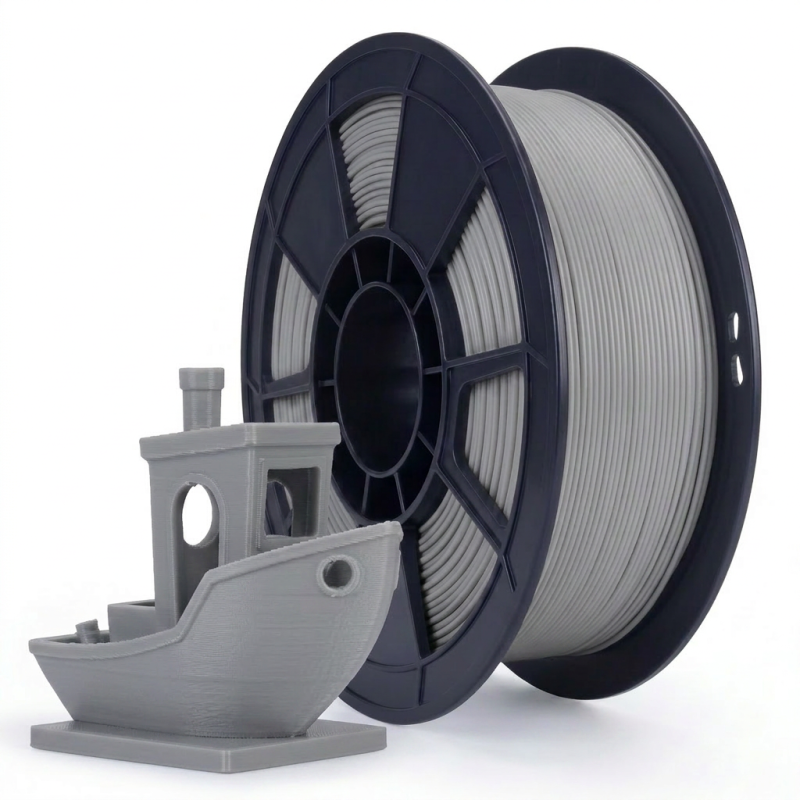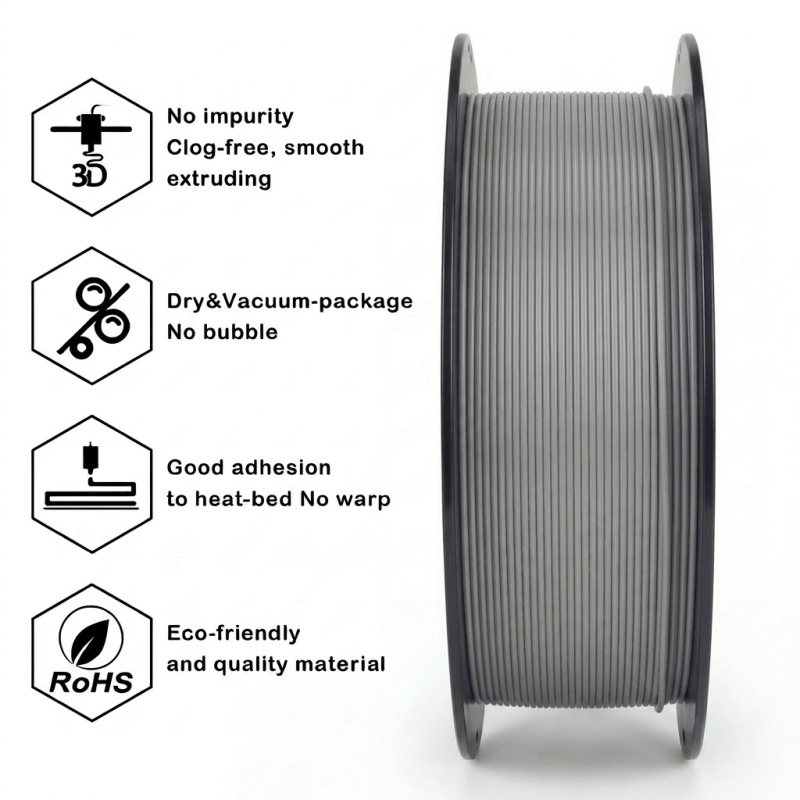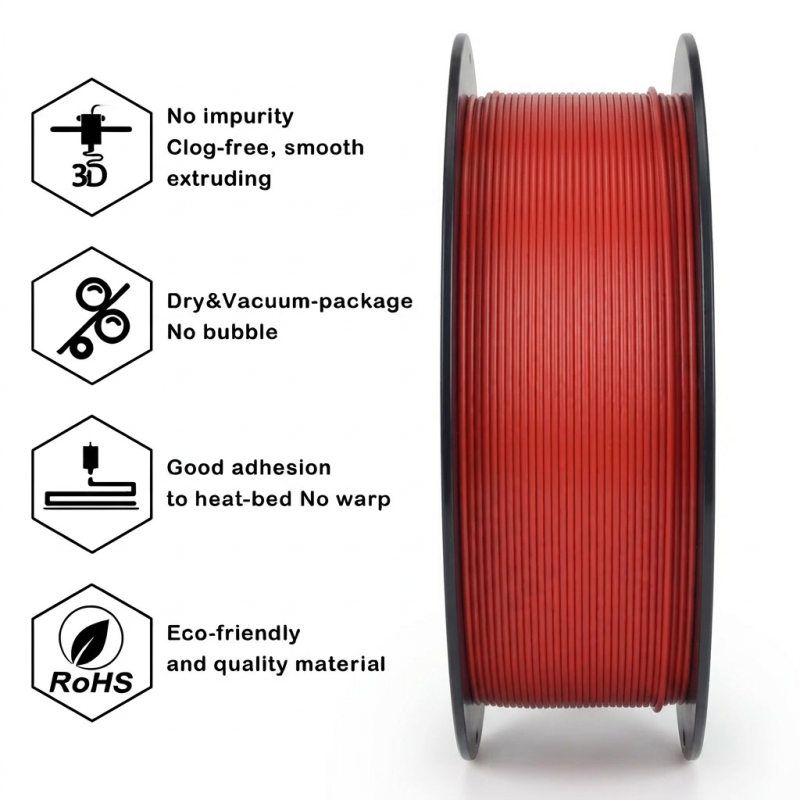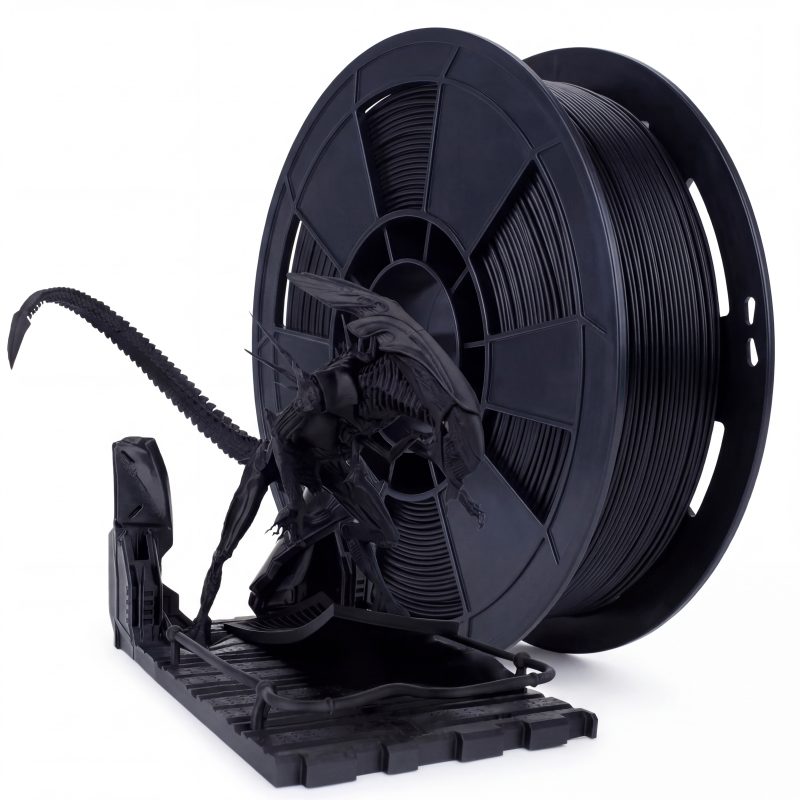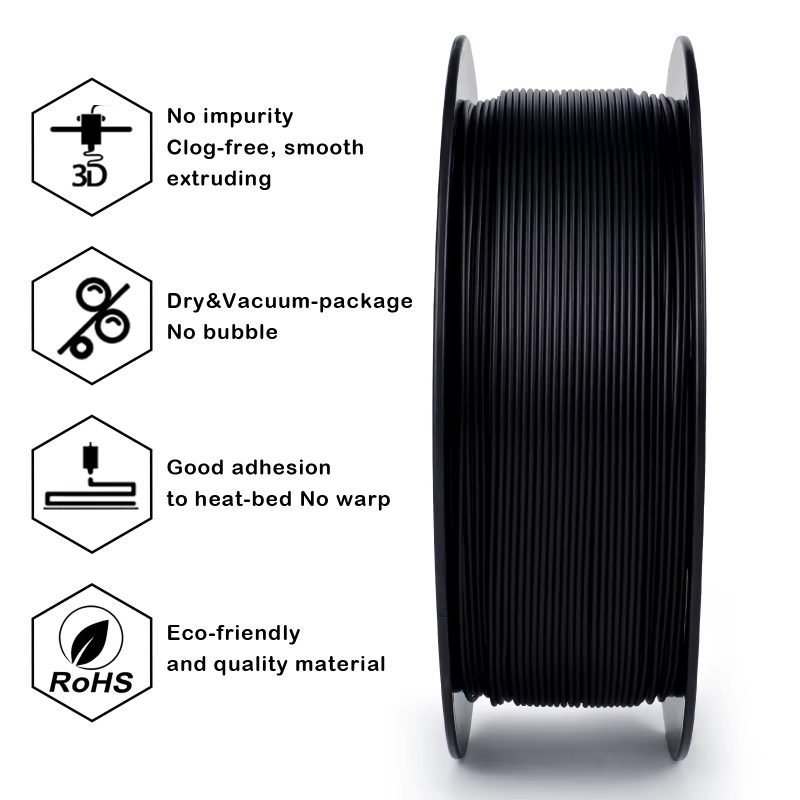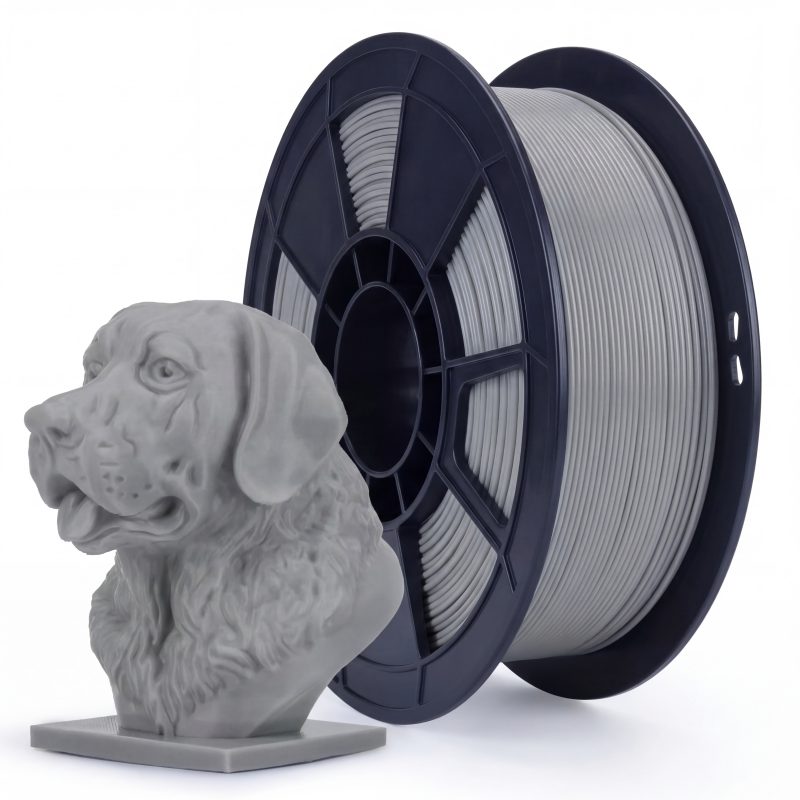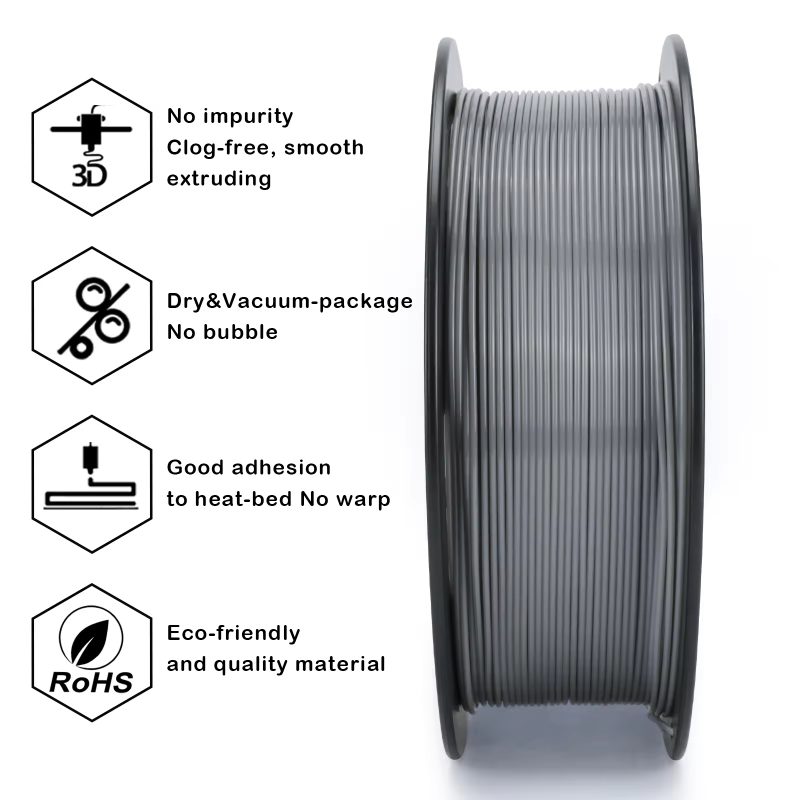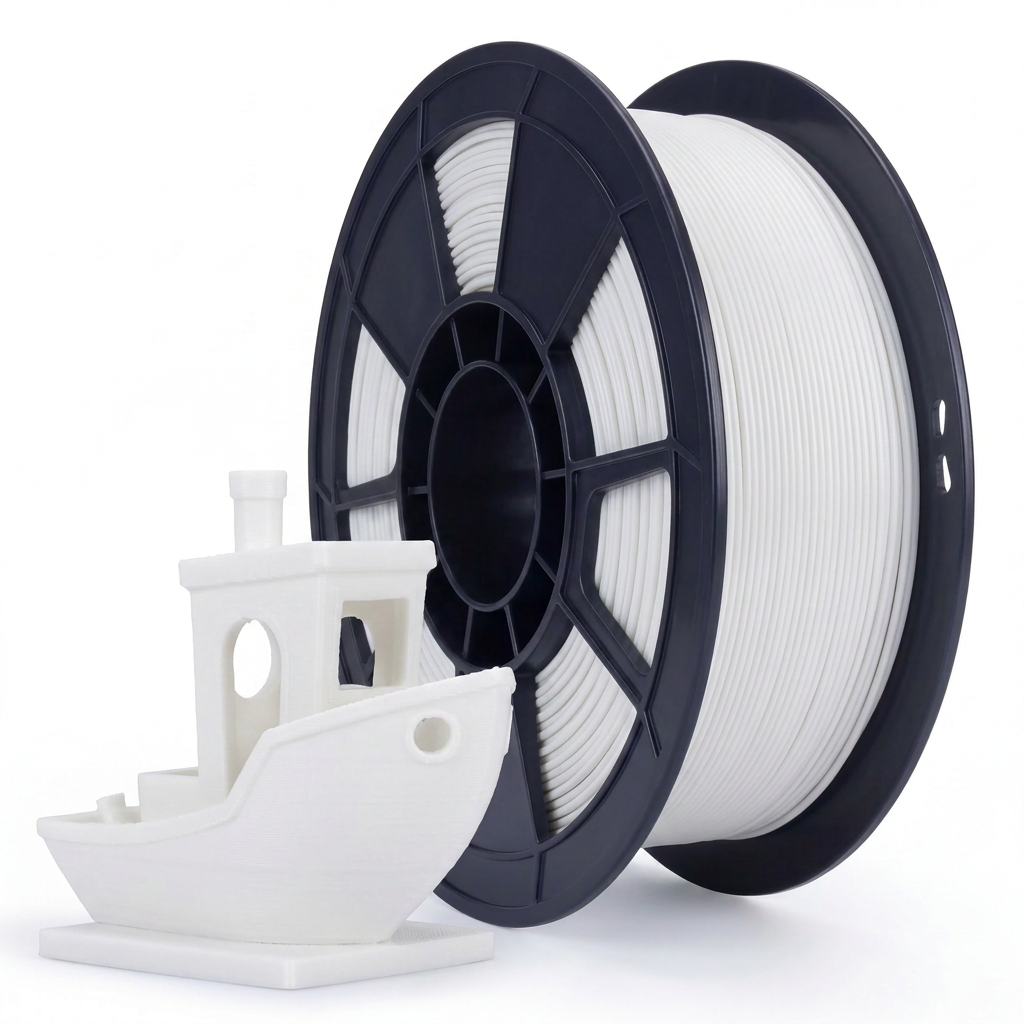
High Speed PLA Filament White – Product Overview
The SigmaFilament High Speed PLA Filament in White is engineered for one job: keeping a fleet of fast printers running at full throughput without babysitting. Modern CoreXY and Klipper-based machines can move at 300–600mm/s, but ordinary PLA becomes the bottleneck — the polymer simply cannot melt fast enough, and prints come out under-extruded, matte-streaked, or delaminated. This high speed PLA filament uses an optimized high-flow formulation with lower melt viscosity, so the material reaches full melt inside a standard hotend even at the volumetric flow rates fast printing demands, and re-solidifies quickly enough for clean bridging and sharp corners at speed.
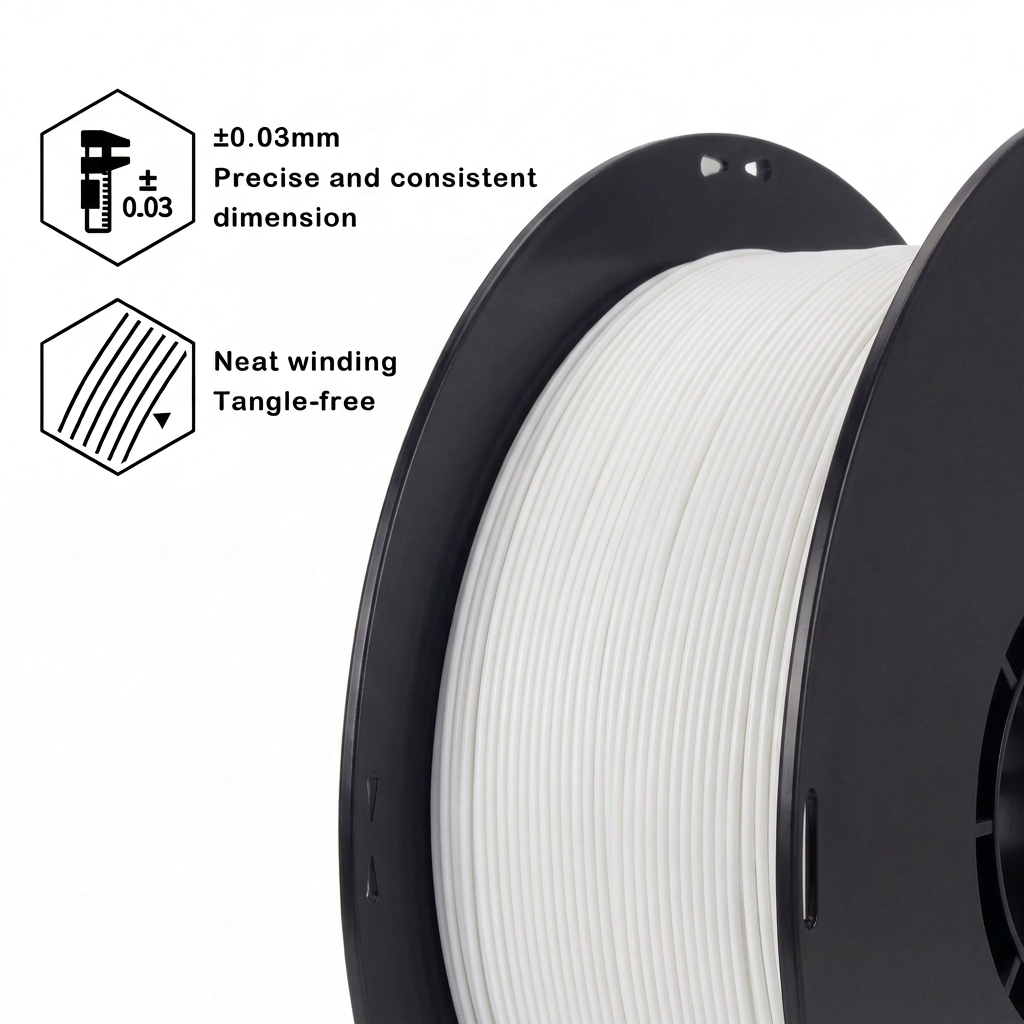
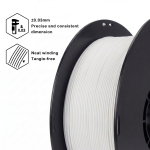
The colorway is deliberate. White is the default color of production: neutral prototype batches, presentation models that photograph cleanly, and paint-ready blanks for props, cosplay, and product mockups. Because print farms buy white by the carton rather than the spool, we hold batch whiteness consistency to strict internal color-control limits — pigment loading is verified per production batch, so the parts a farm ships in March match the parts it ships in June. Combined with a ±0.03mm diameter tolerance and neat, tangle-free winding, every spool behaves like the last one in the feeder, which is exactly what unattended overnight queues require.
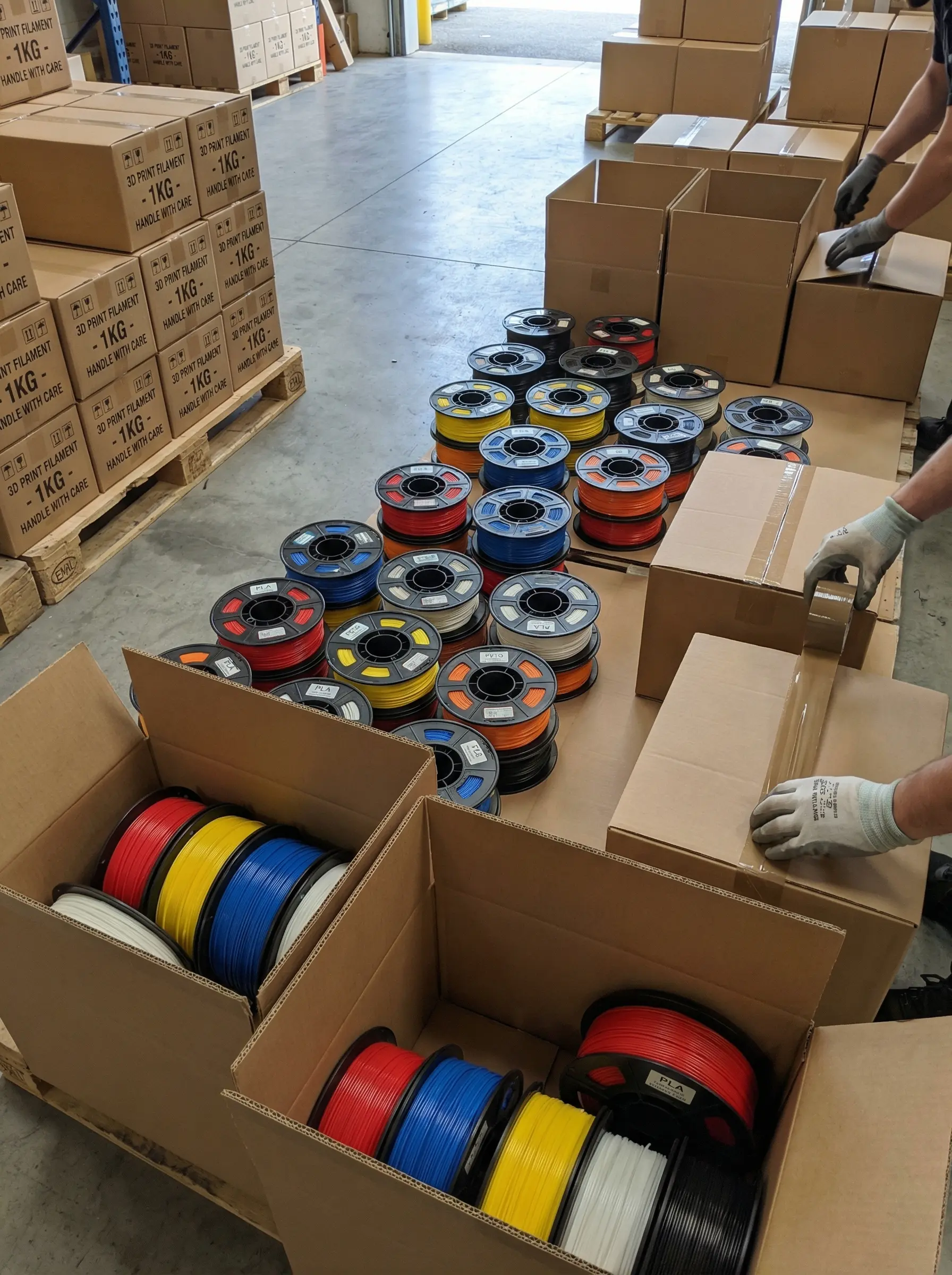
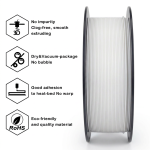
Underneath the speed story is a clean, plant-based PLA: biodegradable, low odor, RoHS and REACH compliant, and easy on standard 0.4mm brass nozzles. Each 1kg spool is vacuum sealed with desiccant and boxed individually. SigmaFilament manufactures in-house in Guangdong, China under ISO 9001 quality management, with free samples for qualified business customers, carton and pallet pricing for print farms, and full OEM/ODM services including private-label packaging and custom spool sizes.
Why This High Speed PLA Filament Stands Out
⚡ Built for Throughput — Not Just a Speed Number on the Box
Plenty of spools claim a big mm/s figure. What actually limits fast printing is volumetric flow: at 600mm/s with a 0.4mm nozzle and 0.2mm layers, a printer needs roughly 48mm³/s of molten plastic, far beyond what standard PLA formulations melt cleanly. This high speed PLA filament is compounded specifically to close that gap.
- High-Flow Melt Behavior — Lower melt viscosity lets the polymer reach full melt in the short residence time of a fast-moving hotend, preventing the under-extrusion and dull streaking that ordinary PLA shows above ~200mm/s
- Wide 30–600mm/s Window — One spool covers everything from 30mm/s fine-detail presentation prints to 600mm/s draft-mode farm runs; no separate “fast” and “quality” inventory to manage
- Batch-Consistent Whiteness — Pigment concentration is controlled and verified per batch, so multi-spool production runs and reorders stay one uniform white across an entire fleet’s output
- ±0.03mm Diameter Stability — Consistent cross-section keeps extrusion pressure steady, which matters twice as much at high speed where flow errors amplify into visible surface defects
- Fast Re-Solidification — Tuned crystallization lets fresh layers firm up quickly under part cooling, holding bridges, overhangs, and sharp corners even when layer times drop below a few seconds
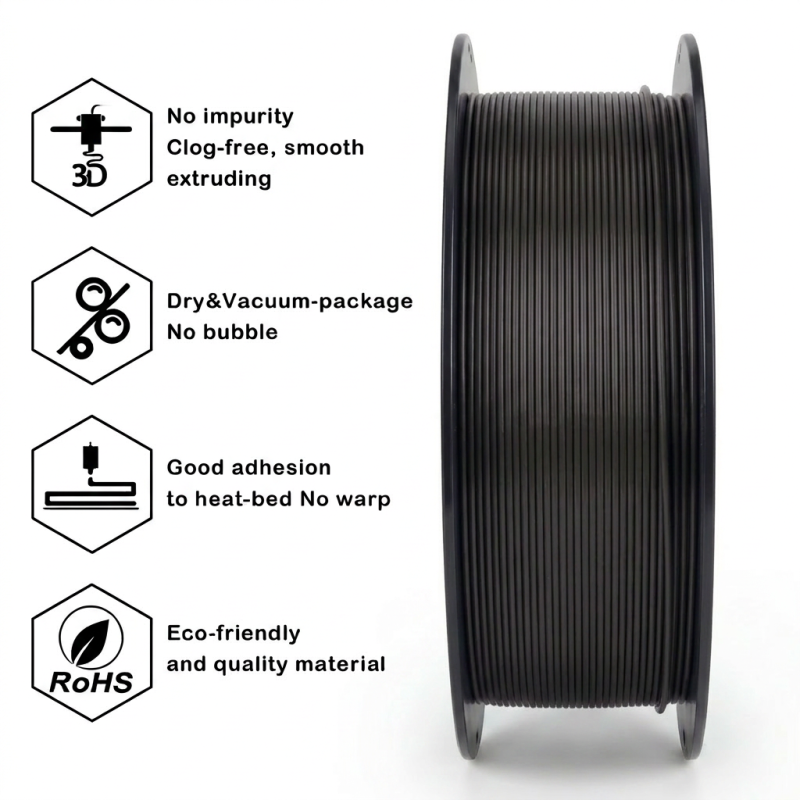
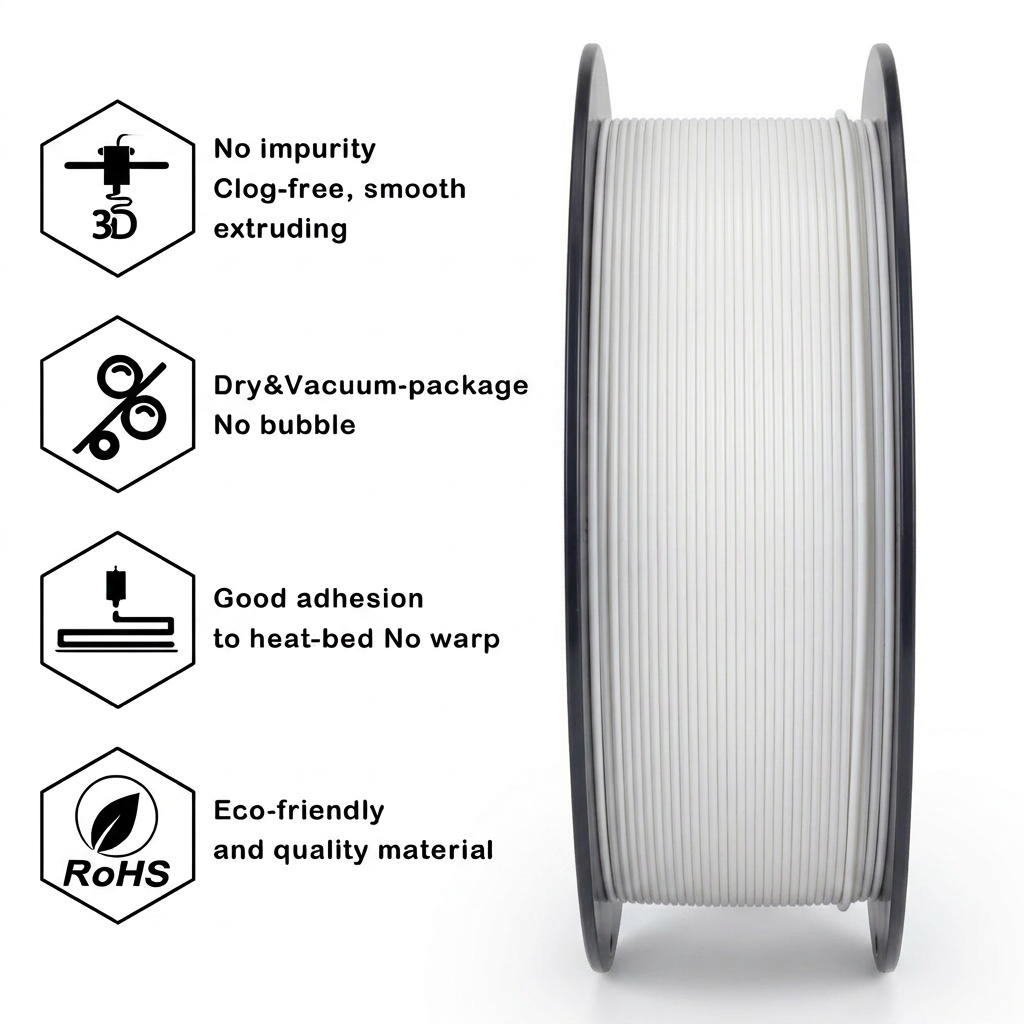
- Clog-Free Purity for Unattended Runs — Filtered raw material and closed-loop extrusion keep contaminants out of the strand, protecting overnight and weekend queues where one clog can cost a whole build plate
The result is a spool a farm operator can load on any machine in the fleet, at any speed tier, and trust to finish the queue.
Premium High Speed PLA at Factory-Direct Pricing
SigmaFilament is a direct manufacturer based in Guangdong, China. We compound, extrude, wind, and pack every spool of this high speed PLA filament in-house — so print farms and resellers get high-flow performance at the price point white PLA needs to hit when you consume it by the pallet.
| 🏎️ Real Throughput Gains | 💰 Factory-Direct Pricing | 🔁 Reorder Repeatability |
| Cutting a 6-hour print to under 2 hours multiplies daily plate turns across every machine in the fleet | No brand markup, no middlemen — volume tiers at 100kg, 500kg, and 1000kg+ built for farm consumption rates | Same whiteness, same diameter, same melt behavior on every reorder — client work stays visually identical for months |
Why Choose White High Speed PLA for Your Projects
| ⬜ The Neutral Default | When a client hasn’t specified a color — and most prototype briefs don’t — white is the answer that never needs approval. It reads as professional in design reviews, doesn’t bias perception of form the way saturated colors do, and photographs accurately for documentation, listings, and pitch decks. Farms standardize on white because it removes a decision from every order. |
| 🖌️ The Paint-Ready Base | The matte white surface sands cleanly without gumming, shows filler primer coverage instantly, and gives acrylics, lacquers, and airbrush work a true-neutral undertone — no color bleed-through from below. For prop makers, miniature painters, and cosplay commissions, starting white cuts a full priming cycle compared to starting from dark filament. |
| 🏭 Fleet-Wide Uniformity | A 20-printer farm running one order across ten spools cannot tolerate visible white-point drift between spools. Batch-controlled pigment loading means parts printed on machine 3 with spool A match parts from machine 17 with spool B — so batch orders can be boxed together without sorting by shade. |
| 💡 Light & Photography Friendly | White diffuses light softly, which makes it the standard choice for lamp shades, sign letters, and LED housings — and it gives product photographers an easy subject: no color cast, clean shadows, accurate exposure. E-commerce sellers printing display samples get catalog-ready parts straight off the plate. |
| ⏱️ Iteration at Speed | Product designers iterating a housing five times in a day need each revision in hours, not overnight. At 300–600mm/s draft settings, this high speed PLA filament turns a same-week iteration loop into a same-day one — and the neutral white makes dimensional issues, layer defects, and surface problems easier to spot than on dark or glossy filament. |
| 🧒 Office & Classroom Safe | Plant-based PLA prints with low odor and no styrene-class fumes, so the same spool that runs a production farm is also appropriate for design offices, school makerspaces, and library labs. RoHS and REACH compliant, free of restricted heavy metals — no enclosure or ventilation upgrade required. |
High Speed PLA vs. Standard PLA vs. PLA Pro vs. High Speed PETG — Comparison
| Property | High Speed PLA (This) | Standard PLA | PLA Pro | High Speed PETG |
|---|---|---|---|---|
| Max Print Speed | ★★★★★ Up to 600mm/s | ★★☆☆☆ ~60–100mm/s | ★★☆☆☆ 30–100mm/s | ★★★★★ Up to 600mm/s |
| Quality at Speed | ★★★★★ Formulated for flow | ★★☆☆☆ Under-extrudes fast | ★★★☆☆ Quality-first, slow | ★★★★☆ Slight stringing risk |
| Ease of Printing | ★★★★★ PLA-easy, low bed temp | ★★★★★ Easiest | ★★★★★ Easy | ★★★☆☆ Needs tuning |
| Surface Finish | ★★★★☆ Clean matte white | ★★★★☆ Satin | ★★★★★ High gloss | ★★★☆☆ Glossy, shows lines |
| Heat / Chemical Resistance | ★★☆☆☆ Indoor use (~55–60°C) | ★★☆☆☆ | ★★★☆☆ | ★★★★☆ Better outdoors |
| Best For | Print farms, prototypes, paint-ready parts | Hobby prints, decor | Glossy display pieces | Fast functional parts |
| Price Point | ★★★★☆ (Mid — pays back in throughput) | ★★★★★ (Lowest) | ★★★★☆ | ★★★★☆ |
Recommended Print Settings for High Speed PLA Filament
This filament runs on a standard PLA profile at everyday speeds, and scales into high-speed profiles with three adjustments: hotter nozzle at higher flow, aggressive part cooling, and a raised volumetric flow limit in the slicer. The notes below cover what actually changes as speed climbs.
⚠️ Notes Before Printing at High Speed:
- Raise temperature with speed — At 30–150mm/s, print at 190–210°C like normal PLA. At 250–400mm/s, move to 210–225°C. Above 400mm/s, run 220–230°C so the melt keeps up with the shorter residence time in the hotend.
- Unlock the volumetric flow limit — Slicers cap PLA profiles at 12–20mm³/s by default; that cap silently slows your printer down regardless of the mm/s value you enter. Raise the max volumetric speed for this filament to match your hotend’s tested capability, then verify with a flow-rate test tower.
- Part cooling at 100% — Short layer times mean each layer must solidify in seconds. Run auxiliary fans if your machine has them, and enable minimum layer time (4–6s) so small parts don’t print on molten plastic.
- Calibrate input shaping and pressure advance — On Klipper and fast CoreXY firmware, resonance compensation and pressure advance make the visible difference between “fast” and “fast and clean.” Recalibrate after switching filament brands.
Optimal Print Settings for This High Speed PLA
| Nozzle Temperature | 190–230°C (190–210°C below 150mm/s; 220–230°C above 400mm/s) |
| Bed Temperature | 35–60°C (60°C recommended for large flat bases) |
| Print Speed | 30–600mm/s (200–400mm/s is the practical sweet spot on most fast machines) |
| Layer Height | 0.12–0.28mm (0.20mm balances speed and finish for farm work) |
| Cooling Fan | 100% from layer 2; auxiliary/chamber fans on for speeds above 300mm/s |
| Retraction | 0.5–1.2mm at 35–45mm/s (direct drive); 4–5mm (Bowden) |
| Max Volumetric Speed | Set to your hotend’s tested limit; standard hotends ~15–20mm³/s, high-flow hotends 30mm³/s+ |
| Minimum Layer Time | 4–6 seconds (prevents small features printing on molten plastic) |
| Infill | 10–15% gyroid or grid for prototypes; 20–30% for handled parts |
| Nozzle Type | Standard 0.4mm brass; 0.6mm recommended for maximum throughput drafts |
| Bed Adhesion | Textured or smooth PEI, no glue needed; brim only for tall narrow parts |
| Drying (if needed) | 45°C for 4–6 hours after long open-air exposure. See our filament dryer settings guide |
💡 Pro Tip — Run Two Farm Profiles, Not One: The highest-throughput farms don’t print everything at maximum speed. Set up two slicer presets for this filament and assign them per order type:
- DRAFT-600 — 0.6mm nozzle or 0.28mm layers, 400–600mm/s outer walls unlocked, 225–230°C, auxiliary cooling on. Use for fit-check prototypes, internal jigs, and anything that will be sanded or painted anyway.
- CLIENT-QUALITY — 0.4mm nozzle, 0.16–0.20mm layers, 150–250mm/s, 205–215°C. Use for presentation models, customer-facing parts, and photography samples.
Because the same spool handles both profiles, machines never need a material change between order types — the queue scheduler just picks the preset. That single decision removes most of the filament-swap downtime in a mixed-work farm.
Technical Specifications
| Parameter | Specification |
|---|---|
| Material | High-flow PLA, optimized for rapid melt and fast re-solidification |
| Color | White (neutral matte, batch-controlled pigment loading) |
| Surface Finish | Standard matte — sands and paints cleanly |
| Filament Diameter | 1.75mm (0.069 in) |
| Diameter Tolerance | ±0.03mm |
| Net Weight | 1kg (2.2 lbs) per spool |
| Nozzle Temperature | 190–230°C (374–446°F) |
| Bed Temperature | 35–60°C (95–140°F) |
| Print Speed | 30–600mm/s (high-speed optimized) |
| Practical Speed Sweet Spot | 200–400mm/s on stock fast CoreXY machines |
| Recommended Layer Height | 0.12–0.28mm (0.20mm typical for farm production) |
| Required Nozzle | Standard 0.4mm brass (0.6mm optional for draft throughput) |
| Enclosure | Not required — open frame preferred for part cooling |
| Bubbles in Filament | 100% bubble-free (vacuum extrusion process) |
| Winding | Neat side-by-side winding, tangle-free for unattended runs |
| Post-Processing | Sanding, filler primer, acrylic/lacquer painting, cold welding, vapor-free finishing |
| Compliance | RoHS and REACH compliant; biodegradable PLA base |
| Drying Temperature | 45°C for 4–6 hours (only after >4 weeks open-air exposure) |
| Packaging | Vacuum-sealed bag with desiccant, individual carton box |
| Manufacturing Origin | Guangdong, China — ISO 9001 quality management |
| Free Sample | Available for qualified business customers |
| OEM/ODM | Available — Learn about our OEM services |
Material Properties & Performance
Mechanically, this high speed PLA filament sits in the same performance band as quality standard PLA — the high-flow modification targets melt behavior, not filler content, so there is no strength penalty for the speed capability when parts are printed within the recommended temperature-for-speed windows. Layer adhesion is the property to watch at speed: printing too cold for a given flow rate is what weakens fast prints, which is why the temperature ladder in the settings section matters more here than on slow filaments. Explore our full PLA filament range for gloss, matte, silk, and gradient alternatives built on the same production lines.
Mechanical & Thermal Properties
| Property | Value | Test Standard |
|---|---|---|
| Tensile Strength | 50–60 MPa | ISO 527 / ASTM D638 |
| Flexural Modulus | 2,300–2,800 MPa | ISO 178 / ASTM D790 |
| Flexural Strength | 75–90 MPa | ISO 178 / ASTM D790 |
| Impact Strength (Izod, Notched) | 3–5 kJ/m² | ISO 180 / ASTM D256 |
| Elongation at Break | 5–8% | ISO 527 / ASTM D638 |
| Glass Transition Temperature | ~60°C (140°F) | ISO 11357 |
| Heat Deflection Temperature | ~55°C (0.45 MPa) | ISO 75 / ASTM D648 |
| Density | 1.24 g/cm³ | ISO 1183 |
| Shrinkage | 0.3–0.5% (low) | ISO 294-4 |
| Biodegradability | Industrial compostable | ASTM D6400 / EN 13432 |
Printer-Specific Settings for High Speed PLA Filament
| Printer | Nozzle | Bed | Speed | Notes |
|---|---|---|---|---|
| Bambu Lab X1C / P1S | 220°C | 55°C | 250–400mm/s | Start from the Generic PLA profile, raise max volumetric speed to your tested value; aux fan on above 300mm/s |
| Bambu Lab A1 / A1 mini | 215°C | 55°C | 200–300mm/s | Bedslinger geometry limits top speed on tall parts; keep outer walls at ~200mm/s for best surfaces |
| Creality K1 / K1 Max | 220°C | 50°C | 300–500mm/s | Use the Hyper PLA profile as a base; side fan on; verify input shaping after any hardware change |
| Prusa MK4 / CORE One | 215°C | 60°C | 200–300mm/s | PrusaSlicer SPEED profile with Input Shaper enabled; smooth PEI sheet works without glue |
| Anycubic Kobra 3 | 215°C | 55°C | 250–400mm/s | High-speed PLA preset works out of the box; reduce flow 1–2% if corners look plump |
| Voron 2.4 / Klipper CoreXY | 225°C | 55°C | 300–600mm/s | With a high-flow hotend and tuned pressure advance this filament reaches its full 600mm/s ceiling |
Applications for White High Speed PLA Filament
This high speed PLA filament earns its place wherever volume, turnaround, or a neutral finish is the requirement. These are the six workloads it was formulated for.
| 🏭 Print Farm Batch Production | Hundreds of identical parts across a fleet of fast machines: e-commerce products, subscription-box items, and contract manufacturing runs. The combination of 600mm/s capability, tangle-free winding, and batch-consistent whiteness is aimed squarely at operators who measure output in plates per day, not prints per week. |
| ⚙️ Rapid Prototyping & Iteration | Engineering and product-design teams cycling through housings, brackets, and enclosures multiple times a day. Draft-speed prints land in hours, and the neutral white surface makes layer defects, warping, and dimensional issues easy to see and photograph for the revision log. |
| 🖌️ Paint-Ready Props & Cosplay Blanks | Helmets, armor pieces, sword hilts, and commission miniatures that will be sanded, primed, and painted. Starting from matte white eliminates the extra primer coats dark filament demands, and the fast draft profile means large multi-piece props finish printing in a weekend instead of a week. |
| 🏛️ Architectural & Presentation Models | Massing studies, site models, and client presentation pieces where white is the professional convention. Uniform whiteness across dozens of printed components lets large models assemble without visible shade mismatch, and the matte finish reads cleanly under gallery and boardroom lighting. |
| 💡 Signage, Lamps & LED Housings | Channel letters, diffuser panels, night lights, and LED fixture housings that exploit white PLA’s soft, even light diffusion. Sign shops printing letter sets by the batch benefit from both the throughput and the shade consistency — a storefront sign with mismatched whites is a redo, not a discount. |
| 🎓 Education & Makerspaces | Classroom fleets burn through neutral filament faster than any other color, and fast printing means more student projects per session. Low odor, RoHS/REACH compliance, and forgiving PLA printability make this a safe default spool for supervised and unsupervised student use alike. |
Environmental & Safety Standards
| 🌱 Plant-Based PLA | Derived from renewable feedstock such as corn starch and sugarcane rather than petroleum. Industrial compostable per ASTM D6400 / EN 13432. |
| ✅ RoHS & REACH Compliant | Free of lead, mercury, cadmium, hexavalent chromium, and other restricted substances. Suitable for EU and global retail and institutional markets. |
| 🏭 ISO 9001 Manufacturing | Diameter, pigment loading, melt-flow behavior, and winding quality verified per production batch under certified quality management. |
| 📦 Vacuum Sealed + Desiccant | 100% bubble-free vacuum extrusion plus moisture-proof packaging, so the first print off a fresh spool runs as cleanly as the hundredth. |
Packaging & Global Shipping
| Destination | Standard Delivery | Express Available |
|---|---|---|
| European Union | 5–10 business days | ✓ 3–5 days |
| United States | 7–12 business days | ✓ 4–6 days |
| United Kingdom | 7–12 business days | ✓ 4–6 days |
| Canada | 8–14 business days | ✓ 5–7 days |
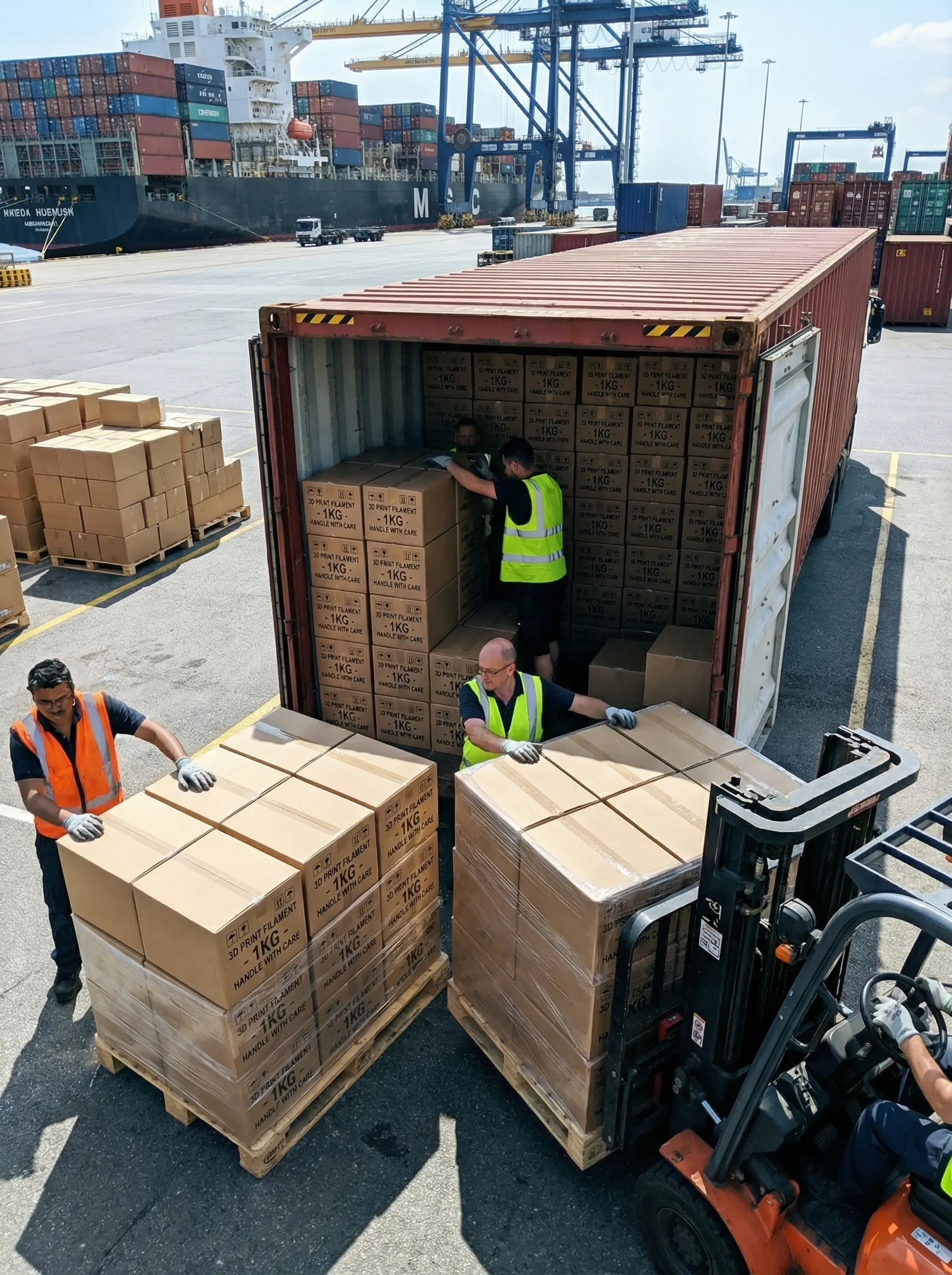
Packaging: Vacuum-sealed bag with desiccant, individual carton box; carton and pallet packing for farm-volume orders. Customs: DDP and DAP terms available.
Bulk Orders & OEM/ODM Services
| 📊 Flexible MOQ | Trial cartons for evaluation through to recurring pallet schedules for production farms. Free samples available for qualified business customers. |
| 💰 Volume Pricing | Tier breakpoints at 100kg+, 500kg+, and 1000kg+ with progressive discounts — structured around monthly farm consumption rather than one-off orders. |
| 🎨 OEM/ODM Services | • Private-label spools and retail boxes under your brand • Custom white points and off-white shades (Pantone / RAL matching) • Custom spool sizes (0.5kg, 2kg, 3kg, 5kg) for high-capacity feeders • Custom labeling, QR batch traceability, and barcode integration |
| 🎁 Free Sample Program | Test the flow behavior, whiteness, and winding quality on your own machines before committing to volume. Evaluation spools ship to qualified business customers worldwide. |
Storage & Handling Guidelines
| Storage Guidelines | |
|---|---|
| Temperature | 15–25°C (59–77°F) |
| Humidity | Below 50% RH (PLA is mildly hygroscopic; moisture shows first as stringing at high speed) |
| Shelf Life | 24 months (unopened, vacuum sealed) |
| Drying (if needed) | 45°C for 4–6 hours (only after >4 weeks of open-air exposure) |
| Light Exposure | Store away from direct sunlight — prolonged UV can yellow white PLA over time |
| Farm Rotation | Use first-in, first-out spool rotation and keep opened spools in dry boxes between shifts for consistent fleet output |
Printer Compatibility
This high speed PLA filament works with any 1.75mm FDM/FFF 3D printer — from a basic bedslinger at 50mm/s to a tuned Klipper CoreXY at 600mm/s. No hardened nozzle, no enclosure, no special hardware required; faster machines simply unlock more of its ceiling.
| Bambu Lab X1C, P1S, A1, A1 mini | Prusa MK4, CORE One, MINI+ | Creality K1, K1 Max, Ender 3 series | Anycubic Kobra 2, Kobra 3 | Voron / Sovol 2.4, Trident, SV08 | Elegoo / QIDI Neptune 4, Q1 Pro, Plus 4 |
Why Choose SigmaFilament for High Speed PLA
| 🏭 Direct Manufacturer | Compounding, extrusion, winding, and packing under one roof in Guangdong, China — full control over melt-flow behavior and factory-direct wholesale pricing. |
| ⚡ Speed-Grade QC | Every high-speed batch is verified for melt-flow consistency and diameter stability — the two variables that decide whether a filament actually performs at 400mm/s or just claims to. |
| ⬜ Color Control | Batch-level pigment verification keeps white white — no creamy drift, no gray cast — across reorders months apart. |
| 🌍 Global B2B Service | English-speaking support across EU/US business hours, DDP/DAP shipping, and recurring-supply scheduling for farms that reorder monthly. |
| 🔧 Full OEM/ODM | Private label, custom white points, custom spool sizes up to 5kg, and batch-traceability labeling for resellers and branded farms. |
Frequently Asked Questions About High Speed PLA Filament
Ready to Make White Your Fastest Color?
Contact SigmaFilament for farm-volume pricing, free evaluation samples, or to set up a recurring supply schedule — including private-label OEM/ODM options and large-format spools for high-capacity feeders.
📧 Email us for a quick quote · 🌍 Worldwide shipping with DDP/DAP terms · 🎁 Free samples for qualified customers
| Filament Diameter | 1.75mm ,2.85mm (3.00mm) |
|---|---|
| Spool Weight | 1kg ,3kg ,5kg ,Sample (200g) |