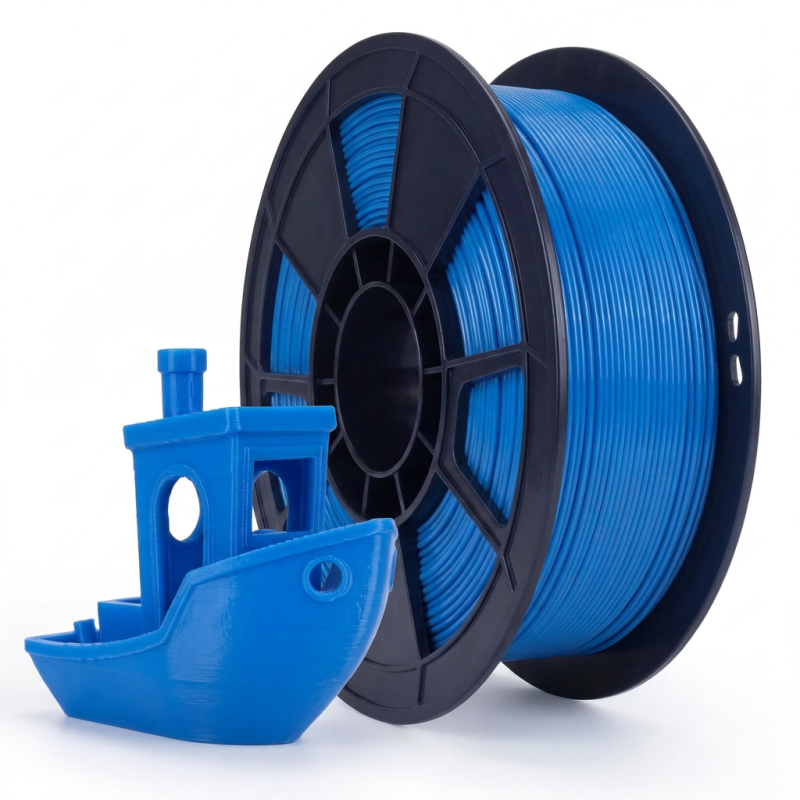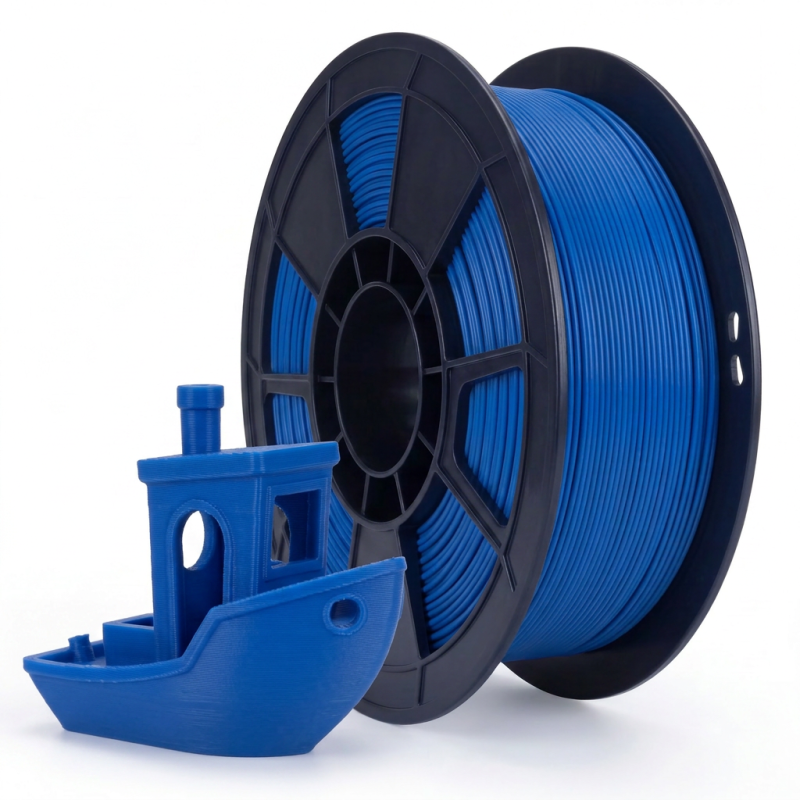
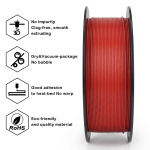
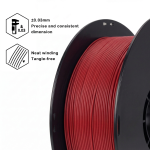
High Speed PLA Filament Red – Product Overview
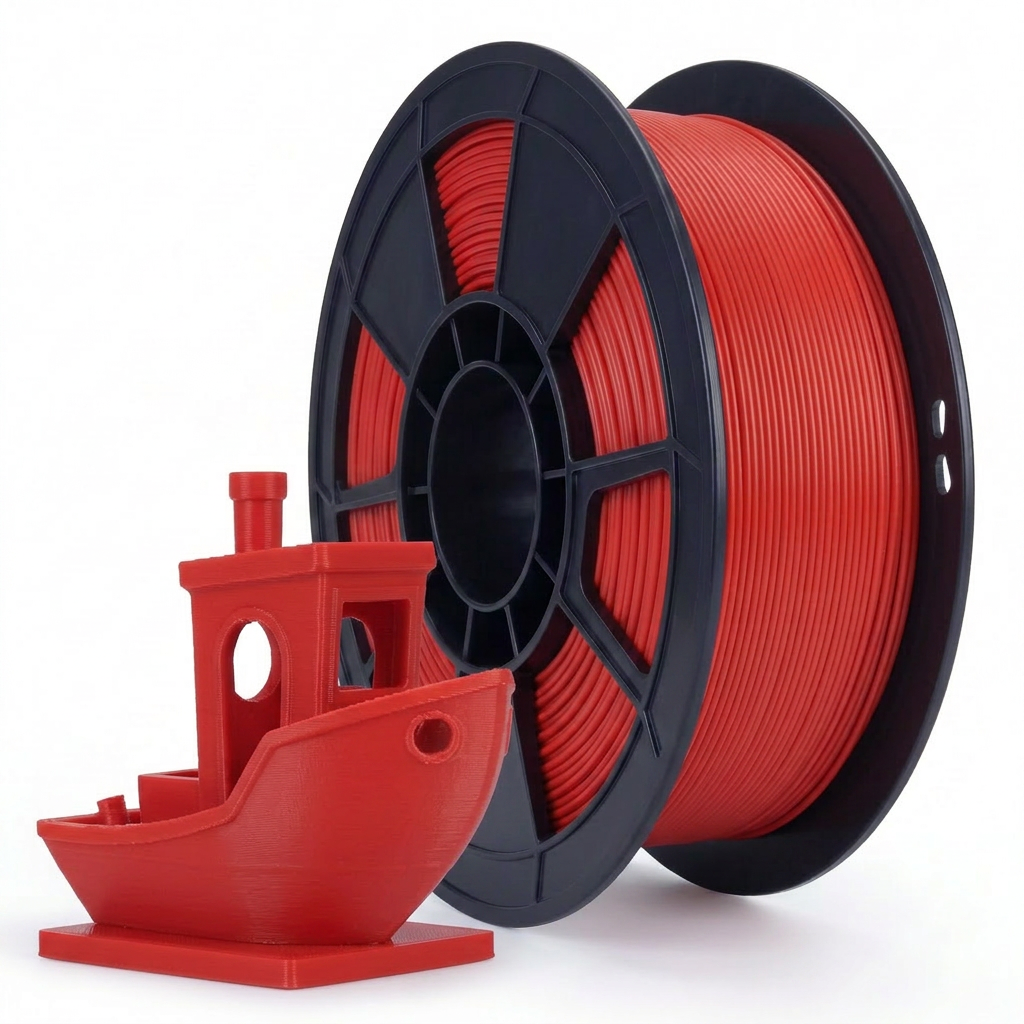
The SigmaFilament High Speed PLA Filament in Red pairs two things that rarely come on the same spool: a genuinely fast, high-flow PLA formulation rated for print speeds up to 600mm/s, and a saturated, high-visibility matte red that does functional work on a shop floor. This high speed PLA filament is chemically optimized for low melt viscosity and rapid cooling, so it stays fully molten through the nozzle at flow rates that would under-extrude standard PLA — then solidifies quickly enough to hold crisp corners and clean overhangs at farm throughput.
The red itself is chosen deliberately. In manufacturing environments, red is the universal signal color — stop, reject, do-not-touch, inspect-before-use. That makes this colorway the natural material for safety marking components, lockout accessories, no-go gauges, reject bins, and jig or fixture parts under a visual-management (poka-yoke) system. A red fixture on a workbench is instantly distinguishable from the product it holds; a red spacer that must be removed before machine start-up is impossible to overlook. Print those parts at 600mm/s instead of overnight, and visual management stops being a printing bottleneck.
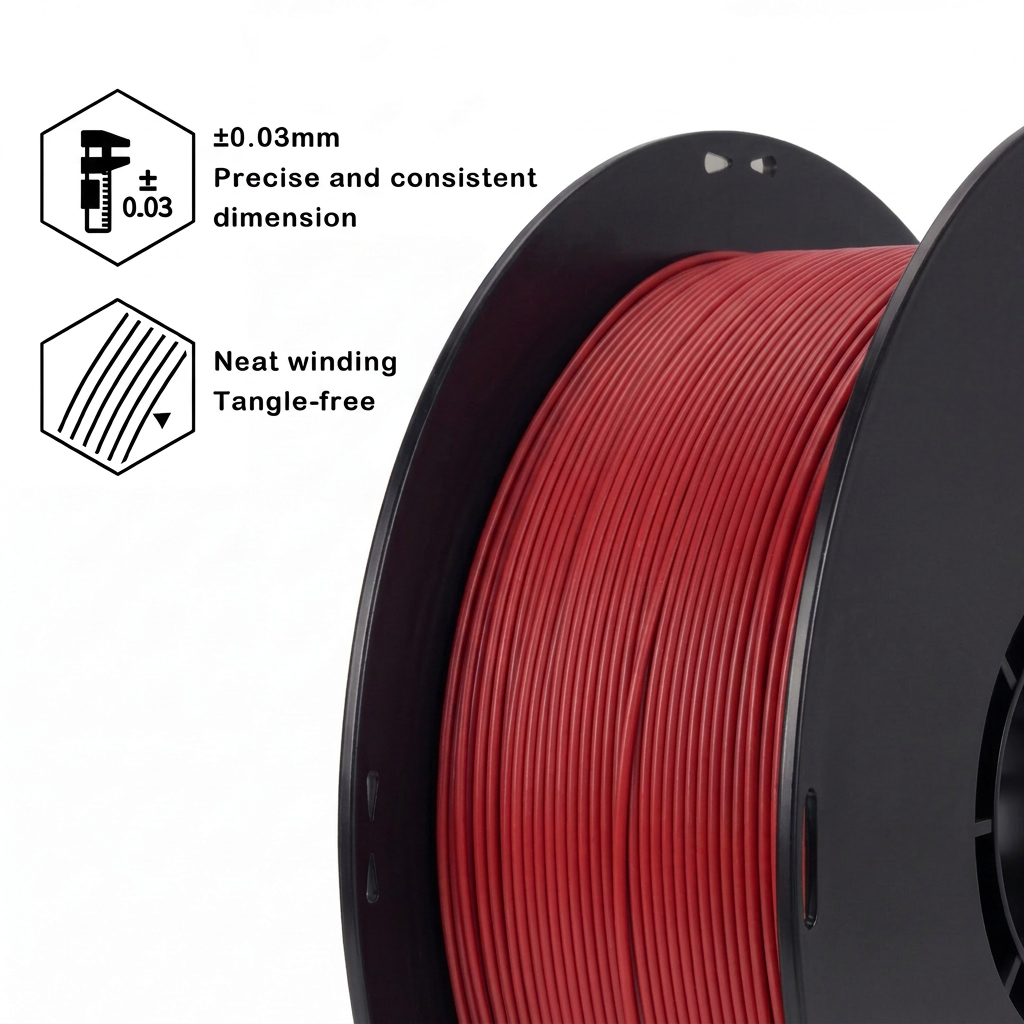
Beyond the factory floor, the same saturated red carries small-batch brand work: promotional items, red-accent product housings, event giveaways, and seasonal short runs where a customer’s brand color is non-negotiable and the deadline is tight. Every spool of this high speed PLA filament is extruded to 1.75mm ±0.03mm, vacuum sealed with desiccant, and manufactured under ISO 9001 quality management in Guangdong, China. Free samples, volume pricing, and full OEM/ODM services — including custom red shades and private label packaging — are available for qualified business customers.
Why This High Speed PLA Filament Stands Out
⚡ Signal-Red Parts at Production Throughput
Most red PLA is ordinary PLA with pigment — it looks right but throttles a modern CoreXY printer to a third of its rated speed. This high speed PLA filament is formulated the other way around: speed first, with a red that holds its saturation at any layer height.
- 30–600mm/s Working Window — Prints reliably on a ten-year-old bedslinger at 50mm/s and on a Bambu Lab X1C or Creality K1 Max at full rated speed; one spool serves the whole fleet
- High-Flow Melt Behavior — Lower melt viscosity keeps extrusion pressure stable at high volumetric flow, preventing the under-extrusion gaps and matte streaking that standard PLA shows above ~150mm/s
- Layer Adhesion That Survives Speed — Interlayer bonding is engineered for short layer times, so parts printed in 40 minutes carry loads like parts printed in 4 hours
- High-Visibility Matte Red — A saturated signal red with a standard matte surface that stays readable under harsh workshop lighting — no glare, no washed-out camera footage on farm monitoring streams
- Repeatable Color for Repeatable Systems — Batch-controlled pigment loading means the red jig you print next quarter matches the red jig on the line today, which is exactly what a color-coded workstation depends on
- Rapid Cooling, Sharp Details — Fast solidification keeps bridges, text embossing, and warning-symbol geometry crisp even when the fan barely has time to work
Fast enough for a print farm, visible enough for a factory floor — that combination is the whole point of this spool.
Premium High Speed PLA at Factory-Direct Pricing
SigmaFilament is a direct manufacturer based in Guangdong, China. We compound, extrude, wind, and pack every spool of this high speed PLA filament in-house — so print farms and industrial buyers get high-flow performance without the markup of brand resellers.
| ⚡ Throughput Economics | 💰 Factory-Direct Pricing | 🎨 Color Consistency |
| A printer that finishes parts 3–4× faster earns 3–4× more per day — the filament that enables it pays for itself on the first production run | No middlemen, no licensing fees — volume discounts at 100kg, 500kg, 1000kg+ keep per-spool cost predictable at fleet scale | Pigment loading is verified per batch, so color-coded tooling systems and brand-red product runs stay matched across reorders |
Why Choose Red High Speed PLA for Your Projects
| 🛑 Safety Marking Parts | Machine guard indicators, remove-before-operation tags, emergency-stop surrounds, pinch-point covers, and cable-hazard markers all rely on red being seen instantly. A saturated matte red prints these components in-house, on demand, the same morning a safety walk flags the need — instead of waiting on an external supplier. |
| 👁️ Jig & Fixture Visual Management | Lean and 5S workstations color-code tooling: red for reject bins, no-go gauges, calibration-due fixtures, and do-not-use jigs. Because this high speed PLA filament prints a full fixture in under an hour, a production engineer can roll out a color standard across an entire line in days — and reprint a matching replacement whenever one cracks or walks off. |
| 🏷️ Brand-Red Short Runs | Promotional keychains, red-accent housings, trade-show giveaways, and seasonal product runs where the client’s brand color is fixed and the deadline is short. At 600mm/s-class speeds, a 200-piece batch that used to occupy a printer for a week ships in a weekend — with batch-consistent color from first piece to last. |
| 🏭 Print Farm Throughput | Farms bill by finished parts, not by spools. A high-flow PLA that lets every CoreXY machine run at its rated speed raises fleet output without adding a single printer — and the wide 30–600mm/s window means older machines in the fleet run the same material with a slower profile, keeping inventory simple. |
| ⏱️ Iteration-Speed Prototyping | Design teams iterate as fast as the printer allows. When a form-check prototype finishes in 35 minutes instead of 3 hours, engineers test more variants per day — and a bright red prototype is easy to spot in review photos, on a crowded bench, and in handoff meetings. |
| 🎓 Classrooms & Makerspaces | Biodegradable, low-odor PLA is the standard choice for shared indoor spaces, and fast printing means a full class gets parts back in one session instead of next week. The vivid red also photographs well for project documentation and competition entries. |
Red High Speed PLA vs. Standard PLA vs. High Speed PETG vs. PLA Pro — Comparison
| Property | High Speed PLA (This) | Standard PLA | High Speed PETG | PLA Pro |
|---|---|---|---|---|
| Max Practical Speed | ★★★★★ Up to 600mm/s | ★★☆☆☆ ~60–150mm/s | ★★★★★ Up to 600mm/s | ★★★☆☆ 30–100mm/s |
| Ease of Printing | ★★★★★ Beginner OK | ★★★★★ Easiest | ★★★★☆ Needs stringing tune | ★★★★★ |
| Layer Adhesion at Speed | ★★★★★ Engineered for it | ★★☆☆☆ Drops sharply | ★★★★★ | ★★★☆☆ At normal speeds |
| Heat Resistance | ★★★☆☆ ~55–60°C (PLA) | ★★★☆☆ ~55–60°C | ★★★★☆ ~70–75°C | ★★★☆☆ ~55–60°C |
| Bed Requirements | ★★★★★ 35–60°C, PEI | ★★★★★ Same | ★★★☆☆ 60–80°C | ★★★★★ 35–60°C |
| Best For | Safety parts, jigs, red short runs, farms | Everyday hobby prints | Fast functional/outdoor parts | Glossy display prints |
| Price Point | ★★★★☆ (Mid) | ★★★★★ (Lowest) | ★★★★☆ | ★★★★☆ |
Recommended Print Settings for Red High Speed PLA Filament
This filament behaves like well-mannered PLA at low speed and only asks for small adjustments when you push it. If you run it at everyday speeds, your existing PLA profile works as-is. The notes below matter once you go past ~200mm/s.
⚠️ Notes Before Printing at High Speed:
- Raise temperature with speed — At 300mm/s and above, filament spends far less time in the melt zone. Move toward the upper end of the 190–230°C window (roughly 220–230°C) so the plastic is fully molten before it exits the nozzle; stay near 200–210°C for slow, detailed prints.
- Cooling at 100% — Short layer times demand maximum part cooling from layer 2 onward. High-airflow stock fans on modern CoreXY machines are sufficient; on older printers, cap speed rather than printing hot layers onto soft layers.
- Calibrate input shaping and flow — Resonance compensation (Klipper input shaper / Bambu vibration calibration) and a quick maximum-volumetric-flow test are what separate clean 500mm/s walls from ringing artifacts. Run both once per printer and save the profile.
- Watch minimum layer time on small parts — A tiny red tag printed at 600mm/s finishes each layer in a second or two. Set a minimum layer time (4–8s) or print several parts per plate so each layer cools before the next lands.
Optimal Print Settings for This High Speed PLA
| Nozzle Temperature | 190–230°C (374–446°F) — use 220–230°C above 300mm/s, 200–210°C below 150mm/s |
| Bed Temperature | 35–60°C (95–140°F); 55–60°C recommended for large flat parts |
| Print Speed | 30–600mm/s (high-speed optimized); 200–400mm/s is the sweet spot for quality + throughput |
| Layer Height | 0.16–0.28mm; 0.20mm balances speed and surface quality for tooling parts |
| Cooling Fan | 100% from layer 2 onward — non-negotiable at high speed |
| Wall Count | 2–3 walls; 3–4 walls for jigs and fixtures that see repeated handling |
| Retraction | 0.5–1.0mm at 35–45mm/s (direct drive); 4–5mm (Bowden) |
| Infill | 15–25% grid/gyroid for tooling; 10% for visual prototypes |
| Nozzle Type | Standard 0.4mm brass; 0.6mm widens the flow margin for maximum-speed production |
| Enclosure | Not required — open frame preferred for cooling |
| Bed Adhesion | Textured or smooth PEI, glass with glue stick — standard PLA surfaces all work |
| Drying (if needed) | 45°C for 4–6 hours after long open-air exposure. See our filament dryer settings guide |
💡 Pro Tip — Find Your Printer’s Real Speed Ceiling Before the Production Run: Print one 3DBenchy at 200mm/s, one at 350mm/s, and one at 500mm/s using the same 0.20mm profile, raising nozzle temperature ~10°C per step. Compare the hull sides for ringing and the chimney for cooling artifacts. The fastest Benchy that still looks clean is your production speed for this material on that machine — lock it into a named slicer profile (“HS-PLA Red — Production”) so every operator on the farm runs the same validated settings instead of guessing.
Technical Specifications
| Parameter | Specification |
|---|---|
| Material | High-flow PLA optimized for high-speed FDM printing |
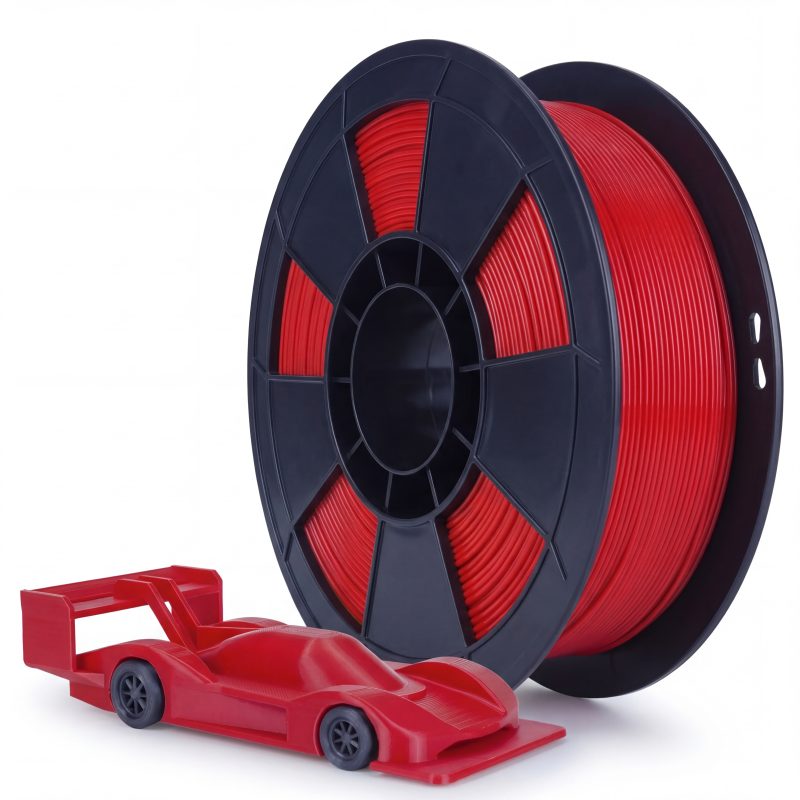
| Color | Red (high-visibility signal red, standard matte finish) |
| Finish | Standard matte — low glare under workshop lighting |
| Filament Diameter | 1.75mm (0.069 in) |
| Diameter Tolerance | ±0.03mm |
| Net Weight | 1kg (2.2 lbs) per spool |
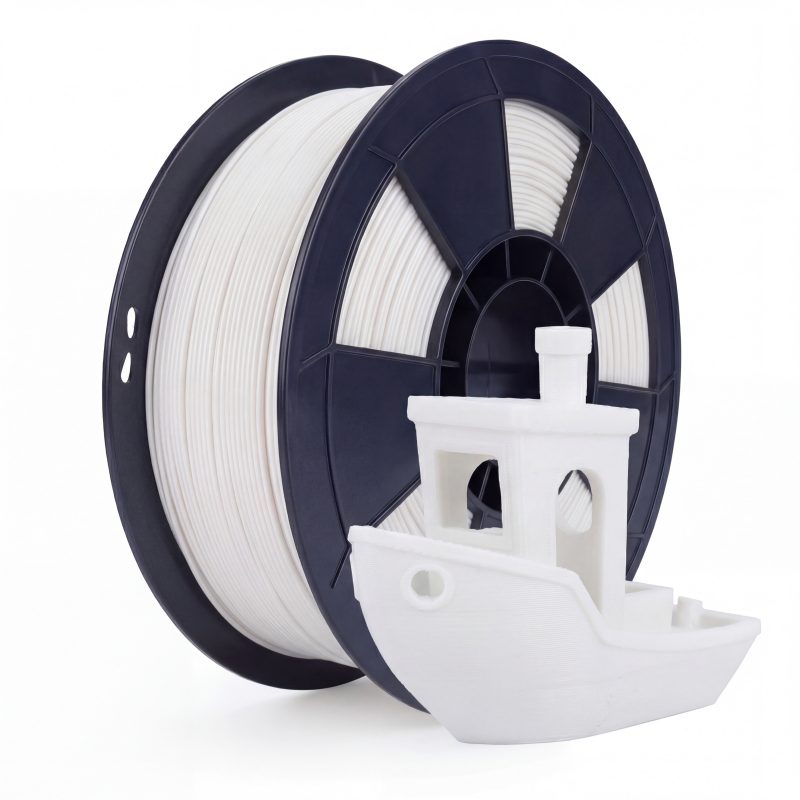
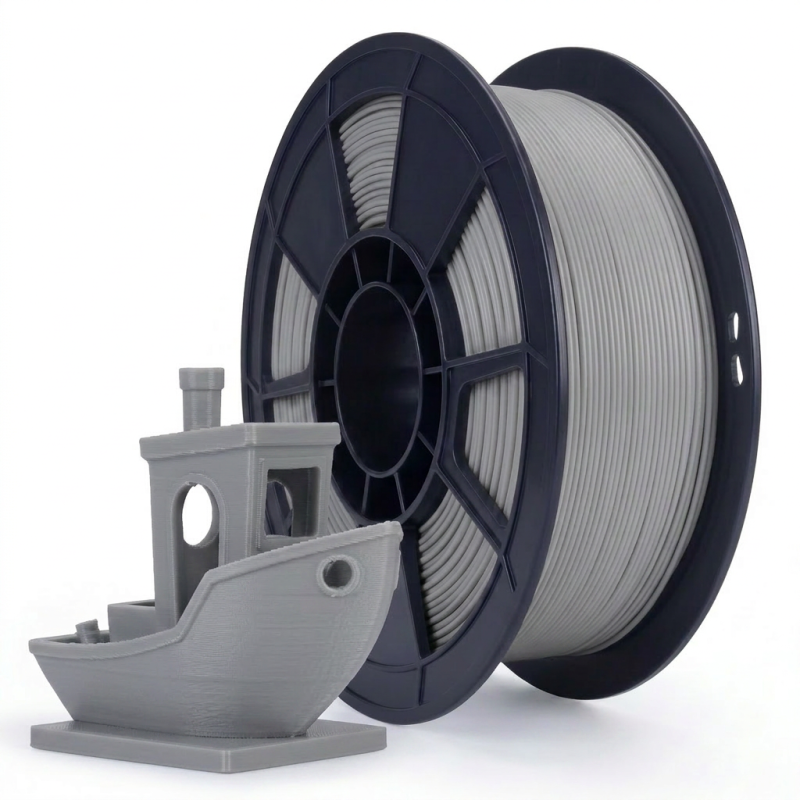
| Spool Type | Lightweight black skeleton (cutout) spool — easy remaining-filament check |
| Nozzle Temperature | 190–230°C (374–446°F) |
| Bed Temperature | 35–60°C (95–140°F) |
| Print Speed | 30–600mm/s (high-speed optimized) |
| Recommended Production Speed | 200–400mm/s (best quality-to-throughput balance) |
| Required Nozzle | Standard 0.4mm brass (no hardened nozzle required) |
| Enclosure | Not required — open-frame printers preferred for cooling |
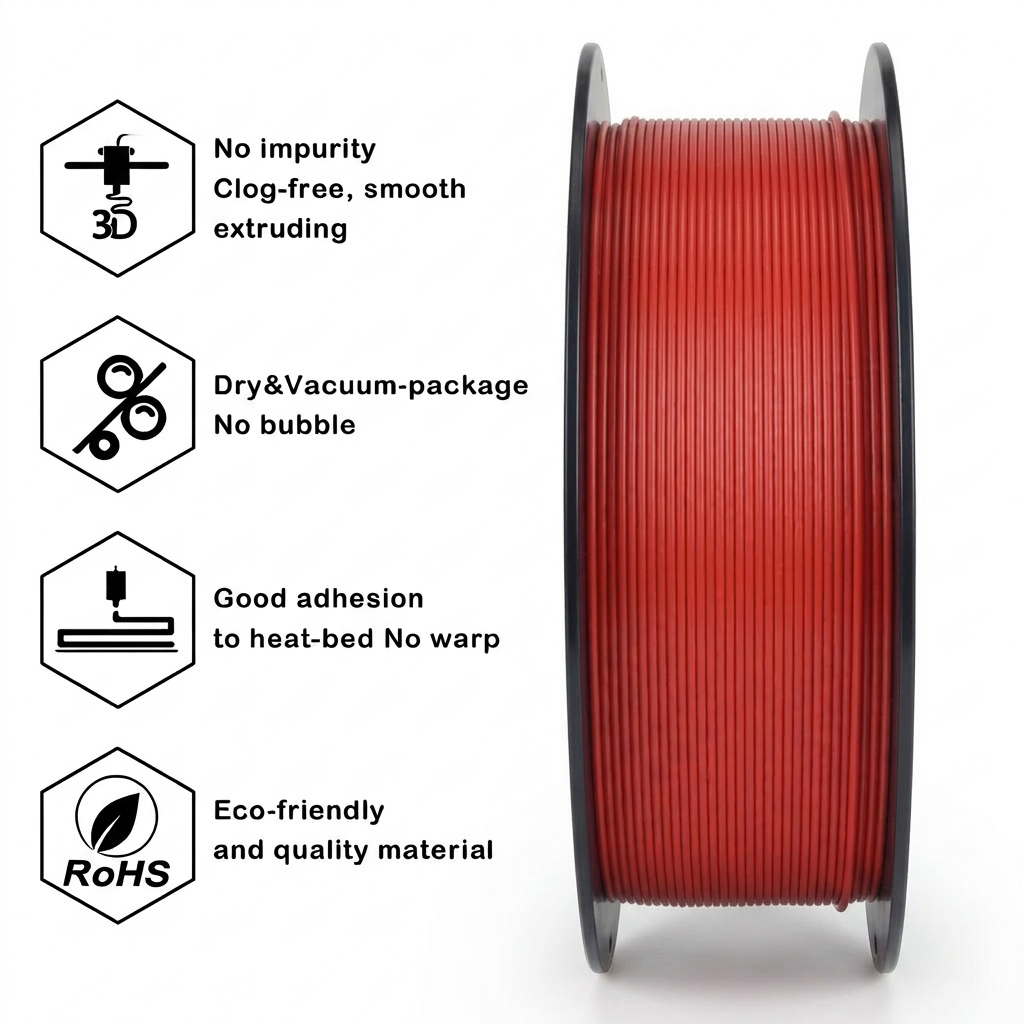
| Winding | Precision side-by-side winding, tangle-free feeding |
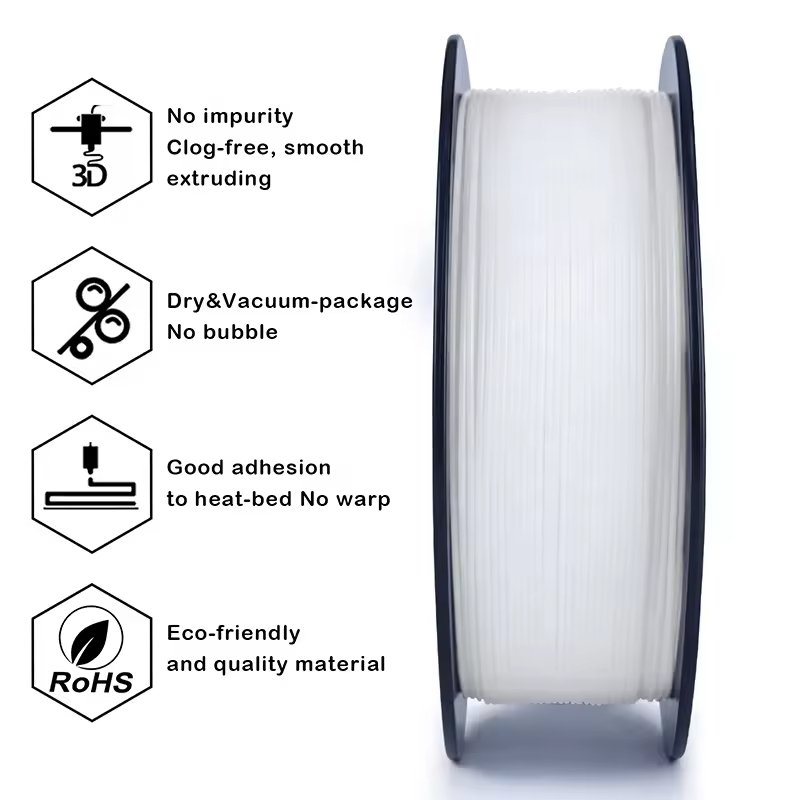
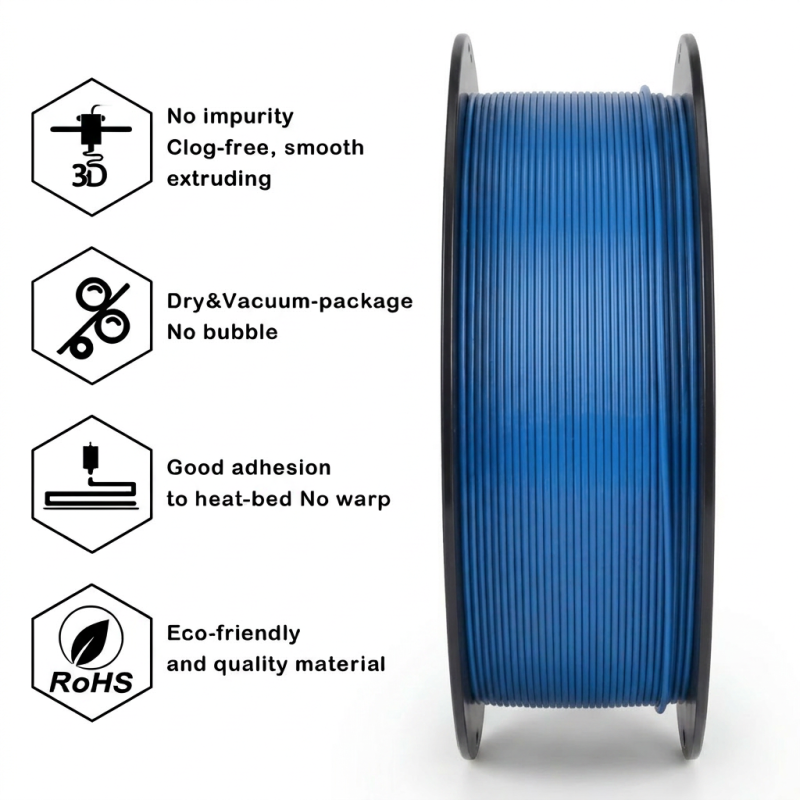
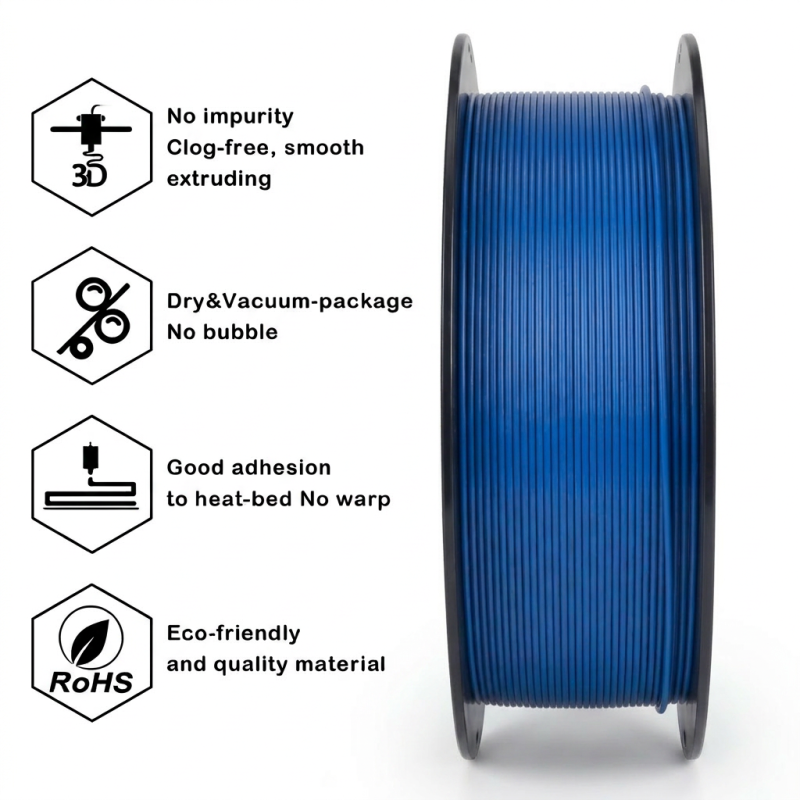
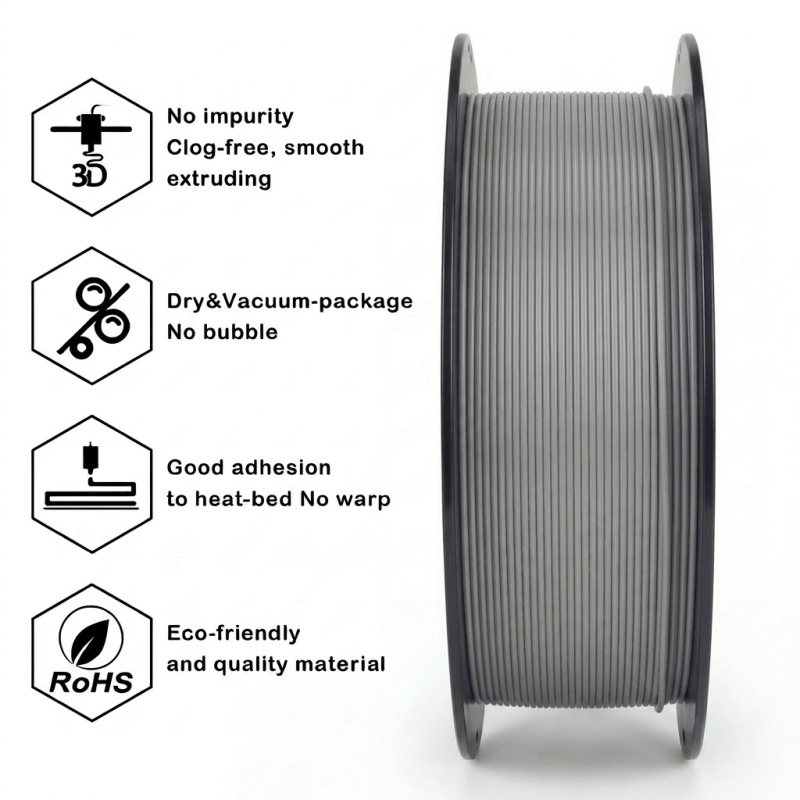
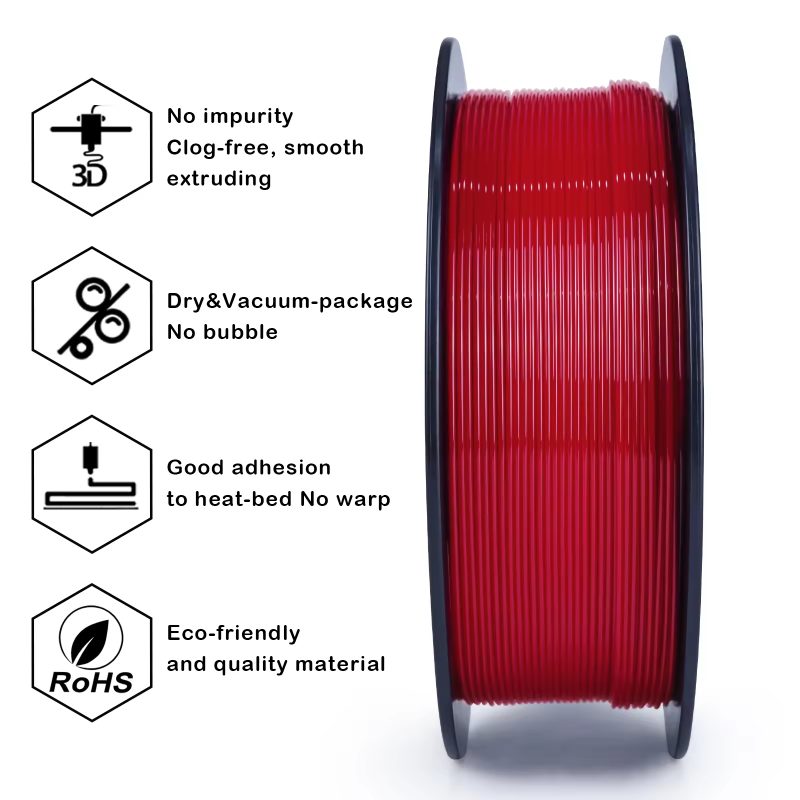
| Bubbles in Filament | Bubble-free vacuum extrusion for stable high-flow output |
| Post-Processing | Sanding, drilling, tapping, painting; matte surface takes labels and markers well |
| Drying Temperature | 45°C for 4–6 hours (only after extended open-air exposure) |
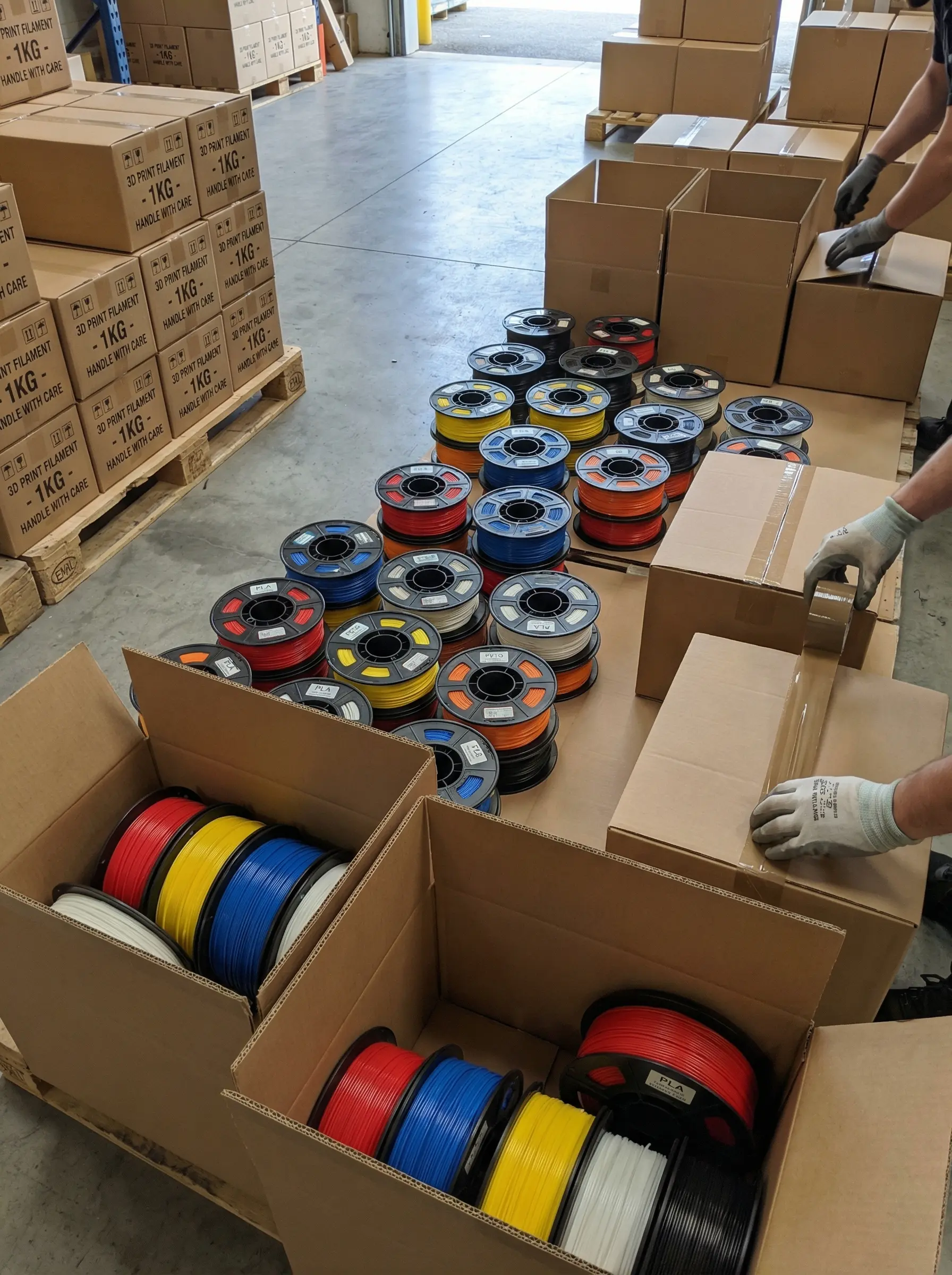
| Packaging | Vacuum-sealed bag with desiccant, individual carton box |
| Manufacturing Origin | Guangdong, China (ISO 9001 quality management) |
| Free Sample | Available for qualified business customers |
| OEM/ODM | Available — Learn about our OEM services |
Material Properties & Performance
Mechanically, this high speed PLA filament sits in the same class as premium standard PLA — the high-flow modification targets melt viscosity and cooling behavior, not filler content, so you keep PLA’s stiffness and surface quality while unlocking the speed. The practical difference shows up at short layer times: where standard PLA loses interlayer bonding when layers cool in seconds, this formulation is engineered to keep bonding strength through fast cycles. Typical property ranges for the material class are below; for engineering parts that need more than PLA can give, browse our full PLA filament range or step up to a reinforced material.
Mechanical & Thermal Properties (Typical, Material Class)
| Property | Typical Value | Test Standard |
|---|---|---|
| Tensile Strength | 50–60 MPa | ISO 527 / ASTM D638 |
| Flexural Modulus | 2,300–2,800 MPa | ISO 178 / ASTM D790 |
| Flexural Strength | 75–90 MPa | ISO 178 / ASTM D790 |
| Impact Strength (Izod, Notched) | 3–5 kJ/m² | ISO 180 / ASTM D256 |
| Elongation at Break | 5–8% | ISO 527 / ASTM D638 |
| Glass Transition Temperature | ~60°C (140°F) | ISO 11357 |
| Heat Deflection Temperature | ~55°C (0.45 MPa) | ISO 75 / ASTM D648 |
| Density | 1.24 g/cm³ | ISO 1183 |
| Shrinkage | 0.3–0.5% (low) | ISO 294-4 |
| Biodegradability | Industrial compostable (PLA base resin) | ASTM D6400 / EN 13432 |
Printer-Specific Settings for Red High Speed PLA
| Printer | Nozzle | Bed | Speed | Notes |
|---|---|---|---|---|
| Bambu Lab X1C / P1S | 225°C | 55°C | 300–500mm/s | Start from the stock high-speed PLA profile; run vibration calibration first, aux fan on |
| Creality K1 / K1 Max | 225°C | 55°C | 300–600mm/s | The Hyper/high-speed PLA preset maps directly; side fan on for parts with fine features |
| Prusa MK4 / MK4S | 220°C | 55°C | 200–300mm/s | Use a SPEED profile in PrusaSlicer; the high-flow nozzle option raises the practical ceiling |
| Creality Ender 3 / S1 | 205°C | 50°C | 60–120mm/s | Bedslingers are motion-limited, not material-limited — this filament still prints cleanly at the machine’s best speed |
| Anycubic Kobra 2 / 3 | 215°C | 55°C | 150–250mm/s | Use the fast-PLA preset; drop 20–30% speed on tall thin parts for cooling headroom |
| Voron / Klipper builds | 225°C | 55°C | 300–600mm/s | Tune input shaper and pressure advance; a high-flow hotend (CHT-style) unlocks the top of the speed range |
Applications for Red High Speed PLA Filament
This spool is built for work where the red is functional and the deadline is real. These are the applications where it earns its place on the shelf.
| 🛑 Safety Marking & Warning Components | Remove-before-start tags, machine guard indicators, emergency-stop button surrounds, pinch-point covers, floor-marking clip holders, and cable-hazard sleeves. Red is the color the eye finds first, and in-house printing means a flagged hazard gets a physical marker the same shift — not after a two-week purchasing cycle. |
| 👁️ Jigs, Fixtures & Visual Management | Color-coded workholding under 5S / poka-yoke systems: red no-go gauges beside green go gauges, red reject bins, red calibration-due fixture tags, red do-not-use tool cradles. Printing at 200–400mm/s makes it economical to standardize a whole production line on color-coded tooling and reprint replacements on demand. |
| 🏷️ Brand-Red Product Runs | Short-run merchandise, red-accent enclosures, trade-show giveaways, holiday and Lunar New Year items, and client work where a red brand color is specified. Batch-consistent pigmentation keeps piece #1 and piece #200 identical, and 600mm/s-class throughput compresses a week of printing into a weekend. |
| ⚙️ Rapid Prototyping | Form, fit, and ergonomics checks where iteration count matters more than material ceiling. A 35-minute prototype loop means engineers test five variants in an afternoon — and a bright red part is easy to track through review photos, shared benches, and design handoffs. |
| 🏭 Print Farm Production | Farms running red SKUs — toys, game pieces, holiday items, promotional parts — get more finished units per machine-day from the same fleet. The wide 30–600mm/s window lets mixed fleets (CoreXY flagships plus older bedslingers) share one material with per-machine profiles. |
| 🎓 Education, Events & Demos | Classroom projects, robotics club parts, maker-faire demo prints, and live speed-printing demonstrations. Low-odor biodegradable PLA suits shared indoor spaces, fast turnaround gets parts into students’ hands within one session, and a vivid red Benchy printed live in under 20 minutes is a demo that sells itself. |
Environmental & Safety Standards
| 🌱 Plant-Based PLA | Derived from renewable feedstock such as corn starch — not petroleum. PLA base resin is industrial compostable per ASTM D6400 / EN 13432. |
| ✅ RoHS Compliant | Free of lead, mercury, cadmium, hexavalent chromium, PBB, and PBDE. Suitable for EU and global retail markets, including red pigment systems. |
| 🏭 ISO 9001 Certified | Manufactured under certified quality management. Diameter, melt-flow behavior, pigment loading, and winding quality verified per batch. |
| 📦 Vacuum Sealed + Desiccant | Bubble-free vacuum extrusion plus moisture-proof packaging — dry filament is a hard requirement for stable extrusion at high flow rates. |
Packaging & Global Shipping
| Destination | Standard Delivery | Express Available |
|---|---|---|
| European Union | 5–10 business days | ✓ 3–5 days |
| United States | 7–12 business days | ✓ 4–6 days |
| United Kingdom | 7–12 business days | ✓ 4–6 days |
| Canada | 8–14 business days | ✓ 5–7 days |
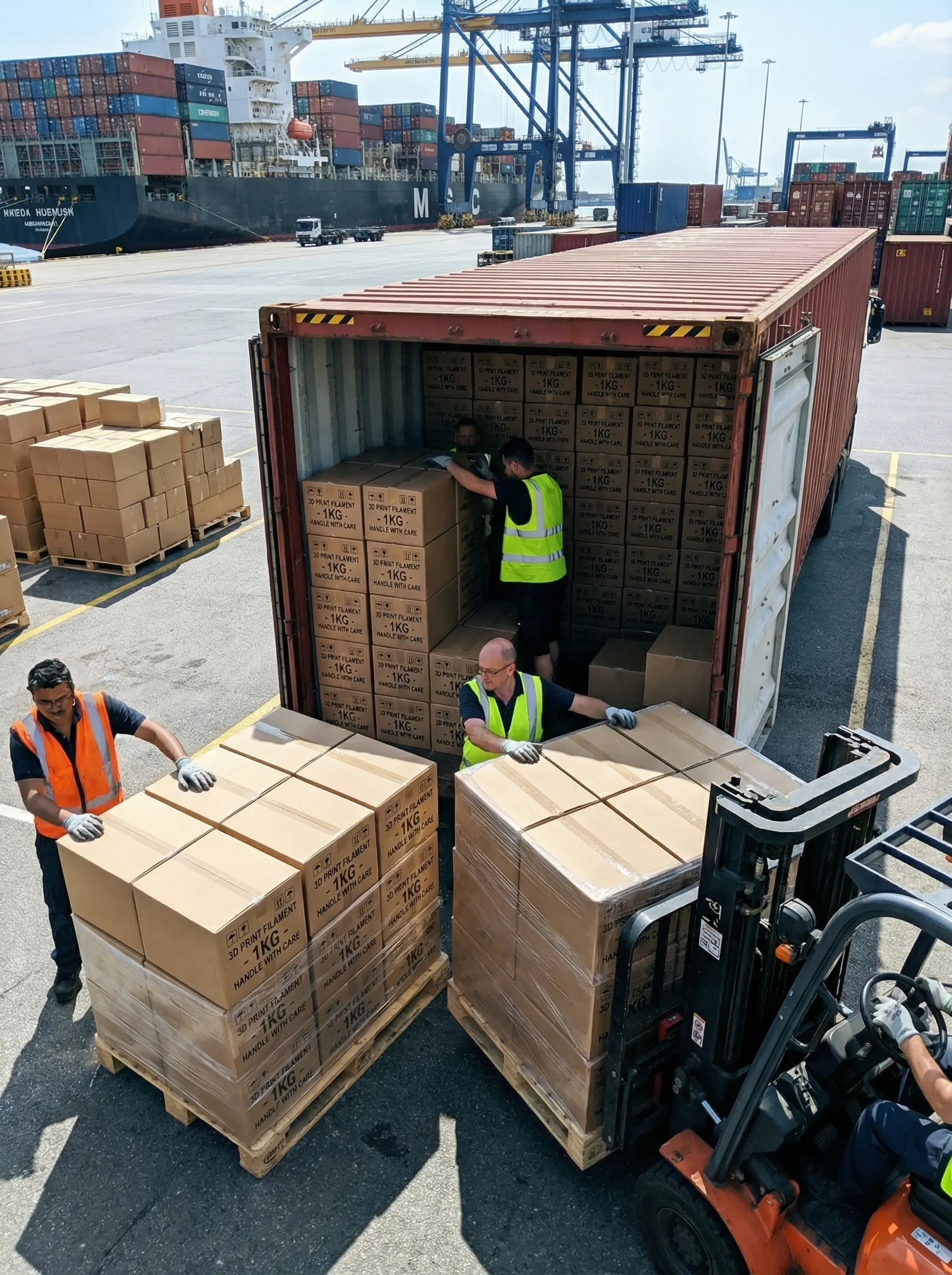
Packaging: Vacuum-sealed bag with desiccant, individual carton box. Customs: DDP and DAP terms available.
Bulk Orders & OEM/ODM Services
| 📊 Flexible MOQ | Trial orders to large-volume production. Free samples available for qualified business customers who want to validate high-speed profiles before committing. |
| 💰 Volume Pricing | Tier breakpoints: 100kg+, 500kg+, 1000kg+ with progressive discounts — sized for print farms and distributors restocking monthly. |
| 🎨 Custom Colors (OEM/ODM) | • Custom red shades matched to brand or corporate color standards • Private label packaging and branded spools • Custom spool sizes (0.5kg, 2kg, 3kg, 5kg) for farm feeding systems • Co-branded retail boxes |
| 🎁 Free Sample Program | Evaluation samples for qualified business customers — benchmark the speed ceiling, color accuracy, and packaging on your own machines before a volume order. |
Storage & Handling Guidelines
| Storage Guidelines | |
|---|---|
| Temperature | 15–25°C (59–77°F) |
| Humidity | Below 50% RH — moisture causes popping and flow instability, which high-speed printing amplifies |
| Shelf Life | 24 months (unopened, vacuum sealed) |
| Drying (if needed) | 45°C for 4–6 hours after extended open-air exposure |
| Light Exposure | Avoid direct sunlight — prolonged UV can dull red pigment saturation over time |
| Handling | Secure the filament end in the spool holes when unloading — a crossed strand is the #1 cause of mid-print failures on unattended farm machines |
Printer Compatibility
This filament works with any 1.75mm FDM/FFF 3D printer — from open-frame bedslingers to enclosed CoreXY flagships. Only the top of the speed range depends on your machine’s motion system and hotend flow limit; the material itself needs nothing beyond a standard 0.4mm brass nozzle.
| Bambu Lab X1C, P1S, A1, A1 mini | Creality K1, K1 Max, Ender 3 series | Prusa MK4, MK4S, MINI+, XL | Anycubic Kobra 2, Kobra 3 | Voron / Sovol 2.4, Trident, SV07 | Elegoo / QIDI Neptune 4, Q1 Pro, X-Max 3 |
Why Choose SigmaFilament for High Speed PLA
| 🏭 Direct Manufacturer | Factory-direct pricing from Guangdong, China with full control over compounding, pigment dispersion, extrusion, winding, and packaging — no reseller markup between the extrusion line and your print farm. |
| ⚡ Speed-First Formulation | Melt-flow behavior tuned specifically for the 30–600mm/s window, verified per batch — not standard PLA relabeled with a speed claim. |
| ✅ Quality Assured | ±0.03mm tolerance, ISO 9001 quality management, RoHS compliance, vacuum-sealed packaging with desiccant on every spool. |
| 🌍 Global B2B Service | English-speaking support across EU/US business hours, DDP/DAP shipping terms, and export documentation handled for wholesale customers. |
| 🔧 Full OEM/ODM | Custom red shades, private label packaging, custom spool formats, and co-branded retail boxes — one factory covering the whole program. |
Frequently Asked Questions About Red High Speed PLA Filament
Ready to Run Red at 600mm/s?
Contact SigmaFilament today for bulk pricing, free samples, or to discuss your OEM/ODM requirements — including custom red shades, private label packaging, and custom spool formats for farm feeding systems.
📧 Email us for a quick quote · 🌍 Worldwide shipping with DDP/DAP terms · 🎁 Free samples for qualified customers
| Filament Diameter | 1.75mm ,2.85mm (3.00mm) |
|---|---|
| Spool Weight | 1kg ,3kg ,5kg ,Sample (200g) |