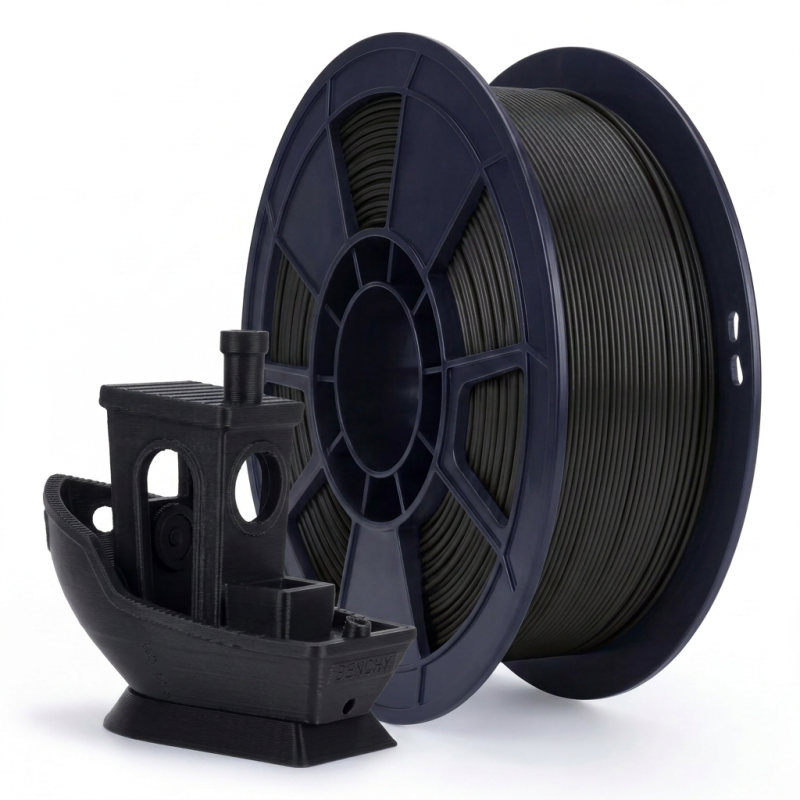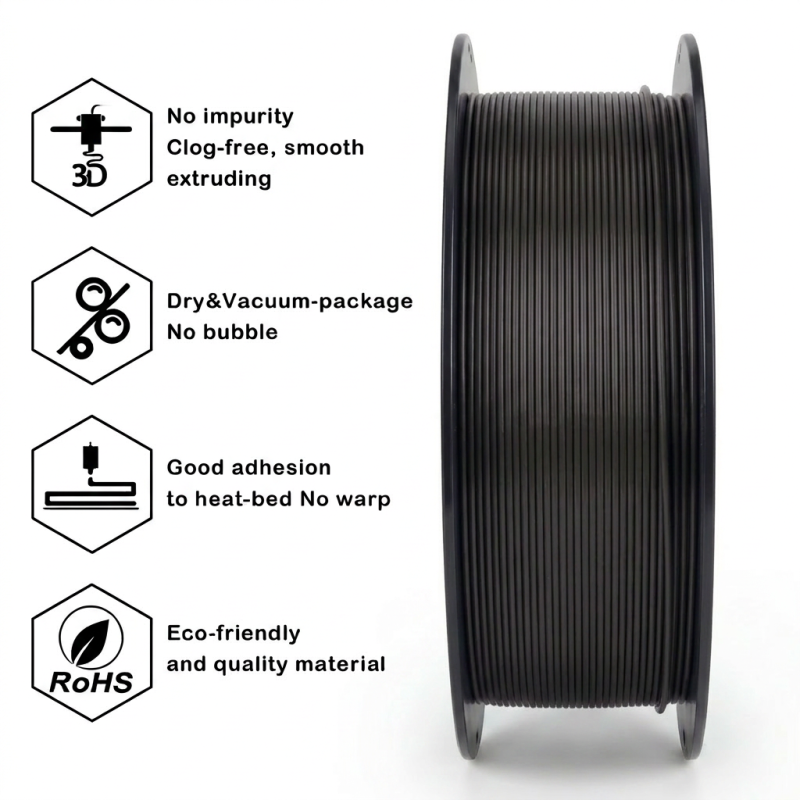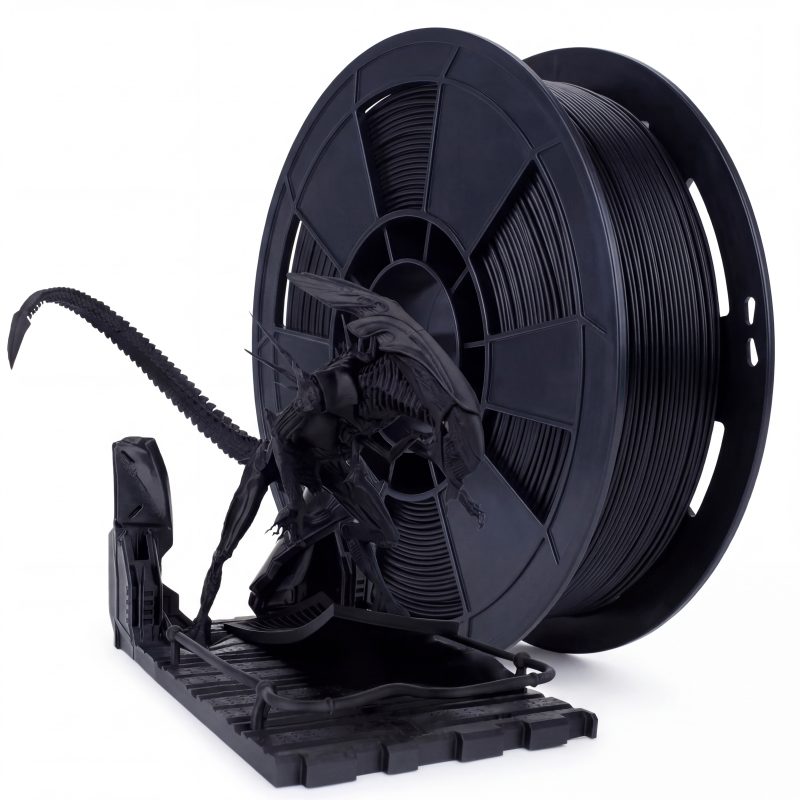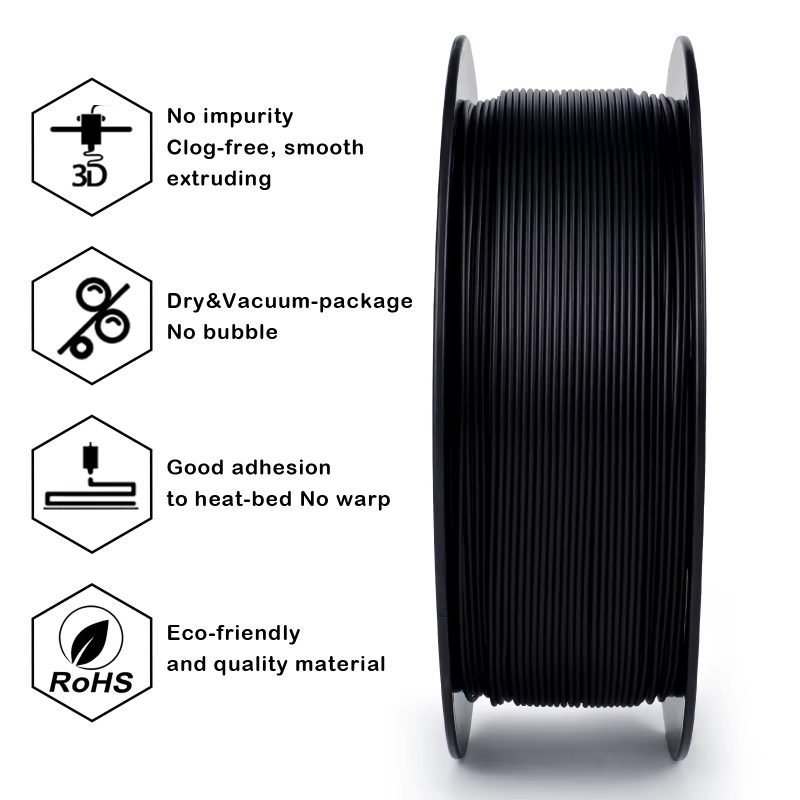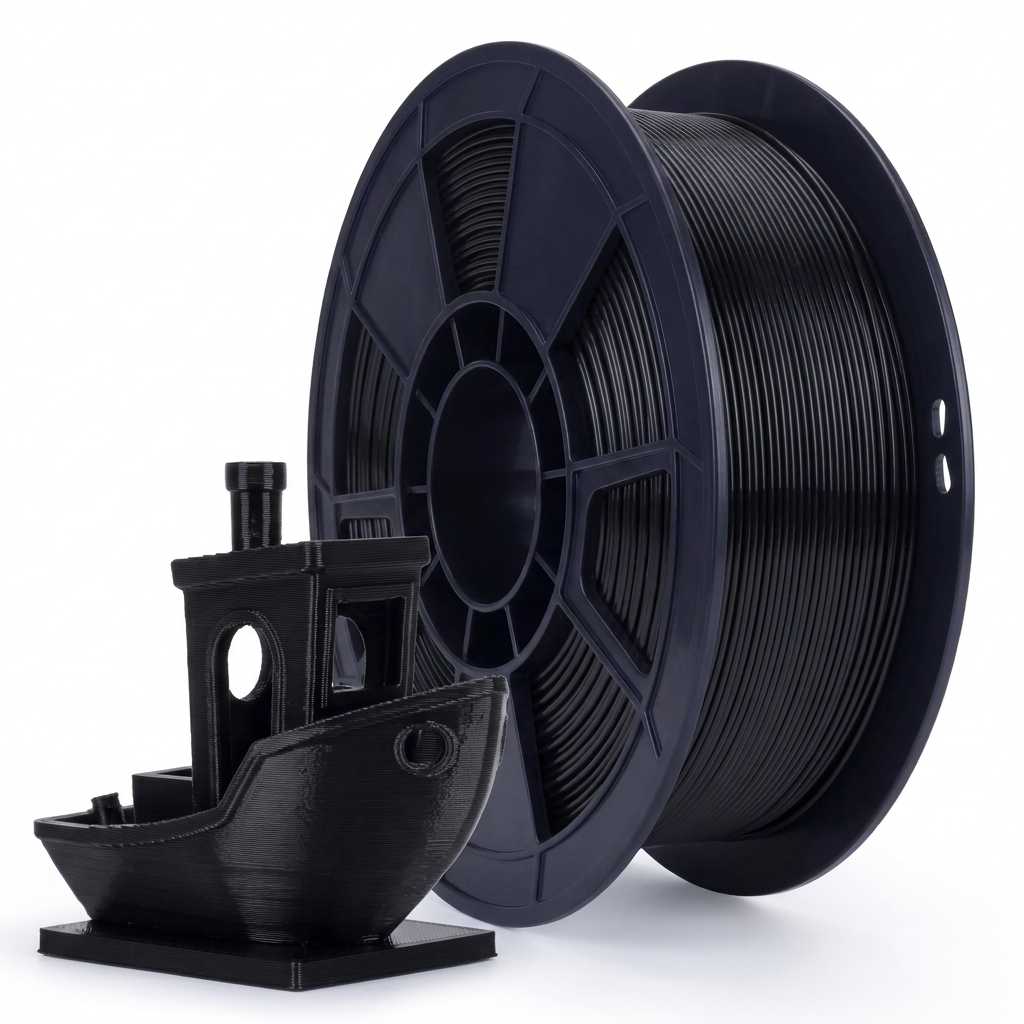
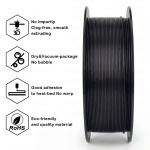
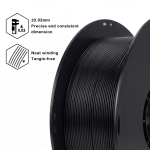
High Speed PETG Filament Black – Product Overview
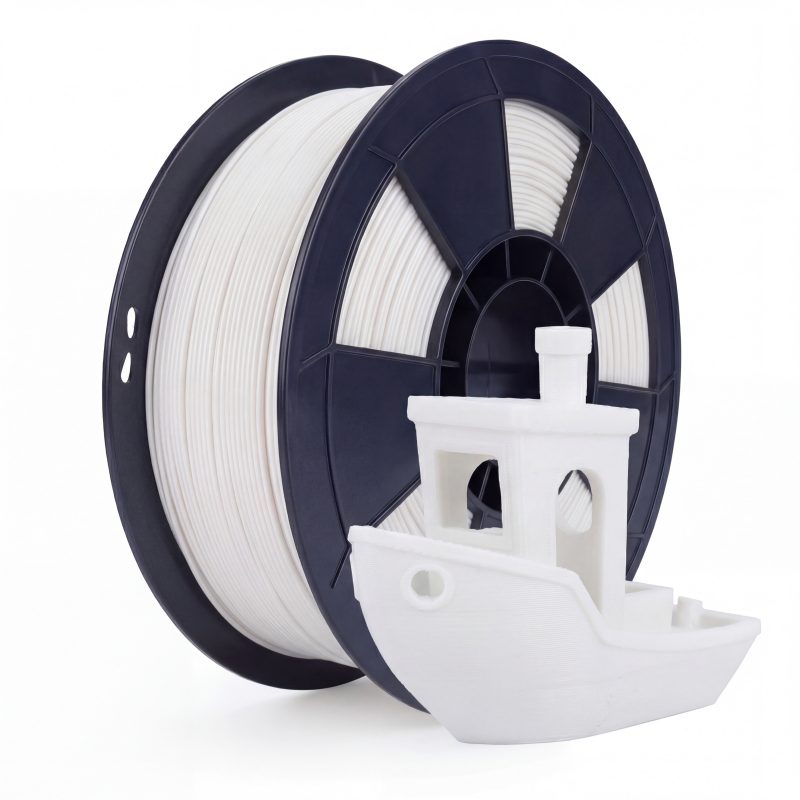
The SigmaFilament high speed PETG filament in Black is built for one job: producing functional, end-use parts at production throughput. The high-flow PETG formulation melts quickly and evenly, holding interlayer bonding at print speeds up to 600mm/s—so brackets, housings, mounts, and fixtures that used to take four hours come off the plate in under one, without turning brittle the way standard PETG does when pushed past its flow limit.
Black is the default color of working parts for a reason. It matches electronics, tools, vehicles, and machinery; it hides workshop grime and handling marks; and PETG’s natural gloss gives visible surfaces an injection-molded look that flat black PLA can’t match. On matte-textured build plates the first layer picks up a uniform satin finish, while side walls print with a deep gloss-black sheen—two finishes from one spool, both of which conceal layer lines far better than lighter colors do.
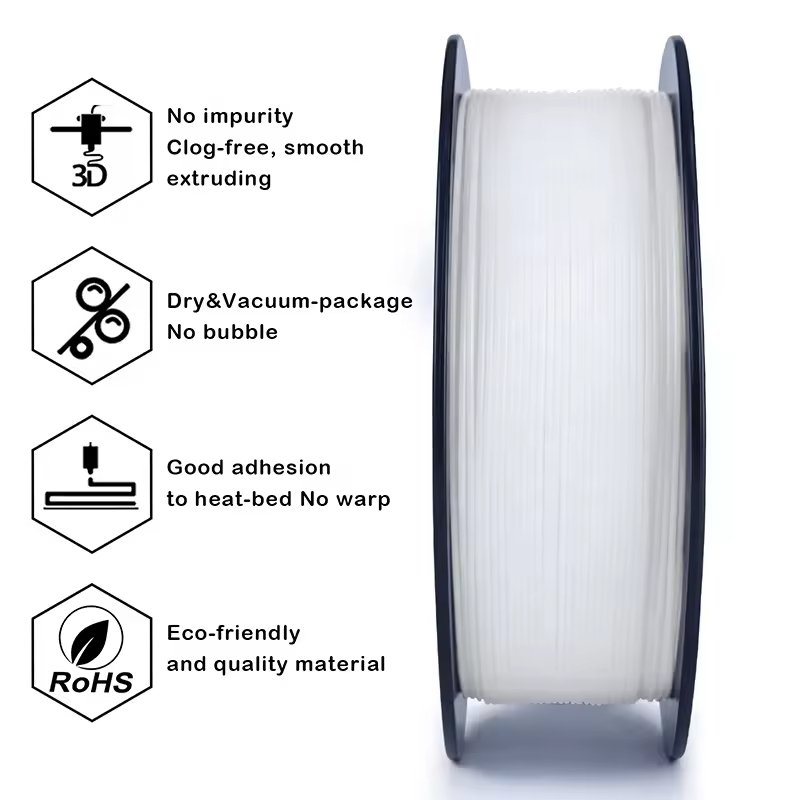
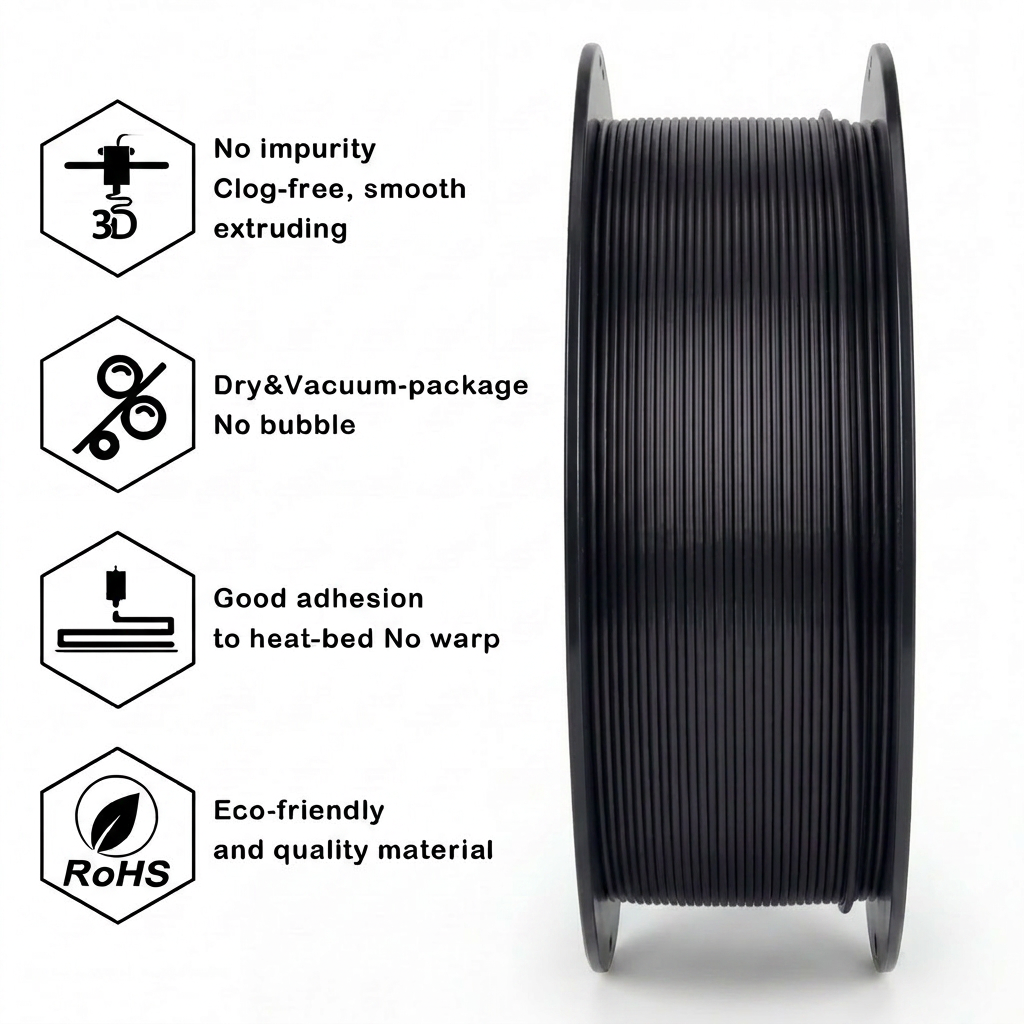
Underneath the finish is the material working parts actually need: PETG’s chemical resistance against acids, alkalis, alcohols, oils, and household cleaners; moisture repellence and weather tolerance for outdoor service; and ductile toughness that absorbs impacts instead of shattering. Manufactured in Guangdong, China with ±0.03mm diameter tolerance, vacuum sealed with desiccant, and RoHS/REACH compliant. Free samples, volume pricing, and full OEM/ODM support are available for print farms, resellers, and brands.
Why This High Speed PETG Filament Stands Out
⚡ End-Use Parts at Print-Farm Throughput
Most PETG forces a choice: print slow and get strong parts, or print fast and get delamination. This high speed PETG filament is compounded specifically to remove that trade-off—the resin’s melt flow is tuned so full interlayer fusion happens inside the shorter contact window of a fast toolhead.
- 30–600mm/s Working Range — One spool covers everything from careful 30mm/s bridging to full-speed 600mm/s infill on high-flow machines; no separate “slow PETG” and “fast PETG” inventory needed
- Layer Adhesion That Survives Speed — The high-flow base resin reaches full melt faster, so layers fuse properly even when each one gets only a fraction of a second of contact time
- Consistent Deep Black — High pigment loading with uniform dispersion delivers the same black on every spool and every batch—critical when a customer’s product line mixes parts printed months apart
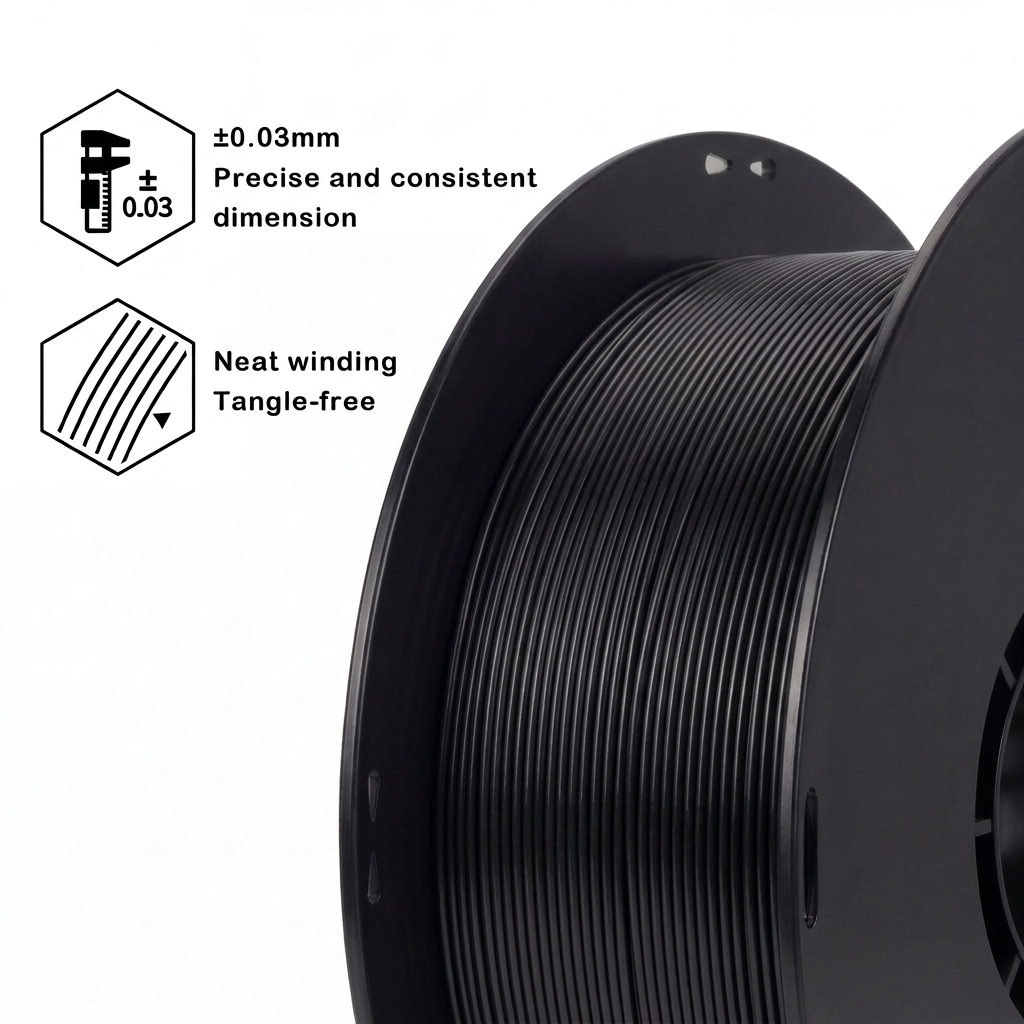
- ±0.03mm Diameter Control — At 600mm/s, a diameter blip that a slow printer shrugs off becomes a visible flow defect; tight tolerance keeps extrusion pressure stable at exactly the speeds where it matters most
- Built for Unattended Runs — Tangle-free precision winding and clog-free filtered compounding are what let a print farm start a 60-hour queue on Friday and collect parts on Monday
- Chemical & Weather Duty — Unlike high speed PLA, finished parts tolerate solvents, fuels splash, cleaning agents, damp garages, and outdoor mounting—so “fast” no longer means “indoor decorative only”
Speed is only useful if the parts that come off the plate are parts you can ship. This filament is engineered so both statements stay true at once.
Premium High Speed PETG at Factory-Direct Pricing
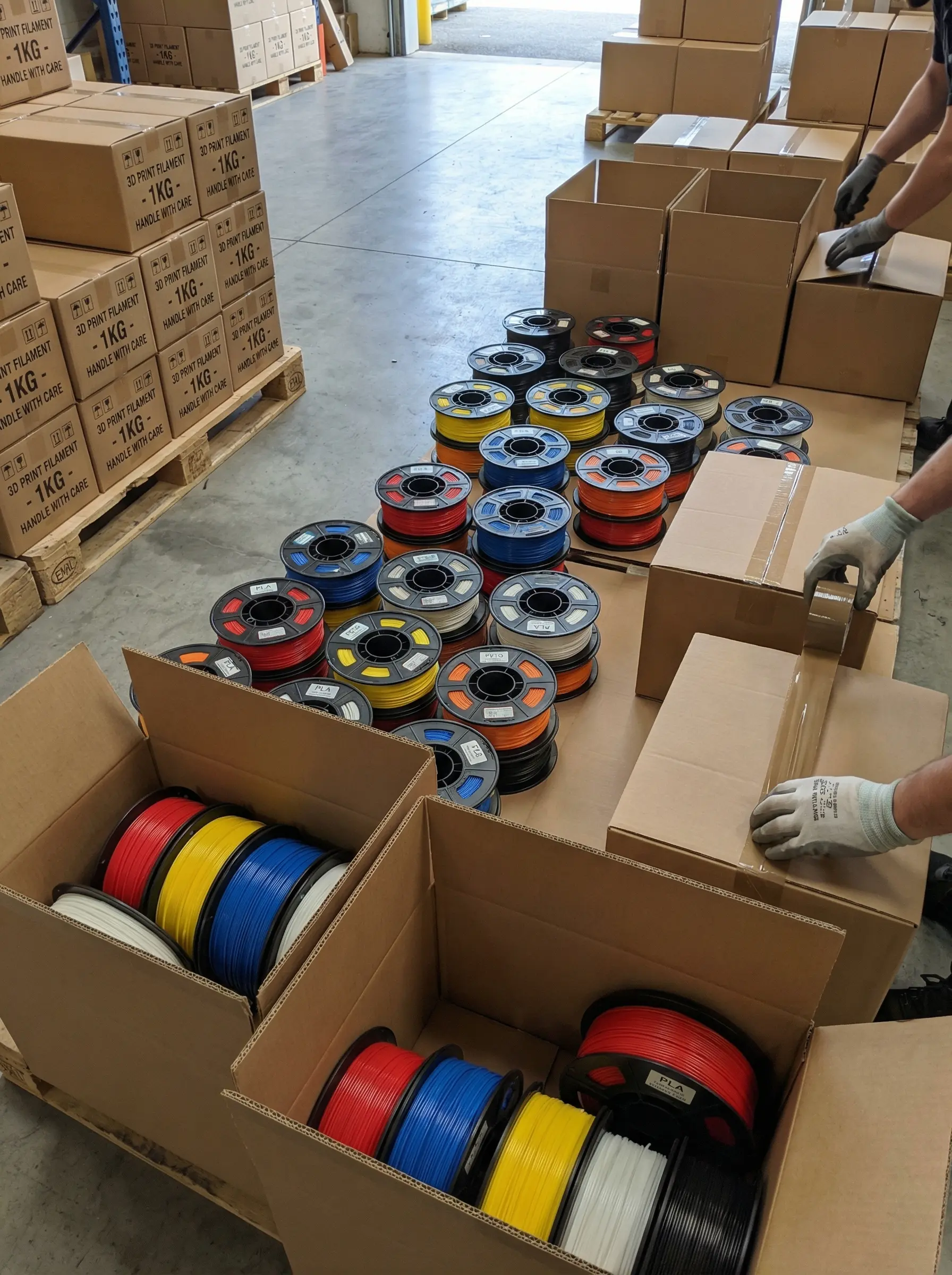
SigmaFilament is a direct manufacturer based in Guangdong, China. We compound, extrude, wind, and pack every spool of high speed PETG filament in-house, alongside the rest of our PETG range—so production buyers get high-flow performance at raw-material economics, not reseller markup.
| ⏱️ Throughput Economics | 💰 Factory-Direct Pricing | 🔁 Batch Repeatability |
| Cutting print time by 50–70% multiplies the output of every machine you already own—the cheapest capacity upgrade a farm can buy | No middlemen, no brand tax—volume discounts at 100kg, 500kg, and 1000kg+ tiers keep per-part material cost predictable | Same black, same flow behavior, same tolerance—reorder six months later and your slicer profiles still work unchanged |
Why Choose Black High Speed PETG for Your Projects
| 🔩 Production Bracket Standard | Camera mounts, sensor brackets, cable management, wall hooks, shelf supports—the bread-and-butter SKUs of every functional print catalog are overwhelmingly ordered in black. Stocking one fast black PETG covers the majority of end-use demand with a single slicer profile and a single inventory line. |
| 🧪 Chemical Exposure Duty | PETG shrugs off contact with alcohols, dilute acids and alkalis, oils, greases, and cleaning agents that visibly soften or craze PLA. For workshop organizers, spray-bottle parts, battery holders, and anything that gets wiped down with disinfectant, black PETG is the low-drama choice—and black additionally hides the staining that chemical contact leaves on lighter parts. |
| 🌦️ Outdoor & Vehicle Service | Moisture repellence and weather tolerance let black PETG parts live outdoors—hose guides, antenna mounts, garden fixtures, trailer clips—where PLA slowly deforms in summer heat. Black pigment also masks the gradual surface dulling that long UV exposure causes on any thermoplastic, so aged parts keep looking intentional. |
| 🖥️ Electronics & Enclosure Match | Routers, printers, monitors, chargers, lab equipment—consumer and industrial electronics default to black. Enclosures, lids, brackets, and replacement panels printed in this PETG sit next to injection-molded housings without announcing themselves as 3D printed, and the gloss side walls read as “product,” not “prototype.” |
| ✨ Gloss That Hides Layers | Dark colors conceal layer lines better than light ones, and PETG’s natural surface gloss deepens the effect—the eye reads reflection, not topology. At the 0.2–0.28mm layer heights used for fast functional printing, black is the most forgiving color you can run, which means less post-processing per sellable part. |
| 🌡️ Heat Margin Over PLA | With a glass transition around 80°C, PETG keeps its shape in parked cars, sunny windowsills, and near warm electronics—exactly the environments where black parts (which absorb more solar heat) get punished. A black PLA bracket on a dashboard is a known failure; a black PETG one is a normal application. |
High Speed PETG vs. Standard PETG vs. High Speed PLA vs. ABS — Comparison
| Property | High Speed PETG (This) | Standard PETG | High Speed PLA | ABS |
|---|---|---|---|---|
| Max Practical Speed | ★★★★★ Up to 600mm/s | ★★☆☆☆ 30–60mm/s | ★★★★★ Up to 600mm/s | ★★★☆☆ Moderate |
| Toughness / Ductility | ★★★★★ Ductile, impact-absorbing | ★★★★★ Ductile | ★★★☆☆ Stiffer, more brittle | ★★★★☆ Tough |
| Chemical Resistance | ★★★★★ Acids, alkalis, oils | ★★★★★ Same | ★★☆☆☆ Limited | ★★★☆☆ Moderate |
| Heat Tolerance | ★★★★☆ ~80°C Tg | ★★★★☆ ~80°C Tg | ★★☆☆☆ ~60°C Tg | ★★★★★ ~100°C Tg |
| Warping / Ease of Printing | ★★★★☆ Low warp, no enclosure | ★★★★☆ Low warp | ★★★★★ Easiest | ★★☆☆☆ Enclosure preferred |
| Outdoor / Moisture Duty | ★★★★★ Weather-tolerant | ★★★★★ Same | ★★☆☆☆ Deforms in heat | ★★★★☆ Good |
| Printing Odor | ★★★★★ Very low | ★★★★★ Very low | ★★★★★ Very low | ★★☆☆☆ Noticeable |
| Best For | End-use functional parts at volume | Functional parts, no rush | Fast prototypes, models | High-heat mechanical parts |
Recommended Print Settings for High Speed PETG Filament
This filament behaves like well-mannered PETG at low speed and only asks for two things as you accelerate: more heat and honest cooling. If you already have a working PETG profile, start there, raise the speed in steps, and follow the notes below.
⚠️ Critical Notes for High-Speed PETG Printing:
- Scale temperature with speed — Run 230–235°C for careful sub-100mm/s work and move toward 245–250°C as speeds climb past 300mm/s; faster extrusion means less dwell time in the melt zone, so the hotend must work hotter to fully plasticize the strand.
- Know your volumetric flow limit — Speed × layer height × line width = mm³/s. If the result exceeds what your hotend can melt, you get under-extrusion regardless of what the speed slider says. Cap your slicer’s volumetric flow at your hotend’s rated limit and let it govern speed automatically.
- Print dry, always — PETG is hygroscopic, and at high flow rates absorbed moisture flashes into steam aggressively: stringing, popping, and foamy surfaces appear sooner than they would at 40mm/s. If a spool has been open more than a couple of weeks, dry it at 60–65°C for 4–6 hours first.
- Moderate cooling, not maximum — 30–50% fan preserves layer bonding; 100% fan at 600mm/s can quench layers before they fuse. Increase cooling only for bridges and overhangs, ideally via your slicer’s dynamic fan controls.
- Keep PETG off bare smooth PEI — PETG bonds aggressively to smooth PEI and can tear the coating on part removal. Use textured PEI, or apply a release layer (glue stick / window cleaner) on smooth sheets.
Optimal Print Settings for This High Speed PETG Filament
| Nozzle Temperature | 230–250°C (230–235°C below 100mm/s; 245–250°C above 300mm/s) |
| Bed Temperature | 60–80°C (70°C is a reliable starting point on textured PEI) |
| Print Speed | 30–600mm/s (200–300mm/s is the sweet spot for strength + finish on most CoreXY machines) |
| Layer Height | 0.2–0.28mm for production parts; 0.16mm for cosmetic surfaces |
| Cooling Fan | 30–50% general; boost for bridges/overhangs only |
| Wall Count | 3–4 walls for load-bearing parts; 2 walls for covers and shrouds |
| Retraction | 0.5–1.0mm at 30–40mm/s (direct drive); 3–5mm (Bowden); keep short to limit PETG stringing |
| Infill | 20–40% gyroid or grid for functional parts; 15% for enclosures |
| Volumetric Flow Cap | Set to your hotend’s rated mm³/s; this is the real speed governor at 600mm/s settings |
| Nozzle Type | Standard 0.4mm brass; high-flow or 0.6mm nozzle recommended to exploit the top speed range |
| Bed Surface | Textured PEI preferred; glue-stick release layer on smooth PEI or glass |
| Enclosure | Not required; open-frame printers are fine, avoid cold drafts |
| Drying (if needed) | 60–65°C for 4–6 hours. See our filament dryer settings guide |
💡 Pro Tip — Tune Speed by Flow, Not by the Speed Slider: The fastest reliable profile is found in three steps:
- Measure your ceiling — Print a max-flow test tower (extrusion rate stepped in 2mm³/s increments) and note where the surface starts to under-extrude. That number, minus 10% safety margin, is your machine’s real limit with this filament.
- Cap volumetric flow in the slicer — Enter that value as the volumetric speed limit, then set nominal speeds high (e.g., 400–600mm/s). The slicer will automatically slow only the moves that would exceed the melt limit—outer walls stay glossy, infill flies.
- Raise temperature with throughput — If you upgrade to a high-flow hotend or 0.6mm nozzle later, move nozzle temperature toward the top of the 230–250°C window to match the higher melt demand. Same spool, same profile logic, roughly double the output.
For black parts specifically: gloss shows tuning flaws less than light colors, but it does highlight blobs and seam zits under direct light. Enable seam-hiding (rear/sharpest-corner seam position) and your fast parts will pass retail inspection without sanding.
Technical Specifications
| Parameter | Specification |
|---|---|
| Material | High-flow PETG (polyethylene terephthalate glycol), speed-optimized formulation |
| Color | Black (deep jet black, glossy finish) |
| Series | HS-PETG (High Speed PETG) |
| Filament Diameter | 1.75mm (0.069 in) |
| Diameter Tolerance | ±0.03mm |
| Net Weight | 1kg (2.2 lbs) per spool |
| Nozzle Temperature | 230–250°C (446–482°F) |
| Bed Temperature | 60–80°C (140–176°F) |
| Print Speed | 30–600mm/s |
| Recommended Speed | 200–300mm/s (best strength-to-finish balance on stock high-flow hotends) |
| Surface Finish | Glossy side walls; satin first layer on textured plates |
| Bubbles in Filament | 100% bubble-free (vacuum extrusion + inline diameter monitoring) |
| Required Nozzle | Standard 0.4mm brass; high-flow/0.6mm recommended for 300mm/s+ |
| Enclosure | Not required (open-frame compatible) |
| Post-Processing | Sanding, drilling, tapping, machining; solvent smoothing not applicable (a practical advantage—parts resist solvents by design) |
| Drying Recommendation | 60–65°C for 4–6 hours if the spool has been open >2 weeks |
| Compliance | RoHS / REACH compliant |
| Packaging | Vacuum-sealed bag with desiccant, individual carton box |
| Manufacturing Origin | Guangdong, China |
| Free Sample | Available for qualified business customers |
| OEM/ODM | Available — Learn about our OEM services |
Material Properties & Performance
Mechanically, this high speed PETG filament delivers the ductile, impact-absorbing behavior PETG is chosen for—the high-flow modification is achieved through melt-rheology tuning, not by diluting the polymer with fillers, so finished parts keep the toughness and chemical resistance of a quality PETG. The values below are typical ranges for the material class; for a broader look at how PETG ranks against engineering and composite materials, see our strongest 3D printer filament guide.
Mechanical & Thermal Properties (Typical Values)
| Property | Typical Value | Test Standard |
|---|---|---|
| Tensile Strength | 45–52 MPa | ISO 527 / ASTM D638 |
| Flexural Strength | 60–75 MPa | ISO 178 / ASTM D790 |
| Flexural Modulus | 1,800–2,100 MPa | ISO 178 / ASTM D790 |
| Impact Strength (Izod, Notched) | 4–8 kJ/m² | ISO 180 / ASTM D256 |
| Elongation at Break | 15–25% (printed parts) | ISO 527 / ASTM D638 |
| Glass Transition Temperature | ~80°C (176°F) | ISO 11357 |
| Heat Deflection Temperature | ~68–70°C (0.45 MPa) | ISO 75 / ASTM D648 |
| Density | 1.27 g/cm³ | ISO 1183 |
| Shrinkage | 0.2–0.5% (low, minimal warping) | ISO 294-4 |
| Chemical Resistance | Resists dilute acids/alkalis, alcohols, oils, greases, household cleaners | — |
Printer-Specific Settings for High Speed PETG Filament
| Printer | Nozzle | Bed | Speed | Notes |
|---|---|---|---|---|
| Bambu Lab X1C / P1S | 245°C | 70°C | 200–300mm/s | Start from the Generic PETG HF profile; textured PEI plate, no glue needed; disable aux fan above 50% to protect layer bonding |
| Creality K1 / K1 Max | 245–250°C | 70°C | 300mm/s (600 burst) | The machines this class of filament was made for; Hyper PETG profile works as-is; dry filament is mandatory at these flow rates |
| Prusa MK4 / MK4S | 240°C | 75°C | 150–200mm/s | Use PETG profile with Input Shaper; textured sheet strongly preferred—PETG can damage smooth PEI without a release layer |
| Voron 2.4 / Trident (Klipper) | 245–250°C | 75°C | Up to 600mm/s | With a high-flow hotend (Rapido/Dragon HF class) and pressure advance tuned, this filament will use the full speed range |
| Elegoo Neptune 4 Pro / Plus | 240–245°C | 70°C | 150–250mm/s | Klipper firmware handles the speed well; keep the powerful part-cooling fan at ≤50% for PETG |
| QIDI X-Plus 3 / X-Max 3 | 245°C | 75°C | 250–350mm/s | High-flow stock hotend takes good advantage of this formula; chamber not needed—leave the door open for PETG |
Applications for Black High Speed PETG Filament
This high-flow black PETG earns its place wherever parts must survive real use and arrive on a deadline. These are the applications our production customers actually run it for.
| 🔩 Brackets, Mounts & Clips | Camera and sensor mounts, wall brackets, cable clips, monitor risers, VESA adapters, and shelf supports—the highest-volume functional SKUs in any print catalog. PETG’s ductility means clips flex instead of snapping, and black matches the hardware these parts attach to. At 200–300mm/s, per-part cost drops enough to compete with off-the-shelf plastic hardware. |
| 📦 Enclosures & Housings | Electronics project boxes, Raspberry Pi and controller cases, junction covers, battery holders, and replacement panels for appliances. The glossy black surface reads as injection-molded product, PETG tolerates the warmth of enclosed electronics where PLA sags, and the material’s low warp keeps large flat lids genuinely flat. |
| 🌦️ Outdoor & Garden Fixtures | Hose guides, drip-irrigation fittings, antenna mounts, license-plate frames, gate hardware, and birdhouse components. PETG’s moisture repellence and weather tolerance handle rain and humidity; the ~80°C glass transition survives summer sun exposure that permanently deforms PLA parts on the same fence post. |
| 🏭 Jigs, Fixtures & Tooling | Assembly jigs, drill guides, soldering fixtures, positioning gauges, and machine guards for workshops and light manufacturing. Chemical resistance matters here—cutting fluids, flux, IPA wipe-downs—and high-speed printing means a broken fixture is reprinted over lunch instead of overnight, keeping the line moving. |
| 🚗 RC, Drone & Vehicle Parts | Drone frames and camera gimbal guards, RC chassis components, dashboard mounts, trim clips, and interior organizers. Black is the native color of this entire category, PETG absorbs vibration and impact without cracking, and heat tolerance handles parked-car interiors that turn PLA accessories into modern art. |
| 🛒 Print-Farm Production SKUs | Etsy and e-commerce sellers running repeat functional products—organizers, stands, hooks, adapters—live or die on machine-hours per unit. A filament that cuts cycle time in half while holding a consistent retail-grade black across reorders directly raises margin per machine per day. This is the spool that becomes the farm’s default inventory line. |
Environmental & Safety Standards
| ✅ RoHS Compliant | Free of lead, mercury, cadmium, hexavalent chromium, PBB, PBDE, and other restricted heavy metals. Suitable for EU and global retail markets. |
| 🇪🇺 REACH Compliant | Formulated in line with EU REACH requirements on substances of very high concern—relevant for resellers and brands importing into the European market. |
| 👃 Low-Odor Printing | PETG prints with very low odor and no styrene-class fumes—suitable for offices, studios, and workshop spaces without dedicated ventilation. |
| 📦 Vacuum Sealed + Desiccant | 100% bubble-free vacuum extrusion plus moisture-proof packaging with desiccant—dry, print-ready filament straight out of the box. |
Packaging & Global Shipping
| Destination | Standard Delivery | Express Available |
|---|---|---|
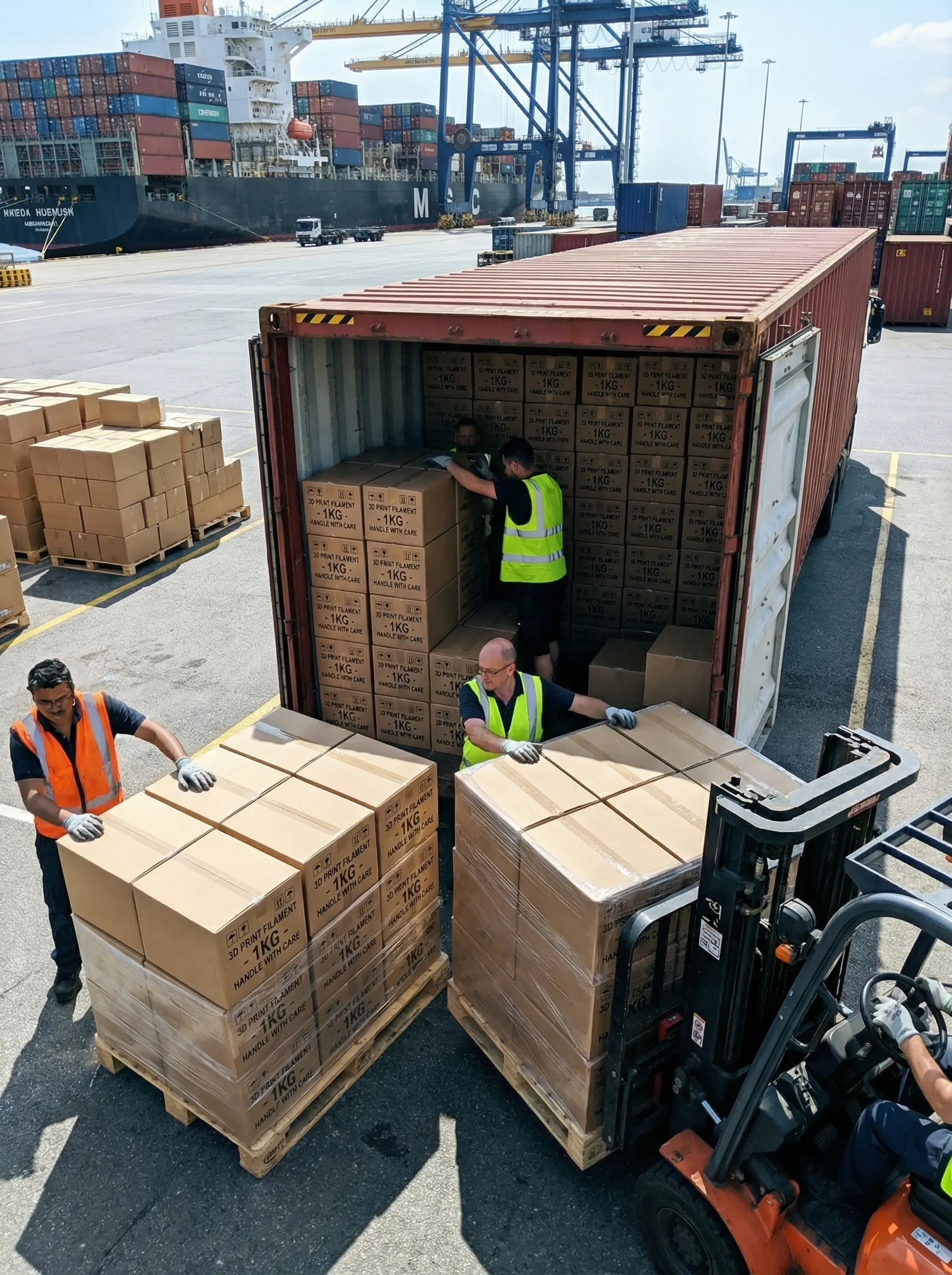
| European Union | 5–10 business days | ✓ 3–5 days |
| United States | 7–12 business days | ✓ 4–6 days |
| United Kingdom | 7–12 business days | ✓ 4–6 days |
| Canada | 8–14 business days | ✓ 5–7 days |
Packaging: Vacuum-sealed bag with desiccant, individual carton box; master cartons for volume orders. Customs: DDP and DAP terms available.
Bulk Orders & OEM/ODM Services
| 📊 Flexible MOQ | From trial cartons for print farms testing a new house filament to container-scale production supply. Free samples available for qualified business customers. |
| 💰 Volume Pricing | Tier breakpoints at 100kg+, 500kg+, and 1000kg+ with progressive discounts—black high speed PETG is a natural anchor SKU for standing monthly orders. |
| 🏷️ Private Label (OEM/ODM) | • Your brand on spool, box, and label • Custom black shades and finishes (jet, matte-tuned) plus full color matching • Custom spool sizes (0.5kg, 2kg, 3kg, 5kg) • Custom flow tuning for specific machine fleets • Retail-ready co-branded packaging |
| 🎁 Free Sample Program | Evaluation samples for qualified business customers—test flow behavior on your own fleet, verify black consistency against your existing SKUs, and validate packaging before committing to volume. |
Storage & Handling Guidelines
| Storage Guidelines | |
|---|---|
| Temperature | 15–25°C (59–77°F) |
| Humidity | Below 50% RH sealed; open spools in active use are best kept in a dry box (PETG is hygroscopic) |
| Shelf Life | 24 months (unopened, vacuum sealed) |
| Drying | 60–65°C for 4–6 hours after >2 weeks of open-air exposure; moisture symptoms (stringing, popping, matte rough surfaces) appear faster at high flow rates than at slow speeds |
| Light Exposure | Store away from direct sunlight; black pigment is UV-stable but prolonged heat from sun exposure can distort the spool |
| Handling | Keep the filament end secured in the spool’s parking holes—a loose end that slips under a winding is the classic cause of mid-print jams during long unattended runs |
Printer Compatibility
This filament works with any 1.75mm FDM/FFF printer that reaches 250°C and has a heated bed—the speed range simply scales to what your machine can deliver. Slow printers get an unusually forgiving PETG; fast CoreXY machines get their full rated throughput.
| Bambu Lab X1C, P1S, A1, A1 mini | Creality K1, K1 Max, Ender 3 V3 | Prusa MK4, MK4S, XL, MINI+ | Voron / Sovol 2.4, Trident, SV08 | Elegoo / QIDI Neptune 4, X-Plus 3 | Anycubic Kobra 2, Kobra 3 |
Why Choose SigmaFilament for High Speed PETG
| 🏭 Direct Manufacturer | Factory-direct pricing from Guangdong, China with in-house control over resin compounding, pigment dispersion, extrusion, winding, and packaging—no outsourced steps, no mystery batches. |
| ⚡ High-Flow Specialists | Our high speed lines (HS-PLA, HS-PETG, HS-ABS) share a melt-rheology platform developed specifically for the 300–600mm/s printer generation—flow behavior is engineered, not marketing-labeled. |
| ✅ Quality Assured | ±0.03mm tolerance with inline diameter monitoring, RoHS/REACH compliance, vacuum-sealed dry packaging, and per-batch color verification against the master black standard. |
| 🌍 Global Service | English-speaking support covering EU/US business hours, DDP/DAP shipping terms, and export documentation handled for you. |
| 🔧 Full OEM/ODM | Private label spools and packaging, custom shades and finishes, custom spool sizes, and flow tuning matched to your fleet—built for brands and farms that resell under their own name. |
Frequently Asked Questions About High Speed PETG Filament
Ready to Cut Your Print Times Without Cutting Corners?
Contact SigmaFilament today for bulk pricing, free samples, or to discuss OEM/ODM requirements for black high speed PETG—private label, custom spool sizes, and flow tuning for your fleet.
📧 Email us for a quick quote · 🌍 Worldwide shipping with DDP/DAP terms · 🎁 Free samples for qualified customers
| Filament Diameter | 1.75mm ,2.85mm (3.00mm) |
|---|---|
| Spool Weight | 1kg ,3kg ,5kg ,Sample (200g) |