Metal Filament 3D Printer: What Your Machine Actually Needs

TL;DR
A ‘metal filament 3D printer’ is an ordinary FDM printer qualified for an abrasive filament. Metal-FILLED composite prints on a well-qualified desktop machine and stays polymer; SINTERABLE filament prints a green part that a debind-and-sinter furnace turns into metal, with anisotropic shrinkage of roughly 15 to 20%, largest along the build direction, designed in at CAD time. Most printers qualify for the first after a nozzle change. None qualify for the second without furnace access.
Abstract
There is no consumer metal 3D printer. What the phrase "metal filament 3D printer" describes is an ordinary FDM machine qualified to run an abrasive, highly filled polymer. Two routes hide inside that qualification: a metal-filled composite that prints on a well-qualified desktop FDM machine and stays polymer forever, and a sinterable feedstock like the 316L class that prints a green part which only becomes metal after an external debind-and-sinter furnace, with anisotropic sinter shrinkage of roughly 15 to 20%, largest along the build direction, designed into the CAD file at the outset (Jacob et al., 2024; Tosto et al., 2024). On the second route the printer is often the cheap leg; furnace access is where the real capital cost sits (Jacob et al., 2024).
This guide is written for the engineer or shop owner standing in front of a specific FDM machine, wondering whether it counts as a metal filament 3D printer at all, and deciding whether it can do the job. What follows walks the two routes side by side, then works through the parts of the machine that decide which one it can run: nozzle material and diameter as an ongoing abrasion budget, the extruder architecture and drive-gear question, the hotend and chamber’s thermal requirements, and the furnace conversation the sinterable path forces before the first spool arrives. It closes with a checklist a reader can run against the printer on the desk in front of them, and a decision table mapping printer class to what it can build.
Key Takeaways
- No consumer metal 3D printer exists. There are ordinary FDM machines qualified for abrasive filaments, and there are furnaces.
- Metal-filled and sinterable are different capability questions, not two grades of the same product line.
- Brass nozzles are consumed rather than worn, so hardened steel is the practical floor for these filaments.
- Direct drive with a short constrained path beats Bowden on brittle, heavily filled composite filament every time.
- Sinterable printing requires furnace access and anisotropic sinter shrinkage of roughly 15 to 20%, largest in Z, designed into the part at CAD time.
- Most printers qualify for metal-filled after a nozzle change. None sinter without a furnace, no exceptions.
Table of Contents
- Abstract
- Key Takeaways
- There Is No Consumer Metal 3D Printer
- The Abrasion Budget: Nozzles Are a Consumable Now
- The Extruder: Why Bowden Struggles and Direct Drive Wins
- Hotend, Bed and Chamber: The Thermal Requirements
- The Sintering Route: A Capability, Not a Setting
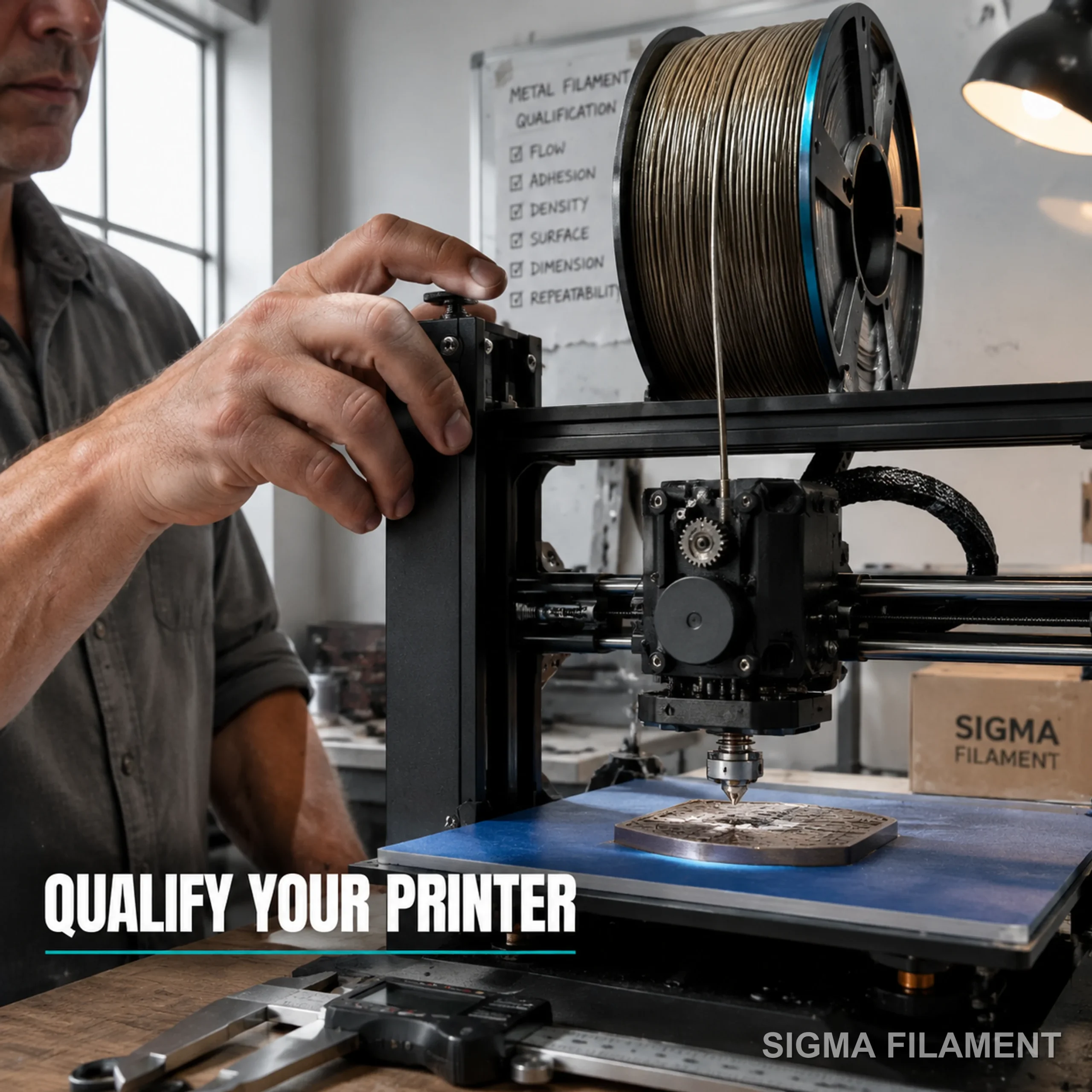
- Qualify Your Own Printer: A Checklist
- Buying the Filament: What to Specify
- Frequently Asked Questions
- Conclusion
- References
By the Numbers
- 15 to 20% linear sinter shrinkage in metal FFF, anisotropic and largest along the build direction (Jacob et al., 2024; Tosto et al., 2024)
- 120% XY, 126% Z CAD scale factors used on Ultrafuse 316L green parts to compensate for that shrinkage before slicing (Tosto et al., 2021)
- 0.6 mm practical minimum nozzle diameter for highly filled composite feedstocks (Tosto et al., 2021)
- 90 C bed temperature used to print sinterable 316L in a peer-reviewed study (Tosto et al., 2021)
Glossary
- Green part: the printed FDM part before any furnace step. On the sinterable route it is polymer bound around metal powder and still measures at the printer’s dimensions, not the final metal part’s.
- Brown part: the intermediate after debind and before sinter. The primary binder has been removed; a secondary polymer skeleton and metal-to-metal powder contacts still hold the geometry, and it is fragile.
- Debind: the catalytic or solvent step that dissolves the primary binder out of the green part before sintering.
- Sinter: the high-temperature furnace cycle under hydrogen or an inert atmosphere that fuses the remaining metal powder into a solid metal object.
- Metal-filled: a composite filament in which metal powder is suspended in a polymer matrix. The printed part stays polymer forever; no post-process converts it to metal.
- Sinterable: a feedstock like BASF Ultrafuse 316L whose printed green part becomes metal only after debind and sinter.
- Volumetric flow: the melt throughput a hotend can sustain, in cubic millimeters per second. It is the real speed ceiling on filled filaments, not the slicer’s print-speed setting.
- All-metal hotend: a hotend with no PTFE liner in the melt zone, required for matrix polymers whose melt temperatures would degrade PTFE.
- Bowden extruder: an extruder architecture in which the motor sits at the base of the machine and pushes filament through a PTFE tube to a distant print head.
- Direct drive: an extruder architecture in which the motor sits at the print head, so the unsupported filament path is short and buckling has little room to happen.
- Anisotropic shrinkage: direction-dependent shrinkage in which the part contracts by a different percentage along each axis. Isotropic shrinkage would contract equally in all directions; sintered 316L is anisotropic.
There Is No Consumer Metal 3D Printer
A metal filament 3D printer is not a distinct machine class. It is an ordinary FDM printer qualified to run an abrasive, highly filled polymer, and the phrase covers two routes that ask very different things from the machine. One route stays polymer forever. The other is not metal at all until a furnace has finished with it.
A metal filament 3D printer is an ordinary FDM machine, formally classed under ISO/ASTM 52900 in the same material-extrusion process family as any other desktop FDM printer (International Organization for Standardization, 2021; Jacob et al., 2024). Two filament routes exist: metal-filled composite, which stays polymer forever, and sinterable metal, whose printed part shrinks anisotropically, typically by 15 to 20% and most along the build direction, after a debind-and-sinter cycle (Jacob et al., 2024).
The other technology commonly called "metal 3D printing" is laser powder-bed fusion, and the confusion between the two is worth naming plainly. Powder-bed systems fuse loose metal powder with a laser to make a solid metal part in a single step, and they are what most people picture when they hear the phrase. Those systems are industrial capital equipment for aerospace, medical, and mold-tool work (Jacob et al., 2024). A metal filament 3D printer, by contrast, is the desktop or benchtop material-extrusion machine on the bench in front of you. Its fitness for this job comes down to a small set of hardware checks, not a purchase order.
Which of the two filament routes the reader actually needs decides everything else about the machine. The composite route asks for a nozzle upgrade and little more. The sinterable route asks for a full second stage of capital equipment, and its printed part is only a preview of the eventual metal one.
| Route | What the part is at the end | What the printer must have | What else you need | Best for |
|---|---|---|---|---|
| Metal-filled composite | Stays polymer forever, with a patina finish carrying real metal weight and feel | A well-qualified desktop FDM machine with a hardened-steel or better nozzle | Nothing beyond nozzle upgrades and a little post-polish | Decorative parts, prototyping, patina and weight cues |
| Sinterable metal (BASF Ultrafuse 316L class) | A true metal part after the furnace, in the same class as MIM stainless steel | Direct-drive FDM, hardened nozzle, all-metal hotend, heated enclosure | Debind and sinter access, and CAD scaled to about 120% XY and 126% Z to offset anisotropic shrinkage (Tosto et al., 2021; Tosto et al., 2024) | Small-batch stainless steel functional parts |
Two practical consequences follow. Composite filament produces a decorative object that looks and weighs like the base alloy but never becomes it; the metal powder is suspended in a polymer matrix that leaves the nozzle as polymer and stays that way. No heat, no post-process, no wash will convert the part into solid metal. The value is aesthetic and haptic: a printed housing that reads as bronze in the hand, a chess piece with the weight of the real thing.
Sinterable filament is different in kind. It prints a "green" part in which the polymer binder is a temporary carrier for the metal powder. A debind step removes the binder chemically or thermally, and a sinter step at temperatures near the alloy’s melting point fuses the remaining powder into a solid piece of stainless. The part shrinks anisotropically along the way, typically by 15 to 20% and most along the build direction (Jacob et al., 2024), which is why the CAD model must be scaled up before printing rather than corrected afterwards. Miss the compensation and the result is a beautiful undersized paperweight.
The chemistry of each family, the alloys involved, and how the powders are actually made are covered separately in metal-filled and sinterable metal filament.
The Abrasion Budget: Nozzles Are a Consumable Now
A metal-filled filament is a polymer matrix carrying a heavy load of powdered metal, and above a certain loading that powder does what powder does inside any narrow orifice: it scours. The nozzle you run today is not the nozzle you own next quarter. Brass in particular is not worn on this feedstock; it is consumed. The bore widens, the exit becomes ragged, and the geometry the slicer assumes stops matching the geometry the machine actually has. Bronze, copper, iron, tungsten and stainless powders all behave this way, and denser powders are worse because a heavier particle carries more inertia into the same tool steel.
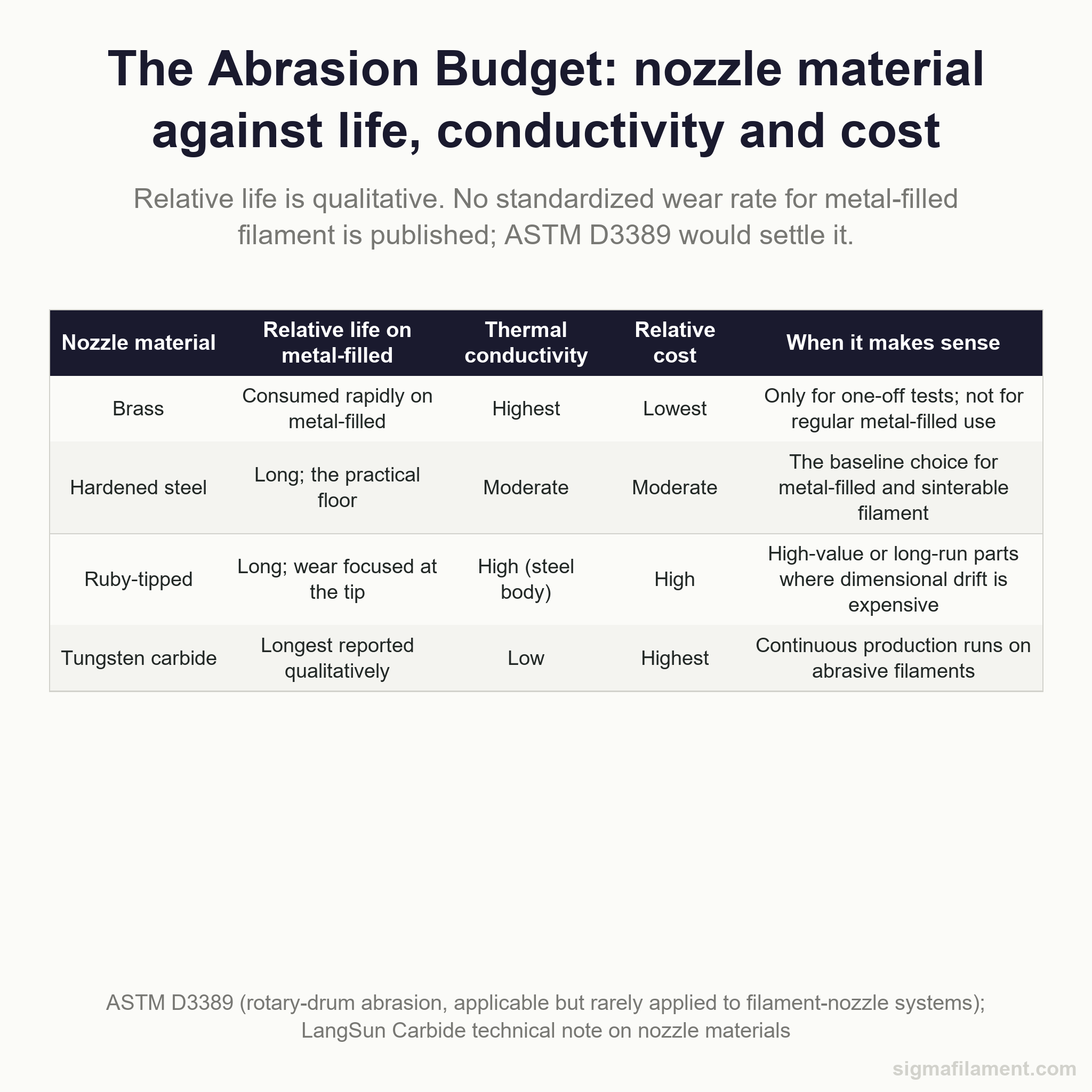
There is no standardized, peer-reviewed nozzle-wear rate for metal-filled filament. ASTM D3389 (the coated-fabric Taber rotary-platform abrader) and ASTM D4060 (organic coatings) are the nearest published abrasion methods, but neither is designed for filament-and-nozzle systems and the FFF industry rarely applies either to this problem (ASTM International, 2021). What exists is anecdotal and practitioner-reported, so any nozzle-life figure quoted to two significant digits should be read with that caveat.
The four materials in normal circulation for this problem each trade something. Brass buys speed and heat transfer. Hardened steel buys wear life at some cost in conductivity. Ruby-tipped nozzles concentrate wear resistance at the exit while keeping a steel body that still moves heat. Tungsten carbide is the far end of the wear curve and pays for it in thermal lag and price.
| Nozzle material | Relative life on metal-filled | Thermal conductivity | Relative cost | When it makes sense |
|---|---|---|---|---|
| Brass | Consumed rapidly on metal-filled | Highest | Lowest | Only for one-off tests; not for regular metal-filled use |
| Hardened steel | Long; the practical floor | Moderate | Moderate | The baseline choice for metal-filled and sinterable filament |
| Ruby-tipped | Long; wear focused at the tip | High (steel body) | High | High-value or long-run parts where dimensional drift is expensive |
| Tungsten carbide | Longest reported qualitatively | Low | Highest | Continuous production runs on abrasive filaments |
Thermal conductivity matters because the melt zone in an FDM hotend is shorter than most operators picture. A tungsten carbide tip bleeds less heat into the moving polymer than brass and needs more upstream temperature to hold the same volumetric flow. That is a slower calibration, not a harder one, but it is a real change to the machine profile that the operator should expect to re-tune once the nozzle material changes.
Nozzle diameter is a hardware tax, not a preference
A 0.4 mm nozzle is marginal on a highly filled feedstock. The agglomerates a heavily loaded polymer inevitably carries either clog outright or force retraction and pressure profiles a standard hotend cannot hold. The practical choice is 0.6 mm (Tosto et al., 2021).
That is a geometric cost the reader has to accept up front. Layer resolution and the minimum representable feature scale with the nozzle, so a fine thread, a shallow chamfer, or a wall much thinner than the nozzle diameter becomes unrepresentable at 0.6 mm where a 0.4 mm nozzle could have carried it. Some parts stop being printable on this machine as a result, and the answer is to reprofile the parts, not the nozzle.
A worn nozzle degrades parts before it clogs
A worn nozzle does not usually clog first. It drifts. Extrusion width becomes inconsistent, corners round, and dimensional accuracy walks off over the course of a spool before anything on the print screen looks wrong. Owners who use "it still prints" as the health check are shipping parts that measure out of spec on a caliper. If the print is a decorative bronze bust that is fine. If it is a mounting bracket that has to line up with a machined face, it is not. Track the nozzle by kilograms of filament run and by first-layer coupons, not by whether the machine still finishes a job.
The honest framing is the one to end on. Nozzle replacement is a recurring consumable cost, not a one-time hardware upgrade, and it is a legitimate reason not to run metal-filled on a machine whose output does not need the metal in it. Carbon-fiber loadings sit in the same abrasive-tax bracket for the same reason. If a finished polymer part serves the job, the printer does not have to be qualified for a filament it will only wear itself out on.
Your next step
Qualifying the printer’s nozzle, extruder and hotend answers only half the question: the material still has to hold its own tolerance once it is loaded onto that hardware. A specialty and high-performance filament line built for exactly this kind of demanding, closely toleranced feedstock runs behind 10,000 sqm of production floor, 20+ extrusion lines and roughly 30 tons/day of capacity, with every spool checked 70+ times against a documented defect rate under 0.01% and a +/-0.02mm tolerance band. Send your spec and request a sample and qualify it on your own bench before committing to a production run.
The Extruder: Why Bowden Struggles and Direct Drive Wins
Can a Bowden extruder print metal filament? Sometimes, briefly, rarely well. A Bowden path fights what a metal-filled filament is. The polymer matrix has lost most of the ductility that made it forgiving (Sturm, 2026), and under the compressive force needed to push viscous, heavily filled melt through a small nozzle, the unconstrained length prefers to buckle sideways rather than translate forward.
That is the mechanics of a Bowden extruder in one sentence. The motor sits at the base of the machine, the filament runs through a length of PTFE tubing to a print head that may be tens of centimeters away, and every centimeter of that path is unsupported. A well-behaved PLA absorbs the flex. A filament carrying a large fraction of metal powder does not. So buckling propagates, feed becomes inconsistent, and eventually the filament fractures inside a tube where nothing can see it while the extruder keeps grinding air.
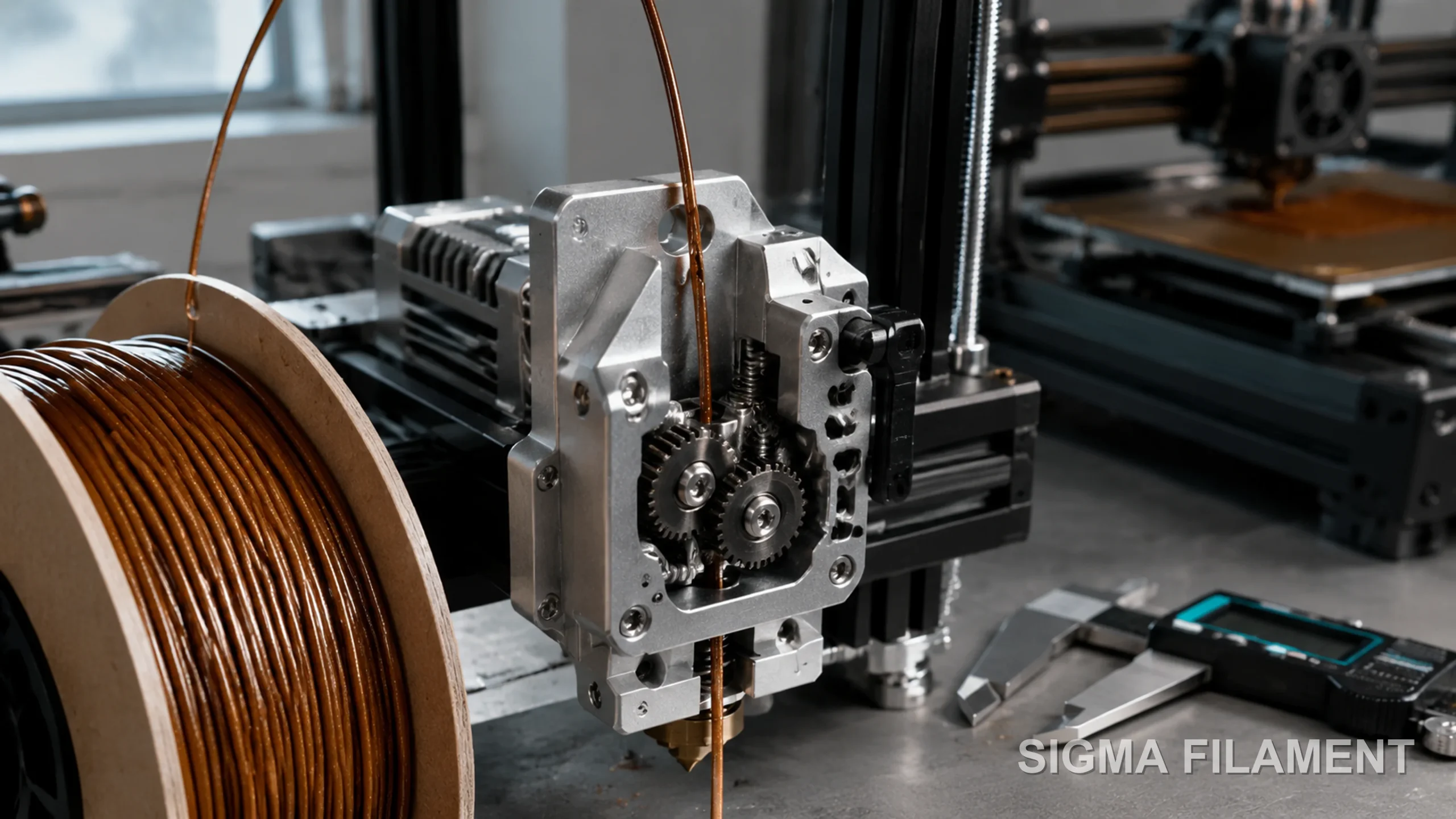
Direct drive removes most of the lever. The motor sits at the print head, the path from spool to hotend is short, and what remains can be constrained by a guide. Pushing force does not have to cross a soft tube, so buckling has almost nowhere to happen. Ultrafuse 316L itself is described in the peer-reviewed literature as usable in any Bowden or direct-drive extruder (Tosto et al., 2021), while practitioner accounts of the same brittle-filament failure mode converge firmly on direct drive on filled feedstocks.
The drive gear is a wear item too, and this catches people who assumed the nozzle was the only consumable. The gear teeth are biting into a matrix carrying abrasive metal powder every second the extruder runs, and a rounded-off gear slips before it fails outright. The first symptom is under-extrusion that reads convincingly as a partial clog: patchy walls, thin top layers, occasional gaps in what should be solid infill. A hardened or fully steel drive gear earns its price on any machine that runs metal-filled or sinterable material regularly.
Brittleness meets a second failure mode at the spool.
Minimum bend radius on a highly filled 1.75 mm filament is a geometry constraint, not a temperature you can tune around. VDI 3405 Part 4.1, the VDI guideline on characterizing filament for material extrusion, treats bendability as a filament parameter in its own section, next to moisture content and filler, and aims its test methods at factory certificates and incoming-goods inspection (Verein Deutscher Ingenieure, 2021).
The practical consequence is that a tight guide, a sharp turn out of the spool holder, or an unsupported reel snaps the filament in front of the extruder before the extruder ever sees it. Filament that arrives already cracked on the reel prints badly and misdirects the diagnosis toward the machine.
The practical rule is compact. Shorten and straighten the path from spool to nozzle. Constrain what remains of it. Use a hardened drive gear. Support the spool so it feeds without a hanging bend. Before blaming the printer, unwind a meter of filament and flex it in your hands: if it cracks, no extruder architecture is going to save the print, and the fault is upstream of the machine entirely.
Hotend, Bed and Chamber: The Thermal Requirements
The mistake buyers make when they qualify a metal filament 3D printer for a filled feedstock is to look at the metal powder and pick an all-metal hotend on that basis. The metal powder does not decide it. The matrix polymer does. A PLA-matrix composite runs fine through a PTFE-lined hotend because the melt zone stays below the PTFE’s degradation point. An ABS, polycarbonate or nylon matrix demands an all-metal hotend regardless of what the filler is, because PTFE at those setpoints outgasses and blocks the nozzle. Sinterable 316L prints hot as well, at a 240 C nozzle in one peer-reviewed study (Tosto et al., 2021), so plan on an all-metal hotend for it.
Heat creep is the second-order failure. A heavily filled filament carries a higher thermal mass into the melt zone than an unfilled polymer, and a wide nozzle asked for a high flow rate pulls that mass through faster than a marginal heat break can dissipate. The symptom looks like a feed problem: skipped steps, clicking, thin extrusion. The cause is a hotend that cannot keep the melt zone hot and the cold zone cold at the flow the slicer is asking for.
On a metal filament 3D printer, the pace of a print on filled feedstock is capped by how much melt the hotend can push each second: its volumetric-flow ceiling. Measure that ceiling on your own hotend with the spool you plan to run (step the feed rate up on a test extrusion until the line thins or the extruder clicks), because a metal-filament print calendar is set by the hotend, not the profile the slicer offers.
That volumetric-flow ceiling is what every buyer of a metal filament 3D printer discovers late. The job runs at that ceiling regardless of what the profile claims. Plan the calendar around the flow rate, not the marketing sheet.
Bed adhesion shifts because filler content changes shrinkage behavior, so first-layer discipline matters more on filled material than on the polymer alone: a clean, level bed at the correct temperature band, an adhesive that suits the matrix, and no drafts. The metal-filled route sits around 50 to 70 C at the bed and often works without an enclosure; sinterable 316L was printed on a 90 C bed in a peer-reviewed study (Tosto et al., 2021) and benefits from an enclosed chamber for warp control. For the wider enclosure decision, see the enclosed 3D printer buyer’s guide.
Retraction distances, per-material temperature profiles and slicer walkthroughs are printing-guide territory: see the printing guide for those. The machine itself, by route:
| Requirement | Metal-filled route | Sinterable 316L route |
|---|---|---|
| Hotend construction | Matrix-dependent: PTFE-lined acceptable for a PLA matrix; all-metal for ABS/PC or nylon matrix | All-metal hotend required |
| Bed temperature | 50 to 70 C typical (matrix-dependent) | About 90 C (Tosto et al., 2021) |
| Enclosure or chamber | Recommended for ABS or polycarbonate matrix; optional for PLA | Enclosure recommended for warp control |
| Realistic print speed | 15 to 40 mm/s on a well-tuned profile | 15 to 40 mm/s (Jasik et al., 2025) |
| Volumetric flow | Measure the ceiling on your own hotend with the metal-filled spool you plan to run | Measure the ceiling on your own hotend with the 316L feedstock you plan to run |
The Sintering Route: A Capability, Not a Setting
Do I need a furnace to 3D print metal? Yes. A sinterable filament like BASF Ultrafuse 316L prints a polymer-bound green part on an ordinary desktop FDM machine; that part becomes stainless steel only after a debind step removes the binder and a sinter cycle in a controlled-atmosphere furnace fuses the powder (Jacob et al., 2024; Lotfizarei et al., 2024). This decides whether you have the capability at all, not which metal filament 3D printer to buy.
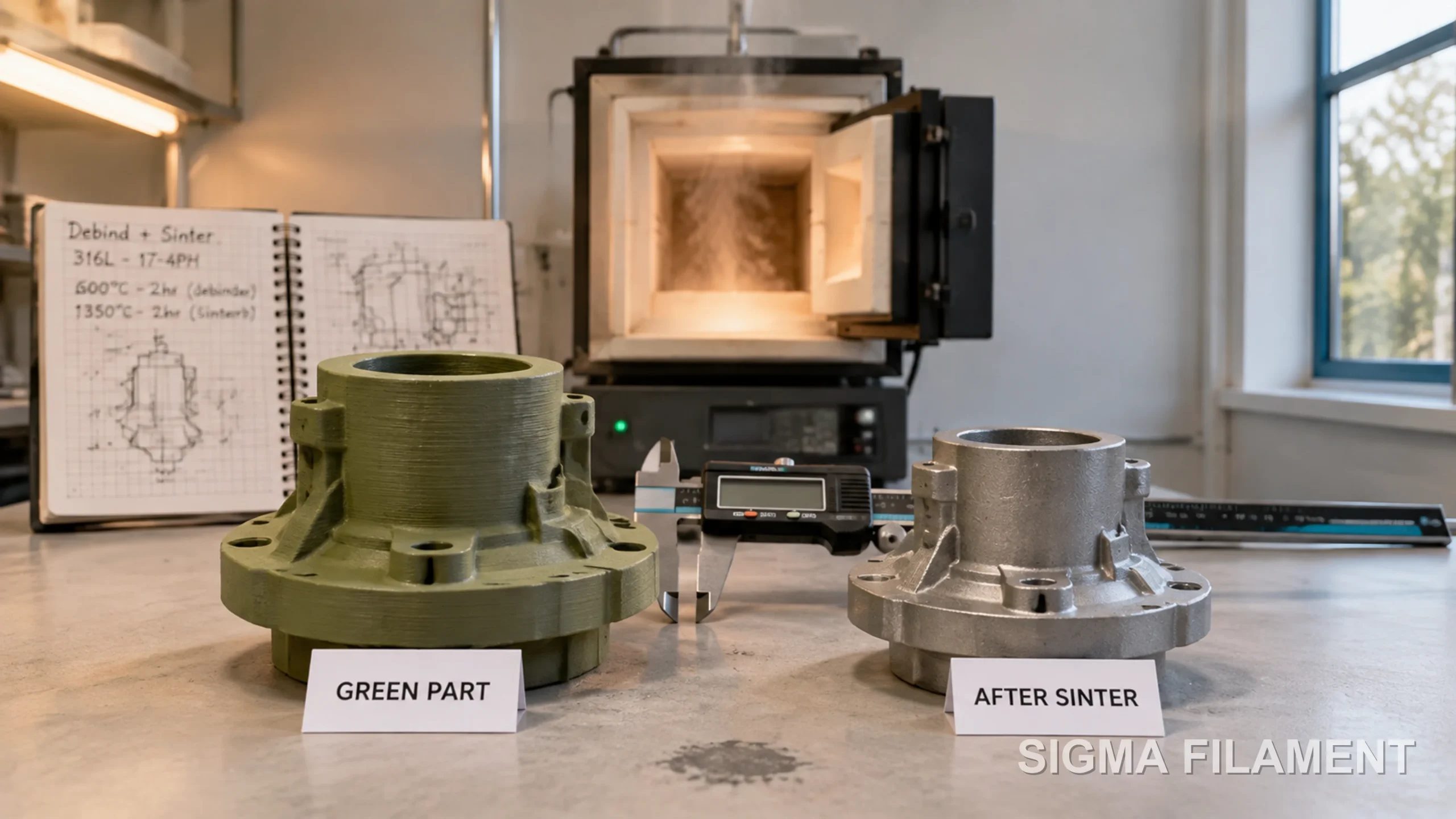
The workflow has three stages, and only the first happens in your shop. You print the green part on a qualified FDM machine. You hand it to a catalytic or solvent debind process that dissolves the primary binder, leaving a fragile brown part held together by a secondary polymer skeleton and metal-to-metal powder contacts. That brown part then goes into a sinter furnace under hydrogen or an inert atmosphere and is fired at high temperature until the powder densifies into a metal object (Jacob et al., 2024; Lotfizarei et al., 2024). The green part is not metal. The brown part is not metal. Nothing is metal until the furnace is done, and each of those intermediates is fragile enough that dropped or over-handled parts are scrap.
Shrinkage is a CAD decision, not a slicer setting
The single hardest lesson on the sinterable route is that the sintered part is materially smaller than the green part. Linear sinter shrinkage in metal FFF typically runs 15 to 20%, largest along the build direction, so the green part is drawn oversize at CAD time before slicing (Jacob et al., 2024; Tosto et al., 2024). One peer-reviewed study printed Ultrafuse 316L green parts with scale factors of about 120% in XY and 126% in Z, and its flat specimens shrank about 20% in XY and 25% in Z (Tosto et al., 2021). Trying to compensate after the fact by scaling the STL, tweaking flow, or "printing a little larger" fails, because shrinkage is not uniform under gravity: unsupported overhangs slump, thin walls warp, and long flat spans distort during sintering. Designs that survive the furnace are ones that were drawn for it.
Total cost of ownership, honestly
| Cost line | Composite (metal-filled) | Sinterable |
|---|---|---|
| Printer | The FDM machine you likely already own, qualified per the checklist | Same qualified FDM machine |
| Filament | Standard consumable, priced per kg | Priced per kg, typically higher than the polymer-only baseline |
| Debind and sinter access | Not required | In-house furnace as capital equipment, or a contract service bureau billed per batch |
| Calendar time per iteration | Print time only | Print time plus debind and a multi-day sinter cycle, plus ship-and-return if bureau |
| Designed-in shrinkage | Not required | Anisotropic (roughly 15 to 20%, largest in Z) at CAD time, non-negotiable |
Published price bands for turnkey debind-and-sinter appliances and for per-batch bureau rates vary widely by alloy, part volume, geography and furnace atmosphere, and no single reliable public figure covers the range. What determines your actual cost is which of the two you pick: capital equipment amortized across many parts, or a per-batch charge that stays constant.
Who should not do this
A shop that wants one or two metal parts, once, should almost never buy a furnace. A CNC quote or an industrial service bureau will deliver those parts faster, more predictably, and at lower total cost than qualifying a new capability. Buying a furnace to make two demonstrator parts is a capital-equipment mistake dressed as a capability upgrade. The sinterable route earns its complexity only when there are recurring low-volume metal geometries that machining quotes badly, and where the shrinkage design work amortizes across many iterations. If neither is true, the honest answer is to stay on the composite route for decorative and demonstrator parts and outsource the actual metal ones. The full print recipe for Ultrafuse-class filaments lives in the metal filament printing guide.
Qualify Your Own Printer: A Checklist
Run this against the machine on your desk before you order the spool. Each item is a check with a pass condition and a next step when it fails. Work top to bottom; a failure lower down is usually the cheaper fix.
A metal filament 3D printer is an ordinary FDM machine qualified to run an abrasive, highly filled polymer, and the current peer-reviewed review of metal fused filament fabrication frames the field the same way: the process is material extrusion with a hardened flow path, and any part that is genuinely metal at the end has passed through a debind-and-sinter step (Jacob et al., 2024).
The seven checks
| Check | Pass condition | If it fails |
|---|---|---|
| Nozzle material and diameter | Hardened steel at minimum, at a bore wider than the smallest feature you care about | Swap brass for hardened steel and step up to a wider bore on high-loading composite; brass is only defensible for a one-off decorative print |
| Extruder architecture and drive-gear material | Direct drive with a short, constrained filament path and hardened steel drive gears | Shorten and straighten a Bowden path, replace a plastic-toothed pulley with a hardened one, and inspect the drive gear as a wear item on filled stock |
| Hotend type against the intended matrix polymer | An all-metal hotend rated for the matrix polymer’s melt ceiling | Replace a PTFE-lined hotend before running a high-temp matrix, or restrict the printer to matrices the current hotend can safely carry |
| Filament path geometry and bend radius | No turn tighter than the filament’s minimum bend radius; the spool supported so the reel is not pulling the strand around a sharp corner | Reroute the path, add a rolling guide, and check the strand on the reel for cracks before loading |
| Bed surface and enclosure | Build surface and adhesive matched to the matrix polymer; an enclosure fitted if the matrix polymer requires one | Fit an appropriate build surface, and if the matrix warps, price a chamber into the project before the first spool; the enclosed 3D printer buyer’s guide covers the trade-offs |
| Achievable volumetric flow | Measured flow, not headline flow, that comfortably exceeds what the intended nozzle at the intended speed will demand | Drop the print speed, step down the nozzle bore, or fit a high-flow hotend; the printing guide carries calibrated targets |
| Furnace access and CAD shrinkage (sinterable route only) | Booked debind-and-sinter time, in-house or at a service bureau, and the CAD scaled up by the supplier’s published factor before slicing | Do not print. Without a furnace the green part never becomes metal; without the design scale-up it sinters undersized |
Which class of printer runs what
| Printer class | Metal-filled composite | Sinterable metal filament |
|---|---|---|
| Entry-level Bowden with a brass nozzle | Occasional prints only, and only after the brass is swapped; the drive path will still fight brittle stock | Not qualified |
| Mid-range direct-drive with a hardened nozzle | Qualified after the routine hardened-nozzle and hardened-drive-gear checks | Qualified for the print leg only if a furnace path exists off the printer |
| Enclosed industrial machine | Qualified, subject to hotend and drive gear matching the specific matrix | Qualified for the print leg; the sinter leg is still a separate booking |
| Any printer without furnace access | Not applicable | Not qualified. The bottleneck is the debind-and-sinter step, not the printer |
Two honest headlines fall out of the checklist. Most metal filament 3D printers qualify for the metal-filled route after a nozzle change, so the buying decision is about consumables cadence, not a new machine. No printer, at any price, qualifies for the sinterable route without furnace access, whether in-house capital equipment or a booked service-bureau slot.
Buying the Filament: What to Specify
Once your machine is qualified, the spool is the next variable. Metal-filled filaments carry 40 to 80 wt% metal powder in a polymer matrix, and that loading defeats the extrusion controls that hold commodity PLA to a tight diameter. Buyers should specify tolerance, filler dispersion, batch-to-batch loading, and packaging, and require documentation that names the test method (Tosto et al., 2021; Sturm, 2026).
Five things matter, in this order.
Diameter tolerance
A highly filled compound is harder to hold to tolerance than an unfilled one because the melt viscosity and thermal conductivity both shift with loading, and any variation moves the extruded diameter. On composites, ±0.03 mm is a working number; anything looser will fight your extruder before you diagnose anything else. Ask what the tolerance guarantee is and what fraction of the reel is measured, not the marketing round number.
Filler dispersion
The failure mode that catches buyers is agglomerates: local clumps of metal powder that read as clogs, inconsistent surface, and uneven extrusion width rather than as an obvious defect on the reel. A visibly clean strand can still fail this test. Compounding discipline and inline monitoring are what prevent it, and reels that pass a laser diameter sweep may still fail on dispersion if the compounding step was rushed.
Batch-to-batch metal loading
This matters on the metal-filled route because loading drives density and thermal behavior, and it matters doubly on the sinterable route because loading drives shrinkage. A loading swing between batches moves your part dimensions after sintering, so the CAD compensation you built for batch A produces out-of-tolerance parts from batch B. Require a stated loading window per batch and traceability back to the compounded lot.
Moisture and packaging
Metal-filled and matrix polymers absorb water. Insist on vacuum-sealed spools with a desiccant, an intact seal on arrival, and a stated moisture spec at pack time. A wet reel prints as popping, layer adhesion loss, and stringing that no slicer setting will fix.
Documentation that names the test method
A datasheet quoting a bare number tells you nothing. Insist on the method behind each figure: which ISO or ASTM procedure, which sample geometry, which conditioning. A tensile number without ISO 527 or ASTM D638 is a marketing figure. So is an abrasion claim that names no standardized abrasion method; ASTM D3389 (coated-fabric Taber abrasion) and ASTM D4060 (organic coatings) are the nearest published benchmarks.
What a manufacturer’s QC ought to look like matches this: an ISO 9001:2015 quality system on a real production floor with dual-axis laser diameter monitoring on every extrusion pass, ±0.02 mm on commodity grades, 70+ inspections per spool, and a documented defect rate below 0.01%. Ours runs 20+ extrusion lines in a 10,000 m² facility and ships to 200+ brands across 50+ export countries. Ask any supplier for those numbers before the sample ships.
Frequently Asked Questions
Can any 3D printer use metal filament?
No. Any FDM machine can attempt it, but few pass a basic qualification: a hardened nozzle, a hotend rated for the matrix polymer, an extruder with enough torque, and a filament path that will not snap a brittle, heavily filled strand. Metal filament is a load on the machine, and an unqualified printer fails silently through dimensional drift and clogs long before it stops printing.
What kind of 3D printer do I need for metal filament?
A metal filament 3D printer is an ordinary FDM machine, qualified for the job. For metal-FILLED composites, most desktop printers pass after a nozzle swap and a shorter, better-supported filament path. For SINTERABLE filament, add an enclosure, a direct-drive extruder, an all-metal hotend, and access to a debind-and-sinter furnace. There is no separate class of consumer "metal" machine.
Do I need a hardened nozzle for metal filament?
Yes. Brass is a consumable at metal loadings, wearing visibly within kilograms of abrasive filament in practitioner reports (ASTM International, 2021; Jacob et al., 2024). Hardened steel is the practical floor for regular use; tungsten carbide is the long-life upgrade when nozzle changes become the operational bottleneck. ASTM D3389 (the coated-fabric Taber rotary-platform abrader) is the nearest published abrasion method, but it is rarely run against filament-nozzle systems, so the wear numbers you see are anecdotal.
Can a Bowden extruder print metal filament?
Yes, cautiously, and often no. A long unconstrained Bowden path fights a stiff, brittle filament: the strand snaps inside the PTFE tube on tight turns (Sturm, 2026; Forstner et al., 2024). Metal-FILLED spools can be coaxed through a short, well-supported Bowden setup with a straightened path. Sinterable filament under load is a different problem, and the supplier guidelines lean firmly toward direct drive with a short, straight path.
Do I need a furnace to 3D print metal?
It depends on which route. Metal-FILLED filament needs no furnace and never becomes metal; the print is a polymer composite with metal powder dispersed through it, decorative in intent. Sinterable filament (Ultrafuse 316L class) DOES need a furnace: the printed green part is polymer until catalytic debind and sintering drive off the binder and fuse the metal (Jacob et al., 2024). No furnace, no metal.
Is metal filament brittle?
Yes, and increasingly so at high filler loadings. Highly filled composites lose tensile flexibility as the polymer matrix carries more powder; the strand cracks under tight bend radii long before it fails in the nozzle (Sturm, 2026; Forstner et al., 2024). VDI 3405 Part 4.1, the VDI guideline on characterizing filament for material extrusion, lists bendability among the filament parameters it covers (Verein Deutscher Ingenieure, 2021). Straighten the path, support the spool, and inspect the reel before every job.
What is the difference between metal-filled and sinterable metal filament?
The end state. Metal-FILLED filament is a polymer composite whose print stays polymer forever: plastic loaded with metal powder, useful for decorative and weight-additive parts. Sinterable filament (BASF Ultrafuse 316L, Virtual Foundry Filamet) prints a green part that a debind-and-sinter furnace converts into dense metal, with substantial linear shrinkage designed into the CAD model up front (Jacob et al., 2024). Different capability, different route.
How much does metal filament cost for a 3D printer?
No comparable-across-vendors spool price is published, so a single figure would be invented rather than reported. What decides it: matrix polymer, metal loading (metal-FILLED at moderate loadings versus sinterable at very high loadings), alloy (bronze, copper, 316L, 17-4PH, tungsten), and spool size. The sinterable route also carries a separate per-batch debind-and-sinter cost, either as furnace capital or as a service-bureau charge.
Conclusion
Deciding on a metal filament 3D printer is a sequence of three questions, and they matter in order.
First, decide which route your part actually requires. Metal-filled composite and sinterable filament are different capability questions rather than two grades of one product, and buying the wrong one wastes the entire evaluation. A decorative polymer part with metal loading and a fully metallic sintered part leave the printer in different states, and one of the two demands a furnace.
Second, run the checklist against the printer you already own. Most machines pass for metal-filled after a nozzle change, and that is genuinely good news worth stating plainly. A hardened nozzle, a short constrained filament path, and a hotend matched to the matrix polymer will bring most well-maintained desktop machines into range without further capital.
Third, only if the sinterable route is genuinely required, price the furnace or the service bureau honestly before buying a spool. Debind-and-sinter equipment is capital, bureaus charge per batch, and both add calendar time a machining quote does not. For a shop that needs one or two metal parts, the machining quote is often the correct answer, and concluding so is not a failure of the evaluation. It is the point of running one.
References
- Jacob, J., Pejak Simunec, D., Kandjani, A. E. Z., Trinchi, A., & Sola, A. (2024). A review of fused filament fabrication of metal parts (metal FFF): Current developments and future challenges. Technologies, 12(12), 267. https://doi.org/10.3390/technologies12120267
- Jasik, K., Śnieżek, L., & Kluczyński, J. (2025). Additive manufacturing of metals using the MEX method: Process characteristics and performance properties: A review. Materials, 18(12), 2744. https://doi.org/10.3390/ma18122744
- Tosto, C., Tirillo, J., Sarasini, F., & Cicala, G. (2021). Hybrid metal/polymer filaments for fused filament fabrication (FFF) to print metal parts. Applied Sciences, 11(4), 1444. https://doi.org/10.3390/app11041444
- Lotfizarei, Z., Mostafapour, A., Barari, A., & Jalili, A. (2024). Analysis of metal fused filament fabrication process chain for 316L stainless steel. Manufacturing Letters, 41, 1022-1033. https://doi.org/10.1016/j.mfglet.2024.09.127
- Tosto, C., Saitta, L., Barbagallo, R., Blanco, I., & Cicala, G. (2024). Optimizing dimensional accuracy in metal fused filament fabrication: A study on shrinkage prediction for 316L parts. In 2024 IEEE International Conference and Exposition on Electric and Power Engineering (EPEi) (pp. 648-651). IEEE. https://doi.org/10.1109/epei63510.2024.10758154
- Sturm, M. (2026). Investigation of filler share influence in highly filled carbon polymer compounds (>50 vol%) with material extrusion (MEX) based additive manufacturing. Next Research, 4, 101256. https://doi.org/10.1016/j.nexres.2025.101256
- Forstner, T., Cholewa, S., & Drummer, D. (2024). Influence of wax addition on feedstock processing behavior in additive manufacturing of metals by material extrusion. Progress in Additive Manufacturing, 9, 625-632. https://doi.org/10.1007/s40964-024-00671-4
- International Organization for Standardization. (2021). ISO/ASTM 52900:2021 Additive manufacturing – General principles – Fundamentals and vocabulary. ISO. https://www.iso.org/standard/74514.html
- ASTM International. (2021). ASTM D3389-21: Standard test method for coated fabrics abrasion resistance (rotary platform abrader). ASTM International. https://www.astm.org/d3389-21.html
- ASTM International. (2019). ASTM D4060-19: Standard test method for abrasion resistance of organic coatings by the Taber abraser. ASTM International. https://www.astm.org/d4060-19.html
- Verein Deutscher Ingenieure. (2021). VDI 3405 Part 4.1: Additive manufacturing processes – Amendment to ISO/ASTM 52903-1: Material extrusion of polymer parts – Filament characterisation. VDI. https://www.vdi.de/en/home/vdi-standards/details/vdi-3405-blatt-41-additive-manufacturing-processes-amendment-to-isoastm-52903-1-material-extrusion-of-polymer-parts-filament-characterisation
Last reviewed and updated: September 2026. Author: SigmaFilament Engineering Team. For custom filament solutions and wholesale inquiries, contact our team.