

Free Filament Samples for Wholesale Buyers — Tested on Your Machines, Not Our Datasheet
Request up to three 200 g sample spools, wound from the same production lots we ship by the pallet. Every box carries a lot-specific COA, the matching TDS, and physical colour chips. No deposit, no card, no sales call before you have the material in your hands.
- ISO 9001:2015 factory
- Dispatch in 3–5 business days
- Freight credited on your first order
- Reply within 24–48 hours
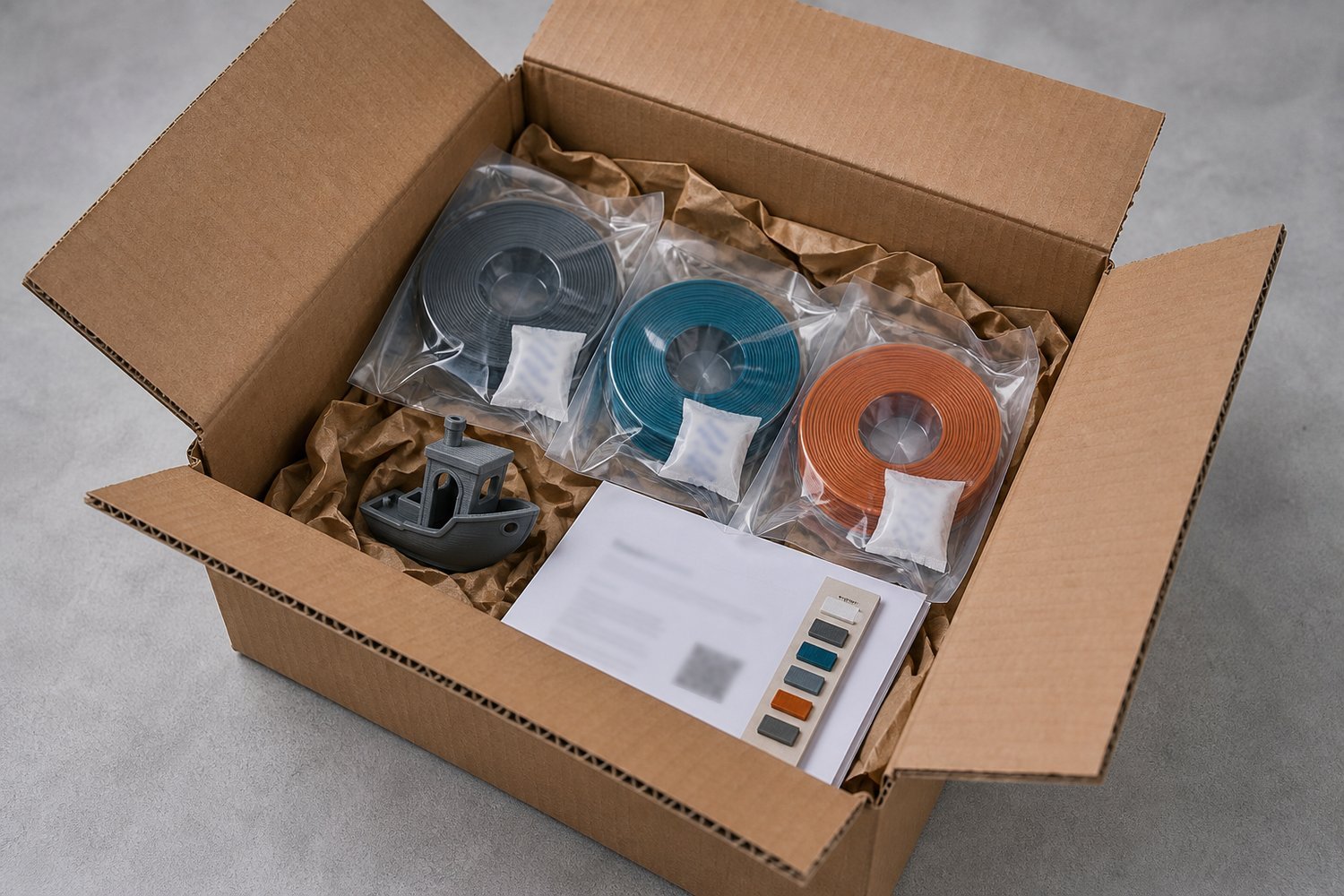
A sample box, not a spool in a jiffy bag
SigmaFilament’s free filament sample programme sends wholesale buyers up to three 200 g spools of any material in the catalogue, cut from a live production run rather than a display shelf. It exists for one reason: a spec sheet is a claim, and a spool on your own printer is evidence. Everything in the box is there so you can check that claim yourself.
- 01Up to 3 × 200 g sample spoolsYour choice of material, colour and diameter — roughly 68 m of 1.75 mm filament per spool, vacuum-sealed with desiccant.
- 02Lot-specific Certificate of AnalysisMeasured diameter, ovality, moisture and colour values for your exact lot number — not nominal spec targets copied off a template.
- 03TDS and a starting print profileMechanical and thermal properties with the ISO or ASTM method beside each figure, plus nozzle, bed, speed and drying settings.
- 04Physical colour chipsInjected chips with HEX and RAL references, because no two monitors agree on what “matte graphite” looks like.
- 05Your tiered price sheetSealed in the same box, so you can run the landed-cost maths the same afternoon the samples arrive.
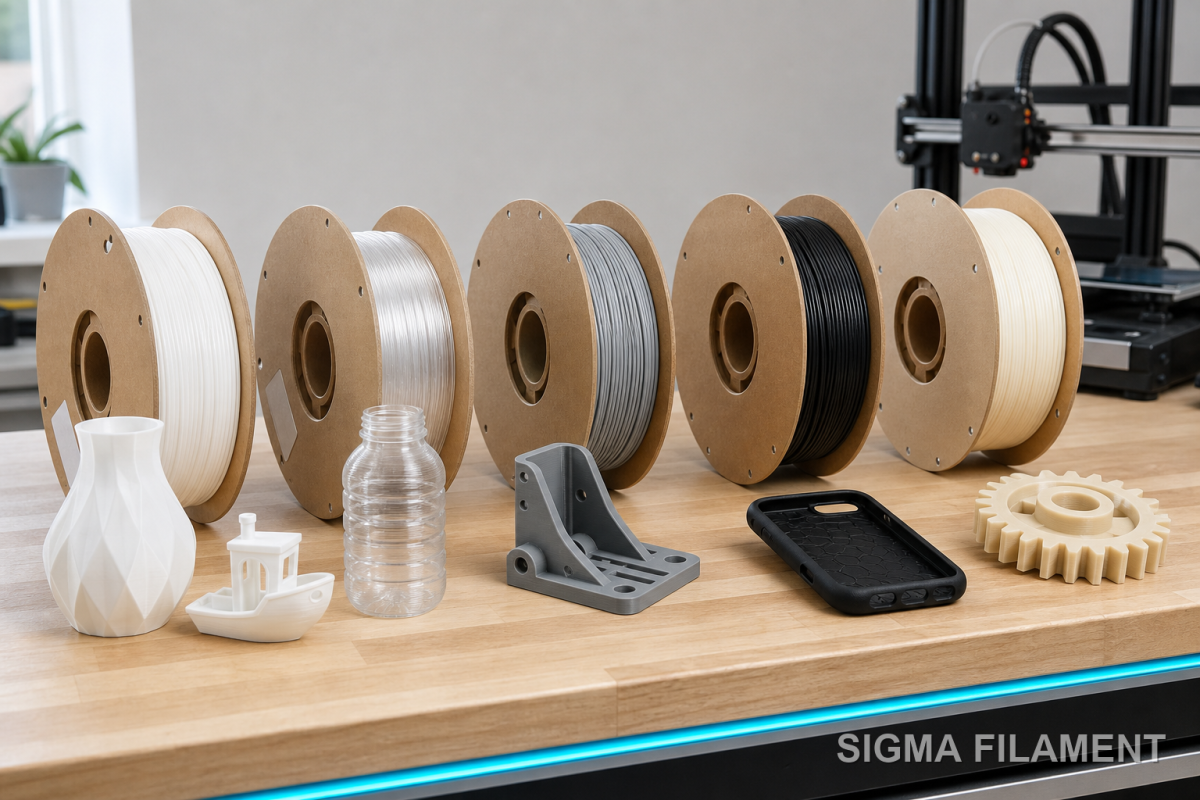
Why 200 g and not a full kilo? Two hundred grams is enough to print a calibration cube, a tolerance tower, a real part from your own catalogue and still have material left to measure — while staying inside express-courier sample weights so the box clears customs quickly and cheaply. If you need to qualify a material properly across a production line, see the full-kilo evaluation route in the spool specification below.
We would rather you test three spools than regret a pallet
Nobody who has been burned by a bad filament lot buys on a datasheet again. These are the three things a sample settles that no document can.
🎯Your printer is the real test
Filament that runs clean on a Bambu X1C can chatter on a Bowden machine at 300 mm/s. Tolerance interacts with your extruder, your retraction settings and your ambient humidity — not with our laser micrometer readings.
🎨Colour has to be seen in person
Every screen renders differently, and pigment behaves differently in PLA, PETG and ABS bases. A matte grey that looks right on your monitor can land warm or green in the box. Physical chips settle it in one look.
📉A bad lot costs more than it saves
One jam that stops a farm for a day usually erases a year of the per-kilo saving that made the cheap supplier attractive in the first place. Sampling is the cheapest insurance in the whole procurement process.
Four sample kits — or build your own
These are shortcuts, not restrictions. If you already know the exact SKUs you want, skip the kits and list them in the form; we will send those instead.
- PLA+ / PLA Pro — one colour
- Standard PETG — one colour
- High-Speed PLA (HS-PLA)
- Printed test model per material
- Silk PLA — metallic lustre
- Dual or tri-colour silk
- Matte PLA or marble PLA
- Full colour chip card
- PLA-CF or PETG-CF
- ASA or flame-retardant ABS
- PA-CF nylon composite
- Lot test data included
- Your Pantone or RAL, matched
- Two base resins, one colour
- Spectrophotometer ΔE report
- Colour chip before production
Colour matching takes longer than stock colours. Anything from the standing catalogue dispatches in 3–5 business days. A custom Pantone or RAL match needs 3–5 days in the colour lab first, so plan on roughly 8–10 business days end to end for KIT-OEM. Full detail on the OEM / ODM services page.
Sample spool specification
Sample spools are held to production tolerances, because a sample produced to a different standard than the goods tells you nothing useful.
| Net weight | 200 g (0.44 lb). Full 1 kg, 3 kg and 5 kg spools are available as a paid evaluation order — see spool sizes and bulk options. |
|---|---|
| Diameter | 1.75 mm standard · 2.85 mm (3.00 mm) on request · both held to the same tolerance as production stock |
| Diameter tolerance | ±0.02 mm for PLA and PETG · ±0.03 mm for carbon-fibre, glass-fibre and engineering composites — monitored in real time by dual-axis laser micrometers |
| Approximate length | ~68 m at 1.75 mm · ~26 m at 2.85 mm (PLA; varies with material density) |
| Resin | 100% virgin, no regrind and no recycled scrap — the same pellet source and formula as the production lot |
| Moisture at packing | Below 0.3% — dried, then vacuum-sealed with silica gel desiccant |
| Colour accuracy | ΔE < 1.5 against the reference, verified by spectrophotometer rather than by eye |
| Packaging | Vacuum-sealed PE bag with desiccant, in a double-wall carton |
| Lot marking | Every spool carries its production lot number, cross-referenced to the enclosed COA |
| Shelf life | 24 months sealed, stored at 15–30 °C below 30% relative humidity |
Need more than 200 g to qualify a material? Print farms validating a material for a production line usually want three to five full kilos before committing. We supply that as a paid evaluation order at wholesale unit price and credit the full amount against your first bulk purchase order. Put the quantity in the form and we will quote it with the sample reply.
Who the free sample programme is for
We manufacture at wholesale volume, so the free kit is built for buyers evaluating a supply relationship. If you sit somewhere between these categories, ask anyway — a person reads every request.
Being straight about who this is not for. If you print as a hobby and want one spool to try, a free kit shipped by air from a factory in Shenzhen is a slow, freight-heavy way to get it — a retailer will serve you better and faster. And a request with no company name, no business email and no volume in mind usually gets questions back before it gets a box. That is not gatekeeping for its own sake; it is how we keep the programme free for the buyers it was built for.
From form to filament in about a week
Five steps, and you only do the first one. Timings are business days from the moment the form lands.
You tell us what to put in the box
Materials, colours, diameter and roughly what volume you would buy if the samples work. That last line matters — it decides whether we quote you a carton or a container.
Day 1 · two minutesWe confirm and fill in the gaps
A named account manager replies within 24–48 hours, usually with the tiered price sheet attached so you have the numbers before the box lands.
Day 1–2 · we replySpools are wound from a live lot
Not pulled from a display shelf. We wind your 200 g spools off a current production run, record the lot number, and pull that lot’s QC data into your COA.
Day 2–4 · in the plantThe box ships with tracking
DHL, FedEx or UPS express from Shenzhen. You get the tracking number the day it leaves, plus the commercial invoice your customs broker will ask for.
Day 3–5 · dispatchYou test — then we talk, or we do not
Run them however you like. If the results hold up, your pricing is already on file. If they do not, tell us what failed; that feedback is worth more to us than the spools cost.
Your timeline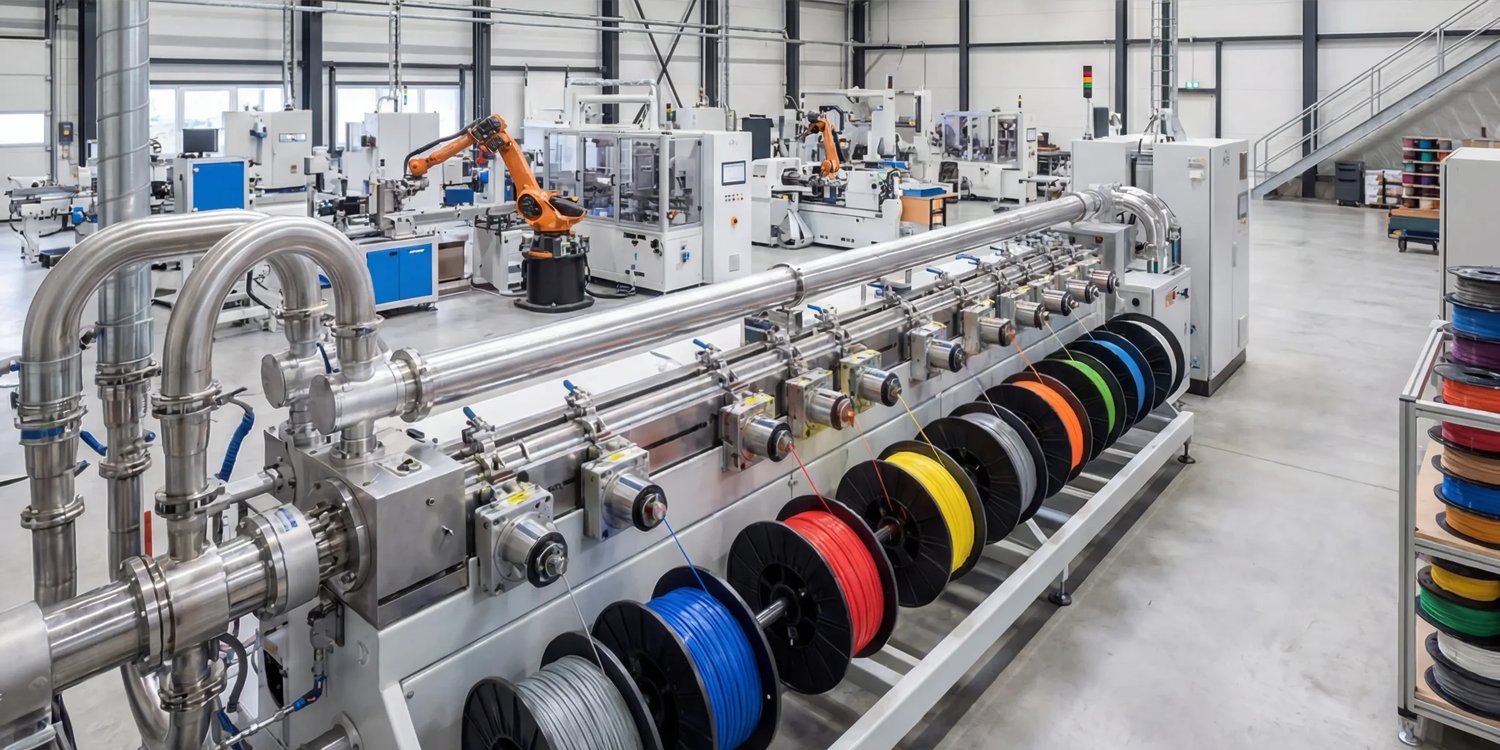
Tell us what to put in the box
Two minutes. No account, no deposit, no card. A named person replies within 24–48 hours.
Materials you can request
Nine families, 160+ SKUs, all extruded on our own lines. Browse a category and put the exact SKU in the form if you already know what you want.
Not sure which family fits the job? The 13-material specification guide and the selection framework for production buyers compare them properly before you commit a sample slot.
Send a Pantone code, get a chip back
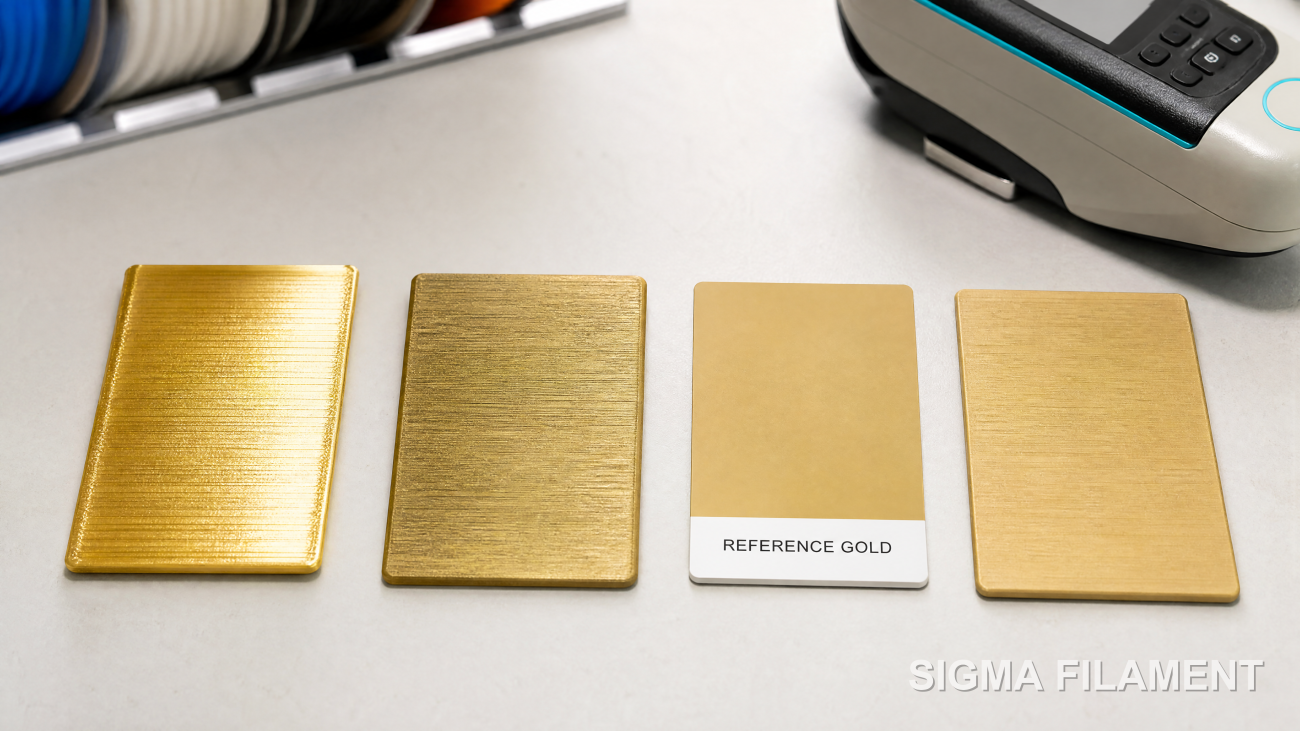
We run our own colour lab and compound our own masterbatch rather than buying pre-coloured pellets, which is why a custom shade takes days rather than months. Send a Pantone or RAL reference, a HEX value, a physical part or a competitor’s spool — all five are routine starting points.
- Matched to ΔE < 1.5, verified on a spectrophotometer rather than by eye
- Approval chips back in 3–5 business days, before anything is committed to a run
- The same shade reproduced across PLA, PETG and ABS bases where you need a family
- Automated gravimetric dosing holds colour lot to lot, not just on the first run
| Pantone code | Solid Coated or TPX. The most accurate route. |
|---|---|
| RAL number | Classic or Design. Common for industrial and enclosure work. |
| HEX or RGB | Workable, but screen values drift — expect one extra approval round. |
| A physical part | Post it to Shenzhen and we scan it. Best for matching an existing product. |
| A competitor’s spool | An entirely normal request. Send it, we match it. |
The filament is free. Here is how the freight works.
We would rather be plain about this on the page than surprise you in an email. Three options, and most buyers take the third.
📦Your courier account
Give us your DHL, FedEx or UPS number and we ship collect. You see the exact freight cost on your own account and we add nothing to it.
💳We prepay, you reimburse
We book the courier and invoice the freight at cost — typically US$35–60 depending on destination and box weight. No handling margin.
↩️Freight credited back
Whatever you paid for sample freight comes off your first bulk order. In practice, most buyers who go on to order end up paying nothing for sampling at all.
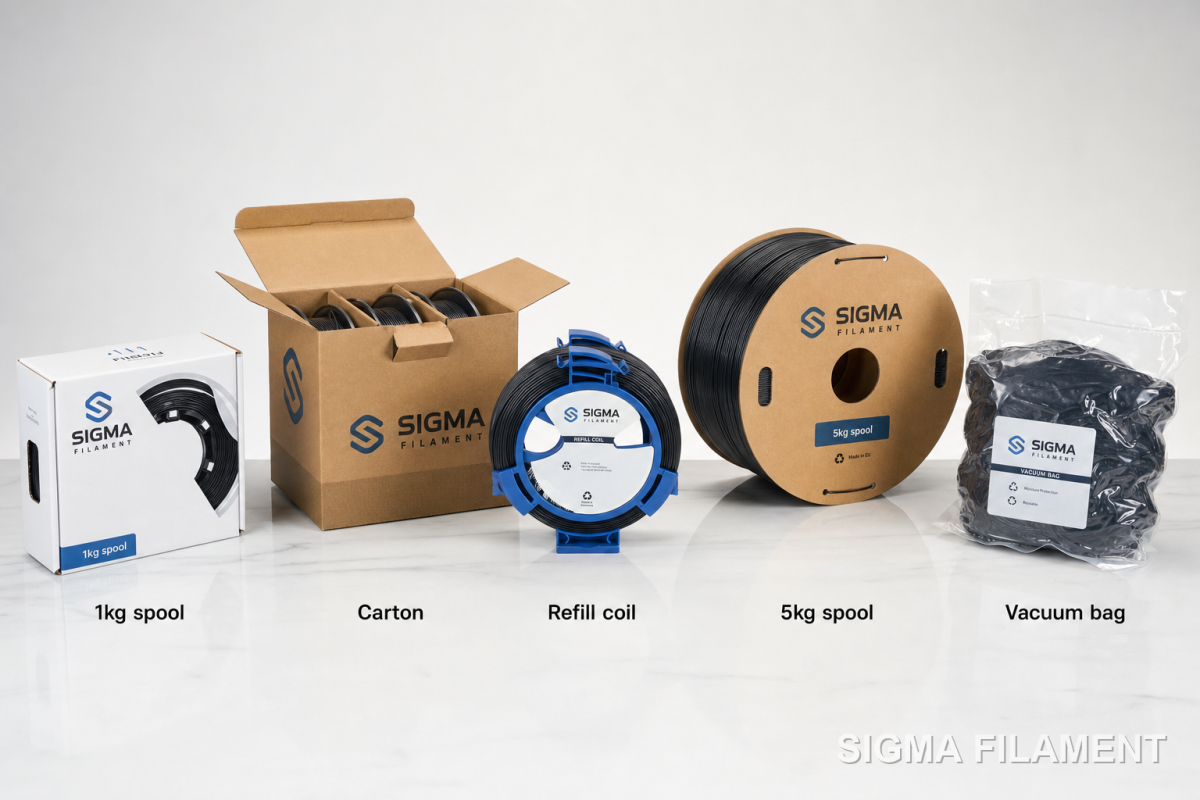
Sample spools ship in the same vacuum-sealed, desiccant-packed format as production stock — the packaging is part of what you are evaluating.
| Destination | Express transit | Duty on samples | Notes |
|---|---|---|---|
| United States & Canada | 5–9 days | Usually below de minimis | Declared as a commercial sample under HS 3916.90 |
| European Union | 5–9 days | VAT may apply on arrival | RoHS and REACH declarations enclosed by default |
| United Kingdom | 5–9 days | VAT may apply on arrival | Additional compliance paperwork on request |
| Australia & New Zealand | 6–10 days | Usually below threshold | Straightforward clearance at sample weights |
| Middle East, LATAM, SE Asia | 7–12 days | Varies by country | Tell us if you need a specific invoice format |
On import duty. Sample-weight shipments usually clear without duty, but the threshold is set by your country, not by us. We declare honestly and at the correct HS code. We will not under-declare a shipment to dodge a charge — a buyer who later finds that on the paperwork has every right to stop trusting everything else we said.
How to evaluate the spools we send
Most sample tests are one Benchy and a shrug. This is the seven-point protocol our own QA line runs — use it on our spools and on whatever you buy today, then compare. We publish it knowing you might use it against us.
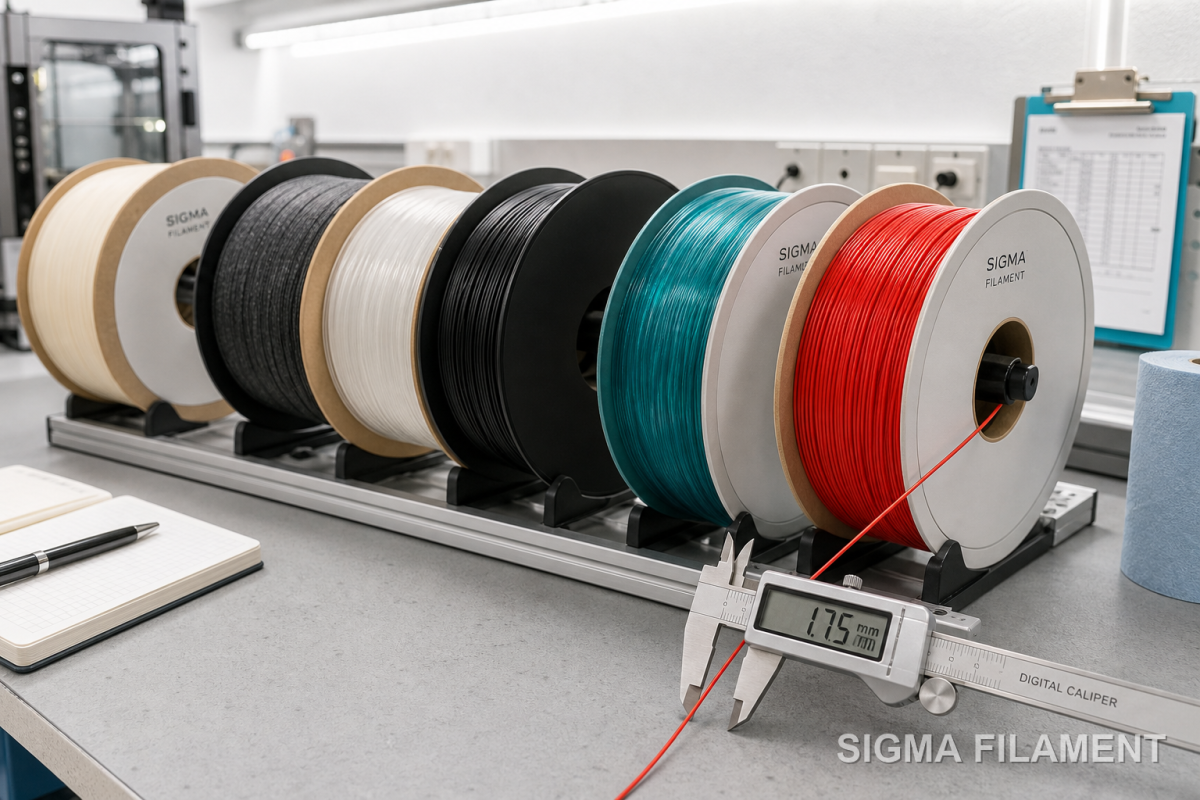
- 01
Diameter — measure, do not assume
Take digital calipers to 20 points along one metre, rotating 90° at each point, and record min, max and mean. This single test separates real factories from relabellers faster than anything else.
Pass: inside ±0.02 mm for PLA and PETG - 02
Ovality — round, not oval
At each point take a second reading rotated 90°. The difference is ovality. Oval filament meters inconsistently through the extruder even when the mean diameter looks perfect on paper.
Pass: under 0.02 mm difference - 03
Moisture — weigh, dry, weigh again
Weigh the spool, dry it at the material’s recommended temperature for six hours, weigh it again. Loss above roughly 0.3% means it shipped wet — a packaging failure, not a resin failure.
Pass: under 0.3% weight loss - 04
Colour — compare against your reference
Print a flat swatch and hold it against your Pantone chip or existing stock in daylight, not under shop LEDs. With a spectrophotometer, check ΔE against the value printed on our COA.
Pass: ΔE under 1.5 versus reference - 05
Layer adhesion — break something on purpose
Print two identical tensile bars, one flat and one upright, then pull both to failure. The ratio between them is the honest measure of interlayer bonding at your settings, not ours.
Pass: consistent with the TDS figures - 06
Long-run stability — print until it is empty
The failure mode that costs a farm money is not the first metre, it is metre four hundred. Run a long unattended job and watch for flow drift, tangles at the core and any change in surface finish.
Pass: no jams, no visible flow drift - 07
Paperwork — check the COA matches the spool
Take the lot number printed on the spool and confirm it appears on the enclosed COA with measured values rather than nominal ones. A COA showing spec targets instead of measurements is a template, not a record.
Pass: lot number matches, values measured
If something fails, tell us in detail. Send the numbers and a photo. If it is our problem we will say so, correct it on the line and send a replacement lot. If it is a settings or humidity issue on your side we will tell you that too, even though it costs us the sale that week. More on how we run quality checks: how to choose a reliable filament manufacturer.
Documents that ship with the samples
If you are specifying a material into a tender, a product dossier or a school procurement file, the documents matter as much as the filament. These come in the box or by email — you do not have to ask twice.
Why a good sample sometimes means nothing
Anyone who has sourced from Asia has met the golden sample: an immaculate first spool, followed by a container that prints nothing like it. The risk is real and it has a specific structural cause — so here is how to check for it.
| Question to ask | Source manufacturer | Trading company | SigmaFilament |
|---|---|---|---|
| Which lot did this sample come from? | Can name it | Often cannot — the goods were bought in | Lot number on the spool and on the COA |
| Are the COA values measured or nominal? | Measured, from their own QC | Usually copied off a spec sheet | Measured on dual-axis laser micrometers |
| Can I visit or video-call the line? | Yes | May show someone else’s factory | Live video walk, or visit us in Bao’an |
| Who chose the resin? | They did | Whoever they bought from | We buy virgin pellets direct and specify the grade |
| Will production match this sample? | Verifiable against QC records | Cannot guarantee which factory ships | Same lines, same formula, per-lot COA on every order |
| What happens if a lot goes bad? | They fix the process | They pass the complaint upstream | Lot records retained and the lot replaced |
Use these questions on us too. Reply to your sample confirmation email with any of them. If we get evasive, that tells you something more useful than a good Benchy does. The longer version of this argument — landed cost, supplier vetting, MOQ maths — is in the complete bulk filament buyer’s guide.
If the samples work out
No pressure to decide quickly — but so you can plan, this is the shape of a first order. Your price sheet arrives with the samples, so you are never waiting on a quote to run the numbers.
| Tier | Minimum | Lead time | Best for |
|---|---|---|---|
| First wholesale order | 100 spools, mixed freely across materials, colours and spool sizes | 3–5 days in stock · 10–15 days produced | Testing the relationship at low risk |
| High-Speed series | 200 spools | 10–15 days | Farms running 300 mm/s and above |
| Private label / OEM | 500 spools with your branding | 15–25 days | Launching or scaling your own brand |
| Custom formula or colour | Discussed per project | Roughly 3 weeks including approval | Exclusive shades and ODM formulations |
📄Terms we support
FOB Shenzhen, CIF, DAP and DDP. On DDP we handle clearance and duty so the pallet simply arrives at your dock.
💱Payment
T/T bank transfer. Standard terms are payment before production; negotiable once we have order history together.
🔁Repeat supply
Regular buyers get a dedicated account manager, held stock on your top SKUs and scheduled shipments against a forecast. Volume discounts reach 20% at 1,000+ spools.
Reading that helps you test well
Three programme pages and three guides that most buyers read alongside a sample request.
Wholesale & bulk programme →
Tiered pricing, MOQ, materials and logistics for farms, schools, resellers and distributors.
Spool sizes & bulk options →
1 kg, 3 kg and 5 kg in every material, scaling to carton, pallet and container.
OEM / ODM services →
Private-label spools, custom colours to ΔE < 1.5 and custom formulations under NDA.
Bulk filament buyer’s guide →
Landed cost, supplier vetting and the arithmetic behind bulk pricing.
Filament brands, ranked →
Fourteen brands assessed by tier, so you know what you are comparing our samples against.
Vetting a filament maker →
Seven checks to run on any wholesale supplier before the first purchase order.
Questions buyers ask before requesting free filament samples
What the free sample kit covers, who qualifies, what it costs to ship, and what happens after you have tested the spools.