

A Practical Guide to Filament Spool Diameter: 5 Key Dimensions for a Perfect Fit in 2026

Abstract
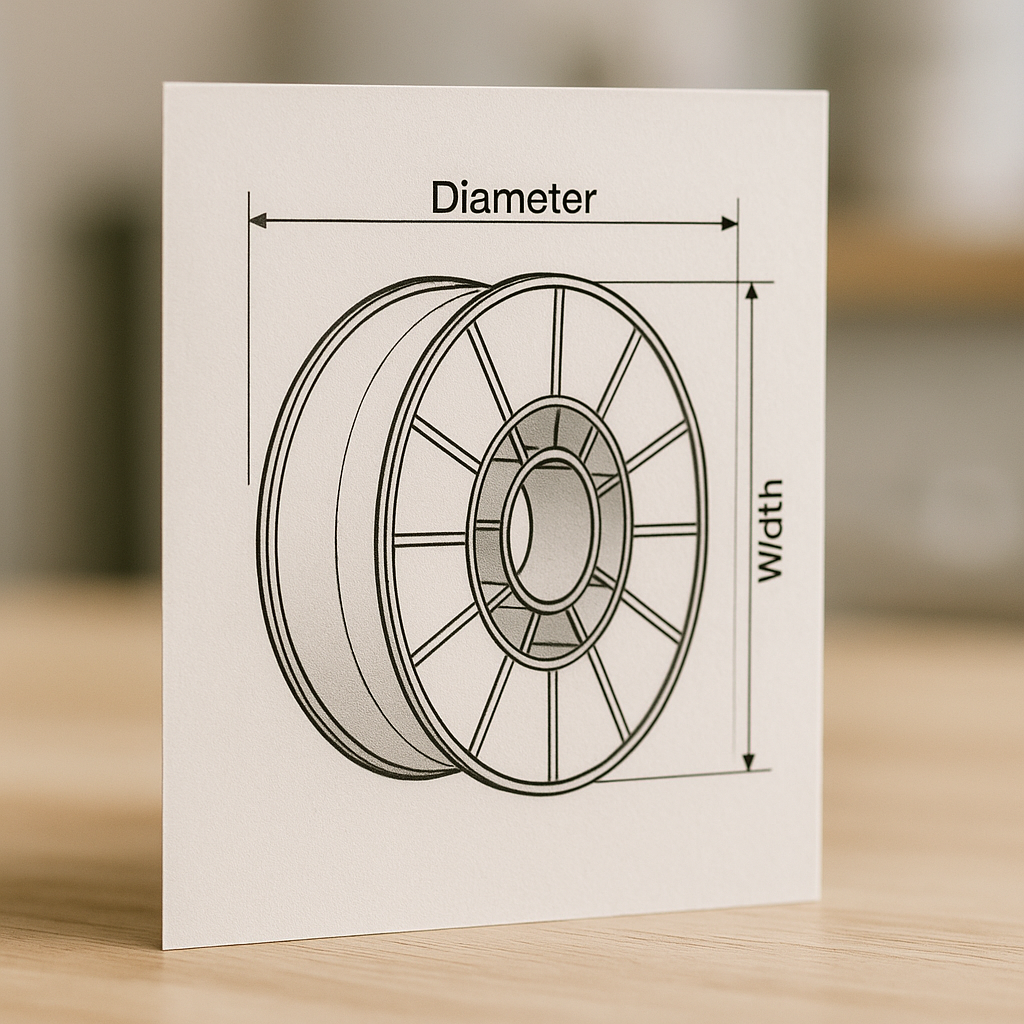
The physical compatibility between a filament spool and a 3D printer represents a foundational yet frequently overlooked aspect of fused deposition modeling. While filament material properties are extensively debated, the dimensional characteristics of the spool itself often lead to unforeseen operational failures. An investigation into the manufacturing landscape reveals a persistent lack of standardization for the filament spool diameter, width, and arbor hole size, creating significant challenges for users, particularly those employing automated material systems. This analysis deconstructs the five critical dimensions that define a spool’s geometry: outer diameter, overall width, arbor hole diameter, inner hub diameter, and traverse width. By examining these parameters, this guide provides a systematic framework for assessing spool-to-printer compatibility. It explores the practical implications of dimensional mismatches, from the inability to mount a spool to issues with unwinding mechanics that degrade print quality. The objective is to equip operators with the necessary knowledge to preemptively identify and resolve compatibility issues, thereby minimizing downtime and ensuring a smoother, more reliable printing workflow.
Key Takeaways
- Measure your printer’s spool holder before purchasing new filament.
- The arbor hole is the most critical dimension for mounting the spool.
- An incompatible filament spool diameter can prevent it from fitting in an enclosure.
- Cardboard and plastic spools often have different dimensions even for the same weight.
- Use printable adapters to resolve most common spool compatibility issues.
- Automated Material Systems (AMS) have very strict spool size requirements.
- Check a manufacturer’s technical data sheet for precise spool dimensions.
Table of Contents
- The Unspoken Standard: Why Filament Spool Diameter Isn’t Standardized
- Decoding the 5 Key Dimensions of a Filament Spool
- Common Spool Sizes and Manufacturer Variations
- Printer Compatibility: Matching Your Spool to Your Machine
- Beyond the Fit: How Spool Dimensions Impact Print Quality
- Frequently Asked Questions (FAQ)
- Conclusion
- References
The Unspoken Standard: Why Filament Spool Diameter Isn’t Standardized
One of the more perplexing experiences in 3D printing is bringing home a new, exciting roll of filament only to discover it simply does not fit on your printer. The spool is too wide for the holder, too large in diameter for the enclosure, or its central hole is too small for the mounting rod. This frustrating scenario begs a question: Why, in an industry built on precision, is there no universal standard for the dimensions of a filament spool? The answer lies in a confluence of historical development, manufacturing economics, and evolving printer design.
A Brief History of Filament Spools
To understand the present, we must look to the past. In the early days of consumer 3D printing, the community was a small, tight-knit group of hobbyists and pioneers. Filament was often sourced from industrial suppliers of welding wire or plastic stock, and the spools they came on were functional rather than designed. As the RepRap movement gained momentum, and desktop printers became more accessible, companies emerged to cater specifically to this new market. These early manufacturers made their own choices about spool design, balancing material cost, shipping logistics, and their own production machinery. There was no governing body to dictate a standard, so a variety of “good enough” solutions proliferated. What worked for one company became their de facto standard, and as the industry grew exponentially, these disparate designs became entrenched. We are, in essence, living with the legacy of those early, independent decisions.
The Manufacturer’s Dilemma: Cost vs. Compatibility
For a filament manufacturer, the spool is a significant component of the final product’s cost, not just in terms of the plastic used to make it but also in the energy for injection molding, storage space, and shipping weight. A decision to make a spool wall 1mm thicker, or to increase the flange diameter by 10mm, has a cascading effect on costs when producing tens of thousands of units. Each manufacturer performs a delicate balancing act. They aim to create a spool that is robust enough to protect the filament during transit and use, yet economical enough to maintain competitive pricing.
This economic pressure often discourages standardization. Adopting a universal standard would require many manufacturers to re-tool their injection molding equipment—a substantial capital investment. Furthermore, a “standard” spool might be larger or heavier than a company’s proprietary design, permanently increasing their material and shipping costs. Consequently, many brands stick with their proven, cost-optimized designs, prioritizing their own operational efficiency over universal compatibility. This is why you see such a wide variety of designs, from thin-walled spools to heavily ribbed, robust models.
How Material Weight Influences Spool Design
The amount of filament a spool is designed to hold directly dictates its size and construction. The most common size for hobbyists is the 1kg spool, but the market also serves industrial users with spools holding 2.5kg, 5kg, or even more .
A 5kg spool is not simply a scaled-up 1kg spool. The structural demands are much greater. The flanges must be thicker and stronger to contain the weight and pressure of the filament coil without warping or breaking. The central hub or barrel must be able to withstand the torque of being turned on a holder without cracking. These larger spools often feature much larger outer diameters and widths, making them incompatible with the majority of consumer desktop printers without a dedicated external mounting solution. This specialization based on weight is another factor that fragments any move toward a single standard, as the needs of a user printing small models with 1kg spools are vastly different from a production shop using bulk PLA and PETG on large-format machines.
Decoding the 5 Key Dimensions of a Filament Spool
To navigate the world of non-standardized spools, it is not enough to know that differences exist; one must understand precisely what to measure. By breaking a spool down into five key geometric properties, you can create a dimensional profile that allows for a confident prediction of its compatibility with any given 3D printer. Think of it as a spool’s unique fingerprint. Mastering these five measurements will empower you to avoid purchase mistakes and adapt your setup when necessary.
Dimension 1: Outer Diameter – The First Check for Fit
The outer diameter, sometimes called the flange diameter, is the measurement across the widest part of the spool, from edge to edge. This is often the first point of failure for compatibility.
- Why it Matters: Many modern 3D printers are enclosed to help with temperature regulation, especially for materials like ABS. The internal height and depth of these enclosures place a hard limit on the maximum spool diameter they can accommodate. A spool with a 205mm outer diameter simply will not fit inside an enclosure designed for a maximum of 200mm. Similarly, some printers integrate the spool holder into the frame in a way that a large diameter spool would collide with the gantry at its highest point of travel.
- Common Range: For most 1kg spools, this dimension sits around 200mm, as the brand table below shows, but measure before you buy. However, “budget” spools might be smaller, and some specialty materials or brands might use spools as large as 250mm or even 300mm.
Dimension 2: Spool Width (or Height) – Ensuring Clearance
The spool width is the total distance from the outer face of one flange to the outer face of the other. It determines how much space the spool will occupy on the mounting rod.
- Why it Matters: Spool holders on printers have a finite length. If a spool’s width exceeds the length of the mounting arm, it cannot be secured properly. It might sit precariously on the edge, risking a fall during printing, or it may not be possible to put the retaining nut or cap on at all. In multi-material systems like the Bambu Lab AMS, the width is a critical specification; a spool that is too wide will jam the mechanism and prevent it from feeding filament.
- Common Range: For 1kg spools, the width usually varies from 55mm to 75mm. This seemingly small 20mm variance is more than enough to cause widespread compatibility problems.
Dimension 3: Arbor Hole Diameter – The Critical Mount Point
The arbor hole, or center hole, is the opening in the very center of the spool that slides onto the printer’s spool holder. This is arguably the most critical dimension for basic fitment.
- Why it Matters: If the arbor hole is smaller than the diameter of your printer’s mounting rod, the spool cannot be mounted. It is a simple go/no-go check. This is a very common issue, as arbor hole diameters have one of the widest variations among manufacturers. Some are designed for a simple rod, while others are designed to interface with specific locking mechanisms.
- Common Range: This dimension can range from a small 32mm to a much larger 52mm or even 58mm. A common size seen is around 52-54mm . This significant difference is why a spool from one brand may fit perfectly while another is completely unusable without an adapter.
| Dimension Name | Typical Range (1kg Spool) | Primary Compatibility Check | Common Failure Scenario |
|---|---|---|---|
| Outer Diameter | 195 mm – 205 mm | Printer enclosure / frame clearance | Spool is too large to fit inside the printer. |
| Spool Width | 55 mm – 75 mm | Length of the spool holder arm | Spool is too wide to be secured on the mount. |
| Arbor Hole Diameter | 32 mm – 58 mm | Diameter of the spool holder arm | Spool’s center hole is too small for the mount. |
Dimension 4: Inner Hub Diameter – The Unseen Factor in Unwinding
The inner hub diameter, also known as the barrel or core diameter, is the diameter of the central cylinder around which the filament is wound. This dimension does not typically affect whether a spool will fit on your printer, but it can have a subtle impact on print quality.
- Why it Matters: As the filament gets used up, it is pulled from a progressively smaller radius. A very small inner hub diameter can impart a significant amount of curve into the last portion of the filament. This tightly coiled filament can create extra tension and resistance in the feed path, particularly in long Bowden tubes, potentially leading to under-extrusion issues. It forces the filament to bend more sharply, which can be problematic for more brittle materials like some PLAs or specialty composites.
- Common Range: This is not a widely publicized specification but generally falls between 80mm and 100mm.
Dimension 5: A Practical Measurement Guide: Tools and Techniques
You do not need sophisticated metrology equipment to measure a filament spool. A simple set of digital calipers is the most effective tool, but a tape measure or ruler can suffice for the larger dimensions.
- Outer Diameter: Place the spool on a flat surface. Lay a ruler or tape measure across the center, ensuring you are measuring the widest point. For better accuracy with calipers, measure from the inside edge of one flange to the outside edge of the other, then measure the thickness of one flange and add it twice to your initial measurement.
- Spool Width: Use calipers to measure from the flattest part of the outside of one flange to the flattest part of the other. With a ruler, stand the spool on its edge and measure its height.
- Arbor Hole Diameter: This is where calipers are most useful. Use the internal measuring jaws to get a precise reading of the center hole’s diameter.
- Your Printer: Do not forget to measure your printer as well! Measure the diameter of the spool mounting rod and the maximum length available for the spool. For enclosed printers, measure the internal clearance where the spool will sit. Keep these numbers handy when shopping for filament.
Common Spool Sizes and Manufacturer Variations
While a true universal standard remains elusive, the market has naturally gravitated towards a few common form factors, especially for the popular 1kg spool size. However, the “common” size is more of a loose guideline than a rigid specification. The subtle deviations between brands are the primary source of compatibility headaches. Understanding these variations, along with the rise of alternative spooling methods, is key to making informed purchasing decisions (Singh, 2026).
The “Standard” 1kg Spool: A Mythical Beast?
If you were to survey a dozen 1kg filament spools from different manufacturers, you would likely find that most share a similar outer diameter, typically around 200mm. This is because this size is a reasonable compromise that fits a wide range of open-frame and enclosed printers. Where the variations truly emerge are in the width and the arbor hole diameter.
For instance, one brand might favor a wider, more stable spool at 72mm wide, while another might opt for a slimmer 65mm profile to save on plastic and shipping costs. The most chaotic dimension is the arbor hole. You might find holes of 51mm, 53mm, and 55mm, all from prominent brands, and all mutually incompatible with a printer designed for a specific one. This is why it is more accurate to think of “common size ranges” rather than a single “standard size.”
A Comparative Look at Major Brands
The differences become clear when you compare the specifications directly. Manufacturers who cater to users of specific ecosystems, like Bambu Lab or Prusa, tend to optimize their spool dimensions for their own hardware, especially for automated material systems. Other brands aim for broader compatibility, often using a larger arbor hole that can be adapted down if needed.
| Manufacturer | Outer Diameter (mm) | Spool Width (mm) | Arbor Hole (mm) | Notable Features |
|---|---|---|---|---|
| Prusament | 200 | 67 | 53 | Hexagonal pattern on the hub for better grip. |
| Bambu Lab | 200 | 68 | 57 | Designed for their AMS, includes RFID chip. |
| Overture | 200 | 64 | 56 | Often uses cardboard spools, dimensions can vary slightly. |
| Polymaker | 200 | 65.8 | 53.2 | Publishes detailed spec sheets for all spools. |
| SigmaFilament | 200 | 65 | 53 | Focus on consistency for OEM/ODM clients. |
Note: These dimensions are typical for 1kg spools and can change. Always verify with the manufacturer’s current specifications.
Navigating Non-Standard Spools: Cardboard, MasterSpools, and Refills
In response to environmental concerns about plastic waste, several innovations in spooling have gained popularity, each bringing its own compatibility considerations.
- Cardboard Spools: Brands like Overture and Polymaker have increasingly shifted to spools made of recycled cardboard. While ecologically beneficial, these spools introduce new problems. The arbor holes can be less precise and may wear down over time, creating dust. More importantly, the outer rims of cardboard spools can be problematic for AMS units that rely on rollers to spin the spool. The cardboard can slip or deform, leading to feed errors.
- MasterSpool and Refills: The MasterSpool concept, popularized by RichRap, involves a reusable, 3D-printed plastic spool that comes apart. Users then purchase “refills,” which are just coils of filament with no spool. This dramatically reduces waste. The challenge is that you must first print a MasterSpool that fits your printer’s holder, and the process of loading the refill coil can sometimes be tricky.
- Spool-less Coils: Some manufacturers sell filament in a coil, held together with zip ties, with no spool at all. This is the most eco-friendly option but requires the user to have a compatible reusable spool or a dedicated winding machine to transfer the filament, making it a solution best suited for high-volume users.
Printer Compatibility: Matching Your Spool to Your Machine
The ultimate goal is to ensure a harmonious relationship between your filament supply and your printer. This compatibility extends beyond simple measurements and into the mechanical design of the printer’s spool handling system. From the most basic holder to sophisticated, multi-material bays, the design intent of the printer dictates the spools it will accept. Understanding your printer’s system is just as important as understanding the spool’s dimensions.
Spool Holder Designs: From Simple Rods to Enclosed Bays
The design of a printer’s spool holder is the primary interface determining compatibility. These designs can be broadly categorized:
- Frame-Mounted Rod: This is the most common and traditional design. A simple rod, either horizontal or vertical, is attached to the printer’s frame. Compatibility is determined by the rod’s diameter (matching the arbor hole) and its length (matching the spool width). This design is generally the most forgiving of variations in outer diameter.
- Roller-Based Holder: Instead of a central rod, some holders, particularly external or “drybox” designs, use a set of bearings or rollers on which the outer flanges of the spool rest. The spool is then free to rotate on these rollers. Here, the outer diameter and width are the key factors. The arbor hole size is completely irrelevant. However, spools with damaged or uneven flanges can perform poorly on this type of holder.
- Enclosed Bays: As seen in machines from manufacturers like Bambu Lab, Ultimaker, and Raise3D, the spools are placed inside a dedicated compartment or bay within the printer. These systems offer the least flexibility. They have strict maximum limits on both the outer diameter and the width of the spool, so check the printer’s stated limits. Any spool exceeding these dimensions will not fit, period.
The Role of Automatic Material Systems (AMS) and Spool Constraints
The rise of reliable, consumer-friendly multi-material printing has introduced a new layer of stringent compatibility requirements. Systems like Bambu Lab’s AMS are marvels of engineering, but they achieve their reliability through tight tolerances. An AMS unit is not just a holder; it is an active part of the filament feeding mechanism.
- Dimensional Constraints: The AMS has a cassette system that requires spools to be within a very specific range of widths (e.g., 55mm to 68mm) and diameters (e.g., 197mm to 202mm). A spool that is too narrow can wobble and cause winding errors. A spool that is too wide will physically jam in the bay.
- Material and Surface Constraints: As mentioned, the drive rollers in an AMS often struggle with the slick or dusty surface of cardboard spools, leading to slippage and failed filament loading or unloading operations. This has led to a large community-driven effort to design and print adapter rings or “rims” that can be clipped onto cardboard spools to give them a smooth, plastic surface for the rollers to grip.
When Things Don’t Fit: Adapters, Respoolers, and DIY Solutions
When you inevitably encounter an incompatible spool, you are not without options. The 3D printing community has developed a wealth of solutions to bridge these compatibility gaps.
- Printable Adapters: This is the most common and effective solution. If your spool’s arbor hole is too large for your printer’s holder, you can print a simple ring-shaped adapter that slides into the spool, reducing the inner diameter to a snug fit. There are countless designs available on platforms like Printables and Thingiverse, including parametric designs you can customize to your exact needs. Similarly, if a spool is too narrow, you can print spacers to prevent it from sliding back and forth on the holder.
- External Spool Holders: If the spool is too large in diameter to fit in your printer’s enclosure or integrated holder, the best solution is an external holder. You can print one yourself—many excellent designs use standard skate bearings for a smooth feed—or purchase a commercial one. This places the spool outside the printer, feeding the filament in through a small opening or a reverse-Bowden tube.
- Respooling Machines: For those who frequently buy filament on non-standard spools or wish to use large 5kg spools with a desktop printer, a filament respooling machine is a worthwhile investment. These devices allow you to wind filament from one spool to another. This is the ideal solution for using cardboard spools with an AMS; you can respool the filament onto an empty, compatible plastic spool.
Beyond the Fit: How Spool Dimensions Impact Print Quality
While physical fitment is the most immediate concern, the geometry of a filament spool can also have more subtle, indirect effects on the quality of your finished prints. These issues relate to the mechanics of how the filament unwinds from the spool and travels to the extruder. A poorly managed feed path can introduce printing artifacts that are difficult to diagnose without considering the source of the filament itself.
Tangless Unwinding: The Importance of a Smooth Feed Path
Ideally, the filament should pull off the spool in a straight line with minimal resistance. The design of the spool and its interaction with the holder play a crucial role here.
- Binding and Snagging: If a spool is a loose fit on its holder, it can shift or wobble as the filament is pulled. This can change the angle of the feed path, causing the filament to rub against the edge of the spool flange. In a worst-case scenario, the filament can get snagged under another strand on the spool, causing a tangle that stops the print entirely. A correctly sized arbor hole, or an adapter that ensures a snug fit, helps keep the spool aligned and promotes a clean, straight pull.
- Friction: The material of the spool holder also matters. A plastic spool rotating on a simple plastic arm can generate friction. Most quality printers use a holder with bearings or a low-friction material to allow the spool to rotate freely. Excessive friction requires the extruder motor to work harder to pull the filament, which can lead to inconsistent extrusion.
Filament Tension and Its Effect on Extrusion
The extruder in your 3D printer is designed to work against a certain amount of resistance. While it can handle pulling filament through a Bowden tube and melting it in the hotend, adding unnecessary tension from the spool can disrupt this delicate balance.
Imagine trying to write with a pen while someone is constantly pulling it away from you. Your handwriting would become inconsistent. The same principle applies to the extruder. If it has to overcome significant force just to get the spool to rotate, the flow of plastic through the nozzle may not be perfectly steady. This can manifest as subtle, difficult-to-diagnose print quality issues, such as faint vertical lines on the surface of a print or inconsistent layer widths. Using a smooth, low-friction spool holder and ensuring the filament path is not constricted are key to minimizing this variable tension.
The Final Few Meters: Challenges with Small Hub Diameters
The issue of the inner hub diameter, mentioned earlier, becomes most apparent as you near the end of a filament roll. As the filament is pulled from a tighter and tighter coil, two problems can arise.
- Increased Curvature: The filament retains a “memory” of its coiled shape. Tightly coiled filament coming off a small hub will be more resistant to being straightened out in the feed path. For brittle materials, like some wood-filled or silk PLAs, this repeated stress of unbending can cause the filament to snap mid-print, a particularly frustrating failure when you are hours into a large job.
- Increased Pulling Force: From a physics perspective, it requires more torque to rotate the spool when pulling the filament from a smaller radius. This means the extruder motor must work slightly harder at the end of the roll than at the beginning. While most well-calibrated extruders can handle this change, it is another variable that can contribute to subtle extrusion inconsistencies on machines that are not perfectly tuned. It underscores why every component, right back to the spool, is part of a system that contributes to the final print quality. When selecting between different high-performance specialty materials, considering the spooling quality itself can be a minor but relevant factor.
Frequently Asked Questions (FAQ)
What is the standard filament spool diameter for a 1kg roll? There is no official, universally enforced standard. However, a de facto common size has emerged, with most 1kg spools having an outer diameter of approximately 200 mm (or 7.87 inches). The width and arbor hole diameter vary much more significantly between brands.
How do I measure my printer’s spool holder capacity? Use a set of calipers or a ruler. Measure the diameter of the central mounting rod and the usable length of the rod where the spool sits. For enclosed printers, also measure the internal height and depth of the spool compartment to determine the maximum outer diameter that will fit.
Can I use a spool that is too wide for my holder? Generally, no. If the spool is wider than the mounting arm, you will not be able to secure it safely. The best solution in this case is to use an external, standalone spool holder that can accommodate the larger width.
Are cardboard spools a different size than plastic ones? The core dimensions (outer diameter, width, arbor hole) of cardboard spools are designed to be similar to their plastic counterparts from the same brand. However, due to the nature of the material, tolerances can be looser. The main compatibility issue arises with their outer rims, which can slip in roller-based automatic material systems (AMS).
What is an arbor hole and why is its size so important? The arbor hole is the central hole in the spool that slides onto the printer’s mounting arm or rod. Its diameter is critical because if the hole is smaller than the rod, the spool cannot be mounted at all, making it unusable without modification or a different holder.
Do 5kg spools use the same hub size as 1kg spools? No, larger format spools like those holding 5kg of filament are significantly larger in every dimension, including the arbor hole, outer diameter, and width. They are designed for industrial machines and require dedicated, robust mounting systems not found on standard desktop printers.
Will a non-standard spool void my printer’s warranty? Using a spool that does not fit and then forcing it or having it fall and damage the machine could potentially void a warranty. However, simply using a third-party filament on a compatible, well-designed adapter or external holder will not void the warranty for most printer brands.
Conclusion
The seemingly simple spool that holds our 3D printing filament is a component governed by a complex interplay of history, economics, and engineering trade-offs. The lack of a universal standard for filament spool diameter and its related dimensions is not an oversight but a consequence of a rapidly evolving and decentralized industry. For the end-user, this reality transforms the act of buying filament from a simple material choice into a question of mechanical compatibility. By arming oneself with knowledge of the five critical dimensions—outer diameter, width, arbor hole, inner hub, and traverse—one can move from a position of frustrating guesswork to one of informed decision-making. Understanding how to measure both the spool and the printer, and being aware of the elegant, community-driven solutions like printable adapters and external holders, empowers every maker to overcome these compatibility hurdles. Ultimately, a moment spent with a pair of calipers before a purchase can save hours of frustration and ensure that the focus remains on the creative act of printing, not on the struggle to simply mount the material.
References
- OnlySpoolz. (n.d.). Database of filament spools info.
- SigmaFilament. (2026a, January 26). An expert’s guide to the strongest 3D printer filament: 5 data-backed materials for 2026. sigmafilament.com
- SigmaFilament. (2026b, January 27). A practical 2026 buyer’s guide: PLA vs PETG vs ABS. sigmafilament.com
- Singh, S. (2026, January 12). The complete 3D printer filament guide: Technical data, brand analysis & scientific research (2025). 3D Printed Decor.
Last reviewed and updated: February 2026. Author: SigmaFilament Engineering Team. For custom filament solutions and wholesale inquiries, contact our team.