Data-Backed Buyer’s Guide: 5 Toughest 3D Filament Materials for 2026


Abstract
The determination of the “toughest” material in fused deposition modeling presents a complex engineering question, moving beyond the singular metric of tensile strength to encompass a triad of mechanical properties: strength, stiffness, and impact resistance. An investigation into the leading engineering-grade polymers available in 2026 reveals that material selection is contingent upon the specific application’s demands. Polycarbonate (PC) distinguishes itself through exceptional impact resistance, making it suitable for parts subjected to sudden loads. Polyamides (Nylons), particularly in their PA6 and PA12 variants, offer superior durability, wear resistance, and a low coefficient of friction for moving parts. The introduction of fiber reinforcements, such as carbon or glass, into base polymers like PETG or Nylon creates composite filaments with dramatically increased stiffness and strength, albeit with specific hardware requirements. At the apex of performance, Polyether Ether Ketone (PEEK) provides unparalleled thermal and chemical resistance for extreme environments, though its processing demands specialized industrial equipment. This analysis provides a data-driven framework for navigating these materials, clarifying the trade-offs between printability, mechanical performance, and cost to identify the optimal tough filament for a given functional purpose.
Key Takeaways
- Polycarbonate (PC) offers the best impact resistance for parts that must withstand sudden forces.
- Nylon provides excellent durability, flexibility, and wear resistance for moving components like gears.
- Use a hardened nozzle for abrasive composite filaments like carbon fiber to prevent rapid wear.
- Drying hygroscopic materials like Nylon and PC is critical for achieving optimal print quality.
- Fiber-reinforced composites provide the highest stiffness for structurally rigid applications.
- Selecting the toughest 3D filament requires matching material properties to your specific project needs.
- PEEK is reserved for extreme temperature and chemical applications requiring industrial printers.
Table of Contents
- Understanding “Toughness” in 3D Printing Filaments
- Contender 1: Polycarbonate (PC) – The King of Impact Resistance
- Contender 2: Nylon (Polyamide) – The Champion of Durability and Flexibility
- Contender 3: Fiber-Reinforced Composites – Strength Redefined
- Contender 4: PEEK – The Apex of Performance (and Price)
- Contender 5: Specialized and Toughened Variants
- How to Choose the Right Toughest 3D Filament for Your Project
- Frequently Asked Questions (FAQ)
- Conclusion
- References
Understanding “Toughness” in 3D Printing Filaments
When we embark on the quest to identify the toughest 3D filament, we are not merely asking which material is the “strongest.” The language we use in everyday life often conflates several distinct engineering principles. A material that is strong might shatter under a sudden impact, while a material that can absorb a blow might deform under a constant load. To make an informed choice for our functional parts, we must first dissect the concept of “toughness” into its constituent mechanical properties. This requires us to move beyond marketing slogans and into the realm of material science, where numbers and definitions provide a clearer picture. Think of it not as finding a single champion, but as scouting a team of specialists, each with a unique skill set.
Beyond Tensile Strength: What Does “Tough” Really Mean?
In the world of material science, toughness is a specific term. It represents a material’s ability to absorb energy and plastically deform without fracturing. Imagine a car bumper; its purpose is to crumple and absorb the energy of a collision, protecting the occupants. It is tough. A pane of glass, by contrast, might be very strong under slow, steady pressure, but it will shatter on impact because it is brittle, not tough. To understand this, we must look at three core properties:
- Tensile Strength: This is the property most people think of as “strength.” It is the maximum stress a material can withstand while being stretched or pulled before necking down and breaking. It is measured in megapascals (MPa). A high tensile strength is critical for parts like brackets or hooks that are under constant tension.
- Stiffness (Flexural Modulus): This measures a material’s resistance to bending. A material with a high flexural modulus is very rigid, while one with a low modulus is flexible. Think of a dry spaghetti noodle—it is stiff but breaks easily. A cooked noodle is flexible but not stiff. For a part that must not deflect under load, like a support beam or a drone arm, high stiffness is paramount. This is also measured in MPa.
- Impact Resistance (Toughness): This is the ability to withstand a sudden shock or impact without breaking. It is often measured by the Izod or Charpy impact test, which involves striking a notched sample with a pendulum. The energy absorbed by the sample before it fractures is recorded, typically in kilojoules per square meter (kJ/m²). A protective phone case or the frame of a remote-control car needs high impact resistance.
A truly tough material often represents a balance of these properties. It needs sufficient tensile strength to not break under load, but also enough ductility to deform and absorb energy rather than catastrophically failing.
A Comparative Overview of Material Properties
To put these concepts into a practical context, it helps to see the numbers side-by-side. The table below provides a comparative baseline for several common and engineering-grade filaments. Note that these are typical values; specific formulations from different manufacturers will vary. We include PLA as a familiar reference point to illustrate the significant performance gains offered by more advanced materials.
| Material | Typical Tensile Strength (MPa) | Typical Flexural Modulus (MPa) | Izod Impact Strength (kJ/m²) | Max Service Temp. (°C) | Print Difficulty |
|---|---|---|---|---|---|
| PLA | 45 – 60 | 2,000 – 3,500 | 2 – 5 | ~55 | Easy |
| PETG | 45 – 55 | 2,000 – 2,500 | 8 – 12 | ~70 | Easy-Medium |
| ABS | 35 – 50 | 1,800 – 2,200 | 15 – 25 | ~95 | Medium |
| Nylon (PA12) | 45 – 60 | 1,200 – 1,700 | 30 – 60 | ~100 | Medium-Hard |
| Polycarbonate (PC) | 60 – 70 | 2,200 – 2,400 | >80 | ~120 | Hard |
| Nylon Carbon Fiber (PA-CF) | 80 – 120 | 6,000 – 8,000 | 9 – 15 | ~155 | Hard |
| PEEK | 90 – 100 | 3,500 – 4,000 | ~55 | ~250 | Very Hard |
As the data reveals, there is no single “best” material. Nylon Carbon Fiber has a staggering flexural modulus, making it incredibly stiff, but its impact strength is lower than that of standard ABS. Polycarbonate, on the other hand, does not have the highest tensile strength or stiffness, but its impact resistance is in a class of its own. This table is our map for the journey ahead, guiding our exploration of each contender.
Contender 1: Polycarbonate (PC) – The King of Impact Resistance
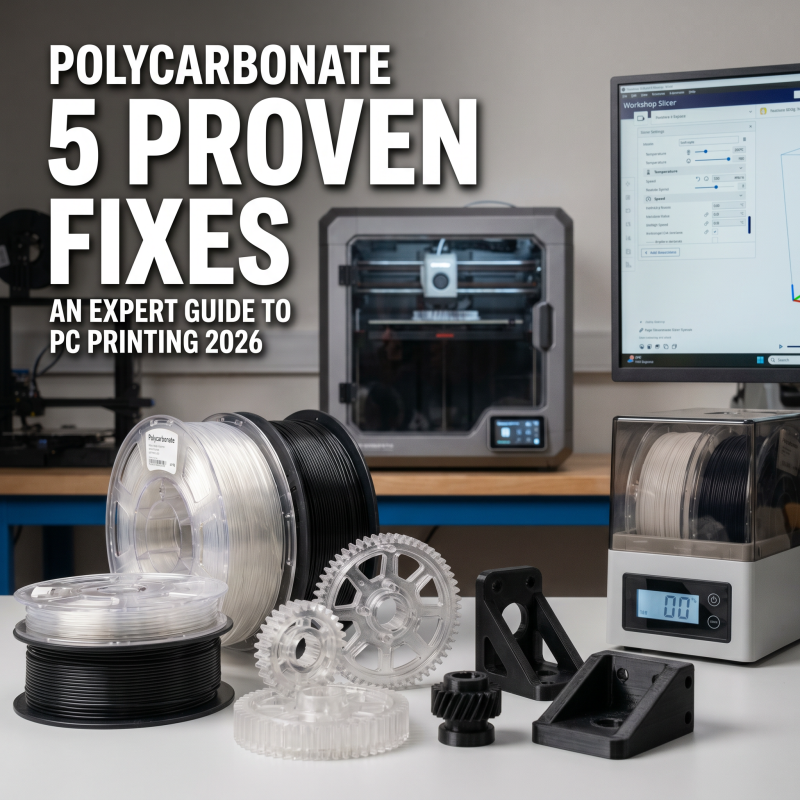
When the primary requirement for a part is the ability to survive sudden, violent shocks, Polycarbonate (PC) is often the first material engineers turn to. It is the material used to make bulletproof glass and riot shields for a reason. In the world of 3D printing, PC has earned a reputation as arguably the strongest consumer-grade filament, a claim supported by numerous manufacturers and reviewers (All3DP, n.d.). Its defining characteristic is a level of toughness that other common filaments simply cannot match.
The Material Science of Polycarbonate
Polycarbonate is a thermoplastic polymer belonging to the polyester family. Its molecular structure contains carbonate groups, which allow it to absorb a tremendous amount of energy before failing. This is the source of its legendary impact resistance. When you strike a piece of PC, the polymer chains are able to move and untangle, dissipating the force over a wider area rather than concentrating it at a single point of fracture.
Beyond its toughness, PC boasts several other desirable properties. It has a high glass transition temperature, meaning it can withstand operating temperatures of around 120°C without deforming, significantly higher than ABS or PETG. It also possesses good tensile strength and is dimensionally stable after printing. In its raw, uncolored form, it is optically transparent, though 3D printed parts will be translucent due to the layer lines. This combination of strength, heat resistance, and toughness makes it a formidable material for functional applications.
Printing with Polycarbonate: Challenges and Solutions
With great performance comes great responsibility—or in this case, great printing difficulty. PC is not a “press print and walk away” material. It presents three main challenges that must be actively managed for success.
- High Temperature Requirements: PC requires very high temperatures to melt and extrude properly. A nozzle temperature of 260-310°C is typical, which is at the upper limit of or beyond what many entry-level printers can achieve. Furthermore, a heated bed temperature of 100-130°C is mandatory. Without it, the first layer will not adhere, and the print will fail immediately.
- Warping: PC has a high coefficient of thermal expansion, meaning it shrinks significantly as it cools. This thermal contraction creates immense internal stress within a print. The bottom layers, stuck to the hot bed, try to stay put while the upper, cooler layers pull inward. This battle results in the corners of the print lifting off the bed, an issue known as warping. The only reliable solution is to use a fully enclosed 3D printer. An enclosure traps heat, raising the ambient temperature around the part. This slows the cooling process, reduces the temperature gradient between the part and its surroundings, and minimizes the internal stresses that cause warping.
- Hygroscopicity: Like Nylon, Polycarbonate is hygroscopic, meaning it readily absorbs moisture from the air. Printing with “wet” PC is a recipe for disaster. The absorbed water turns to steam in the hot end, creating bubbles in the extruded filament. This results in a frosty, ugly surface finish, terrible layer adhesion, and a mechanically weak, brittle part. To succeed, PC filament must be dried in a dedicated filament dryer or a modified food dehydrator at around 80°C for at least 6-8 hours before printing. It should also be stored in a sealed, airtight container with desiccant when not in use.
Ideal Applications for PC
Despite the challenges, mastering PC printing unlocks the ability to create parts with exceptional durability. Its properties make it the ideal choice for:
- Mechanical Parts: Drone frames, high-impact gears, and robust brackets that need to survive crashes and hard use.
- Functional Prototypes: Creating prototypes that can be subjected to real-world testing and abuse without failing.
- Protective Components: Housings for electronics, protective guards for machinery, and custom cases that need to offer maximum impact protection.
For anyone serious about producing end-use parts that can withstand mechanical abuse, learning to print with Polycarbonate is a necessary and rewarding step.
Contender 2: Nylon (Polyamide) – The Champion of Durability and Flexibility
While Polycarbonate is the master of resisting a single, powerful impact, Nylon (Polyamide) is the champion of long-term durability and wear resistance. If PC is a shield, Nylon is a set of high-quality gears, designed to run smoothly and tirelessly for thousands of cycles. A tough, semi-flexible material with high impact and abrasion resistance, it is an ideal choice for durable parts such as plastic gears, screws, and cable ties (Simplify3D, n.d.). When a part needs to bend without breaking or slide against another surface without wearing out, Nylon is often the answer.
Exploring the Nylon Family (PA6, PA12)
Nylon is not a single material but a family of polymers called polyamides (PA). The numbers that follow, such as PA6 and PA12, refer to the number of carbon atoms in the monomers that make up the polymer chain. This seemingly small chemical difference has a significant impact on the material’s properties.
- PA6: This variant is generally harder, stiffer, and has slightly higher tensile strength. It is often chosen for applications where rigidity and strength are the primary concerns. However, it is also more hygroscopic than PA12, making it more challenging to print.
- PA12: This is a more common variant in 3D printing. It is more flexible, has better chemical resistance, and is significantly less hygroscopic than PA6. Its lower moisture absorption makes it more dimensionally stable and easier to print reliably.
A defining characteristic of all Nylons is their exceptionally low coefficient of friction. This gives them a slippery, self-lubricating quality. When two Nylon parts rub against each other, they do so with minimal resistance and wear. This property, combined with its excellent fatigue resistance (the ability to withstand repeated cycles of stress), makes it perfect for parts that move.
The Hygroscopic Nature of Nylon: A Critical Hurdle
The greatest challenge in working with Nylon is its profound hygroscopicity. The amide groups in its chemical structure are polar and form strong hydrogen bonds with water molecules in the atmosphere. A spool of Nylon left in a typical room can absorb over 2% of its weight in water in just 24 hours.
Printing with moisture-laden Nylon is an exercise in frustration. As the filament enters the hot end, the trapped water violently boils into steam. This can be heard as popping or crackling sounds from the nozzle. The steam creates voids within the extruded plastic, leading to a host of problems:
- Poor Surface Finish: The part will have a rough, fuzzy, or pockmarked appearance.
- Weak Interlayer Adhesion: The steam bubbles prevent the layers from bonding properly, resulting in a part that is structurally compromised and can easily be pulled apart.
- Stringing and Oozing: The inconsistent pressure in the nozzle caused by steam generation leads to excessive stringing between travel moves.
- Dimensional Inaccuracy: The foaming effect of the steam can cause the extruded lines to be wider than intended.
Success with Nylon is therefore entirely dependent on a rigorous drying protocol. The filament must be dried before every print, even if it was just dried a few days prior. A dedicated filament dryer is the best tool for the job. Use the drying temperature and time on the filament maker’s data sheet to fully remove the absorbed moisture. During printing, using a sealed, dry box that feeds directly to the printer is the gold standard for maintaining a low-moisture state.
Applications Where Nylon Excels
When properly dried and printed, Nylon produces parts that are tough in a way no other filament can replicate. Its unique blend of properties makes it ideal for:
- Gears, Bushings, and Bearings: Its self-lubricating nature and high wear resistance are perfect for components that slide or rotate against each other.
- Living Hinges: Its excellent flexibility and fatigue resistance allow for the creation of thin, flexible joints that can be bent thousands of times without breaking.
- Durable Tools and Jigs: Fixtures, jigs, and hand tools printed in Nylon can withstand repeated use and abuse in a workshop environment.
- Flexible, Impact-Resistant Parts: For components that need to absorb impact by flexing rather than remaining rigid, like clips or snap-fit enclosures.
Nylon demands patience and preparation, but the reward is parts with a professional-grade toughness and durability that opens up a new world of functional 3D printing.
Contender 3: Fiber-Reinforced Composites – Strength Redefined
If base polymers like PC and Nylon are the workhorses of functional printing, then fiber-reinforced composites are the thoroughbreds. By infusing a standard polymer with short, chopped fibers of a much stronger material, we create a composite that exhibits properties far beyond what the base polymer could achieve on its own. This is the same principle used in high-performance industries like aerospace and motorsports, where carbon fiber composites have replaced metals. For 3D printing, this technology allows us to create parts with unprecedented stiffness and strength, turning a desktop printer into a tool for producing truly engineering-grade components.
The Principle of Composite Reinforcement
Imagine concrete. On its own, it has great compressive strength but is weak under tension. By adding steel rebar, we create reinforced concrete. The concrete handles the compression, and the steel handles the tension, resulting in a composite material that is strong in every direction.
Fiber-reinforced filaments work in a similar way. A base polymer, like PETG or Nylon, acts as the “matrix.” This matrix is then filled with a percentage (typically 10-30%) of chopped fibers, such as carbon fiber or glass fiber. When the part is under stress, the load is transferred from the weaker polymer matrix to the incredibly strong and stiff fibers. This has a dramatic effect on the material’s mechanical properties, most notably:
- Increased Stiffness (Flexural Modulus): This is the most significant improvement. Adding carbon fibers can increase the stiffness of a polymer by two to four times. This is crucial for parts that must resist bending or flexing under load.
- Increased Tensile Strength: The fibers also help the material resist being pulled apart, boosting its tensile strength.
- Improved Dimensional Stability: The rigid fibers within the matrix help to control the polymer’s shrinkage as it cools. This results in less warping and more dimensionally accurate parts compared to the unfilled base polymer.
However, there is a trade-off. The addition of rigid fibers typically reduces the polymer’s elongation at break, meaning the composite material is often more brittle than its base polymer. It will resist bending with incredible force, but when it does fail, it is more likely to snap rather than deform.
Carbon Fiber vs. Glass Fiber: A Comparative Analysis
The two most common reinforcement materials are carbon fiber (CF) and glass fiber (GF). While they serve a similar purpose, they have distinct characteristics that make them suitable for different applications. Understanding these differences is key to selecting the right composite.
| Property | Carbon Fiber (CF) Reinforcement | Glass Fiber (GF) Reinforcement |
|---|---|---|
| Stiffness/Modulus | Extremely high. Provides the best rigidity per weight. | High. Significantly stiffer than base polymer, but less than CF. |
| Strength | Very high tensile strength. | Good tensile strength. |
| Weight | Very lightweight. Ideal for aerospace and drone applications. | Heavier than carbon fiber. |
| Cost | Higher cost. | Lower cost. Excellent performance-to-price ratio. |
| Abrasiveness | Extremely abrasive. Rapidly wears out standard nozzles. | Very abrasive. Also requires a hardened nozzle. |
| Electrical Conductivity | Conductive. Cannot be used for electrical insulation. | Insulator. Excellent for electronic enclosures and components. |
| Appearance | Matte black, fibrous surface that hides layer lines. | Typically a milky or fibrous appearance in the base color. |
Case Study: Carbon Fiber PETG and Carbon Fiber Nylon (PA-CF)
To see these principles in action, let’s examine two popular composite materials.
Carbon Fiber PETG (PETG-CF): This material, detailed in guides like the one from SigmaFilament (2026), represents an accessible entry into the world of composites. It takes the user-friendliness and low-warp characteristics of PETG and enhances them with carbon fiber. The resulting Carbon Fiber PETG is significantly stiffer and more dimensionally stable than standard PETG, with a beautiful matte finish that conceals layer lines. It is an excellent choice for functional prototypes, jigs, and fixtures that require high rigidity without the printing difficulty of Nylon or PC.
Nylon Carbon Fiber (PA-CF): This is a high-performance engineering material. By combining the durability and temperature resistance of a Nylon base (like PA6 or PA12) with 15-20% carbon fiber, you get a filament with truly exceptional properties. This makes it strong enough to replace machined aluminum in some applications. It is ideal for end-use parts in automotive, robotics, and industrial machinery.
The one non-negotiable rule for printing any fiber-reinforced composite is the need for a hardened nozzle. The chopped fibers are incredibly abrasive. A standard brass nozzle can be worn out and ruined in a matter of hours, or even during a single large print. The nozzle’s internal diameter will be enlarged, leading to under-extrusion and print failure. A hardened steel, ruby, or tungsten carbide nozzle is required to withstand this abrasion. This is a small investment to protect your printer and ensure successful prints with these advanced, tough materials.
Contender 4: PEEK – The Apex of Performance (and Price)
If we visualize 3D printing materials on a pyramid, the base would be made of standard polymers like PLA and PETG. The middle tier would be occupied by engineering materials like ABS, PC, and Nylon. At the very pinnacle, in a class of its own, sits a family of ultra-high-performance polymers, and PEEK (Polyether Ether Ketone) is its king. PEEK is not just a tougher filament; it represents a different paradigm of material performance, offering properties that allow 3D printing to compete directly with traditional manufacturing of metals like aluminum and stainless steel in the most demanding environments.
An Introduction to High-Performance Polymers
What elevates a polymer to “high-performance” status? It is the ability to maintain excellent mechanical, thermal, and chemical properties under conditions where other plastics would simply fail. PEEK is a semi-crystalline thermoplastic known for its incredible combination of characteristics:
- Extreme Thermal Resistance: PEEK has a continuous service temperature of around 250°C (482°F) and can withstand short-term exposure to even higher temperatures. Its melting point is over 340°C. This allows it to be used in high-temperature engines, sterilization processes, and downhole drilling applications.
- Exceptional Chemical Resistance: PEEK is virtually inert to a vast range of organic and inorganic chemicals, including acids, bases, solvents, and hydrocarbons. It is one of the most chemically resistant plastics available.
- High Strength and Stiffness: PEEK’s tensile strength is 90 to 100 MPa (Wikipedia contributors, n.d.), which makes it one of the strongest unfilled polymers you can print. When reinforced with carbon fiber (PEEK-CF), its mechanical properties become competitive with metals.
- Biocompatibility: Medical-grade PEEK is biocompatible and can be used for implants inside the human body, such as spinal fusion cages and cranial plates.
This extraordinary profile makes PEEK one of the most capable materials in the world, not just in 3D printing.
The Demands of Printing PEEK
This level of performance does not come easily or cheaply. Printing PEEK is a professional endeavor that requires specialized, industrial-grade equipment. Attempting to print PEEK on a standard desktop 3D printer is not just likely to fail—it is impossible and potentially dangerous. The requirements are strict:
- Ultra-High-Temperature Hot End: PEEK requires an extrusion temperature between 380°C and 420°C. This is far beyond the capabilities of most printers, which typically top out around 300°C. An all-metal hot end with a powerful heater cartridge and specialized thermistor or thermocouple is necessary.
- High-Temperature Heated Bed: To ensure adhesion and prevent warping, a bed temperature of at least 120°C is required, with 140-160°C being more common.
- Actively Heated Chamber: This is the most critical requirement. PEEK is a semi-crystalline polymer, and controlling the rate at which it cools and crystallizes is essential for achieving its full mechanical properties. Printing must be done inside an actively heated chamber capable of maintaining an ambient temperature of at least 70°C, and often above 120°C. Without this, the part will delaminate, warp severely, and be incredibly brittle.
The printers capable of meeting these demands are industrial machines that cost tens of thousands, or even hundreds of thousands, of dollars. The filament itself is also exceptionally expensive, often costing $500 to $1,000 per kilogram.
When to Justify Using PEEK
Given the extreme cost and hardware requirements, PEEK is not a material for hobbyists or general prototyping. Its use is justified only in applications where no other material will suffice and the cost is warranted by the performance. Such applications include:
- Aerospace: Lightweight components inside engines or on aircraft exteriors that require high heat and chemical resistance.
- Medical: Custom surgical guides, tools, and long-term implants.
- Oil and Gas: Seals, valves, and sensor housings used in downhole drilling environments with high temperatures and pressures.
- Industrial Manufacturing: Metal-replacement parts for jigs, fixtures, and end-effectors in high-temperature manufacturing processes.
PEEK represents the absolute summit of what is possible with polymer 3D printing. While it may be out of reach for most users, its existence pushes the boundaries of the technology and demonstrates the potential for 3D printing to create parts for the most extreme applications imaginable.
Contender 5: Specialized and Toughened Variants
While the high-performance engineering polymers represent the top tier of toughness, the material science landscape is not so black and white. There exists a fascinating and highly practical middle ground: specialized blends and toughened variants that aim to provide enhanced properties without the extreme printing requirements of materials like PC or PEEK. These filaments are designed to bridge the gap, offering a significant step up in performance from standard materials like PLA while remaining accessible to a wider range of users and printers. They represent a pragmatic approach to finding the toughest 3D filament for everyday functional printing.
Tough PLA: Bridging the Gap
For years, users faced a difficult choice: the ease of printing with PLA or the superior mechanical properties of ABS. PLA is simple to print but brittle, while ABS is tough but prone to warping and emits unpleasant fumes. “Tough PLA” was developed to solve this dilemma. It is a formulation of PLA that has been modified with additives to improve its ductility and impact resistance.
In practice, this means that while standard PLA might shatter when dropped, a part printed from Tough PLA is more likely to deform or bounce, surviving the impact. It achieves this improved toughness while retaining the key benefits of PLA:
- Ease of Printing: It prints at similar temperatures to standard PLA and does not require a heated bed or enclosure.
- Low Warping: It exhibits minimal shrinkage, making it reliable for large prints.
- No Strong Fumes: It does not produce the strong odor associated with printing ABS.
Tough PLA is not in the same league as Polycarbonate or Nylon for absolute toughness. However, it is an outstanding material for its purpose: creating functional prototypes, jigs, and fixtures that need to be more durable than standard PLA parts, without the hassle of printing with more demanding materials. It is perhaps the toughest of the “easy-to-print” filaments.
Polycarbonate Blends (PC-ABS)
What if you could combine the best attributes of two different polymers? This is the principle behind polymer blends. PC-ABS is a popular industrial thermoplastic that has made its way into 3D printing. It is a composite material that synergistically combines the strength and heat resistance of Polycarbonate with the flexibility and easier processing of ABS.
The result is a filament that offers a compromise between the two parent materials. Compared to pure PC, PC-ABS is easier to print, with a lower tendency to warp and lower printing temperatures. Compared to pure ABS, it has significantly better impact resistance and a higher heat deflection temperature. This makes it an excellent choice for applications like automotive components, electronics enclosures, and protective gear where a high degree of toughness is required, but the extreme difficulty of printing pure PC is a barrier.
Aramid Fiber (Kevlar) Composites
While carbon fiber is known for adding stiffness, another type of fiber—aramid—is known for adding sheer durability. Aramid is the generic name for the fiber used in well-known brands like Kevlar. When aramid fibers are blended into a polymer matrix like ABS or ASA, they create a composite with exceptional properties.
The aramid fibers are incredibly difficult to cut or break, which translates to a printed part that is highly resistant to wear and tear. These parts have a matte, fibrous surface and are incredibly durable. They are an excellent, albeit niche, choice for applications like:
- Protective drone parts that need to survive repeated impacts.
- Jigs and fixtures that come into contact with abrasive surfaces.
- End-use parts that require a high degree of wear resistance over their lifetime.
These specialized variants demonstrate that the search for the toughest 3D filament is rich with options. By understanding the specific benefits of these modified materials, users can select a filament that is perfectly tuned to their application needs and printer capabilities.
How to Choose the Right Toughest 3D Filament for Your Project
Navigating the expansive landscape of engineering filaments can feel daunting. With each material presenting a unique profile of strengths, weaknesses, and printing requirements, the choice is far from simple. However, the selection process can be demystified by shifting our perspective. Instead of asking, “What is the toughest 3D filament?”, we should be asking, “What specific properties does my application demand, and which material best fulfills those needs?” This application-centric approach transforms a confusing choice into a logical process of elimination.
Defining Your Application’s Needs
Before you even look at a spool of filament, you must first thoroughly analyze the part you intend to create. This is an exercise in engineering empathy—putting yourself in the part’s place and considering the forces and environment it will experience. Ask yourself a series of critical questions:
- What is the primary mode of failure? Will the part be under constant tension, like a cable tie? Will it be subjected to bending forces, like a shelf bracket? Or is it most likely to fail from a sudden impact, like a protective casing? This will tell you whether to prioritize tensile strength, flexural modulus, or impact resistance.
- What is the operating environment? What is the maximum temperature the part will experience? Will it be exposed to sunlight (UV radiation)? Will it come into contact with chemicals, oils, or solvents? This will guide your choice towards materials with appropriate thermal and chemical resistance, like ASA or PEEK.
- Are there any dimensional or flexibility requirements? Does the part need to be extremely rigid and dimensionally stable, or does it need to bend and flex without breaking, like a living hinge? This is the classic choice between a stiff carbon fiber composite and a ductile Nylon.
- What are the capabilities of my printer? Be honest about your hardware. Does your printer have an all-metal hot end capable of reaching 300°C? Do you have a sealed, actively heated enclosure? Can you implement a reliable filament drying solution? Your printer’s capabilities will immediately rule out certain materials. There is no point buying a spool of PEEK if you have an open-air entry-level printer.
- What is my budget? The cost of these materials varies dramatically, from affordable Tough PLA to eye-wateringly expensive PEEK. Consider not only the cost of the filament but also any necessary hardware upgrades, like a hardened nozzle or a filament dryer.
A Practical Decision Flowchart
By answering the questions above, you can build a decision-making framework. Let’s walk through a common thought process for selecting a material.
- Start with the Baseline: My part needs to be more durable than standard PLA.
- Assess Printability vs. Performance: Do I need a simple, reliable printing experience above all else?
- Yes: My printer is not enclosed, and I want minimal fuss.
- Action: Choose Tough PLA for good impact resistance with the ease of PLA printing, or PETG for a good balance of strength, flexibility, and temperature resistance.
- No: I have an enclosed printer (or am willing to build one) and am ready for a challenge to get top-tier performance.
- Proceed to the next step.
- Yes: My printer is not enclosed, and I want minimal fuss.
- Identify the Critical Mechanical Property: What is the most important type of toughness for my part?
- Highest Impact Resistance: The part is a protective case or a drone frame that must survive crashes.
- Action: Choose Polycarbonate (PC). Prepare for high temperatures and meticulous drying.
- Highest Durability and Wear Resistance: The part is a gear, a living hinge, or a component that needs to be flexible and fatigue-resistant.
- Action: Choose Nylon (PA). Invest in a filament dryer; it is not optional.
- Highest Stiffness and Rigidity: The part is a structural bracket or frame that must not bend under any circumstances.
- Action: Choose a Carbon Fiber Composite Filament (like PETG-CF or PA-CF). Install a hardened nozzle before you print anything.
- Extreme Heat and Chemical Resistance: The part will operate in an engine bay, a chemical bath, or be subjected to steam sterilization.
- Action: If you have an industrial high-temperature printer and a significant budget, choose PEEK. Otherwise, re-evaluate if a lower-temperature material like PC or ASA-CF could work.
- Highest Impact Resistance: The part is a protective case or a drone frame that must survive crashes.
This structured approach ensures that you are not just picking a material that is generically “tough,” but one that is specifically engineered for the challenges your part will face.
Frequently Asked Questions (FAQ)
What is the single strongest 3D printer filament? This question is nuanced because “strongest” can refer to different properties. For tensile strength (resisting being pulled apart), carbon fiber-reinforced composites like PA-CF often have the highest values. For impact strength (resisting sudden shocks), Polycarbonate (PC) is generally considered the champion among consumer-accessible materials. For ultimate performance in all categories, including thermal and chemical resistance, industrial materials like PEEK and PEKK are at the top, but they require highly specialized printers.
Do I need a special printer to use the toughest 3D filament? For many of them, yes. While materials like Tough PLA can be printed on almost any machine, most high-performance filaments have specific hardware needs. Polycarbonate (PC) and ABS require an enclosed printer to prevent warping. All fiber-reinforced composites (like carbon fiber or glass fiber) are highly abrasive and mandate the use of a hardened steel, ruby, or tungsten carbide nozzle to avoid rapid wear. Materials like PEEK require industrial printers with ultra-high-temperature hot ends (>400°C) and actively heated chambers (>120°C).
Is PETG a tough filament? PETG is a great all-around material and is certainly tougher than standard PLA. It has better impact resistance and is more flexible, making it less brittle. However, its toughness, particularly its impact strength and wear resistance, does not reach the same level as engineering materials like Polycarbonate or Nylon. It is best described as a durable, user-friendly filament that serves as an excellent intermediate step between basic and advanced materials.
How do I stop my Nylon or PC filament from warping? Warping in these materials is caused by thermal contraction as the print cools. The most effective solution is to use an enclosed 3D printer to maintain a high ambient temperature around the part, which slows cooling and reduces internal stress. Additionally, using a high bed temperature (100-130°C for PC, 60-90°C for Nylon), ensuring the bed is perfectly clean, and using a strong adhesion aid like a PEI build surface, Magigoo PC, or a simple glue stick is critical. Printing with a wide brim or a raft can also help anchor the corners of the part to the build plate.
Is carbon fiber filament electrically conductive? Yes. Most filaments reinforced with carbon fiber are electrically conductive due to the nature of the carbon fibers themselves. This is a critical safety consideration. You should not use these materials to print electrical enclosures, insulators, or any part that will come into contact with live circuits, as it could create a short circuit. For applications requiring high stiffness and electrical insulation, a glass fiber-reinforced composite (GF) is the appropriate choice.
What is the difference between toughness and strength? In material science, these are distinct terms. Strength (specifically tensile strength) is a material’s ability to resist a steady, pulling force without breaking. Toughness (specifically impact strength) is a material’s ability to absorb sudden energy, like from a drop or a strike, without fracturing. A ceramic knife is very strong and hard but not tough; it will shatter if dropped. A rubber mallet is not very strong but is extremely tough. For functional 3D printed parts, a balance of both is often desirable.
Conclusion
The pursuit of the toughest 3D filament leads us not to a single material, but to a deeper appreciation for the rich diversity of modern polymer science. We have seen that “toughness” is not a monolithic concept but a composite of specific, measurable properties: the impact-absorbing resilience of Polycarbonate, the durable, low-friction flexibility of Nylon, the unyielding rigidity of carbon fiber composites, and the extreme environmental resistance of PEEK. The selection of the right material is therefore not a simple ranking but a thoughtful process of alignment, matching the unique character of a filament to the specific challenges a part will face in its functional life.
This journey from the familiar brittleness of PLA to the industrial might of PEEK underscores a fundamental truth of engineering: there are no perfect materials, only optimal choices for a given application. Success in printing functional, durable parts depends less on having the “strongest” filament and more on understanding the nuanced trade-offs between performance, printability, and cost. By embracing a data-driven, application-focused mindset, any creator—from a hobbyist to a professional engineer—can harness these advanced materials to fabricate parts that are not just prototypes, but robust, reliable solutions capable of withstanding the rigors of the real world. The power lies not just in the filament, but in the informed choice.
References
- All3DP. (n.d.). The strongest 3D printer filament. All3DP. Retrieved February 2, 2026, from
- SigmaFilament. (2026, January 25). Actionable buyer’s guide: 7 factors for success with carbon fiber PETG in 2026. SigmaFilament. https://sigmafilament.com/carbon-fiber-petg-printing-guide/
- Wikipedia contributors. (n.d.). Polyether ether ketone. Wikipedia. Retrieved November 2, 2026, from https://en.wikipedia.org/w/index.php?title=Polyether_ether_ketone&oldid=1379370760
- Simplify3D. (n.d.). Ultimate materials guide: 3D printing with Nylon. Simplify3D. Retrieved November 28, 2026, from https://www.simplify3d.com/resources/materials-guide/nylon/
Last reviewed and updated: February 2026. Author: SigmaFilament Engineering Team. For custom filament solutions and wholesale inquiries, contact our team.