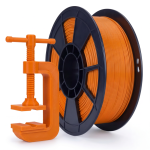
Orange ABS Filament — Heat-Resistant, Impact-Tough and Built for Functional Parts
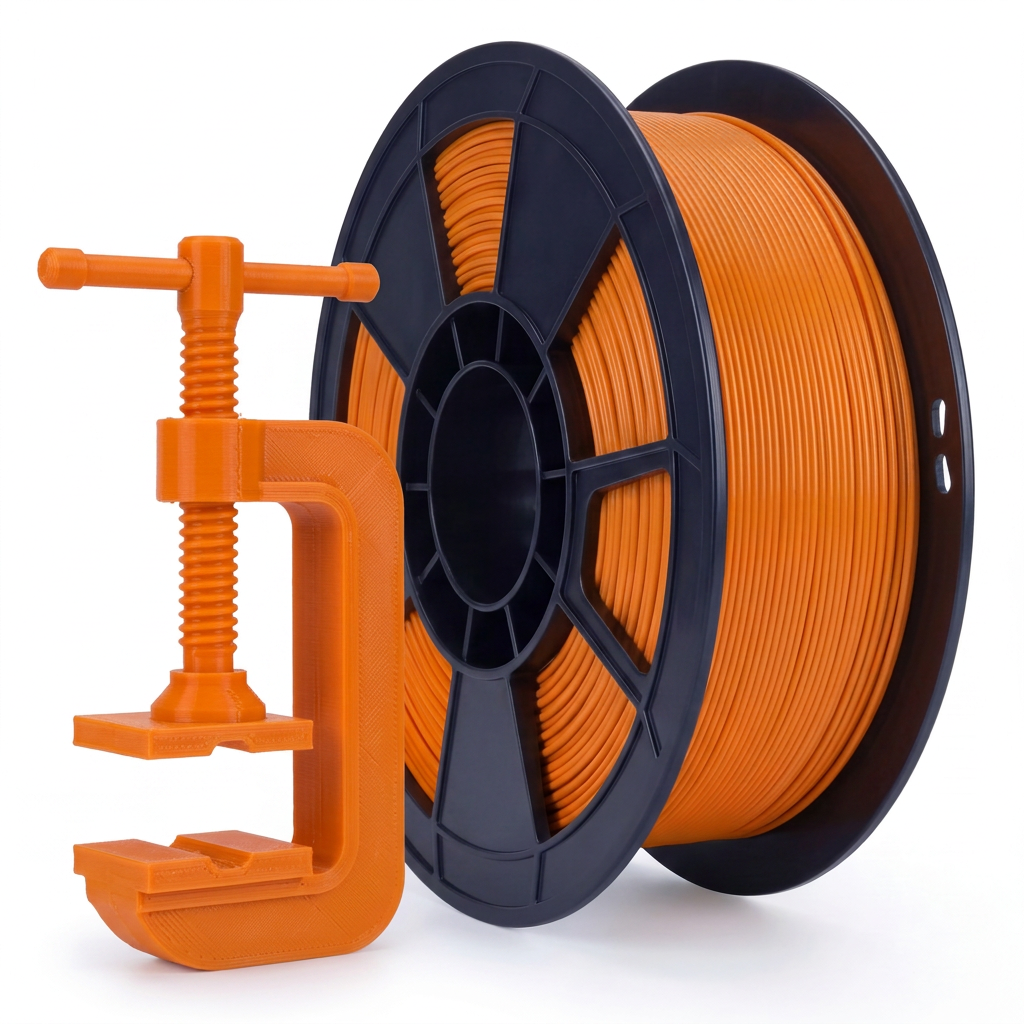
Orange ABS is the engineering workhorse for parts that have to survive real use: heat, impact, torque and the occasional drop off a workbench. ABS (Acrylonitrile Butadiene Styrene) is the same tough thermoplastic used in power-tool housings, automotive trim and LEGO bricks, and printed at 1.75mm it gives a workshop a material that holds its shape near warm motors, shrugs off knocks that would shatter a rigid PLA part, and can be acetone-vapor smoothed into a sealed, glossy finish. The bold, opaque orange is chosen deliberately — it is the safety-visibility color of tool handles, machine guards and warning parts, and unlike a pastel it stays legible on a busy shop floor.
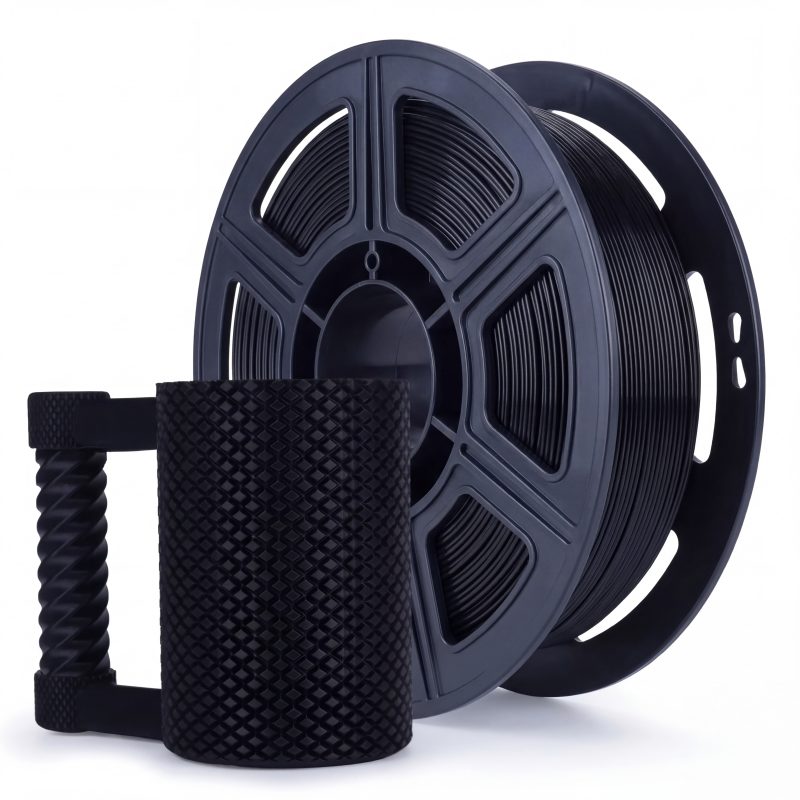
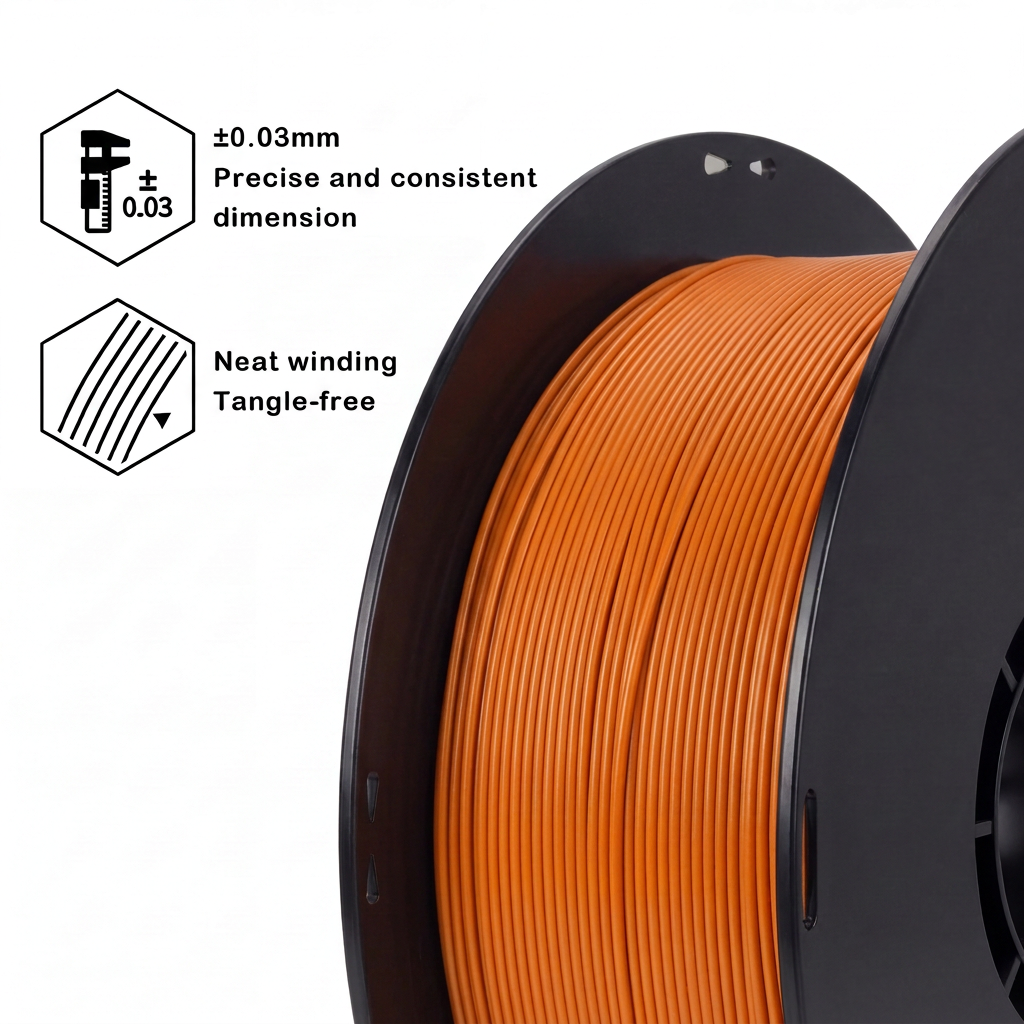
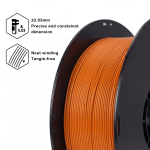
What separates a dependable spool from a frustrating one is process consistency, so this orange ABS filament is held to a ±0.03mm diameter tolerance and wound tangle-free on a black open-lattice spool. ABS is a warp-prone material: it contracts as it cools, and any inconsistency in feed or temperature turns into lifted corners, split layers and cracked walls. A tight, consistent diameter keeps extrusion even across the long, fully-heated prints that ABS parts usually demand, and the tangle-free winding stops the mid-print snags that ruin a six-hour enclosure. Every spool ships vacuum-sealed with desiccant, because damp ABS prints rough, stringy and weak.
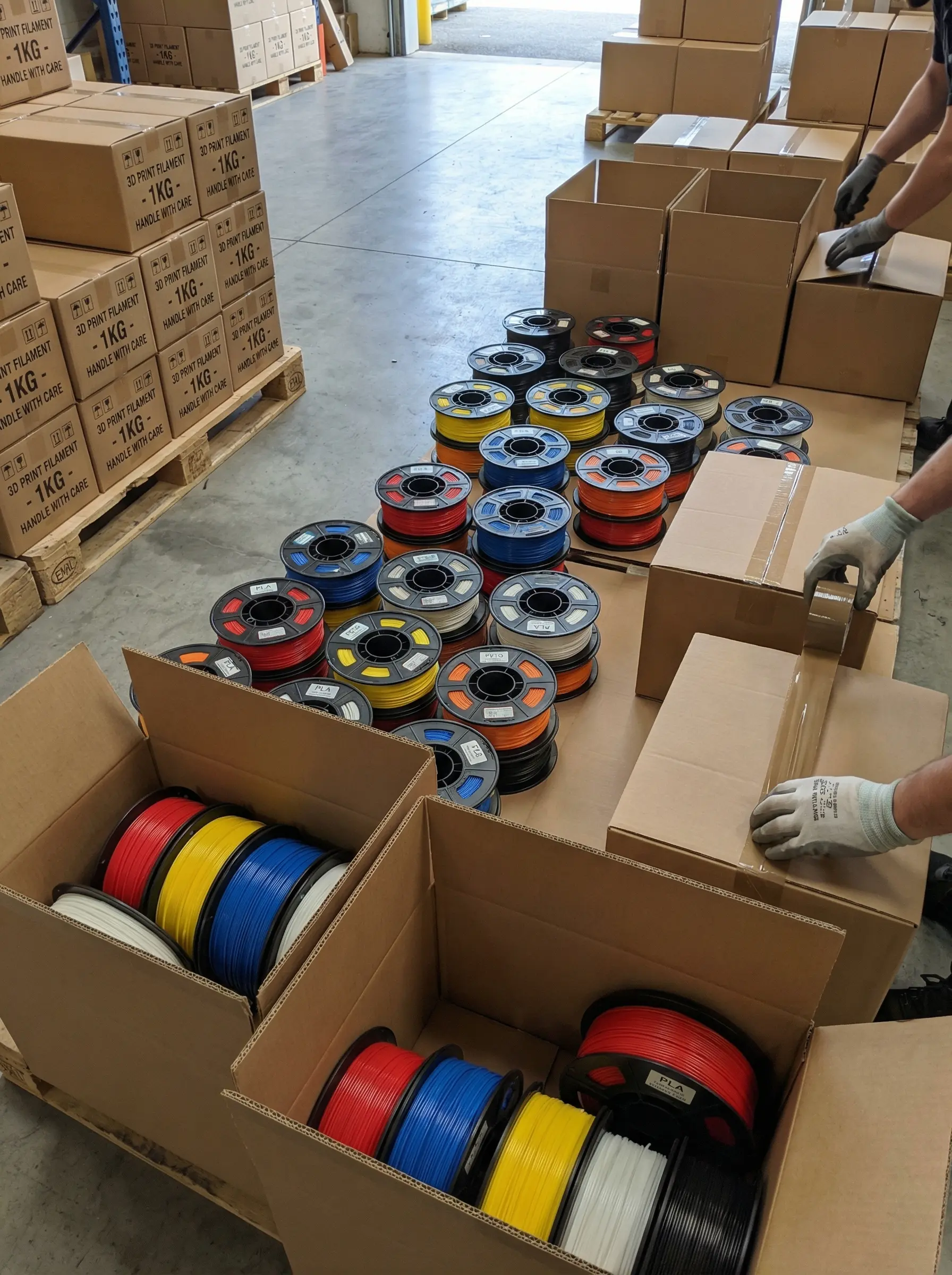
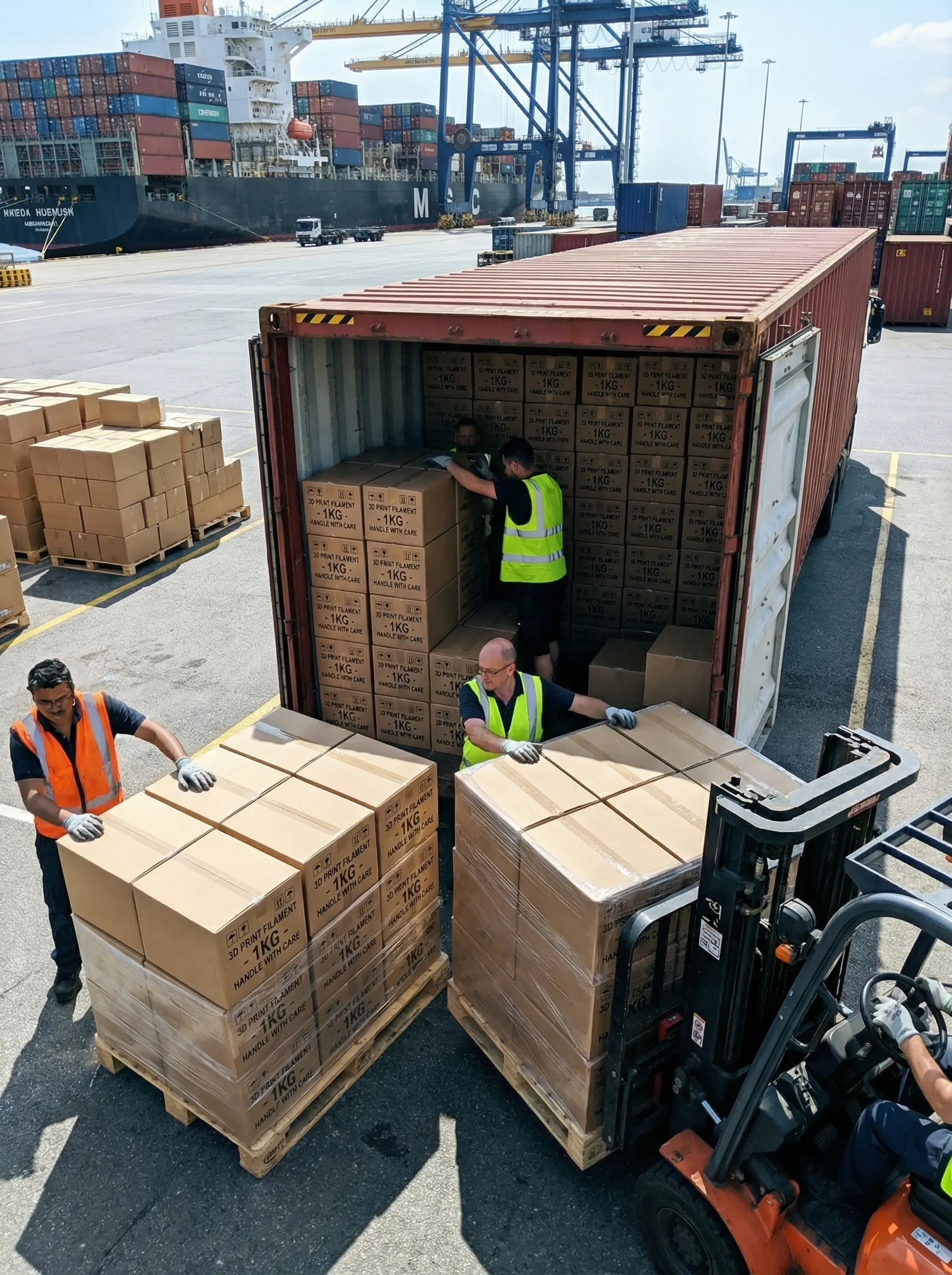
As a factory-direct product, this filament is stocked for both single-spool buyers and volume programs. If you are sourcing for production — tool housings, mounting brackets, automotive interior clips, functional jigs — it is available through our direct manufacturer wholesale program and through full OEM/ODM services with custom color, spool and private-label packaging.
ABS is often the material a workshop reaches for the moment a part stops being decorative and starts being functional. PLA looks fine on a shelf but softens in a hot car, creeps under sustained load and cracks under impact; ABS is engineered for exactly those conditions. Choosing orange specifically adds a layer of practical value — high-visibility parts, color-coded fixtures, and prototypes that read clearly in photos and on the line. Below you will find the print settings, mechanical data, application guidance and design tips that make this orange ABS filament reliable in practice, not just on paper.
Why This Orange ABS Filament Stands Out
- Genuine heat resistance: a glass-transition temperature around 105 °C and a heat-deflection point near 98 °C mean parts keep their shape in a hot car, near a stepper motor or under an enclosure lamp — conditions where PLA sags.
- High impact strength and toughness: ABS absorbs impact and flexes slightly before it fails, so clamps, brackets and housings survive drops and torque that would crack a brittle filament.
- Acetone-vapor smoothable: a light acetone vapor pass melts the surface into a glossy, watertight skin — useful for sealed enclosures, smooth handles and finished-looking prototypes.
- Bold, opaque safety orange: a high-visibility tone for tool grips, machine guards, warning parts and color-coded fixtures that must be seen, not blended in.
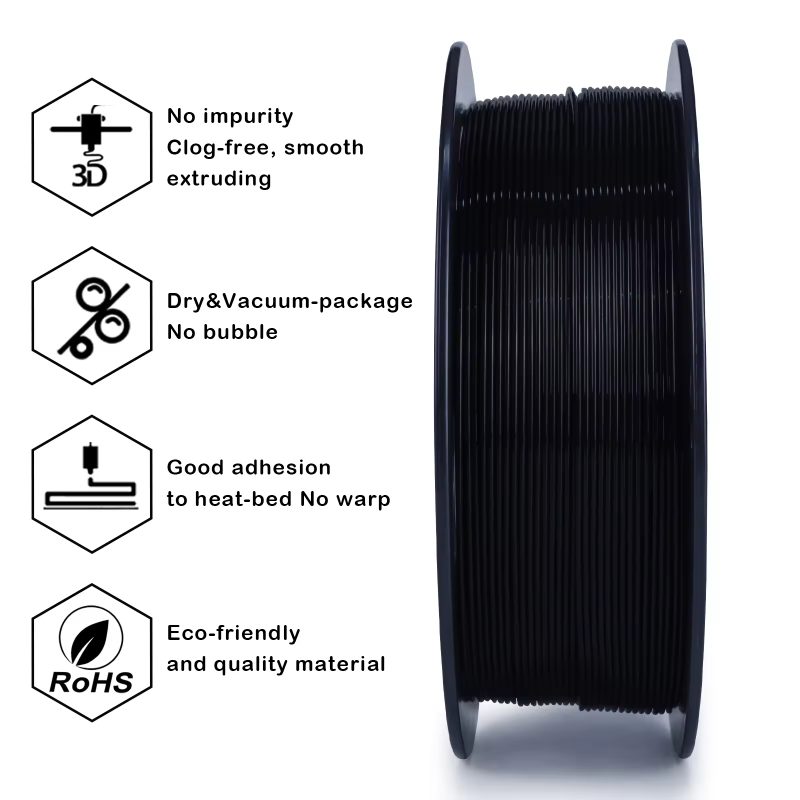
- ±0.03mm tolerance for even extrusion: consistent diameter keeps flow steady across the long, fully-heated prints ABS parts typically require, reducing warp-driven failures.
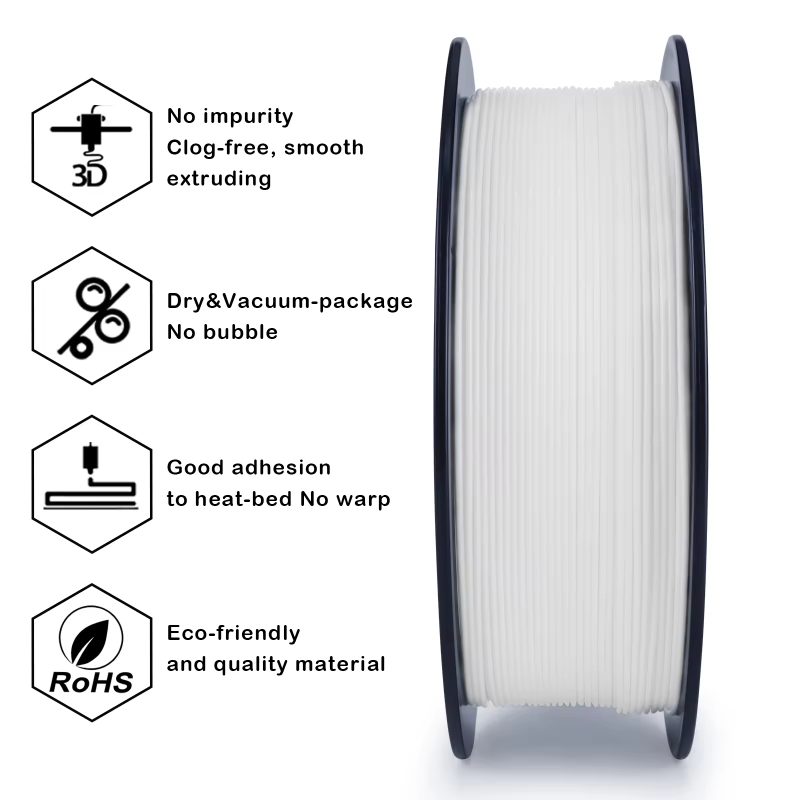
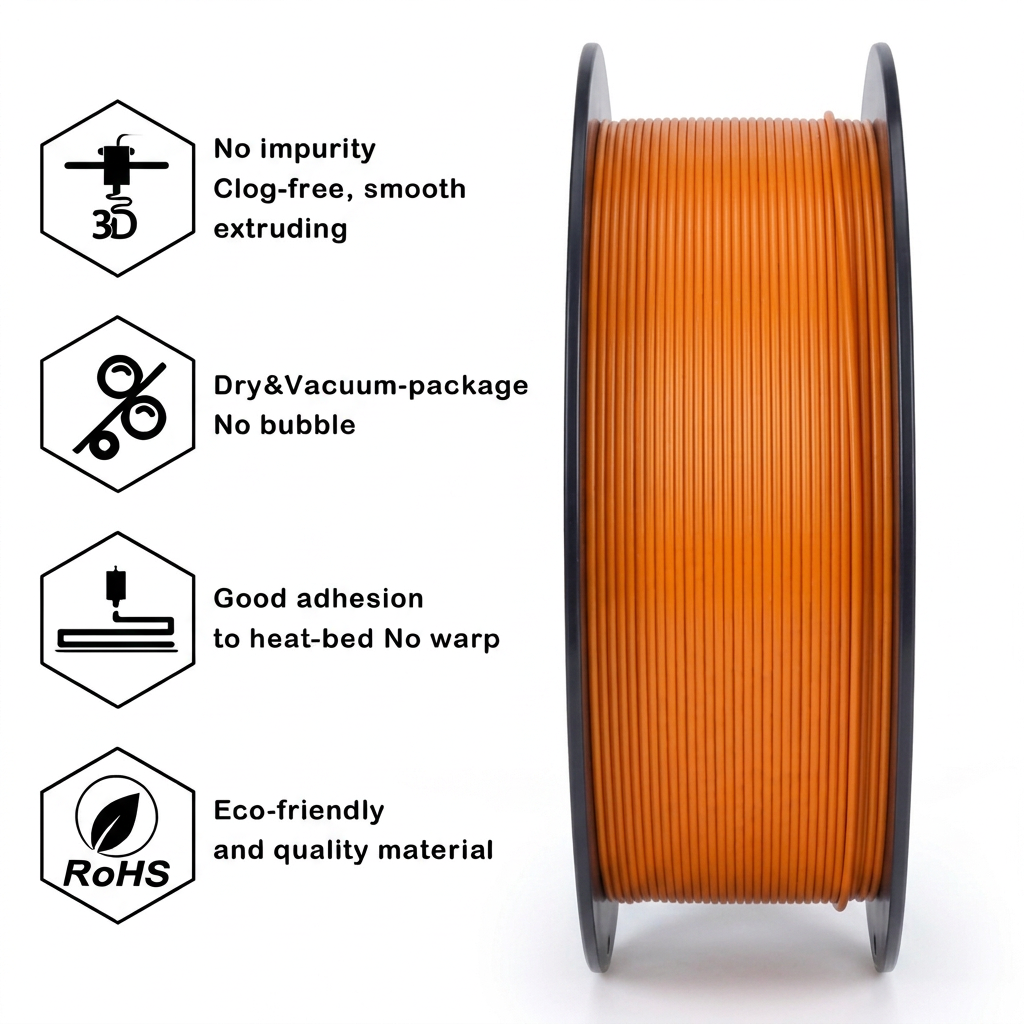
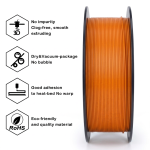
- Vacuum-sealed and dried at packing: ABS picks up moisture over time; dry-at-arrival packaging protects surface finish and layer bonding straight out of the box.
Premium Orange ABS at Factory-Direct Pricing
| Quality You Get | How We Deliver It | What It Means For You |
|---|---|---|
| Consistent toughness | Controlled ABS resin, batch-verified | Parts perform the same, batch to batch |
| Warp-resistant printing | ±0.03mm diameter + tangle-free winding | Fewer lifted corners and failed long prints |
| Dry on arrival | Vacuum seal + desiccant, sealed at packing | Less stringing and rough surfaces out of the box |
Why Choose Orange ABS for Your Projects
| Takes the heat | Holds shape in hot cars and near warm machinery where PLA softens. |
| Survives impact | Tough and slightly flexible — resists cracking under knocks and torque. |
| Machinable & finishable | Drill, tap, sand, glue and acetone-smooth like a real engineering plastic. |
| High visibility | Safety-orange parts stand out for guards, tools and warning components. |
| Color-coding ready | Ideal for fixtures and jigs sorted by function or line. |
| Volume-ready supply | Consistent stock for production, wholesale and OEM. |
How Orange ABS Compares
| Property | Orange ABS | PLA | PETG |
|---|---|---|---|
| Heat resistance | High (~98 °C HDT) | Low (~55 °C, softens easily) | Moderate (~70 °C) |
| Impact strength | High — tough, absorbs shock | Low — brittle, cracks | Good |
| Print difficulty | Needs heat + enclosure | Easiest to print | Easy–moderate |
| Post-processing | Acetone-smoothable, sands well | Sands, hard to smooth chemically | Limited |
| Best use | Functional & heat-exposed parts | Display & indoor models | Water-resistant, semi-flexible parts |
Orange ABS vs Orange PLA — A Sourcing Note
Orange PLA and orange ABS can look almost identical on the spool, but they belong to two different worlds. PLA is the right call for a display piece, a cosplay prop or an indoor model — it prints easily and looks great. The moment a part has a job to do, though, the difference is stark: leave a PLA bracket on a dashboard in summer and it warps; drop a PLA clamp and it snaps at the layer line; put a PLA housing near a stepper motor and it creeps under the heat. Orange ABS filament is engineered for that exact category of part. It holds its geometry above 90 °C, it flexes and absorbs a knock instead of shattering, and it can be tapped, drilled and glued like a proper engineering plastic. For a contract shop or a reseller supplying makers who build functional things, a spool of orange ABS covers a set of jobs that no amount of PLA can touch — and the safety-orange color earns its keep on guards, tools and warning parts where visibility is a feature.
For buyers standardizing a production BOM, orange ABS also simplifies inspection and identification. A consistent, saturated orange makes color-coded fixtures instantly recognizable on a line, and batch-to-batch color stability means a part printed this quarter matches one printed next. Combined with the ±0.03mm diameter control and dry vacuum packaging, that makes this orange ABS filament a low-variance input you can design a repeatable, warp-managed process around rather than re-tune around every delivery.
Recommended Print Settings
| Parameter | Recommended |
|---|---|
| Nozzle temperature | 230–260 °C (240 °C typical) |
| Bed temperature | 90–110 °C (100 °C typical) |
| Print speed | 40–60 mm/s |
| Cooling fan | Off or ≤20% (cooling causes cracking) |
| Enclosure | Strongly recommended |
| Bed adhesion | Glue stick / ABS slurry / brim |
| Drying | 60–80 °C for 4h if exposed to air |
Troubleshooting ABS Prints
| Symptom | Likely Cause | Fix |
|---|---|---|
| Corners lift / part warps off the bed | Uneven cooling; ambient too cold | Use an enclosure, bed 100–110 °C, disable part fan, add a brim and clean the bed |
| Layers split / cracks mid-part | Temperature drop between layers | Enclose the printer, raise nozzle 5–10 °C, keep the fan off, avoid drafts |
| Stringing / rough, hazy surface | Damp filament | Dry at 60–80 °C for 4h; print from a dry box; reseal with desiccant |
| Weak, easily-split walls | Nozzle too cool for good layer fusion | Increase nozzle to 245–255 °C; slow slightly for better bonding |
| First layer won’t stick | Cold bed / bare surface | Bed 100 °C, apply glue stick or ABS slurry, slow the first layer |
Technical Specifications
| Material | Acrylonitrile Butadiene Styrene (ABS) |
| Color | Opaque Safety Orange |
| Diameter | 1.75mm |
| Diameter tolerance | ±0.03mm |
| Net weight | 1kg (spool) |
| Approx. length | ~400m at 1.75mm |
| Glass transition temp | ~105 °C |
| Heat deflection temp | ~98 °C |
| Elongation at break | 10–20% (typical) |
| Recommended nozzle | ≥0.4mm, hardened not required |
| Nozzle temperature | 230–260 °C |
| Bed temperature | 90–110 °C |
| Print speed | 40–60 mm/s |
| Enclosure | Strongly recommended |
| Heated bed | Required |
| Post-processing | Acetone smoothing, sanding, drilling, gluing |
| Odor | Noticeable — ventilate the workspace |
| Moisture sensitivity | Moderate — keep sealed/dry |
| Compliance | RoHS / REACH |
Material Properties & Performance
ABS earns its place in the engineering-plastic category because of how it behaves under stress and heat. It has a glass-transition temperature around 105 °C, which is why a printed part keeps its shape in a parked car or beside a warm motor long after a PLA part would have slumped. It is tough rather than brittle: under impact it deforms and absorbs energy instead of snapping cleanly at a stress point, which is exactly what you want from a clamp, a bracket or a housing that gets handled and dropped.
The other half of ABS’s value is finishability. Because the polymer dissolves in acetone, a light vapor pass melts the outer surface into a glossy, sealed skin — hiding layer lines and making enclosures effectively watertight. The same solvent behavior means parts can be chemically welded together for assemblies larger than the build plate. The trade-off is process discipline: ABS shrinks as it cools, so it demands a hot bed, a stable enclosed ambient and minimal part cooling to print without warping or cracking. Every quality-control step on this filament — diameter accuracy, tangle-free winding, dry vacuum packaging — exists to remove the variables that make warp-prone ABS unpredictable, so the material’s real strengths reach the print bed intact.
| Property | Typical Value | Test Standard |
|---|---|---|
| Tensile strength | 35–45 MPa | ASTM D638 |
| Elongation at break | 10–20% | ASTM D638 |
| Izod impact (notched) | High | ASTM D256 |
| Heat deflection temp | ~98 °C | ASTM D648 |
| Glass transition temp | ~105 °C | DSC |
Printer-Specific Settings
| Bambu Lab X1/P1 (enclosed) | 250 °C / bed 100 °C / 50 mm/s, ABS profile, fan off |
| Prusa MK4 + enclosure | 245 °C / bed 100 °C / 45 mm/s |
| Creality K1C (enclosed) | 250 °C / bed 100 °C / 50–60 mm/s |
| Creality Ender 3 + enclosure | 240 °C / bed 100 °C / 40 mm/s, glue stick, brim |
| Voron 2.4 (enclosed) | 250 °C / bed 105 °C / 50–60 mm/s tuned |
| Qidi / enclosed machines | 245 °C / bed 100 °C / 45–55 mm/s |
Applications
| Functional mechanical parts | Clamps, brackets, gears, mounts and load-bearing components. |
| Enclosures & housings | Electronics cases that resist heat and can be acetone-sealed. |
| Tools, jigs & fixtures | Shop-floor tooling and high-visibility color-coded fixtures. |
| Automotive interior | Trim clips, mounts and dashboard parts that see cabin heat. |
| Safety & warning parts | Machine guards, handles and covers where orange visibility matters. |
| Functional prototypes | Iterations that must be tested under real heat and load. |
Industry Use Cases
Across industries, ABS shows up wherever a printed part has to work rather than just look good. In automotive and machinery, orange ABS filament prints trim clips, dust boots, mounting brackets and dashboard parts that must tolerate a hot cabin and constant vibration — and the safety-orange color doubles as a visual marker for service parts. In industrial tooling and manufacturing, it becomes jigs, fixtures, soft-jaw inserts and machine guards, where color-coded orange fixtures are instantly identifiable on a busy line. In electronics and product development, it makes enclosures and housings that resist warm internal components and can be acetone-smoothed into sealed, professional-looking cases. In robotics and RC, it prints structural chassis parts, brackets and mounts that survive crashes where a brittle material would shatter. And in education and workshops, high-visibility orange ABS is a favorite for functional teaching models and durable shop tools. The common thread is a part that faces heat, impact or load — and a bold orange that keeps it visible while it does its job.
Because a single engineering material spans so many of these jobs, standardizing on one dependable orange ABS filament simplifies purchasing: one input, one dial-in enclosed profile, one inspection reference — reused across brackets, enclosures, tools and automotive parts instead of qualifying a different filament for each product line.
Designing Parts for ABS
Getting the most out of orange ABS filament is as much about design as it is about slicer settings, because warping is a geometry problem before it is a temperature problem. A few habits make ABS parts print cleaner and stay stronger: add generous fillets and chamfers at corners so cooling stress has nowhere to concentrate and lift; keep large flat bottoms to a minimum, or split them, because broad flat areas warp the hardest; use 3–4 perimeters and 30–50% infill for structural parts so load is carried by solid walls rather than sparse fill; and orient the part so the main load runs along the layers, not across a single weak layer line. For assemblies, remember you can chemically weld ABS with acetone, so it is often smarter to print a big part in sections and bond them than to fight warp on one huge footprint. These choices are what separate an ABS part that comes off the bed flat and strong from one that cracks at the corner overnight.
Environmental & Safety Standards
| ✅ RoHS Restricted substances compliant | ✅ REACH SVHC compliant | ✅ Ventilate Styrene odor — print in aired space | ✅ Vacuum sealed Dry, desiccant-protected |
Packaging & Global Shipping
| Region | Method | Typical Time |
|---|---|---|
| North America | Air / express + sea for bulk | 7–20 days |
| Europe | Air / express + sea for bulk | 7–20 days |
| Asia-Pacific | Air / express | 5–12 days |
| Rest of world | Air + freight forwarding | 10–25 days |
Bulk Orders & OEM/ODM Services
| Custom color | Matched oranges and full palettes for color-coded lines. |
| Custom formulation | Standard ABS or tougher/heat-boosted grades to match your part. |
| Private label | Your spool, label and packaging design. |
| Volume pricing | Contact us for 10+ spool and pallet quotes via our OEM/ODM services. |
Storage & Handling Guidelines
| Reseal in the vacuum bag with desiccant after each print session. |
| Store below 20% RH; ABS absorbs moisture more slowly than TPU but still degrades when damp. |
| Dry at 60–80 °C for 4h if you see stringing or a hazy surface. |
| Keep away from direct sunlight and heat sources on the shelf. |
| Store acetone separately and handle smoothing in a ventilated space. |
| Handle spools by the hub to keep windings tight and tangle-free. |
Printer Compatibility
| Bambu Lab | Prusa | Creality | Voron | Qidi | Elegoo |
|---|---|---|---|---|---|
| ✅ Enclosed | ✅ MK4 + box | ✅ K1/enclosed | ✅ 2.4/Trident | ✅ X-Plus | ✅ + enclosure |
Any 1.75mm printer with a heated bed can run ABS; an enclosure is what makes it reliable and warp-free. For a broader look at durable engineering materials, see our strongest 3D printer filament guide.
Why Choose SigmaFilament for ABS
| Factory-direct | We manufacture the filament — no middle-man markup. |
| Batch consistency | Verified diameter and color spool to spool. |
| Dry packaging | Vacuum-sealed to keep ABS printing clean in transit. |
| OEM/ODM ready | Custom color, formulation and private-label programs. |
| Global logistics | Reliable worldwide shipping for samples and pallets. |
For print farms and production buyers, the value of a filament is measured in unattended reliability — how many spools run back-to-back without a warped corner, a cracked layer or a color mismatch. That is exactly where a manufacturer-controlled input pays off. Diameter is held to ±0.03mm so multi-machine enclosed profiles stay valid across every spool; color is batch-verified so a color-coded fixture printed today matches one printed next quarter; and vacuum-sealed dry packaging means a fresh spool prints clean out of the box instead of needing a drying cycle first. When you are running dozens of functional ABS parts a day, those three controls are the difference between a process you trust and one you babysit. If you are scaling functional production, talk to us about a standing wholesale supply or an OEM program tuned to your exact part.
Buying Orange ABS With Confidence
Whether you are printing a handful of parts or specifying a production input, this filament is built to remove the usual ABS friction. New to ABS? Start with the recommended enclosed profile above, run a hot bed, keep the fan off, and you will get flat, strong functional parts instead of warped corners. Already running ABS production? This material slots into an existing enclosed profile with minimal re-tuning, and its bold, stable color keeps color-coding and high-visibility parts consistent across batches. Buyers who have been burned by inconsistent ABS — warping on one spool, cracking on the next — tend to appreciate that a filament held to tight diameter and dryness tolerances behaves the same every time.
Every spool of orange ABS filament is manufactured, wound and packed under the same controls, and we back the material with responsive technical support and sample availability for qualified buyers. If your application needs a tougher or higher-heat ABS grade, a custom orange matched to a corporate standard, or private-label spools, our team can adapt this filament to your specification without you having to re-qualify a new supplier. That combination — a dependable off-the-shelf orange ABS spool plus a factory that can customize it — is what makes SigmaFilament a practical long-term source rather than a one-off purchase.
Frequently Asked Questions
Do I need an enclosure to print this orange ABS filament?
Why does my ABS keep warping or cracking?
Can I acetone-smooth this orange ABS?
How is ABS different from PLA for functional parts?
Does ABS smell while printing?
Do you offer orange ABS for wholesale or OEM/private-label?
Source Orange ABS Direct From the Factory
Heat-resistant, impact-tough, acetone-smoothable and dry-packed — ready for functional parts, enclosures, tools and automotive trim. Order a spool to test, or request wholesale & OEM pricing for production volumes.
Free samples for qualified buyers · Wholesale & OEM/ODM available
| Material | ABS |
|---|---|
| Color | Orange |
| Filament Diameter | 1.75mm ,2.85mm (3.00mm) |
| Spool Weight | 1kg ,3kg ,5kg ,Sample (200g) |