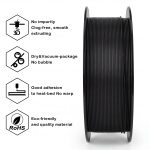
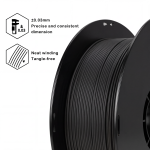
ABS Carbon Fiber Filament – Product Overview
The SigmaFilament ABS Carbon Fiber Filament delivers carbon fiber performance at a price point that makes volume production economically viable. While nylon-CF composites (PA6-CF, PA12-CF) offer the highest mechanical performance, they also carry premium pricing that can make large-scale or cost-sensitive projects impractical. ABS-CF fills the gap: genuine carbon fiber reinforcement at a fraction of the nylon-CF price point.
With 15% chopped carbon fiber content, this ABS-CF filament transforms standard ABS from a general-purpose material into a rigid, dimensionally stable engineering composite. The carbon fiber dramatically reduces the flex and creep that limit standard ABS in structural applications, improves thermal conductivity for electronic housings, enhances surface hardness for wear-facing parts, and produces the distinctive matte black “carbon fiber look” that signals engineering sophistication.
The ABS base brings its own well-established advantages: ~100-110°C heat deflection temperature (improved further by CF reinforcement), acetone vapor smoothing capability for production-quality surface finish, excellent machinability (drill, tap, sand, paint), and decades of proven performance in automotive, electronic, and consumer product manufacturing. ABS is the material that injection-molded LEGO bricks, automotive dashboards, and electronic housings are made from – adding carbon fiber to this proven base creates a composite with real industrial pedigree.
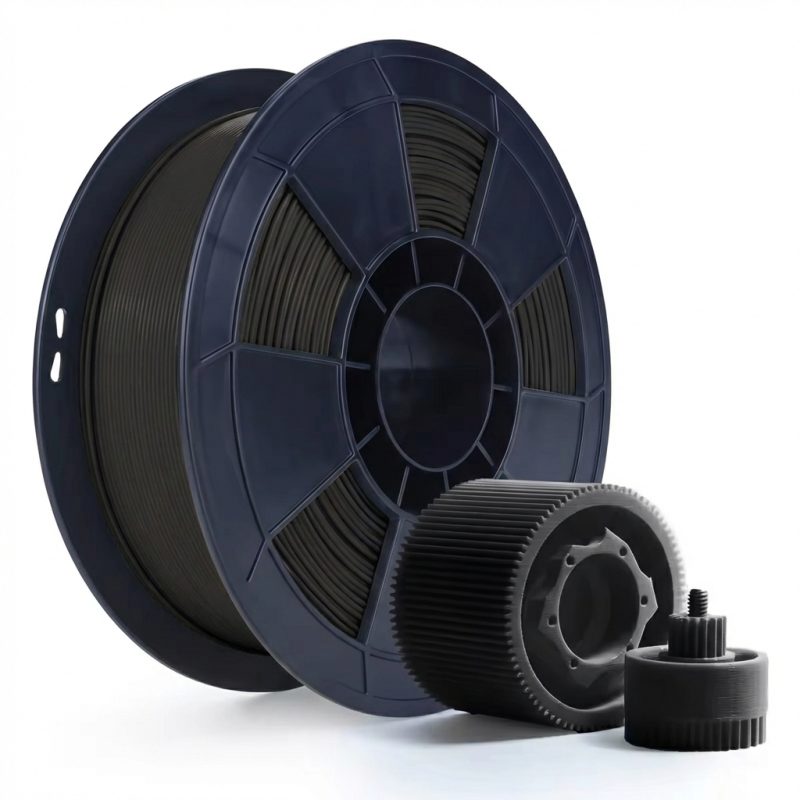
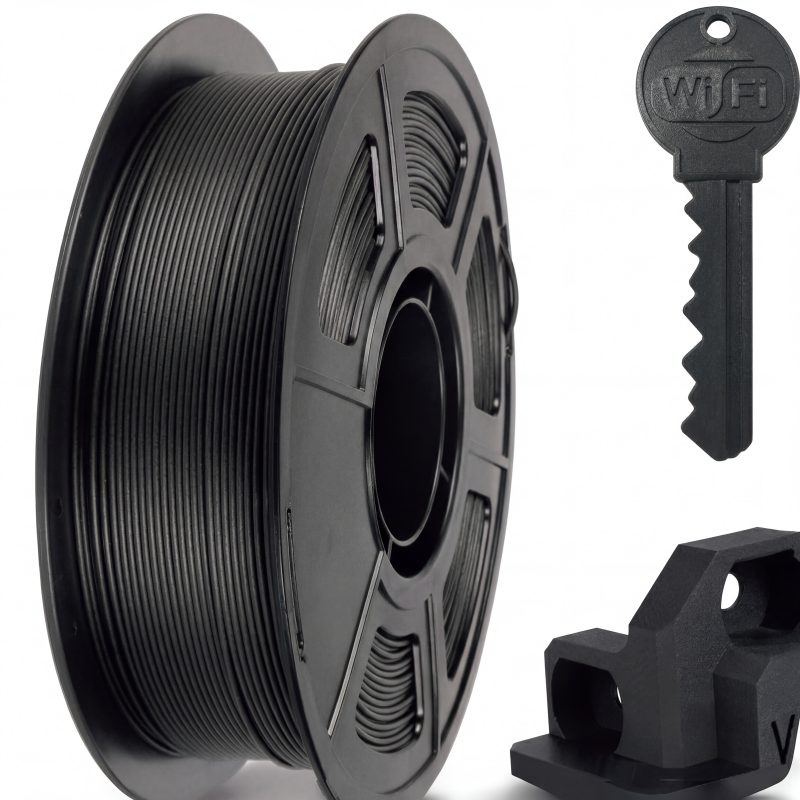
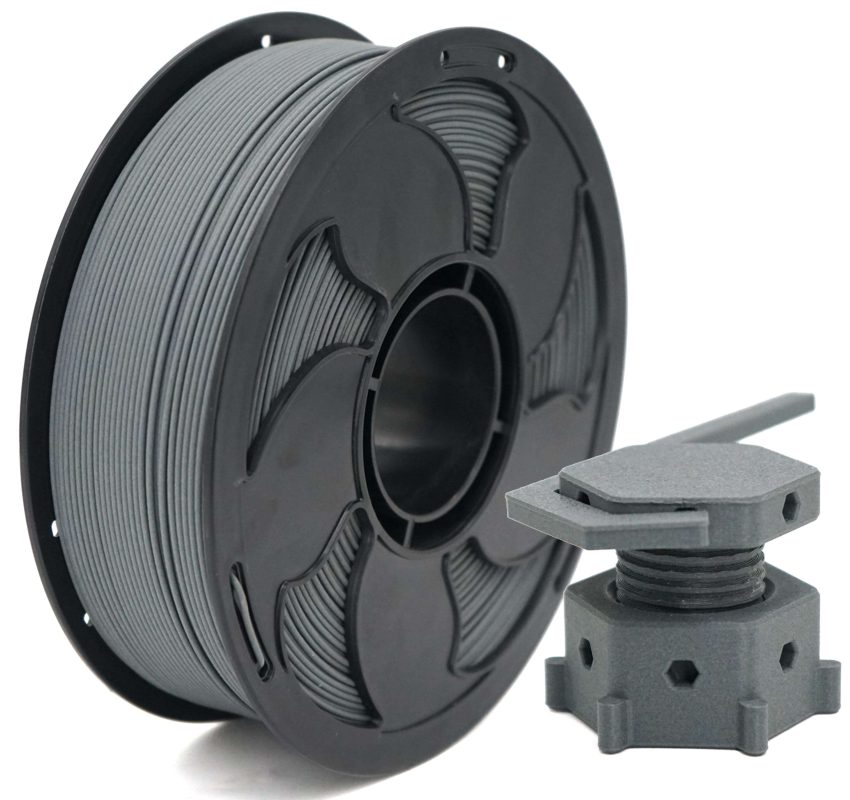
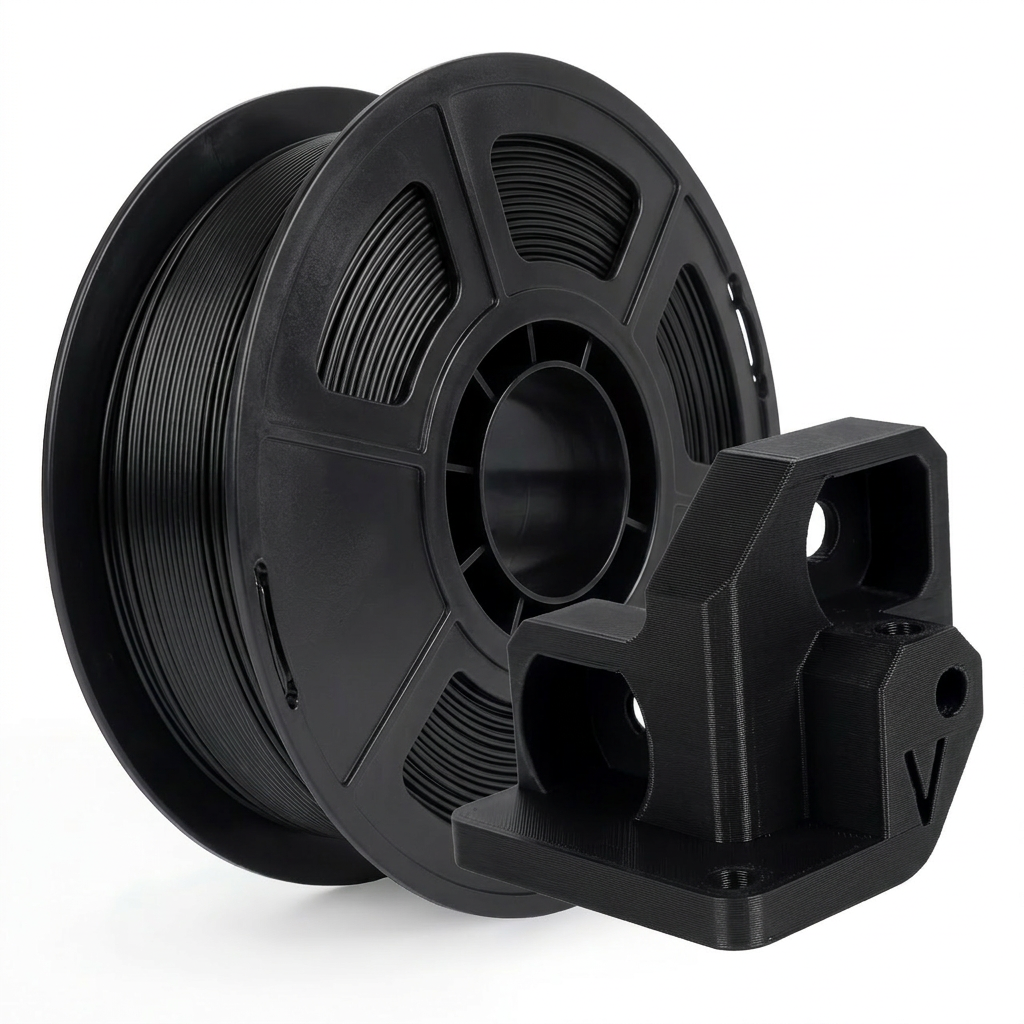
The precision mounting bracket in our product image demonstrates ABS-CF’s core capability: a rigid, dimensionally accurate functional part with threaded inserts, mounting holes, and structural ribs – the type of component that automotive and electronics manufacturers print in quantity.
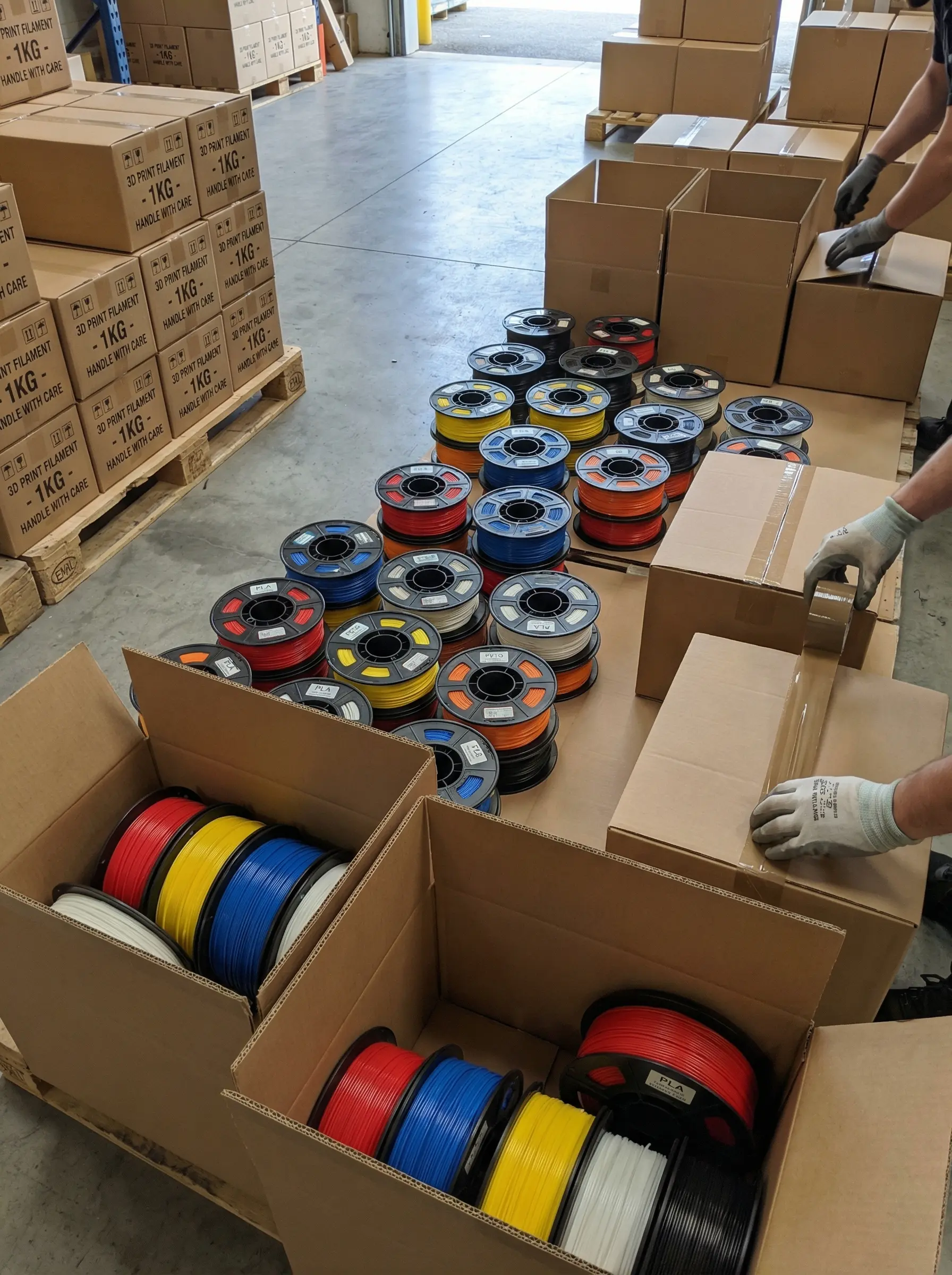
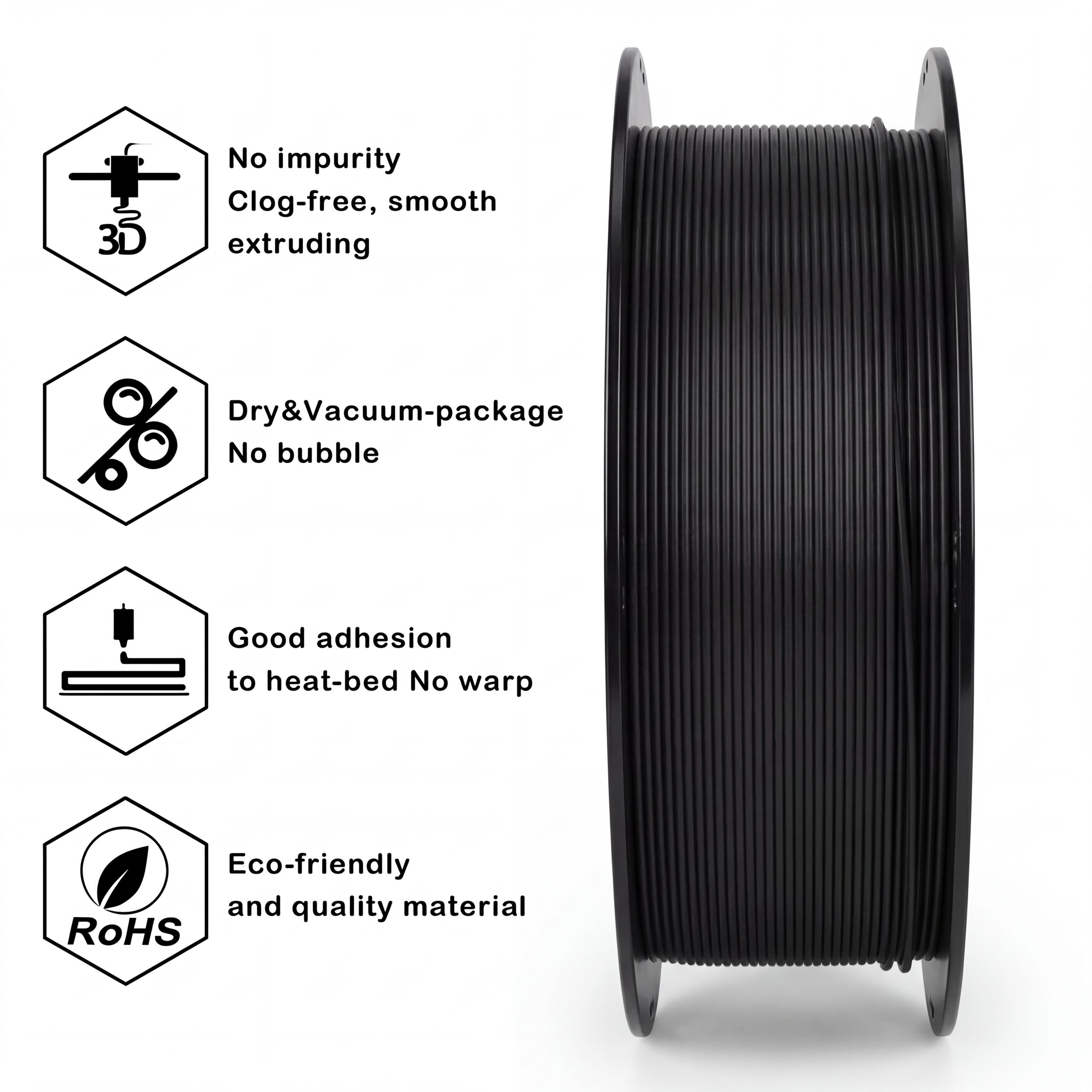
Manufactured under ISO 9001 quality management. Full RoHS compliance, OEM/ODM services, and free samples available.
Why ABS Carbon Fiber Stands Out
💰 Carbon Fiber Performance at ABS Economics – The Cost-Effective Engineering Composite
Not every application needs nylon-CF’s premium specs. Many need carbon fiber stiffness at a price that makes volume production realistic. ABS-CF delivers exactly that.
- Best Value CF Composite – ABS-CF costs 40-60% less than PA6-CF or PA12-CF per kilogram while delivering 80%+ of the stiffness improvement. For applications where nylon-level heat resistance (180°C+) isn’t required, ABS-CF provides the same rigidity advantage at dramatically lower material cost. In volume production (100+ parts/month), this cost difference is the difference between viable and unviable unit economics
- Familiar ABS Ecosystem – If your shop already prints ABS, switching to ABS-CF requires zero workflow changes beyond swapping in a hardened nozzle. Same temperatures (slightly higher), same bed adhesion strategies, same enclosure setup, same post-processing toolkit. No new drying protocols, no new bed surfaces, no new slicer profiles from scratch. For ABS-experienced shops, ABS-CF is a seamless upgrade
- Acetone Smoothable – The Killer Feature – ABS-CF can be acetone vapor smoothed to produce injection-mold-quality surface finish. No other carbon fiber composite offers this. PA-CF requires laborious manual sanding. PLA-CF can’t be chemically smoothed at all. ABS-CF parts emerge from acetone vapor with glossy, layer-line-free surfaces that clients and end-users cannot distinguish from injection-molded parts
- 15% CF – The Sweet Spot – Lower CF content (5-10%) provides insufficient stiffness improvement. Higher content (20%+) makes the material brittle and difficult to print. 15% carbon fiber delivers the optimal balance: dramatic stiffness improvement, good interlayer adhesion, reliable printability, and retained ABS toughness
- Improved Thermal Management – Carbon fiber improves ABS’s thermal conductivity, enabling better heat dissipation in electronic housings and enclosures. For LED driver housings, motor controllers, and power electronics, ABS-CF moves heat away from components more effectively than standard ABS
- Anti-Warp Champion – ABS’s notorious warping tendency is significantly reduced by carbon fiber reinforcement. CF reduces the thermal expansion coefficient, meaning less shrinkage stress during cooling. Large ABS-CF parts warp measurably less than equivalent standard ABS parts – a practical benefit that improves first-print success rates
Carbon fiber performance for projects where the budget is as real as the engineering requirements.
Why Choose ABS Carbon Fiber
| 🚗 Automotive Parts | ABS is already the standard material for automotive interior components (injection-molded dashboards, trim panels, vent housings). ABS-CF adds the stiffness needed for structural brackets, mount plates, and under-dash components. The ~105-110°C HDT handles automotive interior temperatures. Acetone smoothing produces OEM-quality surface finish for visible parts. Cost-effective for prototyping entire vehicle interior subsystems. |
| 📱 Electronic Enclosures | ABS-CF is ideal for electronic device housings: rigid enough to protect components, thermally conductive enough to dissipate heat, dimensionally stable enough for precise component fitment, and post-processable to production-quality appearance. The CF reinforcement adds EMI shielding properties (carbon fiber is electrically conductive) – a bonus for sensitive electronics applications. |
| 🛡️ Protective Covers | Equipment guards, instrument cases, tool housings, and protective shells. ABS-CF’s combination of impact resistance (ABS base) and stiffness (CF reinforcement) creates covers that resist both impact and deformation. The improved surface hardness from CF reduces scratching and wear on protective surfaces. |
| 🏭 Volume Production | The core economic argument: when you’re printing 50-500+ parts, material cost directly impacts unit economics. ABS-CF at 40-60% less than nylon-CF can make the difference between a profitable production run and an unprofitable one. For parts that don’t need nylon’s extreme heat/chemical performance, ABS-CF is the financially responsible engineering choice. |
| ⚙️ Tooling & Fixtures | Assembly jigs, alignment fixtures, and production aids. ABS-CF tooling is stiffer than standard ABS, more affordable than nylon-CF, and can be acetone-smoothed to eliminate sharp edges that might scratch finished products during assembly. The reduced warping vs. standard ABS means more accurate tooling dimensions. |
| 🏋️ Sporting & Outdoor | Equipment components, protective gear accessories, mount brackets, and custom sport accessories. ABS-CF provides the lightweight rigidity needed for performance equipment at a cost point that makes custom/small-batch sporting goods viable. |
ABS-CF vs. PA6-CF vs. PETG-GF vs. Standard ABS – Engineering Material Comparison
| Property | ABS-CF (This) | PA6-CF | PETG-GF | Standard ABS |
|---|---|---|---|---|
| Cost | ★★★★☆ (40-60% less than PA-CF) | ★★☆☆☆ (Premium) | ★★★★☆ | ★★★★★ (Cheapest) |
| Stiffness | ★★★★☆ (15% CF) | ★★★★★ | ★★★★☆ | ★★★☆☆ |
| Heat Resistance | ~105-110°C ★★★★☆ | 180°C+ ★★★★★ | 85-95°C ★★★☆☆ | ~100°C ★★★☆☆ |
| Post-Processing | ★★★★★ (Acetone smoothable!) | ★★☆☆☆ (Sand only) | ★★☆☆☆ | ★★★★★ |
| Warping | ★★★★☆ (CF reduces warp) | ★★★☆☆ | ★★★★★ (Minimal) | ★★☆☆☆ (Notorious) |
| Best For | Cost-effective CF production | Max performance | Easy stiffness upgrade | General ABS parts |
Recommended Print Settings
2. Hardened steel nozzle REQUIRED – Carbon fiber wears brass rapidly. Hardened steel or ruby nozzle.
3. Ventilation important – ABS emits styrene fumes. Print in ventilated space or use printer with filtration.
4. Drying recommended – 65-70°C for 4-6 hours. ABS-CF is less moisture-sensitive than nylon but more than PETG.
Optimal Settings
| Nozzle Temperature | 250-270°C (260°C optimal) |
| Bed Temperature | 80-100°C (90°C recommended) |
| Print Speed | 30-80mm/s (50mm/s balanced) |
| Layer Height | 0.15-0.28mm (0.20mm typical) |
| Cooling Fan | 0-20% (minimal for ABS bonding) |
| Wall Count | 3-4 for structural; 2 for lightweight |
| Infill | 20-40% functional; 50%+ heavy duty |
| Nozzle | Hardened steel REQUIRED |
| Enclosure | Recommended (50-60°C chamber) |
| Bed Surface | PEI, ABS slurry on glass, or Kapton tape |
| Drying | 65-70°C for 4-6 hours |
Technical Specifications
| Parameter | Specification |
|---|---|
| Material | ABS + 15% Chopped Carbon Fiber |
| Color | Black (Matte CF Finish) |
| Model | ABS-CF |
| CF Content | 15% |
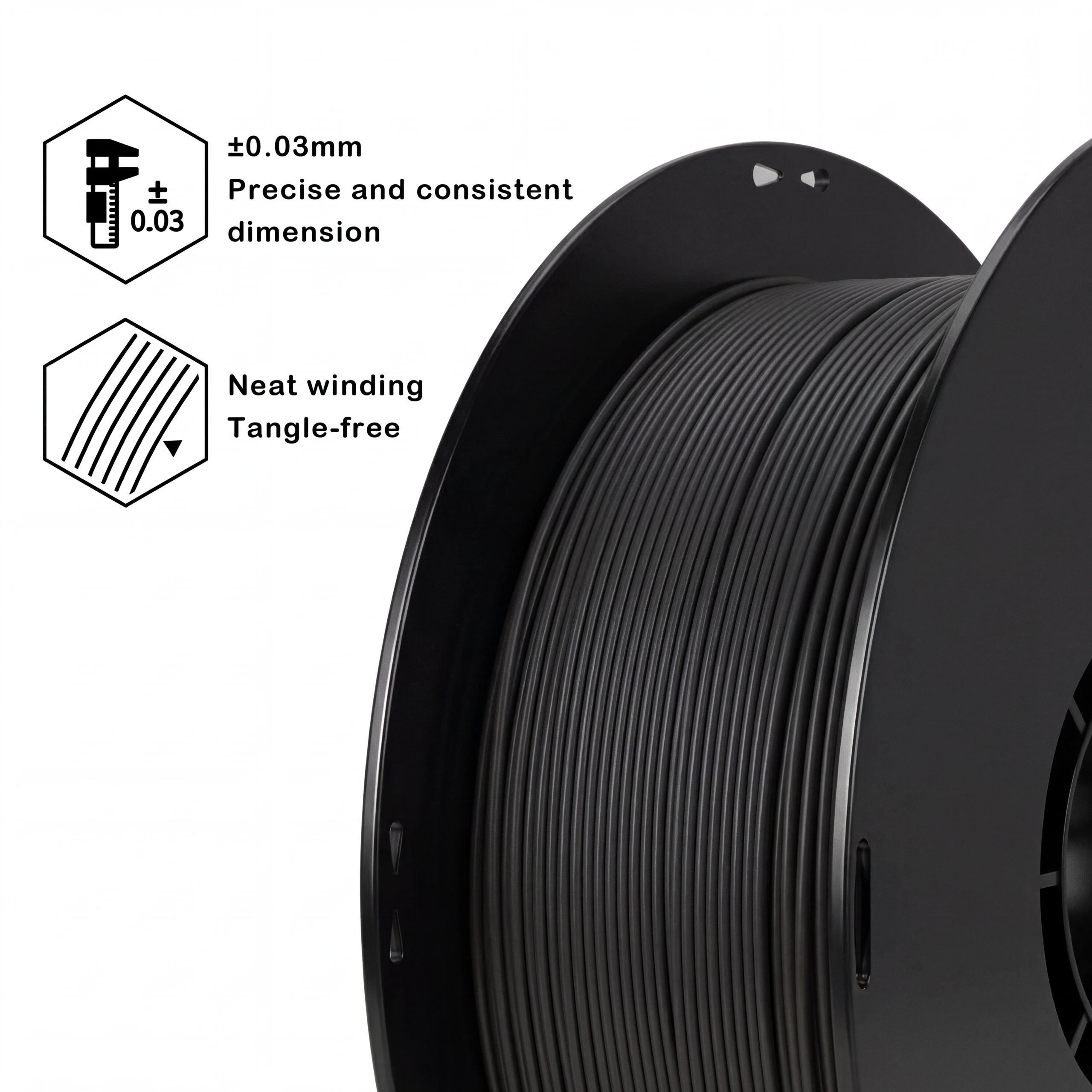
| Diameter | 1.75mm ± 0.05mm |
| Net Weight | 1kg (2.2 lbs) |
| Nozzle Temp | 250-270°C |
| Bed Temp | 80-100°C |
| Speed | 30-80mm/s |
| Nozzle Type | Hardened steel required |
| Enclosure | Recommended |
| Post-Processing | Acetone smoothable, sandable, paintable, drillable |
| Drying | 65-70°C for 4-6 hours |
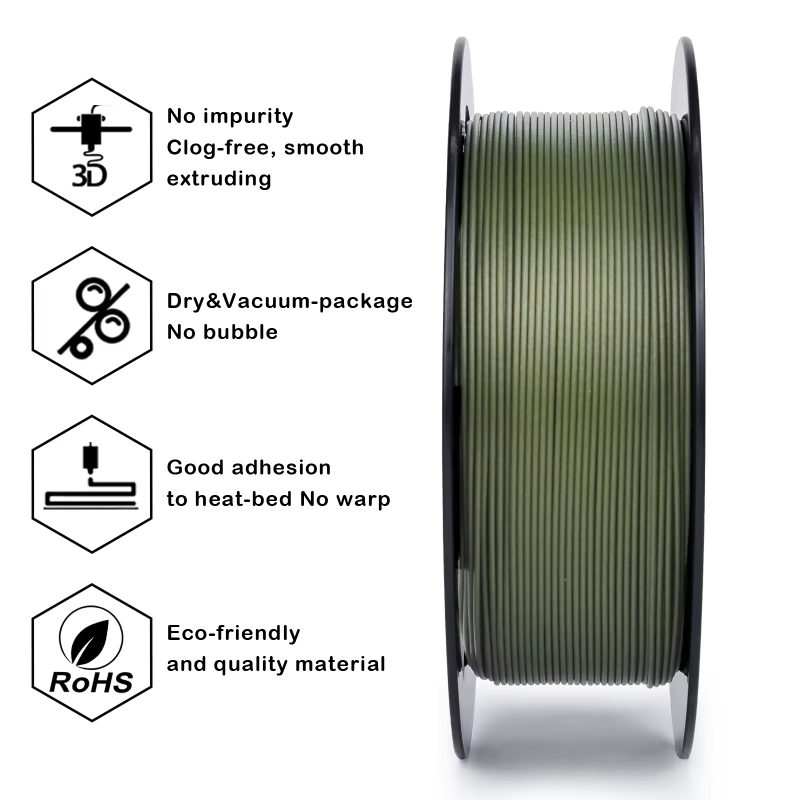
| Packaging | Vacuum sealed with desiccant |
| Origin | Guangdong, China |
| Free Sample | Available |
| OEM/ODM | Available – Learn more |
Material Properties
| Property | Value | Standard |
|---|---|---|
| Tensile Strength | 55-65 MPa | ISO 527 |
| Flexural Modulus | 4,500-6,500 MPa | ISO 178 |
| Impact Strength (Izod) | 4-6 kJ/m² | ISO 180 |
| HDT (0.45 MPa) | ~105-110°C | ISO 75 |
| Elongation at Break | 3-6% | ISO 527 |
| Density | 1.10-1.15 g/cm³ | ISO 1183 |
| Shrinkage | 0.3-0.6% (reduced vs. standard ABS) | ISO 294-4 |
| Thermal Conductivity | Improved vs. standard ABS (CF enhancement) | – |
Applications
| 🚗 Automotive | Interior brackets, dashboard mounts, vent housings, cable clips, and structural trim. ABS is the automotive industry’s default plastic; CF adds the stiffness for structural use. Acetone smooth for OEM-quality appearance. |
| 📱 Electronics | Device housings, controller enclosures, sensor covers, and PCB mounting brackets. Improved thermal conductivity dissipates heat. CF adds EMI shielding. Acetone smooth for consumer-product finish. |
| 🛡️ Protective Parts | Equipment guards, instrument cases, tool housings. ABS impact + CF stiffness for covers that resist both impact and deformation. |
| 🔧 Tooling | Assembly jigs, fixtures, and production aids. Cost-effective for high-volume tooling where nylon-CF is overkill. |
| 🏋️ Sporting Goods | Equipment brackets, mount accessories, protective gear components. Lightweight rigidity for performance applications. |
| ✈️ Aerospace Prototypes | Non-structural prototypes and mockups. Cost-effective for iterative design cycles where nylon-CF’s premium pricing slows iteration speed. |
Environmental & Safety
✅ RoHS | 🏭 ISO 9001 | ♻️ ABS recyclable | 📦 Vacuum sealed | ⚠️ Print in ventilated area (styrene fumes)
Shipping
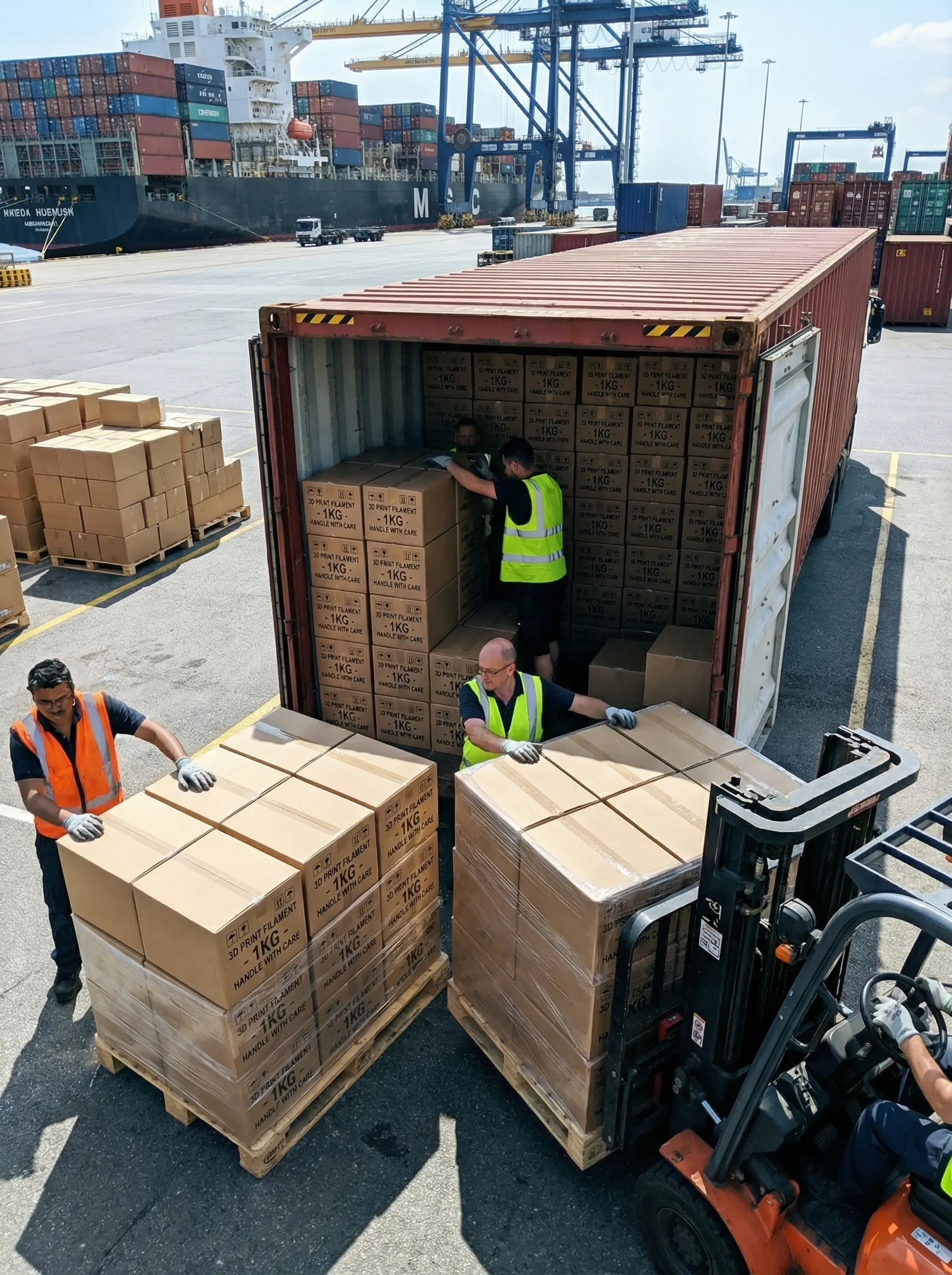
EU: 5-10 days (Express 3-5) | US: 7-12 days (Express 4-6) | UK: 7-12 days (Express 4-6) | Canada: 8-14 days (Express 5-7). DDP/DAP.
Bulk & OEM/ODM
Flexible MOQ, free samples, 100kg+/500kg+/1000kg+. Custom CF content (10-20%). ABS-GF (glass fiber) also available. Custom colors possible. Private label; custom spool sizes. Learn more.
Storage
15-25°C, below 30% RH, 12 months sealed, dry 65-70°C 4-6h if needed.
Printer Compatibility
All-metal hotend 270°C+. Hardened nozzle. Enclosed printer recommended. Ventilated space required.
| Bambu Lab X1C ✓ Enclosed + filter | Voron 2.4 ✓ Ideal | QIDI X-Max 3 ✓ Enclosed | Prusa MK4 ⚠️ Needs enclosure | Creality K1 ⚠️ Needs enclosure |
FAQ
Ready for Cost-Effective Carbon Fiber?
Contact SigmaFilament today for bulk pricing, free samples, or to discuss custom ABS-CF formulations.
📧 Email us for a quick quote | 🌍 Worldwide shipping with DDP/DAP | 🎁 Free samples for qualified customers
| Color | Black |
|---|---|
| Spool Weight | 1kg ,3kg ,5kg ,Sample (200g) |
| Filament Diameter | 1.75mm ,2.85mm (3.00mm) |