Black PC Filament — Engineering-Grade Polycarbonate for Parts That Have to Survive
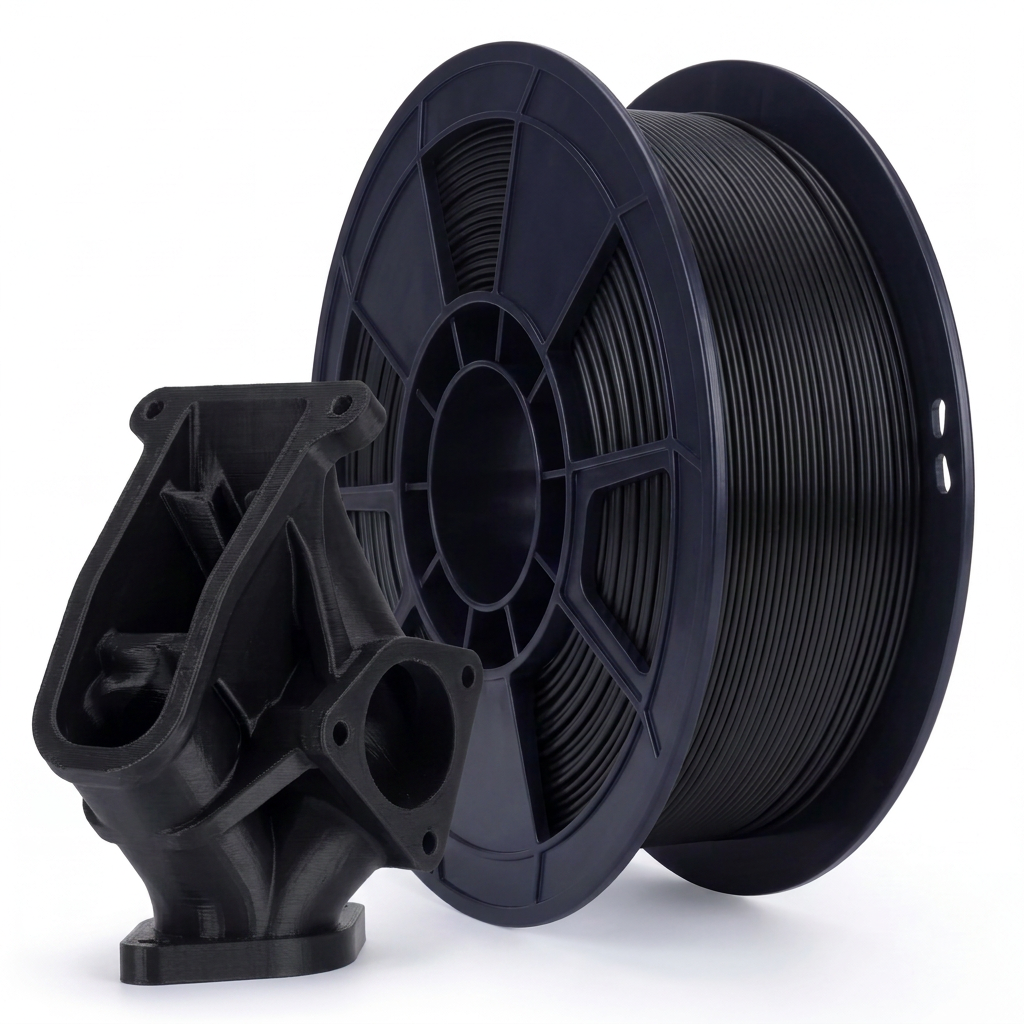
Black PC filament is the material you reach for when a rigid part has to keep working under heat, load and impact that would deform PLA, soften PETG or crack ABS. Polycarbonate is a true engineering thermoplastic: it prints one of the strongest, stiffest and most heat-tolerant parts available on a desktop machine, with a heat-deflection point in the region of 110 °C and higher and impact toughness in a class that PC shares with the glazing used in safety visors and machine guards. This 1.75mm material is pigmented a deep, even graphite-black that hides layer lines on functional parts and reads as a finished engineering component rather than a prototype.
There is no getting around the fact that this is a demanding material, and honest sourcing means saying so up front. This black PC filament wants a high nozzle temperature of 260–290 °C, a hot bed at 100–120 °C, an all-metal hotend and — critically — a closed, heat-retaining enclosure to stop the tall thermal gradient between the nozzle and the chamber from warping the part or splitting layers. It is also strongly hygroscopic, which is the single most important thing to understand about printing PC: it pulls moisture from the air fast, and wet PC prints out weak, bubbly, cloudy and brittle, throwing away the very strength you bought it for. That is why every spool of this PC ships vacuum-sealed with desiccant, and why drying is treated as a core requirement rather than an optional tip.
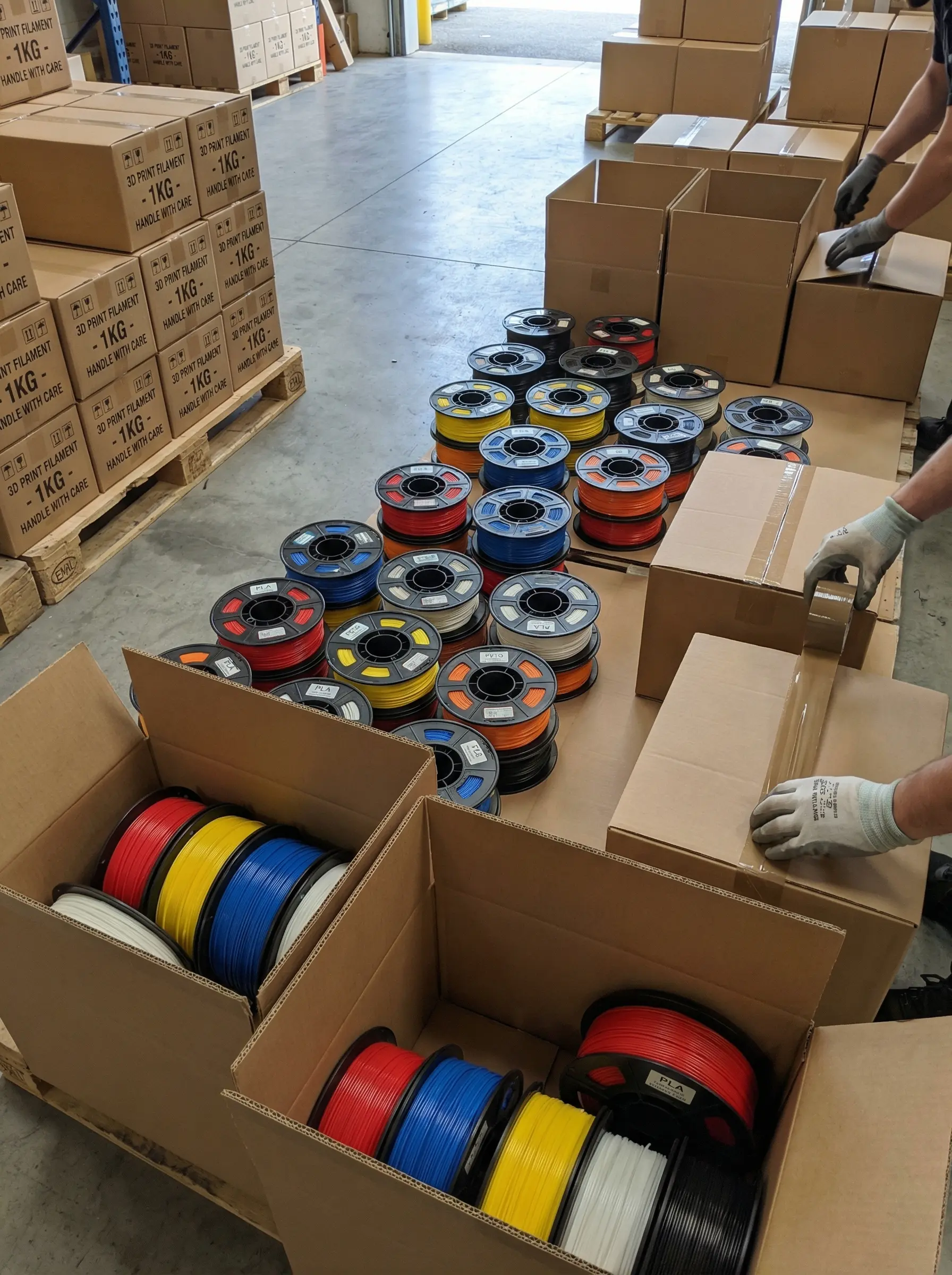
As a factory-direct product, black PC 1.75mm is stocked for both single-spool engineers and volume production programs. If you are sourcing polycarbonate for functional end-use parts — brackets, housings, structural components, high-temperature jigs — this black PC filament is available through our direct manufacturer wholesale program and through full OEM/ODM services with custom color, spool, diameter and private-label packaging.
Most workshops move up to PC for one reason: they have hit the ceiling of what an easier filament can do. A fixture keeps softening next to a heat source, a bracket keeps snapping under vibration, an enclosure part warps in a hot car. That is the category where black PC filament earns its place — it is the answer once strength, stiffness and heat resistance become non-negotiable. Below you will find the print settings, mechanical data, application guidance and design tips that make this material reliable in practice, not just impressive on a datasheet.
Why This Black PC Filament Stands Out
- Extreme strength, engineering-grade: polycarbonate delivers high tensile strength and rigidity, so a PC bracket carries loads that would flex or fracture a PLA or PETG equivalent. It is genuinely a structural material.
- Heat resistance to ~110 °C and beyond: parts stay dimensionally stable at temperatures that leave PLA sagging near 60 °C. PC belongs anywhere the part sees a hot enclosure, a motor, direct sun in a closed car or nearby machinery.
- Outstanding impact toughness: PC absorbs sudden shock and keeps its shape instead of shattering — the property that makes it the go-to for protective housings, guards and load-bearing clips.
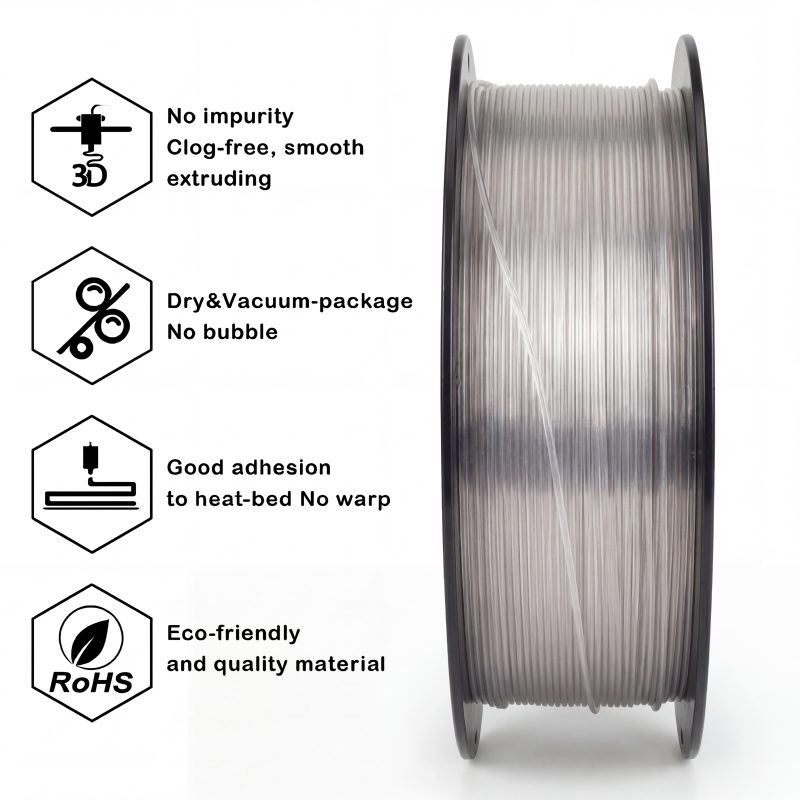
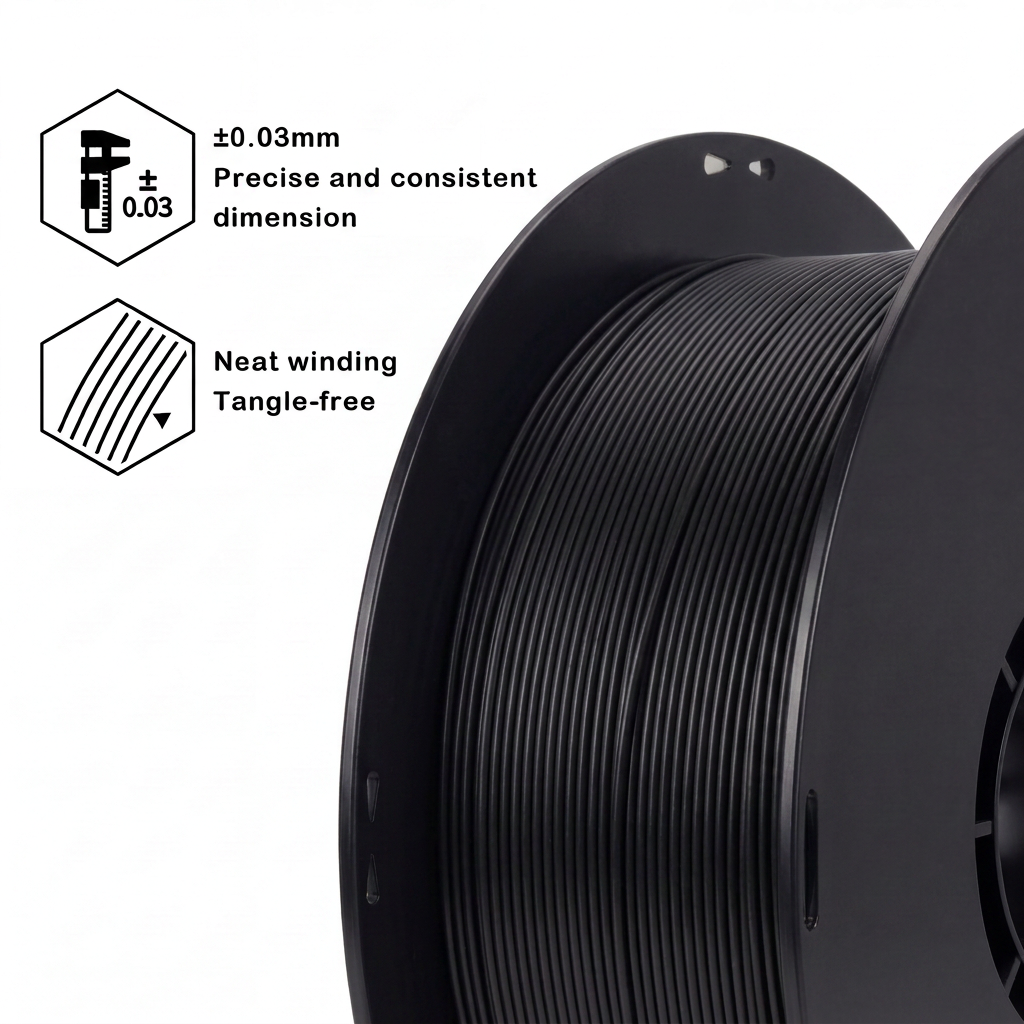
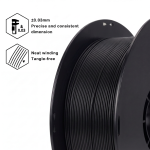
- ±0.03mm diameter tolerance: a consistent diameter keeps flow even through a hot all-metal hotend, which matters when you are already pushing a stiff, high-temperature melt.
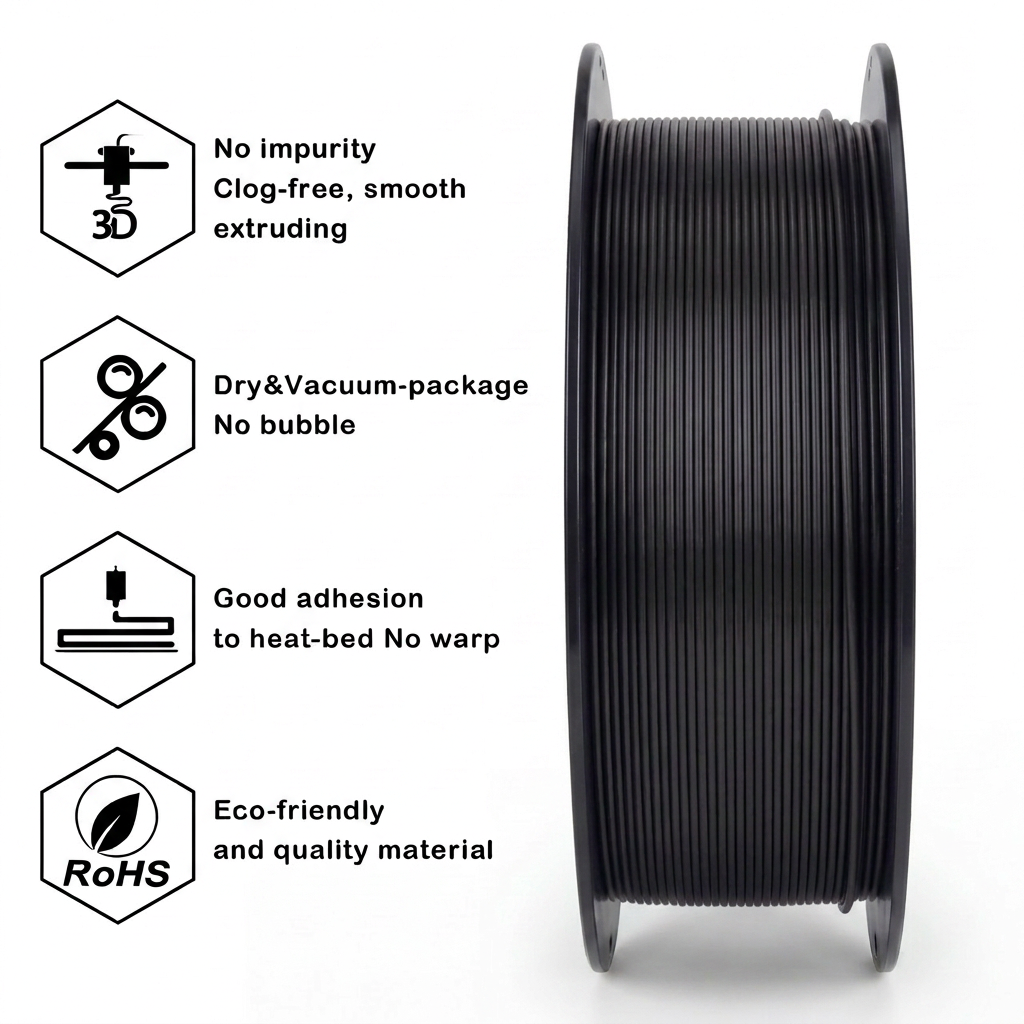
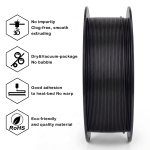
- Vacuum-sealed and dried at packing: because PC absorbs moisture aggressively, dry-at-arrival packaging directly protects layer bonding and the mechanical strength you are paying for.
- Deep uniform black: an even graphite tone that disguises layer lines and gives functional parts a finished, professional look straight off the bed.
Premium Polycarbonate at Factory-Direct Pricing
| Quality You Get | How We Deliver It | What It Means For You |
|---|---|---|
| Consistent strength | Engineering-grade PC resin, batch-verified | Parts hit the same mechanical numbers, batch to batch |
| Reliable flow at high temp | ±0.03mm diameter + tangle-free winding | Even extrusion at 260–290 °C, fewer mid-print faults |
| Dry on arrival | Vacuum seal + desiccant, sealed at packing | Strong, clear layers instead of wet, brittle, bubbly parts |
Why Choose Black PC for Your Projects
| Stays strong under load | High tensile strength and stiffness for structural, load-bearing parts. |
| Handles heat | Holds shape near 110 °C where PLA and PETG give up. |
| Absorbs impact | Takes shock and vibration without cracking or shattering. |
| Professional black finish | Even graphite tone that hides layers on functional parts. |
| True end-use material | For jigs, fixtures and functional parts, not just prototypes. |
| Volume-ready supply | Consistent stock for production, wholesale and OEM. |
How Black PC Compares
| Property | PC (this material) | ABS | PLA / PETG |
|---|---|---|---|
| Strength & stiffness | Very high (engineering-grade) | Moderate–high | Low–moderate |
| Heat resistance | ~110 °C+ (HDT) | ~85–100 °C | ~55–70 °C |
| Impact toughness | Outstanding | Good | Low (PLA) / Good (PETG) |
| Print difficulty | Hard — hot, enclosed, dry | Moderate — enclosure helps | Easy |
| Best use | Heat-resistant structural parts, jigs | Functional housings, tools | Prototypes, general parts |
When to Step Up from ABS to PC — A Sourcing Note
ABS is the default “engineering-ish” filament for most shops, and for a lot of functional housings and tools it is genuinely enough. The moment to step up to polycarbonate is when the part has to do more than one hard thing at once — carry a real load and sit near heat, or take repeated impact and hold a tight dimension when warm. That is the crossover point where ABS starts to compromise and black PC filament pulls ahead: it is meaningfully stronger and stiffer, its heat-deflection point is roughly 20–40 °C higher, and its impact resistance is in a different league. The price of that performance is process discipline — a hotter hotend, a closed enclosure and an absolute commitment to keeping the filament dry — but for a part that fails when it softens or snaps, the trade is worth it.
For buyers standardizing a production BOM, black is the practical color to stock in an engineering material. A deep, uniform black hides layer lines on functional parts, does not show the surface texture that a translucent or light PC would, and reads as a finished component to an end customer. Combined with the ±0.03mm diameter control and dry vacuum packaging, that makes this black PC filament a low-variance structural input you can design a repeatable, load-rated process around rather than re-qualify with every delivery — which is exactly what matters when the part is doing a job, not sitting on a shelf.
Recommended Print Settings
| Parameter | Recommended |
|---|---|
| Nozzle temperature | 260–290 °C (275 °C typical) |
| Bed temperature | 100–120 °C |
| Print speed | 20–40 mm/s (30 mm/s recommended) |
| Enclosure | Required — closed, heat-retaining chamber |
| Cooling fan | Off or minimal (0–20%) for layer strength |
| Hotend | All-metal, capable of 300 °C |
| Drying | 70–80 °C for 6–8h before printing (mandatory) |
Troubleshooting Polycarbonate Prints
| Symptom | Likely Cause | Fix |
|---|---|---|
| Corners lift / part warps off the bed | Cold chamber, drafts, weak first-layer grip | Close the enclosure, bed 110–120 °C, add a brim, use PC adhesive on the plate |
| Weak, brittle, cloudy or bubbly prints | Damp filament (most common with PC) | Dry at 70–80 °C for 6–8h; print from a heated dry box |
| Layers split / delaminate | Too much part cooling or too low a nozzle temp | Turn the fan down/off, raise nozzle toward 285–290 °C, keep the chamber warm |
| Nozzle clogs / under-extrusion | Temp too low or a non-all-metal hotend | Use an all-metal hotend rated to 300 °C; raise temperature into range |
| Stringing / oozing | Moisture or excess temperature | Dry the spool first; then trim nozzle temp 5–10 °C and tune retraction |
Technical Specifications
| Material | Polycarbonate (PC) |
| Color | Black (deep graphite) |
| Diameter | 1.75mm |
| Diameter tolerance | ±0.03mm |
| Net weight | 1kg (spool) |
| Approx. length | ~340m at 1.75mm |
| Density | ~1.20 g/cm³ |
| Heat deflection temp (HDT) | ~110–130 °C |
| Glass transition (Tg) | ~145 °C |
| Tensile strength | ~60–70 MPa (typical) |
| Elongation at break | ~90–110% (typical) |
| Recommended nozzle | ≥0.4mm, all-metal (300 °C capable) |
| Nozzle temperature | 260–290 °C |
| Bed temperature | 100–120 °C |
| Print speed | 20–40 mm/s |
| Enclosure | Required (closed, heated chamber ideal) |
| Cooling fan | Off / minimal (0–20%) |
| Odor | Low–moderate (ventilate) |
| Moisture sensitivity | Very high (hygroscopic) — must dry before printing |
| Compliance | RoHS / REACH |
Material Properties & Performance
Polycarbonate’s value is in the combination it offers, not any single number: it is simultaneously strong, stiff, heat-tolerant and impact-resistant, and that intersection is rare. Most filaments give you one or two of those and compromise on the rest — PLA is stiff but weak and heat-sensitive, TPU is tough but soft, ABS is a decent all-rounder but tops out well below PC on both heat and strength. This black PC filament sits at the demanding end of the desktop material range precisely because it refuses to trade those properties off against each other.
The heat story is what most people buy PC for. Where a PLA part starts sagging around 55–60 °C, polycarbonate holds its shape and load rating up to roughly 110 °C and beyond, with a glass-transition temperature near 145 °C. That means a PC bracket keeps working inside a warm enclosure, near a stepper motor, in a sun-baked car interior or next to a heat source that would quietly deform an easier plastic. Paired with high tensile strength and genuinely outstanding impact toughness — PC absorbs a sudden blow and springs back rather than cracking — you get a material engineered for parts that carry load, take knocks and stay hot. The one discipline that unlocks all of it is dryness: every quality-control step on this PC, from diameter accuracy to tangle-free winding to dry vacuum packaging, exists to make sure moisture never robs the print of the strength the polymer is capable of.
| Property | Typical Value | Test Standard |
|---|---|---|
| Tensile strength | 60–70 MPa | ASTM D638 |
| Elongation at break | 90–110% | ASTM D638 |
| Flexural modulus | 2200–2400 MPa | ASTM D790 |
| Izod impact (notched) | High | ASTM D256 |
| Heat deflection temp | ~110–130 °C | ASTM D648 |
| Glass transition (Tg) | ~145 °C | DSC |
Printer-Specific Settings
PC needs a high-temperature, enclosed machine — the printers below are ones with an all-metal hotend and a heat-retaining chamber. Open, Bowden-only machines are not recommended for polycarbonate.
| Bambu Lab X1C (enclosed, hardened) | 270 °C / bed 100 °C / 30 mm/s, chamber closed, fan low |
| QIDI X-Max 3 / Plus 4 (high-temp, enclosed) | 280 °C / bed 110 °C / 30 mm/s, active chamber heat |
| Creality K1 Max (enclosed) | 275 °C / bed 110 °C / 30 mm/s, fan off/low |
| Prusa MK4 + enclosure | 275 °C / bed 110 °C / 25–30 mm/s, keep door closed |
| Voron 2.4 (enclosed, all-metal) | 285 °C / bed 110 °C / 30–40 mm/s tuned, warm chamber |
| Raise3D Pro3 (enclosed, industrial) | 280 °C / bed 110 °C / 30 mm/s, chamber-controlled |
Applications
| Heat-resistant mechanical parts | Brackets, mounts and drive parts that sit near motors, heat or friction. |
| Enclosures & housings | Electronics and equipment housings that must resist impact and warmth. |
| Structural components | Load-bearing frames, arms and clips where stiffness and strength matter. |
| Jigs & fixtures | Manufacturing aids that hold tolerance under heat and repeated handling. |
| Automotive & under-hood | Trim, ducts and brackets that endure a hot engine bay or closed cabin. |
| Protective guards | Machine guards and shields that must take impact without shattering. |
Industry Use Cases
Across industries, polycarbonate shows up wherever a part has to be strong, warm and struck all at once. In manufacturing and automation, black PC filament prints jigs, fixtures, tool holders and end-of-arm tooling that keep their dimensions through repeated handling and shop-floor heat, where a PLA fixture would creep out of tolerance. In automotive, it produces under-hood brackets, ducting, connector housings and trim clips that survive engine-bay temperatures and the impact of a slammed panel. In electronics and electrical, PC’s stiffness and heat tolerance suit enclosures, insulator brackets and mounting hardware that sit close to warm components. In machinery and robotics, it becomes structural arms, gear housings and protective guards that absorb vibration and shock without cracking. And in engineering prototyping, PC lets a team validate a functional part under near-real thermal and mechanical loads before committing to injection tooling. The common thread is a part that must not soften, must not snap and must not distort under load.
Because one engineering material spans so many of these jobs, standardizing on a dependable black PC filament simplifies purchasing: one high-performance input, one dialed-in high-temperature profile and one inspection reference — reused across brackets, housings, fixtures and guards instead of qualifying a separate specialty filament for each demanding product line.
Designing Parts for Polycarbonate
Getting the most out of black polycarbonate is as much about design and thermal management as it is about slicer numbers. A few habits pay off: design to minimize large flat footprints and long unbroken edges, which are where warping stress concentrates — break big bottom faces up or add a brim so corners cannot peel. Use 3–4 perimeters and 30–50% infill for structural parts so strength comes from solid walls rather than thin skins over sparse fill, and let the near-zero cooling fully fuse each layer for maximum inter-layer strength. Add generous fillets at internal corners, because even a tough material concentrates stress at a sharp re-entrant corner under impact. Orient the part so the main load path runs along the layers, not across a single weak layer line, and keep bosses and screw holes reinforced with extra walls. Above all, treat the enclosure and a dry spool as part of the design, not the setup — a beautifully modeled PC part still fails if the chamber is cold or the filament is wet.
Environmental & Safety Standards
| ✅ RoHS Restricted substances compliant | ✅ REACH SVHC compliant | ✅ Ventilated printing Low–moderate odor at temp | ✅ Vacuum sealed Dry, desiccant-protected |
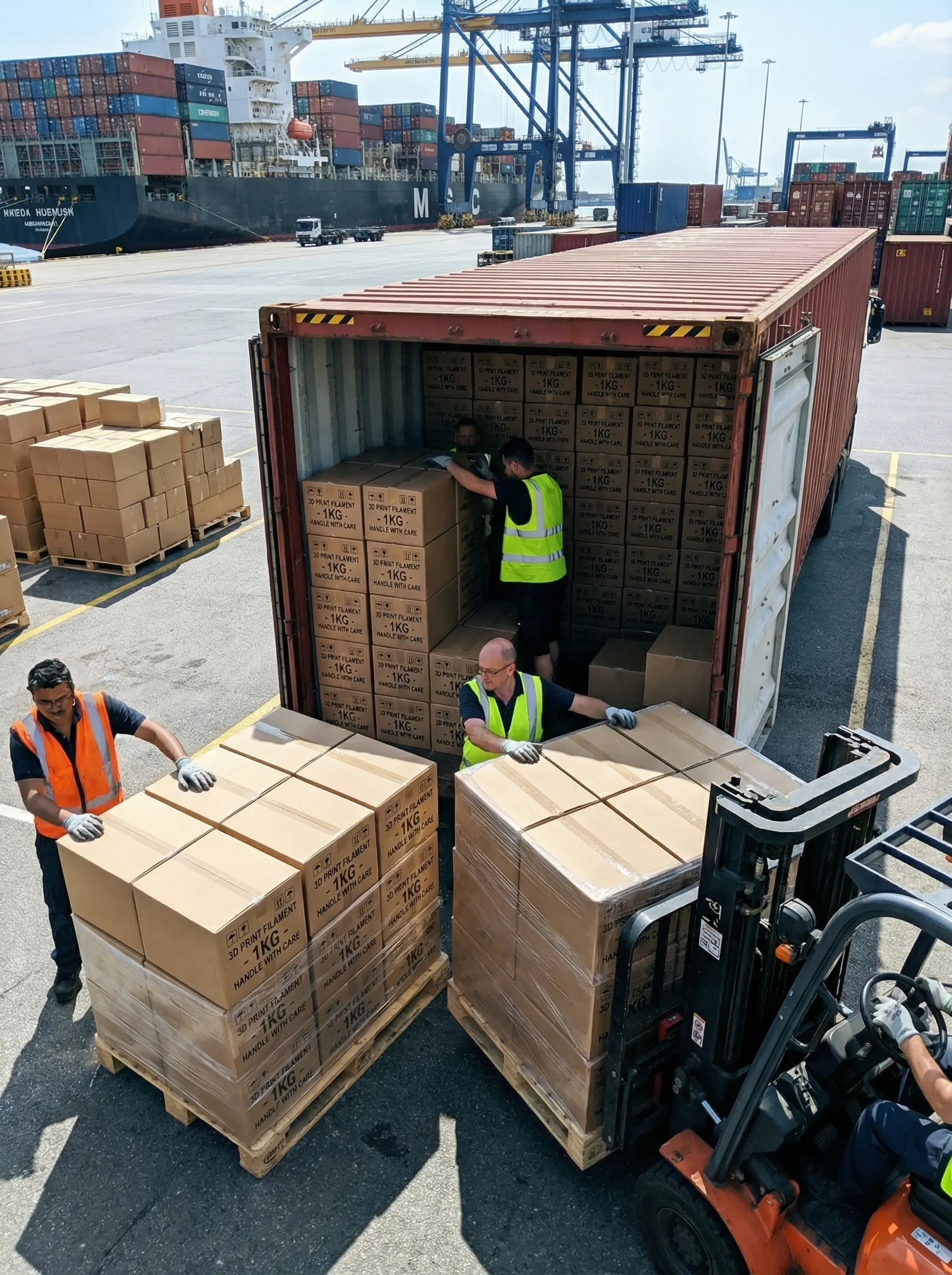
Packaging & Global Shipping
| Region | Method | Typical Time |
|---|---|---|
| North America | Air / express + sea for bulk | 7–20 days |
| Europe | Air / express + sea for bulk | 7–20 days |
| Asia-Pacific | Air / express | 5–12 days |
| Rest of world | Air + freight forwarding | 10–25 days |
Bulk Orders & OEM/ODM Services
| Custom grades | Standard PC or blended/reinforced PC to match your part’s needs. |
| Custom color | Color-matched PC beyond this standard black. |
| Private label | Your spool, label and packaging design. |
| Volume pricing | Contact us for 10+ spool and pallet quotes via our OEM/ODM services. |
Storage & Handling Guidelines
| Reseal in the vacuum bag with desiccant immediately after each print session. |
| Dry at 70–80 °C for 6–8h before printing — PC is very hygroscopic and needs it every time. |
| Print from a heated dry box for long jobs to keep the filament dry mid-print. |
| Store below 15–20% RH; a sealed container with fresh desiccant is ideal. |
| Keep away from direct sunlight and heat sources when stored. |
| Handle spools by the hub to keep windings tight and tangle-free. |
Printer Compatibility
| Bambu Lab | QIDI | Creality | Prusa | Voron | Raise3D |
|---|---|---|---|---|---|
| ✅ X1C enclosed | ✅ X-Max/Plus | ✅ K1 Max | ✅ MK4 + box | ✅ Enclosed | ✅ Pro3 |
PC needs a 300 °C-capable all-metal hotend and a closed, heat-retaining enclosure; open or Bowden-only machines are not recommended. For where polycarbonate sits among the toughest options, see our strongest 3D printer filament guide.
Why Choose SigmaFilament for Polycarbonate
| Factory-direct | We manufacture the filament — no middle-man markup. |
| Batch consistency | Verified diameter and mechanical performance spool to spool. |
| Dry packaging | Vacuum-sealed to protect strongly hygroscopic PC in transit. |
| OEM/ODM ready | Custom grades, color and private-label programs. |
| Global logistics | Reliable worldwide shipping for samples and pallets. |
For engineering shops and production buyers, the value of a filament like this is measured in whether a finished part hits its load rating and survives its environment — and with polycarbonate, most of that is decided before the print even starts, by resin quality and moisture control. That is exactly where a manufacturer-controlled input pays off. Diameter is held to ±0.03mm so a hot, stiff PC melt flows evenly through the whole print; mechanical performance is batch-verified so a bracket printed today matches one printed next quarter; and vacuum-sealed dry packaging means the strength is still in the filament when it reaches your printer instead of being lost to humid warehouse air. When a part is doing a structural job, those controls are the difference between a black PC filament you can spec into a BOM and one you have to re-test every batch.
Buying Black PC With Confidence
Whether you are printing a handful of functional parts or specifying a production input, this black PC filament is built to reward good process discipline. New to polycarbonate? Dry the spool at 70–80 °C, close your enclosure, run little to no part cooling and start from the recommended profile above — do those four things and PC’s reputation for difficulty largely disappears. Already running engineering materials? This PC slots into an existing high-temperature, enclosed workflow with minimal re-tuning, and its consistent diameter and verified performance keep multi-machine profiles valid across every spool. Engineers who have been burned by weak, warped or bubbly PC prints tend to appreciate that a filament held to tight diameter and dryness standards behaves predictably print after print.
Every spool of this black PC filament is manufactured, wound and packed under the same controls, and we back the material with responsive technical support and sample availability for qualified buyers. If your application needs a reinforced or blended PC grade, a custom color beyond standard black, or private-label spools, our team can adapt this polycarbonate to your specification without you having to re-qualify a new supplier. That combination — a dependable off-the-shelf black PC filament plus a factory that can customize it — is what makes SigmaFilament a practical long-term source rather than a one-off purchase. Whether you are validating a single heat-resistant prototype today or standardizing a structural component across a full product line, the same spool, the same tolerances and the same support are behind every order, so the material you qualify once keeps performing the same way as your volumes grow.
Frequently Asked Questions
Do I really need an enclosure to print PC?
Why did my PC print come out weak, cloudy or bubbly?
How heat-resistant is this black PC filament?
What hotend and nozzle temperature does PC need?
Is PC stronger than ABS or PETG?
Do you offer black PC for wholesale or OEM/private-label?
Source Black PC Polycarbonate Direct From the Factory
Extreme strength, ~110 °C+ heat resistance, high impact, dry-packed and consistent — ready for heat-resistant parts, housings and jigs. Order a spool to test, or request wholesale & OEM pricing for production volumes.
Free samples for qualified buyers · Wholesale & OEM/ODM available
| Material | Polycarbonate PC |
|---|---|
| Color | Black |
| Filament Diameter | 1.75mm ,2.85mm (3.00mm) |
| Spool Weight | 1kg ,3kg ,5kg ,Sample (200g) |