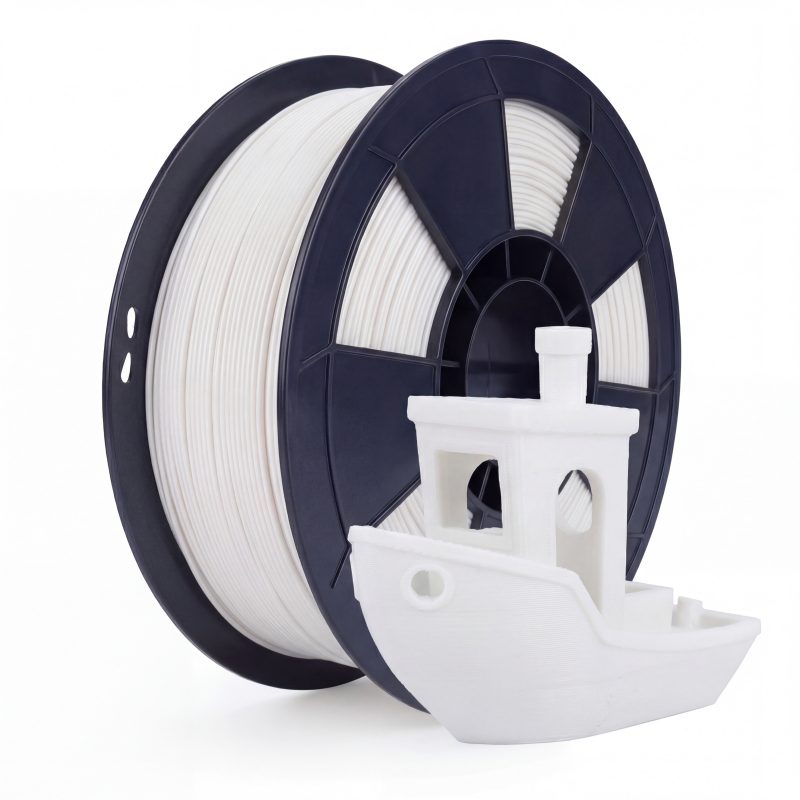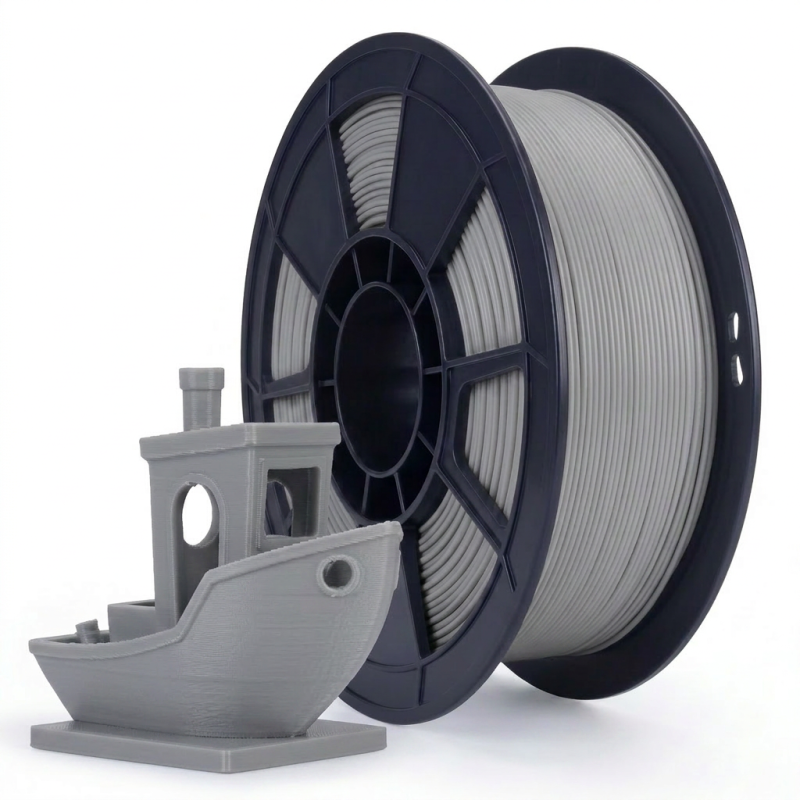
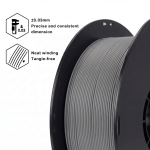
High Speed ABS Filament Gray – Product Overview
The SigmaFilament high speed ABS filament in Gray is a high-flow, low-odor ABS engineered for the current generation of fast CoreXY printers—rated from 30 all the way up to 600mm/s—and aimed squarely at the parts that keep a production line moving. Where decorative filaments are judged by how they look on a shelf, this material is judged by how many shifts a printed assembly jig survives, whether a machine guard still fits after a summer next to a warm spindle, and how quickly you can replace a broken fixture between batches. The formulation pairs ABS-grade heat and impact resistance with a melt-flow profile tuned for high-speed extrusion, so speed no longer means choosing between throughput and layer strength.
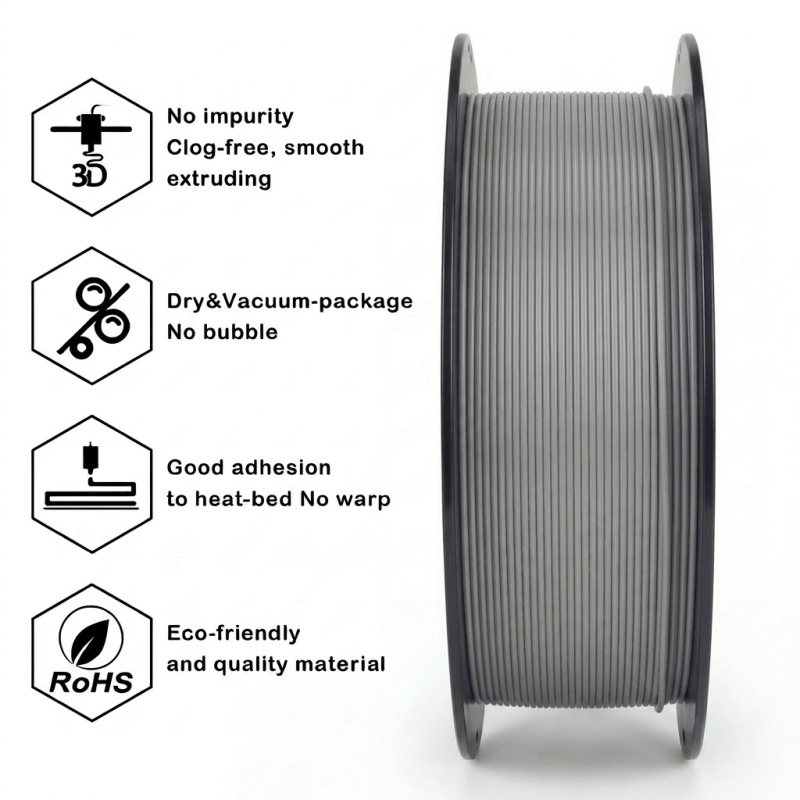
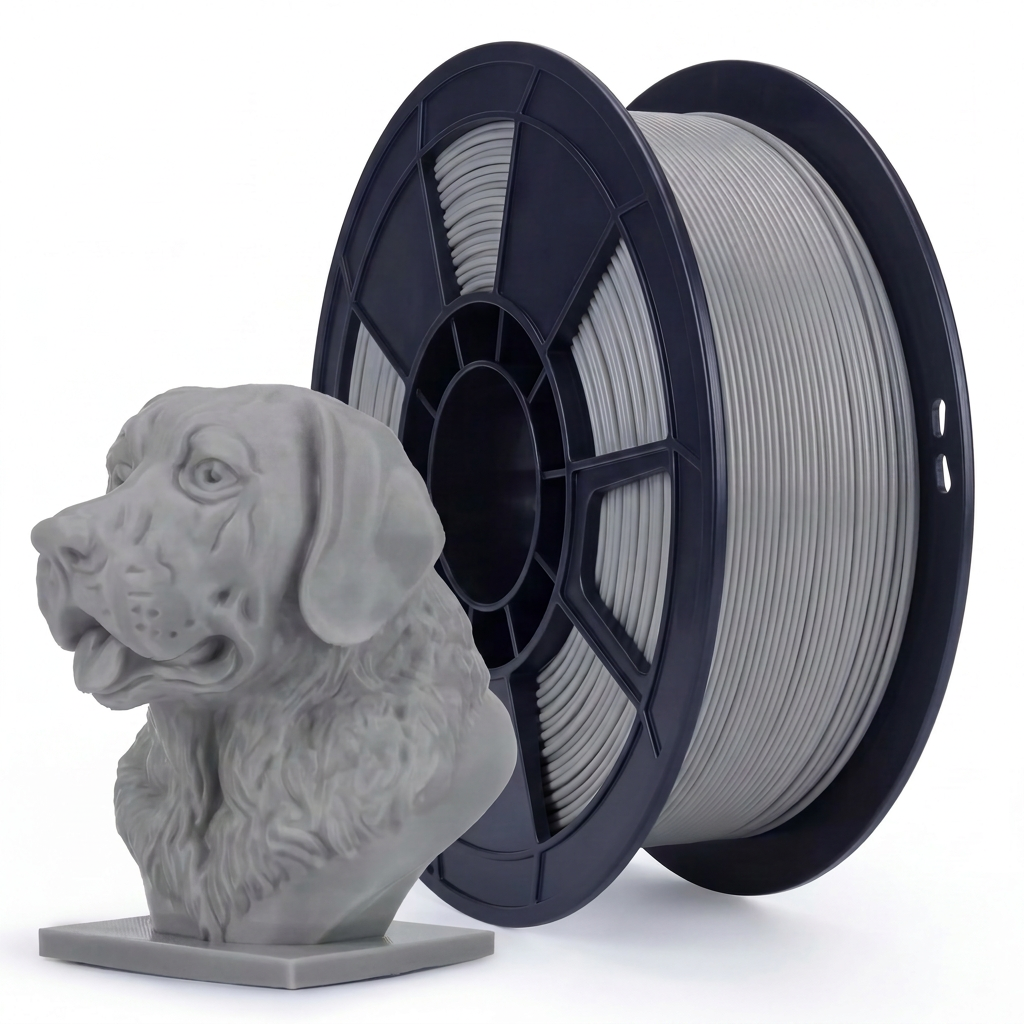
The colorway is deliberate. This is industrial jig gray—the standard matte mid-gray (close to #757575) that production equipment has worn for decades. On a shop floor, gray parts blend in next to CNC enclosures, control cabinets, and injection-molded machine panels instead of shouting for attention. The matte surface behaves like a coat of primer: it shows surface detail honestly under inspection lighting, produces no glare under overhead fluorescents, and photographs cleanly for design reviews and work instructions. Just as practically, mid-gray hides the dust, oil smudges, and handling scuffs that make white fixtures look tired in a week and glossy black parts show every fingerprint.
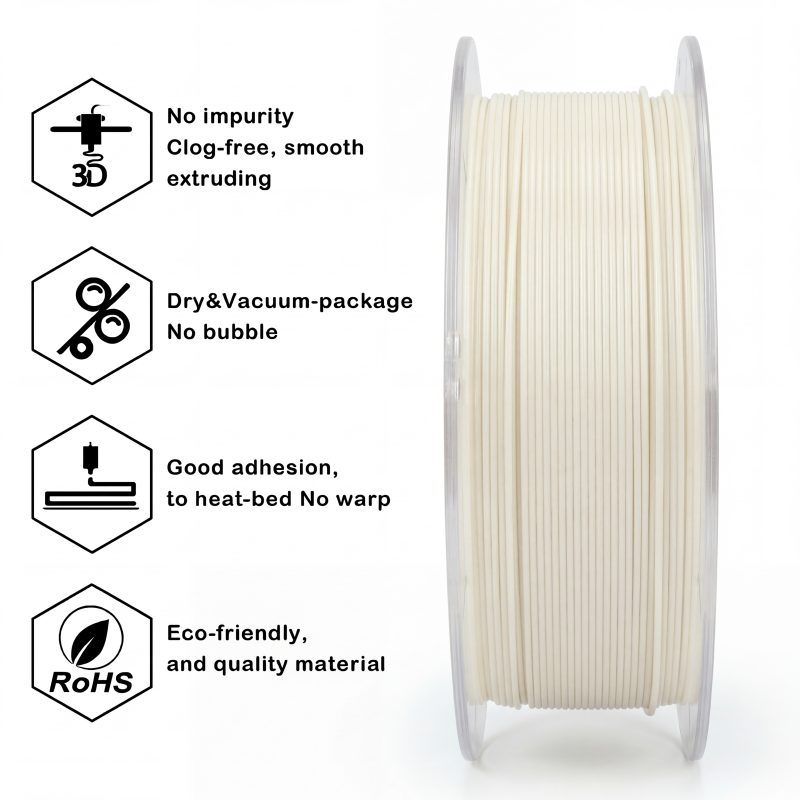
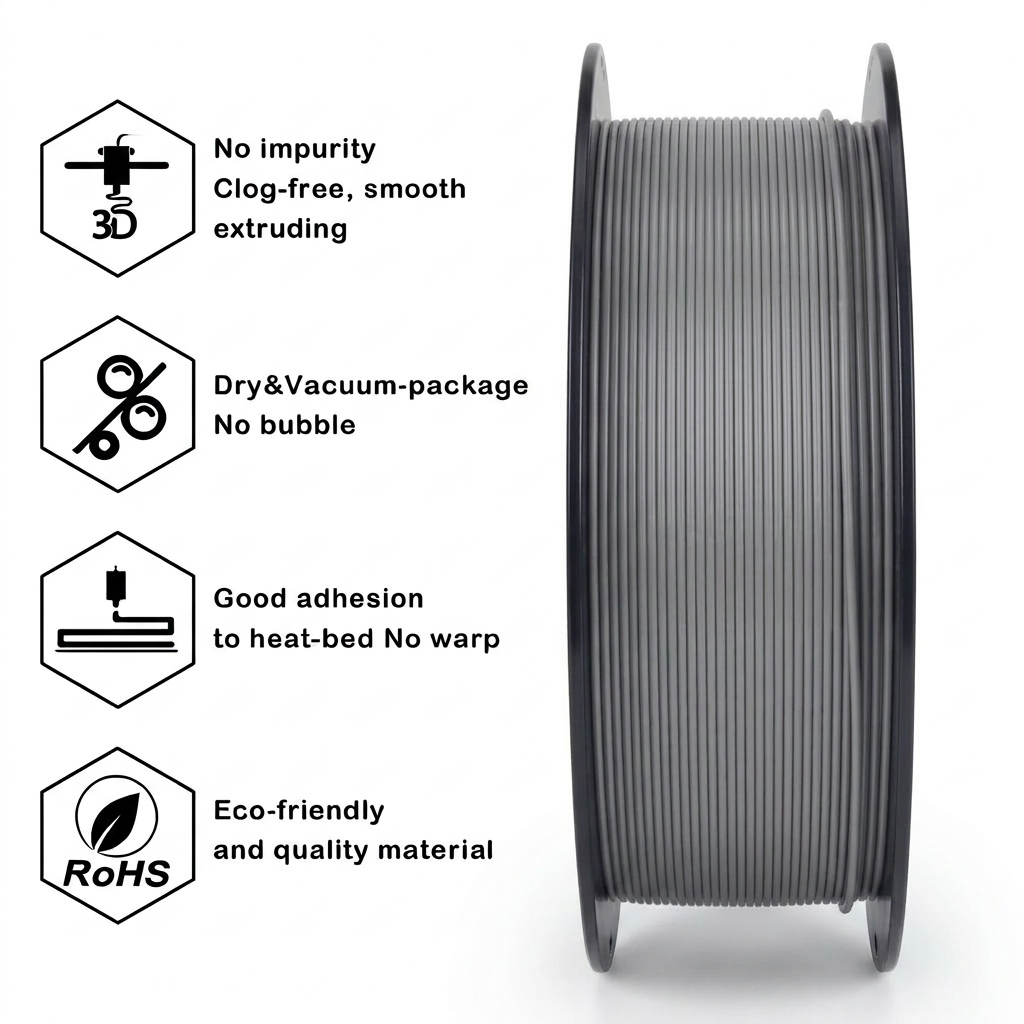
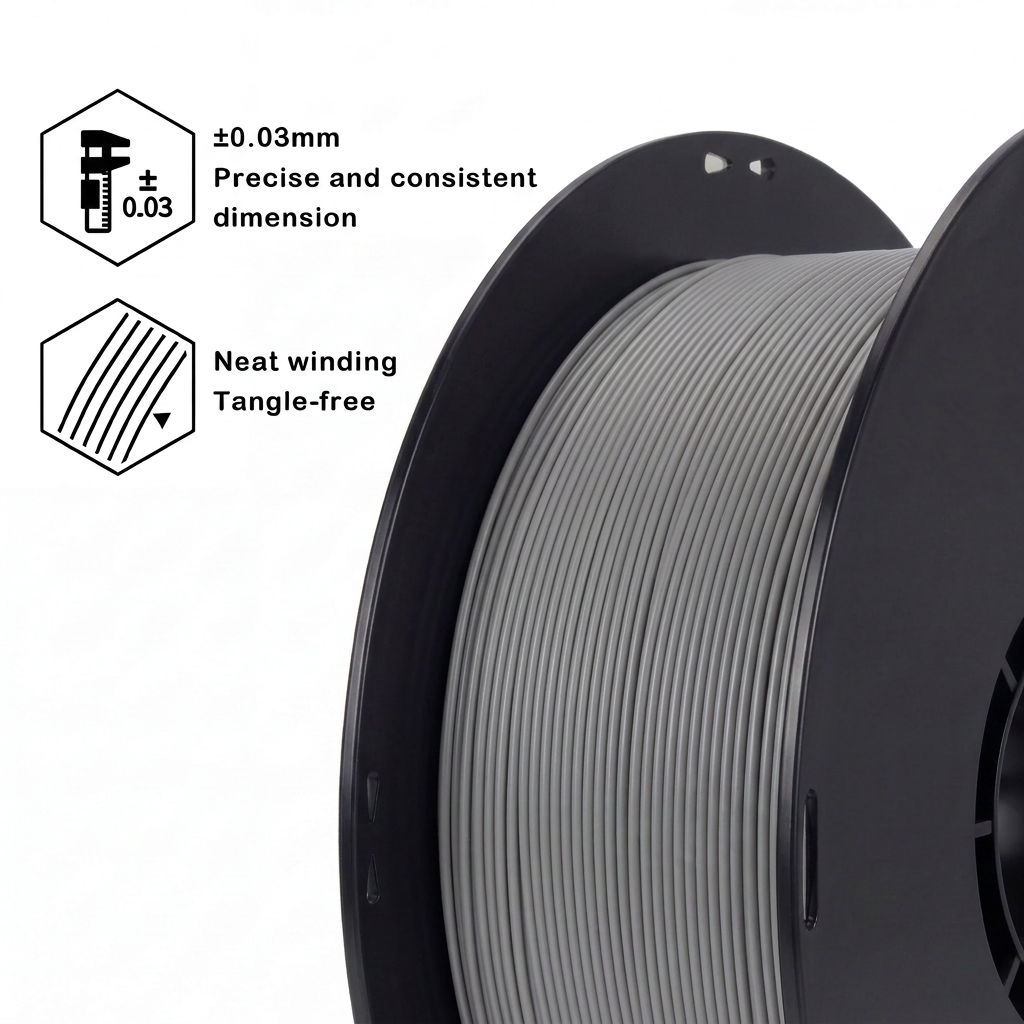
Underneath the color sits the same discipline that runs through the whole high-speed line: ±0.03mm diameter tolerance, 100% bubble-free vacuum extrusion, neat tangle-free winding, and vacuum-sealed packaging with desiccant. Every spool of this high speed ABS filament is compounded, extruded, and packed in-house under ISO 9001 quality management in Guangdong, China. Free samples are available for qualified business customers, and full OEM/ODM support—including custom gray shades matched to your equipment palette and private-label packaging—is available for volume buyers.
Why This High Speed ABS Filament Stands Out
⚡ Production-Floor ABS That Keeps Up With Your Printers
Fast printers stopped being exotic years ago; fast engineering materials did not. Standard ABS starves the hotend above moderate speeds, stinks up the room, and lifts off open-frame beds. This high speed ABS filament was formulated to remove all three objections at once.
- 30–600mm/s Rated — High-flow rheology keeps extrusion stable across the full speed range of modern CoreXY machines, from careful 60mm/s detail work to flat-out 600mm/s draft fixtures
- Low-Odor Formulation — Printing fumes are noticeably reduced versus standard ABS, making it workable in shared workshops and print farms where operators spend the whole day next to the machines
- Interlayer Adhesion at Speed — The failure mode of fast ABS is weak layer bonds; this formulation is tuned so walls printed at 300mm/s still shear like walls, not like stacked chips
- No Enclosure Required — A reduced-warp base resin holds corners down on open-frame printers with an 80–100°C bed, so you don’t need a heated chamber to print reliable mid-size fixtures
- Jig & Fixture Duty Cycle — ABS-class heat resistance (glass transition around 105°C) and impact toughness mean printed jigs survive clamping forces, dropped tools, and warm equipment bays that soften PLA
- Fleet-Consistent Gray — Batch-to-batch color control keeps this year’s replacement fixture visually identical to last year’s original, so a wall of gray jigs still reads as one system
The result is a single gray spool that covers the unglamorous majority of what industrial 3D printers actually print: tooling, guarding, housings, and holders.
Premium High Speed ABS at Factory-Direct Pricing
SigmaFilament is a direct manufacturer based in Guangdong, China. We compound the resin, extrude the strand, wind the spool, and pack the box ourselves—so print farms and fixture shops get engineering-grade high speed ABS filament at the price point that makes printing tooling in-house cheaper than outsourcing it.
| ⚡ High-Flow Consistency | 💰 Factory-Direct Pricing | 🔁 Fleet Repeatability |
| ±0.03mm diameter and a stable melt-flow window mean the same profile works on every printer in the farm | No middlemen or brand markups—volume discounts at 100kg, 500kg, and 1000kg+ tiers | Reorder months later and the replacement jig matches the original in color, fit, and strength |
Why Choose Industrial Gray ABS for Your Projects
| 🏭 The Industrial Standard Color | Machine builders have standardized on mid-grays for equipment panels, guarding, and enclosures for a reason: gray parts look intentional in any production environment. A printed sensor bracket or cable guide in this gray reads as OEM equipment, not as a hobbyist add-on bolted to a professional machine. |
| 🧤 Shop-Floor Practicality | Fixtures get handled with cutting-oil fingers, parked on dusty benches, and knocked around in tool drawers. Mid-gray hides the grime that makes white fixtures look worn within days, while avoiding the fingerprint-magnet effect of glossy black. Gray tooling stays presentable between cleanings. |
| 🔍 Inspection-Friendly Matte Surface | Matte mid-gray behaves like primer under inspection light: it reveals layer defects, blobs, and dimensional issues honestly instead of hiding them in gloss reflections or shadow. That makes first-article checks faster—and it’s also why gray prototypes photograph so cleanly for design reviews and documentation. |
| 📷 Scan & Vision Friendly | Neutral mid-gray is a forgiving tone for 3D scanning and machine-vision setups: it neither absorbs light the way dark glossy black does nor blows out highlights the way bright white can. For reverse-engineering workflows and camera-guided assembly cells, gray fixtures simply behave better. |
| 🎨 Neutral Base for Marking & Branding | Gray takes paint markers, engraved labels, adhesive ID tags, and safety-color accents cleanly—red go/no-go zones and yellow caution marks pop against it. And because it’s brand-neutral, contract shops can put gray tooling in front of any customer without clashing with corporate colors. |
| 📦 Consistent Reorders for Fixture Fleets | When a line runs forty printed fixtures, one off-shade replacement is instantly visible—and quietly erodes confidence in the whole system. Batch-controlled pigmentation keeps every reorder of this gray visually continuous with the fleet already on the floor, month after month. |
High Speed ABS vs. Standard ABS vs. ASA vs. PETG — Comparison
| Property | High Speed ABS (This) | Standard ABS | ASA | PETG |
|---|---|---|---|---|
| Practical Print Speed | ★★★★★ 30–600mm/s | ★★☆☆☆ ~40–80mm/s | ★★☆☆☆ ~40–80mm/s | ★★★☆☆ Speed grades exist |
| Odor While Printing | ★★★★☆ Low-odor formula | ★★☆☆☆ Strong | ★★★☆☆ Moderate | ★★★★★ Minimal |
| Enclosure Requirement | ★★★★☆ Not required | ★★☆☆☆ Strongly advised | ★★★☆☆ Advised | ★★★★★ Never needed |
| Heat Resistance | ★★★★☆ Tg ~105°C class | ★★★★☆ Same class | ★★★★☆ Same class | ★★★☆☆ ~75–80°C |
| Impact Toughness | ★★★★★ ABS-grade | ★★★★★ | ★★★★☆ | ★★★★☆ |
| UV / Outdoor Use | ★★☆☆☆ Indoor duty | ★★☆☆☆ Indoor duty | ★★★★★ UV stable | ★★★☆☆ Fair |
| Post-Processing | ★★★★★ Sand, tap, acetone-smooth | ★★★★★ Same | ★★★★☆ | ★★★☆☆ Gummy to sand |
| Best For | Jigs, fixtures, guards, housings at speed | Enclosed-printer functional parts | Outdoor brackets, automotive exterior | Wet/chemical environments |
Recommended Print Settings for High Speed ABS Filament
This high speed ABS filament prints like a well-behaved ABS with a much wider speed window. If you already have a reliable ABS profile, start there and raise speeds incrementally; if you’re coming from PLA or PETG, the notes below cover the handful of settings that actually matter.
⚠️ Notes Before Printing:
- Speed and strength trade off at the extremes — Interlayer bonding is strongest up to roughly 300mm/s; above that, treat parts as drafts or non-critical tooling and validate any fixture that will see real clamping loads.
- Volumetric flow is the true limit — 600mm/s at production line widths demands a high-flow hotend. If your slicer caps volumetric speed (mm³/s), raise the cap for this material rather than fighting phantom underextrusion.
- Drafts cause more failures than missing enclosures — The low-warp formula holds open-frame beds fine, but a cold cross-breeze from a door, window, or AC vent will still lift corners. Position the printer away from moving air.
- Respect the first layer — Run the bed at the top of its range (90–100°C) for the first layers, slow the first layer to ~50% speed, and use a brim on large flat fixtures. Almost every ABS failure is decided in layer one.
Optimal Print Settings for This High Speed ABS
| Nozzle Temperature | 240–260°C (250°C recommended; use the upper end above ~300mm/s for melt flow) |
| Bed Temperature | 80–100°C (90–100°C recommended for large flat parts) |
| Print Speed | 30–600mm/s (150–300mm/s sweet spot for functional fixtures) |
| Layer Height | 0.16–0.28mm (0.20mm standard for tooling; 0.28mm for draft fixtures) |
| Cooling Fan | 0–20% (up to 40% for bridges and overhangs only—excess cooling weakens layer bonds) |
| Wall Count | 3–4 walls for jigs and fixtures; 2 walls for covers and housings |
| Infill | 30–60% grid/gyroid for load-bearing tooling; 15–20% for enclosures |
| Retraction | 0.5–1.0mm at 35–45mm/s (direct drive); 4–6mm (Bowden) |
| Nozzle Type | Standard 0.4mm brass; high-flow hotend recommended above ~300mm/s |
| Enclosure | Not required; a closed chamber still helps very large or very flat fixtures |
| Bed Adhesion | Textured PEI with glue-stick release layer; brim 5–10mm on large flat parts |
| Drying (if needed) | 75–80°C for 2–4 hours after extended exposure. See our filament dryer settings guide |
💡 Pro Tip — Calibrate Once, Then Cut Fixtures Like Parts: Jigs and fixtures live or die on dimensional accuracy, and ABS shrinks slightly as it cools (typically in the 0.4–0.7% range). Before printing your first real fixture:
- Print a calibration coupon — a 100mm bar with a bored hole and a boss—at your production speed and temperature, then measure it after it fully cools to room temperature.
- Compensate in the slicer, not the CAD — use horizontal expansion / XY compensation for hole and slot fits, and a global scale factor only if overall length is off. Save it as a dedicated “HS-ABS tooling” profile.
Do this once per printer and every subsequent locating pin, datum bore, and press-fit in this gray will land on size—because the ±0.03mm strand consistency means the material behaves the same spool after spool.
Technical Specifications
| Parameter | Specification |
|---|---|
| Material | High-flow ABS (acrylonitrile butadiene styrene), low-odor formulation |
| Color | Gray — standard matte industrial mid-gray (close to #757575) |
| Model | HS-ABS-GY |
| Filament Diameter | 1.75mm (0.069 in) |
| Diameter Tolerance | ±0.03mm |
| Net Weight | 1kg (2.2 lbs) per spool |
| Gross Weight | ~1.3kg (with spool and packaging) |
| Length | ~400 m per 1kg spool (1.75mm) |
| Nozzle Temperature | 240–260°C (464–500°F) |
| Bed Temperature | 80–100°C (176–212°F) |
| Print Speed | 30–600mm/s |
| Recommended Speed | 150–300mm/s for functional tooling; up to 600mm/s with high-flow hotends |
| Odor | Low-odor formulation (reduced versus standard ABS; general ventilation still recommended) |
| Enclosure | Not required (reduced-warp formula for open-frame printers) |
| Bubbles in Filament | 100% bubble-free (vacuum extrusion) |
| Required Nozzle | Standard 0.4mm brass; high-flow hotend for the upper speed range |
| Post-Processing | Sanding, drilling, tapping, machining, painting, acetone vapor smoothing |
| Drying Temperature | 75–80°C for 2–4 hours (only after extended open-air exposure) |
| Packaging | Vacuum-sealed bag with desiccant, individual carton box |
| Manufacturing Origin | Guangdong, China |
| Free Sample | Available for qualified business customers |
| OEM/ODM | Available — Learn about our OEM services |
Material Properties & Performance
Mechanically, this high speed ABS filament delivers the property profile that made ABS the default engineering plastic for decades: genuine impact toughness, useful stiffness, and a glass transition around 105°C that keeps parts rigid in warm equipment bays where PLA sags and PETG softens. The values below are typical ranges for this material class printed at recommended settings; batch documentation is available to volume customers on request. For a broader ranking of materials by mechanical performance, see our strongest 3D printer filament guide.
Mechanical & Thermal Properties (Typical)
| Property | Typical Value | Test Standard |
|---|---|---|
| Tensile Strength | 38–45 MPa | ISO 527 / ASTM D638 |
| Elongation at Break | 15–30% | ISO 527 / ASTM D638 |
| Flexural Strength | 60–75 MPa | ISO 178 / ASTM D790 |
| Flexural Modulus | 1,900–2,400 MPa | ISO 178 / ASTM D790 |
| Impact Strength (Izod, Notched) | 18–25 kJ/m² | ISO 180 / ASTM D256 |
| Glass Transition Temperature | ~105°C (221°F) | ISO 11357 |
| Heat Deflection Temperature | ~95–100°C (0.45 MPa) | ISO 75 / ASTM D648 |
| Density | 1.04 g/cm³ | ISO 1183 |
| Molding Shrinkage | 0.4–0.7% | ISO 294-4 |
| Moisture Absorption (23°C / 50% RH) | ~0.2–0.4% | ISO 62 |
Printer-Specific Settings for High Speed ABS
| Printer | Nozzle | Bed | Speed | Notes |
|---|---|---|---|---|
| Bambu Lab X1C / P1S | 255°C | 90°C | 150–300mm/s | Start from the Generic ABS profile; glue-stick release layer on textured PEI; keep the door closed for large fixtures |
| Creality K1 / K1 Max | 250°C | 95°C | 200–300mm/s | Stock ABS profile works; raise the slicer’s max volumetric speed cap if you see underextrusion at top speed |
| QIDI X-Plus 3 / X-Max 3 | 260°C | 95°C | 300–600mm/s | High-flow hotend plus actively heated chamber makes this the easiest route to the top of the speed range |
| Voron 2.4 / Trident | 255°C | 100°C | 200–400mm/s | With a high-flow hotend (CHT-style or equivalent) and tuned pressure advance, 400mm/s+ walls stay clean |
| Prusa MK4 / MK3S+ | 255°C | 100°C | 100–200mm/s | Open frame is fine for small/medium parts; enable a draft shield for tall fixtures in breezy rooms |
| Creality Ender 3 S1 / V3 | 245°C | 90°C | 60–120mm/s | Use an 8–10mm brim on flat tooling; position the printer away from doors and AC vents |
Applications for High Speed ABS Filament Gray
This high speed ABS filament is aimed at the working end of 3D printing—the tooling, guarding, and housings that industrial users reprint constantly. The gray colorway isn’t decoration here; in each application below it does a practical job.
| 🔧 Production Jigs & Fixtures | Assembly jigs, alignment fixtures, drill guides, bonding fixtures, and go/no-go gauges—printed overnight at 200–300mm/s instead of machined next week. ABS toughness shrugs off clamping loads and dropped-on-concrete accidents, and the matte gray makes scribed reference marks and paint-marker labels easy to read on the line. |
| 🛡️ Machine Guards & Covers | Belt covers, chip shields, sensor housings, limit-switch protectors, and control-box enclosures that must tolerate warm motors and the occasional impact. In this equipment-panel gray, a printed guard installed next to injection-molded OEM covers looks like part of the machine rather than a retrofit. |
| 🤖 Robotics & End-of-Arm Tooling | Gripper fingers, vacuum-cup mounts, cable-chain guides, and EOAT brackets where every gram matters and iteration speed matters more. Print a revised gripper at lunch, test it in the afternoon—and because neutral gray behaves predictably under machine-vision lighting, camera-guided cells keep working when tooling changes. |
| 🚗 Automotive & Appliance Prototyping | Interior clips, brackets, bezels, and trim mock-ups in the material class these parts will eventually be molded from. Matte gray prototypes read remarkably close to production plastic in review meetings and photograph without glare—useful when the deliverable is a decision, not just a part. |
| 🧰 Workshop Tooling & Organization | Tool holders, shadow boards, CNC accessory mounts, soft jaws for light-duty work, storage bins, and machine-side organizers that live in dust and cutting oil. Mid-gray hides workshop grime far longer than white and doesn’t show fingerprints the way black does—organization systems stay presentable. |
| 📐 Pre-Production Validation Parts | Form-fit-function parts printed before committing to injection-mold tooling. The primer-like matte gray surface exposes sink-prone geometry, layer artifacts, and dimensional issues honestly under inspection light—catching design problems while they still cost a spool, not a mold revision. |
Environmental & Safety Standards
| 👃 Low-Odor Formulation | Engineered to noticeably reduce printing fumes versus standard ABS. General workshop ventilation is still recommended, as with any ABS-class material. |
| ✅ RoHS / REACH Compliant | Free of lead, mercury, cadmium, hexavalent chromium, and other restricted substances—suitable for EU and global industrial procurement. |
| 🏭 ISO 9001 Manufacturing | Produced under certified quality management. Diameter, pigment consistency, and winding quality verified per batch. |
| 📦 Vacuum Sealed + Desiccant | 100% bubble-free vacuum extrusion plus moisture-proof packaging—print dry, strong tooling straight out of the box. |
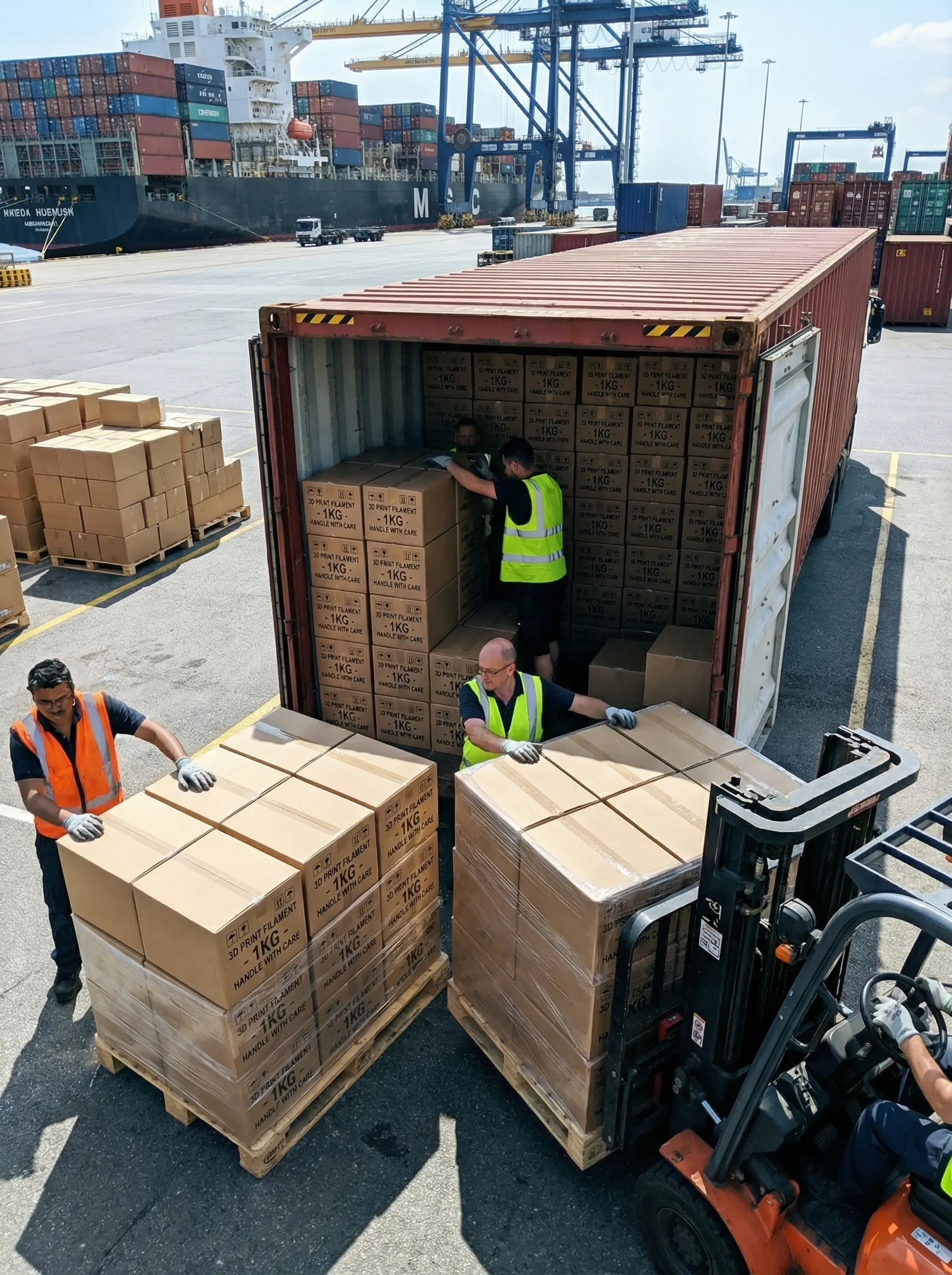
Packaging & Global Shipping
| Destination | Standard Delivery | Express Available |
|---|---|---|
| European Union | 5–10 business days | ✓ 3–5 days |
| United States | 7–12 business days | ✓ 4–6 days |
| United Kingdom | 7–12 business days | ✓ 4–6 days |
| Canada | 8–14 business days | ✓ 5–7 days |
Packaging: Vacuum-sealed bag with desiccant, individual carton box. Customs: DDP and DAP terms available.
Bulk Orders & OEM/ODM Services
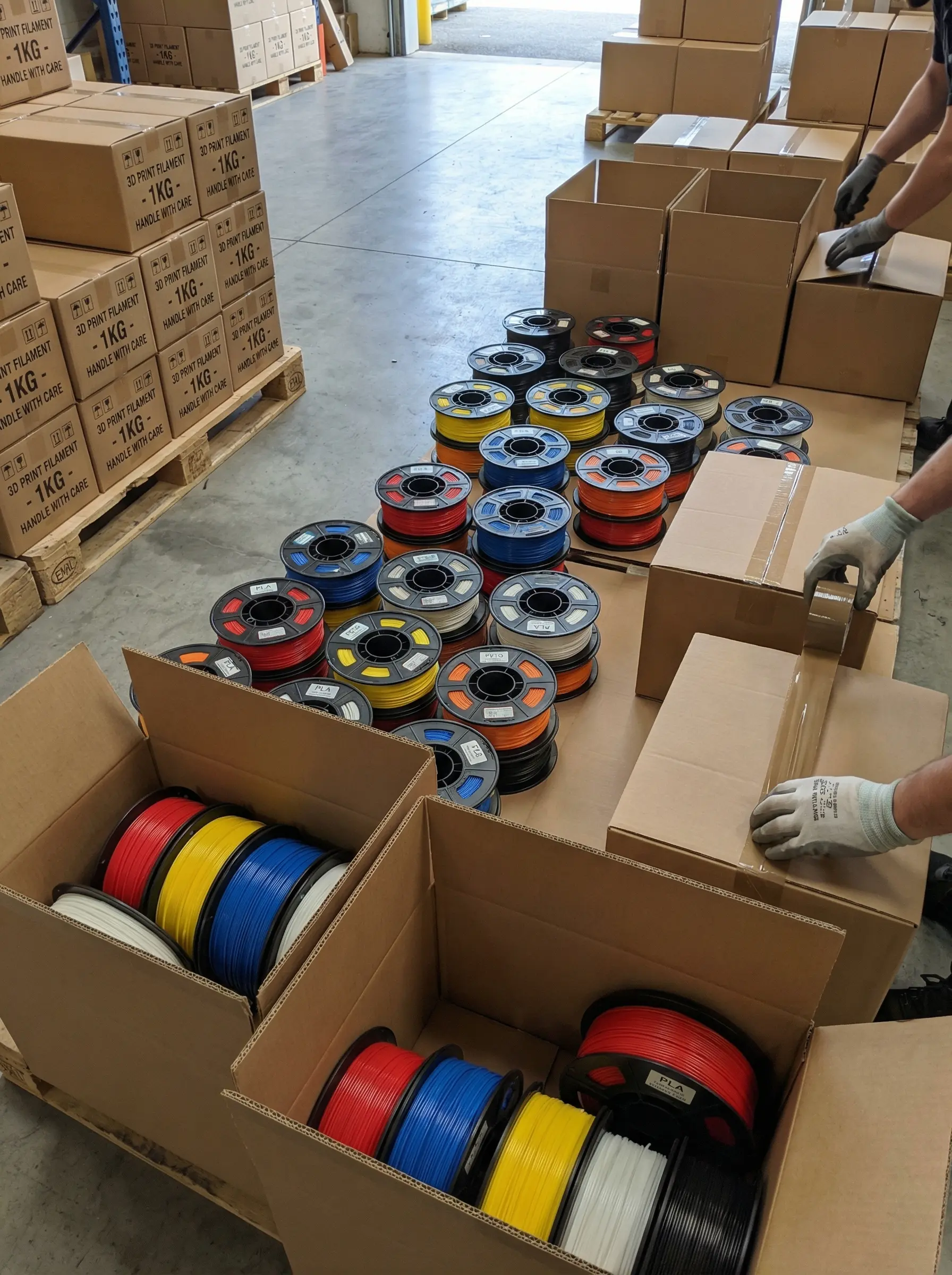
| 📊 Flexible MOQ | From trial orders for a single print farm to container-volume production supply. Free samples available for qualified business customers. |
| 💰 Volume Pricing | Tier breakpoints at 100kg+, 500kg+, and 1000kg+ with progressive discounts—sized for farms that burn through gray tooling filament weekly. |
| 🩶 Custom Grays & Private Label (OEM/ODM) | • Custom gray shades matched to your equipment palette (Pantone / RAL references) • Private-label packaging and co-branded boxes • Custom spool sizes (0.5kg, 2kg, 3kg, 5kg) • High-speed formulations in additional colors on request |
| 🎁 Free Sample Program | Evaluation spools for qualified business customers—benchmark speed, interlayer strength, and color consistency on your own machines before committing to volume. |
Storage & Handling Guidelines
| Storage Guidelines | |
|---|---|
| Temperature | 15–25°C (59–77°F) |
| Humidity | Below 50% RH (ABS is mildly hygroscopic—less than nylon, more than you’d think) |
| Shelf Life | 24 months (unopened, vacuum sealed) |
| Drying (if needed) | 75–80°C for 2–4 hours after extended exposure; damp ABS shows as slight haze and popping at high flow rates |
| Light Exposure | Store away from direct sunlight—prolonged UV yellows ABS surfaces over time |
| Handling | Secure the filament end in the spool notch between prints—crossed winding is the top cause of mid-print feed failures at speed |
Printer Compatibility
This high speed ABS filament works with any 1.75mm FDM/FFF printer whose hotend reaches 260°C and whose heated bed sustains 80–100°C—no enclosure required. It pairs naturally with the fast CoreXY generation, and also prints this line’s sibling colorway: see the high speed ABS in Pure White for light-colored housings and consumer-facing parts.
| Bambu Lab X1C, P1S, P1P, A1* | Creality K1, K1 Max, Ender S1/V3 | QIDI X-Plus 3, X-Max 3, Q1 Pro | Voron / RatRig 2.4, Trident, V-Core | Prusa MK4, MK3S+, XL | Anycubic / Elegoo Kobra 2/3, Neptune 4 |
*Open-bed machines: keep parts small-to-medium or add a draft shield; a 100°C-capable bed gives the widest margin on large flat fixtures.
Why Choose SigmaFilament for High Speed ABS Filament
| 🏭 Direct Manufacturer | Factory-direct pricing from Guangdong, China with in-house control of compounding, extrusion, winding, and packaging—no reseller markup between our line and yours. |
| ⚡ High-Speed Specialists | Our high-speed line is formulated for melt-flow stability at modern CoreXY speeds—the same engineering focus behind our 600mm/s-rated PLA, PETG, and ABS ranges. |
| ✅ Quality Assured | ±0.03mm tolerance, 100% bubble-free vacuum extrusion, batch-controlled pigmentation, ISO 9001 quality management. |
| 🌍 Global B2B Service | English-speaking support across EU/US business hours, DDP/DAP shipping terms, and documentation support for industrial procurement. |
| 🔧 Full OEM/ODM | Custom gray shades, private-label packaging, custom spool sizes, and high-speed formulations in additional colors for volume partners. |
Frequently Asked Questions About High Speed ABS Filament
Ready to Standardize Your Tooling on High Speed ABS?
Contact SigmaFilament today for bulk pricing, free samples, or to discuss OEM/ODM requirements—including custom gray shades matched to your equipment palette and private-label packaging for this high speed ABS filament.
📧 Email us for a quick quote · 🌍 Worldwide shipping with DDP/DAP terms · 🎁 Free samples for qualified customers
| Filament Diameter | 1.75mm ,2.85mm (3.00mm) |
|---|---|
| Spool Weight | 1kg ,3kg ,5kg ,Sample (200g) |