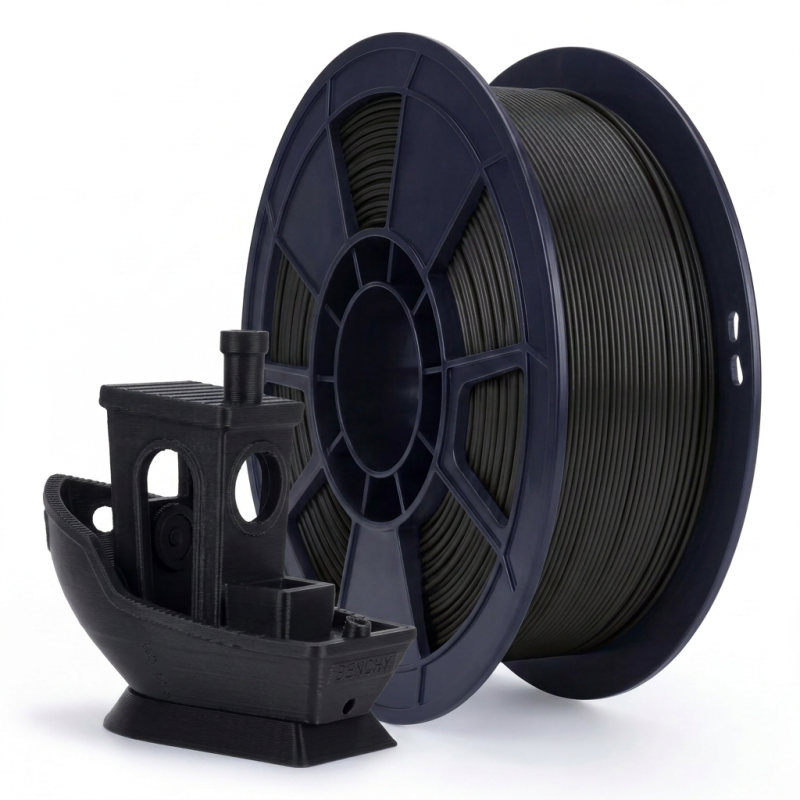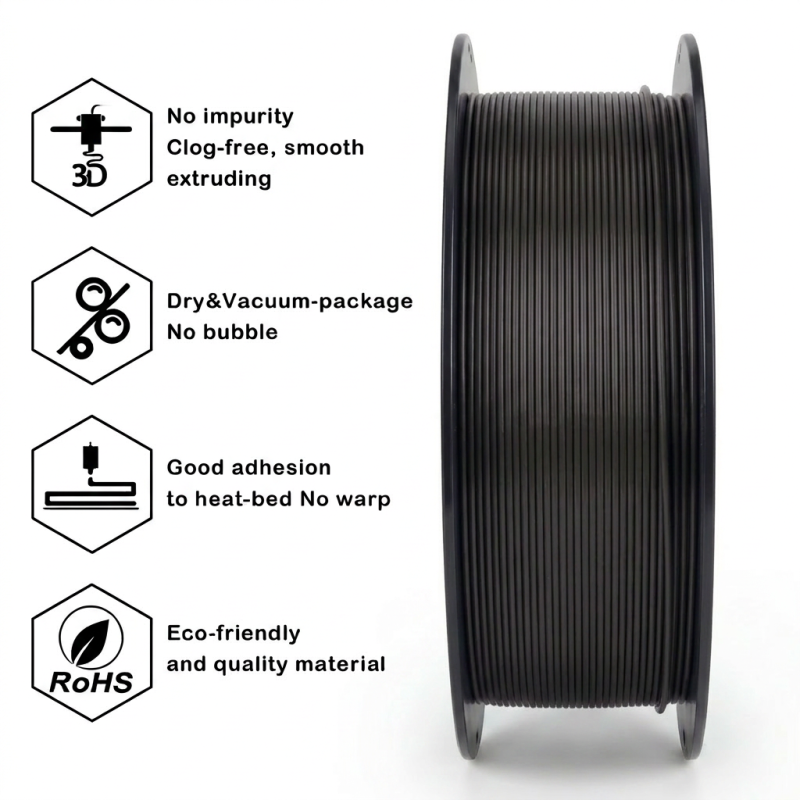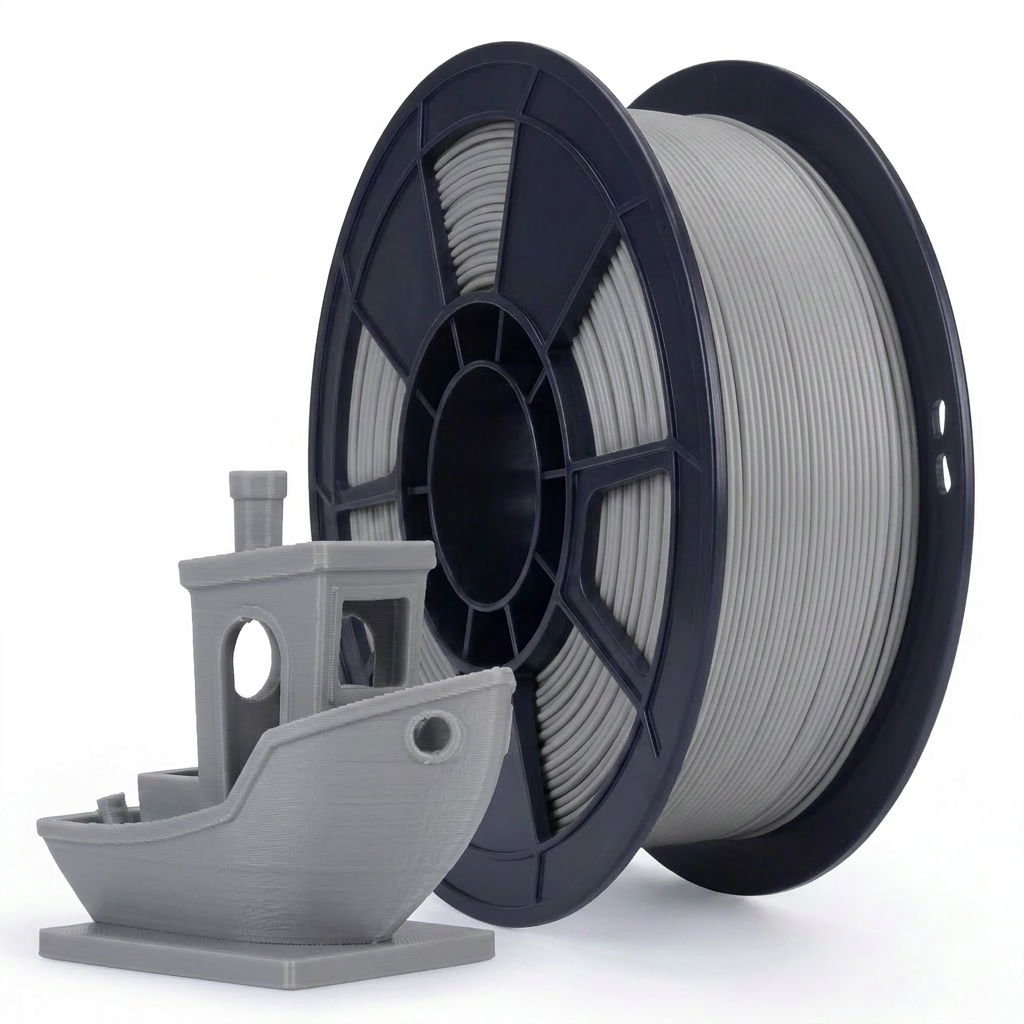
High Speed PLA Filament Gray – Product Overview
SigmaFilament gray high speed PLA filament is engineered for teams that measure printing in iterations per day, not hours per part. The high-flow PLA formulation melts quickly and extrudes consistently across the entire 30–600mm/s speed range, so CoreXY machines like the Bambu Lab X1C, Creality K1, and Voron builds can run at full rated speed without the under-extrusion, matte-to-glossy banding, or weak layer bonding that standard PLA shows past 150mm/s.
The color is the second half of the engineering story. This is a neutral #9E9E9E-class engineering gray with a standard matte finish—the same mid-tone gray that CAD packages use as their default render material. A prototype printed in this gray looks like the on-screen model made physical: no color bias to distract stakeholders during design reviews, no gloss to exaggerate surfaces, and no dark tone to swallow fine details. When you photograph a mockup for a pitch deck or drop it next to production parts for a fit check, the gray stays visually silent and lets geometry do the talking.
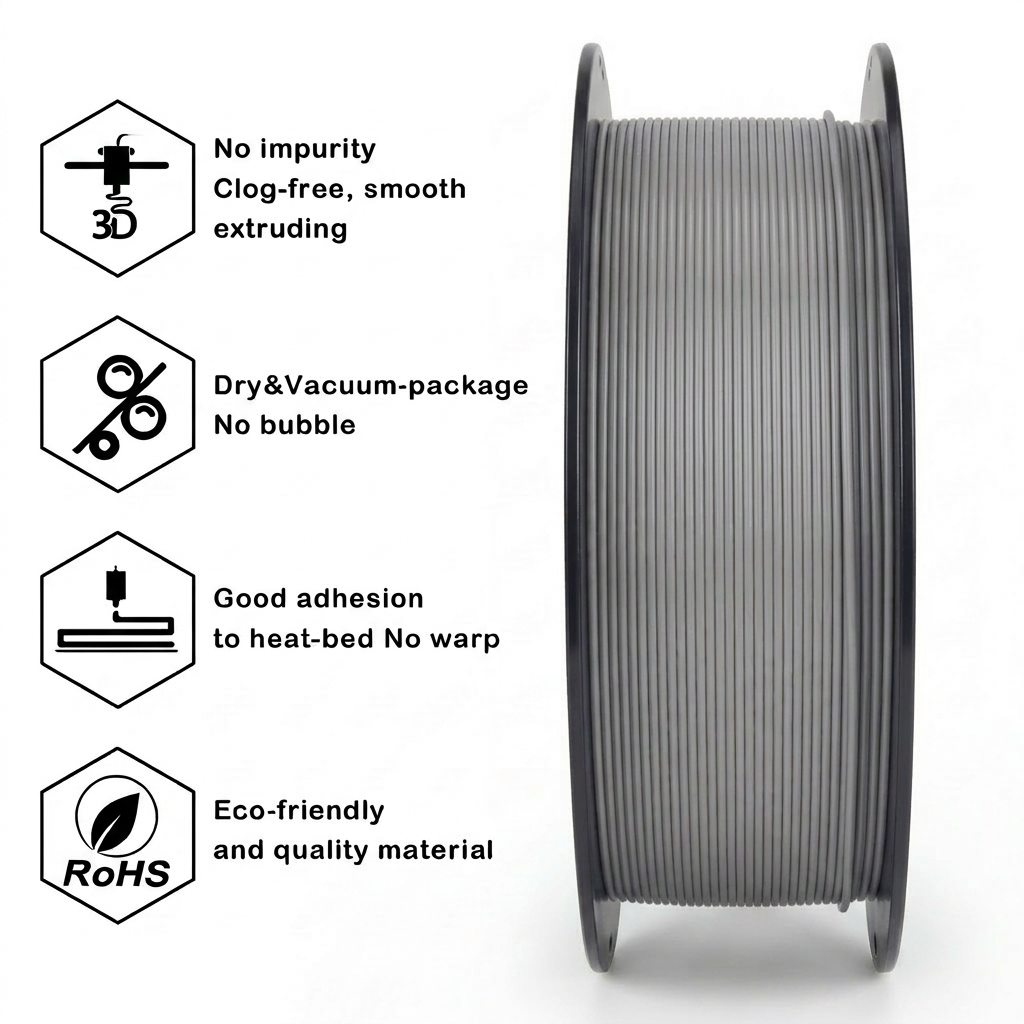
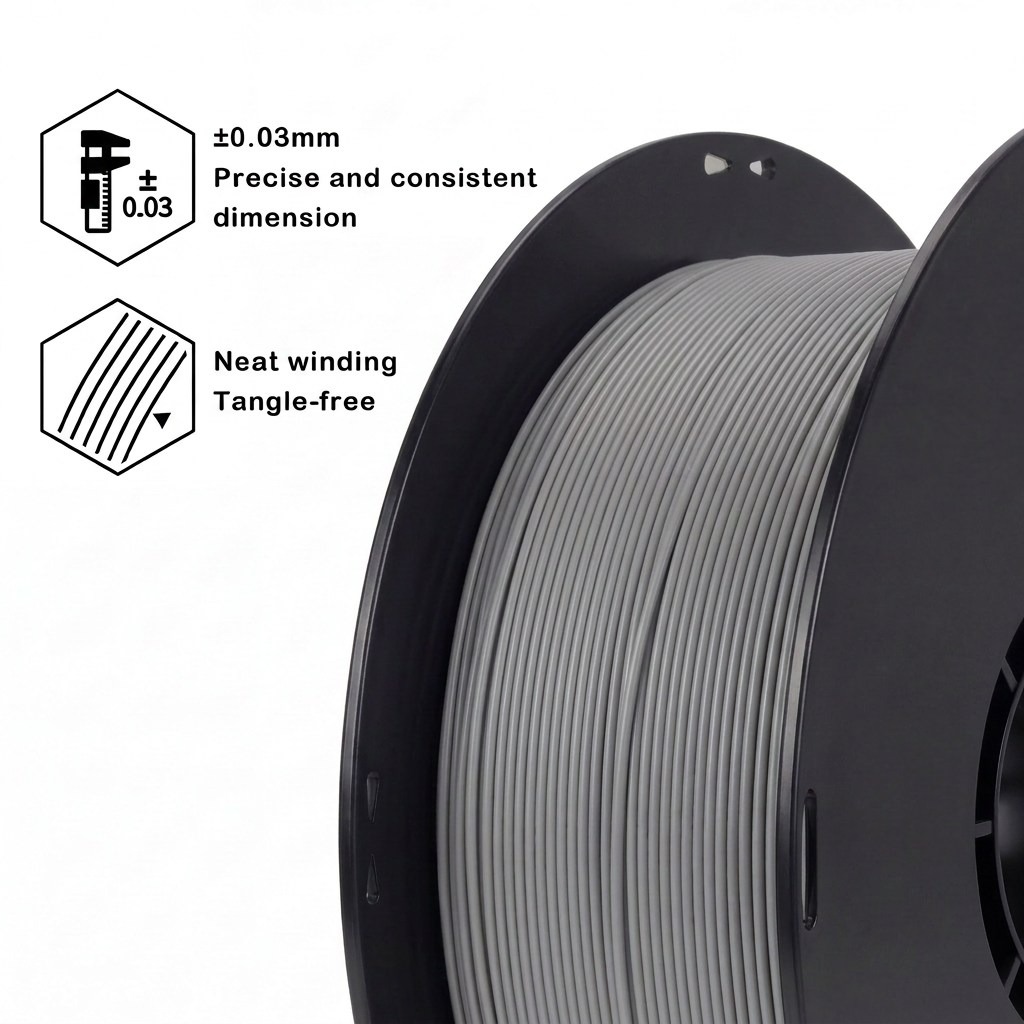
Mid-gray is also the most honest color for print quality control. White blows out highlights and visually hides layer lines; black crushes shadows and conceals surface defects until you tilt the part under a lamp. Gray sits in the middle of the exposure range, so seams, layer consistency, and overhang quality are visible at a glance—exactly what you want when validating a printer profile or auditing parts off a farm. Manufactured by SigmaFilament in Guangdong, China with ±0.03mm diameter tolerance, vacuum-sealed packaging, and RoHS/REACH compliance. Free samples, volume pricing, and full OEM/ODM support—including custom gray tones—are available for business customers.
Why This High Speed PLA Filament Stands Out
⚡ Engineering Gray at 600mm/s — Built for the Prototype Loop
Most filament pages talk about how prints look. This gray high speed PLA filament is about how fast you can learn: print the revision, check the fit, fix the CAD, print again—all inside the same working session.
- 30–600mm/s Working Range — High-flow formulation keeps melt viscosity stable at extreme volumetric flow rates, so fast printers stay fed and slow printers get an unusually forgiving material
- CAD-Neutral Color Match — The #9E9E9E-class gray mirrors default CAD viewport material, so physical prototypes read as direct continuations of the on-screen design—ideal for design reviews and client sign-off
- Defect-Revealing Matte Surface — Mid-gray matte exposes layer lines, seams, blobs, and overhang sag more clearly than white or black, making it the natural choice for profile tuning and part QC
- Layer Adhesion That Survives Speed — Interlayer bonding holds across the full speed range, so a 500mm/s draft prototype is still strong enough to test-fit, thread, and handle
- Low-Warp, Low-Drama Bed Behavior — 35–60°C bed temperatures and low shrinkage mean flat first layers on PEI or textured plates, even on rapid back-to-back farm cycles
- Camera-Neutral for Documentation — Neutral gray doesn’t cast color onto neighboring objects or fool white balance, so prototype photos for reports, listings, and pitch decks stay true
One spool covers the whole prototype loop: draft-speed fit checks in the morning, presentation-quality models for the afternoon review.
Premium High Speed PLA at Factory-Direct Pricing
SigmaFilament is a direct manufacturer based in Guangdong, China. We compound, extrude, wind, and pack every spool of gray high speed PLA filament in-house—so engineering teams and print farms get high-flow performance without the reseller markup that usually comes attached to “high speed” branding.
| ⚡ Verified High-Flow | 💰 Factory-Direct Pricing | 🎯 Gray You Can Reorder |
| Formulated for stable extrusion from 30 to 600mm/s—no under-fed corners, no speed-band gloss shifts | No middlemen and no “speed premium”—volume discounts scale for print farms and distributors | Pigment loading is controlled per batch, so the gray of next quarter’s spools matches the prototypes you photographed this quarter |
Why Choose Gray High Speed PLA for Your Projects
| 📐 CAD-Neutral Fit Checks | When a bracket, housing, or enclosure comes off the plate in the same neutral gray as the CAD viewport, everyone in the review evaluates geometry instead of reacting to color. Dimensional questions—wall thickness, boss placement, clearance around fasteners—get answered faster because nothing else competes for attention. |
| 🔍 Honest Surface QC | Mid-gray sits in the middle of the camera’s and the eye’s exposure range. Layer lines, Z-seams, ringing, and overhang sag all show at their true severity—unlike white (which washes defects out) or black (which hides them in shadow). If you tune printer profiles or audit farm output, gray is the color that tells the truth. |
| 📸 Photography That Doesn’t Fight You | Neutral gray reflects no color cast onto surrounding objects and doesn’t skew white balance, so prototype photos for documentation, investor decks, and pre-launch listings come out accurate on the first shot. Gray parts also sit comfortably next to aluminum, steel, and injection-molded components in assembly photos. |
| ⚡ Same-Day Iteration Loops | At 400–600mm/s draft speeds, a mid-size enclosure prints in the time a coffee takes to go cold. Teams move from “waiting on the printer” to running three or four design revisions in a single day—the practical difference between a prototype culture and a queue culture. |
| 🏢 Office & Studio Friendly | PLA prints with low odor and needs no enclosure or ventilation upgrades, so the printer can live next to the engineers who use it. The 35–60°C bed requirement also keeps energy draw modest on machines that run all day. |
| 🏭 Print-Farm Standard Color | A single neutral gray SKU covers prototyping, jigs, fixtures, and customer draft parts—fewer spool changes, simpler inventory, and a consistent look across every machine in the room. Batch-controlled pigmentation means parts printed on different machines and different weeks still match. |
High Speed PLA Gray vs. Standard PLA vs. High Speed PETG vs. High Speed ABS — Comparison
| Property | HS PLA Gray (This) | Standard PLA | High Speed PETG | High Speed ABS |
|---|---|---|---|---|
| Max Practical Speed | ★★★★★ Up to 600mm/s | ★★☆☆☆ ~60–150mm/s | ★★★★★ Up to 600mm/s | ★★★★★ Up to 600mm/s |
| Print Difficulty | ★★★★★ Easiest | ★★★★★ Easiest | ★★★★☆ Some stringing | ★★★☆☆ Hot bed needed |
| Stiffness / Detail Fidelity | ★★★★★ Rigid, crisp corners | ★★★★★ | ★★★☆☆ Slightly flexible | ★★★★☆ |
| Heat Resistance | ★★☆☆☆ ~55–60°C | ★★☆☆☆ ~55–60°C | ★★★☆☆ ~70–75°C | ★★★★☆ ~90–100°C |
| Warping Risk | ★★★★★ Very low, 35–60°C bed | ★★★★★ Very low | ★★★★☆ Low | ★★★☆☆ Moderate |
| Outdoor / Chemical Duty | ✗ Indoor prototyping focus | ✗ Indoor | ✓ Weather & chemical resistant | ✓ Tough, heat tolerant |
| Best For | Fit checks, form studies, design reviews, farm drafts | Everyday prints on slower machines | Functional outdoor parts, fast | Heat-exposed functional parts |
| Price Point | ★★★★★ (PLA economy) | ★★★★★ (Lowest) | ★★★★☆ | ★★★★☆ |
Recommended Print Settings for Gray High Speed PLA Filament
This gray high speed PLA filament runs on an ordinary PLA profile at ordinary speeds—nothing special is required to simply use it. The notes below matter only when you push toward the upper end of the 30–600mm/s range, where cooling capacity and temperature choice decide how clean the result looks.
⚠️ Notes Before Printing at High Speed:
- Speed is a cooling problem first — Past ~300mm/s, part cooling becomes the bottleneck. Run the cooling fan at 100% and let the slicer’s minimum-layer-time setting slow down small features so they solidify before the next pass.
- Use the upper temperature band at speed — Within the 190–230°C window, choose the higher end (about 220–230°C) for 300mm/s+ printing so the melt keeps up with the flow demand; drop toward 200–210°C for slower, finer presentation prints.
- Know your printer’s real ceiling — 600mm/s assumes a high-flow hotend and CoreXY motion system. On a stock bed-slinger, the filament is not the limit—the machine is. It will still print beautifully at whatever speed the printer can actually sustain.
- Check flow calibration per profile — Draft and presentation profiles push very different volumetric rates. Calibrate flow (or use your slicer’s auto-calibration) once per profile and the gray’s matte surface will show you immediately whether extrusion is dialed in.
Optimal Print Settings for This High Speed PLA
| Nozzle Temperature | 190–230°C (374–446°F) — upper band for 300mm/s+, lower band for fine finishing |
| Bed Temperature | 35–60°C (95–140°F) |
| Print Speed | 30–600mm/s (300–500mm/s typical draft; 100–150mm/s for presentation surfaces) |
| Layer Height | 0.20–0.28mm for draft fit checks; 0.12–0.16mm for review models |
| Cooling Fan | 100% from layer 2 onward; enable minimum layer time for small features |
| Wall Count | 2 walls for drafts; 3 walls for parts that will be drilled, tapped, or handled hard |
| Retraction | 0.5–1.0mm at 35–45 mm/s (direct drive); 4–5mm (Bowden) |
| Infill | 10–15% for form studies; 25–40% for fit checks that see fastener torque |
| Nozzle Type | Standard 0.4mm brass; 0.6mm speeds up bulky drafts further |
| Enclosure | Not required — open frame preferred for cooling at speed |
| Bed Adhesion | Textured or smooth PEI; glue stick on glass beds |
| Drying (if needed) | 45°C for 4–6 hours after long open-air storage. See our filament dryer settings guide |
💡 Pro Tip — Run a Two-Profile Workflow: Teams that get the most out of this material keep two slicer profiles side by side:
- DRAFT (400–600mm/s, 0.24–0.28mm layers, 2 walls, 10% infill) — for fit checks, clearance tests, and “does it even assemble?” questions. Parts land in minutes and the matte gray still photographs well enough for internal notes.
- REVIEW (100–150mm/s, 0.12–0.16mm layers, 3 walls, 210°C) — for the version that goes in front of a client or on the pitch table. Slower speed plus the lower temperature band gives the crispest corners and the most uniform matte surface.
Because both profiles run from the same spool, the draft and the review model are the exact same gray—so photos taken across the whole iteration history stay visually consistent in documentation.
Technical Specifications
| Parameter | Specification |
|---|---|
| Material | High-flow PLA optimized for high-speed extrusion |
| Color | Gray (#9E9E9E-class neutral engineering gray) |
| Surface Finish | Standard matte |
| Model | HS-PLA-GY |
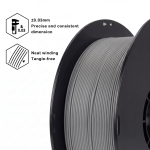
| Filament Diameter | 1.75mm (0.069 in) |
| Diameter Tolerance | ± 0.03 mm |
| Net Weight | 1 kg (2.2 lbs) per spool |
| Length | ~330 m per 1 kg spool (1.75 mm) |
| Nozzle Temperature | 190–230 °C (374–446 °F) |
| Bed Temperature | 35–60 °C (95–140 °F) |
| Print Speed | 30–600 mm/s (high-speed optimized) |
| Recommended Draft Speed | 300–500 mm/s on CoreXY machines with adequate part cooling |
| Recommended Finish Speed | 100–150 mm/s for presentation-quality surfaces |
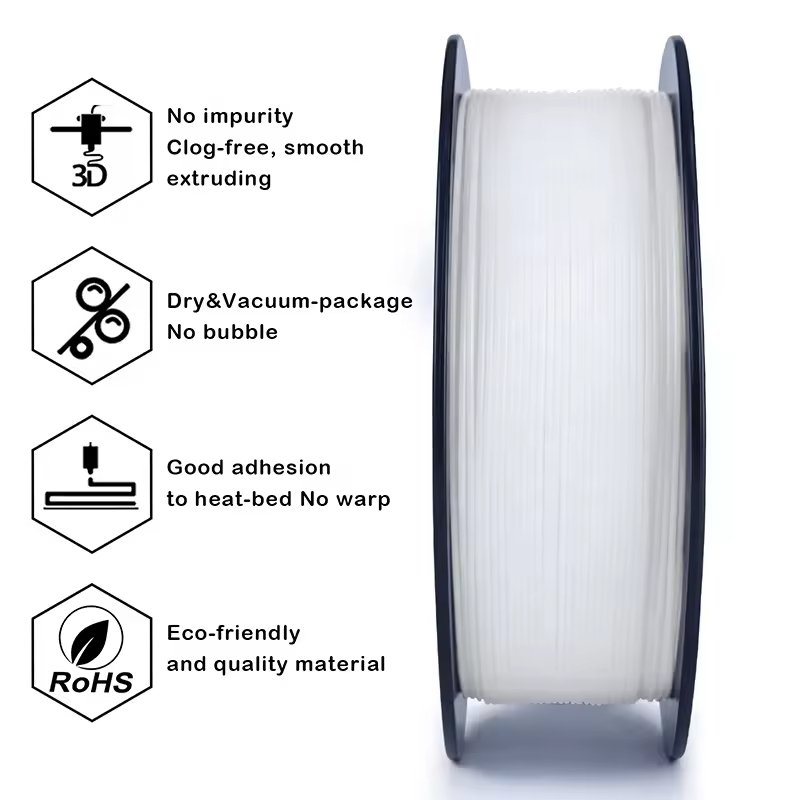
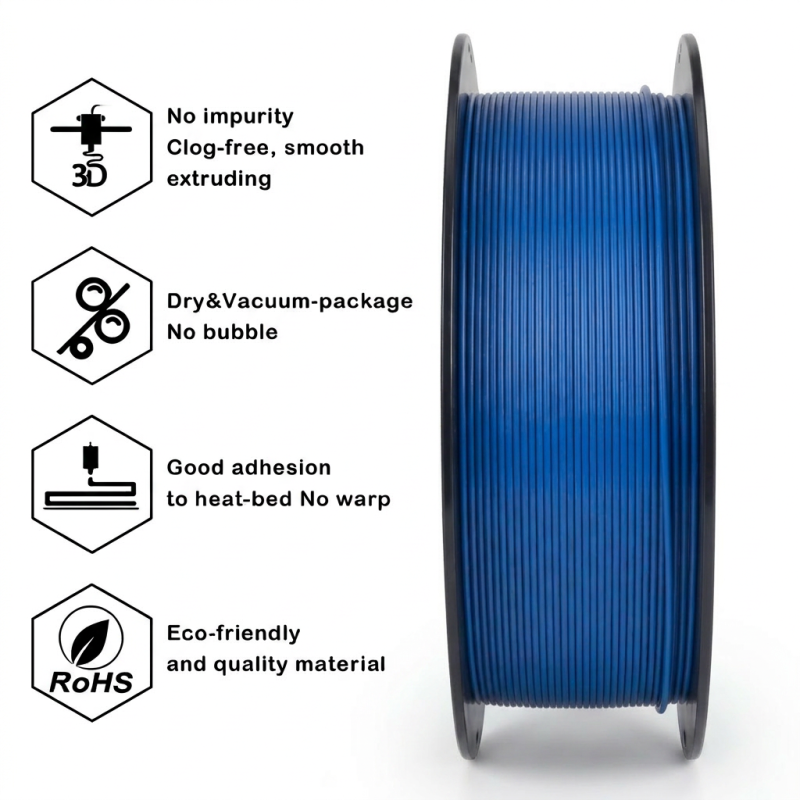
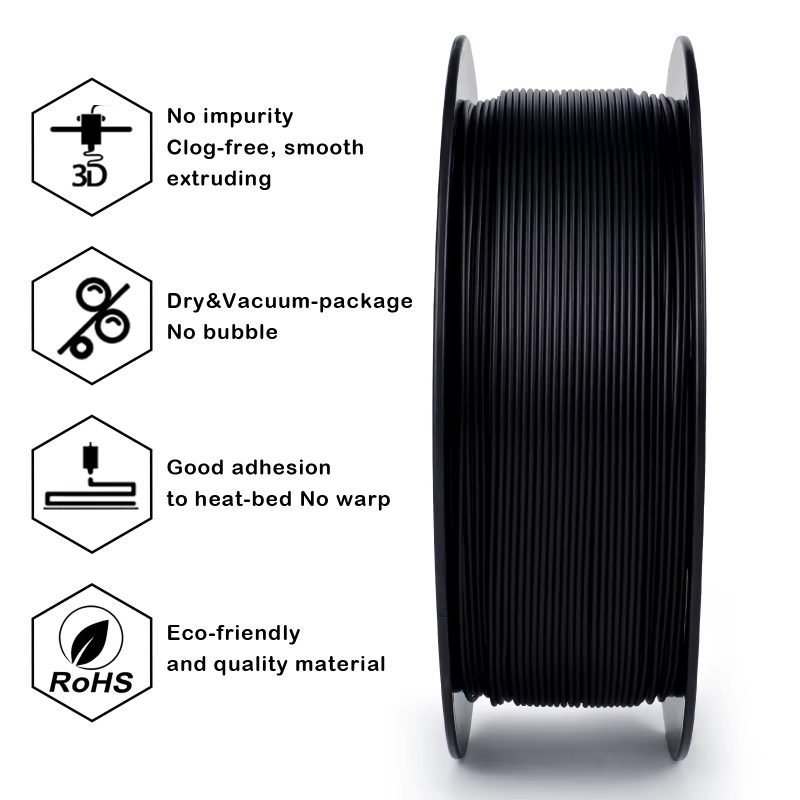
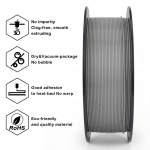
| Bubbles in Filament | 100% bubble-free (vacuum extrusion) |
| Required Nozzle | Standard 0.4 mm brass (no hardened nozzle required) |
| Enclosure | Not required — open-frame printing preferred for cooling |
| Post-Processing | Sands and primes exceptionally well — neutral gray is an ideal primer-ready base coat |
| Drying Temperature | 45 °C for 4–6 hours (only after extended open-air exposure) |
| Compliance | RoHS / REACH compliant, biodegradable PLA |
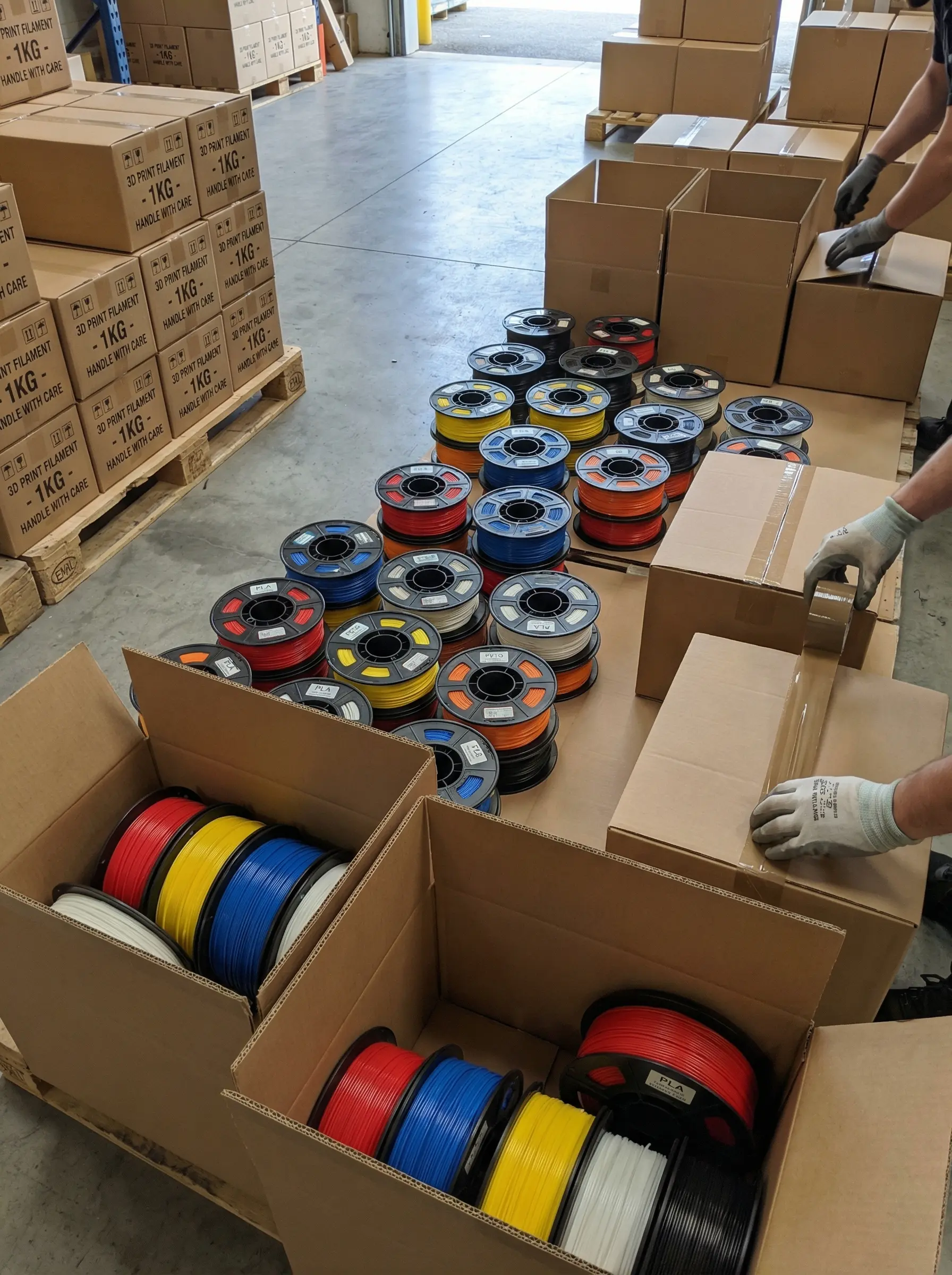
| Packaging | Vacuum-sealed bag with desiccant, individual carton box |
| Manufacturing Origin | Guangdong, China |
| Free Sample | Available for qualified business customers |
| OEM/ODM | Available — Learn about our OEM services |
Material Properties & Performance
Mechanically, this gray high speed PLA filament delivers the stiffness and detail fidelity PLA is known for—the high-flow modification changes how the melt behaves in the hotend, not what the solidified part is. Printed parts are rigid, dimensionally stable, and hold crisp edges, which is exactly what fit-check and form-validation prototypes need: a screw boss that doesn’t flex during a test-fit tells you more than a tougher but bendier material would. For a broader view of how PLA ranks against engineering polymers, see our strongest 3D printer filament guide.
Mechanical & Thermal Properties (typical PLA values)
| Property | Typical Value | Test Standard |
|---|---|---|
| Tensile Strength | 50–60 MPa | ISO 527 / ASTM D638 |
| Flexural Modulus | 2,300–2,800 MPa | ISO 178 / ASTM D790 |
| Flexural Strength | 75–90 MPa | ISO 178 / ASTM D790 |
| Impact Strength (Izod, Notched) | 3–5 kJ/m² | ISO 180 / ASTM D256 |
| Elongation at Break | 5–8% | ISO 527 / ASTM D638 |
| Glass Transition Temperature | ~60 °C (140 °F) | ISO 11357 |
| Heat Deflection Temperature | ~55 °C (0.45 MPa) | ISO 75 / ASTM D648 |
| Density | 1.24 g/cm³ | ISO 1183 |
| Shrinkage | 0.3–0.5% (low) | ISO 294-4 |
| Biodegradability | Industrial compostable | ASTM D6400 / EN 13432 |
Printer-Specific Settings for Gray High Speed PLA
| Printer | Nozzle | Bed | Speed | Notes |
|---|---|---|---|---|
| Bambu Lab X1C / P1S | 225 °C | 55 °C | 300–500 mm/s | Start from the high-speed PLA preset; aux fan on for drafts above 400 mm/s |
| Creality K1 / K1 Max | 225 °C | 55 °C | 300–600 mm/s | Hyper-PLA-class profile works directly; keep side fan running on large flat parts |
| Voron 2.4 / Trident | 225 °C | 55 °C | 300–600 mm/s | With a high-flow hotend and tuned pressure advance this filament reaches its full ceiling |
| Prusa MK4 / MK4S | 220 °C | 55 °C | 200–300 mm/s | Input-shaper SPEED profile; drop to 210 °C / 120 mm/s for review-quality models |
| Creality Ender 3 / S1 | 205 °C | 50 °C | 60–100 mm/s | Standard PLA profile; the wide flow window makes this unusually forgiving on stock hotends |
| Anycubic Kobra 2 / 3 | 215 °C | 55 °C | 150–250 mm/s | Default fast profile is fine; calibrate flow once and the matte gray will show a uniform top surface |
Applications for Gray High Speed PLA Filament
This gray high speed PLA filament is built for the work that happens between CAD and production. Below are the applications where the combination of neutral gray and 600mm/s throughput earns its place on the rack.
| 📐 Fit-Check & Tolerance Prototypes | Enclosures, brackets, snap-fit housings, and mounting plates printed at draft speed answer the only question that matters early: does it assemble? The rigid PLA holds hole diameters and slot widths faithfully, and the neutral gray makes gaps and misalignments visually obvious against mating parts. |
| 🖐️ Form & Ergonomics Studies | Handles, grips, remotes, wearables, and consumer-product shells evaluated in the hand before tooling is cut. The CAD-matching gray keeps the evaluation about proportion and feel—reviewers respond to the shape, not to an arbitrary plastic color that won’t exist in production. |
| 📸 Photography & Pitch Mockups | Pre-launch product shots, crowdfunding page mockups, and investor-deck hero images need parts that photograph cleanly. Neutral matte gray holds detail under studio light, casts no color onto the scene, and looks deliberate next to aluminum and glass props—no repainting required. |
| 🔧 Jigs, Fixtures & Shop Organization | Drill guides, alignment jigs, soldering fixtures, tool holders, and bin systems for indoor benches. Gray hides workshop grime better than white, keeps a uniform professional look across the shop, and the 600mm/s ceiling means replacing a broken fixture costs minutes, not an afternoon. |
| 🏛️ Architectural & Scale Models | Massing studies, site models, and concept maquettes have used neutral gray as the professional standard for decades—it reads as “study model,” lets light and shadow define the forms, and unifies components printed across multiple machines. High-speed drafts make same-week client presentations realistic. |
| 🏭 Print-Farm Draft Production | Service bureaus running fleets of CoreXY machines can standardize on one gray SKU for customer drafts, internal tooling, and primer-ready parts destined for painting. High throughput per machine plus batch-consistent color means quotes get tighter and reprints get rarer. |
Environmental & Safety Standards
| 🌱 Plant-Based PLA | Derived from renewable feedstock rather than petroleum. Biodegradable and industrial compostable per ASTM D6400 / EN 13432. |
| ✅ RoHS / REACH Compliant | Free of lead, mercury, cadmium, hexavalent chromium, and other restricted substances. Suitable for EU and global markets. |
| 🏭 ISO 9001 Manufacturing | Produced under certified quality management—diameter, pigment consistency, and winding quality verified per batch. |
| 📦 Vacuum Sealed + Desiccant | 100% bubble-free vacuum extrusion plus moisture-proof packaging, so high-speed flow behavior is consistent straight out of the box. |
Packaging & Global Shipping
| Destination | Standard Delivery | Express Available |
|---|---|---|
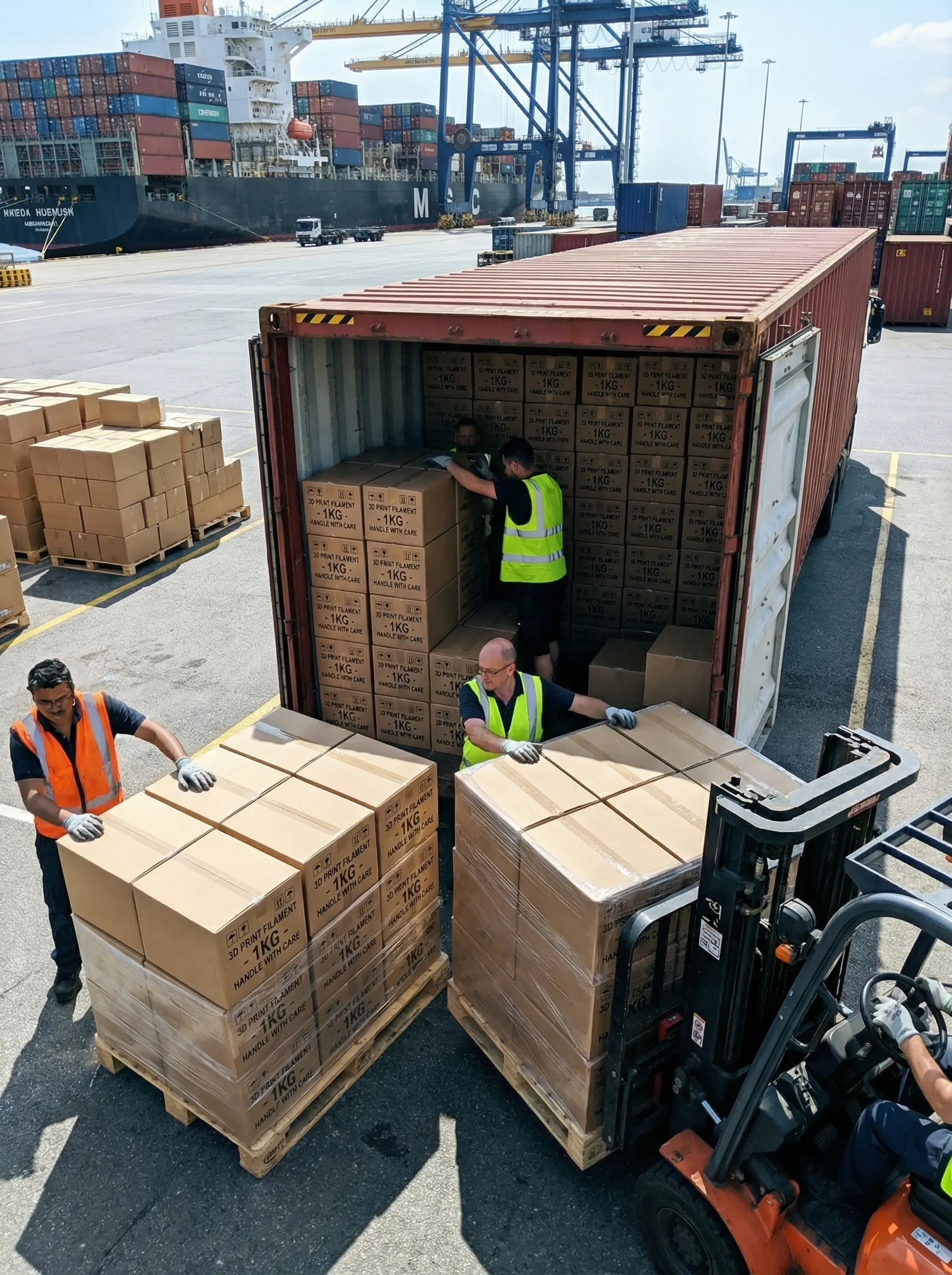
| European Union | 5–10 business days | ✓ 3–5 days |
| United States | 7–12 business days | ✓ 4–6 days |
| United Kingdom | 7–12 business days | ✓ 4–6 days |
| Canada | 8–14 business days | ✓ 5–7 days |
Packaging: Vacuum-sealed bag with desiccant, individual carton box. Customs: DDP and DAP terms available.
Bulk Orders & OEM/ODM Services
| 📊 Flexible MOQ | Trial orders through container volume. Free evaluation samples for qualified business customers—test the 600mm/s claim on your own machines before committing. |
| 💰 Volume Pricing | Tier breakpoints at 100kg+, 500kg+, and 1000kg+ with progressive discounts—structured for print farms and distributors who burn through draft material weekly. |
| 🎨 Custom Grays (OEM/ODM) | • Custom gray tones from light silver to graphite (Pantone / RAL matching) • Brand-matched neutrals for corporate prototyping standards • Private label packaging and co-branded boxes • Custom spool sizes (0.5 kg, 2 kg, 3 kg, 5 kg) |
| 🎁 Free Sample Program | Evaluation samples available for qualified business customers. Verify flow stability, color consistency, and packaging quality before volume orders. |
Storage & Handling Guidelines
| Storage Guidelines | |
|---|---|
| Temperature | 15–25 °C (59–77 °F) |
| Humidity | Below 50% RH (PLA is mildly hygroscopic; moisture shows up first as stringing at high speed) |
| Shelf Life | 24 months (unopened, vacuum sealed) |
| Drying (if needed) | 45 °C for 4–6 hours after extended open-air exposure |
| Light Exposure | Avoid prolonged direct sunlight in storage |
| Handling | Keep the strand under tension when unloading—a loose loop that slips under adjacent windings will stop a 600mm/s print far more abruptly than a slow one |
Printer Compatibility
This gray high speed PLA filament works with any 1.75mm FDM/FFF 3D printer—the 600mm/s ceiling is there for CoreXY speed machines, but the wide 190–230°C window and forgiving flow behavior make it equally comfortable on stock bed-slingers running at everyday speeds.
| Bambu Lab X1C, P1S, A1, A1 mini | Creality K1, K1 Max, Ender 3 series | Prusa MK4, MK4S, MINI+, XL | Voron 2.4, Trident, 0.2 | Anycubic Kobra 2, Kobra 3 | Elegoo / QIDI Neptune 4, Q1 Pro, X-Max 3 |
Why Choose SigmaFilament for High Speed PLA
| 🏭 Direct Manufacturer | Factory-direct pricing from Guangdong, China with full control over compounding, extrusion, winding, and packaging—no reseller layers between the line and your printer. |
| ⚡ High-Speed Specialists | A dedicated high-speed PLA range within a full high-speed series (PLA, PETG, ABS), formulated specifically for the flow rates modern CoreXY printers demand. |
| ✅ Quality Assured | ±0.03mm tolerance, ISO 9001 manufacturing, RoHS/REACH compliance, and batch-controlled gray pigmentation for reorder consistency. |
| 🌍 Global Service | English-speaking support, EU/US business hours, DDP/DAP shipping terms for hassle-free import. |
| 🔧 Full OEM/ODM | Custom gray tones, Pantone/RAL matching, private label, and custom spool sizes—build a house-brand prototyping filament on our line. |
Frequently Asked Questions About Gray High Speed PLA Filament
Ready to Shorten Your Prototype Loop?
Contact SigmaFilament today for bulk pricing, free samples, or to discuss your OEM/ODM requirements—including custom gray tones, Pantone/RAL matching, and private label packaging for high speed PLA.
📧 Email us for a quick quote · 🌍 Worldwide shipping with DDP/DAP terms · 🎁 Free samples for qualified customers
| Filament Diameter | 1.75mm ,2.85mm (3.00mm) |
|---|---|
| Spool Weight | 1kg ,3kg ,5kg ,Sample (200g) |