

Types of filament: the complete 2026 material guide


Key Takeaways
- Six material families cover almost all FDM printing: PLA, PETG, ABS/ASA, nylon, flexible TPU, and high-performance PC and PEEK/PEI.
- PLA prints easiest at ~190-220C with no enclosure; ABS and ASA need ~220-260C and an enclosed chamber.
- PETG balances strength and ease, resisting moisture and moderate heat where PLA softens and warps.
- Carbon-fiber and glass-filled grades add stiffness and heat resistance but require a hardened steel nozzle.
- Nylon, PC and PEEK/PEI handle functional and high-temperature parts but demand drying and high chamber heat.
- For resale the demand core is PLA, PETG and ABS; specialty and composite grades are higher-margin add-ons.
Table of Contents
- Key Takeaways
- Table of Contents
- Abstract
- What counts as a type? The 6 filament families at a glance
- The filament property matrix: temperatures, strength and heat resistance
- The everyday materials: PLA, PETG, ABS and ASA
- Engineering and high-performance filaments: nylon, PC, PEEK and PEI
- Flexible and composite filaments: TPU, carbon fiber and filled grades
- Support materials: PVA, HIPS and BVOH
- How to choose: a decision matrix by application
- What to stock: a bulk filament mix for resellers and print farms
- Frequently asked questions
- Conclusion
- References
Abstract
The types of filament used in fused-deposition 3D printing sort into six material families: PLA, PETG, ABS and its weatherable cousin ASA, nylon, flexible TPU, and the high-performance group of PC, PEEK and PEI. Each family occupies a different point on four axes that rarely move together, namely printability, mechanical strength, heat resistance, and cost per kilogram. PLA prints easily and costs little but softens near 60 degrees Celsius. PEEK survives autoclave temperatures yet demands a 400-degree hotend and a heated chamber. The right pick depends on the part, not on a single ranking. This guide settles those tradeoffs with published datasheet figures rather than qualitative marketing claims.
The audience here is broad: makers choosing a first roll, design engineers specifying production parts, and resellers or print-farm buyers planning what to stock in bulk. The structure follows the same path. A families-at-a-glance overview opens it, followed by a numeric property matrix, then per-family deep dives, a section on carbon and glass composites plus support materials, a decision matrix organized by application, and bulk-stocking guidance for procurement teams.
What counts as a type? The 6 filament families at a glance
A filament "type" is a base polymer family, not a brand or a color. PLA, PETG and nylon are types. Within each type sit variants and blends that tune one property without changing the underlying chemistry. PLA+ toughens standard PLA, silk and matte PLA alter only the surface, and PETG-CF adds chopped carbon fiber for stiffness. So the dozens of spools on a supplier shelf collapse into a short list of base resins, each with a predictable thermal and mechanical signature. Sorting the types of filament this way is the fastest route to a sound material choice.

Six families cover almost every fused-deposition job. The table below states the practical print range and the single trait that defines each one.
| Family | Common examples | Print temp (C) | Key strength | Main weakness | Typical use |
|---|---|---|---|---|---|
| PLA | PLA, PLA+, silk, matte | 190-220 | easiest to print, rigid | low heat resistance (~60 C) | prototypes, models, display |
| PETG | PETG, PETG-CF | 230-250 | tough, water and chemical resistant | stringing | functional parts, enclosures |
| ABS / ASA | ABS, ASA | 220-260 | heat and impact resistant, ASA is UV-stable | warps, needs enclosure | automotive, outdoor (ASA) |
| Nylon (PA) | PA6, PA12, PA-CF | 250-270 | tough, abrasion and chemical resistant | very hygroscopic | gears, living hinges, industrial |
| Flexible (TPU/TPE) | TPU, TPE | 215-240 | rubber-like, elastic | slow, hard to print | seals, gaskets, grips |
| High-performance (PC, PEEK, PEI) | PC, PEEK, PEI/ULTEM | 260-400 | extreme heat and strength | demanding hardware | aerospace, medical, under-hood |
Read the table top to bottom and the difficulty curve is clear. PLA and PETG run on an open-frame printer with no chamber heating (Simplify3D, n.d.). ABS, ASA, nylon and the high-performance group warp as they cool, so each wants an enclosure and, for nylon, a drying step before the spool ever loads (Simplify3D, n.d.). The flexible row sits apart. TPU is easy on temperature yet slow to feed, because a soft elastomer buckles under fast retraction (Simplify3D, n.d.).
Heat resistance is the axis that separates the families most sharply. Standard PLA loses rigidity once a part passes roughly 60 C (NatureWorks, 2017), which rules it out for a car dashboard or a sunlit fixture. ASA holds its shape and its color outdoors, the reason it displaced ABS for signage and exterior trim (Simplify3D, n.d.). At the far end, PEEK keeps working past 240 C in continuous service (Weerg, n.d.), but that performance costs a 400 C hotend and an industrial toolchain few desktop machines carry.
The high-performance family spans the widest print range in the table, from PC at the low boundary to PEEK and PEI near 400 C, which is why the column reads 260-400 rather than a tighter band. Treat the printed numbers as representative ranges; specimen geometry, print orientation, and post-processing all shift the published figure for a given grade.
Across vendor datasheets, the standard families cluster in print temperature: PLA at 190-220 C and PETG at 230-260 C, while ABS commonly lists 220-250 C (Simplify3D, n.d.). The high-performance group separates by more than 180 C, with PEEK rated for a 360-420 C nozzle, a gap that dictates entirely different hardware.
The filament property matrix: temperatures, strength and heat resistance
Most comparison guides rate filament with filled-in dots: three for strength, four for ease, two for heat. Dots cannot be measured, sorted, or designed against. A 40 MPa part and a 100 MPa part both earn "high," yet one survives a load the other snaps under. The table below replaces every dot with a number pulled from manufacturer datasheets and published community tests, so a buyer can match a real spec to a real requirement. Read it by column when you have one hard constraint (a 250-degree-Celsius hotend ceiling, a part that must flex, a bed that tops out at 60 degrees) and by row when you already know the material and need its full envelope. Values are representative ranges, not absolutes, because specimen geometry, print orientation, and post-processing all shift the result (Tunçel, 2024).
Filament property matrix. Print and bed temperatures in degrees Celsius; tensile strength in MPa; heat resistance as heat-deflection temperature or continuous-service temperature.
| Material | Print temp (C) | Bed temp (C) | Tensile strength (MPa) | Elongation (%) | Heat resistance / HDT (C) | Ease (1-5) | Enclosure | Hardened nozzle |
|---|---|---|---|---|---|---|---|---|
| PLA | 190-220 | 40-60 | 28-60 | 3-6 | 55-65 | 5 | No | No |
| PLA+ | 200-225 | 45-60 | 45-65 | 5-15 | 55-65 | 5 | No | No |
| PETG | 230-260 | 65-85 | 40-50 | 100-130 | 62-70 | 4 | No | No |
| ABS | 220-250 | 90-110 | 35-40 | 12-17 | varies by grade | 3 | Yes | No |
| ASA | 220-250 | 90-110 | varies by grade | 10-20 | 86-106 | 3 | Yes | No |
| Nylon (PA) | 250-290 | 70-110 | 48-83 | 6-50 | 135-175 | 2 | Yes | Filled grades |
| PC | 260-310 | 80-120 | 50-68 | 5-100 | ~110-140 (service) | 2 | Yes | No |
| TPU | 215-240 | 30-75 | 23-37 | very high (rubber-like) | ~78 | 3 | No | No |
| PA-CF | 260-300 | 70-110 | 71-100 | low-moderate | high (above base PA) | 2 | Yes | Yes |
| PEEK | 360-420 | 120-160 | 80-105 | 25-30 | 240-260 | 1 | Yes | No |
| PEI (ULTEM 9085) | 350-380 | 120-160 | 70-105 | varies by grade | 170-217 | 1 | Yes | No |
"Strongest" is not one number. Rank by tensile and PEEK and PA-CF lead near 100 MPa (Weerg, n.d.). Rank by elongation, the proxy for toughness, and the rubber-like TPU wins outright while the rigid high-performance grades sit at the other end. Rank by heat and PEEK clears 240 degrees Celsius while PLA fails at 60 (Weerg, n.d.). A dot chart collapses these three axes into one bar and hides the tradeoff that actually decides a build.
The ease column compresses what the temperatures imply. A 5 prints open-frame on a stock brass nozzle. A 1 needs a heated chamber, a hardened or all-metal hotend, and filament dried before every run. Enclosure and hardened-nozzle flags carry their own cost: ABS, ASA, PC and every high-performance polymer warp without chamber heat (Simplify3D, n.d.), and any carbon-filled grade abrades brass within a few spools.
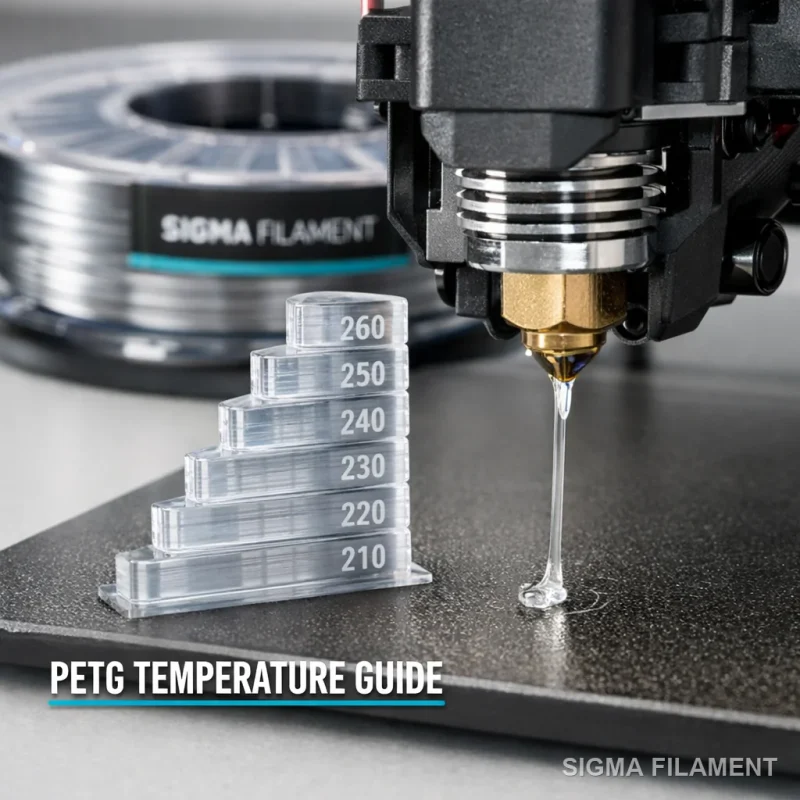
PETG temperatures run 230 to 260 degrees Celsius at the nozzle with elongation at break of 100 to 130 percent, which is why it tolerates impact that snaps brittle PLA. Nylon and the high-performance group share one trap absent from the table: they are hygroscopic, readily absorbing moisture from the air, so dry them before printing and store them sealed with desiccant, or stringing and weak layers follow (Simplify3D, n.d.).
The everyday materials: PLA, PETG, ABS and ASA
Four standard polymers cover the bulk of day-to-day printing and the bulk of any reseller’s volume. They share a defining trait: a modest heat ceiling compared with the engineering polymers; PETG copolyester, for example, deflects at about 70 C under a light load (Eastman Chemical Company, n.d.). What separates them is print difficulty and toughness, plus where the finished part will live.
PLA and PLA+
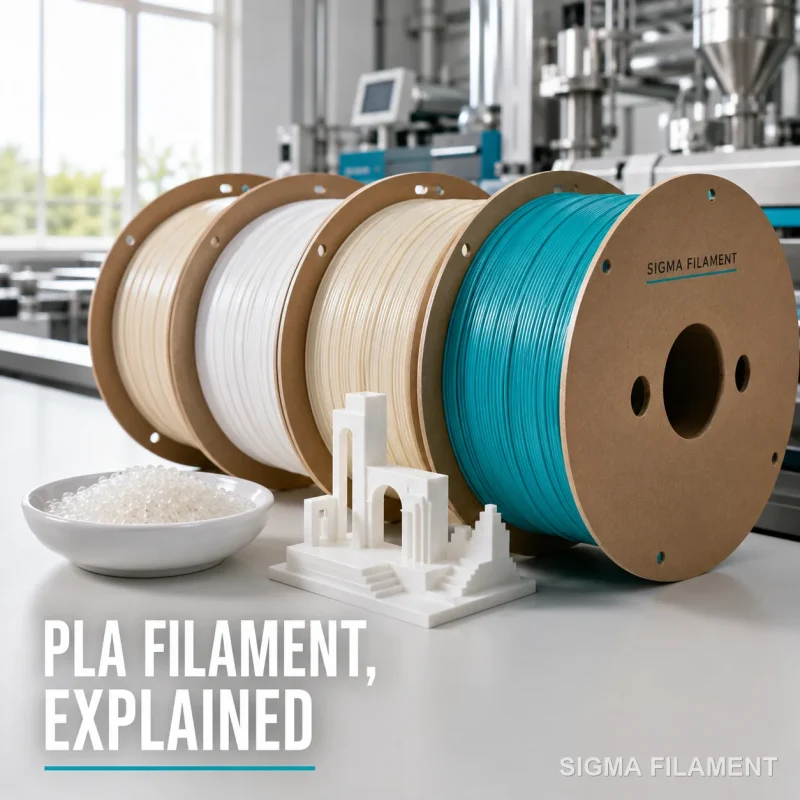
PLA is the entry point for nearly every printer. It runs at a low nozzle temperature of 190 to 220 C on a 40 to 60 C bed, needs no enclosure, and warps very little because it barely shrinks as it cools (NatureWorks, 2017). Derived from plant starch rather than petroleum, it prints clean and holds fine detail, which makes it the default for prototypes, display models, and miniatures. The trade-off is heat: a PLA part begins to soften above 60 C, so it has no business in a hot car or near a motor (NatureWorks, 2017). Standard PLA is also rigid to the point of brittleness, with elongation around 3 to 6 percent (NatureWorks, 2017).
PLA+ answers that brittleness. By blending in toughening modifiers, manufacturers lift impact resistance and push tensile strength into the 45 to 65 MPa range while keeping the same easy print profile (NatureWorks, 2017). For functional-light parts that still see room-temperature service, PLA+ is the smarter default. Because both grades print on the same easy profile, they are also the workhorse of any bulk PLA inventory, sold in standard and PLA+ formulations across dozens of colors.
PETG
PETG sits one rung up. It prints hotter, at 230 to 250 C on a heated bed, and rewards the extra heat with good impact resistance plus resistance to water and many chemicals (Simplify3D, n.d.). Elongation at break runs 100 to 130 percent in molded-bar tests of PETG copolyester, so parts bend before they snap (Eastman Chemical Company, n.d.). Select PETG resin grades are food-contact compliant and meet ISO 10993 and/or USP Class VI biocompatibility requirements (Eastman Chemical Company, n.d.), though a printed part still needs cleaning and post-processing to qualify. The two quirks worth planning for: PETG strings between travel moves, and it absorbs enough moisture that drying before a long job pays off. It is the workhorse for functional parts, brackets and enclosures.
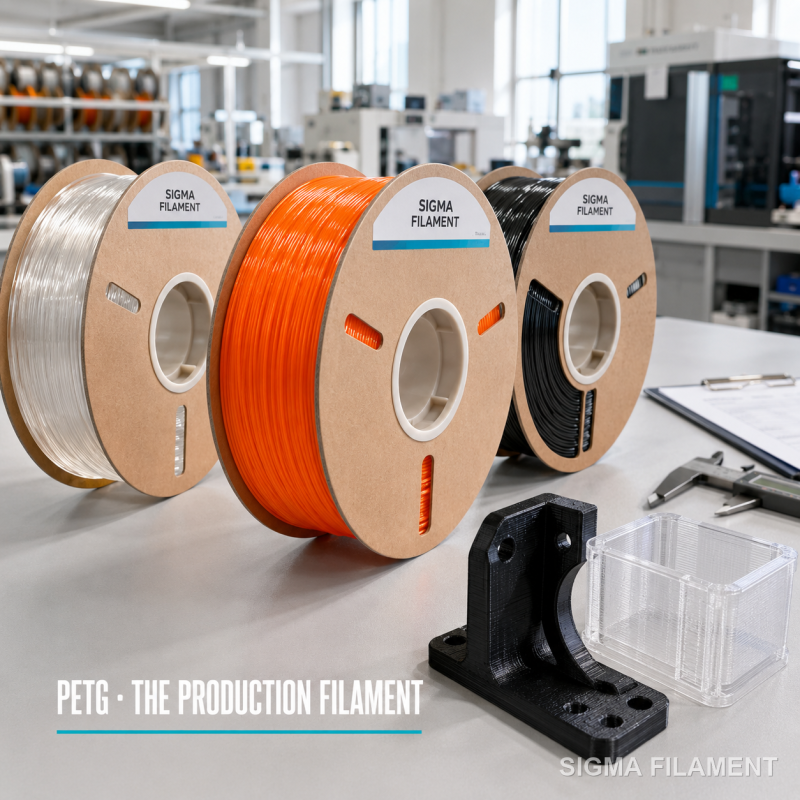
PETG is also where the standard family earns most of its functional-part reputation, a useful anchor when explaining types of filament to a buyer who only knows PLA. That functional reputation is why wholesale PETG ships in toughened, clear, high-speed and carbon-fiber variants for production work, not just prototyping.
ABS and ASA
ABS and ASA close out the standard tier with higher heat and impact resistance, printing at roughly 220 to 250 C on a 90 to 110 C bed, with an enclosure recommended for ABS because it shrinks and warps as it cools (Simplify3D, n.d.); both want ventilation. ABS holds up to warmer service than PLA and can be vapor-smoothed with acetone for a glossy finish.
ASA is best understood as ABS’s weatherable cousin. Its mechanical behavior is close to ABS, but it resists UV and harsh weather, which is why it is the pick for outdoor signage, automotive trim, and exterior housings (Simplify3D, n.d.). If a part will sit in sunlight, choose ASA; if it stays indoors, plain ABS does the same job for less.
A standard PLA part begins to soften above 60 C (NatureWorks, 2017), while ASA and ABS hold their shape at warmer service temperatures and ASA adds UV and weather resistance (Simplify3D, n.d.). That single threshold, ambient versus heat-and-weather, drives most everyday material choices.
Engineering and high-performance filaments: nylon, PC, PEEK and PEI
Above the standard tier sit the filament grades built for parts that do work rather than sit on a shelf. Engineering materials push the heat ceiling past 100 C and trade easy printing for mechanical performance, the kind of strength a load-bearing bracket or a part near a motor actually needs. The high-performance polymers go further still, into territory that needs an industrial machine and a fat budget. Every material below shares two demands: it must be dried before it prints, and most want an enclosed, heated chamber to stop the part curling off the bed.
Nylon (PA) and PA blends
Nylon, sold as PA6, PA12 and carbon-filled PA-CF, is the toughest of the common engineering plastics. It resists abrasion, fatigue and most solvents, and it has a low coefficient of friction, which is why it is the default for gears, bushings and living hinges that flex thousands of cycles without cracking (Simplify3D, n.d.). Tensile strength runs from roughly 48 to 83 MPa depending on grade, and carbon-fiber PA-CF has been community-tested near 71.6 MPa with a large stiffness gain (Tunçel, 2024). Nylon’s one real weakness is water. It is among the most hygroscopic types of filament on the market, so dry it for a few hours before use and keep it in a sealed dry box with desiccant while it prints, or the print bubbles and turns weak (Simplify3D, n.d.). Plan on a nozzle around 250 to 290 C, an enclosure, and a hardened nozzle for the filled grades.
Polycarbonate (PC)
Polycarbonate is the impact and heat specialist. It prints at roughly 260 to 310 C on an 80 to 120 C bed, and an enclosure is required (Simplify3D, n.d.). In return it delivers very high heat deflection and impact resistance, and the polymer is naturally transparent (Simplify3D, n.d.). That combination suits load-bearing brackets, parts mounted near heat sources, and clear functional housings. PC absorbs moisture from the air as well, so the same drying discipline as nylon applies.
PEEK and PEI (ULTEM)
At the top sit the high-performance polymers, and the practical question is almost always PEEK versus PEI. PEEK is the ceiling: a nozzle of 360 to 420 C, a heated chamber, continuous service around 240 to 260 C, and a UL94 V0 flame rating, which is why it shows up in aerospace, medical and oil and gas hardware (Weerg, n.d.). PEI, sold as ULTEM 9085, prints cooler at roughly 350 to 380 C and costs noticeably less, while still carrying a UL94 V0 rating and a glass transition near 186 to 217 C (Weerg, n.d.). The honest trade is this: PEI is more printable and cheaper with a lower performance ceiling than PEEK, so most flame-rated structural work runs PEI, and only the most extreme thermal or chemical jobs justify PEEK.
PEEK needs a very hot nozzle and a heated chamber and keeps working past 240 C in continuous service (Weerg, n.d.), while PEI (ULTEM 9085) prints somewhat cooler and costs less, with a lower ceiling of about 170 C in continuous service (Weerg, n.d.), which makes it the usual choice for flame-rated structural parts.
Flexible and composite filaments: TPU, carbon fiber and filled grades
Two families sit outside the standard rigid plastics. Flexible elastomers bend and rebound; composites add a fiber or powder to a base resin to change how it behaves. Both reward a printer set up for the job, and both show up often in a reseller’s catalog of filament types.

Flexible: TPU and TPE
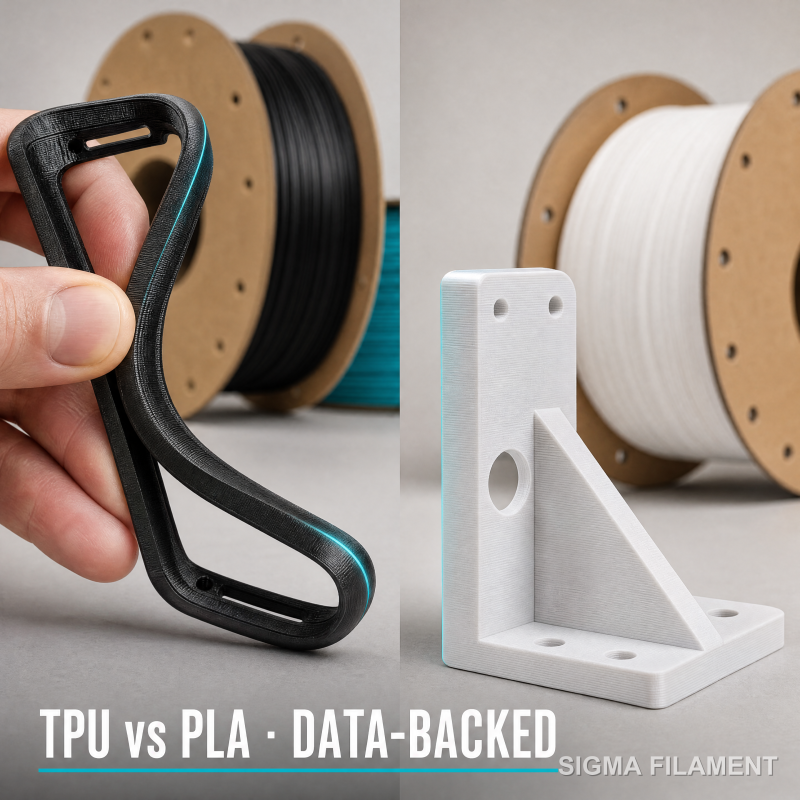
TPU and TPE are rubber-like thermoplastics graded by Shore hardness, where a lower A number means a softer part. Check the Shore A rating on the label before you buy. A 95A grade feeds more predictably; an 85A grade flexes further but fights the extruder.
Print these slow and warm. A nozzle temperature from the spool label, with low retraction, handles the soft polymer, and flexible grades stretch a long way before they break. The feed path matters more than the temperature. A direct-drive extruder pushes the filament a short distance into the hotzone, while a Bowden setup lets the elastic strand buckle and jam. A harder 95A grade is the safer pick for reliable feeding on a constrained feeder. Typical work includes seals, gaskets, grips, hinges and protective phone cases.
Composite and filled grades
Composites blend short chopped fiber or fine powder into a familiar base such as PLA, PETG or nylon. The additive changes stiffness, finish or weight rather than turning the polymer into a new material class. The base still sets the print temperature and the heat resistance, so a PLA-CF part still softens near 60 C and a nylon-based PA-CF still needs drying before it runs cleanly.
| Composite | Base + fill | What the fiber or fill changes | Nozzle needed | Best for |
|---|---|---|---|---|
| PLA-CF | PLA + carbon fiber | Stiffer, matte finish, less warp | Hardened | Jigs, fixtures, cosmetic parts |
| PETG-CF | PETG + carbon fiber | Added rigidity, matte, low warp | Hardened | Brackets, semi-structural parts |
| PA-CF | Nylon + carbon fiber | Strong, stiff, raised heat resistance | Hardened | Functional and end-use parts |
| Glass-filled (GF) | Resin + glass fiber | Higher stiffness and heat resistance | Hardened | Load-paths needing rigidity |
| Wood-fill | PLA + wood particles | Aesthetic grain, sandable surface | Brass or hardened | Decorative models |
| Metal-fill | PLA + metal powder | Real weight and metallic look | Hardened | Display and prop pieces |
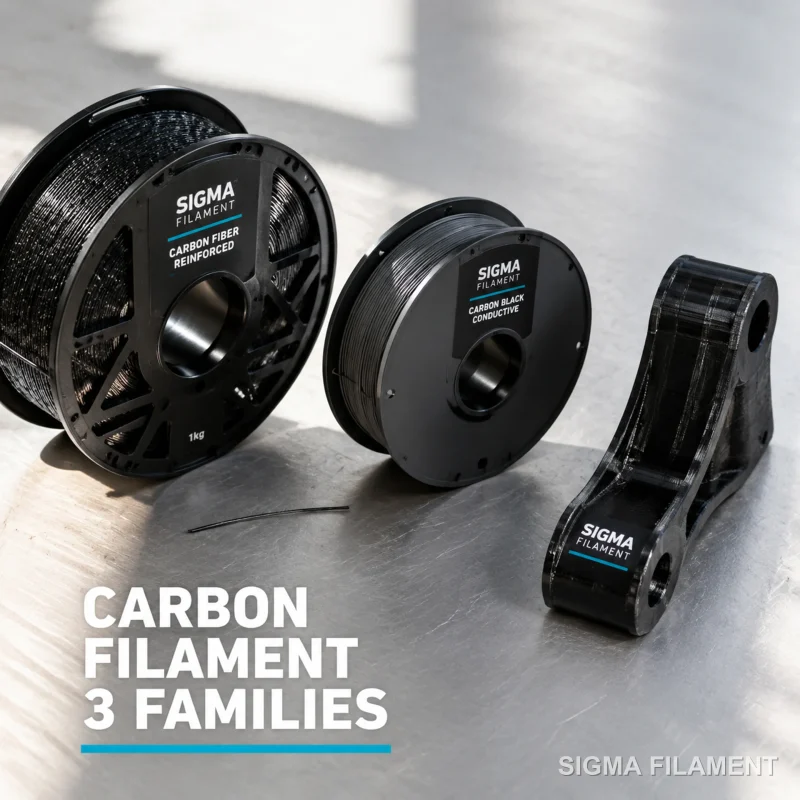
A common misconception is that carbon fiber makes a part stronger. The fiber raises modulus, the resistance to bending, and improves dimensional stability, but tensile strength often holds steady or drops. PLA-CF runs about 30% stiffer than plain PLA at roughly 44 to 49 MPa tensile, with weaker layer adhesion (Tunçel, 2024). Many fills trade a stiffer, more rigid part for a more brittle one.
Abrasive fills wear soft brass fast. Carbon fiber, glass and metal powders all demand a hardened steel or ruby nozzle, usually 0.4 mm or wider, since the particles grind a standard tip open within a few spools (Simplify3D, n.d.). A worn nozzle drifts off dimensional spec long before it stops extruding, which is why QC-conscious print farms treat hardened nozzles as a consumable, not an upgrade.
Support materials: PVA, HIPS and BVOH
Support filament is the one category among the types of filament that never ends up in the finished part. It prints from a second extruder to hold up overhangs and bridges, then washes or peels away, leaving clean surfaces that breakaway support cannot match. Three materials dominate the soluble class.
Soluble supports
The split that confuses most buyers is PVA versus HIPS, and it comes down to solvent and partner material. PVA (polyvinyl alcohol) dissolves in plain water and pairs with PLA, PETG and nylon, which makes it the default soluble support for low-temperature prints (3D Platform, n.d.). HIPS (high-impact polystyrene) does not dissolve in water at all; it dissolves in d-limonene and is the standard partner for ABS, since both print in the same temperature window inside an enclosure (3D Platform, n.d.). HIPS also doubles as a light structural material in its own right, so a spool serves two purposes.
BVOH (butenediol vinyl alcohol) is the third option. Like PVA it is water-soluble, but it dissolves faster and more cleanly, tolerates a wider band of partner materials including nylon, and forgives imperfect print settings. It costs more per kilogram, which is the trade you accept for the easier release (3D Platform, n.d.). For complex internal geometry where a support has to vanish without scrubbing, that extra cost usually pays for itself in finishing time.
| Material | Dissolves in | Pairs with | Notes |
|---|---|---|---|
| PVA | Water | PLA, PETG | Very hygroscopic, must stay dry; clean dissolve |
| HIPS | Limonene (d-limonene) | ABS | Also a light structural material; not water-soluble |
| BVOH | Water | PLA, PETG, nylon | Dissolves faster than PVA, more forgiving, pricier |
When to use which
Match the support to the model material. Printing PLA or PETG and want water cleanup, reach for PVA or, for tricky geometry, BVOH. Printing ABS in an enclosure, HIPS is the only sensible pick because water-soluble supports cannot survive the chamber heat that ABS demands.
PVA and BVOH are both severely hygroscopic and must be dried at roughly 65 C and stored with desiccant; a wet spool oozes, strings and fails to bond, wasting the whole second extruder (3D Platform, n.d.). HIPS is far more tolerant of ambient humidity, one more reason it stays paired with ABS.
How to choose: a decision matrix by application
The fastest way to pick a material is to stop picking a material. Start with the part. Write down what the finished piece has to survive: a load, a temperature, sunlight, a chemical, a press-fit, a flex cycle. Each of those requirements maps cleanly to one or two polymer families, and the mapping rarely changes between projects. A bracket that carries weight needs toughness and fatigue resistance, so the answer is PETG, nylon, or a carbon-filled grade, never PLA, regardless of color or price (Simplify3D, n.d.). A part that lives outdoors needs UV stability, which points at ASA, a material made to resist UV and harsh weather (Simplify3D, n.d.). Reverse the order and you end up rationalizing a spool you already own.

Match the part to the material
Three constraints decide most builds: mechanical demand, environment and contact. Mechanical demand splits prototyping (cheap, dimensionally accurate, low stress) from functional service (impact, fatigue, sustained load). Environment covers heat, UV and weather. Contact covers food, skin and chemicals. Run the part through those three filters in order and the candidate list usually drops to one or two materials before you ever open a price page. Only then do the secondary questions matter: does it warp enough to need an enclosure, does the fill abrade a brass nozzle, does the polymer absorb moisture and need drying first.
The decision matrix
The grid below collapses the common requirements into a starting recommendation. Treat the right column as the reason, not a footnote, because the reason is what survives when a new variant lands next year.
Filament decision matrix by application.
| Application / requirement | Recommended material(s) | Why |
|---|---|---|
| Prototyping / visual models | PLA, PLA+ | Cheap, easy, low warp, dimensionally accurate (NatureWorks, 2017) |
| Functional / load-bearing | PETG, nylon, PA-CF | Toughness plus fatigue resistance (Simplify3D, n.d.) |
| Outdoor / UV exposure | ASA | UV and weather resistance (Simplify3D, n.d.) |
| Flexible parts | TPU | Rubber-like elasticity, high elongation |
| High heat / under-hood | PC, nylon, PEEK or PEI | High heat-deflection temperature (Weerg, n.d.) |
| Food contact | PETG (food-grade) | Food-contact compliant resin grades (Eastman Chemical Company, n.d.) |
| Miniatures / fine detail | PLA, resin alternative | Crisp edges, sharp detail (NatureWorks, 2017) |
| Chemical exposure | Nylon, PETG | Solvent and chemical resistance (Simplify3D, n.d.) |
Two cells deserve a caveat. Food contact depends on a compliant grade and on print hygiene, since FDM parts with their layer lines, pores and cracks are hard to clean no matter how safe the polymer is. And under-hood heat is a spectrum: PC handles roughly 110 to 140 C of service, while PEEK and PEI reach past 170 C at a hardware cost most shops cannot justify (Weerg, n.d.). Across these eight types of filament, requirement-first selection lands the right material on the first attempt far more often than browsing by brand.
A PLA part begins to soften above 60 C (NatureWorks, 2017), yet most hobby prints never approach that line, which is why PLA and PLA+ remain the correct default for prototyping and display work despite their low heat ceiling. Match the requirement, not the reputation.
What to stock: a bulk filament mix for resellers and print farms
Most buying guides rank the types of filament by what prints well. A reseller or print farm has a different question: what moves off the shelf, and what protects margin. Those two answers rarely point at the same material, which is why a stocking plan weighted to printability alone tends to tie up cash in spools that turn slowly.
The mix below sorts a catalog into three tiers by the role each material plays in the business, not by its datasheet.
The demand core
PLA, PLA+ and PETG carry the unit volume. PLA remains the most widely printed material across consumer and prototyping work (Tunçel, 2024), and PETG is the standard choice when a part needs moisture and chemical resistance without an enclosure (Tunçel, 2024). ABS and ASA sit just behind, steady sellers to customers running enclosed printers.
At volume, two specs matter more than color. Tight diameter tolerance keeps high-throughput farms from clogging and failing prints, and batch-to-batch consistency means a reorder behaves like the last one. Color depth is the other reorder driver: PLA sells in dozens of shades, and a thin palette caps repeat orders no matter how good the polymer is. A deep catalog of stock materials spanning standard polymers, composites and specialty finishes lets a reseller match that color depth without chasing multiple suppliers.
| Tier | Materials | Approx. share of demand | Notes for resellers |
|---|---|---|---|
| Volume core | PLA, PLA+, PETG | The majority of unit demand | Wide color depth, tight diameter tolerance, fast turns |
| Mid-tier | ABS/ASA, TPU | Meaningful steady demand | Enclosure-printer customers, flexible niche |
| Specialty / high-margin | Nylon, PC, PA-CF, PEEK/PEI | Low volume, higher margin | Sell on spec and support, smaller MOQ |
Margin and specialty add-ons
Engineering grades flip the logic. Nylon, polycarbonate, PA-CF and PEEK/PEI move slowly, but each spool earns more and the buyer expects technical backup, not the lowest price. These sell on published properties and application support, so a datasheet and a responsive account contact close more orders than a discount.
The stocking ratio is inverted between the two halves of the catalog: the volume core supplies most of the units while specialty grades supply a disproportionate share of the gross margin. A catalog skewed toward exotic materials looks impressive and turns slowly; one with deep PLA and PETG plus a thin specialty shelf usually carries both the cash flow and the margin.
A wholesale buyer can mix PLA and PETG stock colors freely from a 100-spool minimum with no per-SKU floor, while private-label and custom-color OEM runs begin near 500 spools, and diameter holds to about plus or minus 0.02mm on the high-volume polymers (Tunçel, 2024). That structure lets a reseller stock the core deep and add specialty SKUs in small lots.
Sourcing for resale or a production fleet? Talk to our team about wholesale and OEM/ODM filament across PLA, PETG, ABS and engineering grades.
Frequently asked questions
What are the different types of 3D printer filament?
Filament splits into six base families: PLA, PETG, ABS and ASA, nylon (PA), flexible TPU, and high-performance polymers such as PC, PEEK and PEI. Layered on top are composite grades, where carbon fiber, glass, wood or metal powder is blended into a base resin, plus soluble support materials like PVA and HIPS.
What is the difference between PLA, PETG and ABS?
PLA is the easiest to print and the lowest in heat resistance, PETG is tougher and water-resistant, and ABS handles heat and impact but needs an enclosure. PLA softens near 60C (NatureWorks, 2017), so it suits visual prototypes. PETG resists moisture and chemicals for functional parts. ABS prints hot, around 220-250C (Simplify3D, n.d.), and warps without a heated chamber.
What is the strongest 3D printer filament?
There is no single strongest filament; the answer depends on the metric. For raw tensile strength and stiffness, carbon-fiber-filled grades and polycarbonate lead, with PEEK-CF reaching about 126 MPa (Weerg, n.d.). For toughness and fatigue life, nylon wins. For combined heat and load, PEEK holds parts above 250C continuously (Weerg, n.d.). Match the property to the part.
Which 3D printer filament is the easiest to print?
PLA is the easiest filament to print and the best starting point for any new operator. It runs at roughly 190-220C (NatureWorks, 2017) with a bed near 50-60C, needs no enclosure, and rarely warps. Layer adhesion is forgiving, stringing is minimal, and most printers ship with a reliable PLA profile out of the box.
Is PLA food safe?
The PLA polymer itself is food-contact-capable, but a printed part usually is not safe for repeated food use. FDM layers leave microscopic gaps that trap bacteria and resist cleaning, and most spools are not certified food-grade or may carry colorant additives. For genuine food contact, use a certified food-grade filament plus a food-safe sealant or coating.
What is the best filament for outdoor use?
ASA is the best general choice for outdoor parts because it resists UV and holds color and strength under sunlight. PETG is an acceptable second option for moderate exposure, since it tolerates moisture well. Avoid PLA outdoors; it absorbs heat, grows brittle under UV, and can sag at temperatures a parked car easily reaches.
Do I need an enclosure to print ABS or ASA?
Yes, an enclosure is strongly recommended for both ABS and ASA. These styrene-based materials shrink as they cool, and an open printer lets drafts cause warping, layer splitting and cracked corners on larger parts. An enclosed chamber holds ambient heat steady. PLA and PETG do not need one and print fine in open air.
Do carbon-fiber filaments require a hardened nozzle?
Yes, carbon-fiber filaments require a hardened steel or ruby-tipped nozzle. The chopped fibers, along with glass and metal fills, are abrasive and grind out a standard brass nozzle within a few spools, widening the bore until print quality drops. Hardened nozzles resist that wear. Budget for one before running any filled or reinforced grade.
What is the difference between PEEK and PEI (ULTEM)?
PEEK is the higher-performance polymer, printing near 360-400C and holding parts above 250C in service (Weerg, n.d.), while PEI (ULTEM) runs cooler, costs less, and prints more easily with a lower service ceiling of about 170C. ULTEM 9085 carries a glass transition around 186C (Weerg, n.d.). PEEK suits the most demanding aerospace and medical loads; PEI covers most high-heat tooling at lower cost.
What filaments should a print farm or reseller stock in bulk?
Stock the volume core in depth and treat specialty grades as margin add-ons. PLA, PETG and ABS drive most repeat demand, so carry broad color depth and consistent batches across those three. Add ASA, TPU and PLA-CF as mid-volume lines. Nylon, PC and PA-CF move slower but carry higher margin, so stock them lean.
Conclusion
Material selection gets simpler once the order is fixed. Begin with what the part has to survive, map that single requirement to a polymer family, then confirm the practical needs before you commit: hotend temperature, whether warp forces an enclosure, whether the polymer absorbs moisture and needs drying, and whether an abrasive fill demands a hardened nozzle. Those four checks separate a material that prints from one that only looks right on a datasheet. The same logic scales to procurement. A catalog earns its margin by weighting stock toward the demand core, PLA, PETG and ABS, which move in volume, while specialty grades such as nylon, ASA and the high-performance polymers sit on top as lower-turnover, higher-margin additions. Read this way, the dozens of types of filament on the market reduce to a short, defensible shortlist for any given part or any given shelf.
For wholesale pricing or OEM and ODM production, contact our team.
References
- Simplify3D. (n.d.). Ultimate 3D printing materials guide. https://www.simplify3d.com/resources/materials-guide/
- NatureWorks. (2017). Ingeo biopolymer 3D870 technical data sheet. https://natureworksllc.com/getContentAsset/…/TechnicalDataSheet_3D870_monofilament.pdf
- Eastman Chemical Company. (n.d.). Eastar copolyester 6763: Technical data sheet. https://productcatalog.eastman.com/tds/ProdDatasheet.aspx?product=71040786&pn=Eastar+6763+Copolyester
- Weerg. (n.d.). ULTEM (PEI) vs PEEK: Differences, advantages and applications compared. https://www.weerg.com/guides/ultem-vs-peek
- 3D Platform. (n.d.). 3D printing tech tips: Soluble support structures. https://3dplatform.com/blogs/blog/3d-printing-tech-tips-soluble-support-structures
- Tunçel, O. (2024). The influence of the raster angle on the dimensional accuracy of FDM-printed PLA, PETG and ABS tensile specimens. European Mechanical Science, 8(1), 11-18. https://doi.org/10.26701/ems.1392387
Last reviewed and updated: May 2026. Author: SigmaFilament Engineering Team. For custom filament solutions and wholesale inquiries, contact our team.



Thanks for every other great article. Where else may anyone get that
type of info in such an ideal method of writing? I have a presentation next week, and I am at the search for such info.