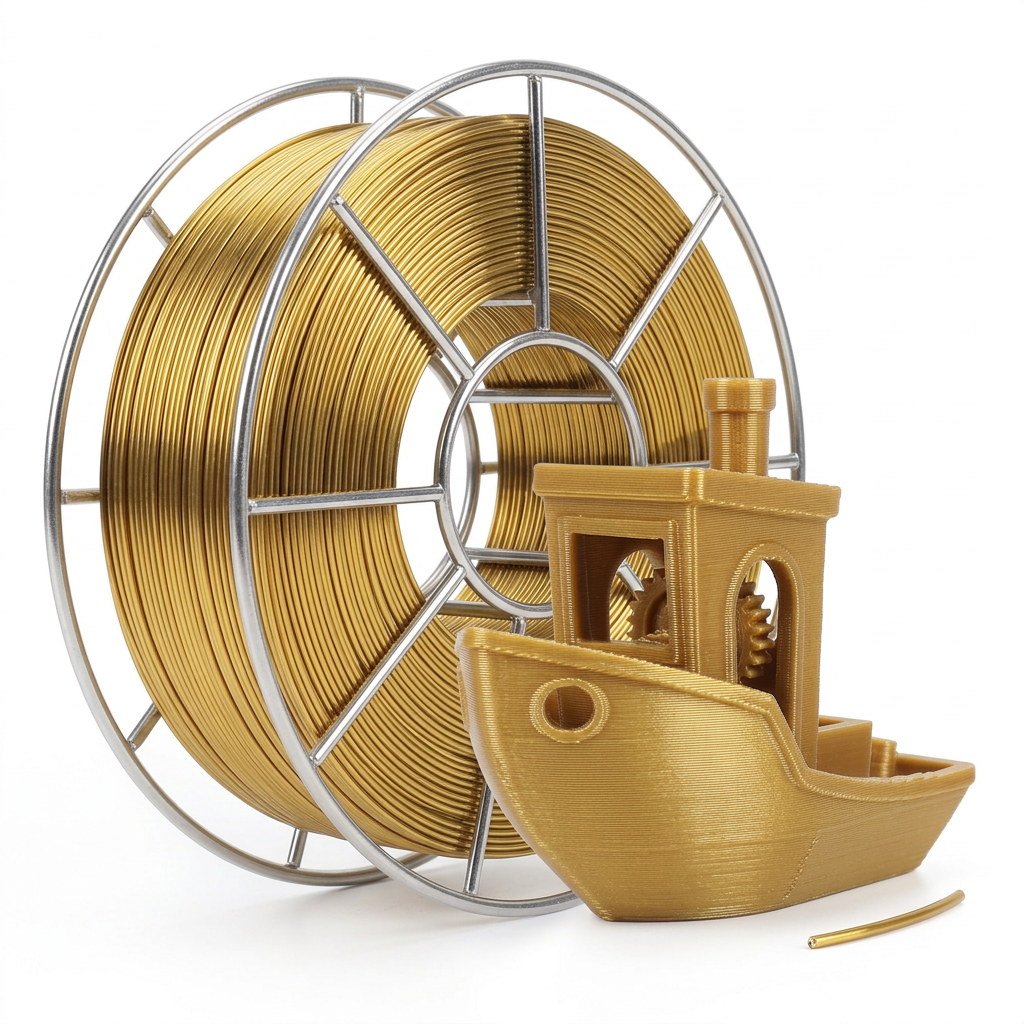
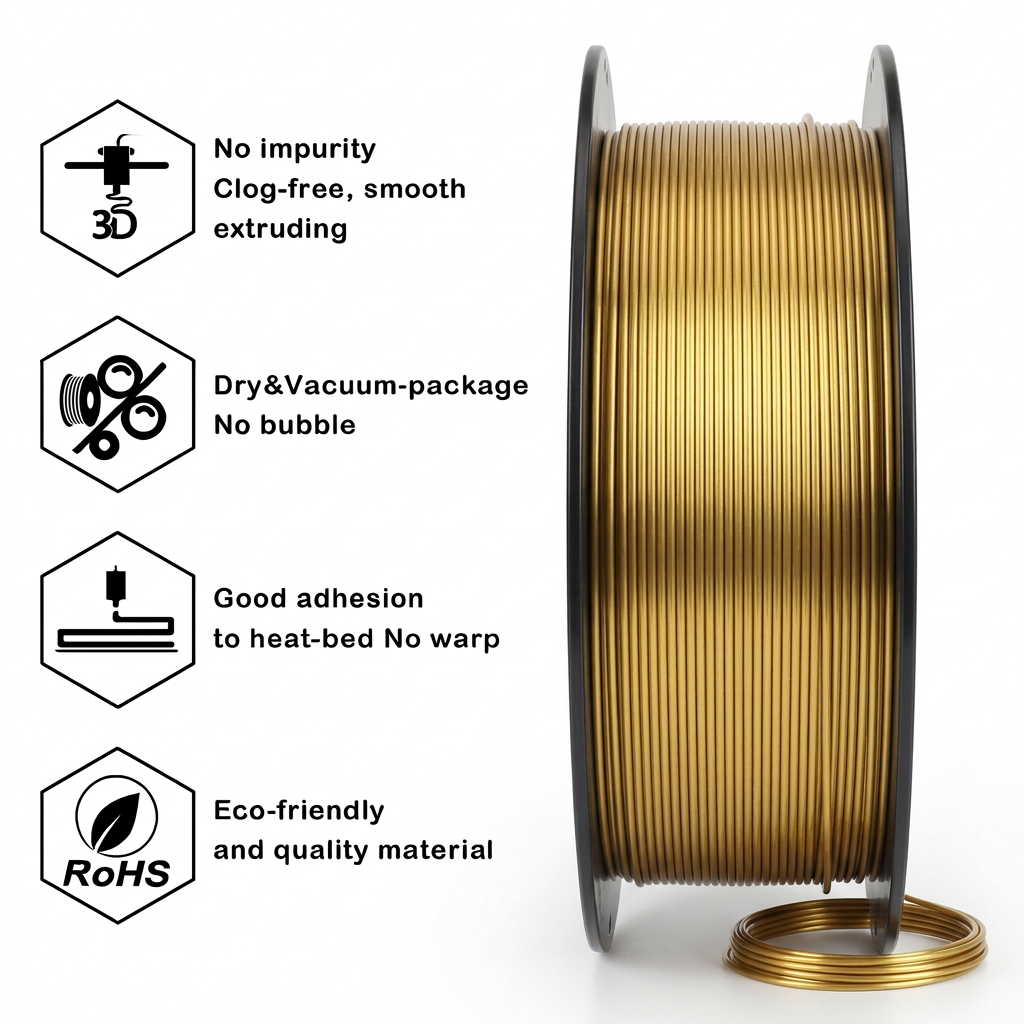
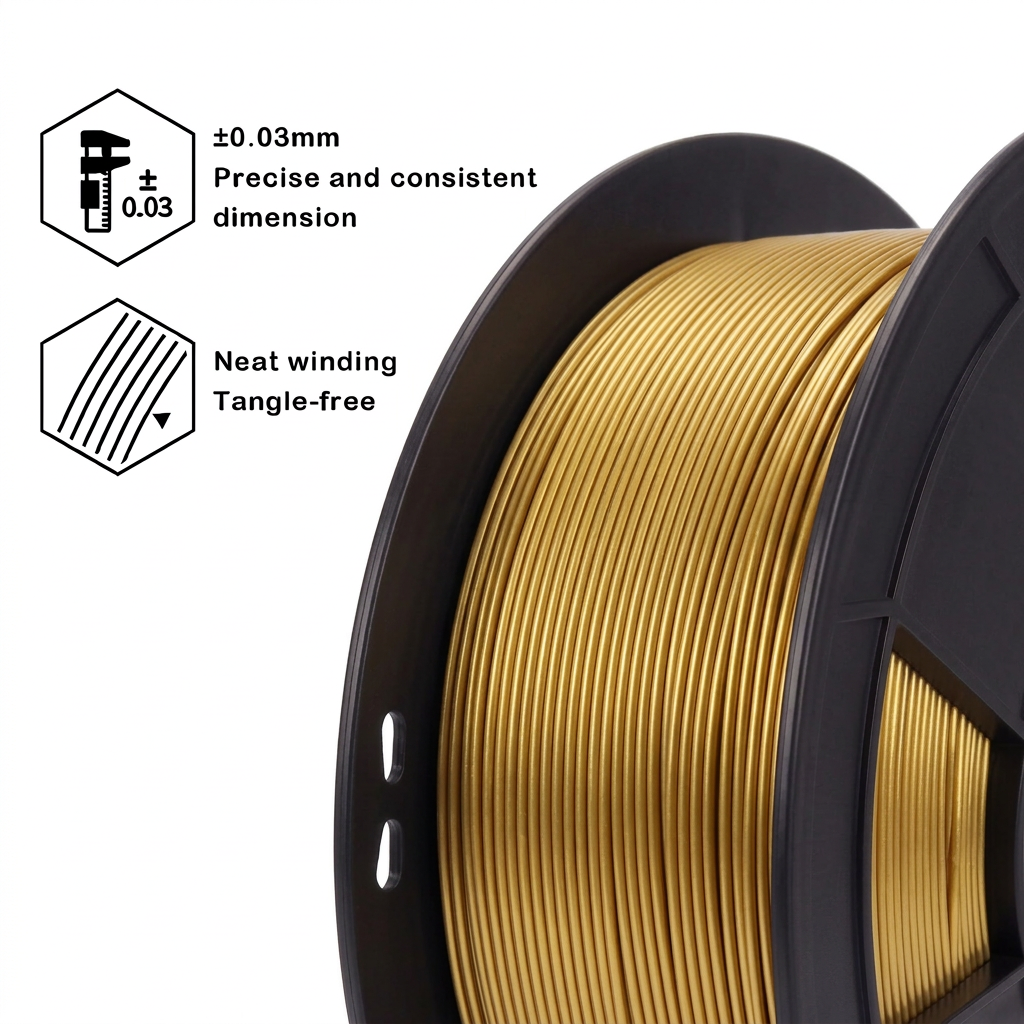
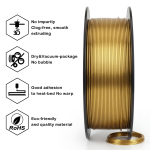
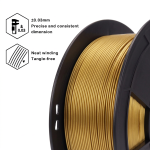
PEI Filament – Product Overview
The SigmaFilament PEI Filament delivers what many engineers actually need but PEEK overshoots: genuine high-performance polymer capability at a more accessible printing temperature and cost point. While PEEK demands 400-450°C nozzle temperatures and 150-200°C heated chambers that only the most expensive printers provide, PEI prints at 350-370°C with 130-160°C chamber requirements – temperatures achievable by a broader range of high-temperature industrial printers at significantly lower capital cost.
Polyetherimide (PEI) – commercially known by SABIC’s trade name Ultem – is one of the most respected engineering polymers in aerospace, medical, and electrical industries. Its distinctive amber-gold color is instantly recognized by engineers worldwide as the visual signature of “this is a serious high-performance material.” When a procurement engineer sees amber-gold parts, they know they’re looking at Ultem-class performance: 170°C continuous use, UL94 V-0 flame resistance without additives, stable dielectric properties for electrical insulation, and FDA-recognized biocompatibility.
The performance positioning is strategic: PEI delivers 90% of PEEK’s practical capability at roughly 60% of the price and with less demanding printer requirements. For the majority of high-temperature applications – electrical connectors, aerospace interior components, medical device housings, automotive under-hood brackets – PEI’s 170°C continuous use, V-0 flame rating, and chemical resistance meet the specification requirements completely. PEEK’s additional 90°C of thermal headroom is only needed for the most extreme applications (jet engine proximity, downhole oil tools, implantable devices).
PEI also offers a unique advantage over PEEK: amorphous structure = naturally better dimensional accuracy. Unlike semi-crystalline PEEK which requires careful annealing to achieve full properties, amorphous PEI delivers its full performance as-printed, with lower and more predictable shrinkage. For precision parts and tight-tolerance assemblies, PEI is often the better choice even when PEEK’s thermal performance would be acceptable.
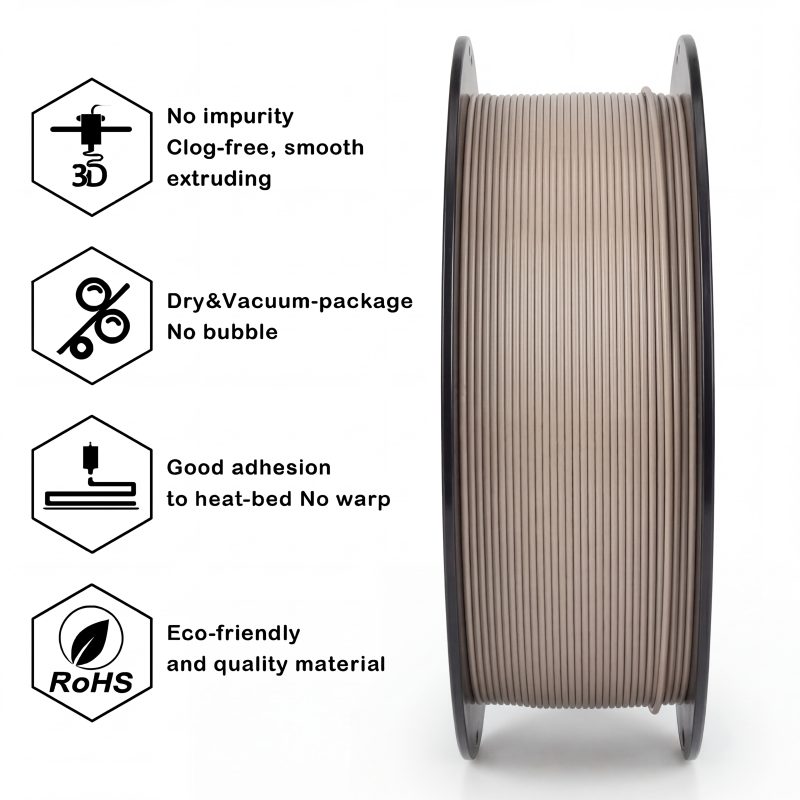
Manufactured under ISO 9001 quality management. Full RoHS compliance, OEM/ODM services, and free samples available.
Why PEI Filament Stands Out
🏆 90% of PEEK Performance at 60% of the Cost – The Practical High-Performance Choice
PEEK is the ceiling. PEI is the sweet spot. For most high-performance applications, PEI delivers everything you need without the extremes PEEK demands.
- 50°C Lower Print Temperature Than PEEK – PEI prints at 350-370°C vs. PEEK’s 400-450°C. This seemingly modest difference has massive practical implications: more printers can reach PEI temperatures, hotend longevity is significantly better, and the heated chamber requirement drops from 150-200°C (PEEK) to 130-160°C (PEI). This opens PEI to a wider range of high-temp printers that PEEK excludes
- 170°C Continuous Use – The Real-World Sweet Spot – Most “high-temperature” applications actually operate at 120-170°C: automotive under-hood (140°C), electrical connector housings (130°C), autoclave-sterilizable medical devices (134°C), and aerospace interior zones (150°C). PEI covers all of these. PEEK’s 260°C is needed only for extreme environments like jet engine nacelles and downhole tools
- UL94 V-0 Without Additives – Like PEEK, PEI achieves the highest flame classification inherently. This is mandatory for aerospace interior components (FAR 25.853), railway vehicles, electrical equipment, and nuclear facilities. PA-CF, PETG-GF, and ABS-CF cannot achieve V-0
- Superior Dimensional Accuracy vs. PEEK – PEI is amorphous; PEEK is semi-crystalline. Amorphous polymers have lower, more uniform, and more predictable shrinkage than semi-crystalline ones. PEI parts come off the printer with tighter dimensional tolerances and require no post-print annealing to achieve full properties – a significant workflow advantage for precision parts
- Best-in-Class Dielectric Properties – PEI/Ultem is the #1 material choice for high-temperature electrical insulation. Its dielectric constant and loss factor remain stable across a wide temperature and frequency range – critical for connectors, insulator bodies, circuit substrates, and RF components
- Biocompatible & Sterilizable – FDA-recognized for food contact. Autoclave sterilizable at 134°C. Suitable for reusable medical instruments, surgical guides, and food processing equipment
The amber-gold standard of practical high-performance engineering.
Why Choose PEI
| ⚡ Electrical Insulation | PEI’s primary industrial application. High-temperature connector bodies, insulator housings, circuit board substrates, coil bobbins, and RF component housings. Stable dielectric constant across temperature and frequency. UL94 V-0 for electrical safety certification. PEI is the default material for electrical insulation where operating temperature exceeds 130°C – the point where standard engineering plastics fail. |
| ✈️ Aerospace | Interior panels, ducting, brackets, wire harness clips, and galley components. PEI/Ultem 9085 is one of the very few FDM materials with full aerospace certifications (FAR 25.853 flame, smoke, toxicity compliance). For aerospace companies evaluating 3D printed alternatives to traditional manufacturing, PEI is often the first material that passes certification – easier to qualify than PEEK and proven in service on commercial aircraft. |
| 🏥 Medical & Food | Reusable surgical instruments, autoclavable medical device housings, sterilization trays, food processing components, and laboratory equipment. PEI withstands repeated autoclave sterilization cycles (134°C, steam) without dimensional change or property degradation – a critical requirement for reusable medical devices. |
| 🚗 Automotive High-Temp | Under-hood sensor brackets, ECU housings, connector bodies, and thermal shields. PEI’s 170°C continuous use comfortably handles the automotive under-hood environment (typically 120-150°C peak). UL94 V-0 meets automotive fire safety requirements. More cost-effective than PEEK for the majority of automotive high-temp applications. |
| 📐 Precision Tooling | High-temperature jigs, composite layup tools, and autoclave-compatible fixtures. PEI’s amorphous structure provides superior dimensional accuracy vs. semi-crystalline PEEK. For composite manufacturing tools that must maintain tight tolerances through repeated autoclave cycles (134°C), PEI is often preferred over PEEK specifically for its dimensional predictability. |
| 🏭 Industrial Components | Pump impellers, valve components, bearing cages, and chemical-resistant housings. PEI resists a broad range of industrial chemicals, withstands sustained mechanical stress at elevated temperatures, and maintains its amber-gold appearance (useful for visual identification of high-performance components in mixed-material assemblies). |
PEI vs. PEEK vs. PA6-CF vs. PC – High-Performance Material Selection
| Property | PEI (This) | PEEK | PA6-CF | PC |
|---|---|---|---|---|
| Continuous Use Temp | 170°C ★★★★☆ | 260°C ★★★★★ | 150°C ★★★☆☆ | 120°C ★★☆☆☆ |
| Flame Rating | UL94 V-0 ★★★★★ | UL94 V-0 ★★★★★ | Not rated | UL94 V-2 |
| Dimensional Accuracy | ★★★★★ (Amorphous – best) | ★★★★☆ (Needs annealing) | ★★★☆☆ | ★★★★☆ |
| Dielectric Properties | ★★★★★ (Best in class) | ★★★★☆ | ★★☆☆☆ (CF conductive) | ★★★★☆ |
| Print Accessibility | ★★★☆☆ (350-370°C) | ★★☆☆☆ (400-450°C) | ★★★☆☆ (260-300°C) | ★★★★☆ (240-270°C) |
| Cost | ★★★☆☆ (Premium but < PEEK) | ★★☆☆☆ (Most expensive) | ★★★★☆ | ★★★★☆ |
| Best For | Electrical, aerospace, medical | Extreme environments | Industrial production | Optical/general high-temp |
Print Settings – High-Temperature Printer Required
2. Heated chamber (130-160°C) recommended – Less extreme than PEEK’s 150-200°C. Some mid-range industrial printers achieve this.
3. Heated bed (100-120°C) – PEI sheet (smooth) or specialty build surface.
4. Drying: 120-150°C for 4-6 hours – Standard filament dryers may not reach this; use an oven. Lower than PEEK’s 150°C requirement.
5. Compatible printers: Intamsys FUNMAT HT, CreatBot F430/PEEK-300, Apium P155/P220, AON3D M2+, Roboze Argo, miniFactory Ultra, and similar platforms that can reach 370°C nozzle temperature.
Optimal Settings
| Nozzle Temperature | 350-370°C (360°C typical starting point) |
| Bed Temperature | 100-120°C |
| Chamber Temperature | 130-160°C recommended |
| Print Speed | 50-100mm/s (faster than PEEK thanks to amorphous flow) |
| Layer Height | 0.10-0.25mm (0.15-0.20mm typical) |
| Cooling Fan | 0% (chamber heat environment) |
| Wall Count | 3-4 structural; 2 general |
| Infill | 25-40% functional; 50%+ critical |
| Nozzle | Steel or ruby; PEI-compatible hotend |
| Bed Surface | PEI sheet, Garolite G10, or glass with high-temp adhesive |
| Drying | 120-150°C for 4-6 hours |
Technical Specifications
| Parameter | Specification |
|---|---|
| Material | PEI (Polyetherimide) – Ultem-Grade |
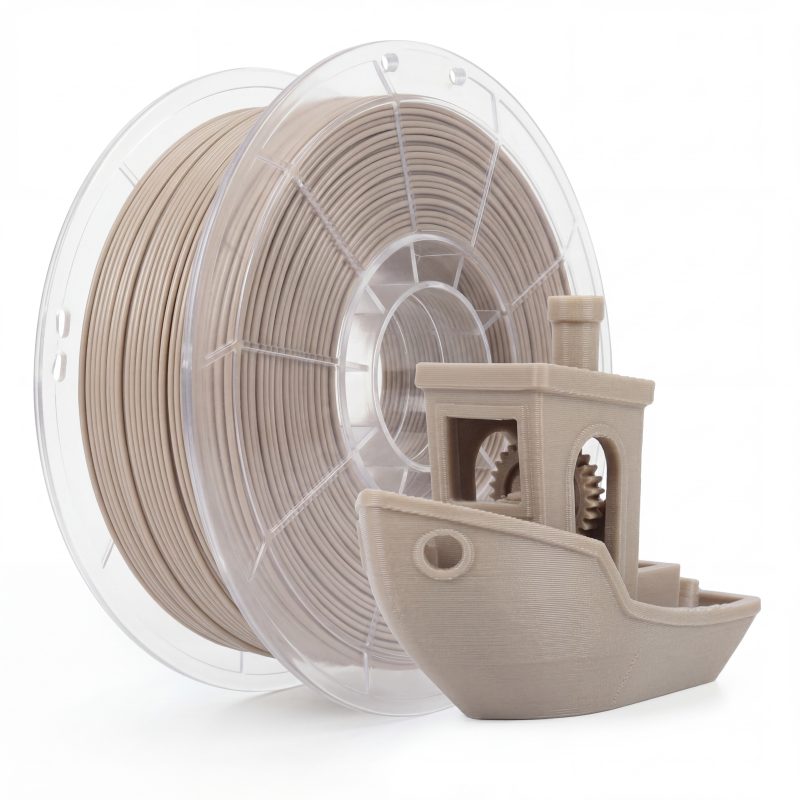
| Color | Amber Gold (PEI Signature Color) |
| Model | PEI-AG |
| Diameter | 1.75mm ± 0.05mm |
| Net Weight | 500g (1.1 lbs) |
| Nozzle Temp | 350-370°C |
| Bed Temp | 100-120°C |
| Chamber | 130-160°C recommended |
| Speed | 50-100mm/s |
| Drying | 120-150°C, 4-6 hours |
| Packaging | Vacuum sealed with desiccant |
| Origin | Guangdong, China |
| Free Sample | Available |
| OEM/ODM | Available – Learn more |
Material Properties
| Property | Value | Standard |
|---|---|---|
| Tensile Strength | >85 MPa | ISO 527 |
| Flexural Modulus | 3,000-3,500 MPa | ISO 178 |
| Elongation at Break | 50-60% | ISO 527 |
| HDT (1.8 MPa) | ~195-200°C | ISO 75 |
| Glass Transition (Tg) | 217°C | ISO 11357 |
| Continuous Use Temperature | Up to 170°C | – |
| Flammability | UL94 V-0 | UL94 |
| Dielectric Constant (1 MHz) | 3.15 | ASTM D150 |
| Density | 1.27 g/cm³ | ISO 1183 |
| Moisture Absorption (24h) | ~0.25% | ISO 62 |
Applications
| ⚡ Electrical/Electronic | High-temp connectors, insulator bodies, coil bobbins, circuit substrates, and RF housings. PEI is the #1 material choice for high-temperature electrical insulation. Stable dielectric across temp/frequency. UL94 V-0. |
| ✈️ Aerospace | Interior panels, brackets, ducting, wire clips. PEI/Ultem 9085 has established FAR 25.853 certifications. Proven in commercial aircraft service. More accessible to certify than PEEK. |
| 🏥 Medical | Reusable surgical instruments, sterilization trays, autoclavable device housings, surgical guides. FDA-recognized. Withstands 134°C autoclave cycles without degradation. |
| 🚗 Automotive | Under-hood brackets, ECU housings, sensor mounts, connector bodies. 170°C continuous covers automotive thermal environment. V-0 meets fire safety. |
| 📐 Precision Tooling | Composite layup tools, autoclave-compatible jigs, high-temp fixtures. Amorphous structure = best dimensional predictability of any high-performance polymer. |
| 🏭 Industrial | Pump components, valve parts, bearing cages, chemical-resistant housings. Broad chemical resistance with 170°C thermal capability. |
Environmental & Safety
✅ RoHS | 🏭 ISO 9001 | 🔥 UL94 V-0 | 🏥 FDA-recognized biocompatible | ♻️ PEI recyclable | 📦 Vacuum sealed
Shipping
EU: 5-10 days (Express 3-5) | US: 7-12 days (Express 4-6) | UK: 7-12 days (Express 4-6) | Canada: 8-14 days (Express 5-7). DDP/DAP.
Bulk & OEM/ODM
Flexible MOQ, free samples. Custom: PEI-CF (carbon fiber reinforced for maximum stiffness), PEI-GF (glass fiber), PEI Black, custom colors. Custom spool sizes 250g-5kg. Private label. Learn more.
Storage
15-25°C, below 30% RH, 12 months sealed, dry 120-150°C 4-6h before printing.
Printer Compatibility
PEI requires a high-temperature industrial 3D printer. Standard desktop printers cannot print PEI.
| Intamsys FUNMAT HT ✓ | CreatBot F430 ✓ | Apium P155/P220 ✓ | AON3D M2+ ✓ | Roboze Argo ✓ | miniFactory Ultra ✓ |
FAQ
Ready for Practical High-Performance?
Contact SigmaFilament today for bulk pricing, free samples, or to discuss custom PEI formulations for your engineering requirements.
📧 Email us for a quick quote | 🌍 Worldwide shipping with DDP/DAP | 🎁 Free samples for qualified customers
| Filament Diameter | 1.75mm ,2.85mm (3.00mm) |
|---|---|
| Spool Weight | 1kg ,3kg ,5kg ,Sample (200g) |